
追随达尔文:小猎犬号之旅In The Footsteps Of Darwin
一句话概览
追随达尔文:小猎犬号之旅 是一款已收录于村了吗规则库的桌游,支持 2–5 人,原名 In The Footsteps Of Darwin。
本页内容:一句话概览 · 常见问题
这游戏怎么玩
- 本站已收录这款游戏的规则资料,可以在对话里直接提问规则细节。
常见问题(FAQ)
以下 1 条问答中 0 条来自站内玩家的真实提问,其余 1 条为本站整理的常见疑问;答复内容保持原样。
追随达尔文:小猎犬号之旅支持几个人玩?
2–5 人。
去哪查完整规则
想核对具体规则细节、卡牌效果或某个回合的结算方式,可以在村了吗里选中这款游戏后直接提问。
同类桌游
- 卡坦岛德式
- 工业革命:伯明翰德式
- 勃艮第城堡:特别典藏版德式
- 方舟动物园德式
- 卡卡颂抽象
- 瘟疫危机传承:第一季美式
- 阿瑞迪亚:勇踏征途美式
- 重塑宇宙德式
- 幽港迷城美式
- 埃多拉的德鲁伊德式
规则原文(Markdown)
本站收录这款游戏的规则原文 1 个文件,此处内联渲染 1 个,可直接展开阅读或下载。
Rule_EN_Darwin.md28.3 KB
Grégory Grard & Matthieu Verdier Maud Briand & David Sitbon
Darwvin
Rulebook

About Charles Darwin

Charles Darwin (1809-1882) was an English naturalist. The fifth of six children, he grew up in a wealthy and educated family.
Charles Darwin in 1816, aged 7.
His grandfather Erasmus Darwin was a famous poet, botanist and zoologist.
Darwin went to the University of Edinburgh Medical School in 1825. He soon showed interest in natural history, particularly about marine invertebrates. Two years later, he joined the Christ's College of Cambridge. His years at Cambridge developed his interest in the living world, fueled by bis botany teacher, Fobn Stevens Henslow (1795-1861).
The Voyage of HMS Beagle
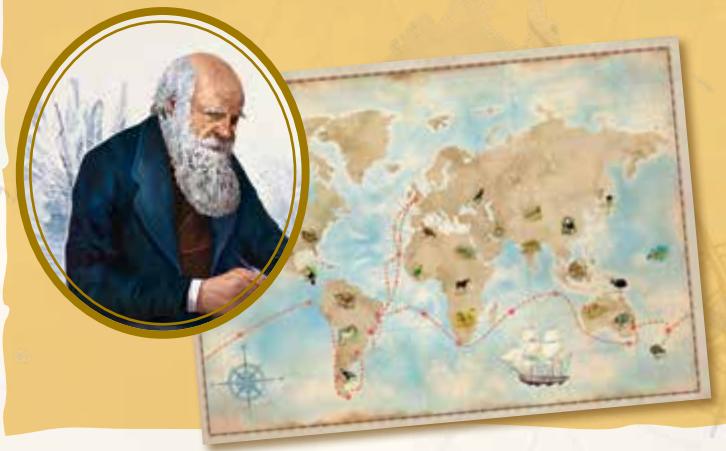
The voyage lasted almost five years, until October, 1836: Cape Verde Islands, South American coast, Galapagos Islands (where Darwin observed 13 different species of “mockingbirds" that would prove essential to elaborate his future theory), Tabiti, New Zealand, Australia,

Tasmania, Cocos Island, Maldives, Mauritius, Saint Helena, Ascension Island, Le Cap, Brazil, back to Cape Verde, Azores, and back home.
Happy to see these landscapes that he dreamed of, and free to go wherever he wanted (most of the time, he would explore the land), Darwin noted all of his geological and zoological observations in a notebook, gathered living organisms or fossils, and methodically maintained a rich collection of specimen, most of them unknown to science at that time.
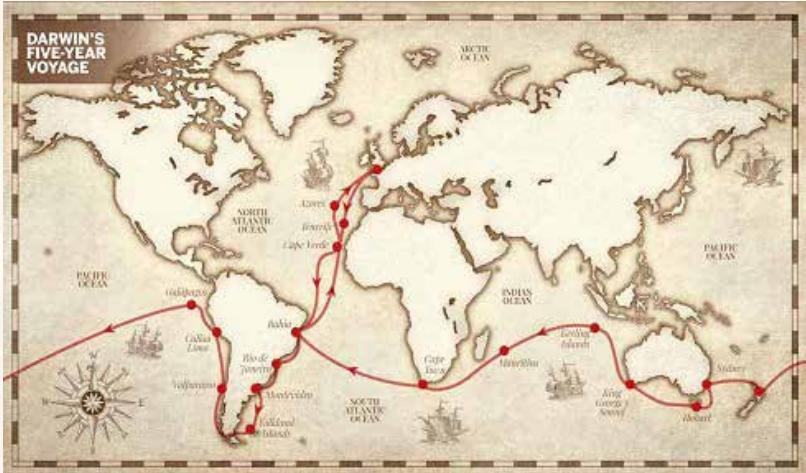
The voyage of the Beagle (1831-1836).

HMS Beagle being hailed by native Fuegians, by Conrad Martens (1833).
Darwin expressed his gratitude to Fobn Henslow by sen ding detailed letters that precisely described his unprecedented observations, along with wise comments. Henslow published several of these letters without telling Darwin; when Darwin came back, he discovered that he was considered as one of the bopes of the young generation by many British scientists.

Darwin started to elaborate his natural selection theory by observing the beak of several birds from the Galapagos Islands.

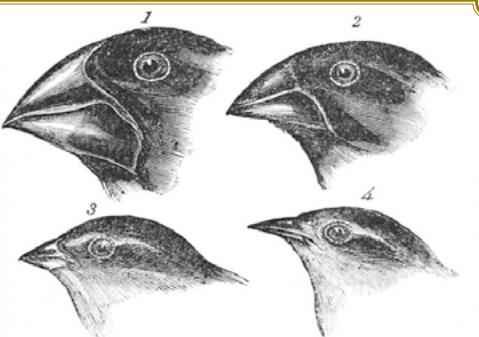
1. Geospiza magnirostris. 3. Geospiza parvula.
2. Geospiza fortis. 4. Certhidea olivasea.
Becoming Part of the Scientific Establishment; First Writings
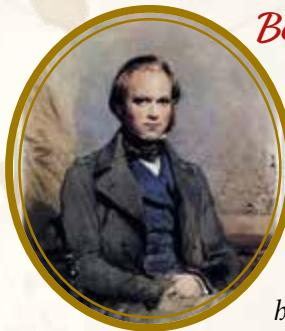
In 1838, Darwin became Secretary of the Geological Society. One year later, aged 30, he became a member of the Royal Society – always reluctant to become a teacher because of his difficult college years though.
Charles Darwin, end of 1830s, by George Richmond.
The next year, he married his cousin Emma Wedgwood and published Fournal of Researches, bis notes about his expedition on the Beagle – the book would become famous under the name The Voyage of the Beagle.
On the Origin of Species
In 1842, Darwin decided to settle in a small town in Kent. Despite frequent nausea, vertigos, insomnia and weaknesses (whose cause was never identified), be led a quiet and countrystyle life there, methodically studying what he brought back from the Beagle expedition. Every day, he kept noting his observations, pursuing a habit that was born on the Beagle and that he would keep until his death in 1882. In Summer 1858, an event caused bis

Tangara darwini, illustration from Darwin's Voyage of the Beagle, 1939.
theory of natural selection to gain momentum: as Darwin was working on it, Alfred Wallace, also a naturalist, sent him an essay that described the same idea, prompting immediate joint publication of both their theories. Darwin's book, On the Origin of Species, was an immediate success.
Six editions would be released until 1872, each time with important modifications. Darwin amended entire paragraphs to answer the critics with detailed arguments, to correct some mistakes, and to sharpen his theory. In the end, the sixth edition had 150 pages more than the first edition, and fifteen chapters instead of fourteen.

Patagonian Pampas Cat (Felis pajeros), illustration from Darwin's Voyage of the Beagle, 1939.

Follow the trail of Darwin and embark on the Beagle!
The year is 1856. To complete the writing of On the Origin of Species, Darwin needs you! Twenty years after bis expedition around the world, he wants to gather new information about animal life, particularly on continents wbere he barely set foot, such as North America, Asia and part of Africa.
Now too old and too busy writing and taking care of his family, he entrusts you with this mission – after all, you were recommended by bis colleagues from the Royal Society of London! Who else than young naturalists eager for discovery could belp the renowned scholar to complete the writing of his most famous work?

Theme and goal of the game
Players are junior naturalists who just arrived aboard the Beagle to belp Charles Darwin finish bis book On the Origin of Species. During this journey, you will study animals, carry out cartographic surveys, publish your findings and develop theories. Your goal is to score more Victory Points (VP) than your opponents to determine who contributed the most to the Origin of Species!

Before your first game:
Shuffle the 64 Animal tiles and the 5 Character tiles together, then store them in the dedicated area of the box.
0Journey board
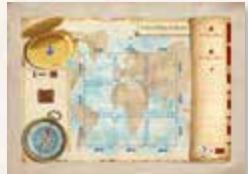
• "journey" side

•"appendix"side
64Animal tiles


16Publication tokens
15Compass tokens
To simplify and diversify, we added an annelid (Giant Gippsland earthworm) to the Arthropod category although it does not belong to it.


Darwin token
Not as well-known as birds, mammals and reptiles, arthropodsarthropods regroup insects, crustaceans, chelicerates (spiders and scorpions) and myriapods (centipedes). They represent half of all known species!
Designers'note:
O Beagle figure
⑤Naturalist's notebooks

6Character tiles
28Theory tiles

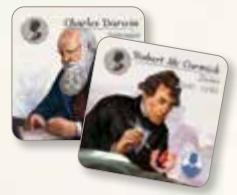


10Guide tokens

0score pad
01 cloth bag
0rulebook
0appendix booklet
Setup
① Place the board, Journey side up, at the center of the table, then place the Beagle on its starting space.
2Give a Naturalist's notebook to each player, henceforth called a“naturalist" in the rulebook. The last naturalist who traveled by ship takes the Darwin token: they will start the game. If no naturalist has ever traveled by ship, choose your favorite way to determine who will play first.
3Place the Guide, Publication and Compass tokens on the dedicated spaces of the Journey board.
4A. Take 12 tiles from the box for each naturalist in play, then form several face down piles, that you place next to the Fourney board. B. Take another 9 tiles from the box and place them face up on each of the 9 spaces of the Fourney board (for example, take 24 + 9 = 33 tiles in a game with 2 naturalists).
5A. Deal a Theory tile to each naturalist. They must place it face up on their topmost Theory space, at the top right of their notebook. B. Then, form two face-down Theory draw piles and place them on the dedicated spaces of the Fourney board. Then, draw 3 of them and place them face up on their dedicated spaces.
6Each naturalist takes a Guide token and places it on the dedicated space.

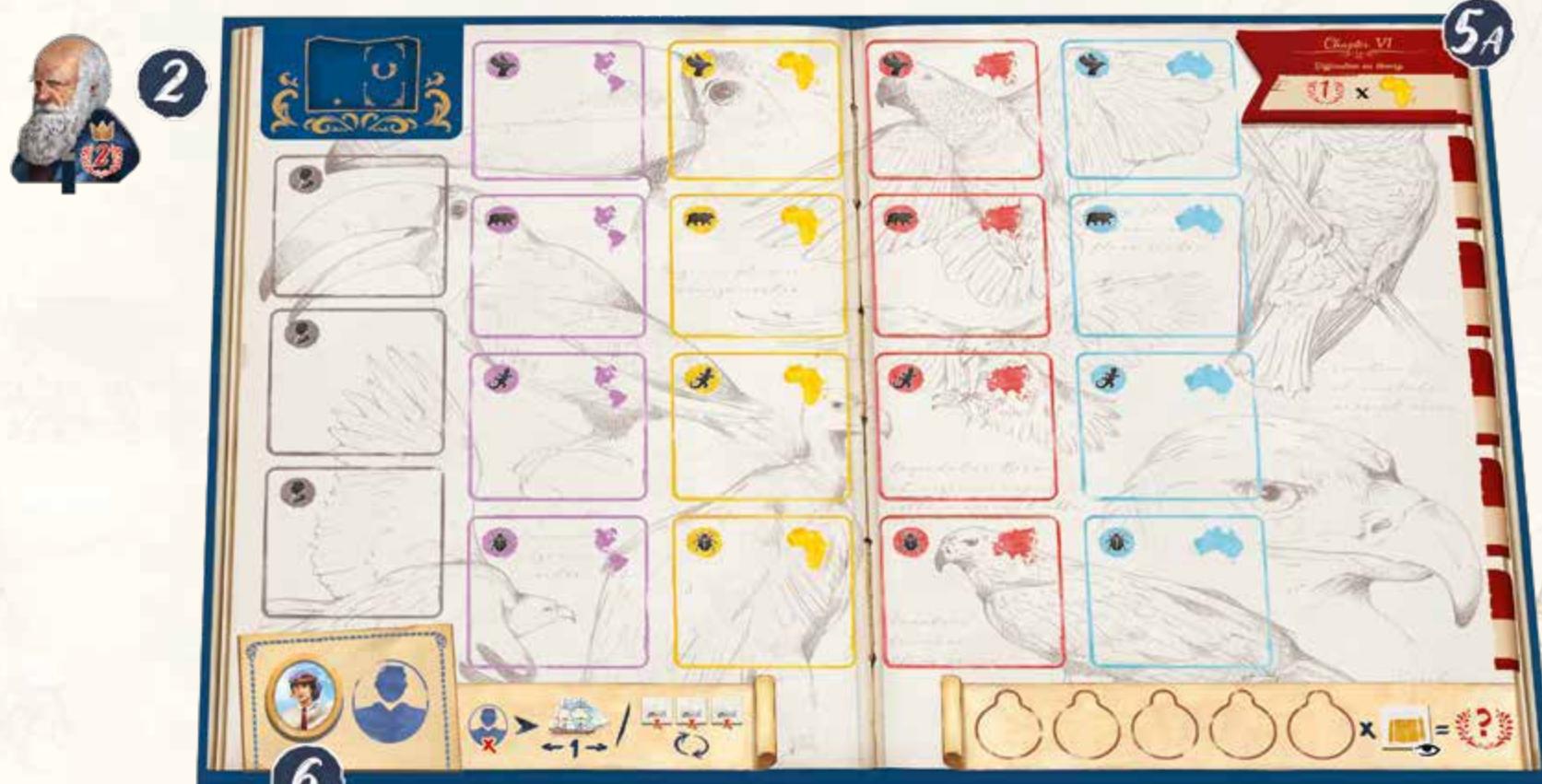
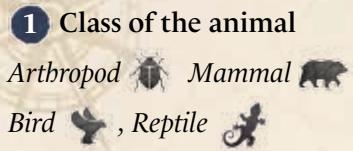
What's on an Animal tile?
What's on a Character tile?
2Name (English and Latin), size and ecosystem of the animal. America Africa Asia Oceania


③ Bonus when you study the animal (either an immediate or an endgame bonus).

Emblematic animal icon.

Starting with the naturalist controlling the Darwin token, naturalists take turns in clockwise order. On their turn, a naturalist performs these two steps in order:

Study an Animal or Take inspiration from a Character.
2 Voyage of the Beagle.
The game ends after each naturalist has placed exactly 12 tiles (Animal or Character) on their notebook.
1 Study an Animal or Take inspiration from a Character
Choose one of the 3 tiles facing the Beagle and place it onto your Naturalist's notebook. It may be either an animal to study or a character from the Beagle's previous journey who will inspire you.
0Character icon.
Character's name, occupation, date of birth, date of death.
Bonus when you take inspiration from the character.


Example : the Beagle is facing a Coral Snake, an Armadillo girdled lizard and a Fapanese crane . Anna decides to study the Fapanese crane and places it on her notebook.2
Study an animal
Take the animal and place it on the space in your notebook matching their ecosystem and their class, then resolve their immediate bonus, if any:

Discover: these animals are an important discovery for the scientific community: they will be worth12or3VP at the end of the game.

Example : Anna studies a Fapanese crane, wbich will earn her3at the end of the game if it is still visible.

Chart: these animals are worth VP at the end of the game depending on the number of Compasses you have.

Example : Louison studies a Saltwater crocodile, which will earn her 1 VP for each compass she has at the end of the game if it is still visible.

Surwey: immediately take a Compass token and place it in the Survey area at the bottom of your notebook You may not have more than 5 of these tokens: should you be to take a 6th one, you may study the animal, but you do not take the compass.
Example: Anna studies a Keel-billed toucan, which comes with a Compass token. She immediately takes the token and places it at the bottom of her notebook.


Hire a guide: immediately take a Guide token and place it on an empty Guide space of your notebook. You may not have more than 2 of these tokens: should you be to bire a 3rd guide, you may study the animal, but you do not bire the guide.
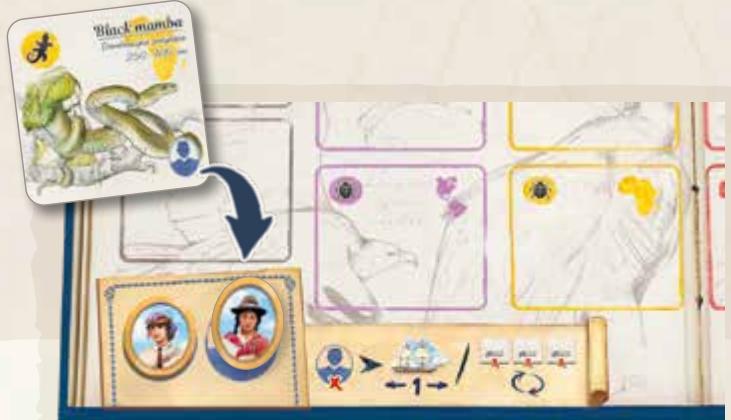
Example : Louison studies a Black Mamba and therefore immediately hires a guide, wbich she places on her notebook. She may use them later in the game to perform a special action (Sail or Probe).

Emblematic: immediately take the Darwin token from wboever controls it and place it next to your notebook. If you were the one controlling it, nothing happens. At the end of the game, the naturalist controlling the Darwin token scores2
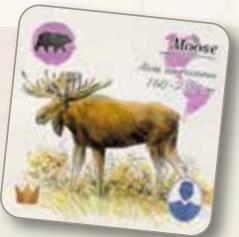
Example: Louison studies a Moose, which has a icon. Since Anna controls the Darwin token, Louison takes it from ber and places it next to ber own notebook. It will earn her2 if she still controls it at the end of the game.
Take inspiration from a character
If the tile is a Character tile, place it on an available space on the left side of your notebook, then gain its bonus.
You may not be inspired by more than 3 characters.
Characters'bonuses are detailed on page 12 of this rulebook.
Example : Anna takes inspiration from Conrad Martens. She places the tile on her notebook, then resolves its bonus: it counts as 1 Chart and allows her to bire a Guide.


2 Voyage of the Beagle
After placing a tile (Animal or Character) on your notebook, resolve these steps in order:
A) Move the Beagle as many spaces forward(following the arrows) as the distance between Beagle and the tile you just selected (i.e. 1, 2 or 3 spaces).

B) Draw a new tile and place it face up on the empty space of the Journey board.

Special actions
Use a Guide
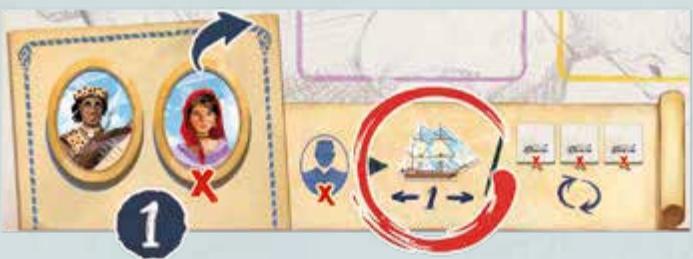
At the beginning of your turn, before selecting an Animal or Character tile, you may use a single one of your Guides (by returning the token to the Fourney board) to perform one of the following special actions:

Sail : move the Beagle one space back or forward.
Then, play your turn as usual.
Example : at the beginning of her turn, Louison uses a Guide to Sail1 , because she wishes to study an Elephant, worth at the end of the game 2. She moves the Beagle one space back 3and plays her turn: she studies the Elephant , and then moves the Beagle two spaces forward following the arrows 4


Probe : discard the 3 tiles facing the Beagle and place them face down in any order at the bottom of any draw pile: replace them with 3 tiles from any draw pile. Then, play your turn as usual.
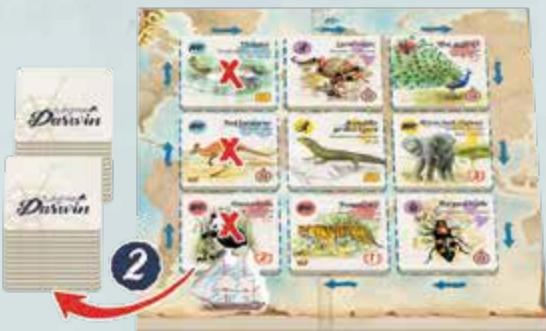
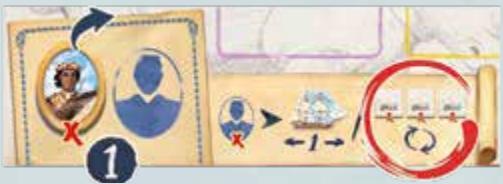

Exemple:
at the beginning of ber turn, Louison uses a Guide to Probe ①: she discards the 3 tiles facing the Beagle, returns them to the bottom of any draw pile2and reveals 3 new tiles 3. Then, she plays her turn as usual: she studies an Emu, then moves the Beagle one space forward following the arrows 4

Develop a Theory
When you study an animal from a class and an ecosystem you already studied, place the tile on top of the previous one, then resolve its immediate bonus, if any. The covered tile remains there but any VP value or icon on it will now be ignored. If you cover another icon ( ), nothing happens: you do not have to return these elements.
Then, take a Theory tile among the 3 on display, or from the top of any draw pile. Place this Theory on the next available space of your notebook: its VP will be checked at the end of the game. You may own both copies of the same Theory if you wish to.
Then, if you took a Theory from the row, reveal a new one from any draw pile to complete the row.
Important: you may not have more than 6 Theories. If you take a 7th one, return one of your choice (possibly the one you just took) to the bottom of any draw pile. Should you need to draw a Theory and the row is empty, nothing happens.
Important : you may cover the same animal space of your notebook several times.


Example: Anna studies an Imperial eagle and must stack it on top of the Fapanese crane she studied earlier, because both animals share the same class and the same ecosystem1. Then, she takes a Theory tile, that she places on the right side of her notebook2
Write a Publication

Each time you cover all 4 spaces of a given ecosystem or class (i.e. by completing a column or a row on your notebook), you write a publication! Take any publication token on the Fourney board and place it on the dedicated space at the top left of your notebook. Should you write more publications later in the game, simply stack the tokens.
IMPORTANT: if you cover the 4 spaces of an ecosystem or a class that you already completed before, you cannot write a Publication again that way.
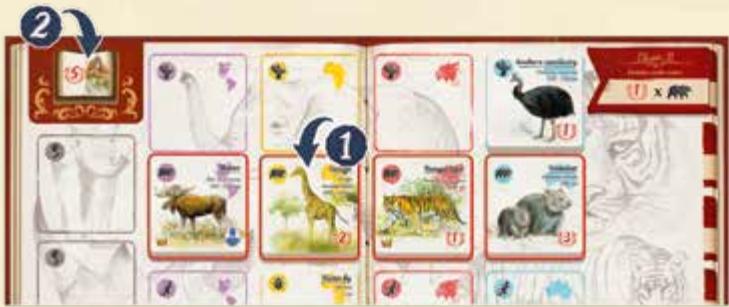
Example: Louison studies a Giraffe, which causes her to have covered all the Mammals spaces of her notebook1: she takes a Publication token and places it at the top left of her notebook2


End of the game
When the last tile from the draw pile is placed onto the Journey board, the game ends. This happens once each naturalist has placed exactly 12 tiles (Animal and/or Character) on their notebook.
Score VP in the following categories:

Discoveries : add up VP from your visible discovered animals (VP from covered animals are ignored). If you have been inspired by Robert McCormick, add his to this category.

Chart : multiply the number of Compasses you own by the number of visible icons you own.


Publications : score5 for each Publication you wrote.
Theories: check your Theories and score their VP (see next page).
Token Darwin: if you control it, add2 to this category.
Add up these 5 categories: the naturalist with the most VP wins the game. If there is a tie, the naturalist with the most VP in the Theory category wins the game. If there is still a tie, the tied naturalists share the victory.

Example: Anna scores:
4 VP for Discoveries:3for the Great white pelican,1for the Ostrich.
12VP for Chart: she bas 4 visible icons (Okapi, Armadillo girdled lizard, Tsetse fly and Conrad Martens) and 3 in the Survey area of her notebook.

10VP for Publications (she wrote two).
12VP for Theories: per animal from Africa (6VP), per visible Emblematic animal (4VP because she developed this Theory twice), and1per Reptile (2VP).
2because she controls the Darwin token.
Anna's score is 40 VP!
Achievements
When you win the game, check whether you completed one of the achievements below. If you did, write down your name in the empty box!
| Darwinism - Scored_ 50 VP or more. | Observer - Scored 20 VP or more in the Discoveries category. | |
| Mentor - Took inspiration from 3 Characters. | Natural selection - Studied 3 animals from the same class and ecosystem. | |
| Expert - Wrote 3 Publications. | Cultural exchange Ended the game with 2 Guides. | |
| Theorist - Developed 6 Theories. | Emblematic - Had 4 visible Emblematic animals. | |
| Cartographer-0Collected 5 Compasses . | Diversification- Had123 家 visible. |
Theories

Chapter 1 – Variation under domestication.

Score 1 VP for each Bird you studied, including those you covered.
Chapter 2 – Variation under nature.

Score 1 VP for each Mammal you studied, including those you covered.
Chapter 3 – Struggle for existence.

Score 1 VP for each Reptile you studied, including those you covered.
Chapter 4 – Natural selection.

Score 1 VP for each Arthropod you studied, including those you covered.
Chapter 5 – Laws of variation.

Score 1 VP for each animal from America you studied, including those you covered.
Chapter 6 – Difficulties on theory

Score 1 VP for each animal from Africa you studied, including those you covered.
Chapter 7 – Miscellaneous objections to the theory of natural selection.

Score 1 VP for each animal from Asia you studied, including those you covered.

Chapter 8 – Instinct.
Score 1 VP for each animal from Oceania you studied, including those you covered.

Charles Darwin (1809-1882)

Naturalist. Boarding the Beagle at just 22, be travelled for 5 years around the world on the now famous ship, developing the theory of natural selection, wbich be publisbed in 1858 under the name On the Origin of Species.
Take 1 Theory tile among the 3 on display or from the top of any draw pile, then Hire a Guide.
Robert FitzRoy (1805-1865)

Ship captain. He was in charge of the H.M.S Beagle's expedition dedicated to the bydrograpbic exploration of Southern American coasts (1831-1836). He then became governor of New Zealand (1843-1845).
Hire 2 Guides.
John Henslow (1795-1861)

Botanist. He was Charles Darwin's teacher at the University of Cambridge and referenced bim for the H.M.S. Beagle's expedition. He publisbed Darwin's letters, contributing to bis fame.
Survey and Hire a Guide.
Chapter 9 – Hybridism.

Score 1 VP for each animal you studied in the top-left quarter of your Naturalist's notebook, including those you covered.
Chapter 10 – On the imperfection of the geological record.

Score 1 VP for each animal you studied in the top-right quarter of your Naturalist's notebook, including those you covered.
Chapter 11 – On the geological successions of organic beings.

Score 1 VP for each animal you studied in the bottom-left quarter of your Naturalist's notebook, including those you covered.
Chapter 12 – Geographical distribution.

Score 1 VP for each animal you studied in the bottom-right quarter of your Naturalist's notebook, including those you covered.
Chapter 13 – Mutual affinities of organic beings.

Score 1 VP for each of your Theories.
Chapter 14 – Morphology and embryology.

Score 2 VP for each visible Guide icon on your tiles.
Chapter 15 - Recapitulation.

Score 2 VP for each of your Publications.
Chapter 16 - Conclusion.

Score 1 VP for each visible Emblematic animal you studied

Conrad Martens (1801-1878)
Painter. Robert FitzRoy, wbom be met in 1833 in Montevideo, bired bim to replace the artist voyaging on the H.M.S. Beagle, who bad fallen ill. When the Beagle stopped over in Australia, Martens decided to stay and live there, wbich be did until the end of bis life. Chart and Hire a Guide.

Robert Mc Cormick (1800-1890)
Doctor. A surgeon working for the English Navy, be officially travelled aboard the Beagle as a naturalist. During bis career be took part in other expeditions, including one aiming to find the South pole.
Score 4 VP at the end of the game. Hire a Guide.
IMPORTANT: you may never have more than 2 Guide tokens. Should you be to bire a 3™d guide, you may take inspiration from the character, but you do not hire the guide. This rule also applies for your 6th compass if you take inspiration from Fobn Henslow or for your 7th Theory if you take inspiration from Charles Darwin.
下载 Markdown原文为社区整理/出版社公开资料,版权归原作者,仅供个人学习查阅。