
化身博士:对决苏格兰场Jekyll And Hyde Vs Scotland Yard
一句话概览
化身博士:对决苏格兰场 是一款已收录于村了吗规则库的桌游,支持 2 人,原名 Jekyll And Hyde Vs Scotland Yard。
本页内容:一句话概览 · 常见问题
这游戏怎么玩
- 本站已收录这款游戏的规则资料,可以在对话里直接提问规则细节。
常见问题(FAQ)
以下 1 条问答中 0 条来自站内玩家的真实提问,其余 1 条为本站整理的常见疑问;答复内容保持原样。
化身博士:对决苏格兰场支持几个人玩?
2 人。
去哪查完整规则
想核对具体规则细节、卡牌效果或某个回合的结算方式,可以在村了吗里选中这款游戏后直接提问。
同类桌游
- 卡坦岛德式
- 工业革命:伯明翰德式
- 勃艮第城堡:特别典藏版德式
- 方舟动物园德式
- 卡卡颂抽象
- 瘟疫危机传承:第一季美式
- 阿瑞迪亚:勇踏征途美式
- 重塑宇宙德式
- 幽港迷城美式
- 埃多拉的德鲁伊德式
规则原文(Markdown)
本站收录这款游戏的规则原文 1 个文件,此处内联渲染 1 个,可直接展开阅读或下载。
25C-JHvsSY-rulebook-EN-US-20240926.md22.1 KB
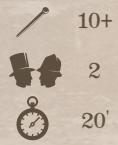
JEKYLL&HYDE
SCOTLAND YARD
Jekyll & Hyde vs. Scotland Yard is a cooperative trick-taking game for 2 players. You are Dr. Jekyll, the kind doctor and valued friend. However, you are also the infamous Mr. Hyde, chased by Scotland Yard for your many misdeeds in the City of London.
Your objective is to maintain the balance in the duality of your personality, while staying ahead of Scotland Yard's investigation.
COMPONENTS
Front

Back

28 Playing cards

12 Chapter cards

2 Character cards
Front

Back

1 Turn Order token

3 Color Rank tokens
Jekyll & Hyde Scotland Yard

2 Pawns

1 Game board
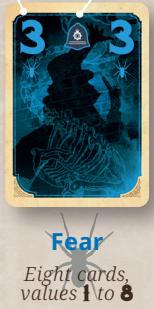
Value
1, 2 and 3s have a Scotland Yard icon
Playing cards

Ruse Eight cards, values 1 to 8

8s have a Jekyll & Hyde icon
Manipulation Eight cards, values 1 to 8

Potion Four cards, values 3+ to 6+
Character cards, Turn Order token, and Leading Character
At the start of a chapter, decide who will play as Dr. Jekyll and who as Mr. Hyde. Players cannot exchange characters between rounds.
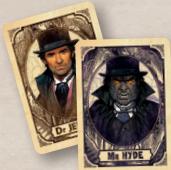
Some cards mention the “Leading Character", which means the player whose Character is currently face-up on the Turn Order token. The arrows on the Turn Order token set the direction of taking turns during the round.

Chapter cards
Chapter rule
Story

The full moon was shining, and a thick fog covering the city of London. Dr. Jekyll was in a hurry to get home. He had been maintaining balance with his evil double for several weeks. The new formula seemed to work, but the effects were already starting to wear off.
Starting position of Jekyll & Hyde pawn
Scotland Yard starting position
Turn Order token position

Color Rank position
Game board
Jekyll & Hyde starting positions
The game board tracks the position of the players and the progress of their escape from pursuit by Scotland Yard. It also tracks the current ranking of the card colors.
GAME OVERVIEW
Jekyll & Hyde vs. Scotland Yard is a cooperative game for 2 players It is divided into several chapters, intended to be played one after the other to complete the game, but you can stop between chapters and resume later if you wish. Each chapter introduces changes in gameplay with dedicated "Chapter rules".
• CHAPTERS I, II, & III gradually introduce the objectives and constraints of the standard game.
· CHAPTER IV is the standard game.
• CHAPTERS V TO X are variations to the standard game with additional objectives or constraints to raise the challenge.
Whenever you finish a chapter, whether by success or defeat, you can record your progress and achievements on the score tracker at the end of this rulebook.
CHAPTER OVERVIEW
Each chapter is played over two rounds. In each round, players compete against the City of London, which they must give some of their cards at the start of each round. The players successfully complete the chapter if they manage to reach exactly the final position on the track.
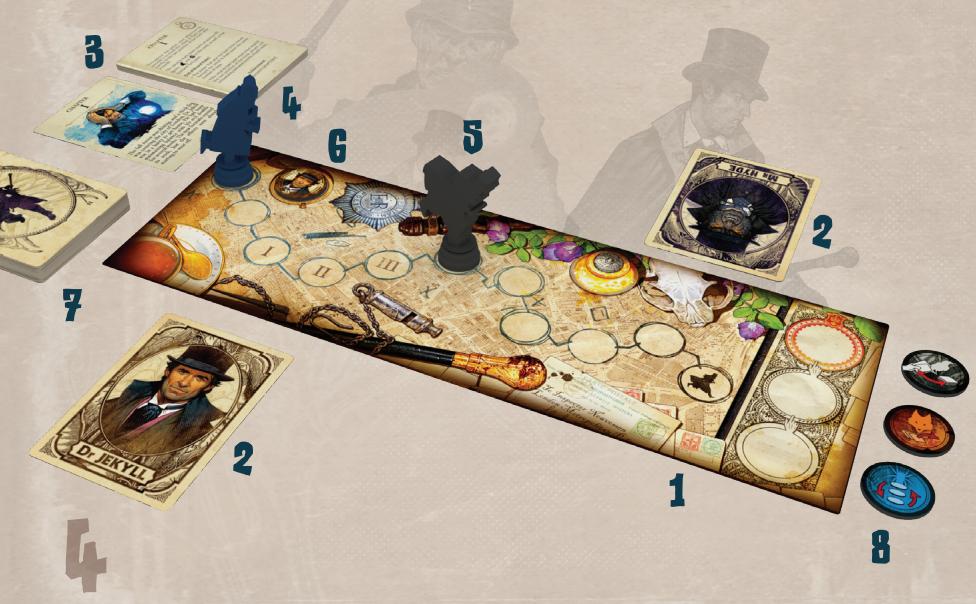
CHAPTER SETUP
-
Place the board in the center of the table.
-
One player takes the Jekyll Character card, and the other player the Hyde Character card.
-
Display the two Chapter cards corresponding to your current chapter and read the story and rules out loud.
Note: Story and rules for each chapter are split between two cards.
- Place the Scotland Yard pawn on the board as indicated by the Chapter card. If the Chapter card doesn't specify the starting position, place the pawn on the standard starting position.

- Place the Jekyll & Hyde pawn on the board as indicated by the Chapter card.
Note: From Chapter V onward, the starting position depends on the number of previous attempts you have made at completing the Chapter.
-
Flip the Turn Order token to choose a side at random and place it on the board.
-
Place all 28 Playing cards to the left of the board.
-
Place the three Color tokens to the right of the board.
PLAYING A ROUND
Each round is played in 3 phases: Day, Night, and End of Round.
Communication Rules
Day phase: Players may discuss freely before dealing the cards. As soon as they start dealing cards, no more discussion is allowed.
Night phase: Players are not allowed to communicate at all, with one exception. When a potion's effect is triggered during the Night phase, players may discuss how to resolve it. (Potions are described in detail on page 6.)
Note: These are the recommended communication rules, but feel free to adapt them and allow limited game state discussion during the Night phase if you feel it will help make the game more enjoyable. For example, you might allow reminders about objectives for the round, the number of tricks left to win, etc.
Day phase
In the Day phase, players receive their cards and set up the City deck.
-
Shuffle the 28 Playing cards and deal 12 cards to each player.
-
Place the remaining cards to the left of the board face-down to form the Reserve.
-
Each player must choose four of their cards to give to the City, without revealing them to the other player. When choosing the cards, players must give all their 8s to the City.
-
Shuffle the four cards given by Jekyll with the four cards given by Hyde and place them face-down to the right of the board to form the City deck.
Night phase
In the Night phase, players use their cards to help them escape the pursuit of Scotland Yard.
One turn of each player choosing and playing a card is called a trick.
The player who played the most valuable card wins the trick.
To start the Night phase, reveal the top card from the City deck as the opening card. Then, following the current turn order, each player must play a card face-up.
On their turn, a player must play a card of the same color as the opening card. If they don't have a card of the opening color, they can play any card. Potion cards are an exception — a player may play a potion at any time, even if they have a card of the opening color.
If the opening card is a potion, the next player can play any card. The first color card played in a trick always determines the opening color. Once both players and the City have played one card each:
• The player who played the highest card of the highest color rank wins the trick. The cards are placed face-up in front of that player.
• If the City played the highest card of the highest color rank, the City wins the trick. The cards are placed face-up beside the City deck.
The winner of the trick now plays a new opening card from the hand to start the next trick.
On its turn, the City always plays the top card of the City deck.
At any time, players may look at the cards from previous tricks but may never look at the Reserve, the City deck, or each other's hands.
Color Ranks
Colors are not ranked at the beginning of a round. During each round, their rank is defined by playing cards. The first color to appear has the lowest rank. Place the matching Color token in the appropriate space on the game board. The next color to appear takes the middle rank. Then, the last color token is immediately placed on the highest rank position.

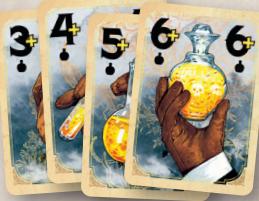
Potion Cards
Whenever a pair of cards containing one potion and one color card is played one after the other, the potion's effect triggers immediately. Such a pair of cards is called a Reaction (like a “chemical reaction").
The Reaction's effect depends on the color of the card (see next page).
During the Reaction, it is not necessarily the player who triggered the Reaction that resolves the effect. Players discuss and decide together which one of them resolves it.
Players always resolve the effect for one player or the other, even if the Reaction is triggered by the City. Resolving the effect is mandatory, even if not beneficial to the players. The effect is resolved before the outcome of the trick is decided.
When a potion is in a Reaction, it is considered to be the same color as the color card it is reacting with.
Potion cards have a “+" symbol because they win ties when the color card of the same value and color is also in the same trick. If there are two potions in a trick, they are both considered to have the same color as the third card of the trick.
Only one Reaction can occur per trick.
Reaction Effects

Ruse: One player must take the trick most recently won by the City. If the City has not yet won a trick, the effect is canceled.

Fear: Players must rearrange the Color Rank tokens into a different order.
You can change the rank of all three tokens, but you must change the rank of at least two. If there is only one token in play, the effect is canceled.

Manipulation: One player must exchange the top card from the City deck with a card from their hand.
First, draw from the City deck, then put a card from your hand back on top of the City deck. You can put back the same card you drew. If you draw an 8, you may keep it. If the City deck is empty, the effect is canceled.

Potion Effects Resolution Examples
In these examples, cards are shown in the order played.
Ruse is ranked highest, Fear is middle, and Manipulation lowest.
Fear 4 → Ruse 3 → Potion 5+
Playing Potion 5+ after Ruse 3 triggers a Ruse Reaction. Potion 5+ takes on the color Ruse, making it the highest value of the highest-ranked color. Potion 5+ wins the trick.
Fear 4 → Potion 5+ → Ruse 3
Playing Potion 5+ after Fear 4 triggers a Fear Reaction. The players choose to swap the rank of Fear and Manipulation, leaving Ruse as the highest-ranked color, so Ruse 3 wins the trick.
Potion 3+ → Potion 4+ → Fear 4
Playing Potion 4+ after Potion 3+ does not trigger a Reaction. Playing Fear 4 after Potion 4+ triggers a Fear Reaction. Both potions take on the color Fear. Potion 4+ wins the trick.
Fear 4 → Potion 3+ → Potion 4+
Playing Potion 3+ after Fear 4 triggers a Fear Reaction. Potion 4+ has no color to pair with and triggers no effect. Both potions take on the color Fear. Potion 4+ wins the trick.
Potion 3+ → Potion 5+ → Potion 4+
Since no color card is played, there is no Reaction. Although there is no color, Potion 5+ has the highest value and wins the trick.
Example trick:
-
Jekyll plays the Potion 3+.
-
Hyde plays Ruse 5, triggering a Reaction. Jekyll & Hyde discuss and agree that Jekyll resolves the effect, taking a trick back from the City.

- The City plays Potion 5+, triggering no Reaction because Ruse 5 (played by Hyde) already reacted with Potion 3+ (played by Jekyll). The City wins the trick: Potion 3+ and 5+ are considered Ruse since the only color card is Ruse. Potion 5+ wins the tie over Ruse 5 because of its “+” symbol.
End of Round phase
When both players have played all their cards and the final trick is completed, proceed with the End of Round phase.
Note: The first four Chapters of the game help you learn and progress by gradually introducing the End of Round rules. From Chapter IV, those rules always apply unless stated otherwise by the current Chapter rule.
Each player counts their tricks. The City's tricks are ignored.
CHAPTER I
The player who won the least number of tricks advances the Jekyll & Hyde pawn by that number of steps. If the players are tied, they have both won the least number of tricks, and the Leading Character advances the pawn. If one player has not won any tricks, the Jekyll & Hyde pawn doesn't move.
CHAPTER II
All rules from Chapter I, plus:
Players advance the Jekyll & Hyde pawn one step for each card of value 8 in their tricks.
CHAPTER III
All rules from Chapters I & II, plus:
If the Jekyll & Hyde pawn has already reached the final position of the track but must move further, advance the Scotland Yard pawn instead.
Advance the Scotland Yard pawn one step for each card that has a Scotland Yard icon (values 1, 2, and 3) in the tricks won by the Leading Character.
CHAPTER IV ONWARD (STANDARD GAME)
All rules from Chapters I, II, & III, plus:
Advance the Scotland Yard pawn one step for each card that has a Scotland Yard icon (1, 2, and 3) in the tricks won by the non-Leading Character.
When the first round ends, flip the Turn Order token to the other side. Reset the Color Rank tokens by clearing them off to the right of the board, and proceed with a new Day phase (see page 5).
Note: Even if the Jekyll & Hyde pawn is already at the final position on the track by the end of the first round, players must still play the second round.
END OF CHAPTER
Defeat
CHAPTERS I & II
You are defeated if the Jekyll & Hyde pawn must move beyond the final position of the track. The chapter ends immediately.
CHAPTER III ONWARD
You are defeated if the Scotland Yard pawn reaches or exceeds the position of the Jekyll & Hyde pawn. The chapter ends immediately.
ALL CHAPTERS
You are defeated if the Jekyll & Hyde pawn is not at the final position of the track at the end of the second round.
Success
If the Jekyll & Hyde pawn is at the final position of the track at the end of the second round, you have completed the chapter successfully!
TRACKING YOUR SCORE
Defeat
CHAPTERS I TO IV
Defeat means you automatically fail the achievement, earning 0 points. However, these chapters serve as tutorials, so you can either restart the chapter or move on to the next chapter if you wish.
CHAPTER V ONWARD
Mark an on the leftmost unmarked attempt for the chapter on the score tracker and restart the chapter. It may take many attempts to complete a chapter, but after 7 attempts there is no need to mark an because completing the chapter earns 0 points by then.
Success
CHAPTERS I TO IV
If you completed the achievement, earn the points () indicated on the Chapter card. Record your points on the score tracker and move on to the next chapter. However, if you fail to complete the

achievement despite completing the chapter, you can either restart the chapter to try again or earn 0 points and move on to the next chapter.
CHAPTER V ONWARD
Circle the leftmost unmarked attempt for the chapter on the score tracker. You earn the number of points () corresponding to that attempt on the Chapter card. Record your points on the score tracker and move on to the next chapter.
Example chapter scoring:
Jekyll & Hyde have successfully completed CHAPTER V. They have already failed two times. As a result, they circle attempt 3 and earn 2 points. Then they move on to CHAPTER VI.
| CHAPTER III | 2 | CHAPTER III | 2 | ||||||||
| CHAPTER IV | 0 | CHAPTER IV | 0 | ||||||||
| CHAPTER V | XX34567+ | _ | CHAPTER V | XX③45 6 7+ | 2 | ||||||
| CHAPTER VI | 1 2 3 4 5 6 7+ | CHAPTER VI | 1 2 3 4 5 6 7+ | ||||||||
| CHAPTER VII | 1 2 3 4 5 6 7+ | CHAPTER VII | 1 2 3 4 5 6 7+ | ||||||||
END OF GAME
Success in CHAPTER X means you have completed the game. Congratulations! Tally your final score and record it so you can try to beat it the next time you play.
Note: Remember, you can stop playing the game between chapters, and resume later from where you stopped.

CREDITS
Game Design: Olivier Cipière, Gaëtan Beaujannot, Geonill Illustration: Vincent Dutrait
Graphic Design: Eva Dream Editing: Tylor Kim
Additional editing/proofreading: Antoine Prono (Transludis)

mandoo
Producers: Kevin Kim, Marco Jung
© 2023 Mandoo Games Co., Ltd. All rights reserved.

This edition published by 25th Century Games, under license. Editing: Joel Finch
www.25thCenturyGames.com
PLAYER 1:
PLAYER 2:
| CHAPTER | ATTEMPTS | ★ | NOTES |
| CHAPTER I | |||
| CHAPTER II | |||
| CHAPTER III | |||
| CHAPTER IV | |||
| CHAPTER V | 1 2 3 4 5 6 7+ | ||
| CHAPTER VI | 1 2 3 4 5 6 7+ | ||
| CHAPTER VII | 1 2 3 4 5 6 7+ | ||
| CHAPTER VIII | 1 2 3 4 5 6 7+ | ||
| CHAPTER IX | 1 2 3 4 5 6 7+ | ||
| CHAPTER X | 1 2 3 4 5 6 7+ | ||
| TOTAL |
You can download the score tracker from the website at mandoogames.com
下载 Markdown原文为社区整理/出版社公开资料,版权归原作者,仅供个人学习查阅。