
Kashgar: Merchants of the Silk RoadKashgar Merchants Silk Road
一句话概览
Kashgar: Merchants of the Silk Road 是一款已收录于村了吗规则库的桌游,支持 2–4 人,原名 Kashgar Merchants Silk Road。
本页内容:一句话概览 · 常见问题
这游戏怎么玩
- 本站已收录这款游戏的规则资料,可以在对话里直接提问规则细节。
常见问题(FAQ)
以下 1 条问答中 0 条来自站内玩家的真实提问,其余 1 条为本站整理的常见疑问;答复内容保持原样。
Kashgar: Merchants of the Silk Road支持几个人玩?
2–4 人。
去哪查完整规则
想核对具体规则细节、卡牌效果或某个回合的结算方式,可以在村了吗里选中这款游戏后直接提问。
同类桌游
- 卡坦岛德式
- 工业革命:伯明翰德式
- 勃艮第城堡:特别典藏版德式
- 方舟动物园德式
- 卡卡颂抽象
- 瘟疫危机传承:第一季美式
- 阿瑞迪亚:勇踏征途美式
- 重塑宇宙德式
- 幽港迷城美式
- 埃多拉的德鲁伊德式
规则原文(Markdown)
本站收录这款游戏的规则原文 1 个文件,此处内联渲染 1 个,可直接展开阅读或下载。
Kashgar_Manual_A_8pp_lowres.md17.5 KB
KASHGMR Merchants of the Silk Road
How to Play

Cloves

13 Patriarchs
(with Matriarchs on the reverse)
KASHGMR Merchants of the Sílk Road
Edea and Goal of the Game
As spice dealers, players will traverse the Silk Road with their caravans, maintaining trade relations with Kashgar in the west of China. They will send out members of their caravans to attract more people, and thereby increase their stocks of spices, gold, and mules, that enable them to fulfill orders. Players will earn victory points by fulfilling orders, and also for some of the people they add to their caravans. Once a player reaches 25 victory points, play will end after the current round. The player with the most victory points will be the most successful merchant of the Silk Road!
Components
165 Cards (including 125 Person cards in 5 different types, and 40 Order cards):

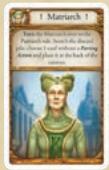
12 Starting cards

(Reverse)
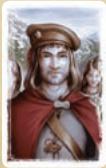
76 Standard cards

(Reverse)

12 Special cards
40 Orders
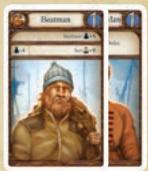
(Reverse)

12 Expansion cards (Reverse)


(Reverse)

4 Mule tokens
And, 4 Player boards.

4 Gold tokens

20 Spice tokens (4 each in 5 types)

Card Symbols:
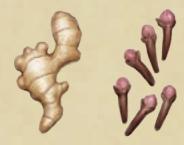


Star-


Cinnamon

Gold

Ml

Any spice
1) Shuffle the cards and place them in their respective decks facedown on the table:
- Shuffle12 Start cards to form a deck.
- Shuffle the 76 Standard cards to form a deck.
- Shuffle the 12 Special cards to form a deck.
- Shuffle the 40 Order cards to form a deck.
Note: In your first game do not use the 12 additional cards that belong to the “Cut and Thrust” expansion. They have the same backs as the Standard cards, but their fronts differ because of their beige-colored backgrounds. These cards (completely or partially) can be shuffled in with the standard cards in later matches to make play more interactive and conflict-ridden.
2) Draw 4 Order cards and place them face up in the middle of the table, near the Order deck.
3) Place one of the Patriarch cards nearby, on the table.
4) Each player receives:
- 1 Player board.
- 1 Mule token, 1 Gold token and 5 Spice tokens in the 5 spice colors. (Place them in their corresponding columns, all at value 3, on the player board.)
- 3 Patriarch cards. Place them face-up and side-by-side.
- 3 randomly-drawn Starting cards. Place one face up behind each of the Patriarch cards. Each of these three columns of cards now represents a caravan the player controls.
For 2-3 player games, place any leftover player components back in the box.


Cost for performing the cards action
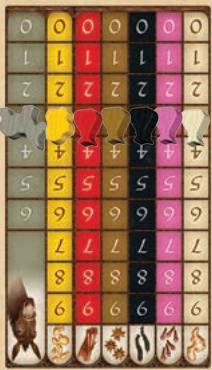
Player 2s player board and 3 Caravans.

Deck of Order cards


4 Order cards

Discard pile for the Standard cards

Deck of Standard Cards
Deck of Special cards
Player 1s player board


3 Caravans with a Patriarch face-up at the front, and a random Starting card at the back.
Course of the Game
General rule: the card texts always take precedence over these rules.
The starting player will be the person with the lowest ranked (see the number at the bottom-right corner) Starting card in any of their Caravans.

On their turn, the current player selects the front card of one of his caravans. Then he must – depending on the card – choose one of three options:
A) Caravan action
or
B) Parting action
or
C) Pass
Then it is the turn of the next player in clockwise order.
A) Caravan action
Caravan actions are written on light backgrounds. If the player wants to perform a caravan action with the selected card, he places this card at the end of the same caravan, i.e. pushes it all the way back, so it is now under all the other cards in its caravan.
To perform the caravan action of the card, he must pay the costs specified in the light background area by adjusting the corresponding markers on his player board. Note: some caravan actions have no cost and can be executed directly.
$$
\left. \mathbf { \mathcal { B } } \mathbf { - } \mathbf { 1 } \ \frac { 1 } { \mathbf { \mathcal { a } } _ { 1 } } \ \mathrm { C o s t } = \mathrm { C l o v e s } - 1 \right.
$$
Now the player performs the selected caravan action as described on the card.
Cards obtained as a result of caravan actions are always placed behind the just-used card, i.e. furthest back in the caravan.
When a card contains more than one caravan action, only one of the actions can be performed on a turn.
Also, it is not allowed to pay again and perform the action multiple times.
B) Parting action
Parting actions are written on red backgrounds. If the player wants to perform a parting action with the selected card, he removes the card from the game (placing it back in the box).
To perform the parting action of the card, he must pay the costs specified in the red background area on the card by adjusting the corresponding markers on his player board. Note: most parting actions have no cost and can be executed directly.
Now the player performs the selected parting action as described on the card.
Cards obtained as a result of parting actions are always placed furthest back in the caravan.
When a card contains more than one parting action, only one of the actions can be performed. Also, it is not allowed to pay again and perform the action multiple times.
C) Pass
If a player cannot (or will not) pay the cost of a caravan action, and prefers not to perform the parting action of the selected card, no action is taken. The card is still placed at the end of its caravan. This ends the players turn.
Exception: Cards displaying “!" in the card name cannot be passed over, i.e.: if the Patriarch or Matriarch (or the Additional card, Gate Keeper) is selected, the player must perform either its caravan or parting action. (See the Card Index for more info.)
Example of a Turn:
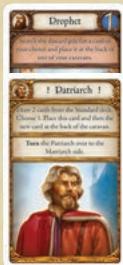
At the beginning of the game, Patriarchs are at the front of all caravans. The current player selects one Patriarch and places it at the back of the same caravan.

Caravan 1

Caravan 2
Caravan 3
He chose the Patriarch in caravan 1 because next turn he would like to use the card behind it (the Grocer) to fulfill a Order. He could also have chosen the Patriarch at the front of either caravan 2 or 3, but would rather not use the Servant or the Prophet next turn.
He opts for the Patriarch's first caravan action because he wants to expand caravan 1. Both of the Patriarch caravan actions have no costs, so the player pays nothing. As described on the card, the player draws 2 cards from the deck of Standard cards. He draws a Planter and a Baker. He opts for the Planter and places the Baker on the Standard discard pile. He places the Planter behind the Patriarch at the end of the first caravan.

Caravan 1 Caravan 2Caravan 3
The player could have instead used the Patriarch's second caravan action. Then he would have turned the Patriarch over (to reveal the Matriarch side), and then he would have placed it at the end of caravan 1. But he would not have received a new card for caravan 1.
Fulfilling orders
Orders can only be fulfilled by performing a caravan or parting action. Most orders have a cost to be paid, as indicated on the Order card. However, there are also caravan actions and parting actions that explicitly fulfill an order for free.
Anatomy of a Order Card:
Name

Mule requirements
To fulfill and acquire an Order card:
- The player must have at least as many mules as shown on left part of the Order card. (These are not paid, the player just has to have them.)
- The player must also pay the required cost of the order shown at the bottom of the card, paying spices and mules or gold. To pay, the player reduces the corresponding marker(s) on his player board.
The player then takes the fulfilled order and places it face up in front of himself, so that all the players can see its points value. Hint: multiple orders can be overlapped so that all points are visible.
Finally, the player draws a new Order card from the deck, so that once again there are 4 face up Order cards available to the players.
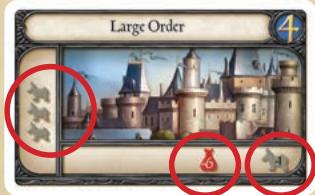
Example of Fulfilling an Order: The current player selects the Grocer's parting action, removing the card from the game.
With the Grocer's parting action he may fulfill a faceup order, and he opts for the Large Order, which will earn him 4 victory points.
The player must now fulfill the order conditions and pay the costs. He meets the order's requirement of owning at least 3 mules (these are not paid). Now, the player must also pay the cost. To pay one mule, he shifts his mule marker down by 1 on his player board. He also moves the cinnamon marker down 6 spaces.
The player takes the fulfilled order and places it face in front of himself. He has now earned 4 victory points.


End of the Game
The game end is triggered as soon as a player reaches 25 victory points or more (counting points on all their Order and Person Cards). The current round of play is played to its end. The player who has the most points wins. In case of a tie, the tied player who last earned points wins.
General Notes on the Rules
Increase: If a card says “Increase”, it means that the player's spices, gold, or mules can be increased to the speciied value. Mules can rise to a maximum value of 6, spices and gold to a value of 9. So in some cases it may be necessary to forfeit a portion of an Increase.
When spices, gold or mule indicators are separated by a “/" (slash), the player must decide which one of these to increase. When there is no slash, everything shown is increased.
Set: If a card says “Set”, this means that the specified spices, gold or mules must be set to exactly the specified value, regardless of the value they had before! 'This can sometimes mean that the value may be increased, at other times that the value must be reduced. It can also sometimes remain unchanged.
Remove: If a card says “Remove", it means that the affected card is placed back in the box and no longer used in the current game!
Turn: If a card says that it is to be “turned”, then the card is simply turned on its back. The Patriarch and the Matriarch are turned over at the end of their “turn” caravan actions.
Fulfill 1 Order: If a card says “Fulfill 1 Order" and nothing else is specified, then this can be be a Small Order, Large Order, or Special Order.
Draw Cards: When cards may be drawn, draw them from the corresponding deck:
- Orders from the Orders deck,
- Special cards from the Special cards deck,
- Standard cards (and Expansion cards) from the Standard cards deck.
(Since, when using the Expansion cards, they are in the Standard cards deck, when an instruction indicates Standard cards, it also means the Expansion cards.)
Unwanted Cards: Some actions allow players to keep a card after looking at a selection of cards. After a Standard (or Expansion) card is drawn and placed in the specified position in the caravan, any unwanted cards looked at as part of the action are placed on the discard pile.
Unwanted Order and Special cards are placed under their respective decks.
Discard: The discard pile may be inspected by all players at any time.
Victory points: Each player's points must be visible at all times to all players, and called out when requested.
Important: The special rules on the cards always take precedence over the general rules in these instructions. Example: Normally, to fulfill a order you must pay the cost in spices, gold and mules specified on the Order card. But some cards (e.g. the Scribe), permit fulfilling a order for free.
The "Cut & Thrust” Expansíon
Experienced players who want more interaction, may choose to include any number of the 12 Expansion cards into the deck of Standard cards at the beginning of the game.
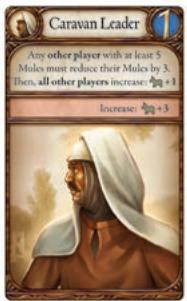
The 12 cards include 2 each of the following persons: Beggar, Caravan Leader, Conjuress, Gate Keeper, Herder, and Messenger.



The Designer: Gerhard Hecht (b. 1966 in Munich), lives with his wife and two children near Augsburg,
Germany. He plays passionate table tennis, is an avid movie-watcher, and reads fantasy novels. Even at a young age, Gerhard toyed with changing the rules of his favorite games, and then, began implementing his own ideas. Originally designed almost 10 years ago, Kashgar was his first published game. He thanks all his friends, who he tormented with countless prototypes, and who made it possible for the game to be playable at all.
Illustrations: Franz Vohwinkel Graphic Design: Franz and Imelda Vohwinkel Editing: KOSMOS-Redaktion
English translation: Rick Heli with Maren Oksienik
The designer and publishers thank all playtesters and rules readers.
This production is ©2018 Grail Games PO Box 4 Ashfield NSW 1800 AUSTRALIA info@grailgames.com.au www.grailgames.com.au Games worth seeking.

Licenced from Kosmos ©2013 Franckh Kosmos Verlags-GmbH & Co. Pfizerstraße 5-7 D-70184 Stuttgart Tel.: +49 711 2191–0 info@kosmos.de www.kosmos.de
KOSOS

原文为社区整理/出版社公开资料,版权归原作者,仅供个人学习查阅。