
激光游戏Khet
一句话概览
激光游戏 是一款已收录于村了吗规则库的桌游,支持 2 人,原名 Khet。
本页内容:一句话概览 · 常见问题
这游戏怎么玩
- 本站已收录这款游戏的规则资料,可以在对话里直接提问规则细节。
常见问题(FAQ)
以下 1 条问答中 0 条来自站内玩家的真实提问,其余 1 条为本站整理的常见疑问;答复内容保持原样。
激光游戏支持几个人玩?
2 人。
去哪查完整规则
想核对具体规则细节、卡牌效果或某个回合的结算方式,可以在村了吗里选中这款游戏后直接提问。
同类桌游
- 卡坦岛德式
- 工业革命:伯明翰德式
- 勃艮第城堡:特别典藏版德式
- 方舟动物园德式
- 卡卡颂抽象
- 瘟疫危机传承:第一季美式
- 阿瑞迪亚:勇踏征途美式
- 重塑宇宙德式
- 幽港迷城美式
- 埃多拉的德鲁伊德式
规则原文(Markdown)
本站收录这款游戏的规则原文 1 个文件,此处内联渲染 1 个,可直接展开阅读或下载。
Khet_Rules_final.md7.2 KB
Khet strategy at the speed of light
Rules of Play
Khet is fun and easy to learn because all the pieces move in the same way. The object of the game is to illuminate your opponent’s pharaoh by bouncing your laser beam off the mirrored pieces and around the playing field. You can learn how to play in minutes.
Pieces
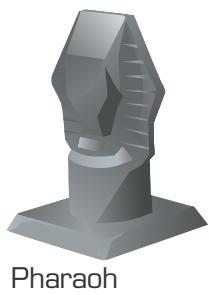
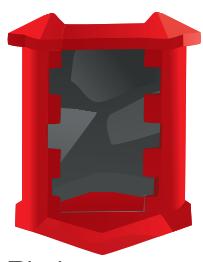
Djed

Obelisk

1 In the box the pieces are set up in one possible startingconfiguration. As you become familiar with the game, you can invent your own starting configuration to create new possibilities and challenges.

2 Players take turns, each player moving only his/her own pieces. Silver always moves first. All the pieces, including pharaohs, can be moved.
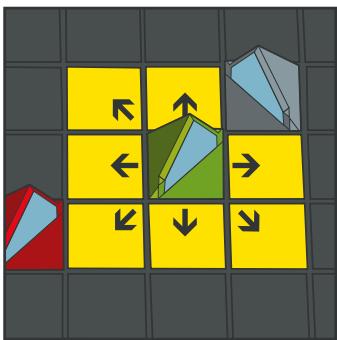
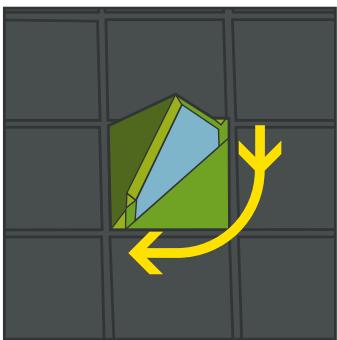
3 A turn consists of moving a piece one square in any direction (including diagonally) or of rotating a piece 90 degrees without changing squares. A piece cannot be moved and rotated on the same turn or rotated more than 90 degrees on one turn.
OR

No red piece can move into the silver squares and no silver piece can move into the red squares.

Except for the djed piece, no piece can move into a square occupied by another piece.
6
The djed piece can move into a square occupied by a pyramid or an obelisk of either color; the pyramid or obelisk then goes to the square the djed piece started from. In other words, the djed piece can swap places with an adjacent pyramid or obelisk, but not with a pharaoh or another djed piece. Neither piece rotates.


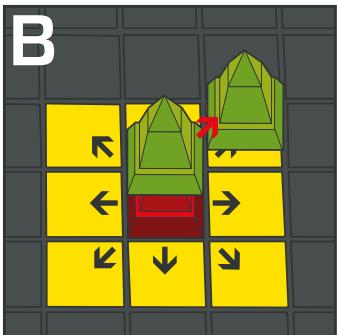
The obelisks have the power to stack or unstack on top of each other. In the stacked configuration the player may either move the stacked obelisks as one unit one square (as shown in example A) in any direction or unstack the top obelisk moving it one square in any direction while leaving the bottom obelisk in its place (as shown in example B). If a stacked obelisk is hit, only the top obelisk is removed from play leaving the bottom obelisk to remain in its position on the board. You can only stack once, so there are no triple or quadruple stacks allowed. Only obelisks of the same color may be stacked.
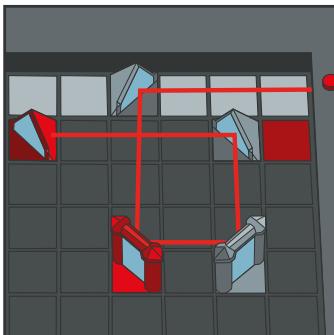
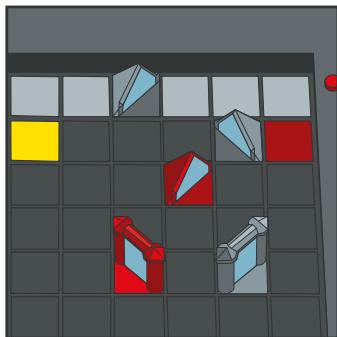
8 When a player has moved, she/he pushes his/her laser button, sending the beam around the field. Once the player removes his/her hand from the piece, the move cannot be taken back and the laser must be fired. Players may not test where the beam will go by firing the laser before completing their moves! (When the laser beam hits one of the mirrors, it will always turn 90 degrees, as shown in the diagrams below. The beam always travels along the rows and columns; as long as the pieces are properly positioned in their squares, it will never go off at weird angles).
9 When the player sends the laser beam around the field, it will stop either on the wall of the field or on the non-mirrored surface of one of the pieces. If it stops on a pharaoh, the player whose pharaoh is illuminated loses the game. If it stops on any other piece, that piece is removed from the board (even if it is the player’s own piece). The laser is fired only once a turn. The turn is over whether or not a piece is hit.
1 The game ends when the beam hits a pharaoh. The winneris the player whose pharaoh wasn’t hit. A player who hits hi0 is the player whose pharaoh wasn't hit. A player who hits his or her own pharaoh is out of luck.
11 If the same board arrangement appears for a third time in the same game, i.e., the same pieces of the same colors occupy the same squares in the same orientations, the player making the next move can declare a draw.
OR



Starting Configurations
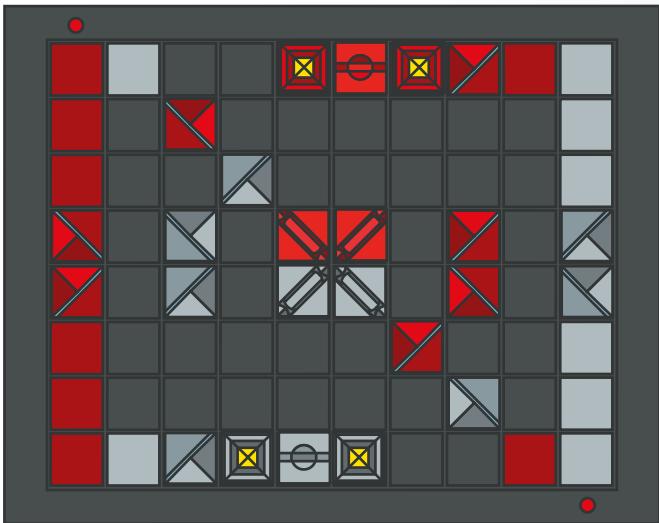
Unlike chess or checkers, Khet begins with the pieces spread over the board. Many different starting configurations will give interesting and enjoyable games. The three configurations shown have been tested extensively. They offer plenty of opportunities for skillful strategic maneuvers (and they are not as complicated as they look). We recommend that you start with the CLASSIC setup. Then, as you become more experienced, try IMHOTEP for new strategic possibilities.
As you become more expert, use your own creativity to design new starting positions!
Also available are the expansion 'beam-splitting' pieces available at the website and in select stores to increase the challenge and excitement as multiple beams travel around the playing field.
www.khet.com
IMHOTEP: A variation on CLASSIC that opens up new defensive possibilities.

DYNASTY: A setup with an immediate balance of offense and defense that develops quickly.
CLASSIC: Use this setup if this is your first time to play Khet.


Pharaoh

Pyramid
Innovention Toys, LLC New Orleans, LA 70131 www.khet.com


Djed
Logo, Packaging and Web Site Design oktoberproject www.oktoberproject.com

Obelisk

Stacked Obelisks (2 Obelisks Stacked On Top Of Each Other)
LASER RADIATION DO NOT STARE INTO BEAM DIODE LASER 1 mW MAX OUTPUT at 635-670 nm CLASS II LASER PRODUCT
This Device complies with 21CFR part 1040.10 and 1040.11
下载 Markdown原文为社区整理/出版社公开资料,版权归原作者,仅供个人学习查阅。