
运输大亨Kings Of Air And Steam
一句话概览
运输大亨 是一款已收录于村了吗规则库的桌游,支持 2–7 人,原名 Kings Of Air And Steam。
本页内容:一句话概览 · 常见问题
这游戏怎么玩
- 本站已收录这款游戏的规则资料,可以在对话里直接提问规则细节。
常见问题(FAQ)
以下 1 条问答中 0 条来自站内玩家的真实提问,其余 1 条为本站整理的常见疑问;答复内容保持原样。
运输大亨支持几个人玩?
2–7 人。
去哪查完整规则
想核对具体规则细节、卡牌效果或某个回合的结算方式,可以在村了吗里选中这款游戏后直接提问。
同类桌游
- 卡坦岛德式
- 工业革命:伯明翰德式
- 勃艮第城堡:特别典藏版德式
- 方舟动物园德式
- 卡卡颂抽象
- 瘟疫危机传承:第一季美式
- 阿瑞迪亚:勇踏征途美式
- 重塑宇宙德式
- 幽港迷城美式
- 埃多拉的德鲁伊德式
规则原文(Markdown)
本站收录这款游戏的规则原文 1 个文件,此处内联渲染 1 个,可直接展开阅读或下载。
KingsOfAirAndSteam_rules_web.md82.5 KB
GAMEPLAY SCHEMATICS

At Tasty Minstrel we strive to bring you great games. Scott Almes' Kings ofAir and Steam started out great, and it's been made even greater through the support of the 934 people and groups listed below. Their generosity during our KickStarter campaign enabled us to add a seventh playable team; to make the game playable for seven players instead of six; and to include the outstanding molded Airship pieces. Because of all of you, everyone enjoys a richer and fuller experience. Thanks for your support, enjoy the game, and keep your eyes peeled for more awesome titles from Tasty Minstrel!
• •A • • A. Toprac, Aaron & Rebecca Hoop, Aaron M Nessim, Aaron Recht, Aaron Seeber, Achilles Amor, Adam Easterday, Adam Thyssen, Adrian Bai Shuren, Adrian Beale, Ago Luberg, AK Foose, Alan Winterrowd, Alec Ware, Alex Grant, Alexander Grigoryev, Alexis Perez, Alice Lee, Allan Brandt, Allan Smulling, Allen Sam, Allen Schneidewent, Allison Mazan, Alvin Ong, Amanda Chan, Amanda Powers, Amy Courtney, Anastasia Schild, Anders Stagsted Bentsen, Andrew "Peachy" Pearce, Andrew Buckles, Andrew Garttmeyer, Andrew Matiukas , Andrew Norton, Andrew Ohst Andrew Perry, Andrew Rout, Andrew Schensted, Andrew Stingel, Andrew Waqq, Andrew Zimmerman Jones, Andrey Skidchenko, Andy Kerr, Andy Rogstad, Andy Wakefield, Anne-Christin Kreutzmann, Annemette Wolff, Anonymous, Anthony Lazaroski, Anthony Thompson, Antti Koskinen, Arden D. Nelson Jr., Area 42 Games, Aries Socrates, Arne Kreutzmann, Attila, Aurélien Breton, Austin McDonald, Avery and Finley's College Fund. • • B• • Barrett Clemence, Bartelheimer Yann, BattleQuest Games, The Board Game Shop, Becky Muilenburg, Bellevue Board Game Geeks, Ben "Stones" Croft, Ben Allen, Ben Friedberq, Ben Roberts, Benjamin Bernocco, Benjamin Kay, Benjamin Schwartz, Benjamin Steinhauser, Benjamin Workman, Benoit Flageol, Bernard Gilroy, Bernard Yeo Boon Att, Betsi Goutal,Bill Creasey, Bill Glasgow, Bill Narotski, Bill Rosgen , Blimpmaster G.J. Allbutt, Bob Menzel, Bob Rademaker, Brad Kane, Brad Kwiatek, Bradford Cone, Bradford Stokes, Bradley Eng-Kohn, Brandon LeCompte, Brandon Miquel, Brent Bryan, Brent Mair, Brett Bell, Brett Orr, Brett Rabatin, Brian Boyle, Brian C. Mills, Brian Henderson, Brian Lint, Brian Lucier, Brian Mccarthy, Brian Miller, Brian P. McBarron, Brian P. McCarty, Brian Stevenson, Brian Symington, Brian W. Lenz, Brigette Anderson, Bruce Harlick, Bruce Heroux, Bruce LeCompte, Bruce Snell, Bryan and Sue Almes, Bryan Graham, Bryan Musson, Bryon Quick, Bulldozers, Buster Felinia. • • C • • C. Scott Kippen, Cairns Boardgamers, Caitlin Woodward, Calvin Shafer, Cameron Calka, Candy Weber, Carl Bussema III, Carl Crook, Carl Enns, Carl Vereen, Casey Lent, Catherine Pfeifer, Cathleen Feduke, Cathy Griffin, Cedric Aber, Chad Cook, Chad Hantak, Chad Rektorik, Chad Walock, Charles "Dirty Weston" Chaikaew, Charles Dubé, Charles Feduke, Charles Pearson, Charles Simon, Charles Townsend, Charles Warrender, Charlie Collins, Charlie Henty, Chip Moore, Chris Bender, Chris Bird, Chris Brandt, Chris Brooks, Chris Davis, Chris Deibler, Chris Geggus, Chris Hansen, Chris Hartman, Chris Hinsz, Chris Mazur, Chris Meyers, Chris Sessoms, Chris Topher, Chris Wuebbles, Christian Nord, Christian Spear, Christof Sigel, Christophe Cheval, Christopher Davis, Christopher Earley, Christopher J. Sniezek, Christopher M. Amidon, Christopher Nelson, Christopher Sullivan, Chuck Carroll, Cindy Nowak, Claude "Cigal" Galarneau, Claude Sirois, cliff hutton, Cliff McCarthy, Cliff Stornel, Clinton Broadbent, Cody Maggard, Cole Wehrle, Connie Chinn, Corey Quin, Corinne Harland, Courtney Quinn, Craig, Craig "Crizz" Bartel, Craig Massey, Curt Crane. • • D • • D. Bezzant, Dale Maxfield, Dallas Games Marathon, Damien Martin, Damon Wilder, Dan Foster, Dan Hentschel, Dan Luxenberq, Dan Stanley, Dan Walma, Danella Durante, Dániel Csete-Czinege, Daniel Grant, Daniel J. McM. Knaack, Daniel Kelly, Daniel Kerins, Daniel Palmer, Daniel Powers, Daniel Purdy, Daniel Son, Daniel Southwick, Daniel Winoqrad-Cort, Daniel Winterhalter, Danielle Van Gorder, Dany Simard, Darryl Clark, Darth May, Daryl Andrews, Daryl Wilks, Dave Oleksy, Dave Perkovich, Dave Saunders, David "Elwood" Hitchcock, David Aber, David Black, David Call, David Cathcart, David Crandall, David Crawford, David Eison, David Etherton, David Hoffman, David Hopson, David Hughart, David Lawrence, David LeCompte, David Logan, David Merrick, David Mitchell, David Montgomery, David Orange, David P. Moffett, David Proctor, David R. Pucci, David Rapp, David Rohrl, David Schleusener, David T. Van Sweden, David Thomas, David Wilson, daz, Deb & Dave Alverson, Demian Lord, Dennis Holliday, Derek Andelloux, Derek Chin, Diane Atherton, Dieter Pearcey, DiqitalLostBoys.com, DJ Jahn, Don Clevenger, Don Jorgensen, Donald Wheeler, Donny Do, Doug Beebe, Doug Dorman, Doug Tabacco, Douglas Catchpole, Douglas Fein, Drew Blas, Dunda, Dwayne Sherrard, Dwolve. • •E • • E.J. Bocan III, ed kowalczewski, Edmond Hyland, Edward Liming, Edward Sagritalo, Edward Silverstone, Eisenhorn Oakenfell, Eldon Nichol, Eli Kaplow, Elisabeth Rex, Emil Ali, Eric (Orange Pants) Johnson, Eric Alvarado, Eric Bonny, Eric Chu, Eric DeMarbre, Eric Demers, Eric J. Carter, Eric J. Sexton, Eric Johnson, Eric Jordan, Eric Kaylor, Eric Lafrance, Eric Little, Eric Perotti, Eric Rampson, Eric Rasmussen, Eric Salyers, Erick Slazinski, Erik Henna Hagen, Erik Kinq, Erik Lehmann, Erin anderson, Erin Matchan, Erin Preder, Ethan Assahi Martinez, Evan Parker. • • F• • Ferdinand Adolf , Francis Cournoyer, Francis Wallinqford, Frederic Desmet, Fredrick Barry. • • G • • G. Jay Christensen, G. Scott Russel, GameBreakPodcast.com, GamesForAll.ca, Gary Harland, Gary Summerhayes, Garyp, Gavin Easterday, Gene Platt, Geoff Stilwell, Geoffrey M Green, Geoffrey Steenberge, George & Deborah Parker, George Olive, George Ramos, Gerald Robinson, Gerald Squelart, Gerdt Hallmann, Gergely 'Leaxe' Czuppon, Gerhard Zelenka, Getúlio Romão Campos Júnior, Gil Anderson, Gil Bellemare, Gino Davegqio, Graeme Christie, Graf von Zeppelin, Grant Godel, Greq Grothaus, Greq Schatzman, Greq Wyman, Gregory Dalesandre, Gretchen Burlingame, Guy Duval, Guy Jacobson, Györqy Lipták. • • H• • Han Weiding, Harri Kokkonen, Harry Denton, Harry Hammermueller, Heinrich Auqust, Henri Romeo Patricio, Henry Roenke, Hugh Cowan. • • I • • Ian "The Champ" Trout, Ian Gowen, Ian John-Gill Watts, Ian Sanchez Moroni, Igor Potapov, Isaac Holmlund, Izack Chee. • • J • • Jack Francisco Jr, Jack Gulick, Jacob Coon, Jake Reynolds, Jakob Frederiksen, James "Left" Nutt, James Ballard, James Dillane, James E Cheng, James Hastings, James Herrington, James Lin, James Mastros, James Otto, James Pacheco, James V. Brown, Jameus Hutchens, Jamie Furtner, Jan Hercules Bekker, Janis Grunte, Jason Arnold, Jason Brown, Jason Bryan, Jason Finley, Jason Fordham, Jason Lurie, Jason Preder, Jason Schissel, Jaxon Hendrix, Jay Berry, Jean Rolfe, Jeff "Kertain" Messina, Jeff Berger, Jeff Fournier, Jeff Glasson, Jeff Gracia, Jeff Hobbs, Jeff King, Jeff Lane, Jeff McCardel, JEFF MYERS, Jeff Ridenour, Jeff Wessel, Jeff Wong, Jeffary Sonnentag, Jeffrey Benson, Jeffrey Krauss, Jeffrey Reed, Jenn Evans, Jennifer Aber, Jenny Gronseth, Jérémie Dubois, Jeremy Epp, Jeremy Hauss, Jeremy Heilman, Jeremy Oppenheim, Jeremy P Lee, Jeremy Southard, Jeremy Sydik, Jesper Laugesen, Jess Boronico, Jess Robinson, Jim Buchanan, Jim Reader, Jim Silva, Jim Wuerch, Joe Adams, JOE AGUAYO, Joe Francese, Joe Watkins, Joe Zarate-Sanderlin, Joel and Rachel Hansen, Joel Eddy, Joel Green, Joel Siragher, Johannes Werdehausen, John Anderson, John B Morgan, John Ball, john baluci, John Burt, John Cmar, John Coates, John Halko, John Hanlon, John Kaminar, John Kaufeld, John Marquette, John Michael Assad, John Morrow, John Trolinger, Johnnyspys, Jon Barker, Jon Bowker, Jon Cooper, Jon Dyhr, Jon Francum, Jon Greisz, Jon Sharp, Jonathan Borzilleri, Jonathan Chia Kangyu, Jonathan Kay, Jonathan Lacson, Jonathan MacDonald, Jonathan Pui, Jonathan Wiley, Jordan Booth, Jordan Olive, Jordan Stewart, Joseph A. Veehoff, Joseph Boeke, Joseph Hines, Joseph Kramar, Joseph Le May, Joseph M. Louis, Joseph Ritter, Joseph Traub, Josh Bazin, Josh Bodine, Josh Landry, Josh Patterson, Joshua Beale, Joshua Bluestein, Joshua Buergel, Joshua Crowe, Joshua Donaldson, Joshua Johnson, Joshua Jones, Joshua Kocur, Jovana Taylor, Joyce Chingcuangco, Jussi Pirinen, Justin Mohareb, Justin Oei, Justin Pitt, Justin S Chavez, Justus Kelloniemi. • • K• • K. Drefke, K.C. Skedzielewski, Kadin and Melana Jury, Kai Alexis Price, Kari Herrington, Kari Powers, Karl Newell, Kaspar Jenni, Kate Trgovac, Katherine Armstrong, Katherine Baxter, Kathleen Richardson, Keenan McCardle, Keith Hendrix, Keith Koleno, Kel Rayens, ken burt, Ken Franklin, Ken Hill, Ken Leyhe Sr, Ken Shogren, Kenny VenOsdel, Kerry Harrison, Kerryn Rubin, Kevin Barnes, Kevin Bertram, Kevin Bohlmann , Kevin Brusky, Kevin Duffy, Kevin G. Nunn, Kevin J. Maroney, Kevin Kidwell, Kevin McKenzie, Kevin Rodkey, Kevin Tierney, Kiel Joseph Wells, Kip Kwiatkowski, Kirk Monsen, Konstantin Gorbunov, Kosit Phanthanusorn, Kris Plaskey, Kris Richardson, Kristi Lawless, Kryste Gorum, Kurt Zdanio, Kyle Oliver, Kyle Pinches, Kyle R. Woods, Kyle Wittwer. • •L • • Labalbi, Lady Tegalton Kellysworth, Lance Peterson, Lane Taylor, Lara Clark, Larry Babcock, Larry F. Neal Jr., Larry Wile, Lars Schear, Laura Burns, Laura Hughes, Laura K Price, Lawrence Whalen, Lee Wardle, Lee-Anne Leslie, Leonard Kay, Leonardo Cabral Colombo (Montagna), LeRoy Blanchette, Life Happens, Lily & Rosie Newell, Linda Boroughs, lonnie kim, Lord Paul D. Murray Esq., Loren Cadelinia, Loren Overby, The Louis Family, Louis Perrochon, Louis Sylvester, Louise McCully, Luis Espinosa. • • M • • M. Sean Molley, Marc Buchanan, Marc Sira, Marc Waters, Marcus Tong , Mari A. Pucci, Maria Brown, Mark A Biqgar, Mark Blackman, Mark Brown, Mark Gondree, Mark Horn, Mark Massey, Mark Ranstoller, Mark Shocklee, Mark Valente, Markku Wächter, Markus Werdenich, Marquis Cote, Martin Samocha, Martti Remmelgas, Mary Ann Pham, Máté Mocsáry, Mathieu Martin, Mathue Faulkner, Matt Bredenberg, Matt Brosseau, Matt Fullenwider, Matt Gordon, Matt Hulse, Matt Logan, Matt Parker, Matthew Alexander, Matthew and Nikki Bown, Matthew Crowe, Matthew Dunstan, Matthew Goddard, Matthew Hartshorne, Matthew Kashuba, Matthew Klasinski, Matthew Klure, Matthew L. Smith, Matthew Marshall , Matthew Metcalf, Matthew Santucci, Matthew Wiley, Maxfield Stewart, Maxim Kalenkov, Megan Hendrix, Melanie Hallmann, Melissa, Melissa Poole, Merrell Family, Michael Armstrong, Michael Black, Michael Chen, Michael De Rosa, Michael Etherton, Michael Feinberg, Michael Hamlin, Michael Hayes, Michael Inguagiato, Michael Jean, Michael Johnston, Michael Logan, Michael Mesich, Michael P Oliver, Michael Potter, Michael R. Brandl, Michael Rahlff, Michael Skvarla, Michael Sokalski, Michael Stum, Michael Tervoort, Michael visconti, Michael Weber, Michele Carroll, Michelle Kennedy, Michelle Sweetland, Mikash Keldrew, Mike Cooper, Mike Eldridge, Mike Foster, Mike Lacoche, Mike Melvin, Mike Mestemaker, Mike Pokrzywa, Mike Schaer, Mike Thompson, Mikko Saari, Miles Bossons, Miles Diener-Bennett, Minty Hunter, Mitchell Rabb, Mivamoto Musashi, Mohan Rajagopalan, Mona Hendrix. • • N• • Nancy Martira, Nate Walker, Nathan Evans, Nathan McCullough, Nathan Nabeta, Nathan Worcester , Nathaniel Lawrence, Nathaniel Tenefrancia, Neal Levin, nehu, Neil & Natalie Ford, Neil Christiansen, Nicholas Omann, Nicholas Vitek, Nicholas Witchey, Nick Cegelka, Nick Dalager, Nick DeBusk, Nick McElveen, Nick Rusch, Nick Stellato, Nick, Issy & Theo Lowson, Nikki Ebright, Nikki, Connor, Elliot, Max and Amy Wakefield, Noah Bast, Noriko Tenefrancia, NutForge Games. • • 0 • • Off the Beaten Path Bookstore and Cafe, Olivier Marchand Olivier Rouleau, Oscar Bertram, Oscar Winner Adam 0'Brien, Otto-Ville Virkkunen, • •P• • Paige Bertram, Paige Watson, Patrick Carkin, Patrick Coleman, Patrick Johanns. Patrick Reinartz. paul engle, Paul Fassett, Paul Kutscha, Paul Mather, Paul Paterson, Paul R. Daniels, Paul Roberts, Paul Stephen Co, Paulo Amora, Pete Hopkins, Pete Scheidler, Peter Anderson, Peter Jackson, Peter McAndrew, Esquire, Peter Mueller, Peter S Maylott, Peter Schott, Phil Bauer, Phil Fry, Philip Cahiwat, Philip Manoff, Phillip Jones, Pyry Tuominen. • • Q • • Quinn Ortmeyer. • • R• • Racheal Johnson, Ralph Severson, Raman Ohri, Randall Rasmussen, Randy Warner, Ravindra Prasad, Ray Smith, Rebecca Hines, Rebecca Saxton, Reid Steele, Ren Decena, Renato Bruno, Rene Soria, Rich Hims, Richard Jefferson, Richard Rodrigues, Rick Adkins, Rick Scholes, Rick Vinyard, Rob Koch, Rob McDiarmid, Robert Duman, Robert Jones, Robert Kircher, Robert Moyer, Robert Ruescher, Robert Scholl, Roberto Zaghis, Roger Barnette, Roger Eastep, Rohit Ramesh, Roland Kuenzi, Roy Quek, Russ Hewson, Russell Martin, Ruth Boyack, Ryan "boardgameguy" Bruns, Ryan Cole, Ryan McMullin, Ryan Metzler, Ryan Nakagawa, Ryan Silva. • •S • • S. Slagqy, Samuel Wolfgang Schimek, Samwell Angove, Sandra Stumpf, Sara VanderWal, The Sawyer Family, Schoenweiss Stefan, Scot, Scott "Aldie" Alden, Scott "Skedoozy" Mayle, Scott Arens, Scott B, Scott Everts, Scott Fort, Scott Gowell, Scott Halvorson, Scott Marlow, Scott Minkoff, Scott Nisenfeld, Scott Pagliaroni, Scott Pitner, Scott Rabin, Scott Silver, Scott Suehle, Scott Tooker, Sean Croteau, Sen-Foong Lim, Seppi Morris, Setsuji Umei, Shane Bennett, Shanizan Herman, Sharzade Krzyzaniak Shawn Hendrix, Shawn Ridenour, Shawn Simas, Sheldon Chin, Silas Snider, Simon Bryn Amaya Price, Simon Davis, Simon Higgs, Simon Holding, Simon Lemon, Sing Tang, Slatch, Smoox, Sochan Sok, solarisphase, Sophia McCurdy, Spike Fikter, Stéphane Michaud, Stephanie Bryant c/o Video Nation, Stephanie Franklin, Stephen Cappello, Stephen Carlson, Stephen Elliott, Stephen JH Lee, Stephen Smith, Stephen Waits, Steve Boone, Steve Walker, Steven Dajic, Steven Dast, Steven Grady, Steven Riola, Steven Sartain, Steven Scholl, Strider Agostinelli, Susan Lato, Suzi Hough, Suzi Rondot. • •T• • Tahlia Merril, Tameri Etherton, Tan Han Lip , Tan Pham, Taneli Armanto, Taylor Everding, Ted Louis Glenn , Ted Swalwell, Telegraph Road, Thomas, Thomas Brun Thomas Courtney, Thomas McGill, Tiffany Grayson, Tim Seitz, TimAA, Timo Lamminen, Ting-Hsuan Lin, Tivadar Farkas, Todd Keskey, Todd Lang, Todd Raethka, Todd Russell, Tom Balzano, Tom Lathos, Tom McCorry, Tom Powers, Toni Miinalainen, Toni Sallanmaa, Tony Casale, Tony Mastrangeli, Tony Tran, Toshiaki Sakai, Toshiji Nagoshi, Trampas Johnson, Travis Bonczkowski, Travis Murray, Trent Seigfried, Trev, Trevor George, Trevor Hendrix, Troy D'Hondt, Tyrone Cheeseman. • • U • • Uffe Thorsen, Unmil Karadkar. • •V• • Victoria Tao, Vince Lupo, Vincent McClellan, Vladimir Vukicevic, Voyze G Harris. • •W • • W David MacKenzie, wade broadhead, Wai-Mei Rocks, Warren Adams, Warren Kiser, Warren Maruschak, Warren Sistrom, Wazzadeeno, Wei Jen, Weston Clowney, Wieke de Boer, Will Jennings, Will Middlecamp, Will Sullivan, Willim Angel, William Baldwin c/o Heather-Lee Thompson, William Bennett, William Hartman K., William MacIntosh William Springer, Wong Jun Yet, Wong Lap Yin , WoodForSheep Hobbies Ltd., Wystan Benbow. • •Y• • Yannick Suter, Yonner Toff, Yves LaFrance, Yvette LeCompte. • •Z• • Zachary Sugawara, and Zack Neward.
KINGS OF AIR & STEAM
On the cusp of the twentieth century, America is the undisputed land of industry. Factories fire their machines twentyfour hours a day and demand is skyrocketing in the cities. A small but fierce rivalry of shipping barons must manage their amazing airships and the extensive railroad system in order to get goods to the cities before the demand is met by someone else. Anyone who can't stay competitive will be left with nothing but dust in their coffers!
The process is simple: factories produce the goods (machinery, textiles, chemicals, food, and luxuries) that are coveted by the cityfolk. Airships—forbidden from landing in the cities but capable of carrying cargo over great distances—must be used to gather those goods and deliver them to depots along the rail network. Trains then haul the goods to the cities that want them, earning cash for the competitor that gets there first! Will you be the King of Air and Steam?
OVERVIEW: THE OVERARCHING ELUCIDATION
2-7 PLAYERS 1-2 HOURS AGES 13+
The game spans 5 rounds. At the beginning of each round, the players will plan ahead for their Airship flights using four of their own Movement cards. When everyone is ready, everyone's first planned card is revealed; according to the turn order and movement limits of the cards, players move their Airships then take an Action. Actions include Building Depots, Upgrading your Airship or Train, Shipping Goods by rail, and Soliciting Funds from the bank. When all players have acted, the second planned cards are revealed, and so on through the four planned cards until all players have finished carrying out their plans for the round. All the while, players must keep aware of the rising values of the different types of Goods, and try to get the most-valuable Goods from the specialized factories that produce them to the cities that want them. At the end of the game, the player with the most money and the greatest shipping network will be declared the King of Air and Steam!
COMPONENTS: THE MATERIAL APPARATUS
7 Game Boards
Several of these (depending on the number of players) are put together to form the play area. Each board is divided up into a number of hex-shaped spaces, some of which contain Factories, Cities, or railroad tracks.
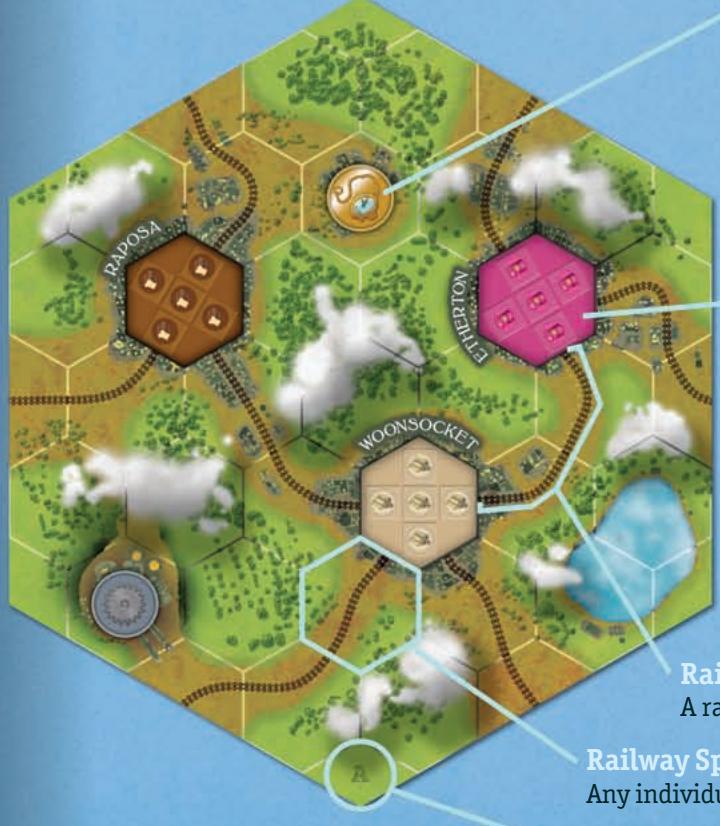
6 Board bumpers
Used when assembling the play area.

Factories
This is where Goods are produced, of the type shown.

Chemicals

Machinery

Food
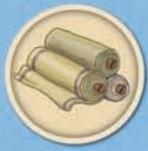
Textiles

Luxuries
Cities
Players deliver their Goods here. Each City shows the type of Goods it wants, and has five slots for delivered Goods. When the slots are filled, the City's demand for that Good is fulfilled.

Chemicals

Machinery

Food
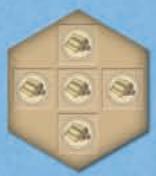
Textiles

Luxuries
Railroad Link A railroad connection between two Cities.
Railway Space Any individual space that has railroad track running through it.
Board Letter
COMPONENTS: THE MATERIAL APPARATUS (CONTINUED)
7 Double-sided Player Boards
Used to plan your Airship movement, store your cargo, and keep track of your Airship and Train upgrades. Each board also provides a Scoring summary, a Game Round summary and a reminder of the available Actions.
Shown here is the Basic side of the board; all boards are identical on the Basic side. The reverse is the Normal side, which features a unique illustration of your Airship, your team logo, and (in some cases) different stats for your Airship. Details of the different Player Boards can be found in the Normal Game Appendix.
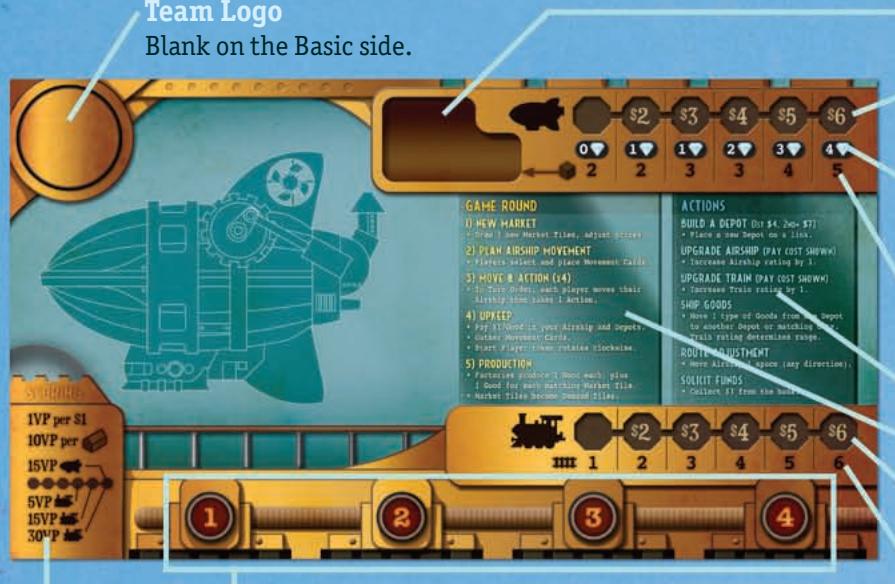
Scoring Summary
Movement Card Sockets Play your Movement Cards to these sockets when you are planning your Airship movement for the round.
14 Upgrade Markers
2 in each player color. Used on the Airship and Train Upgrade Tracks on your player board.

Cargo Hold
Store the Goods your Airship is carrying here.
Airship Upgrade Track Shows your Airship's level and the cost to upgrade it.
Airship Diamond Rating
Shows the maximum number of Diamonds that you can play (on your Movement Cards) in a round.
Airship Cargo Capacity Shows how many Goods your Airship can carry at once.
Actions Summary
Game Round Summary
Train Upgrade Track
Shows your Train's level and the cost to upgrade it. Train Rating
Shows how far you may Ship Goods in one Action.
Market Board
Keeps track of the value of delivered Goods, and houses the three Market Tiles that make up the futures market.

Current cash value of delivered Goods
Approximately 20 each of five types. These represent the Goods that you will be collecting and delivering for profit.
20 Market/Demand Tiles
Chemicals

Food
Chemicals
Machinery
4 of each Good type. While in the bins of the Market Board, these Market Tiles raise the value and production speed of the corresponding Goods. After they exit the Market Board, they become Demand Tiles and will eventually be placed on a City that has had its original demand fulfilled.


Machinery
Textiles



Luxuries

Goods Cubes
The backs of the Market/Demand tiles are identical. Once a Demand Tile on a City has been fulfilled (by some combination of players delivering Goods to fill its three slots), it is flipped over to the back side to indicate that the City is no longer accepting any deliveries.

Back
Food

Textiles


Luxuries
70 Depot Tokens
10 in each player color. A Depot on a rail Link opens that Link to be used for shipping Goods (free for the Depot owner, \$1 to the owner for anyone else). Your own Depots are where your Airship unloads Goods to get them onto the railway in the first place, and can store your own Goods.


91 Movement Cards
7 decks of 13 cards each. Each deck is distinguishable by the logo on the back. Movement Cards are used to plan your Airship's movement every round.
Card Backs
Turn Order Indicator

This letter indicates when in the turn order this card is resolved.
Movement Value
This is the number of spaces your Airship moves when you resolve this card.
Diamond Cost
Each card displays 0-2 Diamonds. If a revealed card would cause the Diamond total of all your exposed Movement cards to exceed your Airship's Diamond Rating, you lose your turn.
Card Summary
Each card has a faint summary which lets you easily see all of your cards' information when they are held in your hand.
7 plastic Airship figurines
1 in each player color. These are used to indicate the location of player Airships on the board, and will move about during the game.


Throughout the rules examples, this symbol (in the appropriate color) will represent an Airship.
Money
Plenty of cash in several denominations.
First-player marker

Used in the Basic game only to resolve turn order disputes.


The Special Card

Star Symbol★ Denotes the special card in each deck.
Each deck is comprised of 13 cards, but only 12 of them are used in the Basic game. The 13th special card in each deck is marked with a star symbol in its summary and is only used in the Normal game. Each special card has a unique ability that is summarized on the card and explained in detail in the Normal Game Appendix.
7 double-sided Character Cards
Character Cards are used in the Normal game only. Each player's chosen Character provides a unique benefit during the game. See the Normal Game Appendix for details.
Team Logo

Character Name
Character Ability
Summarized on the card and explained in detail in the Normal Game Appendix.
Priority Number
Used in the Normal game only to resolve turn order disputes and other timing issues.
Various Ability tokens
Used in the Normal game only, some of the Characters' abilities require the use of certain Ability tokens. Details on the various tokens and their usage can be found in the Normal Game Appendix.


SETUP: PREPARATORY PROCEDURES EXPLAINED AND ILLUSTRATED
These instructions are for the Basic game. Changes to setup for the Normal game are found in the Normal Game Appendix.
Each player takes a Player Board (Basic side up) and a Movement Card deck. (It doesn't matter which ones, in the Basic game.) Each player should remove the unique 13th card (marked with the symbol) from their Movement Card deck and return it to the box. Return unused boards and decks to the box.
Each player selects a color and takes the Airship figurine, all ten Depots, and both Upgrade Markers in their color. Each player places their Upgrade Markers on the starting spaces of their Airship and Train Upgrade tracks. Return unused colors to the box.

Separate the money by denomination and create a bank that everyone can reach, or near a player willing to act as banker for the game. Deal each player \$12.

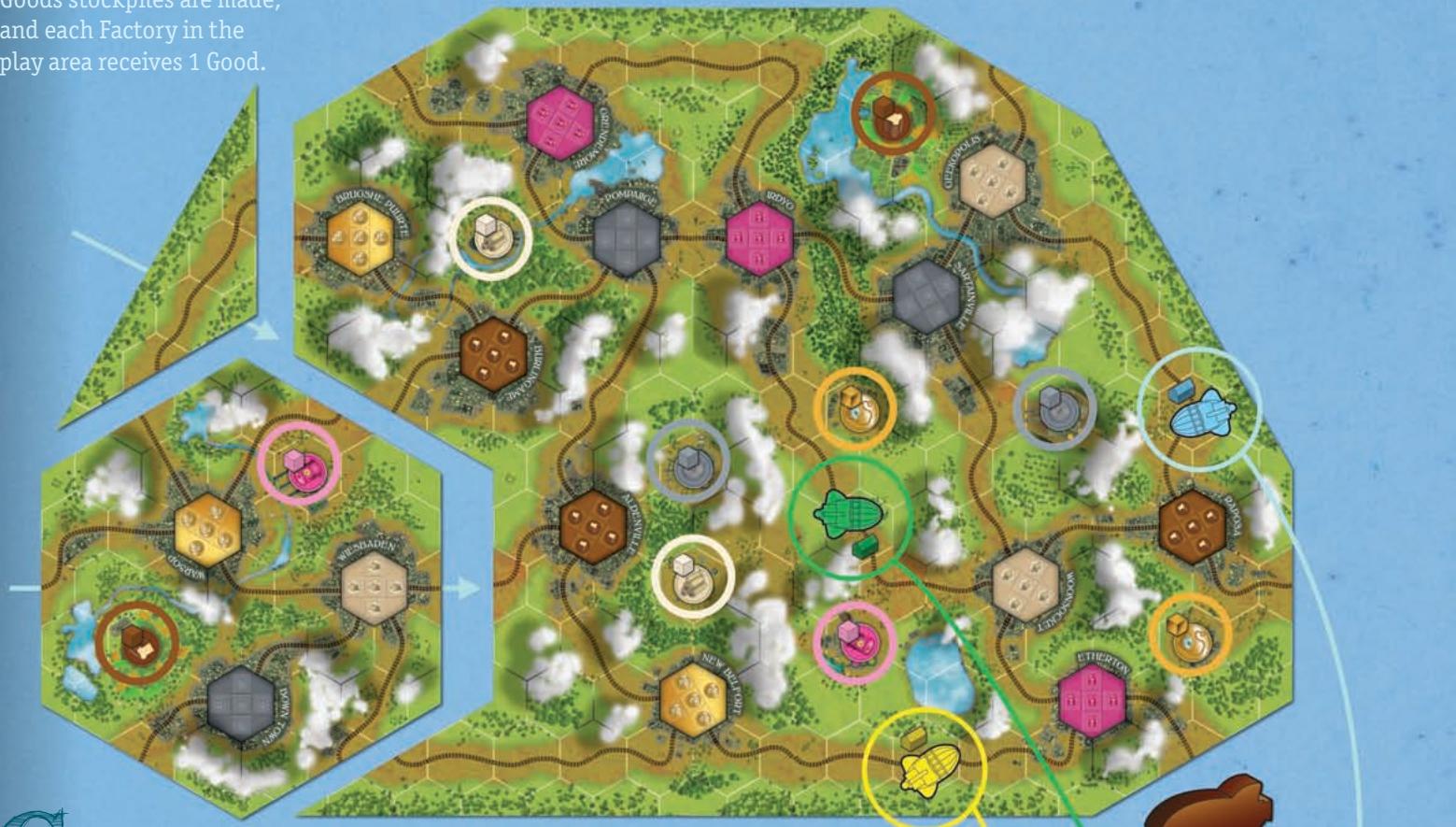
Assemble the play area from the indicated Game Boards and bumpers, using the chart to the right based on the number of players. Each board has a letter in one corner for identification, while all bumpers are identical. Orientation and relative position of the boards does not matter and should be random.
Place 1 Good on each Factory in the play area of the matching type. Place the rest of the Goods in stockpiles near the play area.

 | |||
| Boards used | Bumpers | Configuration | |
| 2 players, or"3 playercutthroat" | A, B, C | 3 |  |
| 3, 4, or 5 players | A, B, C, D, EorA, B, C, F, G | 5 |  |
| 6 or 7 players | All sevenboards | 6 | 8 |

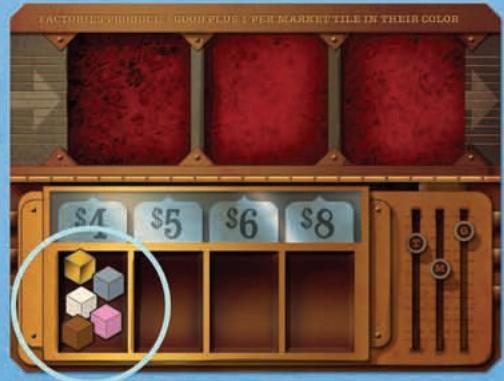
Place the Market board near the play area. Place 1 Good of each type in the \$4 space on the Market board.
Take three Market tiles of each type, shuffle them together face down, and create a face down draw pile near the Market board where shown. Return the five unused tiles to the box.
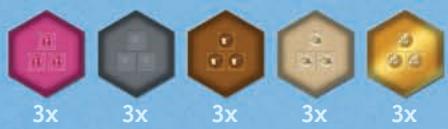

Uncertainty variant: For a less predictable game, shuffle all of the twenty Market tiles together face down, remove five and return them to the box face down without looking at them, and create a face down draw pile near the Market board where shown.

Randomly determine who will go first, and give that player the First-player marker. Then, in reverse turn order (starting with the player to the right of the starting player and rotating counter-clockwise), each player:

• Places a Depot on any open railway space. (Exception: During setup, players may not place their starting Depot on the same link as another player; during the game, new Depots may be built on shared links.)
• Places their own Airship on that same space.


Everyone gets their Player Boards, Movement Card decks, Airships, Depots, Upgrade Markers, and \$12. A bank is formed.


The play area is assembled, Goods stockpiles are made, and each Factory in the play area receives 1 Good.

1 Good of each type is placed in the \$4 space of the Market board. Market tiles are shuffled to form a draw pile.

Starting with the player to the right of the random starting player, each player places a Depot and their Airship on a space of an unoccupied link.
HOW TO PLAY: THE UNDERLYING STRUCTURE OF THINGS
Note: These rules describe the Basic Game. To learn the Normal game, read and understand the Basic version and then read the Normal Game Appendix at the back of the rulebook. The rules differences from Basic to Normal are not major but will result in a richer game experience.
Kings ofAir & Steam is played over a series of 5 rounds. Each round consists of 5 separate phases. After the fifth and final round there is a special Clearance Phase, and then the game is over. The player who has built the greatest shipping empire wins!
Each of the five game rounds includes the following phases, summarized on the Player Boards for easy reference:
1. NEW MARKET
Draw 3 new Market tiles, place them in the bins of the Market board, and adjust Goods prices accordingly.
2. PLAN AIRSHIP MOVEMENT
• Players each secretly select 4 Movement cards according to how they plan to move their Airship this round, and place them in the sockets of their Player Boards in the order they intend to resolve them.
3. Move & AcTIOn (x4)
· All players' first planned Movement cards are revealed. In turn order (determined by the cards), each player moves their Airship as directed by their own card, then takes 1 Action of their choice. Once complete, this cycle is repeated three more times; for the second, third, and fourth planned Movement cards.
4. UPKEEP
• Each player pays \$1 to the bank for each Good KEPT in their Airship's Cargo Hold and in their own Depots.
• Players gather their own played Movement cards back into their decks.
The First-player token rotates clockwise.
5. PRODUCTION
• Each Factory produces 1 Good, plus 1 Good for each Market tile of their type in the bins of the Market board.
• Market tiles in the bins of the Market board are swept off to become Demand Tiles.
I. NEW MARKET
Draw 3 Market tiles from the draw pile to the left of the Market board, and place them face up in the Futures market bins on the Market board. (Which bin is irrelevant.)
If there are not enough tiles in the draw pile to fill all three Futures market bins, this means that five rounds have already passed and the game is over... proceed to the Clearance Phase.
For each placed tile, move the matching Goods cube one drawer to the right on the "current cash value of delivered goods" track. (Maximum value for any Good is \$8; A cube can not move past the rightmost drawer even if a drawn tile would normally cause it to move.)
When this process is complete, the New Market phase is over.

Example: Three tiles are drawn and placed in the futures market bins: Luxuries, Machinery, and another Luxuries. The Machinery cube is moved one space to the right (to the \$5 drawer), and the Luxuries cube is moved two spaces to the right (to the \$6 drawer)
2. PLAN AIRSHIP MOVEMENT
During this phase, all players simultaneously plan the movements that their own Airship will make during the Move & Action phase, which follows immediately after. Learning how that phase works—and how the Airships move—will help you understand how to properly plan during this phase.
To plan your Airship's movement, look through your own Movement cards and choose any four of them to place face down (1 per socket) next to the numbered sockets on your own Player Board as shown. Your Movement cards will be revealed and resolved in order from 1 through 4 during the four cycles of the Move & Action phase, so be sure to place your cards in the sequence that will benefit you most.
Things to keep in mind when planning
• The Turn Order Indicator. This tells you when in the turn order you will take your turn. Details found in the Move & Action phase.
• The Movement Value. This is the number of spaces your Airship will move when the card is resolved.
The Diamond Cost. Your Airship has a specific Diamond Rating, which can be raised by Upgrading your Airship (explained later). As the Move & Action phase progresses, you will be revealing the cards that you planned during this phase one at a time, then performing movement and actions. If you ever reveal a card and it causes your total revealed Diamond count to exceed your Airship's current Diamond Rating, you must skip that card's turn. So, make sure that the cards you plan in this phase don't cause that to happen.


Turn Order Indicator
Movement Value
Diamond Cost
Note: Once this phase is over, you may not change your Movement cards or resolve them in a different order. You are permitted to peek at your own face down cards as the next phase progresses, to remind yourself of which cards you'd planned.
Example: Green is planning his Airship movement. He selects the four cards shown here and places them face down by his sockets so that they will be resolved in the order he wants. That order dictates how far his Airship will fly in each of the four cycles of the upcoming Move & Action phase.
As we can see here, in the first cycle, Green plans to fly 1 space..
In the second cycle he plans to fly 4 spaces.
In the third cycle he plans to fly 3 spaces.
In the fourth cycle he plans to fly 2 spaces.
Of course there are other considerations that may have helped Green make up his mind about which card to plan for a given cycle; Turn Order and Diamond Costs, for example. You'll come to understand those considerations as you continue through the game rules.

3. MOVE & ACTION (x4)
The Move & Action phase is where most of the game happens. It is broken up into four cycles. In each cycle, each player will get their own turn. In the first cycle, all players reveal the Movement card they had planned in socket 1; in turn order each player moves their Airship then takes an Action. When everyone is finished, the second cycle is resolved in the same way for socket 2, then so on through the third and fourth cycles until all Movement cards have been resolved and everyone has had four turns.
TURN ORDER
Turn order is determined anew at the beginning of every cycle, when everyone's Movement Cards for that cycle are revealed. Turn order in each cycle goes in alphabetical order following the Turn Order Indicators on the revealed Movement Cards.
ABCDEFG
If multiple players have played a card with the same letter, then turn order between those players starts at the First-player marker and rotates clockwise.

Example: Everyone reveals the cards they planned in socket 1. Green's Turn Order Indicator is a B. Blue and Yellow both show a C. Green will go first, then Blue and Yellow must resolve their tie using the First-player marker (currently held by Green). Starting at the marker and working clockwise, we see that Blue will go before Yellow.
ON YOUR TURN
Your turn (on any given cycle) is composed of four steps:
a) Check Diamonds (make sure you haven't exceeded your Diamond Rating)
b) Movement (fly your Airship then optionally Load/Unload)
c) Action (take one of the six possible Actions)
d) Slide Card (tuck your resolved card up under your Player Board)
a) Check Diamonds (make sure you haven't exceeded your Diamond Rating)
The first thing you must do on your turn is check to see whether this turn's Movement card causes your revealed Diamonds to exceed your current Diamond Rating.
• If your total of revealed Diamonds doesn't exceed your current Diamond Rating, continue your turn as normal.
If your total of revealed Diamonds does exceed your current Diamond Rating, return the Movement card to your deck and skip your turn; you perform no Movement or Action and play passes to the next player.
Timing is everything: The penalty for excess Diamonds is not triggered until the card is actually revealed... and it is possible to raise your Diamond Rating on your turn by Upgrading your Airship (explained later). Therefore it is possible to plan more Diamonds than your Airship can handle—and not suffer the penalty—as long as you make sure to raise your Diamond Rating sufficiently in a cycle that occurs before the excess Diamonds are revealed.
Example: In the example to the right, if Green had Upgraded his Airship in the first or second cycle, his Diamond Rating would have been raised to 2 and he wouldn't have suffered the penalty. Oops!

Example: It is Green's turn in the third cycle. His Airship's Diamond Rating is 1 and he already has a revealed Diamond from the second cycle. (It's peeking out from socket 2.)
Whoops! Green has planned poorly and his third card reveals another Diamond, which brings his total number of revealed Diamonds to 2... exceeding his Diamond Rating.
As a penalty, Green returns the violating Movement card to his own deck, and must skip this turn, performing no movement or actions. Hopefully he has had better foresight for the card in his fourth socket!
b) Movement (fly your Airship then optionally Load/Unload)
The Movement step of your turn includes your Airship's Flight from one space to another in the play area, then the optional Load/Unload of Goods to/from your Airship.
Flight
Your Movement card tells you how many spaces you must move your Airship, obeying the following rules:
• You must move the total number of spaces of your card's Movement Value and may not backtrack.
Note: There is a card in each deck with the Movement Value of zero. For this card, your Airship stays where it is but you may still Load/Unload.
• You are not required to move in a straight line. You may make as many wide turns as you want during your flight, but you may not perform sharp turns.
Note: It never matters which way your Airship is pointing when your turn begins; you may swivel it however you like before you actually move it. Each turn's flight (and its concerns regarding sharp turns) is considered separate from the previous turn's flight.
You may not move off the play area. You may pass through partial hexes along the edge of the play area during your movement but you may not end your turn in one.
• You may pass through Cities during your movement but you may not end your turn in one.
SHARP TURNS ARE NOT OK

Aside from the restrictions mentioned above, you may pass through and/or end your turn on any sort of space regardless of the game board art or anything else the space contains. (Factories, railways, bodies of water, any player's Depots, other Airships, etc.)

STRAIGHT LINES ANDWIDE TURNS ARE OK

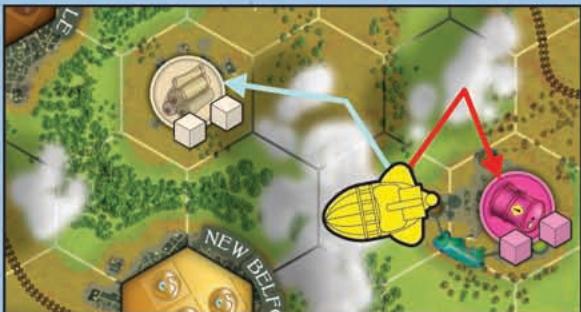
Flight Example: It is Yellow's turn and she is interested in picking up some Goods to fill her Cargo Hold. Nearby are two Factories (Textiles and Chemicals) which each have 2 Goods available. Yellow's Movement card for this cycle has a Movement Value of 2. From her position, there is no way for her to move to the Chemicals Factory in 2 spaces without making a sharp turn. She can get to the Textiles Factory without any sharp turns, so that is what she decides to do.
Load/Unload
After your flight, you may freely Load and/or Unload Goods to or from your Airship. Loading or Unloading is only permitted after your flight for this turn; not before nor during the flight.
You may Load goods if your Airship is in a space with:
• one of your own Depots that has at least one Good
• a Factory that has at least one Good
• Each Depot can hold an unlimited amount of Goods.
You may Unload goods if your Airship is in a space with one of your own Depots. To Unload, simply take the Good(s) you wish to Unload from the Cargo Hold on your Player Board and place them in the space with your Depot.
To Load, simply take the Good(s) you wish to Load from the space, and place them in the Cargo Hold on your Player Board. Remember that you can not exceed your Cargo Capacity when Loading Goods; you mayjettison Goods from your Cargo Hold (return them to their stockpiles) specifically to make room for an equal number of Goods of a different type that would otherwise cause you to exceed your Cargo Capacity. (Goods may not be jettisoned except in this case.)
Note: If you are at your own Depot that has at least one Good, and you also have Goods in your Cargo Hold, it is permitted (though rare) to both Load and Unload on your turn. Make sure that you Unload first so that you don't have to jettison anything!


Loading Example: It is Yellow's turn and her Airship has just ended its flight in the same space as a Textiles Factory that has two Goods cubes. Yellow's Cargo Capacity is 2 and she already has a Chemicals cube in her Cargo Hold from earlier. She could therefore Load one Textiles cube into her Airship's Cargo Hold or she could jettison the Chemicals cube and load both Textiles cubes.
Unloading Example: It is Green's turn and his Airship has just ended its flight in the same space as his own Depot. Green has 3 Goods in his Cargo Hold (2 Food and 1 Luxuries), and could Unload any number of them to the Depot by moving them to the space.
c) Action (take one of the six possible Actions)
During the Action step of your turn, you will choose and perform one of the six possible Actions. These Actions are:
• BUILD A DEPOT (Add a Depot to a Link)
• UPGRADE AIRSHIP (Increase your Airship rating by 1)
• UPGRADE TRAIN (Increase your Train rating by 1)
• SHIP G00DS (Move one type of Goods from one Depot to another Depot or a matching City)
• ROUTE ADJUSTMENT (Move your Airship 1 space)
• SOLICIT FUNDS (Collect \$3 from the bank)
• BUILD A DEPOT (Add a Depot to a Link)
Depots are a critical part of your shipping network; they are the only place that your Airship can Unload gathered Goods so that they can then be delivered to the Cities. Additionally, a Link does not become usable for Shipping Goods (explained later) until there is at least one Depot somewhere along its length. You start the game with one Depot, but you will certainly want to build more.
To Build a Depot, you must have a Depot token remaining (therefore each player can have at most 10 built Depots by the end of the game). Take the Depot token from your supply and place it on any railway space that doesn't already have a Depot on it.

Cost to Build a Depot: If yours is the first Depot on this Link, pay \$4 to the bank. If there is already at least one other Depot on the Link (including any of your own), pay \$7 to the bank.
Note: Every Depot of yours on the board is worth 10 Victory Points at the end of the game. See Scoring for details.
• UPGRADE AIRSHIP (Increase your Airship rating by 1)

Upgrading your Airship increases its Cargo Capacity and/or Diamond Rating. To Upgrade your Airship, pay the amount shown in the next slot of the Airship Upgrade Track and slide your Upgrade Marker into that slot. You may only Upgrade once per Action.
Note: Upgrading your Airship fully is worth 15 Victory Points at the end of the game. See Scoring for details.
• UPGRADE TRAIN (Increase your Train rating by 1)
Upgrading your Train increases your Train Rating, which will allow you to Ship Goods further with a single Action (explained later). To Upgrade your Train, pay the amount shown in the next slot of the Train Upgrade Track and slide your Upgrade Marker into that slot. You may only Upgrade once per Action.
Note: Upgrading your Train to the higher levels is worth varying Victory Points at the end of the game. See Scoring for details.
Example: It is Blue's turn and he wants to Build a Depot. Out of the three complete links shown above, he can't build on A because every space of the Link already has a Depot on it. To build on B would cost him \$4 since he'd be the first Depot there. To build on C, he wouldn't be the first Depot there and it would cost him \$7. The wise choice here is probably B: Not only is it cheaper, but Blue would shut other players out from building Depots on that Link since there'd be no available spaces left.
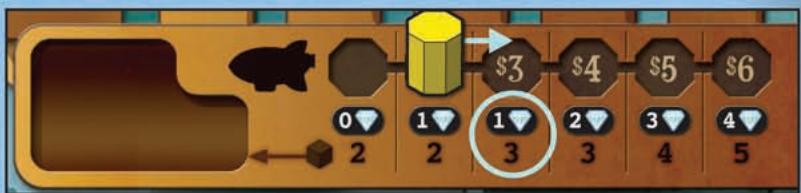
Example: It is Yellow's turn and she wants to Upgrade her Airship. Currently her Airship rating gives her a Diamond Limit of 1 and a Cargo Capacity of 2 Goods. She pays the \$3 shown in the next slot and slides her marker into that slot. Her Diamond Limit remains at 1, but her Cargo Capacity has improved to 3 Goods.
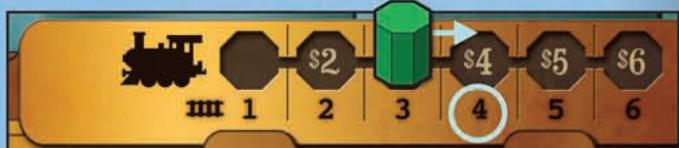
Example: It is Green's turn and he wants to Upgrade his Train. Currently his Train Rating is 3. He pays the \$4 shown in the next slot and slides his marker into that slot. His Train Rating improves to 4.
• SHIP G00DS (Move one type of Goods from one Depot to another Depot or a matching City)
Shipping Goods is the final step in your effort to bring Goods from the Factories to the Cities that want them, and is the way you'll earn most of your money; money has many uses and is also worth valuable Victory Points at the end of the game.
To Ship Goods, move any number of Goods of one type (your shipment) from one of your own Depots to either:
• Another one of your own Depots, (there is no limit to the number of Goods any Depot can hold), or
• A City of matching type (the City must have enough empty slots to accept the number of Goods in your shipment).
Whatever the destination, you are only permitted to Ship Goods there if you can trace a route of connected railroad tracks from the starting point to the destination (passing through any Cities on the way), and all of the following criteria are met:
• Every Link on the route must have at least one Depot on it.
• Your Train Rating must be high enough. As your shipment moves from its starting point to its destination, it stops at one Depot on every Link along the way, and then at the destination. (You must stop at your own Depots when possible; if a Link on your route has only Depots belonging to other players, you choose which opponent Depot you will stop at and must pay a toll described below.) Your Train Rating is the maximum number of stops you can make in a single Ship Goods action.
• Every time your shipment stops at another player's Depot, you owe that player a \$1 toll for each Good in the shipment. Payment of tolls technically happens after the Ship Goods Action is complete. Therefore, money earned from Delivering Goods to a City (details on page 12) may be used to pay any tolls that were amassed along the way.
Note: In the event that you would not be able to afford your tolls even after the shipment, you may not make the shipment.
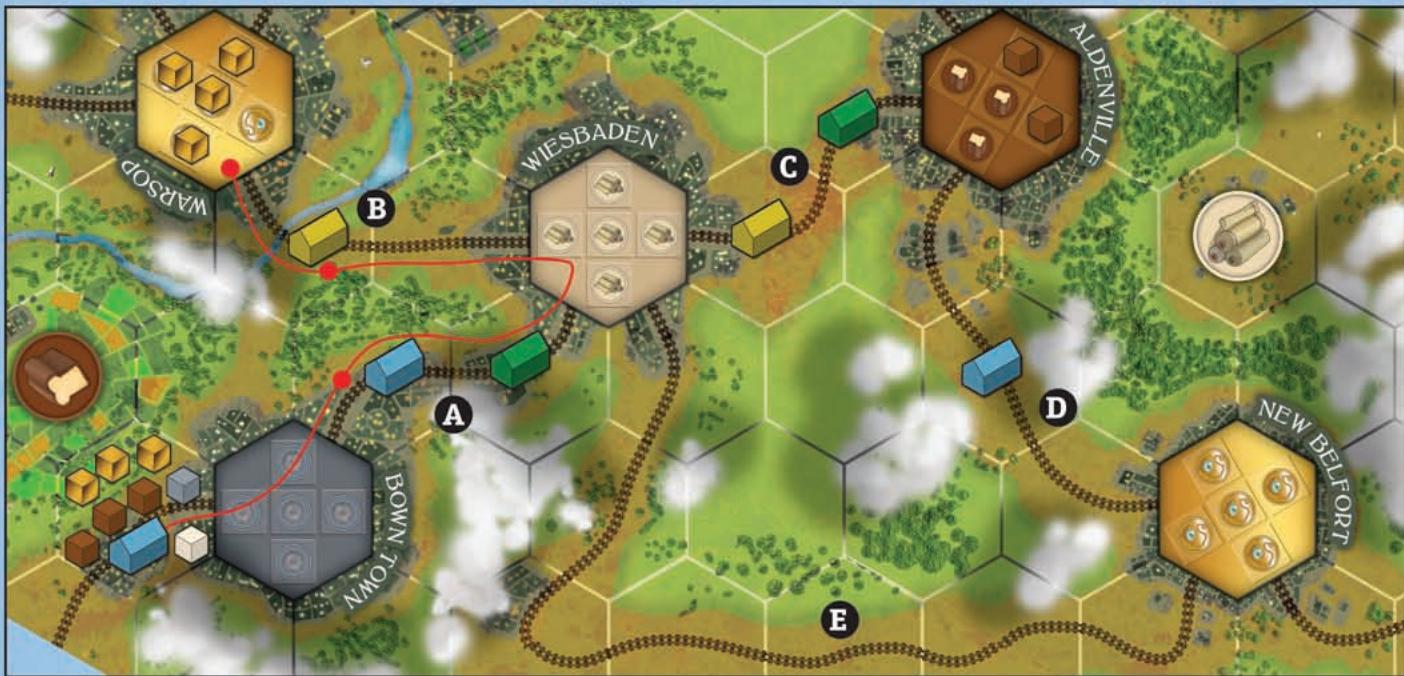
Example: It is Blue's turn and he wants to Ship Goods from his Depot in the bottom left. Blue's Train Rating is 3. Let's look at some of his options:
Option 1: Blue could ship his single Machinery cube to Bown Town. The only stop on this route would be the stop at Bown Town itself, so this shipment requires a Train Rating of 1.
Option 2: To ship his single Textiles cube to Wiesbaden, Blue would stop at his own Depot on Link A, and then in Wiesbaden. This shipment therefore requires a Train Rating of 2.
Option 3: Warsop has only 1 slot left to receive Goods, so Blue could only ship one of his three Luxuries cubes there. To do so, he'd need to stop three times... once at his own Depot on Link A,once at Yellow's Depot on Link B, then once in Warsop. (For Link B, Blue would owe Yellow a toll of \$1 for the 1 Good.) The red line in the diagram further illustrates this example; the red dots on the line are the route's stops.
Option 4: Aldenville has 3 slots left for Food, so Blue could ship all three of his Food cubes there. To do so, he'd need to stop three times... once at his own Depot on Link A, once at either Yellow or Green's Depot on link C, and once in Aldenville.(For Link C, Blue would choose which Depot, then owe the owner a \$3 toll; \$1 per Good.)
Option 5: New Belfort has plenty of slots for Luxuries, but it can not be reached since it would require 4 stops to get there. Link E is not useable since it has no Depots. Blue would need to stop once at his own Depot on Link A, once at either Yellow or Green's Depot on Link C (owing a toll of course),once at his own Depot on Link D, then finally at New Belfort. Since Blue's Train Rating is only 3, that's one stop too many. Blue could instead ship the three Luxuries cubes to his own Depot on Link D, which requires only a Train Rating of 3... getting those Goods the rest of the way to New Belfort will have to wait for a later turn!
SHIP GOODS (CONTINUED FROM PREVIOUS PAGE)
Once you've determined that your intended Ship Goods Action is permitted, move the Goods cubes to their destination. If the destination is another one of your own Depots, the Goods are simply placed in the space with the Depot. If the destination is a City, then this is known as Delivering Goods.
Delivering Goods
When your Shipment arrives at the City, place each Goods cube into any empty slot in the City. (Remember that you may not ship more Goods to a City than it has empty slots.) For each Goods cube placed, collect money from the bank according to that Goods type's current delivery value on the Market Board.
Note: Tolls are paid now, after any money from deliveries is earned.
If all of the slots on the City are now filled with Goods, the City has been fulfilled.


Example: In Option 4 on the previous page, Blue could send a shipment of 3 Food cubes to Aldenville. He would take the 3 Food from his starting Depot and place one in each of the empty slots on Aldenville. Since the value shown for Food on the Market Board is \$5, Blue would collect a total of \$15 for the shipment (\$5 x 3 cubes.), then pay the \$3 toll to either Yellow or Green.
Fulfilling a City
When a City is fulfilled, remove all five Goods that are in its slots and return them to their stockpile. Draw a random Demand Tile from the stack next to the Market Board (see the Production phase for details) and place it face up on the City space. Treat this Demand tile as if it were a normal City that wants the Goods it displays (with only three slots for deliveries as opposed to the five slots that all original Cities have).
If it was a Demand tile that was fulfilled, then you should still remove the (three) Goods and return them to their stockpile. Instead of drawing a new Demand tile as for an original City, simply flip the fulfilled tile over and return it face down to the City space. This City will not accept any deliveries for the remainder of the game.


Example: After Blue's delivery seen above, Aldenville has been fulfilled. Blue returns the five Food cubes to their stockpile and draws a random Demand tile from the stack; It's a Textiles tile. He places the tile on Aldenville and now Aldenville wants Textiles.

If later in the game the three Textiles slots on Aldenville get filled (fulfilling the city again), the Textiles cubes will be returned to their stockpile, the tile will be flipped over to the back side and Aldenville will no longer accept Goods.

• ROUTE ADJUSTMENT (Move your Airship 1 space)
To make a Route Adjustment, simply move your Airship one space in any direction. This move is independent from your flight, and it doesn't matter which direction your Airship is facing. (You may not move onto Cities or onto any partial hexes.) After you have moved, you are permitted to Load/Unload as if your flight had just ended, following the rules described in the Load/Unload section on page 9.
Note: Route Adjustment is especially useful if you discover that you've misplanned your Airship travel—or if another player's actions have caused you to reconsider your plans!

Example: Yellow had planned a 2-space flight this cycle and was intending to fly to the Machinery Factory two spaces away... but Green went first in the turn order and grabbed all

the Goods there! Yellow can instead use her 2-space flight to fly closer to the nearby Luxuries Factory, then use a Route Adjustment to move the final space onto the Factory and gather the 2 Luxuries cubes there.
• SOLICIT FUNDS (Collect \$3 from the bank)
A shrewd captain of industry such as yourself can always find a way to drum up some extra cash when needed—or when none of the other actions fit in with your plans. To Solicit Funds, simply collect \$3 from the bank.

d) Slide Card (tuck your resolved card up under your Player Board)
Once you're finished your Movement and your Action, your turn is over. The last thing you should do is slide this cycle's Movement card up under your Player Board so that only the bottom portion is peeking out. Make sure that any Diamond symbols on the card remain visible.

Example: Green has just finished his turn in Cycle 3. To wrap up his turn, he'll tuck the Movement card in socket 3 up under his Player Board, so that the bottom is peeking out like the Movement cards in sockets 1 and 2.
When all players have taken their turn in a cycle, the cycle is over. If there are still any cycles remaining (easily noted by checking if players still have planned Movement cards in their sockets that have not yet been tucked up under the Player Boards), start the Move & Action phase over again with the next cycle. When all four cycles are finished, (and all planned Movement cards are tucked up under the Player Boards),the Move & Action phase of this round is complete.
4. UPKEEP
The Upkeep phase has three steps:
- For each Goods cube they KEEP in their own Depots and Airship hold, each player must pay \$1 to the bank. Count up the Goods held in your Airship's Cargo Hold and stored in your own Depots. For each Good, you must either pay \$1 to the bank or return that Good to its stockpile.
Example: Yellow has 2 Goods in her Cargo Hold and 5 Goods stored in her Depots, for a total
内容过长,此处只内联前一部分;完整内容请下载或到规则页阅读。
下载 Markdown原文为社区整理/出版社公开资料,版权归原作者,仅供个人学习查阅。