
KōhakuKohaku
一句话概览
Kōhaku 是一款已收录于村了吗规则库的桌游,支持 1–4 人,原名 Kohaku。
本页内容:一句话概览 · 常见问题
这游戏怎么玩
- 本站已收录这款游戏的规则资料,可以在对话里直接提问规则细节。
常见问题(FAQ)
以下 1 条问答中 0 条来自站内玩家的真实提问,其余 1 条为本站整理的常见疑问;答复内容保持原样。
Kōhaku支持几个人玩?
1–4 人。
去哪查完整规则
想核对具体规则细节、卡牌效果或某个回合的结算方式,可以在村了吗里选中这款游戏后直接提问。
同类桌游
- 卡坦岛德式
- 工业革命:伯明翰德式
- 勃艮第城堡:特别典藏版德式
- 方舟动物园德式
- 卡卡颂抽象
- 瘟疫危机传承:第一季美式
- 阿瑞迪亚:勇踏征途美式
- 重塑宇宙德式
- 幽港迷城美式
- 埃多拉的德鲁伊德式
规则原文(Markdown)
本站收录这款游戏的规则原文 1 个文件,此处内联渲染 1 个,可直接展开阅读或下载。
Kohaku_Rulebook.md7.4 KB
By Danny Devine
COMPONENTS

58 Koi Tiles

62 Feature Tiles

8 Scoring Markers
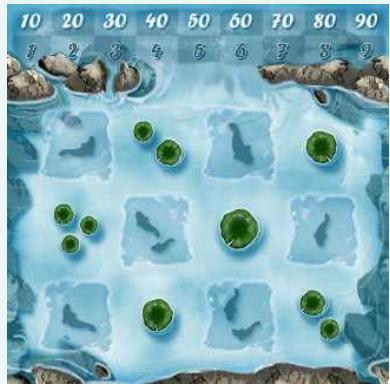
Pond Mat
SETUP
Place the pond mat in the center of the table.
Remove koi tiles from the game according to the number of players.

2 Players - Remove all koi tiles marked with 3 & 4 stones, they will not be used. Shuffle the remaining koi tiles, then randomly remove 7 more from the game.
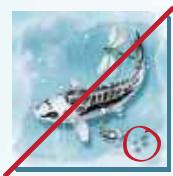
3 Players - Remove all koi tiles marked with 4 stones, they will not be used. Shuffle the remaining koi tiles, then randomly remove 5 more from the game.
4 Players - Shuffle all the koi tiles, then randomly remove 5 from the game.

Setup Example
Place the shuffled stack of koi tiles face down next to the pond mat. Shuffle all feature tiles and place them face down next to the pond mat.
Place a face up koi tile on each space of the pond mat that contains fish, then a face up feature tile on each space that contains lily pads.
The calmest person at the table is the first player.
GAME PLAY
Starting with the first player, then moving clockwise, players will take turns selecting koi and feature tiles to add to their personal koi ponds. On your turn, follow these steps in order:
Select Tiles: You must select any 2 adjacent tiles from the central pond mat. You will always take 1 koi and 1 feature tile.
Place Tiles: Place the tiles you just selected into your personal koi pond. New tiles must be placed adjacent to existing tiles, and they must alternate between koi and feature tiles (like a checkerboard). Simply put, a koi tile can never touch another koi tile. Once a tile is placed in your pond, it cannot be moved or removed. The first 2 tiles you select must be adjacent, but after that you do not have to place newly taken tiles next to each other in your koi pond.
Refill the Pond Mat: Finally, if there are any tiles in the center spaces of the pond mat, move them to their corresponding spaces on the outer edge. Then refill the center spaces of the pond mat with new koi and feature tiles, turning them face up. It is now the next player's turn.
VARIETIES OF KOI
Koi come in a wide variety of colors and are often accompanied by dragonflies or adorable babies.

Solid Color Koi are always 1 color. These rare beauties match fewer feature tiles, but will earn you 1 point each (signified by a coin) at the end of the game. They also act as tie breakers.

Feature Tile
Two-Tone Koi always feature 2 colors, and for the purpose of scoring are considered to be both colors.
Koi Tile

You will always take 1 of each tile type from the pond mat, but they don't have to be placed next to each other in your personal koi pond.


Amaya just took the 2 tiles highlighted in red. She decides to place her koi next to the dual flower feature and she places her rock

feature next to the koi with 3 babies she placed last turn.

Before the next player's turn, Amaya slides any tiles remaining in the middle to fill empty spaces on the outer edge, making sure that the feature and koi tiles go to their respective spaces. She would then refill the middle with one of each tile type.
Feature Tiles - There are 7 different types of feature tiles. Each of them score differently.
( ) indicates how many are in the stack of feature tiles.

Single Flowers (24) - Score 2 points for every adjacent koi tile with fish that contain the flower's color. If koi surround all four sides of the flower and have a matching color, then the flower scores 12 points instead.

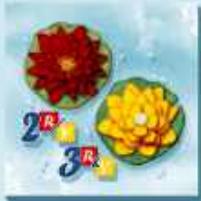
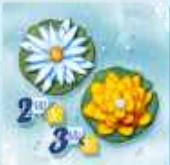
Dual Flowers (6) - Score 2 points for every adjacent koi tile with fish that contain one flower's color. Score 3 points instead if the koi on the tile are both colors.
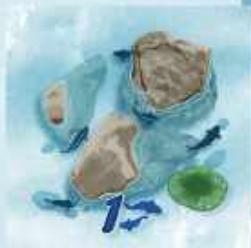
Rocks (6) - A perfect spot for babies to hide, score 1 point for every individual baby koi on each adjacent tile.

Frogs (6) - Hungry and helpful, frogs score 1 point for every individual dragonfly on each adjacent tile.

Butterflies (8) - Examine every koi tile in the same row and/or column as the butterfly. Score 2 points for each of these koi tiles with fish that contain the butterfly's color.


Turtles (6) - Turtles are worth 5 points each, regardless of where they are in your pond.
Statues (6) - Statues score according to the number of adjacent koi tiles, regardless of the color of fish on the koi tiles.
The game is over when there are no more koi tiles to add to the pond mat. In a 2-player game this will be after 14 rounds, in a game with 3 or 4 players this will be after 12 rounds. Once this happens, clear the remaining tiles from the central pond mat.
1 KOI =1 point, 2 KOI =3 points
3 KOI = 6 points, 4 KOI = 10 points
END GAME

SCORING
Select a color for your scoring markers and place one on the ONES row and one on the TENS row of the scoring track on the central pond mat. One at a time, players score their individual koi ponds. Only feature tiles score points. It's recommended that you score your feature tiles from left to right, top to bottom, saying the points aloud so another player can track the score. In addition to feature tiles, players score 1 point for each coin in their koi pond, these appear on all single color koi tiles. The player with the most points wins. If tied then the player with the most coins is the winner, if still tied players peacefully share the victory.

Did you win? Make sure to snap a picture of your beautiful creation and share it with us using #KohakuGame
Game Design, Illustration & Graphic Design: Danny Devine Playtesters: Steven Aramini, Joe Kisenwether, Paul Kluka, Wil Reed, Sarah Reed, & Ryan Sanders. © 2020 Gold Seal Games, LLC. All Rights Reserved.
下载 Markdown原文为社区整理/出版社公开资料,版权归原作者,仅供个人学习查阅。