
幕后交易Kuhhandel Master
一句话概览
幕后交易 是一款已收录于村了吗规则库的桌游,支持 3–5 人,原名 Kuhhandel Master。
本页内容:一句话概览 · 常见问题
这游戏怎么玩
- 本站已收录这款游戏的规则资料,可以在对话里直接提问规则细节。
常见问题(FAQ)
以下 1 条问答中 0 条来自站内玩家的真实提问,其余 1 条为本站整理的常见疑问;答复内容保持原样。
幕后交易支持几个人玩?
3–5 人。
去哪查完整规则
想核对具体规则细节、卡牌效果或某个回合的结算方式,可以在村了吗里选中这款游戏后直接提问。
同类桌游
- 卡坦岛德式
- 工业革命:伯明翰德式
- 勃艮第城堡:特别典藏版德式
- 方舟动物园德式
- 卡卡颂抽象
- 瘟疫危机传承:第一季美式
- 阿瑞迪亚:勇踏征途美式
- 重塑宇宙德式
- 幽港迷城美式
- 埃多拉的德鲁伊德式
规则原文(Markdown)
本站收录这款游戏的规则原文 2 个文件,此处内联渲染 2 个,可直接展开阅读或下载。
rules_en_kuhhandel-master_1117.md14.6 KB
来源类型:纯文本规则(非 PDF 源,早期抓取/转换产物)
说明:原文未改动,仅调整存放位置与文件名;非 PDF 扫描件,无对应原书 PDF
Kuhhandel Master Rulebook | RulesPalRulesPalChatRulebookKuhhandel MasterKuhhandel Master Rulebook Table of Contents Table of Contents Contents Value of the animal cards
Goal
Preparation
Flow of the Game
Auction Animal Card
Pedigree Card
Rat Card
Specifics During an Auction
Horse-trading (Kuhhandel) Horse-trading with Rats
No Pedigree Horse-trading
End of the Game and Scoring Example of Scoring
For 2 Players Preparation
Flow of the Game
Alternative Game for 2-6 Players
Additional Variants from BoardGameGeek
Contents
40 animal cards with red backs (10 animal quartets)
10 pedigree cards with red backs (one of each animal)
4 rat cards with red backs
66 money cards with green backs (value of 0-500: 12×0, 18×10, 6×20, 12×50, 6×100, 6×200, 6×500)
Value of the animal cards
10 – chicken
40 – goose
90 – cat
160 – dog
250 – sheep
350 – goat
500 – donkey
650 – pig
800 – cow
1000 – horse
Goal
By bidding, the players try to get as many (and preferably as expensive) animal quartets as possible. They also try to acquire pedigree cards corresponding to their quartets and stick other players with the rat cards (Dutch expression: "split in the stomach"). The winner is the player with the most points.
The following applies to games for 3-6 players. There is a variant for 2 players at the end of this rule set.
Preparation
The animal, pedigree and rat cards (= all red-backed cards) are shuffled and placed face down in a pile at the center of the table.
Every player receives the following starting money into his hand: 2×0 – 3×10 – 1×20 – 1×50
Flow of the Game
After the starting player, the game continues to the left. The player whose turn it is has one of the following options:
Auction
Or Horse-trading
After this the next player has his turn.
At the start of the game only the "auction" is possible as there are no animals to do a horse-trade with.
Auction
A player who chooses auction turns over the first card from the face down pile and auctions it. Depending on whether an animal, pedigree, or rat card is turned, different rules are followed for running the auction.
Animal Card
There are 10 animal quartets in the game that yield points. Only a complete quartet will yield points.
The value on each card is the value of the complete quartet. All other players (the auctioneer doesn't participate) make bids as they please. There is no turn order in bidding. Each new bid must exceed the preceding bid by at least 10.
If the auctioneer can't entice the players to bid anymore he closes the auction and calls (for example) "30 going once, 30 going twice, 30 sold!"
If the sale is made, the auctioneer either:
Gives the auctioned animal card to the winning bidder. The winning bidder places this card face up in front of him. He pays the amount he has bid to the auctioneer.
Or the auctioneer uses his buying right and keeps the card for himself. In this case he pays the amount of the winning bid to the winning bidder.
Nobody bids? If no bids are made for 5 seconds, the auctioneer closes the auction by calling "zero going once, zero going twice, no sale". In this case the auctioneer gets the animal card for free.
Pedigree Card
For each animal species (excluding the rat) there is 1 pedigree card. This card will yield at least 250 points.
Pedigree cards are traded by Dutch Auction. In this case, not the value but the number of money cards counts. The auctioneer places the pedigree card on the table within easy reach of all the players. He starts by slowly and evenly counting down, starting from 10.
The first player to hit the card with his flat hand and yells "MINE" is the new owner of the pedigree card. He then pays the number of money cards to the auctioneer.
The value of these cards is of no importance. (They could all be cards with value 0 or 500 or any combination of different or the same value cards; so if you have to pay 4 cards you could pay: 0, 0, 0, 0 or 0, 0, 100, 500 etc.)
The auctioneer hands the pedigree card to the new owner. The new owner places the pedigree card face up in front of him.
Right to buy: If the auctioneer wants to use his right to buy he can do so. However, he must do this before he has seen the offered cards, so before he knows the exact money value he would get. If the auctioneer executes his right to buy he must then pay the number of offered cards to the auction winner.
If nobody yells "MINE" when the bidding is at "1", the auctioneer gets the pedigree card for free.
Rat Card
The rat is the only animal that steals points. One of the animal sets of the player who has all 4 rats does not count in the calculation of points. (See scoring.)
When a rat card comes up for auction, the next player to the auctioneer has the first choice: he either
takes the rat card and places it face up in front of him,
or places one money card (of any value, even 0) face down next to the rat card.
After a player has decided to place a money card, the next player has the same options: take the card, and any money cards placed with it, or place another money card. This continues, including the auctioneer, until a player chooses to take the rat card along with all the money cards that were placed next to the rat card.
Important: The auctioneer that turned over the rat card remains auctioneer for the next auction. If in this auction another rat is turned over, the whole cycle starts anew and the auctioneer still gets to be the next auctioneer once somebody has taken the rat card.
Specifics During an Auction
Not the exact amount of money. Money is never changed. If a player cannot exactly match the amount of his bid with his money cards, he must pay more and doesn't get any money back. The same goes for the auctioneer if he chooses to execute his buying right.
Not enough money. If a player bids more than he can pay, he must prove this is the case by showing his cards. The auction then starts over again with the same animal card. The false bidder can still participate.
Donkey money. If the auctioneer turns over a donkey, the auction is interrupted. Each player, including the auctioneer, receives a money card:
1st donkey: 50
2nd donkey: 100
3rd donkey: 200
4th donkey: 500
After payment of these cards, the auction is resumed as normal and the donkey is auctioned off like any other animal card.
Horse-trading (Kuhhandel)
If the auctioneer has animals that at least one other player also possesses, he may opt to offer a horse-trade to one of these other players. This other player cannot refuse the horse-trade. This horse-trade is performed instead of the auction and follows these rules:
First, he challenges an opponent. He calls the animal he wants to horse-trade about. After that he makes a bid by placing one or more cards face down on the table. He may include cards with value 0, only play cards with value 0, or even play all his money cards.
The challenged player has 2 options:
Accept. The challenged player accepts the bid. He gives the animal that was horse-traded to the challenger and takes the money cards, without looking at them first.
Or counter offer. The challenged player places, also face down, a counter offer on the table. In this case both bids are exchanged and counted secretly. The player making the higher offer gets the animal from the other party. Everybody keeps the money he received from the other player. In case of a tie: both players keep the exchanged money and make a new offer. If this is again a tie, the challenger gets the animal.
In case both players have two animals of the same quartet, the horse-trade must include both of these animals. If one player has two or three animals and the other player has just one animal of this quartet, the horse-trade will always be about one animal.
Horse-trading with Rats
Horse-trading with rats is almost the same as regular horse-trading. There is one difference. The player making the higher bid loses his rat(s) to his opponent.
To horse-trade with rats, both players must own at least one rat. In case of a tie in bidding, the horse-trade is repeated. If after this the players are tied again, the challenger gives his rat(s) to the other player.
No Pedigree Horse-trading
Pedigree cards cannot change ownership. There is no horse-trading with pedigree cards.
End of the Game and Scoring
As soon as all the cards are auctioned off, all players, in turn, must perform horse-trading. A player that only has complete quartets in front of him is skipped. If all quartets are complete, the game is finished.
Scoring proceeds in the following steps:
Rat Quartet. The owner of the rat quartet excludes one of his animal quartets from scoring. Both quartets (rat and animal) are removed from the game and those points are not scored.
Calculating total value of animal quartets. Each player sums the total value of his animal quartets. Remember, the value of every animal card is the value of the complete quartet. (4 cows = 800 points.)
Matching pedigree cards. For each pedigree card a player has that matches one of his animal quartets, he scores 250 points. Exception: when a player excludes an animal quartet because of his rats and he has the corresponding pedigree card, this pedigree card is not counted here (but it is in step 5).
Multiplication. After all points are totaled, the sum is multiplied by the number of animal quartets a player holds. For example, if a player has 3 quartets, he triples his total points. The pedigree cards do not influence the multiplication.
Count non-matching pedigree cards. For each pedigree card without the corresponding animal quartet, a player adds 250 points after his multiplication to his point total.
The player with the most points is the winner. Money has no effect and is worthless at this stage.
Example of Scoring
Player A owns at the end of the game: a quartet of rats; 3 animal quartets: goose (40), dog (160), cow (800); 2 pedigree cards: 1 matching (dog), 1 non-matching (horse).
Quartet of rats excludes the quartet of geese.
800 (cow) + 160 (dog) = 960
960 + 250 (matching pedigree card dog) = 1210
2 animal quartets = ×2 = 1210 × 2 = 2420
2420 + 250 (non-matching pedigree card horse) = 2670
Player A has 2670 points.
For 2 Players
When playing this game with 2 players, the same rules apply as with 3-6 players, with the following changes:
Preparation
Both players receive their starting money as normal. Eight money cards, two each of 50, 100, 200 and 500, are placed on the table for when the donkeys show up.
Apart from the 0-cards in the starting money, all the other 0-cards are removed from the game. Hereafter, all remaining money cards are shuffled and ten cards are randomly removed from this pile. Do not look at them.
The money cards that remain are shuffled together with the animal, pedigree and rat cards. The resulting pile (containing green and red backed cards) is placed face down on the table.
Flow of the Game
In the game there are no auctions. Instead, there is division. The player whose turn it is has 2 options: horse-trading or division.
Horse-trading functions exactly like in the 3-6 player game.
Division works as follows: Player A looks secretly at the top card of the pile and either
keeps the card for himself, or
gives it to his opponent.
If A keeps the card for himself, his opponent immediately receives the next card from the pile. Player A does not get to see this card. If A decides to give the card to his opponent, he himself is the one that immediately receives the next card from the pile. After this player B gets his turn.
Animal, pedigree and rat cards are placed face up. Money cards are kept in hand. If the pile is completely divided, the only option is to horse-trade.
Scoring remains the same.
Alternative Game for 2-6 Players
For even more tactics and tension we've included two more variants:
Super horse-trading. If a player starts a horse-trade, he is still allowed to auction off a card afterwards. (Or divide cards in a 2-player game.)
Audit. After scoring, the players add the value of their money cards in hand to the total amount of points they scored.
Example: At the end of the game, player A still has money cards with a total value of 430 in hand. In the preceding example of scoring, he would now score a total of 3100 points: 2670 + 430 = 3100.
Additional Variants from BoardGameGeek
A 2-sided bluffing system during horse-trading, by Mr Thijs. This is just a small variant, but adds a lot to the game. If player A decides to do a horse-trade with player B, and player B doesn't just accept the offer but makes a counter offer, Player A can decide to add some money to his offer. Player B can react to this by adding money too or not. This continues until one of the players decides to not add extra money cards. This variant makes it possible to get a lot more money out of a trade for one of the 2 players by good bluffing and makes the horse-trading tenser and less passive for player B. Just try it out and discover the extra fun.
Ways of making Kuhhandel shorter: Bidding for two cards, by EndersGame. Like many others, I've thought that this game went on too long for what it is. This variant solves the problem nicely, without detracting from the game-play. We now play with the following rules, to speed up the game to an appropriate playing time:
Start with four animals each (determined randomly, or if you want to eliminate luck: a chicken, a goose, a cat and a dog).
Auction two animals at a time: bid for two animals at the same time (i.e. turn two cards and bid for the combo). The active auctioneer has 2 choices – a regular auction (now with 2 animals not 1) or a horse-trade for one type of animal. This way the game goes faster and the bidding and bluffing is pretty serious.
An optional rule (result of misapplying the original rules – it's uncertain if it's worth trying out): If a horse-trade is counter-bid, exchange money. If the active player (who chose the horse-trade) bids more cash, he takes the other player's animal card. If the "defending" player bids more, he only keeps his animal card – he doesn't take the active player's animal card. The effect of this change is that deciding to make a horse-trade challenge is less risky for the active player: he might lose cash, but won't lose an animal card. This allows cash-short players to extort some cash out of richer players.
下载 MarkdownYou're Bluffing Rules v1.2.md7.0 KB
By Rüdiger Koltze, Ravensburger 1985 A card game for 3 – 5 players from 10 – 99 years
Contents
40 Animal cards (10 x sets of four cards)
55 Money cards
(10 x 0 / 20 x 10 / 10 x 50 / 5 x 100, 200, 500)

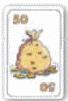
Goal
Players attempt to acquire sets of animal cards. They do this by bidding on animal cards during auctions or by trying to bluff their opponents during a “cow trade” (Kuhhandel). The player with the highest score at the end of the game wins.
Setup
Shuffle the animals cards and place them in a face down pile in the middle of the table. Sort the money cards by their value (0, 10, 50, 100, 200, and 500). Each player receives the following:
• Two value 0 money cards,
• four value 10 money cards, and
• one value 50 money card.
The remaining money cards are placed face down in a pile. The players decide on a starting player. Players are recommended to keep their money cards face down and secret during the game.
Playing the Game
Players can choose between two possible actions:
-
Auction the animal card on top of the stack or
-
Offer to make a “cow trade” (Kuhhandel) with another player.
As soon as the player has concluded either of these two possible actions, their turn is over and their neighbor in clockwise order proceeds to play.
Note: At the beginning of the game there will only be auctions, as “cow trades” (Kuhhandel) are not yet possible. However, as soon as two players have cards from the same set of animals, a “cow trade” becomes possible.
Action 1: Auction
The current player turns over the topmost card on the stack. All other players bid simultaneously on this card. Each subsequent bid must be higher than the preceeding one. The auctioneer may not participate in the bidding. When there are no more higher bids, the auctioneer accepts the highest bid by saying: “30 going first, 30 going second and gone for 30!" It is possible to get a valuable animal card for the bargain price of 10, or in the same manner, to pay much more than the value of the animal! When the bid is accepted, the auctioneer hands the animal card to the highest bidder. The winning player then pays the money to the auctioneer. However, after the auction, the auctioneer may pay the value of the highest bid to the highest bidder and take the card for themselves.
If nobody wants to bid on an animal, the player auctioning off the card gets it for free.
The players must display all owned animal cards openly in front of them on the table.
No Change
If a player doesn't have the exact amount of money offered and, instead, has more, the other player does not give back change.
Player is Unable to Pay
If a player cannot pay for their bid, they must reveal all of their money cards and the bidding process is repeated without them.
When nobody bids for an animal card, the auctioneer must call it out by saying: “A goose going first, a goose going second and a goose going third!" If no one has bid anything by then, the auctioneer may obtain the card for free. However, if another player makes an offer, regardless of how low, the auctioneer passes the animal to them and receives the money (as normal), except when they choose to purchase the card for themselves.
The Donkey
Whenever the donkey is turned over for auction, the game is immediately interrupted. The current player deals everybody additional money cards. One value 50 money card at the
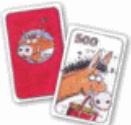
first donkey, one value 100 money card at the second donkey, one value 200 money card at the third donkey, and one value 1二
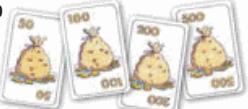
fourth donkey. When everybody receives their money, the donkey is auctioned off as normal.
No more Animal Cards in the Deck
When there are no more animals to auction off, players are no longer able to perform Action 1: Auction.
Action 2: “Cow trade”(Kuhhandel)
As soon as two players own animals from the same sets, the player in turn may choose to offer the other player a “cow trade”. If more than two players have animals from the same set, then the current player can decide with whom they want to make the “cow trade” with. The “cow trade” begins by player A making a hidden monetary offer to player B and telling them which of their animals they wish to trade.
You are permitted to bluff. For example, you are allowed to play a hand on the table that doesn't have any money cards, to offer 0 value money cards, or to only include 0 value money cards in the offer. Once player A's offer is on the table, player B must decide how they want to react by choosing one of the following options:
Option 1 - Counter-offer:
Player B puts a hidden counter-offer on the table. Both offers are swapped and counted face-down and silently. The player who was offered the most amount of money from their opponent must hand over their animal card. Both players keep the money received from their opponent. If it happens that both players offered the same amount of money, then player A must redo their offer. Player B must again decide how they want to react. If they make a counter-offer and again it turns out to be the same amount as player A's offer, player B must give player A their animal card for free.
Option 2 - Accept the offer:
Player B accepts the offer without making a counter-offer and hands player A the animal card that was being traded.
Special "cow trade”(Kuhhandel)
If both player A and player B own a pair of the same set of animals, then the trade will always be about the pairs. One of the players wil trade off the pair of the opponent and complete his set of animals. If one of the two players owns one card of the set and the other player owns a pair (or a three of a kind), then the trade will only be about one animal card.
No more Animal Cards and Complete Sets of Cards
If there are no more animal cards in the stack for auctioning, trading becomes obligatory. Players who only have complete sets of animal cards cannot participate in the trading and, therefore, will be skipped.
Example of Scoring
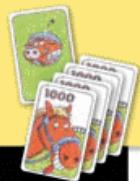
A player has a set of 4 pigs, 4 dogs and 4 roosters.
Their score is 650 + 160 + 10 = 820 points.
Since they own 3 full sets, their score is tripled and their final score is 820 x 3 = 2460 points.
Ending the Game
When the animal card stack has been depleted and there are no more possible “cow trades” (Kuhhandel) to be made, the game is over. Every player adds up their cards and calculates their score: the value on the card is equal to the points for the whole set (for example: 4 cows = 800 points). If a player has two full sets, they double their score, if they have three full sets, they triple it, and so on. Money isn't worth anything.
The player with the highest score is the winner!
下载 Markdown原文为社区整理/出版社公开资料,版权归原作者,仅供个人学习查阅。