
Kupferkessel Co.Kupferkessel Co
一句话概览
Kupferkessel Co. 是一款已收录于村了吗规则库的桌游,支持 2 人,原名 Kupferkessel Co。
本页内容:一句话概览 · 常见问题
这游戏怎么玩
- 本站已收录这款游戏的规则资料,可以在对话里直接提问规则细节。
常见问题(FAQ)
以下 1 条问答中 0 条来自站内玩家的真实提问,其余 1 条为本站整理的常见疑问;答复内容保持原样。
Kupferkessel Co.支持几个人玩?
2 人。
去哪查完整规则
想核对具体规则细节、卡牌效果或某个回合的结算方式,可以在村了吗里选中这款游戏后直接提问。
同类桌游
- 卡坦岛德式
- 工业革命:伯明翰德式
- 勃艮第城堡:特别典藏版德式
- 方舟动物园德式
- 卡卡颂抽象
- 瘟疫危机传承:第一季美式
- 阿瑞迪亚:勇踏征途美式
- 重塑宇宙德式
- 幽港迷城美式
- 埃多拉的德鲁伊德式
规则原文(Markdown)
本站收录这款游戏的规则原文 1 个文件,此处内联渲染 1 个,可直接展开阅读或下载。
Kupferkessel Co - Rules Booklet v1.1.md14.0 KB
Kupferkessel Co. English Rule Book
This booklet has been constructed using an English translation by Pitt Crandlemire and the images and layout from the original German rule booklet
The document has been designed to be printed as a booklet therefore THE PAGES ARE NOT IN SEQUENCE Each A4 sheet contains two pages, see the page numbers at the bottom of each
Instructions for printing
- Print from Adobe Reader
turn Page Scaling “off’ and Rotate and Center “off”
change the paper orientation to Landscape in the printer Properties
- DO NOT print this page - ie select pages 2-5 only
- Print on both sides, either with a duplex printer or by returning each sheet to the printer for the second side
- Trim the edges off using the guidelines
- Place the pages on top of each other in the order they were printed
- Now fold both sheets in half
- Hey presto! A booklet with all the pages in the correct order which fits neatly in the game box
You can print on one side only and still fold the final output into a booklet if you like, however two out of every four pages will be blank
Any comments or suggestions just contact me through boardgamegeek.com
Nick Pitman
(MonkeyMagic)

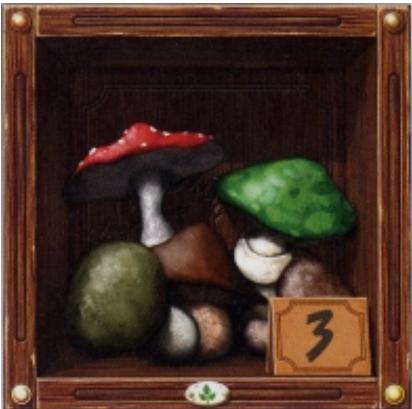
Variant for 3 players
First, you need a third playing piece, which you place next to one of the two remaining vacant corner spaces. This playing piece should be in one of the remaining colors (purple, brown, green, gray). The normal course of the game and the scoring remains unchanged.
The action "explodierender Kupferkessel" (exploding copper kettles) means that the active player may remove each of the other players' top cards.
If you want to play with the extra Recipe cards, you should remove the +15 and +5 bonus cards, leaving only the +10 bonus cards. From these, remove the "three cards from at least three plant ingredients” card. That will leave 5 cards, from which each player gets one card face-down.
Goldsieber, 2001
Designed by Günter Burkhardt
Graphics by Franz Vohwinkel
English translation by Pitt Crandlemire
Images and Translation brought together by Nick Pitman

Kupferkessel Co.
for 2 players from 6 years
A hearty welcome to the Copper Kettle Company, the business for quality conscious witches and wizards. Here you can find everything you need to give your magic potions and elixirs their greatest efficacy!
Components
56 Ingredients cards (14 different ingredients, each numbered 1 to 4)
4 Corner cards
2 Overview cards
13 Recipe cards
2 player pawns
1 rules booklet

Before the first game, use a pair of sharp scissors to carefully cut out the Corner cards at the dotted lines.

Set-up
• The 56 Ingredient cards are shuffled face-down. They are then laid out face-up, one by one, into a 6 x 6 grid. The four corners of the grid are left vacant, however, so that there will be a total of only 32 Ingredient cards in the final grid. The remaining Ingredient cards are placed as a face-down Ingredient deck next to the grid.
• Now place the 4 Corner cards into the vacant corners, so that the grid is now completely filled. One pawn is set next to each of two of the Corner cards, diagonally opposite each other.
• Each player gets an Overview card and a playing figure. The players place their pawns next to the Corner cards with the illustration of the figure of their color.
• Now each player draws another card from the Ingredient deck and places it face-up in front of himself. If either card shows an ingredient with a black or white symbol, that player places it under the deck and draws another, repeating this process as necessary until he draws a card with a color other than white or black. Should this card have a symbol in the lower left corner, ignore it at this stage.
The player will place all further Ingredient cards that he gets in the course of the game on this first card. This storage stack is thus known as that player's Magic Kettle.

• The player with the white pawn begins.
• The 13 Recipe cards are only used in the variant game, so they go back into the box for now.
Goal of the game
In alternating turns, the players gather ingredients and put them on their storage stacks, the Magic Kettles.
Each player tries to collect as many ingredient cards as possible. Players are only able to see the topmost ingredient in their kettle, however, so they must try to remember which ingredients they have already collected. Otherwise there will be unpleasant surprises at the end of the game because solitary Ingredient cards score a penalty. It is recommended that players familiarize themselves with the scoring rules before the first game. They are described later in these rules. The overview cards can serve as a reminder of the scoring. At the end of the game, the player with the most points wins.
Course of the game
Moving pawns
On his turn, a player must move his pawn clockwise around the outer edge of the card grid. Pawns must be moved exactly as many spaces as the number shown on the topmost Ingredient card of that player's Magic Kettle. Each Ingredient card in the
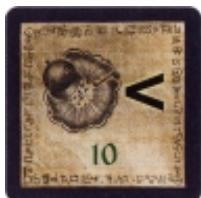
If you have fewer ingredients with the exploding kettle symbol than your opponent, you get a bonus of 10 points.
If you have more or the same number of cards with this symbol as your opponent, you don't get the bonus.
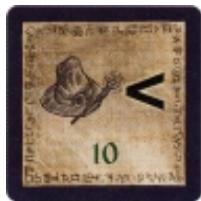
If you have fewer ingredients with the magic wand and magic hat symbol than your opponent, you get a bonus of 10 points.
If you have more or the same number of cards with this symbol as your opponent, you don't get the bonus.

If you have at least three cards from at least three different plant ingredients, you get a bonus of 10 points.
The bottom edge of ingredients cards that count as plants show a symbol with a leaf.
There are 5 different types of plant ingredients: Roots (gray), Mosses (blue), Fungi (brown), Pumpkin (green), and Vines (lilac).

If you have fewer Ingredient cards than opponent, you get a bonus of 10 points.
For this purpose, only the number of Ingredient cards and not their value is important. If you have more or the same number of cards as your opponent, you don't get the bonus.
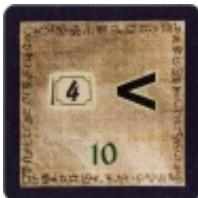
If you have fewer Ingredient cards with the value 4 than your opponent, you get a bonus of 10 points.
If you have more or the same number of cards of value 4 as your opponent, you don't get the bonus.
Variant
In the variant, the Recipe cards are added. The 5 blank Recipe cards are not used and should be placed back into the box. Players can use them to make up their own recipes.
The 13 remaining Recipe cards are shuffled face-down and then set-up progresses as in the basic game.
Once set-up is complete, each player gets two face-down Recipe cards, which they examine without revealing them to the other player. These cards show additional tasks. If the relevant player has completed the task at the end of the game, he gets the indicated number of bonus points in addition to his normal scoring. If the player doesn't complete the task, there are no penalties.
Through use of the Recipe cards, the colors of the ingredients and the collected symbols now have meaning during scoring.
The Recipe cards


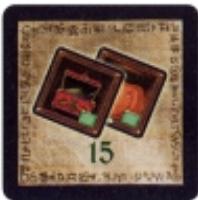
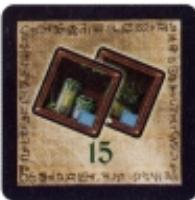
You must have at least three cards from both ingredients in this color. Bonus = 15 points. Whenever two different ingredients are required, they will always be in the same color.


You must have at least three cards from one ingredient in this color. The bonus is 5 points.

If you take the last card from a row and finish the game, you get a bonus of 10 points.
It doesn't matter if you put the card in your kettle or simply discard it.
outer edge and each Corner card counts as one space.
Only one pawn may land on or stop next to each card. If a pawn comes to a space with the opposing player's pawn, it skips over that space without counting it for movement.
Taking Ingredient cards
Once movement is complete, the active player must take a card from the row which his pawn is next to.
This card is placed face-up in his Magic Kettle, on top of and completely covering all cards underneath it.
If, at the end of movement, a pawn is next to a Corner card, that player doesn't get to take an Ingredient card and his turn is finished.
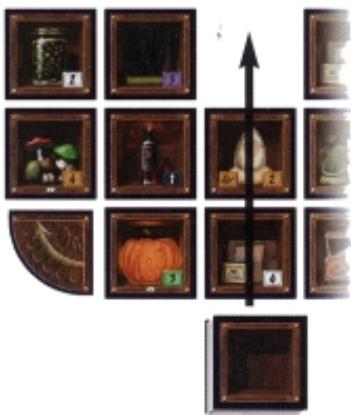
Example:

The Black player has the Pumpkin 4 as the topmost ingredient in his kettle. He moves his pawn 4 spaces as a result. He skips over the white pawn without counting it as a space. Then he takes a card (marked in the diagram with a white "X") from the row where his pawn is now sitting and puts it face-up as the top card in his kettle.
Some Ingredient cards show a symbol in the lower left corner, either an exploding kettle or a magic wand and magic hat. These symbols allow the player who takes the card to execute a special action. He must announce to the other player, however, that he has taken such a card and is using the special action. If he forgets or chooses not to use the special action, it is forfeited.
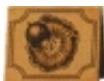
Exploding kettle
The other player must take the topmost Ingredient card in his Magic Kettle and place it face-down under the Ingredient deck. When doing this, he
must be careful not to shift the cards in his kettle because he is not allowed to look at any of them except the new top card.
If the Ingredient deck has been exhausted, the card is removed from the game instead.
Note: If the other player only has a single card in his kettle, it may not be taken away from him!
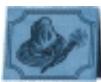
Magic wand and magic hat
The player ends his turn and then immediately takes another one.
2 Note: A player may not take more than two turns in a row. Thus, even if a player takes a second magic wand and magic hat card after the first, the other player still gets to take the next turn.
Replace the Ingredient card
Now the active player draws the top card of the Ingredient deck and places it face-up into the empty space on the card grid. His turn is then finished and the other player takes a turn.
If the Ingredient deck has been exhausted, the empty space remains empty.
End of the game
If the Ingredient deck has been exhausted, no more cards can be added to the empty spaces. As a result, more and more gaps will appear in the grid.
The game ends when a player takes the last card from any row. In this situation, this player has the choice to either keep the card and add it to his kettle or to refuse the card and simply discard it.
If this card shows a symbol, the action is not executed, whether the player keeps the card or not.
Scoring
Now the players get plus points for their collected ingredients - and minuses...
The player with most points wins.
Altogether there are 14 different ingredients. In each ingredient, there are four cards with a value from 1 to 4. The value of each Ingredient card is shown in the lower right corner.
In order to make scoring easier, the players sort the cards from their kettle first by type of ingredient and then by value within each ingredient.
When playing without Recipe cards, the symbols and colors have no meaning, with the exception of black and white.

The player with most Ingredient cards of value 1 gets 5 points. If both players have an equal number of cards of value 1, no one gets the points.
All Ingredient cards in the player's own color (black or white) score double their value.
Ingredients for which you have only a single card score a penalty equal to the value of the card.
Ingredients for which you have two cards score no points.
Ingredients for which you have three cards score the sum of the values of the cards.
Ingredients for which you have all four cards score the sum of the values of the cards plus a bonus of 5
Example: The White player has these cards in his kettle at the end of the game:


2 x (1 + 2 + 3 + 4) +5 = +25

2 x (-3) = -6
1 + 2 + 4 = +7
0
Since the Whiskers and the Eye of Newt are ingredients in the White player's color, they count double. The bonus for having all four Whisker cards is not doubled. So, the White player has a total of 26 points.
下载 Markdown原文为社区整理/出版社公开资料,版权归原作者,仅供个人学习查阅。