
Last LightLast Light
一句话概览
Last Light 是一款已收录于村了吗规则库的桌游,支持 1–4 人,原名 Last Light。
本页内容:一句话概览 · 常见问题
这游戏怎么玩
- 本站已收录这款游戏的规则资料,可以在对话里直接提问规则细节。
常见问题(FAQ)
以下 1 条问答中 0 条来自站内玩家的真实提问,其余 1 条为本站整理的常见疑问;答复内容保持原样。
Last Light支持几个人玩?
1–4 人。
去哪查完整规则
想核对具体规则细节、卡牌效果或某个回合的结算方式,可以在村了吗里选中这款游戏后直接提问。
同类桌游
- 卡坦岛德式
- 工业革命:伯明翰德式
- 勃艮第城堡:特别典藏版德式
- 方舟动物园德式
- 卡卡颂抽象
- 瘟疫危机传承:第一季美式
- 阿瑞迪亚:勇踏征途美式
- 重塑宇宙德式
- 幽港迷城美式
- 埃多拉的德鲁伊德式
规则原文(Markdown)
本站收录这款游戏的规则原文 1 个文件,此处内联渲染 1 个,可直接展开阅读或下载。
LastLight2ndEdFinal.md33.4 KB
LASTLIGHT
BILLIONS OF YEARS IN THE FUTURE, WHEN MOST OF THE STARS HAVE DIED, ONLY RARE WHITE DWARFS REMAIN—THE LAST LIGHT IN THE UNIVERSE.
LAST LIGHT
Last Light is a fast-paced 4X game with simultaneous turns for 2-4 players.
Take on the roles of alien factions racing to control the last light in the universe. Research technologies, mine and trade resources, build ships and extractors, and harvest light to get ahead of your competitors. The first player to collect 20 light wins the game!
COMPONENTS

1 ROTATING GAME BOARD

4 PLAYER BOARDS

4 COLONY SHIP TOKENS
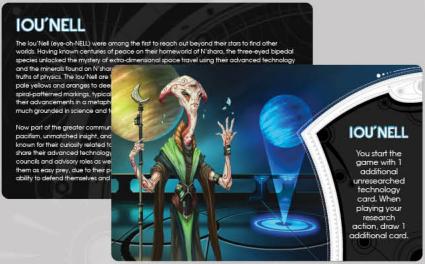
15 ALIEN FACTION CARDS

24 ACTION CARDS 〔6 for each player]

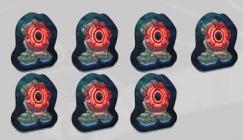
7 ASTEROIDS
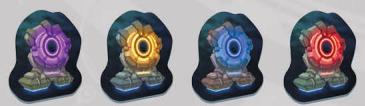
32 EXTRACTORS [8 for each player]

20 SMALL SHIPS (5 for each player]

12 MEDIUM SHIPS [3 for each player]
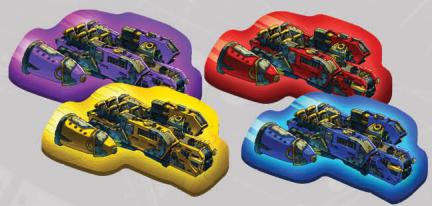
8 LARGE SHIPS [2 for each player]

15 UNIQUE PLANETS

1 WHITE DWARF STAR
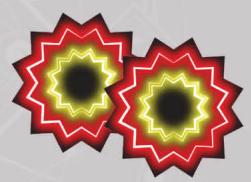
20 DAMAGE TOKENS

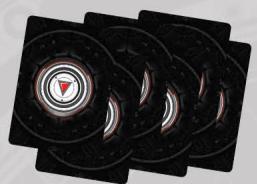
15 PLANETARY ID TOKENS
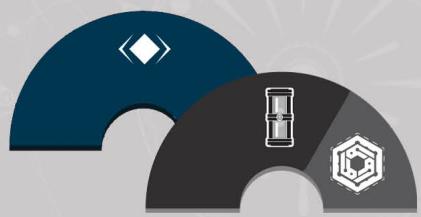

19 COMMON PLANETARYEXPLORATION TOKENS
14 RARE PLANETARY EXPLORATION TOKENS

12 DEEP SPACE EXPLORATION TOKENS
16 PLANETARY ACHIEVEMENT CARDS [4 for each player]

1 FIRST PLAYER TOKEN

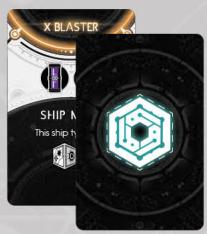

83 TECHNOLOGY CARDS
4 REFERENCE CARDS


4 GRAVEYARD CARDS

6 CUSTOM DICE

20 ATTENTION TOKENS

30 GREY COMMON RESOURCES
15 LARGE LIGHT CRYSTALS (value 5]


15 PURPLE UNCOMMON RESOURCES

15 SMALL LIGHTCRYSTALS(value 1)
15 ORANGE RARE RESOURCES
For most components, the numbers listed are what we've asked the manufacturer to include in each copy but are more than you actually need in order to account for manufacturing variance (or in case your dog eats one]. If you find your counts are over or under by a couple of pieces, in most cases, your game will still be completely playable as intended.
SETUP
Give each player the following components in their chosen color:
5 small, 3 medium, and 2 large ships
8 extractors
1 colony ship
6 action cards


Also give each player:
1 set of planetary achievement cards (1 of each color)
2 alien faction cards (Note: some alien faction cards are labeled 3+ and should be removed when playing with 2 players.]
1 graveyard card (with the correct side face up, according to the number of players in your game)

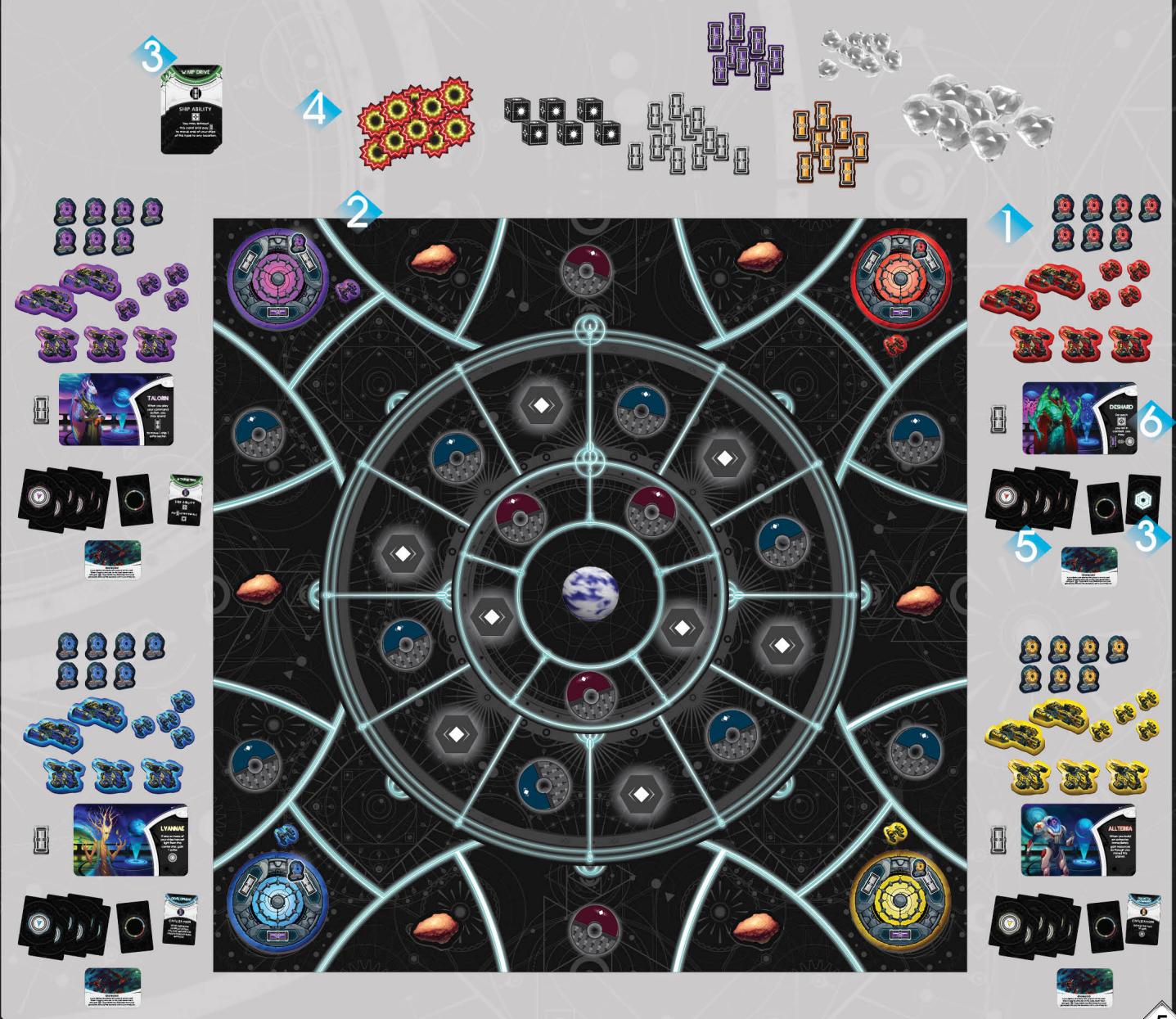
2 Set up the game board according to the number of players as pictured on pages 6,7 and 8. Any unused tokens should be returned to the box.
The planets (along with their planetary ID tokens) should be randomly distributed to their locations as shown on the map.
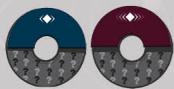
The planetary exploration tokens should be shuffled in two face-down piles according to their type, then assigned face down to their locations as shown on the map.
Randomly distribute the deep space exploration tokens face down to their locations.
Then place the asteroid tokens and the players' colony ship tokens.
Lastly, each player places one small ship in their starting sector and an extractor on one of the common resource spaces (grey) on their colony ship token.
PLANETARY TERMINOLOGY Inner Planets - planets on the small inner ring. Outer Planets - planets on the large middle ring. Distant Planets - planets not on either ring.
HOW DO I SET UP PLANETS RANDOMLY?! Due to the fact that most of the planets in Last
Light move over the course of the game, the effect of any given planet's starting location on the
balance of the game is negligible. Don't overthink it.
3 Shuffle the deck of technology cards and place it near the board face down. Then deal 1 technology card to each player.
4 Place the resources, damage tokens, and dice near the board within easy reach of all players.
5 Each player secretly and simultaneously chooses 1 planetary achievement card and 1 alien faction card to keep. The rest are returned to the box face down.
6 All players reveal their alien faction card.
Give the first player token to the player who most recently looked at the stars.
You are now ready to begin!
is a combination of the random planet icon and the appropriate planetary exploration token icon.


COLONY SHIP

WHITE DWARF

PLANET (random)

ASTEROID

KEY

COMMON PLANETARY EXPLORATION TOKEN (face down]
RARE PLANETARY EXPLORATION TOKEN (face down)

DEEP SPACE EXPLORATION TOKEN (face down)
Stacked random planet + appropriate planetary exploration token


COLONY SHIP

WHITE DWARF

PLANET (random)

ASTEROID

KEY
COMMON PLANETARY EXPLORATION TOKEN (face down]

RARE PLANETARY EXPLORATION TOKEN (face down)

DEEP SPACE EXPLORATION TOKEN (face down)

Stacked random planet + appropriate planetary exploration token
NOTE: The 2-player game uses the variant rules on pg 15. We recommend you familiarize yourself with the standard rules before reading the variant rules.


COLONY SHIP

WHITE DWARF

PLANET (random)

ASTEROID

KEY
COMMON PLANETARY EXPLORATION TOKEN (face down)

RARE PLANETARY EXPLORATION TOKEN (face down)


DEEP SPACE EXPLORATION TOKEN (face down)
Stacked random planet + appropriate planetary exploration token
WINNING THE GAME
The game ends at the end of a round when at least one player has 20+ light. Whoever has the most light at the end of the game wins.
PLAYING THE GAME
Turns in Last Light are played simultaneously. Only the Command action card must be resolved in player order, beginning with the player holding the first player token and proceeding clockwise.
Each round, players simultaneously choose a single action card to play then take the action(s] on that card. Your played action cards stay on the table until you play your Refresh card. Refresh cards stay on the table until all players have played their Refresh.
NOTE: Players always get an action. If–at the start of a round-you have no action cards in your hand, pick up all your action cards except Refresh.
After the last Refresh has been played, and all players have finished their actions, each player takes their Refresh card back and the board is rotated according to the end of round instructions (pg 14).
Each action card has a unique effect listed below. Though most actions can be resolved simultaneously, if there is ever a conflict with regards to the timing resolution of actions or technologies, the player with the lower number on their played action card resolves theirs first. If the conflict occurs between players who both played the same action card, resolve beginning with the player holding the first player token and proceeding clockwise.
OVERVIEW
Your alien faction will travel the galaxy and collect the needed supplies to secure the most light by the end of the game. The following is a brief description of what each action will do for you.
-
RESEARCH: Gain new technologies to enhance your other actions
-
MINE: Gather resources from your extractors
-
CONSTRUCT: Build ships and extractors
-
TRADE: Exchange your resources for other types of resources
-
REFRESH: Return all previously played action cards and gain light
-
COMMAND: Move your ships and attack enemy ships

ACTION CARD #1 - RESEARCH
Research is broken into two parts (Research & Manufacture Technologies] which are resolved in order.
1. RESEARCH

Gain 1 for every 4 technology cards you have in play. Then, draw 3 technology cards from the technology deck and add 2 to your hand as unresearched technology cards. The other card is discarded face up next to the technology deck. If you should draw a technology card but the technology deck is empty, shuffle the technology discard pile and create a new technology deck from which to draw.
2. MANUFACTURE TECHNOLOGIES
Play any number of unresearched technology cards from your hand by paying the costs indicated in the center of those cards. Resources paid to manufacture technology cards are returned to the supply.
There are 3 types of technology cards which are each put into play in a slightly different way:
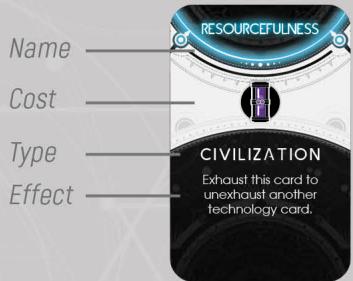
Civilization technology cards are played face up near your player board. If a civilization technology says to exhaust when you use it, flip it over until you play your Refresh card. If it does not say to exhaust when you use it, its effect is always on once you have it in play. There is no limit to the number of technology cards you may have in your hand or play area. No player may have two civilization technologies with the same name.

Ship ability technology cards are played on your player board to the left of the ship type they are modifying (see the example board below]. Many of these cards require a player to rollwhen attacking with a ship of the associated type in order to activate their effect. Each ship type may only have one ship ability. Playing a ship ability on a ship type that already has one causes the previously played technology card to be discarded.
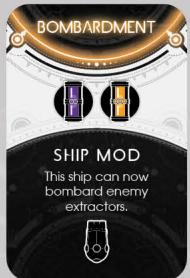
Ship mod technology cards are played beneath the ship depicted on your player board and slid under the board so that only the effect icon remains visible.
Ship mods give a permanent upgrade to all ships of the associated type. These mods can give ships additional movement , additional shields or additional attacks
Small ships may hold 1 ship mod. Large ships may hold 3 ship mods.
Medium ships may hold 2 ship mods.

The player owning this board has a ship mod attached to their small ships that affects all (and only] their small ships. They also have a ship ability that activates when one of their medium ships rolls ain combat. Their medium ships have two mods.
ACTION CARD #2 - MINE
Collect a resource from the supply for each extractor you have on the board.
To see what resource is collected from planets, consult the planetary exploration token associated with the planet
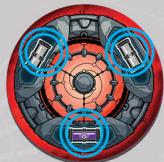
To see what resources are collected from your colony ship, consult the icons in any sector of your colony ship containing an extractor.
ACTION CARD #3 - CONSTRUCT
Construct is broken into two parts (Ships & Extractor] which are resolved in order.

1. SHIPS
To build a ship, pay the cost indicated on your player board for the ship type you would like to build. You can build as many ships as you can afford to pay for. Built ships are placed in your home sector (the sector which contains your colony ship]. Resources paid to build ships are returned to the supply.

*If you wish to build a ship that is in an opponent's graveyard, you must pay the ship build cost to that opponent instead of the bank and return the ship from their graveyard to play. You cannot build an extractor from an opponent's graveyard.
2. EXTRACTOR
Place an extractor either on a sector of your colony ship that does not yet contain an extractor or in the sector of a planet containing only your ships and not containing a previously built extractor belonging to any player.
You may only build a single extractor with this action.
Building an extractor does not require you to pay any resources.
A planet is considered to be controlled by the player who has an extractor on that planet.
ACTION CARD #4 - TRADE
Choose 2 of the following actions to perform. You may choose the same action twice.
Gain 1
Trade 2 for 1 (or 1 for 2 )
Trade 2 for 1 (or 1 for 2)
Trade 2 for 1

After choosing your two actions, choose 1 other player to gain 1from the supply.
ACTION CARD #5 - REFRESH
Refresh is broken into two parts (Refresh & Claim) which are resolved in order.
1. REFRESH
Ready all of your exhausted technology cards and alien faction cards by flipping them face up. Remove all damage tokens currently on your ships. Pick up all your previously played action cards and return them to your hand. (Your Refresh card stays on the table.]
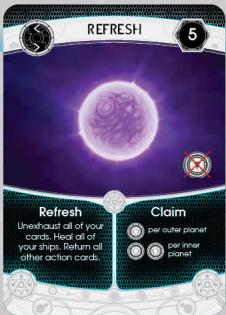
2. CLAIM
Collect light from the general supply for each of the following:
Collect 1 light for each extractor you have on a non-blockaded* planet on the outer ring.
Collect 2 light for each extractor you have on a non-blockaded* planet on the inner ring.
*A planet is considered blockaded if any ships of a different color than the extractor occupy that sector.
A played Refresh card cannot be returned to your hand by card or explore effects (indicated by this symbol ]. Played Refresh cards stay on the table until all players have played their Refresh cards, at which point a rotation occurs. This is covered in the end of round section below.
ACTION CARD #6 - COMMAND
Command is broken into two parts (Move & Attack). Each of these steps is resolved independently and in turn order beginning with the player holding the first player token and proceeding clockwise.
1. MOVE

You may move each of your ships. Ships of every size can move into 1 adjacent sector by default. Ship mod technologies can increase a ship type's movement. (Reminder: Medium ships can hold 2 ship mod technology cards & large ships can hold 3 ship mod technology cards, so it is possible that a ship moves through multiple sectors.)
Ships cannot enter a sector containing an asteroid. Ships cannot move to a sector that is connected to their current sector only by a diagonal corner.
Ships can freely enter and exit all other sectors.
After moving all of your ships, reveal any deep space exploration tokens or planetary exploration tokens in sectors you now occupy with ships. Tokens can be revealed in any order you choose but you must reveal them one at a time and completely resolve the effect of a revealed token before moving on to the next one.

Deep space exploration tokens are removed from the board after they have been resolved.
Resource collected when you mine this planet —

Effect earned immediately when token is revealed
Planetary exploration tokens remain on the board as they depict what resource their associated planet produces when mined.

Exploration Icons Explained


You may pick up an action card other than the Refresh card.

Draw one tech card and put it in your hand.
You may immediately build an extractor on this planet.

You may take a trade action, making one trade only.
Immediately build a small ship in this sector (if you have one unbuilt in your supply).

You may move one of your ships to this sector.

Gain resource(s) of the type shown.


Gain a light.
Manufacture a tech card from your hand without paying its cost.
2. ATTACK
All players that chose Command must finish their movement before the attack phase occurs; at which point, all ships controlled by those players may attack. Ships may attack even if they did not move. Ships without bombardment can only attack if there is an enemy ship present. Ships with bombardment can attack if there is an enemy ship or extractor present. The ships controlled by players that did not choose
by sector. The player holding the first player token chooses the order in which the sectors are resolved.
Attack rolls should be in turn order, but all damage is resolved simultaneously. A ship that takes enough damage to be destroyed will still roll attack dice before being removed from the board.

Each small ship rolls 1 attack die by default.
Each medium ship rolls 2 attack dice by default.

Each large ship rolls 3 attack dice by default.
(These numbers may be altered by ship mods or other technology cards)
Players may roll for their ships in any order. Dice should be rolled for all ships of the same type simultaneously. Since your ships are likely to have different abilities, refrain from rolling dice for different ship types together. Attacking is optional, but once you have rolled attack dice, assigning all rolled damage is mandatory.

Range - the range a unit can fire. Range 1 can only attack in the same sector. Range 2 can attack in adjacent sectors.
Combat Icons Explained:
Damage is assigned to targets by the player rolling the dice.
Shields - the amount of damage a unit needs to take to be destroyed.
Place a damage token beneath a ship for each damage it receives.

Any ship which receives damage equal to its shields is destroyed and placed on the graveyard card of the player who assigned the final damage.
Attack - the number of dice a unit rolls in combat.
Extractors may be targeted by ships with bombardment but only if there are no enemy ships remaining in the sector.
Bombardment - Hits from this ship can destroy extractors (but only if there are no enemy ships remaining).

ATTENTION TOKENS Combat is the most complex
phase of the game. The included attention tokens are provided for your use to help remember things that you might forget while resolving this phase. The
most common uses are to place them in a sector to indicate that combat has already been resolved there or to place them under a ship who has a
technology they need to activate.
Combat Dice Results Explained:

Miss


Deal 1 damage
Deal 1 damage and activate the ship ability associated with this ship type (if possible]
Activate the ship ability associated with this ship type (if possible)
Note: As long as activating a ship ability does not cause it to exhaust, you can activate it multiple times with multiple activation symbols.
Note: Sometimes technology cards can cause a ship to move after it has participated in combat. Each ship may only participate in 1 combat per turn unless the technology card specifically states otherwise.

Deal 1 damage
and roll another
combat die,
applying its result (this can result in a series of dice being added if the
appears multiple
times in a single
combat).
Graveyard
When you destroy an enemy ship or extractor, place it in your graveyard. As soon as you have 4 units in your graveyard, gain 1 light from the supply and return the units to their original owners. (In a 2-player game, you gain 2 light as soon as you have 4 units in your graveyard.)

Graveyard If you destroy an enemy unit, place it on this card. When 4 enemy units are on this card, return them and gain . Opponents may Build ships from your graveyard, but pay the resource cost to you if they do.
END OF ROUND
A game round ends after every player has resolved their played action card.
During the end of round phase, check to see if the board needs to be rotated then check if the game ends. If the game continues, the start player token passes clockwise to the next player.
BOARD ROTATION
If all players have their Refresh card on the table, rotation occurs.
The inner ring rotates 90 degrees clockwise.
The outer ring rotates 45 degrees clockwise.

Align the to the next clockwise position to ensure the board is rotated properly.
When the board rotates, each player collects 1 light from the supply for each ship they have in the center sector (the one containing the white dwarf star] regardless of the ship type.
When the board rotates, the first player token is passed to the next player clockwise.
Finally, all players pick up their Refresh cards.

GAME END
If any player has 20+ light at the end of a round, the game ends.
The player with the most light wins the game.
If there is a tie, the tied player with the most Technology cards in play is the winner.
If multiple tied players have the same number of technology cards in play, then the player among them who has the most resources wins the game.
When playing with 2 players, you must have at least 1 action card already played (i.e. on the table) before you can play your Refresh card.
Additionally, 2-player games include a non-player faction called "The Lumos."
During setup, select an unplayed color to act as the Lumos and set their ships next to the game board. The Lumos will need no components other than their ships.
Add 2 small Lumos ships to the center sector of the game board (in the sector containing the white dwarf star).
Every time the board rotates, add 2 more ships to the center sector. Add the two smallest ships available.
When Lumos ships are destroyed they go to the player's graveyard as normal. When they are removed from the graveyard, they are returned to the box. They are never added back to the Lumos' supply. If you run out of ships to add to the center sector, no new Lumos ships will join the game.
The Lumos are allied to whichever human player has the least light. If players are tied for light the Lumos are not allied to any player.
Lumos ships blockade planets of the player(s) they are not allied with.
When an allied player plays the Command card, they may command the Lumos ships as well.
Lumos ships do not reveal exploration tiles when entering a sector that contains them.
Lumos ships do not use your faction ability-they are their own faction.
When attacking with Lumos ships, roll separately from your own ships as Lumos ships do not use technologies associated with your civilization or your ships-they attack only using the base stats associated with their ship size.
Ships destroyed by Lumos ships that you are controlling do go to your graveyard.
The Lumos change allegiance only at the end of an action card resolution. (e.g. If you were to discover a light during the move portion of command that would tie you with the other player, you would still finish commanding all the Lumos before the alliance ended.)
TIMING: Most questions we receive about how to play last light involve some variation of "how precisely should I time the resolution of my tech card / faction ability / etc.?"
And the very specific answer to this is that players may execute their abilities and technologies during the resolution of their actions (either before or after the effect of their action card). Meaning players who played Research will resolve their actions (and the use of their technologies and faction abilities) before players who played Mine, who will resolve theirs before the players who played Construct, and so on.
Players who played the same action as each other technically resolve their actions, technologies, and alien faction effects in turn order - beginning with the player closest to the one with the start player token and proceeding clockwise.
But it is worth saying here, Last Light is not designed with turn based play in mind. In the vast majority of circumstances, effects that occur outside of the Command step will have little effect on other players and are designed to be done and resolved simultaneously. You must only adhere to the strictest timing resolutions on the rare occasions that there is a conflict between players about whose effect happens first.
Exploration Icons Explained

You may pick up an action card other than the Refresh card.

Draw one tech card and put it in your hand.

You may immediately build an extractor on this planet.
Combat Dice Results Explained

Miss

Deal 1 damage

Deal 1 damage and activate the ship ability associated with this ship type [if possible]


You may take a trade action, making one trade only.

Immediately build a small ship in this sector (if you have one unbuilt in your supply).

You may move one of your ships to this sector.
Activate the ship ability associated with this ship type (if possible)
Deal 1 damage and roll another combat die, applying its result (this can result in a series of dice being added if the appears multiple times in a single combat).


Strategy Tip: The best ways to gain light are to build extractors on planets and to have ships in the center sector when the board rotates. The best way to stop a leader is to work with other players to blockade their extractors and destroy their ships.


Gain resource(s) of the type shown.

Gain a light.

Combat Icons Explained
Manufacture a tech card from your hand without paying its cost.
CREDITS
Range - the range a unit can fire. Range 1 can only attack in the same sector. Range 2 can attack in adjacent sectors.
Shields - the amount of damage a unit needs to take to be destroyed.
Attack - the number of dice a unit rolls in combat.
Bombardment - Hits from this ship can destroy extractors (but only if there are no enemy ships remaining)
Game Design: Roy Cannaday Game Development: Joshua Lobkowicz Illustration: Clark Miller Graphic Design: Christian Strain & Jose David Lanza Worldbuilding: Kristin Devine Layout: Sarah Lafser Editing: Bryan Gerding
Playtesting: Kent & Courtney Parker, Callin Flores, Rob Newman, Trevor Roberts, Catch Fullwood, Kevin Ellenburg, Chris Yi, Mike DiLisio, Steven Huang, Crystal Dax, Jerry Hawthorne, Isaac Vega, Emerson Matsuuchi, Ruthie
Dominguez, Colby Dauch, Nate French, Chris Barr, Sam Healey, Rodger Moore, Lance Myxter, Mike Boseak, Jerry Lillie, Shannon
Pepitone, Keri Lawrence, Kurt Pankau, James Dunn, Luke Holmes, Christopher 'cignet' James, Chris Kluwe, Clemens Jurgschat
Chris Nelson, Patryk Rurek, Joshua Anderson, Veritas, bufferunderflow, William Newell, Kyle Kennedy-LeBlanc, Gwommy, Daniel Sloan, and many more at conventions and online who took the time to play without regard for credit. Thanks to you all!
原文为社区整理/出版社公开资料,版权归原作者,仅供个人学习查阅。