
法师战争:竞技场Mage Wars Arena
一句话概览
法师战争:竞技场 是一款已收录于村了吗规则库的桌游,支持 2 人,原名 Mage Wars Arena。
本页内容:一句话概览 · 常见问题
这游戏怎么玩
- 本站已收录这款游戏的规则资料,可以在对话里直接提问规则细节。
常见问题(FAQ)
以下 1 条问答来自站内玩家的真实提问,答复由本站依据规则资料作答;答复内容保持原样,仅对提问做了去口语化的轻微整理。
飞行生物在同区域攻击敌方生物后,敌方非飞行生物化可以在同区域通过近战攻击伤害到我的飞行生物吗?
结论
不能。 敌方那只普通非飞行生物不能在它自己的行动阶段用近战攻击打你的飞行生物——除非它拥有 Reach(触及) 特征。
规则原文的规定是:非飞行生物不能对飞行生物做近战攻击,除非它有 Reach 特征。近战攻击的前提是“目标必须与攻击者在同一区域”,但这一条对飞行生物不成立,同区域也不能近战打飞行生物。远程攻击则可以正常把飞行生物选为目标。
需要注意的例外窗口
- 你的飞行生物近战打非飞行目标时,会临时失去 Flying
这是唯一会让它被近战/反击打到的时机:
- 飞行生物要对非飞行生物做近战攻击,必须在该攻击行动结束前失去 Flying 特征(要俯冲进入触及范围);
- 因此在这次攻击行动进行期间,它按非飞行处理,会正常受到伤害屏障和反击(Counterstrike)的影响。
所以如果你用飞行生物冲进同区域并用近战打敌方非飞行生物,而这个敌方生物拥有带 Counterstrike 特征的快速近战攻击(或它正在 Guard),它可以在反击步骤反击你的飞行生物。
- 反击的限制
- 反击必须是该生物的快速近战攻击,且带 Counterstrike 特征;全行动近战或远程攻击不能用来反击。
- 一个生物对每个近战攻击它的生物只能反击一次,即使它有多重 Counterstrike 也不叠加。
- 反击是自愿的,可以放弃。
- 远程攻击跳过反击步骤。
- 其他补充
- 飞行特征不能在一次攻击行动中途获得或失去:如果某个生物在攻击行动进行中获得 Flying,整个攻击行动仍按它没有 Flying 来结算,攻击行动结束后才获得该特征。
- 所有生物对飞行生物始终有视线(LoS),反之亦然,所以不要指望靠“看不见”躲开远程攻击。
- 如果飞行生物自己去 Guard,则它在持有 guard 标记期间失去且不能获得 Flying 特征——这时它会被当普通生物对待。
一句话总结
同区域的敌方非飞行生物打不到你已结束攻击、恢复飞行的飞行生物;只有它自己有 Reach、或者你的飞行生物在俯冲近战的那一次攻击行动期间(可被反击、可被伤害屏障命中),才可能被近战伤害到。远程攻击则随时可以打飞行生物。
本内容仅供参考,如有冲突以说明书和身边大佬为准。
去哪查完整规则
想核对具体规则细节、卡牌效果或某个回合的结算方式,可以在村了吗里选中这款游戏后直接提问。
同类桌游
- 卡坦岛德式
- 工业革命:伯明翰德式
- 勃艮第城堡:特别典藏版德式
- 方舟动物园德式
- 卡卡颂抽象
- 瘟疫危机传承:第一季美式
- 阿瑞迪亚:勇踏征途美式
- 重塑宇宙德式
- 幽港迷城美式
- 埃多拉的德鲁伊德式
规则原文(Markdown)
本站收录这款游戏的规则原文 9 个文件,此处内联渲染 3 个,可直接展开阅读或下载。
96662_Druid+Necro+Rulebook+(Web).md19.2 KB
DRUID VS NECROMANCER
INTRODUCTION
Welcome to the Mage Wars®: Druid vs. Necromancer expansion set! In this set you'll find 2 Mage Cards, 2 Mage Ability Cards, 216 spell cards, 2 spellbooks, and a sheet of die-cut markers,
s well as these rules. You'll need the Mage Wars®: Core Set in order to play. With the spells included you will be able to construct both a Druid and a Necromancer spellbook, as well as develop new strategies for the original four Mages. We've even included recommended spell lists for the Druid and Necromancer. Your cards come organized in this same order for your convenience. Let's get started!
CREDITS
Game Design Bryan Pope Assistant Game Design Aaron Brosman, Alexander Mont Art Director John Guytan Layout & Design Chris Henson Playtest Manager Patrick Connor Cover and Mage Art Craig Spearing Production Manager John Rogers
Zac Belado
Marc Bennett
Lewis Bronson
Matthew Burch
David Chang
Martin Cubberley
Ray D'Arcy
John Cornelius Edmond
PLAYTESTERS
Justin Matthew Emanuele
Rafael Fuentes
Andrew Michael Glass
Harry E. Gloss
Joshua Hughes
Adam Humpolick
Matthew Humpolick
Tim McCurry
Dylan McInnis Matt Mclnnis John Milligan Jerome Minter II Dalius Rupainis Daniel Stegner Stephen Walters Daniel M Ward III
THE DRUID
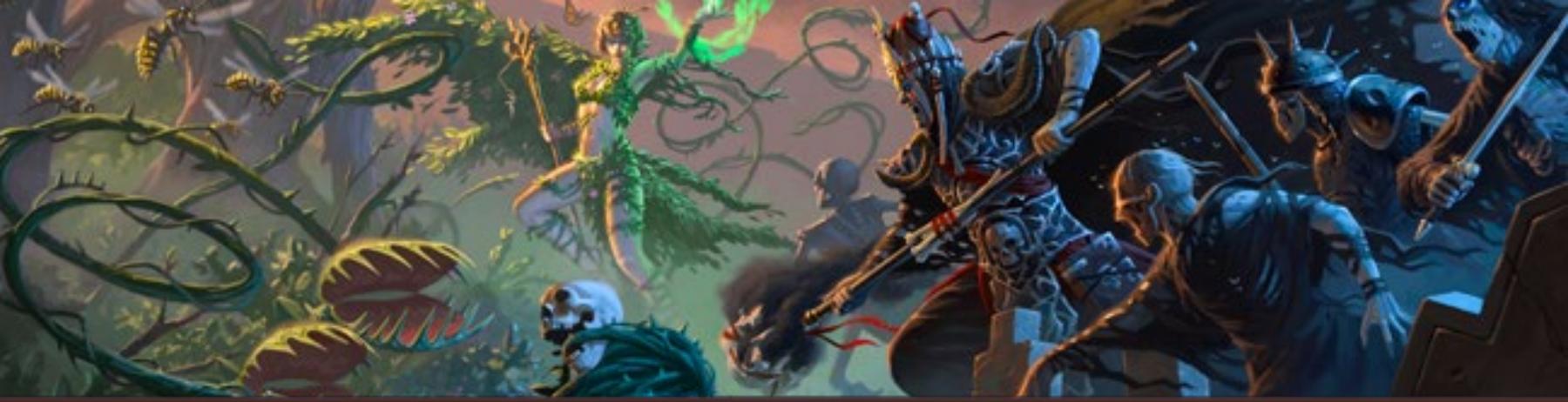
We have tended our groves for centuries beyond remembrance. We are stewards of life itself, in its most powerful form. The tiniest seed can sunder boulders, and it answers our call. Unleashing the savagery of beasts is nothing compared to unleashing the vengeance of the forest itself. Life cannot be stopped.

Druids cover the arena with various vines and plants. Their spreading vines explode into showers of thorns and carnivorous plants. Using a basic knowledge of water spells, Druids support their plants until their opponents are consumed. Everyone returns to the earth to nurture nature, whether they wish to or not.
Attributes
The Druid has a Channeling rate of 9, a life of 30, and a basic melee attack of 3 dice. Her subclass is Wychwood.
Training
The Druid is trained in the Nature school. As part of her mastery of all plant-life she is also trained with level one Water spells. As their destructive natures work against all of the life the Druid sows, she must pay triple for any Fire and War spells during spellbook creation.
SPECIAL ABILITIES Spreading Vines
Life springs up in the footsteps of the Druid. Each Deployment Phase, the Druid may place a new Vine marker in her zone. Or, she may instead place that marker in a zone, or adjacent to a zone, containing a Vine marker she controls.

The Druid, and her spawnpoints and familiars, can use her Vine markers to extend the range of vine spells they cast. See “Vine Markers” in the codex.
Treebond
A Druid is only as strong as the forest she protects. When a friendly tree conjuration comes into play she may bond with it, placing her Treebond marker
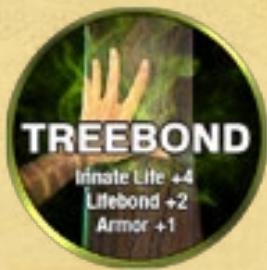
on it. This bonding makes both the tree and the Druid stronger. The Druid gains Innate Life +4 and Channel +1. The tree gains Innate Life +4, Armor +1, and Lifebond +2. This allows the Druid to constantly transfer damage between herself and her bonded tree. When the tree is destroyed the bond is lost along with all benefits, and the marker is permanently destroyed.
THE DRUID'S SPELLBOOK
| EQUIPMENT | 1 Druid's Leaf Ring 1 Meditation Amulet 1 Mohktari's Branch 1 Veteran's Belt 1 Vinewhip Staff 3 Bloodspine Wall |
| CONJURATIONS | 3 Corrosive Orchid 1 Etherian Lifetree 1 Mohktari, Great Tree of Life 3 Nightshade Lotus 1 Samara Tree 4 Seedling Pod 3 Stranglevine 2 Tanglevine 1 Vine Tree |
| CREATURES | 1 Devouring Jelly 1 Kralathor, The Devourer 4 Raptor Vine 3 Spitting Raptor 1 Tataree 1 Togorah, Forest Sentinel 3 Thornlasher 3 Vine Snapper |
| ENCHANTMENTS | 1 Barkskin 1 Stumble 4 Burst of Thorns |
| INCANTATIONS | 1 Dispel |
| ATTACKS | 3 Renewing Rain 4 Acid Ball |
When using this spellbook, the first thing you will want to do is pick which tree you want to bond with. Any of the four trees present are excellent. Each of the different trees has a dramatically different playstyle. After that, if you've bonded with the Vine Tree or Samara Tree, casting a Meditation Amulet to power the mana for those trees is a fantastic play. In general, the Druid wants to spread across the arena and spring her plants up right where she needs them.
THE NECROMANCER
The Bog Queen stirs in the Darkfenne. Death has returned to Etheria, and we are the reapers. The unholy tides of undeath sweep across the land, and each that falls before our blight will rise in our service. We bind the fallen to our will and march forward to offer the souls of the living to our unholy Queen.

Necromancers master the dark arts. They raise skeletons and zombies from the dead and unleash them upon the living. From his graveyard and book of the dead, he constantly summons an unending torrent of the risen dead. Who can stand against a wave of flesh and bones?
Attributes
The Necromancer has a channeling of 10, a life of 32, and a basic melee attack of 3 dice. His subclass is Darkfenne.
Training
The Necromancer is trained in the Dark school, and thus is privy to the most blasphemous rituals. As such, he finds Holy spells much harder to prepare, and pays triple for them during spellbook creation.
SPECIAL ABILITIES Plague Master
Death is the ally of a skilled Necromancer. They spend their time perfecting diseases to spread amongst the peoples of Etheria. The benefit of this study is two-fold: First, studying plagues has granted the Necromancer the Poison Immunity trait. Secondly, during the Upkeep Phase, for each object that has one or more poison condition markers on it, the Necromancer may pay 1 mana to place 1 direct poison damage on that object.
Eternal Servant
Plagues are but one aspect of death. Through his blasphemous studies, the Necromancer can make a single undead creature truly undy-
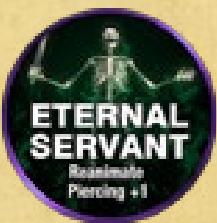
ing. When summoning a non-Legendary non-Epic undead creature, the Necromancer can make it his Eternal Servant and places the Eternal Servant marker on it. All of the creature's attacks gain the Piercing +1 trait. Then, should the servant be destroyed, the Necromancer may Reanimate the creature by paying its casting cost. The servant returns to play at the end of the round (see “Reanimate" in codex). You can assign the Eternal Servant marker to it, or hold the marker to place on another undead creature later.
| EQUIPMENT | 1 Cloak of Shadows 1 Death Ring 1 Deathshroud Staff 1 Libro Mortuos 1 Meditation Amulet 1 Wand of Healing |
| CONJURATIONS | 1 Altar of Skulls 1 Graveyard 3 Wall of Bones 1 Ziggurat of Undeath |
| 3 Acolyte of the Bog Queen 2 Deathfang 2 Grey Wraith 1 Mort 2 Plague Zombie 1 Ravenous Ghoul 1 Shaggoth-Zora 2 Skeletal Archer 2 Skeletal Knight 5 Skeletal Minion 1 Unstable Zombie 2 Venomous Zombie 2 Zombie Brute | |
| ENCHANTMENTS 2 Rise Again INCANTATIONS | 4 Zombie Crawler 4 Zombie Minion 2 Animate Dead 1 Dispel |
| 1 Dissolve 3 Reassemble 1 Unholy Resurgence 1 Zombie Frenzy 2 Acid Ball |
This build allows you to choose zombies or skeletons. Both have powerful incantations (e.g. Reassemble, Zombie Frenzy) and amazing late game cards (e.g. Altar of Skulls, Ziggurat of Undeath). Once you pick a side, stick with it. Put synergy into one side or the other, but not both. Keep in mind that the Necromancer has two spawnpoints, so there should be no shortage of casting actions. Your only bottleneck is how much mana you generate. Don't hesitate to meditate if it keeps both spawnpoints running.
NEW RULES
Conjuration Attack Actions
If a conjuration has an attack bar, then once per round, before or after any friendly creature's Action Phase, it can make that attack. Use a ready marker to keep track of making that attack. Unless the spell text says otherwise, you can make the attack once per round, and the conjuration can make its attack the same round it comes into play.
Destroyed
When an object is destroyed, everything attached to it is destroyed and discarded. This includes damage, condition markers, tokens, enchantments, and conjurations. Ability markers are returned to the Mage. Then, the object is placed in its owner's discard pile. The object may then resolve a “destroyed" effect. For example, a Plague Zombie will explode. Some effects replace being discarded such as Cantrip or Obliterate.
Spell School Training
A mage pays spellpoints equal to the level of any spells they're
trained in when building their spellbook, and double the level for any untrained spells.
Example: Druid's are trained in level one Water spells. She pays double for any Water spells above level one, as normal. Level one Water spells will cost one spellpoint, but level three water spells will cost six.
If a spell has the “X School Only” trait, only a Mage trained in that school, up to that level or higher, can use that spell.
Example: Any "Water Mage Only" spells of level one are available to a Druid, but not higher level ones. Those are beyond her training.
Removed from the Game
When an object is removed from the game, unless an ability or effect specifically says otherwise, it is beyond the reach of any effect or ability in the game, and has no effect on anything in the game. It cannot be cast again.
Example: Animate Dead cannot be cast on a creature that was removed from the game, because it is not in a discard pile. See "Obliterate."
CODEX
Bleed(Condition Marker)

This creature has suffered a deep bleeding wound. Bleed only affects Living non-plant creatures. Each Upkeep Phase, place one direct damage on this creature. Whenever this creature heals or
regenerates, you may remove 1 Bleed condition for each point of healing you cancel. Finite Life prevents healing and regeneration, as such bleed markers cannot be removed through healing. Effects that allow you to remove conditions can still remove bleed markers. The marker has a removal cost of 2.
Corrode (Condition Marker)
Corrode is an acid condition which wears away armor. For each Corrode condition marker on a creature or conjuration, it receives Armor -1. Objects can never have Corrode markers on them which would reduce their armor to below

zero (any extra markers are immediately destroyed). If an object would receive Corrode condition markers that would reduce its armor to less than zero, instead it receives only enough Corrode markers to reduce its armor to zero, and takes one point of direct acid damage for each excess marker. Corrode has no effect on Incorporeal objects. The marker has a removal cost of 2. Example: A Druid has 2 Corrode markers on her, and a Bearskin. Her current armor value is O. If she would receive another Corrode condition, she instead receives 1 direct acid damage. She decides to cast Wind Wyvern Hide (which has the same location as Bearskin, and thus will replace it. When the Bearskin is removed, the Druid has zero armor and thus both Corrode markers are destroyed. Then, the Wind Wyvern Hide comes into play, and the Druid now has an armor value of 2.
Devour (Attack Trait)
This creature eats other creatures! If an attack with Devour would destroy a Corporeal creature, Obliterate that creature instead.
Growth (Condition Marker)
A creature with a Growth condition marker has grown in size. Each Growth marker provides Melee +1 and Innate Life +3. This marker has no removal cost, and cannot be removed by spells or effects which remove condition markers.

Ichthellid Larva (Condition Marker)
A creature with this condition marker has been impregnated with an Ichthellid Larva. Ichthellid Larva is a poison condition with a removal cost of 5. The Ichthellid Larva marker is controlled by the controller of the Ichthellid that placed the marker. A
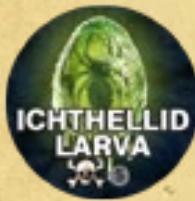
creature can have only one Ichthellid Larva marker on it. When this creature is destroyed, the controller of the Ichthellid Larva marker may choose an Ichthellid creature from his spellbook or discard pile, and place it face down in the zone the creature was in when it was destroyed. This Ichthellid comes into play at the end of the round for no mana cost, similar to how the Reanimate effect works.
Innate Life +X (Object Trait)
This creature has an increase to its Life, which usually represents an increase to size or mass, and bypasses the Finite Life trait.
Intercept (Object Trait)
If this creature is guarding, and if a ranged attack targets a non-flying object in the same zone, this creature may redirect that ranged
attack to itself, as long as it can be a legal target for that attack. The intercept is announced and occurs immediately after the Declare Attack Step (and before the Avoid Attack Step). It loses its guard marker at the end of the attack which it intercepts. Cannot Intercept a zone attack. Cannot Intercept if Restrained or Incapacitated.
Lifebond +X (Object Trait)
During the Upkeep Phase, choose one: you may transfer up to X damage from your Mage onto this object, or you may transfer up to X damage from this object to your Mage, regardless of range or LoS. This ability is not affected by the Finite Life trait.
Lumbering (Object Trait)
This creature is clumsy and/or hobbled. It is always hindered, and thus it can only take up to 1 move action during its Action Phase, even if it gains the Fast trait.
Obliterate (Effect)
When you obliterate an object, it is utterly destroyed, leaving no trace. The object is destroyed, then it is removed from the game. It does not become discarded or get returned to a spellbook. Any ability or effect printed on that object, or attached to it (such as a marker or enchantment), which triggers on destruction, is canceled. Other destruction effects, not attached to or part of the Obliterated object, can still occur.
Examples: When you obliterate a Goblin Bomber it will not explode. When you obliterate a creature with an Ichthellid Larva marker, the Larva will not hatch. If you obliterate an opponent's creature, their Valshalla still gains a Wrath token.
Obscured (Object Trait)
This object is difficult to see. It cannot be targeted from more than one zone away (this is for all purposes - ranged attacks, spells, abilities, etc.). Any enchantments or equipment attached to the object also gain the Obscured trait, but attached conjurations do not.
Reanimate (Effect)
This creature reanimates upon death. If this creature is destroyed, it is moved from the discard pile to the zone it was just destroyed in, and placed face down in that zone, with a face-down action marker on it. This creature is considered temporarily out of play. At the end of the round, the creature card is flipped face up and is Summoned into play. Reanimate does not occur if the creature is removed from the game when it is destroyed. See “Obliterate."
Reconstruct (Effect)
Reconstruct is an effect, which removes damage from Nonliving objects. It is not Regeneration or Healing, and is not affected by the Finite Life trait.
Resilient (Object Trait)
This object is incredibly resistant to damage. This object ignores all non-critical damage from Attacks. Direct damage, and attack effects, occur normally.
Rooted (Object Trait)
This creature is rooted to the ground. It cannot take move actions, and it has the Unmovable trait. It is not Restrained, so it can still guard, hinder, and Intercept as normal.
Snatch (Effect)
This attack can grab and pull creatures into its zone. Snatch is a Push effect, where the object is Pushed one zone closer towards the source of the Push. Uncontainable or Unmovable creatures cannot be affected.
Stuck (Condition Marker)
Creature is Restrained and Unmovable. At the end of each of its Action Phases, a Stuck creature may attempt an escape roll: on a roll of 7 or higher, remove Stuck. If this creature is Teleported destroy all Stuck conditions on it. Stuck has no effect on Conjurations and Uncontainable objects. Stuck has a removal cost of 4.

Tainted (Condition Marker)
This cursed or venomous attack creates a tainted or infected wound that will not heal. Tainted is a poison condition. The marker counts as three damage, and this damage cannot be healed or regenerated. The marker has a removal cost of 3, and can be removed normally by spells or abilities which remove conditions, even if the Tainted object has the Finite Life trait. A Tainted marker placed by an attack does not count as damage dealt by the attack.

Uproot X (Object Trait)
This creature can uproot itself from the ground and move freely. When this creature is activated, you may pay X mana. If you do, it loses the Rooted trait until the end of its Action Phase.
Vigilant (Object Trait)
This creature is constantly guarding, protecting, or sheltering friendly objects. At the end of its Action Phase you may place a Guard marker on this creature, if it does not already have one.
Vine Markers (Game Marker)
Vine markers are a Living conjuration with 1 life, no armor, and they cannot gain armor. Vine markers hinder enemy non-Flying creatures. Any amount of damage will destroy a Vine Marker, regardless of its total life. They can't be targeted by ranged attacks. Any number of Vine markers can occupy a zone. As the Druid, or any object she controls, casts a vine spell, you can destroy a target Vine marker

she controls as an additional cost to cast that spell. If you do, you may target that Vine marker's zone, an object in that Vine marker's zone, or a border of that Vine marker's zone, ignoring range. If two or more Druids are playing, each should use a different side of the Vine marker to distinguish ownership.
Zombie (Condition Marker)
This creature has been raised from the dead. It gains the undead and zombie subtypes. It gains the Psychic Immunity, Slow, Nonliving, and Bloodthirsty +0 traits. The Zombie marker has no removal cost and cannot be removed by spells or effects which remove condition

markers. If this creature would be destroyed, Obliterate it. If a creature already has the Slow trait at the time it received this marker, then it also receives a Stun condition marker.
下载 Markdown94853_MageWarsSoloRulesv7.md16.5 KB
94853_MageWarsSoloRulesv7
逐页 VLM 转写(qwen3-vl-plus),源 PDF:94853_MageWarsSoloRulesv7.pdf,未翻译。
MAGE WARS SOLO VARIANT RULES
Your Mage (YM) = Your selected mage
Dummy Mage (DM) = AI mage/opponent
Setup
-
Prepare your selected mage spell book
-
Build 4 decks for the Dummy Mage as follows (see Play Mat):
• Creature Deck - 15
• Incantations - 10 (these will combine with the Enchantments)
• Enchantments - 10* (these will combine with the Incantations)
• Attack Spells Deck - 10
• Equipment Deck - 5 (Armor or similar equipment for defense)
See the suggested starting decks for your first game at the end of these rules. -
Select an opposing Dummy Mage and put it in the opposing starting zone with a Quick Cast marker and an Action Marker (unless you own an additional quick cast marker). These 2 markers represent the quick casts/actions for the DM in Stages 1 & 3 of the Action Stage (the DM will Quick Cast/Act twice per round). Also set a status board up to use for tracking the damage/life of the selected dummy mage. Set the life total at the total for the selected mage. You can set this total higher for a greater challenge or lower for a shorter game.
Gameplay
Ready Stage
Initiative - (the DM gets initiative at the start of the game)
Reset - reset YM & DM action markers
Channel - YM channels mana accordingly (no mana management for DM)
Upkeep - check both YM & DM cards for upkeep (i.e. condition damage, regeneration, etc.)
Planning - YM selects 2 spell cards to use this round
Deployment - YM deploys per rules
Action Stage
-
First Quick Cast Stage - (see the Quick Cast/Action Die Roll Sequence for DM quick casting/actions on the next page)
-
Creature Actions Stage -
a. Your Mage (you may pass per rules if the Dummy Mage has more creatures)
b. Dummy Mage (see the Creature Action Sequence on the 3rd page)
REPEAT a & b UNTIL ALL CREATURES ARE OUT OF ACTIONS -
Final Quick Cast Stage - (the DM will quick cast/act AGAIN just as he did in the 1st Quick Cast Stage. YM will only quick cast here if he has not already done so as per rules.)
(just to be clear - the DM will Quick Cast/Act 2 times - once in Stage 1 & once in Stage 3)
• If you choose to pass on your 1st Quick Cast, the DM will Quick Cast/Act first.
• If a condition like Stun is placed on the DM, the DM will flip over its Quick Cast marker for that stage and not act until the next possible Quick Cast/Action.
created by Dan Cavaliere - v7 last updated Wednesday, July 20, 2022
MAGE WARS SOLO VARIANT RULES
Quick Cast/Action Die Roll Sequence for the Dummy Mage
When Quick Casting/Action for the Dummy Mage you will roll the 12 sided die and act according to the die roll result and corresponding numbers below. The Dummy Mage will Move, Summon a creature, or Cast an Enchantment/Incantation, or Cast an Attack Spell.
- If the DM is 3 zones or more away from any ENEMY creature, re roll all results of 8+ until you roll a result of 1-7. This is usually happens at the beginning of the game - avoids DM stagnation.
- Drawing from the Equipment Deck will happen any time the DM can NOT make a legal play or move i.e. makes a roll to move and would run into an arena wall, draws an enchantment that can not be played, etc. Once equipment is drawn it is immediately attached to the DM. If the Equipment Deck is exhausted, use the DM’s Battle Skill.
1 - 3 = Move the DM by rolling the d12 again and use the Compass Rose or Play Mat to determine direction. If the DM is against an arena wall and can’t move in the rolled direction, he will stay in the current zone and not move this turn. Instead, the DM will draw from the Equipment Deck and attach the drawn equipment. If there’s no equipment available (deck is exhausted), the DM can use its Battle Skill and attack an enemy creature if possible.
4 - 7 = Add 1 random creature from the creature deck to the zone with the Dummy Mage (remember to add an ‘inactive’ action marker. This creature will become active in the next Reset stage.)
8 -10 = Cast an Enchantment or Incantation by drawing from the Enchantment/Incantation combined deck.
When an Enchantment Spell is drawn -
i. If it is an Enemy Zone enchantment cast it in a manner that will effect YM and/or as many enemy creatures possible within range.
ii. If it is an Enemy Creature enchantment, cast it on the enemy creature with the highest remaining life value within range.
iii. If it is a Friendly Creature enchantment cast it on the creature with the lowest remaining life value that is in the same zone with an enemy creature or with the YM. If none are in the same zone, put it on the creature with the lowest remaining life value that is closest to YM. If there is more than one creature like this, choose randomly. The enchantment is cast and revealed immediately.
When an Incantation Spell is drawn -
Place this incantation using the same criteria in the above steps for enchantments (i. ii. iii.).
- If on any DM turn there are no creatures in range for these spells, discard the spell and then draw from the Equipment Deck. Do the same if at any time the Enchantment/Incantation deck is exhausted.
11 -12 = Cast Attack Spell -
A. Draw an Attack spell from the Attack Spell Deck
B. This spell will always targets YM first. If it is a Zone Attack it effects all objects in the zone, friendly and enemy. If the YM is out of range it will target the closest YM creature or zone with YM creature(s). Use the Enchantment/Incantation criteria(i. ii. iii.) above.
created by Dan Cavaliere - v7 last updated Wednesday, July 20, 2022
MAGE WARS SOLO VARIANT RULES
- If on any DM turn there are no creatures in range for these spells, discard the spell and then draw from the Equipment Deck. Do the same if at any time the Attack deck is exhausted.
- Spells which involve a push effect will require a roll for push direction. See the Codex and look under Push for the corresponding die roll/directions or use the Compass Rose or Play Mat.
Creature Action Sequence for the Dummy Mage
Creature actions for the DM should be handled as follows:
- If YM has more active creatures than the DM, the DM will pass until you each have an equal amount. Start with the creature that has the highest mana cost and then each turn move to the next highest mana costing creature sequentially (choose randomly if equal). Each creature will attempt to do one of the following actions in this order:
A. Make a legal Full Action attack on the YM or the YM’s creatures.
If the DM creature has 2 types of legal attack choices choose one randomly.
i. DM’s creatures will always attack YM first, if able.
ii. DM’s creatures will attack YM’s creatures if YM is unable to be attacked. If more than one creature can be targeted, attack the creature with the highest remaining life value. (remember to check for Guards)
B. Move 1 Zone & Attack with a Quick Action using the same criteria for step A (above).
C. Move 2 Zones if able and always toward YM or YM’s creature with the highest remaining life value if it is closer – when equal zone distances apart, move the creature towards YM. (i.e. - YM creature and YM are both 2 zones away).
**. Guard/Defend – as a ‘special’ action, if an active DM creature is in the same zone as the DM and the DM is melee attacked, flip the action marker over & use the DM creature as if it had a Guard marker already on it. This helps the DM defense w/o deciding on when & how the DM guards. If there is more than one creature that can guard use the creature with the highest mana cost.
-
The DM’s creatures will try to move through walls if the YM is on the other side of a wall within the zone the wall is assigned. Otherwise they will attack the wall if able and pursue YM.
-
If a DM creature is engaged with one of your creatures in a zone that does not contain YM, it will try to move away if possible (check for traits like Hinder, Restrained, etc.) and move toward YM to get in an attacking position on YM.
Game End
- When either Mage gains damage to reach their life total.
- As an alternate Game End condition you can try this:
When the DM’s Creature deck is exhausted and all the DM’s creatures in the arena have been eliminated. In this case, total the mana cost of all the YM’s creatures killed by the DM and multiply it x2. Then total the mana cost of all the DM’s creatures killed by the you (YM). If your total exceeds the DM’s total w/the multiplier, you win!!!
created by Dan Cavaliere - v7 last updated Wednesday, July 20, 2022
MAGE WARS SOLO VARIANT RULES
Suggested Starting Dummy Mage Decks/Spell Book
| Creatures | Enchantments | Incantations | Attack Spells |
|---|---|---|---|
| Bitterwood Fox x2 | Agony x2 | Battle Fury x2 | Blinding Flash x2 |
| Brogan Bloodstone | Bear Strength x2 | Heal | Electrify x2 |
| Darkfenne Bat x2 | Bull Endurance x2 | Knockdown | Fireball |
| Darkfenne Hydra | Eagle Wings | Banish | Flameblast |
| Emerald Tegu | Falcon Precision | Perfect Strike x2 | Jet Stream |
| Firebrand Imp | Maim Wings x2 | Charge x2 | Pillar of Light |
| Gorgon Archer | Purge Magic | Ring of Fire | |
| Highland Unicorn | Equipment | Thunderbolt | |
| Dark Pact Slayer | Colossus Belt | ||
| Mana Leech | Dragonscale Hauberk | ||
| Skeletal Sentry | Leather Boots | ||
| Stonegaze Basilisk | Leather Gloves | ||
| Timber Wolf | Sunfire Amulet |
Dummy Mage Turn Examples
The DM has initiative and it is Action Stage 1/First Quick Cast. You roll the d12 for the DM’s 1st Quick Cast/Action and the result is a 9. You check to see if the DM is less than 3 Zones away from any of YM’s creatures or YM. It is not so you must re roll the d12. This time you roll a 3. This means the DM will move so you roll again for direction. You roll a result of 5 so the DM moves one zone to the east/right. (see Example 1)
DM’s turn during the Action Stage 2/Creature Actions Stage. The DM has 3 creatures in the arena - a Bitterwood Fox (mana cost 5), an Iron Golem (mana cost 13), and a ManaLeech (mana cost 8). The Iron Golem will act first since it has the highest mana cost, followed by the Mana Leech, and finally the Bitterwood Fox. (see Example 2)
Action Stage 3/Second Quick Cast. You roll the d12 for the DM’s 2nd Quick Cast/Action and this time the result is a 5. You draw a creature from the creature deck pile and add it to the zone where the DM is. Place an ‘inactive’ action marker on this creature. (see Example 3)
The following 3 examples would happen if the DM is less than 3 zones from YM or YM creature
Quick Cast/Action d12 die roll results in a 9. You draw from the Enchantment/Incantation Deck. You draw an Enchantment from and it is Bear Strength. The DM’s creatures are 3 zones away so you can not cast it on any of them and you must discard it without any effect.
Quick Cast/Action d12 die roll results in a 10. You draw from the Enchantment/Incantation Deck. You draw an Incantation and it is Battle Fury. The DM has 2 friendly creatures within the spell range requirement. One is an Emerald Tegu with 5 damage and the other is a Bitterwood Fox with no damage. You must cast it on the Emerald Tegu since it has the lowest remaining life value. (see Example 4)
Quick Cast/Action d12 die roll results in a 12. You draw an Attack Spell from the Attack
created by Dan Cavaliere - v7 last updated Wednesday, July 20, 2022
MAGE WARS SOLO VARIANT RULES
Deck and it is Jet Stream. There is an enemy creature in the zone adjacent to the DM so you roll the dice and apply the damage and effects to that creature.
The DM has an Emerald Tegu that is in a zone with 3 of YM’s creatures. It is the Emerald Tegu’s turn and you must determine which of the 3 creatures it is to attack. There are 2 Bitterwood Foxes and a Thunderift Falcon. One Fox has 3 life remaining, the other Fox has 4 life remaining, and the Falcon has all 5 life remaining. The Falcon should be the target of the attack but it has the flying trait and can’t be reached therefore the Fox that has 4 life remaining is attacked since it has the highest remaining life value and is a legal target. (see Example 5)
On the DM’s turn after a roll of 9, the Enchantment Spell, Bear Strength is drawn. The only DM controlled creature in range is over 2 zones away making the spell useless. Bear Strength would be discarded and instead a draw from the Equipment Deck will happen. (see Example 6)
For a greater challenge, see if you can create tougher creature, enchantment, incantation, or attack spell decks (or make ALL the decks stronger!) or even make the DM life total higher. Please send any suggestions or feedback to me at BGG through the files page you downloaded these rules from, the thread announcing these rules, or geek mail. I hope these rules bring you some enjoyment of this great game when you can’t find a partner to play it with!
Special thanks to BGG user latindog for contributing ideas to help improve the AI in version 7!!
created by Dan Cavaliere - v7 last updated Wednesday, July 20, 2022
MAGE WARS SOLO VARIANT RULES
Example 1
| Moves 1 zone east/right | 1 zone away | 2 zones away | |
|---|---|---|---|
| DM → [图: 蓝色右向箭头] | |||
| 1 zone away | 2 zones away | 3 zones away | |
| Timber Wolf (YM's) | |||
| 4 zones away | |||
| YM |
Example 2
| DM | The Iron Golem acts first followed by the Mana Leech and then the Bitterwood Fox. |
|---|---|
| (1) Golem (DM's) Mana Cost 13 | (2) Leech (DM's) Mana Cost 8 (3) Fox (DM's) Mana Cost 5 |
Example 3
| DM | |
|---|---|
| New Creature (w/inactive marker) | |
| Golem (DM's) Mana Cost 13 | Leech (DM's) Mana Cost 8 Fox (DM's) Mana Cost 5 |
created by Dan Cavaliere - v7 last updated Wednesday, July 20, 2022
MAGE WARS SOLO VARIANT RULES
Example 4
| DM | DM will cast Battle Fury on the Emerald Tegu since it has the lowest remaining life value. |
|---|---|
| Emerald Tegu - 5 damage (3 life remaining) | Timber Wolf (YM's) YM (Fox - No damage (5 life remaining)) |
Example 5
| DM | Emerald Tegu (DM's) | Fox (YM's) - 3 life remaining |
|---|---|---|
| The Emerald Tegu will attack the Fox with 4 life remaining since the Falcon has the Flying trait and can't be reached for an attack. | Fox (YM's) - 4 life remaining | Falcon (YM's) - 5 life remaining |
Example 6
| DM | 1 zone away | 2 zones away | |
|---|---|---|---|
| 1 zone away | 2 zones away | Closest DM Creature |
created by Dan Cavaliere - v7 last updated Wednesday, July 20, 2022
Draw on Rolls of 4-7
- Creature Deck (15)
Draw on Rolls of 8-10
- Enchantment Spells (10)
& - Incantation Spells (10)
(shuffle together)
On rolls of 1-3 the DM will move. Roll again and use this compass.
[图: 中央黄色方框写“On rolls of 1-3 the DM will move. Roll again and use this compass.”,四向箭头分别指向四个区域:上箭头标“1-3”指向“Draw on Rolls of 4-7”区域;右箭头标“4-6”指向“Draw when Dummy Mage loses an action or can not move”区域;下箭头标“7-9”指向“Draw when Dummy Mage loses an action or can not move”区域;左箭头标“10-12”指向“Draw on Rolls of 11-12”区域]
Draw on Rolls of 11-12
- Attack Spell Deck (10)
Draw when Dummy Mage loses an action or can not move
- Equipment Deck (5)
94853_MageWarsSoloRulesv6.md15.2 KB
94853_MageWarsSoloRulesv6
逐页 VLM 转写(qwen3-vl-plus),源 PDF:94853_MageWarsSoloRulesv6.pdf,未翻译。
MAGE WARS SOLO VARIANT RULES
Your Mage (YM) = Your selected mage
Dummy Mage (DM) = AI mage/opponent
Setup
-
Prepare your selected mage spell book
-
Build 4 decks for the Dummy Mage as follows:
• Creature Deck - 15
• Incantation Deck - 10
• Enchantment Deck - 10
• Attack Spells Deck - 10
See the suggested starting decks for your first game at the end of these rules. -
Select an opposing Dummy Mage and put it in the opposing starting zone with a Quick Cast marker and an Action Marker (unless you own an additional quick cast marker). These 2 markers represent the quick casts/actions for the DM in Stages 1 & 3 of the Action Stage (the DM will Quick Cast/Act twice per round). Also set a status board up to use for tracking the damage/life of the selected dummy mage. Set the life total at the total for the selected mage. You can set this total higher for a greater challenge or lower for a shorter game.
Gameplay
Ready Stage
Initiative - (the DM gets initiative at the start of the game)
Reset - reset YM & DM action markers
Channel - YM channels mana accordingly (no mana management for DM)
Upkeep - check both YM & DM cards for upkeep (i.e. condition damage, regeneration, etc.)
Planning - YM selects 2 spell cards to use this round
Deployment - YM deploys per rules
Action Stage
- First Quick Cast Stage - (see the Quick Cast/Action Die Roll Sequence for DM quick casting/actions on the next page)
- Creature Actions Stage -
a. Your Mage (you may pass per rules if the Dummy Mage has more creatures)
b. Dummy Mage (see the Creature Action Sequence on the 3rd page)
REPEAT a & b UNTIL ALL CREATURES ARE OUT OF ACTIONS - Final Quick Cast Stage - (the DM will quick cast/act AGAIN just as he did in the 1st Quick Cast Stage. YM will only quick cast here if he has not already done so as per rules.)
(just to be clear - the DM will Quick Cast/Act 2 times - once in Stage 1 & once in Stage 3)
*If you choose to pass on your 1st Quick Cast, the DM will Quick Cast/Act first.
**If a condition like Stun is placed on the DM, the DM will flip over it's Quick Cast marker for that stage and not act until the next possible Quick Cast/Action.
created by Dan Cavaliere - v6 last updated Sunday, January 4th, 2015
MAGE WARS SOLO VARIANT RULES
Quick Cast/Action Die Roll Sequence for the Dummy Mage
When Quick Casting/Action for the Dummy Mage you will roll the 12 sided die and act according to the die roll result and corresponding numbers below. The Dummy Mage will Move, Summon a creature, or Cast an Enchantment/Incantation, or Cast an Attack Spell.
If the DM is 3 zones or more away from ANY enemy creature, re roll all results of 8+ until you roll a result of 1-7. This is usually happens at the beginning of the game - avoids DM stagnation.
1 - 3 = Move the DM by rolling the d12 again and use the Compass Rose or Codex (under Push definition) to determine direction. If the DM is against an arena wall and can’t move in the rolled direction, he will stay in the current zone and not move this turn.
4 - 7 = Add 1 random creature from the creature deck to the zone with the Dummy Mage (remember to add an ‘inactive’ action marker. This creature will become active in the next Reset stage.)
8 -10 = Cast an Enchantment OR an Incantation by rolling the d12 again:
On the 2nd roll, draw according to the ranges below:
1-6 = draw an Enchantment Spell from the Enchantment Deck -
i. If it is an Enemy Zone enchantment cast it in a manner that will effect YM and/or as many enemy creatures possible within range.
ii. If it is an Enemy Creature enchantment, cast it on the enemy creature with the highest remaining life value within range.
iii. If it is a Friendly Creature enchantment cast it on the creature with the lowest remaining life value that is in the same zone with an enemy creature or with the YM. If none are in the same zone, put it on the creature with the lowest remaining life value that is closest to YM. If there is more than one creature like this, choose randomly. The enchantment is cast and revealed immediately.
(if the Enchantment would not make sense or be able to work effectively, discard it and continue to the next stage - i.e. Maim Wings would not work if there are no enemy creatures with flying in a zone within range.)
7-12 = draw an Incantation from the Incantation Deck -
Place this incantation using the same criteria in the above steps for enchantments (i. ii. iii.).
(if the Incantation would not make sense or be able to work effectively, discard it and continue to the next stage. i.e. Battle Fury w/o being able to attack because it’s the end of round or no creatures available.)
If there are no creatures in range for these spells, discard the spell and move on. (This works as a good balance to the ‘unlimited mana’ that the DM has.)
**If at any time a deck is exhausted and the roll results in a draw from that deck - the DM loses this turn.
11 -12 = Cast Attack Spell -
A. Draw an Attack spell from the Attack Spell Deck
B. This spell will always targets YM first. If it is a Zone Attack it effects all objects in the zone, friendly and enemy. If the YM is out of range it will target the closest YM creature or zone with YM creature(s). Use the Enchantment/Incantation criteria(i. ii. iii.) above. If nothing is in range, discard the spell.
Spells which involve a push effect will require a roll for push direction. See the Codex and look under Push for the corresponding die roll/directions or use the Compass Rose.
created by Dan Cavaliere - v6 last updated Sunday, January 4th, 2015
MAGE WARS SOLO VARIANT RULES
Creature Action Sequence for the Dummy Mage
Creature actions for the DM should be handled as follows:
If YM has more active creatures than the DM, the DM will pass until you each have an equal amount. Start with the creature that has the highest mana cost and then each turn move to the next highest mana costing creature sequentially (choose randomly if equal). Each creature will attempt to do one of the following actions in this order:
A. Make a legal Full Action attack on the YM or the YM’s creatures.
If the DM creature has 2 types of legal attack choices choose one randomly.
i. DM’s creatures will always attack YM first, if able.
ii. DM’s creatures will attack YM’s creatures if YM is unable to be attacked. If more than one creature can be targeted, attack the creature with the highest remaining life value. (remember to check for Guards)
B. Move 1 Zone & Attack with a Quick Action using the same criteria for step A (above).
C. Move 2 Zones if able and always toward YM or YM’s creature with the highest remaining life value if it is closer – when equal zone distances apart, move the creature towards YM. (i.e. - YM creature and YM are both 2 zones away).
The DM’s creatures will try to move through walls if the YM is on the other side of a wall within the zone the wall is assigned. Otherwise they will attack the wall if able and pursue YM.
Once a DM’s creature is engaged in battle with YM, YM’s creature, or an object (conjunction) it will stay and attack all objects that are attackable until there are none left in that zone. Once there are no creatures to attack (eliminated, moved away, or from traits like flying, invisible, etc.) it will pursue YM or the next closest creature if YM is further away.
Game End
- When either Mage gains damage to reach their life total.
- As an alternate Game End condition you can try this:
When the DM’s creature deck is exhausted and all the DM’s creatures in the arena have been eliminated. In this case, total the mana cost of all the YM’s creatures killed by the DM and multiply it x2. Then total the mana cost of all the DM’s creatures killed by the you (YM). If your total exceeds the DM’s total w/the multiplier, you win!!!
Suggested Starting Dummy Mage Decks/Spell Book
| Creatures | Enchantments | Incantations | Attack Spells |
|---|---|---|---|
| Bitterwood Fox x2 | Agony x2 | Battle Fury x2 | Blinding Flash x2 |
| Brogan Bloodstone | Bear Strength x2 | Heal | Electrify x2 |
| Darkfenne Bat x2 | Bull Endurance x2 | Knockdown | Fireball |
| Darkfenne Hydra | Eagle Wings | Banish | Flameblast |
| Emerald Tegu | Falcon Precision | Perfect Strike x2 | Jet Stream |
| Firebrand Imp | Main Wings x2 | Charge x2 | Pillar of Light |
| Gorgon Archer | Purge Magic | Ring of Fire | |
| Highland Unicorn | Thunderbolt | ||
| Dark Pact Slayer | |||
| Mana Leech | |||
| Skeletal Sentry | |||
| Stonegaze Basilisk | |||
| Timber Wolf |
created by Dan Cavaliere - v6 last updated Sunday, January 4th, 2015
MAGE WARS SOLO VARIANT RULES
Dummy Mage Turn Examples
The DM has initiative and it is Action Stage 1/First Quick Cast. You roll the d12 for the DM’s 1st Quick Cast/Action and the result is a 9. You check to see if the DM is less than 3 Zones away from any of YM’s creatures or YM. It is not so you must re roll the d12. This time you roll a 3. This means the DM will move so you roll again for direction. You roll a result of 5 so the DM moves one zone to the east/right. (see Example 1)
DM’s turn during the Action Stage 2/Creature Actions Stage. The DM has 3 creatures in the arena - a Bitterwood Fox (mana cost 5), an Iron Golem (mana cost 13), and a ManaLeech (mana cost 8). The Iron Golem will act first since it has the highest mana cost, followed by the Mana Leech, and finally the Bitterwood Fox. (see Example 2)
Action Stage 3/Second Quick Cast. You roll the d12 for the DM’s 2nd Quick Cast/Action and this time the result is a 5. You draw a creature from the creature deck pile and add it to the zone where the DM is. Place an ‘inactive’ action marker on this creature. (see Example 3)
The following 3 examples would happen if the DM is less than 3 zones from YM or YM creature
Quick Cast/Action d12 die roll results in a 9. You must roll the d12 again to determine if it is an Enchantment or Incantation and this time roll a 2. You draw an Enchantment from the Enchantment Deck and it is Bear Strength. The DM’s creatures are 3 zones away so you can not cast it on any of them and you must discard it without any effect.
Quick Cast/Action d12 die roll results in a 10. You must roll the d12 again and this time you roll a 9. You draw an Incantation from the Incantation Deck and it is Battle Fury. The DM has 2 friendly creatures within the spell range requirement. One is an Emerald Tegu with 5 damage and the other is a Bitterwood Fox with no damage. You must cast it on the Emerald Tegu since it has the lowest remaining life value. (see Example 4)
Quick Cast/Action d12 die roll results in a 12. You draw an Attack Spell from the Attack Deck and it is Jet Stream. There is an enemy creature in the zone adjacent to the DM so you roll the dice and apply the damage and effects to that creature.
The DM has an Emerald Tegu that is in a zone with 3 of YM’s creatures. It is the Emerald Tegu’s turn and you must determine which of the 3 creatures it is to attack. There are 2 Bitterwood Foxes and a Thunderift Falcon. One Fox has 3 life remaining, the other Fox has 4 life remaining, and the Falcon has all 5 life remaining. The Falcon should be the target of the attack but it has the flying trait and can’t be reached therefore the Fox that has 4 life remaining is attacked since it has the highest remaining life value and is a legal target. (see Example 5)
For a greater challenge, see if you can create tougher creature, enchantment, incantation, or attack spell decks (or make ALL the decks stronger!) or even make the DM life total higher. Please send any suggestions or feedback to me at BGG through the files page you downloaded these rules from, the thread announcing these rules, or geek mail. I hope these rules bring you some enjoyment of this great game when you can’t find a partner to play it with!
created by Dan Cavaliere - v6 last updated Sunday, January 4th, 2015
Example 1
| Moves 1 zone east/right | 1 zone away | 2 zones away | |
|---|---|---|---|
| DM → [图: 蓝色右向箭头] | |||
| 1 zone away | 2 zones away | 3 zones away | |
| Timber Wolf (YM's) | |||
| 4 zones away | |||
| YM |
Example 2
| DM | The Iron Golem acts first followed by the Mana Leech and then the Bitterwood Fox. |
|---|---|
| (1) Golem (DM's) Mana Cost 13 | (2) Leech (DM's) Mana Cost 8 (3) Fox (DM's) Mana Cost 5 |
Example 3
| DM | |
|---|---|
| New Creature (w/inactive marker) | |
| Golem (DM's) Mana Cost 13 | Leech (DM's) Mana Cost 8 Fox (DM's) Mana Cost 5 |
created by Dan Cavaliere - v6 last updated Sunday, January 4th, 2015
Example 4
| DM | DM will cast Battle Fury on the Emerald Tegu since it has the lowest remaining life value. |
|---|---|
| Emerald Tegu - 5 damage (3 life remaining) | Timber Wolf (YM's) YM (Fox - No damage (5 life remaining)) |
Example 5
| DM | Emerald Tegu (DM's) | Fox (YM's) - 3 life remaining |
|---|---|---|
| The Emerald Tegu will attack the Fox with 4 life remaining since the Falcon has the Flying trait and can't be reached for an attack. | Fox (YM's) - 4 life remaining | Falcon (YM's) - 5 life remaining |
created by Dan Cavaliere - v6 last updated Sunday, January 4th, 2015
Draw on Rolls of 4-7
[图: 左上角白色方框内含棕色矩形标签“Creature Deck”]
Draw on Rolls of 11-12
[图: 右上角白色方框内含红色矩形标签“Attack Spell Deck”]
On rolls of 1-3 the DM will move. Roll again and use this compass.
[图: 中央黄色矩形框,四向箭头分别指向:上箭头标“1-3”,右箭头标“4-6”,下箭头标“7-9”,左箭头标“10-12”]
Draw on Rolls of 1-6
AFTER initial Roll of 8-10
[图: 左下角白色方框内含橙色矩形标签“Enchantment Spell Deck”]
Draw on Rolls of 7-12
AFTER initial Roll of 8-10
[图: 右下角白色方框内含紫色矩形标签“Incantation Spell Deck”]
下载 Markdown原文为社区整理/出版社公开资料,版权归原作者,仅供个人学习查阅。