
MarraCashMarracash
一句话概览
MarraCash 是一款已收录于村了吗规则库的桌游,支持 3–4 人,原名 Marracash。
本页内容:一句话概览 · 常见问题
这游戏怎么玩
- 本站已收录这款游戏的规则资料,可以在对话里直接提问规则细节。
常见问题(FAQ)
以下 1 条问答中 0 条来自站内玩家的真实提问,其余 1 条为本站整理的常见疑问;答复内容保持原样。
MarraCash支持几个人玩?
3–4 人。
去哪查完整规则
想核对具体规则细节、卡牌效果或某个回合的结算方式,可以在村了吗里选中这款游戏后直接提问。
同类桌游
- 卡坦岛德式
- 工业革命:伯明翰德式
- 勃艮第城堡:特别典藏版德式
- 方舟动物园德式
- 卡卡颂抽象
- 瘟疫危机传承:第一季美式
- 阿瑞迪亚:勇踏征途美式
- 重塑宇宙德式
- 幽港迷城美式
- 埃多拉的德鲁伊德式
规则原文(Markdown)
本站收录这款游戏的规则原文 1 个文件,此处内联渲染 1 个,可直接展开阅读或下载。
Marracash.md11.0 KB
Marracash
Invented by Stefan Dorra
Some pictures from original rules added; text added to reference pictures & clarify rules by Doug Chorey
Goal
Have the most money at the end of the game.
Preparations
Punch out the 24 shop signs and the 4 game sequence cards.
Press the 24 shop signs into the 24 plastic stands.
Play with Dirham or New Dirham. New Dirhams are worth 25 Dirham, and denoted ND or within parentheses.
Give each player:
a game sequence card
1,200 Dirham money (48 NewDirham)
six shop signs of the same name (Ali, Anfa, Omar, Leila)
All players jointly distribute the visitors:
On each of the three dark blue fountain spaces (the entrance spaces) must be placed three visitors. No two visitors of each group of three may be the same color.
The remaining 45 visitors are arranged outside the city walls in a U-shaped line. The order is arbitrary, but there may never be more than three visitors of the same color next to each other in the line. This "visitor queue" may only have two ends (see the illustration) [this just means that new visitors to the city must be taken from one or the other end of the line -- they cannot be plucked from the middle, leaving a gap].
Starting
A player is chosen to begin. Play then proceeds clockwise.
The First Round
The only action that takes place in the first round is the auctioning of shops.
The current player selects any shop and sets the auction stone on it.
The player who set the stone is the auctioneer. The auctioneer must make the first bid. The minimum bid is 100 Dirham (4 New Dirham).
Continuing clockwise, all other players may make a bid or pass. The bids must be higher than the last bid. If you pass you are excluded from making further bids in the current auction.

The auction continues until all players but one has passed. The remaining bidder buys the shop by paying the bid and placing his or her shop sign on the shop space. In the picture, Ali and Omar have each purchased one shop. The blue auction stone is given to the player whose turn is next.
The bid is paid to the bank. But: The auctioneer receives a cut based on the amount of the bid. If the auctioneer buys the shop, no cut is awarded and the entire bid goes to the bank.
| WINNING BID | AUCTIONEERCUT |
| 500 Dirham or less (20 NewDirham or less) | 100 Dirham (4NewDirham) |
| more than 500 Dirham(more than 20 New Dirham) | 200 Dirham (8NewDirham) |
The first game round ends once each player has been an auctioneer. It is quite possible that a player may start the real game (staring with round 2) without a shop.
The Second and Following Rounds
Each player, in turn, must choose one of the following three possibilities, each consisting of two actions which must be performed in order:
Option A – move & move
o 1: Choose a fountain, and move all visitors currently at that fountain to the first fountain in the direction you choose to move the group.
o 2: Repeat #1 above.
Option B – move & auction
o 1: Choose a fountain, and move all visitors currently at that fountain to the first fountain in the direction you choose to move the group.
o 2: Select any unowned shop and auction it as in round 1.
Option C – auction & auction
o 1: Select any unowned shop and auction it as in round 1.
o 2: Select any unowned shop and auction it as in round 1.
Note that you may NOT auction a shop and then move a group of visitors.
IMPORTANT: If one of the three dark blue entrance fountains is empty at the end of a player's turn, that player must bring new visitors into the town (see New Visitors).
Moving Visitor Groups

When a player moves a visitor group, ALL visitors in that group must be moved to the same adjacent fountain space. Each game piece should be moved separately, following the same route. If a group is moved onto an occupied fountain, it simply merges with the existing group and all visitors on that fountain will thereafter move together.
In the picture, the group of three visitors will move together from the Entrance Gate fountain towards one of the three indicated fountains. Note, once inside the city, visitors cannot leave. The dark blue fountains are only to mark the "entrance points" for the visitors outside the city. In all else, they are treated as fountains.
Crowds move past unowned shops without incident. However, the consequence of moving past an owned shop may be different...
When Is a Shop Entered?
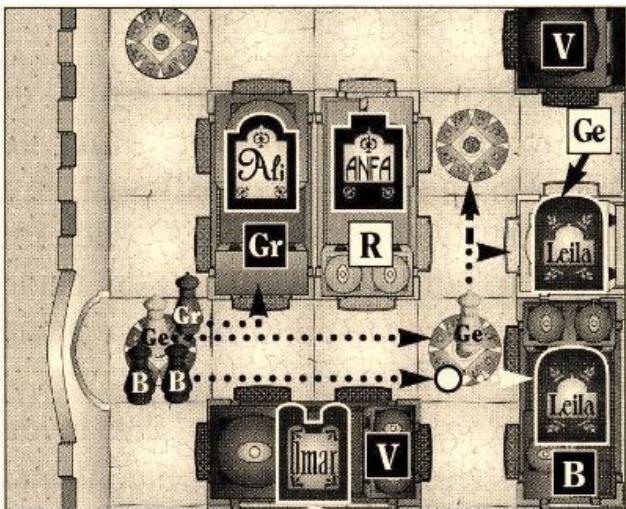
If a visitor passes an owned shop of the same color as that visitor, that visitor enters the shop via the first door it passes. In the 1st picture below, the Green visitor goes into Ali’s Green shop, the Blue visitor that stopped on the fountain just outside the Leila’s Blue shop goes into the Blue shop, and the GE visitor stops at the next fountain space adjacent to the Blue shop.

Once a visitor enters a shop, the visitor is now permanently a customer of that shop -- and customers spend money. The amount a new customer pays to the shop owner is based on the total number of customers (including the new one) currently in the shop.
| CUSTOMERS | 1 | 2 | 3 | 4 | 5+ |
| PAYMENT | 100 | 200 | 300 | 400 | 500 |
| ALT PAY | 4 | 8 | 12 | 16 | 20 |
Thus the first customer in a shop pays the owner 100(4). The third pays 300(12). The sixth pays 500(20). In the below picture,
Leila’s Blue shop get’s 100(4) for the 1st Blue visitor and 200(8) for the 2nd Blue visitor.
Once a customer enters a shop, it remains there for the rest of the game.
In the below picture, Leila has won an auction for the GE shop on a previous player’s turn. Moving the GE visitor upwards on a 2nd move, causes the GE visitor to enter Leila’s GE shop.
The Mover's Cut
If a player moves a group of visitors and causes one or more visitors to enter another player's shop, the moving player gets a cut of the shop owner's profits. The amount depends on the TOTAL profit made from ALL customers brought into each shop from that group:
| SHOPOWNER'SPROFITS | MOVER'S CUT |
| 300 or less (12 ND orless) | 50 per customer (2ND per customer) |
| 325 or over (13 ND orover) | 100 per customer (4ND per customer) |
The cut is always paid by the owner of the shop from the profits earned from the customers. Obviously, no cut is awarded for visitors moved into a player's own shop.
Special Case
If a shop is auctioned and there is a group of visitors at a fountain adjacent to one of its
doors, then all visitors in the crowd of the same color immediately enter the shop as customers and the owner immediately receives profits. The auctioneer does not receive a cut of any customers in this special case.
New Visitors
If at the end of a player's turn one (or more) of the entrance spaces is empty, then that player must bring new visitors into the city. The player chooses one of the ends of the visitor queue and takes 2, 3, or 4 successive game visitors and places them (as a group) on one of the empty entrance spaces.
The End of the Game
As soon as no more visitors are outside the city wall, the last round begins. Each player gets one last turn. The last turn will be taken by the player who brought the last group of visitors into the city.
The winner is the player with the most cash. Shops owned do not count towards the cash total.
Hints
At each auction of a shop, the amount offered should stand in a reasonable relationship to the expected profit. Paying 500(20) for a shop that only pulls in three customers will only net a profit of 100(4).
If another player is the only owner of a shop of a certain color, then you should auction more shops of that color. Why? Because the more shops of a color ready to receive customers, the fewer customers will theoretically enter any one of them.
If you own a shop, you should try to get other players to buy shops in the same neighborhood by offering them for auction. Why? The more players who own shops in the neighborhood, the more visitors will stream into that part of town.
If it’s up to you to bring new visitors into the city, don't choose visitors that will only help yourself. Remember that the player to your left goes next so if you can make it worthwhile for this player to move the new crowd in a favorable direction, you'll both profit.
Support your opponents' empty shops. If you move 2 red customers into Ali's empty shop, then Ali gets 300(12) from which you get a cut of 100(4). If you think this helps Ali too much, remember that the next player may be able to profit even more by moving the same visitors. If Leila had a red shop in range of the same two red visitors, and if her shop already had 2 customers in it, then you know that she will snap them up and make a 700(28) profit -- and you'll get nothing.
Yellow is a popular color. There are 14 yellow visitors (vs. 10 in each other color) and the yellow souvenirs bring in the most money (see variant, below).
Souvenir Variant
Tourists buy souvenirs, represented by 25 souvenir cards (5 in each color). In this variant, players may earn extra money by selling particular souvenirs.
The souvenir cards are shuffled and stacked face down next to the board. At the start of the game, the uppermost two cards are placed face up next to the stack so that all players can see both.
Every time a visitor enters a shop of the same color as at least one of the face-up cards, the shop owner takes the card and receives the profit printed on the card from the bank.
Once "sold", the souvenir card is removed from the game.
If two cards of the same color are both faceup, the shop owner decides which one to sell.
If a player finishes his or her turn and one or both of the souvenir cards have been sold, then the player turns over enough cards to bring the total of face-up cards back to two.
IMPORTANT: The profits from souvenir cards are added to the shop owner's profits from customers when determining the cut paid to the moving player.
下载 Markdown原文为社区整理/出版社公开资料,版权归原作者,仅供个人学习查阅。