
芳野寻踪Meadow
一句话概览
芳野寻踪 是一款已收录于村了吗规则库的桌游,支持 1–4 人,原名 Meadow。
本页内容:一句话概览 · 常见问题
这游戏怎么玩
- 本站已收录这款游戏的规则资料,可以在对话里直接提问规则细节。
常见问题(FAQ)
以下 1 条问答中 0 条来自站内玩家的真实提问,其余 1 条为本站整理的常见疑问;答复内容保持原样。
芳野寻踪支持几个人玩?
1–4 人。
去哪查完整规则
想核对具体规则细节、卡牌效果或某个回合的结算方式,可以在村了吗里选中这款游戏后直接提问。
同类桌游
- 卡坦岛德式
- 工业革命:伯明翰德式
- 勃艮第城堡:特别典藏版德式
- 方舟动物园德式
- 卡卡颂抽象
- 瘟疫危机传承:第一季美式
- 阿瑞迪亚:勇踏征途美式
- 重塑宇宙德式
- 幽港迷城美式
- 埃多拉的德鲁伊德式
规则原文(Markdown)
本站收录这款游戏的规则原文 1 个文件,此处内联渲染 1 个,可直接展开阅读或下载。
Meadow_EN_rulebook.md35.1 KB
Meadow
wing
anterna
abdomen
Rulebook

n Meadow, players are wanderers observing nature, home to the most interesting stories, where animals and plants are the main actors. Equipped with a map, players wander a picturesque landscape, searching for inspiration among the breathtaking sights. They are led by their passion for discovering the mysteries of nature, and by their desire to become acclaimed as the most skilled observer. The title will be won by the person who earns the most points from observing types of animals, plants, and landscapes, as well as from souvenirs gathered during their trip. The competition continues at the campfire where players race to fulfill their adventure's goals.
From the Designer
I'd like to greatly thank all the testers and colleagues from Rebel studio – without your involvement, patience and kindness my simple prototype would have never become a real game.
My son Wojciech accompanied me on all of the stages of
Hi, I'm Robin Redbreast!
I'm going to share some secrets of the Meadow with you, so it's easier for you to understand the rules of the game and will make you a more inquisitive observer of nature. Maybe I can help you win!
Search for me on the following pages. Catch me if you can!
development of Meadow. His enthusiasm, unwavering faith and willingness to help (as well as convincing me to go on walks in surrounding forests and meadows) were the best support in the moments of doubt. Thanks a lot for all you did for me!
Credits
Game designer: Klemens Kalicki Illustrations: Karolina Kijak Graphic design: Katarzyna Fiebiger

Game development: Przemek Wojtkowiak, Andrzej Olejarczyk, Wojciech Chroboczyński Project coordination: Sławek Gacal

studio@rebel.pl
Translation and editing: Tabletop Polish Layout: Rebel team, Łukasz S. Kowal
r'ebel
Rebel Sp. z 0.0. ul. Budowlanych 64c 80-298 Gdańsk, Poland publishing@rebel.pl www.rebelgames.eu
cards
Components


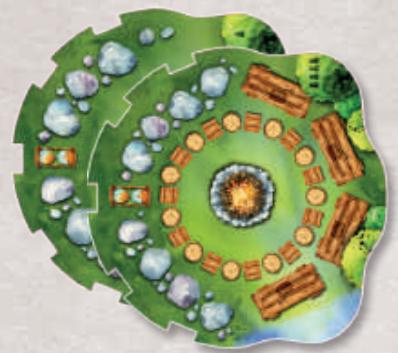
2 two-sided campfire boards (depending on player count)
2 block tokens for the campfire boards

1 round marker
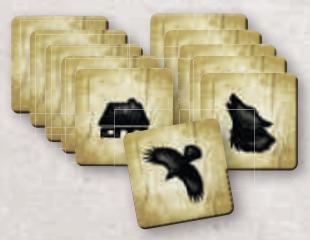
11 basic goal tokens
4 foldable deck holders
1 goal token for games using the Envelope U: Big Encounters
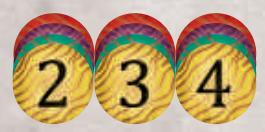
12 bonus tokens (3 in each of the 4 colors)
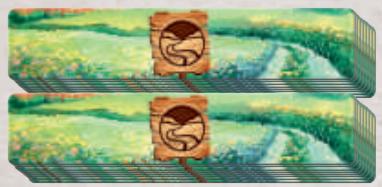
28 road tokens
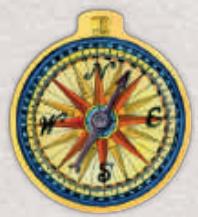
1 first player token
Solo play components:

4 color markers

184 cards, including:
cards
cards


4 two-sided starting ground cards


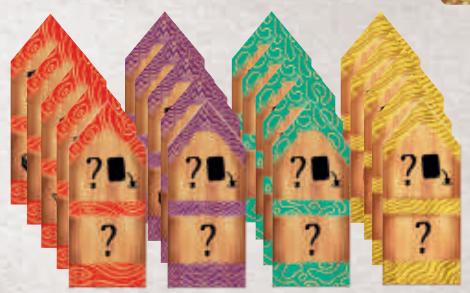

20 path tokens (5 in each of the 4 colors)
5 envelopes (6 cards in each)
1 solo play game token
For the solo play rules, see page 14.
Place the road tokens within easy access of all players.
Place 3 of the 4 deck holders in the cut-out spots on the main board. Place the remaining deck holder next to the board.
Divide the cards according to their backs and create 4 decks.

Shuffle each of the decks separately and place them in the deck holders as illustrated. At the beginning of the game, you will use 3 decks: W, S and E. Later in the game, the S deck will be replaced with the N deck.
Fill all the spots on the board with face-up cards of the corresponding decks. The left column will have 4 W cards, the next two columns have 4 S cards each, and the final column will have 4 E cards.


Place the correct campfire board for your
player count next to the main board with the side showing the symbol for
the number of players. The unused campfire board is returned to the box.


Shuffle the goal tokens and randomly place 1 token at a time on the square spots on the campfire board. Unused goal tokens are returned to the box (a 4-player game will use all the basic goal tokens).
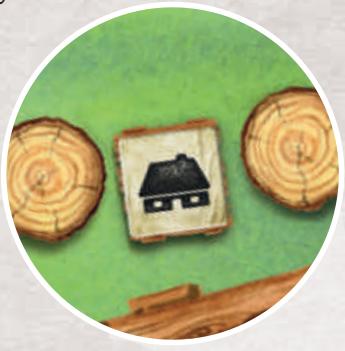

When playing a 2-player game, block 2 notches of the campfire board with the block tokens. In a 3-player game, block only 1. These notches are blocked for the entirety of the game.


Each player chooses a color and takes the following components:

5 path tokens matching the color of the player (in a 4-player game, the token with the ? symbol is returned to the box - it will not be used),

3 bonus tokens of the matching color,
a road token with the visible road symbol,

a two-sided starting ground card.


Place the round marker on the 1st rock of the round tracker.


The player that was last stung by a bee receives the first player token and starts the game.
Component and round number depending on the player count
block tokens
| 1 player 1, 2, 3, 4, ? | 3 | 2 | 6 |
| 2 players 1, 2, 3, 4,? | 5 | 2 | 6 |
| 3 players 1, 2, 3, 4,? | 8 | 1 | 6 |
| 4 players 1,2,3,4 | 11 | 0 | 8 |
Player Preparation

Each player starts the game with 5 cards in hand.
The cards are taken in the following way: Beginning with the player to the right of the starting player and going counter-clockwise, each player chooses a row on the main board and adds all 4 of the cards in that row to their hand. They then draw 1 card from the currently unused N deck.
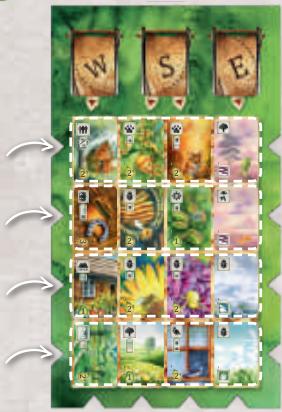
After a player chooses their cards, refill the
empty slots on the board with cards from the corresponding decks.
Repeat until all players have their starting 5 cards.
Before the 1st round, but after taking the card rows, each player chooses a side of their starting ground card and places the card in their meadow area - with the chosen side face up - as their first card.
Important! When preparing the 1st game, it might be easier to randomly deal the starting 5 cards, rather than select them from a row. Thus, deal each player: 1 W card, 2 S cards, 1 E card, and 1 N card.

It's a good idea to choose a row that contains cards that are connected. You will read about it later in the rulebook.

Example 1. Steven chooses the 2ⁿd row and takes the 4 cards from the board and 1 card from the N deck that is currently next to the board.
Player area
Meadow area
Here you play the vertically oriented ground and observation cards (see page 8).
Two-sided starting ground card You start the game with this card showing the side of your choice.
Surroundings area
Here you play the horizontally oriented landscape and discovery cards (see pages 10-11).


Each player starts with 1 road token.

Bonus and path tokens Place these components next to your meadow area.
You are ready to play the game!
The Course of the Game
The game consists of 6 rounds in a 2- and 3-player game, or 8 rounds in a 4-player game (the number of stones on the campfire board corresponds to the number of rounds). Players take their turns in clockwise order, starting with the first player.
Player Turn
During your turn, you must perform an action, placing your path token in 1 notch of the main board or campfire board. You can place your token only in an unoccupied notch. The token remains in the notch until the end of the round.
Each path token allows you to take 1 of 2 action types, depending on its placement:
main board - drawing cards and (optionally) playing them in the meadow or surroundings area,
campfire board – taking a special action and (optionally) fulfilling a goal.
The action becomes available after placing the token in the notch in the main board.
The top
The bottom
The action becomes available after placing the token in the notch in the campfire board.

End of the Round
The round lasts until all players have used all of their path tokens. Then the players collect their path tokens, and the first player token moves to the player to the left of the current first player. The round token moves to the next spot on the round tracker.
End of the Game
The game ends after finishing the last round. The winner of the game is the player with the most points from played cards and fulfilled goals.

Main Board Actions

Drawing and Playing Cards
If you place your path token in 1 of the notches in the main board, you perform the top action. After placing the path token, you:
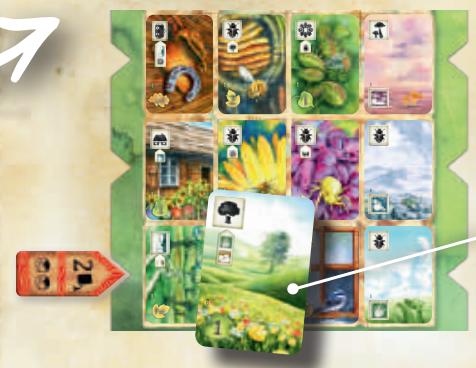
Count a number of spaces from the token equal to the number shown in the direction it is pointing. The ? is any number 1-4 of your choosing. You must take the card chosen by the token. The empty spot is immediately refilledwith a card from the corresponding deck.
You may then play 1 card from your hand into your meadow or surroundings area (you may play the card you have just taken from the main board or a card that you already had in your hand).
Important! In the rare case that an empty spot cannot be refilled because there are no cards left in the deck, it should be left empty. If you place the path token that enables you to take the card from that empty spot, you can only play a card.

Example 2. Caroline, the yellow player, places her path token in a free notch. The number on the token indicates the row that she takes the card from. Caroline uses the number 3 path token, therefore she takes the 3rd card along the row, counting from the placed token. Then, after refilling the empty spot with the S card, Caroline can play 1 card from her hand.
Rules for Playing Cards
You play vertically oriented ground and observation cards in your meadow area. You play the horizontally oriented landscape and discovery cards in your surroundings area.
Important! You cannot move played cards (of any type) – they must stay where played until the end of the game.
Ground Cards
The ground cards illustrate ecosystems that are connected with the habitats of various types of animals, plants and fungi. They have a ground symbol, which will be useful for playing cards in the future.
When playing a ground card, place it on the right or left side of any already played ground cards.
You can have up to 10 ground cards in your meadow area.
Symbols at the bottom of the ground cards must always be visible – you cannot cover them. The ground cards create the lowest level of the meadow, therefore they cannot be played on top of other cards.

Remember, the more different symbols on your ground cards in your meadow area, the greater possibility to play the next card.

Example 3. Caroline decided to play a ground card. Her meadow area already has 2 other ground cards. The arrows indicate where she may play the new ground card.
Observation cards
Observation cards present types of animals, plants, and fungi as well as human made creations – buildings and surrounding items. They represent notes that you make during your trek.
You can play an observation card either on top of a ground card or on another observation card if the requirements to play the card are met. The requirements are considered fulfilled if your meadow area has all the required symbols visible.
Your card columns must start with a ground card, but you can have any number of observation cards in each column.
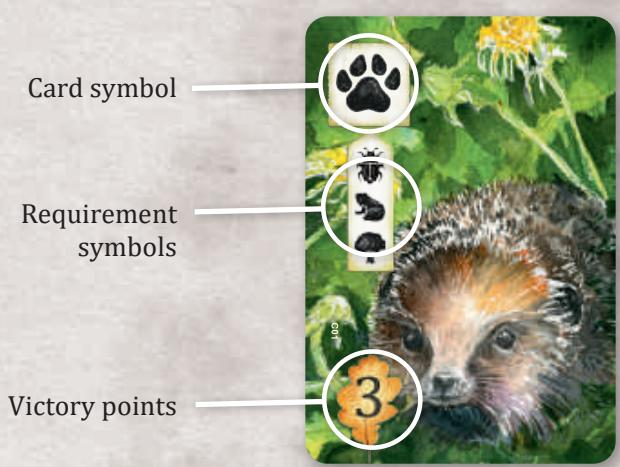
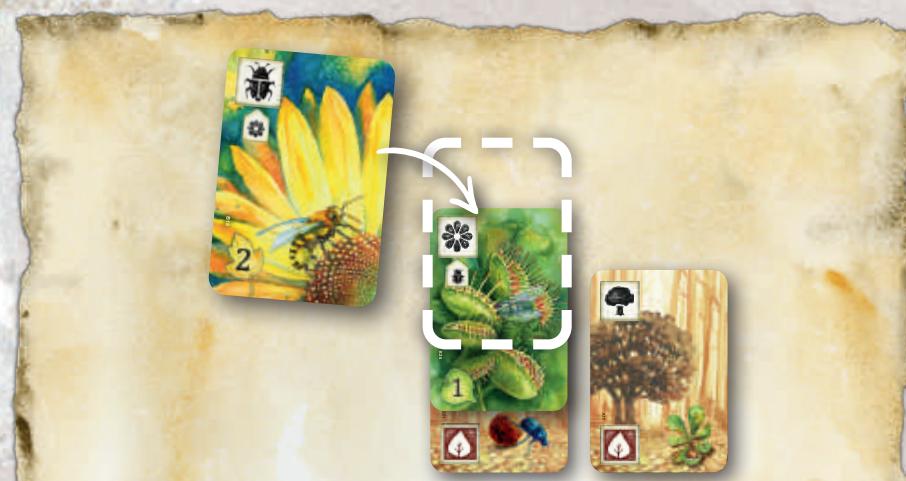
Playing Observation Cards
When playing an observation card on a ground card, you must remember not to cover the ground symbol. When playing new cards, make sure to place them so the victory points value on a previously played card is visible.
When playing an observation card, the following scenarios are possible:
Card has 1 requirement. You play the card on top of a card with the required symbol (see Example 4). If you have several cards that fulfill this requirement, choose 1 of them and place the card on it.
Card has 2 or more requirements. You play the card on a chosen card that has any of the required symbols (see Example 5). All of the required symbols must be visible in your meadow – only then can you cover 1 of them.
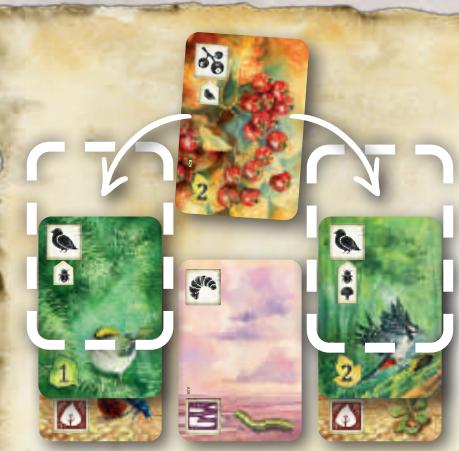
Example 4. Will wants to play his Common hawthorn card. In his meadow area, he already has 2 cards with the required symbol. He can choose to play the new card on either of them. When playing the card, he covers the chosen symbol but leaves the victory point value on the covered card visible.

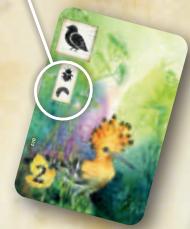
Example 5. Steven plays his Eurasian hoopoe card in his meadow area. This card requires theandsymbols. Steven can choose which of the required symbols to cover. The covered symbol cannot be used again, however the remaining symbol can be used in the future (as long as it is visible). Steven also gains a newsymbol from his hoopoe.
If 1 of the requirements on the observation card is for a ground symbol, you can play the card directly on top of an empty ground card (you must still fulfill all other requirements) or on another observation card at the top of a column with that ground card at the bottom (regardless of the symbols on the top observation card in this column – see Example 6).

Example 6. Will plays the Peacock butterfly card. This card requires the and symbols. Will may therefore play it on the ground card with the symbol or at the top of the column with the ground symbol base.
Choice of a Requirement

If the requirement symbols are divided with a slash, it means that you need only 1 out of 2 presented symbols to fulfill the requirement. You decide which symbol to choose. For game purposes, a choice requirement only counts as one symbol (not two).
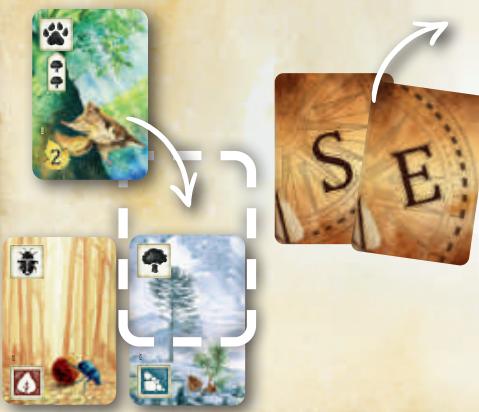
Required Adjacent Columns

On some of the cards, the requirement symbols are marked with arrows. In such a case, the card must be played in a column immediately adjacent to a column showing the indicated required symbol. If, among the requirement symbols, there is a symbol marked with arrows and another symbol without
arrows, you must have both symbols in your play area, but you can choose where to place the card (see the example below).
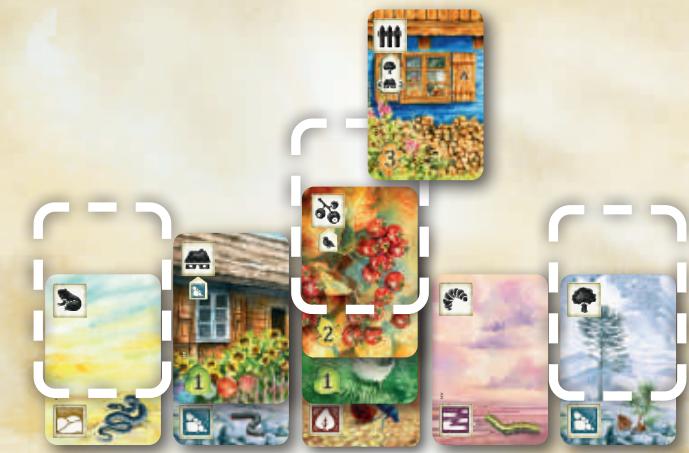
Example 7. Will may place the Chopped firewood card on 1 of the 3 marked spots.
Replacing a Missing Symbol
If you are missing a required symbol in your play area, you may discard any 2 cards from your hand to ignore 1 requirement symbol of the played card (you can do this multiple times). You cannot ignore all of the symbols this way - you must always have at least 1 of the required symbols. Place the discarded cards in any order on the bottom of the corresponding decks (see the example below).
Example 8. Steven wants
to play the Siberian flying
squirrel card. In his
meadow area, he only
has 1 card with the required symbol. He plays this
card on the card with the symbol and ignores the
missing symbol by
discarding 2 other cards.
Remember that when you play a card, you lose the symbol of the card you cover in your meadow area. However, you still have the ground symbol visible and you can use it multiple times. Some of the cards provide 2 card symbols – covering them loses both.
Landscape Cards
Landscape cards have illustrations of the landscapes that the players wander. They give you the èsymbol.

Requirement symbols
Landscape cards are played in the surroundings area (see page 6).
All of the landscape cards require a road token.
When playing a landscape card, the following scenarios are possible:
Card requires only a road token. You play the card and place 1 of your unused road tokens below it, then flip the token, so the side without the road symbol is visible, marking it as used.

Example 9. Caroline plays a landscape card in her surroundings area. To do that she takes 1 of her unused road tokens and places it below this card and then flips the token so the side without the road symbol is visible.
Card requires a road token and other symbols. You must have all of the required symbols in your meadow area and a road token. You play the card and place 1 of your unused road tokens below it, then flip the token, so the side without the road symbol is visible, marking it as used. You do not lose the required symbols - you may still use them to fulfill the requirements of other cards.
If you are missing a required symbol in your play area, you may discard any 2 cards from your hand to ignore 1 requirement symbol of the played card (you can do this multiple times). You cannot ignore the symbol this way. Place the discarded cards in any order on the bottom of the corresponding decks.
Discovery Cards
Discovery cards are items you find during your trek. They are souvenirs and mementos from your travels. They are marked with the symbol.
You place the discovery cards on previously played landscape cards by covering thesymbol.

When playing discovery cards the following scenarios are possible:
Card requires only the symbol. You play the card, placing it on one of your unused landscape cards.
Card requires the symbol and other symbols. You must have all of the required symbols in your meadow area. You play the card, placing it on one of your unused landscape cards. You do not lose the other required symbols - you may still use them to fulfill the requirements of other cards.

Example 10. Will found a horseshoe in his travels. This card requires the andsymbols. In his meadow area, Will has a visible symbol, so he can play this card on a landscape card.
As with other cards, you can discard any 2 cards from your hand to ignore 1 requirement symbol from the played card (you can do this multiple times). You cannot ignore the requirement this way. Place the discarded cards in any order on the bottom of the corresponding decks.

Example 11. Properly filled player area.
Campfire Board Actions

Performing Special Actions and Optional Goal Fulfillment
If you place your path token in 1 of the notches in the campfire board, you perform its bottom action. After placing the path token, you take the indicated special action and you have a chance to fulfill a goal (see next page).
Types of special actions:

Take any face-up card from the main board and refill the empty spot with the top card of the corresponding deck. You cannot play this card this turn.

Take 2 road tokens and place them in your surroundings area with the road symbol facing up. You cannot play a card this turn.

Look at the top 3 cards of one deck on the board (not the unused one). Add 1 of these cards to your hand and put the remaining 2 cards on the bottom of the deck in any order. You cannot play a card this turn.

Play up to 2 cards from your hand into your meadow and/or surroundings area.
Important! If you chose one of the first 3 special actions, you cannot play any cards! It's an often forgotten rule.

?" Path Token
This path token is used in a 2- and 3-player game. Placing this token in a main board notch allows you to take any card from the indicated row or column (the ? value is decided by you). Placing this token in a campfire board notch allows you to take any special action.
Placing a Path Token on the Bench
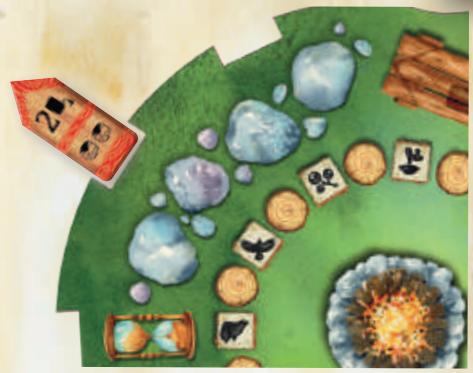
You can play the path token on an unoccupied bench on the campfire board (marked with the symbol). Doing this allows you to play 1 card in your meadow or surroundings area.


Goals
On the campfire board, the neighboring goal tokens create pairs. If you have both symbols of the pair visible in your meadow area, you may claim the space between the pair with one of your bonus tokens. You may only claim it after placing a path token in the notch of the campfire board. You decide if you want to place the bonus token before, during or after taking the special action. Your bonus tokens are placed on the board starting with the lowest valued ones (in the order 2, 3, 4). Only 1 bonus token can be placed between each pair. During your turn, you can place only 1 bonus token on the campfire board even if you have more symbols that fulfil several goals.
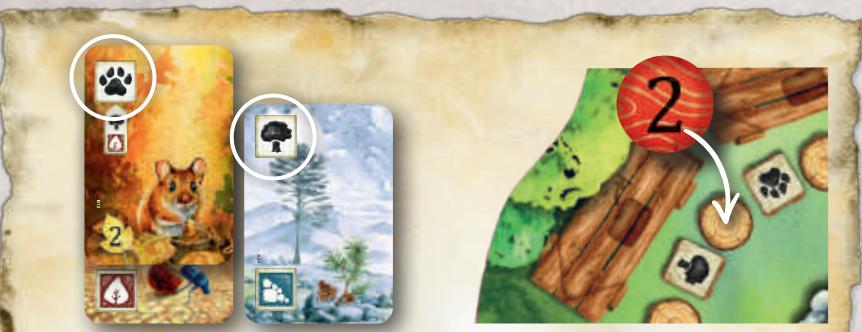
Example 12. Steven places a path token in the notch of the campfire board and takes a special action. In his meadow area, he has the andsymbols. There is a pair matching those symbols on the campfire board, and the space between them is free. He plays his 2-value bonus token between this pair.
When taking the special action with the number 4 or ? path token (if ? copies the action of the number 4 token), you can place the bonus token before or after playing your first or second card.

End of Round
When all players have placed all their path tokens, the round ends. Then the players collect all their path tokens.
The player that started the round passes the first player token to the player on their left. In the next round, this person will be the first player.
Move the round marker to the next spot on the round tracker.
Halfway Point

When the round marker passes the hourglass on the campfire board, you must do the following:
Discard all of the cards from the main board and randomly place them on the bottom of the corresponding decks.
Replace the S deck holder with the N deck holder.
Refill the board with new cards from the corresponding decks.
Continue the game according to the normal rules.
End of Game and Scoring

The game ends at the end of the final round (last spot on the round tracker). Players count their victory points from the cards they played in their meadow and surroundings areas, as well as their bonus tokens from the campfire board. When counting the victory points from the played cards, remember to count all the cards in your play area. Cards remaining in your hand do not give you any victory points. Each bonus token played on the campfire board gives exactly the same number of victory points as its value. Unused bonus tokens do not give any victory points.
The winner is the player with the most victory points. In case of a tie, the winner is the player with the most discovery cards played. If there is still a tie, the players share victory.
Envelopes
There are 5 envelopes in the game box with thematic cards. Because of the advanced rules of those cards, we recommend you not use them in the first few games. It is assumed you will open the envelopes after fulfilling the requirements described below, but do not take that too seriously. It is all about having fun!
The thematic sets of cards in the envelopes are independent expansions. You can freely mix them with the base cards by shuffling them into their corresponding decks. Each card is marked in the bottom part with a letter corresponding to the marking on the envelope to make separating the cards easier during future games.
ENVELOPE T – National Parks. Open after visiting a national park or nature reserve. Cards in this envelope have only 2 ground symbols. Cards from this expansion do not introduce any new mechanics.
ENVELOPE U - Big Encounters. Open at the end of any game that has at least 5 symbols visible among all player areas. This set introduces the symbol. You cannot place any cards on a card with this symbol. Even if there is a required ground symbol on the card in the column or if this column would fulfill the requirement of adjacent areas. The punch board includes a red token with the symbol. If you use cards from this envelope, add this token to the other basic goal tokens.

ENVELOPE W – Long Unseen. Open after a trip to a forest, where you saw a wild animal. Cards from this expansion do not introduce any new mechanics.
ENVELOPE X - First Signs of Spring. Open on the first day of spring. Cards from this expansion do not introduce any new mechanics.
ENVELOPE Y - Christmas. Open on the 24th of December. Cards from this expansion do not introduce any new mechanics.

Solo play game token
Solo Variant
In this variant, the game is played exactly as a 2-player game, but your only opponent is a dummy player called Rover.
Changes to the Setup
Place the campfire board below the main board with thesymbol facing up. Place the round marker on the 1st rock of the round tracker.
Randomly pick 3 (face-down) goal tokens. Place 1 face-up token at a time on the square spots around the campfire on the campfire board.
Place 2 block tokens in the notches of the campfire board.
Choose a color and take all of the components for that color as in a standard game.
Place the solo play game token next to the main board.
Shuffle the path tokens (including the ? tokens) of all of the other colors and form a face-down pile. Place them next to the solo play game token.
Take 1 color marker of each of the other colors and randomly place them as illustrated, face-up.

Color markers
Pile of the remaining path tokens

Rover does not have their own meadow or surroundings areas, and the cards they collect during the game are placed in a deck above the solo play game token.
Take your starting cards and refill the empty slots on the board with cards from the corresponding deck. Then take all of the cards from the 1st row under the deck holders and 1 card from the N deck and place them in Rover's deck. Refill the board again.
Changes to Gameplay
In the solo game, Rover is always the first player. The turns are taken interchangeably until you run out of path tokens.
During Rover's turn, flip the top path token in their pile.
If the token is a ? token, place it in any unused notch of the campfire board. If all of the notches are used, discard the token. In both cases, do not take any other actions.
If you flip any other token, look at its color. Place it in an unused notch of the main board according to the solo play game token and the color markers. If the notch indicated by the solo play game token is already taken, use the closest clockwise unused notch. Then take the card indicated by the path token, place it on Rover's deck, and refill the empty spot with a card from the corresponding deck.
Rover does not use the bonus tokens.
The round is over when you place your last path token. Collect all of your path tokens, then collect all of the other tokens (those played by Rover this round and the unused ones), shuffle them and create a new face-down pile. Move the round marker to the next spot on the round tracker.
When the round marker passes the hourglass symbol, do the following:
Discard all of the cards from the main board and randomly place them on the bottom of the corresponding decks.
Replace the S deck holder with the N deck holder.
Refill the board with new cards from the corresponding decks.

Example 13. Caroline reveals a path token from Rover's pile. The path token is red and shows the number 3. Caroline places the path token on the left side of the main board in the notch marked on the solo play game token with number 3. She takes the card indicated by the path token and places it on Rover's card deck.
End of Game and Scoring
The game ends at the end of the 6th round – it is time to count the points.
Count all of the points in Rover's card deck.
Then count your points according to the standard rules. If your score is lower, it means you did not observe enough interesting things during this trek. If your score is higher or equal to Rover's score, check the table below to see how you faired.
Solo scoring table
| <39 | You were distracted. You managed to immortalize only a few interesting species. |
| 40-49 | It was a fruitful trek. However, you observed only a few fascinating species. |
| 50-59 | Amazing species! The memories of this trek will stay with you for a long time. |
| 60+ | Your collection is worth displaying. |


Take 1 of your path tokens and place it:
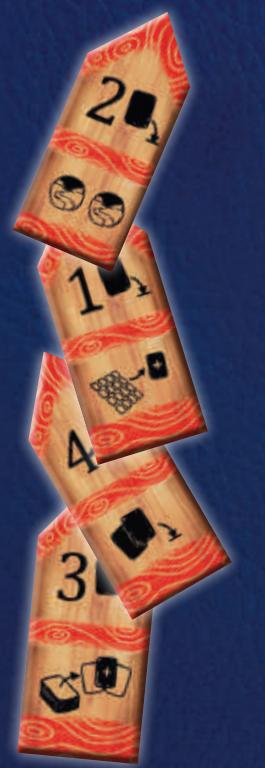
either on the campfire board
and take a special action:

Take 1 card from the board.

Take 2 road tokens.
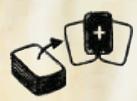

Look at the top 3 cards of any deck and keep 1 of them.
Play 2 cards.
or on the main board
Take the card indicated by the token.
then you may play a card
If you have the required symbols.
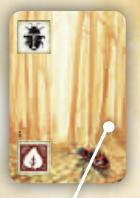
Place an observation card on top of a card with the required symol.

Place landscape and discovery cards above your meadow area.

Place a ground card next to another ground card (max 10).
原文为社区整理/出版社公开资料,版权归原作者,仅供个人学习查阅。