
巨文明Mega Civilization
一句话概览
巨文明 是一款已收录于村了吗规则库的桌游,支持 5–13 人,原名 Mega Civilization。
本页内容:一句话概览 · 常见问题
这游戏怎么玩
- 本站已收录这款游戏的规则资料,可以在对话里直接提问规则细节。
常见问题(FAQ)
以下 1 条问答中 0 条来自站内玩家的真实提问,其余 1 条为本站整理的常见疑问;答复内容保持原样。
巨文明支持几个人玩?
5–13 人。
去哪查完整规则
想核对具体规则细节、卡牌效果或某个回合的结算方式,可以在村了吗里选中这款游戏后直接提问。
同类桌游
- 卡坦岛德式
- 工业革命:伯明翰德式
- 勃艮第城堡:特别典藏版德式
- 方舟动物园德式
- 卡卡颂抽象
- 瘟疫危机传承:第一季美式
- 阿瑞迪亚:勇踏征途美式
- 重塑宇宙德式
- 幽港迷城美式
- 埃多拉的德鲁伊德式
规则原文(Markdown)
本站收录这款游戏的规则原文 6 个文件,此处内联渲染 3 个,可直接展开阅读或下载。
MegaCivilization_Rulebook_Updated_Version_.md177.6 KB

(ONTENT
123456万8910 lntroductionge 2
Game componentspage 4
General rules and deintionage 6
Setting up te gamepage 10
Map boar set 14
Sequence o plag 20
Leaving the gamepage 31
Card-specific rules - Calamitiespage 32
Card-secii rle -Cilization Advanceage 38
The Short ag 44
11. Division of Trade Cards page 46
1. INTRODVCTION
Mega Civilization is a game of skill for 5 to 18 players covering the historical development of ancient civilizations from just after the last lce Age to the dawn of the new era at the end of the lron Age - a time span of almost 8000 years. Each player leads his own civilization as it tries to expand its culture over a map board that stretches across the Mediterranean Sea, and the Middle East, all the way to India..
Although battles and territorial strategy are important, Mega Civilization is not a wargame as you might expect when looking at the map board. Instead, the objective of play is to gain a level of overall advancement involving cultural, economic, scientific, political, civic and religious factors. The player who most effectively balances these various goals will achieve the best scores and win the game
THE GOAL
The objective of Mega Civilization is to acquire the highest number of Victory Points by building cities and developing Civilization Advances. This will be done over various phases and turns, some of which will be performed simultaneously by the players. After each turn, a check is made for each player to move forward on the Archeological Succession Table (A.S.T.). Each step on this timeline represents a certain period of time in history reaching fror the Stone Age to the late Iron Age. Advancement there will provide even more Victory Points. The winner will not necessarily be the first player to reach the end of the A.S.T. or the player with the highest number of cities or Civilization Advances, although these are the key factors in determining the winner.
DESCRIPTION OF PLAY
Each civilization begins with a single population token and every turn each player increases his population by adding tokens to each area he occupies. These tokens can be moved over the map board by land, or by sea using ships. Since each area has a population limit, a good strategic overview wil give players advantage in occupying more and more areas. If players manage to move sufficient tokens into areas, they can build a city there. These cities generate trade cards which will eventually lead to knowledge and wealth.
During trade sessions, players receive not only the commodities they need to complete sets; they might also receive calamities which will remove population or cities. Specific Civilization Advances will protect the players from natural or civic calamities. The development of these Civilization Advances is symbolized by turning in sets of trading goods, as the wealthier civilizations will acquire more Civilization Advances.
As civilizations develop, it will be harder for their rulers to find the right balance between future population growth, maintaining enough support for their cities and increasing their treasury. If they cannot manage their token population, their cities might eventually revolt during the Tax collection phase. The civilizations with the strongest economy traditionally score the highest.
LENGTH OF A GAME
A game of Mega Civilization can take 10-12 hours to complete. The game also includes the beginnerscenario The First Game', which will take only 1-2 hours. Another scenario, The Short Game', provides the same excitement as the full game, although the game starts in a later age. This way games can be played in 'just 6-8 hours.
DEVELOPMENT
Somewhere around 1999 John Rodriguez, living in Texas, USA, picked up the idea to create a bigger map and some extra cards for his favorite game: Civilization by Francis Tresham. Much historical research ensued with larger and larger maps, new civilizations and new advances. A few years later, he shared his map and cards on the internet, creating the forum Civproject where anyone with ideas could contribute to his project.
At the same time Ho de Haan, living in the Netherlands, Europe, had similar ideas creating extensions to his favorite game Civilization and started searching the internet for resources. He came across the forum and after a while John and Ho decided to work together to take this shared idea to a higher level. They worked on the design, artwork and simplicity to this enormous game which now accomodates up to 18 players. At first it was just an extension to the original garme, but now they started working on the game from scratch, No single detail was safe, Rules would change radically, new ideas were launched and sometimes failed and years went by testing, testing, changing, testing, adding removing, testing changing and testing again. For years, each with their own group of players on either side of the ocean, John and Flo kept discussing their findings and fully redesigned the first idea to the game it is today, As each game takes a full day and requires a group of people to play, the effort to perform the most comprehensive testing was a real challenge.
Here it is, Mega Civilization: a game for 5-18 players. Created by devoted Civilization-fans who put their heart into this wonderful game.
We would like to thank: Gerart de Haan,
Jon Severinsson, Martin Brodén, Jeffrey Brent McBeth, Judith van der Molen, Miquel Schumacher, Michael Bruinsma, Jacob Boersma, Jochem van Dijk, Mirjam Molenkamp, David van Nederveen Meerkerk, Johannes van der Horst, Bob Feis, Ronald Engeringh, Mike Droog, Marcel Remijn, Tony Lemmers, Rico Radeke, Nathan Barhorst, Bill Kohler, Florian Buhr, JR Honeycutt and all the play-testers and the contributors of the Civproject forum.
Civilization, original design: Francis Tresham.
Mega Civilization authors: John Rodriguez, Ho de Haan,
Game development: John Rodriguez, Flo de Haan, Gerart de Haan.
Text: Flo de Haan.
Illustrations and graphic design: Franz Vohwinkel,
Graphic design rules: 999 Games b.v.

© 2019 999 Games b.v. Published by: 999 Games b.v. P.O. box 60230 NL.- 1320 AG Almere The Netherlands www.999games.nl Customer service: E; customerservice@999games.nl All rights reserved Made in EU

999 Games b.v. thanks Mayfair inc. for licensing the rights to Civilization. Their support and cooperation made this project possible.

2. GAME (OMPONENTS
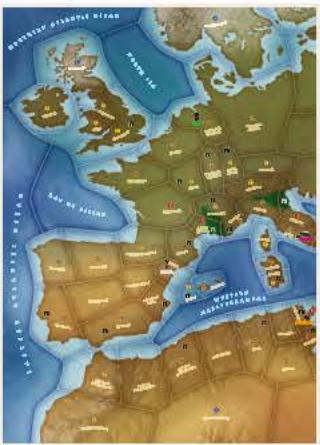

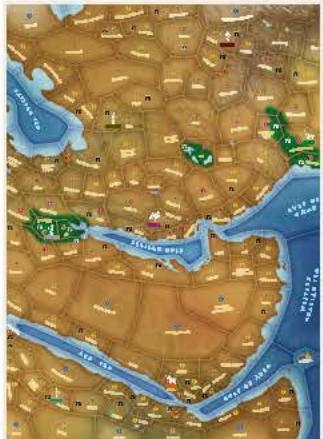
4 Map boards
2074 TOKENS 18 civilizations, consisting of:


55 population tokens (+1 spare)

9 cities

4 ships
2 AST / Census markers (+2 spare)
Credit tokens
30

in 5 colors
Barbarians
30

30

in 5 colors
in 5 colors

in 5 colors
30

18
in 5 colors

1 turn marker (+1 spare)
Pirate cities

Turn markers
50
4


Out of play tokens
Barbarian tokens
70

18 player mats
1 double sided A.S.T.

Basic
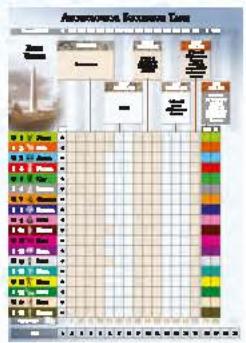
Expert
1 census track

840 TRADE CARDS
Blue set

201 Western trade cards
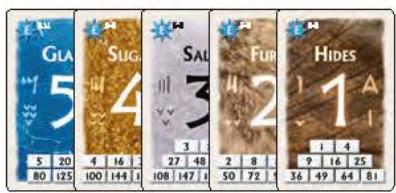
201 Eastern trade cards
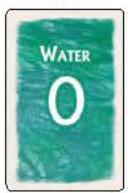
18 Water-cards

7 Spare cards
Orange set

172 Western trade cards

172 Eastern trade cards

18 Water-cards

7 Spare cards
Player sequence cards

18 numbered cards

18 The Short Game scenario cards

8 Spare cards
729 CIVILIZATION ADVANCE CARDS

724 Civilization Advances

5 Spare cards
10 Double sided player aids

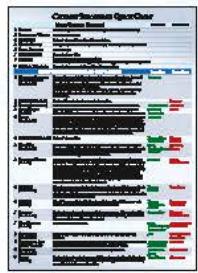
Strategy Explorer ‘Calamity Resolution' quick chart
1 Rulebook
1 'The First Game' scenario booklet
1 set of ziplock bags for storage
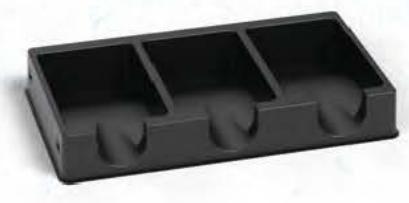
12 Trade cards holders

1 Certificate of authenticity
3. GENERAL RULES AND DEFINITIONS
THE PLAYING PIECES
THE PLAYER MATS
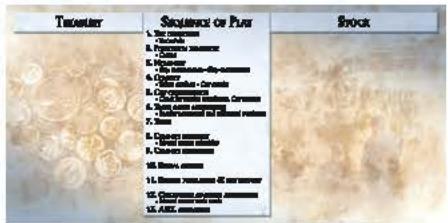
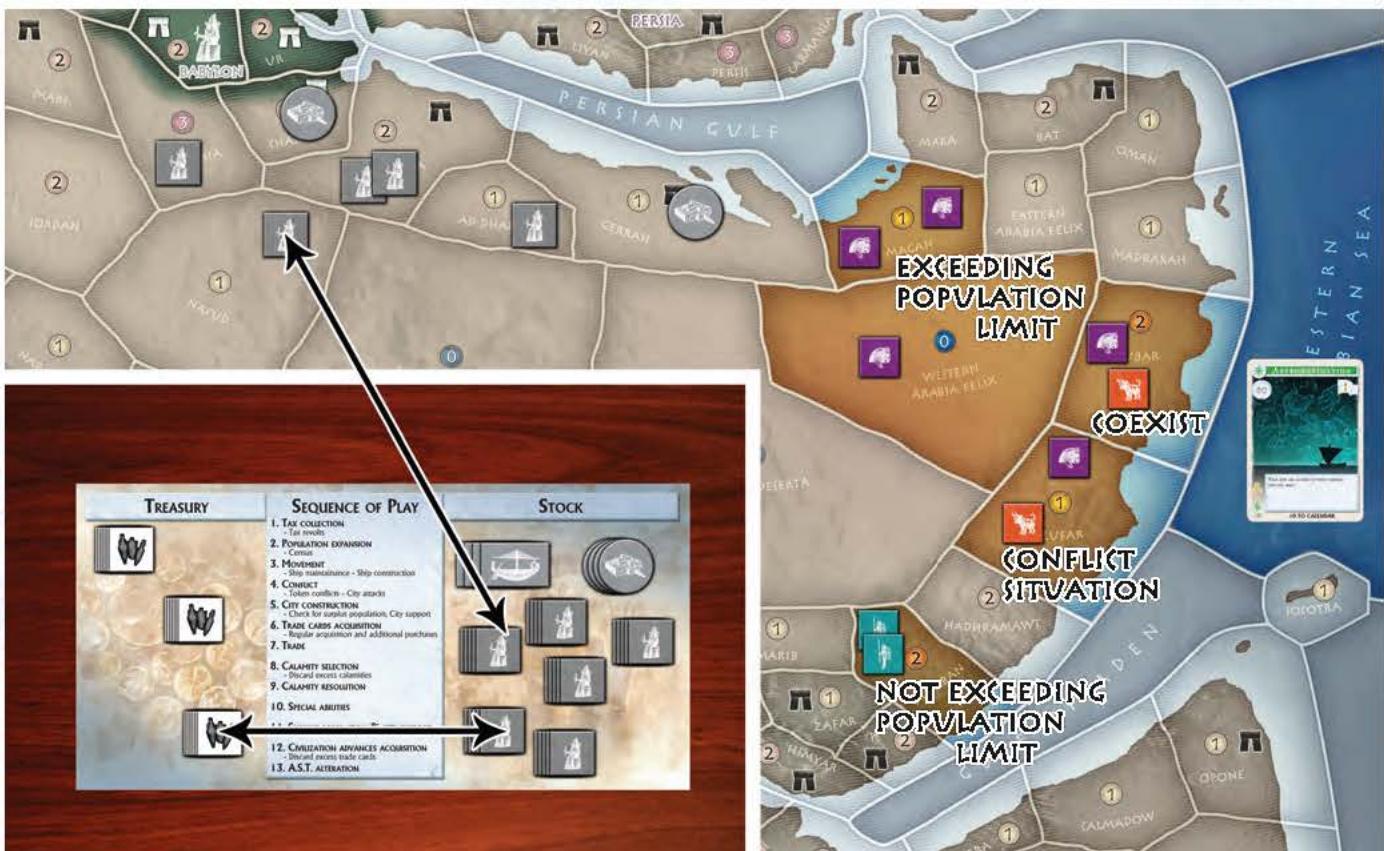
Each player uses a player mat to store his playing pieces. The player mat is divided into two sections: treasury and stock, divided by the 'sequence of play'. During the game it is important to keep the tokens in these two areas separate, A player has 55 population tokens, 9 cities and 4 ships. The 55 tokens are two-sided: one side serves as population, while the other serves as treasury. So each of his 55 tokens is either on the board, in stock or in treasury. Ships and cities are either on the board or in stock, but never in treasury.
STOCK
By default, each player's playing pieces are placed in the stock-area with the colored side up and are considered to be 'in stock'. If a playing piece is destroyed or removed from the board, it is returned to stock, Tokens that are placed on the board are always taken from stock and, unless specified otherwise, placed with the colored side up.
TREASURY
Some rules force or allow players to transfer tokens to the treasury-area. These tokens are then referred to as 'treasury tokens' or 'in treasury'. Any tokens in treasury must be flipped upside down to show the white side, The amphorae are the symbol for a player's treasury. Tokens in treasury are not considered to be population tokens. lf a player pays treasury, the treasury tokens are turned over and moved back to stock.
UNITS
Population tokens and cities are further referred to as 'Units'. A population token counts as 1 unit point. A city counts as 5 unit points (or 5 units). Ships do not count as units.
BARBARIANS AND PIRATES
As the game evolves, eventually barbarian tokens and pirate cities will appear on the board as a result of calamities.
MAP BOARD DEFINITIONS

Adjacent areas
Unless specified otherwise 'an adjacent area' means 'sharing a border'.
A. Areas adjacent by land; share at least a land border B. Areas adjacent by water; share at least a water border. Markings in areas
C. Population limit; a circle containing a number from 0 to 4. This defines the limit of population tokens allowed in an area during specific moments in a game turn.
D. Open Sea area; an area that contains strictly water and has no population limit.
E. Coastal area; an area that contains land and water (indirectly) connected to an open sea area, Areas containing inland seas such as 'Anatolia' (map board 2) or 'Nis' (map board 3) are not considered 'Coastal Areas'
F. Area-name; if an area has no name, it is considered to be out of play.
G. Starting location; an area containing a Civilization's name and symbol.
H. City site; a black or white stone gate-symbol in an area.
- Volcano; a volcano symbol in an area or on the border of 2 areas. A volcano on the border of 2 areas is considered to be in both areas.
J. Flood plain; a dark green stretch of land extending over parts of 1 or more areas. All areas fully or partly covered by a single flood plain are considered to be 'on the flood plain'. City sites on a flood plain show a white color. Black city sites in an area with a flood plain are considered to be not on that flood plain and thus safe.
Additional notes
• Open sea areas are considered to be always in play, even though their area name is printed on a different map board piece.
• Although the area-name for 'Caspian Sea' is printed on both map board 2 and 3, this is considered to be one area.
• The area Chalcis is not considered adjacent to Athens, The same is true for Boeotia and Eretria.
(VILIZATION ADVANCES

Group color & symbol (in case of a dual group)
Additiona credits, if pesent, pecified as attributes
Specific credits to a single card
GROUPS / COLORS
The cards are divided in 5 groups represented by colors as well as symbols: Science (green star), Arts (blue harp), Crafts (orange vase), Civics (red temple) and Religion (yellow tribal). Some Civilization Advances belong to 2 groups rather than just 1.
VICTORY POINTS
On the right top side of each card, it shows either 1, 3 or 6 Victory Points in a banner symbol. The points are counted at the end of the game to determine the winner.
ERRATA CARDS
This errata kit indudes 2 packs of 77 cards with updated copies of 7 Civilization Advances and, in addition, 1 full set of all 51 (updated) Civilization Advances, The content of Provincial Empire' has not been changed, but its wording was slighty updated ('5' instead of 'five'). All updated cards have a repair symbol () printed in the lower right corner and replace the original cards that do not have this symbol
ATTRIBUTES
Most Civilization Advances show one or more attributes that apply to the holder of the card exclusively These attributes typically provide calamity protection or benefits in play, however, sometimes they might aggravate certain calamity effects in addition to these benefits. Special abilities can be used once a turn during a specific phase called Special abilities phase.
(REDITS AND (REDIT SYMBOLS
Once a player acquires a Civilization Advance, he receives the credit tokens printed on the left side of the card. These credits give a bonus when purchasing other Civilization Advances of the same group. Some Civilization Advances provide additional credit tokens marked with a; these credits are then mentioned in the attributes, Most of the Civilization Advances provide additional credits to a specific card.
TRADE CARDS
It is important to distinguish 'blue marked' cards and orange marked' cards (blue and orange cards have different backsides). Orange marked cards are only used in games of 12-18 players.
The trade cards are divided into 2 groups: 'Commodities' and 'Calamities'.
• Commodities show trading goods with a large number (1-9).
Calamities show an illustration and either the indication 'Minor Calamity', 'Major Calamity' or 'Major Calamity (Non Tradeable)'.
ARCHEOLOGKCAL SUSCESSION TABLE (A.S.T.)
The Archeological Succession Table (further called A.S.T.) has two sides. One side shows the 'Basic A.S.T.', the other side is the 'Expert A.S.T.' for experienced players, We suggest to start your first games using the 'Basic A.S.T.'. The A.S.T. is divided into 6 epochs: Stone Age, Early Bronze Age, Middle Bronze Age, Late Bronze Age, Early lron Age and Late Iron Age. Players start placing their succession marker covering the arrow on the left and after each turn, if players meet the requirements specified on the top of the A.S.T., they move their succession marker 1 space to the right. These rows vary per player and each civilization must stick to his own requirements per step on the A.S.T.
A.S.T.-RANKING / A.S.T.-POSITION
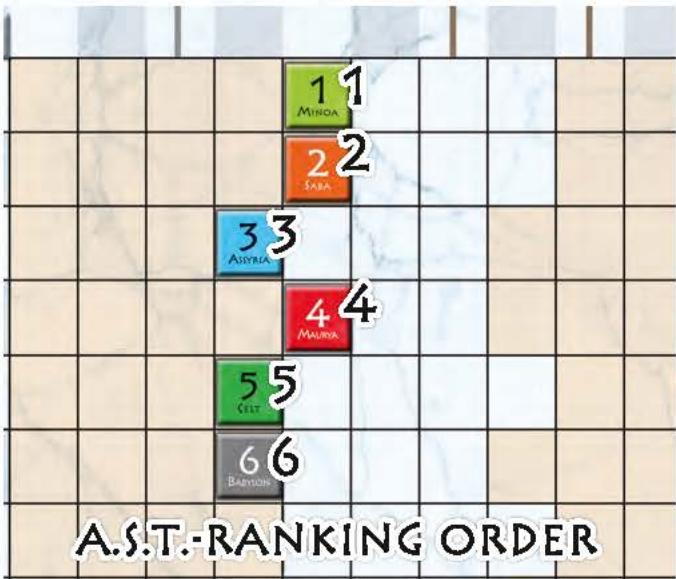
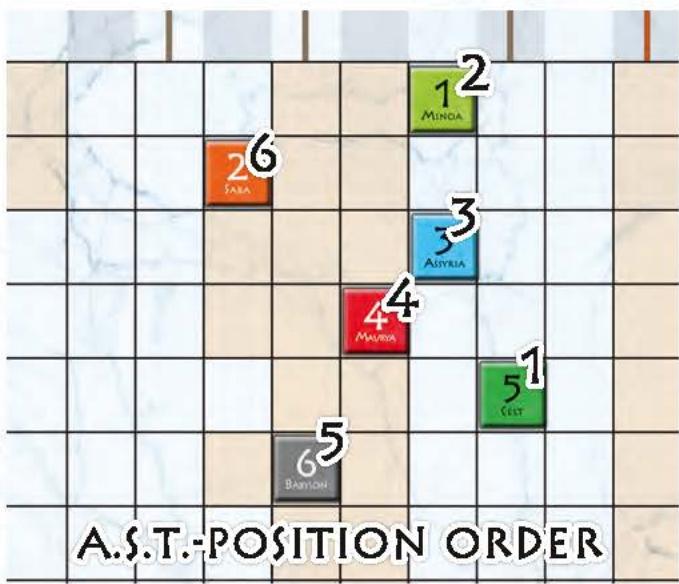
'A.S.T.-ranking' is specified as the vertical position on the list of civilizations as printed on the A.S.T., from the top to the bottom (Civilization #), irrespective of the horizontal position of succession markers. Smaller Civilization nurbers take priority over larger Civilization numbers.
'A.S.T.-position' is specified as the horizontal position of the actual succession markers. The marker furthest to the right is considered to be highest in position order. A.S.T.-ranking breaks ties
At any time, if a tie occurs between players' activities and it is not dlearly specified how to break the tie, it is broken by A.S.T.-ranking.
A turn marker is used to show the number of game turns played.

Commodity
Calamities
- SETTING VP THE GAME Mega Civilization is a game that can be played from 5 up to 18 players.
There are some differences in the setup rules when playing with 5-8 players, 9-11 players, 12–14 players or 15-18 players. When starting a game, you should follow these adjustments accordingly if mentioned.
If this is your first game, it is recommended that you use the scenario The First Game' which is designed to explain the rules to any new group of preferably 5 players. 'The First Game'-scenario will take 1-2 hours.
Once you have finished 'The First Game' you are ready to start a full game.
SETTING GAME LIMITS FOR THE FULL GAME
You can choose between either side of the A.S.T. These show the Basic or Expert version. The basic A.S.T. is recommended for beginners and casual players, whereas the Expert version is aimed towards more experienced groups of players. The Expert version will take 1-2 more game turns and thus 1-2 hours more than the Basic version. The Expert version has some added rules which will be explained later.
You may consider setting your own time limit. If no specific game limit is set, by default the game ends if the succession marker of 1 or more players has entered the 'Late Iron Age' epoch on the A.S.T. A full game of Mega Civilization will take approximately 10-12 hours to complete, depending on the number of players and their experience. Consider the additional time needed for taking breaks during the game.
If you want a shorter game (6-8 hours), follow the rules for setting up 'The Short Game'. This scenario is not a beginners scenario, but a shorter version of the game for experienced players.
SELECTING THE MAP BOARD
The game is divided into 'West' and 'East' which can be played independently by 5-9 players. For 10 players 'West' is played and for 11 players 'East' is played. For 12-18 players, West' and 'East' are combined and then referred to as 'blocks'.
Depending on the number of players, use the appropriate setup instructions given in Chapter 5, Map board setups (page 14).
(IMILIZATIONS
Take the playing pieces for only the civilizations mentioned in this setup and leave the others in the box, You will also need the set of black barbarian tokens and pirate cities for later in the game.
Randomly deal the player sequence cards after which, in order, each player may dhoose a civilization to play. Each player receives a player mat and places all 55 population tokens, 9 cities, and 4 ships on the 'stock' area of his player mat (colored side up). Each player takes 1 token from stock and places it on the corresponding starting location on the map board.
Keep in mind that when playing both blocks combined (12 to 18 players), players from the East and West blocks do not necessarily start on the 2 most Eastern or Western map boards respectively (see also page 16). It is clearly specified in the setups which civilizations belong to either East or West. Players should remember to which block they belong and for the remainder of the game draw only trade cards from that block.
Each civilization is associated with a 'region'; a group of areas which are most commonly occupied by the civilization. This does not mean that players should not try to occupy areas assigned to another civilization's region. In fact, to win the game, players will have to expand their boundaries. The regions are specified at the map board setups (page 18-19).
For each player, place a census marker on the Census track (in the large empty area above '1-12') and a succession marker covering the arrow on the A.S.T.
Place a turn marker on turn 1 on the A.S.T.
(IVILIZATION ADVANCES
Sort out all Civilization Advances and create stacks, face up, sorted in ascending cost price order. Sort out the Credit tokens and place them next to the Civilization Advances. lt is not necessary to place the 51 stacks directly within reach.
SELECTING TRADE CARDS
This is an important part of setting up the game.
The game is provided with trade cards containing either blue E/W-symbols or orange E/W-symbols. The blue set and the orange set have different backsides. There is no situation where these two types are mixed. Each player count requires a different setup of trade cards. You could use the aid of the 'Division of Trade cards'-chart (page 46/47) to select the right sets of commodities and calamities. 1n all cases the 'water' commodities are used. Place a stack of water cards face up next to all other trade cards. The function will be explained later.
5-9 PLAYERS (Choose either West or East)
For a game of 5-9 players, only cards containing the bhue symbols are used. lf you play 'West' then only take the cards showing a 'W'. The same applies to cards showing an 'E' when playing 'East'. Take only the cards showing the right number of players (right of the E/W-symbol)
10 PLAYERS (West)
In a 10-player game, the only option is to play 'West', All cards containing the blue W-symbols are used in this case.
11 PLAYERS (East)
1n an 11-player game, the only option is to play 'East'. All cards containing the blue E-symbols are used in this case
12-14 PLAYERS
For a game of 12-14 players, it is divided into 2 combined games. 'West' uses only cards containing the orange W-symbols. 'East' uses only cards containing the orange E-symbols. Take only the cards showing the right number of players (right of the E/W-symbol).
15-18 PLAYERS
For a game of 15-18 players, it is divided into 2 combined games. 'West' uses only cards containing the orange W-symbols. 'East' uses only cards containing the orange E-symbols. All orange cards are used for 15-18 players.
PRESHUFFLING TRADE CARDS
At the start of the game, the trade cards are not just randomly piled in stacks, but are prepared in a defined order, To prepare this, follow the specific instructions depending on the number of players.
SETTING UP THE GAME FOR 5-8 PLAYERS
Make sure the following cards are present:
If playing West:
9 ochre, 9 clay, 8 papyri, 8 iron, 8 fish, 9 fruit, 7 wool, 8 oil, 6 wine, 7 textiles, 5 tin, 6 copper, 5 resin,
6 incense, 4 marble, 5 gemstones, 4 ivory, 5 gold,
8 Major Calamities (Non Tradeable) and 8 Major Calamities (Tradeable).
If playing East:
9 flax, 9 hides, 8 stone, 8 furs, 8 timber, 9 salt
7 cotton, 8 sugar, 6 lacquer, 7 livestock, 5 silver,
6 bronze, 5 jade, 6 spice, 4 dye, 5 tea, 4 silk, 5 pearls,
8 Major Calamities (Non Tradeable) and 8 Major Calamities
(Tradeable).
Preshuffling the trade cards
Sort all trade cards into 9 stacks by number (the large number in the center, or in the upper left corner).
Each stack contains 2 different sets of commodities and, with the exception of the first stack, 2 different calamities.
For each of the 9 stacks take all of the following steps in turn (with the cards face down):
-
Shuffle the combination of both sets of commodities (without the calamities).
-
From this stack, set aside an arount of cards equal to the number of players.
-
Shuffle the Tradeable Major Calamity into the stack of remaining commodities (stack 1 does not contain calamities).
-
Place the Non Tradeable Calamity at the bottom of the stack.
-
Place the cards previously set aside on top of the stack.
Place all 9 stacks in their stack holders and use the same number of holders for discard piles.
Additional rules for 5 and 6 players
For a 5-player game only, each player collects 1 credit token worth 10 of each color at the start of the game. For a 6-player game only, each player collects 1 credit token worth 5 of each color at the start of the game. These credits are not collected when playing The Short Game'.
SETTING UP THE GAME FOR 9-11 PLAYERS
Make sure the following cards are present:
When playing West (9 or 10 players):
9 ochre, 9 clay, 8 bone, 8 papyri, 8 iron, 8 wax, 8 fish,
9 fruit, 8 ceramics, 7 wool, 8 oil, 8 grain, 6 wine,
7 textiles, 6 glass, 5 tin, 6 copper, 6 lead, 5 resin,
6 incense, 6 herbs, 4 marble, 5 gemstones, 4 obsidian
4 ivory, 5 gold, 4 amber, 8 Major Calamities (Non Tradeable),
8 Major Calamities (Tradeable), and 8 Minor Calamities.
When playing East (9 or 11 players):
9 flax, 9 hides, 8 bone, 8 stone, 8 furs, 8 wax, 8 timber,
9 salt, 8 ceramics, 7 cotton, 8 sugar, 8 grain, 6 lacquer,
7 livestock, 6 glass, 5 silver, 6 bronze, 6 lead, 5 jade,
6 spice, 6 herbs, 4 dye, 5 tea, 4 obsidian, 4 silk, 5 pearls,
4 amber, 8 Major Calarities (Non Tradeable), 8 Major
Calamities (Tradeable), and 8 Minor Calamities.
Preshuffling the trade cards
Sort all trade cards into 9 stadks by number (the large number in the center, or in the upper left corner).
Each stack contains 3 different sets of commodities and, with the exception of the first stack, 3 different calamities.
From these sets of commodities, for each stack a single set is referred to as The additional set of commodities' (only for the purpose of setting up the game), These are bone (1) - wax (2) -ceramics (3)- grain (4) - glass (5) -lead (6) - herbs (7) - obsidian (8) - amber (9). This additional set must first be separated from the rest.
For each of the 9 stacks tak all of the following steps in turn (with the cards face down):
-
Shuffle the combination of the 2 regular sets of commodities and only the Minor Calamity (stack 1 does not contain calamities).
-
Shuffle the combination of 'the additional set' and the Tradeable Major Calamity and place this underneath the previously shuffled set of cards.
-
Place the Non Tradeable Calamity underneath this stack.
Place all 9 stacks in their stack holders and use the same number of holders for discard piles.
SETTING VP THE GAME FOR 12-14 PLAYERS
A game of 12-14 players uses 2 separate 'blocks' of 9 stacks. Cards used for the 'West'-block must contain an orange W-symbol. Cards used for the East-block must contain an orange E-symbol. Make sure the folowing cards are present:
| West | East | |
| stack 1 | 9 ochre, 5 clay, 4 hides | 9 flax, 4 clay, 5 hides |
| stack2 | 8 papyr, 4 iron, 4 furs | 8 stone, 4 iron, 4 furs |
| stack 3 | 8 fish, 5 fruit, 4 salt | 8 timber, 4 fruit, 5 salt |
| stack 4 | 7 wool, 4 oil, 4 sugar | 7 cotton, 4 oil, 4 sugar |
| stack 5 | 6 wine, 4 textlles, 3 livestock | 6 lacquer, 3 textiles, 4 livestock |
| stack 6 | 5 tin, 3 copper, 3 bronze | 5 silver, 3 copper, 3 bronze |
| stack 7 | 5 resin, 3 incense, 3 spice | 5 jade, 3 incense, 3 spice |
| stack 8 | 4 marble, 3 gemstones, 2 tea | 4 dye, 2 gemstones, 3 tea |
| stack 9 | 4 ivory, 3 gold, 2 pearls | 4 silk, 2 gold, 3 pearls |
From the calamities, select only the Major Calamities of either block and add these to the corresponding blocks (8 Major Calamities (Non Tradeable) and 8 Major Calamities (Tradeable) per block). The Minor Calamities are not used.
Preshuffling the trade cards
Sort all trade cards into two sets of 9 stacks by number (the large number in the center, or in the upper left corner).
For either block, each stack contains 1 complete set of commodities, 2 broken sets (for which the other part is in the other block) and, with the exception of the first stack, 2 calamities.
The full sets of the following commodities are referred to as The additional set of commodities' (only for the purpose of setting up the game).:
West: ochre (1)-papyri (2)- fish (3)-wool (4)- wine (5)-tin (6)-resin (7)-marble (8)-ivory (9)
East: flax (1)-stone (2) - timber (3)- cotton (4) - lacquer (5) -silver (6) -jade (7)-dye (8)- silk (9)
For the purpose of setting up a 12-14 player game, these complete sets must be separated from the others
Set up either block separately. For each of the 9 stacks take all of the following steps in tur (with the cards face down):
-
Shuffle the combination of the 2 broken sets of commodities.
-
Shuffle the combination of 'the additional set' and the Tradeable Major Calamity and place this underneath the previously shuffled set of cards (stack 1 does not contain calamities).
-
Place the Non Tradeable Calamity underneath this stack.
Place each of the 9 West stacks in their appropriate West stack holder, use an equal number of holders for West discard piles and then do the same for East,
Additional rules for 12 players
For a 12-player game only, each player collects 1 credit token worth 5 of each color at the start of the game. These credits are not collected when playing The Short Game'.
SETTING VP THE GAME FOR 15-18 PLAYE
A game of 15-18 players uses 2 separate blocks of 9 stacks each. Cards used for the 'West'-block must contain an orange W-symbol. Cards used for the 'East'-block must contain an orange E-symbol. Make sure the following cards are present:
| West | East | |
| stack 1 | 9 ochre, 5 day, 4 hides, 4 bone | 9 flax, 4 day, 5 hides, 4 bone |
| stack2 | 8 papyri, 4 íron, 4 furs, 4 wax | 8 stone, 4 iron, 4 furs, 4 wax |
| stack 3 | 8 fish, 5 fruit, 4 salt, 4 cerarnikcs | 8 timber, 4 fruit, 5 salt, 4 ceramics |
| stack 4 | 7 wool, 4 oil, 4 sugar, 4 grain | 7 cotton, 4 oil, 4 sugar, 4 grain |
| stack 5 | 6 wine, 4 textiles, 3 livestock, 3 glass | 6 lacquer, 3 textiles, 4 livestock, 3 glass |
| stack 6 | 5 tin, 3 copper, 3 bronze, 3 lead | 5 silver, 3 copper, 3 bronze, 3 lead |
| stack7 | 5 resin, 3 incense, 3 spice, 3 herbs | 5 jade, 3 incense, 3 spice, 3 herbs |
| stack8 | 4 marble, 3 gerstones, 2 tea, 2obsidian | 4 dye, 2 gemstones, 3 tea, 2 obsidian |
| stack9 | 4 ivory, 3 gold, 2 pearls, 2 amber | 4 silk, 2 gold, 3 pearls, 2 amber |
Select all calamities of either block and add these to the selection of the corresponding blocks (8 Major Calamities (Non Tradeable), 8 Major Calamities (Tradeable) and 8 Minor Calamities per block).
Preshuffling the trade cards
Sort all trade cards incuding commodities and calamities by number into 9 stacks per block
For either block, each stack contains 1 complete set of commodities, 3 broken sets (for which the other part is in the other block) and, with the exception of the first stack, 2 calamities.
The full sets of the following commodities are referred to as The additional set of commodities' (only for the purpose of setting up the game).:
West: ochre (1) -papyri (2) -fish (3)-wool (4)- wine (5)-tin (6)-resin (7)-marble (8)-ivory (9)
East: flax (1) -stone (2)-timber (3)-cotton (4)- Lacquer (5) -silver (6)-jade (7) -dye (8) - silk (9)
For the purpose of setting up a 15-18-player game, these complete sets must be separated from the others.
Set up either block separately, For each of the 9 stacks take all of the following steps in turn (with the cards face down):
-
Shuffle the combination of the 3 broken sets of commodities and the Minor Calamity (stack 1 does not contain calamities).
-
Shuffle the combination of 'the additional set' and the Tradeable Major Calamity and place this underneath the previously shuffled set of cards.
-
Place the Non Tradeable Calamity underneath this stack.
Place each of the 9 West stacks in their appropriate West stack holder, use an equal nurber of holders for West discard piles and then do the same for East,
When playing East and West combined (12-18 players):
It is recommended to select 2 players (or independent game masters) to take care of either block separately. This involves dealing cards, sorting out cards, reshuffling them and so on.
When playing with separate blocks, if there is enough room, it may be wise to split the stacks of Civilization Advances for either block. This way it creates shorter queues at 'the shop'.
At all times, if players demand, they may look at the Division of Trade cards' chart (page 46/47). It provides a clear overview of how trade cards are divided over the trade cards stacks.
5. MAP BOARD SETUPS
The game is divided into 'West' and 'East' which can be played independently by 5-9 players, For 10 players 'West' is played and for 11 players 'East' is played. For 12-18 players, West' and 'East' are combined and then referred to as 'blocks'.
The civilizations mentioned and the colored parts are the areas being used. Place 'out of play' tokens on the population limit of each area that is grayed out in the map board setup.

Map boand West with 6 players.

Map board West with 5 players

Map board West with 7 players.
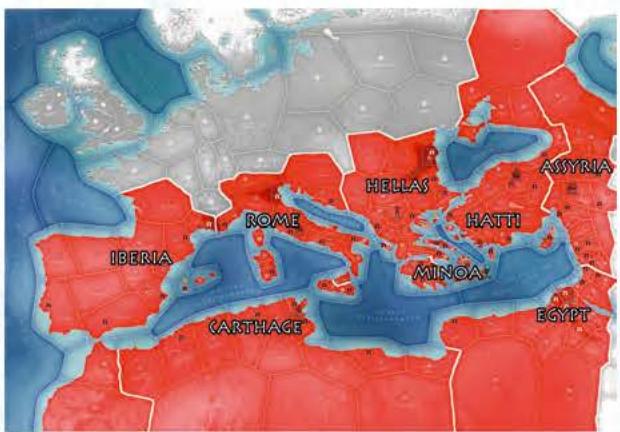
Map boand West with 8 players.

Map board West with 9 players.
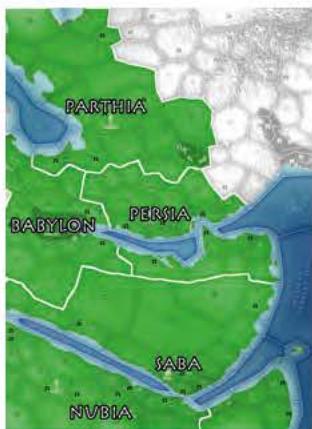
Map board East with 5 players.
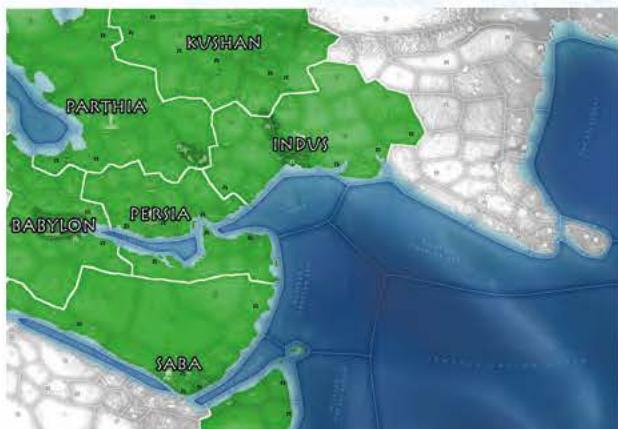
Map board East with 6 players.

Map board East with 7 players.
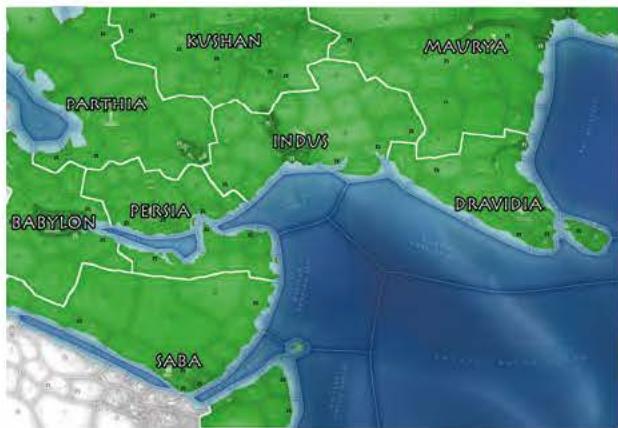
Map board East with 8 players.

Map boand East with 9 players.

Map board 10 players. All civilizations are considered West
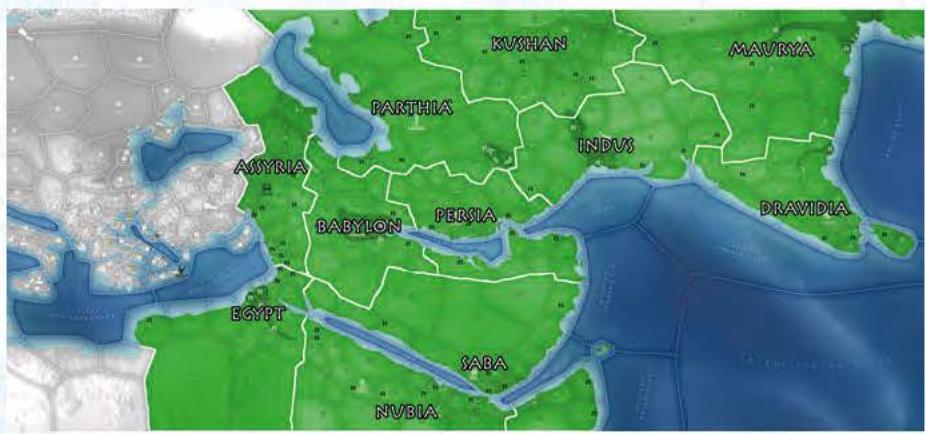
Map board 11 players. All civilizations are considered East.

Map board 12 players (6 plyrs West 6 playrs East). Assyria is considered East for this setup.

Map board 13 players (6 players West-7 players East). Assyria and Egypt are considend East for this setup.

Map boand 14 players (7 players West-7 players East). Assyria and Egypt are considered East for this setup.
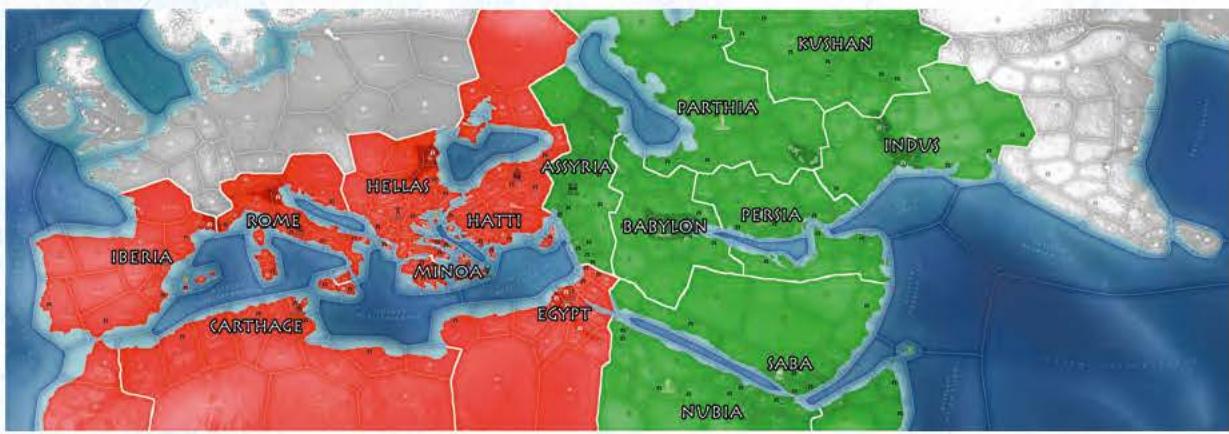
Map board 15 players (7 players West -8 players East). Assyria is considered East for this setup.
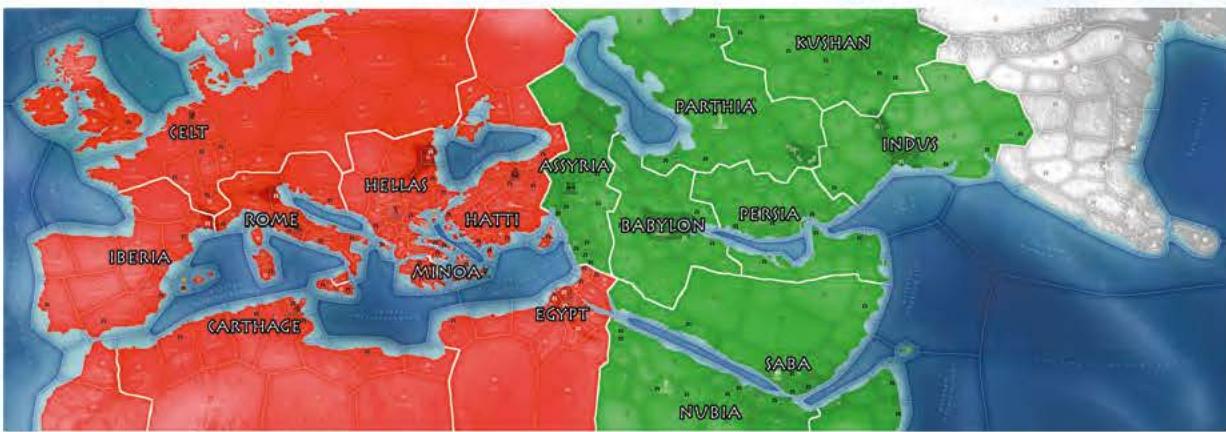
Map board 16 players (8 players West - 8 players East). Assyria is considered East kor this setup.

Map board 17 players (8 players West-9 players East).
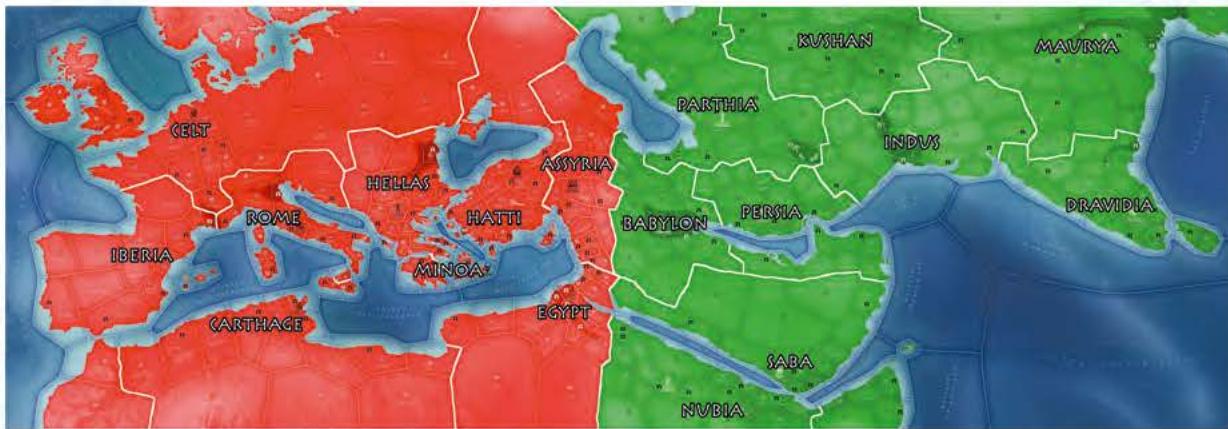
Map board 18 playrs(9 players West-9 players East).

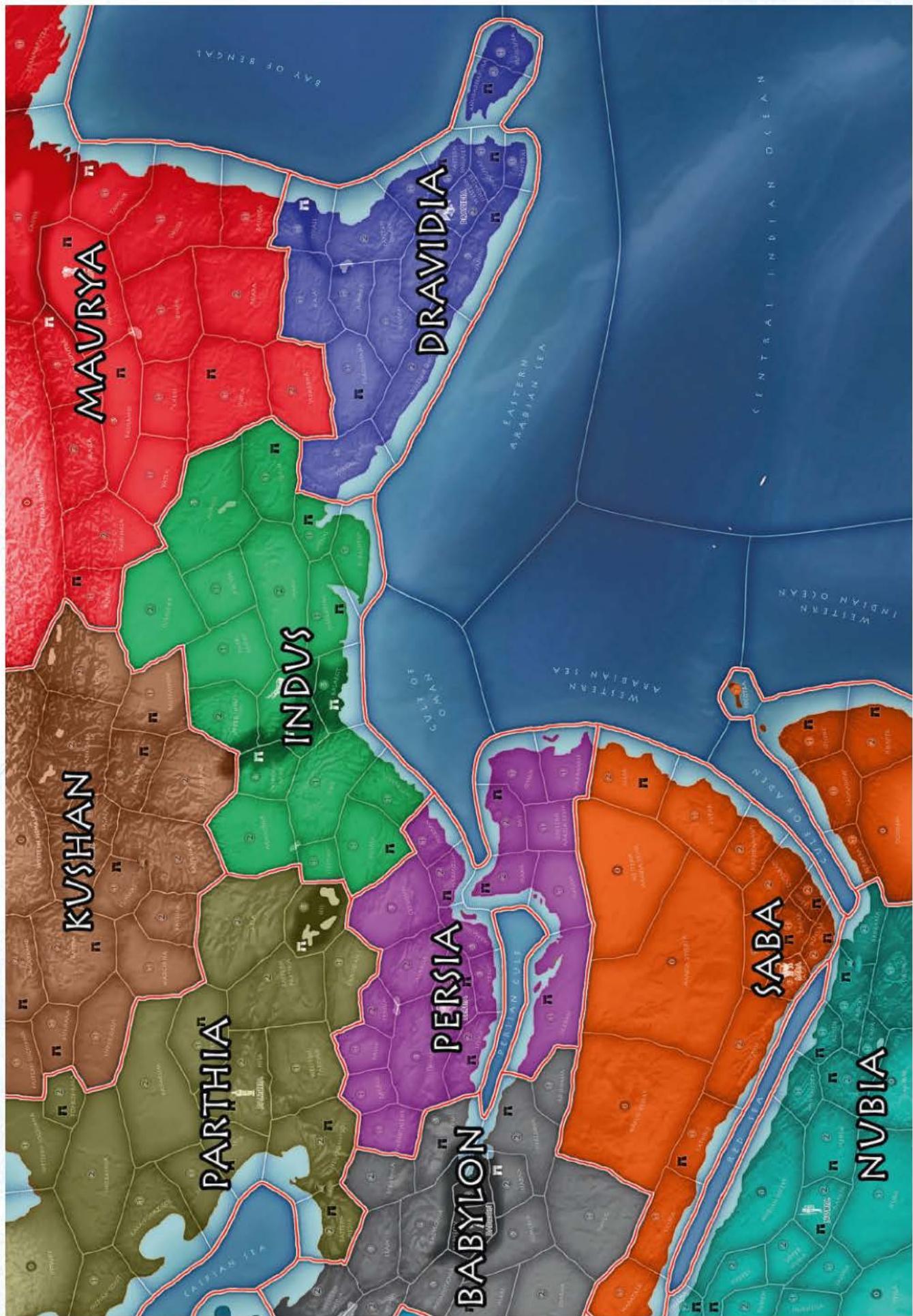
A GRAY BOX DES(RIBES SPECIFK ADJUSTMENTS BASED ON THE NUMBER OF PLAYERS VSED.
6. SEQVENCE OF PLAY TURN-BYTURN PROXEDURE
The game turn
The game is played in game turns, divided into phases, which may be divided into several steps. During each phase most activities are resolved simultaneously by all players or sometimes in a specific order. At the end of each game turn, players check whether goals are reached and start a new game turn or determine victory.
A.S.T.-ranking order and breaking ties
At any time, if a tie occurs between players' activities, unless specified otherwise, ties are broken by A.S.Tranking. Players do not necessariły need to stick to this order and may act before their turn to speed up play. However, players may insist on waiting for their turn, In all other cases, players must follow the right order as specified. Players may never proceed to a new phase before their turn.
The Beneficiary
At several points, the rules speak of 'the beneficiary. This is a player that often acts as the controller of an event and is often immune to certain negative effects. A player may or may not directly benefit from being the beneficiary.
The beneficiary is usually defined as:
The player with the most cities in stock. In case of a tie, from these players, the player with the most tokens in stock becomes the beneficiary. Next, from these players, A.S.T.-ranking breaks ties, In the case of calamity resolution there is a more specific definition described in chapter 8. Card-specific rules - Calamities (page 32).
Note: At some points the game rules or components refer to he' or 'his'. These phrasings are used for readability purposes, but should be interpreted as 'he/she', 'his/her', 'they' or 'their'.
THE ORDER OF PHASES
-
Tax collection
-
Population expansion (and Census)
-
Movement
-
Conflict
-
City construction (and Remove surplus population and Check for city support)
-
Trade cards acquisition
-
Trade
-
Calamity selection
-
Calamity resolution
-
Special abilities
-
Remove surplus population (and Check for city support)
-
Civilization advances acquisition
-
A.S.T.-alteration
1. TAx (OLLECTION
Order: Simultaneous
1A. TAX (OLLECTION
All players must transfer a number of population tokens from stock to treasury equal to their tax rate for each of their cities on the map board and flip them upside down in the treasury box. The default 'tax rate' is 2 and this may be adjusted later in the game through specific Civilization Advances. Players cannot choose to refrain from collecting tax. If any players do not have sufficient tokens in stock to comply, proceed to step 1b (otherwise step 1b can be skipped)
Example: John has 5 cities on the boand, He must transfer 10 tokens from stock to treasury.
1B. TAX REVOLTS
It might occur that 1 or more players do not have sufficient tokens in stock to collect their taxes, If this occurs, all other players must first finish their tax collection as usual, Players that had insufficient tokens in stock move all their tokens in stock to treasury.
Annexation; To annex a city (and/ or tokens) means to replace an enemy's city and/or tokens with one of your own. The enemy's units are returned to the owner's stock.
For each city that this player could not fully collect tax from, the beneficiary may choose and annex 1 of his cities, referred to as 'tax revolt'. This beneficiary does not collect taxes for any cities gained this way in the same game turn. In this phase no check for city support (see 5c., page 24) is made. As soon as a beneficiary of a tax revolt has insufficient cities to replace a city with, a next beneficiary is selected for the remaining cities. If all players have 9 cities on the board, any remaining cities affected by tax revolt are destroyed instead.
Example: Michael has 5 cities on the board. He must transfer 10 tokens from stock to treasury, but he has only 7 tokens in stock, He must transfer all 7 tokens to treasury and 2 of his cities revolt. Frank has the most cities in stock and becomes the beneficiary. He may choose 2 ofMichael's cities and replace them with his own, from stock.
If 2 or more players are victims of a tax revolt, the tax revolts are resolved in A.S.T.-ranking order. A victim of a tax revolt cannot be the beneficiary of his own or any other player's tax revolt during the same game turn.
2. POPVLATION EXPANSION
Order: Simultaneous, but may be resolved in A.S.T.- ranking order if desired.
2A. POPVLATION EXPANSION
Each player must place population tokens from stock in each area containing his tokens:
1 token in each area containing 1 of his tokens and 2 tokens in each area containing 2 or more of his tokens (so an area containing 3 or 4 tokens only gets an additional 2; not 3 or 4).
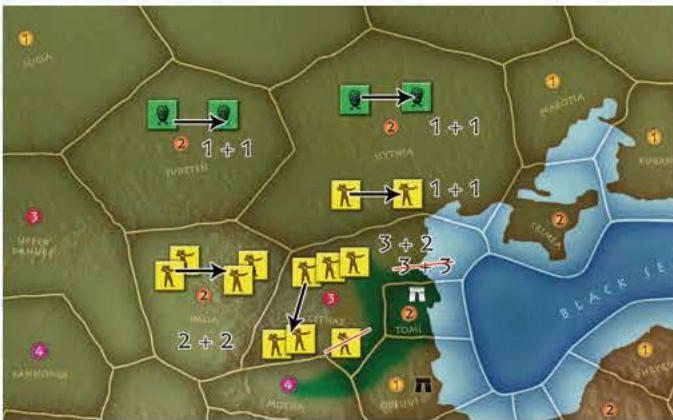
Tip: It is prefenable to place each expanded token upside down so that each player can dearty see which tokens were originally situated in the area and which are expanded. Flip all tokens to the colored side when finished.
If a player does not have sufficient tokens in stock to complete his population expansion, he may choose where to add available tokens from stock taking into account the above guidelines. This may indude redistributing his previously placed tokens this game turn. Players cannot choose to expand fewer tokens than possible. Adding tokens during the Population expansion phase is not considered attacking. Barbarian tokens do not expand.
2B. (ENSUS
Make sure all census markers are flipped to the colored side Next, all players count their number of tokens on the board and adjust their Census markers accordingly on the Census track (cities and ships are not counted)
Tip: Since each player has exactly 55 tokens, sometimes it may be easier to count the tokens in stock and treasury combined and subtract this number from 55. Use the small number in the lower right corner of the boxes this way.


Place the Census-markers alongside the numbers rather than on top of them.
Use the numbers on the Censusmarkers to indicate their mutual A.S.T.-nanking onder, pointing away from the track.
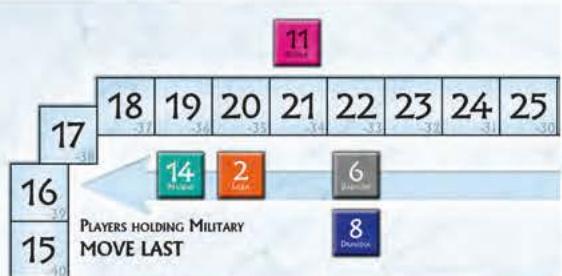
Use the inside of the track for players holding 'Military. Their mutual onder is again defined by A.S.T-ranking, indicated by the numbers on the Census-markers.
3. MOVEMENT
This phase is resolved in Census order. The player with the highest census takes all of the actions in turn. After he has finished all steps in this phase, the player with the next highest census-count takes all of these steps and so on, until all players have done so. A.S.T.-ranking breaks ties (see page 9). However, it is preferable that players move simultaneously if possible as this speeds up game play. All players may take their movement action as soon as they like, but players may insist on waiting for their turn, Players may move a part of all of their tokens, and wait for the remainder of their tokens for players that move before them. As long as a player is busy moving, that player may revert any of his moved tokens if he changes his mind, However, once the player declares his movement has ended he cannot revert any of his movement decisions. Barbarian tokens do not move.
Players may move each of their tokens on the board either 1 step to an area adjacent by land or onto a ship, and may move each of their ships 4 steps.
Ship construction
At any time during his Movement phase, before, during or after moving his tokens, until the moment he declares his movement has ended, a player may choose to build ships. This can only be done in coastal areas containing 1 or more of his tokens. A player can build no more than 4 ships per game turn. There are 3 ways to build a ship: 1. Pay 2 treasury tokens.
-
Pay 1 treasury token and destroy 1 population token from the ship area.
-
Destroy 2 tokens from the board, at least 1 of which is from the ship area.
A ship can be used the turm it is built.
Ship maintenance
As soon as a player wants to use a ship that was built during a previous game turn, he must first either pay 1 treasury token or destroy one of his tokens from anywhere on the board for that ship. This can be done at any time during his movement action before using the ship, and this may be decided for each ship independently at different times during his movement action. He may also choose to maintain a ship this way and choose to not move it, or possibly move it later during his movement action. A player can only pay maintenance once per ship per game turn this way. A player may choose not to maintain a ship this way and destroy it in order to rebuild it in the same turn. A player cannot voluntarily destroy a ship that was built in the current tur or was maintained from a previous turn in order to build it again in the same turn.
Ship movement
Players may move each of their ships 4 areas by water per turn. By default, ships cannot be moved through open sea areas. At any time during ship movement, the ship may embark or disembark any number of tokens, but a ship can only carry up to 5 tokens at the same time by default. After the ship's last step any tokens on it are automatically disembarked in the area. Tokens cannot stay on ships after movement. Tokens may move either by ship or by land (not both). Ships may move through an area containing an ‘out of play' token, but cannot end movement or disembark tokens there, Ships cannot block or engage in conflict with other player's ships.
Tip: Once a token or ship has moved or if you have decided to not move it, flip it. At the end of Movement phase, flip all your tokens and ships back to the colored side.
End of movement
As soon as a player declares his movement has ended, he must destroy all of his ships that were not built this turn and not maintained this turn.
City building
Cities are only built in the City construction phase. However, in order to build a city, players must have at least 6 tokens in an area containing a city site during the Movement phase, If, after a conflict, a player still has 6 or more tokens in an area, he may build a city there in the appropriate phase. Players can also attempt to build a 'wilderness city' in an area without a city site, but in this case at least 12 tokens are required. Wilderness cities can never be built in areas with a population limit of '0', regardless of the effects of any Civilization Advances held by the player
Causing a conflict situation
As soon as a player enters an area that contains 1 or more tokens belonging to other player(s) or barbarian tokens and as a result the population limit is exceeded (ships are not counted), or the area contains an enerny city or a pirate city, this is considered 'causing conflict' and in this case 'a conflict situation' occurs. This conflict situation may be voided if the enemy player moves later and moves tokens out of the area afterward. In that case there is no longer a conflict situation in that area. If a player moves before his turn, and he causes a conflict situation, he cannot revert his choice for that token, even if the enerny player voids the conflict situation afterward. The conflict itself, if occurring is only resolved during the
Conflict phase. 'Entering an area' is defined as either moving a token into the area by land, or disembarking a token from a ship into the area. The movement of a ship itself into an area is not considered as entering the area, attacking, or causing conflict. If players share an area with only population tokens and the population limit of the area is not exceeded, all tokens co-exist and no conflict situation occurs in this area.
Attackīng a city
As soon as a player enters an area containing an enemy city or a pirate city, this is considered 'attacking the city', regardless of the number of tokens used (even if it is 1). To successfully attack a city a player must move at least 7 tokens into the city area or the attack fails. 'Attacking' only applies to attacking a city; tokens can not be attacked.
Defending a city
A city under attack can be defended by moving tokens into the area, either before or after the attack, The defending player should of course take into account the order of movement. Any token conflict involving a city will be resolved during the Conflict phase. It is not possible for two or more players to combine in attack, for this wil result in a token conflict between all players involved. Any remaining tokens are considered as attacking the city, even if the number of tokens proves insufficient.
4. (ONFLICT
Order of resolution in a Conflict phase There are 2 different types of conflict. Conflict between tokens of a single player and a city is defined as 'city attack'. A conflict between tokens of two or more players in an area, regardless of whether or not that area contains a city, is considered a 'token conflict'.
4a. All token conflicts are resolved before any city attacks are resolved, It is preferable to resolve all token conflicts simultaneously. Unsuccessful city attacks are not considered token conflict and these tokens are only removed during the resolution of city attacks, Any foreseen surplus population may not be removed during the Conflict phase.
4b. Only after all token conflicts have been resolved, all city attacks must be resolved one at a time, in A.S.T.-ranking order of the defending players. Attacks on pirate cities are always resolved before any other city attacks. If more than 1 city
The barbarians
For the purpose of the Conflict phase only, unless specified otherwise, all barbarian tokens and pirate cities are considered as if they would belong to a single player defined as 'The Barbarians’. If a rule refers to players, this rule may apply to 'The Barbarians' as well. 'The Barbarians' do not benefit from any Civilization Advances.
4A. RESOLUTION OF TOKEN CONFLICTS
Token conflicts are resolved in 'rounds of token removal', For each area in which a token conflict occurs, players must count all tokens involved (ships are not involved). In each round, the player having the minority must first remove 1 of his tokens.
If the conflict has not ended, the following player in minority order must remove 1 of his tokens from the area, and so on, until all players irvolved have done so, or until the token conflict has ended, If players have an equal number of tokens to start with, they must remove 1 token simultaneously. It may occur that by removing tokens simultaneously the area ends up depopulated or occupied by fewer tokens than the population limmit.
After each round of token removal, the check for token majority is done again and a new round of token removal starts, and so forth, until the conflict ends.
End of conflict
The conflict in an area immediately ends as soon if at any time the population limit is no longer exceeded or if a single player is the only player occupying the area with tokens (even if he exceeds the population limit). A conflict might end before a ful round of token removal is completed. Any excess tokens remain in the area.
If a token conflict occurs in an area that also contains a city, the conflict ends as soon as only a single player has tokens left in the area. Removed tokens are returned to stock. Any remaining enemy tokens this way are considered to be attacking the city, which is resolved in phase 4B. Friendly tokens remain in the area until phase 5B.
4B. RESOLUTION OF (ITY ATTACKS
For each city attack, first determine whether the attack is successful or not, By default, an attack is successful if, after the resolution of all token conflicts, the attacker has at least7 tokens in the area containing the enemy city. If the attack is unsuccessful, all tokens from the attacking player in the city area are not removed now, but rather during phase 5b.
Resolution of a successful city attack
A successful city attack is divided into 4 steps. Each city attack must be resolved completely, one at a time, in the following order:
-
The defending player replaces his city with 6 of his tokens from stock. If he has insufficient tokens, he replaces it with whatever tokens he has left in stock, even if it is 0. Only if a defender has insufficient tokens to replace his cities with and he is attacking another city in the same turn, he may wait for this other city attack to be resolved first. He may do this once per turn.
-
A token conflict is resolved following the exact same rules as a normal token conflict.
-
After a successful city attack, the attacking player may choose to draw a trade card at random from the defending player's hand. If the defending player does not hold any trade cards at this point, the attacking player cannot draw a card and this option is canceled.
-
After a successful city attack, the attacking player may also choose to gain up to 3 treasury tokens from his stock, The defending player's treasury is unaffected,
Attacking a pīrate city
If a pirate city is successfully attacked, the city is replaced with 6 barbarian tokens, and a token conflict is resolved. The attacker cannot draw a trade card, but may still gain up to 3 treasury tokens.
5. (ITY (ONSTRUCTION
This phase is divided into 3 steps:
5a. City Construction.
5b. Surplus Population Removal.
5c. Check for support and unsupported city reduction.
All players must take all 3 steps in this specific order. All players take their actions simultaneously, but players may choose to take their actions in A.S.T.- ranking order.
5A. (ITY (ONSTRUTIOn
Players may choose to build any number of cities per turn in areas that meet the following requirements:
• At least 6 tokens in an area with a city site.
• At least 12 tokens in an area without a city site (referred to as 'wilderness city'), Cities cannot be built in an area with population limit 'O', regardless of the effects of any
Civilization Advances held by the player
Each area can only contain 1 city. For each city built, the player removes all tokens from the area (irrespective of ownership) and places a city in the area from stock, All removed tokens are returned to stock. The maximum number of cities in play for any player is 9.
Note: The map board contains white and black city sites. For the purpose of city construction they are treated in the same way.
5B. SURPLUS POPVLATION REMOVAL
When building a city, all population in that area is removed. Once an area contains a city, it can no longer support population tokens. Remove all tokens exceeding population limits from all areas, Ships do not count towards population limits.
Note: 'Agriculture' and 'Public Works’ may create exceptions to this rule.
5c.(ITY SUPPORT AND REDUCTION
After the player has removed all of his surplus population he must check for city support. By default a player's city support rate is 2. This means that a player should have at least 2 tokens on the board for each of his cities on the board. For each city that he cannot support he should remove one city of his choice and replace it with tokens equal to the population limit of that area, repeating this process until he has sufficient city support. This is referred to as 'Reducing a city'. lf a player has built any cities this turn he must reduce these cities first. Any tokens newly gained through city reduction immediately count for city support for other cities.
6. TRADE (ARDS A(QVISITION
IMPORTANT:
Before drawing or dealing any cards for the first time, make sure the stacks are set up in the right way as dened in chapter 4. Setting up the game (page 11-13). For any other game turn do not forget to check carefully
内容过长,此处只内联前一部分;完整内容请下载或到规则页阅读。
下载 Markdown02.md41.7 KB
Map-board Setups
The game is divided into 'West' and 'East' which can be played independently by 5-9 players. For 10 players 'West' is played and for 11 players 'East' is played. For 12-18 players, 'West' and 'East' are combined and then referred to as 'blocks'.
The civilizations mentioned and the colored parts are the areas being used. Place 'out of play' tokens on the population limit of each area that is grayed out in the map-board setup. The regions-divisions in the last two images represent the same areas that are being used for each specific civilization.
The rulebook provides one map-board illustration for every player count from 5 to 18, showing exactly which areas of the four map-boards are in play and which civilizations occupy them (refer to the physical map-boards and the illustrations in the printed rulebook, pages 14-17, for the precise area boundaries). The player counts and notes are:
Map-board West with 5, 6, 7, 8, or 9 players.
Map-board East with 5, 6, 7, 8, or 9 players.
Map-board 10 players. All civilizations are considered West.
Map-board 11 players. All civilizations are considered East.
Map-board 12 players (6 players West - 6 players East). Assyria is considered East for this setup.
Map-board 13 players (6 players West - 7 players East). Assyria and Egypt are considered East for this setup.
Map-board 14 players (7 players West - 7 players East). Assyria and Egypt are considered East for this setup.
Map-board 15 players (8 players West - 7 players East). Assyria is considered East for this setup.
Map-board 16 players (8 players West - 8 players East). Assyria is considered East for this setup.
Map-board 17 players (8 players West - 9 players East).
Map-board 18 players (9 players West - 9 players East).
The 18 Civilizations and Their Regions
The full Western map shows the regions of Assyria, Egypt, Hatti, Minoa, Hellas, Celt, Rome, Carthage, and Iberia. The full Eastern map shows the regions of Maurya, Dravidia, Kushan, Indus, Persia, Parthia, Babylon, Saba, and Nubia.
Sequence of Play
Turn-by-turn Procedure
An orange box describes general rules. A gray box describes specific adjustments based on the number of players used.
The game turn — The game is played in turns, divided into phases, which in turn may be divided into several steps. During each phase most activities are resolved simultaneously by all players or sometimes in a specific order. At the end of each turn, players check whether goals are reached and start a new turn or determine victory.
A.S.T.-ranking order — At any time, if a tie occurs between players' activities, unless clearly specified, it is resolved in A.S.T.-ranking order. Players do not necessarily need to stick to this order and may act before their turn to speed up play. However, players may insist on waiting for their turn. In all other cases, players must follow the right order as specified. Players may never proceed to a new phase before their turn.
The Beneficiary — At several points, the rules speak of 'the beneficiary'. This is a player that often acts as the controller of an event and is often immune to certain negative effects. A player may or may not directly benefit from being the 'beneficiary'.
The beneficiary is usually defined as: The player with the most cities in stock. In case of a tie, from these players, the player with the most tokens in stock becomes the beneficiary. Next, from these players, A.S.T.-ranking order breaks ties. In case of calamities there is a more specific definition described in chapter 8. Card Specific Rules - The Calamities (page 33).
The Order of Phases
Tax collection
Population expansion (and Census)
Movement
Conflict
City construction (and Remove surplus population and Check for city support)
Trade cards acquisition
Trade
Calamity selection
Calamity resolution
Special abilities
Remove surplus population (and Check for city support)
Civilization advances acquisition
A.S.T.-alteration
1. Tax Collection
Order: Simultaneously
1a. Tax Collection
All players must transfer a number of tokens from stock to treasury equal to their tax rate for each of their cities on the map-board and flip them upside down in the treasury box. The default 'tax rate' is 2 and this may be adjusted later in the game through specific Civilization Advances. Players cannot choose to refrain from collecting tax. As long as all players have sufficient tokens in stock to comply, step 1b can be skipped.
Example: John has 5 cities on the board. He must transfer 10 tokens from stock to treasury.
1b. Tax Revolts
It might occur that 1 or more players do not have sufficient tokens in stock to collect their taxes. If this occurs, all other players must first finish their tax collection as usual. Players that had insufficient tokens in stock move all their tokens in stock to treasury.
For each city that this player could not collect tax from, 'the beneficiary' may choose and annex 1 of his cities, referred to as 'tax revolt'. This beneficiary does not collect taxes for any newly gained cities this way in the same turn. In this phase no check for city support is made.
Example: Michael has 5 cities on the board. He must transfer 10 tokens from stock to treasury, but he has only 7 tokens in stock. He must transfer all 7 to treasury and 2 of his cities revolt. Frank has the most cities in stock and becomes the beneficiary. He may choose 2 of Michael's cities and replace them with his own, from stock.
If more than 1 player are victims of a tax revolt, the tax revolts are resolved in A.S.T.-ranking order. A victim of a tax revolt cannot be the beneficiary of his own or any other player's tax revolt during the same turn.
2. Population Expansion
Order: Simultaneously, but may be resolved in A.S.T.-ranking order if desired.
2a. Population Expansion
Each player must place tokens from stock in each area containing his tokens:
1 token in each area containing 1 of his tokens and 2 tokens in each area containing 2 or more of his tokens (so an area containing 3 or 4 tokens only gets an additional 2; not 3 or 4).
If an area contains tokens belonging to more than 1 player, all of these players may expand population in this area as usual. It is very common that tokens are added to an area in excess of its population limit.
Tip: It is preferable to place each expanded token upside down so that each player can clearly see which tokens were originally situated in the area and which are expanded. Flip all tokens to the colored side when finished.
If a player does not have sufficient tokens in stock to complete his population expansion, he may choose where to add available tokens from stock regarding the above guidelines. This may include re-dividing his previously placed tokens this turn. Players cannot choose to expand less tokens than possible. Adding tokens during the Population Expansion-phase is not considered attacking. Barbarian tokens do not expand.
2b. Census
After a player has expanded his population according to the rules he must count all of his tokens on the board and change the status of his Census-marker on the Census track (cities and ships are not counted).
Tip: Since a player has exactly 55 tokens, sometimes it is easier to count the tokens in stock and treasury combined and subtract this number from 55.
Place the Census-markers alongside the numbers rather than on top of them. Use the numbers on the Census-markers to indicate their mutual A.S.T.-ranking order, pointing away from the track. Use the inside of the track for players holding 'Military'. Their mutual A.S.T.-order is again defined by the numbers on the Census-markers. Players holding Military move last.
3. Movement
This phase is resolved in Census order. The player with the highest Census takes all of the following actions in turn. After he has finished all steps in this phase, the player with the next highest census-count takes all of these steps and so on, until all players have done so. A.S.T.-ranking order breaks ties. However, it is preferable that players move simultaneously if possible as this speeds up game play. Players may insist to wait for their turn. As long as a player is busy moving, that player may revert any of his moved tokens when changing his mind. However, once the player is done he cannot change his movement. Barbarian tokens do not move.
Players may move each of their tokens on the board 1 step to an area adjacent by land. At any time during their Movement-phase players may choose to build ships. This can only be done in coastal areas containing 1 or more of his tokens. To do so, he must pay 2 treasury, or destroy 2 tokens from the area he builds the ship in or destroy 2 tokens from 2 different areas, 1 of which is the ship area or a combination of 1 token and 1 treasury.
Players may move each of their ships 4 areas by water per turn. By default, ships cannot be moved through open sea areas. At any moment during ship movement, the ship may embark or disembark any number of tokens, but a ship can only carry up to 5 tokens at the same time by default. After the ship's last step any tokens on it are automatically disembarked in the area. Tokens cannot stay on ships after movement. Tokens may move either by ship or by land (not both). Ships may move through an area containing an 'out of play' token, but cannot end movement or disembark tokens there.
Once a player starts movement with ships built during a previous turn, he must first either pay 1 treasury or sacrifice a token for each ship he has on the board, or destroy each ship he does not want to retain. A player may choose not to maintain a ship, in order to rebuild it in the same turn.
At the end of a player's movement all of his ships that have not moved must either be destroyed or the player must pay 1 treasury/sacrifice 1 token per ship he wants to retain.
Tip: Once a token or ship has moved or if you choose to not move it, flip it upside down. After you are done with all movement, flip them all back to show that you are done.
City building
Cities are only built in the City Construction-phase. However, in order to build a city, players must have at least 6 tokens in an area containing a city site during the Movement-phase. If, after a conflict, a player still has 6 or more tokens in an area he may build a city there in the appropriate phase. Players can also try to build a 'wilderness city' in an area without a city site, but in this case 12 tokens are required. Wilderness cities can never be built in areas with a population limit of '0', regardless of holding any Civilization Advances.
Conflict situations
As soon as a player enters an area that also contains 1 or more tokens belonging to other player(s), exceeding the population limit a 'conflict situation' occurs. This is regarded as 'causing a conflict'. 'Entering an area' is defined by either moving a token into the area by land, or a token disembarking a ship in the area. The movement of a ship (with or without tokens on it) into an area is not regarded as entering the area, attacking, or causing conflict. If players share an area and the population limit of the area is not exceeded, all tokens co-exist and no conflict situation occurs in this area.
Attacking a city
As soon as a player enters an area containing an enemy city, this is considered 'attacking the city', regardless of the number of tokens used (even if it is 1). To successfully attack a city a player must move at least 7 tokens into the city area or the attack fails. 'Attacking' only applies to attacking a city; tokens can never be attacked.
Defending a city
If a player attacks a city and the defending player still has to commence his Movement-phase, the defender can move tokens into the area to defend the city. During the Conflict-phase it will first result in a token conflict. Any remaining tokens are regarded as attacking the city, even if the number of tokens proves insufficient. If the city is not attacked successfully, this will eventually result in surplus population.
4. Conflict
Order of resolution in a conflict-phase — There are 2 different types of conflict. Conflict between tokens is defined as 'token conflict'. Conflict between tokens and a city is defined as 'city attack'.
4a. All token conflicts are resolved before all city attacks are resolved. It is preferable to resolve all token conflicts simultaneously. Any possible unsuccessful city attacks are not considered token conflict and these tokens are only removed during the resolution of city attacks. Any foreseen surplus population may not be removed during the Conflict-phase.
4b. After all token conflicts are resolved, all city attacks must be resolved one at a time, in defending A.S.T.-ranking order. If more than 1 city belonging to the same player is attacked, he may choose the order. Attacks on pirate cities are always resolved before any other city attacks.
The barbarians — As the game evolves, eventually barbarian tokens and pirate cities will appear on the board. For the purpose of the Conflict-phase only, other than clearly specified, all barbarian tokens and pirate cities are considered as if they would belong to a single player defined as 'The Barbarians'. If a rule refers to players, this rule may refer to 'The Barbarians' as well, though 'The Barbarians' do not benefit from any Civilization Advances.
4a. Resolution of Token Conflicts
Token conflicts are resolved in 'rounds of token removal'. For each area in which a token conflict occurs, players must count all tokens involved. The player(s) having the minority must first remove 1 of their tokens (removed tokens are destroyed and returned to stock). Next the following player(s) must remove 1 of their tokens from the area until all players involved have done so. If players have an equal number of tokens to start with, they must remove their tokens simultaneously.
After each player has removed a token, the check for majority is done again and tokens are removed again, and so forth. At any moment the population limit is no longer exceeded or a single player is the only player occupying the area (even if he exceeds the population limit), the conflict immediately ends in this area. Any excess tokens remain in the area. It may occur that by removing tokens simultaneously the area ends up depopulated or occupied by less tokens than the population limit.
When a city under attack is defended by tokens or when more than 2 players are involved in a city attack, a conflict between the tokens is resolved first. Any remaining tokens may still be counted to attack the city.
4b. Resolution of City Attacks
For each city attack, first define whether the attack is successful or not. By default, an attack is unsuccessful if the attacker has less than 7 tokens in the area (this may be altered by players holding 'Engineering'). In the case of an unsuccessful attack, all tokens from the attacking player in the city area are destroyed.
Resolution of a successful city attack
A successful city attack is divided in 4 steps and each city attack must be resolved completely, one at a time, in the following order:
The defending player replaces his city by 6 of his tokens from stock. If he has insufficient tokens, he replaces it with whatever tokens he has left in stock, even if it is 0. Only if a defender has insufficient tokens to replace his cities by and he is attacking another city in the same turn, he may wait for this to be resolved first. He may do this once.
A token conflict is resolved following the exact same rules as a normal token conflict.
As a result of the successful attack, the attacking player may choose to draw a trade card at random from the defending player's hand. If the defending player does not hold any trade cards at this point, the attacking player cannot draw a card and this option is canceled. Both players are not allowed to inform the other players which card was drawn.
The attacking player may choose to gain up to 3 treasury. The defending player's treasury is unaffected.
Attacking a pirate city
If a pirate city is successfully attacked, the city is replaced by 6 barbarian tokens. The attacker cannot draw a trade card, but may still gain up to 3 treasury as result of the attack.
5. City Construction
This phase is divided into 3 steps:
5a. City Construction.
5b. Surplus Population Removal.
5c. Check for support and unsupported city reduction.
All players must take all 3 steps in this specific order. All players take their actions simultaneously, but players may choose to take their action in A.S.T.-ranking order.
5a. City Construction
Players may choose to build any number of cities per turn in areas regarding the minimum requirements:
At least 6 tokens in an area with a city site.
At least 12 tokens in an area without a city site (referred to as 'wilderness city'). Cities cannot be built in an area with population limit '0'. Each area can only contain 1 city.
For each city built, the player removes all tokens from the area and places a city in the area from stock. The maximum number of cities in play for any player is 9.
Note: The map-board contains white and black city sites. For the purpose of city construction they are treated in the same way.
5b. Surplus Population Removal
After the player has built his cities, he must immediately remove all of his tokens exceeding the population limits. This includes any tokens in areas containing a city.
Note: 'Agriculture' and 'Public Works' may create exceptions to this rule.
5c. City Support and Reduction
After the player has removed all of his surplus population he must check for city support. By default a player's city support rate is 2. This means that a player should have at least 2 tokens on the board for each of his cities on the board. For each city that he cannot support he should remove one of his choice and replace it with tokens equal to the population limit of that area until he has sufficient city support. This is referred to as 'Reducing a city'. If a player has built any cities this turn he must reduce these cities first. Any tokens newly gained by reduction may immediately count for city support for other cities.
6. Trade Cards Acquisition
IMPORTANT: Before drawing or dealing any cards for the first time, make sure the stacks are set up in the right way as defined in chapter 4. Setting up the game (page 11-13). For any other turn do not forget to check carefully to be sure all cards discarded in the previous turn are shuffled the right way and placed under the appropriate stacks, as mentioned in phase 13b.
Tip: Before drawing cards, write down a list containing the number of cities for each player and have a single player deal all the cards.
Players are not allowed to conceal their total hand size of trade cards.
6a. Drawing Trade Cards
The player with the least number of cities on the board first draws a number of trade cards equal to the number of his cities in play. Then, the player with the next least number of cities in play draws his trade cards as described. If more than 1 player has the same number of cities in play, the player with the highest A.S.T.-ranking order draws first. Players without cities draw no trade cards.
Players may look at the cards they draw but are not allowed to inform other players what they drew (it may be a commodity or a calamity). If at any point a stack is empty, a player does not draw a substitute card from another stack. Instead he draws a 'water' card, which can be used as a trade card worth '0'.
Example: Ronald (Minoa) has 3 cities, so he draws first. He draws from stack 1, 2 and 3. Judith (Hellas) and Tony (Egypt) both have 5 cities, but Hellas is higher on the A.S.T. than Egypt, so for their mutual order Hellas draws first. Judith draws from stack 1, 2, 3, 4 and 5. (card 4 turns out to be a calamity). Tony would draw from stack 1, 2, 3, 4 and 5, but stack 2 is empty, so he draws from stack 1, receives a 'water' card and draws from stack 3, 4 and 5.
6b. Additional Purchases
After all players have drawn their regular trade cards, in the exact same order as step 6a, each player may choose to purchase any number of additional trade cards, one by one, and/or pass. By default players can only purchase a trade card from stack 9 for 15 treasury tokens. Players are not allowed to count the number of cards left on a particular stack (unless the stack is empty). A player must pay treasury before receiving the card. If at any moment a stack is empty, players may still choose that stack but receive a 'water' card instead and still pay the same amount of treasury as the initial trade card. After a player receives cards or passes, he cannot revert his choice. A player is not allowed to inform other players what he drew and the player cannot return a card if he does not like the result, for instance if it turns out to be a calamity.
Separate trade card blocks — If the separate trade card blocks East and West are used (12-18 players), the western civilizations draw or purchase cards strictly from the 'West'-block and the same applies to East-cards for eastern civilizations. Even when a stack is empty at one block, a player does not draw a substitute card from the other block, instead he draws a 'water' card.
7. Trade
Time limit — It is recommended to set a time limit of 10 minutes for this phase, using a timer that is visible to all players. Some groups prefer longer or shorter trading times – use what works best for your group.
The value of commodity cards
A single card of a specific commodity is worth its face value, which is equal to the number printed in the first box at the bottom of the card. Two equal cards of a specific commodity are worth the amount equal to the number printed in the second box at the bottom of the card, 3 equal cards of a specific commodity are worth the third box, and so on.
In other words: set value = (number of identical commodity cards)² x (face value of the commodity).
Commodities of the same face value but with different names are worth only their individual face values combined.
Example values: 1 Ceramics card (face value 3) = Value 3. 2 Ceramics cards = Value 12. 3 Iron cards (face value 2) = Value 18. 1 Ceramics + 1 Fruit (same face value 3, but different-named commodities) = Total value 6 (their individual face values combined, not squared together). 8 Oil cards (face value 4) = Value 256.
Calamities
Except for Non Tradeable Calamities, which may never be traded, all other calamities may be included in a trade transaction but cannot be mentioned in a trade offer.
During the Trade-phase, calamities do not have any effect, other than acting as trade cards, though during the Calamity Resolution-phase, any calamities held by a player at that point will resolve eventually.
Trade
The objective is to try and complete sets of equal trade cards to increase their total set value as described above. For each commodity type there are exactly enough cards to complete 1 set of trading cards, which is equal to the number of boxes shown on the commodity. It may turn out that a set cannot be completed during a single turn.
Simultaneously, each player may make trade negotiations with any other player.
Trades cannot involve more than 2 players at a time and each trade must include at least 3 trade cards per player.
For each trade offer (per player) both players must truthfully inform each other on the identity of 2 commodities, as well as the total number of cards involved in their offer. Both players may choose to mention the names of the excess commodities involved in the deal this way, though this information does not necessarily have to be the truth. If more than 2 commodities are mentioned, the first 2 mentioned must be true. Players are not allowed to speak about calamities held or involved in a trade, though players may promise a calamity-free trade offer, which does not need to be true either. Treasury or Civilization Advances cannot be involved, though any other (non-binding) promises such as peace-treaties are allowed.
Once both players agree on a trade, the trade transaction is resolved and all trade cards involved are transferred simultaneously. Other players are not allowed to see which cards are traded. A trade transaction cannot be reverted except when a player receives a Non Tradeable Calamity, a different number of cards than specified, or not at least the first 2 commodities specified. In this case all cards involved are reverted and the players may make new negotiations. Players are not allowed to conduct trade deals in bad faith simply to gain information and revert a deal.
End of trade
As soon as no player is willing or able to trade or if the time limit is reached the trade session ends.
Separate trade card blocks — If the separate trade card blocks East and West are used (12-18 players), players may trade with players from either side. In fact, in this case, most of the time it is the only way to complete a set.
8. Calamity Selection
Calamity limit per player — After this phase players are not allowed to hold more than 3 calamities, 2 of which may be Major Calamities (either Non Tradeable or Tradeable), 3 of which may be Minor Calamities and none of which may be duplicates.
In a game of 5-8 and 12-14 players, no Minor Calamities are used. In this case the rule should be read as 'no more than 2 calamities'. In a game using a single block (up to 11 players), there are no duplicate calamities involved.
All players must truthfully reveal the number (but not the identity) of the calamities they hold by placing the calamities face down in front of them, so that every player can see who holds what number of calamities. These cards are regarded as if they were still held by the player. If at this point nobody holds a calamity, this phase can be skipped.
Regardless of the number of calamities held by a player, if a single player holds any calamities of the same name, he must discard 1 of these at random. If the number of calamities held by a player still exceeds the limit described above, he must discard the excess cards at random until the limit is no longer exceeded. All discarded calamities must be placed on their appropriate discard piles, 1 stack for each number.
Example 1: David holds 3 calamities in an 8-player game: 'Famine', 'Treachery' and 'Barbarian Hordes'. In this phase he has to discard 1 of the cards. He shuffles them face down and his neighbor draws one. He reveals 'Treachery'. This calamity is discarded. David will be the victim of 'Famine' and 'Barbarian Hordes' in the next phase.
Example 2: Jacob holds 5 calamities in a 16-player game: 'Superstition', another 'Superstition', 'Tyranny', 'Squandered Wealth' and 'Coastal Migration'. That is 3 Major Calamities and 2 Minor Calamities. He first has to discard 1 of the 2 'Superstitions' at random. Next, since he still exceeds the limit, 1 of his 4 calamities left is discarded randomly. This could possibly be 'Tyranny', the one he wishes to get rid of most, but also the considerably less harmful 'Squandered Wealth'.
After all calamities are resolved, the calamity cards (and possibly any commodity cards discarded) must be placed on their appropriate discard piles, 1 stack for each number.
At this point no checks are made for surplus population, city support or conflict.
Separate trade card blocks — If 2 players reveal calamities of the same name, these 2 calamities are resolved in A.S.T.-order, but may be resolved simultaneously.
A player cannot be selected as a secondary victim of a specific calamity, when the player: is also the primary victim of a calamity of the same name; has been selected as the secondary victim of a calamity of the same name; is the beneficiary of a calamity with the same name during the same turn. When selecting the beneficiary or secondary victim of a Non Tradeable Calamity, players must choose a player from their own block. It may still occur that a player suffers from secondary damage if one or more areas are selected for the calamity resolution instead of players (for example Volcanic Eruption or Earthquake, Flood, Cyclone).
9. Calamity Resolution
This phase is divided into 2 steps, where first all Minor Calamities are resolved simultaneously, and then, in a specific order, all Major Calamities.
When resolving any calamity, the rules as described in chapter 8 'Card Specific Rules - The Calamities' (page 33) must be respected. The Calamity Resolution Quickchart may be used, but it does not specify every detail or exception and acts as a quick guide.
9a. Minor Calamities
Simultaneously all players must reveal all Minor Calamities that they hold and resolve them simultaneously. Players may wait for players with a higher A.S.T.-ranking, before resolving their own Minor Calamities, if this influences their decisions. If a player is the victim of more than 1 Minor Calamity, his Minor Calamities must be resolved in ascending stack order. Civilization Advances do not directly influence the effects of Minor Calamities.
9b. Major Calamities
One player (or the game master) calls all calamities, one at a time, in order of ascending stack number. Since there are 2 Major Calamities per stack, the Non Tradeable of the two is always called and resolved before the Tradeable is (thus always starting with 'Volcanic Eruption or Earthquake').
Once a player holds a calamity that is called, he must reveal it and resolve it, before the next calamity is called, until all calamities are revealed and resolved.
10. Special Abilities
This phase is resolved in A.S.T.-position order (the player progressed furthest on the A.S.T. is first). Each player using special abilities must wait for his turn.
Special abilities
The attributes on specific Civilization Advances that say 'SPECIAL ABILITY' are referred to as Special Abilities: Diaspora, Fundamentalism, Monotheism, Politics, Provincial Empire, Trade Routes and Universal Doctrine.
The attributes are described in chapter 9 'Card Specific Rules - The Civilization Advances' (page 38).
Special Abilities may be used either entirely or not at all.
Special abilities that refer to units refer to cities and/or population tokens, not ships.
Placing, destroying or annexing units is not considered attacking or causing conflict.
In between any Special Abilities, no check is made for surplus population, city support or conflict.
Protection against special abilities
If a player holds a Civilization Advance that says 'protects against X', this player cannot be the target of another player's Special Ability with name X and his units are unaffected if involved.
In A.S.T.-position order, players may choose to use any of their special abilities in any desired order. Players are not allowed to take their actions before their turn, as this may influence other player's decisions.
11. Remove Surplus Population
Order: simultaneously
In those rare occasions that there is a conflict situation at this point, it is resolved as if it were a conflict, following the exact same rules as phase 4.
Each player must then check for and remove any surplus population and consequently do a check for city support and, if needed, reduce any cities following the same rules as in phase 5b and 5c.
12. Civilization Advances Acquisition
Order: This phase is resolved in A.S.T.-position order (the player progressed furthest on the A.S.T. purchases first), with A.S.T.-ranking as a tiebreaker (the higher player purchases first). If desired, players may make purchases simultaneously, to speed up game-play, but any player may choose to wait for his turn.
Hand limit
After this phase, each player must keep a hand limit of commodity cards, regardless of whether he purchased any Civilization Advances or not. The hand limits vary per number of players:
5-11 players: 8 commodity cards.
12-18 players: 9 commodity cards.
The attributes and clarifications of each advance are described in chapter 9 'Card specific rules - The Advances' (page 38).
Each player may choose to purchase any number of Civilization Advances. Players can spend the trade cards (set value) in any combination with treasury tokens (worth 1 point each). Keep in mind the hand limit of trade cards that is mentioned above. If a player does not purchase anything he must discard his excess trade cards to meet the hand limit mentioned.
Once a player purchases a Civilization Advance he immediately receives the credit tokens printed on it. He keeps these credit tokens for the rest of the game.
The default price of a Civilization Advance is printed on the card. This price may be reduced in the following ways:
Credit tokens a player has received in previous turns;
Additional credits printed on other Civilization Advances players have bought in previous turns.
If a Civilization Advance belongs to 2 groups/colors, the discount from the color with the highest value of credit tokens applies. The credit value of the 2 colors is never combined.
Credit tokens held by a player may be counted for purchasing more than 1 number of Civilization Advances during a single transaction.
Example 1: John has bought 'Music' (80 - blue - arts) in the previous turn. He now has 10 credits to all blue cards (arts) and 5 credits to all yellow cards (religion). If he purchases 'Drama and Poetry' (80 - blue - arts) this turn, he may subtract 10, and buy it for 70. If he would buy 'Mysticism' (50 dual yellow/blue - dual religion/arts) during the same turn, he may subtract 10 from that as well and buy it for 40. Even though 'Mysticism' is both blue and yellow and he also holds 5 yellow credits, he cannot add this to the blue credits, as he should only count the highest color credits.
Example 2: Flo has bought 'Pottery' (60 - orange - crafts) and 'Masonry' (60 - orange - crafts) in a previous turn. He now holds 20 orange credits, 5 green credits and 5 blue credits. He wants to buy 'Agriculture' (120 - orange - crafts). He may subtract the 20 orange credits plus 'Pottery' provides an additional 10 credits to 'Agriculture' alone. Therefore he may buy it for 90 rather than 120. It will provide him with an additional 10 orange credit tokens, so next turn he could subtract 30 from all orange cards.
As long as players have enough trade points, they can purchase any card they like. They do not have to hold any pre-requisite cards. A player can only buy 1 copy of each Civilization Advance. If a player spends trade points, the combined total of trade cards and treasury used is counted. If he spends more points than required he will not receive any 'change', neither in treasury tokens, nor in trade cards.
If players forget to subtract credit points, they will not receive any change in a later phase or turn. It may occur that a player can get a card for free if he has built up sufficient value in credit tokens. The purchase price can never be lower than zero.
Civilization Advances and credit tokens held by players are open for all other players to see. They cannot be exchanged or lost. The attributes on each Civilization Advance only apply to the holder of the card and go into effect as soon as the transaction is completed. All effects and credits are cumulative.
Note: The game does not include 18 copies of each Civilization Advance card. However, all 51 advances are available for each player. The most common Civilization Advances are printed more often than more rarely bought ones. Once a stack of cards runs out, players can use a substitute note instead.
'Strategy Explorer - Quickchart'
When buying Civilization Advances players may use this quickchart to define their strategy. It gives an overview of how the system of all 51 Civilizations is built up in 3 groups of 17 cards. Each card in the low range gives 10 credits to a specific card in the midrange, which in turn gives 20 credits to a specific card in the high range. Also, it shows the color of each card and the number of credits it provides.
Example 3: If Michael bought 'Pottery' in a previous turn, he has 10 credits to all crafts (orange). That would make 'Agriculture' 110. But the card itself gives 10 additional credits to 'Agriculture' as well. Therefore 'Agriculture' will cost 100. If he buys it, this will mean that next turn he has 20 specific credits to 'Democracy', which then will cost 200 instead of 220.
Quickchart chain example: Pottery (60, orange/crafts, 1 VP) → gives 10 credits to Agriculture. Agriculture (120, orange/crafts, 3 VP) → gives 20 credits to Democracy. Democracy (220, red/civics, 6 VP).
13. A.S.T. Alteration
This phase is divided into 5 steps which are resolved in A.S.T.-ranking order.
For the Basic A.S.T. the 6 different epochs and their requirements are:
Stone Age: no requirements.
Early Bronze Age: at least 2 cities.
Middle Bronze Age: at least 3 cities and 3 Civilization Advances.
Late Bronze Age: at least 3 cities and 3 Civilization Advances with a minimal cost price of 100 each.
Early Iron Age: at least 4 cities and 2 Civilization Advances with a minimal cost price of 200 each.
Late Iron Age: at least 5 cities and 3 Civilization Advances with a minimal cost price of 200 each.
For the Expert A.S.T. the 6 different epochs and their requirements are:
Stone Age: no requirements.
Early Bronze Age: at least 3 cities.
Middle Bronze Age: at least 3 cities and 5 Victory Points in Civilization Advances.
Late Bronze Age: at least 4 cities and 12 Civilization Advances.
Early Iron Age: at least 5 cities and 10 Civilization Advances with a cost price of less than 100 each and a total of 38 Victory Points in Civilization Advances.
Late Iron Age: at least 6 cities and 17 Civilization Advances with a cost price of less than 100 each plus 56 Victory Points in Civilization Advances.
Requirements count for both entering and moving through an epoch. The calamity effect of 'Regression' does not prevent a player from advancing during this phase, providing that he fulfills all epoch requirements.
IMPORTANT: After the A.S.T. has been altered:
Check that all trade cards discarded or used this turn have been turned in.
Check that all cards are on the right discard pile.
Follow the right procedure when shuffling all piles.
13a. Succession Markers
In A.S.T.-ranking order, each player checks for the requirements of the next space on his track and takes either of the following actions:
If he meets the requirements his succession marker is moved 1 space forward.
If he does not meet the requirements, his succession marker stays in place this turn.
Additional rules: Only if the Expert version of the A.S.T. is used, if a player has no cities on the board at this point, his succession marker is moved 1 space backward (except for markers in the Stone Age, where there is no requirement).
After all players have checked/moved their A.S.T.-marker, also move the turn marker one space to the right.
13b. Game End
The game ends when the succession marker of 1 or more players enters the final (colored) space. In that case move to 13d: Victory Determination, otherwise finish this phase.
Additional rules: Only if the Expert version of the A.S.T. is used, the game runs for 1 additional turn after 1 or more players have entered the first of 2 final (colored spaces). In this final turn, player's markers may advance, stay in place or move back, even out of the colored zone, but in any case the game ends after this final turn. In this case move to 13d: Victory Determination.
13c. Reshuffling Trade Cards
All trade cards discarded or used this turn must be placed on their appropriate discard piles, 1 stack for each number.
Separate trade card blocks — If the separate trade card blocks East and West are used (12-18 players), all cards belonging to each individual block must be gathered and sorted separately. In this case the following rules must be applied to either block separately.
WARNING: Do not mix any cards from the East and West blocks.
Cards are not shuffled through the remaining stacks. Rather, for each of the 9 discard piles, all cards except for the Non Tradeable Calamity are first shuffled and then placed face down under the remaining stack of trade cards of the appropriate number. Next all Non Tradeable Calamities are placed under each stack accordingly. This way, the remaining undrawn cards are still on top of each stack and the Non Tradeable Calamity is always placed at the bottom.
13d. Victory Determination
At the end of the game, each player is granted the following Victory Points (VP):
The player with the highest number of Victory Points is the winner!
If two or more players have the same number of points, ties are broken in the following order:
The position of his succession marker on the A.S.T.
The player with the single largest number of Civilization Advances (in order): worth 6 VP; worth 3 VP.
The total price of all Civilization Advances the player holds.
The highest total value of credit tokens of a single color.
The highest total number of credit tokens.
The number of cities the player has on the board.
The number of tokens the player has on the board.
A.S.T.-ranking order.
下载 Markdown01.md21.9 KB
Game Components
4 map-boards
2074 tokens — 18 civilizations, consisting of:
55 population tokens (+1 spare) — one distinct color/design per civilization
9 cities
4 ships
2 AST / Census markers (+2 spare)
Credit tokens
30 population-credit tokens of value 5, in 5 colors
30 population-credit tokens of value 10, in 5 colors
30 population-credit tokens of value 20, in 5 colors
30 population-credit tokens of value 50, in 5 colors
4 population-credit tokens of value 100, in 5 colors
City-credit tokens (temple, urn, triskele/knowledge, and star icons) of value 5, 10, 20, 50, and 100
Barbarians
18 Pirate cities
50 Barbarian tokens
Turn markers — 1 turn marker (+1 spare)
Out of play tokens — 70
18 player mats, each listing the Treasury, Sequence of Play, and Stock areas
1 double sided A.S.T. (Archeological Succession Table) — a Basic side and an Expert side
1 census track
840 trade cards
Blue set: 201 Western trade cards, 201 Eastern trade cards, 18 Water-cards, 7 Spare cards
Orange set: 172 Western trade cards, 172 Eastern trade cards, 18 Water-cards, 7 Spare cards
Player sequence cards: 18 numbered cards
18 "The Short Game" scenario cards, 8 Spare cards
729 Civilization Advance cards — 724 Civilization Advances, 5 Spare cards
10 Double sided player aids — a Strategy Explorer side and a 'Calamity Resolution' quick-chart side
1 Rulebook
1 "The First Game" scenario booklet
12 Trade card holders
1 set of ziplock bags for storage
1 Certificate of authenticity
General Rules and Clarifications
If this is the first time you are reading the manual, it is recommended that you skip this chapter for now and play 'The First Game' as described in the separate booklet.
The Player Mats
Each player uses a player mat to store his playing pieces. The player mat is divided into two parts: treasury and stock, divided by the 'sequence of play'. During the game it is important to note in which areas of the mat tokens will be kept. A player has 55 population tokens, 9 cities and 4 ships. The 55 tokens are two-sided: one side serves as population, while the other serves as treasury. So each of his 55 tokens is either on the board, in stock or in treasury. Ships and cities are either on the board or in stock, but never in treasury.
Units
Population tokens and cities are further referred to as 'Units'. Ships do not count as units.
Stock
By default, each player's playing pieces are placed in the stock-area with the colored side up and are considered to be 'in stock'. If a playing piece is destroyed or removed from the board, it is never removed from the game but always returned to stock. If a player pays treasury, the treasury tokens are turned over and moved to stock. Tokens that are placed on the board are always taken from stock and, unless clearly specified, are always placed with the colored side up.
Treasury
Some rules force or allow players to transfer tokens to the treasury-area. These tokens are then referred to as 'treasury tokens' or 'in treasury'. Any tokens in treasury must be flipped upside down to show the white side. The amphorae are the symbol for a player's treasury. Tokens in treasury are not regarded as population tokens.
Map-board Definitions
Adjacent areas. Unless clearly specified 'an adjacent area' means 'sharing a border'.
Areas adjacent by land; share at least a land border.
Areas adjacent by water; share at least a water border.
Markings in Areas
Population limit; a circle containing a number from 0 to 4.
Open Sea area; contains strictly water and have no population limits.
Coastal area; an area that contains land and water (indirectly) connected to an open sea area. Areas containing inland seas such as 'Anatolia' (map-board 2) or 'Nis' (map-board 3) are not considered 'Coastal Areas'.
Area-name; If an area has no name, it is regarded to be not on the map.
Starting location; an area containing a Civilization's name and symbol.
City site; a black or white stone gate-symbol in an area.
Volcano; a volcano symbol in an area or on the border of 2 areas. A volcano on the border of 2 areas is considered to be in both areas.
Flood plain; dark green stretch of land extending over parts of 1 or more areas. All areas fully or partly covered by a single flood plain are considered to be 'on the flood plain'. City sites on a flood plain show a white color. Black city sites in an area with a flood plain are considered to be not on that flood plain and thus safe.
Additional notes
Open sea areas are considered to be always in play, even though their area name is printed on a different map-board piece. Although the area-name for 'Caspian Sea' is printed on both map-board 2 and 3, this is considered to be one area.
Civilization Advances
A Civilization Advance card shows: a group color & symbol, the name of the Civilization Advance, a second group color & symbol (in case of a dual group), Victory Points, a cost price, color credits, attributes (with any additional credits), and specific credits to a single card.
Groups / colors
The cards are divided in 5 groups represented by colors as well as symbols: Science (green star), Arts (blue harp), Crafts (orange vase), Civics (red temple) and Religion (yellow tribal). Some Civilization Advances belong to 2 groups rather than just 1.
Victory Points
On the right top side of each card, it shows either 1, 3 or 6 Victory Points in a banner symbol. The points are counted at the end of the game to determine the winner.
Attributes
Most Civilization Advances show one or more attributes that apply to the holder of the card exclusively. These attributes typically provide calamity protection or benefits in play, however, sometimes they might aggravate certain calamity effects in addition to these benefits. Special Abilities can be used once a turn during a specific phase called Special Abilities-phase.
Credits and credit symbols
Once a player acquires a Civilization Advance, he receives the credit tokens printed on the left side of the card. These credits give a bonus when purchasing other Civilization Advances of the same group. Some Civilization Advances provide additional credit tokens; these credits are then mentioned in the attributes. A majority of the Civilization Advances provide additional credits to a specific card.
Trade Cards
It is important to keep a division between 'blue marked' cards and 'orange marked' cards (blue and orange cards have different backsides). Orange marked cards are only used in games of 12-18 players.
The trade cards are divided in 2 groups: 'Commodities' and 'Calamities'.
Commodities show trading goods.
Calamities show an illustration and either the indication 'Minor Calamity', 'Major Calamity' or 'Major Calamity (Non Tradeable)'.
Archeological Succession Table (A.S.T.)
The Archeological Succession Table (further called A.S.T.) has two sides. One side shows the 'Basic A.S.T.', the other side is the 'Expert A.S.T.' for experienced players. We suggest to start your first games using the 'Basic A.S.T.'. The A.S.T. is divided into 6 epochs: Stone age, Early Bronze Age, Middle Bronze Age, Late Bronze Age, Early Iron Age and Late Iron Age. Players start placing their succession marker in the arrow on the left and after each turn, if players meet the requirements mentioned on top, they may move their succession marker 1 space to the right. These rows vary per player and each civilization must stick to his own requirements per step on the A.S.T.
A.S.T.-ranking / A.S.T.-position
'A.S.T.-ranking' or 'A.S.T.-order' is specified as the vertical position on the list of civilizations as printed on the A.S.T., from the top to the bottom, irrespective of the horizontal position of succession markers.
'A.S.T.-position' is specified as the horizontal position of the actual succession markers. The marker furthest to the right is considered to be highest in position order. Ties are broken by A.S.T.-ranking order.
Whenever 'A.S.T.-order' is mentioned this refers to 'A.S.T.-ranking' order.
At any time, if a tie occurs between players' activities and it is not clearly specified how to break the tie, it is resolved in A.S.T.-ranking order.
A turn marker is used to show the number of turns played.
Setting Up the Game
Mega Civilization is a game that can be played from 5 up to 18 players.
There are some differences in the setup rules when playing with 5-8 players, 9-11 players, 12-14 players or 15-18 players. When starting a game, you should follow these adjustments accordingly if mentioned.
If this is your first game, it is recommended that you use the scenario 'The First Game' which is designed to explain the rules to any new group of preferably 5 players. 'The First Game'-scenario will take 1-2 hours.
Once you have finished 'The First Game' you are ready to start a full game.
Setting Game Limits for the Full Game
You can choose between either side of the A.S.T. These show the Basic or Expert version. The basic A.S.T. is recommended for beginners and regular players, where the Expert version is served for the more experienced groups of players. The Expert version will take 1-2 more turns and thus 1-2 hours more than the Basic version. The Expert version has some added rules which will be explained later.
You may consider setting your own time limit. If no specific game limit is set, by default the game ends if the succession marker of 1 or more players has entered the 'Late Iron Age' epoch on the A.S.T. A full game of Mega Civilization will take approximately 10-12 hours to complete, depending on the number of players and their experience. Regard the additional time needed for taking breaks during the game.
If you want a shorter game (6-8 hours), follow the rules for setting up 'The Short Game'. This scenario is not a beginners scenario, but a shorter version of the game for experienced players.
Selecting the Map-board
The game is divided into 'West' and 'East' which can be played independently by 5-9 players. For 10 players 'West' is played and for 11 players 'East' is played. For 12-18 players, 'West' and 'East' are combined and then referred to as 'blocks'.
Depending on the number of players, use the setups as defined in chapter 5. Map-board setups (page 14).
Take the playing pieces for only the civilizations mentioned in this setup and leave the others in the box. You will also need the set of black Barbarian tokens and pirate cities for later in the game.
Regions
Each civilization is associated with a 'region'; a group of areas which are most commonly occupied by the civilization. This does not mean that players should not try to occupy areas assigned to another civilization's region. In fact, to win the game, players will have to expand their boundaries. The regions are specified at the map-board setups.
Deal the numbered startup cards after which, in order, each player may choose a civilization to play. Each player receives a player mat and places all 55 population tokens, 9 cities and 4 ships on the 'stock' area of his player mat (colored side up). Each player takes 1 token from stock and places it on the corresponding starting location on the map-board.
Keep in mind that when playing both blocks combined (12 to 18 players), players from the East and West blocks do not necessarily start on the 2 most Eastern or Western map-boards respectively (see also page 16). It is clearly specified in the setups which civilizations belong to either East or West. Players should remember to which block they belong and for the remainder of the game draw only trade cards from that block.
For each player, place a census marker on the Census track (in the large empty area above '1-12') and a succession marker in the arrow on the A.S.T.
Place a turn marker on turn 1 on the A.S.T.
Sort out all Civilization Advances and create stacks sorted in ascending cost price order. Sort out the Credit tokens and place them next to the Civilization Advances. It is not necessary to place the 51 stacks directly within reach.
Selecting Trade Cards
This is an important part of setting up the game.
The game is provided with trade cards containing either blue E/W-symbols or orange E/W-symbols. The blue set and the orange set have different backsides. There is no situation where these two types are mixed. For each number of players involved an exact selection of trade cards is used. You can use the 'Division of Trade cards'-chart (page 46/47) to select the right sets of commodities and calamities.
In all cases the 'water' commodities are used. Place a stack of water cards face up next to all other trade cards. The function will be explained later.
5-9 players (Choose either West or East)
For a game of 5-9 players, only cards containing the blue symbols are used. If you play 'West' then only take the cards showing a 'W'. The same applies to cards showing an 'E' when playing 'East'. Take only the cards showing the right number of players (right of the E/W-symbol).
10 players (West)
In a 10-player game, the only option is to play 'West'. All cards containing the blue W-symbols are used in this case.
11 players (East)
In an 11-player game, the only option is to play 'East'. All cards containing the blue E-symbols are used in this case.
12-14 players
For a game of 12-14 players, it is divided into 2 combined games. 'West' uses only cards containing the orange W-symbols. 'East' uses only cards containing the orange E-symbols. Take only the cards showing the right number of players (right of the E/W-symbol).
15-18 players
For a game of 12-18 players, it is divided into 2 combined games. 'West' uses only cards containing the orange W-symbols. 'East' uses only cards containing the orange E-symbols. All orange cards are used for 15-18 players.
Preshuffling Trade Cards
From the start of the game, the trade cards are not just randomly piled in stacks, but are prepared in a defined order. To prepare this, follow the specific instructions depending on the number of players.
Setting Up the Game for 5-8 Players
Make sure the following cards are present:
If playing West: 9 ochre, 9 clay, 8 papyri, 8 iron, 8 fish, 9 fruit, 7 wool, 8 oil, 6 wine, 7 textiles, 5 tin, 6 copper, 5 resin, 6 incense, 4 marble, 5 gemstones, 4 ivory, 5 gold. Plus the 8 Major Calamities (Non Tradeable) and the 8 Major Calamities (Tradeable).
If playing East: 9 flax, 9 hides, 8 stone, 8 furs, 8 timber, 9 salt, 7 cotton, 8 sugar, 6 lacquer, 7 livestock, 5 silver, 6 bronze, 5 jade, 6 spice, 4 dye, 5 tea, 4 silk, 5 pearls. Plus the 8 Major Calamities (Non Tradeable) and the 8 Major Calamities (Tradeable).
Preshuffling the trade cards
Sort all trade cards into 9 stacks (per number).
For each of the 9 stacks take all of the following steps in turn (cards kept face down):
Shuffle the combination of both sets of commodities (without the calamities).
From this stack, set an amount of cards aside equal to the number of players.
Shuffle the Tradeable Major Calamity through the stack of remaining commodities (stack 1 does not contain calamities).
Place the Non Tradeable Calamity at the bottom of the stack.
Place the cards previously set aside on top of the stack.
Place all 9 stacks in their stack holders and use the same number of holders for discard piles.
Additional rules for 5 and 6 players — For a 5-player game only, each player collects 1 credit token worth 10 of each color at the start of the game. For a 6-player game only, each player collects 1 credit token worth 5 of each color at the start of the game.
Setting Up the Game for 9-11 Players
Make sure the following cards are present:
When playing West (9 or 11 players): 9 ochre, 9 clay, 8 bone, 8 papyri, 8 iron, 8 wax, 8 fish, 9 fruit, 8 ceramics, 7 wool, 8 oil, 8 grain, 6 wine, 7 textiles, 6 glass, 5 tin, 6 copper, 6 lead, 5 resin, 6 incense, 6 herbs, 4 marble, 5 gemstones, 4 obsidian, 4 ivory, 5 gold, 4 amber and all 24 calamities.
When playing East (9 or 10 players): 9 flax, 9 hides, 8 bone, 8 stone, 8 furs, 8 wax, 8 timber, 9 salt, 8 ceramics, 7 cotton, 8 sugar, 8 grain, 6 lacquer, 7 livestock, 6 glass, 5 silver, 6 bronze, 6 lead, 5 jade, 6 spice, 6 herbs, 4 dye, 5 tea, 4 obsidian, 4 silk, 5 pearls, 4 amber and all 24 calamities.
Preshuffling the trade cards
Sort all trade cards into 9 stacks (per number).
Each stack contains 3 different sets of commodities and 3 different calamities.
From these sets of commodities, for each stack a single set is referred to as 'The additional set of commodities'. These are bone - wax - ceramics - grain - glass - lead - herbs - obsidian - amber. This additional set must be separated from the rest.
For each of the 9 stacks take all of the following steps in turn:
Shuffle the combination of the 2 regular sets of commodities and only the Minor Calamity (stack 1 does not contain calamities).
Shuffle the combination of 'the additional set' and the Tradeable Major Calamity and place this underneath the previously shuffled set of cards.
Place the Non Tradeable Calamity underneath this stack.
Place all 9 stacks in their stack holders and use the same number of holders for discard piles.
Setting Up the Game for 12-14 Players
A game of 12-14 players uses 2 separate 'blocks' of 9 stacks. Cards used for the 'West'-block must contain an orange W-symbol. Cards used for the 'East'-block must contain an orange E-symbol. Make sure the following cards are present:
From the calamities select only the Major Calamities of either block and add these to the selection of the appropriate blocks (16 calamities per block). The Minor Calamities are not used.
Preshuffling the trade cards
Sort all trade cards including commodities and Major Calamities per number into 9 stacks.
For either block, each stack contains 1 complete set of commodities and 2 broken sets (for which the other part is in the other block).
The full sets of the following commodities are referred to as 'The additional set of commodities':
West: ochre - papyri - fish - wool - wine - tin - resin - marble - ivory.
East: flax - stone - timber - cotton - lacquer - silver - jade - dye - silk.
For the purpose of setting up a 12-14 player game, these complete sets must be separated from the others.
Set up either block separately. For each of the 9 stacks take all of the following steps in turn:
Shuffle the combination of the 2 broken sets of commodities.
Shuffle the combination of 'the additional set' and the Tradeable Major Calamity and place this underneath the previously shuffled set of cards (stack 1 does not contain calamities).
Place the Non Tradeable Calamity underneath this stack.
Place each of the 9 West stacks in their appropriate West stack holder, use an equal number of holders for West discard piles and then do the same for East.
Additional rules for 12 players — For a 12-player game only, each player collects 1 credit token worth 5 of each color at the start of the game.
Setting Up the Game for 15-18 Players
A game of 15-18 players uses 2 separate blocks of 9 stacks. Cards used for the 'West'-block must contain an orange W-symbol. Cards used for the 'East'-block must contain an orange E-symbol. Make sure the following cards are present:
Select all calamities of either block and add these to the selection of the appropriate blocks (24 calamities per block).
Preshuffling the trade cards
Sort all trade cards including commodities and calamities per number into 9 stacks per block.
For either block, each stack contains 1 complete set of commodities and 3 broken sets (for which the other part is in the other block).
The full sets of the following commodities are referred to as 'The additional set of commodities':
West: ochre - papyri - fish - wool - wine - tin - resin - marble - ivory.
East: flax - stone - timber - cotton - lacquer - silver - jade - dye - silk.
For the purpose of setting up a 15-18-player game, these complete sets must be separated from the others.
Set up either block separately. For each of the 9 stacks take all of the following steps in turn:
Shuffle the combination of the 3 broken sets of commodities and the Minor Calamity (stack 1 does not contain calamities).
Shuffle the combination of 'the additional set' and the Tradeable Major Calamity and place this underneath the previously shuffled set of cards.
Place the Non Tradeable Calamity underneath this stack.
Place each of the 9 West stacks in their appropriate West stack holder, use an equal number of holders for West discard piles and then do the same for East.
When playing East and West combined (12-18 players): It is recommended to select 2 players (or independent game masters) to take care of either block separately. This involves dealing cards, sorting out cards, reshuffling them and so on.
When playing with separate blocks, if there is enough room, it may be wise to split the stacks of Civilization Advances for either block. This way it creates shorter queues at 'the shop'.
At all times, if players demand, they may look at the 'Division of Trade cards' chart (page 46/47). It provides a clear overview of how trade cards are divided over the trade cards stacks.
下载 Markdown原文为社区整理/出版社公开资料,版权归原作者,仅供个人学习查阅。