
茉莉之家Molly House
一句话概览
茉莉之家 是一款已收录于村了吗规则库的桌游,支持 1–5 人,原名 Molly House。
本页内容:一句话概览 · 常见问题
这游戏怎么玩
- 本站已收录这款游戏的规则资料,可以在对话里直接提问规则细节。
常见问题(FAQ)
以下 1 条问答中 0 条来自站内玩家的真实提问,其余 1 条为本站整理的常见疑问;答复内容保持原样。
茉莉之家支持几个人玩?
1–5 人。
去哪查完整规则
想核对具体规则细节、卡牌效果或某个回合的结算方式,可以在村了吗里选中这款游戏后直接提问。
同类桌游
- 卡坦岛德式
- 工业革命:伯明翰德式
- 勃艮第城堡:特别典藏版德式
- 方舟动物园德式
- 卡卡颂抽象
- 瘟疫危机传承:第一季美式
- 阿瑞迪亚:勇踏征途美式
- 重塑宇宙德式
- 幽港迷城美式
- 埃多拉的德鲁伊德式
规则原文(Markdown)
本站收录这款游戏的规则原文 1 个文件,此处内联渲染 1 个,可直接展开阅读或下载。
Molly House Rules (BGG).md58.6 KB

MOLLY HOUSE
Rules of Play
In the early 18th century, London was rapidly becoming one of the largest cities in Europe. Vibrant discussions about new ways of living were being hosted at coffee houses across the city. And in the backrooms of certain establishments, a community was being born.
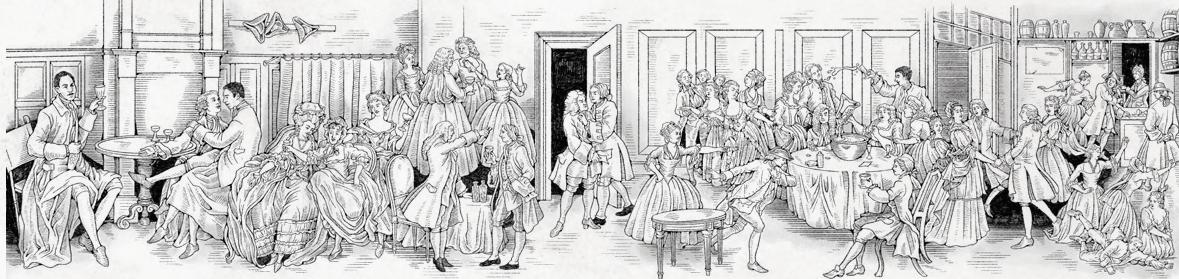
This was the thriving, underground world of the mollies, pioneering explorers of gender and sexuality who built a community during this period of possibility and change. Bawdy songs rang out as bedecked mollies engaged in masquerades. The nights were filled with unsanctioned weddings and gin-soaked christenings.
Molly House celebrates this community by inviting players to take the roles of these mollies as they navigate their desires and dodge the watchful eyes of the Society for the Reformation of Manners, a citizen group that sought to stamp out any behavior it deemed deviant.
During the game, players try to accumulate joy by throwing and participating in festivities. In preparation, they move around the board to collect vice cards to play at these festivities. Certain sites on the board let players use cards in their hands to build their reputations, which can improve later actions but also expose them to risk. Other sites—the shops—offer items that provide a variety of benefits.
At festivities, players will also score joy for the community. This is a crucial element of the game. In order for the community to survive, players must help the community pass its joy threshold by collaborating to throw the most magnificent festivities.
Of course, this collaboration comes at a price. Staging festivities and taking some actions will gradually increase the size of the gossip pile. Each week, this pile will be inspected, possibly generating evidence against the houses. With enough evidence, the Society will raid a molly house and indict those players with the highest reputation there.
If sufficient evidence is generated over the course of the game, the wider community will be fully infiltrated, ending the game and leaving only those who successfully betrayed the community eligible to win.
Components
This section contains an accounting of all components as well as their general function.
BOARD AND PLAYMAT
Molly House uses a four-panel board as well as a playmat.
RuLEs AnD AIDs
There are two rulebooks: this one and the solo rules. In addition there are two large aid sheets and five poker-sized aid cards.
GAME STATE MARKERS
There are seven game state markers. The gold octagon marks the current week. The black disc is used to mark community joy. The candelabra is used to indicate the current festivity runner and to determine the start player at the beginning of a week.
In addition, each molly house has a token to indicate that it has been raided and a pair of tokens used to mark the adjacent cruising sites to show that they are now more dangerous.

CUBES
There are sixteen cubes in each of the four suit colors. These cubes represent permanent reputation if in a player's area or evidence against a molly house if on the board.
DRAW AND MULTIPLIER TOKENS
There are ten draw tokens. These tokens indicate that a player will draw a card at the start of the next week. There are five multiplier tokens. Cubes and draw tokens are not piece limited. You may place either on a multiplier to indicate that it counts as three of that piece.


PLAYER PIECES


Each player has a joy marker, a pawn, a player board, and four encounter tokens in their color (one informer and three loyal). The joy marker indicates joy on the star side or hanged on the reverse.

DICE
There are two custom six-sided dice, which are used for movement, and four ten-sided dice, which are used to record the values of rogues and resolve indictments.

SOLO GAME COMPONENTS
SMALL CARDS
There are twenty item cards, eight major indictments, and eight minor indictments.
For the solo game, there are four standard six-sided dice, a 25-card orchestration deck, five play/pass tokens, and four joker tokens. The solo game requires only four play/pass tokens, but we have included a fifth so that players may use them as an aid in multiplayer games to show who has passed.

VICE CARDS
There are 52 vice cards that form the heart of Molly House. The three different types of vice cards are described here, along with their general game function. Many concepts and rules that are discussed in greater detail later are mentioned here in passing.
VALUE SUIT JoY
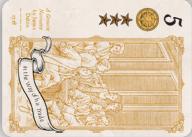
Desires

These cards represent the different gestures, desires, and encounters that were frowned upon by the Society for the Reformation of Manners. All desire cards have three important attributes: value, suit, and joy. A card's suit and value are used to build festivities at molly houses.
The suits of Molly House:

Pentacles
The stars on a card indicate the amount of joy gained when the card is scored during festivities.

Fans
Desire cards also feature a fragment drawn from a period source and a citation. We have preserved the original spelling, punctuation, and capitalization.

Hearts
Cups
Threats
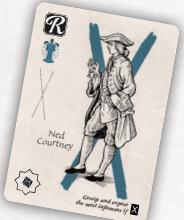
There are two types of threats: constables (C) and rogues (R). If players ignore them, they can lead to the collapse of the community. However, by scoring them in festivities, you can protect the community and clear cards in your reputation.
Unlike desires, these cards do not score joy. They also have a special effect when played during festivities.
Constables feature the names of officials while rogues are the names of known informers.
TYPE SUIT

FESTIVITY EFFECT Constables may form Quiet Gatherings at festivities.
DISCARD REMINDER Mollies and threats are added to gossip if discarded from the market.
Mollies
There are two types of mollies: jacks () and queens (Q). Mollies have a joy amount, which is used only in specific circumstances. In addition, mollies offer a scoring bonus.
Each molly is modeled after a named historical counterpart.
Both mollies and threats also include a reminder on the bottom right to place in the gossip pile if a market discard removes them from the market.
TYPE SUIT
Joy Mollies do not
have a normal joy value; however, they
may score joy for
the community if selected at festivities.

MOLLY BONUS This icon means that you score two joy whenever you add a pentacles desire to your reputation.
Setup
GENERAL SETUP
- Place the board and the playmat in the center of the play area.
Place the cubes, house raided markers, dangerouscruising markers,dice, multiplier tokens, and draw tokens nearby.
Create the vice deck. Gather molly cards (jacks and queens) and threat cards (constables and rogues), then add numbered desire cards as indicated below.
Two Three Four Five Players Players Players Players 1-6 1-71-8 1-9
Shuffle this deck and place to the right of the topmost slot on the board's right side.
Fill Market. Deal four cards, face up, to the four slots below the vice deck.
5 Create the Gossip Pile. Deal one card, face down, and place it in the gossip pile.
- Place the community joy marker on the "0" space of the joy track and the current week marker on the "1" space of the week track.
Shuffle the 8 major and 8 minor indictment cards and place them in two stacks near the board.
- Shuffle the 20 item cards and deal one, face up, on each shop site. Place the remaining items in a stack near the board.
Give a random player the candelabra.
They will be the first player.




PLAYER SETUP:
10Take a matching player board, pawn, and set of four encounter tokens. Keep the encounter tokens face down near your board. You may always look at them.
113Deal Player Hands. Deal four vice cards to each player. If playing with two players, deal five cards instead.
123Place your joy marker on the "o" space of the winding joy track.
13Each player secretly selects one card from their hand and places it face down in their reputation area to the left of their player board. Then, all players simultaneously reveal their card. They then place their pawn on the molly house that matches the card's suit. Then:
If it was a desire card, they score the amount of joy indicated on the card.
If it was a threat card, add it to the safe pile (a face up discard pile placed anywhere near the area of play).
If it was a molly card, nothing further happens. Players often choose this option to score molly bonuses later (page 7).
General Rules and Concepts
SHARING INFORMATION
Players are free to talk about the game and their hands, but they may never directly reveal cards in their hands to other players unless instructed. As an example, any player may freely declare that they have two sevens, but may not directly reveal those cards to verify it. They could be lying. Figuring out how much you should say about your hand and whom you should trust are two of the central challenges of the game!
MATCHING PIECES
Various rules in the game will refer to a "matching" game piece. Matching pieces are those that have or are associated with the same suit and color.
HAND LIMITS
Players must observe a hand size limit of six cards. Additional cards may be taken into your hand, but you must add any excess cards to the gossip pile face down at the end of your turn.
All these things match.

THE GOSSIP ANd SAFE PILES
Throughout the game, cards are often added to the gossip pile, located on the bottom right corner of the board. All cards in this pile are face down; the order in which cards are added does not matter.
The gossip pile is examined at the end of each week. If threats are discovered in the pile, it can lead to the gathering of evidence, the raiding of houses, the indictment of players, and the destruction of the wider community.
In contrast to cards in the gossip pile, cards in the safe pile will not harm players or the community. The safe pile may be placed anywhere near the area of play, and it can be freely inspected at any time.
REPUTATION
Throughout the game, players will add cards and cubes to their reputation, storing cards to the left of their player board and cubes on the player board itself. These cards and cubes are used to measure a player's reputation in each of the game's four suits.
To determine player's reputation in a specific suit, add up the total number of cubes and cards matching that suit in their reputation. A player's reputation boosts their actions at matching sites but also makes them more vulnerable to indictments if that house is raided.
Reputations are public information, and any cards there should remain face up. During the game, cards will often leave a player's reputation. In contrast, cubes in a reputation are never lost.

Blue has a reputation of four in pentacles, one in hearts, and one in cups.
THREATS AND BEING EXPOSED
Throughout the game, threats will sometimes be added to the gossip pile. When this publicly happens, a specific player or players will be exposed. When a player is exposed, they must add all cards in their reputations matching the threat that triggered exposure to the gossip pile and take a matching cube for each. The various methods for determining who is exposed are described throughout the rules.

Exposure Icon
MOLLY BONUSES
If a player has a molly in their reputation, they will score bonus joy when desires (numbered cards) in the matching suit are added to their reputation. This bonus is two joy with a matching jack, three joy with a matching queen, or five joy with both.
During a festivity, it is possible that both mollies and desires will enter a player's reputation at the same time. When this happens, add mollies before desires. This rule ensures that you gain your Molly Bonuses for newly added cards, even if those cards are then lost due to a threat at the same party (this is described later on page 11)!

LOYALTY AND INFORMING
Players begin loyal to the molly houses. However, as houses are raided by the Society for the Reformation of Manners, players will be given opportunities to inform on other still-active houses. If an informer's assigned house is raided before the end of the game, they will be granted a pardon for their past crimes and gain another path to victory if the Community Infiltration ending occurs.
Sequence of Play
A game of Molly House is composed of up to five weeks. Each week is composed of several rounds of player turns. On a player's turn, they will usually move their pawn around the board and then take an action. Many of these actions deplete a central deck of cards, called the vice deck.
If the vice deck is empty at the start of a player's turn, they should take the candelabra and then resolve the End of the Week phases. That player will take their turn after resolving these phases so long as the game has not ended.
How the Game Ends
A game of Molly House may end when resolving the End of the Week phases. There are three different endings, and each uses a different method for determining the game's winners and losers.
COMMUNITY INFILTRATION occurs if all four houses have been raided or if at least one raided house has accumulated seven or more evidence. All players are hanged except those who became successful informers. The informer who was most useful to the Society for the Reformation of Manners wins. Informers become useful by ensuring the right suit of evidence is gathered and by keeping a low profile.
COMMUNITY SURVIVAL occurs if the community joy marker has equaled or surpassed the threshold corresponding to the number of players as indicated on the joy track (e.g. 3o with four players). In that event, the player(s) with the most joy win(s). Though players will have to resolve indictments, the community has demonstrated its persistence and will continue to thrive despite persecution.
COMMUNITY ATROPHY occurs if neither of the above conditions has been met by the end of the game's fifth week. All players lose. This ending represents the erosion of the molly houses: although the Society failed to persecute the mollies, their culture failed to become self-sustaining.
Your Turn
Roll the two movement dice and resolve market discard(s). For each market discard icon you roll, take the card from the market that is farthest from the vice deck and add it to the safe pile. If it is a molly or threat card, add it to the gossip pile instead. Remember that the safe pile can be freely inspected while cards in the gossip pile are always face down.


The Most Infamous is Exposed. Whenever a threat from the market is added to the gossip pile, the most infamous player is exposed. To determine the most infamous player, each player adds up the numerical value of cards in their reputation matching the threat (with mollies being treated as tens). The player with the highest sum is the most infamous. If there is a tie, all tied players are exposed. If none of the players have a matching card in their reputations, no player is exposed.
Next, move your pawn. Count the number of boot icons on exactly one or both of the dice you rolled. Move your pawn that exact number of sites along the board, without backtracking. If one of the dice rolled was a market discard (no boots), you may remain at the same site. If you rolled two market discards, you may choose to be picked up by a fancy fellow in a carriage and place your pawn on any site.

Boot Icon
Then, you must take one action. You always have access to the three basic actions and your site's action. Actions are described below.
Finally, refill the market and check hand size. Shift the remaining cards in the market down to fill any empty spaces, and refill the market from the vice deck, if possible. If your hand has more than 6 cards, add the excess to the gossip pile. Threats will not expose players if added to gossip in this way.
Play then continues with the next player clockwise. If the vice deck is empty, the next clockwise player will resolve the End of the Week phases before taking their turn.
Basic Actions
These actions can be taken on any site so long as the action's requirement is met. For instance, you can indulge only if there is a market card matching your site.
LiE Low
Draw the top card of the vice deck and add it to your hand.
INDULGE
Select a card in the market matching the suit of your current site and add it to your hand. You cannot take this action if you are at one of the four shop sites, since they do not match any suit.
ACCUSE
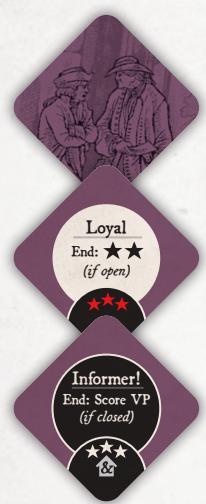
If another player is at your site, you may reveal one of their placed encounter tokens (these tokens are often placed during the End of the Week). Note that while their pawn must be at your site, the encounter token you reveal may be at any house, so long as it has not yet been revealed.
If it shows loyal, lower your joy by three spaces.
If it shows an informer, score three joy and then advance the community joy marker by the same amount. The accused player is now a revealed informer (see page 14).
Site Actions
These actions can only be taken if your pawn is at the corresponding site. If a molly house has been raided, players may not Throw a Festivity at that site.
Many molly houses were public coffee shops or boarding houses that offered access to the molly community for trusted patrons. In the game, it is assumed that all players have already earned the trust necessary to enter these communities.
CRUISE
The cruising sites are adjacent to each molly house. While there, take one desire card (not a threat or a molly) that matches the site from your hand and add it to your reputation. If you already have a molly in your reputation matching the card you cruised with, remember to score the bonus!

Next, draw cards from the vice deck equal to your reputation in the site's suit, but no more than four. If there are not enough cards in the deck, take a draw token for each card that you could not draw. You cannot take this action if you do not add a desire to your reputation, even if you have a reputation with this site's suit!
Dangerous Cruising. After a molly house has been raided, cruising becomes more dangerous at its adjacent sites. After playing a card and drawing cards (and scoring any molly bonuses), you must add the card you just played to the gossip pile and gain one matching cube.
CRUISE ACTION

Pink takes the cruise action at St Paul's Cathedral and plays a desire of pentacles to their reputation. Because they have five matching reputation (including card just played), they draw four cards, the maximum allowed.
SHOP
The shop sites are located at the mid-point along each edge
of the board. While there, take the item from the site
and place it, face up, on your one of your player
board's item slots. If you already have two
items, you must discard either the item just
taken or one of your other two. The powers of items are described on page 16. Note that you do not refill the shop; new items will be placed during the End of the Week phase.

Finally, perform a market discard as described on the previous page (adding the farthest card from the vice deck to the safe pile if the card is a desire, to the gossip pile if it is a molly, or to the gossip pile and resolving exposure if it was a threat).


THROW A FESTIVITY
This action offers players their primary way of scoring joy. It can be taken at one of the four corners of the board, so as long as that house has not been raided. Unlike other actions, this action is resolved over a number of phases, which are described below. You must have at least two cards in your hand to take this action (or three if playing with just two players).
Running Out of Cards. During a festivity the vice deck will sometimes run out of cards. If a player has to draw a card and there are no cards remaining, they instead gain a draw token for each. Any timing issues around drawing are decided clockwise, runner first. If the community has to play a card, shuffle the gossip pile and draw from that.
First, bring the party to order.
To indicate that a party is about to begin, take the candelabra and place it in front of you. You are the festivity runner.
Second, play cards.
Cards are played over two rounds (or over three rounds in a game with two players). At the start of each round, reveal the top card of the vice deck and place it in the center of the board; it is considered to have been played by the community. Then players each take a turn, starting with the runner and proceeding clockwise.
When it is a player's turn, they must either pass or play:
If they pass, their turn is skipped for the remainder of the festivity.
If they play, they place any card from their hand on the table in front of them. The festivity runner must play a card each round.
Rogues are Fickle. If a player plays a rogue, they must set its value to any number from zero to nine, indicating the value with a ten-sided die. This card will act as a desire of that value when determining the festivity rank. If the community plays a rogue, determine its value randomly by rolling a ten-sided die. A rogue may take a value, such as zero, that is not otherwise in the game.
Third, determine and score the festivity.
After all rounds have been played, the best set of four cards is selected to be scored from among those played, using the following ranking:
1st Surprise Ball: Four desire cards of the same suit in sequential order.
2nd Christening: Queen and 3 desire cards of the same value.
3rd Dance: Jack and 3 desire cards in sequential order (ignore suit).
If multiple sets of the same rank could be made, the set containing the desire with the highest value is selected. If the winning set could be made multiple ways (e.g. with a rogue instead of a desire of the same value), the festivity runner decides which specific cards will be selected.
If no set of the above ranks can be made, a Quiet Gathering occurs. The four lowest desires are selected as the winning set, ignoring rogues. If there were fewer than four desires played, score only those.
Constables are Intimidating. During Quiet Gatherings, treat constables as zero-value desires. This means constables will always be selected during a Quiet Gathering.

Then, each selected card is added to the reputation of the player who played it and is scored. Each card scores its player as much joy as indicated by its stars (or lack thereof) and may trigger molly bonuses (see page 7).
If a community card was selected, advance the community joy marker by the amount indicated, then add the card to the safe pile. If the community played a molly card that was selected, count it as having four stars. Remember that mollies do not have regular joy values, so players never score this.
FOILING A THREAT
Scoring a threat at a festivity represents a successful effort to outfox the Society and protect one's own reputation and the wider community.
If a threat card is part of the selected set, add it to the safe pile instead after all other cards have been resolved. The player who played the card then adds all matching cards in their reputation to the safe pile. If a threat played by the community was selected, all players do this.
The Pride Rule. Any player who adds cards to the safe pile at this time may take a matching cube for each card added to the safe pile. They may not do this partially: it is all or nothing. Decide any timing issues in turn order (clockwise starting with candelabra).
If multiple threats are selected as part of the same festivity, the party runner decides the order in which they are foiled.
Fourth, generate gossip.
The festivity runner then adds the remaining cards on the table to the gossip pile, one at a time. Each time a card is added to the gossip pile, the player who played it draws one card from the vice deck. No cards are drawn to replace those played by the community. Remember: if the vice deck runs out of cards, players gain draw tokens instead.

The Party-goer is Exposed. If a player played a threat that was added to the gossip pile, that player is exposed (page 6).
The Community is Exposed. If the community played a threat that was added to the gossip pile, all players are exposed (page 6).
Fifth, score the runner's bonus and the community's bonus. If a Surprise Ball, Christening, or Dance occurred, the festivity runner scores joy equal to their reputation matching their pawn's site. If a Quiet Gathering occurred, the runner loses this amount of joy instead. Then the community joy marker is advanced +3/+2/+1/-1 if a Surprise Ball/Christening/Dance/Quiet Gathering occurred. Joy cannot go below zero.

End of the Week
If the vice deck is empty at the start of your turn, take the candelabra and resolve the phases described in this section.
REVEAL THREATS
Each player must reveal all threat cards in their hand and add them to the gossip pile (for revealed informers, see page 14). Any player who reveals one or more threat cards gains a single draw token.

The Hesitant Players are Exposed. Each time a player adds a threat to the gossip pile, they are exposed.
Note on verification: if playing the game in a tournament setting (or if you are bothered by the possibility of cheating), have a third party quickly check the hands of players to ensure that there are no undisclosed threats that would otherwise need to be revealed now.
THE SOCIETY INVESTIGATES
Each week the Society for the Reformation of Manners gathers to review the evidence it has obtained from its many spies. During this phase the Society may raid houses and undermine the community.
First, prepare the gossip pile.
Shuffle the gossip pile. Add one third of the cards to the safe pile, rounding down. Reveal the remainder.
Second, gather evidence.
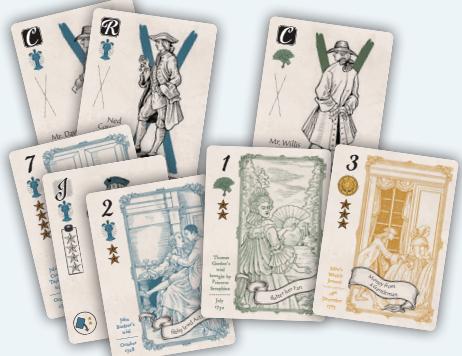
Examine the revealed cards. Each threat generates one matching evidence for each matching desire or molly. Place this evidence on the matching molly houses.
Third, check for raids.
If an open molly house has seven or more evidence, it is raided! Place a "House Raided" token on that site and a "Dangerous Cruising' token at the two adjacent sites. Then return seven evidence from that house to the supply, leaving any remainder
When a house is raided, the player(s) with the most reputation in the matching house gain(s) a major indictment. The player(s) with the second most reputation in the matching house gain(s) a minor indictment. In the case of ties, all tied players receive the same type of indictment. This means that if there are three players tied for first and two players tied for second, the three
EXAMINING GOSSIP
The gossip pile has 11 cards in it. Three are discarded. The remaining eight are revealed.
The following evidence is generated:

The cups evidence is placed on Julius Cesar Taylor's and fans evidence is placed on Miss Muff’s.
players will each get major indictments and the two players will both get minor indictments. Players with no reputation matching the raided house are not considered.
Any indictments gained should be placed, face down, below their player's board. Players may inspect their indictments at any time. There is no limit to the number of indictments a player may have.
In the very unlikely case that a stack of indictments cards runs out, no cards of that type are gained. Instead, any players who would have gained that indictment lower their joy by four for a minor indictment and eight for a major indictment. Joy cannot fall below zero.

Fourth, check for game end.
Then, check to see if the game has ended.
If all four houses have been raided or a raided house has accumulated seven or more evidence, the game ends with Community Infiltration.
Otherwise, if the community joy marker has reached or exceeded the game end threshold for your player count, the game ends with Community Survival.
If neither of these conditions has been met and the fifth week has been completed, the game ends with Community Atrophy.
If the game ends, skip any remaining phases in the End of the Week and resolve final scoring. Scoring for the different endings is described on page 18.
ENCOUNTER THE SOCIETY
Simultaneously, all players who gained indictment cards this week must select one of their encounter tokens and place it, face down, on the nearest open molly house to that player's pawn (going clockwise if tied). Encounter tokens are considered to match the suit of the molly house where they are placed. Players may inspect their own encounter tokens at any time. It is possible for the same player to have multiple encounter tokens on a single house.
If a player has one or no encounter tokens, they may skip this phase.
CLEANUP
Perform the following steps to prepare for the next week.
-
Shuffle all vice cards except those in players' hands, players' reputations, and the market. This deck of cards becomes the vice deck.
-
Deal one card to the gossip pile face down and refill any vacant market spaces with face up cards from the vice deck.
-
Starting with the player with the candelabra and proceeding clockwise, each player draws one card for each of their draw tokens, then returns those tokens to the supply.
-
Discard any item cards on shops and then deal one new item, face up, to each shop site. If the item deck is empty, shuffle the discarded items to form a new item deck.
-
Finally, advance the current week marker to the next week. Play now resumes with the player with the candelabra.
Betraying the Mollies
Historically, the molly houses were brought down by a network of informers who were coerced into helping the Society for the Reformation of Manners.
Players often become informers by playing their informer encounter token during the Encounter the Society phase (see previous page).
An informer succeeds if the house where they placed their informer token has been raided by the end of the game. There are two potential benefits to being a successful informer:
Indictments Pardoned. If the game ends with Community Survival, successful informers discard all of their indictments.
Another Path to Victory. If the game ends with Community Infiltration, successful informers are not hanged. Instead, they will score victory points (not joy!) based on their performance as an informer. Their scoring is described on the next page.
However, being an informer is not without risk! An unsuccessful informer will gain an additional major indictment if the community survives.
REVEALED INFORMERS
If a player's informer token is revealed during the game, they become a revealed informer. They must immediately add all cards in their reputation that match their informer token to the safe pile.
In addition, they must follow the benefits and restrictions listed below.
A Social Pariah
Revealed informer must add any cards in excess of their hand size to the safe pile (instead of the gossip pile) at the end of their turns.
A Known Threat
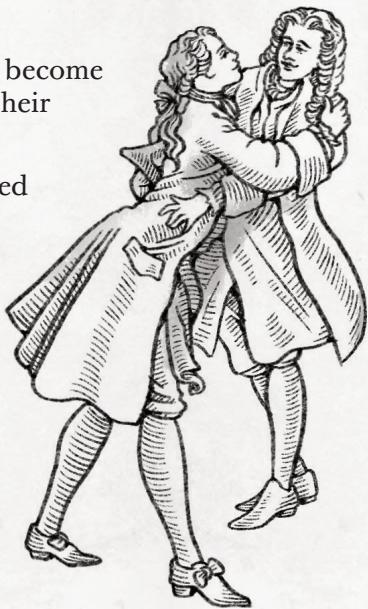
After sets are determined and scored at festivities, any cards in a revealed informer's reputation matching their informer token are added to the safe pile. Note that this happens before threats that failed to score expose player(s)!
At the end of the week, they do not reveal threats matching their informer token.
Unwelcome near the Molly House
Revealed informers can no longer take the Throw a Festivity action at the molly house matching their informer token or the Cruise action at the adjacent sites. If a festivity occurs at that molly house on another player's turn, they must pass and the community then plays an additional card. They also cannot play items at festivities at that house.
A RUSH TO RESOLUTION
If all players are revealed informers in the last open house, the week ends immediately and should be treated as if it is the fifth week. This rule allows the game to end at the moment when players no longer have a way to meaningful contest victory. This should be a very rare situation.
Game End and Victory
If the game end is triggered, follow the corresponding resolution below.
COMMUNITY INFILTRATION All players reveal their encounter tokens.
Players without informer tokens and those with an informer token matching an open house are found guilty of sodomy and hanged; flip their joy marker over to its hanged side.
Players with an informer token matching a raided house are not hanged. Instead, they set their joy to zero.
Each of these informers will now tally their score. They score two victory points per evidence at the house with their informer token, plus two victory points for each reputation point of all other players that matches that house. They then will subtract one point for their own reputation in all suits. This includes the suit they informed against! Successful in-
formers may wish to tally their score on the joy track, but some groups may find it in poor taste.
The game is now over, and the player with the highest positive number of victory points wins. If any players are tied for the highest score or no player has a score greater than zero, all lose.
COMMUNITY SURVIVAL
All players reveal their indictments and encounter tokens on the board.
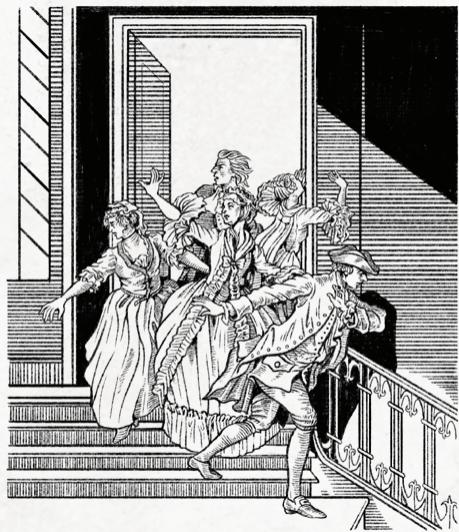
INFORMER SCORING EXAMPLE
The game has ended with Community Infiltration. Though raided, there are no cubes on Julius Cesar Taylor's molly house (cups). Yellow has revealed their informer token on that house. Red's reputation is seven cups. Blue's is two cups. Yellow's is five cups and two hearts. Yellow's final score will be 11. They get 18 for Red's and Blue's reputations [(7+2)×2], but deduct seven for their own reputation.
Pardon successful informers. If a player's informer token is at a raided house, they have successfully collaborated with the Society. That player discards all of their indictments. Then, any played loyal tokens belonging to that player are discarded.
Prosecute failed informers. If a player's informer token matches an open house, their failure to collaborate is punished by the Society. That player gains one major indictment card.
Score loyal tokens. Each player scores 2 joy for each of their loyal tokens at an open house.
Finally, in turn order, each player with at least one indictment must face a trial, resolving each of their indictment cards in any order as follows: Roll a ten-sided die and lower their joy by the amount indicated on the card for that die result. If the amount shows a noose icon, the player has been hanged and must flip their joy marker.

Noose Icon
The game is now over, and the player with the highest joy who hasn't been hanged wins. If there is a tie, tied players share the victory.
COMMUNITY ATROPHY All players lose.
Item Powers
Players may have up to two items stored in the slots on their player board. These items do not count as part of a player's reputation.
When players use an item, they should resolve its effect and then discard it.
Items use a variety of timing windows. Molly House is not a real-time game, and players should allow one another a little grace if a timing window is narrowly missed. Any timing conflicts should be resolved clockwise, starting with the player with the candelabra.
BOTTLE OF GIN
Play after the last card of a festivity is played but before the winning set is selected. All players—even those who passed—play an additional round. Do not play an additional card for the community. Players, including the runner, may pass during this additional round.
Revealed informers who were previously barred from playing may play during this round as if the festivity were at another house.

BRIBE
Play on your turn instead of taking an action. Examine the gossip pile and secretly add one card of your choice to your hand.
DOMINO

Play before revealing gossip during the Society Investigates phase. Your reputation is ignored if any houses are raided. For example, even if you have most reputation in a specific house (and would have taken a major indictment), you will take no indictment, and other players may receive the major and minor indictments instead.
DRESS

After you play a card during a festivity, you may also play the dress item in the matching suit. The requirement for a Surprise Ball for this festivity is now four desires of this suit rather than its usual requirement of four sequential cards of any one suit. As usual, if there are more than four cards played of that suit, the highest are selected. Remember too that rogues count as desires.
If multiple dresses are played, multiple suits may be used to build a Surprise Ball. For instance, if the cups and hearts dresses are both played, a Surprise Ball could be formed with one cups and three hearts.

Any played dresses are discarded at the end of the festivity, even if the set was not a Surprise Ball.
NEWSPAPER NOTICE
Play on your turn instead of taking an action if your pawn is at an open molly house. Place one of your encounter tokens, face up, at this site. Add all matching cards in the market to the gossip pile, scoring 2 joy for each

card if you placed a loyal encounter token. Any threats are resolved as if added to gossip by a market discard. Players often use Newspaper notices to become informers, and, as they play their informer token face up, they become revealed informers immediately. .
VIOLIN
Play at any time during a festivity before the set is selected. Draw an additional two cards for the community. If the vice deck is empty, shuffle and draw from the gossip pile.


FESTIVITY EXAMPLE
THE FESTIVITY's CONTEXT
Blue heads to Mother Clap's for a festivity. The reputations of all players are shown below. Note that Blue has a reputation of two in pentacles, so as long as a Quiet Gathering doesn't take place, they are likely to score at least two joy for their runner's bonus because Mother Clap's suit is pentacles.
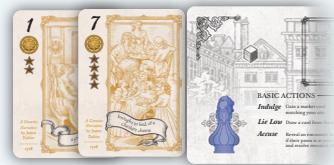
Pawns and markers are pictured only to indicate seating order and card ownership.
Round OnE
The community plays a Jack.
Blue wants to build off the Jack, so opts for a 4, hoping for a Dance.
Yellow has no interest and plays a 2, hoping for a Quiet Gathering.

Purple likes where Blue is going and joins the Dance with a 5.
Round Two
The community plays a Constable.
That constable scares Blue, who has a considerable reputation in pentacles. They opt to play a low value card, now hoping for a Quiet Gathering.

Yellow plays another low value card.
Purple thankfully has a 6, so the dance is successful.
DETERMINE AND SCORE FESTIVITY
Blue must select the Jack, 4, 5, and 6, which makes a Dance. The community scores 4 joy and discards the Jack. Blue scores 3 joy and Purple scores 1o joy (7 for the played cards and 3 for the molly bonus of the queen in their reputation). Players add the cards they score to their reputations.
GENERATE GOSSIP
The remaining cards are added to the gossip pile. Blue draws one card from the deck and Yellow draws two. Because a threat played by the community was not scored, all players are exposed by it: gaining cubes for any pentacles cards in their reputations (including those just added!) and adding those cards to the gossip pile. Purple gains one pentacles cube, Blue gains two.

SCORE COMMUNITY AND RUNNER BONUSES
Finally, Blue scores two joy as their runner's bonus (for their reputation at this house) and the community scores one joy (for the Dance). Note that even though the failure to score the pentacles constable forced Blue to move the pentacles cards in their reputation to gossip, the cards were replaced by cubes so their reputation is unchanged.

These reputation cards go to gossip because the pentacles threat was not scored. Their owners take a cube for each.
These cards played at the festivity go to gossip because they were not scored.

Credits and Essays
Original Concept and Design: Jo Kelly
Illustrations: Rachel Ford
Additional Design: Cole Wehrle
Solo Design: Richard Wilkins
Development: Jo Kelly, Cole Wehrle, Drew Wehrle
Research, Essays, and Historical Notes: Jo Kelly
Editing and Proofreading: Jon Healey with Leonard Ash
Playtesting: Xoe Allred, Leonard Ash, Florian Bänsch, Will Barker, Adam Bell, Susannah "Bill" Billig, Thomas Butler, cado, Trysten Cain, Alison Collins, Ash & Misty Dasuqi, Aja Essex, Jonathan Epp, Chris Flores, Hywel Harrington, Stephen Haynes, Haze, Mar Hepto, Sophie Humphries, Lauren Ino, Christian Jensen, Ali Kay, LoveShard, Jai Manacsa, Jardine Miles, Tom Pickard, Lin Ren, Cutty Reynolds, Tim Rousham, Ryan Schneider, Jason Stone, Ian Sundstrom, Nic Tringali, uropb, Arno Van de Velde, Vera Vetterli, Samuel Vriezen, Blake Wehrle, Brian Williams, Mark Wright
DESIGN HISTORY & DEDICATION
Molly House was conceived in response to the announcement of the inaugural Zenobia Award in late 2o2o. I was a musician who hadn't played a gig in months and needed somewhere to put that energy, and working on a game was something I'd certainly thought about but never pursued in earnest. I was aware of molly houses, thanks to the title of a piece written by my composition tutor, Michael Finnissy, and as I researched further, a game concept came into being.
After a brief time as a head-to-head game of mollies versus constables, the concept developed into more or less what you find now: playing as mollies risking imprisonment and even their lives in the pursuit of queer joy, or being coerced into betraying the community for their own survival. Over the course of the Zenobia Award process, it morphed from a simple push-your-luck card game to a much larger euro, but even though the game functioned and was saying all the right things, I still knew it could be vastly improved.
When the Zenobia Award ended, Cole, who had been my assigned mentor, reached out with a tentative offer to work towards publication. I accepted. Then ensued several months of Cole, Drew and me passing the design back and forth, making radical mechanical alterations, always in pursuit of the original vision of the game.
The biggest problems we were trying to solve were how to make the players, together with the non-player mollies represented in the game, feel like a living community, and how to make the festivities truly feel like parties in how they play. It took years of collaborative effort to come up with the solutions present in the game today.
I am forever indebted to endlessly patient friends, family, collaborators, Zenobia Award volunteers and many strangers who have invested time and effort into this project. I dedicate this game to all mollies, past, present and future, who blaze the trail for those who come after them.
ON PRESENTATION AND IDENTITY
While it's tempting to project our own ideas onto the past, we have tried our best to meet the mollies on their own terms when presenting them in this game. For that reason, where possible, we have used their "maiden names, as these are how they would have referred to each other within the community. We can speculate on whether these were aliases used to hide legal names, something akin to drag personas, a representation of their true identities, or some combination of all of these, but we can never be truly sure.
There is not much recorded dialogue from within the community, so the question of pronouns is hard to answer. There is certainly evidence that some mollies often or always took on female personas and referred to each other as "she." Whether this is similar to queer men's modern custom of calling each other "she," a way to indicate a trans-like identity, both, or neither, we can only speculate upon.
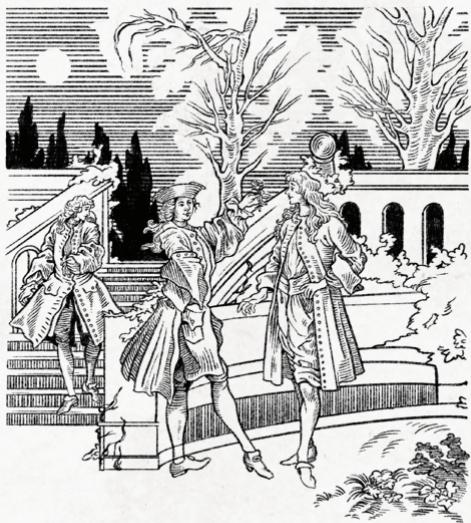
MOLLY BIOGRAPHIES
Historical Note: Some of these biographies mention the crime of "assault with intent to commit sodomy." This does not imply lack of consent. Two people could be indicted for "assaulting" each other for engaging in consensual sex.
Flying Horse Moll
Mentioned as one of 40 misbehaving "men in women's clothes" apprehended after a private masquerade in January 1725 who "generally go amongst themselves by Female Names or rather by the Names of the Racers at Newmarket"(the famous racetrack in Suffolk). Also mentioned in Julius Cesar Taylor's trial and in a list of names of mollies given in notorious robber James Dalton's confession.


Orange Deb
Indicted under the legal name Martin Mackintosh in July 1726 for assaulting Joseph Sellers with intent to commit sodomy. Sellers was one of the Society for the Reformation of Manners constables and was admitted entrance to a molly house in Drury Lane by posing as the husband of informer Mark Partridge. Orange Deb was sentenced to pillory, a 1o Mark fine and a year in prison.

Princess Seraphina
Perhaps the most well-documented molly from the time. Although mentioned in the Old Bailey Proceedings, she was not the one on trial. She brought a case against one Thomas Gordon for allegedly stealing her clothes. She called several character witnesses, many of whom appeared not to be part of the molly community, but still referred to her as "she" and "her" and "never heard that she had any other Name than the Princess Seraphina." She was described as very feminine, often wearing dresses and attending masquerades, and it was well known and seemingly accepted among her neighbors that she had relations with men.
Prety Criss
One of the list of molly names given by James Dalton, Prety Criss is described only as 'a Soldier of the 2nd Regiment'. Criss is far from the only name on the list where this is the case. I have found no further information about many of the mollies listed, including Small Coal Mary, Tub Nan, Sukey Pisquill, Hardward Nan and Thumbs and Waste Jenny.

Queen Irons
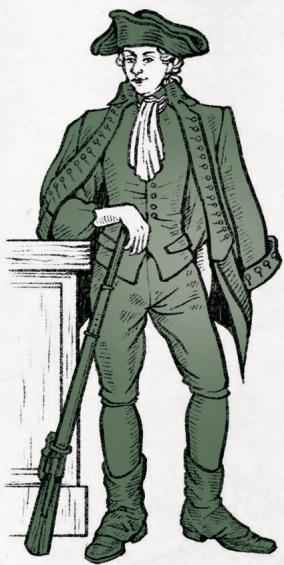
Sukey Haws, a molly and member of James Dalton's gang, recounted stories from the molly houses to Dalton, which he repeated in his confession. He gave the story of a wedding between Queen Irons and another molly, with Miss Kitten and Princess Seraphina as bridesmaids. A newspaper from October 1726 reported on Queen Irons' conviction for assault with attempt to commit sodomy, with a sentence of pillory, a fine and three months' imprisonment.
Aunt England
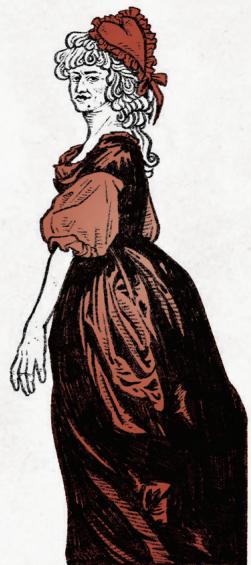
James Dalton named Aunt England as a "noted soap boiler" and a steward at Sukey Bevell's molly house, and also as a standing gossip at a lying-in in which Aunt Grear was "brought to bed of a Cheshire cheese." No further information is available about Aunt England or Sukey Bevell, which suggests maiden names may sometimes have functioned to avoid the discovery of mollies' legal names, thereby protecting their identities.
Susan Guzzle
Mentioned in James Dalton's 1728 confession as the midwife at a "lying-in," a mock birthing ceremony in which a molly would sit in a chair, attended by others with napkins and a basin of water, and act out giving birth to a wooden doll. Similar scenes are described in Ned Ward's Satirical Reflections on Clubs from 17o9 and robber Thomas Neaves' 1728 confession. Randolph Trumbach has theorized this may have its origins in a rural tradition, citing a "mock groaning"from a small Gloucestershire village in 1716 in which a "sodomite" was dressed in a mantua and feigned giving birth to a wad of straw in baby's clothes.

Miss Kitten
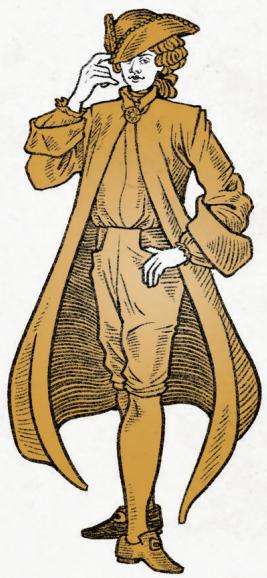
The bridesmaid from Queen Irons' wedding was convicted of extortion under the legal name James Oviat in February 1728. Miss Kitten threatened to swear sodomy against Rodolphus Blank after an apparent cruising attempt in St James's Park. Miss Kitten got a guinea out of it, but when Blank refused to pay any more, Miss Kitten fetched a constable, which backfired when other prisoners recognized Kitten and resulted in a sentence of pillory, a fine and prison.
MOLLY HOUSE OWNERs
Julius Cesar Taylor
A Black molly who ran a molly house where the christening ceremony is known to have occurred, in which mollies were given a maiden name by having gin thrown in their face. Julius Cesar Taylor was found guilty of both assault and keeping a disorderly house, but was sentenced only to a fine and was required to find a surety to ensure his ongoing good behavior (this was essentially a sponsor who could guarantee a bond of some amount).
Sukey Bevell
Sukey Bevell's molly house is mentioned in James Dalton's narrative as a place of extravagance in The Mint (a district in Southwark) and the location of Queen Irons' wedding, but no further information is given elsewhere. There is no record of it having been raided.

COnSTABLES & ROGUES
The Society for the Reformation of Manners was a group active in the late 17th and early 18th century, set up with the aim to enforce laws against behavior its members deemed immoral, including sex work, Sabbath breaking, swearing and sodomy. To achieve this, they paid agents to find information and apprehend perpetrators of these crimes, essentially forming one of the first proto-police forces in London.
Samuel Stevens, William Davison, Thomas Willis and Joseph Sellers were agents of the Society for the Reformation of Manners. They gathered evidence against mollies by staking out cruising spots and infiltrating molly houses and recruited informers from within the molly community to help them achieve this.
According to Randolph Trumbach, the government took over these cases in early 1726, and with the help of the Society's evidence, 56 mollies were charged or arrested for crimes relating to sodomy in that year.
Mother Clap
Margaret "Mother" Clap was a cis woman who ran a molly house at a coffee house owned by her husband, which was reported to regularly have 4o attendees. Her molly house was raided in 1725, leading to two death sentences and Clap being convicted of a crime tantamount to keeping a brothel. Her sentence of pillory and prison is believed to have led to her death.

Miss Muff
Miss Muff's molly house was raided by Thomas Willis and accomplices in October 1728. They apprehended the lady of the house along with "nine male Ladies," based on information given by Jonathan Parrey. According to the papers, Miss Muff was committed to Newgate for a misdemeanor.

The rogues of Molly House take their names from informers who gave the constables access to the molly community, ultimately resulting in several molly house raids, many incarcerations and a handful of death sentences.
Ned Courtney

A young molly who gave evidence against George Keger and George Whytle, the former of whom was sentenced to death but later reprieved, and the latter acquitted by a jury.
Mark Partridge
Ihe most prolific informer of the time, who gave evidence against twelve molly house owners and sixteen other mollies. Reportedly betrayed the mollies out of revenge against an ex-lover named Harrington, who
9 doesn't appear to have been caught.
Thomas Newton
Gave evidence against three attendees at molly houses, including Mother Clap's, resulting in three death sentences. The guilty parties were hanged at Tyburn in May 1726.
Jonathan Parrey
Gave evidence against three attendees at Miss Muff's molly house, including John Bleak Cowland, who claimed to attend only to learn the violin, but was found guilty and sentenced to death, though later reprieved.

READING QUEER GEORGIANS
Queer history is a relatively new field, formed from incomplete fragments that are rarely written by queer people themselves. However, there is a relative wealth of primary sources on mollies and their communities due to their policing by The Society for the Reformation of Manners and the police forces that were established in the Society's wake. These are readily accessible in The Proceedings of the Old Bailey, which have been scanned, digitized and catalogued online. A search for records related to the crime of"Sodomy," "Assault with sodomitical intent," or "Keeping a brothel" will bring you the trial records of many of the people included in this game.
While not exclusively about molly houses, Rictor Norton's Mother Clap's Molly House (1992) is the only full-length history book on the topic that I'm aware of. Although still a valuable read, it's certainly showing its age, and is positively misogynistic and transphobic in places. Its insistence that the history of molly houses is the history of gay men exclusively, and does not include people we might think of as trans and queer today, is a strange anachronism that fails to meet the mollies on their own terms. However, Norton's online sourcebook, Homosexuality in Eighteenth-Century England, is an invaluable archive of digitized primary sources, including contemporary newspaper articles and chapters from books not so easily accessible.
For a broader and more extensive history of gender and sexuality in the 18th century, see the work of Randolph Trumbach, including his chapter in Queer Sites: Gay Urban Histories Since 16oo (1999) and his book Sex and the Gender Revolution: Volume One. Heterosexuality and the Third Gender in Enlightenment London (1998). A second volume, dedicated to homosexuality, is apparently in the works. Further exploration of Georgian attitudes about gender and identity can be found in Dror Wahrman's The Making of the Modern Self (2oo7), which gave me a lot more confidence in the ways we chose to depict and refer to mollies within the game.
Even learning how to do queer history was an important part of this process. Chris Roulston's "New Approaches to the Queer 18th Century" in Literature Compass, vol. 10, no. 10 (2o13), and its references to the works of Valerie Traub, Laura Doan, Madhavi Menon and many others introduced me to the concepts of "unhistoricism," looking for the "unheard of," and "queering history" as a verb, all of which were important tools in our attempt to approach this game correctly.
下载 Markdown原文为社区整理/出版社公开资料,版权归原作者,仅供个人学习查阅。