
神话之战:万神殿Mythic Battles: Pantheon
一句话概览
神话之战:万神殿 是一款已收录于村了吗规则库的桌游,支持 2–4 人,原名 Mythic Battles: Pantheon。
本页内容:一句话概览 · 游戏概述 · 1. 游戏组件 · 2. 游戏设置 · 3. 游戏流程与回合结构 · 4. 动作(Actions) · 5. 神圣石(Divine Stone) · 6. 战争艺术卡(AoW 卡)与操作(Manoeuvres) · 7. 战场(Battlefield) · 8. 单位系统 · 9. 类别(Class) · 10. 天赋(Talents) · 11. 能力(Powers) · 常见问题
神话之战:万神殿 规则速览
本页收录规则速览的前 12 节(篇幅所限省略了后 3 节),完整规则速览与卡牌可在村了吗查询。
游戏概述
大灾变(Cataclysm)后众神苏醒,奥林匹斯碎裂为蕴含神力的结晶碎片(omphalos),英雄与怪物重返人间。玩家组建军队,由神灵率领,争夺神圣碎片以重建万神殿。
核心流程: 招募军队 → 轮流激活单位执行动作(移动、攻击、拾取神石等) → 达成胜利条件。
核心机制: 骰子战斗(双突击系统)、手牌驱动激活、区域移动与地形互动、神石争夺。
1. 游戏组件
| 组件 | 说明 |
|---|---|
| 游戏板 | 被边界划分为多个区域,每区有地形图标和容量数字 |
| 仪表盘(Dashboard) | 供神灵/泰坦/英雄/怪物使用,含属性滑块、天赋、能力、招募点数等 |
| 部队卡(Troop Card) | 供部队单位使用,含属性、微缩模型数量、天赋、能力 |
| 微缩模型 | 代表各单位;部队单位含多个微缩模型 |
| 激活卡(Activation Card) | 每单位一套,仅列单位名和激活卡数;用于激活单位 |
| 战争艺术卡(Art of War / AoW 卡) | 全相同的通用卡,用于支付额外激活、操作、能力等费用 |
| Omphalos 卡 | 吸收希腊神圣石后获得;可恢复生命或替代 AoW 卡弃置 |
| 神圣石(Divine Stone) | 塑料宝石,按场景图放在板上;希腊体系称 omphalos |
| 骰子 | 用于攻击解析 |
| 3D 地形元素 | 树木、废墟石柱等,影响地形效果 |
| Token | 各类标记(能力标记 power token 等) |
2. 游戏设置
2.1 遭遇战(Skirmish)
- 选择招募类型:Draft 或 Constructed(Constructed 仅限 2 人或 4 人团队赛)
- 选板
- Draft:协商选 1 块板
- Constructed:每人选 1 块板 - 决定先手
- Draft:每人掷骰,最高者先手;下一位(顺时针)选部署侧
- Constructed:每人掷骰,最高者先手并从两块板中选一;下一位选部署侧 - 招募(见 2.3)
- 桌面设置(见 2.4)
- 开始游戏:先手玩家开始,顺时针轮流
2.2 冒险模式(Adventure)
- 选场景(注意建议人数)
- 招募(场景指定 Draft 或 Limited)
- Draft:场景指定 RP 值,有选/反选过程
- Limited:场景指定双方全部军队 - 桌面设置
- 开始游戏
2.3 招募军队
Draft
RP 依人数:2 人 = 18 RP,3 人 = 16 RP,4 人 = 14 RP。
招募步骤:
1. 展出所有可用单位的仪表盘/部队卡
2. 协商神灵类型(God 或 Titan),从先手开始顺时针轮流选神灵
3. 从最后选神灵的玩家开始逆时针轮流选剩余单位,直到 RP 用完
限制:
- 选单位时立即付 RP
- 每人最多 1 个神灵(Divinity)
- 除神灵外,最多 1 个 ≥5 RP 的单位
- 同队不能选同一单位两次(如 Achilles 和 Veteran Achilles 算同一单位)
- RP 不够时,剩余 RP 转为 AoW 卡(1 RP = 1 张 AoW 卡入起手牌);RP 为 0 的玩家跳过
Constructed
同 Draft 的 RP 和限制,但额外要求:RP 总和必须恰好等于可用 RP。
Limited
场景指定所有可用单位。
2.4 桌面设置(Table Setup)
- 放板、放 3D 地形、神圣石、token、微缩模型(按场景图);3D 地形位置若未指定则按地形描述放置
- 放骰子、AoW 卡牌堆、omphalos 卡牌堆
- 每人放自己的微缩模型、仪表盘、部队卡、token
- 先手开始顺时针,每人轮流放一个部队单位到部署区,直到全部放完
- 每人组牌堆:所有单位激活卡 + AoW 卡数 = 所有单位战略价值(Strategic Value)总和
- 每人组成手牌:3 张额外 AoW 卡 + 牌堆顶 3 张 + 招募阶段获得的 AoW 卡
2.5 团队赛(Team Play)
- 4 人建议 2v2
- 同队坐一起时按"Z"形顺序轮转(非简单顺时针)
- 每人 14 RP
- 若规则说顺时针则按"Z"方向;逆时针则从玩家 4 开始反向
3. 游戏流程与回合结构
游戏由一系列轮次(rounds)组成,每轮每人一个回合(turn),先手开始顺时针。
3.1 回合顺序(Turn Sequence)
阶段 1 — 回合开始:
- 上一回合触发的"持续一轮"的效果结束
- 活跃玩家从牌堆抽 1 张卡
- 若选择跳过回合(pass),可再抽 1 张,直接进入回合结束阶段
阶段 2 — 激活单位:
1. 弃 1 张目标单位的激活卡,声明该单位执行简单动作还是复合动作
2. 解析激活开始时触发的能力
3. 单位执行动作:0/1/2 个简单动作,或 0/1 个复合动作
4. 解析激活结束时触发的能力
阶段 3 — 激活其他单位(可选):
- 已达激活上限或不想再激活 → 进回合结束阶段
- 想再激活 → 弃 1 张 AoW 卡,回到阶段 2
阶段 4 — 回合结束:
- 决定是否弃 1 张 AoW 卡执行部队召回(Troop Recall)
- 下一位玩家(顺时针)成为活跃玩家
3.2 激活上限(Activation Limit)
- 每回合最多激活 2 个不同单位
- 同一单位每回合只能激活 1 次
3.3 部队召回(Troop Recall)
- 弃 1 张 AoW 卡
- 选一个己方部队(在场或被摧毁均可)
- 该部队所有微缩模型移到神灵所在区域
- 若该部队携带 divine stone,石头留在原区域
- 该部队上的所有 token 移除,效果取消
3.4 牌堆规则
- 弃牌:公开弃牌,任何玩家随时可查看
- 牌堆耗尽:无法抽牌时游戏暂停,所有玩家执行:
1. 将剩余牌堆加入手牌
2. 洗牌弃牌堆形成新牌堆
3. 若手牌不足 3 张则补抽
4. 从暂停点恢复
5. 触发暂停的玩家补抽之前未能抽的牌
4. 动作(Actions)
6 种动作分两类:简单(Simple)和复合(Complex)。
通用限制:
- 两个简单动作必须不同
- 每个动作必须在下一个开始前完成
- 若执行了 Attack,同一次激活内不能再 Walk 离开
- 执行复合动作时,该单位不能使用天赋或能力(主动、被动或攻击性的)
4.1 简单动作(Simple Actions)
Walk
- 可进入 = Movement 属性值的区域数,每次必须进入相邻区域
- 进入含敌方单位的区域时立即停止
- 只能进入地形/边界允许的区域
- 不能进入已满区域
Attack
两种:普通攻击(Normal Attack)和区域攻击(Area Attack)。
普通攻击(Normal Attack)
三步:目标选择 → 攻击解析 → 反击。
目标选择:
- 目标必须满足至少一个条件:
- 可见 + 距离 ≤ 攻击者射程(Range 0 始终可攻击同区域敌人)
- 在相邻的已满区域内,攻击者可视为在目标区域内攻击(Range 0)
可见性(Visible)与障碍(Obstacle):
- 障碍类型:含至少 1 个单位的区域;地形/边界描述中标明为障碍的区域或边界
- 判定:从攻击者区域中心图标到目标区域中心图标画假想线,不经过障碍物(忽略出发和到达区域)则可见。同区域目标始终可见。
距离与射程:
- 距离 = 从一个区域到另一个区域的最少区域数(不含攻击者自身区域),不计边界/地形类型
- Range X = 距离 ≤ X;Range X+ = 距离 ≥ X
攻击解析步骤:
① 有效值计算: 攻击方和防御方分别计算有效 offence/defence(基础值 + 修正)。修正不能让属性 < 0 或 > 10。
② 第一次突击(First Assault):
1. 攻击者掷 = 有效 offence 数量的骰子
2. 立即移除空白骰
3. 攻击者可牺牲任意数量的骰子(每牺牲 1 颗给另 1 颗 +1)
4. 当某骰结果 ≥ 有效 defence → 立即放在攻击者仪表盘/部队卡上(= 造成 1 伤口)
③ 第二次突击(Second Assault):
- 条件:第一次突击中有骰子结果为 5(直接或修正后均可)
1. 选择任意数量的"结果为 5"的骰子重掷
2. 移除空白骰(之前结果丢失)
3. 新结果加到第一次突击的 5 上
4. 同样可牺牲骰子给其他骰子加值
④ 伤害(Wounds):
- 每颗 ≥ 有效 defence 的骰 = 1 伤口 = 1 点 vitality 损失
- 神灵/英雄/怪物:滑块下移相应行数,显示新属性
- 部队:移除相应数量的微缩模型放到部队卡上
摧毁(Destroyed):
- vitality = 0 时摧毁
- 神灵/英雄/怪物:滑块无法再下移时 = 摧毁,微缩模型和仪表盘放回盒子,不能返回游戏
- 部队:最后一个微缩模型被移除 = 摧毁
- 摧毁时掉落携带物(divine stone 等)在被摧毁区域;power token 归还储备池
- 3-4 人游戏中神灵被摧毁时,该神灵控制的所有元素从游戏中移除
- 被摧毁单位的激活卡和 AoW 卡留在游戏中
反击(Retaliation):
- 仅 Range 0 攻击时,防御方可反击
- 防御方变为攻击方:弃 1 张自己的激活卡,按普通攻击解析流程执行
- 不能反击反击(不能连锁反击)
- 每回合最多反击 1 次
区域攻击(Area Attack)
- 部分单位可用区域攻击作为其 Attack 动作
- 攻击该区域内所有单位(盟友 + 敌方),但不攻击自身
- 目标区域必须含至少 1 个敌方单位
步骤:
1. 区域选择:在射程内、可见的区域
2. 目标选择:逐个选择目标单位,每个单位只能被选 1 次
3. 攻击解析:按普通攻击流程;若目标为盟友,由敌方玩家替攻击方解析(不能花 AoW 卡,但可自由选择使用攻击单位的天赋和能力)
4. 若还有未被选为目标的单位,回到步骤 2
重要:区域攻击时防御方不能反击。
Claim
- 同区域有未领取的 divine stone,且该单位未携带时,可领取
- 领取后 divine stone 放在该单位微缩模型底座上
- 游戏中可多次领取,但同时只能携带 1 颗
- 携带 divine stone 不影响正常动作
4.2 复合动作(Complex Actions)
Run
- 可进入 = Movement + 1 的区域数
- 同 Walk 的其他规则(进入敌方区域停止、地形/边界限制、不能进已满区域)
Deploy
- 仅限首次进入游戏的单位;已在场或被摧毁的单位不能 Deploy
- 放在所属军队的部署区(按场景指定)
- 地形类型必须允许
- 部队单位在游戏开始时已在板上(见桌面设置)
- 不能 Deploy 到已满区域
Absorb(吸收)
- 仅神灵(Divinity)可执行
- 在同区域有未领取的 divine stone 或盟友单位携带的 divine stone 时可吸收
- 吸收后 divine stone token 从板上取下放在神灵仪表盘上
- 若该 divine stone 与该神灵属同一神话体系,其效果生效
5. 神圣石(Divine Stone)
不同神话体系有不同 divine stone:希腊 = omphalos,北欧 = rune,埃及 = kheper。
- 已领取(Claimed):在微缩模型底座上;每单位只能携带 1 颗
- 未领取(Unclaimed):在板上区域中
- 丢弃(Dropping):激活期间任何时候可丢弃,非动作;丢弃后变为未领取
特殊规则:某些元素视为等同于 omphalos/divine stone,遵循所有相关规则,但不能被吸收。
Omphalos 效果: 吸收希腊 divine stone 的神灵控制者拿 1 张 Omphalos 卡加入手牌。
Omphalos 卡两种用法:
1. 随时放回盒子 → 神灵恢复 1 点 vitality(不减少仪表盘上 omphalos 数量)
2. 可代替 AoW 卡弃置
6. 战争艺术卡(AoW 卡)与操作(Manoeuvres)
6.1 AoW 卡
AoW 卡是购买操作和效果的货币。
必须弃 AoW 卡时,可弃:
- 1 张 AoW 卡,或
- 1 张 Omphalos 卡,或
- 2 张被摧毁的非部队单位的激活卡
6.2 操作(Manoeuvres)
- 任何时候(无论谁的回合)均可执行
- 每轮每种操作每玩家只能买 1 次
- 需付 AoW 卡费用
| 操作 | 费用 | 效果 |
|---|---|---|
| Draw Cards | 1 AoW | 立即从牌堆抽 2 张 |
| Search for a Card | 1 AoW | 立即从牌堆搜取 1 张想要的卡加入手牌,然后洗牌 |
| Evade | 1 AoW | 用飞行非部队单位(被 Range 0 攻击的目标)声明闪避。攻击者可换目标(距离 ≤ 其射程);若攻击不重定向,操作视为已执行但浪费 |
7. 战场(Battlefield)
7.1 边界(Boundaries)
- 区域由边界分隔,每条边界只有一种类型,只分隔两个区域
- 两个区域可由多条不同边界分隔
- 移动时按最不严格的边界处理
| 边界类型 | 移动 | 效果 |
|---|---|---|
| Cage Walls | 部队和英雄可过;其他类型不可 | 无 |
| Chains | 可过 | Walk/Run 穿越时必须结束该动作 |
| Escarpment | 可过 | 无 |
| Heights | 不影响移动(取决于所处边界类型) | 箭头指向低处;高处单位攻击低处目标时 +1 offence +1 range;判定可见性时忽略障碍 |
| Normal | 可过 | 无 |
| Wall | 不可过 | 是障碍物 |
7.2 地形(Terrain)
每区域为单一地形类型。使用 3D 元素的地形:若所有 3D 元素被移除,该区域变为 Open Ground。
| 地形 | 障碍 | 3D 元素 | 效果 |
|---|---|---|---|
| 开阔地 Open Ground | 否 | 无 | 无 |
| 森林 Forest | 是 | 树(数量 = 区域容量÷2 向上取整) | 区内单位对 Range 1+ 攻击 +1 defence |
| 废墟 Ruins | 是 | 1 根废墟石柱/区 | 区内单位对 Range 0 攻击 +1 defence |
| 岩石 Rock | 是 | 无 | 区内单位射程 +1;Range 1+ 攻击时 +1 offence;判定可见性时忽略障碍 |
| 悬崖 Cliff | 是 | 无 | 无 |
| 裂隙 Rift | 否 | 无 | 步兵和英雄无影响;神灵和怪物不能在此区结束激活;只能沿骷髅头路径通过,且移动力必须足以在同一次激活中离开;穿越时无视敌方单位 |
| 沼泽 Swamp(水生) | 否 | 无 | 步行或跑入此区立即结束激活;此区单位不能步行,Run 最大移动 1;对 Range 1+ 攻击 -1 defence |
| 水域 Water(水生) | 否 | 无 | 此区单位的主动能力、攻击性能力及天赋被忽略 |
| 楼梯 Stairs | 否 | 无 | 同岩石效果:射程 +1,Range 1+ 攻击 +1 offence,判定可见性时忽略障碍 |
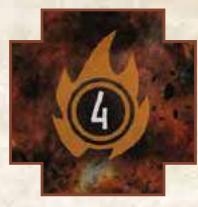
| 岩浆 Lava | 否 | 无 | 进入立即受 1 伤;控制者须将其移至相邻非岩浆区;移动动作立即结束 |
| 极地 Polar | 是 | 无 | 激活开始时若在此区,立即受 1 伤;本回合只能执行 1 次简单或 1 次复合动作,且不能使用主动/攻击性能力 |
| 笼 Cage | 是 | 无 | 区内单位对 Range 1+ 攻击 +1 defence |
8. 单位系统
8.1 单位类型
5 种单位类型:Gods(神)、Titans(泰坦)、Heroes(英雄)、Monsters(怪物)、Troops(部队)。
- Gods + Titans 统称 Divinities(神灵)
单位归属:同玩家控制或同队 = 盟友;对手控制 = 敌方。单位视自身为盟友。
8.2 属性(Stats)
| 属性 | 含义 |
|---|---|
| Offence(攻击) | 第一次突击掷骰数 |
| Defence(防御) | 被击伤的门槛值 |
| Range(射程) | 可攻击的最大区域距离;Range 0 = 自身区域 |
| Movement(移动力) | Walk 时移动的区域数 |
| Available Power | 能力攻击骰数(数字)或能力可用性(符号);"—"表示不可用 |
| Vitality(生命) | 剩余生命值;不能超过最大值 |
属性修正限制:offence/defence/range/movement 不能降至 0 以下,也不能升至 10 以上。
8.3 仪表盘(Dashboard)
用于 Gods/Titans/Heroes/Monsters。颜色编码:蓝色 = Titans,绿色 = Monsters,黄色 = Gods,灰色 = Heroes。
仪表盘包含:
- 属性滑块(Stat Slide):插入仪表盘槽中,通过中央窗口显示当前属性。游戏开始时在最顶行
- 属性表(Stats Table):每行对应 1 点生命值,受伤后属性变化
- 激活卡数量(Activation Card):图标数 = 该单位可用激活卡数
- 战略价值(Strategic Value):图标数 = 可获得的 AoW 卡数
- 招募点数(Recruitment Points, RP):招募该单位的费用
- 单位名称、天赋(Talents)、能力(Powers)、类别(Class)
8.4 部队单位(Troop Units)
- 通常费用 1 RP
- 由 1 或多个微缩模型代表,同一部队所有微缩模型必须在同一区域
- 微缩模型数 = 生命值数;全部上场 = 完整部队
- 被摧毁的部队可通过 Troop Recall 返回
- 部队卡包含:微缩模型数量、激活卡数量、名称、类别、属性(无 vitality,以微缩模型数替代)、天赋、能力描述
- 仅剩 1 个微缩模型时,天赋失效
9. 类别(Class)
所有单位有一个类别,以图标显示在面板或兵牌上;无图标视为陆生(Terrestrial)。
| 类别 | 效果 |
|---|---|
| 陆生 Terrestrial | 无 |
| 水生 Aquatic | 步行或跑步时若起点和途经区均为水生地形,移动力 +1;忽略所有水生地形效果 |
| 耐火 Fireproof | 忽略所有岩浆地形效果 |
| 寒带 Boreal | 忽略所有极地地形效果 |
| 巨型 Huge | 不能进入容量低于 3 的区域 |
| 飞行 Flying | 可部署在部署区的悬崖或岩石区上;激活时获得 2 个额外复合动作 |
飞行单位额外动作:
- 快速飞行(Fast Flight):可进入 移动力 +1 个区域,忽略所有地形效果;可进入悬崖和岩石区、穿越城墙和断崖边界;不能进入满区;不被敌方单位阻挡(但仍须遵守其他边界效果);不能丢弃神石
- 空中攻击(Aerial Attack):遵循普通攻击流程,额外:忽略所在区域地形效果、射程 +1、判定可见性时忽略障碍物;所在区域始终视为满区;忽略可移动巨型单位的天赋和能力
10. 天赋(Talents)
使用天赋为可选。同一名称天赋不能对同一单位重复生效。部队单位只剩 1 个微缩模型时,其天赋不可再用。
| 天赋 | 效果 |
|---|---|
| 弓箭手 Archer | 远程普通攻击计算有效攻击力时 +1 |
| 阻拦 Block | 同区敌方单位不能执行步行或跑步;同区敌方单位不能拾取神石;拥有此天赋的单位忽略上述效果 |
| 鼓舞 Bolster | 普通或范围攻击计算攻防值时,同区友方部队单位 +1 attack +1 defence |
| 攀爬 Climb | 可步行进入岩石或悬崖区;可穿越断崖边界;忽略锁链边界效果 |
| 近战 Close Combat | Range 0 普通攻击计算有效攻击力时 +1(至当前激活结束) |
| 近身保护 Close Protection | 普通或范围攻击计算有效防御值时,若有友方单位在同区,+1 defence |
| 自然之力 Force of Nature | 选择普通或范围攻击目标前,若所在区有至少 1 个 3D 元素,可移除 1 个 3D 元素获得 +1 attack +1 range(至当前激活结束) |
| 宝石收集者 Gem Collector | 激活期间,可从周围任何可见区域执行 Claim 动作 |
| 守卫 Guard | 敌方选择普通或范围攻击目标后,若同区有友方被攻击,可将目标转为自身;不能用于反击或地形效果 |
| 先手 Initiative | 被选为 Range 0 普通攻击目标后,可在原始攻击结算前先反击;若反击后攻击者不在射程内则行动结束,否则攻击者继续攻击且目标不能再次反击;若双方均有此天赋则效果忽略 |
| 领袖 Leader | 激活阶段结束时,可从牌库中搜索 1 张可见友方部队的激活牌展示后加入手牌;若该部队属于己方另一玩家,从其牌库取牌;随后可弃 1 张激活牌立即激活该部队(计入回合最大激活数,不需要弃 AoW 卡);若被激活单位不归主动玩家所有,拥有领袖天赋的玩家获得该单位控制权至本回合结束 |
| 强力投掷 Mighty Throw | 第一次攻击骰结果出来后、丢弃空白骰前,可将目标投掷 1 个区(该区不能满、地形须允许目标进入、只能穿越允许移动的边界);目标掉落所有已拾取神石;投掷所需空白骰数:部队/英雄 1、怪物/神灵 2、泰坦 3;投掷后攻击正常结算(即使目标超出射程) |
| 机动 Mobility | 攻击后仍可步行 |
| 屠怪者 Monster Slayer | 第一次攻击骰结果出来后、丢弃空白骰前,若目标为怪物,可重掷最多 2 颗骰;攻击正常结算 |
| 方阵 Phalanx | 普通或范围攻击计算攻防值时,若有友方部队在同区,+1 attack +1 defence |
| 偷袭 Sneak Attack | Range 0 普通攻击计算有效攻击力时,若有友方在同区,+1 attack(至当前激活结束) |
| 折磨 Torment | Range 0 普通攻击计算有效防御值时,目标 -1 defence(至攻击结束) |
11. 能力(Powers)
11.1 能力类型
| 类型 | 可用条件 | 限制 |
|---|---|---|
| 永久 Permanent | 满足使用条件即可,即使在执行复杂动作或不在面板上时也可使用 | — |
| 被动 Passive | 满足使用条件即可,但执行复杂动作时或不在面板上时不可用 | — |
| 主动 Active | 每回合激活期间只能使用 1 次 | 执行复杂动作时不可用 |
| 攻击 Offensive | 激活期间可用 | 执行复杂动作时不可用;替代 1 次简单攻击动作(计入 2 次简单动作限制);若描述无特别说明则遵循普通攻击流程 |
11.2 使用规则
- 能力只有在可用时才能使用:图标(或同色底色上的数字)出现在面板滑块窗口中
- 需要支付 AoW 卡牌作为费用;若无标注则免费
- 当能力描述中出现带黑白底色的数值 X 时,表示该属性的有效值由滑块窗口决定,且不可修改
- 被效果触发的能力必须结算
11.3 能力标记(Power Tokens)
- 初始设置时按面板指示领取标记,组成储备池
- 标记被移除游戏时放回储备池(除非另有说明)
- 标记在场时持续生效,无论对应能力类型如何,即使创造标记的单位被消灭
- 部分标记有防御和生命值,可作为单位被攻击(但攻击者的天赋被忽略);生命值归零时移除游戏
常见问题(FAQ)
以下 1 条问答中 0 条来自站内玩家的真实提问,其余 1 条为本站整理的常见疑问;答复内容保持原样。
神话之战:万神殿支持几个人玩?
2–4 人。
去哪查完整规则
想核对具体规则细节、卡牌效果或某个回合的结算方式,可以在村了吗里选中这款游戏后直接提问。
同类桌游
规则原文(Markdown)
本站收录这款游戏的规则原文 1 个文件,此处内联渲染 1 个,可直接展开阅读或下载。
b3-mythic-battles-pantheon-rulebook.md96.6 KB
222222222222222222222222222222222222222222

15555555555955559555555555555555555555555555555
A·TROOP POWERS. .27
B· DASHBOARD POWERS .27
<· USING POWERS 28
• POWER TOKENS. .28
SUMMARY
A NEW DESTINY
INTRODUCTION
GAME TERMS
RULES HIERARCHY
WINNING THE GAME
OVERVIEW
A·GAME BOARDS.
B·UNITS
I• THE HERO, MONSTER, GOD AND TITAN UNITS
2•TROOP UNITS
· OTHER GAME COMPONENTS..
GAME SETUP
A·SKIRMISH ...
B·ADVENTURE
<·RECRUITING AN ARMY..
•TABLE SETUP
• TEAM PLAY ...
PLAYING THE GAME 3
A•TURN SEQUENCE .
B·TROOP RECALL. 3
·ACTIVATION LIMI.... 13
D·DECK 13
ACTIONS 14
A· SIMPLE ACTIONS....
I· WALK.
2·ATTACK..
a• Normal attack.... Z
b• Area attack....
CLAIM
B· COMPLEX ACTIONS ...
I· RUN
2• DEPLOY.. 19
3. ABsORB. 10
DIVINE STONE 19
ART OF WAR CARDS 20
XI MANOEUVRES 20
A·DRAW CARDS 20
B• SEARCH FOR A CARD. 20
·EVADE 20

XII BATTLEFIELD
A NEW DESTINY
The Persian Wars were over, the Greeks victorious. None could doubt their courage or strength. The Athenian fleet had brought peace to the seas, and Sparta basked in the glory earned by the valiant sacrifice of Leonidas and his three hundred warriors at Thermopylae.
The gods of Olympus looked down and were satisfied with their work. While the mortals imagined that this victory was their making, the gods knew the truth. They were the ones who had restored order in a world dominated by chaos. Their glory had inspired the heroes who had chased the monsters and made Greece a safer place. They gave their patronage and gifts to the mortal cities that now prospered in their name.
From atop his golden throne, thunderbolt in hand, Zeus allowed himself a moment to rest. The Titans and the Giants were locked up in Tartarus; the monsters and wild tribes defeated or exiled. Only the prosperous and peaceful humanity remained in this Greece he had built. All was well. At least, so he thought...
But beneath the calm surface of the Olympian court bubbled a wrathful fury of monumental proportions, and it was about to erupt. Zeus was calm, but his wife, Hera, was furious beyond words. Yet again, Zeus had been unfaithful. Yet again, a mortal woman had borne him a son: Ambrosios, the Last-born. Yet again, Hera was shamed and humiliated in front of all the gods of Olympus. This time she was going to make him pay.
In truth, it was the Moirai doing. Hera was angry, of course, but it was the Moirai that stoked the flame of this anger in the apoplectic fury she found herself in, whispering in her ear, poisoning her thoughts and influencing her to take the most foolhardy of actions.
And so Hera veiled her face and slípped away from Olympus. She crossed the mortal realms to reach the unfathomable depths of the Underworld, to the gates of the ancient prison of Tartarus. There, at the foot of the iron gates, Hera managed to bend Campe's will. And so, in Hera's mad gesture of defiance and spite, the heavy iron doors were opened wide, and the Titans whom Zeus had imprisoned were released once more!
Intoxicated with centuries of brooding their dark revenge, the mighty primordial divinities wrought havoc across Greece. A second war between gods and titans - a second Titanomachy - had begun!
The vast battles of this divine war caused carnage on a scale never before seen by mortals. Entire cities were razed, lands flooded, or crushed by tumbling mountains, and millions died. And still they fought on. In danger of losing everything, Zeus summoned all the Olympian gods to his side, and in a final cataclysmic battle, they fought to save Olympus itself against Cronos and hís army.
The final clash was apocalyptic. Gods and Titans fought on the slopes of Olympus. In a fínal moment of destruction, a phenomenal force was unleashed which shook the world. An explosion so devastating that many gods perished. Much later, man named this event "the Cataclysm".
Of the mortals, fewer than one in ten survived the shock wave of the Cataclysm. Gods and Titans alike were stunned or killed, and the survivors lay in an everlasting stupor, for almost a century. During this time lapse, the Last-born fought to help the remaining of mankind rebuild itself, before vanishing. When the gods awoke, it was to a different world. Olympus was gone, scattered in a billion pieces. And among the scattered debris, a new stone, the omphalos, had been formed from the crystallized energy of the dead gods.
The gods were not the only dazed survivors that stared with wonderment at this ruined land. When Zeus had called for help, Hades had left his guardianship of the Underworld to fight alongside him. In the ensuing cataclysm, it was not only the Titans who escaped. The world was turned upside down, and no one stood guard at the gates of the Underworld. The monsters slain by legendary heroes had escaped too, and now sowed terror in the ruins of Greece.
But all is not lost. The monsters were not the only ones to have escaped from the darkness. The heroes who slew them were also back in the land of the living. The legendary names of Heracles and Achilles ring out once more.
A new era had started: the Age of Hope. The surviving gods are the natural leaders of this melting pot of monsters and heroes. They alone can control the wanton urges of these creatures, as well as the egos of the legends. And even if they are weak compared to their former selves, the gods remain hugely powerful.
The gods quickly realized that the key to their salvation was in absorbing the scattered omphalos, and regaining the divine power that was rightfully theirs. With this renewed immortality, they could create a new pantheon of gods, formed in their own image. And so they set out, accompanied by bands of followers, to search across the abandoned expanses of Greece for the rare and priceless omphalos, and a chance to build a new world...
I· INTRODUCTION
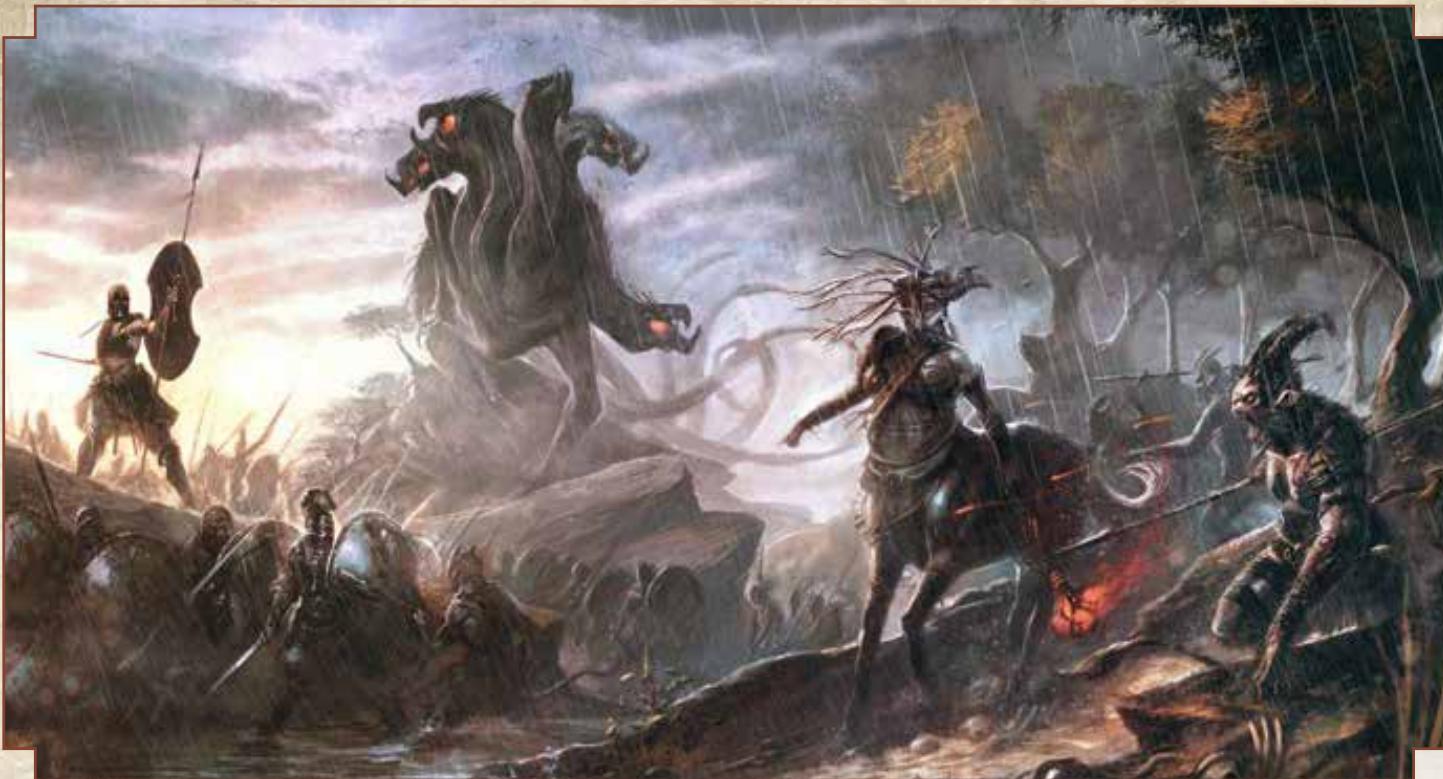
The Second Titanomachy is over; you are on the threshold of a new era: The Age of Hope. Greece is now a post-apocalyptic land in which the Gods have fallen, where heroes and long-dead monsters have been released from Hell. In all this chaos, who will be your champion in the struggle to forge a new world from the ashes of the old?
In MYTHIC BATTLES: PANTHEON - You muster your army, led by your divinity, and enter battle to regain the divine shards of power - A player's army consists of all the units under their control.
II· GAME TERMS
There are many game terms in MYTHIC BATTLES: PANTHEON,some of which are also words in common use. For the full list, see the index on page 38.
To avoid confusion, the following conventions are used: stats are written in italics, for example: offence or range;
Powers and talents are capitalized, for example: Soul Culling, Leader, or Bolster.
III・RULES HIERARCHY
Some rules are designed to overwrite others, such as when a power bends or breaks the rules described in this rulebook.
During a game, when two rules contradict each other, the rule with the higher priority takes precedence.
From highest priority to lowest, the order is:
1SCENARIO RULES
2 POWERS
3 TALENTS
4 CLASS
5GAME RULES
IMPORTANT: some of therules dealing with the resolution of effects override this hierarchy and take precedence over all other rules and/or effects. These rules are preceded by this icon:

1GNORED EFFECTS
When an effect is ignored, it is not applied and, in terms of the priority hierarchy, has no effect.

SIMULTANEOUS EFFECTS
If two or more effects happen at the same tíme, the active player decides the effect resolution order. The selected effect must be fully resolved BEFORE the next effect begins.

TRIGGERED EFFECTS
A triggered effect is always fully resolved before any other effect is resolved. An effect is not cancelled if its trigger conditions are no longer fulfilled during its resolution.
Example, an effect that moves a terrestrial unit into an aquatic area is completely resolved even if the effect cannot be triggered in thistype of area.
IV·WINNING THE GAME
MYTHIC BATTLES: PANTHEON can be played ín two ways: skirmish mode or adventure mode.
In skirmish mode, there are two ways to win, irrespective of the number of players. The game ends immediately if:

IN A PLAYER VS PLAYER GAME
When only one divinity remaíns alíve.
When a divinity absorbs a total of four divine stones.
IN A TEAM VS TEAM GAME

When one divinity of a side is destroyed.
When a dívinity or dívinities of a side absorb four divine stones.
The player or team that still owns at least one divinity OR a divinity, or divinities, who has absorbed a total of four divine stones wins the game.
In adventure mode, players select a scenario. Each scenario states its own victory conditions. These conditions are not always the same for each player.
V·OVERVIEW
MYTHIC BATTLES: PANTHEON uses different types of game components such as boards, miniatures, dashboards, and cards.
A·GAME BOARDS
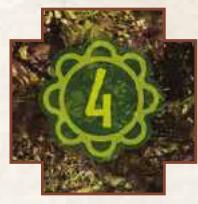
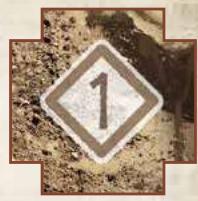
The game boards define the battlefield where the game is played. They are divided into areas, which are delímited by boundaries. In the center of each area is an icon. These icons are used to determine líne of sight. The icon shape denotes the area's terrain type. It also contains a number that indicates the area's capacity.
When the number of units (not miniatures) in the area equals its capacity, the area is full, meaning it cannot contain any addítional units.

OPEN GROUND
FOREST
RUINS
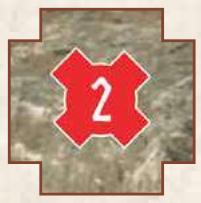
Rock


CLIFF
R1FT

SWAMP

STAIRS
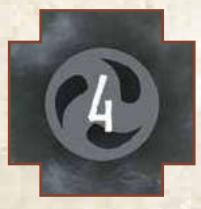
WATER
LAVA

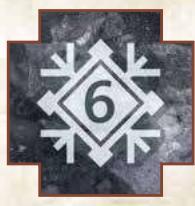
CAGE
POLAR
Two areas are considered adjacent if they share a common boundary.
A units "surroundings" are the area in which the unit is located and all areas adjacent to that area.

EFFECTS IN SURROUNDING AREAS
An effect that affects the surrounding area of a unit must target an area that is visible to the unit responsible for generating the effect.
B·UNITS
Each players army is comprised of units.
UNIT ALLEGIANCE: A unit is allied to another if they are both controlled by the same player OR if the two players that control them are on the same side. A unit considers itself as an ally. A unit controlled by an opponent is an enemy unit.
These units are represented by miniatures on the board, and represented by dashboards or troop cards off the board.
There are 5 different types of units: gods and titans (dívinities), heroes, monsters and troops.
DASHBOARDS

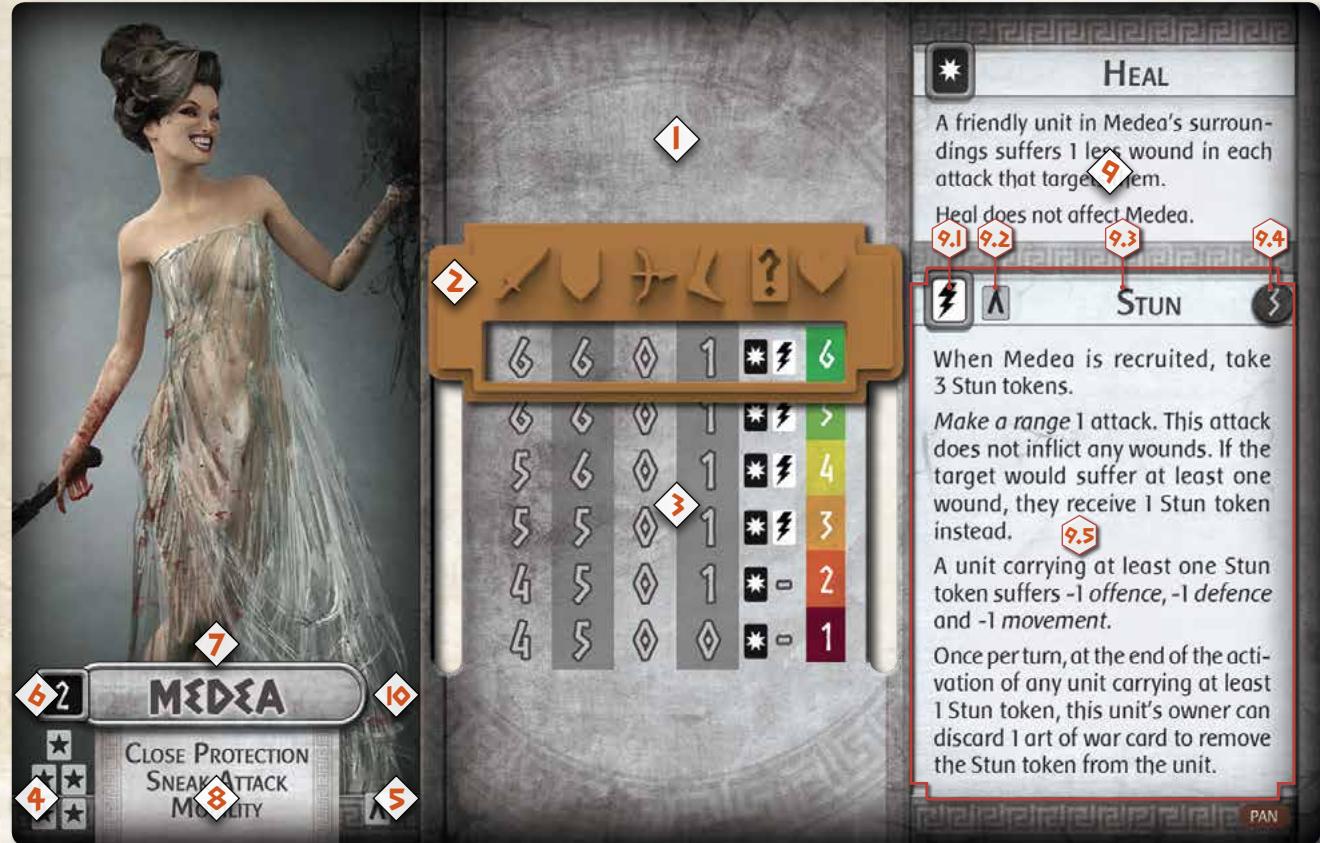
TYPE OF UNIT: Blue: Titans Green: Monsters

Yellow: Gods Gray: Heroes
STAT SLIDE:
this slide sits in the slots cut into the dashboard. The unit's current stats are visible through the stat slide's central window. The symbols for the different stats are embossed on the stat slide and are defined below. A unit starts the game with its slide on the topmost row.

STATS TABLE:
each row of the table corresponds to a vítalíty point of the unit. As a unit is wounded, the stats change.

ACTIVATION CARD:
the number of activation cards available to the unit. Each icon represents one activation card.

STRATEGIC VALUE:
THE HERO, MONSTER, GOD AND TITAN UNITS
each icon represents one art of war card (AoW card).
Each of these units is represented by 1 unique miniature on the board and represented by a dashboard which lists and tracks their various game values:

RECRUITMENT POINTS: the unit's cost in recruitment points (RP).

UNIT'S NAME.

TALENTS.

POWERS:
the unit's powers can be found on the right side of the dashboard. Each power is described in a box as follows:

Type of power


Cost

Number of tokens associated with the power (if required)
Name
Meo s,ard

A detailed description

CLASS:
a unit can be aquatic, fireproof, flying, boreal, huge or terrestrial. If none of these icons is present, then it is a terrestrial unit.


AQUATIC

FIREPROOF

FLYING
BOREAL
HUGE
STATS

OFFENCE: the number of dice the unit rolls for its first assault in an attack.

DEFENCE: a value that denotes how difficult it is to wound the unit.

RANGE: the maximum distance in number of areas at which the unit may make an attack. Range 0 is the area the unit occupies.

MOVEMENT: the number of areas the unit travels when they walk.

AVAILABLE POWER: the number of dice used for offensive power attacks (number) or the availability of a power (symbol). If this entry is a dash, then that power can no longer be used.

VITALITY: number of remaining vítalíty points.

A units' vítalíty cannot be increased beyond the maximum value indicated on its dashboard or troop card.

Modifiers (powers, talents, terrain, etc.) can neither decrease the values of offence, defence, range and movement below 0, nor increase them above 10.
2•TROOP UNITS
Unless stated otherwise, a troop unit always costs 1 RP to recruit.
A troop unit is represented by one or several miniatures on the board. All the miniatures in play from the same troop unit must always be in the same area.
These miniatures also represent the vitality points of the unit. A complete unit is a troop unit with all its miniatures on the board.
A destroyed troop unit can return to the game usíng troop recall (see page 13).
This type of unit is represented by a troop card which lists and tracks their various game values:
TROOP CARDS

Spartan Troop Card

NUMBER OF MINIATURES:
each symbol represents one miniature in the troop and also corresponds to its number of vitalíty points.

ACTIVATION CARDS:
the number of activation cards available to the unit. Each icon represents one activation card.

NAME.

CLASS.

STATS:
a troop card displays the same stats as other types of units (offence, defence, range and movement). However, the vítalíty stat is not indicated, AS this is represented by the number of this unit's miniatures on the board.

TALENTS:
if a troop unit is no longer complete and there is only one miniature left of the troop, that troop's talents can no longer be used.

POWER DESCRIPTION.
·OTHER GAME COMPONENTS
In addition to the boards, miniatures, dashboards and troop cards, there are also a number of other game components that players will use.

ACTIVATION CARDS
Each unit has their own set of identical activation cards. An activation card only lists the unit's name, the associated artwork and the number of activation cards it has. These cards allow units to
be actívated during the game.

ART OF WAR (AOW) CARDS
These cards are all identical. They allow the players to pay for additional activations, manoeuvres, powers, etc.
OMPHALOS

Omphalos are the divine stones in Greek mythology. They are represented by plastic gems which represent the crystalized divine energy needed by the divinities to recover their lost power. They are placed on the board as indicated by the scenario map.
VI· GAME SETUP
Every game of MYTHIC BATTLES: PANTHEON is set up according to the game mode selected by the players: skirmish or adventure.
A·SKIRM1SH
If players decide to play in skirmish mode, follow the steps below:
RECRUITMENT TYPE CHOICE
Players jointly decide which game recruitment type to use: draft or constructed. The remainder of the game setup step varies depending on this choice. NOTE:The constructed recruitment type can only be used for 2-player, or 4-player team games.
Whatever the recruitment type, move on to step 2.
• BOARD CHOICE.
2.a DRAFT:players agree on the board to be used during the game. Move on to step 3.a.
2.b CONSTRUCTED: each player selects a board. Which board will be used during gameplay is determined during one of the following steps. Move on to 4.b.
3• DECIDING THE LEAD PLAYER
3.a DRAFT:each player rolls a die. Whoever gets the highest score is the lead player. The next player in a clockwise direction selects the side of the board on which they will deploy. Move on to step 4.a.
3.b CONSTRUCTED:each player rolls a die. Whoever gets the highest score is the lead player and chooses which board they will play on from the two boards previously selected. The following player in a clockwise direction decides which side of the board they will deploy on. Move on to step 5.
4•RECRUITMENT
4.a DRAFT:each player recruits all the units they will control during the game. These constitute their army. Refer to the description of the relevant recruitment type then move on to step 5.
4.b CONSTRUCTED:each player recruits all the units they will control during the game. These constí- tute their army. Refer to the description of the relevant recruitment type then move on to step 3.b.
5• TABLE SETUP
Players jointly arrange all the game components as described in chapter D - Table setup (see page 12).
•STARTING THE GAME
The lead player starts the game, then the other player or players each play their turn clockwise around the table.
B·ADVENTURE
If players decide to play in adventure mode, follow the steps below:
1 SCENARIO CHOICE
Playersselectascenariotogether,ensuringthescenariorecommended number of players is taken into account.
2·RECRUITMENT
Each scenario dictates the type of recruitment process touse: draft or límited.
DRAFT: Recruitment poínts (RP) value is player number dependant and is scenario-dictated. Selection and counter selection occurs.
LIMITED: Each player's army is scenario-dictated.
3• TABLE SETUP
Players jointly arrange all the game components as described in chapter D - Table setup (see page 12).
4•STARTING THE GAME
The lead player starts the game then the other player or players each play their turn clockwise around the table.
·RECRUITING AN ARMY
I• DRAFT
Draft allows units to be recruited from all players' available units, or from a previously agreed upon selection of units.
In skirmish mode, the number of players determines the number of RP available to each player to spend on their army:
2 players18 RP
3 players 16 RP
4 players 14 RP
In adventure mode, the scenario dictates the number of recruitment points (RP) available for each player to spend on their army, and the lead player and any unit selection restrictions.
To recruit your army, follow these steps:
Lay out the dashboards and the troop cards of ALL available units on the table.
Players jointly decide on the type of divinity they wish to play: god or titan. Then, starting with the lead player and moving clockwise around the table, players take turns selecting a divinity of that type for their army.
3 Starting with the last player to choose their divinity, and moving counter-clockwise around the table, players take turns in selecting, one by one, the remainder of their army until all their RP are spent.
The following restrictions apply to each player:
when a player recruits a unit, the RP cost must be paid immediately,
an army may never include more than one divinity (god or titan),
an army may not include more than one unit, in addition to their divinity, whose cost is more than or equal to 5 RP,
an army or the same side in a team game may NOT include the SAME unit twice (Example: Achilles and Veteran Achilles or Heracles and Veteran Heracles, are both considered to be the same unit).
If a player cannot afford any of the remaíning units, then any remaining RP are converted into AoW cards: take one AoW card for each unspent RP from the AoW card deck. These will form part of the player's starting hand. If a player has 0 RP remaining, the other players continue selecting units in the same order, skipping the player whose recruitment has ended.
2•CONSTRUCTED
Constructed allows the recruitment of units from all players' available units. The number of players determines the number of RP available for each player to spend on their army:
2 players18 RP
3 players16 RP
4 players 14 RP
Players must jointly decide on the type of divinity they wish to play: god or titan.
To form their armies, each player recruits their units from all those in their possession. The following restrictíons apply to each player:
when a player recruits a unit, the RP cost must be paid,
an army may never include more than one dívinity (god or titan),
an army may not include more than one unit, in addition to their divinity, whose cost is more than or equal to 5 RP,
the RP total of all the recruited units must be exactly equal to the number of RP available at the beginning of recruitment,
◆ an army or the same side in a team game may NOT include the SAME unit twice (Example: Achilles and Veteran Achilles or Heracles and Veteran Heracles, are both considered to be the same unit).
3. LIMITED
The scenario dictates all the units that are available to be recruited by the players.

·TABLE SETUP
During setup, regardless of game mode, the table is set up using the following steps:
Place the selected board in the center of the table. Add any 3D terrain elements, divine stones, tokens, and miniatures indicated on the scenario map. If the exact location of the 3D terrain elements is not scenario-dictated, they are placed according to the description of the corresponding terrain type (see page 21).
2 Place the dice, the AoW card deck and the omphalos card deck next to the board.
3 Each player places the miniatures, the dashboards, the troop cards and the tokens of their units in front of them.
Starting with the lead player then, moving clockwise around the table, each player in turn places a troop unit on one of the deployment areas. Continue until all the players have placed all their troop units on the board.
5Each player builds their deck from:
all the activation cards for every unit in their army and,
a number of AoW cards equal to the total of all the strategic values of their units.
6Each player forms their hand with:
3 additional AoW cards,
the first 3 cards from their deck,
any AoW cards gained during the recruitment of their army if they were no longer able to recruit.
·TEAM PLAY
For four-player skirmish games, we advise you to play as two teams of two players instead of a freefor-all. Players on the same team constitute a side. All units on the same side are considered allies. The game play is identical to a player against player game with one exception.
In addition to sharing your victory with your teammate, the only rule change is about how the players are seated around the table and the impact this has on turn order.
As players in the same team deploy their miniatures on the same side of the board, it is easier for them to sit side by side. If this is the case, the round needs to be played in a “Z” as shown in the diagram below.
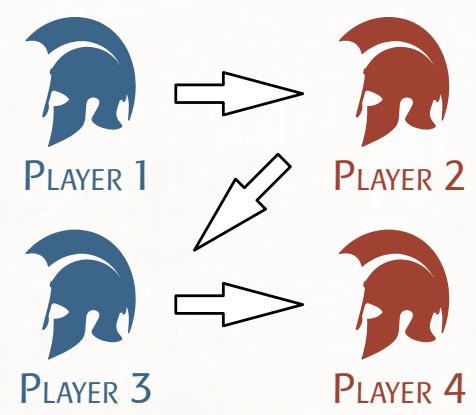
This order works both for turns in the recruitment of armies, and in the game itself. If the rules say clockwise, play the “Z" as shown above; if it is counter-clockwise, follow the diagram below starting with player 4.

Each player has 14 RP available for their army and the setup instructions used are the same as for a twoplayer game.
VII· PLAYING THE GAME
Mythic Battles is played in a series of rounds. During each round, each player takes a turn. The round starts with the lead player's turn, andcontinues clockwise around the table.
A·TURN SEQUENCE
Each turn consists of the following phases as described below. The player, whose turn it currently is, is knownas the active player and they must complete each step in order to be able to activate their units.
1 START OF TURN PHASE
La: Effects of powers that were triggered during the previous turn of the active player that only last for one round, end now.
1.b: The active player draws 1 card from their deck.
.c: If they pass their turn, they can draw another card and then go directly to the end of turn phase (4).
2◆ ACTIVATE A UNIT PHASE
2.a: The active player discards 1 activation card of the unit they wish to activate. They then declare if their unit will carry out simple actions or one complex action.
2.b: Any powers that have been triggered at the start of the unit's activation are resolved.
2.c: The unit is actívated and can carry out:
0, 1 or 2 simple actions
0 or 1 complex action
2.d:Any powers that are triggered at the end of the unit's activation are resolved.
3 ◆ ACTIVATE ANOTHER UNIT PHASE
3.a:If the active player has activated a number of uníts equal to their activation límit or if they no longer wish to activate another unit, they go directly to the end of turn phase (4).
3.b:If the active player chooses to activate another unit, they discard 1 AoW card and go back to the activate a unit phase (2).
4 ◆ END OF TURN PHASE
4.a:The active player decides whether or not to discard 1 AoW card to perform a troop recall.
4.b:The next player in a clockwise direction becomes the new active player. Their turn starts at the start of turn phase (1).
B·TROOP RECALL
When a player recalls a troop, they choose a troop unit (either in play or destroyed) that they control. All the miniatures of the unit (in play or not) are moved to the same area as their divinity. If the unit is carrying a divine stone, it is dropped in the original area the unit occupied. In addition, any tokens placed on the unit are removed from the game and their effects are cancelled.
·ACTIVATION LIMIT
A player may activate a maximum of 2 different units from their own army in each of their turns.
A unit cannot actívate more than once a turn.
D·DECK
DISCARD: players discard their cards face up in a pile to form their discard pile. This pile may be looked at by any player at any tíme duríng gameplay.
DECK RUN OUT: The game pauses when a player can no longer draw a card because their deck has run out.
All players refresh their decks, using the following steps:
Each player adds their entire remaining deck to their hand.
2 Each player shuffles their díscard pile to form a new deck.
3 If necessary, each player draws a card (or cards) in order to have a hand of 3 cards.
4 Play resumes from the point where it was paused.
5 The player that triggered the pause draws any cards they were previously unable to.
VIII·ACTIONS
There are 6 actions to choose from, divided into two types: simple or complex.
A·SIMPLE ACTIONS
The símple actions are: walk, attack and claím.
If a unit carries out simple actions, the following restrictions must be taken into consideration:
the two actions must be different,
each action must be completed before the next is begun,
if a unít carries out an attack, they cannot walk away after the attack during the same activation.
I· WALK
During a walk action, a unit may enter the same number of areas as its movement stat. Each new area must be adjacent to the previous one.
A unit's walk ends as soon as it enters an area contaíning one or more enemy units.
A unit can only enter an area whose terrain type description allows it. In addition, the unit can only cross boundaries whose boundary type description allows it.

A unit cannot enter a full area.
Z·ATTACK
There are two types of attacks: the normal attack and the area attack.
The attacker is the unit declaring the attack and the defender is the unit that is the target of the attack.
When the attacker or the defender is referred to, it can either mean the unit, or the player controlling it.
a • NORMAL ATTACK
A unit carrying out this action resolves the steps of a normal attack sequence.
1 TARGET CHOICE;
2ATTACK RESOLUTION;
3RETALIATION.
1 TARGET CHOICE
The attacker can only target enemy units that fulfill at least one of the following conditions:
the unit is both visible and at a distance that is less than or equal to the attacker's range. A unit can always target an enemy unit in the same area (range 0).
the unit is in an adjacent area that is full. In this case, the attacker can decide to attack as if they were in the target's own area (range 0).
VISIBLE UNIT AND OBSTACLE
There are different kínds of obstacles; these are an area if it contaíns at least one unit,
an area or a boundary that specifies in its description that it constitutes an obstacle,
To determine if a target is visible, the active player draws an imaginary líne between the center icon in the attacker's area and that of their target. If this line does not encounter an obstacle, ignoring its departure and destination area, the target is considered visible.
A target that occupies the same area as the attacker is always considered visible.
DISTANCE AND RANGE
A target is in range if the attacker's range stat is equal to, or greater than, the shortest distance to it. To calculate this distance, a player must count the minimum number of areas necessary to go from one area to the other without takíng into account the boundary and terrain types. The attacker's area is not taken into account in thís calculation.
Where reference is made to range X (X being a number), it refers to a distance less than or equal to X.
Where reference is made to range X+, it refers to a dístance more than or equal to X.


ATALANTA (range stat 2) can attack HERACLES or the SPARTAN, both units are within her range and there are no obstacles blocking her line of sight.

She cannot attack the CENTAUR. The Centaur is within her range, but the rock area is considered an obstacle that blocks her líne of sight

She cannot attack ACHILLES. He is within her range, but the area occupied by the SPARTAN unit blocks her líne of sight.
2 ATTACK RESOLUTION
To resolve an attack, carry out the following steps in order.
2.a EFFECTIVE VALUE CALCULATION
2.b FIRST ASSAULT
2.cSECOND ASSAULT
2.dWOUNDS
2.a EFFECTIVE VALUE CALCULATION
The attacker and the defender each calculate their effective offence and defence values. These are the values of the unit's stats after any applicable modifiers have been taken into account. If, in a scenario or in a power, it refers to attacking with a certain number of dice,this corresponds to the effective offence of the attack.

She can attack any of the 3 UNITS located within a 2 area range, as long as there are no obstacles that block her line of sight.

HERACLES has a range stat of O, but he can attack any of the 3 units in the adjacent area (range 1), since the area is full. His attack against one of those units is considered a range 0 attack.

The modifiers (powers, talents, terrains, etc.) cannot reduce offence or defence below 0, or raise them above 10.
2.b FIRST ASSAULT
2.b.1:The attacker rolls a number of dice equal to their effective offence.
2.b.2:Any blank results are immediately removed. For each step, once a die has been removed, it is set aside and takes no further part in this attack.
2.b.3:Among the remaining dice, the attacker can discard as many dice as they want to get bonuses for the other dice. Each discarded die adds +1 to the result of another die. The new value of the remaining dice is equal to their result increased by the number of dice discarded to give them bonuses.
At each step, as soon as the value of a die equals or exceeds the effective defence of the target, the die is immediately placed on the attacker's dashboard or troop card to signify that they have inflicted a wound on the target (see 2.dWouNDs).
2.C SECOND ASSAULT
If, during the first assault, the attacker rolled one or several dice with a result of 5, no matter if it was a direct result or after modification,they can carry out a second assault. To do this, carry out the following steps in order. If not, go straight to step 2.dWouNDs.
2.c.1: The attacker rolls as many dice as they wish from those of the first assault with a result equal to 5.
2.c.2:Any blank results are immediately removed.
Their previous result is thus lost.
2.c.3:The new results of the rolled dice are added to the 5 from the first assault.
2.c.4:Among the remaíning dice (includíng any dice not discarded during the first assault), the attacker can discard as many dice as they want to get bonuses for the other dice. Each discarded die adds +1 to the result of another die. The new value of the remaining dice is equal to their result increased by the number of dice discarded to give them bonuses.
2.d WOUNDS
Each die result equaling or exceeding the effective defence of the defender unit inflicts a wound. For each die on the attacker's dashboard or troop card, the defender loses a vítalíty point:
If the defender is a dívínity, a hero or a monster, the player moves the dashboard's stat slide down a number of lines equal to the number of vítalíty points lost, in order to reveal the unit's new stats.
If the defender is a troop unít, the player removes as many of the unit's miniatures as lost vítalíty points and places them on their troop card.
DESTROYED UNIT
A unit is destroyed when its vítalíty reaches 0:
dívínities, heroes or monsters: this means when the player can no longer push the slide down on the dashboard. The miniature is then removed from the board and placed with its dashboard back in the box. These units cannot return to the game.
troops: this means when the player has removed the last miniature of the troop from the board.
A destroyed unit drops any elements it may be carrying (divine stones, etc.) in the area in which it was destroyed. If it had one or several power tokens attached to it, these are replaced in the appropriate reserve pool. A destroyed unit's activation and AoW cards remaín in play. In a 3 or 4 player game, when a divinity is destroyed, the player controlling it removes from the game every element controlled by that divinity.
3RETALIATION
If the defender is the target of a range 0 attack, they can retaliate against the unit who triggered the attack. The defender becomes the attacker and vice versa: the retaliator must discard 1 of their activation cards then resolve the attack as a normal attack (see 2AttACk RESOLUTION).
A unit cannot retaliate against a retalíation.
A unit cannot retaliate more than once per turn.
b • AREA ATTACK
An area attack is available to some units as their attack action. An area attack targets all units, allies and enemies, in the area except the unit making the attack. The target area must contain at least one enemy unit. The area itself is not attacked.
1AREA CHOICE:
the attacker chooses the area to be attacked. The area must be within range and visible to the attacker.
2 TARGET CHOICE:
the attacker chooses the target unit. Each unit can only be targeted once.
3 ATTACK RESOLUTION:
the attacker resolves the attack against this target in the same way as a normal attack (see page 14). If an allied unit is the target, the attack is resolved by the enemy player as if they owned the attacking unit. The enemy player cannot spend AoW cards but can otherwise freely decide which of the attacking unit's talents and powers to use in the attack.
If there is at least one unit that has not been targeted in the area, the attacker returns to step 2 of this sequence to target the new unit. If not, the attack is over.
IMPORTANT: the defender cannot retaliate during an area attack.
RESOLUTION OF AN ATTACK EXAMPLE
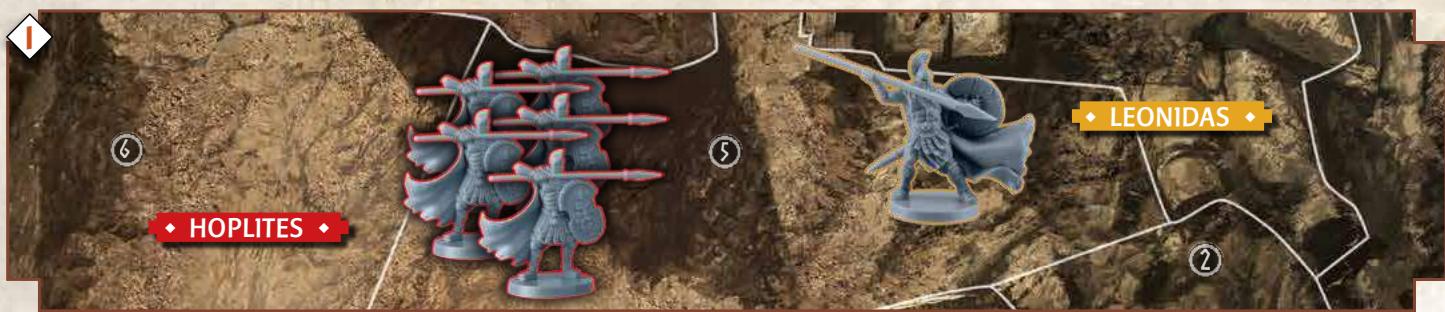
The HOPLITES carry out an attack. The player controlling them (the attacker) chooses LEON1DAS as their target. This is feasible because LEONIDAS is in the same area as the HOPLITES. The defender does not declare the use of any talents or class.
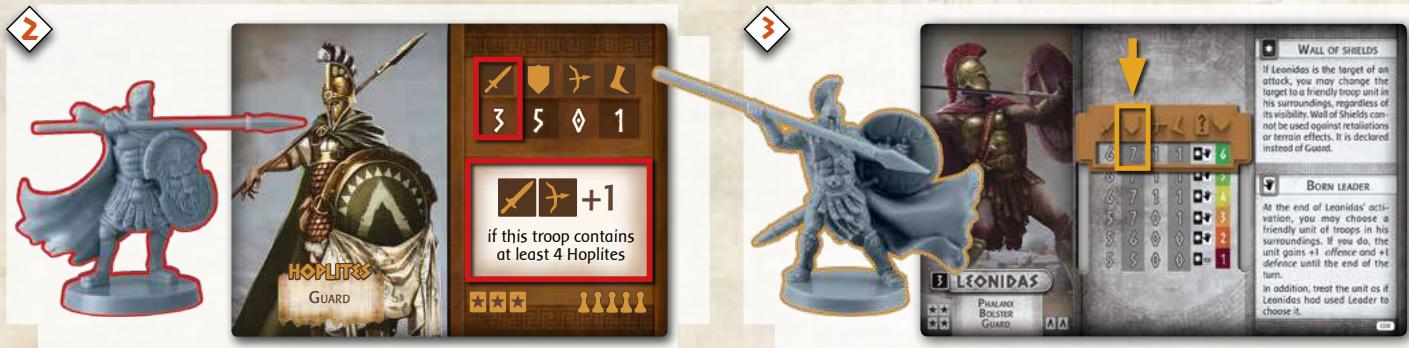
The attacker claims +1 to their offence using their The effective defence of LEONiDAS is 7. power. The effective offence of the HOPLITES is now 4.

The attacker carries out the first assault. For this they roll 4 dice. The results are: blank, 3, 4 and 5.
They immediately discard the die with the blank result. They then decide to discard the 3 in order to increase the die result of 4 by 1. lts new result is now 5.


The attacker carries out a second assault. They decide to reroll all the dice with a result of 5. The result on each die is 1. This increases each of their previous results by 1. Their new result is now 6.


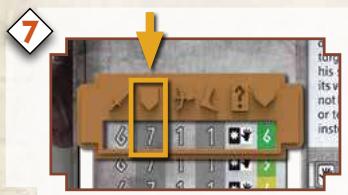
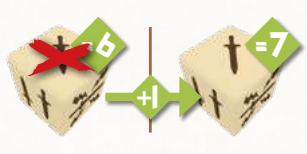
The effective defence of LEON1DAS is 7. To wound him, the attacker must have a result of at least 7 with a die. So they decide to discard one of their two dice to increase the result of the other one by 1 in order to generate a result of 7.
LEONIDAS has an effectíve offence of 6. The HOPLITES have an effective defence of 5.

The attacker compares the result of their die to the effective defence of LEONIDAS. This result is equal to LEONIDAS'effective defence value, so a wound is inflicted by the HOPLITES. LEONIDAS'vitality is reduced to 5. The defender immediately moves the slide down one slot to LEONIDAS' new vitality value.


The defender declares retalíation against the HOPLITES. This is feasible because LEONIDAS is in the same area as the HOPLITES. They discard a LEONIDAS activation card. There is no declaration of the use of talents or class.
LEONIDAS carries out the first assault of his retalíation.
He rolls 6 dice, the results are: 1, 2, 2, 3, 4 and 5.

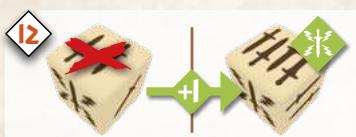


He decides to discard a die to increase the result of another die to 5 and he discards another two dice to increase the result of the other one to 5. He now has 3 dice, each with the result of 5.
He decides not to carry out a second assault and goes straight to applying wounds.
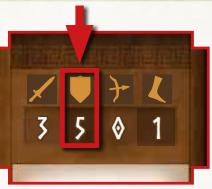

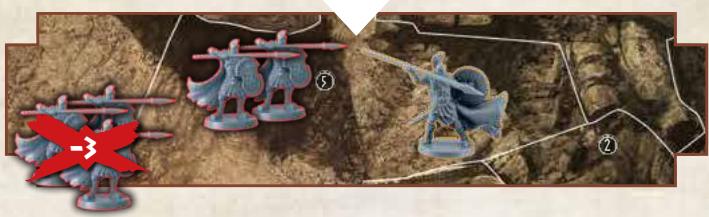
LEONIDAS compares the results of his dice to the effective defence of the HOPLITES. The results of his three dice are equal to the HOPLITES' effective defence value, so three wounds are inflicted by LEONIDAS. The vitality of the HOPLITES is reduced to 2. The defender immediately removes three HOPLITE miniatures from the board.
3. CLAIM
A unit can claím an available divine stone (on the board) in the same area if they are not already carrying one. When a unit performs this action, the controlling player places the newly claimed divine stone on the unit's base. A unit may carry divine stones multiple tímes during a game, as long as they are only carrying a síngle stone at a tíme.
While a unit is carrying a divine stone it can still perform actions as normal.
B·COMPLEX ACTIONS
The complex actions are: run, absorb and deploy.
A unit carrying out a complex action cannot use their talents or powers (active, passive or offensive) for the duration of the activation.
I· RUN
During a run action, a unit may enter the same number of areas as their movement stat +1. Each new area must be adjacent to the previous one.
A unit's run ends as soon as they enter an area containing one or more enemy units.
A unit can only enter an area whose terrain type description allows it. Moreover, the unit can only cross boundaries whose boundary type description allows it.

A unít cannot enter a full area.
Z·DEPLOY
This action can only be carried out by a unit entering the game for the first time. A unit already in play or one which has been destroyed can no longer deploy.
During a deploy action, a unit is placed in their army's deployment zone, as dictated by the scenario. This must be allowed by the terrain type of the area.
A troop unit starts the game on the board (see D TABLE SETUP page 12).

A unít cannot deploy ínto a full area.
3·ABSORB
Only divinities in the same area as an unclaimed divine stone, or one collected by an allied unit, can absorb it. When a divinity absorbs a divine stone, the divine stone token is taken from the board and placed on their dashboard.
In addítion, if thís dívine stone comes from the same mythology as the divinity, its effects are applied.
IX·DIVINE STONE
There are different divine stones associated with the different mythologies of the Mythic Battles universe. The divine stone of Greek mythology is the omphalos. That of Scandinavian mythology is the rune and the kheper for Egyptian mythology. A divine stone is either claímed or unclaímed.
CLAIMED DIVINE STONE:
A divine stone is claímed if it is carried by a unit on the base of one of their miniatures. A unit can only carry one claímed divine stone at a time.
UNCLAIMED DIVINE STONE:
A dívíne stone is unclaímed if it is on an area of the board and not on the base of a miniature.
DROPPING A DIVINE STONE:
a unit can drop a claímed divine stone in their area at any moment during their activation. Dropping a divine stone is not an action. Once dropped, it is then considered unclaimed.
Some game elements are treated in the same way as omphalosor divine stones. Whenever a rule or effect indicates that an element is considered to be the same as an omphalos or a divine stone, it follows all the rules and effects relevant to divine stones, but cannot be absorbed.
EFFECT OF AN OMPHALOS:
the effect of an omphalos allows the player controlling the Greek divinity who absorbs it to take an Omphalos card and add it to their hand.

An omphalos card can be used ín two ways:
During any part of their turn, a player can take an omphalos card from their hand and put it back in the box. In return, their divinity regains one vítalíty point. This does not reduce the number of omphalos on the divinity's dashboard.
An omphalos card can be discarded in the place of an AoW card.
X·ART OF WAR CARDS
Art of war cards are the currency with which a player can buy manoeuvres and other game effects.
When a player must discard an AoW card, the player can discard:


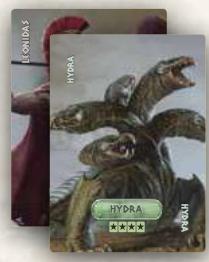
1 AoW card
1 OMPHALOS card
2 ACTIVATION cards from previously DESTROYED, non-troop units.
XI·MANOEUVRES
A player can carry out manoeuvres at any moment during a round (regardless of whose turn it currently is).
Each manoeuvre can only be bought once per round and per player.
A player must pay the cost in AoW cards to resolve the effects of a manoeuvre.
A·DRAW CARDS
COST:1 AoW card
EFFECT:the player immediately draws 2 cards from their deck.
B·SEARCH FOR A CARD
COST:1 AoW card
EFFECT:the player immediately searches through their deck and takes 1 card of their choice to add to their hand. They then shuffle their deck.
<·EVADE
COST: 1 AoW card
EFFECT:the player declares the use of evade with a flying non-troop unit that is the target of a range 0 attack. The attacker can choose a different target at a distance that is less than or equal to their range. If the attack is not redirected, the action is considered taken, but wasted.
XII・BATTLEFIELD
A·BOUNDARIES
The areas on the board are separated and delimited by game elements known as boundaries.
A boundary is represented by a líne or artwork, for example a wall, which defines its type. Each is only one type and only separates two areas. However, two areas can be separated by several different boundaries.
When moving between two areas separated by several boundaries, the least restrictive one is taken into account.

LEONIDAS wants to move to an adjacent area. He cannot cross the wall A, as movement is forbidden. The normal boundary Ballows him to move. He is therefore able to move to his destination area.
Different boundary types are presented as follows:

BOUNDARY TYPE
MOVEMENT: or X(indicates if this type of boundary allows the movement of units between the areas it separates).
EFFECT:description of the boundary effects.

CAGE WALLS
MOVEMENT: for troop units and heroes;
for other unit types.
EFFECT: none.

CHAINS
MOVEMENT:
EFFECT:units movíng through this boundary performing a walk or a run action must end this action.

ESCARPMENT
MOVEMENT:

EFFECT: none.

HEIGHTS
MOVEMENT:the Heights icon does not affect unit movement actions - the boundary type on which it is placed does.
EFFECT:the arrowhead points towards lower level areas. A unit standing behind the arrowhead, on the higher side, gains +1 offence and +1 range for attacks targeting a unit in any lower level area. In addition, obstacles are ignored when determining if a target in a lower area is visible or not.

NORMAL
MOVEMENT:

EFFECT: none.

WALL
MOVEMENT:

EFFECT:this boundary is an obstacle. A wall boundary is represented by a wall image surrounded by a contínuous red line. The image itself is not an area.
B·TERRAIN
Each area is a síngle terraín type, índicated by its area icon.
If, in the description of a type of terrain, it is indicated that the terrain uses 3D elements, like trees or ruined columns, the effects can only be applied if at least one 3D element remains in the area.
If all 3D elements are removed, the area becomes open ground.
Different terrain types are presented as follows:
TYPE OF TERRAIN

MOVEMENT: or X(indicates if this type of terrain allows the movement of units to this area).
OBSTACLE:yes or no (indicates if the area is an obstacle).
3D ELEMENTS:number and type (índícates if the terrain uses 3D elements).
EFFECT:description of the terrain effects

CAGE
OBSTACLE: yes
3D ELEMENTS: none
EFFECT:a unit in this area gains +1 defence against any attack at range 1+.

CL1FF
OBSTACLE: yes
3D ELEMENTS:none
EFFECT: none

FOREST

MOVEMENT:
OBSTACLE: yes
3D ELEMENTS:the number of trees per area is equal to the area's capacity divided by two and rounded up.
EFFECT:a unit in this area gains +1 defence against attacks of range 1+.

LAVA

MOVEMENT:
OBSTACLE: no
3D ELEMENTS:none
EFFECT:a unit entering a lava area immediately suffers one wound. The controlling player must then move the unit to an adjacent non-lava area of their choice. The movement action ends immediately.

OPEN GROUND
→MOVEMENT:
OBSTACLE: no
3D ELEMENTS: none
EFFECT: none

POLAR
MOVEMENT:
OBSTACLE: yes
V 3D ELEMENTS: none
EFFECT:a unit that starts their activation in a polar area immediately suffers 1 wound. In addition, for the remainder of the turn, they can only carry out one simple or one complex action and cannot use active or offensive powers.

R1FT
MOVEMENT:
OBSTACLE:no
▶3D ELEMENTS:none
EFFECT:tthis area has no effect on troop units and heroes. Divinities and monsters must not end their activation in this area. They may only move through this area along a path of skulls (see image below) and only if their movement stat is enough to allow them to leave the area in the same actí- vation. Divinities and monsters that walk or run through this area are not stopped by any enemy units present.

Rock

MOVEMENT:

OBSTACLE: yes
3D ELEMENTS:none
EFFECT:a unit in this area gains +1 range. For attacks of range 1+, they gain +1 offence. In addition, obstacles are ignored when determining whether a target is visible or not.

RUINS
MOVEMENT:
OBSTACLE:yes
3D ELEMENTS:1 ruíned column per area
EFFECT:a unit in this area gains +1 defence against range 0 attacks.

STAIRS
MOVEMENT:
OBSTACLE: no
3D ELEMENTS:none
EFFECT:a unit in this area gaíns +1 range. For attacks of range 1+, they gain +1 offence. In addition, obstacles are ignored when determining whether a target is visible or not.

SWAMP (AQUATIC)
MOVEMENT:
OBSTACLE: no
3D ELEMENTS:none
EFFECT:units that walk or run into this area immediately end their activation. A unit in this area cannot walk and can run with a maximum movement of 1. In addition, they suffer -1 defence against attacks of range 1+.

WATER (AQUATIC)
MOVEMENT:
OBSTACLE: no
▶3D ELEMENTS:none
EFFECT: active and offensive powers and talents of units in this area are ignored.

XIII·CLASS
All units have a class that is shown by the possible presence of an icon on their dashboard or troop card. If there is no icon, the unit is considered as being of the terrestrial class.
TERRESTRIAL
EFFECT:none

AQUATIC
EFFECT:aquatic units gain +1 movement for walk or run actions if they start in, and only enter, aquatic areas during that action.
Aquatic units ignore all aquatic terrain effects (water, swamp, etc.).
FIREPROOF
EFFECT:fireproof units ignore all lava terrain effects.

BOREAL
EFFECT:boreal units ignore all polar terraín effects.

◆ HUGE
EFFECT:a huge unit can never enter an area wíth an area capacíty lower than 3.

FLYING
EFFECT: flyíng uníts can deploy on a cliff or rock area of their deployment zone.
A flying unit is not constantly in the air and moves on the ground. However, they can take flight to land elsewhere or swoop down on an enemy.
To represent this, a player who activates a flying unit has access to 2 addítional complex actions:
Fast flight:
a unit that carries out a fast flight can enter as many areas as their movement stat +1 ignoring any terrain effects. During this action, the unit can enter cliff and rock areas. In addition, they can cross wall and escarpment boundaries. They cannot enter full areas.
During this action, the unit cannot drop a divine stone.
Note: units carrying out a fast flight are not stopped by enemy units that occupy the areas they fly over. They must respect other boundary effects.
Aeríal attack:
a unít that carries out an aerial attack follows the sequence of a normal attack with the following exceptions:
they ignore any terrain effects of the area they occupy,
they gain a bonus of +1 range,
when this unit determines if its target is visible or not, any obstacles are ignored.
The area this unit occupies is always considered full, regardless of its
内容过长,此处只内联前一部分;完整内容请下载或到规则页阅读。
下载 Markdown原文为社区整理/出版社公开资料,版权归原作者,仅供个人学习查阅。