
Nexus OpsNexus Ops
一句话概览
Nexus Ops 是一款已收录于村了吗规则库的桌游,支持 2–4 人,原名 Nexus Ops。
本页内容:一句话概览 · 常见问题
这游戏怎么玩
- 本站已收录这款游戏的规则资料,可以在对话里直接提问规则细节。
常见问题(FAQ)
以下 1 条问答中 0 条来自站内玩家的真实提问,其余 1 条为本站整理的常见疑问;答复内容保持原样。
Nexus Ops支持几个人玩?
2–4 人。
去哪查完整规则
想核对具体规则细节、卡牌效果或某个回合的结算方式,可以在村了吗里选中这款游戏后直接提问。
同类桌游
- 卡坦岛德式
- 工业革命:伯明翰德式
- 勃艮第城堡:特别典藏版德式
- 方舟动物园德式
- 卡卡颂抽象
- 瘟疫危机传承:第一季美式
- 阿瑞迪亚:勇踏征途美式
- 重塑宇宙德式
- 幽港迷城美式
- 埃多拉的德鲁伊德式
规则原文(Markdown)
本站收录这款游戏的规则原文 1 个文件,此处内联渲染 1 个,可直接展开阅读或下载。
Nexus-Rulebook_webV7.md29.6 KB
NEXUS OPS
"In the year 2315, space explorers discover a moon in a remote planetary system. There they stumble upon Rubium, a rare and valuable energy source. The explorers sell the moon's location to immoral and competitive galactic corporations, Ares Inc., Black Helix Industries, The Galactic Syndicate, and Zyborg Technologies. Each send a strike force to seize control of the moon. When the invading forces arrive, they discover that the moon has its' own life forms, including magnificent dragon like beings that can breathe incandescent plasma. The competing forces waste no time in conscripting these and other life forms as fighting units.
Mysterious monoliths jut from the moon's surface, and revealing the highest concentrations of Rubium that lie around them. Fierce battles erupt near the monoliths as the invading forces struggle to possess the Rubium mines and carry out their corporations' secret orders.
The moon's landscape is strange. The aliens are even stranger. Perhaps strangest of all are the secret agendas that drive the sinister corporations . . .
COMPONENTS

164 Plastic Figures (48 Humans, 32 Fungoids, 32 Crystallines, 24 Rock Striders, 16 Lava Leapers, 12 Rubium Dragons)

4 Player Boards

16 Game Board Tiles (6 single tiles, 6 double tiles, 4 triple tiles (home bases))

108 Cards (40 Mission, 36 Secret Mission, 32 Energize)
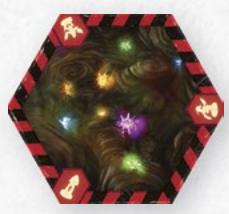
1 Double-Sided Monolith Tile
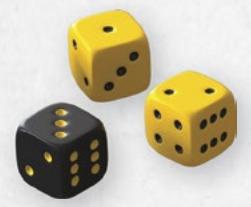
6 Dice
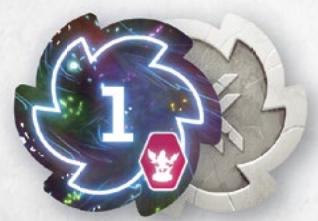
24 Exploration Tokens
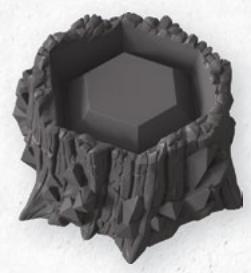
1 3D Monolith
65 Rubium Gems (50 1s, 15 5s)
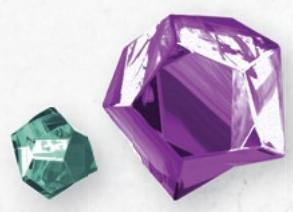

1 First Player Token (for the Vortex variant)
This edition of Nexus Ops contains optional rules in addition to the classic game. This rulebook is written assuming players are playing the classic game.
For the optional rules, see pages 11-15.
SETUP
Randomly determine who plays first. Then prepare the game for play as follows.
-
Starting with the first player, each player chooses a color and takes the plastic unit pieces and player board for that color.
-
Place the 3D Monolith in the middle of the table. Place the Monolith tile with red border face-up into the Monolith. Shuffle the 6 single-hex tiles face down, then place them face up in a circle around the Monolith. Place the 6 double-hex tiles in the same way in a circle around the single-hex tiles. Then attach a home-base tile to the board for each player, according to where they're sitting at the table. See player specific configurations on page 4.
-
Shuffle the Secret Mission deck and the Energize deck and put them face down near the playing area. Put the Mission cards in a stack near the other decks.
-
Randomly place 1 Exploration tile face down on each of the 18 hex spaces surrounding the Monolith, excluding home bases. The Exploration Tiles with the blue borders can be returned to the box. They are only used when playing with the Extra Exploration Tokens variant (page 12)
-
Put the dice near the playing area. Put the rubium gems in a pile next to the board; that pile is called the bank.
-
Get your starting rubium gems. The first player always gets 8 rubium. Each player to the left gets 3 more than the previous player. For example, in a 4-player game, the first player gets 8, the second gets 11, the third gets 14, and the fourth gets 17.

TERRAIN TYPES
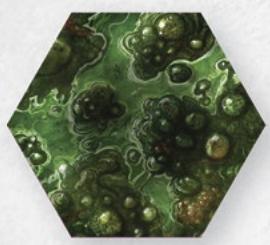
Liquifungus Forest
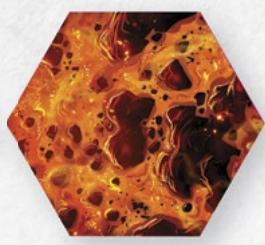
Magma Pool

Monolith

Crystal Spires

Rock Plains
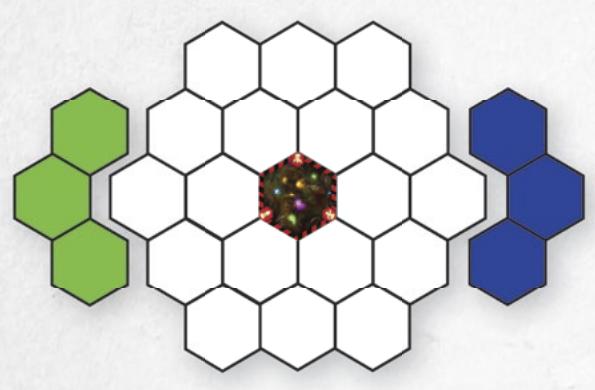
2 Player Game Setup

4 Player Game Setup
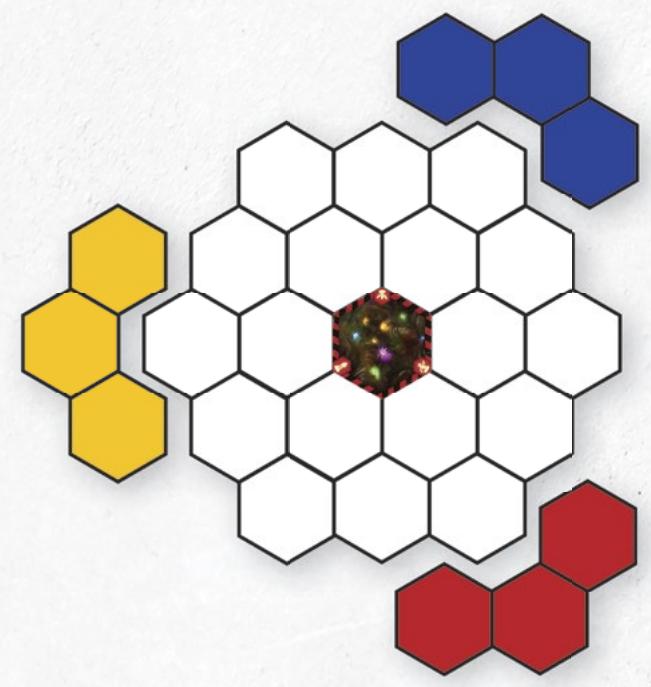
3 Player Game Setup
THE GOAL
You're a combat leader commanding troops on an alien moon. Deploy your units to accomplish the Secret Missions of your corporation. Score 12 victory points before any other player, and you achieve control of the region and win the game.
HOW TO PLAY
Players take turns going left from the first player.
During your turn, do the following in order.
-
Deploy. Purchase and place new units and play Deploy Phase Energize cards.
-
Move. Each of your units can move once.
-
Explore. Reveal discovered Exploration tiles.
-
Fight. Conduct one round of fighting for each battle you're in.
-
Income. Gain rubium for the mines you control.
-
Draw. Draw 1 Secret Mission card. If you control the Monolith, draw 2 Energize cards.
1. DEPLOY
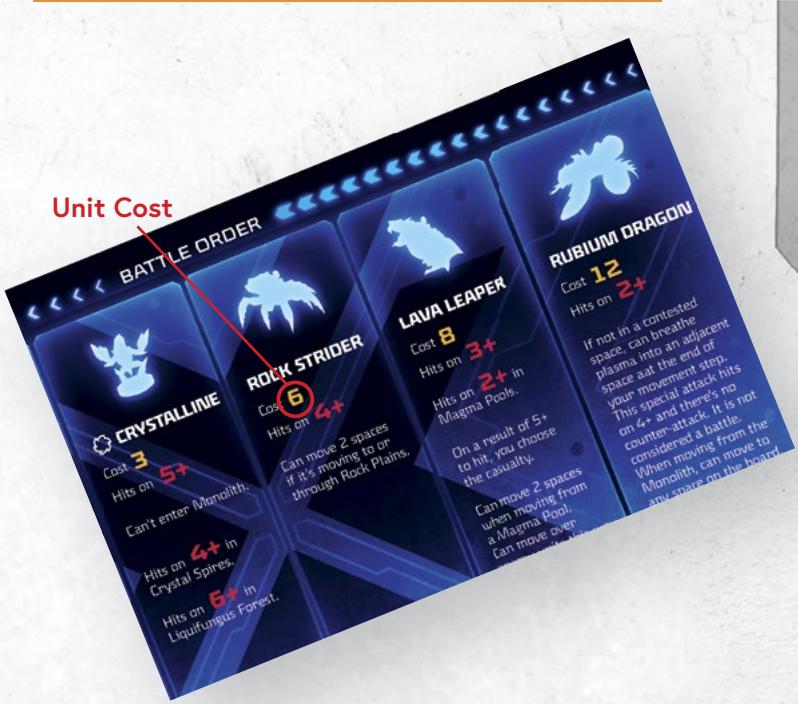
Each unit has a cost in rubium listed on your player board. You may purchase as many of those units as you'd like for their listed cost. When purchasing the units, return spent rubium to the bank.
Once you have purchased units, put each of them on any of your three home-base spaces. (You can split them up between those spaces.) If another player's units occupy any of your home-base spaces, you may still put your units there.
The number and type of units you can purchase is limited by the number of figures available. It's possible to run out of a particular unit type. When units are destroyed during the course of the game, however, they return to your supply and may be purchased again later.
The Deploy phase is the only time you may play Deployment Phase Energize cards. To play one, simply say you're playing it and follow its instructions. Then discard it face up next to the Energize deck.
You may play Deployment Phase Energize cards and purchase units in any order you choose.

BREAKING THE RULES
Some units and cards have special rules that override the general rules. In the case of a conflict, follow the rules for that unit or card.
2. MOVE
You can move each of your units one space (hex) during the Move phase. If a unit has the ability to move more than one space (such as the Rock Strider), it can't move through a space that contains enemy units. When a unit moves into a space that contains an enemy unit, it must stop there (unless its ability says otherwise).
Some units can't enter certain spaces, as noted on the player board. If your turn finishes and another player finds one of your units on a space it can't enter, you must move that unit back to one of your home-base spaces (your choice).
CONTROLLED SPACE
You "control" a space if you are the only player with any units there.
CONTESTED SPACE
A space is "contested" if more than one player has units in that space.

RETREATING
If you have a unit that began the turn in a contested space, it may move from that space (retreat) but it must end its move in a space you control or in an empty space. In other words, a unit can't retreat from a battle into another battle.
Example: You want your Rock Strider to retreat. Even though there's a Rock Plains between it and a space containing more enemy units, you can't move your Strider to or through that opponent-controlled space.

DRAGON BREATH
At the end of your movement phase, if you have a Rubium Dragon on the board in a space you control, it can breathe plasma into an adjacent space.
To breathe plasma, announce which space your Dragon is breathing into, then roll a die. If you roll a 4 or higher, the player who has units in that space chooses a unit in that space and removes it from the board. If more than one player has units in that space, choose which of the players takes the casualty after you roll.
This special attack isn't considered a battle: If it succeeds, you can't play a "win a battle" Mission or Secret Mission card. Also, you can't use Energize battle cards to affect the result of plasma breath. If your opponent loses their only unit in that space as a result of the breath, they don't draw an Energize card (the normal result of losing all your units in a battle when someone attacks you). Because this special attack isn't considered a battle, your opponent doesn't get to attack your Dragon.

3. EXPLORE
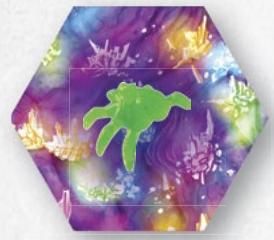
After you move, if any of your units ends its movement on a space with a face-down Exploration token, flip that token face up. You discover units and/or mines as shown on the face of the token.
If the token shows a unit, get one of those units from your supply and put it on that space, discarding the exploration token from the game. That unit now belongs to you and, on your next turn, you can move it and send it into battle like any of your other units.
If the token shows a mine, leave it face-up on that space.

Immediately add a rock strider to this space and discard the token.
If the token shows a unit and mine, place the unit on the space, and leave the token on the space where it will remain as a mine.
Mine tokens don't move from the space where they were discovered.
NOTE: Anything with a pink background denotes something that you gain immediately when revealing the exploration token.

Immediately add a fungoid to this space. Leave the token on the space since it also contains a mine.
4. FIGHT
Conduct one round of battle in each contested space where you have units. If there are multiple battles, you choose the sequence to conduct them.
Order of Battle
Units attack in a particular order, called the Battle Order, as shown on each player board. The order runs from right to left. All Rubium Dragons attack first, then all Lava Leapers, and so on. Once each unit has attacked in order, then the battle in that space ends for the turn, even if both attacker and defender have units remaining in that space.
ORDER OF BATTLE

When a unit type comes up in the order of battle, both the attacker and defender simultaneously make an attack roll for each unit they have of that type. To succeed on an attack roll, you must roll equal to or higher than the "hits on" number listed for that unit on the player board.
For each successful attack roll, your opponent chooses one of their units on that space and returns it to their supply. That unit is destroyed and may no longer participate in that battle. If it hasn't attacked yet because that unit type hasn't come up in the order of battle, it no longer has the opportunity.
Example: You are battling an opponent and you each have 1 Rubium Dragon in the battle. You each make an attack roll for your Dragons simultaneously. You roll a 1 and miss, but your opponent rolls a 2 and hits. You choose to take one of your Humans in that space off the board as a casualty. When the order of battle reaches Humans, that Human can't attack because it was destroyed
Example: In the above example, let's say you both hit with your Rubium Dragons and you choose to take your Dragon off the board as a casualty. Your opponent must still choose a casualty because your Dragon still scored a hit and casualties are chosen after all units of a given type attack.
In cases when more than one opponent has units in a space, you choose one of those opponents to be the defender. Only you and the defending player then participate in the battle. If you eliminate all of that player's units, you win the battle.
TIMING
The player whose turn it is always makes decisions first, such as deciding which casualties to remove or whether to play an Energize battle card.
Results of Battle
You win a battle if you attack on your turn and eliminate all the defender's units in a space. Many Secret Mission cards and all Mission cards involve winning a battle. For each battle you win, you can play one of these cards. (See "Cards" below for more details.)
You lose a battle if all of your units in a space are destroyed. If it's another player's turn when you lose a battle, you draw 1 Energize card. If you attack on your turn and lose all your units in a battle, you don't draw an Energize card, and your opponent can't play a Mission card.
• Neither player wins or loses if both have units remaining at the end of battle.
5. INCOME
For each space you control with a mine, you gain rubium equal to the number on that mine if you have at least one Human, Fungoid, or Crystalline on it. Take rubium from the bank equal to the amount you earn.
6. DRAW
Do the following during this phase:
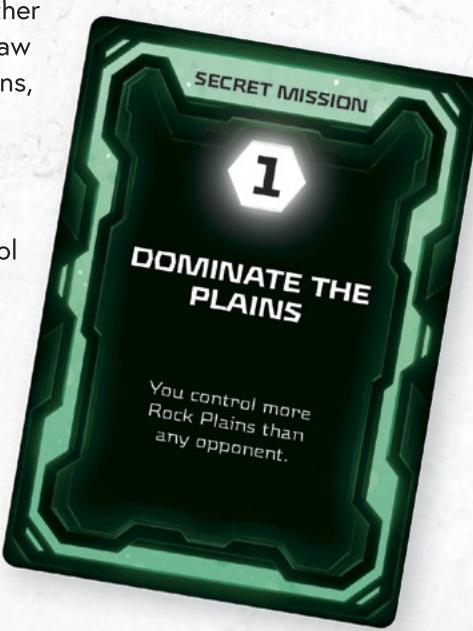
Draw 1 Secret Mission card. Keep it secret in your hand until you play it. If you draw a Secret Mission card and you meet its requirements, you may play it immediately. For example, if you control more Rock
Plains than any other player and you draw Dominate the Plains, you could play it immediately.
Draw 2 Energize cards if you control the Monolith. Keep them secret in your hand until you play them.
CARDS
There are three types of cards: Energize, Secret Mission, and Mission. You may discard Energize and Secret Mission cards from your hand anytime during your turn to gain 1 rubium per discarded card. Discarded cards go face up next to the appropriate deck.
Energize Cards
There are two ways to get Energize cards: You draw 1 card whenever you lose a battle on someone else's turn, and you draw 2 cards if you control the Monolith at the end of your turn. When you draw an Energize card, keep it secret in your hand until you decide to play it. If the deck runs out, reshuffle the discarded cards to make a new deck.
You can only play Deployment Phase Energize cards during the Deploy phase of the turn. To play one, simply tell the other players you're playing it, then follow its text. When you're done, put it face up in the discard pile.

Energize Battle Cards
Energize battle cards may be played during a battle when the text on the card says it can be played. To play one, simply say you're playing it and follow its instructions.
During a battle, any player may play Energize battle cards, even players not involved in the battle. The attacker goes first in playing Energize battle cards, then the defender, then clockwise from the defender.
Mission and Secret Mission Cards
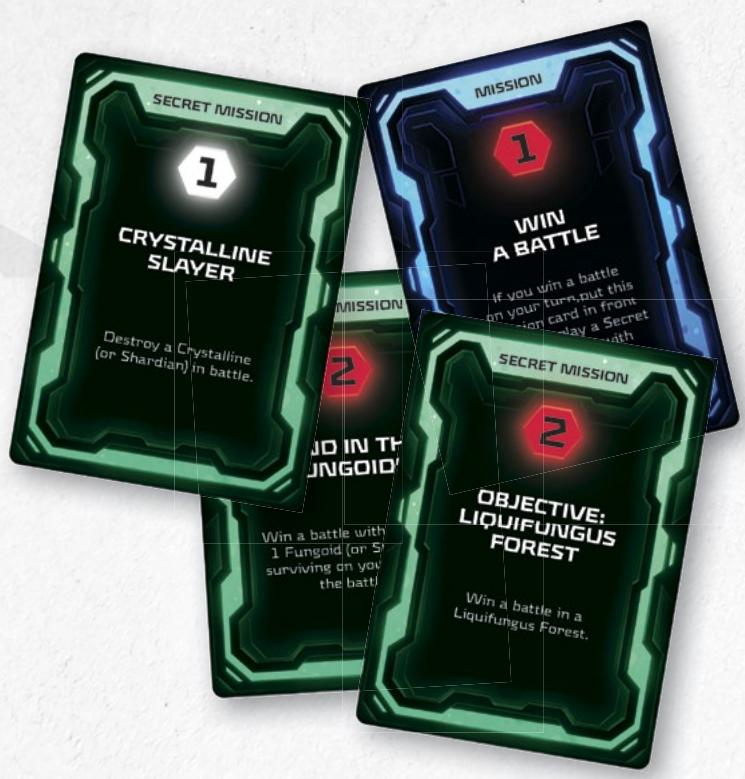
Secret Mission cards are kept secret in your hand until you meet their requirements on your turn. Mission cards are kept in a stack that you can draw from whenever you win a battle as long as you don't play a Secret Mission card for winning that battle.
A Secret Mission or Mission card can be played only on your turn. You can play it as soon as you accomplish the goal listed on the card. To play it, announce you're playing it and put it face up in front of you. It will remain there for the rest of the game.
Many Secret Mission Cards and all Mission Cards involve winning a battle. For each battle you win, you can play only one card with the victory point total listed in red. You may play any number of relevant Secret Mission cards with the victory point total listed in white.
Example: You win a battle in a Liquifungus Forest and you have a Fungoid surviving on your side of the battle. You could play Send in the Fungoids, Objective: Liquifungus Forest, or a Mission card from the stack, but only one of those three. You could, however, play one of those cards and also a Crystalline Slayer card if you destroyed a Crystalline in that battle, because the VP number on that card isn't red.

Draw 1 Energize card whenever you lose a battle on someone else's turn. Draw 2 cards if you control the Monolith at the end of your turn.

Draw 1 Secret Mission card at the end of your turn.

Take and play 1 Mission card whenever you win a battle as long as you don't play a Secret Mission card for winning that battle.
Each Secret Mission and Mission card has a VP number at the top. That number tells you how many victory points you earn when you accomplish that mission. As soon as the total number of victory points you've achieved reaches 12, you win the game.
WINNING THE GAME
The game ends immediately when either of the following happens:
• A player earns a total of at least 12 victory points' worth of Mission and Secret Mission cards. That player wins the game.
A player is eliminated from the game. A player is eliminated if his or her last unit is destroyed, they don't have enough rubium to purchase any more units, and that player doesn't have any cards to discard for rubium. The player with the highest VP total among the remaining players wins the game. In case of a tie, the tied player controlling the most spaces wins. If there's still a tie, the tied player with the most units on the board wins. Finally, if there's still a tie, the game is a draw.

OPTIONAL RULES
This section explains several optional rules that players may freely use to customize the game to their liking. Although not all of the optional rules can be used together, players can experience Nexus Ops in many different ways by using several optional rules during the same game (e.g., players can use the alternate units, intercepted transmissions, and the vortex). Before starting the game, players must all agree on which optional rules (if any) they wish to use.
TIME IS OF THE ESSENCE
The game ends immediately after a player acquires 10 or more victory points. That player wins the game. The game still ends if a player is eliminated, as described in "Winning the Game."
IN FDR THE LONG HAUL
The game ends immediately after a player acquires 14 or more victory points. That player wins the game. The game still ends if a player is eliminated, as described in "Winning the Game."
EXECUTIVE ORDERS
During the Receive Starting Rubium step of setup, all players receive one Secret Mission card.
KING OF THE HILL
If the active player controls the Monolith hex during the Draw phase, they may either draw two Energize cards or take one King of the Hill card (the backside of the Battle Victory card) and place it faceup in their play area. If they takes a King of the Hill card, all other players each draw one Energize card. King of the Hill cards are worth 1 victory point each. Players still gain Battle Victory cards as normal.
TOP PRIORITY
Instead of drawing one Secret Mission card during the Draw phase, the active player draws two Secret Mission cards, chooses one to keep in their hand, and returns the other card to the bottom of the Secret Mission deck.
EXTRA EXPLORATION TOKENS
Included with this game are six extra exploration tokens, marked with blue borders. These tokens are meant to increase the variety of rewards that players can find on the board. These bonus tokens can be used in the classic or variant game and in conjunction with any other optional rules.

Level 1 Mine & Draw an Energize Card
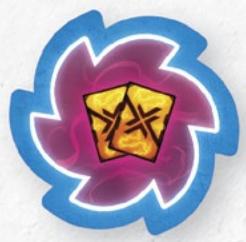
Draw 2 Energize Cards (Discard the token)

Collect 7 Rubium(Discard the token)
During the "Place Exploration Tokens" step of setup, instead of returning the exploration tokens with blue borders to the game box, players are free to exchange these bonus exploration tokens with any of the other exploration tokens. There can only ever be 18 exploration tokens on the board (12 on the Energy Dependence two-player board), so return all unused exploration tokens to the game box.
Note: For optimal game balance, it is recommended that the entire group of exploration tokens contain mines that generate no fewer than a total of 16 rubium.
INTERCEPTED TRANSMISSIONS
After preparing the Secret Mission deck during setup, draw two more Secret Mission cards than the number of players in the game. (For example: in a two-player game, players draw four Secret Mission cards; in a three player game, players draw five Secret Mission cards; in a four-player game players draw six Secret Mission cards.) Reveal these cards by placing them faceup near the board where all players can see them. This row of cards is called the TRANSMISSION LINE.
During the game, players do not draw Secret Mission cards into their hand. Instead, the active player may fulfill any card(s) in the transmission line. When the active player fulfills a card, he places it faceup in his play area. During the Draw phase, he replenishes the transmission line back to the original total. The active player may still only collect one Secret Mission Card with a point value in a red circle, or collect a standard Mission Card.

FOUR-PLAYER TEAM RULES
To play a four-player team game, set up the game for four players as shown in the diagram on page 4. Players separate into two teams of two players each. Teammates sit across from each other. Instead of playing to 12 individual victory points, the first team to reach a combined total of 20 victory points wins the game.
At the end of the Draw phase, the active player's teammate may choose one card from his hand and pass that card facedown to the active player, who adds it to his hand. The passed card can either be an Energize card or a Secret Mission card.
If the active player moves any of his units into a hex that contains his teammate's units, the hex is considered contested but no battle occurs. Neither player collects rubium from a mine in that hex. The active player can move units that are capable of moving more than one hex through hexes containing his teammate's units as long as none of the opposing team's units are present.
Teammates may discuss whatever they like, but all talk must be public. Also, aside from the card-passing rule explained above, a player may show his teammate some cards from his hand. If he does so, he must show it to all players.
If one player is eliminated, the game does not end. The remaining teammate continues playing and can still win the game for the team. The eliminated player's victory points still count toward the team's total victory points.
If two teammates are both eliminated, the game ends. The surviving team wins the game.
VORTEX
During the Place Terrain step of setup, flip the Monolith hex to reveal the Vortex. Each edge of this hex is labeled with one face of a six-sided die. It does not matter how players orient this hex during setup, but once placed it must remain in that position for the duration of the game. Give the Start Player Marker to the first player.
Each time before the first player takes his turn, they must follow these steps to resolve the Vortex's effect:
-
Roll one black die and one yellow die, and then refer to the numbers on the Vortex hex. The Vortex sucks in all units occupying the hex that borders the number shown on the black die. Then the storm, blows these units into the hex that borders the number shown on the yellow die. Simply move the units to this new hex.
-
Then roll one die and refer to the numbers on the vortex hex. The Vortex projects massive amounts of energy, toward the hex that borders the number shown on the die. All units occupying that hex are destroyed.
-
Finally, for each controlled hex adjacent to the vortex, the controlling player draws one Energize card.
Note: Skip these steps during the first turn of the game.
No unit may enter the monolith when the Vortex is in play. Cards affecting the Monolith do not affect the Vortex. During setup, return "Death From Above" and "Secure the Monolith" to the game box; they are not used.

ALTERNATE UNITS
To play with alternate units; use the backside of the player board labeled "Alternate Units." Some clarifications
• Clones: If players have difficulty remembering the purchasing limit, simply place newly purchased Clones next to the home base tiles. Then at the end of the Deploy Phase, move them on to the tiles.
Shardian: If a defender destroys his own Shardians and he has no other units in the contested hex, he loses the battle and the attacker wins the battle.
• Sporling: It is possible for Sporlings to move several times and participate in multiple battles during a single turn.
• Boulder Blitzer: If in a Rock Plains, Boulder Blitzers attack before all other units (instead of after Magma Divers).
Magma Diver: When moving from a Magma Pool, Magma Divers "dive" down and may surface in any other Magma Pool as well as any hex adjacent to a Magma Pool.
Monolith Wyrm: Each time the Monolith Wyrm scores a hit during its special attack, the owner must roll another die. This process continues until the Monolith Wyrm misses.
ALTERNATE TWO-PLAYER BOARDS
This section describes how to set up and play with alternate two-player boards.
ENERGY DEPENDENCE
During the "Place the Terrain" step of setup, set aside the following terrain tiles:
• 3 Double-hex tiles with a Liquifungus Forest • 1 Single-hex Crystal Spires
• 1 Double-hex tile with a Crystal Spires • 2 Single-hex Magma Pools
• 1 Single-hex Liquifungus Forest
Return all other terrain tiles to the game box. Then shufle the set aside terrain tiles and build the board according to the setup diagram on page 15.
During the "Place Exploration Tokens" step of setup, set aside the following 12 exploration tokens into two identical piles that contain:
• 2 Rock Strider tokens
• 2 Rubium Mine (1) + Crystalline tokens
• 1 Rubium Mine (2) tokens
• 1 Rubium Mine (1) + Fungoid tokens
Return all remaining exploration tokens to the game box. Each player shufles one pile facedown and then randomly places those tokens on their opponent's side of the map.
All other rules remain unchanged.
BAD NEIGHBORS
During setup, players place the terrain according to the standard two-player setup. However, players must place their home base hexes much closer to each other than required in the standard two-player setup.

ALTERNATE TWO-PLAYER BOARDS
ENERGY DEPENDENCE

CREDITS
NEXUS OPS
Game Designer: Charlie Catino
Developer: Bill McQuillan
Associate Producer,
Board & Card Games: Kane Klenko
Art Director: Anita Osburn
Illustrator: Mihajlo Dimitrievski
Graphic Designer: Cold Castle Studios
Production Artist: Adam Kelzer
Monolith Sculptor: Niklas Norman
Optional Rules Development: Steven Kimball
HASBRO
Team Hasbro: Elizabeth Artale, Paul Strickland, Tayla Reo, Brian Casentin, Kaiser Ramos & Christopher Troise
A AVALON HILL

Licensed by: Hasbro
RENEGADE
RENEGADE GAME STUDIOS:
President & Publisher: Scott Gaeta
Finance Controller: Robyn Gaeta
Vice President of Operations: Leisha Cummins Vice President Sales: Andrew Lupp
Senior Producer, Board & Card Games:
Dan Bojanowski
Senior Game Designer: Matt Hyra
Producer, RPGs: Kevin Schluter
Marketing Manager: Jordan Gaeta
E-Commerce Manager: Nick Medinger
Event Manager: Sara Erickson
Organized Play Manager: Trevor McGregor
Customer Service Manager: Jenni Janikowski Director of Visual Design: Anita Osburn
Creative Director, Games: Jeanne Torres
Creative Director, RPGs: Sarah Robinson
Associate Producer, Board & Card Games:
Kane Klenko
Associate Producer, Heroscape: Lee Houff
Associate Producer, RPGs: Ben Heisler
Project Manager: Rachel Del Rio
Game Designers: Dan Blanchett, Christopher Chung. & Sarah Rowan
Lead Developer, World of Darkness:
Juhana Pettersson
Finance & Sales Coordinator: Madeline Minervini Playtest Coordinator: Marcus E. Burchers
Creative Production: Noelle Lopez & Gordon Tucker Sales Assistant: Sophia Gambill
Marketing Assistant: Anais Morgan
Customer Service: Bethany Bauthues
For additional information or support, please visit us online: www.renegadegames.com f /PlayRGS @PlayRenegade@Renegade_Game_Studios 0 /RenegadeGameStudios-
下载 Markdown原文为社区整理/出版社公开资料,版权归原作者,仅供个人学习查阅。