
迷你地下城One Deck Dungeon
一句话概览
迷你地下城 是一款已收录于村了吗规则库的桌游,支持 1–2 人,原名 One Deck Dungeon。
本页内容:一句话概览 · 常见问题
这游戏怎么玩
- 本站已收录这款游戏的规则资料,可以在对话里直接提问规则细节。
常见问题(FAQ)
以下 1 条问答来自站内玩家的真实提问,答复由本站依据规则资料作答;答复内容保持原样,仅对提问做了去口语化的轻微整理。
每个角色的技能是怎么发动的?
结论
《迷你地下城》里「角色自带的技能」和「作为战利品学到的技能」是两回事,发动方式不同,需要分开讲:
- 英雄卡自带的专属能力叫「英雄壮举(Heroic Feat)」,不算技能,发动时机固定在遭遇流程的「使用英雄壮举」这一步。
- 「技能(Skill)」是通过战利品学到的能力,发动时机在遭遇流程的「使用技能并放置骰子」这一步,通常需要先支付骰子。
一、英雄壮举(英雄卡自带的专属能力)
怎么发动:在遭遇流程的「使用英雄壮举」步骤,每名英雄可以选择发动自己的壮举。
- 壮举通常让你获得黑色英雄骰,这些骰子在本场遭遇中可当作任意颜色使用,并加入你的骰池。
- 壮举不算技能。
- 双人遭遇时,一名英雄先完整结算完自己的壮举,另一名英雄再决定是否发动自己的。
条件与例外:
- 有些壮举(例如法师的「充能 Mana Charge」)必须先按特定条件把骰子存放在英雄卡上,之后才能发动;存放的骰子在花掉之前放在英雄卡上,需要时用壮举把它们掷出。你可以随时选择把存放的骰子退回公共供应堆。
- 许多壮举标有图标,表示不能在 Boss 战中使用;存放在这类壮举上的骰子,在到达 Boss 时要退回公共供应堆。
二、技能(从战利品学到的能力)
怎么发动:在遭遇流程的「使用技能并放置骰子」步骤,通过支付技能所需的骰子来发动。
- 技能左侧是费用,右侧是效果。 先支付(弃掉)费用所需的骰子,然后结算效果;效果通常会给你额外骰子,也用于帮你克服遭遇。
- 只能花你自己骰池里的骰子,不能花队友的。 花掉的骰子弃回公共供应堆。从技能获得的骰子放进你自己的骰池。
- 每个技能每场遭遇(Boss 战中是每一轮)只能使用一次。
- 每个技能标题旁有图标,标明它只能用于战斗遭遇还是危机遭遇。Boss 战中,战斗中可用的技能可以使用,每项技能每轮一次。
不同费用类型的发动方式:
- 力量/敏捷技能:从你的骰池中弃掉与费用数量相符的力量骰或敏捷骰。
- 魔法技能(法术):从你的骰池中弃掉一颗或多颗魔法骰,点数之和至少要达到法术标明的法力费用(例如一颗 1 和一颗 2 就能支付)。
- 免费技能:没有费用即可使用,但每场遭遇仍只能使用一次。
三、顺带说明:药水
药水不是技能,发动方式是弃掉一个药水指示物,即可获得队伍已确认的某一种药水的效果。与技能不同,只要队伍有足够的药水指示物,药水在一场遭遇或 Boss 轮中可以使用多次。
……(完整内容可在村了吗查询)
去哪查完整规则
想核对具体规则细节、卡牌效果或某个回合的结算方式,可以在村了吗里选中这款游戏后直接提问。
同类桌游
- 卡坦岛德式
- 工业革命:伯明翰德式
- 勃艮第城堡:特别典藏版德式
- 方舟动物园德式
- 卡卡颂抽象
- 瘟疫危机传承:第一季美式
- 阿瑞迪亚:勇踏征途美式
- 重塑宇宙德式
- 幽港迷城美式
- 埃多拉的德鲁伊德式
规则原文(Markdown)
本站收录这款游戏的规则原文 1 个文件,此处内联渲染 1 个,可直接展开阅读或下载。
RuleBook_1.9.md42.9 KB
ONEDECK DUNGEON
Adventure Guide
ONE DECK DUNGEON RULES V1.9
Adventure calls! Lairs of monstrous enemies have sprung up all over the countryside. As heroes, your duty is clear: conquer every dungeon, defeat every foe, and overcome every peril. As is tradition, you'll enter each dungeon with only the simplest equipment, and gather better loot as you delve.
A deck of encounter cards contains all the dangerous foes and perilous obstacles you'll come across. Each card also shows the loot and experience gained by surviving your encounter. You'll need every advantage, because every time the deck is reshuffled you'll descend one floor deeper. Each time you do, all the monsters and traps will get stronger and more perilous. If any hero runs out of health, the game will end. If you make it through three floors, the dungeon's boss awaits you at the bottom. Defeat it to claim victory!

Forest of Shadows: This rulebook also contains all the rules for the Forest of Shadows expansion in one unified rulebook. Expansion rules are contained in green boxes of text like this one. If you are not playing with the expansion, you can ignore these boxes entirely.
OBJECTIVE
Clear all three floors of the dungeon, and then defeat the boss! If any hero in your party runs out of health, the game is over. In Campaign Mode (p26), each game will earn you check-marks on your campaign sheet, making your hero stronger for your next adventure.
CONTENTS
• 5 Hero Cards
• 30 Dice
(8 Pink/Agility, 8 Yellow/Strength,
8 Blue/Magic, 6 Black/Heroic)
• 1 Turn Reference Card
• 1 Campaign Sheet Pad
• 44 Encounter Cards
• 4 Level Cards
• 5 Dungeon/Boss Cards
• Stairs Card
• 2 Basic Skills Cards
• 15 Red Damage Tokens
• 6 White Potion Tokens

Forest of Shadows, in addition to its own different set of heroes, encounters, bosses, dungeons, turn reference, and campaign sheets, ilso contains:
• 8 Green Poison Tokens
• Poison Reference Card
• Basic Potion Card
• Hordes of the Shadows 4P Difficulty Enhancement Card
RULES INDEX
Page 4-5: Setup
Page 6-8: Using Dice
Page 9-12: The Game Turn
Page 13-19: Encounters
Page 20-21: Feats, Skills and Potions
Page 22-23: Leveling Up, Descending
Page 24-25: Boss Fight
Page 26-27: Campaign Mode, Challenge Tiers
Page 28-29: Four Player Rules
Page 30-31: Poison, Exile, Cure Potion / Starting Potions
Page 32-35: FAQ/Credits
HOW TO RAID A DUNGEON
SETUP: CHOOSE A HERO & DUNGEON
DUNGEON/BOSS

Dots next to a dungeon's name represent its difficulty. More dots mean a harder dungeon (and boss!) The boss is on the back of the dungeon card.
Each player chooses a hero card, and together your party chooses a dungeon to face. Multiplayer games are fully cooperative. Use the 1P side of hero and level cards if playing solo, use the 2P side if playing with two or four players.
Your hero has stat cons for strength (), agility () magic (), and also icons representing health ().
NEXT: ASSEMBLE THE PLAY AREA


) Forest of Shadows: Start with one basic potion identified and tucked under the Cure Potion on the Turn Reference. (see p31: Cure Potion)
Setup steps:
-
Stack the experience level cards (level 1 on top, level 4 on the bottom).
-
Shuffle all the encounter cards together into a deck. Place the stairs card underneath the deck.
-
Slide the dungeon card under the Turn Reference, so that only the first floor of the dungeon is showing.
-
Return the unused heroes and dungeons to the box.
-
Place one potion token on the Turn Reference.
-
Assemble all the rest of the dice and tokens to form the general supply.
-
Start your adventure!
After your first game, you're ready to start a campaign and select a challenge tier to help set the difficulty level (see p26-27: Campaign Mode / Challenge Tiers). Basic skill cards are only used when playing the campaign.
USING DICE
Before the adventure starts, you'll need to know about dice. The 30 dice in the box are your tools for conquering all the obstacles you'll encounter in the dungeon. There are four colors of dice. Yellow for strength (), pink for agility (), blue for magic (), and black heroic dice () which can be used as if they were any color. Dice typically reside in one of three places: the general supply, your dice pool, or on an encounter card, where the party will place them to cover up challenge boxes.
THE GENERAL SUPPLY
The dice, along with the tokens for potions form the general supply. There are 8 each of strength, agility, and magic dice, 6 heroic dice, and 6 potion tokens. Dice return to the general supply immediately when spent to pay for a skill, potion tokens return when spent to use a potion effect, and all dice return to the supply at the end of an encounter. Dice and potion tokens are limited by what is in the general supply. Damage tokens are unlimited, and you can use substitutes instead if you run out.
YOUR DICE POOL
During an encounter, all the dice you've rolled form your dice pool. In a two player game, each hero's dice pool is kept separate. Dice there can be used to pay for activating that hero's skills or to place on challenge boxes on an encounter card. Dice gained or rolled from skills are always put into your dice pool. After an encounter, all dice go to the general supply.
PLACING DICE
Each encounter card in the game has many challenge boxes on it. Your success depends on covering up as many of them as you can. Every box you fail to cover will force you to take damage or cost you valuable time! (see p17: Suffer Consequences)
Here are the rules governing placement of dice in challenge boxes:
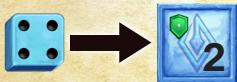
A small box can only be filled by a single die matching its color, and the die must be equal to or higher than the number in the box.


You may use any number of dice to fill a wide box matching their color, as long as their total value is at least
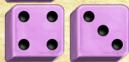
as high as the number in the box. Two heroes can place dice in a wide box together. Stack all the dice up on top of the wide box, in multiple layers if necessary.
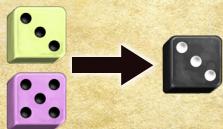
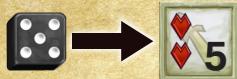
discarding any two dice. The gained heroic die is equal to the lower of those two dice.
Note: Two heroes can each contribute a die and choose which hero gains the black die.
Heroic dice can be used as if they were any color, including to contribute to a wide box or to pay for activation of a skill.
STORED DICE
Normally at the end of each encounter, all dice are returned to the General Supply. Some Heroic Feats are an exception to this rule, and allow one or more dice to be stored to be used on a future turn.
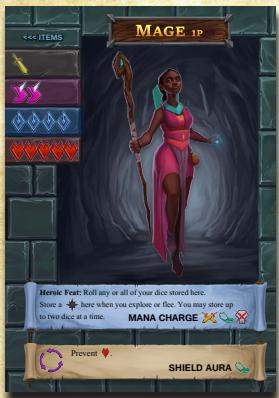
Ex: the Mage's Mana Charge (1P version shown):
Heroic Feat: Roll any or all of your dice stored here. Store ahere when you explore or flee. You may store up to two dice at a time. MANA CHARGE XX
In the Abyssal Depths expansion, dice placed on the Fiend card will remain there between turns.

Exiled Dice and Tokens: Some effects in Forest of Shadows and Abyssal Depths will exile a component. Dice or tokens that are exiled are returned to the game box, not the General Supply. This can have important implications, since the dice in the supply are limited!
Ex: If you need to roll 7 yellow dice but only 5 are available, you only get to roll 5.
TURNS: OVERVIEW
Every game turn in One Deck Dungeon is shared by the entire party. You will act together to face encounters and overcome them, which will of course result in wondrous loot! On the following pages are detailed descriptions of each part of the game turn. Here's a list of everything that will happen in a turn:
PHASE 1: TIME PASSES
PHASE 2: EXPLORE OR ENTER A ROOM
OPTION 1: EXPLORE
END OF TURN
OPTION 2: ENTER A ROOM
CHANCE TO FLEE (AND IMMEDIATELY END TURN)
START: SPECIAL ABILITY ( ONLY)
STEP 1: PERIL CHOICE ( ONLY)
STEP 2: USE HEROIC FEAT
STEP 3: GATHER + ROLL DICE
STEP 4: USE SKILLS AND PLACE DICE
STEP 5: SUFFER CONSEQUENCES
STEP 6: CLAIM LOOT
END OF TURN
TURNS: DETAILED RULES
Every turn has two phases, and the turn is shared by the entire party.
PHASE 1: TIME PASSES
You must spend two time at the start of each turn.
The passage of time in One Deck Dungeon is represented by discarding cards off the top of the encounter deck. For each time () spent, discard one card face-up into a discard pile next to the encounter deck.
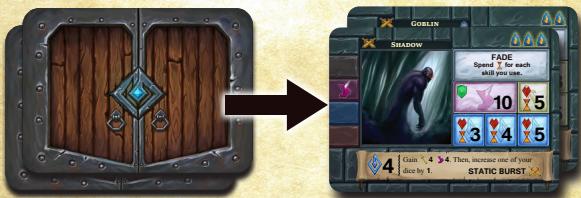
PHASE 2: EXPLORE OR ENTER A ROOM
There is no map or board in One Deck Dungeon. Instead, the dungeon's layout is represented by face-down cards called closed doors, as the art on the back of each encounter card depicts a large wooden door. There are always four available slots for doors.
The explore option lets the party search through the dungeon to discover new doorways to open. On later turns, you can enter a room, flipping over a closed door to reveal both an encounter and the loot you could claim!
TURN OPTION: EXPLORE
To explore, add face-down doors from the encounter deck to the table until there are four total doors in play. Open doors (face-up cards that you fled from) count toward the limit of four, as do closed doors from previous explore turns.
• You cannot explore if there are already four doors (whether open or closed) in play.
• You cannot explore if the stairs card is visible, because that means the encounter deck is empty.
• You can explore if there is at least one card in the encounter deck, but not enough to make four doors. Place as many as you can, and then the turn ends. The party may choose to descend.
• Some dungeons adjust the door limit of four.

Forest of Shadows: After exploring, the party must attempt to Resist Poison if they have any poison tokens. (see p28: Poison)
EXAMPLE TURN #1: EXPLORE
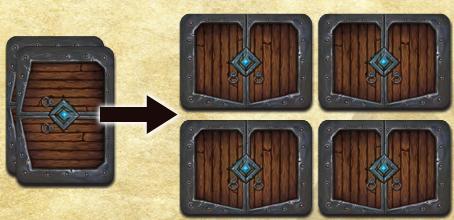
After spending to begin the first turn of the game, explore by placing four cards from the deck face-down as closed doors. On the next page, a second example turn shows the Enter a Room option.
TURN OPTION: ENTER A ROOM
All the action in One Deck Dungeon lies behind doors. When the party uses their turn to enter a room, you must select one of the doors in play.
If the door is closed (face-down), first open the door by flipping it face-up. Then, the party can choose to either start an encounter or flee. If you flee, the turn ends immediately and the face-up card remains in play as an open door. Otherwise, start an encounter using that card.
If the door was already open (face-up), start an encounter. You cannot choose to spend your turn to enter an already open door and then flee from it.
The steps involved in resolving an encounter are described on the following pages. After the encounter is complete, the turn is over. All dice are returned to the general supply, except for those stored on heroic feats or exiled.
EXAMPLE TURN #2: ENTER A ROOM
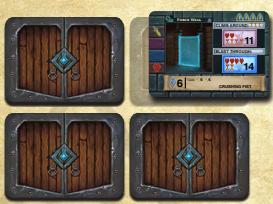
After spending on your second turn, enter a room. Open one of the doors by flipping it face-up. It's a Force Wall peril.
You must choose:
(1) Start the encounter on the card (rolling dice, suffering consequences, and then claiming loot)
(2) Flee and end the turn.
TURN #3 AND BEYOND:
On future turns, you'll always spendand then have to choose whether to explore or enter a room based on the current situation. Good luck!
ENCOUNTERS
Each card in the encounter deck shows something standing between you and conquering the dungeon. In addition to the center of the card showing the obstacle the party must overcome, the edges of the card display the loot you'll claim if you make it. Encounters come in two types: combats and perils.

*The set icon is on half of the cards. It is used by expansions.
An encounter consists of several steps, done in order. In any encounter, your ultimate goal is to cover as many challenge boxes as possible. Each box you don't cover will result in consequences. Combat and peril encounters have some differences, but the general encounter structure is the same
START: SPECIAL ABILITY ( ONLY)
Most foes in combat encounters have a special ability. Its effect begins now. For abilities with an instruction such as Fire Elemental's “Place a damage on a hero”, follow that instruction now. If you flee from an encounter, ignore the ability.
STEP 1: PERIL CHOICE ( ONLY)
Peril encounters offer you two choices on how to overcome the obstacle they represent. The party must choose one of the two options now. Some choices have an associated time cost, which is paid now by discarding cards off the top of the encounter deck. The other choice's challenge box is ignored entirely.
STEP 2: USE HEROIC FEAT
Each hero may choose to use their heroic feat. Heroic feats allow you to roll black heroic dice (), which can be used as any color during the encounter. As with all dice rolled during an encounter, they are added to your dice pool. In a 2P encounter, one hero chooses to use their feat and resolves it completely before the other hero decides whether to use theirs.
Many heroic feats have an icon () indicating that they cannot be used during the boss fight.
Some heroic feats store dice on your hero card. These are not part of the general supply nor the dice pool, until you use the heroic feat to roll them. You can choose to return them to the general supply at any time.
STEP 3: GATHER + ROLL DICE
Each icon on your hero card (plus icons on your items) lets you roll a die of its color.
In a combat encounter, you will roll all of these dice. In the example to the right, you would roll seven dice.
In a peril encounter, you will roll only the dice you have access to that match the color

of the option you chose in step 2. In this example, if you chose a magic-based option on a peril you would roll only the four blue magic dice.
All dice you roll are placed in an area called your dice pool. Your dice pool is where all dice you use to cover boxes and pay for skills are spent from. At the end of an encounter, leftover dice there are returned to the general supply.
• In a 2P encounter, each hero's dice pool is kept separate.
• If the party is experience level 2 or higher, the level card grants black heroic dice as bonus to every encounter (even Perils). While gathering dice, the party must choose which hero rolls each encounter bonus die.
• If there are not enough dice of a color available in the general supply, your excess icons have no effect. In a 2P game, choose which hero claims dice to roll first.
• Some dungeon or combat encounter special abilities trigger off of die rolls, such as “Immediately discard all 1s and 3s rolled". These take effect before any of your hero's skills can be used.

Forest of Shadows: Exiled dice and tokens are placed in the game box. They are unavailable for the remainder of the game.
STEP 4: USE SKILLS AND PLACE DICE
In an encounter, the party must try and cover as many active challenge boxes as possible. In a combat encounter, all challenge boxes on the encounter card are active. In a peril encounter, only the box under the chosen option is active. The other box is ignored entirely.
There are challenge boxes on the dungeon card as well. Depending on the type of encounter, all boxes from all visible floors on the appropriate side of the dungeon card are active. The other side is ignored.

You may take the following actions any number of times:
• Cover a challenge box with dice from your pool. (see p7: Placing Dice). Note: Until you have covered all the boxes with armor (), you cannot cover any non-armor box.
• Use one of your skills (see p20: Skills), first spending any dice required to fulfill its cost. Spent dice are discarded, and then the skill's effect occurs. This will often grant you additional dice. Each skill can only be used once per encounter. Many skills are only usable in one type of encounter (combat or peril), which is indicated by icons next to the skill's title.
• Spend a potion token to use the effects of any one potion type you've identified.
• Spend two dice to gain a heroic die, placing it in your pool. Set its value equal to the lower of the two spent dice.
• Discard a die to the general supply. This can be useful if you need to gain or roll a die and there are none of the correct color left in the general supply.
Dice spent for any of these actions are returned to the general supply, available for use by skills or effects later in the encounter.
During a peril encounter, if there is ever a die in your dice pool that does not match the color of the peril option, discard it immediately. Heroic dice match any option color. The dungeon challenge boxes for peril encounters are grey, and can be filled with any die.
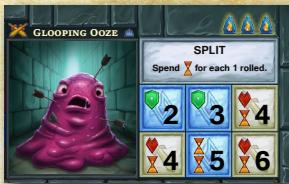
Combat Example: On page 30 we've provided a quick example of placing dice in a Combat Encounter against a Glooping Ooze.
STEP 5: SUFFER CONSEQUENCES
If you are unable to cover every active challenge box, the icons in the remaining active boxes show the consequences of completing the encounter:
For each visible , place one damage token on your hero card. In a 2P encounter, damage must be divided as evenly as possible. For example, 3 damage would be split as 1 to one hero, and 2 to the other.
For each visible , spend one time by discarding the top card of the deck.

Forest of Shadows: For each visible , place one poison token on your hero. In a 2P game, they must be split just like damage.
If any hero has at least as many damage tokens as health, then the game is over unless they use a potion or other effect to heal. (see p21: Potions)
If a skill or effect causes some number of icons to be ignored, they never become part of the consequences for the encounter.
After suffering consequences (and surviving), the encounter card is claimed as loot. The party chooses to take it either as an item, a skill, a potion, or XP. In the case of an item or a skill, the party chooses which hero claims the card as loot. Potions and XP are shared by the entire party.
Your current experience level card restricts the number of items and skills each hero can have. It also provides you with bonus heroic dice for all encounters once you reach level 2.
1) Items represent new equipment your hero picks up in the dungeon, raising stats so you can roll more dice in each encounter. To take a card as an item, tuck it under the left edge of your hero card.
2) Skills give your hero various ways to use dice for greater effect. To take a card as a skill, tuck it under the bottom edge of your hero card.
3) Identified Potions give you more options on how to spend your potion tokens. To identify a potion, tuck the card under the bottom edge of the Turn Reference. When you identify a potion, add a potion token to the Turn Reference. Each token there can be used for any one potion effect.
4) XP (Experience) helps the party level up. To take a card as XP, tuck it under the level card, with the experience lanterns showing.
When taking an item or skill as loot, you can replace an existing item or skill with your new loot. The replaced card becomes XP, and is immediately tucked under the level card. A hero cannot have duplicate skills, and the party cannot identify the same potion type twice.

Forest of Shadows: Several peril encounter cards have arrows associated with their two choices, where one specifically leads to an item as loot, and the other to a skill. You can still take the card as XP, if you don't want the assigned type of loot.

FEATS, SKILLS AND POTIONS
HEROIC FEATS
Each hero has a special ability called a heroic feat. Most feats grant access to black heroic dice. During the “Use Heroic Feat" step of an encounter, each hero can choose to use their feat. A heroic feat does not count as a skill.
Heroic Feat: Roll any or all of your dice stored here. Store a here when you explore or flee. You may store up to two dice at a time. MANA CHARGEX
Some feats (such as Mana Charge) can only be used after you store up heroic dice based on various conditions. These dice are placed on the hero card until spent.
Note that most heroic feats cannot be used during the boss fight (). Stored dice on these feats are returned to the general supply when you reach the boss.
SKILLS AND POTIONS
Every skill or potion has icons next to its title indicating whether it can be used in combat encounters or peril encounters. Each skill can only be used once during each encounter or boss round. Potions can be used multiple times in an encounter or boss round, as long as the party has enough potion tokens.
The left side of a skill is its cost. Each skill will cost one or more of the dice that you've rolled for an encounter. You can only spend dice from your pool, not your partner's. Spent dice are discarded to the general supply. The right side of a skill is its effect, which will help you overcome the encounter.

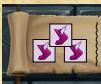
Strength / Agility Skills: Discard from your pool the number of strength or agility dice that matches the cost of the skill.

Magic Skills (Spells): Discard from your pool one or more magic dice. Their values must add up to at least the mana cost indicated on the spell. Ex: A 1 and 2 would pay for this skill.

Free Skills: There is no cost to use a free skill. It may still only be used once per encounter.

Potions: Discard one potion token from the Turn Reference. A potion token can be used by a hero to gain the effects of any one potion ability the party has identified.
After paying the cost for the skill or potion, perform its effects. Effects use the following keywords:
Gain: Take a die of the given color from the supply and add it to your pool, showing the number indicated.
Roll: Take a die of the specified color, roll it, and add it to your pool.
Increase: Change the value of one of the dice in your pool by the indicated amount. A die's value cannot go above 6 or below 1.
Reroll/Change: Alter dice already in your pool.
Prevent: Ignore symbols in challenge boxes during Suffer Consequences.
Discard: Place the die in the general supply.
Healing and Invisibility potions can be used during times other than encounters. In a 2P game, both heroes skip the encounter if an Invisibility potion is used. Only one hero heals when a Healing potion is used.
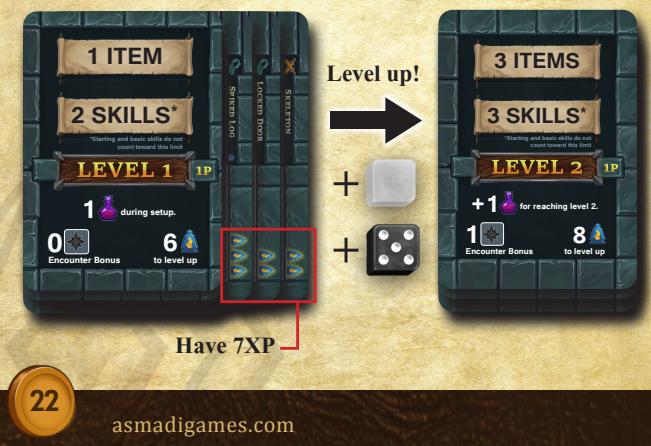
LEVELING UP
At the end of an encounter, if the party has enough experience tucked under the level card, the heroes all level up together!
Remove the level card and cards with enough XP to achieve the new experience level. Place them in the game box. Any unused XP cards are not removed.
Each level-up will grant one free potion token. Also, your heroes' capacity for holding items and learning skills will increase. Finally, the level card indicates how many free heroic dice the party gains for each encounter and Boss Fight round. The party chooses which hero rolls the bonus heroic dice each time.
Level 4 is the maximum level. Instead of leveling up, the party may spend 5 XP to gain a potion while at experience level 4.
DESCENDING
The stairs card is placed at the bottom of the dungeon deck at the start of each floor of the dungeon. When it's revealed, the path deeper into the dungeon opens. If you dawdle too long, though, the various fiends of the dungeon will catch up to you.
While the stairs card is visible, place a damage token on it for each time spent for any reason. Each time three tokens are on the card, a hero takes one damage and three tokens are removed from the stairs card. This can happen multiple times.
The party can descend at the end of any turn when the stairs card is visible, or immediately if the stairs are revealed while spending time to start a turn. To descend, discard all doors currently in play and shuffle the discard pile to form a new deck. Place the stairs card on the bottom, again. Slide the dungeon card up, to reveal the new floor's effects and challenge boxes. All visible effects and challenge boxes, including ones from previous floors, are now in effect.


BOSS FIGHT
When you descend from the third floor of the dungeon, flip over the dungeon card. It's time to fight the boss! The Boss Fight consists of multiple rounds. The boss has a health value and a special ability along the bottom of its card. After each round, the party will deal damage to the boss.

Heroic feats marked with cannot be used in the Boss Fight. If you have any heroic dice stored on your hero card for such a feat, return them to the general supply before the fight. The following steps occur each round:
1) Gather and Roll Dice: Just like a Combat Encounter.
2) Place Dice / Use Skills: Same as a Combat Encounter. Skills and potions usable during a Combat Encounter can be used in the boss fight. Each skill can be used once per round.
3) Consequences: Suffer consequences for uncovered challenge boxes.
If this damage causes the game to end, stop before moving on to step 4.

4) Strike the Boss: For eachcovered, place one damage token on the boss. If the boss has at least as many damage as health, the party has defeated it and the heroes win the game!
5) New Round: Return all dice in pools and on the boss to the general supply, and begin a new round.
Forest of Shadows: At the start of each round, the party must attempt to Resist Poison if they have any poison tokens. (see p28: Poison)

After rolling dice and using skills (and removing all 1s due to the Yeti's special ability), the Warrior is lucky enough to fill most of the boxes on the Yeti, starting with the Armor box.
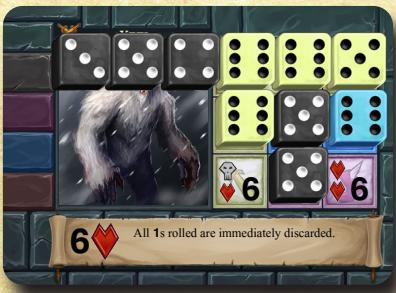
The Warrior takes three damage, but the Yeti also takes three damage, thanks to the three coveredboxes. All dice are cleared, and a new round begins. If the warrior can survive, she might overcome the Yeti on the next round!
CAMPAIGN MODE
Campaign mode allows you to build up a hero's power over multiple plays. Each campaign sheet represents one player's adventures with one of the five heroes. At the end of each game you'll earn check-marks that you can apply toward earning talents. They will help you in future games.
You earn one check-mark for each time you descended or leveled up, and an additional three if you defeated the boss. After an easy (one dot) dungeon, you can only check off green circles, after a medium (two dot) dungeon, green circles or yellow squares, after a hard (three dot) dungeon, any colored spaces. Once all spaces next to a talent have been checked off, you have unlocked that talent for future games. You can apply checkmarks to any talent, and fill the boxes in any order you choose.
There are four groups of talents, called focuses. Basic talents can be used in every game. At the start of each game, choose one other focus to be active. Talents from the two inactive focuses cannot be used during that game.
Talent that have a, oricon ork juit like kills ht you can use once per appropriate encounter (just like combat skills, combat talents can also be used in the boss fight). Other talents are in effect all the time. Your basic skill from the Veteran talent does not count against the skill limit on the level card. Using a talent does not cost any dice.
Use the boxes at the bottom of the campaign sheet to track how many games you've played, and which bosses you've defeated. Try to defeat all of them in as few plays as possible!
CHALLENGE TIERS
When playing in campaign mode, choose from four difficulty levels. Playing on more difficult challenge tiers will give you more check-marks for the campaign sheet if you reach the boss, whether or not you defeat it.
Novice: Before the game begins, advance to experience level 2. This includes gaining a second potion.
Standard: Before the game begins, draw one card and claim it as experience. Gain one extra check-mark if you reach the boss.
Veteran: No rules changes. Gain two extra check-marks if you reach the boss.
Fearless: Start without a potion. Gain three extra check-marks if you reach the boss.
CAMPAIGN SHEET EXAMPLE
Previously, Lyra the Archer has earned a number of check-marks (shown in black), including enough to gain the Veteran talent.
| BIC | 000 | Veteran: Start each game with any one Bas | |
| 000Z 000ZZ | Durability: You have one extra health. |
In her latest adventure, she went into the Yeti's Cavern, a medium-difficulty dungeon. She made it to the third floor, and reached experience level 4, at the Standard challenge tier. Two checks for clearing floors 1 and 2, and three checks for reaching experience levels 2, 3 and 4. Since she didn't reach the boss fight, she does not receive the 1 bonus check for Standard. The five new checks (shown in red) are enough to earn the Durability talent!
FOUR PLAYER RULES
With two sets of One Deck Dungeon (or with the base set and an expansion), you can play as a four hero party. With four heroes, two encounter decks are shuffled together, and most things in the game are doubled. Closed doors have two face-down cards, and when the party chooses to Enter a Room, they split up into two groups of two to face the two encounters. Each is resolved separately, as a 2P encounter. The party chooses which order to resolve the encounters. A number of other changes are necessary, as well.
FOUR PLAYER CHANGES
A four player game requires two sets of One Deck Dungeon, and the following changes to rules:
Setup: Each of the four players chooses a hero. Flip hero and experience level cards to the 2P side, and the stairs card to the 4P side. Place two potions on the Turn Reference, or four if on the novice challenge tier. Shuffle both decks together to form one encounter deck.
• Time Passes: Spend four time instead of two, each turn.
• Explore: Each closed door is two face-down cards in a stack. If you would create a stack with only one card, discard it.
• Enter a Room: Flip both cards in the stack face-up to become one open door. The party must choose to flee or have two encounters.
Encounters: The party must split up into two pairs to have the two encounters. They may be resolved in either order. Damage from consequences and effects from an encounter must be assigned to a hero in that encounter. Each encounter requires all dungeon boxes to be filled, and all dice are cleared before the second encounter.
General Supply: For each encounter (or boss round), the dice in the general supply are divided into two identical supplies, one for each pair of heroes. When some dice have been exiled, divide by color as evenly as possible. The general supply should have 12 potion tokens in a 4P game.
• Loot: After both encounters are complete, the party chooses how to assign the two cards as loot. One hero can claim both cards, if desired.
• Level Up: XP required to level up is doubled. The entire party levels up together, and gains two potions instead of one when doing so.
Stairs: The 4P stairs card is used. Every time six tokens are placed on the stairs, any two heroes each take one damage token (even if not the heroes currently in an encounter).
Boss: The boss has double health. During each boss round, the party splits up into two pairs. Each pair, in turn, has a normal 2P round against the boss. If the first pair kills the boss, the game ends before the second pair has to fight. The party can split up differently in each round. A boss special ability that happens at the start of each boss round happens separately for each pair.
• Minotaur: X = 2 times damage, instead of 4 times damage.
• Dungeon Abilities: Effects that trigger each turn, each explore action, or when entering a floor have their impact doubled.
• Invisibility Potion: An invisibility potion skips an encounter for one pair of heroes. The other encounter is unaffected.

Poison: Split into two groups of two to each Resist Poison, any time the party is required to do so. The visible are split as evenly as possible between the two groups, before rolling.
Hordes of the Things: This optional card can be added to 4P games to make them more challenging. Good luck!
FOREST OF SHADOWS EXPANSION RULES
POISON
In addition to damage and time, Forest of Shadows challenge boxes contain poison () icons. If not covered, a poison icon causes a green poison token to be placed on a hero.
Poison is not damage. It builds up slowly, and can become very dangerous if not dealt with. Each time the party takes an explore turn (and at the start of every boss round), they must Resist Poison, by rolling any one die. If its value is higher than the number of poison tokens in the party, they are successful, and one poison token is removed. Otherwise they fail. One poison token is still removed from a hero, but two damage tokens are added to the same hero.
Half of the encounter cards in Forest of Shadows have a leaf icon () next to the card title. For each leaf on an open door when the party resists poison, add 1 to the roll. These represent antidote herbs scattered around the forest.
• If there are no poison tokens in the general supply, place a damage token instead, for each poison token that would be placed.
• Any effect that heals a damage token can instead remove a poison token.
• The Resist Poison roll is only affected by skills, abilities, or effects that directly mention it.
EXILE
Several effects call for a die or token to be exiled. An exiled die or token is placed in the game box, unavailable for the remainder of the game.
HYBRID DUNGEON / MIXING SETS
You can mix cards from One Deck Dungeon with Forest of Shadows to create a hybrid encounter deck. Use 22 cards from each, specifically all the cards with a () or () next to the card's title. Use the Hybrid Dungeon side of the Resist Poison card, which changes success to no longer remove a poison token.
You can freely mix heroes from different sets. When selecting a dungeon, it should match the cards in the encounter deck. With a hybrid deck, you can use any dungeon. For a 4P hybrid deck, mix all 44 cards from each of the two different sets together. Note that there will be only 8 poison tokens available in a 4P hybrid game.
CURE POTION
The Forest of Shadows Turn Reference has a Cure potion instead of Healing. It passively adds healing to every potion you use, and to every potion token you gain. When using the Turn Reference with the Cure potion, the party begins the game with one Basic Potion type available. Choose any one of the four on the card, and tuck it under the Cure potion during setup.
• If you use a potion but have no damage to remove, the healing effect is lost
• You can choose to spend a potion token anytime to use the Cure potion to heal one damage, it just isn't as efficient.
• The party does not get an extra second potion token at the start of the game for the Basic Potion card.
SPLIT-LOOT PERILS
Some Peril encounters have an arrow next to each choice, one with Item' and one with Skill' inside, pointing at that edge of the card. The only way to take the item as loot is to make the item choice, likewise the only way to take the skill is to make the skill choice. You can take the card as XP with either choice.
FREQUENTLY ASKED QUESTIONS
Start of Turn / Explore
Q: Can I enter an already-open door and then flee from it?
A: No. You can only flee if you open a closed door.
Q: What happens if the Stairs Card is revealed while exploring?
A: You place as many closed doors as you can, and then the turn is over. In a 4P game, if you would place a door with just one card, discard it instead.
Rolling Dice and Using Skills
Q: In a 2P game, how does sharing dice work? Can I use my partner's dice for skills? What about skills like Cleave?
A: Dice that you roll or gain for any reason are “yours". This includes your attribute dice, dice rolled from your heroic feats before an encounter, dice rolled or gained by normal skills, and heroic dice granted by the Experience Level card (players choose who gets to roll these dice). Keep your dice separate from your partner's. You cannot use your partner's dice to pay for skills. Skills like Cleave that affect “your" dice cannot affect your partner's. You and your partner can each contribute a die together to create a heroic die. In this case, choose which player gains the new die.
Q: Can I use skills to avoid Split, Ethereal, Weakness Curse, or Daring Gamble? A: No. These effects happen immediately after rolling dice.
Q: Can I use dice I gain from one skill to pay for another?
A: Yes. Once gained or rolled, your new dice can be used for any purpose.
Q: What can I do if I run out of available dice?
A: You may discard dice at any time to the supply if you don't want them. This can allow you or your partner to gain them from another skill or potion.
Q: Can I use free skills more than once?
A: Each skill may only be used once per encounter.
Q: Can I use one blue die to pay for more than one spell?
A: No. Each spell is paid for individually, and dice used are discarded.
Potions
Q: How do I get potions?
A: You get one potion token to start the game. You gain one potion token each time you level up. If you identify a potion as loot, tucking it under the Turn Reference Card, you gain one potion token. The “Prepared" talent gives you one extra token to start the game.
Q: When can I use potions?
A: Invisibility is used before an encounter. Healing potions are used at the start of a turn to heal 3 damage from a single hero, or during battle to heal 2 damage from a single hero. All other potion types are used during an encounter, at the same time you can use skills.
Damage, Time, and Prevention Skills
Q: When do I use damage and time prevention skills?
A: Use them during the encounter. During the Suffer Consequences part of the encounter, subtract the prevented damage or time from the visible icons, before taking damage and spending time.
Q: How do Freezing Winds and Blade Storm work with prevention skills / sharing damage? What time and damage count toward these triggers?
A: Freezing Winds and Blade Storm only care about damage dealt and time spent during Suffer Consequences. Ignore the costs of skills, peril choices, or combat effects. First, count up how much damage and time is on all uncovered boxes. Then, apply prevention skills that were used (ex: Dodge). If there is still enough time to be spent to trigger Freezing Winds, or damage to trigger Blade Storm, add one damage. Finally, divide the damage up between characters, and then spend any required time.
Q: What happens if the Stairs Card is visible and causes damage during Suffer Consequences?
A: Resolve this damage after the Suffer Consequences step.
Q: On a Peril Encounter, when do I spend time for the choice I made?
A: Immediately upon making the choice, before heroic skills or rolling dice. This time is not part of the Consequences of the encounter.
STORY MODE: ARTIFACT QUESTS
Thanks to a stretch goal from the Forest of Shadows Kickstarter, we've added an extra set of challenges with stories, called Artifact Quests. Carrying artifacts into the dungeons increases their difficulty, but is necessary to dispel their dark magic and reveal their secrets!
You can access it (for free!) at: OneDeckDungeon.com/story
COMBAT ENCOUNTER EXAMPLE
The Mage rolls her dice in combat:
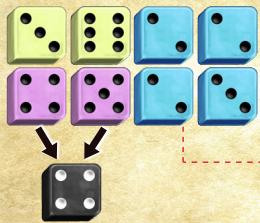
The armor boxes are filled first. Then, two dice are spent to gain a heroic die, since the agility dice were otherwise useless. Finally, other dice are placed in challenge boxes, including the dungeon card's box. No 1s were rolled, so Split has no effect.
The consequences of the combat are


CREDITS
Created by Chris Cieslik
Art Directed by Alanna Cervenak
Core Artwork by Will Pitzer
Additional Art by Vicki Sarkeesian
Editing by Alys Dutton
Playtesting & Development: Eric Reuss, Julia Urquhart, Kat Dutton, Rob Seater, Mike Walsh, Marc Hartstein, Jacob Davenport, Evan Derrick, Kevin O'Brien, the many people who downloaded and tried our Print and Play, our Kickstarter backers, and all our Department of Fun visitors at Gen Con!
VISIT US ONLINE
@AsmadiGames
AsmadiGames.com + OneDeckDungeon.com
ffacebook.com/AsmadiGames
twitch.tv/AsmadiGames
Get the One Deck Dungeon Soundtrack and other
bonus content from OneDeckDungeon.com!
© 2021Asmadi Games
Asmadi Games | 23 Windsor St #2 | Arlington MA 02474

原文为社区整理/出版社公开资料,版权归原作者,仅供个人学习查阅。