
Orapa MineOrapa Mine
一句话概览
Orapa Mine 是一款已收录于村了吗规则库的桌游,支持 2–5 人,原名 Orapa Mine。
本页内容:一句话概览 · 常见问题
这游戏怎么玩
- 本站已收录这款游戏的规则资料,可以在对话里直接提问规则细节。
常见问题(FAQ)
以下 1 条问答中 0 条来自站内玩家的真实提问,其余 1 条为本站整理的常见疑问;答复内容保持原样。
Orapa Mine支持几个人玩?
2–5 人。
去哪查完整规则
想核对具体规则细节、卡牌效果或某个回合的结算方式,可以在村了吗里选中这款游戏后直接提问。
同类桌游
- 卡坦岛德式
- 工业革命:伯明翰德式
- 勃艮第城堡:特别典藏版德式
- 方舟动物园德式
- 卡卡颂抽象
- 瘟疫危机传承:第一季美式
- 阿瑞迪亚:勇踏征途美式
- 重塑宇宙德式
- 幽港迷城美式
- 埃多拉的德鲁伊德式
规则原文(Markdown)
本站收录这款游戏的规则原文 1 个文件,此处内联渲染 1 个,可直接展开阅读或下载。
OrapaMine_aco_ol_EN.md8.3 KB
@ 02Λ2Λ MINE
8+ 2-5 20 ages players min.
An inquiry has been made to locate gemstones at the Orapa Mine, the world's largest diamond mine. By shooting ultrasonic waves deep into the ground, we can determine the position and condition of the gemstones based on where they return from. Occasionally, the ultrasonic waves may bounce back strangely, but as experts, we will ultimately find the gems. Just as we always have.
Components
2 Mine boards, 5 screens, gem 2 sets (each with 7 pieces), solution sheet
Game Setup (3 or more people)
One problem designer is selected. The problem designer arranges gems in the mine and does not participate in the competition to find the gems. Their role is solely to communicate the results of the ultrasonic scans to the explorers.
• Preparation of the problem designer : Bring one mine board and one gem set, along with one screen. Unfold the screen and cover the mine board. In the basic version, use only 5 pieces from the gem set of 7 (1 red, 1 blue, 1 yellow, 2 white), excluding the 2 black pieces. Place these 5 pieces on the mine board according to the following rules.
a. Place the corners of the gem pieces to align with the points on the board. Align the grid pattern inside each piece with the grid on the board. The grid pattern inside the piece cannot be placed diagonally. Gem pieces must be placed entirely within the grid.
b. You cannot place edges of the pieces directly adjacent to each other. However, corners can touch edges, and corners can touch corners.
c. You cannot cover the X marks in the center of the board, nor can gem pieces be placed touching or covering these marks.
d. From the edge of the board, you cannot place any one piece in such a way that it becomes completely surrounded by other pieces.
• Preparation of the explorers : All other players become explorers. The explorers must find and record the positions and shapes of the gems placed by the problem designer on their solution sheets. The first explorer to accurately record this information wins.
Each explorer brings one solution sheet and one screen. They use the screen to cover their solution sheet so that its contents are not visible to others. Each explorer prepares a pencil and eraser.
All preparations are complete. The remaining gem pieces and mine boards will be used for 2 Player play / Blackbody Expansion, etc, among others. Rules for 2 Player play / Blackbody Expansion will be explained separately later.
Play!
The player seated to the left of the problem designer takes turns clockwise. On their turn, each player fires one ultrasound. The problem designer then informs all players of the results of the ultrasound.
On the solution sheet, there is a grid of 10 x 8. Players select a number (1-18) or a letter (A-R) from the edges of the grid to fire an ultrasound. The ultrasound travels in a straight line from the chosen location, bouncing off minerals at right angles or horizontally and vertically before exiting the mine. The problem designer must specify to all players (A) the edge point from which the ultrasound exits, (B) The color it exits as. All explorers then record this information on their solution sheets according to their own method.
• Explorers can inquire about the results of a previously fired ultrasound. In this case, they do not use their own turn to fire a new ultrasound. This allows them to clarify or reconsider information without advancing the game state.
• If needed, explorers can inquire about (C) the number of times the ultrasound has reflected off minerals instead of (B) the color of the ultrasound. In this case, they use their turn to ask this question. The problem designer must still provide (A) the exit point of the ultrasound in response to the query.
[ Ultrasound Shooting Example ]
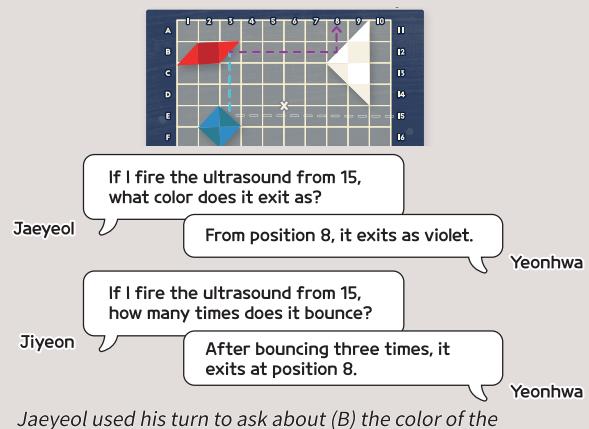
Jaeyeol used his turn to ask about (B) the color of the ultrasound. Jiyeon guessed there would be a white gem along that path and asked about (C) the number of times the ultrasound bounced off gems.
The color of the gem
At the Orapa Mine, there are 5 types of gems: red, blue, yellow, white, and black. The ultrasound fired by explorers is transparent. When it hits the gems, its color changes accordingly, and if it interacts with multiple gems, their colors may mix.

a. When the ultrasound hits a white gem, its color changes to white. Similarly, it changes to red when hitting a red gem, and likewise for other colors it encounters.
b. When the ultrasound hits red and yellow gems, it changes to the intermediate color, orange. If it hits red and blue gems, it changes to violet. If it hits yellow and blue gems, it changes to green. If the ultrasound hits red, blue, and yellow gems simultaneously, it changes to black.
c. When the ultrasound hits red and white gems, it changes to the intermediate color, pink. If it hits yellow and white gems, it changes to lemon yellow. If it hits blue and white gems, it changes to sky blue.
d. Occasionally, the ultrasound may hit the same color gem multiple times or encounter multiple colors before hitting white. In such cases, detailed color changes are not precisely detected. It is assumed that each color is encountered only once, or white is ignored.
[Example colors of minerals]
b. If the ultrasound hits two of the red, yellow, or blue gems, it changes to the intermediate color between them.

c. If the ultrasound hits red, yellow, blue, and white gems, it changes to the intermediate color between them.
d. When the ultrasound hits gems of multiple colors, it does not detect color changes in detail. If it hits three or more types of gems, white gems are ignored.

Game End
The player who first accurately guesses the positions and arrangements of all gems wins. At any point during the game, explorers can submit their solution sheets containing their answers to the problem designer. The problem designer reviews the sheet, and if it matches the current layout of the gems exactly, that explorer wins. If incorrect, that explorer loses and is immediately eliminated from the game. Other explorers still have opportunities to submit their solution sheets.
2 Player play!
If two players are playing, they can fully enjoy Orapa Mine.Each player acts as both the problem designer and an explorer.
• Each player, acting as the problem designer, arranges gem pieces on their respective mine board. As explorers, they each prepare a pencil and eraser to record their exploration results on a solution sheet. Both the mine board and solution sheet are covered with screens.
• The players determine the starting player and take turns asking and answering questions. The rest of the game proceeds as described earlier. As explorers, the player who first accurately guesses the positions and arrangements of all gems on the opponent's mine board wins.
Blackbody Expansion
If you're familiar with gem exploration, you can try playing the more challenging Blackbody expansion.
• You can add black gem pieces to the mine. Players can agree to use either 1 or 2 additional pieces. Using 2 pieces will make the game more challenging.
• Black gem pieces do not reflect ultrasound. The ultrasound dissipates upon hitting a black gem and does not exit anywhere. Instead of specifying the exit point of the ultrasound, the problem designer responds with It has dissipated.
• Explorers can spend their turn during exploration to ask where something is located?'. For example, you can ask, "What is at 4, E?” The response could be "Nothing is there,""There is a white gem," "There is half of a red gem," and so on.
• Black gem pieces make it impossible to accurately predict the final layout. Explorers should record only the positions where gems are known to exist on their solution sheets.
[Example of the Blackbody expansion]

During the process of observing ultrasound waves, Jiyeon successfully deduced the location of the black mineral but could not determine the orientation in which the black mineral was placed. Jiyeon marks the black mineral on the solution sheet as described above and continues with the exploration.
下载 Markdown原文为社区整理/出版社公开资料,版权归原作者,仅供个人学习查阅。