
仙境梦游Parade
一句话概览
仙境梦游 是一款已收录于村了吗规则库的桌游,支持 2–6 人,原名 Parade。
本页内容:一句话概览 · 游戏概述 · 1. 游戏组件 · 2. 游戏设置(游行准备) · 3. 回合流程 / 行动介绍 · 4. 最后一轮和游戏结束 · 5. 计分 · 6. 获胜条件 · 7. 二人游戏规则 · 关键规则与常见问题 · 常见问题
仙境梦游 规则速览
以下规则速览由本站整理,与官方规则书表述不同,仅供快速上手参考。
游戏概述
梦境中的盛大游行已然开始,人人都身着盛装,街道也被各处粉饰。你是这次游行的一个组织者,一直在努力劝说更多的人加入到游行中来;但只过了很短的时间,人们便开始对游行失去兴趣——如果有穿着同样服装或者更高阶的人物出现,他们便会立刻离开游行并且向你抱怨。玩家需要打出手牌,同时尽可能从游行队列中拿取最少的卡牌:没人希望在梦境中得分,因为都是黄粱美梦。
核心机制: 手牌管理、游行队列移除机制、颜色与数值比较、最低分获胜。
1. 游戏组件
| 组件 | 数量/说明 |
|---|---|
| 卡牌 | 66张(分为6种颜色,价值从0到10,每种11张) |
| 计分板 | 1张 |
2. 游戏设置(游行准备)
随机决定起始玩家,从起始玩家开始顺时针进行游戏。
- 起始玩家洗匀牌堆,面朝下发给每名玩家5张卡牌。
- 在桌子中间面朝上额外放置6张卡牌(一张挨着一张),这些卡牌就是最初的游行参与者。
- 将游戏盒摆放在游行队列的任意一端用来标记游行队列的开头,另一端则被叫做游行队列的末尾。
- 剩下的卡牌面朝下放在桌子中间,这就是抽牌堆。
3. 回合流程 / 行动介绍
轮到你的回合时,按照下面的顺序执行行动:
- 选择你手牌中的1张卡,把它面朝上放在游行队列的末尾。这张卡牌在下一个行动计算卡牌数量时不作计算。
- 如有必要,移走游行队列中应被移走的卡牌并摆放在自己面前。
- 从抽牌堆抽牌,直到将手牌补充至5张。
然后下一名玩家进行她的回合,执行相同的行动。
3.1 移走卡牌的判定
根据打出的卡牌,一些卡牌需要从游行队列中被移走:
- 如果参与游行的卡牌数量小于等于打出的卡牌的价值,没有卡牌需要被移走。
- 如果参与游行的卡牌数量大于打出的卡牌的价值,那么一些卡牌可能被移走。
- 想要决定哪张卡牌会被移走:从游行队列的末尾开始数牌,直到队列开头,刚打出的那张牌不用数;每张位置编号大于刚打出的那张牌价值的牌进入"移除模式"。
- 如果一张价值0的卡牌被打出,所有卡牌进入移除模式。
3.2 移除模式中的判定
使用以下规则决定移除模式中的哪张卡牌会被移走:
- 所有与打出的卡牌颜色相同的牌;
- 所有与打出的卡牌相比,价值更低或者相等的牌。
记住,你只能移除在"移除模式"中的卡牌。
3.3 移除后的整理
移除的卡牌面朝上放在玩家面前,并且按照颜色分堆摆放。所有卡牌的价值需对所有玩家可见,所以最好每种颜色的牌都顶部错开叠成一列放置(露出分值)。接着,把队列中剩下的卡牌依次向游行队列的开头移动,填补因为移走卡牌而产生的空缺。
3.4 移除举例
一张卡牌(绿色-3)从手牌中打出并被放在游行队列的末尾。因为这张卡牌价值为3,所以你忽略接下来的3张卡牌(这些卡牌不受刚打出来的这张牌的影响),剩下的4张卡牌则可以被移除,它们也正是玩家移走的牌:
- 所有与打出的卡牌颜色相同的牌:例如,绿色-0和绿色-7这2张牌必须被移除。
- 所有与打出的卡牌相比价值更低或相等的牌:例如,红色-3这张牌必须被移除。
记住,你只能移除在"移除模式"中的卡牌。
4. 最后一轮和游戏结束
- 当一名玩家收集到所有6种颜色的卡牌后,或者当抽牌堆被耗尽后,最后一轮开始。
- 如果一名玩家收集到了第6种颜色的卡牌,她依旧结束她的回合。然后,每个玩家(包括收集到第6种颜色卡牌的玩家)再进行额外一轮;但是,这轮中玩家不能从抽牌堆摸牌。游戏在这最后一轮结束后结束。
- 如果抽牌堆耗尽,则所有玩家再进行额外一轮,游戏在每个人手牌中都只有4张卡牌后结束。
- 如果有其他玩家在最后一轮中也获得了她的第6种颜色的卡牌,这不会有什么影响,这轮结束后游戏也结束。
5. 计分
游戏结束后,每个玩家从她的手牌中选择2张卡牌弃除;然后,手牌中剩下的2张卡牌加入到玩家面前。注意:这样的2张卡牌可以加入到一种你已经拥有的颜色,或者重新自成一堆(如果你没有任何那种颜色的卡牌的话)。只有摆在玩家面前的卡牌会被计分,还在参与游行的卡牌请清除。
对于每种颜色,玩家需要决定它们各自的分值,所以每种颜色分开计分:
- 决定拥有每种颜色卡牌数量最多的玩家。这个玩家或这些玩家把数量最多的这个颜色的卡牌翻面,这些面朝下的每张卡都算作1分(印在卡牌上的价值不计算)。
- 每名玩家将她所有面朝上的卡牌上的价值加起来。将这个总计与从面朝下的卡牌中获得的分数相加,就是最终得分。
计分举例
括号中的数字表示卡牌的价值。
- 爱丽丝: 3张红色卡牌(10,8,3),5张蓝色卡牌(9,7,6,5,0),1张紫色卡牌(0),2张绿色卡牌(4,2),3张灰色卡牌(7,4,0)。爱丽丝拥有最多数量的蓝色和灰色卡牌。红色计 10+8+3=21;蓝色按5张卡牌翻面各算1分;紫色为0。
- 帽客: 2张红色卡牌(1,0),1张蓝色卡牌(8),4张紫色卡牌(8,7,5,3),3张灰色卡牌(9,8,1),2张橙色卡牌(10,1)。帽客拥有最多数量的紫色和灰色卡牌。
- 裂嘴猫: 4张红色卡牌(7,6,5,2),2张蓝色卡牌(4,3),2张紫色卡牌(2,1),4张绿色卡牌(9,8,7,6),1张灰色卡牌(10),3张橙色卡牌(3,2,0)。裂嘴猫拥有最多数量的红色、绿色和橙色卡牌。
帽客赢得此游戏。
6. 获胜条件
梦境总是有点如露亦如电,所以分数最低的玩家获胜。如果平手,平手玩家中面前卡牌(翻面且朝上的那些卡)数量最少的玩家获胜。
7. 二人游戏规则
唯一改变的规则是计分时决定谁多谁少的方式:只有当一名玩家比另外一名玩家多出2张或者更多一种颜色的卡牌时,她才胜出。
关键规则与常见问题
易错规则
- 打出的那张牌不参与本轮计数,计算移除模式时刚打出的牌要被跳过。
- 先看数量、后看颜色与数值: 只有在游行队列卡牌数量大于打出牌价值时才可能移除卡牌,数量小于等于价值时没有卡牌需要被移走。
- 只有"移除模式"中的牌才能被移除:位置编号大于打出牌价值的那部分卡牌以外的牌不会受影响。
- 价值0的牌打出时,所有卡牌进入移除模式。
- 移除的牌按颜色分堆放在自己面前,且必须让所有玩家都能看到其价值。
- 忘记补牌: 每次回合结束要抽牌把手牌补充至5张(最后一轮除外,那一轮不能从抽牌堆摸牌)。
- 游戏结束的两种触发不同: 有人收集到全部6种颜色时,该轮之后每人再走一轮且不能摸牌;抽牌堆耗尽时,每人再走一轮,结束时每人手牌只有4张。
- 只有面前的卡牌计分,还在游行队列中的卡牌要清除。
- 计分时先弃2张手牌,再把剩余2张加入自己面前(可并入已有颜色,或另起一堆)。
常见问题
-
Q:什么时候进入最后一轮?
A:当一名玩家收集到所有6种颜色的卡牌后,或者当抽牌堆被耗尽后,最后一轮开始。 -
Q:最后一轮还能从抽牌堆摸牌吗?
A:如果是因为有人收集到第6种颜色而进入的最后一轮,这轮中玩家不能从抽牌堆摸牌;如果是因为抽牌堆耗尽,则所有玩家再进行额外一轮,游戏在每个人手牌中都只有4张卡牌后结束。 -
Q:怎样才算赢?
A:分数最低的玩家获胜;平手时,平手玩家中面前卡牌数量(翻面且朝上的那些卡)最少的玩家获胜。 -
Q:二人游戏有什么不同?
A:只有计分时判定"谁拥有某种颜色最多的卡牌"的方式不同——只有当一名玩家比另一名玩家多出2张或更多该颜色的卡牌时,她才胜出(并在该颜色上翻面计分)。
常见问题(FAQ)
以下 1 条问答中 0 条来自站内玩家的真实提问,其余 1 条为本站整理的常见疑问;答复内容保持原样。
仙境梦游支持几个人玩?
2–6 人。
去哪查完整规则
想核对具体规则细节、卡牌效果或某个回合的结算方式,可以在村了吗里选中这款游戏后直接提问。
同类桌游
- 卡坦岛德式
- 工业革命:伯明翰德式
- 勃艮第城堡:特别典藏版德式
- 方舟动物园德式
- 卡卡颂抽象
- 瘟疫危机传承:第一季美式
- 阿瑞迪亚:勇踏征途美式
- 重塑宇宙德式
- 幽港迷城美式
- 埃多拉的德鲁伊德式
规则原文(Markdown)
本站收录这款游戏的规则原文 2 个文件,此处内联渲染 2 个,可直接展开阅读或下载。
rules_zh_仙境梦游_3997.md7.2 KB
RULEBOOK
parade
梦境中的盛大游行已然开始。人人都身着盛装,街道也被各处粉饰,尽是一派欢腾景象。
让我们寻找更多的人加入游行吧.
你是这次游行的一个组织者并且一直在努力劝说更多的人加入到游行中来.
如果已经参与到游行中的人不要那么早离开,就好了…
只过了很短的时间,人们便开始对游行失去兴趣。如果有穿着同样服装或者更高阶的人物出现,它们便会立刻离开游行并且向你抱怨。
你只是希望每个人都从中获得快乐,但是为什么这却那么难呢?
游戏目标
玩家需要打出她们的手牌,但是尽可能从游行队列中拿取最少的卡牌。没人希望在梦境中得分(因为都是黄粱美梦啊)。
游戏配件
66 张卡牌 (分为6种颜色, 价值从0到10, 每种11张), 1张 计分板
游行准备
随机决定起始玩家.从起始玩家开始,顺时针进行游戏.起始玩家洗匀牌堆并面朝下发给每名玩家5张卡牌.然后,在桌子中间面朝上额外放置6张卡牌(一张挨着一张).这些卡牌就是最初的游行参与者.将游戏盒摆放在游行队列的任意一端用来标记游行队列的开头.另一端则被叫做游行队列的末尾.剩下的卡牌面朝下放在桌子中间,这就是抽牌堆.
回合流程
轮到你的回合时,你按照下面的顺序执行行动.
-
选择你手牌中的1张卡把它放在游行队列的末尾.
-
如有必要,移走游行队列中应被移走的卡牌并摆放在自己面前.
-
从抽牌堆抽1张牌.
然后,下一名玩家进行她的回合,执行相同的行动。
行动介绍
-
玩家 从她的手牌中选择一张卡牌,面朝上放在游行队列末尾。这张卡牌在下一个行动计算卡牌数量时不作计算。
-
根据打出的卡牌,一些卡牌需要从游行队列中被移走.
如果参与游行的卡牌数量小于等于打出的卡牌的价值,没有卡牌需要被移走.
如果参与游行的卡牌数量大于打出的卡牌的价值,那么一些卡牌可能被移走.
想要决定哪张卡牌会被移走,从游行队列的末尾开始数牌,直到队列开头,刚打出的那张牌不用数.每张位置编号大于刚打出的那张牌价值的牌进入“移除模式”.
使用以下规则,决定移除模式中的哪张卡牌会被移走:
-所有与打出的卡牌颜色相同的牌
-所有与打出的卡牌相比,价值更低或者相等的牌(见举例)
移除的卡牌面朝上放在玩家面前并且按照颜色分堆摆放.所有卡牌的价值需对所有玩家可见,所以最好每种颜色的牌都顶部错开叠成一列放置(露出分值).
接着,把队列中剩下的卡牌依次向游行队列的开头移动,填补因为移走卡牌而产生的空缺。
如果一张价值0的卡牌被打出,所有卡牌进入移除模式.
- 玩家从抽牌堆抽取卡牌,直到将她的手牌补充至5张。

一张卡牌 (绿色-3) 从手牌中打出并被放在游行队列的末尾. 因为这张卡牌价值为3, 所以你忽略接下来的3张卡牌 (这些卡牌不受刚打出来的这张牌的影响). 剩下的4张卡牌则可以被移除, 它们也正是玩家移走的牌. 所有与打出的卡牌颜色相同的牌:
比如, 绿色-0和绿色-7这2张牌必须被移除.
所有与打出的卡牌相比, 价值更低或相等的牌:
比如,红色-3这张牌必须被移除.
记住,你只能移除在“移除模式”中的卡牌.

最后一轮和游戏结束
当一名玩家收集到所有 6 种颜色的卡牌后,或者当抽牌堆被耗尽后,最后一轮开始.
如果一名玩家收集到了第6种颜色的卡牌, 她依旧结束她的回合. 然后, 每个玩家, 包括收集到第6种颜色卡牌的玩家, 再进行额外一轮. 但是, 这轮中玩家不能从抽牌堆摸牌.
游戏在这最后一轮结束后结束.
如果抽牌堆耗尽,则所有玩家再进行额外一轮.游戏在每个人手牌中都只有4张卡牌后结束.
如果有其他玩家在最后一轮中也获得了她的第6种颜色的卡牌,这不会有什么影响.这轮结束后,游戏也结束.
计分
在游戏结束后,每个玩家从她的手牌中选择2张卡牌弃除。然后,手牌中剩下的2张卡牌加入到玩家面前。注意:这样的2张卡牌可以加入到一种你已经拥有的颜色或者重新自成一堆(如果你没有任何那种颜色的卡牌的话)。只有摆在玩家面前的卡牌会被计分。还在参与游行的卡牌请清除。
对于每种颜色,玩家需要决定它们各自的分值,所以每种颜色分开计分.
-
决定拥有每种颜色卡牌数量最多的玩家. 这个玩家或这些玩家把数量最多的这个颜色的卡牌翻面, 这些面朝下的每张卡都算作1分. (印在卡牌上的价值不计算.)
-
每名玩家将她所有面朝上的卡牌上的价值加起来. 将这个总计与从面朝下的卡牌中获得的分数相加就是最终得分.
获胜条件
梦境,总是有点如露亦如电,所以分数最低的玩家获胜哦.如果平手,平手玩家中面前卡牌(翻面且面朝上的那些卡)数量最少的玩家获胜.

计分例子
括号( )中的数字表示卡牌的价值.
爱丽丝
3 张红色 卡牌 (10,8,3), 5 张蓝色 卡牌 (9,7,6,5,0), 1 张紫色 卡牌 (0), 2 张绿色 卡牌 (4,2), 3 张灰色 卡牌 (7,4,0).
爱丽丝 拥有最多数量的蓝色和灰色卡牌.
她的得分 计算如下:
$$
\text {红色:} 1 0 + 8 + 3 = \quad 2 1
$$
$$
\text {蓝色:} 5 \text {张卡牌} ^ {*} (1) = \begin{array}{l} 5 \ 0 \end{array}
$$
紫色: $0 =$
帽客
2 张红色 卡牌 (1,0), 1 张蓝色 卡牌 (8), 4 张紫色 卡牌 (8, 7,5,3), 3 张灰色 卡牌 (9,8,1), 2 张橙色 卡牌 (10,1).
帽客 拥有最多数量的紫色 和灰色 卡牌.
他的得分是:
总计:
裂嘴猫
4 张红色 卡牌(7,6,5,2),2 张蓝色 卡牌 (4,3),2 张紫色 卡牌 (2,1), 4 张绿色 卡牌 (9,8,7,6),1 张灰色 卡牌 (10),3 张橙色 卡牌 (3,2,0)
裂嘴猫 拥有最多数量的 红色, 绿色 和橙色 卡牌.
他的得分是:
$$
{ } ^ { * } ( 1 ) = \begin{array} { r } { 4 } \ { 1 0 } \end{array}
$$
$$
{ } ^ { * } ( 1 ) = 3
$$


帽客赢得此游戏.
二人游戏规则
唯一改变的规则是计分时决定谁多谁少的方式.
只有当一名玩家比另外一名玩家,多出2张或者更多一种颜色的卡牌时,她才胜出.
Designer: Naoki Homma
卡牌 Illustrations: Chris Quilliams
Development: Team Z-Man Games
©2008 naoki homma / GRIMPEUR, Inc.
©2013, 2015 F2Z Entertainment Inc.
31 rue de la Coopérative
Rigaud QC J0P 1P0
Canada
info@zmangames.com
www.zmangames.com
Parade.md7.4 KB
GP19C Parade
Number of players: 2 - 6 Duration: 30 minutes 10 years and older Author: naoki homma
The parade has started in Wonderland. Everybody is dressed up, the streets are decorated, excitement is in the air. Let' s find more people to join the parade.
You are one of the organizers of the parade and are constantly trying your best to encourage people to join the parade. If only the people already taking part didn' t leave so early... After a short while they just loose any interest in the parade. And if somebody shows up with the same dress or of higher rank, all they do is to leave the parade immediately and complain to you. You just want everybody to have fun, but why is it so difficult nowadays...?
Goal of the game
The players play their hand of cards while trying not to get cards from the parade, as these score negative points
Game components
66 cards in 6 colours with the values from 0 till 10
Preparation of the parade
The start player has to be determined. Starting with the start player the game continues clockwise.
The start player shuffles the deck and deals each player 5 cards face down. 6 more cards are placed face up next to each other in the middle of the table. These cards are the initial participants of the parade. The game box is placed at one end of the parade to mark the front of the parade. The other side is called the end of the parade. The remaining cards are placed face down as the drawing pile in the middle of the table.
Sequence of play
During his turn a player performs the following actions in the order given below.
-
He chooses one of the cards on his hand and lays it at the end of the parade.
-
If necessary, cards will be removed from the parade and laid in front of the player
-
He draws a card from the drawing pile
The next player performs the same actions during his turn.
Explanation of the actions
-
The player chooses one of the cards in his hand and places it face up at the end of the parade. This card does never count when counting the number of cards in the next action.
-
Depending on which card is played, some cards have to be removed from the parade.
If the number of cards already taking part in the parade is less or equal to the value of the played card, no cards have to be removed from the parade.
If the number of cards already taking part is larger than the value of the played card, the cards are numbered beginning at the end of the parade. The card which was played is not taken into account. Every card with a position number larger than the value of the played card enters the removal mode.
The player has to take some of the cards in removed mode - All cards with the same colour as the played card
- All cards with a value less or equal to the value of the played card
The removed cards are laid face up and divided into colours in front of the player. The values of all cards must be visible for all players, so it is best to lay them slightly shifted on top of each other.
The remaining cards in the parade are moved forward towards the front of the parade to close the gaps.
If a card with the value 0 is played, all cards enter removal mode.
- The player draws a card from the drawing pile to replenish his hand to 5 cards.
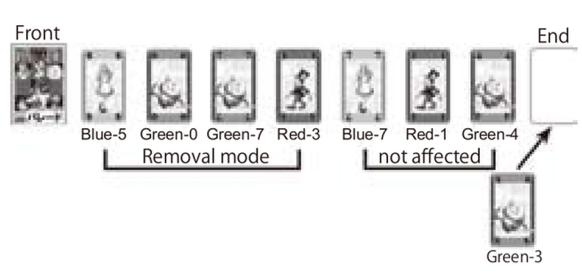
A card (Green-3) is played from the hand and laid at the end of the parade. The following cards have to be taken by the player.
All cards with the same colour as the played card Of all cards in removal mode, the cards Green-0 and Green-7 have to be removed.
All cards with a value less or equal the value of the played card Of all cards in removal mode, the card Red-3 has to be removed.
Last round and end of the game
The last round starts when a player has collected cards of all 6 colours or if the drawing pile is exhausted.
If a player has collected the 6th colour, he finishes his turn as before. After that every player including the one who collected the 6th colour plays one more turn. However the players don't draw a card from the drawing pile.
After this last round the game ends.
If the drawing pile is exhausted, every player plays one more turn. The game ends when everybody has only 4 cards left on their hand.
Even if other players get their 6th colour during the last round, this has no further effect. The games ends after the round.
Scoring
After the end of the game each player chooses 2 of his hand cards and discards them. The remaining 2 cards from his hand are laid to the other cards of the same colour already lying in front of the player.
Only the cards lying in front of a player are scored. The cards still taking part in the parade are discarded.
For each colour the negative points are determined separately. 1. For each colour it is determined, which player has the largest number of cards. For each card this player gets one negative point. The value of the cards is of no importance. If several players have the same number of cards, all of these player get the same negative points according to the number of cards. 2. With the exception of the player(s), who has the largest number of cards of a colour, all other players calculate the sum of the values of their cards. They receive this sum as negative point.
The player with the fewest negative points wins the game.
The player with the highest number of cards of a colour should turn over his cards. These cards lying face down count one point whereas for the cards of the other players lying face up the values have to be added.
Example
(List of the cards that each player has lying in front of him at the end of the game)
The numbers in parentheses () show the value of the cards in the different colours.
Player A
Red 3 cards (10, 8, 3), Blue 5 cards (9, 7, 6, 5, 0), Purple 1 card (0), Green 2 cards (4, 2), Grey 3 cards (7, 4, 0)
Player A owns the largest number of blue and grey cards. His negative points are calculated as follows:
Red: -(10+8+3) = -21
Blue: 5cards * (-1) = -5
Purple: -(0) = 0
Green: -(4+2) = -6
Grey: 3cards * (-1) = -3
Total: = -35points
Player B
Red 2 cards (1, 0), Blue 1 card (8), Purple 4 cards (8, 7, 5, 3), Grey 3 cards (9, 8, 1), Orange 2 cards (10, 1)
Player B owns the largest number of purple and grey cards. His negative points are:
Red: -(1+0) = -1
Blue: -(8) = -8
Purple: 4cards * (-1) = -4
Grey:3cards * (-1) = -3
Orange: -(10 + 1) = -11
Total:-27points
Player C
Red 4 cards(7, 6, 5, 2), Blue 2 cards (4, 3), Purple 2 cards (2, 1), Green 4 cards (9, 8, 7, 6), Grey 1 card (10), Orange 3 cards (3, 2, 0)
Player C owns the largest number of red, green and orange cards. His negative points are:
Red: 4cards -(-1) = -4
Blue: -(4 + 3) = -7
Purple: -(2+1) = -3
Green 4cards * (-1) = -4
Grey: -(10) =-10
Orange: 3cards * (-1) = -3
Total: = -31 points
Player B has won.
2 persons play
The rules don't change when playing with only 2 players, only the scoring is different.
If a player owns of a colour at least 2 cards more than the other player, the number of cards are his negative points. If a player owns only 1 card more or the same number of cards or less, the values of these cards are added up.
Imprint Author: naoki homma Illustrations: yuka saitou
Graphics design: kenji fushimi
Producer: shinsuke yamagami
Print: man-in-do inc.(E-mail:sakudou@mnd.co.jp)
Publisher: GRIMPEUR,Inc. (E-mail:info@grimpeur.co.jp)
For questions and further information about the game http://grimpeur.co.jp/
MADE IN JAPAN ©2008 naoki honma / GRIMPEUR, Inc.
下载 Markdown原文为社区整理/出版社公开资料,版权归原作者,仅供个人学习查阅。