
PlanetariumPlanetarium
一句话概览
Planetarium 是一款已收录于村了吗规则库的桌游,支持 1–4 人,原名 Planetarium。
本页内容:一句话概览 · 常见问题
这游戏怎么玩
- 本站已收录这款游戏的规则资料,可以在对话里直接提问规则细节。
常见问题(FAQ)
以下 1 条问答中 0 条来自站内玩家的真实提问,其余 1 条为本站整理的常见疑问;答复内容保持原样。
Planetarium支持几个人玩?
1–4 人。
去哪查完整规则
想核对具体规则细节、卡牌效果或某个回合的结算方式,可以在村了吗里选中这款游戏后直接提问。
同类桌游
- 卡坦岛德式
- 工业革命:伯明翰德式
- 勃艮第城堡:特别典藏版德式
- 方舟动物园德式
- 卡卡颂抽象
- 瘟疫危机传承:第一季美式
- 阿瑞迪亚:勇踏征途美式
- 重塑宇宙德式
- 幽港迷城美式
- 埃多拉的德鲁伊德式
规则原文(Markdown)
本站收录这款游戏的规则原文 1 个文件,此处内联渲染 1 个,可直接展开阅读或下载。
1-16pg-Planetarium-Rulebook_English.md35.6 KB
PLANÉTARIUMRules
Cards played to Planet C
Carra a land ret
Cards played to Panet B
| Vi | |||
| 3 C | |||
| IV | 120 | ||
| I10 | |||
| = | 100 90 | ||
| 8 80 70 | |||
| m | 6 60 50 | ||
| Ⅲ | 40 | ||
| 30 2 20 | |||
| 10 | |||
| 4 | VI | ||
| Eva | 2 | A | |
| 2 | |||
| D | |||
Cards played to Planet D
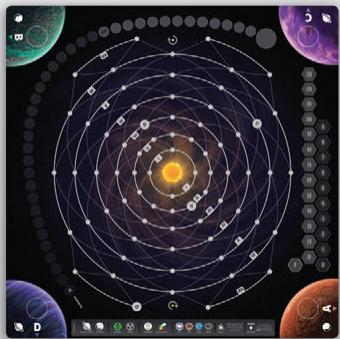
Place the game board in the middle of the table, leaving space around it for a row of cards to be placed on each side.
Place four Planet tokens on the matching A, B, C and D spaces on the board.
Turn the Matter tokens face down, mix them up, and place one on each white dot on the board. Turn all the Matter tokens face up.:
Place the Habitable/Hostile tokens, Hostile side up, in the circles on each of the four corner planet images,
For each player, place two hexagon-shaped scoring markers on the zeroes on the score track (one for the units and one for the tens).
Give each player eight cube-shaped markers in a color that matches their scoring marker.

1 Game board

4 Planet tokens

4 Optional vertical Planet tokens (with stands)

68 Matter tokens(22 Gas, 22 Rock, 16 Water, 8 Metal)

4 Habitable/Hostile tokens (Hostile side shown)


8 scoring markers (2 per player color)

32 player markers (8 per player color)
4 player mats

52 Evolution Cards (18 Low, 18 High, 16 Final)
CREDITS
Design Stéphane Vachon
Additional Design Dann May
Development
Stéphane Vachon
Dann May
James Lewis
Illustration Greg May
Art Direction & Graphic Design Dann May
Production Management Cody Jones
Special Thanks
Bryan Burgoyne, Jonathan Calleja,
Allen Chang, Michael Coulston,
Romain Enselme, Claudia Gutierrez,
Fabien Haond, Michael Fox,
Guido Moyano Loyola, Anthony Sweet
Jon Tennant, Alex Wynnter, Adam Wyse,
and Dan Yarrington.
· To the backers of the Planetäríum Kickstarter campaign, for helping to launch the game, aņd guide it on its trajectory.
“Imagination will often carry us to worlds that never were. But without it we go nowhere.
Carl Sagan
OBJECTIVE
In Planetarium, a new solar system will be born, forged from the swirling mass of matter that orbits its star. Players will take part in this creation, moving tokens to simulate gravity and the accretion of matter, then crashing it onto planetoids that have already begun to form.
Cards will be played that evolve each planet in significant and varied ways; from scorching one into a barren waste, to transforming another intó a potențial nursery for life.
The goal of Planetarium is to be the player that best guides the formation of this new planetary system in their own vision. During the game, players earn points for playing cards that evolve planets. While doing so, they.must also manipulate the final state. of the solar system, and earn points for cards.that can only be played on the final turn of the game.
The player with the most points at the.
end of the game is the winner. ...
THE BASICS STARTING THE GAME
After setting the game up, players take turns until the game ends (see page 10). The player that discarded the highest scoring Final Evolution card during set-up takes the first turn. Then, play proceeds in a clockwise direction. If there is a tie for the highest scoring Final card discarded, then the first player is decided randomly.
TURN SUMMARY
The basics of a turn are:
Move one token on the board (a Planet or a Matter token) one space.
If able to meet a card's requirements, you may play a Low or High Evolution card. Only one card can be played per turn.
. If you played a card, you must draw either a Low Evolution card, a High Evolution card, or draw two Final Evolution cards and discard one of them.
PLAY A CARD?
On most turns, players won't be able to meet the requirements on a card, or may choose not to play a card, in which case they will simply move one token and pass the túrn.
“I can calculate the motion of heavenly bodies, but not the madness of people.”
Isaac Newton


MAKING A MOVE
TOKEN MOVEMENT
There are some basic rules for moving tokens (both Planets and Matter):
o Tokens always move in a clockwise direction around the board/star.
Tokens move along the lines on the board from to . They can move along the thicker circular orbits or the thinner lines hat connect them.
Tokens may only move one space (until the Evolution Track accelerates, see page 10).
Matter tokens cannot move onto, through, or over other Matter tokens.
Matter tokens can move onto the same space as a Planet token, or vice versa. When this happens the Matter token is placed on the player's mat on the matching Planet space.
SPECIAL PLANET MOVES
Planet tokens have two exceptions to the above rules:
A Planet can “sweep out its orbit” by moving. along a thick circular orbit line as far as desired, or until it moves onto the space of a Matter token.
When sweeping out its orbit, a Planet can move through the space occupied by another Planet, but cannot finish its move on the same space.
STORING TOKENS
Matter tokens gathered by colliding them with planets are stored on the player's mat until they. are spent to play an Evolution card.
PLAYING A CARDLOW, HIGH & FINAL
Only Low and High Evolution cards can be played during the majority of the game. Final cards can only be played on the final turn a player takes in the game (see page 10).
REQUIREMENTS
To play any card, the player must meet the requirements listed down thé left edge of the card. Most cards have the requirement of paying Matter tokens of various kinds and amounts. The tokens must be available on the player's mat, on the Planet that the card is to be played to.
Some cards have other requirements. A full list of requirements is printed on page 8.
PAYING MATTER TOKENS
When a card is played that has a Matter requirement, the required Matter tokens must be moved from the player's mat to thé next free space on the Evolution Track.
PLACING CARDS
Played cards are placed along the side of the board designated for the planet they are played on. As cards are played, a row of cards will grow along the edge of the board, showing the events that mark the planet's, evolution.
When a player pláces a card, they also place one of their player markers on the card. These markers identify a card as being played by a specific player, and are a requirement for playing Final Evolution cards, see page 10.
SCORING
The player scores the number of points in thé hexagon in the top right corner of the card.
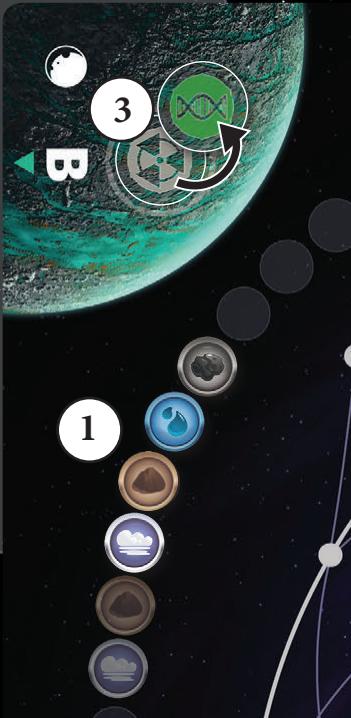
Example: Issac has collected the required Matter tokens on Planet B, so that he may play the Magnetic Field Evolution card, it requires one of each type of Matter. He chooses to play it.

O He moves a Gas, a Rock, a Water, and a Metal token from the Planet B space on his player mat to the next available spaċes on the Evolution track.
② He plays the Magnetic Field card into the next space along the Planet B edge of the board and places his red player márker on it. He scores 11 points, moving his player token up on the score tráck.
He checks the balance of Habitable to Hostile points on Planet B. Magnetic Field adds 11 Habitable points to the planet. There are now more Habitable points (11) than Hostile (10), so he flips the Habitable/Hostile token to Habitable.


CARD REQUIREMENTS
The planet must be a Gaseous. System (as marked ón the player mats and game board).
The planet must be Terrestrial (as marked on the player mats and game board).
The planet must be in an orbit that inclúdes or lies between the numbers listed, see below.
The planet must be Habitable. The Habitable/Hostile token must be on the Habitable side.
The planet must be Hostile. The Habitable/Hostile token must be on the Hostile side.
The listed number of Matter tokens must be present on the player's mat (on the planet they intend to play the card to). When the card is played, these Matter tokens are placed on the next available spaces on the Evolution Track.
The player must remove one of their player markers that is already on a card on the. Planet.

The orbits are marked 1-7 (in Roman numerals). The four arms of the outermost orbits are all orbit 7.
HABITABLE OR HOSTILE?
Planets can either be Habitable or Hostile. This is indicated by the Habitable/Hostile token that is positioned in each planet's corner of the game board. The Habitable/Hostile tile begins the game Hostile side up.
After an Evolution card is scored, the players must check the Planet the card was played on to see if it switches from Hostile to Habitable, or vice versa.
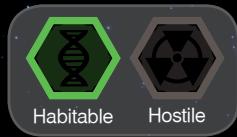
Compare the total points on Hostile Evolution cards and the total points on Habitable Evolution cards (that have been played on the specific Planet). If one total is higher, then place the Habitable/ Hostile token that side up. If the totals are equal, leave the token as it is.
“It is unnatural in a large field to have only one shaft of wheat, and in the infinite Universe only one living world.
Metrodorus of Chios
GRAVITY O
The Gravity icon grants some cards a special power. When a card is played with a Gravity icon, the player may take one Matter token from anywhere on the board and place it on any Planet on their player mat.
DOWNGRADE
The Downgrade icon on a card means that instead of playing a card on your turn, you may discard this card and draw a Low Evolution card. You can only do this for one card per turn, and downgrading a card means that you cannot play another card this turn.
DRAWING CARDS
Whenever a player plays a card, they must draw a card from the Low Evolution or High Evolution deck; or draw two cards from the Final Evolution deck and take one into their hand, discarding the other.
DISCARD PILES
Final Evolution cards that are discarded are placed face-up in a discard pile. When the deck of Final Evolution cards runs out, the discard pile is shuffled and forms a new deck.
Similarly, High Evolution cards discarded with a Downgrade icon are placed in a discard pile, and when the High Evolution deck runs out, are shuffled and form a new High Evolution deck.
If any deck of cards completely runs out, then those cards simply cannot be drawn anymore.
HAND SIZE
A player's hand size is always five cards. A player cannot have more or less than five cards in hand at the start or end of their turm.
Players are limited to four Final Evolution cards. When Final Evolution cards are drawn, only one of the two is ever considered as in the player's hand.
TIP FOR FIRST TIME PLAYERS
When to draw Final Evolution cards, and which to keep, can be an important and interesting decision in the game.
As Final cards can't be played until your final turn, yet take up space in your hand, if you draw too many too early it can make it a lot harder to play Low or High cards, and thus meet the requirements on the Final cards you have. However not having them early may make it harder to plan. To be safe, a good ruleof-thumb is to work to have two Final cards to play at the end of the game.
ENDING A TURN
After a token has been moved, and possibly a card played, play passes to the next player in clockwise order.
The game continues to pass from player to player. The final stages of the game are covered on page 10.
FAQ
What if I run out of player markers?
You may choose to remove one of your previously played markers, and place it on the newly played card. Or, you may play the card without a marker.
Can I play more than one card on a turn?
No. The only turn where you can play more than one card is your final turn, when you may play one High/Low Evolution card as normal, and then any number of Final Evolution cards.
The end of the Evolution Track, showinġ a token being placed on the▶ acceleration space.
FINAL STAGES
ACCELERATION
As cards are played, Matter tokens are placed on the Evolution Track. When a token is placed on thespace, it triggers an acceleration in the development of the solar system. Matter tokens can now be moved one or two spaces.
Planets still follow the normal movement rules for Planets, moving one space, and with the special Planet movement rules, see page 6.
THE FINAL TURN
When a Matter token is placed on the final (larger circlè) space of the Evolution track, the final turns of the game are triggered.
The player that placed the token may now play Final Evolution cards from their hand, ending their game. Then each other player in turn takes their final turn.
A final turn is the same as a normal turn, with the exception that after moving, and playing. a card, a player may then play any number of Final Evolution cards to Planets (if they meet the cards' requirements). Matter tokens paid during the final turn are plaçed on the final space of the Evolution Track.
PLAYING FINAL CARDS
For every Final Evolution card you play to a Planet, you must already
have a player marker on a card on that
Planet. When you play the Final card, remove
one of these markers from a card on that
Planet. Thus, you can only play a number of
Final cards to a Planet equal to or less than
cards you have already played to the Planet.
On your final turn you can play a maximum of 4 Final Evolution cards. Place them to the side of the Planet and score the points as indicated in the top right of the card.
Players do not draw cards on the final turn.
WINNING THE GAME
After each player has taken their final turn and played any Final cards, the player with the most points is the winner of the game! Ties are broken in the following order:
o The player with the most Matter tokens remaining on their player mat.
The player with the most player markers remaining on cards.
The player with the fewest cards in hand.
SOLO VARIANT
OVERVIEW
This variation of the game is to be played by a single player. Dice rolls are used to simulate gravity and the movement of planets, and the actions of other players. To win you must be efficient in your choices.
SET-UP
Set the two. red scoring markers to 100. These red markers will show the Target Score you will need to beat to win the game. As the game is played, this Target Score will be lowered to varying degrees. For an easier game you may set the initial Target Score to 90, or for a more challenging game, set the Target Score to 110.
Take a player mat. Take the blue scoring markers, and set yóur școre to. 0.
You will need two regular 6-sided dice.
TURN SUMMARY
You will take the first turn. Take your turns using the same rules úsed in a regular game of Planetarium.
After each turn, roll the dice and move the planets based on the total of the dice.
2-7: Move all Planets on the corresponding orbit #or less. Move planets in order of A, B, C, then D.
For example, if you roll a 5, then any Planets in orbits 5 and lower are moved, Planets in orbits 6 and 7 arè not moved.
8+: No Planets move.
WHEN DICE MOVE PLANETS
Planets alwäys move directly forward one space on the thick circular orbit, or sweep out their orbit until they hit a Matter token.
If there are no Matter tokens on the orbit, then the planet moves along a thin line onto the adjacent orbit that contains the most Matter tokens (if the number of tokens is a tie, the planet moves to the adjaceņt orbit closest to the sun).
Note: Planets on the last space of orbit 7 move onto orbit 6 (and sweep out their orbit after doing so, if applicable).
Any Matter tokens collected by Planets are placed on the Évolution track face down. The Target Score is lowered by 2 for every face down Matter token as it is placed on the Evolution track. For example, if at the end of the game there are 20 face-down Matter tokens on the track, then the Target sċore should read 60.
ENDING THE SOLO GAME
Play the game until a Matter token is placed in the final space of the Evolution track; either by you or thę Virtual Player, then play Final turn, playing Final Cards as usual.
If your score is higher than the Target Score, you win the game.
TIP FOR SOLO PLAYERS
Depending on your dice rolling, you may be in for a race, or have much more time to attempt a larger score. Either way, the target score will adjust to stay challenging but attainable, so keeping an eye on how fast the system is progressing is important.
SOLAR SYSTEM FORMATIONA COMMON PROCESS IN THE UNIVERSE
ive billion years ago the Solar System did not exist. There was no Earth, no Moon, no Sun, and no other planets. The material that makes up the Solar System today was dispersed in the interstellar medium, the matter that exists between stars in the form of gas, dust, ice, and charged particles. As the spiral arms of the Milky Way galaxy pass through the interstellar medium, they compress this material into giant molecular clouds, also known as a stellar nurseries. These clouds are enormous, spanning hundreds of light years in diameter and containing enough material to form hundreds of thousands of stars and planetary systems.
The Solar System began when a small region of a giant molecular cloud became gravitationally unstable, causing material to accumulate into a dense cloud core. A nearby supernova, a giant explosion that marks the end of a massive star, likely caused this instability. As the cloud material contracted, conservátion of angular momentum caused some of the material to spin out around our central protostar into an accretion disk. It is inside this disk that the material that makes up the planets, moons, and small bodies (asteroids and comets) of our Solar System came into existence.
The compression of the giant molecular cloud caused the interstellar gas, dust, and ice to heat up. The ices sublimated, adding key elements such as oxygen, nitrogen, and carbon to the gas phase. In the central parts of the disk, the dust also vaporized, creating a gas rich in silicon, magnesium, iron, and other rock-forming elements. Amazingly, some of this dust survived this energetic period and
is preserved in the most ancient meteorites as “pre-solar grains”. These grains record condensation in supernova and red-giant stellar outflows and radiation in the interstellar medium.
As this accretional energy gradually dissipated, the gas cooled down leading to. recondensation of the elements and creating a new generation of dust particles. The first elements to condense were calcium and aluminum in the form of ceramic minerals, materials that can survive in high-temperature environments. These “calcium-aluminum-rich inclusions” in meteorites are the oldest solids in our Solar System. Radioisotope dating of these minerals indicated that they are 4.56-billion years old, providing the only direct measurement of the age of our Solar System. The most abundant rock-forming elements were magnesium, silicon, and iron. These elements condensed to form the minerals olivine and pyroxene, which make up most of the Earth's mantle, and iron metal, which makes up planetary cores. These minerals are preserved in ordinary chondrite meteorites, the most common type of meteorite landing on Earth. Meteorites provide scientists the chance to understand the different environments that existed in our protoplanetary disk.
Farther out in the disk, the key elements oxygen, carbon, ad nitrogen condensed as ices and organic molecules. These materials are present in carbonacèous chondrites, rare meteorites that provide information on how the Earth acquired the water that makes up our oceans and the organic material that may have led to the origin of life.
The formation of ice beyond the “snow line” in the outer Solar System resulted in a large amount of solid material. This material accreted quickly, creating planetary cores roughly ten times the size of the Earth. These cores were embedded in the protoplanetary disk, which was comiposed mostly of hydrogen and helium. These large cores have enough gravity to hold on to. the gas, ultimately forming gas-giant planets like Jupiter and Saturn and ice-giant planets like Uranus and Neptune. Smaller bodies, in the outer Solar System grew into icy dwarf planets like Pluto and Eris.
In the inner Solar System, the components of chondritic meteorites collapsed into asteroid-size bodies, hundred of meters in . diameter, within a few million.years. Accretion into planetesimals about the size Mars nd the Moon occurred via “oligarchic growth." During this process the largest bodies, called planetary embryos, grew quickly while the smallest grew slowly. This process resulted in many embryos the size of Mars and the Moon embedded in a swarm of smaller asteroids. Formation of terrestrial planets occurred as the planetary embryos collided together in high-energy impacts. The resulting debris clouds collapsed together, forming the Earth-Moon system. In the region beyond Mars, the gravity field of Jupiter constantly stirred up. the planetesimals, preventing the formation of à large planet and leaving behind a belt of asteroids.
Astronomical observations show that this procèss is common troughout the galaxy. Giant molecular clouds are abundant, with the most famous being the Orion nebula in the belt of the constellation Orion. Detailed observations of protostars by the Hubble and Spitzer space telescopes show that they are indeed surrounded by protoplanetary disks of gas, dust, and ce. Planet-huntinġ space telescopes like the Kepler mission have revealed hundreds of extrasolar planets with a wide range of sizes and compositions. With Planetarium, players get a chance to steer this prócess, building a new planetary system and hopefully creating a planet capable of hosting life!
Dante Lauretta Professor of Planetary Science, University of Arizona

Studying the early solar system: The NASA OSIRIS-REx asteroid sample return mission, launched in September 2016, will visit a carbonaceous asteroid named Bennu to obtain pristine samples from its surface and return them to Earth for detailed analysis in terrestrial laboratories. (Image credit: NASA/Goddard)
THE SEARCH FOR LIFE ON OTHER WORLDS
On f the st im ortan a d challenging questions we are aiming to answer this century is whether life is a phenomenon. exclusive to the Earth. Statistically living organisms should be abundant in the universe. There are billions and billions of stars in our galaxy and it is not unreasonable to assume that many will be orbited by planets. A substantial proportion of these planets or their moons are likely to have orbits or environments that are habitable for Earth-like life. Since the first definitive detection of exoplanets in the 1990s the immense diversity of these distant alien worlds has been obvious. However, for the moment, a better undérstanding of the surface and subsurface conditions of individual exoplanets remaiņns tantalizingly out of reach. Fortunately, an ideal test case for examining whether life has ever evolved on another world exists much closer to home.
Life on Mars has long been an obsession for scientists, science-fiction writers and popular culture: Since their invention telescopes could discern shifting dark areas on the martian surface along with bright polar ice caps. Some over-enthusiastic observers also claimed to see channels or even canals but this was strongly contested by other scientists. By the 1960s i was ċlear that if life did exist on Mars it would have to ċontend with freezing temperatures and a lack of seas or oçeans. In addition, the atmosphere of Mars was found to be enriched in carbon : dioxide in contrast to the abundant nitrogen and oxygen seen on Earth. The atmosphere is also so thin that ultraviolet radiation would be extremely strong at the surface. Life on Mars could ot be ruled out by these observations but it would have to be adapted to distinctly un-Earth-like conditions.
Any lingering hope that Mars might havė cities full of intelligent Martians or vast fields of vegetation were dashed with he first successful probe to fly past the planet in 1965. Mariner 4 imaged Moon-like cratered terrains, measúred extremely low temperátures and was unable to detect a magnetic field. Even worse than ruling out complex life, Mariner 4's observations suggested Mars would be unable to host any life at all. Despite this disappoinment a combination of curiosity and Cold War competitiveness kept Mars exploration going and this persistence would soon pay off in spectacular style.
Late 1971 saw a flurry of activity around Mars. NASA's Mariner 9 became the first spacecraft to orbit another planet in mid-November and was shortly followed by two Soviet Union orbiter and lander missions. Mariner 9 immediately discovered that the whole planet was cloaked in a huge dust storm but the Soviet landers had preprogrammed descent procedures that could not be altered. One lander crashed but the other achieved the remarkable feat of the first soft landing onMars. However, its transmissions cut out after just a few seconds and it was never heard from again. Both the American and Soviet orbiters were far more successful in comparison, with Mariner 9 in particular revolutionising out understanding of the planet. Photos revealed giant volcanoes that dwarf the biggest on Earth and many lava flows appeared to be geologically young. Multiple channèls that had ben eroded out by rivers flowing in Mars' early history were observed. On top of this a vast canyon system, later named as Valles Marineris, was seen near the equator. Valles Marineris is so big that it could extend from one coast of the USA to the other with room to spare. Mars had dramatically bounced back from the dead world suggested by Mariner 4's observations. It was just sheer bad luck that the first fly by mission had managed to photograph the least interesting parts of the planet.
Evidence of ancient flowing waters and long-lived volcanism reignited our interest in understanding life on Mars. Even if life was absent in the present day it may have existed in the past. If any molecular remains of this potential ancient life could be identified then analyses could be performed to examine if these ancient Martians evolved separately from life on Earth. When NASA subsequently launched the twin orbiter and lander missions, Viking 1 and Viking 2, the detection of present-day life and identifying the remains of ancient organisms were mission priorities. Viking 1 landed on the 20th July 1976 and sent back the first image of the martian surface revealing a bolder strewn desęrt with no obvious signs of living . creatures roaming across it. Viking 2 landed on the 3rd September
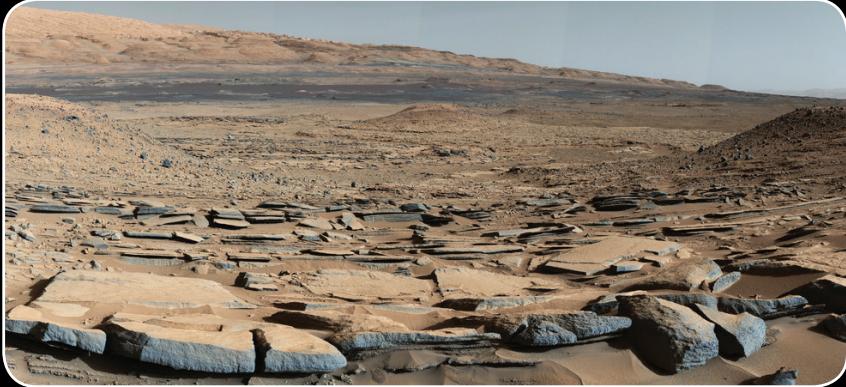
- Both landers took samples from the martian surface and tested them for the presence of life and molecules that past or present life may have left behind. The results of the majority of these tests were inconclusive or negative but one, the labelled-reléase experiment, suggésted some sort of active reaction was occurring in the sampled matérial when nutrients were added. What the cause of this reaction may have been remains debated but a biological source is unlikely given the negative findings of the other experiments. The Viking missions revealed much about the martian surface environment and geology but it was clear that Mars does not give up its secres concerning life so easily.
The rocks and dust that make up Mars' surface. record dramatic climáte shifts from early wet and potentially warm conditions through acidic, sulfur-dominated environments to the cold and diy deserts of today. Every mission following Viking has attempted to understand parts of this geological story. In 1997 Pathfinder, coupled with the tiny Sojourner rover, landed near Ares Vallis, a channel carved by a huge ancient flood. The 2004 Mars Exploration Rovers, Opportunity and Spirit, studied rocks rich in sulfur and iron that revealed a complex history of water-rock interactions. The 2008 Phoenix lander discovered chlorine salts that would disrupt some of the experiménts looking for evidence of life on Mars but also form liquid brines resistant to freezing, which could allow liquid water to flow at times on present-day Mars. In addition o the surface investigations, orbiting missions, such as Mars Global Surveyor, Mars Express, MAVEN and Mars Reconnaissance Orbiter have given us a global view of Mars and its atmosphere.
In 2012 Curiosity entered the fray; this giant roving laboratory is équipped with a huge range of analytical instruments and offers our best hope yet of idéntifying the remains of ancient Martians. The rovér is currently travelling over stacked layers of sediments that record a substantial portion of Mars' geological history. As with Viking, scientists will spend decades analysing and debating data sent back and looking for any evidence of martian life. In the next few years at least two more rovers are scheduled to land and continúe our exploration of the red planet.
With Planetarium we wanted to give a sense of the diverse range of.factors and environments that can support or hinder life, Due to regular volcanism throughout most of its history, perios of flowing lquid water and in combinaton with its proximity to Earth, Mars currently represents our best chance for identifying evidence of ancient living organisms on another :world in the next few years. Beyond this, missions to sample the plumes. of water emanating from icy moons are planned and when the James Webb Špace Telescope launches it will be able to study the atmospheres of exoplanets. It is also important to remember that so far we. only understand Earth-like life. If we discover alien órganisms on the icy moons of our solar system or in environments beyond they may turn out to operate in a radically different way. We hope you enjoy the gamę and are encouraged to find out more about planets, stars and the whole Universe!
James Lewis


CARD SUMMARY
Downgrade
Card Title CARD TYPE
Gravity
Habitable
Requirements Refer to page 8
Final
A short interesting piece of information. A mix of science facts and intriguing speculations that relate to the theme of the card.
GRAVITY
The Gravity icon grants some cards a special power. When a card is played with a Gravity icon, the player may take one Matter token from anywhere on the board and place it on any Planet on their player mat.
DOWNGRADE
The Downgrade icon on a card means that instead of playing a card on your turn, you may discard this card and draw a Low Evolution card. You can only do this for one card per turn, and downgrading a card means that you cannot play another card this turn.
STARTING HANDS
Draw 2 Low Evolution cards
Draw 2 HIGH Evolution cards
Draw 2 FINAL Evolution cards,
keep one and discard one.
Hand size: 5 Cards (with a maximum
of 4 Final Evolution cards)
CARD REQUIREMENTS

The planet must be a Gaseous System (as marked on the player mats and game board).
The planet must be Terrestrial (as marked on the player mats and game board).
The planet must be in an orbit that includes or lies between the numbers listed.

The planet must be Habitable. The Habitable/Hostile token must be on the Habitable side.

The planet must be Hostile. The Habitable/Hostile token must be on the Hostile side.
The listed number of Matter tokens must be present on the player's mat (on the Planet they intend to play the card to). When the card is played, these Matter tokens are placed on the next available spaces on the Evolution Track

The player must remove one of their player markers that is already on a card on the Planet.
ACCELERATION
When a Matter token is placed on the▶ space on the Evolution Track, thereafter Matter tokens may be moved one or two spaces. Planet tokens are not affected.
下载 Markdown原文为社区整理/出版社公开资料,版权归原作者,仅供个人学习查阅。