
预言Prophecy
一句话概览
预言 是一款已收录于村了吗规则库的桌游,支持 2–5 人,原名 Prophecy。
本页内容:一句话概览 · 常见问题
这游戏怎么玩
- 本站已收录这款游戏的规则资料,可以在对话里直接提问规则细节。
常见问题(FAQ)
以下 1 条问答中 0 条来自站内玩家的真实提问,其余 1 条为本站整理的常见疑问;答复内容保持原样。
预言支持几个人玩?
2–5 人。
去哪查完整规则
想核对具体规则细节、卡牌效果或某个回合的结算方式,可以在村了吗里选中这款游戏后直接提问。
同类桌游
- 卡坦岛德式
- 工业革命:伯明翰德式
- 勃艮第城堡:特别典藏版德式
- 方舟动物园德式
- 卡卡颂抽象
- 瘟疫危机传承:第一季美式
- 阿瑞迪亚:勇踏征途美式
- 重塑宇宙德式
- 幽港迷城美式
- 埃多拉的德鲁伊德式
规则原文(Markdown)
本站收录这款游戏的规则原文 1 个文件,此处内联渲染 1 个,可直接展开阅读或下载。
Prophecy_rules.md84.1 KB
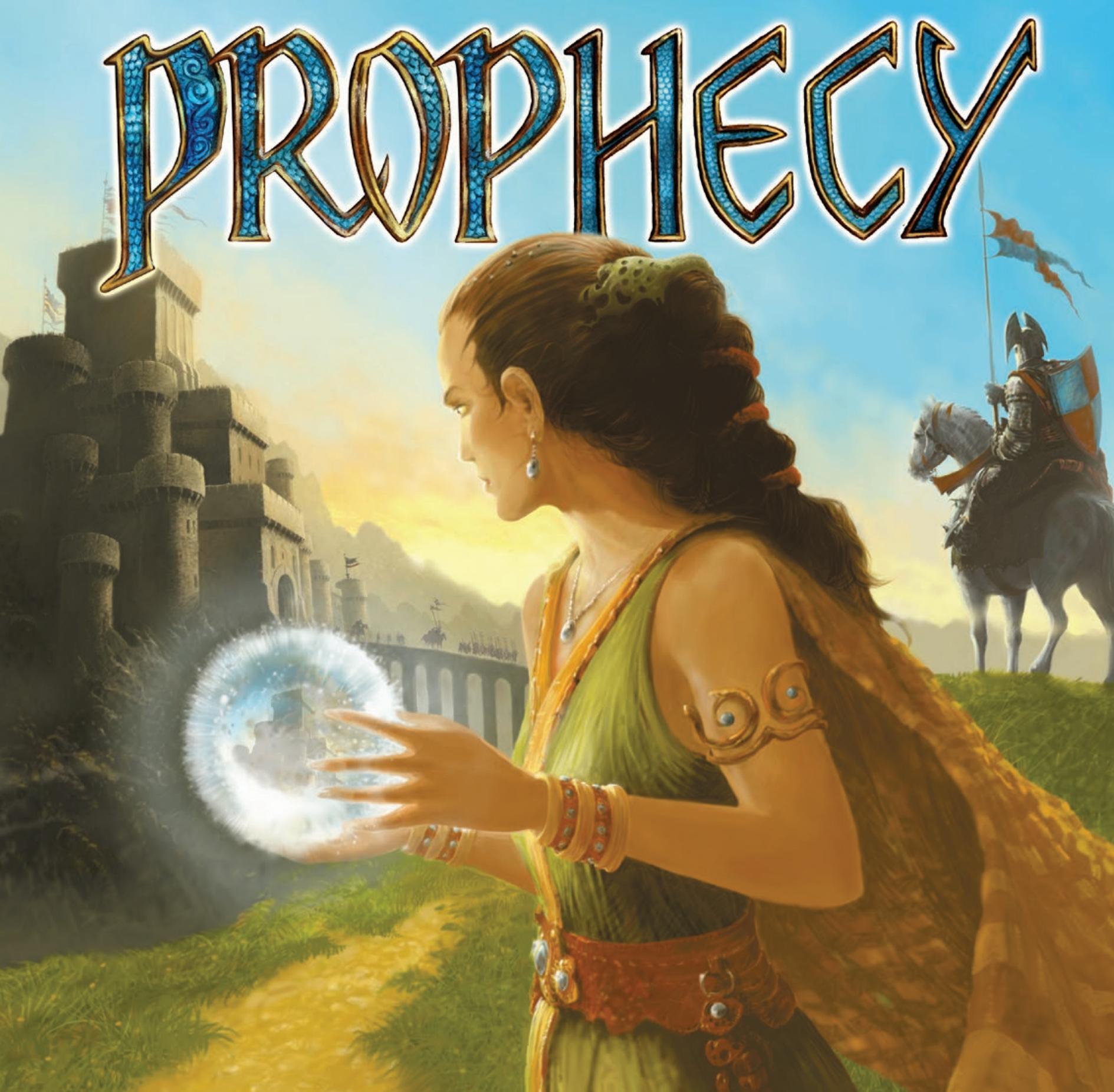

NCE UPON A TIME, a dynasty of wise and powerful kings ruled the land. They protected the kingdom from raiders as well as from internal strife and took care of the peaceful life of their people. Behind this peace were five ancient and powerful artifacts, which are said to have been made by gods at the beginning of time.
But nothing lasts forever. The peace and quiet were broken at last, when one of the kings left his three sons as heirs. Their desire for power set the two eldest sons against each other, and a furious battle for succession began. Chaos ensued. The air was filled with smoke and the land was soaked with blood of the innocent. Finally the eldest brother opened the gates of the worlds and summoned demons to help him. How foolish was he to hope that he could control these inhuman creatures. Demons rushed through the land and completed the havoc started by the war. They killed both princes, stole the royal artifacts and took them into unseen worlds. The youngest brother disappeared without a trace.
So people lost the favor and gifts of the gods as well as their king, and thus began centuries of anarchy and chaos. Bands of robbers and brigands roamed the roads, demons settled in dark, deserted places, and rumor had it that even the dead came to life and strolled the land. There is a legend older than time which foretold all these things. It spoke about the fall of the royal kin and the coming of demons. But the end of this legend gives people hope:
Three times over three centuries people and the land will supper for the sins op the powerpul bepore the hero op royal blood appears, oressed in the armor op the ancient rulers, and settle down on the kings' throne to stop the anarchy and chaos...
Nine hundred years have passed and no hero of royal blood has appeared. Old manuscripts were lost and people no longer cared about the stories of the ancients. Some noblemen tried to declare themselves the heirs of the throne, but no one possessed the ancient artifacts, the only real proof.
What if the last of the princes set out into the world and his blood blended with the common people? What if one of the many ordinary adventurers wandering through the land is predestined to become the king? What if it is YOU?
ROPHECY is for 2 to 5 players. Each player is a hero who walks the world doing heroic deeds, improving her physical and mental strength, looking for powerful weapons and magic items, while learning fighting skills and magic. And when she feels ready, she can challenge demonic guardians from the Astral Planes to obtain the ancient artifacts.
A player's hero is represented by a card which is placed on the table before her and a playing piece which represents the hero on the game board. The character card states her characteristics (Strength and Willpower) at the beginning of the game and shows the possible direction of a character's advancement. On the character card you use red and blue cubes to represent the character's Health and magic energy (Magic).
A character's Strength equals the amount of Health she has. If the character is wounded, she loses a Health which means she becomes weaker until healed. This rule applies to Willpower, which equates to Magic, e.g. if a character casts a Spell which costs two blue cubes, her Willpower is two points weaker until her Magic is recharged.
A character can also get Gold (yellow tokens) and Experience (green tokens). Gold can buy you different Common and Rare Items. Experience allows a character to learn new usable Abilities and Spells. At the beginning of the game, a character has no special Abilities or Spells, but must learn them throughout the game. When Items and Abilities are received, they are placed next to the character card.
A player's playing piece is always present on a space of the game board. During her turn, the player may move her playing piece, however moving is not random. A player must choose which way to go and by which method: on foot, renting a horse or boat, or paying for a Magic Gate. A player can also use Spells to move or even choose not to move at all, spending her turn doing some other activity.
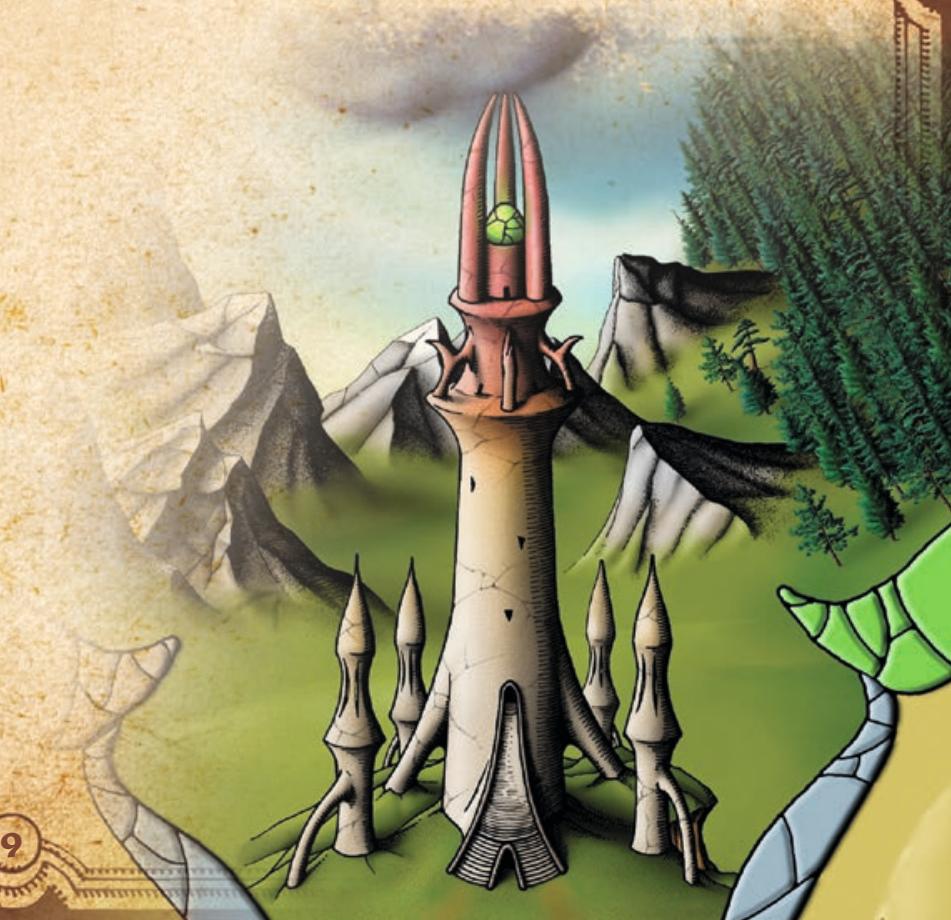
Often the goal of moving is to defeat a Creature or to reach an Opportunity which you want to use, e.g. the City where you might buy a magic Item, the Monastery where you can heal, the Magic Tower where you can learn a Spell, or the Gem Mine where you can find wealth. A player does not influence when and where such an Opportunity appears. At the beginning of every round, a player draws a Chance card which states what happens in the world e.g. where a new Opportunity or Creature appears. It is up to the player how a character's Abilities, Items, and Gold are used to reach the new Opportunity or Creature before opposing players.
The main goal of a character's journey is to improve herself for battle. That means to find the best weapons and Items which can help in battle but mainly to train your body and mind, i.e. to find Opportunities which allow you to permanently raise your character's Strength or Willpower. In a normal battle with a Creature, Strength is used, but some intelligent Creatures may establish mental contact and a Battle of Wills ensues. A Battle of Wills always takes precedence before a Battle of Strength when at least one participant wants to fight mentally. But establishing mental contact is not a simple task, as the one initiating a Battle of Wills must first pay some Magic, and by doing so reduces her Willpower and therefore her chances of success in the battle. It is advantageous to initiate this kind of battle when your Willpower is much higher than your opponent's.
When a character becomes powerful enough, she can attempt to enter any one of the five Astral Planes. There you must fight Guardians – the strongest Creatures in the game, and if you defeat them you earn one of five Artifacts. The winner of the game is the player to get four of the five Artifacts.
It often happens that all five Artifacts have been taken, but among several characters, with no one possessing at least four Artifacts. In this instance, the Final Battle begins – the heroes fight each other, with the losers of a battle giving up an Artifact. A player that possesses no Artifacts is immediately eliminated from the game. The strongest one gaining possession of four of the Artifacts earns the right to ascend the king's throne.
Game Set Up
pROPHECY's rules are not too difficult. At first glance, they may seem long, as they try to handle every situation, but they are written so that you can start playing immediately.
You can begin playing right now. While reading this chapter, unfold the game board, separate the different types of cards available and put them in the appropriate places.
Then deal the character cards and prepare your characters, read the chapters Beginning the Game and One Round of the Game and try to play according to them. When the first battle occurs, read the section on Battles. And once your character becomes strong enough, you may read the chapters Attack on the Astral Planes and Final Battle.
The last pages of the rules are dedicated to other variants of the game, detailed information about specific cards and other additional information, so you do not need to read this initially. You can refer to this section when a specific card requires clarification.
To learn the game you may find the summary card useful, as it covers the most important rules.
Number or Players
Although the game is for two to five players, it is best played with 2 to 4 players. Five-player games could take very long. Do not play with 5 players unless you all know the game well and have the time to finish the game! For your first game, or when introducing a new player, a 3-player game is the best option.
Game Board
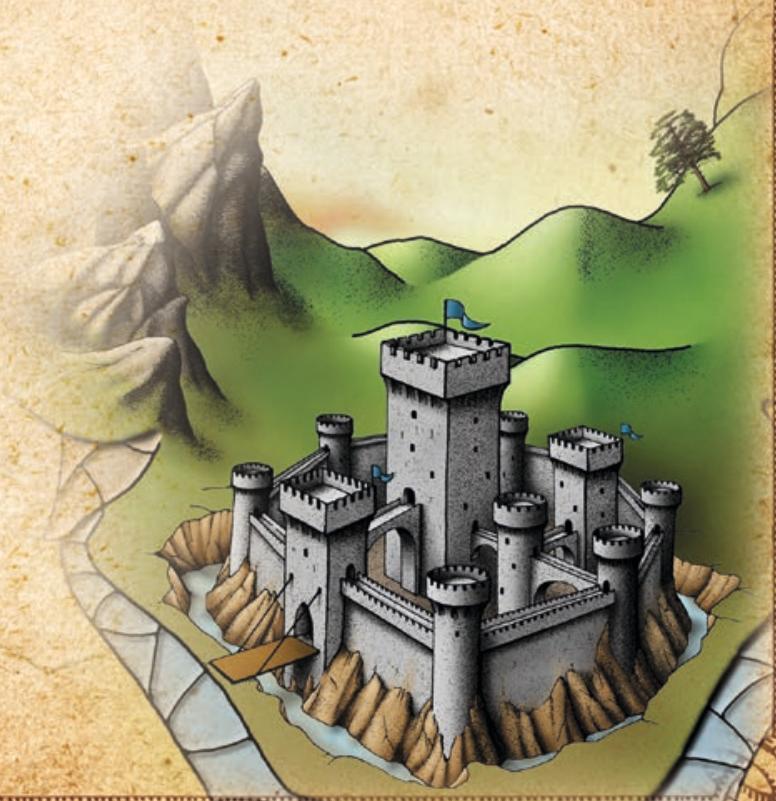
Before you start reading the rules, take a look at the game board. The world in which your characters live is divided into 20 spaces. The majority of spaces are wilderness: Plains, Forests and Mountains. The spaces nearest to the center of the board are called guilds (specifically the Fortress, Thieves' Guild, Forest Camp, Magic Tower, and Monastery). The guilds together with the City and Village are called civilization spaces (these spaces are in blue). The last space is the Enchanted Wilderness.
During the game, you will encounter different Opportunities offering various adventures and dangers in the wilderness, other spaces offer special services (explained later). In the guild spaces, different Abilities appear for your character to learn, and in the City and Village, it is occasionally possible to purchase Common or Rare Items.
In some spaces there are ports or Magic Gates; in the City there are both. On the edge of the game board are 5 dark whirlpools which represent the Astral Planes.
Characters
There are 10 characters in the game. Each has its own larger character card and a playing piece with the same picture. Five stands are included. Place the characters aside for now; it is later described how to choose your character.
Cubes and Tokens
There are cubes and tokens of different colors and sizes in the game. Put those aside in a place where it will be easy to access them. You might want to put them in two places so that all players will be able to get them when needed.
dice
The game includes two 6-sided dice, a darker one for Creatures and a lighter one for characters.
Cards
The game also includes a number of different cards which differ by the card backs. Different card types should never be shuffled together. Sort the cards by type and shuffle each deck separately.
Guardians and Artiracts

There are 5 Artifacts in the game (an orange back with a crown),5 Greater Guardians(a purple back with crossed swords) and5 Lesser Guardians (a pink back with crossed daggers). At the beginning of the game, randomly place face-down in each Astral Plane one Artifact card, one Greater Guardian and one Lesser Guardian.
Chance Cards
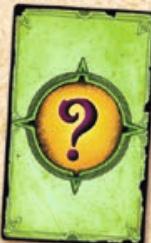
These card backs are green with a question mark. During the course of the game, these cards determine random events in the world. Shuffle these cards and place them face-down in the appropriate corner of the game board.

Adventure Cards
These card backs are yellow with a scroll and a dagger. They represent Creatures and Opportunities which your heroes will encounter. Shuffle these cards and place them face-down in the corner of the game board.

Common and Rare Item Cards
There are two types of Item cards—Common and Rare. Common Item cards have brown backs with an axe symbol, while Rare Item cards have gold backs with a sword symbol. Shuffle these cards separately and place the two decks face-down in the respective corners of the game board.
Ability Cards
There are five other types of cards - Ability cards. These are black with the different guild symbols on the back Shuffle these cards separately and place them face-down in their respective places near the center of the game board.

Discarded Cards
Next to the stacks of Item cards, Adventure cards and Chance cards are marked places for discarded cards. When a deck has been exhausted, shuffle the discarded cards and place them face-down to start a new deck. Ability cards do not have a discard pile. When discarded, these cards should be placed face-down on the bottom of the respective deck.
Beginning the Game
Now you have the game board and cards prepared. You now need to choose your character and prepare her for the world and the adventure ahead.
Choosing Your Character
Randomly deal face-down two of the large character cards to each player. A player must choose one of those and pass the other one face-down to the player on the left. Each player takes the character passed to her, and from those two characters, she chooses one and again passes the other to the player on the left. Each player takes the character passed to her again, but this time, the players must choose the character to play with, while discarding the other one. All players then show their chosen characters.
Character Card
Character Experience
Spent/Lost Health and Willpower
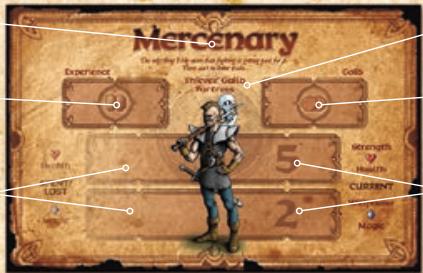
Starting Golo
Starting Health and Willpower
Place the chosen character card in front of you, with enough room around it. The heroes do not start with any special Abilities, but each character card has two guilds listed – these are guilds that the character belongs to and determine her specialization. Character may learn Abilities from any guild, but it costs Gold to learn from guilds not listed. Even a Druid can learn to pick pockets or to wield edged weapons; he just has to pay more for such skills.
A character's starting Strength and Willpower are also stated on a character card. Take the respective quantity of red and blue cubes from the bank and place them on the right side of the character card.
Strength and Health
Red cubes represent a character's Strength, and also represent a character's Health. The cubes on the right side of a character card represent the actual level of Strength and Health of the character. If a character loses a Health, take a red cube from the right side of the card and place it on the left side of the card. From this moment forward, the character has its Strength reduced by one until healed. During the course of the game, if all Health is lost, nothing happens – the character merely has a Strength of 0. But if the character then loses another Health, she is eliminated
Cubes on the left side indicate how much Health needs to be healed. Healing causes moving red cubes from the left side to the right side of the character card.
Only when a card specifically so states, a character can increase her Strength (it is one of the most valuable things in the game). In this case, take a red cube from the bank and add it to the right side of the character card. The maximum number of red cubes a character may have is 8. If a character gains additional Strength when she is already at maximum, she can heal a Health instead.
Willpower and Magic
Willpower and Magic (energy which enables a character to cast Spells) are represented by blue cubes. The system operates the same as with Strength and Health. Here the quantity of cubes on the right side of the character card represents her Willpower and Magic she has currently available. Magic is used for casting Spells, initiating a Battle of Wills and activating some magical Items.
Used Magic is represented by moving blue cubes from the right to the left of the character card (and Willpower consequently being reduced). You can move blue cubes from the left to the right of your character card by recharging your Magic throughout the course of the game. Only when a card specifically so states, a character can increase her Willpower. The maximum number of blue cubes a character may have is 10. If a character gains additional Willpower when she is already at maximum, she can recharge a Magic instead.
A character cannot pay more Magic than she has. If a character cannot pay for a Spell, she may not cast it. If a character has no Magic left, she has 0 Willpower, but there is no other effect. If a Creature takes Magic away from her later, her Willpower stays at 0.

Chance Cards
Mountains, Forests and Plains
These cards tell you to place a new Adventure card in every Mountain, Forest, or Plains space. The player who drew the Chance card draws Adventure cards from the deck and places them (without looking at them) in the appropriate spaces, starting from the space where her character is standing and continuing clockwise. If there is no card in the space yet, she turns the new card faceup. If there is a card already in the respective space, then she places the new card face-down under the other card. If there are two cards already in the space where you must place one, then no additional card is placed there. In every space, there will be one revealed card or one revealed and one face-down card (during the game, someone may reveal the second card, so it is possible to have both cards in a space revealed).If any drawn cards are left over, discard them.
Fortress, Thieves' Guilo, Forest Camp, Magic Tower, Monastery, Open Training
These cards describe in which guild to place an Ability card. A player draws a card from the appropriate deck and places it face-up in the appropriate guild space. If there is already a card in this guild, place this new card across the first so that both are visible.
Village
If there are already two cards here, discard the bottom one to the bottom of respective deck and place the new card across the other. In this case,'a new Ability replaces the oldest one, so there are never more than two cards available in a guild.
The card Open Training allows a player to choose where a new Ability card is revealed. The player can choose to reveal an Ability even if it is to intentionally discard the oldest Ability in a space.
City Merchant, Tradesman
These cards describe where to place new goods, either in the City or the Village. The player discards all goods which are currently in the space and draws three Common Items (Tradesman) or two Rare Items (City Merchant) from the Common or Rare Items deck, placing them face up in the stated space.
Peacerul Times
This allows the player who drew this card to take an additional turn. The additional turn happens in the same round, so no new Chance card is drawn.
prophetic Oream
This reveals a card in the Astral Planes. The cards must be revealed in order, which initially means a Lesser Guardian. If this card is drawn again, then the Greater
Guardian can be revealed from the same Astral Plane or the Lesser Guardian from a different one. The player must always reveal a card, as long as a Guardian or an Artifact remains face-down.
Rerreshing Wind, Kinoly Wind, Magical Breeze, Good Times
These cards heal Health, recharge Magic, or give Gold or Experience to all players, giving the most to the one who drew the card.
Charity
This card gives Gold, Health and Magic to the player or players who have the least in a specific category.
Example: The Druid and Mercenary have 2 Gold and the Paladin 3 Gold. The Paladin also has 1 Health and 3 Magic. The Druid has 3 Health and 2 Magic and the Mercenary 2 Health and 3 Magic. So Charity gives 3 Gold to the Druid and Mercenary, but only heals 1 Health for the Paladin and recharges only the Druid's Magic by 2.
Economic Crisis
This is the only bad Chance card. Do not try to hoard Gold, as the Economic Crisis card takes half away. Round down, so if you have only 1 Gold, this card does not affect you.
Golo and Experience
Yellow tokens represent money – smaller tokens are 1 Gold and larger tokens are 5 Gold. Experience is represented by green tokens – smaller tokens are 1 point and larger ones are 5 points.
At the beginning of the game, each player takes 3 Gold and 3 Experience from the bank and adds them to either side of her character card where indicated on the card. If a player gains more of either, she takes the tokens from the bank, and when Gold or Experience is used, the tokens are returned.
Important Note
Whenever a card states you must lose (sacrifice, pay, have stolen etc.) or add (heal, recharge etc.) Health or Magic, it is talking about moving cubes from the right to the left side of your character card or the other way, respectively. However, whenever a card states that you gain or lose Strength or Willpower, you must take cubes from the bank and add them to the right side of your character card or take cubes from the right side of your character card and put them back in the bank. For clarity, all permanent changes are written on cards in bold print.
Some Items raise your Strength or Willpower temporarily (when you use it or until the end of your turn). In this instance, do not take any cubes from the bank.
Initial Situation
To speed up the game, place some cards on the game board:
1) In every guild, turn up the first Ability card.
2) Find the first Forest, Mountain or Plains card from the Chance deck, draw and place an Adventure card face-up in every terrain space of that type, then shuffle the Chance cards (except the drawn card - place that one in the discard pile).
Start
Now you have your game board, cards and characters ready. You are ready to start.
Each player must take her respective playing piece, put it in its stand, and place it in the guild which is stated first on the character card, e.g. the Paladin starts in the Fortress. Each player rolls a die with the one rolling the highest starting the game.
The first player plays, with play continuing in a clockwise direction. This continues until a player wins by having possession of at least 4 of the 5 Artifacts from the Astral Planes.
One Round or the Game
Game play is summarized on a summary card. A round occurs in 3 phases:
-
Oraw a Chance card (what occurs in the worlo)
-
player's turn, occasionally multiple turns
-
End of a round
Orawing a Chance Card
A player first draws a Chance card, reads it aloud, follows its instructions, then discards it. The vast majority of the cards either place other cards on the game board or help the characters.
The explanations on the previous page clarify what effect specific cards have on the game (right now, best read only about the card you have just drawn; skip the other explanations).
Players' Turns
After a Chance card is drawn, a player takes her turn: move, then fight or take advantage of an Opportunity on the space where she moves. If there is an interesting Opportunity in the space where she is, she cannot use it and then move.
Occasionally a player may have more turns (through a Spell or the card Peaceful Times). In this case, the turns all occur in the same round and no additional Chance card is drawn. Also some Abilities or Items are usable only once per round – these Abilities or Items can be used only once during those turns.
End of a Round
At the end of a round, a player must discard a character's excessive tokens or cards.A character may have a maximum of 15 Gold, 15 Experience points, 7 Items and 7 Abilities.If a character exceeds these limits, then a player must return any excessive tokens to the bank and discard any excessive cards to the respective discard piles (a player can choose which cards to keep and which ones to discard). The round then ends and play continues clockwise.
Discarding of excessive tokens and cards happens at the end of your round; if you acquired those during this turn or turns (or even during other players' rounds), you have chance to use them before discarding, e.g. sell an Item, drink a potion, spend Gold etc. However, if you have 8 red cubes or 10 blue cubes, it is prohibited to gain more.


A player's Turn
A player's turn occurs in the following order:
-
Movement
-
Mandatory right with a creature
-
Non-mandatory right with a creature
-
Use op Possibilities op the space
Movement
A player may do one of the following during this phase:
a. Stay on the same space
b. Walk - move one space to the left or right
c. Rent a horse for 1 Gold – move two spaces to the left or right, ignoring the space in between
Take a boat for 1 Gold – if you are on a space with a Port, you can move to the nearest Port on the left or right
Use a Magic Gate for 2 Gold - if you are on a space with a Magic Gate, you can move to any other Magic Gate
Use any Movement Ability or Item, e.g. Flying Carpet, the Teleportation Spell etc.
Use another activity which states "instead of moving" – either an Ability, or Possibility of certain spaces:
City – skilled labor: pay 1 Magic, earn 2 Gold
Thieves' Guilo – dirty labor: pay 1 Health, earn 3 Gold
Fortress – training: pay 1 Health, gain 2 Experience points
h. Attack an Astral Plane (explained later)
A character can only make one type of movement per turn and that type only once. It is prohibited to pay 2 Gold to ride a horse twice, walk to a port and then take a boat, or teleport and then move. As well, it is prohibited to use multiple abilities that are in place of movement, such as labor in the City.
Example: if a character is in the Village space, the player has several options. She may stay in the same space. She may move one space to the Mountains or the Plains. If she has some Gold, she may pay one to rent a horse and move two spaces to the Magic Tower or Thieves' Guild. For one Gold, she may also rent a boat and move to the Plains near the Forest between the Monastery and the Magic Tower, or to the Mountains near the Forest Camp.
Battle with Creatures
If you arrive in a space where there is a face-down Adventure card, first flip the card face-up (if a face-down Adventure card is in a space where you start the turn, only flip up that card if you decide to stay there).
Adventure cards are either a Creature or an Opportunity. In the case of a Creature, a character must do battle with it. It is also possible that more than one Creature is in a single space. In this case, a character may choose which one to fight first. Battles are described later – for now, the only thing you need to know is that the character can either win, lose or draw.
If character loses or draws, the player's turn ends. It is not possible to fight another Creature or character, nor to use an Opportunity in the space.
If character wins, she earns a reward (explained later). If there is another Creature in the space, she must fight it now.
Battles with Other Characters
If there were no Creatures in the space or you defeated them, and if there is another character in the same space, then you can attack her. Each turn, you can attack only one other character - if there are more characters in the same space, you can choose which one to do battle with. You do not have to attack another character.
Battles are explained later. As opposed to a battle with a Creature, if the character draws or loses a battle with another character, her turn does not end – she can use a Possibility in the space regardless of the outcome of the battle.
In theMonastery, Forest Camp, or if you paid for lodging in theVillage, yourcharacter is safe— it is not possible for other characters to attack you (on the game board there is a white dove here).These safe zones do not apply to characters who have an Artifact- a character walking in the world with these legendary Artifacts is never safe.
Using possibilities
When there are no Creatures in the space (or were defeated), the character can use the Possibility in the space. The character can use more Possibilities if available, and in any order she wishes. Each Possibility can be used multiple times, unless stated otherwise. The Possibilities of specific spaces are described below.
Possibilities
Forests, Mountains and plains - Opportunities
Some Adventure cards represent Opportunities. There are various usable things which you can encounter – some are free and others you must pay for. A player has the choice whether or not to use an Opportunity (if there are two in the space then she can choose in which order to use them). An Opportunity card is for one-time use only and is then discarded. A player cannot use the card just to discard it, e.g. use an Opportunity for healing when her character is at full Health.
Guilos - Training
In guild spaces you can find different Abilities. Upon visiting a guild, a character may learn an Ability which lies there. Every Ability has a cost which is stated in the upper right-hand corner of the card - this is the amount of Experience that must be paid. If the guild is not stated on your character card, then the character does not belong to this guild, so the character must pay not only the Experience, but also an equal amount of Gold. If you learn an Ability, place its card near your Character card and keep it for the rest of the game.
Civilization - Item Repair
Some Items (mainly throwing weapons and shields) can be damaged during the game. Damaged cards should be turned face-down and may not be used. In a Civilization space (a blue space: any guild, the City or the Village), it is possible to repair an Item.For each repaired Item you must pay 1 Gold.
The City and Village - Purchase and Sale of Items
There can be Items in the City or Village spaces which you can buy. A character must pay the price stated on the Item card. It is also possible to sell Items – the price is half, rounded up, e.g. if an Item costs 5 Gold, you receive 3. You must repair damaged Items before selling them. Sold Items do not stay on the same space - they are discarded.
Monastery and Forest Camp - Healing
In the Monastery, a character can heal 1 Health for free, but only once per turn. In the Forest Camp, a character can heal as much Health as she wants, but they cost 1 Gold each.
Magic Wiloerness and the Magic Tower - Recharging Magic
In the Magic Wilderness, a character can recharge 3 Magic for free, but only once per turn. In the Magic Tower, a character can recharge as much Magic as she wants, but pays 1 Gold for every 2 Magic.
The Village - Lodging
In the Village it is possible to stay overnight. A character must pay 1 Gold, and heals 1 Health and recharges 1 Magic and is safe until her next turn (if she does not have an Artifact).
Taking Artiracts
If there is an Artifact in the space (where another character has left it upon dying), then you can take it.
Example: Spellblade is standing in the City. There is also a beautiful Great Sword lying in the space, and she would like to buy it to replace her common Sword. But Spellblade only has 5 Gold, and the price of the Great Sword is 13. She stays in the City and uses the Possibility instead of movement (she pays one Magic and takes two Gold). Now she has 7 Gold. Her next turn she stays in the City again and gets another two Gold for another Magic, and she also sells her Sword (its price is 7 Gold, so she gets 4 when she sells it)—now she has 13 Gold in total and at last she buys the Great Sword. Now she has no Gold and she is missing two Magic (she now has two blue cubes on the left side of her character card). She decides to stay in the City for a third turn and she earns another two Gold for one Magic. In the fourth turn, she uses the Magic Gate (for two Gold) to move into the Enchanted Wilderness, where she recharges all three missing Magic (returning them to the right side of her character card).
Battles or Strength & Wills
In the game there are two types of battles – a Battle of Strength, where both opponents fight physically with weapons, fists, claws etc., and a Battle of Wills, where both opponents have mental contact and use their mind to defeat the other. A Battle of Wills always takes precedence, but creating a mental connection is not easy - the one choosing this type of battle must pay Magic at the beginning of a battle.
Battle with Creatures
Every Creature has its own Strength, Willpower or both, this number representing various weapons, magic or abilities that the Creature has. Here are the possibilities when fighting with Creatures:
a. If a Creature only has Strength, then it means that it is not intelligent and it is therefore not possible to fight with Willpower. The Creature attacks the character and the player must accept the challenge – a Battle of Strength occurs.
b. If a Creature has Strength stated first, then Willpower, it means that it attacks the character with Strength, but it is also capable of fighting with Willpower. The player can decide either to accept a Battle of Strength or to pay 2 Magic, moving blue cubes from the right to the left side of her character card to initiate a Battle of Wills. Note that initiating a Battle of Wills actually lowers a character's Willpower by 2 - a Battle of Wills therefore gives an upper hand to the character only when her Willpower is much higher than Creature's Willpower before the battle.
c. If a Creature only has Willpower, then it attacks the character with it. As a Battle of Wills takes precedence, the player has no other choice than accept this type of battle. The Creature initiated this Battle of Wills, so the player does not pay anything. The amount the creature paid for initiating the battle is not important in this case (it is already counted in that Creature's Willpower).
d. If some other case occurs, e.g. a Creature has Willpower stated first then Strength, then the Creature has specific rules which are described on its card. If you do not understand these specific rules, look at the Appendix at the end of this rulebook.
Then the player decides which Items, Spells or Abilities she uses in battle, counts appropriate bonuses and adds them to her Strength or Willpower. Do not forget that only the cubes on the right side of the character card count, so if the character is missing some Health or Magic, she is also weaker in battle.
The player must then roll both dice at the same time. The lighter die represents the character, and the darker one represents the Creature. Add your total to the number rolled on your die and the Creature's Strength or Willpower to the number rolled on its die. Whoever has the highest total wins. If the totals are the same, it is a draw.
Example: the Druid has a current Strength of 3 and Willpower of 6. He enters a space where the Old Pirate lurks. Luckily there is no port, so the Old Pirate has both Strength and Willpower of 3. The Old Pirate attacks the Druid with Strength. The Druid might accept the Battle of Strength (the odds would be 3 to 3), but he decides to initiate a Battle of Wills. He pays two Magic (moves two blue cubes from the right side to the left side of his character card), so his Willpower is now only 4, one more than the Old Pirate. He rolls both dice, rolling a “4" on the lighter die and a "6" on the darker one. This means that he loses (8 to 10). Because there is no text denoted by an X on the Old Pirate card, the Druid loses one Health (he moves one red cube from the right side to the left side of his character card). The next turn he decides to not move away and fight again. Now he has a Strength of 2 and Willpower of 4. In both types of battles he would be weaker by one point, but he decides to initiate a Battle of Wills again, because he is interested in gaining the Old Pirate's treasure as promised by the text after the check mark . He pays two Magic and rolls the dice. Now he rolls a "3" on the lighter die and a “2 on the darker one. That means a draw—nothing further happens and the Druid's turn ends.
Winning a Battle with a Creature
Discard the Creature which has been defeated in battle. The player takes the appropriate amount of Experience from the bank, which is denoted on the upper right-hand corner of the Creature card. Most Creatures also have a treasure, which is denoted on the card by a check mark . The treasure may be Gold (take this from the bank), a Common or Rare Item (draw the appropriate card), or in some cases an increase in Strength or Willpower (take a cube from the bank). If a strong Creature has no treasure, you typically receive more Experience.
Losing a Battle with a Creature
If a character loses, the Creature stays in the space and the player's turn ends immediately. Also, the character loses 1 Health (move a red cube from the right to the left side of your character card). Some Creatures do something worse to you instead - they can take multiple Health, drain Magic, or steal Gold or Items. This is denoted by an X &. If a Creature takes more Magic than a character has, nothing further usually happens, but if it takes more Health than the character has, tough luck, the character is eliminated from the game (explained later).
Creature Battle that Ends in a Oraw
Nothing happens when a battle ends in a draw. The character is unharmed, and the Creature remains in the same space. As with a loss, the player's turn ends.
Banos op Creatures - 3 Lives
Some Creatures have 3 lives, which is denoted by a 3 symbol 3. When fighting these Creatures, the player is fighting a single battle in which she must roll the dice three times consecutively. To defeat the Creature, the player must win all three rolls. When any roll ends in draw or loss, then the battle is drawn or lost (no need to roll any further). In the next battle, the Creature has 3 lives again.
During a battle, you may not change the type of battle or any weapons. It is possible, though, to influence the outcome of each roll, e.g. by throwing a weapon, casting spells like Concentration, Prayer, Turn Back Time etc., but these effects affect only one roll. If the player paid Magic to initiate a Battle of Wills, the payment is made only once (at the beginning of battle) and Willpower is used for all three rolls.
Special Rules for Creatures
Some Creatures have special rules. These rules are denoted by an exclamation point (if they are mandatory) or by a question mark (if they are optional).
Battles with Other Characters
A battle with another character is similar to a battle with a Creature. An attacking character first announces the battle to the defending character, and then if she is attacking with Strength or Willpower. If a Battle of Wills is paid for, then the defender must accept it. If a Battle of Strength is announced, then the defender can either accept it or announce that she wants to fight with Willpower (and pay for it). Once a type of battle is determined, the battle commences.
In a Battle of Wills, the player (attacker or defender) initiating it must pay 2 Magic plus 1 extra Magic for each Artifact that the opponent has (Artifacts protect their owner from being attacked with Willpower).
The type of battle is now set. Now it is back on the attacker, who must announce which weapons and Items she is using, and if she is going to use any Spells. Then the defender announces the same. Both players now add the characteristic used in the battle (Strength or Willpower) and all bonuses from weapons, Items, Abilities or Spells. Both players now roll a die and add the outcome to their total. Whoever has the higher total wins the battle. If the totals are the same, then it is a draw and nothing happens. (To prevent any conflict, the attacker rolls the lighter die and the defender the darker one.)
Winning a Battle with a Character
Regardless of the type of battle, the results are the same. The losing player can choose what happens to her character.She can either lose 1 Health, or she offers her Items to the winner, who can take any one Item(including an
Artifact). If the loser decides to offer an Item, she cannot change her mind when she sees which Item she will lose. If the losing player has no Items, then she must lose a Health.
Usually it is not such an advantage to attack another character, because the loser will choose to lose Health instead of an Item. An exception to this is if an opponent is seriously wounded and cannot afford to lose any Health, or while using some Abilities from Thieves' Guild. Otherwise, it typically does not make sense to attack other characters in the early stages of the game. Battles between characters are much more useful during the Final Battle (explained later).
Oeath op a Character
When a character loses more Health than she has, the character is eliminated from the game. If this happens due to a battle with another character, then the winner of that battle gets all Gold and Items, including Artifacts (even though the winner will typically have to discard lots of this stuff at the end of her round due to the maximum limit).
If, however, a character dies in a battle with a Creature or for another reason, her Items and Gold are taken by local inhabitants – split those by type and discarded to the bank or the respective discard piles. Abilities are returned to the bottom of the respective guild decks (in random order).
If a character is eliminated and has at least one Artifact (and if the character was not eliminated in a battle with another character), then those Artifacts remain on the space where the character was eliminated. Other characters have the possibility to take them, although they must first defeat all Creatures which reside in that space. It can also happen that the character is eliminated when attacking the Astral Planes. In this case, all the lost Artifacts are added to the one in the respective Astral Plane, and whoever defeats the Greater Guardian in that Astral Plane gets all the Artifacts.
A New Character
If a player's character dies early, the player may take another character (if she wishes so). Shuffle all unused characters (except the ones that have already been eliminated from the game) and draw one at random. The character is readied as at the beginning of the game. At the beginning of the player's round, the new character is placed on its normal starting space (the first guild stated on the character card) and then1 Health and 2 Magic are moved to the left of the character card – these are lost on the trip.Then the player begins play as normal.
If the Final Battle has already begun, it is of course not possible to take another character. Also, if the Final Battle is coming near, with only several Artifacts still in the Astral Planes, then taking a new character makes less sense, as it is difficult to quickly reach a competitive level with a new and inexperienced character.
Items and Abilities
The rules describing the use of Items and Abilities which your character typically takes and keeps, are stated on their respective cards. It should be quite obvious that you cannot use a Great Sword and a shield at the same time or a Healing Potion that says, "use anytime except in battle" in a fight. Of course, if your character has no Items or Abilities, then you can skip this chapter. Come back when you start finding these things.
Potions and Scrolls
All potions (elixirs etc.) and scrolls are used once only. After using one of these Items, discard it.
Weapons and Shielos
A character can possess many Items, but it is necessary to state which ones are used in a battle. A character only has two hands and one head which restrict the number of Items which she can use.
A character can have up to two Items in her hands, including a weapon, shield and/or other Item which clearly states so, i.e. a wand. Only one of these Items can be a weapon and only one can be a shield. If a weapon is two-handed, then it is not possible to use another handheld Item or shield at the same time.
For example, it is possible to hold the Cutlass and the Cape, a wand and a shield, or even two wands, but not possible to hold the Cutlass and the Javelin, two shields, the Great Sword and a shield, or the Great Sword and a wand.
A character can of course only count the bonuses for Items that are actually used in a respective battle. During a battle it is not possible to change the Items being used (even when the battle consists of several rolls). But it is possible to change Items between battles (before another battle with a different Creature or a Guardian or before a battle with a character). Keep in mind that a bonus for throwing a weapon counts only for one roll of the dice. If you fight the Flock of Harpies with three lives and you throw your Axe on the first roll of the battle, the other two rolls are fought without the weapon (it is often better to throw the weapon during the last roll rather than the first).
Crowns and Circlets
At any time a character may only use one Item which states that it is worn on the head.
Example: the Mercenary has gained some Strength and Willpower during the game and now has a Strength of 6 and Willpower of 4. In addition, he has some useful Items: the Cedar Staff, Ivory Wand, Ruby Circlet, Axe and Spiked Shield.
He decides to calm down the Angry Mob, and chooses to use Willpower. The Cedar Staff is a two-handed weapon, so he may not use it together with the Ivory Wand. No matter if he uses the Staff or Wand, he gains + 1. He gains another +1 for the Ruby Circlet. For initiating a Battle of Wills he must pay two Magic, giving him a total of 4 (2+1+1), i.e. two points more than the Mob. He rolls the dice. He rolls a "3" on the lighter die and a “3" on the darker die too. He wins the first roll. He rolls a second time (not paying any additional Magic) so he still has two more than the Angry Mob. This time he rolls a "4" on the lighter die and a "6" on the darker die. The Angry Mob has rolled two higher, resulting in a draw. The battle ends. The next turn the Mercenary fights again, but this time with Strength. He might use his Cedar Staff, which gives him +1, but he decides for the Axe and Spiked Shield, which gives him +1 too, but the Axe may be thrown for an additional bonus. He is one point stronger than the Angry Mob. He rolls a "5" and a "2". He wins. Then a "1" and a “1". He wins again. He decides to throw the Axe on the last roll, so he is now two points stronger than the Angry Mob. This time he rolls a "5' and a "6". The Axe becomes damaged (he turns the card face-down and may not use it again), but it has been worth it, because he has won the battle and receives 7 Experience.
Oie Roll Modirications
Some Spells and Items change the way you roll the dice – rolling a die more times and choosing the best or worst die roll. Note that a player always rolls both dice in a battle, the lighter die representing the player's roll and the darker representing a Creature's. In the case that one side needs multiple dice, the respective die is re-rolled, for example, the Spell Prayer (use before you roll a die – roll twice and keep the result you want) applies only to the lighter die; the player should roll both dice, and then re-roll the lighter die, choosing the best of the two lighter dice rolls.
These effects can also be combined, especially in a battle between two characters.
Abilities
Abilities can be used immediately in the turn upon purchase. Some Abilities are always active and there is no need to specifically state that you are using them, e.g. bonus against demons with Exorcism, and some must be activated (by saying, “I am using this Ability.") You must announce that before the roll of the dice or before a battle; you may not say after a battle, "Oops, I lost by only one point, I will use Blessed Weapon and it is a draw!"
Abilities stay with a character until the end of the game. The only case this does not apply is when a character has more than seven, in which case any excess Abilities must be discarded and returned to the bottom of the respective guild pile.
Spells
Some Abilities are called Spells (mostly from the Magic Tower, but even thieves and warriors have access to some Spells). Spells are Abilities which are activated by paying one or two Magic - the cost is stated on the card below its name. The effect of a Spell on the game is treated the same as other Abilities. Spells are usually usable more times during one turn, but cannot be used in the same moment for the same goal. It is not, for example, possible to use Blessed Weapon on the same weapon twice or use Berserk twice in the same battle.
The use of a magic Item is not classified as a Spell, even if it requires paying Magic to activate it.
Once-a-Round Efrects
Some Items and Abilities can only be used only once a round (Time Loop once every two rounds). This applies regardless of how many turns you have in a round, e.g. when you draw Peaceful Times, you may still use Counterfeiting only once, or you may cast only one Spell cheaper by means of the Ring of Magical Forces.
Effects Usable Ouring Your Turn
Many Items (mainly scrolls and potions) and some Abilities and Spells may be used only during your turn. This is especially important near the end of the game when an attacker has an advantage, because she can use these things while her opponent cannot.
Non-Battle Efrects
A number of Items (some scrolls, all potions) and some Abilities and Spells are not usable during battle. This means they may not be used after choosing the type of the battle. When a Creature (especially a Guardian) does something to you before a battle, such non-battle effects may no longer be used afterwards.
For example, you may not heal Health or recharge Magic which you lost to the Master of Pain until the battle ends. It is also not possible to pay Magic for a Battle of Wills and then recharge it with a potion or with Mass Decay, as the battle has already begun. These non-battle effects may not be used even in battle that consists of several rolls of the dice (Vampires, Creatures with three lives).
However, these non-battle effects may be used between different battles (even when the enemy was already revealed). For example, when a character enters a space and reveals a previously hidden Creature, she can drink a potion to heal herself before fighting it. If she wins the battle and there is another Creature to fight, she may again use any non-battle effects. And if she wins again and decides to fight another character that is in that space, she can use yet another non-battle effect... This also applies between battles with Lesser and Greater Guardians from the Astral Planes.
Attack on the Astral planes
An attack on the Astral Planes can be led from one of two spaces which is adjacentto that Astral Plane, e.g. to the Astral Plane closest to the Monastery, it is possible to attack it from the adjacent Forest or the City. If you are in one of these spaces, instead of moving, you must say, "I am attacking the Astral Plane." You do not encounter any of the cards in the space where you are, as the next battle you will fight will be within the Astral Plane itself.
Battle in the Astral planes
The difference between an average space, where you can choose your opponent, and the Planes is you must fight the Guardians in order. First reveal the Lesser Guardian (if it was not already revealed) and you must fight it in the same way you would fight a normal Creature. If you lose or draw with the Guardian, you return to the space where you attacked from and your turn ends. The Guardian stays revealed. However, if you win, you first collect the reward (all Lesser Guardians offer wondrous treasures) and then you must continue. You must then reveal the Greater Guardian and fight with it. If you lose or draw with it, your turn ends as with a Lesser Guardian, but if you win, you get the most valuable treasure – an Artifact, which the Guardian protected.
If a character defeats the Lesser Guardian only, the revealed Greater Guardian remains alone. From now on, to get the Artifact, only the Greater Guardian must be defeated. Once a player earns an Artifact, the Astral Plane becomes closed and no other player may enter it.
Artiracts
Artifacts are the most powerful Items in the game.Artifacts count towards the total number of Items a character has, so often it is necessary to discard an Item after exiting the Planes (you cannot have more than seven Items).
Artifacts cannot, however, be discarded, sold, damaged or destroyed nor can a Creature take one from you. The only others interested in Artifacts are the other players. As long as there are Artifacts in the Astral Planes, their power is not fully awakened, so during a battle with other characters, they are treated as any other Item – the loser chooses whether to lose a Health or an Item, and if she chooses an Item, she will likely lose an Artifact. But once the last Artifact has been taken from the Astral Planes, then those rules change (described below).
Do not forget, that it is more difficult to make mental contact with the owner of an Artifact: for every Artifact that a character has, an opponent must pay an additional 1 Magic to initiate a Battle of Wills.
Final Battle
The game ends as soon as a character possesses 4 of the 5 Artifacts. Their power is so strong, that the carrier of the fifth Artifact is drawn to the new ruler of the world (even when the carrier is a Greater Guardian) and accepts her rule. But it often happens that even when the last Artifact is claimed from the Astral Planes, the Artifacts are divided between the characters so that no one has four. In this case, any character possessing an Artifact is a Champion and gathers with other Champions to a final test of strength, a Final Battle, to determine who will be crowned King!
Champions
Only when all Artifacts are in the possession of characters does the Final Battle begin and the Final Battle only includes those who possess at least one Artifact. For the other players the game ends – remove their playing pieces from the board. This rule applies throughout the Final Battle – whoever loses her last Artifact is eliminated from the game.
The Battleground
The Champion possessing the Royal Cape determines where the Final Battle will take place. She may choose any of the 25 spaces on the board (not the Astral Planes). This choice is very important because the Champions cannot move away from that space. All Champions may benefit from the terrain or from the inherent possibilities of that space: because once a space is chosen for the Final Battle, all cards are removed from that space and all Champions (characters with at least one Artifact) are moved there and prepare for battle. All Champions heal all their Health, replenish all their Magic, and repair all their broken items.
Final Battle Begins
The Champion to the left of the player that collected the fifth Artifact begins the Final Battle and play continues clockwise until one Champion possesses at least 4 of the 5 Artifacts.
A round of the Final Battle is similar to a normal round, with these exceptions:
• No Chance card is drawn. The player is, however, allowed to use the Banner of Hope, if she possesses it.
• Champions are not allowed to move or in anyway leave the space chosen for the Final Battle by any means. The Champion can use skills, Items or the space's possibilities that are done "instead of movement".
Champions must attack another Champion on their turn. Follow the usual rules for battles between characters. In case of a tie, nothing happens. However, if one of the Champions win, the loser has only one option: she must give one of her Artifacts to the winner. If it was her last Artifact, she is eliminated from the Final Battle (and the game).
The actions are performed in the usual order. So the Banner of Hope comes first, then a chance to use an "instead of movement" action, then nonbattle actions (like drinking a potion), then one mandatory battle with another Champion and then a chance use the space's possibilities.
Example: There are three players playing, in this order: Ranger, Illusionist and Scout. Ranger just gained the fifth Artifact. Now Ranger has two, Illusionist has two, and Scout has only one - the Banner of Hope. Illusionist has the Royal Cape, so she can decide where to fight. She chooses the Magic Tower, because she has more Gold than her opponents, and in the Magic Tower she can use it to replenish her Magic and to repair items. Moreover, Ranger cannot benefit from her Forest Wisdom skill there.
Since the Illusionist plays after Ranger, she starts the Final Battle. She does not move and has no “instead of movement" actions, so she attacks Scout. Scout is stronger, so Illusionist decides for a Battle of Wills. She has to pay 3 Magic for it (2 + number of the Artifacts opponent possesses). They both roll the dice and Illusionist wins the fight using her Flaming Staff. Opponent must give her one Artifact. Scout has no other choice than to give her the Banner of Hope – and since he has no more Artifacts, he is eliminated from the game. Illusionist can then use the space's possibilities – she replenishes her Magic for 2 Gold and repairs her Flaming Staff for one Gold.
As Scout is out of the game, now it is Ranger's turn. She does not use any "instead of movement" actions and attacks Illusionist. She attacks with her Strength. Illusionist would have to pay 4 Magic to change it to a Battle of Wills, as Ranger has two Artifacts. She decides not to do it. Instead, Illusionist uses some spells to increase her chances, and throws her Thor's Hammer at the opponent. But after the dice are rolled, it turns out to be a draw.
Now it is again the Illusionist's turn. She uses the Banner of Hope she won during her last turn. She rolls a “1", so she has +1 to a battle for the entire turn. However, her Thor's Hammer is damaged, and she cannot repair it now (possibilities of the space can be used after combat). She decides to use her "Sacrifice of Blood" skill – instead of moving, she loses one Health and replenishes the Magic she spent last round. Then she drinks a Potion of Concentration to gain +3 Willpower this turn (note she could not do it when Ranger was attacking her, as most of the potions and scrolls can only be used on their controller's turn and not during combat). And finally, she pays 4 Magic to challenge Ranger in a Battle of Wills. If she wins this battle, Ranger would have to give her one of her Artifacts and Illusionist wins the game.
Game Variants
No Final Battle Variant
pROpHECY can be played faster when the goal is to possess two Artifacts.
The first character to possess two Artifacts at any time wins the game.
There is no Final Battle in this variant.
Apocalypse Variant
This variant is a longer version of the standard game. As in the standard game, the game ends as soon as a character possesses 4 of the 5 Artifacts. The Final Battle begins when the fifth Artifact is claimed and no one has 4 of them. A character not in possession of an Artifact at any point is removed from the game.
At the beginning of the Final Battle, the world becomes unstable. The power of the Artifacts trying to get together again is enormous. Accept their will or the whole world will suffer.
When the fifth Artifact is taken from the Astral Planes, shuffle the entire deck of Chance cards, including the discarded cards. The game continues by the same rules (i.e. characters move about the board fighting Creatures and characters and using opportunities, and the Royal Cape owner does not choose a battleground), except the deck now counts down the time towards the Apocalypse. You must try to finish the game before the Apocalypse starts, otherwise terrible things will start to happen.
If the Chance deck is exhausted and the game remains undecided, then the deck is not reshuffled – instead the Apocalypse begins. During the Apocalypse, you do not draw a Chance card. Instead, at the beginning of every round, all characters lose 1 Health and 1 Magic (if five players are playing,
内容过长,此处只内联前一部分;完整内容请下载或到规则页阅读。
下载 Markdown原文为社区整理/出版社公开资料,版权归原作者,仅供个人学习查阅。