
路与船Roads And Boats
一句话概览
路与船 是一款已收录于村了吗规则库的桌游,支持 1–4 人,原名 Roads And Boats。
本页内容:一句话概览 · 游戏概述 · 1. 游戏组件 · 2. 游戏设置 · 3. 回合结构 · 4. 生产阶段 · 5. 移动阶段 · 6. 建造阶段 · 7. 世界奇观阶段 · 8. 研究系统 · 9. 冲突解决 · 10. 收入与胜利 · 关键规则与常见问题 · 常见问题
路与船 规则速览
以下规则速览由本站整理,与官方规则书表述不同,仅供快速上手参考。
游戏概述
在一条跨越数个时代的贸易走廊上,玩家扮演开拓者,从零开始的牲畜、木材和石头出发,建立涵盖伐木厂、锯木厂、矿厂、铸币厂、证券交易所的完整产业链,通过建设道路与水路网络、运输货物、研究新技术来积累财富。最终在游戏结束时获得最多财富分数的玩家获胜。
核心机制: 同时行动四阶段回合制、供应链条管理、地图构建、交通工具容量限制、世界奇观推进
1. 游戏组件
| 组件 | 数量/说明 |
|---|---|
| 六边形地形片 | 140块(3张A版 + 1张B版),含森林、牧场、岩石、山、沙漠、海洋六种类型,部分带有河流 |
| 地面交通工具 | 每种颜色30个(驴、马车、卡车) |
| 水上交通工具 | 每种颜色若干(木筏、划艇、轮船) |
| 墙 | 每种颜色15面 + 中立墙15面(木制棒条) |
| 世界奇观方砖 | 每种颜色40块 + 中立白色方砖33块 |
| 起始点标记 | 每种颜色1个 |
| 研究表 | 每种颜色1个 |
| 研究标记(玻璃石) | 每种颜色8个 + 额外1个 |
| 矿袋和标签 | 18个矿袋 + 18个矿 + 1张贴纸 |
| 塑料覆板 | 1块(用于在地形片上绘制道路/墙) |
| 非永久记号笔 | 1支 |
| 建筑物卡牌 | 大尺寸硬纸板,多种建筑 |
| 货物卡牌 | 小尺寸硬纸板,多种货物 |
| 鹅卵石/标记 | 若干(用于标记繁殖、生产等) |
| 玩家帮助卡 | 每种颜色1张 |
2. 游戏设置
2.1 准备物品
- 将矿袋贴纸配对:每个数字标签贴一个到矿上,另一个贴到对应编号的袋子上
- 玩家颜色标签贴在对应的木制圆盘上
- 将塑料覆板准备好(后续铺在地形片上用于画路和墙)
2.2 世界地图构建
地图由六边形地形片拼接而成。有三种方式创建世界:
- 使用剧本地图: 新手建议使用剧本书中的预设地图
- 自由构建地图: 有经验玩家可以自行搭建
地图大小: 每名玩家约10块陆地片;海洋片数量可自由选择——更多海图倾向更激烈的对抗。
放置顺序: 提议开局的玩家先开始放置,顺时针轮流,每位玩家每次放置1块片(每轮放2块)。每块片必须至少与已有的一片相邻。除河流外,片可以放在任何位置。
河流规则:
- 河流必须以自然方式连接:只能从源头片或常规河流片开始一条河流,且河流需流入海洋
- 不可让河流中途断绝(无源头的末端)
- 不可使其他河流无法完成连接
- 河流不能流出地图边界
覆盖塑料板: 放置完毕后,将塑料覆板覆盖整个地图,用可移除胶带固定。
2.3 确定起始顺序
将祈祷人偶放入杯中抽取,按抽出顺序从近到远排列在神殿前方,对应序列表从右到左放置序列标记。离神殿最近的先祈祷(后行动),最远的后祈祷(先行动)。
2.4 起始位置和初始资源
- 按上述顺序依次选择起始地块:任意陆地块均可,但与你最近邻居之间至少隔一块空片
- 建议选靠近岩石、森林和牧场的地块
- 起始点放上方块:每个玩家获得 3只驴、5组木板、1堆石头、2只鹅
- 起始点标记放在该地块上
3. 回合结构
游戏采用四阶段同步进行的回合制。每个回合依次经过以下四个阶段:
- 生产阶段 — 所有建筑按能力产出货物
- 移动阶段 — 所有交通工具移动一次
- 建造阶段 — 利用现有货物建造新建筑、道路、桥和墙
- 世界奇观阶段 — 购买奇观方砖
阶段指示物(玻璃石)放在阶段表对应位置上。
4. 生产阶段
在生产阶段,检查每一块有建筑的片是否产出货物。
4.1 初级生产者
初级生产者是带有环形符号的大卡片,每轮自动产出1件产品,即使附近没有交通工具也会生产。产出物放在该片上或其交通工具上。
| 建筑 | 产出 | 特殊条件 |
|---|---|---|
| 伐木厂 | 树干 | 只能在森林建造 |
| 采石场 | 石头 | 只能在岩石建造 |
| 泥土坑 | 泥土 | 只能在海岸线或河边建造 |
| 油矿厂 | 燃料 | 只能在海上建造 |
| 矿厂 | 金块/铁矿 | 在山建造;输出随机 |
4.2 矿厂
每个矿厂配有一个编号袋子,内含金块和铁矿计数物。
- 每轮生产时,从对应编号的袋子中随机抽取一个计数物,矿厂产出的就是被抽到的东西
- 标准配置:3金3铁(即各50%概率)
- 若已研究"专业化":可为 4金0铁 或 0金4铁
- 若已研究"大规模":为 5金5铁
- 专业化和大矿厂不可兼用
- 空袋不生产
4.3 中级生产者
中级生产者带有其产物的图标,当有足够输入货物时开始生产。
产能计算: 每份输入产生固定数量的输出。例如锯木厂1堆树干→2组木板,2堆树干→4组木板,3堆树干→6组木板。产能上限为6组(即使有第4堆树干也不会继续产出)。
| 建筑 | 输入 | 产出 |
|---|---|---|
| 锯木厂 | 1堆树干 | 2组木板 |
| 纸工厂 | 2堆树干 或 2组木板 或 1+1混合 | 1张纸 |
| 石头工厂 | 1堆泥土 | 1堆石头 |
| 燃煤厂 | 2堆树干 或 2组木板 或 1+1混合 | 1燃料 |
| 铸币厂 | 1金块 + 1燃料 | 1套硬币 |
| 证券交易所 | 1套硬币 + 1张纸 | 1张股票债券 |
注意: 纸工厂和燃煤厂优先消耗木板,用完木板后才消耗树干。
处理流程:
1. 有交通工具在场上的玩家可以先将自己或片上的货物交给工厂换取产出
2. 然后工厂自动处理片上剩余的完整输入组合物
3. 输出物放在提供输入的交通工具上;如果交通工具载不下,溢出部分留在片上
4. 不得强制取走别人的产出
4.4 交通工具生产
某些工厂可以生产交通工具。新交通工具自动归提供输入货物的玩家所有。
| 工厂 | 输入 | 产出 |
|---|---|---|
| 马车工厂 | 1驴 + 2组木板 | 1马车 |
| 卡车工厂 | 1铁矿 + 1燃料 | 1卡车 |
| 木筏工厂 | 3堆树干 | 1木筏 |
| 划艇工厂 | 3组木板 | 1划艇 |
| 轮船工厂 | 1铁矿 + 1燃料 | 1轮船 |
马车特殊规则: 只要提供驴的玩家在场,马车就归他所有,不需要其其他交通工具也在场。
水上交通工具: 生产后必须立即放入水中——在河内则放入河中,在海岸线上则放到海岸线与海的交界处。
交通工具数量上限:
- 总计不超过 8个 交通工具
- 其中陆地交通工具不超过 5个
- 其中水上交通工具不超过 5个
- 超出时必须销毁多余的(放回通用供应,返还生产成本)
- 无人认领的交通工具也要销毁(输入货物丢失)
4.5 牲畜繁殖
驴和鹅可以作为牲畜在空白牧场上繁殖。
- 空白片定义: 没有任何建筑、货物或其他交通工具的牧场片(路、墙、起始点标记不算障碍)
- 成对繁殖: 同色2只→多1只;3只及以上不会繁殖
- 沙漠在灌溉完成后变为牧场,也可用于繁殖
- 玩家可随时选择不让自己的牲畜繁殖
- 鹅会跟随移动的交通工具(详见移动阶段)
4.6 研究生产
- 成本: 2只鹅 + 1张纸(必须在同一地块上,且该地块有你方的交通工具)
- 不需要任何建筑参与
- 如果在片上留下2只鹅和1张纸(未被任何交通工具带走),这些物资会被自动消耗并消失
5. 移动阶段
每个交通工具每回合可移动一次。
5.1 地面交通工具
| 类型 | 移动力 | 载重 |
|---|---|---|
| 驴 | 2格(无道路时1格) | 2 |
| 马车 | 3格 | 3 |
| 卡车 | 4格 | 6 |
- 必须在道路上移动(驴例外,无道路也能移动但速度减半)
- 路径上所有相邻片必须由道路直接相连(不能有断头路)
- 可以上下折返、绕行或直线前进
- 河流不可越过,除非有桥
拾取和放下:
- 移动过程中可在任何经过的片(包括起点和终点)拾取或放下货物
- 也可以与其他玩家的交通工具交换货物(需对方同意)
- 货物可以放在交通工具上而不是片上
已移动标记: 本轮已经被你移动过的货物需要翻面标示。其他玩家可以搬运这些已移动的货物,但你不能用你的多个交通工具在同轮内搬运同一批货物多次。
5.2 船只
| 类型 | 移动力 | 载重 |
|---|---|---|
| 木筏 | 3格 | 3 |
| 划艇 | 4格 | 5 |
| 轮船 | 6格 | 8 |
- 只能在海上和河流中移动
- 河中的移动方式等同于路上的交通工具沿道路移动
- 从河流进入外海消耗1点移动力
- 在海面从一个片到另一个片消耗1点
- 靠岸动作: 从海片到陆片称为靠岸(不进入河流时),靠岸后本段移动立即终止。靠岸的船放置在海岸线和其来源海片之间的海岸线上
- 只有靠岸的船或河中的船才能与陆地交互
- 靠岸的船离开时只能回到其来源的海片
石油钻塔特殊规则: 船只可以在石油钻塔上存放货物,之后无需视为靠岸即可继续移动。
禁止事项:
- 不得在海上片放下货物
- 不得以任何方式丢弃海上货物
5.3 鹅
鹅不需要被交通工具携带,但它会自动跟随任何从它所在片出发的交通工具(如果你的话)。
- 鹅不能被单独留海上——如果它的片上没有其他交通工具,它必须跟随一艘出海的船
- 鹅可以被放在石油钻塔上休息
- 鹅不能跨河跟随(除非有桥)
- 鹅也可能改跟其他玩家的交通工具——第一个玩家需要先将鹅装载到自己的交通工具上才能阻止
5.4 交通工具搭载
任何交通工具可以搭载另一辆交通工具:
- 被搭载者不能再在本轮自行移动
- 搭载者和被搭载者都不能再装其他货物
- 搭载状态只能在下一移动阶段的开始时解除
- 水上交通工具只能在河流或海岸线卸下被搭载的车辆
5.5 墙的限制
- 任何交通工具都不能穿过其他玩家的墙
- 可通过自己的墙或中立墙
- 建在海岸线上的墙只有所有者可以让其船只靠岸
- 船只靠岸时被其他玩家的墙封住出口,船只被迫退入来源海片
6. 建造阶段
玩家可利用己方交通工具所在位置及该片上的货物进行建造。
6.1 建造前提
- 必须有己方的地面交通工具、河中的船只或靠岸的船只在该地块上
- 不能在河流对侧建造,除非有桥
- 河中的船只可以在两岸任何一方建造
- 每片最多一座建筑(起始点标记不算建筑)
- 建筑不可移除
6.2 建造所需材料
所有建筑都需要木板和石头的组合。具体需求参见玩家帮助卡。不同玩家间的合作是允许的——你可以使用其他玩家愿意提供的货物。
6.3 地形限制
| 建筑 | 可建位置 |
|---|---|
| 伐木厂 | 仅在森林 |
| 采石场 | 仅在岩石 |
| 矿厂 | 仅在山 |
| 油矿厂 | 仅在海上 |
| 泥土坑 | 仅在海岸线或河边 |
| 锯木厂、纸工厂、铸币厂等 | 任意陆地(非沙漠) |
| 所有其他工厂 | 任意非沙漠陆地 |
- 沙漠中只能建造路或墙(直到灌溉完成后沙漠变牧场才可用于建筑)
6.4 需要研究的建筑
以下建筑必须先完成相应研究才能建造:
| 研究课题 | 解锁建筑 |
|---|---|
| 划艇(Rowing) | 划艇工厂 |
| 卡车(Trucking) | 卡车工厂 |
| 航运(Shipping) | 轮船工厂 |
| 钻井(Drilling) | 油矿厂 |
6.5 矿厂与隧道
建造矿厂后,将其对应编号的袋子填满(标准3金3铁)。
新建隧道(需研究"新隧道"):
- 可在你已有交通工具所在的任意矿厂(包括他人矿厂)新建隧道
- 每个新隧道成本:1铁矿 + 1燃料
- 填充选项:3金3铁、4金0铁、0金4铁、5金5铁(取决于是否研究专业化/大规模)
- 可以随时查看任何矿袋内容并计数
6.6 升级交通工具工厂
当你完成某交通工具类型的研究后,可以立即将该类型的所有(或部分的)旧工厂升级为新品种:
- 你必须在该地块上有己方交通工具
- 升级发生在生产阶段内(研究产出后立即执行)
- 升级免费,不消耗货物
- 升级后,工厂立即开始生产新品种(仍在本轮有效)
- 升级后旧品种不可再生产
- 其他玩家(即使也有交通工具在场)不能阻止你升级
6.7 建造道路
- 花费 1堆石头(在你的交通工具所在片上)
- 从当前片中央画到相邻片中央
- 同一片上的道路自动互连(河流分隔除外)
- 河流两岸可建平行道路
- 允许建造穿越墙的路线——但墙所有者才可通行
- 用记号笔在塑料板上绘制
6.8 建造桥梁
- 花费 1堆石头
- 连接河流两侧的道路
- 可在尚无道路的河流上建桥
- 无桥的河流片上,所有要素都被认为在河的某一侧
- 河流源头不需要桥
- 河流分流处需要两座桥才能完全连通
6.9 建造墙壁
- 在两地块之间(不含两片皆海)建造
- 花费 1堆石头(来自你要建造的任意一侧)
- 放置一面墙token在此边缘
- 中立墙任何人都可通行;彩色墙只有所有者可通行
- 墙可以强化:追加2堆石头→第二面token;再追加3堆→第三面token。累计:单面1石、双面3石、三面6石……两面间不可有不同颜色的墙共存
拆除墙:
- 使用木板(不是石头)
- 单面墙:2组木板→变回中立墙
- 双面墙:3组木板→变回中立墙
- 三面墙:4组木板→变回中立墙
- 以此类推
连续墙规则: 在一面已被拆除的墙上重新建造,算作加固而非新墙(费用由累加值决定)。中立墙token的数量等于被拆墙原有的token数。
从船上建造/拆除:
- 靠岸的船:可以从陆地片的任一边界建造/拆除(河对侧无桥不行)
- 未靠岸的海上船:需额外花费2堆石头/木板
封船规则: 如果墙将你靠岸的船的出海路线封死(切断船只),船被立即推入来源海片。
6.10 河流两侧的墙
墙可以直接跨河流建造,不增加额外费用。
7. 世界奇观阶段
建造阶段结束后,玩家可购买世界奇观方砖。
7.1 购买规则
- 每回合不限购买数量(只要有足够货物)
- 购买奇观所需的货物必须来自你自己的起始地块
- 起始地块上必须至少有你的1个交通工具
- 方砖始终放在最低未完成层的最左侧空位
7.2 价格递增
- 前四层未完工前: 每玩家每轮首块砖花1个货物、第2块花2个、第3块花3个……依次递增
- 前四层全部完工后: 首块花2个货物、第2块花3个、第3块花4个……起始价+1
- 同轮其他玩家购买的砖不计入价格(只计你自己的)
- 购买三块砖的花费为6个货物(1+2+3),四块为10个(1+2+3+4)
7.3 灌溉标记
- 当一方砖放在奇观的灌溉标记位置时,地图上所有沙漠变为牧场
- 实际地形片无需更换
7.4 中立方砖
- 所有玩家购完后,放上一块中立白色方砖
- 放在最低未完成层的最左侧空位
7.5 游戏结束时机
- 当一方砖放在标有玩家数量的标记处时,奇观完成,游戏立即结束
- 或者:当第33块中立方砖放置完毕时(最多33轮)
8. 研究系统
研究通过消耗鹅和纸生产,研究分值必须立即分配给七个项目之一,不可储存或交易。
8.1 七个研究项目
| 项目名称 | 效果 |
|---|---|
| 划艇(Rowing) | 可建造划艇工厂 |
| 卡车(Trucking) | 可建造卡车工厂 |
| 航运(Shipping) | 可建造轮船工厂 |
| 钻井(Drilling) | 可建造油矿厂 |
| 专业化(Specialisation) | 矿厂可填充全金或全铁(4/0或0/4) |
| 大规模(Enlargement) | 矿厂可填5金5铁 |
| 新隧道(New Shafts) | 可为已有矿厂新增隧道补充袋中物 |
| 灵光一闪(Light bulb) | 暂无效果(预留扩展规则) |
8.2 升级交通工具工厂
完成交通工具类研究后,可以立即升级场上所有同类型交通工具工厂(需你在该地块上有交通工具)。升级免费,升级后该工厂立即生产新品种。
9. 冲突解决
大多数情况下所有玩家同时行动。当需要确定行动顺序时使用以下方法:
9.1 提出排序
在每个阶段开始时,任一玩家可声明需要确定行动顺序。若无人要求,则同时行动。
9.2 确定顺序(两步法)
- 祈祷阶段: 从离神殿最近的玩家开始轮流决定是否停止祈祷。选择"不祈祷"的玩家把祈祷人偶移到队列末尾。
- 选择顺序: 从离神殿最远的玩家开始选择其在序列表中的位置,离神殿最近的选择权最低。
选定后按序列表从左到右的顺序执行行动。
9.3 阶段开始后出现冲突
若阶段已开始但未确定顺序时出现冲突,按序列表顺序执行(位置1的先行动)。
9.4 通用规则
- 任何时候不得强行夺取别人交通工具上的货物
- 不得摧毁他人的交通工具、建筑、道路或桥
10. 收入与胜利
10.1 财富分数来源
| 来源 | 分值 | 获取方式 |
|---|---|---|
| 金块 | 10分/个 | 矿厂生产 |
| 硬币套装 | 40分/套 | 铸币厂生产 |
| 股票债券 | 120分/张 | 证券交易所生产 |
| 世界奇观方砖 | 见下 | 在世界奇观阶段购买 |
重要:只有放在你交通工具上的金块、硬币、股票才计分! 散落在片上的不计分。
10.2 世界奇观得分
- 每排奇观共 10分,由各玩家在这一排的砖块数均分
- 如有小数向下取整
- 最后一排即使不完整也是10分
- 中立方砖不影响得分
示例: 一排有6块蓝色砖 → 每块得 10÷6 = 1分(1.67向下取整)
10.3 平局处理
同分时,祈祷人偶最接近神殿的玩家获胜。
关键规则与常见问题
易错规则
- 生产阶段所有行动同时进行——除非有人要求确定顺序
- 每交通工具每轮只能移动一次——但可在一次移动中多次拾放货物
- 被翻面标记的货物——本轮已被你移动过的货物不可再由你二次移动(翻面标识)
- 交通工具总数上限8个(陆≤5,水≤5),超额必须立即销毁
- 每片一座建筑——河流分割也不允许第二座(起始点标记不算)
- 河不可越——除非有桥——驴也不能涉水过
- 奇迹砖的货物必须来自起始地块——且起始地上至少有一个你的交通工具
- 研究分值不可存档——必须立即分配到七个项目之一
- 升级工厂限时——必须在研究产出的当轮生产阶段内完成
- 矿厂每轮随机输出——从编号袋中抽签决定金或铁
- 不允许在海上放货——任何货物不得遗留在海片
- 鹅跟随规则——鹅自动跟随交通工具出海,除非有其他交通工具留守
- 墙不可两人同时在两侧提供材料建造或拆除——必须从单一侧提供
FAQ
Q: 我可以和其他玩家合作建造吗?
A: 可以。你可以使用其他玩家交通工具上或片上的货物来建造,前提是他们愿意提供。
Q: 我可以用别人的矿厂吗?
A: 可以。只要有你的交通工具在该矿厂所在片上,你就能为其新建隧道(需有研究且支付成本)。
Q: 沙漠什么时候能用来建造?
A: 世界奇观建成灌溉标记后,所有沙漠变为牧场,方可建造建筑。在此之前沙漠中只能修路或筑墙。
Q: 如果我的工厂产能没被用满怎么办?
A: 工厂会自行处理片上剩余的完整输入组合物。但如果阶段末仍有闲置输入而你没有交通工具在场,工厂生产的交通工具将成为"无人认领"并被销毁,输入货物丢失。
Q: 船可以在河里无限往返吗?
A: 可以。船在河中可以像路上交通工具一样往复移动,靠岸才会终止一段移动行程。
Q: 我能看到别人的矿袋里有什么吗?
A: 可以。规则允许随时查看任何矿袋的内容并计数。
常见问题(FAQ)
以下 1 条问答中 0 条来自站内玩家的真实提问,其余 1 条为本站整理的常见疑问;答复内容保持原样。
路与船支持几个人玩?
1–4 人。
去哪查完整规则
想核对具体规则细节、卡牌效果或某个回合的结算方式,可以在村了吗里选中这款游戏后直接提问。
同类桌游
- 卡坦岛德式
- 工业革命:伯明翰德式
- 勃艮第城堡:特别典藏版德式
- 方舟动物园德式
- 卡卡颂抽象
- 瘟疫危机传承:第一季美式
- 阿瑞迪亚:勇踏征途美式
- 重塑宇宙德式
- 幽港迷城美式
- 埃多拉的德鲁伊德式
规则原文(Markdown)
本站收录这款游戏的规则原文 2 个文件,此处内联渲染 2 个,可直接展开阅读或下载。
rules_zh_路与船_832.md74.2 KB
Roads & Boats Rules
ROADS & BOATS – 3rd edition. For 1 - 4 players from 14 years. Duration 3 to 4 hours. Game design by Jeroen Doumen and Joris Wiersinga. Graphic design by Herman Haverkort and Tamara Jannink. Tested by Arnold Crans, Bram van Dam, Maurice Dekker, Gerben Dirksen, Bianca van Duyl, Mirjam Gorter, Herman Haverkort, Guido van den Heuvel, Marc Jager, Tamara Jannink, Lars Faulenbach, Evert-Jan van der Kaa, Mark-Jan Lenstra, Ragnar Krempel, Corné van Moorsel, Gerard Mulder, Viktor Müller, Richard Renes, Pieter Simoons, Chantal Smulders, Samuel le Wallon, Srecko Suznjevic, Ties-Jan Kluter, authors and others; apologies to those not on the list.
Published by Splotter Spellen BV - Zijpendaalse-weg 17 - 6814 CB Arnhem - Nederland - www.splotter.com.
©2003 Splotter Spellen BV
In Roads & Boats, like many other games, each player builds up a civilization over a long period of time. Unlike most other games, however, this game is not about warfare, population growth, city or nation building. The emphasis instead is on logistics, or especially on transport. Each player starts the game with three donkeys, a heap of wooden boards, some stones and two geese. With these few resources, you try to build such diverse things as woodcutters, roads, boats, mines, a stock exchange, etc. But beware! There is no concept of territory in this game: you cannot own land, nor buildings, so the things you build can be used by any other player. The game can be played by one to five players and lasts approximately four hours.
路与船,像很多其他的游戏,每个玩家在长时期内建立一个文明。但与大多数其它游戏不同的是,此游戏不是关于战争、人口增长、城市或建国。游戏重点换为物流,尤其是在交通方面的。每个玩家在游戏开始时有3只驴子、一推木材图版、一些石头和2只鹅。凭借这些少量资源,你尝试建立不同的事物,如伐木厂、路、船、矿厂、证券交易所等。然而请小心,此游戏中没有领土概念,你不能拥有土地和建筑物,所以你建立的事物也可以被其他任何玩家使用。此游戏可以供1-5 个玩家且游戏时间大概是4 小时。
SUMMARY 概要
Roads & Boats is played in turns. Each turn consists of four phases. In each phase, all players play simultaneously. Players first go through a phase in which all buildings produce goods. There are Primary Producers which produce goods every production phase (such as a woodcutter, which produces one pile of trunks every production phase). Secondary Producers produce goods only when fed the appropriate input goods (eg, the sawmill will cut each pile of trunks delivered into two sets of boards in the production phase).
路与船按轮依次玩。每一轮有 4 个阶段。在每一个阶段,所有玩家同时玩。玩家首先经历的阶段是所有建筑物生产物品。有初级生产者,他们在每个生产阶段生产物品(如伐木厂,它在每个生产阶段中生产一对树干)。中级生产者只在需要适当的输入物品时生产物品(如锯木厂在生产阶段将每一堆树干砍分成 2 组木板)。
Secondly, players go through a phase in which all their transporters may move according to their abilities. The transporters move goods from one tile to another in order to produce new goods or to build new buildings. As the game progresses, players will make new transporters which can carry more and move further.
之后,玩家经历的阶段是他们所有的交通工具可能会通过他们的能力而移动。交通工具把物品从一片移到另一个片上,使得能够生产新物品或建立新的建筑物。随着游戏进程,玩家将制造新的交通工具来运输更多或更远。
The next phase that the players go through each turn is the Building phase. Players may construct buildings on tiles on which they have one of their transporters and the goods required to build that building (e.g. two sets of boards for a stone quarry). These buildings will start producing goods in the next production phase. Players may also build roads to allow their transporters to move to new tiles, and walls to prevent other players from taking away goods that they want to use.
下一阶段就是建筑阶段,玩家依次进行。玩家可以在一块游戏片上建造建筑物,需要玩家自己的交通工具和所需的物品来建造建筑物(如两组图版是为了一个采沙厂)。这些建筑物将开始在下一个生产阶段生产物品。玩家可能也会造路来让他们的交通工具移到新的片上,并且墙能防止其他玩家拿走他们需要的物品。
At the end of the turn, in the phase, all players may contribute bricks to build a wonder. When this wonder is finished, the game ends. The player who has gathered most wealth points, especially stock bonds, wins the game. Players can influence the length of the game by building more bricks in the wonder. After the wonder phase, the production phase of the next turn starts.
在轮结束时,阶段中所有玩家可能会捐献方砖来建造世界奇观。当这个世界奇观完成时,游戏结束。其中收集最多财富分值,尤其是股份债券的玩家赢得游戏。玩家可以通过在世界奇观中建立更多的方砖来影响游戏的时间长度。在世界奇观阶段后,下一轮的生产阶段开始。
Beginners of the game are advised to consider their first (few) games as practice. Roads & Boats is one of those games that you should start without knowing all the rules. Understanding will come through experience.
建议游戏初学者可以考虑他们把第一次(几次)游戏作为练习。路与船是一个你开始不需要知道全部规则的游戏。在游戏过程中会理解。
The Player Aids contain a summary of the most important rules. Use them. For hints on strategy and for one-player rules, see the scenario book. This book should answer all questions about the game rules. If you still find something missing or unclear, write to us. Please try to phrase your questions so that we can answer them with “Yes (because ...)” or “No (because ...)”. You can also check our website for any previously asked questions. Our addresses can be found on the inside of the cover.
玩家帮助包括最重要规则的概要。关于策略提示和一人游戏规则,请参考纲要书。纲要书应该回答了游戏规则中所有的疑问。如果你还是找出一些失误或不清楚的地方,写信告诉我们。请以某种语句提问,这样我们能够回答“是(因为...)”或“不是(因为...)”。你还可以查看我们的网站看任何之前疑问的回答。我们的地址可以在封面里找到。
Materials 材料
For each player (red, yellow, green or blue) there are:
◆ 30 wooden transporters, 15 walls (wooden rods), 2 wooden discs in the player’s colour;
♦ 40 cardboard wonder bricks in the player's colour; (see picture)
◆ 1 home marker in the player’s colour (for technical reasons, the counter sheets contain 3 red and 3 yellow home markers, but only one of each is needed); (see picture)
◆ 1 research table; (see picture)
◆ 8 research markers (glass stones);
◆ 1 player aid that lists the most important rules.
对每一个玩家(红、黄、绿或蓝)都有:
◆ 30个木制交通工具、15面墙(木制棒条)、2个玩家颜色的木制盘;
◆ 40 张玩家颜色的硬纸板世界奇观方砖;(见图)
◆ 1 个玩家颜色主标识(由于技术原因,counter sheet 包括 3 个红和 3 个黄主标识,但是每一种只需要 1 个);(见图)
◆ 1个研究表;(见图)
◆ 8个研究标识(玻璃石);
◆ 1 个玩家帮助,列举了重要规则。
◆ 15 neutral walls (plain-wooden rods);
◆ 33 neutral (white) wonder bricks;
◆ 18 mines (brown wooden cylinders);
◆ 18 little plastic bags that go with the mines; a sheet of stickers;
◆ 140 hexagonal tiles; check that you have three copies of sheet A and one copy of sheet B ;
◆ plastic cover sheet;
♦ non-permanent marker;
◆ several types of goods (small cardboard squares) and buildings (large cardboard squares); check that
◆ you have three copies of sheet C and one copy of D
◆ a game board in two parts, featuring the temple row on top (number 1 in the figure on the right), the wonder (2), the phase chart indicating the four phase of the game (3), and the sequence chart (4) with numbers 1 to 6;
◆ one more glass stone (to use on the phase chart); rule book and scenario book;
另外还有:
◆ 15面中立墙(单色木制棒条);
◆ 33个中立(白色)世界奇观方砖;
◆ 18个矿(褐色木制圆筒)
◆ 18个与矿搭配的小塑料袋;一张标签纸;
◆ 140 块六边形片;检查你应有 3 张 A 的副本和 1 张 B 的副本;
◆ 塑料封面;
◆ 非永久记号笔;
◆ 各种货物(小方厚纸板)和建筑物(大厚纸板);请检查
◆ 你应有 3 张 C 的副本和 1 张 D 的副本
◆ 分成两部分的游戏图版,以神殿为顶部(图中右边数字1),世界奇观(2),阶段表指出游戏的四个阶段(3),及有1到6的序列表(4);
◆ 多一个玻璃石(用在阶段图上);规则书和方案书;
If you ever need more goods, buildings, walls or coloured (non-white) wonder bricks, you may create new ones. The number supplied is not meant to limit the game.
如果你需要更多的货物、建筑物、墙或有颜色(非白色)的世界奇观方砖,你可创造新的。此游戏不限制供应的数量。
FIRST-TIME PREPARATIONS 第一次准备
The sticker sheets hold a series of mine numbers and 8 stickers in the players' colours. For each of the numbers, put one sticker on a mine and the other sticker on a mine bag. The players' stickers should go on the wooden discs of the same colour. For each player there is a praying figure and a sequence marker.
标签纸有矿一系列的数字和 8 个玩家颜色标签。对每一个数字,在一个矿上贴一个标签,其他的标签贴在与矿搭配的袋子上。玩家标签应贴在相同颜色的木制盘上。对于每一个玩家都有祈祷图形和序列记号。
SETTING UP 游戏设置
The game world will be as large as the plastic sheet. Keep in mind that extra space is needed around it for the player aids, research tables, the wonder and the piles of other game parts. The wonder board is put next to the playing area so that every player can see it. Put a glass stone on the phase chart. The tiles, the buildings and the goods are placed so that players can easily reach them. Each player chooses a colour and takes the corresponding supplies of transporters, walls and wonder bricks, a home marker, a research table and a player aid. Cover each item on each research table with a research marker (glass stone).
游戏世界的大小就是塑料板的大小。要记住需要更多的空间在其周围放置玩家帮助、研究表、世界奇观和游戏其他配件。世界奇观图版放在游戏区域,这样每一个玩家都能够看见。把一个玻璃石放在阶段表上。片、建筑物和货物放在玩家容易拿到的地方。每一个玩家选择一个颜色并拿走相对应的所提供的交通工具、墙、世界奇观方砖、主标识、研究表和玩家帮助。用研究标记(玻璃石)在每一个研究表上把每一件都遮盖起来。
CREATING THE WORLD 创造世界
The world map consists of hexagonal tiles of six different types (some of the tiles contain a river):
♦ woods (dark green)
♦ pasture (light green)
◆ rock (grey)
◆ mountains (brown)
◆ desert (yellow) and
◆ sea (blue).
世界地图有 6 种不同的六边形片(有些片上有河流):
◆ 森林(墨绿色)
◆ 牧场 (浅绿色)
◆ 岩石 (灰色)
◆ 山 (褐色)
◆ 沙漠(黄色)和
◆ 海洋 (蓝色)
SETTING UP 设置
There are two ways to make a map. Inexperienced players are advised to select one of the maps provided in the scenario book. More experienced players may want to make a map of their own using the following rules.
有两种方法制造地图。建议没有游戏经验的玩家选择方案书中的一个地图。有游戏经验的玩家可能想根据规则自己制造地图。
World Size 世界大小
Determine how big the map is going to be. As a rough estimate, use about ten land tiles per player. The number of sea tiles can be varied as you please. You can use more land tiles if you want to have a long build up phase before the interaction starts, or less if you want to start interacting with each other right away. In our opinion, it is advisable to give every player at least some opportunity to settle before being harassed by others, but you may think otherwise. A lot of sea tends to give very interactive, hostile games.
决定地图将会有多大。根据粗略的估计,大概每一个玩家会使用10个土地片。海洋片的数量可以由玩家变化。如果玩家想在互动开始前有一个长的建设阶段,玩家可以使用多个土地片,或者使用少的土地片使与其他玩家的互动马上开始。在我们的观点,建议给每个玩家至少一些机会在被其他玩家骚扰前设置,但可能你不这么想。许多海洋往往会营造非常相互影响、不友善的游戏。
Starting Player 开始玩家
The player who proposed to play starts laying the map.
计划玩的玩家开始放置地图。
The Placement 放置
Proceed clockwise. Every player places two tiles in the playing area, one by one, such that each tile borders on at least one other tile already present. Each tile can be placed anywhere, except for rivers.
顺时针方向进行。每一个玩家在游戏区域放置 2 块片,一个接一个,使每一片至少与一片已在放置好的片相邻。除了河流,每一片可以放在任意位置。
Rivers 河流
Rivers must be placed in a natural way. You may start a river only by playing a source tile or by playing a normal river tile such that it flows into the sea. You may not place a tile such that a river ends without a source or that finishing another river becomes impossible. For instance, you may not use the last “straight” river tile if it is needed elsewhere, nor may you start a river if all sources have been used elsewhere. A river may not run off the map. (see picture of source tile and normal river tiles.)
河流必须以自然的方式放置。玩家只能由一块源头片或常规河流片开始一条河流,使它流入海洋。玩家不能放置一块使河流结束却没有源头或导致另外一条河流不可能结束的片。举例来说,玩家不能用最后的“直”河流片,如果别的地方需要此片;玩家也不能开始一条河流,如果所有的源头已经在其他地方被用。一条河流不能离开地图。(见图中的源头片和常规河流片)
Covering the Map 覆盖地图
Place the plastic sheet over the map. Make sure the entire map is covered. Fix the sheet in place with adhesive tape that can be removed easily after playing.
将塑料片盖在地图上。确保整个地图被盖住。用比较容易去除的胶带固定塑料片。
Determining the Starting Sequence 决定游戏顺序
Put the praying figures in a cup and take them out one by one. Place the markers in the row at the temple. The first figure taken out of the cup is placed closest to the temple. The corresponding sequence markers are placed on the sequence chart in the same order from left to right. So the first position is for the player whose praying figure is furthest from the temple. The players choose their starting places in the order as indicated on the sequence chart.
将祈祷图形放在杯子里,然后一个一个拿出来。将标识放置在神殿那一排。第一个被拿出来的图形放置在离神殿最近的地方。对应的序列标识放置在序列表,按照相同的顺序从左到右。这样第一位是离神殿最远的祈祷图形玩家。玩家按照序列表指出的顺序选择他们的开始位置。
Starting Places and Resources 开始位置和资源
Any land tile may be chosen as a starting place, provided there is at least one empty tile between you and your nearest neighbour. It is advisable to select a starting tile close to rock, woods and pasture. Mark the tile by putting your home marker on the tile. All initial resources are also placed on the tile: each player gets 3 donkeys, 5 sets of boards, 1 pile of stones and 2 geese. On some maps, it may be advisable to determine which tiles will be starting tiles instead of letting the players choose freely. In many scenarios, starting tiles are so marked. (see picture of starting resources)
任何土地片都能作为开始的地方,在你和你最近的邻居间提供至少一块空的片。建议选择离岩石、森林和牧场较近的片开始。将你的主标识放在片上以作标记。所有的初始资源也放置在片上:每个玩家有3只驴子、5组图版、1堆石头和2只鹅。在一些地图上,建议决定哪些游戏片作为开始,而不是由玩家自由选择。在很多方案里,开始片非常明显。(见图中的开始资源)
Order of Play 游戏顺序
All players start the game simultaneously. Each game turn consists of four phases. These are:
1. (re-)production
2. movement
3. building
4. wonder construction
Throughout the game, the phase chart is used to indicate which phase is being played.
所有玩家同时开始游戏。每一轮游戏有4份阶段:
1. (再)- 生产
2. 移动
3. 建筑
4. 世界奇观建造
通过游戏,用阶段表表示哪个阶段正在被执行。
In principle, all players resolve each phase simultaneously. Sometimes, conflicts may arise as to the order of play within a phase. Each player may request that the order of play is established when the phase is about to begin. If such a request is made, the order of play is determined according to the conflict rules on page 13.
总体来说,所有玩家同时解决每一阶段。有时候,由于阶段中玩的顺序会产生冲突。每一个玩家可以要求在阶段即将开始的时候建立一个顺序。如果要求发出,玩家顺序将根据冲突规则第13页决定。
If the order of play has not been determined at the beginning of the phase, conflicts may nevertheless arise during the phase. In that case, play is in the order of the sequence markers on the sequence chart.
如果在阶段开始时没有决定玩家顺序,然而又出现了冲突。这种情况下,按照序列表上的序列标识的顺序玩。
(Re-) Production Phase (再)- 生产阶段
In the (re-)production phase, every tile is checked for production. Production takes place on tiles with primary producers, secondary producers and on empty pasture tiles containing livestock. Research can also be produced. This is explained in a separate section.
Some goods (stone, fuel) can be produced by either a primary or a secondary producer.
在(再)- 生产阶段,为生产检查每一片。生产发生在有初级生产者,中级生产者及包含家畜的空牧场片上。研究也能够被生产。这将在其他的部分解释。
有些物品(石头、燃料)既能被初级生产者生产,也能被中级生产者生产。
PRIMARY PRODUCERS 初级生产者
Primary producers are represented by large square pieces with an encircled symbol. They produce one item of the appropriate type every production phase. They produce even if no transporter is nearby! The item produced should be placed on the tile or on a transporter on that tile. In case of a conflict, see the rules about the order of play above.
初级生产者是用有环绕符号的大方块代表。他们在每一个生产阶段生产一件适当类型的物品。他们甚至可以在附近没有交通工具的情况下生产!生产出来的物品应直接放置在片上或片的交通工具上。如有冲突,请参照玩家顺序规则。
Primary producers (and their products) are: woodcutters (trunks), stone quarries (stone), clay pits (clay), oil rigs (fuel) and mines (gold and iron) (pictures on the back cover).
初级生产者(及他们的物品)是:伐木厂(树干)、石矿厂(石头)、泥土坑(泥土)、油矿厂(燃料)及矿厂(黄金和铁)(见封底)
Mines Mines have a variable output. Each turn, for each mine, a counter is drawn randomly from the bag with the mine's number. This counter is either iron ore or gold. The mine produces the product drawn. Mines with empty bags do not produce anything.
矿厂 矿厂有各种的产物。在每一轮,对每一个矿,counter 从袋子里面随机拿出一个矿的数字。这个 counter 不是铁就是黄金。矿厂生产抽出的物品。空的矿厂袋不生产任何物品。
SECONDARY PRODUCERS 中级生产者
Secondary producers are represented by large square pieces with the symbol of their product.
Secondary producers produce one item of the appropriate type if the required input goods are available.
中级生产者是用有物品符号的大方块代表。中级生产者生产适当种类的一个物品如果所需要的输入物品存在。
If more than one set of input goods is available, a secondary producer produces as many sets of output goods, provided its capacity is high enough. The capacity of a producer is the maximum number of output goods it is able to produce per turn.
如果有多于 1 组的输入物品时,输出的物品有多少,一个中级生产者就能生产多少,所能提供的能力是很高的。一个生产者的能力是输出物品每轮最多能生产的数量。
e.g. a sawmill produces 2 sets of board if 1 pile of trunks is present, 4 sets with 2 piles and 6 sets for 3 piles. If more than 3 piles of trunks are present, the sawmill still produces only 6 boards; the surplus trunks remain on the tile.
举例来说,如果有 1 堆树干,一个锯木厂生产 2 组木板,2 堆可以生产 4 组,3 堆可以生产 6 组。如果多于 3 堆树干,锯木厂也只能生产 6 组,剩余的树干留在片上。
Secondary producers (products) are: sawmills (board), stone factories (stone), coal burners (fuel), papermills (paper), mints (coins), and stock markets (stock bonds). Pictures can be found on the back cover.
中级生产者(物品)是:锯木厂(木板),石头工厂(石头),燃煤厂(燃料),纸工厂(纸),铸币厂(硬币)和证券交易所(股票债券)。图片见封底。
Coal burners and papermills can use either two piles of trunks, two sets of boards, or one of both for input.
燃煤厂和纸工厂可以用 2 堆树干或 2 组木板或两种一样一个作为输入。
Goods on transporters Goods on transporters will only be used as input goods if the owner of the transporter wants them to be used. To determine the order in which goods from different transporters are processed, see the conflict rules on page 13.
交通工具上的物品 如果交通工具的主人想使用交通工具上的物品,那么此物品只能作为输入物品。如何决定不同交通工具上物品的使用顺序,请参照冲突规则13页。
All output goods are placed on (one of) the transporter(s) the input goods came from. It is not possible to forcibly take somebody else's output goods if he or she turned in the input goods. If the transporter cannot carry all output (see the movement section), any excess is placed on the tile.
所有的输出物品放在原来放置输入物品的交通工具上。如果其他人交出了输入物品,不允许强迫拿那个人的输出物品,。如果交通工具不能带走所有的输出物品(见移动部分),任何超出的物品放在片上。
Goods on the tile During the production phase, players with a transporter on a factory tile can take goods from the tile, deliver them to the factory for processing and receive the output. They can take the output even if they hand in goods from the tile only. In case of a conflict, see the conflict rules (page 13).
片上的物品 在生产阶段,工厂片上有交通工具的玩家可以从片上拿物品,把他们放到工厂加工并得到输出物品。就算他们只从片上交出物品,也可以得到输出物品。有冲突的情况请参照冲突规则(第13页)。
After all players have produced what they want, each factory will attempt to process any complete set of input goods which remains on the tile. The output will be placed on the tile unattended. The factory continues processing goods from the tile until the full capacity for that round has been exhausted, or until no complete set of input goods remains. Coal burners and paper mills will use all remaining boards on the tile before starting to process trunks.
当所有玩家生成完成后,每一个工厂将尝试处理留在片上的任何完整组的输入物品。输出物品放在无人管理的片上。工厂继续从片上加工物品直到消耗掉那轮的最大能力,或片上没有完成组的输入物品剩下。燃煤厂和纸工厂将在开始加工树干前用尽片上所有的剩余木板。
TRANSPORTER PRODUCTION 交通工具生产
Some factories produce transporters. A transporter automatically takes the colour of whoever handed in the input goods.
一些工厂生产交通工具。一个交通工具自动成为有输入物品的玩家的颜色。
Wagons Wagons are always assigned to the player who handed in the donkey. No other transporter of the donkey's owner needs to be present to claim the wagon.
马车 马车总是被指定给拥有驴子的玩家。没有其他交通工具的驴子主人需要在场索取马车。
Water transporters Water transporters must be placed in the water immediately upon production. The transporter must be placed in a river flowing through the tile, or on the coastline between the factory tile and a neighbouring sea tile. In the latter case, the transporter can only leave the tile by going to the sea tile chosen.
水上交通工具 水上交通工具在生产后必须马上放在水中。此交通工具必须通过片放入河流,或放在工厂片和相邻海洋片中间的海岸线上。在后面的情况下,此交通工具要离开片的话,只能去到被选择的海洋片上。
If a player cannot launch a water transporter because all shores of the factory tile have been blocked by other players' walls, he or she cannot use the factory.
如果玩家由于其他玩家的墙阻挡了全部有工厂片的海岸而不能使其水上交通工具下水,此玩家就不能使用工厂。
Limited number of Transporters At the end of the production phase, a player may own no more than eight transporters; no more than five of these may be land transporters, and no more than five may be water transporters.
有限数量的交通工具 在生产阶段的最后阶段,一个玩家不能拥有多于8个交通工具;其中陆地交通工具不能超过5个,水上交通工具也不能超过5个。
As soon as a player owns too many transporters, he has to put excess transporters out of use immediately. Only a transporter that is currently at a transporter factory can be of use: the transporter is destroyed by simply taking it off the board. The transporter that is destroyed does not need to have the same type as the transporters produced by the factory. If the newly built transporter and the one that delivered the input goods are the only transporters at a transporter factory, one of them must be destroyed immediately. When a transporter is destroyed, the goods used for its production are refunded.
一旦玩家有过多的交通工具,玩家必须把多出的交通工具移出游戏。目前在交通工具工厂只有一种交通工具可以移出游戏:此交通工具直接移出图版。被移出的交通工具不需要和工厂生产出来的交通工具一样。如果新建造交通工具和分配输入物品的交通工具是交通工具厂的唯一交通工具,其中的一个必须马上被移出游戏。当一个交通工具被移除,此生产所用的物品将会被退还。
Unclaimed Transporters If enough input goods remain on the tile at the end of the production phase, and the transporter factory's capacity has not been used by the players, the factory will produce a transporter by itself. Since the players have already completed their production phase, no one can claim the new transporter. The transporter must therefore be destroyed. The input goods are lost and no new transporter is brought into the game.
无人认领的交通工具 如果在生产阶段结束时还有足够多的物品剩余在片上,且玩家还没有使用交通工具工厂的能力,则工厂自己生产一个交通工具。由于玩家已经完成了他们的生产阶段,没有玩家可以获得新的交通工具。因此交通工具需要被移除。输入物品被丢失且没有新的交通工具带入游戏。
Livestock Livestock (donkeys, geese) will reproduce if left as a pair on an empty pasture tile. A tile is empty if it contains no building, goods or other transporters. In the presence of a building, goods or other transporters, donkeys or geese do not reproduce, not even if they are on the other side of a river. However, roads, walls and a home marker may be present. So two donkeys of the same player will produce another donkey, but three will not. Donkeys do not reproduce if their owner does not want them to.
Note that deserts change into pasture, and can thus be used for reproducing, as soon as the irrigation mark is built (see the wonder phase).
牲畜 如果空的牧厂片有一对牲畜(驴子,鹅),他们将繁殖。一块片上没有建筑物、物品或其他交通工具的话,此片就为空片。在建筑物、物品或其他建筑物面前,驴子或鹅将不繁殖,就算他们在河的一边也不繁殖。然而,路、墙和主标识可能在场。所以一个玩家的2只驴子将繁殖另一只驴子,3只则不会繁殖。如果玩家不想驴子繁殖,他们可以不繁殖。
注意,沙漠变成牧场后,一旦灌溉标记建成后就可以用来再生产(请参照世界奇观阶段)。
EXCHANGE OF GOODS, RIVERS 物品交换,河流
During the entire production phase, transporters on the same tile can exchange goods with the tile and with each other freely, if their owner(s) want them to. Goods can be exchanged, delivered or taken across a river only if there is a bridge, or a transporter in the river that is willing to act as a ferry.
在整个生产阶段,只要玩家愿意,在同一块片上的交通工具可以物品交换。物品可以被交换、分配或在有桥的情况下过河,或河流中交通工具愿意作为渡船。
Practical Matters It is advisable to place newly produced goods on the building, so as not to get confused. Every player should look after the buildings he or she built to make sure production is not forgotten. Place the goods on the tile or transporter at the end of the production phase.
实践问题 建议在建筑物上放置新的生产物品,这样就不会不清楚了。每一个玩家应照看他们建造的建筑物以保证不忘记生产。在生产阶段结束时放置物品在片上或交通工具上。
Timing Usually, all production takes place at the same time. Sometimes, two players may want to use the same secondary producer, or they may want to take the products of a primary producer before anyone else can. In case of such a conflict, use the conflict rules on page 13.
时间 通常来说,所有的生产在同一时间发生。有时候,2 个玩家可能想用一样的中级生产者,或他们想在别人之前获得初级生产者的物品。这样产生的冲突,使用冲突规则的 13 页。
Every player may choose to produce in whatever sequence he or she prefers. So, it is possible to produce paper first, then use it to produce research, upgrade a transporter factory (see page 14) and produce a transporter there in one turn.
每一个玩家可以选择按照他喜欢的任何顺序生产。所以,首先造纸是可能的,然后用纸生产研究,升级一个交通工具厂(见14页),在每一轮生产一个交通工具。
MOVEMENT PHASE
Every transporter may move once per turn. Land and water transporters move differently. 每一个运输工具能移动一次在每轮.路上和水上的运输工具移动方式有所不同。
LAND TRANSPORTERS
Land transporters can move only over roads, except for donkeys, which can also move over tiles without roads. However, a donkey moving over tiles without roads moves only one tile per turn, while a donkey moving over roads can move two tiles per turn.
路上工具只能通过道路移动,除了毛驴以外,毛驴也可以在没有道路的路径上移动.同时,这一步移动也耗尽了这只毛驴所有的移动力,他本轮只能移动一格;通常毛驴顺着道路可以一轮移动2格To use a road, the starting tile, end tile and all tiles in between must be directly connected by roads.要使用一条路,所有的起点,终点以及中间路过的点都必须由道路直接相连。
See example picture: Tile A is connected by roads to all numbered tiles. The number indicates the distance. Note that the tile marked Cis only connected indirectly. Transporters will have to pass through the tile marked B to get there. The river blocks any road movement except on source tiles or if a bridge is present. Only a donkey could move from A to D. Even donkeys cannot cross unbridged rivers.
看例子中的图: A 板块被所有标号的道路连接.这些编号显示了距离.注意 C 板块只是单向连接.那么运输工具必须穿过 B 板块去到达 C。河流能过中断任何道路的移动除非是河流的源头或一座桥出现.只有毛驴能过从 A 移动到 D。尽管毛驴不能通过没有桥的河流。
A land transporter may move a number of tiles up to its movement capacity each turn; it may move up and down a road in one turn, provided it has enough movement points available. Donkeys may move a maximum of 2 tiles (1 if there is no road), wagons 3 and trucks 4 tiles per turn.
一格路上交通工具有一个最大移动力,他们能沿着道路移动若干格在一回合里.毛驴能够移动最多两格(如果没有道路就是1格),马车3格,卡车则是4格.
Example in previous column: Three possible routes for a truck. It may drive up and down, circle or drive four spaces in a straight line. Note that it cannot reach tile X, as there is no road to that tile.
前一栏的例子:对于这辆卡车有三种可能的移动路径.他能上货或下货,转圈或直接沿着直线行进4格.注意它不能到达格子X,因为那格子上并无道路。
See example picture: The donkey may move two steps over roads, or one if there are no roads. So it cannot reach any of the tiles marked X.
看例子中的图:毛驴能够沿路行进两格,或没路的情况下行进一格.于是它无法到达任何标记了X的格子.
While moving, a land transporter can pick up things and drop them on any tile it passes, including the tile it starts from and the tile it ends at. Goods can also be taken from or given to another transporter if its owner is willing to yield or accept the goods. Goods can be dropped on transporters instead of on the tile.
当移动时,一个路上交通工具可以装载货物,以及卸载他们在任何一个格子他们所经过的,包括他们移动的出发点和结束点.货物也能够通过运输工具对另一个玩家的运输工具进行传递和给予,只要它的控制者有意愿和能力去接收这些货物.货物能够卸载在运输工具上而不是格子上。
Goods which are dropped on a tile can be carried further by another player who moves later. However, no goods may be moved by more than one transporter of the same player in the movement phase of any one turn. To reflect this, flip over goods that have been moved this turn.
卸载到格子上的货物能够被另一个稍后移动的玩家运输到更远的地方.但是,同一个人不能使用2个或2个以上的运输工具在同一轮里移动同一个货物,考虑这一条,本轮被玩家移动过的货物将会翻面以标示.
Any transporter may carry a number of goods up to its carrying capacity. The goods are placed on top of the transporter which carries them. Donkeys may carry up to 2, wagons up to 3 and trucks up to 6 goods at a time. A transporter may move more goods in a turn, if it drops some goods before picking up more.
任何运输工具能够运载不超过自己运载能力上限的货物.货物被放置在所运载运输工具的上面.毛驴能够运输2个货物,马车3个,卡车6个.一个运输工具能够运输更多的货物,如果他们卸载了一些货物到格子里同时装载了另一些.
See Movement example picture on next page: The donkey moves two steps, taking one pile of trunks out of its tile and returning with two piles of stones. The wagon moves three steps, first taking three stocks, which it drops on the donkey's tile, taking two piles of trunks with it on the next step. It cannot take any stones, as the stones have already been moved this turn.
看下一页的移动例子:毛驴移动了两步,装载了一个树干并返回了两个石头.马车移动了三步,开始携带了三张股票,放置到毛驴的格子;同时带着两个树干移动,它无法移动任何石头,因为石头这回合已经被移动了
Rivers No land transporter, not even a donkey, may cross a river without a bridge. You must always specify on which side of a river land transporters, buildings, goods, or roads are.
河流->没有陆上运输工具,包括毛驴,能过穿越一个没有桥的河流。你必须指定清楚一个有河流经过的陆地上,建筑物,货物,道路,运输工具在河流的哪一边
BOATS
Boats can move only on sea and rivers. On a river, a boat moves just like a land transporter on a road. Moving from a river to open sea takes up one movement point.
船只能在海和河流里移动。在河流里,船的移动方式和路上运输工具相同。同时从河流到达外海需要1个移动点数
On open sea, boats can move from the coast to open sea, between sea tiles and from a sea tile to a land tile at the cost of one movement point per step. Moving from a sea tile to a land tile, if not to enter a river, is called docking. After docking, a boat may not move any further. A docked boat is placed on the coastline between the land tile and the sea tile it came from.
在外海, 船能从海岸移动到外海, 在在海洋之间移动或从海洋的格子到海岸线上的陆地格子需要每一步一个移动点数。从一个海洋格子移动到一个陆地格子, 如果该陆地不是河流, 称为靠岸. 在靠岸后, 船就无法再继续移动. 一格靠岸的船将放置在陆地格子和他移动过来的海岸格子之间的海岸线上。
Only docked boats and boats on a river may interact with a land tile. A docked boat can only leave the tile by moving to the sea tile it came from.
只有靠岸的船和河流中的船只可以同一个陆地板块进行交互.一个靠岸的船只第一步只能移动到他移动过来的那个海岸板块
Boats can exchange goods if they are on the same tile, even on open sea.
船只能够交换货物如果他们处于同一个板块内,即使在外海也可以这样做。
The carrying/movement capacities of the water transporters are 3/3 for rafts, 5/4 for rowing boats and 8/6 for steamers.
水上运输工具的运载和移动能力分别是 3/3 木筏 5/4 木舟 8/6 轮船
It is not allowed to leave goods on a sea tile or to discard them in any way.
不允许玩家将货物留在一个海洋板块上或者以任何方式遗弃。
Oil rigs It is allowed to store goods on an oil rig. After interacting with an oil rig, a ship may move on; it does not count as docking.
石油钻塔-》它可以允许保存货物,在同一个石油钻塔交互后,船只可以继续移动,这并不计入一个靠岸行动
See Boat Movement example picture: The docked steamship first has to move into the open sea, which would take up one movement point. It could use its remaining five points to dock anywhere on the coasts marked O. This will end its turn, no matter how many movement points it used. The coast marked Xis too far to reach in one turn.
看船只移动例子图片:靠岸的轮船第一步只能移动到外海,这耗费了一个行动点数.他还有5点行动点数这样他可以靠岸到标记为O的海岸.这样它结束了它的行动,不管它是否还有剩余的移动力.图中标记为X的海岸是无法在这轮靠岸到的地方
When docking near the river mouth, it has to choose at which side to dock, so it can take either the boards or the trunks. Note that docking at B does not give access to the stones on that tile (but it would if there were a bridge).
当靠岸在河流的出海口,它必须选择靠岸在河流的哪一边,于是它可以运输面粉或树干.注意靠岸在 B 处将不会获得在那板块里的石头(如果 B 处有桥将可以获得)
Before or instead of docking, the ship could travel up and down the river, taking the boards, trunks and/or stones and dropping resources without ending its turn. It could also pass by the oil-rig or the raft and exchange goods there without ending its turn.
在开始或替代靠岸行动,船只可以沿着河流向上或向下,携带面包,树木和/或石头以及卸载这些资源,这都不会导致其结束回合;同时他也可以经过石油钻井或木筏同时交换货物,这样也不会结束回合。
WALLS
No transporter may move through a wall of another player's colour. Moving through your own walls is allowed, as is moving through neutral walls. When a non-neutral wall has been built along the coast, only the wall's owner can dock there.
没有运输工具能够穿越其他玩家所设置的墙.穿越你自己的墙是可以的,如同穿越一个中立的墙,如果一个非中立的墙在海岸上建造,那么只有那个颜色的玩家所拥有的船只能够靠岸.
CONFLICT
It is impossible under any circumstances to take goods forcibly from somebody else's transporter. In case of conflicts about taking goods from a tile, confer to the conflict rules on page 13.
可能在任何条件下,获得别人运输工具上的货物.在那种情况下,请参考13页的冲突规则进行处理.
CARRYING TRANSPORTERS
Any transporter may carry another transporter. However, it is not allowed to move a transporter that has moved on his own already in the same phase. Neither transporter may carry anything else while one is carrying the other. The transporter can only be unloaded at the beginning of a subsequent movement phase. In that movement phase both transporters may carry goods as normal.
任何运输工具能够搬运另一个运输工具.但是,不能通过这种方式移动本轮已经移动了的运输工具。在搬运另一个运输工具时,这个下面从事搬运作业的运输工具无法携带其他任何东西。上面被搬运的运输工具只能在后来的某个移动阶段开始时被放下.在这一移动阶段,两个运输工具均能像正常一样进行货物的运载动作.
Water transporters can be unloaded only at a river or a sea shore. It is impossible under any circumstances to leave a water transporter on the land, unless it is being carried. A boat in a river can unload another boat only in that river. A boat on shore can unload another boat only on the same shore. 水上的运输工具只能在河流或海岸码头放下来.很可能的情况是某个水上工具被建造在了陆地上,接着他只有在被其他运输工具所搬运的条件下才能正常使用。一个在河流里的船只可以在这段河流板块里放下另一个船只,一个码头上的船只可以在这个码头板块里放下另一个船只.
A transporter which is carrying another transporter can still be followed by geese (see below). 一个运输工具就算正在搬运其他运输工具,他也能够被 geese 所追踪(规则见下)
GEESE
Geese do not have to be carried by transporters, although they can be. A goose will follow any transporter moving out of its tile, if the owner of the transporter wants it to. However, geese cannot be left alone at sea: a goose at sea will always follow a transporter moving out of its tile, if no other transporter remains with the goose (but geese can be dropped on an oil-rig, of course). Geese do not follow transporters on the other side of a river, unless there is a bridge.
鹅不需要用运输工具来搬运,尽管他们也可以被搬运.一只鹅可以跟随任何一个运输工具移动出它本身的格子,如果运输工具的主人希望它如此.同时,鹅无法被单独留在海面上,一只在海上的鹅必然会跟随船只的移动,如果没有其他的船只来影响其行动(当然鹅也能够卸载到石油钻塔上),鹅不能跟随河流另一边的运输工具来行动,除非河流上有桥。
Geese which had been following one player's transporter, will follow the transporter of another player which passes through the tile, if that player wants them to. The first player can prevent this only by loading the geese on his transporter. In case of conflicts, see the rules about the order of play on page 13.
当鹅正在跟随某玩家的运输工具,如果另一玩家的运输工具也经过此格子,那么第二个玩家可以要求鹅改为跟随他的运输工具移动。第一个玩家避免如此的唯一办法是在开始时就把鹅装在自己的运输工具上.如果出现冲突,可以参考13页的相关规则。
BUILDING PHASE
Players may build by using goods from tiles on which they have a transporter. It is possible to build buildings, roads, bridges, walls and new mine shafts. It is also possible to demolish walls.
玩家可以用他有运输工具上的货物来建造东西,可以建造建筑物,道路,桥,墙和新的探矿区。同时他也可以废弃掉城墙
PRESENCE OF TRANSPORTER
You may only build on tiles in which either a land transporter, a boat in a river, or a docked boat of your own colour is present. You cannot build anything on the other side of a river unless a bridge is present. A boat in the river can build on both sides. You cannot build on a tile on which you have no transporter.
你只能建造在一个有你颜色的路上运输工具,一个河流中的船只,或一个靠岸的船只的格子里.你不能在河流的另一边建筑除非河流上出现了桥.一个河流中的船只可以在河流的任意一岸建造。你不能在你没有运输工具的格子里建造。
BUILDINGS
Any building can be built by taking the relevant building goods (a combination of boards and stones, as indicated on the player aid) from your own transporter(s) or the tile. Cooperation between transporters of different players is possible, that is, you may also use goods from other players' transporters if they are willing to put them at your disposal.
任何建筑物都可以建造只要你从当前格子或格子上你的运输工具里有足够的建筑材料(一些木块和石块,如同玩家帮助里所指示的).不同玩家的运输工具上的彼此帮助是可以的,这意味着,你也可以在其他玩家允许的条件下通过使用其他玩家运输工具上的货物来完成你的建筑物。
Only one building may be built on each tile. This is true even if a river splits the tile. The home marker does not count as a building. Buildings can never be removed.
每个版块上只能建造一个建筑物,就算河流所分割的版块也是如此。起始点标记不视作一个建筑物,同时建筑物也无法被移除。
Some buildings can only be built on certain tiles, as indicated on the player aid. Possible restrictions are mountains, rock, woods, sea or shore (i.e. a river tile or a tile next to a sea tile). Only oil rigs may be built on a sea tile. If no restriction applies, a building can be built on any land tile except deserts.
一些建筑物只能在指定的地形上建造,如同玩家帮助里所指示的。可能的地形包括山地,岩石,树木,海洋和岸(例如河流标记或靠着海洋的标记)石油钻塔只能建造在海洋板块上,如果没有说明,那么建筑物可以建设在除了荒漠的任何地形上
Note that deserts convert into pasture as soon as the irrigation mark has been built on (see the wonder phase). Before that, only roads and walls can be built in the desert.
注意,沙漠应当立即转化为草原,当灌溉标记被建设完成(查看奇迹阶段)。在此之前,只有陆和墙能在沙漠中建造。
Any factory that requires a shoreline can only be built on a tile that contains a river or on a tile that borders on a sea tile. A shore tile will always remain a shore tile, even if it has been surrounded by walls. Note, however, that you cannot produce a boat if you cannot put it directly into the water. This allows players to deny other players' the use of boat factories by building walls on the shore of the tile that the boat factory is on.
任何需要一段岸的工厂只能被建筑在一个河流或靠近海洋的版块上。
Some buildings can only be built after the appropriate research has been performed. See the research rules for details.
MINES
If a player builds a mine, fill the appropriate bag with 3 gold nuggets and 3 iron ore counters (or 4/0, 0/4, 5/5 if the appropriate research has been performed, see page 14).
The player who built the mine randomly draws one counter from the bag each turn during the production phase. This constitutes the production of that mine. If the bag is empty, the mine does not produce anything.
It is, however, possible to extend the mine by building new shafts, refilling the bag. It is allowed at any time to look in the bags and count.
BUILDING NEW MINE SHAFTS
If the appropriate research has been performed, a player may choose to build new shafts in any mine at which he or she has a transporter. When building a new shaft, three gold nuggets and three iron ore are added to the contents of the mine's bag, whether it was already empty or not. Instead of three gold and three iron, you can add four of one kind or five of both. In that case you must have done the appropriate research for that mixture as well as for building new shafts (see page 14). The added mixture can be another one than the original one.
You may build as many shafts as you like, as long as you hand in the necessary input goods (a new shaft costs one iron and one fuel).
OIL RIGS
As an oil rig is built in open sea, it is not possible to leave goods on the tile to build it. A player must therefore carry all the required goods on his or her transporter(s) to build it.
ROADS
A road may be built from the middle of the building tile to the middle of a neighbouring tile by using one pile of stones from (a transporter on) that tile. All roads on a tile are automatically linked to each other, unless there are rivers between the roads. Parallel roads can be built on river shores. It is allowed to build a road that crosses a wall, even if the wall belongs to another player. However, only the owner of the wall will be able to use the road.
A road is built by drawing it with the marker on the plastic plate.
BRIDGES
A bridge can be built by expending one pile of stones on that tile. All roads on both sides of the river are subsequently connected. A bridge may be built even if there are no roads present.
If a river tile contains no bridge, transporters, goods, buildings and roads on that tile are considered to be on one side of the river. For instance, a transporter on the right side of the river cannot access goods or build anything on the left side of the river.
River springs never need a bridge. At river splittings, two bridges are needed to connect all parts of the tile.
WALLS
A wall can be built between any two tiles, except between two sea tiles. Only the player who owns the wall may pass through it. Other players may not pass.
A wall is built by using one pile of stones on any of the two tiles it borders on. Place a wall token (wooden rod) there.
The owner of a wall can strengthen it by paying an additional two piles of stones for a second wall token, an additional three for a third, etc. This can be done immediately or in later turns. So a three token wall costs a total of six piles of stone. There can never be walls of more than one colour between two tiles at any one time.
Demolishing Walls can be demolished by using two sets of board on any of the tiles bordering the wall. The wall counter is then taken from the tile and replaced by a neutral wall token.
Walls that consist of two tokens may be demolished at a cost of three sets of board, walls of three tokens by expending four sets, etc.
Subsequent Walls A wall which is built “on top of” a demolished wall counts as strengthening the existing wall, even if it is done by another player. So, a second wall costs two piles of stones and will be two tokens strong, a third wall costs three stones and will be three tokens strong, etc. To keep track of this, neutral wall tokens are used. A demolished wall is replaced with a number of neutral wall counters equal to the number of tokens in the demolished wall.
No Building From Both Sides When building, strengthening or demolishing a wall, all necessary material has to be provided from one side of the wall. It is not allowed to provide the necessary goods for a wall or for a demolition from both sides of the wall. However, you can build a wall from one side, then strengthen it from the other.
Building from boats A docked boat can build or demolish walls on any of the borders of the land tile it is in (except on the other side of a river if there is no bridge). A boat on sea, which is not docked, pays two extra piles of stone or board to build or demolish a wall. Walls cannot be built between sea tiles.
Building across rivers Walls can be built across rivers at no extra cost.
Shutting Out Docked Boats If a boat has docked and another player builds a wall so as to close off its exit to sea, so that the wall dissects the boat, then the boat is placed immediately in the sea tile it came from. It is then in open sea.
See example Building A Wall picture: The steamship can build a wall at A or C at a cost of $1 + 2 = 3$ piles of stones because it is building from sea. Demolishing wall Dwill cost $2 + 2 = 4$ sets of boards, and it would take $2 + 2 = 4$ stones to immediately build a new, stronger wall there.
Both rafts could build at A (cost: 1 stone); any wall at A will push the other player's raft into the open sea.
Both rafts could also build a wall in the spaces marked F (1 stone). Because of the river, they cannot build in stretch G, unless they first build a bridge.
The truck could build at G, and/or demolish wall H(for 2 boards) or J (3 boards) and rebuild a wall there (at H for 2 stone; at J for 3 stone).
The two donkeys cannot cooperate to build a strong wall on top of the neutral wall at B, as they are not on the same tile. The lower donkey could build on all the places marked E.
WONDER PHASE 世界奇观阶段
After the building phase, every player has the opportunity to buy one or more bricks in the wonder. A brick may yield 1 to 10 wealth points at the end of the game (see victory conditions).
在建筑阶段,每一个玩家都有机会在世界奇观中买一个或多个砖块。在游戏结束时(见胜利条件),一个砖块可能带来1-10个财富分值
A player can buy an infinite amount of bricks each turn, provided he or she has enough goods to do so. Goods used to buy bricks in the wonder must be expended from the player's starting tile. This tile must also contain at least one of that player's transporters. Bricks are always placed on the leftmost open place on the lowermost uncompleted level of the wonder.
一个玩家每轮可以购买无限多的砖块,假如他有足够的物品来购买。在世界奇观中用来买砖块的物品必须耗用来自玩家的开始片。这一片上必须至少有一个此玩家的交通工具。砖块通常放置在靠底部未完成的世界奇观中最左边开放处。
As long as the first four rows of the wonder have not been fully built, the first brick bought by each player in any one turn costs one goods token (any goods will do), the second two, the third three, etc. Buying three bricks in one turn is thus very costly (six goods). Bricks bought by other players in the same turn do not count towards this increase in price. As soon as the first four rows of the wonder have been fully built, the first brick costs two goods, the second three, etc.
只要世界奇观的前 4 排没有完全建成,每一个玩家在任何一轮花费一个物品币(任何物品)可购买第一块砖,第二块需要 2 个,第三块需要 3 个,等等。在一轮买 3 块砖是花费很庞大的(6 个物品)。其他玩家在同一轮买的砖块不会计算到价格涨价中。一旦世界奇观的前 4 排全部完成,第一块砖需花费 2 个物品,第二块需花费 3 个物品,等等。
As soon as a brick is built on the irrigation mark in the wonder, all deserts are irrigated and converted into pastures. The actual tiles do not have to be replaced.
一旦世界奇观建造到灌溉记号,所有的沙漠都将被灌溉成牧场。不必去更换成实际的片。
After all players have had their chance to build in the wonder, a neutral brick is added. It is placed on the leftmost open place on the lowermost uncompleted level of the wonder.
当所有的玩家都有机会建造世界奇观后,就加上一个中立墙。中立砖块放置在靠底部未完成的世界奇观中最左边开放处。
As soon as a brick is built on the mark indicating the number of players, the wonder is complete and the game ends.
一旦砖块建造到有数量标识的地方,世界奇观完成并且游戏结束。
RESEARCH 研究
Research may be produced during the production phase. It enables a player to build things which cannot be built otherwise.
研究可能在生产阶段就产生。研究能够使玩家建造事物。
PRODUCING RESEARCH 生产研究
Research may be produced during the production phase at the cost of two geese and one paper. No building is needed. The geese and the paper must be on the same tile, which must also contain one of the player's transporters. If two geese and a paper are left on a tile, that is, if they are not being carried by a transporter, both geese and paper are used by the game and disappear. This leads to a great increase in metaphysical understanding which has no practical relevance in the game.
研究可能在生产阶段就产生,此行动需耗费 2 只鹅和一个纸,不需要建筑物。鹅和纸必须在同一块片上,且必须有一个玩家的交通工具。如果 2 只鹅和一个纸留在片上,也就是说,如果他们没有被交通工具运走,他们将被使用后消失。
ALLOCATING RESEARCH POINTS 分配研究分值
Any research point must immediately be allocated to one of the seven possible “projects”. This is indicated by taking the glass stone off the appropriate slot on your research table. Research points cannot be saved, nor can they be traded in any way.
任何研究分值必须马上分配到七个可能“项目”中的一个。就是说你要将玻璃石从研究表上适当的位置拿走。研究分值不能被储存,也不能以任何方式交易。
RESEARCH SUBJECTS 研究课题
Factories 工厂
Researching these subjects gives a player the right to build certain buildings. These buildings are indicated by an R in the buildings table on the player aid. No player may build any of these buildings (rowboat factories, truck factories, steam ship factories and oil rigs) unless the appropriate research has been completed.
研究课题是给与玩家的权利来建造建筑物。这些建筑物在玩家帮助中的建筑物表用 R 指出。玩家只有在完成适当的研究后才能建造这些建筑物(划艇工厂、卡车工厂、蒸汽船工厂和油矿厂)。
Mines 矿厂
In addition, it is possible to research the ability to build better mines. There are two types of improvements: specialized and big mines.
另外,玩家是可以研究建造更好矿厂能力。有两种类型的改进:专业化和大矿厂。
When built, specialized mines (see picture) are not filled with the usual three gold nuggets and iron ore, but may be filled with 4 gold and 0 iron or vice versa.
当建造专业矿厂(见图)的时候,需要 4 个金子和 0 个铁或 0 个金子和 4 个铁,而不是通常的 3 个金子和铁。
Big mines (see picture) are filled with 5 gold nuggets and 5 iron ore. You cannot combine specialization and big mines. Nevertheless you may research both to specialize some mines and enlarge others.
大矿厂(见图)的建造需要 5 个金子和 5 个铁。玩家不能将专业化矿厂和大矿厂结合起来。然而玩家可以既可以研究一些矿厂的专业化,其他矿厂的扩大化。
Researching mines does not alter the stock of existing mines in any way. You can still build normal mines afterwards if you want to.
研究矿厂不改变以存在矿厂的库存。玩家仍然可以建造常规矿厂。
New Shafts
This subject (see picture) enables a player to build additional mine shafts (see building rules).
新隧道
此课题(见图)可以使玩家建造额外的矿厂隧道(见建造规则)。
Light bulb
This slot (see picture) has no effect. It is reserved for possible use with future expansion rules.
灯泡
此研究(见图)没有什么影响。在今后的扩展规则可能会有用到。
UPGRADING TRANSPORTER FACTORIES 升级交通工具工厂
If a player researches a transporter factory (e.g. steam ship factories), he or she may upgrade all (or some) transporter factories of the appropriate type (land or sea) provided one of that player's transporters is on the same tile as the factory. So, if you have a wagon on a tile with a raft factory, you may upgrade it to a steam ship factory even if you did not build the factory yourself; on the other hand, you may not upgrade factories on a tile in which you do not have a transporter, even if you built the factory yourself. Another player cannot prevent you from upgrading even if he, too, has a transporter present.
如果玩家研究交通工具工厂(如蒸汽船工厂),玩家可能要升级所有(或一部分)适当类型(陆地或海洋)的交通工具,交通工具要和工厂在同一片上。所以,如果玩家的片上有一个马车与木筏厂,即使自己没有建立工厂,玩家可以将其升级成为蒸汽船工厂;另一方面,玩家不可以在没有交通工具的片上升级,即使工厂是自己建造的。其他玩家不能阻止你升级,即使他现在有交通工具。
Upgrading must be done immediately after the research is produced (and thus occurs in the production phase); in later turns, upgrading is no longer possible. Upgrading a factory does not cost any goods.
升级必须在研究被生产出来后马上执行(因此发生在生产阶段);此一轮的其他阶段不能升级。升级工厂不需要花费任何物品。
After upgrading, the new factory may build a transporter of the new type in the same production turn. After the upgrade, it is not possible to produce the old type of transporters at that factory anymore.
升级之后,新的工厂可以在同一生产阶段中建造新类型的交通工具。升级之后,工厂不能够在建造之前旧类型的交通工具。
Only transporter factories can be upgraded. The transporters themselves cannot be upgraded, nor can mines be upgraded. New transporters will have to be produced in the transporter factory. The contents of mines change by production and shaft building only.
只有交通工具工厂可以被升级。交通工具本身是不能被升级的,矿厂也不能被升级。新的叫交通工具必须在交通工具工厂中产生。矿厂的变化内容只能通过生产和建造隧道。
CONFLICT
In most cases, all players play simultaneously. However, on some occasions a player may want to perform an action before or after another player, so that conflict arises. In that case it is necessary to determine a playing sequence.
Other types of conflict do not occur. It is impossible under any circumstances to take goods from somebody else's transporter, to destroy other player's transporters or to destroy buildings, roads or bridges already present.
CHOOSING A PLAYING SEQUENCE
At the beginning of each phase, every player may declare that he wants the sequence of play to be determined. If no player wants this, all may play simultaneously. If conflicts arise after the phase has already started, use the order as indicated on the sequence chart, the player on position one playing first.
In the production phase, determine what will be produced by the mines before determining the order of play.
All players have a praying figure, lined up in front of the temple. The figure closest to the temple is said to be in front of the row. The order of the praying figures corresponds to the order in which players may choose when to play. People close to the temple are busy praying, and are thus late in attending to mundane, wordly matters like playing sequences. However, they may invoke the favour of the gods to alter this state of affairs.
A sequence of play is determined in two steps. First, players may decide either to keep praying or to “cash in” their piety. Starting from the player whose praying figure is closest to the temple, all players have the option to move their praying figure to the back of the row. If more than one player chooses to do so in the same phase, the player whose praying figure was closest to temple originally now becomes the last player in the row.
Second, each player chooses a playing position. The player whose praying figure is furthest from the temple may start. He puts his sequence marker on the sequence chart at whatever slot he prefers. Note that the number of slots corresponds to the number of players, i.e. with three players, only slot 1, 2 and 3 are used. After the first player has chosen his position, the other players take turns in choosing their positions, the player who is closest to the temple choosing last.
After all players have chosen their positions, play proceeds in the order indicated by the playing sequence chart.
For an example of a conflict round, see the next page.
EXAMPLE OF A CONFLICT ROUND 冲突回合举例
Production See Figure 1 on next page - Figure a shows the row at the temple.
生产 见下一页图1-神殿那排
Both mines produce gold. Blue declares he wants the order of play to be determined.
两个矿厂都生产金子。蓝色玩家表明他想决定玩家顺序。
Starting from Red, each player has the chance to stop praying. Red decides to be pious. Blue, however, stops praying and moves his praying figure to the back of the row (fig. b). It is of no use to Yellow to stop praying as he was last in the row at the beginning of the turn.
从红色开始,每一个玩家都有机会停止祈祷。红色决定虔诚。蓝色,停止祈祷并把它的祈祷图放回神殿排(图 b)。黄色停止祈祷是没有用的,因为他在这轮开始的时候排在最后。
Blue chooses to play first; Yellow then chooses to play second and Red plays last (fig. c).
蓝色选择第一个玩;黄色选择第二个玩,红色最后(图c)。
Blue gets the gold at mine 1 and the pile of trunks at the woodcutter.
蓝色在矿厂 1 获得金子,在伐木场获得树干。
At the sawmill, both Yellow and Blue can hand in trunks and get boards in return, to a maximum of six sets of boards between the two of them. Blue plays first and has his pile of trunks cut into two sets of boards. Yellow has two piles of trunks cut into four sets of boards. The factory has now produced its full capacity of six sets; therefore Yellow cannot have his third pile of trunks cut.
在锯木厂,黄色和蓝色可以交出树干来获得木板,他们之间最大的木板数量为6组。蓝色先行动,他把树干砍成2组木板。黄色有2堆树干可砍成4组木板。工厂生产数量达到了最大能力6;因此,黄色不能再砍第3堆树干。
At the quarry, Yellow gets the stone; there is no other transporter there.
在采石场,黄色获得石头;那里没有其他交通工具。
The papermill can only produce one paper each turn and will do so for Yellow, since Yellow plays before Red. Only if Yellow does not use the mill, can Red use it.
纸工厂每一轮只能生产一个纸,黄色可以生产纸,由于黄色在红色前面,只有黄色没有使用纸工厂,红色才能使用。
Movement (Figure 2)
Conflict arises again. This time it is Red that wants an order of play to be determined.
Starting from Red, each player has the chance to stop praying. Red decides to do so and moves his praying figure to the back of the row. Yellow wants to keep praying. Blue started the phase at the end of the row, and thus has no options (fig. d).
Starting from Red, each player may now choose when to play. Red chooses to move first; Blue then chooses to play second and Yellow plays last (fig. e).
Red moves first and takes the gold piece at mine 2.
Blue only has two boards and does not know whether to take them to A or to B. Yellow threatens to build walls to close off either mine 1 or 2, but as Yellow will move last, Blue cannot predict which mine will be closed off, and therefore cannot prevent it. Blue moves a donkey with two boards to A. The donkey on the mine stays there and the third Blue donkey moves to the second mine.
Yellow moves the donkey with two stones to mine 2. Yellow's other donkeys stay put.
Building
The order of play does not matter, so players agree to build at the same time. Yellow builds walls at the dashmarked spots. The other players cannot build anything due to lack of goods.
Wonder 世界奇观
No one buys wonder bricks. A neutral brick is placed and the next turn starts.
如果没有玩家购买方砖,放置一块中立方砖,且开始下一轮。
END OF THE GAME 游戏结束
The game ends as soon as the wonder has been completed. The size of the wonder depends on the number of players; bricks can be built until a brick covers the symbol indicating the number of players.
The game also ends when the last neutral brick is built. This is after 33 turns.
一旦世界奇观完成,游戏就结束。世界奇观的大小决定于玩家数量。砖块可以一直建到有一块砖遮盖指明玩家数量的符号。
当最后一块中立砖块建好时,游戏也结束了。这是33轮之后了。
VICTORY DETERMINATION 胜利决定
The player with the most wealth points wins the game. Wealth points are awarded for:
♦ gold nugget: 10 points
◆ set of coins: 40 points
◆ stock bond: 120 points
These items must be in your possession! That is: they must be on a transporter. Objects lying on a tile unattended do not count towards wealth points.
拥有最多财富分值的玩家赢得游戏,财富分值的颁发是:
◆ 金块: 10 分
硬币: 40 分
◆ 股票债券: 120 分
这些物品必须是你的个人财物。也就是说,他们必须在交通工具上。在无人照料的片上的物品是不被计分的。
Wealth points are also awarded for bricks in the wonder. Each row in the wonder scores 10 points; these are divided evenly among all players' bricks on that row. If a player's total on a row is not a whole number, it is rounded down. The last row of the wonder scores 10 points too, even if it is incomplete.
世界奇观的砖块也是财富分值。每一排世界奇观是 10 分;那一排所有玩家的砖块都是均分的。如果一个玩家在一排上的总数不是整数,就取整。就算最后一排的世界奇观没有完成,也是 10 分。
See example picture: There are six players bricks on the row. Blue scores $2 \times 10/6 = 3$ points (3 1/3, rounded down), the red player scores $3 \times 10/6 = 5$ points, and Yellow scores $1 \times 10/6 = 1$ point (1 2/3, rounded down). The neutral (white) brick does not influence the score in any way.
Instead of calculating, you can use the table on the back cover to determine the scoring of wonder rows.
见例图:这一排有玩家的6个砖块,蓝色的分数是 $2 \times 10 / 6 = 3$ 分(31/3,取整),红色的分数是3 $\mathrm{x} 10 / 6 = 5$ 分, 黄色分数是 $1 \times 10 / 6 = 1$ 分 (12/3, 取整)。中立墙不以任何方式影响分数。
你可以用封底的表来决定世界奇观排的分数,来代替计算。
BREAKING TIES 打破平局
In case of a tie, the tied player whose praying figure is closest to the temple wins the game.
在平局的情况下,祈祷图最接近神殿的玩家获胜。
GOODS
Trunks produced by woodcutters
Boards produced by sawmills
Paper produced by papermills
Goose produced by geese
Clay produced by clay pits
Stone produced by quarries or stone factories
Fuel produced by oil-rigs or coal burners
Iron produced by mines
Gold (10 wealth points) produced by mines
Coins (40 wealth points) produced by mint
Stock (120 wealth points) produced by stock exchange
WONDER
Wealth points for bricks in the wonder depend on the number of your own bricks and the number of other players' bricks on the row. Your score for a row can be found in the table shown:
BUILDINGS
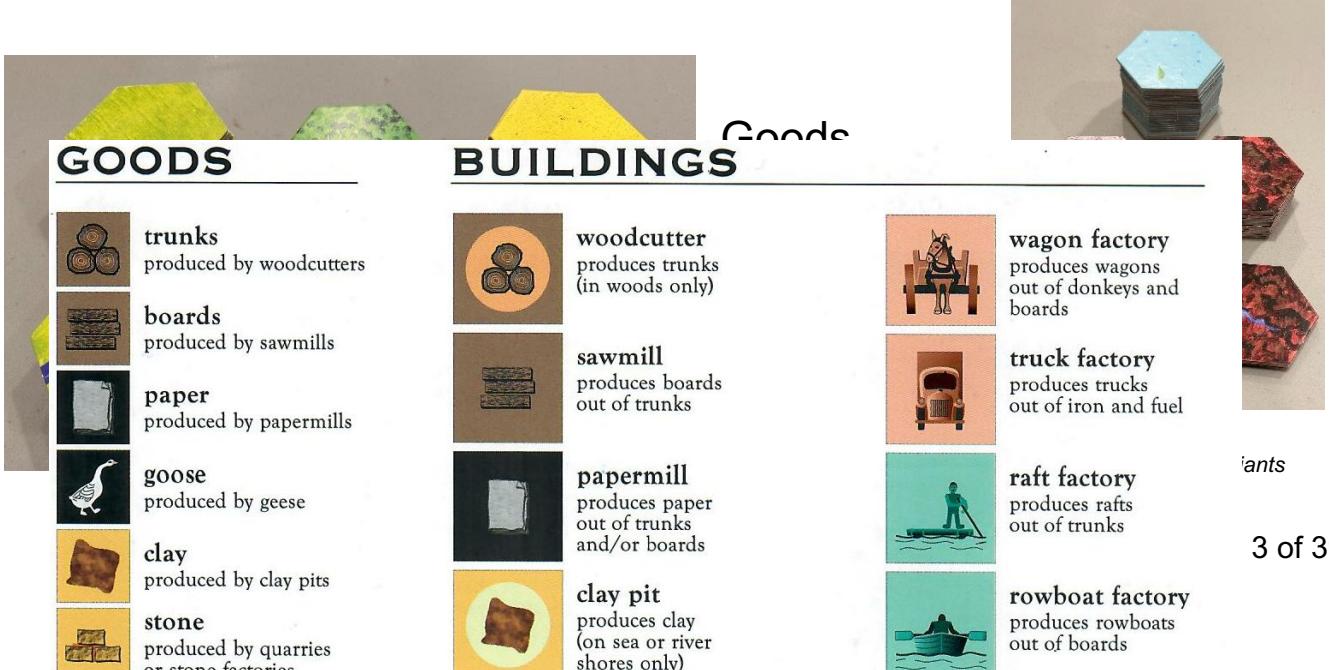
Woodcutter produces trunks (in woods only)
Sawmill produces boards out of trunks
Papermill produces paper out of trunks and/or boards
Clay pit produces clay (on sea or river shores only)
Stone factory produces stones out of clay
Quarry produces stones (on rocks only)
Oil-rig produces fuel (on sea only)
Coal burner produces fuel out of trunks and/or boards
Mine produces gold and/or iron (in mountains only)
Mint produces coins out of gold and fuel
Stock exchange produces stock out of coins and paper
Wagon factory produces wagons out of donkeys and boards
Truck factory produces trucks out of iron and fuel
Raft factory produces rafts out of trunks
Rowboat factory produces rowboats out of boards
Steamer factory produces steam-ships out of iron and fuel
TRANSPORTERS
Donkey
Wagon
Truck
Raft
Rowboat
Steam-ship
RESEARCH
Rowing enables a player to build rowboat factories
Trucking enables a player to build truck factories
Shipping enables a player to build steam-ship factories
Drilling enables a player to build oil-rigs
Specialisation enables a player to fill mine bags with either gold or iron
Enlargement enables a player to fill mine bags with 5 gold and 5 iron
New shafts enables a player to replenish bags of existing mines
Bright idea - no effect (reserved for expansion rules)
Roads & Boats - Tutorial v1.1.md45.5 KB

Roads & Boats is a civilization game unlike most others, focusing not on warfare or territory control, but on the elegant challenge of logistics—specifically the transportation and transformation of goods over time.
What makes Roads & Boats unique?
No ownership of land or buildings: You don’t control territory or lock down buildings.
Anything you build can be used by others.
You only own your transports—and what they carry: Your colored transports and the goods on them are yours and yours alone. But once goods are left on the ground, they’re fair game for anyone. The guiding rule: “If it’s not on a transport, it’s up for grabs!”
Mostly simultaneous play: All players take actions at the same time, except when someone calls for turn order due to a conflict (usually to claim first access to a building or goods).
● Geese! While they’re not the only animals in the game, geese have special rules and behaviors that make them a surprisingly strategic component—especially when it comes to research and movement.
Roads & Boats Tutorial v1.1
The content in this tutorial was adapted from the instructional board game video Roads & Boats: How to Play by JustPlayMediaInc and the Roads & Boats User Manual.
Table of Contents
Overview of Play
The Game Board & Player Phases
Goods, Buildings, & Transports Summary .
Wonder Board
Turn Order, Changing Turn Order, and Conflict. 8
Determining Current Turn Order.... 8
How to Change Current Turn Sequence . 8
Example of Conflict.. 11
Produce Phase.. . 12
Livestock Production (reproduction of Donkeys & Geese). . 12
Produce Goods . 13
Primary Producers (circle highlight on tile) . 13
Secondary Producers . 14
Mines. . 16
Mine Technology . 17
Produce Transports. . 18
Basics of Producing Transports. . 18
Auto-production of Transports. . 19
Produce Research. . 20
Produce Factory Upgrades . 21
Chaining Example . . 22
Movement Phase . . 23
Basic Movement Rules. . 23
Rivers & Bridges. . 24
Geese.. . 25
Sea Transports & Docking/Undocking . 26
Oil Rigs ... . 28
Transporting Transports. . 29
Build Phase. . 30
Build Buildings - The Basics. . 30
Building Mines. . 31
Building Oil Rigs . . 32
Building Clay Pits.. .. 32
Building Roads, Bridges, and Walls . 32
Basics of Building Roads & Bridges . 33
Basics of Building Walls . 34
Demolishing Walls. . 36
Wonder Phase . 37
Game End. . 38
Final Score Tally.. . 38
Game Setup. . 39
Overview of Play
The Game Board & Player Phases
● The game is played over a series of turns
● Each turn has 4 phases shown on the Wonder board:

The current phase is tracked on the Wonder board using an amber glass gem typically used to mark completed player research
○ Produce: Produce livestock, goods, new transportation (including transporters), or research. Note: The first Produce phase is typically skipped because players will not have any buildings on the board yet.
○ Move: Move transportation units across roads, bridges, or across water. Transportation units may carry goods / resources
○ Build: Build new buildings or factories
○ Wonder: Contribute bricks to the common wonder everyone is building to influence Wealth Points at the end of the game. Points are awarded to players with the most bricks contributed on each row of the Wonder.
The main hexes in the game are shown below. The expansion also includes City and Polder hexes. Hexes next to a Sea hex and hexes with a river are considered Shore hexes.
Roads & Boats Tutorial v1.1
Primary Producers: Primary producers are marked with a highlight circle, indicating that they generate goods directly from the terrain and do not require any input resources from players to produce.

Shown Above (eft to right): Woodcutter, Clay Pit, Quarry, and Oil Rig
Secondary Producers: Secondary producers do not have a highlight circle and require players to deliver input resources in order to produce output goods. For example, a Sawmill requires trunks to produce boards. Like primary producers, they operate automatically once the required inputs are present—regardless of whether a player transport is on the hex.

Shown Above (left to right, top to bottom): Coal Burner, Stone Factory, Sawmill, Papermill, Mint, and Stock Exchange
Roads & Boats Tutorial v1.1
Factories: Factories are used to produce new transportation units. Some factory types require research before they can be built. To receive a newly produced transport, a player’s transport must be present on the same hex. Exception: Carts do not require a separate transport to receive them, as they are created by consuming a donkey as part of their production cost.

Top Row: Raft Factory, Rowboat Factory, Steamer Bottom Row: Wagon Factory, Truck Factory. Airports are available in the expansion.
● Transportation Units - Base Game
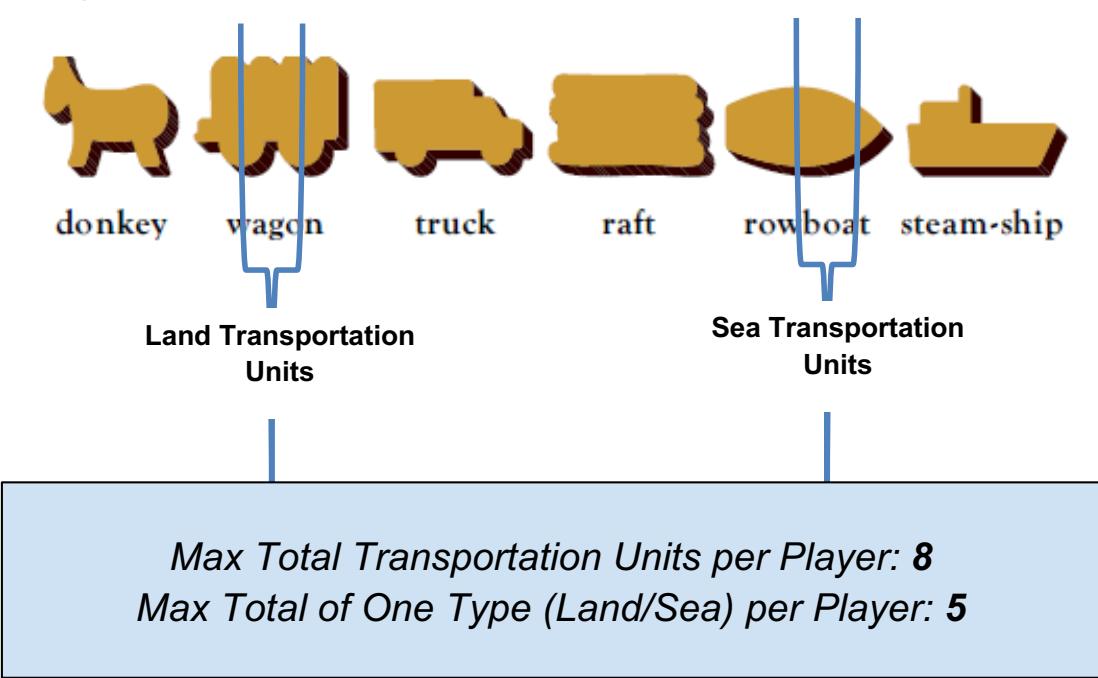
Wonder Board

Players will have the option to place one or more bricks on the wonder board at the end of each turn during the Wonder phase to earn “wealth points” points at the end of the game.
Bricks are placed on the Wonder in turn order starting on the bottom row (left) in the “Start” square. The first brick for each player costs 1 good that must be provisioned from the hex containing the Players Home Tile. A transportation unit must also be present on the hex, otherwise the Player may not use the goods to pay for the Wonder brick.
1st brick cost = 1 good, 2nd brick cost = 2 goods, 3rd brick = 3 goods, etc.
The Wonder board is also a timer for the following:

Cost of Bricks: Once any brick is placed in the 1 = 2 space highlighted in red on the left, the cost to place the 1st brick increases to 2 goods. Additional bricks cost 1 additional good as well. 2nd brick costs 3 goods, 3rd brick costs 4 goods, etc.

Converting Deserts to Pasture: If you have any Desert hexes on the map, they will turn into Pasture hexes once this space is filled by any brick.

Game end: Once a brick is placed in the space containing the number of players relevant to your game, end game is triggered.
Turn Order, Changing Turn Order, and Conflict
Most of the time, play will happen simultaneously. Turn order will only be invoked if a player calls for turn order at the beginning of a phase. Conflict usually occurs ONLY when two players want to get or use resources on a specific hex or to interact with a building or factory before another player. You only play in sequential turn order when there is a Conflict.
Determining Current Turn Order
Play order is determined by order of player pieces on the sequence chart below the Wonder. This can be altered by calling for a turn order change and making changes to the order of the “praying figures” above the Wonder.
■ The player who is furthest to the left plays first continuing to the right in the turn order sequence area below the Wonder as shown in the image below.
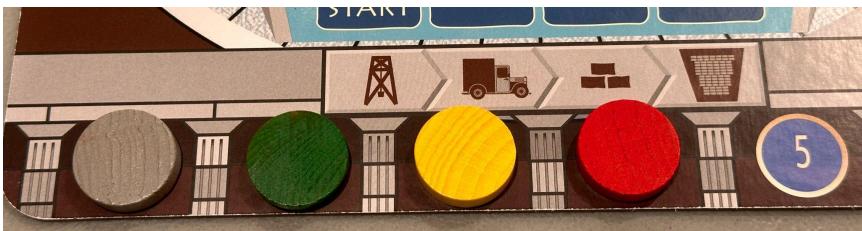
■ A player may invoke turn order by stating they wish to do so at the beginning of a phase
How to Change Current Turn Sequence
When any player calls for turn sequencing to be invoked, other players may also request a turn order change—but it must be declared before the phase begins.
Each player has a “praying figure,” represented by a colored disk above the Wonder board. The arrangement of these disks determines the order in which players select their position in the new turn order.
The player closest to the temple (furthest to the right) is considered the most pious— they are “busy praying” and not concerned with worldly matters like turn order. As a result, they will be last in the turn sequence.
■ The player furthest from the temple (furthest to the left) is the least pious—more focused on action than prayer—and will be first in the turn order.
Roads & Boats Tutorial v1.1
Here’s how to change turn sequence
● Step 1: Each player decides whether or not to “cash in” their piety to move further back in rows towards the exit of the temple to move up in turn order
○ Move all pieces up to clear out the prayer order spaces at the top of the Wonder board

In the image above shows all player pieces lined up in “prayer order” with the “most pious player closest to the temple on the right.

To prepare for changing turn sequence, move all pieces above their current position as shown above
● Step 2: Choose a playing position
○ Player who is closest to the temple may move to the “back of the temple” to become the first player. In the example below, the red player decides to move to the “back of the temple” (moving to furthest position to the left) which will give them the option to be first in turn sequence.

Roads & Boats Tutorial v1.1
○ The player who is second closest to the temple may choose to move to the second position on the left or remain in place. Each subsequent player makes the same choice in order. This decision is optional—players may choose to stay where they are, which will gradually move them closer to the temple and potentially allow them to become first player in a future turn order change.
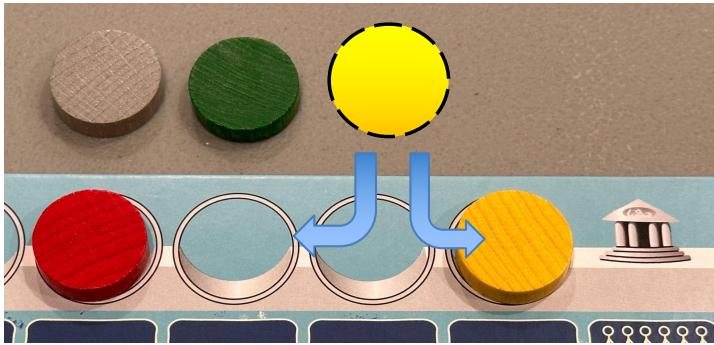
In the example above, the yellow player opts to move closest to the temple which will give them the opportunity to move to the back of the temple and become first player at some point in the future.

The green player decides to not move forward and stays in their same position. Therefore, the gray player has no choice but to stay in 2nd position.
Re-order the turn sequence disk tokens at the bottom of the Wonder board to reflect the new turn order. The red player will now go first in the phase that is about to begin.

● The new turn order will be effective moving into this Phase
● Turn order change can happen at the beginning of any/all phases
You may look at the next unit(s) that will be produced in any/all mines before calling for a turn order change. This is an exception: players may preview the next mine output before deciding whether to invoke turn order for the Production phase.
Example of Conflict
All actions in each phase can be carried out simultaneously, unless there is a conflict. A conflict occurs when two or more players want to do something before the other. In this case, one of the players may invoke the sequence of play. The rest of the phase is then played out in this sequence.
Example of Conflict and Change of Turn Order
A Papermill can only create 1 paper good and requires any 2 of trunks or board goods during the Production phase to produce the paper good. Both the red and yellow players have 2 trunks in which to use the Papermill, but only one of them can use the Papermill this turn because the Papermill can only produce a maximum of 1 paper goods per Produce phase. The yellow player calls for a turn order change at the beginning of the Produce phase.
Assuming the yellow red player was closer to the temple prior to this phase as noted in the example above, they could move in front of the yellow player by calling for a turn order change before the Produce phase begins. Then the red player would get to go first and use the Papermill to produce paper. The yellow player would have to wait until the following turn to use the Papermill.
Additionally, the red player would be able to claim the paper that is produced and immediately place it on their transport (donkey).
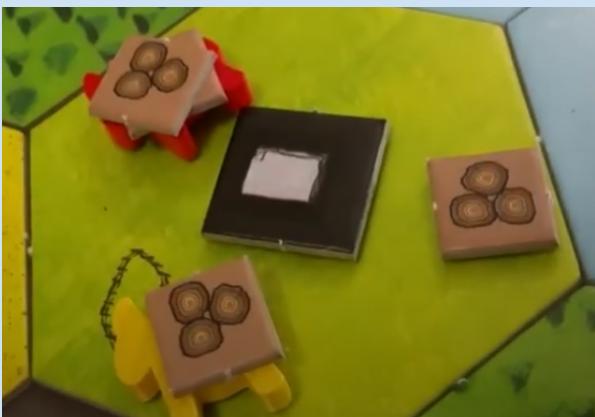
A Papermill will attempt to consume boards first to produce paper first before consuming trunks if both are available on the hex.
Produce Phase
In the Produce phase, all tiles are checked for production. Production takes place on tiles with primary producers, secondary producers, and on empty pasture tiles containing livestock. Research and factory upgrades are also produced during this phase. Transportation units are produced during the Produce phase, not the Build phase.
All types of production described below can be done simultaneously by all players.
Livestock Production (reproduction of Donkeys & Geese)
● To reproduce you must have any of the 4 conditions pictured below:


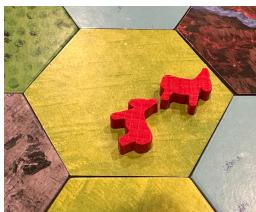
● Only 2 of each livestock (alone)
● Must be on a Pasture hex (no other hex types can be used for reproduction)
● No other tokens in the hex (e.g buildings, resources, goods, other animals, etc) where they will reproduce
● Donkey reproduction must be declared by the player who owns them.
● Geese do not have owners and will reproduce automatically if all reproduction conditions are met.
● The only things that can be in the hex with the reproducing livestock are:
■ Pre-existing road(s) connecting the hex to another hex
■ Pre-existing wall(s) blocking access from another hex to this hex
■ A player’s Home token
Geese reproduce automatically if conditions are met, as they do not have owners. Donkey reproduction must be declared by the owning player.
Roads & Boats Tutorial v1.1
Produce Goods
Primary Producers (circle highlight on tile)


Must be built on the required terrain as shown in the red box to the left. The cost to build each building is listed on the player aid and must be paid in the Build Phase.
● Buildings that require research before they can be built say “Research” below them on the player aid. See Oil Rig in the image above.
Primary producers produce exactly 1 output each production phase. In the images below, the Quarry and Woodcutter produce stone and trunk goods respectively.


Place the new good next to the producer that made it. It’s a good idea to place newly produced goods on the producer initially, especially once you have a lot of producers on the board. It can become confusing keeping track of where you’ve added goods and where you haven’t yet once you have a lot of producers on the board. Once you’ve completed production, move the goods off of the producer.
○ Primary producers will produce whether or not any player’s transports are present
Primary producers produce exactly one good per Produce Phase, with the exception of the Mine and will produce 1 good per Production phase.
Roads & Boats Tutorial v1.1
Secondary Producers
Secondary Producers will only produce if the required input goods are present on the same hex. When those inputs are available, the building will automatically attempt to produce goods up to its maximum capacity, as indicated on the Player Aid. A player’s transport does not need to be present for a Secondary Producer to function.
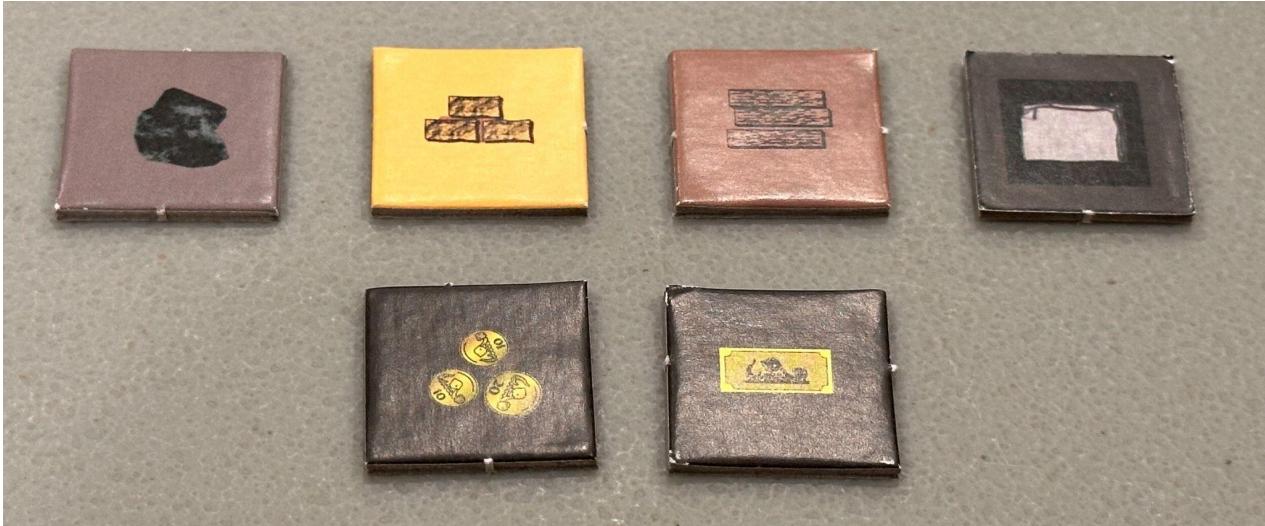
Shown Above (left to right, top to bottom): Coal Burner, Stone Factory, Sawmill, Papermill, Mint, and Stock Exchange
Roads & Boats Tutorial v1.1
Here are the details regarding Secondary Producers:
● Will produce automatically if the required goods are present on a player transport (at discretion of the transport owner) or just sitting on the hex next to the producer.
Will keep producing goods up to its maximum capacity. Any remaining raw resources that cannot be consumed will just stay in the hex and be available for consumption/production next turn.
● Players may use a combination of goods from transports and/or from the hex to satisfy the cost to produce goods from a Secondary Producer.
● Players may take goods produced from a Primary or Secondary Producer and may immediately place them on a transport..
● You can’t forcibly take goods from another player’s transport.
● Requires raw inputs to produce output. Here’s an example of Sawmill production:

Before Production

After Production
In the above example, a Sawmill consumes 1 Trunk to produce 2 Boards.
Reminder: Primary & Secondary Producers will produce automatically as long as the necessary input goods (e.g. Trunk for a Sawmill) are present in the hex, regardless of whether a player transport is present
Roads & Boats Tutorial v1.1
Mines
Mines function as a hybrid between primary and secondary producers: like primary producers, they generate output without requiring input from a transport, but their production is limited to the type of mine built during the Build phase.
A standard mine (built without any research) is filled with 3 gold and 3 iron, which are revealed randomly during the Produce phase. With mine-related research, players can customize the mix and quantity of resources, or re-shaft a depleted mine to refill it and continue production.

You can build a standard mine without any research which will be filled with 3 gold and 3 iron
Here are the specifics related to building a mine:
Must be built on a mountain hex. Pay the goods shown on the player aid depending on the mine being built. Set up the mine, add the goods and randomize them depending on the type of mine being built.
○ When a new mine is built, you may fill it based on technology you’ve researched
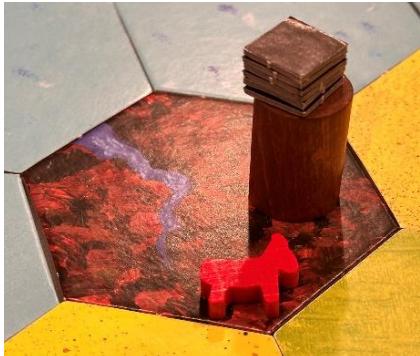
○ At the beginning of the game, players have no technology, so a mine is filled with 3 gold and 3 iron. Players may not fill a mine using a Specialized mine until they have researched the required technology
When filling a standard mine, randomize the goods and place them face down on top of the mine. Alternatively, you number number the mines and place the goods in a bag or cup with a matching number
● Mines produce one good per Produce Phase, regardless of the type of mine built.
During the Produce Phase, reveal the top resource and place it on the hex. It is now available for players to place on transports.
● It will take 6 production phases to deplete a standard (no technology) mine
● Once the resources are produced, the mine will be depleted and will not be able to produce again. Players who have researched the New Shaft technology can re-shaft a mine. See Mine Technology below for more details.
Mine Technology
Players may research 3 technologies related to mines:
● Specialized Mine: You may select either 4 gold or 4 iron to fill the mine.


● Big Mine: Fill the mine with 5 gold and 5 iron

● New Shaft: Fill a mine with standard mine fill (3 iron and 3 gold), Specialized Mine, or Big Mine.
Players must first research Specialized Mine, Big Mine, or New Shaft in order to build a mine that uses any of those advanced fill options.
Produce Transports
Basics of Producing Transports
Produce new Transport: Non-Livestock Transports are produced in Transport Factories (e.g. Wagon Factory, Steam-ship Factory, Raft Factory, etc.)
○ A player must have a previously existing Transport present on the hex to receive the newly produced transport, otherwise the goods will be forfeit and the new transport will be destroyed.
○ Exception – Wagons: When producing a Wagon, it is automatically assigned to the player who provided the donkey as part of the cost. No other transport needs to be present on the hex to receive it.
○ Max 8 total transporters; only 5 of a particular type (land or sea)
○ Out of Service: If you’ve reached the transport limit, you cannot produce a new transport unless you first remove one. To do this, move any existing transport to a Transport Factory. If a transport is present on a factory hex during the Produce phase, it may be destroyed immediately—there’s no need to park it in advance. This is the only way to reduce your total and make space within the 8-transport limit.
If a player has reached the maximum number of transports, they may not produce additional ones until an existing transport is removed. To place a transport Out of Service, it must be located on any Transport Factory during the Produce phase. It is then removed from the game. This is the only way to reduce your total number of transports and make room for new ones.
■ Use your researched buildings (e.g. Factory) to produce a new Truck
■ Notes on Sea unit production
● Must be built on a shore
If the factory is on shore of the sea, newly created transports are placed on the shore and are considered “docked”. It takes one movement to “undock” before movement begins
Roads & Boats Tutorial v1.1
■ If the factory is on a river, then no docking takes place and no additional move is required to “undock.”
● A player may not produce a sea unit to the sea if a wall blocks placement to the sea hex.
Auto-production of Transports
Factories will automatically attempt to produce transports if the resources are available to produce them.
Blocked Production: If the production is blocked (e.g. by a wall), the resources will be consumed/lost, but no unit will be produced.
No player present: Same as blocked production above. A player must be present to receive the newly produced transport or it will be lost.
Produce Research
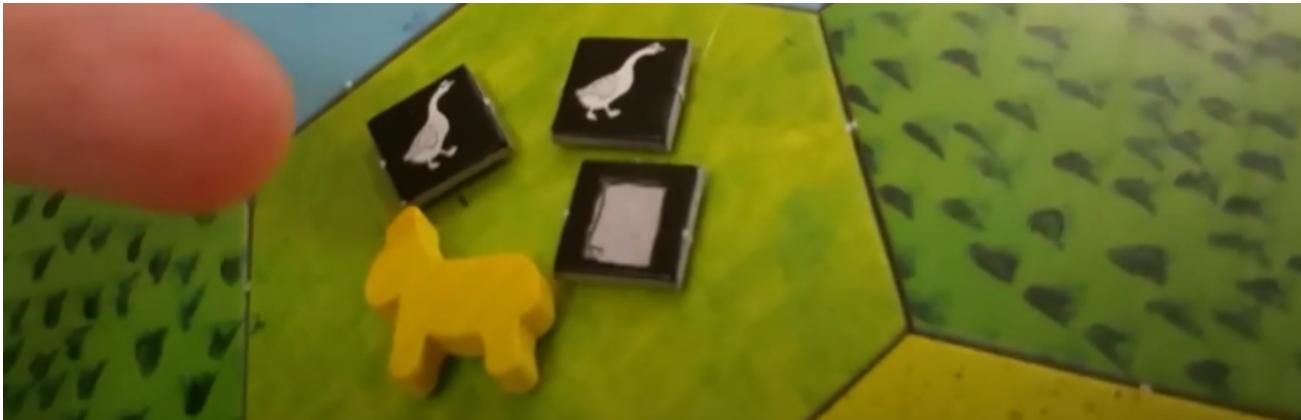
Research is produced during the Produce phase at the cost of 2 geese and 1 paper. No building is required. All three components must be on the same tile, and that tile must also contain one of the player’s transporters. If the geese and paper are left unattended (not carried by a transporter), they are consumed and no research is produced.
● Requires (1) two geese, (2) 1 Paper good, and must be accompanied by a player transporter on the same hex tile.
○ If the two geese and a paper good are left unattended by a player transport, they will be consumed during the Production phase and will not produce any research.
● Select a technology to research and place a marker on the appropriate spot on your player board
| Question | Answer |
| Can I accumulate paper or geese across turns? | XNo |
| What happens if I leave 1 paper + 2 geese on a hexwithout a transporter? | They vanish |
| Can I do partial research this turn, then finish it nextturn? | X No. You must complete it all at once |
| Can I hold unused research points for laterallocation? | X No. You must assign them immediately |
Roads & Boats Tutorial v1.1
Produce Factory Upgrades

● You may upgrade existing factories with upgraded factories (e.g. upgrade a raft factory to a ship factory)
● To perform this action, you must have the corresponding research
● A transport belonging to the player performing the upgrade must be present on the hex of the factory to be upgraded
Other players cannot prevent a player from upgrading a factory if the necessary conditions for upgrade noted above are met, even if another player built the factory being upgraded initially.Other things to consider in Production Phase
Chaining Production Actions: All actions within the Produce phase may be performed in any order the player chooses, and production steps can be chained together. For example, a player may produce goods, use them to conduct research to unlock a factory upgrade, then immediately upgrade that factory and produce a transport from it— provided all required resources are present on the hex. All of this can happen within the same Produce phase. The following page provides an example that illustrates how production actions can be chained together within a single Produce phase.
Roads & Boats Tutorial v1.1
Chaining Example
● Let’s assume a player transport is located on a hex containing a Paper Mill, and that the transport provides 2 trunks to produce a piece of Paper
If the same player transport had 2 geese following, it could immediately produce Research in the same production phase.
● Let’s assume the player chose to research Steam Ship technology.
Let’s assume the player has a different transport on a hex containing a Raft Factory. It could upgrade this Raft Factory to a Steam Ship Factory, regardless of whether the player originally built the Raft Factory or not.
● If this same player also had 2 Fuel and 1 Iron on the same hex as the new Steam Ship Factory, the player could opt to produce a Steam Ship.
● All of the above could happen in the same Production Phase.
● If chaining research + upgrade + transport production in the same Produce phase, be sure the new transport doesn’t exceed your 8-unit limit. You must destroy a transport at the factory if needed.
Sea Transports as “Ferries” on a River: Rivers usually require a bridge to cross from one side of the river hex to the other, but a sea transport can act as a Ferry to allow a player to move back and forth across the hex the same as a bridge would allow (e.g. access to resources on one side of the river for production at a factory or a primary/secondary producer on the other side.
● Production is skipped in the first turn because there are no buildings or factories, and no movement has yet occurred.
Note: Every building or factory will attempt to produce up to its maximum capacity, using any available goods on its hex. If no player transport is present to collect them, the produced goods remain on the hex and may be picked up or used by any player in a later phase.
Movement Phase
Basic Movement Rules
● Movement occurs between hexes only.
○ Assuming a bridge is present, crossing a river does NOT count as a hex movement. All goods are accessible from either side of the river in this case.

The red player’s Donkey has may load the Trunks to the north of the river without any movement. The bridge provides free access to any buildings or goods on either side of the river. No movement is required within a hex.
○ Items may be access freely across a river if a bridge or sea unit acting as a ferry is present
● Each transport may move ONCE during a move phase
● Transports may carry goods or other transports up to their maximum carry capacity (see player aid for details). A transport may carry 1 other transport at a time. When doing this, neither the carrying transport nor the carried transport may carry any goods.
| Transporter | Carry | Move Terrain |
Donkey | 2 | 1 No Road |
| 2 Road | ||
Wagon | 3 | 3 Road |
| Truck | 6 | 4 Road |
Donkeys are the only units that can move across hexes where there is no road. Wagons and Trucks may only move on roads.
Roads & Boats Tutorial v1.1
● Along a movement route, transports may pick up and/or drop off goods an unlimited number of times at any point along the way, as long as they never exceed their maximum carrying capacity at any time.
Goods may only be moved ONCE in a given movement phase. You may not move goods, transfer them to another transport, and move the goods again. Geese are not considered goods and may follow a player’s transport more than once across players’ turns, but each goose may only move once per player’s movement phase..
Goods (boards, trunks, coins, etc.) can only be moved once per Move phase. No relays.
● Even though donkeys can move between hexes without roads, they cannot move across a river without a bridge or sea transport acting as a ferry.
Rivers & Bridges
● Rivers block movement of land-based transports.
● Land transports cannot cross rivers unless a bridge is present or a sea unit is present acting as a ferry.
Geese

● Geese may move in 2 ways:
○ Following a player’s transport as it leaves a hex (player’s discretion on land hexes; mandatory on sea hexes)
○ Being loaded onto a transport and moving with transport.
Geese which had been following one player’s transporter will follow the transporter of another player which passes through the hex, if that player wants them to. This can only occur if the second player moves later in turn order. The first player can prevent this by loading the geese onto their own transporter..
● Geese do not follow transports on the other side of a river unless there is a bridge
Geese may be loaded onto a transport where 1 Geese = 1 Good. Geese loaded on a transport are “protected” and will not follow another player’s transport and cannot be taken by another player.
Geese may only be moved once per player’s movement phase. If left behind on a tile, they may follow the transporter of another player who moves later in turn order, if that player chooses.
● Geese can follow land and sea transports.
Geese cannot be left alone on a sea hex. The Geese will always follow a transport leaving a sea hex. Geese may be dropped off on an oil rig, similar to goods.
Sea Transports & Docking/Undocking

● In order for a sea unit to interact with a land hex that is adjacent to a sea hex, it must be “docked.”
○ Interaction with hexes includes picking up or dropping off goods.
Undocked units on sea hexes may NOT interact with resources on land hexes, with the exception of building and destroying walls, which costs more than doing so on land..
● When initially produced on the shore of a sea hex, the unit is considered “docked.”
● Docking from a sea hex to a land hex takes one movement point.
● When docked, a unit must “undock,” which takes one movement point as well.
Once a sea unit “docks,” its movement ends. The unit may not move again during this movement phase. Any additional movement points are forfeit, but the unit can still interact with the hex, including dropping off and picking up goods..
When docking a sea transport on a river hex, you must choose which side of the river to dock on unless a bridge is present, which then merges both sides. Note: Sea transports on river hexes can access both sides without docking.
Building a wall from an undocked sea transport costs 3 stone: this includes 1 base stone + 2 extra due to the difficulty of construction from the sea.
In the example below, the player would want to dock on the right side of the river hex in order to interact with the goods on the right side of the hex. If there were a bridge on the river hex, a sea transport could dock on either side because the bridge becomes a single contiguous hex when a bridge is present and resource may be loaded from either side.

Docking is not required on river hexes.
Roads & Boats Tutorial v1.1
Oil Rigs
● Oil rigs may only be built in sea hexes
● Sea units can freely interact with oil rigs without docking.
○ Transports must be in the same sea hex to interact with it (i.e. exchange goods)
○ Transports may continue movement after interacting with an oil rig.
● Players may store goods on oil rigs.
Transports may exchange (drop off / pick up) goods on an oil rig. Geese may be exchanged and left on oil rigs, but may never be left in a sea hex without an oil rig.
Roads & Boats Tutorial v1.1
Transporting Transports
● Transports may carry / transport other transports as long as they haven’t already moved during this move phase.
When a transport is being carried (e.g., a truck on a raft), it cannot carry any goods itself during that phase. Neither can the carrying unit carry anything else.
● A transporter cannot transport any goods if it is carrying another transport. The transport takes all carrying capacity. This is true for the unit that is carrying and the unit that is being carried.
● If a transport has already moved during this move phase, it may be loaded onto another transport, but the transport it was loaded onto may not move during this move phase.
Once a transport is unloaded, it may not move during this move phase; it was just moved by the transport on which it was loaded.
● Sea transport unloading limitation: A sea transport can only unload another sea transport onto the same shore or river, and never only land directly.

In the example above, if the row boat transport carried the truck from a previous land hex, through the sea hex, and unloaded the truck transport on the land tile, the truck would not be able to move during this movement phase because it already “moved” by being carried by the row boat.
Build Phase
Build Buildings - The Basics

● You may only build ONE BUILDING on each hex.
● You must have one of your transports present in the hex where you wish to build. Any of the following will meet this requirement:
○ Land transport in the hex where you want to build
○ Sea transport docked to the land hex where you want to build
○ Sea transport on a sea hex where you want to build an oil rig
○ Sea transport on a river hex where you want to build
● Land transports on one side of a river hex cannot build on the other side unless a bridge is present
● River hexes may only have one building - not one on each side of the river
● Costs for all buildings are listed on the player aid
● Some buildings require research before you can build them
Roads & Boats Tutorial v1.1
The home tile is not considered a building and does not prevent placing a building on the hex. However, only one building may exist per hex, including the home tile. It is also required for paying goods into the Wonder—only goods on your home hex can be used.
● Buildings may never be moved or removed from the game
Building Mines

● You can refill an existing shaft regardless of whether the previous fill has been depleted.
● The new mine you use to refill does not need to match the original mine. For example, you can refill a Big Mine shaft in a hex that now contains a New Mine (e.g., 3x3 gold and iron).
● You can use the New Shafts technology to refill existing shafts in previously built mines as often as needed. This method is more efficient and requires less transportation of materials than constructing new mines.
Let’s assume the mine below was built on a previous turn. You may build a New Shaft over the previous mine regardless of whether it's been depleted or not. You can always add one or more new mine shafts to an existing mine if you have the technology and can pay the cost to build it. You will simply add the new Mine Fill (see player aid) to the existing fill.
Let’s say the player has the technology for Specialized Mine and chooses “4 gold” as the fill. The 4 gold would be randomized with any previous fill and added to the mine. Production would continue with the new fill in the next Production phase.

Building Oil Rigs
● Oil rigs must be built on a sea hex
Building an oil rig requires 1 stone and 3 boards, which must be transported together to the sea hex and used all at once. You may not deliver the resources piecemeal or leave them unattended in the sea. As a result, constructing an oil rig requires a transport capable of carrying at least 4 goods.
Building Clay Pits
Clay pits must be built on a shore (e.g. land hex with a river or a land hex that is adjacent to a sea hex)
Building Roads, Bridges, and Walls
● Roads, bridges, and roads start with a base cost of 1 stone
● Roads & bridges can never be removed or destroyed
● See the player aid for additional requirements for each type of unit
Basics of Building Roads & Bridges
In the example below, the donkey on the right is carrying 2 stone resources and may therefore build 2 roads. Roads are drawn directly on the map using a grease pencil or dry erase marker. Once the roads are built, the 2 stone goods are returned to the supply.

● Roads may be built from the center of a hex to any adjacent land hex

● Bridges are built in the same way. A land transport may build a bridge across a river for the cost of 1 stone resource.
Roads & Boats Tutorial v1.1
Basics of Building Walls
See the costs for building walls and strengthening / fortifying walls on the player aid as well as the examples below.
● All resources used to build a wall must come from one side / hex. Players may not take resources from multiple hexes to satisfy wall build resource requirements.
Only one player color wall may exist between any two hexes at a time; multiple playercolored walls on the same border are not allowed.
● You may NOT build walls between two sea hexes.
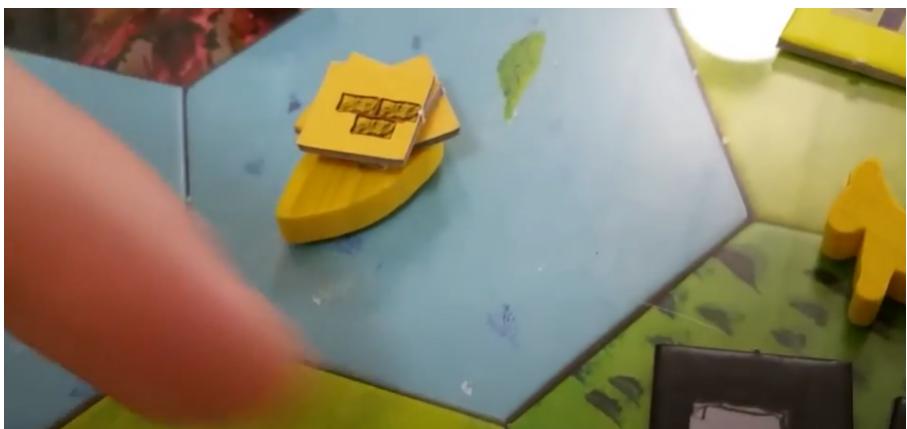
● Walls built from land or a docked sea unit cost only 1 stone. An undocked sea unit may build a wall from a sea hex, but it will cost an additional 2 stone for a total of 3 stone.

● A land transport may build a wall for the cost of 1 stone. Walls may be built between hexes containing a road from either side / hex
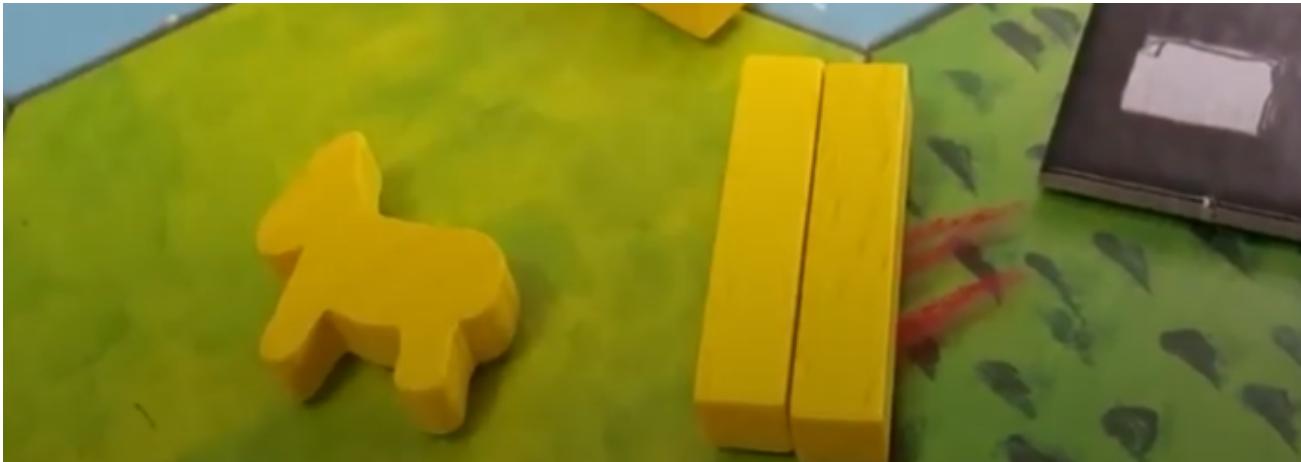
● A player may strengthen / fortify a wall as shown above. The cost to strengthen / fortify from 1 to 2 is two stones. To strengthen / fortify from 2 to 3 costs 3 stone, etc.
● Walls may NEVER be built between 2 sea hexes
Transports may move freely through walls built by their own player color. However, they cannot pass through walls built by other players. To cross, they must either go around the wall or demolish it using the appropriate resources.
If a player builds a wall on a border where another player’s sea transport is currently docked, that transport will be forced to undock and move to the adjacent sea hex. In the example below, the rowboat was docked at the land hex before the red player built the wall and was subsequently pushed back into the sea.

Roads & Boats Tutorial v1.1
Demolishing Walls
● Walls may be demolished. See player aid for costs. There is an additional demolition cost to destroy walls from sea vs. docked, similar to building walls.
When a wall is destroyed, it is returned to the supply and replaced with a neutral wall, representing the remnants of the original structure. Neutral walls do not block movement—any player may pass through them freely. See the illustration below.
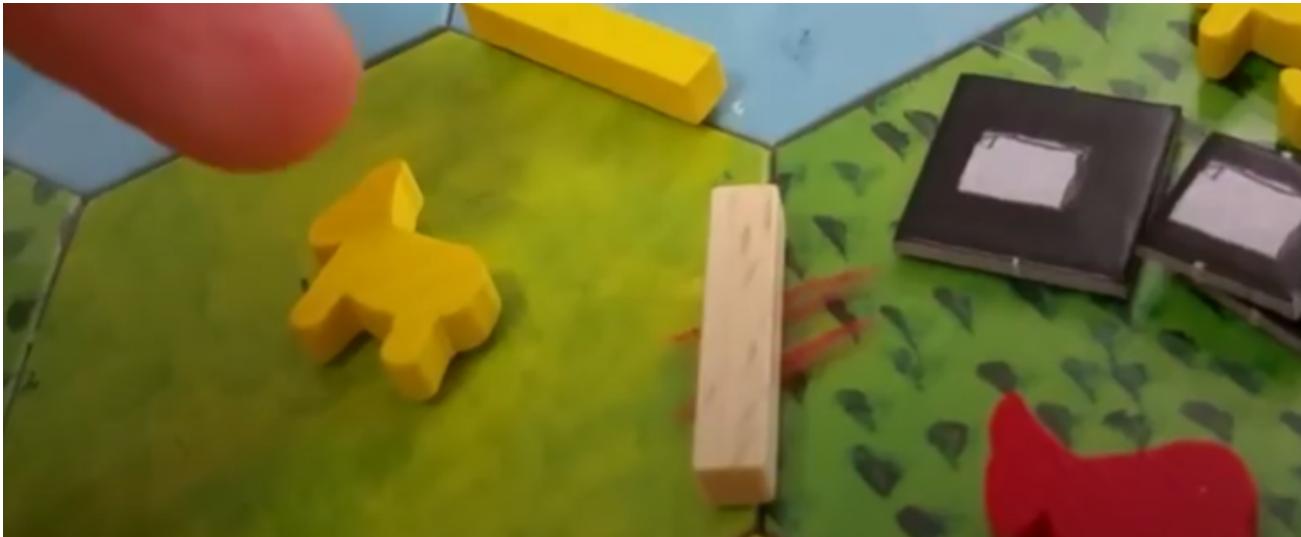
Rebuilding over a neutral wall is considered reinforcing it. For example, if a neutral wall remains from a previously destroyed wall, placing a new wall on that border costs 2 stone—the same as strengthening a wall from level 1 to level 2. Each subsequent reinforcement increases in cost (e.g., 3 stone for level 3), meaning walls become more expensive to rebuild after being demolished.
● There can only be 1 player color wall between two hexes. Two players cannot have walls in the same place.
● Just a reminder, roads, bridges, and buildings can never be destroyed.
Wonder Phase
In the Wonder phase, players have an opportunity to add bricks to the wonder and a neutral brick will be added.
● Requirements for adding a brick to the Wonder
○ The cost for adding the first brick is one good (changes to 2 later in the game)
○ Goods must originate from the hex with the player’s home token
○ A transport must be present on the hex with the home token
● Placement of bricks is based on turn order
● In the example above, the yellow player will have the first chance to add a brick to the Wonder

● The first brick will cost 1 good. The yellow player may add a second brick for a cost of 2 goods, a third brick for 3 goods, etc.
● After the first 4 rows of the Wonder are built, the price to add bricks increases to 2 goods for the first brick, 3 goods for the second brick, 4 goods for the third brick, etc.
Roads & Boats Tutorial v1.1
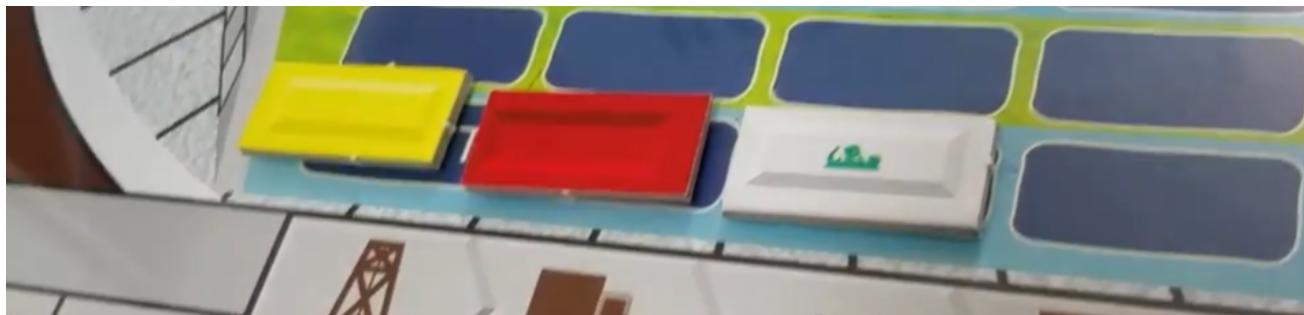
● Once all players are finished adding bricks, a neutral brick is added. See the white brick in the illustration above
Game End
The game will end once a brick is placed on the Wonder in the space matching the player count.

Final Score Tally
● Calculate wealth points for each player in each row of the Wonder.
○ Each row in the Wonder is worth 10 points
○ Points are divided equally amongst players based on brick contribution in each row
○ Fractions of points are rounded down
Determine wealth points from gold, coins, and stock certificates. All goods must be carried on a transport to count for points. Goods left on a hex do NOT count as end game wealth / points.
○ Gold nuggets: 10 points
○ Set of coins: 40 points
○ Stock certificates: 120 points
The player with the most wealth / victory points wins the game. In the event of a tie, the player whose praying figure is closest to the temple wins the game.
Game Setup
● Set up the player map based on player count using the Scenario booklet. If creating your own map, use a mix of at least 10 land hexes per player and as many sea hexes as you want
● Place the Wonder board next to the player map
● Place plexi-glass over the map and Wonder board, if possible
● Create a supply of all of the goods, resources, transportation units, and research
● Give each player pieces in their color
● Turn order
○ Take the Wonder board turn order marker from each player and randomly drop them placing first closest to the wonder.
○ Continue to randomly select tokens placing them further from the Wonder. The player who is furthest away will be first in turn order when Conflicts arise
● Place home tokens. There are two ways to do this
○ Decide as a group where everyone will start
OR
○ Randomly determine a player order (different than Wonder turn order) and each player selects a hex on which to start. Players must be AT LEAST 1 hex away from each other. Try to be near Stone, Pasture, and Woods when selecting a start location.
● Note: The first Produce phase is typically skipped in the first round because players will not have any buildings on the board yet.
● Starting Resources & Units: Give each player the following (listed on the player aid)
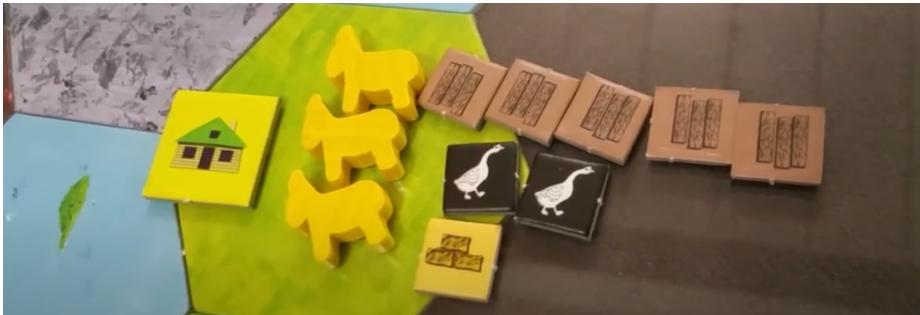
原文为社区整理/出版社公开资料,版权归原作者,仅供个人学习查阅。