
罗马Roma
一句话概览
罗马 是一款已收录于村了吗规则库的桌游,支持 2 人,原名 Roma。
本页内容:一句话概览 · 常见问题
这游戏怎么玩
- 本站已收录这款游戏的规则资料,可以在对话里直接提问规则细节。
常见问题(FAQ)
以下 1 条问答中 0 条来自站内玩家的真实提问,其余 1 条为本站整理的常见疑问;答复内容保持原样。
罗马支持几个人玩?
2 人。
去哪查完整规则
想核对具体规则细节、卡牌效果或某个回合的结算方式,可以在村了吗里选中这款游戏后直接提问。
同类桌游
- 卡坦岛德式
- 工业革命:伯明翰德式
- 勃艮第城堡:特别典藏版德式
- 方舟动物园德式
- 卡卡颂抽象
- 瘟疫危机传承:第一季美式
- 阿瑞迪亚:勇踏征途美式
- 重塑宇宙德式
- 幽港迷城美式
- 埃多拉的德鲁伊德式
规则原文(Markdown)
本站收录这款游戏的规则原文 1 个文件,此处内联渲染 1 个,可直接展开阅读或下载。
Roma_manual_english.md16.1 KB
GETTING READY TO PLAY
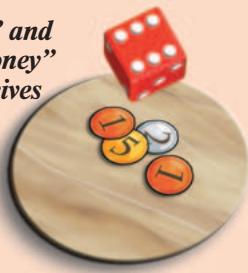
First the play area is set up. The 6 dice discs are laid in ascending order in a row between the two players. The “money” and “cards” discs are laid at either end.
The players each receive 10 victory points and the 3 action dice in the colour of their choice.
The money, the remaining 16 victory points and the battle die are laid ready.
All the cards are shuffled. Each player receives 4 cards in his hand. Each player gives the other player 2 cards face-down. The remaining cards are placed in a pile face-down on the table. Cards which are discarded during the game are placed face-up to form a joint discard pile.
The younger player is the starting player and begins. This player lays his cards face-down on his side of the play area. When laying the cards, the players have a free choice as to which card they put next to which dice disc. However, it is not allowed to have more than 1 card next to any dice disc on either player's side.
The other player then lays his 4 cards on his side. As with the first player, this player can also choose any 4 of the dice discs. Both players then turn their cards over and the starting player begins the game.
HOW TO PLAY
The players take it in turns to make a complete move. A move is made up of 3 phases, which are carried out in the following order:
Phase 1: Add up score for unoccupied dice discs
Phase 2: Throw the dice
Phase 3: Carry out the actions
Phase 1: Add up score for unoccupied dice discs
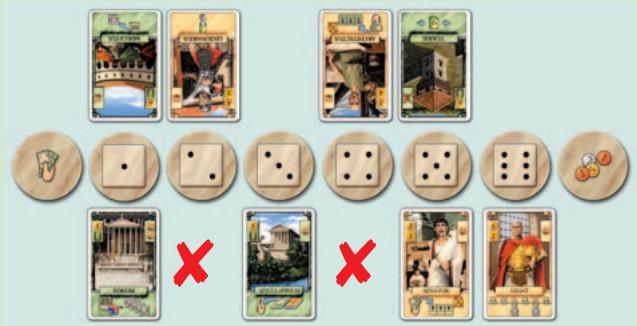
If not all the dice discs are occupied by the player's own cards, the player whose turn it is has to put 1 victory point back in the general stockpile for every unoccupied dice disc on his side.
One player lays his cards here …

… and the other here.

The two players each receive 10 victory points at the beginning of the game.
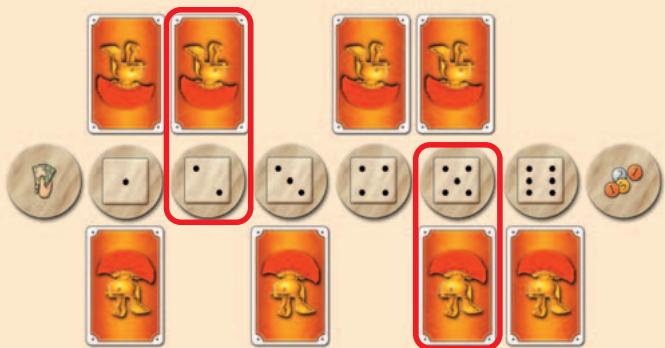
Every card played is allocated to one particular dice disc.
The starting player has to put 2 victory points back in the stockpile during his first go as he only has 4 cards at the start which means that only 4 dice discs are occupied.

Phase 2: Throwing the dice
The player throws his 3 action dice. If all three dice show the same number, the player can throw (all three dice) again.
Phase 3: Carrying out the actions
There are 4 possible types of action which can be carried out. It does not matter how many times or in what order they are carried out.
No dice are used to
• Lay cards
However, this action costs money, the exact amount depends on the card.
One action dice is required for each of the three actions:
• Take money
• Take card(s)
• Activate a card
The player decides which of the dice scores thrown in phase 2 he wants to allocate to which of the different actions. It is not possible to divide up the score on one particular die or to allocate one dice score to more than one action.
The actions in detail:
• Laying cards
Cards are taken from the player's hand and placed face-up. When laying a card, the player always has to allocate the card to a dice disc. Cards are only placed on the player's own side.
Covering cards
If a player wants to lay his card next to a dice disc which has already got a card next to it, the card which is already there is removed and put on the discard pile.
Laying a card costs the number of sestertii shown on the card. A player is only allowed to lay the card if the complete amount has been paid. The money is put in the general stockpile.
• Taking money
A player puts one of their action dice on the “money” disc and takes the number of sestertii shown on the die from the stockpile.
Note: it may be of advantage for the player to accept a throw where all three dice show the same score. The player must decide based on the situation in the game.
Example of a complete move:
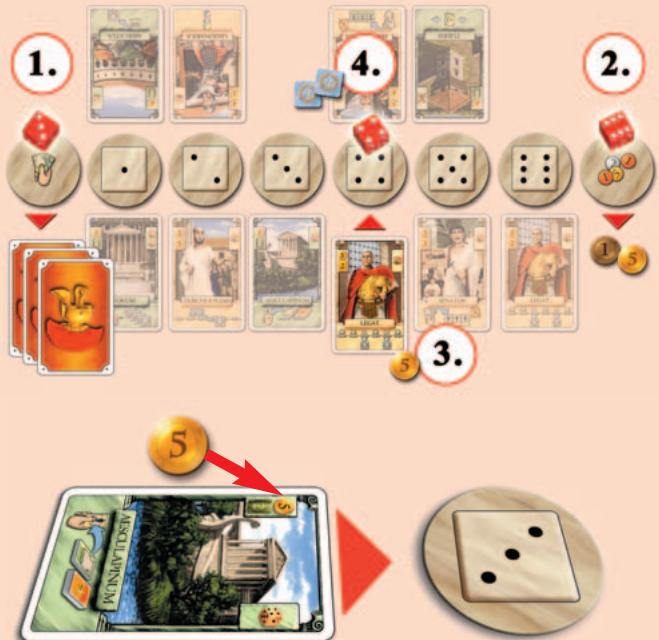
It is Stefan's go. After he has handed back 1 victory point (1 unoccupied dice disc), he throws his dice: he gets a “3”, a “4” and a “6”. He decides to carry out the following actions.
-
He uses his “3” to draw three cards. He keeps one of these in his hand (a “Legat”). Both the other cards are discarded.
-
He uses his “6” to take money from the stockpile;
this means he receives 6 sestertii. -
He plays a card (the “Legat” he has just drawn) by laying it next to the dice disc with four dots. He does not need a die for this. He pays the price shown (5) and gives the corresponding number of sestertii back to the stockpile.
-
He now uses his last die (the “4”) to activate the “Legat” card next to the 4. This wins him 2 victory points in this case.
Example: playing the “Aesculapinum” card costs 5 sestertii.
Example: if the player throws a “6” and allocates this score to the “Take money” action (money disc), the player receives 6 sestertii from
the stockpile.

• Taking card(s)
The player places one of their action dice on the “Cards” disc and draws the number of cards scored with the die. The player keeps 1 of these cards in their hand, the rest are discarded face-up.
If the pile has been used up, the discarded cards are mixed and placed face-down to form a new pile. Players can have as many cards in their hands as they want.
• Activating a card
The player puts one of their action dice on the dice disc showing the same score.
This activates the player's card lying next to this disc, i.e. the instructions on the card are carried out.
If more than one die shows the same score, the card can in turn be activated more than once.
[The instructions for each individual card are given in detail in the appendix on pages 5 and 6.]
Battle
Some cards enable the player to attack the opponent's cards. If there is a battle, the player whose turn it is – this player is always the attacker – throws the battle die once. If the player rolls a score equal to or higher than the defence value of the card under attack, the attacker wins and the card is discarded. In all other cases nothing happens.
If a player has ended their turn, i.e. all their actions have been carried out, play passes to the other player.
END OF THE GAME
The game ends immediately if one of the following two events occurs:
• a player has no victory points left;
• there are no victory points left in the stockpile.
The player with the most victory points wins.
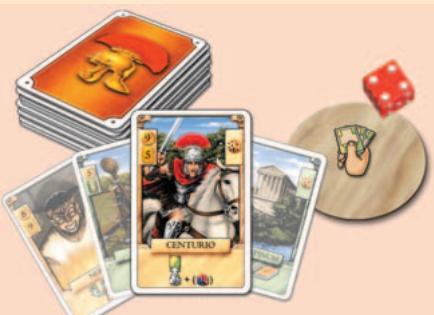
Example: a “4” was allocated to this action. The player can therefore draw 4 cards from the pile and choose one of them.

Example: the player has rolled a “3” and uses this to activate his “Onager” card and attack one of the opponent's cards. Battle commences …
The player rolls a “4” with the battle die, the defence value of the opponent's card is only “3”; the card has been beaten and has to be discarded.
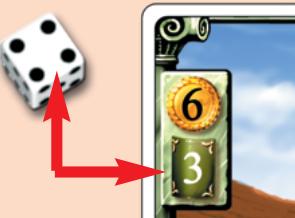
Note: attacking and defence values can be changed by laying more cards. All changes are always taken into consideration.
Note: the following cards can start a battle: Legionarius, Velites, Centurio and Onager.
The Sicarius, Gladiator and Nero cards also have an effect on the cards the opponent has laid; they do not, however, result in a battle.
Note: if there are not enough victory points left in the stockpile for the last payout, the missing points are credited to the respective player.
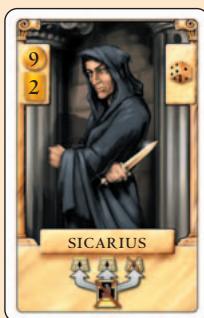
SICARIUS eliminates an opposing, face-up character card. The opposing card and the Sicarius are both discarded.
[1x in the game]

LEGAT A player gets 1 victory point from the stockpile for every dice disc not occupied by the opponent.
[2x in the game]
PRAETORIANUS Any of the opponent's dice disc can be blocked for one go.

[2x in the game]
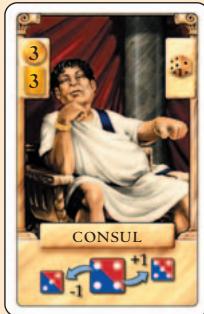
CONSUL
The score on an action die which has not yet been used can be
increased or
decreased by 1 point.
[2x in the game]
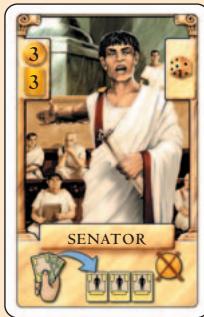
SENATOR enables the player to lay as many character cards as they wish free of charge. The player is allowed to cover any cards.
[2x in the game]


[2x in the game]

[2x in the game]
ARCHITECTUS enables the player to lay as many building cards as they wish free of charge. The player is allowed to cover any cards.
GLADIATOR An opponent's face-up character card (chosen by the player whose turn it is) must be returned to the opponent's hand.
[3x in the game]
[2x in the game]
LEGIONARIUS attacks the opponent's card which is directly opposite, whether it is a character or a building card.
SCAENICUS He performs no action of his own but can copy the action of any of the player's own face-up character cards, and the next time round that of another.
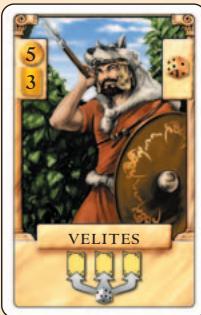
VELITES attacks any opposing character card (does not have to be directly opposite). The battle die is thrown once.
[2x in the game]


CONSILIARIUS The player picks up their character cards and can then lay them again on any dice disc. Buildings can be covered.
[2x in the game]

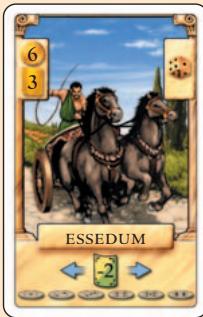
ESSEDUM The defence value of the opponent's face-up cards is reduced by 2.
MERCATOR
For 2 sestertii each, the player can buy 1 victory point from their opponent as
long as there are
money and victory points left!
The opponent gets
the money.
[1x in the game] NERO
destroys any
face-up opposing building card. The destroyed card and Nero are both
discarded.
[1x in the game]
[2x in the game]
HARUSPEX The player can choose any card from the pile of face-down cards and add it to their hand. Afterwards the pile is shuffled.
[2x in the game]
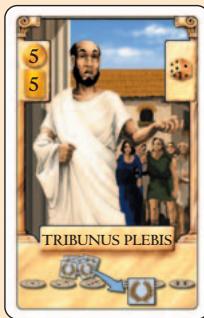
TRIBUNUS PLEBIS The player gets 1 victory point from their opponent.
[2x in the game]

CENTURIO
attacks the card directly opposite, whether it is a
character or building card.
The value of an unused action die can be added to the value of the battle die (the action die is then counted as used).
This is decided after the battle die has been thrown.
[2x in the game]


AESCULAPINUM The temple of Asculapius (the God of healing) enables the player to pick up any character card from the discard pile and add it to their hand.
[2x in the game]

BASILICA
If a Forum is activated (it must lie
directly next to the basilica), the player gets 2 more victory points. The Basilica itself is not activiated.
[2x in the game]
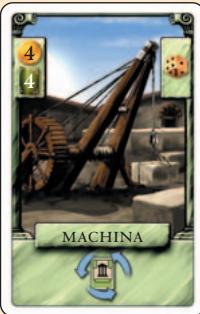
MACHINA The player picks up their building cards and lays them again on any dice discs. Character cards can be covered.
[2x in the game]
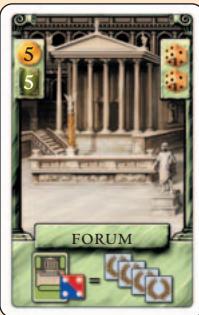
FORUM
requires 2 action dice: one to activate the Forum and the other to determine how many victory points the player receives.
[6x in the game]

MERCATUS The player gets 1 victory point for every face-up Forum that the opponent has.
[2x in the game]

ONAGER This Roman catapult attacks any opposing building. The battle die is thrown once.
[2x in the game]

TEMPLUM
If a Forum is activated (it must lie directly next to the Templum), the third action die can be used to determine the number of additional victory points which the player gets from the general stockpile. The action dice must not yet have been used in this go. The Templum itself is not activated separately.
[2x in the game]

TURRIS As long as the Turris is face-up, the defence value of all the player's other face-up cards increases by 1.
[2x in the game]
AIM OF THE GAME
Rome is in a state of emergency, the Senate and the Guard are embroiled in fierce arguments, the people are divided. Many roads lead to Rome, whether you decide to use powerful cards such as the Turris and the Praetorianus to protect the power and victory
PLAYING EQUIPMENT
• 52 playing cards – 32 character cards and 20 building cards
The price of

Character cards are yellow.
the card when it is laid.
The defence value; if this value is equalled or bettered in a battle, the card must be discarded.
Title of the card
Piktogram, gives details on what the card does.
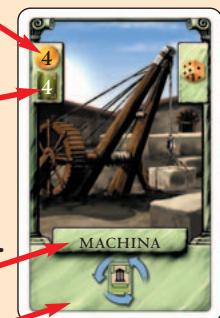
Building cards are green.

This symbol shows that 1 die is required to activate the card.
This card requires 2 dice: one to activate it and another die which determines how many victory points the player receives.
This card does not need any die to be rolled. It stays activated for as long as it is laid.

points you have, or instead prefer to use the Consul and the Tribun to skilfully pull the strings behind the scenes. Whoever succeeds in using their connections and manages to play their cards cleverly will at the end deserve their victor's laurels.
• 6 dice discs – show from 1 to 6 dots
• 1 “money” disc – shows coins, Roman sestertii
• 1 “card” disc – shows the symbol to draw new cards.

• 36 victory points – divided up into one-point and two-point cards.

• Money – the sestertii are used to pay for laying the cards.

• 3 action dice in each of the players' colours – they are needed to activate cards, take money or draw new cards.
• 1 white battle die – to determine the outcome of the battles.
• 1 set of instructions
下载 Markdown原文为社区整理/出版社公开资料,版权归原作者,仅供个人学习查阅。