
圣彼得堡Saint Petersburg
一句话概览
圣彼得堡 是一款已收录于村了吗规则库的桌游,支持 2–4 人,原名 Saint Petersburg。
本页内容:一句话概览 · 常见问题
这游戏怎么玩
- 本站已收录这款游戏的规则资料,可以在对话里直接提问规则细节。
常见问题(FAQ)
以下 1 条问答中 0 条来自站内玩家的真实提问,其余 1 条为本站整理的常见疑问;答复内容保持原样。
圣彼得堡支持几个人玩?
2–4 人。
去哪查完整规则
想核对具体规则细节、卡牌效果或某个回合的结算方式,可以在村了吗里选中这款游戏后直接提问。
同类桌游
- 卡坦岛德式
- 工业革命:伯明翰德式
- 勃艮第城堡:特别典藏版德式
- 方舟动物园德式
- 卡卡颂抽象
- 瘟疫危机传承:第一季美式
- 阿瑞迪亚:勇踏征途美式
- 重塑宇宙德式
- 幽港迷城美式
- 埃多拉的德鲁伊德式
规则原文(Markdown)
本站收录这款游戏的规则原文 1 个文件,此处内联渲染 1 个,可直接展开阅读或下载。
StPetersburg English Rules.md16.6 KB
SANKT ETERSBURG
CONTENTS
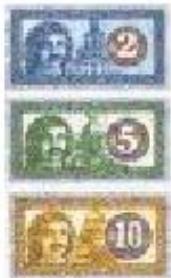
382 rubles: 14x 1, 14x 2, 12x 5, 12x 10, 8x 20
120 cards:
31 Craftsmen
(green back)
Card Cost
28 Buildings
(blue back)
27 Aristocrats
(orange back)
30 Exchange cards (multicolor back): 10 Craftsmen, 10 Buildings, 10 Aristocrats
4 Start Player cards
4 Start Player Markers

8 Pawns: 2xRed, 2xBlue, 2xGreen, 2xYellow
1 Gameboard
Rubles VPs
PREPARATION
• The gameboard is placed in the middle of the table.
• A player shuffles each card deck separately (Craftsmen, Buildings, Aristocrats, Exchange cards).
• Each deck is placed face-down at the corresponding position on the gameboard.
• Each player gets 25 rubles – the player’s money remain secret during the game. The remaining rubles - separated by value – are placed next to the gameboard to form the Bank.
• Each player gets 2 Pawns of the same color. Players place one pawn at the 0 position on the scoretrack located around the gameboard and the other in front of them to indicate their color.
• One player shuffles the 4 Start Player cards face-down and deals them randomly:
4 player game: each player gets 1 Start Player card.
3 player game: each player gets 1 Start Player card and the youngest player gets 2 Start Player cards.
2 player game: each player gets 2 Start Player cards.
• All players reveal their Start Player card(s), get the corresponding Start Player marker(s) and place them in front of them. The Start Player cards are removed from the game, they are no longer needed.
• The oldest player is the Dealer. He draws cards from the Craftsmen card deck and places them face-up at the top row on the gameboard:
8 cards in a 4 player game
6 cards in a 3 player game
4 cards in a 2 player game
Then he rotates the Craftsmen deck 90o. The Dealer also takes care of the Bank, draws replacement cards when needed and keeps the player’s scores using the score markers on the scoretrack.
• The game starts with the Craftsmen Phase.
GAMEPLAY
A game of St. Petersburg lasts many game turns (usually between 7 and 10). Each game turn is divided into 4 Phases that are always executed in the same order:
-
Craftsmen Phase
-
Building Phase
-
Aristocrat Phase
-
Exchange cards Phase

As soon as the 4 phases are over a new game turn begins with the Craftsmen Phase.
Every Phase is further divided into 3 parts (always executed in the same order):
-
Actions: Players buy cards and place them in front of them or they add them to their hand or play cards from their hand in front of them or pass. Actions are the main activity of a Phase.
-
Scoring: Players get Victory Points (VPs) and money from the cards they own.
-
Card Renewal: The Dealer moves remaining cards on the gameboard and adds new ones as needed.
1. ACTIONS
During his turn a player may execute ONE of the following actions:
♦ Buy a card (Craftsman, Building, Aristocrat) OR
♦ Add a card (Craftsman, Building, Aristocrat) to his hand OR
♦ Play a card (Craftsman, Building, Aristocrat) from his hand OR
♦ Pass
The 4 Actions in detail:
♦ BUY A CARD
A player buys a card (Craftsman, Building, Aristocrat). Craftsmen earn money, Buildings earn VPs and Aristocrats earn both. A player may buy a card from any of the two rows on the board. As soon as he buys a card he must pay its cost to the Bank and immediately place the card in front of him. Players should group cards in front of them by type (i.e. Craftsmen together, Buildings together, e.t.c)
Note: It is obvious that during the first phase of the first game turn players can only buy Craftsmen cards since only this type of cards are available. In later phases Buildings and Aristocrats will also become available.
♦ ADD A CARD TO HAND
A player takes a card from any of the two rows on the board and adds the card to his hand. He pays nothing! A player can hold a maximum of 3 cards – all cards in hand are hidden from his opponents. At the end of the game each card still in hand substracts -5 VP from the player’s score!
♦ PLAY A CARD FROM HAND
A player places a card from his hand in front of him. The player has to pay the cost of the card to the Bank. He can even play a card that he baught during the same Phase.
♦ PASS
A player passes when he can’t or doesn’t want to execute any of the other Actions.
Note: A player that passes can still pass again or execute an Action when it is his turn to play again.
The player with the corresponding Start Player marker is the player that executes the first Action of that Phase (i.e. the player with the Building marker gets the first Action in the Building Phase, the player with the Aristocrat marker gets the first Action in the Aristocrat Phase, e.t.c). Players in clockwise order from the first player execute one of the above Actions.
Players execute Actions in turn until all players pass. When all players pass Scoring occurs.
Actions example: It is the Aristocrat Phase. “A” is the first player since he has the Aristocrat marker. He buys an Aristocrat card (paying its cost). “B” has not enough money so he Passes. “C” buys the next Aristocrat card. “D” adds an Aristocrat card to his hand (for free). “A” adds a Craftsman card to his hand. “B” now decides to execute an Action and takes a Building to his hand from the second row. “C” plays an Aristocrat from his hand (and pays its cost). “D” passes. “A” passes. “B” passes. “C” passes. Since all players have now passed the Actions part of the Phase is finished.

Other Rules:
• A player can only Buy a card or Add a card to his hand or Play a card from his hand or Pass.
• A player can Buy or Add to his hand any card from the board (top and bottom rows) during any Phase (i.e. during the Building Phase he can buy a Craftsman card if he so wishes and the card is available).
• A player can Play from his hand any card during any Phase (i.e. he can play a Craftsman card – paying its cost – during the Aristocrat Phase).
2. SCORING
A player gets money and VP’s for the Craftsmen, Buildings and Aristocrats he has in front of him.
Craftsmen score only during the Craftsmen Phase.
Buildings score only during the Building Phase.
Aristocrats score only during the Aristocrat Phase.
All cards of a specific group score, even cards played in previous game turns. Players get money from the Bank. Players mark VP’s with their scoring markers on the scoring track. The Dealer is responsible for the Bank and scoring.
Note: to make scoring simpler the first player of the phase calculates its score and is then followed by the other players in clockwise order.
Scoring example during the Aristocrat Phase: “A” has 5 Craftsmen, 4 Buildings and 5 Aristocrats in front of him. Only Aristocrats score so he gets 12 rubles and 1 VP.

12 Rubles
1 VP
3. CARD RENEWAL
During Actions the players take cards from the board. At the end of each Phase the Dealer adds new cards on the board until there is a total of 8 cards (including any remaining cards) on the board. Note that the total of cards is always 8, the number of players doesn’t matter!
The Dealer draws the cards from the next deck and places them at the top row (only). The total of the new cards and the remaining cards (if any) from the previous Phases must be 8. Before adding new cards he moves any remaining cards to the right without changing their row. Finally he rotates both the current and next card decks 90o to mark the end of this Phase and the start of the next.
Example: Before the beginning of the Exchange cards Phase the Dealer must add 5 cards on the board.

Cards from previous Phases.

He moves the remaining cards from the previous Phase to the right – without changing their row. Then he draws 5 cards from the Exchange cards deck and places them on the top row.
Finally he rotates the Aristocrat card deck to its starting position and rotates the Exchange card deck 90o. That makes it easier to remember the current Phase.

THE EXCHANGE CARDS PHASE
The Exchange cards Phase is somewhat different. There’s no scoring at the end of this Phase. Players do not get any money or VPs. The Actions are the same as in the previous Phases. When the Action part of the Phase is over the Dealer discards all the cards from the bottom row (only). These cards are removed from the game.
Note: At the end of the first game turn there are no cards at the bottom row.
The Dealer then transfers the cards from the top row to the bottom row. It’s a good idea to move the cards to the right side of the bottom row. Then he draws cards from the Craftsmen deck and places them at the top row so that the total number of cards on both rows are now 8.
Example: There are 3 cards remaining at the top row at the end of the Exchange cards Phase. The 3 cards are moved to the bottom right. The Dealer places 5 new Craftsmen cards so the card total is now 8.

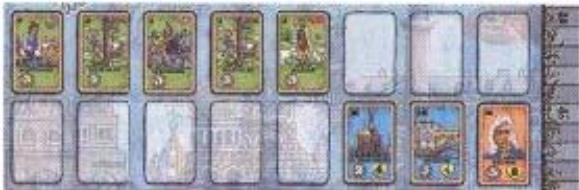
The game turn is now over. Each player gives his Start Player marker(s) to his left opponent as indicated in the following diagram:

4 Player game

3 Player game
2 Player game

GAME END
When the Dealer places the last card of a deck (Craftsman, Building, Aristocrat or Exchange card) on the board the current game turn is played to its end. The game is now over and a final scoring takes place.
Note: If during the final game turn there are not enough cards for the Dealer to place, he places as many as there are available.
FINAL SCORING
During the final scoring players get VPs from their Aristocrat cards and from money they have.
• Only different Aristocrat cards are counted. Consult the table on the gameboard for the VPs gained from Aristocrats.
● Each player scores 1 VP for every 10 rubles he owns.
• Each player scores –5 VPs for each card in his hand.
The winner is the player with the most VPs. In case of a tie the winner is the player with the most money.
Final scoring example: The red player has 6 different Aristocrat cards in front of him. He scores 21 VPs. His 7th Aristocrat scores nothing. He also has 17 rubles. He gains 1 VP for them.

CARD COST REDUCTION
There are 4 ways for a player to reduce the cost of a card he has to pay:
If a player already has one or more identical cards in front of him, he pays 1 ruble less for each identical card.
Example: The player buys a card with a cost of 5. He has 2 identical cards in front of him. He has to pay only 3 rubles. If a player buys a card from the bottom row he pays 1 ruble less.
Example: A card that costs 20 ruble is bought from the bottom row for 19 rubles.
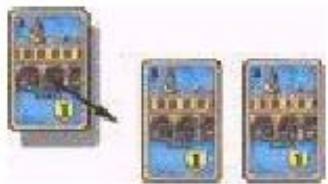

19 Rubles
• A player who owns a Goldsmith pays 1 ruble less for each Aristocrat card.

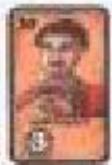
• A player who owns a Carpenter pays 1 ruble less for each Building card.

All reductions in cost are cumulative.
Example: A player buys a Building (cost 20) from the bottom row (-1 ruble). He already has an identical Building in front of him (-1 ruble) and the Carpenter (-1 ruble to all Buildings). He has to pay 17 rubles
NOTE: A player has to pay a minimum of 1 ruble for a card, even if its cost drops to zero or below. A player never gets money back if a card’s cost becomes negative.
Example: A player wants to buy a Building (cost 3). He already has 3 identical Buildings in front of him. He still has to pay 1 ruble.
EXCHANGE CARDS
When a player Buys an Exchange card, or Plays an Exchange card from his hand, he has to do the following:
The player must discard a card of the same color that he has in front of him. He can’t simply add an Exchange card in front of him.
A blue Exchange card replaces a Building, an orange Exchange card replaces an Aristocrat.
The green Exchange cards are different: These cards have a symbol in the upper right corner of the card. A green Exchange card can only replace a green (Craftsman) card with the same symbol.
NOTE: An Exchange card can’t replace another Exchange card.
COST OF EXCHANGE CARDS
If the cost of the Exchange card is higher than the cost of the card it replaces, the player has to pay the difference.
If the cost of the Exchange card is equal or lower than the cost of the card it replaces, the player has to pay 1 ruble.
The usual cost reductions also apply to the Exchange cards.
Example: A player discards a Market to place a Cathedral. The price difference is 10 rubles. The player buys the Cathedral from the bottom row (-1 ruble). He also owns the Carpenter (-1 ruble to Buildings). He has to pay 8 rubles.

SPECIAL CARDS
Some cards have special abilities:

During the Building Phase Scoring, the owner gets 1 ruble for each Aristocrat in front of him.

During the Aristocrat Phase Scoring, the owner gets 1 ruble for each Craftsman in front of him.

A player pays 2 rubles to buy/play this card. If he discards this card to replace it with an Exchange card, this card’s cost is 6 rubles.
The owner of this card has a maximum hand limit of 4 cards.
Immediately after the Building Phase Scoring, the owner of this card may buy up to 5 VPs at a cost of 2 rubles per VP. Note: a player can’t sell VPs to get rubles

Can be replaced by any Green Exchange card.


1 VP during scoring if it’s special ability isn’t in use: During the Actions in the Building Phase, the owner of this card may take the top card from any of the card decks (Craftsmen, Buildings, Aristocrats, Exchange cards). He has to buy that card, add it to his hand or discard it. Then he flips the Observatory face-down and it now scores no VPs. In the beginning of the next Phase it is flipped face-up so it can be used again. Use of the Observatory counts as your action for this turn.
Note: The owner of the Observatory can’t take the last card of a deck.
ST. PETERSBURG FOR 2-3 PLAYERS
The game is the same with the following changes:
At the beginning of the first game turn and before the Craftsmen Phase, the Dealer draws and places 6 cards on the board for a 3 player game and 4 cards for a 2 player game. During the game the Dealer always places cards so their total on the board is 8.
TACTICS
-
It’s a good idea to buy 2 Craftsmen during the first Craftsmen Phase.
-
Expensive cards are valuable.
-
Expensive Buildings score a lot of VPs but can be very expensive.
-
Exchange cards are very interesting.
SPECIAL SITUATION
It is possible (although rare) that no player can play or buy a card during a phase. In that case the Dealer does not add any new cards to the board. During scoring the players will get money so they can buy or play the cards during the next phase.
下载 Markdown原文为社区整理/出版社公开资料,版权归原作者,仅供个人学习查阅。