
索尔顿湖Salton Sea
一句话概览
索尔顿湖 是一款已收录于村了吗规则库的桌游,支持 1–4 人,原名 Salton Sea。
本页内容:一句话概览 · 常见问题
这游戏怎么玩
- 本站已收录这款游戏的规则资料,可以在对话里直接提问规则细节。
常见问题(FAQ)
以下 1 条问答中 0 条来自站内玩家的真实提问,其余 1 条为本站整理的常见疑问;答复内容保持原样。
索尔顿湖支持几个人玩?
1–4 人。
去哪查完整规则
想核对具体规则细节、卡牌效果或某个回合的结算方式,可以在村了吗里选中这款游戏后直接提问。
同类桌游
- 卡坦岛德式
- 工业革命:伯明翰德式
- 勃艮第城堡:特别典藏版德式
- 方舟动物园德式
- 卡卡颂抽象
- 瘟疫危机传承:第一季美式
- 阿瑞迪亚:勇踏征途美式
- 重塑宇宙德式
- 幽港迷城美式
- 埃多拉的德鲁伊德式
规则原文(Markdown)
本站收录这款游戏的规则原文 1 个文件,此处内联渲染 1 个,可直接展开阅读或下载。
Salton Sea ENG.md69.6 KB
RULEBOOK 1-4 14+ 120 min SALTON SEA
DAVID BERNAL AMELIA SALES


SALTON SEA
Salton Sea—a place where we can extract geothermal energy and lithium at the same time
The Salton Sea is a real and very unique body of water located in California near the border with Mexico. It is also a possible solution to one of humanity’s greatest challenges: the transition to new energy sources.
The climate emergency is forcing us to rapidly abandon the use of fossil fuels. Luckily, we do have a solution: renewable energies. Until just recently, when talking about renewable energy sources, we had to limit ourselves basically to constructing reservoirs that allow us to take advantage of the power of water flow to generate electricity. Now, solar and wind energy are being hailed as the new kings of the energy sector for the next few years, since they can be installed anywhere and, more importantly, are the cheapest ways to produce electrical energy. However, there is another renewable energy source that until recently was considered far less and which is now coming into the spotlight: geothermal energy, which takes advantage of the heat inside our planet.
Where does this heat come from? The main bulk of this immense heat—which can reach up to 6,000 ºC (10,000º F), similar to what is found on the surface of the Sun—comes from the moment our planet was formed. Celestial bodies (some as big as the planet Mars) smashed into and then united with the Earth in the process of creation. These impacts released incredible amounts of energy (heat) that has been held within the interior of our planet ever since. Another source of this inner energy are the physical and chemical changes that happened as the Earth grew in size, due to the enormous pressures inside the planet, which generated heat. The most important source of heat is natural radioactivity. A small part of the atoms in the rocks inside the Earth are unstable and naturally split to transform into stable atoms. At the moment they break apart, they release heat, which then accumulates within the inside of our planet.
The end result of all of this is that if we are on the surface of the Earth and drill a hole, the temperature will progressively increase the deeper we go. This proportional increase is known as the geothermal gradient, and typically amounts to a value of 25-30 ºC (77-86º F) for each kilometer (0.62 miles) down we go. However, there are certain spots on the planet that are unusually hot close to the surface. These generally coincide with the edges of tectonic plates, which see a concentration of volcanism. The presence of magma near the surface, whose temperature ranges between 700 and 1,200 ºC (approx.1300-2200º F), means that without drilling particularly deep, we can rapidly reach rocks whose temperatures reach hundreds of degrees. The regions with these characteristics are the preferred choice for the construction of geothermal power plants to produce electrical energy.
This kind of power plant makes use of subterranean water in these areas that exceeds 100 ºC (212 ºF) and naturally turns into steam, which is then channeled by the perforations and used to spin turbines to create electricity. In order to afect the aquifers as little as possible, another option is to extract energy from the steam by using a heat exchanger, so that the water returns to liquid form and can be put back underground where it will heat up again and begin the cycle anew. In those areas where the water is near 100 ºC but does not become steam, the liquid can be pumped out to extract heat. If there is not enough underground water, it is possible to inject cold water (from a river for example) underground so that it is heated by the surrounding rocks and then carry out the same cycle as above.
The advantage of geothermal energy is that it remains constant throughout the day and the year. The disadvantage is that there are few places on our planet where we can access these high subterranean temperatures, so the supply is limited. That is why many countries choose solar and wind energy. But both of these options have a problem: they are intermittent. There is no sun at night, and there are times during the day that the wind does not blow. To solve this, we need to store electricity, and using lithium batteries is one of our best options. Furthermore, we need to replace the use of fossil fuels for vehicles and use renewable electricity more. This has led to a boom in the manufacturing of batteries, with lithium as a key element for an essential part of the energy transition.
Lithium is a very common element and there is plenty present on the planet. However, until recently, there was not much demand and we do not have enough mines to cover the new needs generated by the energy transition. This is why, with the boom in electric vehicles and renewable energy, we are searching for new
deposits of this element around the world so that they can be mined. The greatest amount of lithium is in the sea, dissolved in the water. However, it is so diluted and in such quantities that enormous amounts of water would need to be treated (basically evaporated), and the cost would not be worth the yield. That is why the main areas of interest are those that contain brine: water that has higher salt content than normal marine saltwater. The most common origin of brine is the evaporation of salt water in areas that have been isolated from the ocean. With brine, nature has already done a large part of the evaporation work for us.
If all the water evaporates, solid salt deposits are formed. Geology calls these “evaporites”, precisely because they come from that process. The reverse process can also occur, when fresh water is added to these evaporites (e.g., a river or lake forms above them) and the deposits are dissolved and become brine again. In those cases where there are subterranean brine deposits, we can drill down and pump the brine out since they are liquid. For cases of semisolid or solid salts mixed with sediments and rocks, we can inject water into the perforations to dissolve the salts and then pump out that water, which has been transformed into brine. That is one of the new mechanisms that is now being used to obtain lithium, in addition to traditional methods such as mining solid evaporites and exploiting existing brine deposits.
An important property of water is that the hotter it is, the more dissolved salts it can hold. Therein lies the connection to geothermal heat. As we discussed above, very hot water can be pumped up and heat energy taken from it. If the geothermal power plant is located in an area with brine, we can take advantage of the water (which is brine) that is being pumped up to extract lithium as well as heat. Then the water is injected back underground so that it dissolves more evaporites and is heated by the earth again. The hotter the water gets, the greater quantity of lithium we can extract from each liter of brine. This yields a greater profit than if water is injected into sediments and rocks at a normal temperature. This win-win situation has brought geothermal power plants into the spotlight as a means to extract this valuable element. They take advantage of the heat inside the planet to create electrical power, and at the same time are a potential source of lithium.
The Salton Sea is unique because it brings together all of these elements. On one hand, we have the famous San Andreas Fault that separates the tectonic plates of the Pacific and North America. As at most of the edges of tectonic plates, the area of the Salton Sea, known as the Imperial Valley (which spans 155 miles), shows signs of volcanism and geothermal activity. This geothermal activity is taken advantage of by several power plants, both in the USA and in Mexico. Furthermore, because of its particular geological history, the Imperial Valley was an area in which sea water evaporated: Originally, millions of years ago, this area was part of the ocean. The progressive advance of the Colorado River from the north slowly isolated what would become a valley from the ocean, creating a new inland sea that progressively evaporated away. The river deposited sediments within the valley, which mixed with the brine that had formed there. Today, the area of the Salton Sea is below sea level, and there is a lake that formed there due to an accident in the early 20th Century. For two years, the Colorado River drained into the depression because of an irrigation canal that was not constructed with suficient safety measures, and it took two full years for the engineers to rectify the problem so that the river mouth drained into the Gulf of California again.
This combination of events makes the area of the Salton Sea a great opportunity for the construction of geothermal power plants that can take advantage of the natural resources present. You can drill to get steam and hot water in an area of significant geothermal activity. On top of that, you can use that same hot water, which is indeed brine, to extract lithium and sell that as well as the electricity. Together, you will be able to completely avoid the use of fossil fuels and lead the energy transition towards a fully renewable future.
Marc Belzunces (Barcelona, 1976). Geologist with a bachelor’s degree from the Autonomous University of Barcelona and masters of Ocean Sciences from the Polytechnic University of Catalonia. He was a researcher in the Spanish National Research Council and a consultant on pollution for the Catalan Water Agency and the Spanish Ministry of Agriculture, Food, and the Environment.

COMPONENTS
8 1 business development indicator

114 action cards (see page 14) · 42 \$1 action cards · 36 \$3 action cards · 36 \$5 action cards

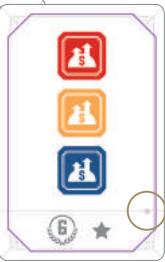
15 objective cards (see page 16) · 5 short-term · 10 long-term


24 profit-sharing tiles, in three types (see page 28)
18 wooden pieces for each player
1 1 score counter
2 1 brine token
3 1 lithium token
4 1 geothermal energy token
5 3 share tokens
6 1 drill token
7 1 drill damage indicator
9 1 extraction plant damage indicator 10 7 engineers

28 research cards (see page 26) · 15 immediate efects · 13 permanent efects

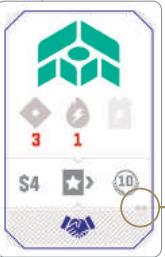
22 contract cards (see page 24) · 11 retail contracts · 11 large account contracts

12 fee tiles · 3 start-up fee · 9 non start-up fee (see page 21)

12 exhausted claim tokens



PLAYER PREPARATION
Each player chooses a color to play with and takes their company board, a cheat sheet, their 18 wooden pieces, their three warehouse tiles, and their starting claim tile:

1 Places their business development indicator in the first space of its track and an

Leaves their warehouse tiles face down and in ascending order on the right side of their company board.

3 Places their lithium token and their geothermal energy token in the “0” space and theirbrine token in the “1” space of their warehouse.
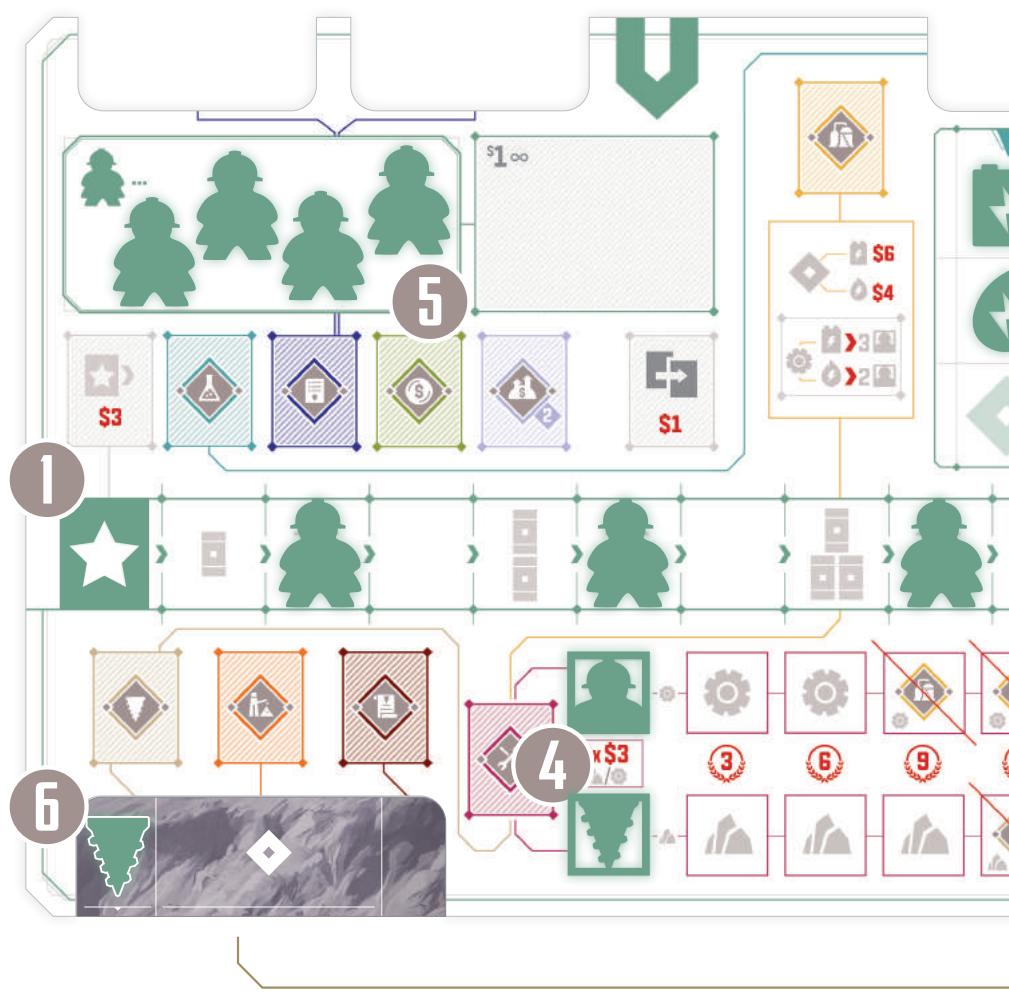

4 Places their drill damage indicator and extraction plant damage indicator in the spaces
5 Places their remaining four engineers in their Human Resources (HR) space.
6 Inserts their starting claim tile into the designated slot and sets their drill token on top of it.
7 Draws one card of each type from the \$1 action deck to form their starting hand (seven

GAME BOARD SETUP
1 Set the game board in the middle of the table. Place each player’s score counter in the first space of the score track and one share token for each player in the bottom space of each corporation’s shares track.

Place the financial assets value indicators on the matching track for each corporation, in the space corresponding to the number of players in the game.
3 Take the profit-sharing tiles for each corporation, mix them up separately and face down. Place one random tile from each corporation in the top space of the game board 3a . In the center space, stack as many tiles as the players minus one 3b . Finally, in the bottom space, stack as many tiles as the number of players in the game 3c . Since these tiles can be checked at any time, you can leave them face up or face down, whichever you prefer.

Example of a three-player game.


4 Separate the three start-up fee tiles (that show the corporation closed icon on the other side) from the rest of the fee tiles and mix each type separately. Randomly place the start-up fee tiles in the current investment 4a space of each corporation and turn it over to reveal what it is. Randomly place two fee tiles face down in the future investments spaces of each corporation 4b (put the remaining tiles back in the box).
5 Separate the claim cards into two decks: one with the superficial extractions and the other with the deep extractions . If there are four, three, or two players in the game, remove one, two, or three cards, respectively, from each deck. Shufle each deck separately, then stack the superficial extractions on top of the deep extractions to create a single deck. Draw the first four cards and place them face up in the spaces indicated on the game board, from top to bottom.
6 Leave the exhausted claim tokens in reach and available for all the players.

Shufle the objective cards, reveal five of them (put the rest back in the box). These are the only objective cards that will be used for this game.
Shufle the other card decks and leave them face down in their respective places (from top to bottom). Start with the research cards deck. For the contract cards, separate them into one deck for the retail contracts and another deck for the large accounts contracts , then shufle them each separately before combining them (so that the retail cards are on top). Finally, place the action cards worth \$5, \$3, and \$1.
Turn over as many action, research, and contract cards as indicated for the number of players in the game (if there are two, three, or four players, you turn over four, five, or six cards, respectively). Leave them to the right of the deck—meaning the area along the right edge of the board, which we refer to as the market.
Randomly determine the starting player. The game is ready to begin.
THE GAME
During the game, you must manage your geothermal lithium extraction corporations so that you obtain the most victory points. The extraction of this mineral and its subsequent processing will be the motor of your businesses.
A game of Salton Sea is made up of several rounds, during which you take turns playing.
THE GAME TURNS

On your turn, you will use one of your engineers to carry out an action. To do this, you place the piece in one of your available spaces. Once the action has been resolved, it is the next player’s turn going clockwise around the table. The round ends once all players have used all the engineers they have available (all players start the game with four engineers, but you can earn more during the game).
On your turn, use one of your engineers to carry out an action by placing the piece on:



An available space on your company board.

An action card you hold in your hand that you play as a Prompt action.

An immediate effect research card located on your company board.
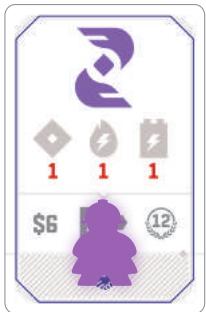
A contract card located on your company board.

All spaces where an engineer can be placed have a background with diagonal lines, both on the game board and on the cards.

The space where you put the engineer is then blocked until the end of the round.
THE ACTIONS
In Salton Sea, there are a variety of actions you may use, broadly divided into three large groups. They are explained in detail in the following sections:
The Industrial Actions
These are operations related to brine extraction in your plant and the processes that stem from it to obtain lithium and geothermal energy.

Acquire a Drilling License (see page 16)

Drill (see page 17)

Extract (see page 18)

Process (see page 20)

Repair Machinery (see page 21)
The Commercial Actions
These allow you to put your products on the market and accept jobs from corporations in the field.

Sell (see page 21)

Enter into a ract (see page 24)

Execute a Contract (see page 24)
The Management Actions
These are investments in your own company aimed at ensuring you make profits and your business and your employees are prosperous.

Research (see page 26)

Buy Shares (see page 27)

Develop a
Business
Project
(see page 25)

Obtain Financing (see page 28)

Repeat an Action (see page 28)
END OF THE ROUND PHASE
Once everybody has used all of their available engineers, the round ends. Then:
Put your used engineers back in the human resources space of your company board.
If you have executed any contracts, remove them from your company board and free up the space. Keep your completed contracts near your board in case they are needed for the final scoring.
If you used a research card with an immediate efect, remove it from your company board and free up the space. If there are more research cards to the right of the card that was removed, move those to the left. Keep your research cards with an immediate efect that you have removed nearby, in case they are needed for the final scoring.
Put the action cards you played as a Prompt action back in your hand.
On the game board:

Discard the claim card in the bottom space. Move the other cards one space down. Reveala new card from the claim deck and leave it face up in the top space.A
In the market, discard the face-up card farthest to the right of each deck. Shufle each of the discard piles and put them beneath their corresponding decks. Move the existing cardsB to the right and draw and reveal as many cards as is appropriate to the number of players.
Finally, the next player in turn order can start the following round.

THE END OF THE GAME
The game ends when during the End of the Round Phase:

THERE ARE NO MORE CARDS TO DRAW AND REVEAL IN THE CLAIM DECK OR TWO CORPORATIONS HAVE CLOSED
During the game, you will obtain victory points (VP) for exhausted claims, executed contracts, short-term objectives, advancing along your business development track past the last space, and for research cards that grant you VP when they are acquired.
At the end of the game, you will also get additional VP for the following:
The total value of the action cards you have in your hand: 2 VP for every \$3.
The shares that you have obtained in the diferent corporations: Each player multiplies the number of shares indicated by their token times the VP shown by the financial assets value track (see page 27).
The product in your warehouse, at a rate of 1 VP for each brine, 3 VP for each geothermal energy, and 5 VP for each lithium.
The VP indicated on your research cards with permanent efects, multiplied by the position on your company board that those research cards are in.
Your short-term objectives (Grey Stars), so long as you have unlocked the possibility to do so on your business development track (see pages 16 and 25).
The long-term objectives that you have fulfilled, including any Grey Stars, so long as you have unlocked the possibility to do so on your business development track (see pages 16 and 25).
On the other hand, you lose VP for:
Damage to your extraction plant

Damage to your drill
Any contracts on your company board that have not been executed (half of the VP amount indicated on those contracts)

Once you have calculated your scores, the player with the most VP wins the game! If here is a tie, the winner is the player who has the highest total value in action cards.
AVAILABLE ACTIONS
The management of this type of company requires a large number of professionals, trained in many distinct fields. Being able to balance attention to detail, respect for the environment, and the drive for profits are the key elements to forging the future of your businesses.
In this section, we present the actions you can perform in the game. On your turn, before taking any of the following actions, you must first take one of the engineers in your HR space and place them in an available action space. The icon covered by that engineer shows what action you can then take.
The green player decides to perform the Acquire a Drilling License action. To do so, they place an engineer in the space with that action on their company board.
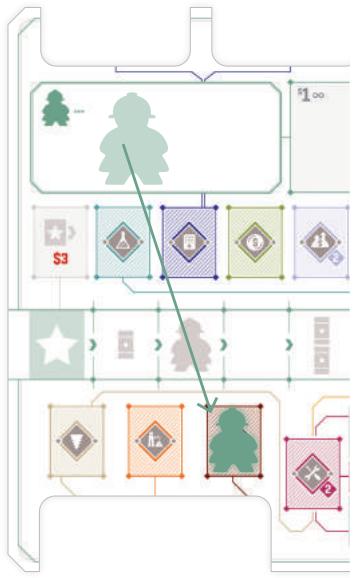
The icon indicates what type of action you may take. A value next to the icon shows the “strength” of the action— the number of times you may perform it. If there is no value, the strength is 1 (or is irrelevant).

For example, this icon allows you to drill two layers by taking one single Drill action.

This icon allows you to buy one claim card by taking the Acquire a Drilling License action.
ACTION AND MONEY CARDS

Players get these cards when they earn money with their businesses. The number of cards that you can accumulate in your hand has no limit. Action cards can be used in two diferent ways during the game. These cards are explained in more detail in the glossary on page 34.
PROMPT ACTIONS
You can play action cards from your hand to perform Prompt actions. When you play a card in this way, leave it face up on the table and immediately place an engineer in the corresponding space.
Once the Prompt action is resolved, the card then remains on the table and you cannot use it again in the current round of play. When the round ends, you get back the action cards that you used to perform Prompt actions and you may put them back in your hand.

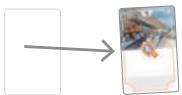
The green player places an engineer on top of this card to carry out a Prompt Drill action.

MONEY
Action cards are divided into three decks determined by their value—\$1, \$3, and \$5. During the game, to make any payment of money, you must discard as many cards as are needed (at least) from your hand to cover the full cost of what you wish to buy. No change is given if you exceed the cost.

Cards discarded in this way are left face down with the market cards with the same value, but turned 90 °, in order to create a discard pile next to the game board.
If you collect money during the game, you take the action cards you want from the market, in whatever combination correctly adds up to the value you are to be paid. You can take cards that are showing their values, or you can draw randomly from the discard piles (if there are any). The revealed cards that you take are not replaced on the board until the end of the round.
The cards obtained in this manner then become part of your hand and you can use them starting with your next turn.
If the market lacks liquidity and does not have enough cash on hand to pay you (that is, there is not enough value on the revealed cards and those in the discard piles to pay the price), you must make do with the amount received, even if it is less than the sale price.


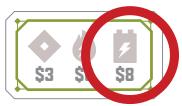


The green player is paid \$8 for the sale of a product. The player checks the market and takes a revealed card worth \$5 and three random cards worth \$1 each from the discard pile. The empty space that was left by the \$5 card is not refilled until the end of the round.


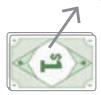


The green player must pay \$5 to purchase a claim card. The player only has two cards worth \$3 each in their hand, so they must discard both, for a total of \$6, to get the \$5 card.
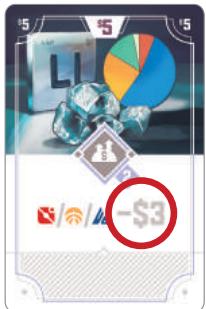
Buy up to 2 shares of the same corporation with a discount of \$3 to the total cost.
OBJECTIVE CARDS
The management of the entire company presents opportunities that, if you know how to take advantage of them at the right moment or plan ahead for them, will generate excellent results at the end of the fiscal year.
There are two types of objective cards (see page 38):
SHORT-TERM
During the game, only the player who completes this objective first can score it. Once scored, the player who fulfilled this objective takes the card and scores VP immediately, then places it next to their board in case it is needed to score the Grey Stars during the final scoring. These cards are not replaced once they have been removed from the game board.
LONG-TERM
These are checked at the end of the game. The players get VP based on the specific requirements on these cards, along with the VP provided by the Grey Stars if possible. If several players fulfill the same long-term objective, all of them receive the indicated reward in VP.


ACQUIRE A DRILLING LICENSE

This action allows you to buy one of the four claim cards available on the game board at that moment and place it at the lower edge of your company board, below the claim card/tile there.
To do so, you have to pay the amount of money that is indicated on the card you want to purchase plus the amount indicated in the space it occupies at that time. Once the card is removed from the game board, a new card is
immediately drawn from the claim deck, turned over, and placed in the top space. If necessary, the rest of the cards are moved down one space each to make room for the new card.

The player decides to buy the card available in the top space, which costs \$2. In addition, because of the surcharge on the space, the cost of the card is increased by \$2, so the player must pay a total of \$4.
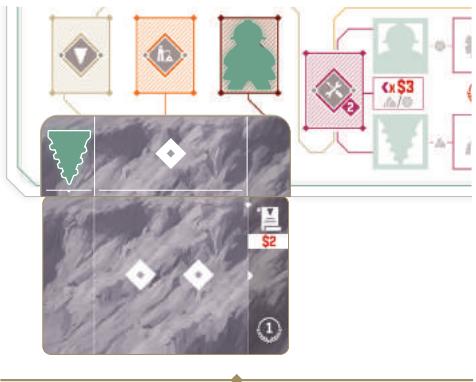
The player places the newly acquired claim card in the space just below their starting claim tile (or, if other cards are already present, below the last claim card there).

DRILL
This action allows you to lower your drill to the next-deeper layer, increasing the depth of your extraction well.


If the drill reaches a layer with rocks, immediately update the position of your drill damage indicator (move forward one space for each rock icon present in the layer being drilled).


This icon indicates that you can ignore the damage caused by one rock when drilling.

If your damage indicator reaches the next-to-last or last space on the track, your drill freezes up and you cannot carry out the Drill action again until you repair the machinery and reduce the damage to the drill (see “Repair Machinery” on page 21).
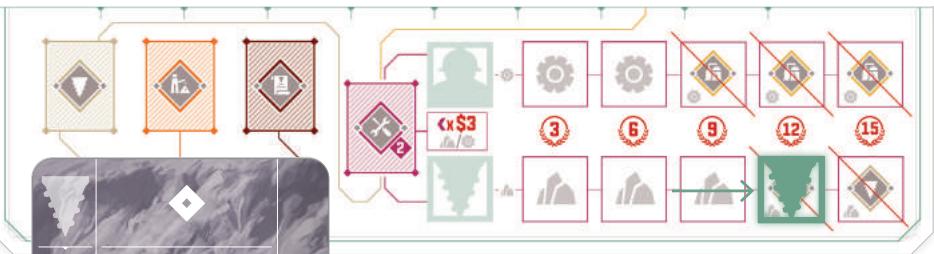
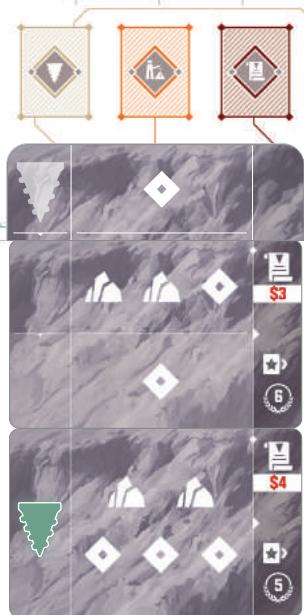

If, when performing this action, you drill through more than one layer (for example, using the Prompt action of a card), every time the drill reaches a layer with rocks, you must update the position of your drill damage indicator. If moving the indicator causes you to reach a space on the track that stops you from drilling, the drill freezes up and cannot be used to drill further.

RTAS DE EXTRACT

This action allows you to extract as many units of brine as are indicated in the corresponding action space, so long as the units are available in your extraction well and you are able to store the brine in your warehouse. In order to extract brine from your well, it is essential that the drill first reaches the layer where the brine is found or deeper.

As you extract brine from a claim, cover the brine icons A with exhausted claim tokens (from top to bottom). For every unit of brine extracted, raise the position of the brine token in your warehouse B (that is, move it one space to the right).

When you have extracted all of the brine from a claim card or tile, you get the indicated reward. C In the example below, you would advance the indicator for your business development track twice and gain 7 VP. Then turn the card over D .

Note: If you are playing on a small table and you do not have much space, when you turn over your claim cards, you can remove them from your well and leave them to one side, in case you need to check an objective at the end of the game.


PROCESS

If you have stored brine, this action allows you to process them and turn them into other products, namely geothermal energy and lithium.
When taking this action, you can process up to as many units of brine as indicated, paying the price of each unit of the resulting product. Additionally, you will have the opportunity to optimize the production and obtain even more units of the desired product. In order to
carry out the Process action, your extraction plant damage indicator must show that the machinery is operational. Otherwise, you must first repair it before you can process the brine.

When you place an engineer on top of the icon for this action, you can:
· PRODUCE ONE LITHIUM

Spend one brine (move your brine token one space to the left) and pay \$6 in action cards to produce one lithium (move your lithium token one space to the right).
· PRODUCE ONE GEOTHERMAL ENERGY

Spend one brine (move your brine token one space to the left) and pay \$4 in action cards to produce one geothermal energy (move your geothermal energy token one space to the right).

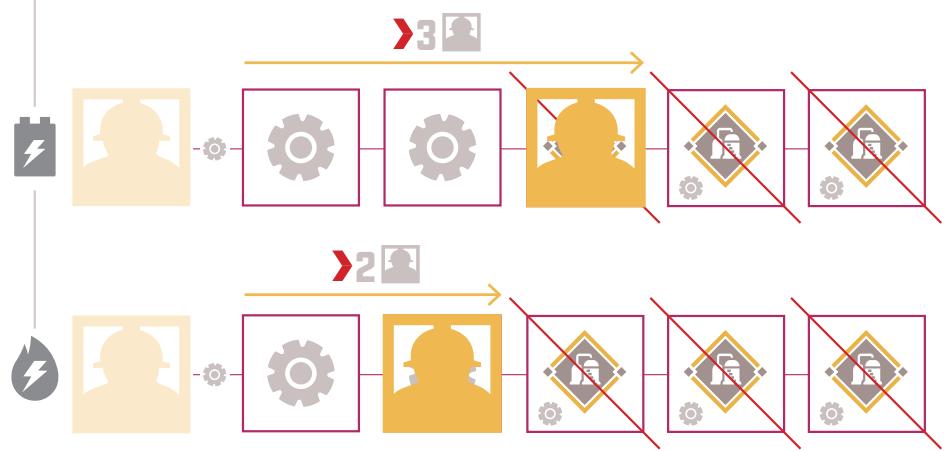
In both cases, you can optimize your production to get even more final product with the same base amount of brine. This involves forcing the machinery, and this causes a bit more wear and tear, but it can be worth it.
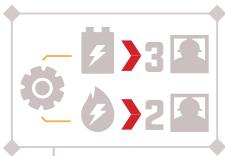
After performing a Process action, regardless of what you produced, you have the option of producing one additional unit of lithium, but your extraction plant damage indicator will move forward three spaces on its track; or you can produce one additional unit of geothermal energy, but your extraction plant damage indicator will move forward two spaces on its track.

RTAS DE OBJETIVOREPAIR MACHINERY

Both drills and extraction plants can be damaged as the game <x\$3 unfolds, which can then impede the players from carrying out the Drill and/or Process actions (see pages 17 and 20, respectively). The Repair Machinery action shown here allows you to repair as many points of damage as indicated within either track, moving the indicator(s) back one space for each point of damage repaired.

The cost to Repair Machinery is \$3 per space on either track.
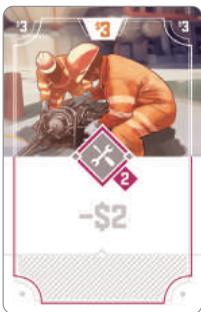
This card allows you to take a Promt action to Repair Machinery, repairing up to two points of damage. You can repair one or two points in one track, or one on each track.
Each damage point repaired has a cost of \$3, but this card grants an overall discount of \$2. If you decide to repair one point of damage you will have to pay \$1 instead of \$3, and if you decide to repair two points (both on the same track, or one on each track) you’ll pay \$4 instead of \$6.

This profit-sharing tile allows
you to repair one point of
damage on either track
paying \$2 instead of \$3,
due to the discount.

SELL

With this action, you can sell the products you have in your warehouse (units of brine, lithium, and/or geothermal energy) to the corporation of your choice out of the three that are on the game board. Each of them purchases each product at a diferent price, as indicated on the fee tile that is in that corporation’s current investment space A .
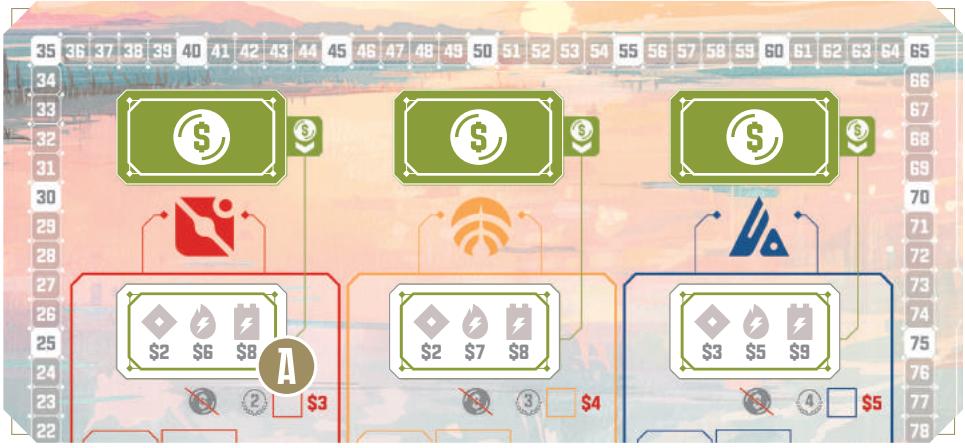
When you do this action, you can sell up to as many units of any type as indicated A , but you can only sell to one corporation. You cannot sell product to multiple corporations during the same Sell action. At the end of the sale, take action cards from the market that add up to a value that is equal to the amount of the sale that you made (See “Money” on page 15).

SELL 2 UNITS MAXIMUM

The Sell action causes the indicator on the financial assets value track for the corporation to whom you sold the product to go up one space, regardless of the number of units sold.

If you perform a Sell action using your company board, you can only sell one unit to a corporation. Its financial assets value indicator will move up one space on its track.

The Prompt action of this card allows you to sell up to three units. When doing so, the purchasing corporation’s
financial assets value indicator will move up one space on its track. Also, if you sell two products at the same time, you get 1 VP; and if you sell three, you receive 3 VP.
When an assets value indicator passes a change fees tile icon, you must replace the tile for that corporation with a new fee tile, which will establish new purchase prices. To do so, take the top tile in the future investments space, reveal it, and put it on top of the current one B .


When a financial assets value indicator reaches the last space in its track, that corporation is closed for the rest of the game and you cannot carry out any more Sell actions there. Turn over the fees tiles stack in its current investment space so it shows the icon of the closed corporation C (on the back of the start-up fees tile). As soon as two financial assets value indicators have reached the last spaces of their tracks, it triggers the end of the game, which concludes once the next End of the Round Phase is completed (see “The End of the Game”, page 13).

The green player plays a card from their hand and places an engineer on it to perform the Prompt Sell action. This allows the player to sell up to three units of products to one corporation, thus making the financial assets value indicator for that corporation move up one space on its track.

The green player has one brine, one geothermal energy, and one lithium in their warehouse D .
They decide to deal with the red corporation E , which at that moment buys lithium at \$9 per unit, geothermal energy at \$7 per unit, and brine at \$2 per unit.


The player opts to sell the lithium and the geothermal energy, collecting a total of \$16 and 1VP. Finally, the financial assets value indicator for the red corporation is moved up to the next space on the track F .


RTAS DE OBJETIVOENTER INTO A CONTRACT

This action allows you to take a contract card from those face up in the market and put it in one of the two spaces (one that is empty) along the upper edge of your company board. Your contracts remain there, occupying those spaces on your board, until you execute them.

RTAS DE OBJETIVOEXECUTE A CONTRACT
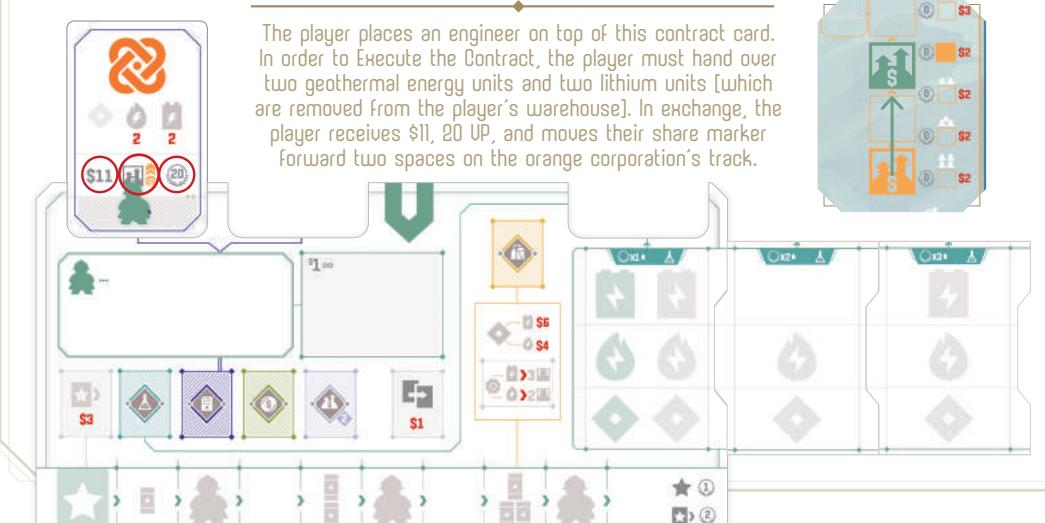
This action allows you to execute one of the contracts you have on your company board. To do so, place one engineer on the contract you wish to execute, spend the product units required to execute it A (subtract the corresponding units from your warehouse), and in exchange you receive the indicated benefit B . Contracts can provide you with the following benefits:
Money (see page 15).\$5


Victory points.

Shares in a corporation: Move your token up one or two spaces on the shares track, as indicated on the contract (see page 27).

Move your business development indicator one or two spaces forward on its track as indicated on the contract (see page 25).

Claim card: Without paying any cost, you can take one of the claim cards available On the board.
During the End of the Round Phase, remove any contracts that you have executed from your company board (and leave them next to your company board in case they are needed for the final scoring).
DEVELOP A BUSINESS PROJECT
The business plan is a fundamental tool for any entrepreneur. So long as everything is crystal clear and you follow it to the letter, it won’t be hard to convince professional investors to take part in your project.

This action allows you to move the indicator on your company’s business development track as many spaces as indicated on the action space. If you carry out this action on your company board, you must pay \$3.
Moving your indicator forward on the development track allows you to unlock warehouse spaces A (when the indicator reaches the corresponding space, turn over your next warehouse tile) and hire new engineers B (place
them in your HR space when the indicator reaches the corresponding space so that they will be available to you next turn). If there are two arrows next to the icon, you can advance your indicator twice.


Getting your indicator to the last space on your development track C unlocks the scoring of Grey Star—for each Grey Star that appears on your completed objective cards, you earn 1 VP at the end of the game.


Once your indicator reaches the last space on this track, any later advance immediately grants you 2 VP.

This action can also appear as a reward on some research, claim and contract cards, or when reaching certain spaces printed on the shares tracks of the board.


RTAS DE ORESEARCH

This action allows you to acquire one of the face-up research cards in the market, so long as you have space to place it on your company board, and you can pay its price (indicated at the top of the card). If the acquisition of the card includes any immediate benefit, it is indicated to the right of the price.

This research card costs \$4. The player immediately obtains a share of this corporation.

This card costs \$2. The player immediately gets 1 VP.
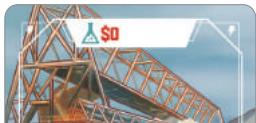
This card has no cost, but it does not generate any immediate benefit either.
When you get a new research card, place it in the available space to the farthest left along the upper edge of your warehouse (to do this, a space must be empty). As you increase the capacity of your warehouse, you will unlock more spaces in which you can place more research cards.

There are two types of research cards:
PERMANENT EFFECTS

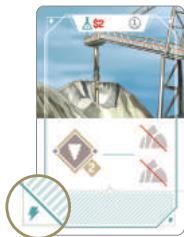
These cards modify the power of a specific action and remain on your company board for the rest of the game. Additionally, cards with permanent efects grant you VP at the end of the game equal to the VP indicated in the lower part of the card multiplied by the position that the card occupies on your board A .
Every time that an Acquire a Drilling License action is performed by the player, they get a \$1 discount on the purchase price of the claim card. Additionally, at the end of the game, this card grants the player a number of VP equal to 1 multiplied by the position that this card occupies in that player’s warehouse.
IMMEDIATE EFFECTS
These cards have an action space in the lower part that you can use only once for the whole game. In the End of the Round Phase, remove any research cards with an immediate efect that you have used from your company board but keep them close by in case they are needed for scoring objectives at the end of the game. Then, move any other research cards you have on your board to the left to fill in the empty spaces.
The player can Drill through up to two layers, ignoring up to two damage caused by rocks.

BUY SHARES

When you do this action, you can buy up to as many shares from a corporation as indicated, but you can only buy from one corporation. When you do, move your token that many spaces on the shares track for this corporation, paying the cost indicated for each share as shown on the financial assets value track at that moment.

The shares that you can purchase are limited by the position of the corporation’s financial assets value indicator: You cannot buy shares from a section above the one that the indicator is currently in.
In this example, the green player cannot buy any more shares in this corporation, unless the financial assets value indicator goes up three more spaces.

\$3 The financial assets value indicators show how much each share is worth in VP at the end of the game (see page 13).

The green player wants to buy shares, knowing that at that moment the shares in the red corporation cost \$1, shares of orange cost \$2, and shares in blue cost \$3. Green’s shares token in the orange corporation is at the same level as the assets value indicator, so they cannot move ahead there. The player decides to buy a share of the blue corporation for \$3, and moves their shares token up one space. If the game ended at this point, they would get 1 VP for each blue share held.

Reward printed on the board
Moving your shares token up on the tracks of each of the corporations generates benefits for you: You are rewarded with what is indicated to the left of each of the spaces on the track as you move up. When your token reaches a profit-sharing icon, take whichever profit-sharing tile you want from the stack. Leave it next to your company board (as it is no longer available to the other players from that point on).

Profit-sharing tile reward

Profit-sharing tiles are secondary actions that do not require an engineer to perform. You can resolve them before or after the main action you carry out on your turn. You can only use one of these tiles per turn. Once used, leave them face down in your playing area until the end of the game. If the reward is printed on the board, claim it immediately by advancing the indicator on your company’s development track one step.
CARTAS DE OBJETIVOBTAIN FINANCING1\$
This action allows you to take an engineer that is in your HR space and place it directly on the Obtain Financing space to draw one \$1 action card from the deck. Unlike other action spaces, there is no limit to the number of times that you can perform this action.

This is the only way to get money directly from an action card deck, since action cards are normally chosen only from among the cards shown face up on the board or taken randomly from the discard piles.
RTAS DE OBJETIVREPEAT AN ACTION
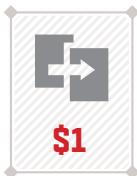
Once you have performed any action on your company board, you can repeat it during the same round of play (except for the Obtain Financing action) simply by using this action.
This action allows you to perform one of the actions currently blocked on your company board again, after paying \$1. Like the rest of the actions, once this action is used it is then blocked for the rest of the round.
Compete against Green Minerals Incorporated (GMI), the market leader in lithium extraction.
To play a solitaire game, set up the game like you would for a two-player game using the normal rules. If you wish to make the game easier, when you set it up, do not deal the seven starting \$1 action cards to GMI.
When setting up a solitaire game, keep the following in mind:
-
GMI does not use engineers, so there is no need to place them on its board.
-
Separate the GMI cards into two diferent decks: starting and advanced . Shufle the decks separately. Using the starting cards, make a row of four cards ( A in the image). Randomly remove two advanced cards (that you will not use in this match) and make a deck with the other three B .
-
Remove the three research cards and the profit-sharing tile that have the copy action icon.

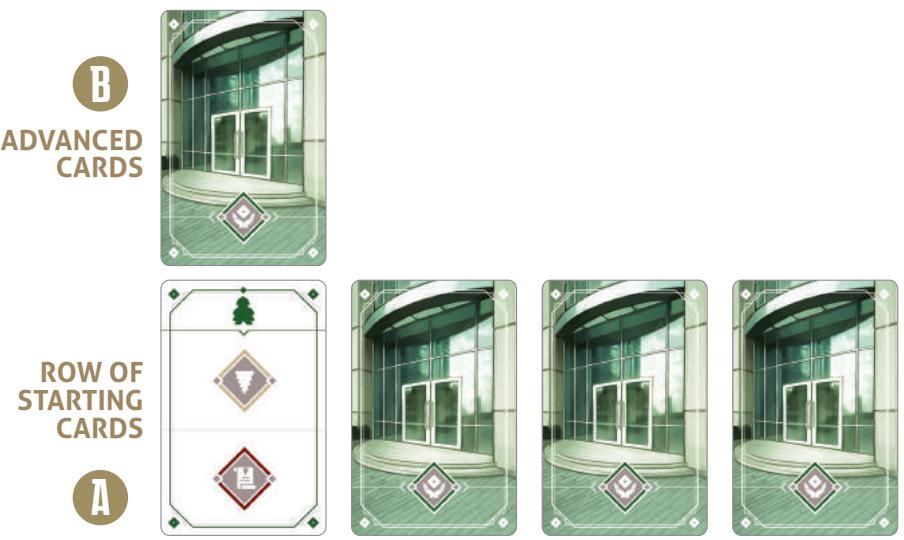
On its turn, GMI will turn over one of its cards, starting with the one farthest to the left, and then perform the action indicated on the card. Once this is resolved, you play your turn. Then you take turns each performing actions until you have placed all of your engineers and GMI has turned over all of its cards. At that point, move on to the End of the Round Phase as you would normally.

The GMI cards show diferent actions placed in vertical order, from the top to the bottom of the card.
GMI will always attempt to perform the action at the top of the card. If it cannot do that, then it attempts the next action down, and so on until it reaches an action it can perform. If it cannot carry out any of the actions on the card, GMI passes its turn.
When its business development indicator reaches a space that allows it to unlock a new warehouse, it turns over the one with the lowest number. When it unlocks a new engineer, it instead adds an advanced GMI card to the farright end of its row of cards.
For GMI, its round ends when it has turned over all the cards in its row. Once the round has ended, shufle the cards in the row and create a new row that will be used in the next round.

GMI’s business development indicator has been moved forward one space on the track and it has unlocked its first warehouse space. Then, its indicator moves to the second space on the track and GMI immediately adds an advanced card to its row, so that it now has 5 cards.
If GMI is the first to complete a short-term objective, it remains in GMI’s playing area to be scored at the end of the game.
The End of the Round Phase and the final scoring are carried out as usual.

ACTIONS AVAILABLE TO GMI
Below, we explain what actions GMI can do:

ACQUIRE A DRILLING LICENSE (see page 16)
GMI always takes the claim card that is lowest on the board without paying any price.
Place the card at the bottom edge of it
内容过长,此处只内联前一部分;完整内容请下载或到规则页阅读。
下载 Markdown原文为社区整理/出版社公开资料,版权归原作者,仅供个人学习查阅。