
The Same GameSame Game
一句话概览
The Same Game 是一款已收录于村了吗规则库的桌游,支持 3–6 人,原名 Same Game。
本页内容:一句话概览 · 常见问题
这游戏怎么玩
- 本站已收录这款游戏的规则资料,可以在对话里直接提问规则细节。
常见问题(FAQ)
以下 1 条问答中 0 条来自站内玩家的真实提问,其余 1 条为本站整理的常见疑问;答复内容保持原样。
The Same Game支持几个人玩?
3–6 人。
去哪查完整规则
想核对具体规则细节、卡牌效果或某个回合的结算方式,可以在村了吗里选中这款游戏后直接提问。
同类桌游
- 卡坦岛德式
- 工业革命:伯明翰德式
- 勃艮第城堡:特别典藏版德式
- 方舟动物园德式
- 卡卡颂抽象
- 瘟疫危机传承:第一季美式
- 阿瑞迪亚:勇踏征途美式
- 重塑宇宙德式
- 幽港迷城美式
- 埃多拉的德鲁伊德式
规则原文(Markdown)
本站收录这款游戏的规则原文 1 个文件,此处内联渲染 1 个,可直接展开阅读或下载。
Rulebook_240x240_EN_006_WEB.md17.2 KB

RULES
A communicative game for 3–6 people ages 10+ by Wolfgang Warsch
Is a microwave more important to humanity than diapers? How differently does a rocking horse move compared to a windshield wiper? And don’t a pizza cutter and a unicycle look similar in some way?
The Same Game is a cooperative game in which players will discuss how completely different objects might share something in common across various categories.
COMPONENTS

1 game board

1 score marker

9 number tiles Front: Number Back: Trap
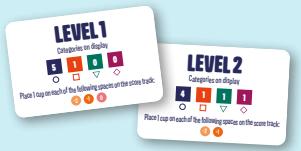
2 level overview cards

165 object cards

1 game length overview card

15 category cards


6 writeable tableaus

6 wipeable pens
AIM OF THE GAME
In The Same Game, you play together as a team.
In the game, you compare 2 objects in relation to different categories. As a result, you gradually remove cups that are next to the categories on display. You score points as long as you do not uncover the trap. If you have correctly selected a category, you can place its cup on the next available space on the score track.
If you reach the medal area at the end of the game, you win The Same Game.
Given number of category cards

SETUP
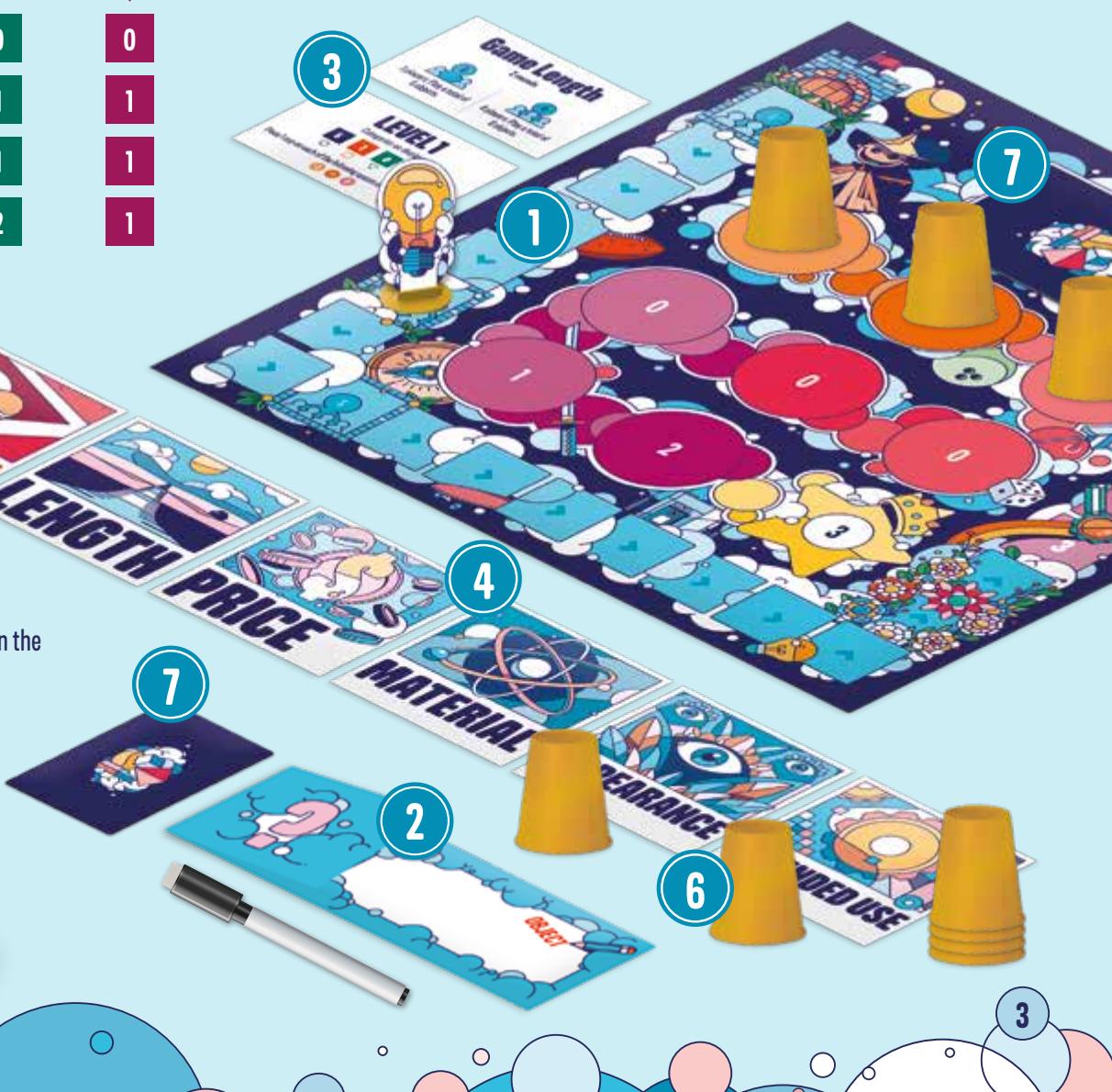
Put the game board on the table and place the score marker on the position of the scoreboard that corresponds to the number of people playing.
Have each player take 1 tableau and 1 pen.
3 Place the game length overview card in front of you according to your number of players. Then take the level overview cards and decide which level you want to play. The levels differ in the number and difficulty of the categories on display.
Level of difficulty
Level 1
5
1
0
Level 2
4
1
Level 3
4
2
Level 4
4
2
For the first game, we recommend that you start with level 1.
Sort the categories by their
backs and shuffle all the
piles well separately.
Draw the given number of blue,
green, orange- and purple
categories and lay them out open in a row below the game board.
5 Put the following number tiles in the bag, depending on the chosen level of difficulty:
Level 1: 1 - 6 | Level 2: 1 - 7 | Level 3: 1 - 8 | Level 4: 1 - 9
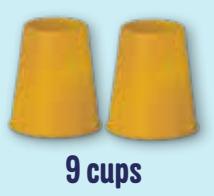
Place 1 cup next to each category on the table.
Note: Depending on the level, 0 to 3 cups remain. Place the remaining cups on the score track, in the middle of the board, starting with “-2”. These cups are not used and remain there throughout the game.
Shuffle all the object cards. Each player draws 1 object card and looks at it secretly. Without looking at it, place exactly 1 object card face down on the corresponding space on the game board.
In a 3-and-4-player game, place the remaining object cards as a draw pile ready for the second round. Otherwise, put the cards back in the box with the rest of the game material. You will not need them in this game.
Now you can start!
Phase 1: The Same
Everyone will find out which category contains the hidden trap during their turn.
1. Write down the number
One after the other, each player takes hold of the bag once. Whoever has the bag performs the following actions:
• Draw a number tile from the bag.
• Secretly write down the number from the tile on your personal tableau.
• Put the number tile back into the bag.
• Pass the bag to the next person.
Keep doing this until everyone has written down a number.

2. Assign a number tile to the categories
Now take all the number tiles out of the bag and place 1 random tile face up next to each category.

3. Determine the personal trap
Now look inconspicuously for the category that is next to the number you wrote down. In this way, you have been assigned your personal category, behind which the trap will be located during your turn.
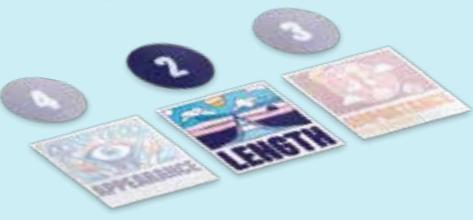
As everyone placed their drawn number tile back into the bag during this phase, it is possible that several players have the same number tile and therefore the same trap category.
Next, prepare your clue for the team to help prevent them from falling into the trap.
Everyone thinks about a clue at the same time.

Now think of an object and write it on your tableau. The object should be as similar as possible in your trap category to the object on your object card. In this way, you help alert your team to the position of the trap. Finally, place your own object card face down on top of the object you just wrote down to keep both secret until your own turn.
Note: Pay attention to the rules for selecting objects at page 7 of these rules.
EXAMPLE
During setup, you drew the tile with the “2” and wrote it on your tableau. Then the “2” was assigned to the category “length”. The category “length” is therefore the trap during your turn and should not be revealed by your team. The other categories on display are: Appearance, Importance to Humanity, Material, Price and Weight.
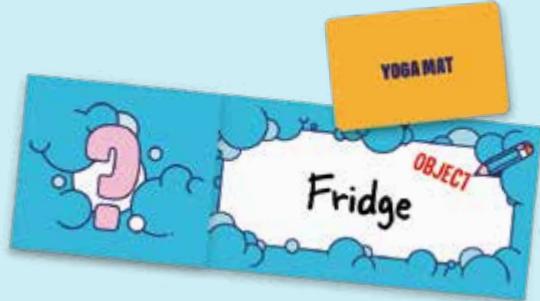
You have drawn the term “yoga mat” as an object card. You now think of an object that has the same length as a yoga mat, if possible, to point out to your team the trap behind the category “length”.
GOOD CLUE
A good clue would be “refrigerator”, for example, because it has a similar length as a yoga mat. In addition, a refrigerator clearly differs from a yoga mat in the other categories Appearance, Importance to Humanity, Material, Price and Weight.
BAD CLUE
An example of a bad clue would be “air mattress”. It has a similar length as a yoga mat, but it also has a similar price and weight as a yoga mat. In addition, the categories Appearance and Importance to Humanity cannot be completely ruled out.
After you have written the chosen object on your tableau, you continue with Phase 2: The Game.
SWAP OBJECT CARD
As a team, you have the opportunity to exchange a drawn object card exactly once during the game. If you want to do this, you consult with your team and first put your own object card back in the box. Then you take the object card that is lying face down on the game board. You do not know the newly drawn object and may only swap the card once for the entire game. The card slot is not refilled, not even in a later round.
do
Phase 2: The Game
Set the trap and read out your clue.
The most curious person starts. Then the game continues in a clockwise direction.
At the beginning of your turn, every other player in your team closes their eyes.
Turn over your number tile (in our example, the “2”) so that the trap is now visible.
Then place a cup on top of each number tile to cover all the tiles.

Note: Always start at one end and then cover one tile at a time so that no cup noises will reveal the approximate position of your trap.
Once you have finished, ask your team to open their eyes again.
Now show your team your two objects: One is the given object on your card, the other is the object you wrote down. From now on, you are not allowed to make any comments or gestures that could give your team any hints.
Now your team discusses which categories are not the trap.
Note: Your task is to find the categories in which the two objects differ. The trap, i.e. the category in which the two objects are similar, is best not revealed at all.
Remove the cups and check your assessment.
Agree on a category together and remove the cup from the number tile.

RIGHT
Is there a number on the number tile? Very good! You have correctly excluded this category. Place the cup on the next available scoring space. Continue with the next category!
WRONG
Can you see the trap on the number tile? Bad luck, the trap is sprung and you are unfortunately not allowed to place this cup on the next scoring space. The current turn ends immediately for you.
Repeat this process until you have either uncovered all the number tiles or have fallen into the trap. Then continue to the end of the turn.
Note: It is not important to guess the trap category right away. It is best to start with the categories where you think there is a clear difference between the two objects and remove these cups first. Then, step by step, move on to the categories where you are unsure.
End of a turn and start of the next.
A turn ends as soon as you have successfully uncovered all the number tiles or removed the cup revealing the trap. The next free number on the score track that is not covered by a cup indicates how many steps you may move your score marker on the scoreboard.
The next person sitting clockwise will start the next turn by turning the trap back to its number side, removing any remaining cups from the number tiles and taking the cups from the scoring spaces.
Then they will start their turn!
Everyone’s clues have been played.
Once you have dealt with all the objects from the team, the round will end.
The game with 5 or 6 people ends after 1 round.
In the game with 3 or 4 people, play one additional full round.
3 people:
2 rounds
Play a total of 6 objects.
4 people:
2 rounds
Play a total of 8 objects.
5 people:
1 round
6 people:
1 round
Play a total of 5 objects.
Play a total of 6 objects.
Start a new round (only in the 3 and 4 player games).
To prepare a new round, clean your tableaus, put the number tiles back in the bag and repeat all the steps from Phase 1: The Same. Then play the new round as described in Phase 2: The Game.
Attention: If you have already swapped the object card in the first round, the empty card slot is not refilled (see Phase 1: Swap Object Card at page 5).
TWO PLAYER GAME
Note: If two people want to play The Same Game, this is possible without changing the rules. To do this, place your score marker on the space for 3/6 players at the beginning of the game and then play 3 rounds (i.e. a total of 6 objects).
END OF THE GAME
The game ends as soon as you have played the given number of objects. You can see how well you did on the scoreboard:
Every space before the bouquet
That was ... well, it was “okay”! Maybe you should try an easier level first ...?
Bouquet

You can pat each other on the back with encouragement. You didn’t win, but you were close!
Bronze

You won the game and you can be proud of your team‘s performance, but there’s still some room for improvement.
Silver

That was impressive. You won!
Play again straight away - and then you‘ll surely win gold!
Gold

Yeah! You have won and crushed it! Off to the next, more difficult level!
RULES FOR SELECTING OBJECTS
• The object you write down must be an object you can touch. Only man-made objects are valid. Plants, animals, clouds, water, etc. are not allowed.
• You may not use numbers.
• Apart from the object, no additional word, such as an adjective, may be used.
• The object must not contain any material: So a cooking spoon would be a valid clue but a wooden cooking spoon would not.
• The object may be a compound word as long as you could also find the word in this form in an english dictionary.
In general, if you have the feeling that you are “cheating” with your clue, then you are probably cheating.
OVERVIEW OF THE CATEGORIES
The Category
| Appearance | The external appearance of the object. |
| Frequency worldwide | The quantity of the object occurring worldwide in the present. |
| Length | The length of the longest side of the object. |
| Material | The materials from which the object is made. |
| Price | The purchase price of the object. |
| Intended use | The application for which the object is intended. |
The Category
| Movement | The movement of the object can be derived from parts of the object moving (e.g. a cuckoo clock), a person moving it (e.g. rocking horse) or it being used with a typical movement (e.g. putting a phone to your ear). |
| Complexity of the structure | How complex is the construction of the object? It does not refer to the production of the object. |
| Importance for humanity | How bad would it be for all humanity if the object no longer existed tomorrow? |
The Category
| Explanation effort | The amount of information needed to use this object properly. How extensive would the instructions be that would accompany this object? |
| Duration of use | The duration of use from the beginning to the end of an active use. It does not refer to the duration of use over the entire life of the object. |
| Frequency of use | The average number of days per year that the object is used. |
The Category
| Weight | The weight of the object |
| Height of the lying object | The height of the object placed so that it has the least height. |
| Volume | How much space does the object take up? |
BRIEF OVERVIEW
Place the game length card in front of you according to the number of players. Then take the level overview cards and set up the game for your selected level.
PHASE 1: THE SAME
Find out which category contains the hidden trap during your turn.
-
Draw number tiles from the bag and write down the number.
-
Place the number tiles next to the categories.
-
Determine your personal trap.
Everyone thinks of a clue at the same time.
Think of an object that is as similar as possible in your trap category to the object on your card and write it on your tableau.
PHASE 2: THE GAME
The most curious person starts. The rest of the team closes their eyes.
-
Turn over your number tile so that the trap is visible.
-
Cover all the number tiles with a cup.
-
The team opens their eyes again.
-
Present your object card and your noted object to your team.
-
Your team discusses which category they want to exclude.
-
Remove the cup of the selected category and check its assessment.
RIGHT
If you see a number on the number tile, you have correctly excluded the category. Place the cup on the next available scoring space on the game board. Continue with the next category.
WRONG
If you see the trap on the tile, the trap is sprung and you are unfortunately not allowed to place this cup on the next scoring space. The current turn ends for you.
END OF A TURN AND START OF THE NEXT.
• When all the number tiles are revealed or the trap is sprung, the round ends.
• Move your score marker the number of spaces according to the space indicated on the scoreboard.
• The next person clockwise takes their turn and starts a new round.
END OF THE GAME
The game ends as soon as you have played a given number of objects.
You can see how well you did on the score table.
Designer: Wolfgang Warsch
Illustration: Christian Schupp
Layout: Fiore GmbH
Realisation: Michael Schmitt
Editors: Kaddy Arendt, Andreas Langkamp
Translation: Vanessa Abel
Support: Cyrill Callenius

IMPRINT
© 2023 Edition Spielwiese Simon-Dach-Str. 21 10245 Berlin, Germany www.edition-spielwiese.de


Distribution: Pegasus Spiele GmbH Am Straßbach 3 61169 Friedberg, Germany www.pegasus.de
v1.0 All rights reserved. Reprinting or publication of the instructions, game material or illustrations is only permitted with prior permission.
/pegasusspieleNA
下载 Markdown原文为社区整理/出版社公开资料,版权归原作者,仅供个人学习查阅。