
撒丁岛Sardegna
一句话概览
撒丁岛 是一款已收录于村了吗规则库的桌游,支持 2–4 人,原名 Sardegna。
本页内容:一句话概览 · 常见问题
这游戏怎么玩
- 本站已收录这款游戏的规则资料,可以在对话里直接提问规则细节。
常见问题(FAQ)
以下 1 条问答中 0 条来自站内玩家的真实提问,其余 1 条为本站整理的常见疑问;答复内容保持原样。
撒丁岛支持几个人玩?
2–4 人。
去哪查完整规则
想核对具体规则细节、卡牌效果或某个回合的结算方式,可以在村了吗里选中这款游戏后直接提问。
同类桌游
- 卡坦岛德式
- 工业革命:伯明翰德式
- 勃艮第城堡:特别典藏版德式
- 方舟动物园德式
- 卡卡颂抽象
- 瘟疫危机传承:第一季美式
- 阿瑞迪亚:勇踏征途美式
- 重塑宇宙德式
- 幽港迷城美式
- 埃多拉的德鲁伊德式
规则原文(Markdown)
本站收录这款游戏的规则原文 1 个文件,此处内联渲染 1 个,可直接展开阅读或下载。
Sardegna_rule_EN_booklet.md10.2 KB
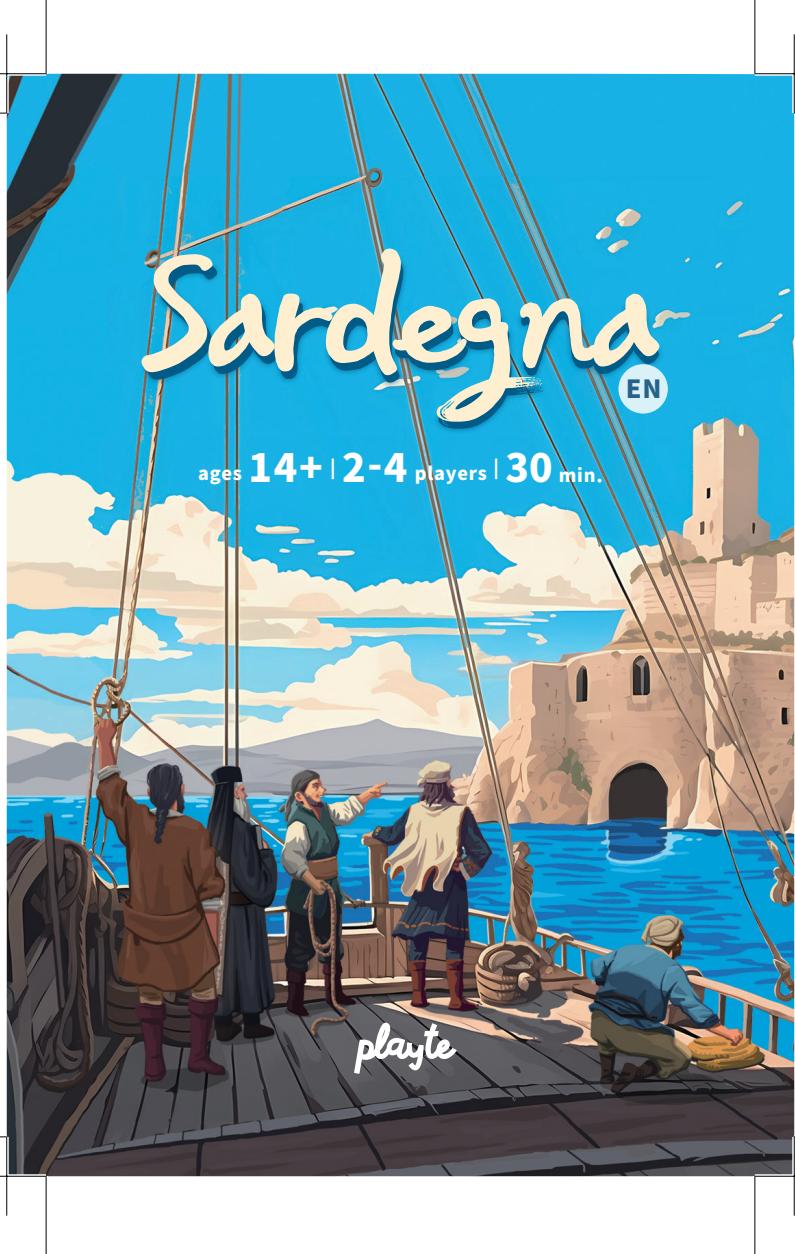
This game is set on the island of Sardegna during the 14th century. Settle the provinces of Sardegna with your people and your priest. Build villages, bring your ships to harbor and increase your influence by building mighty forts.
Components
1 game board, 26 fort cards, 28 character cards, 4 score markers, 4 priests, 8 ships, 12 forts, 16 villages, 20 villagers, 16 agriculture tokens, 4 summary cards
Game Setup
• Unfold the box to lay out the game board.
• Place the 16 agriculture tokens on the 16 island provinces: place the 2 wheat tokens onto the 2 yellow provinces, the 8 olive and wine tokens randomly onto the 8 green provinces, and the 6 thyme and cheese tokens randomly onto the 6 brown provinces.
• Each player chooses a color and takes a summary card plus the 7 character cards, 1 score marker, and 15 pieces in that color (1 priest, 2 ships, 3 forts, 4 villages, and 5 villagers).
• Each player places their score marker near the score track and takes all 7 of their character cards into their hand.
• Shuffle the 26 fort cards to make a deck and place them beside the game board. Deal out 11 fort cards in a facedown row along the side of the deck, then turn the 2 leftmost fort cards face up.
• You are now ready to play Sardegna!
The Game Board
The island is divided into 16 provinces separated by beige borders, each containing an agriculture token.
Each province may contain a maximum of 7 priests, villages, and / or villagers at a time. As soon as a province is full,
no further priests, villages, or villagers may be added to it.
Crossing the border between 2 provinces costs 1 movement. Priests and villagers can move through full provinces, but cannot end their movement there.
Forts: There are 26 square fort spaces are located at the province intersections. Each fort space may hold only 1 fort.
Harbors: The island is surrounded by 7 harbors (indicated by a ship's wheel symbol). There may only be 2 ships in each harbor (only 1 ship in a two-player game), and no player may place both their ships in the same harbor.
Taking Turns
Take turns in clockwise order, beginning with the youngest player. On your turn, choose a character card from your hand, play it face up in front of you, and take an action shown on the card. Then, play passes to the next player.
Played character cards remain in front of you until any player plays the Sentinel card (seepages 6-7).
The Character Cards
Admiral
When you play the Admiral, you may either:
• Add 1 ship from your supply to a harbor; or
• Move any of your ships on the board to harbors of your choice.

Commander
When you play the Commander, you may either:
• Add 1 villager from your supply to any province; or
• Move your villagers up to 4 times. You may move a villager multiple times, or split this movement across multiple villagers freely.

Priest
When you play the Priest, you may either:
• Add your priest from your supply to any province; or
• Move your priest up to 3 times.
When a priest is in a province, opponents may not move or add villages or villagers that are already in the province unless they also have a priest there. If your priest is in a province, however, you may move or add your villages and villagers there as normal.

Farmer
When you play the Farmer, you may harvest 1 agriculture token to score points, as follows.
Choose a harbor containing one of your ships. You may harvest from a province containing one or more of your villager(s) and an agriculture token, so long as:
• that province is adjacent to your chosen harbor; or

• there is an unbroken chain of provinces containing your villager(s) connecting your chosen harbor to the chosen province.
Add the harvested agriculture token to your supply and score points. The first collected agriculture token of each type is worth 1 point; the 2nd, 3rd, and 4th tokens of the the same type are worth 2, 3, and 4 points respectively.
Architect
When you play the Architect, you may either:
• Add 1 fort from your supply to an empty square fort space on the board; or
• Add a village from your supply to any province. The maximum number of villages you may have in play is equal to your harvested agriculture tokens (e.g. if you have 2 agriculture tokens in your supply,

you may have a maximum of 2 villages on the board).
Queen
When you play the Queen, you may copy any action from any character card you have played since the last Sentinel was played (i.e. you may copy an action from any character card in front of you).

Sentinel
When you play the Sentinel, you initiate province scoring, as follows:
- Review the leftmost face-up fort card - this indicates
which fort space and adjacent provinces will be scored (see Scoring Provinces page 6).
-
Score each province which borders that fort space, one at a time, recording points on the score track.
-
After scoring these provinces, discard the scored fort card to the bottom of the deck, and turn over the next face-down fort card in the row. You may either leave the

revealed card in the row or discard that card to the bottom of the fort deck and replace it with a new card drawn and placed face up from the deck. When you are done, two fort cards will be face up. These are the next two forts that will be scored.
Once scoring is complete, all players collect their played character cards and add them to their hand. Play then continues clockwise as normal.
6
Scoring Provinces
Players score points from a province based on their relative influence. Each player gains influence for their pieces in or adjacent to the province, as follows:
• 1 influence per priest or villager in the province
• 2 influence per village in the province
• 1 influence per ship in a harbor adjacent to the province
• 1 influence per fort on the province's border
The player(s) with the most influence in a province score the full victory points shown in that province (inside the laurel wreath). The player(s) with the second-highest influence score half the province's victory points, rounded down.
In a two-player game, or if players tie for most influence in a province, no players score points for second place.

Example – Province Scoring (4-player game):
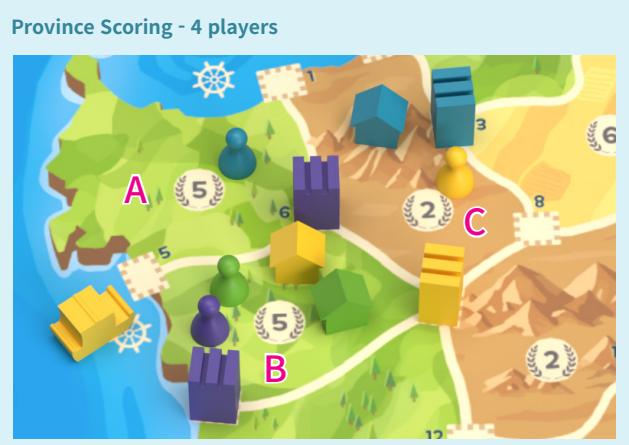
The yellow player plays a Sentinel card, initiating province scoring. The leftmost revealed fort card is #6.
Provinces A, B, and C will be scored during this province scoring, since they are adjacent to fort space #6.
Province A: Blue has 1 villager and Purple has 1 fort on the border, giving each player 1 influence there. Both players get the full 5 points for the province and advance their markers on the score track accordingly.
Province B: Yellow has 1 village, 1 ship in an adjacent harbor, and 1 fort on the border, for a total of 4 influence, while Purple and Green each have 3 influence. Yellow gains 5 points 5 points, and Purple and Green each gain 2 points.
Province C: Blue has 1 village and 1 fort (3 influence), Yellow has 1 villager and 1 fort (2 influence), and Purple has 1 fort (1 influence). Blue scoes 2 points, Yellow scores 1 point, and Purple scores no points.
Example – Fort Cards:
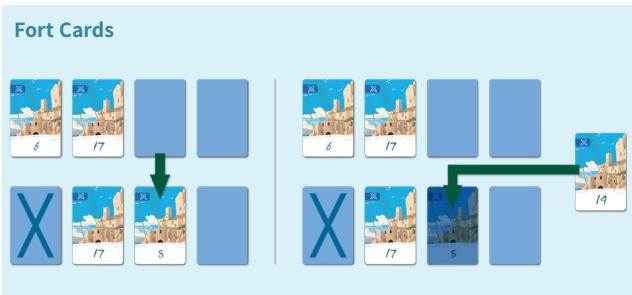
At the beginning of the game, fort cards 6 and 17 are dealt face up. The first scoring will occur around fort space 6 and the second around fort space 17.
Yellow plays her Sentinel card, initiating scoring. After all provices are scored, Yellow removes fort card 6 and reveals the next card in the row – fort card 8. Yellow now has a choice: she can either keep fort card 8 or discard it to the bottom of the fort card deck and draw a new fort card to replace it in the row.
End of Game
The game ends after the 11th fort card is scored. The player with the most points wins!
Variant: Alternate Sentinel Rules
This advanced variant is for experienced players and gives you more control over province scoring. The rest of the game remains unchanged.
Setup
After dealing out the fort row, each player draws 1 fort card from the top of the deck. Keep these fort cards face down in your supply. You may review your private fort card at any time.
Sentinel Card Changes
You may only play the Sentinel when you have 3 or more other character cards played in front of you.
When you resolve the Sentinel and reveal the leftmost face-down fort card, you may do one of the following:
• Leave the revealed fort card in place. Add the top card of the fort card deck to your supply, review both fort cards in your supply, and discard one of them to the bottom of the fort deck; or
• Discard the revealed fort card to the bottom of the fort card deck and replace it with another fort card drawn and placed face up from the deck; or
• Discard the revealed fort card to the bottom of the fort deck and replace it with the fort card from your supply, played face up. Add the top card of the fort card deck to your supply.
10
Designed by Stefan Dorra.
Illustrated by Wanjin Gill.
Published by Gameology Inc. playte . www.playte.com
© Stefan Dorra, Gameology Inc. All rights reserved.
* 'Sardegna' is a product of a licensing agreement between Stefan Dorra and Gameology Inc. The rules and artwork may not be copied.
* The illustrations on the game box and some of the cards were generated by AI, and the illustrator adjusted and finalized them.
* The functions of Sardegna’s game board and box (L BOARD) are patent registered. (KR)10-2530766 / PCT-P-220710

原文为社区整理/出版社公开资料,版权归原作者,仅供个人学习查阅。