
Savernake ForestSavernake Forest
一句话概览
Savernake Forest 是一款已收录于村了吗规则库的桌游,支持 2–4 人,原名 Savernake Forest。
本页内容:一句话概览 · 常见问题
这游戏怎么玩
- 本站已收录这款游戏的规则资料,可以在对话里直接提问规则细节。
常见问题(FAQ)
以下 1 条问答中 0 条来自站内玩家的真实提问,其余 1 条为本站整理的常见疑问;答复内容保持原样。
Savernake Forest支持几个人玩?
2–4 人。
去哪查完整规则
想核对具体规则细节、卡牌效果或某个回合的结算方式,可以在村了吗里选中这款游戏后直接提问。
同类桌游
- 卡坦岛德式
- 工业革命:伯明翰德式
- 勃艮第城堡:特别典藏版德式
- 方舟动物园德式
- 卡卡颂抽象
- 瘟疫危机传承:第一季美式
- 阿瑞迪亚:勇踏征途美式
- 重塑宇宙德式
- 幽港迷城美式
- 埃多拉的德鲁伊德式
规则原文(Markdown)
本站收录这款游戏的规则原文 1 个文件,此处内联渲染 1 个,可直接展开阅读或下载。
SAVERNAKE_FOREST_DEVIR_Rulebook_ENG.md12.1 KB
Rodrigo Rego

Autumn is coming to an end, and the animals of Savernake Forest are preparing for winter by collecting and storing the food they need in order to make it to spring. To win this game, you need to build a forest, fill it with animals, and make sure they are storing their favorite foods!
Goal of the Game
Savernake Forest is a game about placing cards and building paths. Each turn, you'll add a card to your 4×4 forest. Cards can have either animals or the forest paths where they'll find food. You need to make a path for each animal, making sure they collect only the best food.

Game Contents
▶64 Forest cards: 45 Path cards ▶19 Animal cards
34 tokens: 15 Lair tokens ▶15 Water drop tokens ▶4 player Score markers
▶1 1st Player pawn (Rooster)
▶1 double-sided board / score track

Setup
Divide the cards into two decks: Path cards and Animal cards. Shuffle each deck separately, face down.
Randomly give each player 1 Animal card from the top of the deck. Place yours face up in front of you.
Place the board in the middle of the table with the animal side facing up.
Animal cards

Path cards
Place the Lair tokens above the armadillo, the Water drop tokens above the goat, and the deck of Animal cards above the rabbit.
Give each player a marker of their chosen color.
Decide who goes first randomly and give them the 1st Player pawn.
Understanding the Animal Cards
Animal cards show the following:

① The 4 kinds of food that animals can store (berries, worms, eggs, and nuts) and how many points each food is worth to that animal.
② The start of that animal's path.
③ How many points the animal itself scores if it's in your forest.
④ How much food the animal can store.
Each animal awards points based on the path that starts on its card. Animals will store the first food they find along their path until they reach their maximum capacity, regardless of how many points each type of food scores.
Example:
The fox can store 3 food.
It stores the first 3 food items it finds along its path: the worm (1 point), the nut (0 points), and the egg (2 points).
But there's no room for the other egg or the other worm, unless you can expand its ability to store food!

Playing the Game
The game is played over a series of rounds. In each round, every player will take a turn choosing 1 card to add to their forest. When everyone's forest is full (16 cards), the game ends.
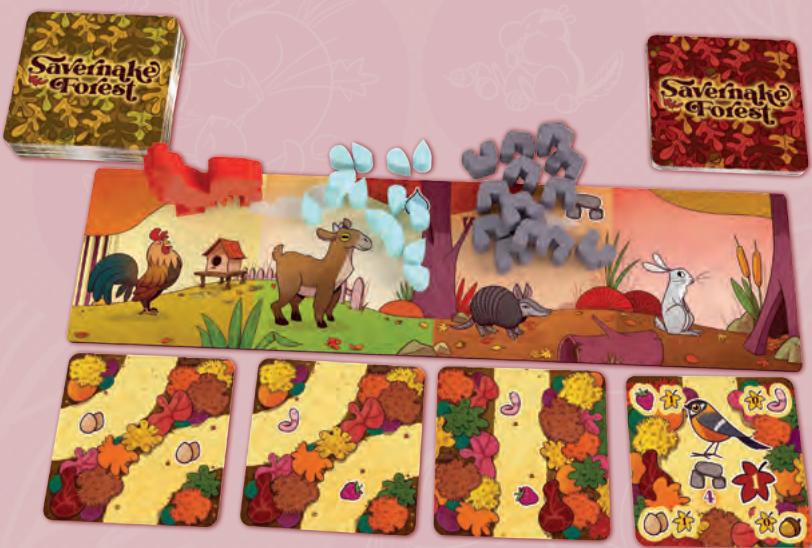
Beginning of a Round
Before each round, place 4 cards below the board: 1 Animal card below the rabbit and 1 Path card below each of the other animals.
Then, the player with the 1st Player pawn takes the first turn, and the game proceeds clockwise.
YourTurin
On your turn, you must take one of the remaining cards from the board and place it in your forest. You must follow these rules when placing a card:
It must be adjacent to at least 1 other card already in your forest.
Your forest must form a 4x4 square—you cannot place a card that would be outside of that area.
You may rotate your card (including Animal cards).
You don't need to follow any existing paths, and dead ends are ok.
There can never be 2 animals on the same path.
What is a Path?
A path is a series of one or more cards that have an unbroken forest path connecting them together. A path can have any number of twists and turns, but will never branch or intersect another path.
Example:
① You cannot have 2 animals on the same path!
② You cannot place here because it wouldn't fit in a 4×4 square!
③ You cannot place here because cards need to be adjacent!
You can place here even though the path doesn't connect to an existing one and it creates a dead end.

Back to our previous example:
The fox has increased its storage capacity to 5. This means that it can store all 5 food items that are currently on its path.
Also, it gathered some water while looking for eggs and worms. This means the eggs are now worth 3 points, and the worms, 2. The nuts are still scoring zero.
The fox is now scoring a total of 10 points, compared to only 3 points before!
Taking a Card
When you take a card, do not refill the board yet. There will be fewer options for the next player.
Each card you take belongs to an animal advisor: the rooster, the armadillo, the goat, or the rabbit. Each advisor gives you a benefit that will be important for the development of your forest.
Rooster
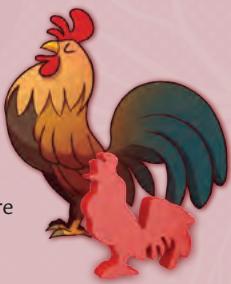
The rooster helps you wake up early next morning so you can be the first to choose a card. When you take a card from the rooster, you also take the 1st Player pawn. If no one takes a card from the rooster—only possible in games with less than 4 players—the current 1st Player keeps it. The player who has this Pawn at the end of the game will score 1 extra point.
Armadillo

The armadillo teaches you how to dig holes to store more
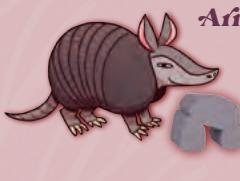
food. When you take a card from the armadillo, you also take 1 Lair token and place it on any of your animals. This token increases that animal's storage capacity by 1.
Goat
The goat teaches you to hydrate better. When you take a card from the goat, you also take 1 Water drop token and place it on the corner of one of your animal cards, next to one of the 4 food items. This token increases that food's value for that animal by 1. You can only place a maximum of 1 Water drop token on each corner of the Animal card.
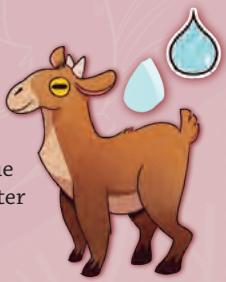

Rabbit
The rabbit is a social animal who helps you bring new animals to your forest. The only way to get new animals is by taking a card from the rabbit.

End of the Round
Once all players have taken 1 card each, the round ends. If there are any cards left (only in 2 or 3-player games), discard them. Then, refill the board with 1 Animal card below the rabbit and 1 Path card below each of the other animals. The player holding the 1st Player pawn starts the new round.
End of the Game
The game ends as soon as everyone completes their 4×4 forests (by gathering 16 cards). Check to see if 2 Animal cards in your forest are sharing the same path. If so, choose all but 1 of them to discard: They won't score.
Now, flip the board to the other side to show the Score Track. Count your points, scoring each animal individually. Use your player marker to track your score. Don't forget to score each animal's own points (from 1 to 3)!
The player who finished with the 1st Player pawn gets 1 extra point.
Whoever has the most points wins! If theres a tie, the tied player closest to the one who finished with the 1st Player pawn (in turn order) wins the game.
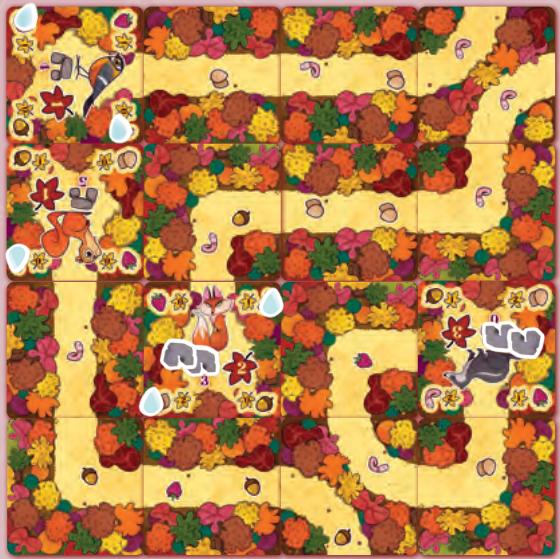
Scoring Example
Titmouse: Scores 2 points per egg and 1 point per worm; Can stock 4 food: Takes 2 eggs and 2 worms. Total: 6 points.
Squirrel: Scores 1 point per nut and 1 point per worm; Can stock 5 food: Takes 1 worm, 3 nuts, and 1 berry. Total: 4 points.
Fox: Scores 3 points per egg and 2 points per worm; Can stock 5 food: Takes 2 worms, 2 eggs, and 1 nut. Total: 10 points.
Badger: Scores 2 points per worm, 1 point per berry, 2 points per egg, and 1 point per nut; Can stock 2 food: Takes 2 worms. Total: 4 points.
Animals: Badger (3), Fox (2), Squirrel (1), Titmouse (1). Total: 7 points.

2-Player Advanced Mode

If you're playing a 2-player game and you want to make it a little more “meaty," you can use the following rule changes:
Instead of a 4×4 forest, you must make an 8x4 forest (can be vertical or horizontal).
Each player starts with 2 random Animal cards at the start of the game instead of 1. Place them side by side. You may freely rotate each one of them.
Each round, you take 2 cards: The first player chooses first then their opponent goes next. The first player takes the third card, and their opponent takes the last one.
Credits
Game designer: Rodrigo Rego Illustrator: Núria Aparicio Layout: CeciRC Text proof: William Campbell English proof: William Niebling Editor and developer: David Esbrí

www.devir.com

Devir Iberia S.L. Rosselló 184. O8008 Barcelona. • Devir Livraria, Ltda. Pólo Industrial. Brejos de Carreteiros, Escritório 2, Olhos de Água 2950-554 Palmela. devir.pt@devir.com. Tel: (351) 212 139 440 • Devir Livraria Ltda. Rua Chamatu, 197-A. Vila Formosa, CEP 03359- 095 São Paulo – SP. CNPJ 57.883.647/0001-26. sac@devir.com.br. Telefone (11) 2924-6918 • Devir Italia. Piazza Petrucci, 8. Camaiore (LU). • Devir Americas. 8123 South Orange Avenue, Suite 166 Orlando, Florida, FL 32809.
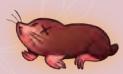
Mole
If you want to know more about the names of all the animals appearing in the
The Animals

Hamster


Hedgehog
Badger

Beaver


Raven
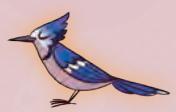
Blue Jay
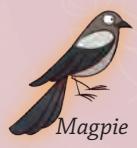

Owl

Mouse
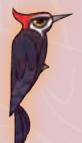

Woodpecker

Squirrel
Chipmunk

Pigmy Possum


Wildcat
Chickadee
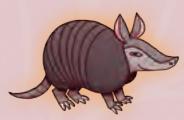
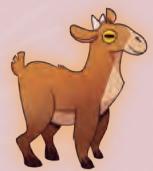
Goat
Armadillo
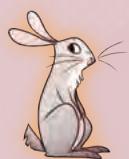
Rabbit

Titmouse


Rooster
caras, check this QR code.

原文为社区整理/出版社公开资料,版权归原作者,仅供个人学习查阅。