
生活Seikatsu
一句话概览
生活 是一款已收录于村了吗规则库的桌游,支持 1–4 人,原名 Seikatsu。
本页内容:一句话概览 · 常见问题
这游戏怎么玩
- 本站已收录这款游戏的规则资料,可以在对话里直接提问规则细节。
常见问题(FAQ)
以下 1 条问答中 0 条来自站内玩家的真实提问,其余 1 条为本站整理的常见疑问;答复内容保持原样。
生活支持几个人玩?
1–4 人。
去哪查完整规则
想核对具体规则细节、卡牌效果或某个回合的结算方式,可以在村了吗里选中这款游戏后直接提问。
同类桌游
- 卡坦岛德式
- 工业革命:伯明翰德式
- 勃艮第城堡:特别典藏版德式
- 方舟动物园德式
- 卡卡颂抽象
- 瘟疫危机传承:第一季美式
- 阿瑞迪亚:勇踏征途美式
- 重塑宇宙德式
- 幽港迷城美式
- 埃多拉的德鲁伊德式
规则原文(Markdown)
本站收录这款游戏的规则原文 1 个文件,此处内联渲染 1 个,可直接展开阅读或下载。
Seikatsu-rulebook-digital.md15.1 KB
Design by Matt Loomis & Isaac Shalev
Seikatsu 生活


INTRODUCTION
In the game of Seikatsu - a word that means "life" in Japanese - players tend a shared garden between each of their pagodas, and compete to have the most breathtaking view of the finished garden. Take turns drawing and playing Garden tiles that feature both a bird and a flower to create flocks of birds and rows of flowers, as seen from your pagoda. Who has the best view of the garden? It's all a matter of perspective!
GAME COMPONENTS


1 GARDEN BOARD
32 GARDEN TILES

3 SCORING PAWNS

4 KOI POND TILES

1 CLOTH BAG
NOTE: The standard game is for 2-3 players. Partnership rules for 4 players, and rules for a challenging solo mode, are included toward the back of this rulebook.
GAME SETUP
① Lay out the Garden board in the center of the play area, and rotate it so that each player is directly facing one of the Pagodas on the board. The pagoda you are facing determines your player color. In a 2-player game use only the pink and blue pagodas.
② Place each player's Scoring pawn on the "0" space of the Score track that runs around the outer edge of the Garden board.
Put all Garden tiles in the Cloth bag and mix them well.
In a 2-player game, draw 2 tiles at random from the Cloth bag and place them on the two spaces adjacent to the koi pond at the center of the Garden board that have flowers. In a 3-player game, draw 3 tiles from the Cloth bag and place them on the three spaces adjacent to the koi pond at the center of the Garden board that have flowers.
2-PLAYER SETUP

⑤ Add the Koi Pond tiles to the Cloth bag and mix well.
Each player draws 2 tiles from the cloth bag, facedown, into their hand.
The wisest player takes the Cloth bag and goes first.
3-PLAYER SETUP

GAMEPLAY
The game is played in turns, beginning with the first player and going clockwise, until the entire Garden board has been filled with tiles. If you're holding the Cloth bag, it's your turn. In a 2-player game each player will have 17 turns. In a 3-player game, each player will have 11 turns.
On your turn, you carry out three simple steps, in order:
-
Play a Tile
-
Score Matching Birds
-
Draw a New Tile
1. PLAY A TILE
On your turn, play any tile from your hand. Follow these two rules when playing the tile:
-
Play the tile on an empty space.
-
Play the tile adjacent to another tile already on the Garden board.
NOTE: The center space of the Garden board is not considered an empty space. You may not play a Garden or Koi tile in the center space.
2. SCORE MATCHING BIRDS
When a bird on the tile you played matches (i.e., is identical to) another bird on an adjacent Garden tile, it forms a Flock of Birds. Score 1 point for the bird on the tile you just played, and 1 point for each matching bird on an adjacent tile. If the bird on the Garden tile does not match any adjacent birds, you do not score any points. Track your score by moving your Scoring pawn along the Score track.
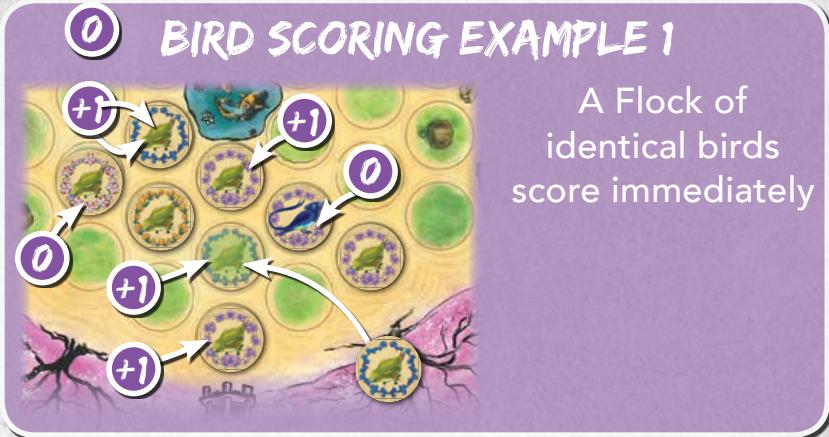
Koi Pond tiles count as a bird of your choice but only on the turn they are played. You'll score points for making a Flock on the turn you place the Koi Pond tile. On all subsequent turns taken by you and your opponents, the Koi Pond tile does not count as a bird and will not be scored as part of a Flock of birds.

3. DRAW A NEW TILE
Draw a new tile from the Cloth bag, if any remain, then pass the bag clockwise to the next player. On your final two turns, no tiles will be left in the bag.
GARDEN TILES
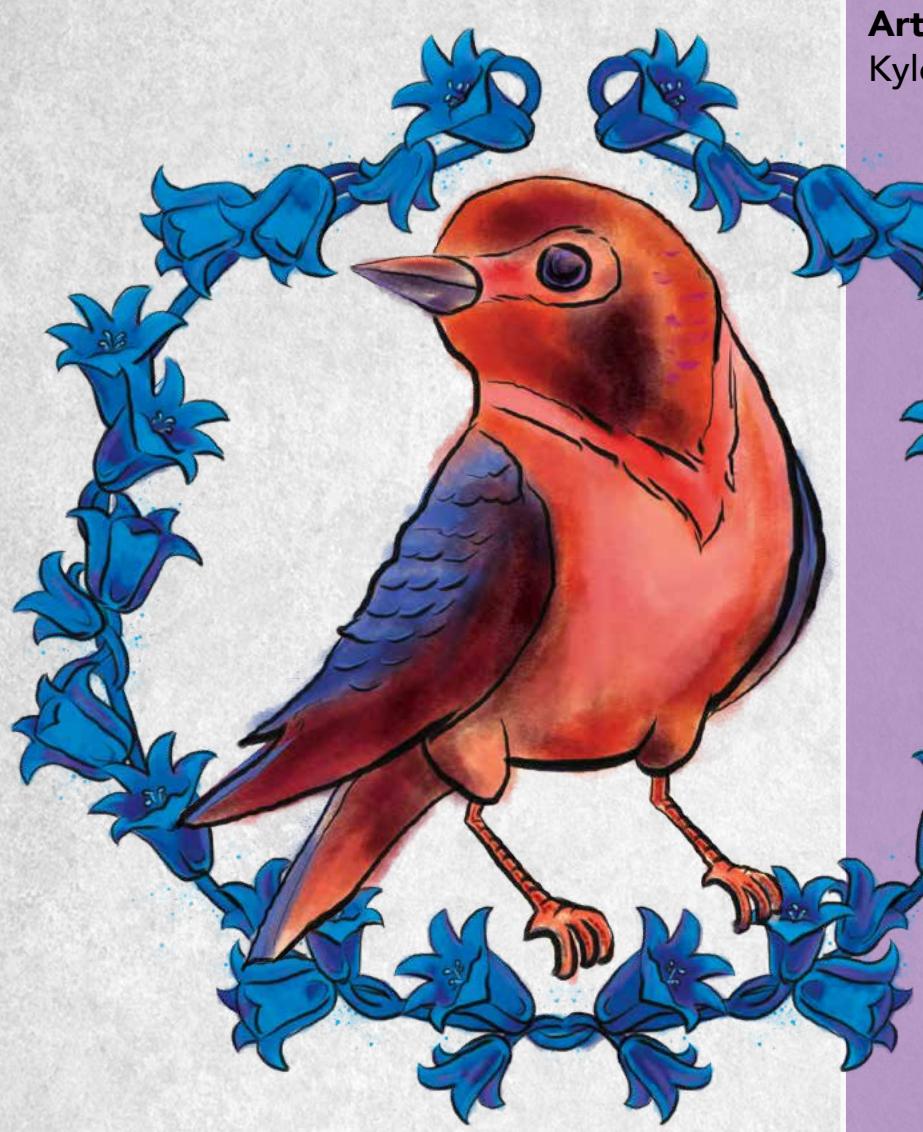
There are two duplicates of each of the 16 different Garden tiles. Each Garden tile features a bird and a flower. There are 4 types of flowers: Primrose (purple), Plumeria (pink), Tulip (orange), and Bluebell (blue); and there are 4 types of birds: Scarlet Tanager (red), Japanese Waxwing (grey), Japanese White Eye (green), and Japanese Paradise Flycatcher (dark blue). Each of the flowers and birds appear on exactly 8 Garden tiles.
NOTE: Tiles in your hand should be kept hidden from all other players until played.
KOI POND TILES
The Koi Pond tile is a special "wild" tile that features a koi fish instead of a bird/flower pair. When you play a Koi Pond tile, it acts as a bird of your choice this turn, and scores as part of a Flock of birds. Once your turn is over, the Koi Pond tile no longer counts as a bird. At the end of the game, each Koi Pond tile acts as a flower of your choice for flower scoring. A Koi Pond tile may be scored as a different flower by different players.
Example: One player may score the tile as an orange Tulip, the second player scores the same tile as a pink Plumeria, and the third player scores it as a purple Primrose.
END OF GAME
When each player has played the last tile from their hand, the Garden board should be completely filled and the game is over. To determine the winner, each player will score for the rows of flowers they have planted, and will add those points to the points earned for Flocks of birds throughout the game.
SCORINGFLOWERS
To score flowers, look down the rows of tiles on the Garden board, from the perspective of your pagoda (see the example on pg. 4).
In each row, identify the largest flower set, which is the largest group of a single type of flower in that row. The flowers in the set do not need to be adjacent to one another in the row. You score only the largest flower set in each row. If there is a tie for largest set in a row, simply score one of the tied sets. Each Koi Pond tile acts as a flower of your choice during flower scoring. A Koi Pond tile may be scored as a different flower by different players.
Sets of flowers score as follows:
1 Flower - 1pt
2 Flowers – 3pts
4 Flowers – 10pts
5 Flowers – 15pts
6 Flowers – 21pts
3 Flowers – 6pts
It's easiest to score flowers one player at a time, starting with the player in last place and proceeding in reverse order. If a player's score exceeds 50 points, continue along the Score Track as normal and add 50 to your final score.
After flower scores have been determined, the player with the most total points is the winner! In the case of a tie, the tied player who was last in the turn order wins.

PINK PLAYER FLOWER SCORING
GREEN PLAYER FLOWER SCORING

| ROW SET POINTS | ||
| 1 | 1 blue (tied) | 1 |
| 2 | 2 Blue (tied) + Koi | 6 |
| 3 | 3 Pink | 6 |
| 4 | 5 Purple | 15 |
| 5 | 2 Pink + Koi | 6 |
| 6 | 2 Blue + Koi | 6 |
| 7 | 2 Yellow + Koi | 6 |
| TOTAL FLOWER POINTS | 46 | |

| ROW SET | POINTS | |
| 1 | 2 Yellow + Koi | 6 |
| 2 | 3 Purple | 6 |
| 3 | 2 Blue (tied) + Koi | 6 |
| 4 | 2 Blue + Koi | 6 |
| 5 | 2 Blue + Koi | 6 |
| 6 | 2 Pink | 3 |
| 7 | 2 Yellow | 3 |
| TOTAL FLOWER POINTS | 36 | |

BLUE PLAIER FLOW SCORING

| ROW SET | POINTS | |
| 1 | 2 Purple + 2 Koi | 10 |
| 2 | 2 Purple | 3 |
| 3 | 2 Pink (tied) + Koi | 6 |
| 4 | 3 Blue + Koi | 10 |
| 5 | 2 Purple (tied) | 3 |
| 6 | 2 Blue (tied) | 3 |
| 7 | 1 Blue (tied) | 1 |
| TOTAL FLOWER POINTS | 36 | |
RULES FOR 4 PLAYERS
When playing with four players, divide up into two teams. Teammates should sit across from one another. Each team will play from the perspectives of one pagoda, so only the pink and blue pagodas will be used. Follow the setup rules as normal, except when placing tiles onto the Garden board. ① Draw 4 tiles and place them on the 2 spaces adjacent to the central koi pond showing flowers, and on the ②2 spaces adjacent to the central koi pond closest to
the green flower. ③ Do not place a tile on the space with flowers in front of the green pagoda or on the space directly across the central koi pond in a straight line from the green pagoda. Follow the setup diagram below. Each player draws 2 tiles, just like in the standard game, and each player takes turns placing tiles. When scoring, players will score for their team, using a single Scoring pawn for the team. Players may not show or otherwise reveal their hands to their teammates. All other rules are as per the standard game.

SOLO RULES
When playing Seikatsu solo, you will lay tiles similar to the regular game, and you will score flower sets from the perspective of your pagoda as usual. However, you will compete against the combined score of the perspectives of the other two pagodas. Choose a difficulty setting: Easy, Medium, or Hard. Depending on the difficulty setting you choose, you may count Flocks of birds for yourself, ignore Flocks or add them to your opponent's score. If your score is higher than the sum of the other two perspectives you win the game.
Set the Garden board up like you would for a 3-player game, placing 3 random Garden tiles on the spaces with flowers adjacent to the koi pond in the center. If the
flowers on these 3 tiles are not all different, discard one of the matching tiles and draw a new one, repeating this process until all three flowers on the board are different. Return all the discarded tiles to the Cloth bag. Draw a Garden tile from the bag, and take all 4 Koi Pond tiles into your hand.
On your turn, choose one of the following:
- Play the Garden tile from your hand adjacent to the last tile that you played.
Note: On your first turn you may play adjacent to any of the 3 tiles on the Garden board.
- Play a Koi Pond tile adjacent to any Garden tile.
After playing a tile, score Flocks of birds. How Flocks score is determined by the level of difficulty you've chosen to play:
• Easy - you score Flocks of birds as in the normal game
• Medium – Ignore scoring for Flocks of birds
• Hard – Score Flocks of birds for your opponent
Continue to take turns, tracking score for you and your opponent with 2 Scoring pawns until you have no more legal moves left. There will very likely be empty spaces remaining on the Garden board. Do not fill in these empty spaces. Score flower sets for your pagoda and add it to your total. Score flower sets for the other two pagodas and add them to your opponent's total. If you score higher than your opponent, you win!
TOURNAMENT MODE
During setup instead of drawing 2 Garden tiles at random from the Cloth bag, distribute the 4 Koi Pond tiles, face-up to each player. In a 2-player game, give each player 2 of these Koi Pond tiles. In a 3-player game, give each player 1 Koi Pond tile and then give the 1 remaining Koi Pond tile to the player last in turn order (i.e., seated to the right of the first player). In a 4-player game, give each player 1 Koi Pond tile.
| FLOWERS | 0 | |||||
| POINTS | 1 | 3 | 6 | 10 | 15 | 21 |
CREDITS
Game Designers: Matt Loomis and Isaac Shalev
Game Design Manager: Daryl Andrews
Art Direction: Jerry Bennington, Kyle Merkley, and Sam Barlin
Artwork: Peter Wocken, Lucas Mendonca (tile inspiration), and Sam Barlin (logo)
Graphic Designer: Peter Wocken Design
Editing: Jerry Bennington, Spencer Reeve, Kyle Merkley, and Dustin Schwartz
Product Development: Jerry Bennington and Daryl Andrews
Product Management: Shauna Monteforte
Special Thanks To: Nate Murray, Ted Adams, Greg Goldstein, Chris Ryall, and Robbie Robbins
© 2017 Idea and Design Works, LLC. All Rights Reserved. IDW Publishing, a division of Idea and Design Works, LLC. 2765 Truxtun Road, San Diego, CA 92106.
下载 Markdown原文为社区整理/出版社公开资料,版权归原作者,仅供个人学习查阅。