
SkatSkat
一句话概览
Skat 是一款已收录于村了吗规则库的桌游,支持 3 人,原名 Skat。
本页内容:一句话概览 · 游戏概述 · 1. 游戏组件 · 2. 游戏设置 · 3. 叫牌阶段 · 4. 换底牌与声明 · 5. 选主与宣言 · 6. 牌的大小顺序 · 7. 打牌阶段 · 8. 计分规则 · 9. 非官方规则 · 关键规则与常见问题 · 常见问题
斯卡特(Skat)规则速览
以下规则速览由本站整理,与官方规则书表述不同,仅供快速上手参考。
游戏概述
斯卡特是流行于德国和西里西亚地区的经典吃墩类纸牌游戏,由国际斯卡特玩家联盟(ISPA)的《国际斯卡特规则》(ISkO)统一规范。三位玩家进行,庄家通过叫牌确定花色与承诺得分,目标是实际获得的局分超过叫分;闲家则合力阻止庄家。核心流程为:发牌→叫牌→定主→打牌→结算。
核心机制: 吃墩、叫牌竞价、底牌交换、宣言系统
1. 游戏组件
| 组件 | 说明 |
|---|---|
| 扑克牌 | 32张(去掉大小王及 2、3、4、5、6) |
| 底牌(Skat) | 每局由牌堆抽出 2 张,面朝下放置于桌面中央 |
可用三种专用牌具:法国扑克(Französisches Blatt)、德国扑克(Deutsches Blatt)、四色比赛牌(Turnierblatt)。四种花色的中文名称依牌具而异——法国/四色牌用梅花(Kreuz)、黑桃(Pik)、红桃(Herz)、方块(Karo),德国牌用橡子(Eichel)、绿叶(Grün)、红心(Herz/Rot)、铃铛(Schellen)。人头牌名称亦有德式叫法:国王 K(König)、皇后 D/O(Dame/Ober)、侍从 B/U(Bube/Unter),下文以法式 ABCD 为准。
2. 游戏设置
2.1 座位确定
每位玩家从牌堆抽取一张牌,点数最大者成为首局发牌者(Geber)。其余玩家按抽牌点数大小依次顺时针入座:
- 先手(Vorhand):坐在发牌者左手边
- 中间手(Mittelhand):坐在先手左手边,也是叫牌的发起者
- 后手(Hinterhand):坐在中间手左手边
下一局的发牌者为当前发牌者的左手边相邻玩家,依序轮转。
2.2 发牌顺序
从发牌者左手边开始顺时针轮流发牌,每人每次 1 张,共三轮:
- 先发 3 张 → 取出 2 张作为底牌(Skat),面朝下置於桌面
- 再发 4 张
- 最后发 3 张
每位玩家最终获得 10 张手牌。
2.3 花色对照
| 花色代号 | 法式/四色牌 | 德国牌 | 分值权重 |
|---|---|---|---|
| ♦ | 方块 Karo | — | 9 |
| ♥ | 红桃 Herz | 红心 Herz/Rot | 10 |
| ♠ | 黑桃 Pik | 绿叶 Grün | 11 |
| ♣ | 梅花 Kreuz | 橡子 Eichel | 12 |
无主(Grand)不选花色,基本分固定 24。空手(Null)计分固定,不计花色倍率。
3. 叫牌阶段
发完牌后进入叫分(Reizen)环节,确定谁做庄家以及本局分值。中间手优先叫牌。
3.1 叫牌流程
- 中间手 选择叫出一个数值或放弃(Pass)
- 若中间手叫了:
- 先手 可以同意或放弃。同意的话,中间手必须叫更高值,否则改弃牌
- 先手若不叫,中间手即已获胜 - 后手 加入叫牌,必须比当前最高值更高才能叫入
- 已叫过的先手 / 中间手仍可再次选择同意或放弃
叫牌终止条件:当两位玩家连续放弃时,第三位即为本局庄家。
3.2 特殊情形
- 中间手直接 Pass → 后手可叫任意分,由先手决定是否同意
- 中间手和后手都 Pass → 先手可叫任意分数成为庄家
- 三人全 Pass → 本局作废,重新洗牌发牌
3.3 庄家的判定
同样数值的叫分,优先级顺序为:先手 > 中间手 > 后手。
庄家的叫分值等于其实际叫出的数字(或在有人同意的情况下,等于被同意的较低数值)。
3.4 叫分值表
| 数值 | 含义 | 计算方式 |
|---|---|---|
| 18 | ◆ 最低分 | 基本分 9 × 倍数 2 |
| 20 | ♥ 最低分 | 基本分 10 × 倍数 2 |
| 22 | ♠ 最低分 | 基本分 11 × 倍数 2 |
| 23 | 空手 Null | 固定分 |
| 24 | ♣ 最低分 | 基本分 12 × 倍数 2 |
| 27–50+ | 各花色递增 | 基本分 × 2~18 倍或递增 |
| 35 | 空手不换牌 Null Hand | 固定分 |
| 46 | 空手明牌 Null Ouvert | 固定分 |
| 59 | 空手不换牌明牌 | 固定分 |
叫牌允许跳级(如直接从 24 叫到 40)。
4. 换底牌与声明
4.1 换底牌(Den Skat nehmen)
庄家可将两张底牌加入手牌,然后从合并后的 12 张手中选出 2 张重新放回桌面作新的底牌。
4.2 不换牌(Hand)
庄家也可以选择不换底牌,称为"Hand"。Hand 状态带来额外优势与风险:
- 达成分可额外获得 +1(Spiel + Hand)
- 失败时需扣除 双倍的局分(而非单倍)
- 只有 Hand 时才有权宣言 Schneider、Schwarz、Offen
无论是否换牌,底牌最后都会归入庄家计分区,并影响王牌分的计算。
4.3 认输(Schenken)
在第一墩牌打出之前,庄家可以随时宣布认输,但输掉的分数不能少于叫分:
| 所叫花色 | 至少亏损额 |
|---|---|
| ♦ 方块 | 叫分 × 6 |
| ♥ 红桃 | 叫分 |
| ♠ 黑桃 | 叫分 × 1.1 |
| ♣ 梅花 | 叫分 × 1.25 |
| 无主 Grand | 叫分 × 1.5 |
- 若按上述公式计算的亏损小于实际局分,则按实际局分扣减
- 空手的认输规则另有规定
5. 选主与宣言
5.1 花色选择
庄家选定一种花色作为主牌花色。该花色的全部 A、10、K、Q/D、9、8、7 均升为主牌,计 7 张。此外所有花色的 J/B(侍从)均为王牌,不受花色限制。
| 花色 | 基本分 | 主牌数量 |
|---|---|---|
| ♦ 方块 | 9 | 7 |
| ♥ 红桃 | 10 | 7 |
| ♠ 黑桃 | 11 | 7 |
| ♣ 梅花 | 12 | 7 |
| 无主 Grand | 24 | 4(仅 4 张侍从) |
5.2 空手(Null)
空手局不设主牌花色,规则完全独立:
| 类型 | 固定分值 |
|---|---|
| 空手 Null | 23 |
| 空手不换牌 Null Hand | 35 |
| 空手明牌 Null Ouvert | 46 |
| 空手不换牌明牌 | 59 |
空手的目标是输掉每一墩。一旦庄家在空手局中赢到任一墩,游戏立即结束,扣除双倍局分。
5.3 附加宣言(仅 Hand 时可宣言)
只在庄家选择不换底牌的情况下,可在选主前追加以下宣言(每种增加对应的达成分):
| 声明 | 达成分加成 | 条件 |
|---|---|---|
| Schneider | +1 | 庄家最终只拿到 29 或以下的牌分(闲家 90+) |
| Schneider angesagt | +1 | 庄家提前宣告自己能拿满牌分(≥90) |
| Schwarz | +1 | 庄家或闲家赢得每一墩 |
| Schwarz angesagt | +1 | 庄家提前宣告自己能连吃全部 10 墩 |
| Offen | +1 | 庄家全程明牌出牌 |
组合规则:
- 庄家若同时达成 Schneider 和 Schwarz,Schneider 也会自动计入(因为 Schwarz 必然包含 Schneider)
- 庄家宣布 Schwarz 并成功时,计 +6 分(Spiel + Hand + Schneider + Schneider angesagt + Schwarz + Schwarz angesagt)
- 庄家宣布 Offen 时,计 +7 分
6. 牌的大小顺序
6.1 花色局(Farbspiel)
| 等级 | 牌张 |
|---|---|
| 1 | ♣J/B(最强王牌) |
| 2 | ♠J/B |
| 3 | ♥J/B |
| 4 | ♦J/B |
| 5 | 主牌花色的 A、10、K、Q/D、9、8、7 |
| 6 | 其余花色的 A > 10 > K > Q/D > 9 > 8 > 7 |
6.2 无主局(Grandspiel)
| 等级 | 牌张 |
|---|---|
| 1 | ♣J/B(最强) |
| 2 | ♠J/B |
| 3 | ♥J/B |
| 4 | ♦J/B |
| 5 | 其他花色的 A > 10 > K > Q/D > 9 > 8 > 7(无主牌花色 A-7) |
6.3 空手局(Nullspiel)
| 等级 | 牌张 |
|---|---|
| 1 | A(最强) |
| 2 | K |
| 3 | Q/D |
| 4 | J/B |
| 5 | 10 |
| 6 | 9 |
| 7 | 8 |
| 8 | 7 |
空手局中牌分权重不变(A=11, 10=10, K=4, Q=3, J=2),只是大小顺序重新排列。
7. 打牌阶段
7.1 出牌顺序
由先手(发牌者左手边的玩家)率先出牌,随后顺时针依次出牌。每轮须出与首引花色相同的牌——跟牌是强制要求。若无该花色,则可自由垫任何牌。
7.2 吃墩
赢下最大一张牌的玩家获得该墩,将该墩 3 张牌面朝下放至自己面前。得墩者接下来率先出牌。
底牌(Skat)在整局结束后才加入庄家的计分区。
8. 计分规则
斯卡的计分体系复杂,局分 = 基本分 × 倍数。倍数由王牌分和达成分决定。
8.1 王牌分(Spitze)
从最强的王牌(♣J/B)开始,连续往下数手牌和底牌中的王牌数量(每张计 1 分)。
- 带(Mit):集齐连续的顶段王牌。例:手中有 ♣J/B + ♠J/B + ♦J/B 但无 ♥J/B → 连续 3 张,带 3
- 缺(Ohne):缺少顶端的王牌。例:仅有 ♥J/B,缺 ♣J/B、♠J/B、♦J/B → 缺 3
- 最少为 1 分,最多为 11 分(花色局中集齐 4 张 J + 7 张同花色牌)
- 无主局没有花色主牌,最多为 4 分(仅 4 张 J)
8.2 达成分(Gewinnstufe)
根据本局情况叠加至王牌分之上,每项 +1:
| 达成分 | 名称 | 触发条件 |
|---|---|---|
| +1 | Spiel | 基础项,每局必计 |
| +1 | Hand | 庄家不换底牌 |
| +1 | Schneider | 庄家或闲家取得 90+ 牌分 |
| +1 | Schneider angesagt | 庄家提前宣言 Schneider |
| +1 | Schwarz | 一方包吃所有 10 墩 |
| +1 | Schwarz angesagt | 庄家提前宣言 Schwarz |
| +1 | Offen | 庄家明牌出牌 |
示例:
- 普通局(双方均正常完成):+1(仅 Spiel)
- Hand 局,闲家 Schwarz:+4(Spiel + Hand + Schneider + Schwarz)
- Hand 局,庄家达成 Schwarz:+6(Spiel + Hand + Schneider + Schneider angesagt + Schwarz + Schwarz angesagt)
- Hand 局,庄家 Offen 且 Schwarz:+7
达成分范围:最少 1,最多 7(明牌状态)。
8.3 倍数与局分
倍数 = 王牌分 + 达成分
局分 = 基本分 × 倍数
局分极值:
- 最小:18 分(带 1 × 2 倍 × ♦ 基本分 9)
- 最大:264 分(带 11 × 11 倍 × 无主基本分 24)
8.4 胜负判定
庄家胜利条件(须同时满足):
- 空手局:庄家输掉每一墩
- 花色局/无主局:庄家获得至少 61 牌分(宣言 Schneider 时至少 90)
- 若宣言 Schwarz 或 Offen:须包吃全部 10 墩
- 局分 > 叫分
| 结果 | 得分变化 |
|---|---|
| 庄家胜 | +局分 |
| 庄家败 | −局分 × 2 |
| 竞赛模式庄家胜 | +局分 + 50 |
| 竞赛模式庄家败 | −局分 − 50(闲家各得 +40) |
注意:局分 < 叫分时,向局分中添加该花色基本分直至 ≥ 叫分。例如叫 48 分、只完成 40 分,则加基本分至 48+ → 仍不足时继续加,直到达标。
9. 非官方规则
9.1 比小(Ramsch / 垃圾牌)
当三家全部 Pass 不叫分时,进入非官方的比小游戏。
- 规则参照无主(Grand),但不设庄家
- 获得最多牌分的玩家失败,扣除一倍牌分
- 若有另一名玩家没吃到任何一墩(Jungfrau),失败者扣分 翻倍
- 最后一墩的庄家将两张底牌计入自己的牌分
- 一人包吃全部 10 墩时,可获 120 分(或部分规则下扣 480 分)
换牌比小(Schieberamsch)
与比小相同,但从第一位玩家起,每位玩家可选择将底牌加入手牌并丢弃两张牌(不可丢弃 J/B)形成新底牌。也可选择不换牌——此时游戏结果翻倍。三人都不换牌时结果为 8 倍。
9.2 加倍(Kontra / Re)
在首张牌打出前,闲家可声明加倍(Kontra):
- 闲家 Kontr → 结果 × 2
- 庄家 Re → 结果 × 4
- 部分版本允许闲家再声明 Hirsch(Subkontra/Supra) → 结果 × 8
9.3 逆序(Sächsische Spitze / 萨克森王牌)
部分非官方规则允许叫"逆序"作为花色选项:
- 大小顺序完全相反:♦J/B > ♥J/B > ♠J/B > ♣J/B
- 其余牌序亦倒转:7 > 8 > 9 > 10 > Q/D > K > A > J
- 基本分为 20
- 牌分权重不变
关键规则与常见问题
易错规则
- 跟牌是强制的:除非手中没有首引花色,否则必须跟同一花色
- 叫牌次序固定:由中间手先发起,不是先手也不是后手
- 同等数值优先权在前:同样数值下,先手优先于中间手,中间手优先于后手
- 底牌始终归庄家计分:无论换不换底牌,Skat 的最终分算庄家的
- 王牌分看连续性:从 ♣J/B 往上必须连续才算"带",断了一张后面的不计;反之"缺"按缺失数量累加
- Schneider 不局限于庄家自己:闲家拿够 90+ 也触发 Schneider 加分
- Schwarz 自动含 Schneider:宣称 Schwarz 并成功后,两者都计分项
- Hand 不换手牌的风险更大:不换底牌失败时扣双倍局分
- 空手赢墩即判负:只要拿到一墩,空手局立刻结束并双倍扣分
- 比小是全场 Pass 时的默认流程,不设庄家、牌分最高者败
- 叫逆序(萨克森王牌)基本分 20,大小顺序完全反转
- 竞赛模式有额外 ±50 分奖励/惩罚,闲家各得 +40
常见问题
-
Q:Skat 用几副牌?
A:一副 32 张(去大王小王 + 2~6),或使用专用的法国/德国/四色 Skat 牌。 -
Q:底牌(Skat)在打牌过程中能看吗?
A:不能。底牌全程面朝下放在桌面上,仅在庄家决定换底牌时才能查看并在之后替换。 -
Q:三人都 Pass 怎么办?
A:进入非官方的比小(Ramsch)环节,牌分最高的玩家输了。 -
Q:王牌分怎么算?比如手上有 ♠J/B 但没有 ♣J/B?
A:缺 1(缺少♣J/B 一张);如果还缺 ♥J/B,则缺 2,以此类推。 -
Q:空手局(Null)需要出主牌吗?
A:不需要。空手局不设主牌,所有玩家只需正常跟牌,目标都是输掉每一墩。 -
Q:叫分允许跳级吗?
A:允许。可以直接从 24 跳到 40,无需按序列逐级叫。 -
Q:Declaration 和喊 Schneider/Schwarz 的关系是什么?
A:二者可以同时使用——选主的同时宣言 Schneider 或 Schwarz,以增加倍数上限。
常见问题(FAQ)
以下 1 条问答中 0 条来自站内玩家的真实提问,其余 1 条为本站整理的常见疑问;答复内容保持原样。
Skat支持几个人玩?
3 人。
去哪查完整规则
想核对具体规则细节、卡牌效果或某个回合的结算方式,可以在村了吗里选中这款游戏后直接提问。
同类桌游
- 卡坦岛德式
- 工业革命:伯明翰德式
- 勃艮第城堡:特别典藏版德式
- 方舟动物园德式
- 卡卡颂抽象
- 瘟疫危机传承:第一季美式
- 阿瑞迪亚:勇踏征途美式
- 重塑宇宙德式
- 幽港迷城美式
- 埃多拉的德鲁伊德式
规则原文(Markdown)
本站收录这款游戏的规则原文 2 个文件,此处内联渲染 2 个,可直接展开阅读或下载。
rules_zh_Skat_26461.md15.1 KB
斯卡特(Skat)
简介
斯卡特(Skat)是一款流行于德国和西里西亚地区的吃墩类游戏。
斯卡特在 1820 年在「斯卡特市」——阿尔腾堡(图林根)被发明,其是基于 Tarock 和 Schafkopf 基础上发展形成的。在 1886 年第一届德国斯卡特集会在阿尔滕堡举行,参加的人数超过了 1000 人。1899 年德国的斯卡特协会在阿尔滕堡正式成立。二次世界大战之后协会于 1953 年迁移到比勒费尔德,2001 年在两德统一 11 年后再次被迁移到了阿尔滕堡。2005 年在比勒费尔德的协会正式宣告结束。2001 年 12 月 1 日国际斯卡特法庭正式成立,正式统一了斯卡特的规范。
目前主流的斯卡特规则为 1999 年建立的国际斯卡特玩家联盟(International Skat Players Association, ISPA)订立的国际斯卡特规则(Internationale Skatordnung, ISkO)。
规则
游戏人数
3人。
游戏牌数
使用一副扑克牌,去掉大小王及2,3,4,5,6,共32张牌。
或者使用 Skat 专用的法国扑克(Französisches Blatt)、德国扑克(Deutsches Blatt)和正式比赛用的四色 Skat 牌(Turnierblatt)。德式的人头牌的名称略有不同, 国王为 K(König)、皇后为 D (Dame) 或 O (Ober)、侍从为 B (Bube) 或 U (Unter)。
花色
Skat 专用的法国扑克(Französisches Blatt)有梅花(Kreuz),黑桃(Pik),红桃(Herz),方块(Karo)四种花色。
| 花色 | |||
| 梅花Kreuz | 黑桃Pik | 红桃Herz | 方块Karo |



Skat 专用的德国扑克(Deutsches Blatt)有橡子(Eichel),绿叶(Grün),红心(Herz / Rot), 铃铛(Schellen)四种花色。
| 花色 | |||
| 橡子Eichel | 绿叶Grün | 红心Herz / Rot | 铃铛Schellen |




正式比赛用的四色 Skat 牌(Turnierblatt)有梅花(Kreuz)黑色,黑桃(Pik)绿色,红桃(Herz)红色,方块(Karo)黄色四种花色。
花色
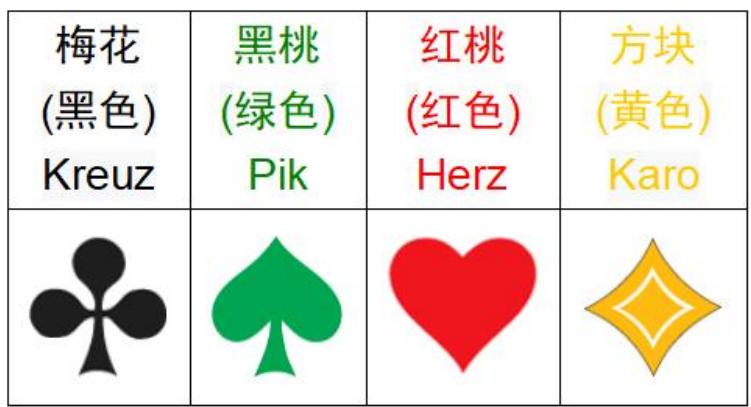
牌面
Skat 专用的法国扑克(Französisches Blatt):

Skat 专用的德国扑克(Deutsches Blatt):
Skat的每张卡牌都有一个分值(Augen,牌分),整副牌一共120分。牌类 A 10 K Q/D/O J/B/U 9-7

正式比赛用的四色 Skat 牌(Turnierblatt):

牌的分值
| 分值 | 11 | 10 | 4 | 3 | 2 | 0 |
牌的比较
花色局(Farbspiel)的大小顺序为:♣J/B>♠J/B>♥J/B>♦J/B> 主牌花色的A>10>K>Q/D>9>8>7>其他花色的A>10>K>Q/D>9>8>7。
无主局(Grandspiel)的大小顺序为:♣J/B>♠J/B>♥J/B>♦J/B>其他花色的 A>10>K>Q/D>9>8>7。
空手局(Nullspiel)的大小顺序为:A>K>Q/D>J/B>10>9>8>7。
座位
玩家各自从牌堆里抽一张牌,抽得点数最大的玩家为发牌者,余下两人则依抽到牌的大小顺序照顺时针坐下。
坐在第一个座位的玩家为第一局的发牌者(Geber),其左手边的玩家为先手(Vorhand),先手左手边的玩家为中间手(Mittelhand),中间手左手边的玩家为后手(Hinterhand)。发牌玩家左手边的玩家为下一局的发牌者。
发牌
从发牌玩家的左手边开始按照顺时针的顺序给每位玩家发 3 张牌,接着将 2 张牌牌面朝下放置在桌上作为底牌(称为 Skat),然后再给每位玩家发 4 张牌,最后再给每位玩家发 3 张牌,这样每位玩家手中都有 10 张牌。
叫牌
发完牌后进入叫分(Reizen)阶段。中间手先叫分或放弃(Pass),对于中间手的叫分,先手可以选择同意或放弃。如果先手同意,中间手必须叫一个更高的数值,否则须放弃。然后,后手加入叫分,后手需要叫一个比当前数值更高的分。如果后手叫分,已经叫分的先手或中间手也可以选择同意或放弃。同意的情况下,后手必须叫一个更高的数值,否则须放弃。
● 如果中间手直接放弃,后手可以叫任意数值的分,由先手来决定是否同意。
● 如果中间手和后手都放弃,先手叫任意数值的分都能成为庄家。
● 总而言之,对于同样大小的叫分,成为庄家的优先顺序为先手>中间手>后手。叫分的数值从小到大为 18(2×♦)、20(2×♥)、22(2×♠)、23(Null)、24(2×♣)、27(3×♦)、30、33、35(Null Hand)、36、40、44、45、46、48、50、……,允许跳级。这些数值均为可以实际达成的数值(9、10、11、12的2倍至18倍、24的2倍至11倍,及空手的23、35、46、59,参考后文局分的计算)。
在另两家都放弃后, 仅剩的一家成为庄家 (Einzelspieler), 其他两家成为闲家 (Mitspieler)。该局的叫分为最后叫的数值, 或, 如果某一家同意后没有其他叫分, 为同意的那个数值。
例如,中间手和先手的对话:18-ok-20-ok-22-ok-23-ok-24-ok-Pass,此时的数值为先手同意的 24。
然后, 后手加入叫分: 27-ok-30-ok-33-ok-35-ok-36-ok-40-ok-44-ok-46-Pass, 此时的数值为后手叫的 46 , 后手成为庄家。
如果三个人都不叫分,则重新洗牌并发牌。
换底牌
庄家可以将两张底牌(Skat)加入手牌,然后从自己的手牌中选两张牌放置于一边作为新的底牌(Skat)。
● 如果庄家选择不换底牌(Skat),则称为 Hand,庄家可以赢得更多的分数(但也有可能会输掉更多的分数),并且获得可以宣言 Schneider、Schwarz 和 Offen 的权利。
- 但是无论是否换牌, 两张底牌 (Skat) 最后都会加入庄家的计分区, 而且会影响庄家的王牌分。
认输
直到第一墩牌结束前,庄家可以选择立刻投降(schenken),但是输掉的分数不能少于叫分。
● 例如庄家叫了 50 分, 则叫◆时至少需输 54 分, ♥时为 50 分, ♠时为 55 分, ♣时为 60 分, 无主时为 72 分。
● 如实际的局分大于叫分,则扣除实际的局分。
叫主
在换完底牌后,庄家必须决定这一局要玩什么。如果庄家没有换过底牌(Skat),也可以选择其中一个对于这一局的附加声明(Spielansage),包括 Schneider、Schwarz 和 Offen。
| 声明 | 分值 | 说明 |
| 方块 ◆ | 9 基本分 | ◆A ◆10 ◆K ◆Q/D ◆9 ◆8 ◆7 成为主牌 |
| 红桃 ♥ | 10 基本分 | ♥A ♥10 ♥K ♥Q/D ♥9 ♥8 ♥7 成为主牌 |
| 黑桃 ♠ | 11 基本分 | ♠A ♠10 ♠K ♠Q/D ♠9 ♠8 ♠7 成为主牌 |
| 梅花 ♣ | 12 基本分 | ♣A ♣10 ♣K ♣Q/D ♣9 ♣8 ♣7 成为主牌 |
| 无主 Grand | 24 基本分 | 仅♣J/B ♠J/B ♥J/B ◆J/B 为主牌 |
| 空手 Null | 23 或 35 | 庄家输掉每一墩 |
| 空手明牌 Null Ouvert | 46 或 59 | 庄家明牌,而且输掉每一墩 |
| Schneider(没换底牌时可选) | +2 达成分 | 庄家至少得到 90 或以上的牌分 |
| 满贯 Schwarz(没换底牌时可选) | +4 达成分 | 庄家赢得每一墩 |
| 明牌 Offen(没换底牌时可选) | +5 达成分 | 庄家明牌,而且赢得每一墩 |
打牌
由发牌者左侧的玩家开始先出牌,然后按顺时针顺序依次出牌,每次出牌只能出一张。轮到其他玩家出牌时则必须出和第一位玩家出的牌花色相同的牌。如果手里没有该花色,则可以出任何一张牌。最后由最大的玩家赢下这一墩(Stich),赢得这一墩的玩家把场上3张牌的牌面朝下放在自己面前,然后由赢得这一墩的玩家开始出牌。
- 花色局(Farbspiel)时,牌的大小为 $\clubsuit J/B > \spadesuit J/B > \heartsuit J/B > \spadesuit J/B >$ 主牌花色的 $A > 10 > K > Q / D > 9 > 8 > 7 >$ 垫牌花色的 $A > 10 > K > Q / D > 9 > 8 > 7 >$ 其余牌。
- 无主局(Grandspiel)时,牌的大小为 $\clubsuit$ J/B> $\spadesuit$ J/B> $\heartsuit$ J/B> $\spadesuit$ J/B>垫牌花色的A>10>K>Q/D>9>8>7>其余牌。
● 空手局(Nullspiel)时,牌的大小为垫牌花色的 A>K>Q/D>J/B>10>9>8>7>其余牌。所有玩家都打完最后一轮牌后,庄家将两张底牌(Skat)加入自己的计分区,并计算这一局所获得的牌分。
计分规则
Skat 最大的特点就是计分系统比较复杂,计算局分(Spielwert)时需要计算基本分和倍数的乘积。
倍数
倍数(Fälle)为王牌分与达成分的总和。
王牌分
王牌分(Spitze)是指从最强的王牌开始连续不断地往下数, 手牌及底牌(Skat)中拥有(Mit)或没有(Ohne)的王牌的数量。每张计1分。
● 如果有♣J/B,则为包含♣J/B的一套连续的王牌的长度。
● 例如有♣J/B ♠J/B ♦J/B,但没有♥J/B时,仅♣J/B ♠J/B为连续的,为带2(Mit 2)。
- 如果没有♣J/B,则为最强的王牌之上缺少的王牌的长度。
● 例如只有♥J/B,但没有其他花色的 J/B 时,缺少♣J/B ♠J/B 这 2 张,为缺 2(Ohne 2)。
王牌分最少为 1 分,最多为 11 分(集齐 4 张 J 和 7 张花色牌)。对于无主(Grand)而言,因为没有花色牌的王牌,所以最多为 4 分。
达成分
达成分(Gewinnstufe)根据游戏的情况加在王牌分之上:
| 达成分 | 名称 | 说明 |
| +1 | Spiel | 底分,每一局都有 |
| +1 | Hand | 庄家没有换过底牌(Skat) |
| +1 | Schneider | 庄家或闲家得到90或以上的牌分 |
| +1 | Schneider angesagt | 庄家宣布自己能得到90或以上的牌分(前提是Hand) |
| +1 | Schwarz | 庄家或闲家赢得每一墩(必然包含Schneider) |
| +1 | Schwarz angesagt | 庄家宣布自己能赢得每一墩(前提是Hand) |
| +1 | Offen | 庄家明牌(并赢得每一墩) |
以上项目组合适用,如庄家不换牌,闲家达成 Schwarz 的情况下,将计算 Spiel、Hand、Schneider、Schwarz,即+4 分。
注意当庄家达成 Schwarz 时,也必将达成 Schneider。因此,如庄家宣布 Schwarz,无论是否成功,将同时计算 Spiel、Hand、Schneider、Schneider angesagt、Schwarz、Schwarz angesagt,即+6 分。
同理,庄家宣言 Offen 时,将计+7 分。
达成分最少为 1 分,最多为 7 分(庄家明牌)。
基本分
基本分(Grundwert)根据不同的花色有不同的数值。
- 方块 ◆=9
- 红桃 ♥=10
- 黑桃 ♠=11
- 梅花♣=12
- 无主(Grand)=24
局分 $=$ 基本分 $\times$ 倍数
局分的范围为最少 18 分(带 1 张王牌加 Spiel 的 2 倍,乘以♦的 9 分),最多为 264 分(带 4 张王牌加 Spiel、Hand、Schneider、Schneider angesagt、Schwarz、Schwarz angesagt、Offen 的 11 倍,乘以无主的 24 分)。
空手的计分规则
空手(Null)有固定的计分规则,不受其他因素影响。
- 空手 (Null) =23
- 空手不换牌(Null Hand)=35
- 空手明牌 (Null Ouvert) =46
- 空手不换牌明牌(Null Ouvert Hand)=59
如果庄家在空手局里赢了一墩,则游戏立即结束并扣除双倍的局分。
胜利判定
庄家想要取得胜利,必须满足以下条件:
-
空手局必须输掉每一墩。
-
花色局或无主局的牌分至少为 61。在声明 Schneider 时, 至少为 90。
-
若声明 Schwarz 或 Offen, 需要赢下每一墩。
-
最终的局分必须大于叫分。
若符合所有条件,庄家胜利并获得局分。若不符合任何一个条件,则庄家失败并失去双倍的局分。
● 在 1999 年之前, 不换牌时只失去单倍的局分。目前此规则可以作为非官方规则被采用。
● 若庄家的局分小于叫分, 则向局分中添加该花色的基本分直到大于等于叫分。如庄家叫 48 分, 但实际只完成了 4 倍的红心 (40 分), 则需要添加基本分至 50 分, 庄家失去 100 分。
其他规则
竞赛规则
在竞赛规则中,对于叫分者而言,胜利时会额外记 50 分,而失败时则会额外记负 50 分,此时两位对手各记 40 分。
比小
比小(Ramsch,垃圾)是 Skat 的一种非官方的附加规则,在三位玩家都不叫分(Pass)时进行。规则与无主相同,但是没有庄家。在比小规则中,获得牌分最高的玩家失败,并失去一倍的牌分。只要有另一名玩家没有吃到任何一墩(Jungfrau),失败的玩家扣除的分数加倍。
赢得最后一墩的玩家将两张底牌(Skat)加入自己的牌分。
- 在比小规则中, 如果有一名玩家吃到全部的 10 墩, 其赢得游戏并获得 120 分。如不承认此规则, 则为失去 480 分。
另有换牌比小(Schieberamsch)的非官方规则,规则和比小相同,但是从第一位玩家开始,每位玩家可以将底牌(Skat)加入手牌,然后从手中弃两张牌(不能弃 J/B)形成新的底牌(Skat)牌。玩家也可以选择不换牌,此时游戏结果翻倍。如果三位玩家都不换牌,游戏结果为 8 倍。
加倍
另一个非官方规则允许闲家在打第一张牌前声明加倍(Kontra)。此时再轮到庄家时,庄家可以选择再加倍(Re)。
● 闲家声明加倍时,游戏结果为 2 倍。庄家再加倍时,游戏结果为 4 倍。
● 部分规则允许闲家在再加倍后声明再再加倍(Hirsch 或 Subkontra 或 Supra),此时游戏结果为 8 倍。
逆序
部分非官方规则允许叫逆序(Sächsische Spitze)作为花色。此规则与无主类似,但是牌序完全相反,为♦J/B>♥J/B>♠J/B>♣J/B>其他花色的(7>8>9>10>Q/D>K>A)。此规则的基本分为20。
- 尽管大小的顺序相反,牌分并不变化。
下载 Markdownrules_en_skat_6819.md34.5 KB
来源类型:纯文本规则(非 PDF 源,早期抓取/转换产物)
说明:原文未改动,仅调整存放位置与文件名;非 PDF 扫描件,无对应原书 PDF
Skat Rulebook | RulesPalRulesPalChatRulebookSkatSkat Rulebook Table of Contents Table of Contents Definitions of Named Persons
International Skat Order (ISkO)
1.0 Overview 1.1 The Game of Skat
1.2 The Deck
2.0 Basic Rules 2.1 Possible Games
2.2 Ranking of the Cards
2.3 Tops
2.4 Basic Values
2.5 Win Levels and Criteria
2.6 Determining the Game Class
3.0 Initiating the Game 3.1 Table Seating
3.2 The Deal
3.3 Bidding
3.4 Parties
3.5 Game Declaration
3.6 Overbid Games
4.0 Execution of the Game 4.1 The Lead
4.2 Following Suit or Trump
4.3 Tricks
4.4 Shortening Up the Game
4.5 Procedures for Rule Violations and Doubtful Cases
Skat Tournament Order (SkWO) 1.0 General
2.0 Legal Questions
3.0 Organizer
4.0 Tournament Plan
5.0 Participant
6.0 Conducting the Tournament 6.1 Seating Order
6.2 Score Sheet
6.3 Scoring
6.4 End of the Tournament
Addresses
Definitions of Named Persons
The following terms, used throughout the Skat Order and the Skat Tournament Order, are defined as follows:
Participant — Every person playing in an event.
Playing Partner — Each of the three to five persons playing at the same table.
Player — Each of the three playing partners involved in the game in question.
Opposition — All of the playing partners at a table except the declarer.
Defender — Each of the two players who play against the declarer.
Declarer — The player who wins the bidding and announces the game to be played.
Kibitzer — A non-playing partner or spectator who is watching a game. Tournament organizers and referees are not considered kibitzers.
International Skat Order (ISkO)
1.0 Overview
1.1 The Game of Skat
1.1.1 Skat is a card game played by three or more players. Each game is played by a declarer against two defenders.
1.1.2 The game originated in Altenburg, Germany, during the second decade of the 19th century. It was developed by combining elements of several older card games.
1.1.3 Two cards dealt face down, called the skat, give the game its name. The word skat is derived from Italian scartare and French écarter, which refer to the laid away cards.
1.1.4 The foremost priority is to promote uniformity in Skat by observing and adhering to all the rules of the Skat Order.
1.1.5 All participants must conduct themselves in a fair, objective and sportsmanlike manner, and not raise specious arguments.
1.2 The Deck
1.2.1 A Skat deck consists of 32 cards in four suits. The suits are ranked, high to low, in the following order: clubs, spades, hearts, and diamonds.
1.2.2 The eight cards in each suit have the following values:
The card values in each suit total 30 points, so the entire deck contains 120 points.
2.0 Basic Rules
2.1 Possible Games
2.1.1 There are two classes of games, those where the declarer picks up the skat, and 'Hand' games where the declarer does not pick up the skat. In both instances there are three types of games which may be played:
Suit games (Clubs, Spades, Hearts, Diamonds)
Grand games
Null games
2.1.2 These are all the possible games:
(Ouvert = Open)
2.2 Ranking of the Cards
2.2.1 In a Suit game, only one suit is trump. The other three suits are ranked below the trump suit and are equal to each other.
2.2.2 The highest trumps in a Suit game are the Jacks, ranked in the same order as the suits. The next seven cards in the trump suit are ranked according to their value.
2.2.3 In a Grand game, only the four Jacks are trump, ranked in the same order as the suits.
2.2.4 In a Null game there is no trump suit or trump cards. The Jacks are just another suit card. The order of the cards changes to: Ace, King, Queen, Jack, Ten, Nine, Eight and Seven.
2.3 Tops
2.3.1 The highest trump cards, in an uninterrupted sequence from the Jack of clubs down, are called "Tops".
2.3.2 If the declarer's cards, including the skat, contain the Jack of clubs, he is said to play "with" a specific number of Tops. If the declarer's cards do not contain the Jack of clubs, then additional absent high trump cards come into consideration, and he is said to play "without" a specific number of Tops.
2.3.3 It is possible to play Suit games "with" or "without" up to eleven Tops (four Jacks and seven trump cards), and Grand games "with" or "without" four Tops (four Jacks).
2.3.4 Suit and Grand games "with" Tops compute at the same win level as games "without" the same number of Tops.
2.4 Basic Values
2.4.1 Every Suit game and Grand game has a constant basic value:
2.4.2 Each Null game has a distinct value:
2.5 Win Levels and Criteria
2.5.1 In Suit and Grand games, the following win levels apply:
2.5.2 The game value of each game is expressed as points. Except for Null games, the game value is calculated based on the class and basic value of the game, combined with the win level and number of Tops credited to the declarer.
2.5.3 The Tops and win levels are added together to yield the sum of the hand. The two game classes thus yield the following possibilities:
The respective sum of the hand is then multiplied by the basic value of the declared game, which yields the specific value of a won game.
2.5.4 The declarer wins a basic game by taking 61 or more points, including points of the two skat cards.
2.5.5 A party who takes 30 or fewer points is designated Schneider.
2.5.6 A party who does not take a single trick is designated Schwarz.
2.5.7 Schneider Announced or Schwarz Announced will be so scored only if the declarer, in a Hand game, actually made the respective announcement in his game declaration. If he wins at a level higher than the announced level, the higher level counts. If the declarer does not achieve the announced level, he loses the game at the announced or higher level. Declarer's negative score is not redoubled (no "own Schneider").
2.5.8 Open (Ouvert) is a valid game level only in open Suit and Grand games. The declarer must win every trick. These games encompass all the multipliers through Schwarz Announced. For example, a game of Clubs Ouvert "with two" would count 9 x 12 = 108 points. A game of Grand Ouvert with four Jacks would score 11 x 24 = 264 points.
2.5.9 The declarer wins a Null game if he does not take a single trick.
2.5.10 If there is a disagreement, the opposition must prove that the declarer lost, and the declarer must prove that he achieved the claimed win level.
2.5.11 Each lost game is entered on the score sheet as a negative number equal to twice the value of the game played.
2.6 Determining the Game Class
2.6.1 The Skat always belongs to the declarer and only he can look at it.
2.6.2 In games where the declarer picks up the skat and looks at it, he must put any two cards of his choice back into the skat. That is, he "buries" them face down on the table. He then declares the game to be played.
2.6.3 In Hand games, the skat remains face down, unseen by any player. The declarer's game declaration is thus based on the ten cards in his hand.
2.6.4 The declarer designates one suit as trump (Suit game) or chooses a Grand game or a Null game.
2.6.5 In an open game, the declarer, before the opening lead, must lay down his ten hand cards face up and clearly visible. If the declarer does not do so, the opposition may request compliance.
The declarer's cards must be arranged by suit and in sequential order. Noncompliance with this rule entitles the opposition to properly arrange the cards.
3.0 Initiating the Game
3.1 Table Seating
3.1.1 The order in which the playing partners sit at a table may be either drawn or predetermined. Playing partner No.1 first chooses a seat. The remaining playing partners then sit in clockwise order beginning at the left of Player No. 1.
3.1.2 A new playing partner may join a table only at the start of a new round. If he does not replace a departed playing partner, he must sit to the right of playing partner No. 1.
3.1.3 A playing partner may leave the game only after a round is complete. Moreover, he must announce this intention before the round begins.
3.2 The Deal
3.2.1 Playing partner No.1 deals the first hand. The playing partner to his right must deal the last game of a round.
3.2.2 The dealer must thoroughly shuffle the cards. The player to his right must then cut the deck one time. The cards are then dealt from the top.
3.2.3 If the cards are shuffled in a riffling (North American) manner, they must be shuffled one more time in the overhand (German) manner before being cut.
3.2.4 Cutting the cards is mandatory. A minimum of four cards must either be lifted up or left on the table.
3.2.5 If a playing partner at a table with more than three playing partners is temporarily absent, the playing partner to his immediate right may cut the cards unless the absentee has expressly reserved his right to do so. If there is an extended absence, a referee determines how to proceed.
3.2.6 Beginning with the playing partner to the left of the dealer, the cards are dealt in the following manner. One round of three cards to each player. Two cards as the skat. Then four cards to each player and finally three cards to each player.
3.2.7 If there are four playing partners at a table, the dealer does not receive any cards. If there are more than four playing partners, the two persons seated to the immediate left of the dealer and the person seated to the immediate right of the dealer are the three players.
3.2.8 If during the deal one or more cards is exposed, regardless of whose fault, the cards must be shuffled, cut and dealt again.
3.2.9 The cards must be dealt in such a manner that their faces cannot be seen by any player. To avoid unnecessary disputes, players should pick up their cards only after a valid deal is completed.
3.2.10 Each player must pick up and hold his cards so that they are not visible to the other players. A player is not permitted to look into another player's cards or to receive information about them.
3.2.11 Each player must count his cards after the deal and, before the end of the bidding, report any discrepancy in the distribution of the cards.
3.2.12 If the cards are misdealt resulting in an unequal distribution, they may be redealt only if the error is detected before the end of the bidding or if both parties (declarer and opposition) have an incorrect number of cards.
3.2.13 Any objection relating to the shuffling, cutting or dealing of the cards must be made before the person objecting picks up his cards.
3.2.14 If a playing partner deals a hand out of turn, the game is void, even if it was completed or was the last game in the round. A round is completed when the first game of the next round has been declared. The last round in a series is completed when the score sheet is signed.
3.2.15 If, within a round, there has been a deal out of turn, all games must be replayed from the point where the unauthorized deal occurred.
3.2.16 If games were dealt out of turn in previous rounds, all completed games in subsequent rounds remain valid. However, the round in progress must be replayed, beginning with a deal by playing partner No. 1.
3.2.17 A player who looks at or exposes the skat during or after a valid deal is barred from bidding.
3.2.18 A player who during or after a valid deal picks up the skat with his cards, is barred from bidding. In such cases, the offending player must shuffle his 12 hand cards, from which the dealer shall draw two cards as the new skat. The original skat may be restored only if all three players can unequivocally identify it.
3.2.19 After every valid deal there must be a valid game. A passed in game is deemed a valid game.
3.3 Bidding
3.3.1 After the deal, the declarer is determined through a bidding process, that is, the offering and acceptance (holding) of game values. The minimum bid is 18 and the maximum bid is 264.
3.3.2 The bidding starts by the player to the left of the dealer (forehand) responding to the bid of the player to his left (middlehand). Middlehand and the third player (rearhand) must offer valid game values but may skip values. To avoid misunderstandings, bids should be in numbers only.
3.3.3 If forehand does not want to play a game at the same or higher value than the value offered by middlehand, he must pass. Rearhand then bids to middlehand in the same manner or passes.
3.3.4 If middlehand does not want to play, or if his highest offer is accepted (held) by forehand, he must pass. Rearhand may then continue bidding to forehand or pass.
3.3.5 The player who offers or accepts (holds) the highest bid always becomes the declarer.
3.3.6 If middlehand and rearhand both pass, forehand may pick up the skat without announcing a bid or may declare a Hand game. Forehand is then required to play a game. If forehand has no bid of 18, he may not pass until middlehand bids. If middlehand passes, forehand may not pass until rearhand has either bid or passed.
3.3.7 If all three players pass, the hand is passed in and the next playing partner deals. Under no circumstances may the same playing partner deal two hands in a row after a valid deal.
3.3.8 The announcement of a pass, bid offer or bid acceptance (holding) is irrevocable.
3.3.9 If, before the end of the bidding, a player picks up or looks at the skat or looks at the cards of another player, he is barred from further bidding. In addition, the other two players are no longer bound by their bids. They can pass or restart the bidding. This rule also applies if the dealer or another playing partner looks at the skat before the bidding has ended. A player who passes before being offered a bid may not re-enter the bidding.
3.3.10 If, after completion of the bidding, only the defenders have an incorrect number of cards, the declarer is deemed to have won a game with a value based on the last bid and the number of present or absent Tops. If the declarer elects to play a game, the number of cards must first be corrected. If only the declarer has an incorrect number of cards, he is deemed to have lost the game.
3.3.11 If, after completion of the bidding, it is noticed that the skat was exposed prior to the completion of bidding, then the declarer has the option of playing or passing.
3.4 Parties
3.4.1 The three playing partners are divided into two parties. The declarer is one party. The other party, called the opposition, is comprised of the two defenders and any other playing partners.
3.4.2 Each opposition member bears equal responsibility for the success or failure of the defenders. Therefore, all players are also jointly responsible for the consequences of rule violations or concession of a game by any of its members.
3.4.3 A playing partner who is not involved in the current game may look at the hand of only one player. However, this is not a right but a privilege.
3.5 Game Declaration
3.5.1 The successful bidder (declarer) must declare a valid game. The declaration must be stated without pauses and must be complete. Hand and Open (Ouvert) games must also be so declared in order for the declarer to receive the enhanced game value. A declaration is irrevocable.
3.5.2 The declarer may declare any game that has a value equal to or higher than the highest value bid.
3.5.3 Following a valid deal, the declarer is deemed to have lost if he declares a game while holding more or fewer than ten cards in his hand. The loss is computed at the basic level without counting Schneider or Schwarz. A card led by the declarer before declaring a game counts as a hand card. The same applies to cards laid down by the declarer in Open (Ouvert) games.
3.5.4 After declaring a valid game, the declarer may not look at the skat or change its contents. Violation of this rule results in a lost game at the basic level without counting Schneider or Schwarz.
3.5.5 After picking up the skat, the announcement of Hand games and win levels is not allowed. Only the announced game counts for scoring (see 2.1.1 above).
3.5.6 If the declarer after picking up the skat can no longer play the intended game because of the bid and the win level, he may declare a game that satisfies his bid and concede a loss.
3.6 Overbid Games
3.6.1 An overbid game where the skat has been picked up must be calculated using multipliers sufficient to cover the bid. On the score sheet, a game in which the game value is unachievable should be marked as "overbid".
3.6.2 A declaration of a no longer playable Null game results in a loss of a Suit or Grand game at a value commensurate with the last bid and the number of present or absent Tops.
3.6.3 If the declarer cannot achieve his bid in a Hand game because there was a Top card in the skat, the declarer has overbid and loses the game even if he takes more than 60 points. The score must be calculated with sufficient multipliers to cover the bid.
3.6.4 A game which, before the first trick is played, is theoretically impossible to win, cannot be converted to a win due to a rule violation by a defender.
4.0 Execution of the Game
4.1 The Lead
4.1.1 The game begins with the game declaration. After the declaration, forehand makes the opening lead. Thereafter, the player who takes the trick leads to the next trick. If the declarer leads out of turn before declaring a game, he is deemed to have lost a game with a value based on the last bid and the present or absent Tops.
4.1.2 A led or played card cannot be taken back. A card is considered led or played if it lies completely on the table. In Open (Ouvert) games, the announcement of a card to be led constitutes a lead of that card. If play continues after violation of this rule, appropriate corrections must be made.
4.1.3 Playing out of turn (or other rule violations) ends the game. The game is won or lost at this point based on the accumulated points up to the time of the violation.
4.1.4 If a player plays out of turn or otherwise violates a rule before the game is decided, the offending party loses the game at the basic level (not Schneider or Schwarz). A higher score must be based on proof that, absent the violation, it would with certainty have been achieved.
4.1.5 If the declarer is forced to achieve a higher multiplier to win the game and a defender leads out of turn or otherwise violates a rule, the declarer is deemed to have won the game at the enhanced value. This exception applies unless the defenders have already taken sufficient points to render the enhanced value impossible to achieve.
4.1.6 An offending party must continue playing if the other party demands it. The rule violation is then deemed waived.
4.1.7 If a lead out of turn is not noticed until after the trick is complete, the lead is deemed to have been properly made.
4.1.8 An opposition member is not allowed to prevent a defender from leading out of turn or violating another rule. Violations of this rule are governed by rules 4.1.3 to 4.1.6.
4.1.9 If a defender accidently plays two or more visible cards or drops a visible card or improperly exposes a card, the game is terminated in accordance with rules 4.1.3 to 4.1.6.
4.1.10 A lead out of turn on the last trick is irrelevant.
4.2 Following Suit or Trump
4.2.1 After a lead, the player to the leader's left plays a card, then the third player. If possible, the card played must be of the same suit or same designated trump.
4.2.2 If a player does not have a card in the suit led, he is entitled to play a trump card or a card of a different suit. If a trump card is led and a player has no trump card, he may play any card.
4.2.3 If a player is able to follow a suit or trump lead but fails to do so, the game is terminated in accordance with 4.1.3 to 4.1.6. However, the non-offending party may demand that the misplay be corrected and that the game continue.
4.2.4 If a failure to follow suit or trump is not noticed until later in the game or after the game is over, play is stopped and reviewed retroactively from the point of the violation, and is scored according to 4.1.3 to 4.1.5.
4.2.5 The right to retroactively assert a failure to follow suit or trump expires when both parties have thrown in their cards.
4.2.6 If, after a valid deal, it is discovered during the course of play that a player has too many or too few cards because he "buried" incorrectly, played two cards at once or did not play at all to a previous trick, or for some other reason ended up with an incorrect number of cards, the game ends in favor of the party with the correct number of cards, and is scored in accordance with 4.1.3 to 4.1.6.
4.2.7 A defender is not allowed to prematurely play a card or to separate a card from the others in his hand in a manner that may influence the outcome of a game. Rules 4.1.3 to 4.1.6 apply.
4.2.8 If during the game any playing partner looks at the skat or exposes it, the game is immediately terminated. The outcome of the game is determined by rules 4.1.3 to 4.1.6.
4.2.9 All playing partners must refrain from comments and gestures which could reveal their cards or influence the outcome of the game. Violations are governed by rules 4.1.3 to 4.1.6.
4.3 Tricks
4.3.1 A trick consists of one card each from forehand, middlehand and rearhand. A trick is complete as soon as the third card lies on the table.
4.3.2 Assuming valid play, a trick belongs to the player who:
Played the highest ranking card in the suit led, as long as the trick contains no trump card, or
Played the highest ranking trump card in the trick.
4.3.3 Tricks must be gathered in in such a manner that the last card played is visible to every player. A player who has not yet led a card or played a card on the next trick is entitled, upon request, to see the last trick again.
4.3.4 Each trick must be gathered in, stacked in the order taken, and maintained face down until the game is over, in such a manner that the game can be reconstructed. The owner of a trick may lead a card for the next trick before gathering his trick.
4.3.5 If the declarer does not gather in one or more successive tricks, he is deemed to be indicating that he will take all remaining tricks. If he fails to do so, the game is deemed to have ended, retroactive to the last trick properly gathered in by the declarer. Rules 4.1.3 to 4.1.6 apply.
4.3.6 Looking at, counting or exposing face down tricks by any playing partner terminates the game according to rules 4.1.3 to 4.1.6 (but see 4.4.3).
4.3.7 No playing partner is allowed to count trumps or points out loud (see 4.2.9).
4.4 Shortening Up the Game
4.4.1 In general, every game should be played to the end. However, the declarer is entitled to concede his declared game as lost, as long as he still holds at least nine cards and his hand correctly reflects his bid and the number of present or absent Tops.
4.4.2 With fewer than nine cards in his hand, the declarer may concede the game only with the permission of at least one opposition player (joint liability).
4.4.3 A game is immediately terminated if one opposition player gives up. Rules 4.1.3 to 4.1.6 apply (joint liability).
4.4.4 The declarer, by laying his cards face up on the table or otherwise exposing them, even to only one defender, is deemed to be proposing to shorten up the game. If the outcome of the game is not yet decided, and if both defenders consent to the shortening, then the declarer has won his declared game. A higher win level can be calculated only if the declarer claims it at the time he proposes to shorten up the game. If a defender does not consent to the shortening, then play of the game shall be resumed with the declarer's cards exposed, and shall be scored according to the outcome.
4.4.5 A defender may reveal his cards only if the declarer cannot take another trick, regardless of how the game is played. Otherwise, the remaining tricks belong to the declarer. Rules 4.1.3 to 4.1.6 apply accordingly.
4.4.6 If a player throws in his cards, the game is ended and that player's party may count only the tricks and points taken up to that point. Win levels will be calculated only if they cannot be theoretically excluded.
4.5 Procedures for Rule Violations and Doubtful Cases
4.5.1 Violations of the International Skat Order and the Tournament Game Order should be immediately reported by a participant.
4.5.2 All disputes and cases of doubt are decided by the tournament director or a duly appointed referee, based on the International Skat Order.
4.5.3 Objections to a referee's decision must be made before the next series starts, to the arbitration board, which consists of at least three members, announced before the event starts. After the last series in a tournament, an objection must be made within 15 minutes after the tournament has ended, and resolved by an arbitration board before the tournament results are announced.
4.5.4 Objections to the decision of the arbitration board may be sent, in writing, to the International Skat Court, which decides only technical rule questions. The settlement of disputes before public courts remains unaffected.
Skat Tournament Order (SkWO)
1.0 General
1.1 Tournaments are events organized by clubs or individuals. Their purpose is to bring together all players for an enjoyable game of Skat.
1.2 Tournaments provide a means of assuring that Skat is played according to the uniform rules of the Skat Order and does not become tainted by unorthodox play or customs.
1.3 All differences in age and occupation are set aside at the Skat table. The friendly but competitive atmosphere of the tournament as a whole and at each table, as well as the changing alliances during the play of the game, all serve to unite the participants. The satisfaction of executing a difficult play and the recognition of one's own and others' analytical or judgmental errors trigger gratifying emotions; however, civility then tempers their expression. In this manner, Skat tournaments promote and strengthen character and personality, and convert community spirit into a reality.
1.4 Skat tournaments may be open either to all Skat players or restricted to a limited constituency (clubs, leagues, qualifying contests).
1.5 Depending on the terms of the tournament advertisement, tournaments are played for individual prestige, money, trophies or merchandise.
1.6 The Skat Order and the Skat Tournament Order govern the course of a tournament.
2.0 Legal Questions
2.1 Skat tournaments are subject to public laws.
2.2 The tournament plan governs the rights and duties of the participants. This constitutes a quasi-contract which is binding on both the organizer and participants.
2.3 The organizer, together with the appointed tournament management, is responsible for conducting the tournament.
3.0 Organizer
3.1 The organizer must be identified as such in the tournament advertisement and the tournament plan.
3.2 The organizer may delegate the running of the tournament to management. Referees may be appointed to settle disputes. Such persons should be sufficiently familiar with the rules of the game, in particular with the Skat Order; be capable of making swift, fair and correct decisions; possess a sense of responsibility; and be considered trustworthy in every respect.
3.3 The organizer and management are responsible for strict compliance with the Skat Order. They establish the conditions of play and prize schedules, manage and supervise the overall event, and upon completion of the event are obligated to provide an accounting. The organizer alone is responsible for distribution of prizes.
3.4 If a tournament must be prematurely terminated or proves to be unworkable, whether due to too few participants or for some other reason, the organizer and management remain obligated to conduct an abbreviated tournament. They must either refund all entry fees or award prizes on a percentage basis.
4.0 Tournament Plan
4.1 The tournament plan should be concise but comprehensive. It must comply with the Skat Order, be precise, clear and free of any contradictions.
4.2 The following information must be included:
a) Organizer, b) Entry Fees and lost game fees, c) Scope of the tournament and number of series, d) Number of players at a table, e) Use of funds and expenditures, f) Organizer's right to bar or expel participants, g) Referees and Arbitration Board, h) Reference to the International Skat Order.
4.3 The tournament plan must be posted during the tournament and available at all times to all participants.
4.4 Playing partners must use the new deck of cards provided to each table. After a session is played the scorekeeper is allowed to keep the used deck of cards for his work, if no other arrangements are made by the organizer.
4.5 The playing partner in seat No. 1 usually keeps score. If all agree, a different playing partner may keep score.
5.0 Participant
5.1 The right to participate is established by acquiring a non-transferable start card or by being named in the list of participants. Payment of the entry fee commits both parties.
5.2 Every participant is required to strictly abide by the Skat Order and the provisions of the tournament plan. He must familiarize himself with the tournament provisions and conduct himself in a manner which does not cause disruption.
5.3 Upon verifiable proof of a deliberate violation of the rules, the organizer and management have the right to summarily expel any participant from the tournament. All participation fees are forfeited. A request to re-register may be denied. The organizer further has the right to bar anyone from participating in a tournament, without stating the grounds.
5.4 All participants are required to play each series to its end. They may not allow another player to take their place in a game. If a participant acrimoniously leaves a game, or due to an emergency, management may designate another person to rightfully and responsibly take the place of the prematurely departing person.
5.5 Organizers and members of management are allowed to participate in the tournament on the same basis as all other participants, as long as supervision of the tournament is assured.
6.0 Conducting the Tournament
6.1 Seating Order
6.1.1 Seating at tables is set by the tournament management or by drawing table seating cards. Every table has four seats. There can at most be three tables with three players.
6.1.2 A participant who changes his assigned table seat without permission of the tournament management is subject to expulsion.
6.1.3 The assigned table seat must be retained until the end of a series.
6.1.4 A table seating card is valid only for the series for which it was drawn or assigned.
6.1.5 Only players with the correct table seating cards are permitted at the table. "Kibitzing" is not permitted.
6.2 Score Sheet
6.2.1 The playing partner in seat No. 1 is normally the scorekeeper. Under exceptional circumstances and with permission of the tournament management, a different playing partner may keep score. Every playing partner is responsible for the correct marking of the score sheet, which must be available at all times for inspection. The dealer should always check to see that the previous game was correctly scored.
6.2.2 Immediately upon completion of every game, the score sheet should be marked with the basic game value, Tops and win level, or with the value for a Null game, as well as the score for winning or losing the game.
6.2.3 In order to avoid unnecessary disputes, the declarer should articulate the game he just played. The scores should be immediately added up or subtracted, so that the current score is recognizable at all times.
6.2.4 Errors on the score sheet may be corrected only upon agreement of all playing partners up until the end of the current series.
6.2.5 At the end of the tournament, all score sheets must be signed by all players before they are returned to the tournament management. Only then can a prize be claimed by players.
6.2.6 The tournament management has the right to:
a) Check the score sheet at any time b) Declare as invalid a deficient, illegible or incomplete score sheet.
6.2.7 Errors on score sheets may be corrected by management by entering the lowest possible point value. If all playing partners agree, missing or corrected scores may belatedly be entered on the score sheet.
6.3 Scoring
6.3.1 The performance of participants is scored as follows:
Game points achieved and number of games played are combined on the score sheet. For each won game, the player receives a bonus of 50 points. For each lost game, the player loses 50 points. At a table with three playing partners, each playing partner is awarded 40 bonus points for each lost game of the other playing partners. At a table with four playing partners, each playing partner is awarded 30 bonus points for each lost game of the other playing partners. A playing partner's game points, plus the bonus points for games played, plus the bonus points for others' lost games yields his final score.
Scoring Formula
Game points for the player
Number of won games minus the player's lost games x 50.
Number of playing partners' lost games x 30 (40 at a table of 3 players).
In case of a tie, the player with the most won games prevails. If there is still a tie, the player with the fewest number of losses prevails. Should the scores still be tied, lots are drawn or a coin tossed to determine the winner.
Scoring example for a table of 4 players
Player A: 437 game points, 12 won games, 3 lost games. Players B, C, D together lost a total of 6 games.
Calculating the total score for player A:
6.3.2 This tournament scoring system supersedes the former system, which was based solely on game points. Under the current system, winning high-scoring games is not the sole deciding factor. Rather, winning numerous smaller games is also rightly considered and can influence the outcome. Moreover, the bonus points for others' lost games reward good defensive play. They also compensate a player who may have lost opportunities to play games due to overbidding by other players.
6.4 End of the Tournament
6.4.1 Participants who have finished playing are not allowed to kibitz at tables where games are still in progress.
6.4.2 After the results of the tournament are compiled, the prizes are awarded. If a prize has to be mailed or delivered, the recipient pays the expenses.
6.4.3 The organizer must retain all score sheets, start cards and any other tournament documents for a period of 6 months.
Addresses
Deutscher Skatverband e.V. Markt 10 D-04600 Altenburg Germany Established: 1899
International Skat Players Association e.V. Weststraße 11 D-26931 Elsfleth Germany Established: 1976
下载 Markdown原文为社区整理/出版社公开资料,版权归原作者,仅供个人学习查阅。