
Star Wars Customizable Card GameStar Wars Customizable Card Game
一句话概览
Star Wars Customizable Card Game 是一款已收录于村了吗规则库的桌游,支持 2 人,原名 Star Wars Customizable Card Game。
本页内容:一句话概览 · 常见问题
这游戏怎么玩
- 本站已收录这款游戏的规则资料,可以在对话里直接提问规则细节。
常见问题(FAQ)
以下 1 条问答中 0 条来自站内玩家的真实提问,其余 1 条为本站整理的常见疑问;答复内容保持原样。
Star Wars Customizable Card Game支持几个人玩?
2 人。
去哪查完整规则
想核对具体规则细节、卡牌效果或某个回合的结算方式,可以在村了吗里选中这款游戏后直接提问。
同类桌游
- 卡坦岛德式
- 工业革命:伯明翰德式
- 勃艮第城堡:特别典藏版德式
- 方舟动物园德式
- 卡卡颂抽象
- 瘟疫危机传承:第一季美式
- 阿瑞迪亚:勇踏征途美式
- 重塑宇宙德式
- 幽港迷城美式
- 埃多拉的德鲁伊德式
规则原文(Markdown)
本站收录这款游戏的规则原文 1 个文件,此处内联渲染 1 个,可直接展开阅读或下载。
SWCCG Rules 3.0.md714.0 KB
Advanced Rulebook

Table of Contents
Chapter 1 - The Basics - Force, Actions,
States, etc. 1-1
Section A. Force, Decks, Piles, & The Table ...........1-1
Life Force. . 1-1
Reserve Deck. . 1-1
Force Pile . 1-1
Used Pile . 1-1
Lost Pile. . 1-1
Hand. . 1-1
Re-circulating. . 1-1
Stack.. . 1-1
Counting A Deck, Pile, Or Stack. . 1-1
Looking At A Deck, Pile, Or Stack . 1-1
Shuffle & Reshuffle. . 1-1
Empty Hand. . 1-2
Empty Deck Or Pile . 1-2
Losing Force. . 1-2
Losing Force - From X. . 1-2
Retrieve . . 1-2
Leaves Table . 1-2
On Table. . 1-2
Exchange . 1-2
Section B. Taking Cards From A Deck/Pile . ...1-3
"With X in title/lore/game text" .1-3
Taking Cards From A Deck Or Pile - Example 1 .. 1-3
Deploying/Playing from a Deck or Pile ..1-3
Taking Cards From A Deck Or Pile - Example 2 . .. 1-3
Taking Cards From A Deck Or Pile - Example 3 .. 1-3
Section C. Actions. ..1-4
Action Within An Action .1-4
Types of Actions .1-4
Optional Actions . 1-4
Just Actions . 1-5
Automatic Actions. . 1-5
Mandatory Actions . 1-5
Steps Of An Action - 1: Initiation. ..1-5
Meeting Conditions. . 1-5
Choosing Targets . 1-5
Paying Costs . 1-6
Steps Of An Action - 2: Responses. ..1-6
Steps Of An Action - 3: Result. .1-6
Actions - At Any Time . 1-6
Actions - Duration. . 1-6
Actions - For Each/For Every . 1-6
Actions - Immune. . 1-6
Actions - Just Deployed, Just Played . 1-6
Actions - Just Lost . . 1-7
The Stack. .1-7
Actions - Example 1 - Deploying A Card . 1-8
Actions - Example 2 - Triggered Automatic Action .. 1-9
Actions - Time To Respond . 1-9
Actions - Example 3 - Just Actions And Backing Up . 1-9
Actions - Example 4 - Competing Just Actions. .. 1-9
Actions - Example 5 - Battle, Just Actions And “Sense/Alter War . 1-10
Actions - Example 6 - Turn Progression. . 1-10
Actions - Example 7 - Automatic vs. Just Actions. . 1-11
Actions - Example 8 - Mandatory Actions. . 1-11
Actions - Example 9 - Simultaneous Actions . 1-11
Implied Target Rule 1-12
Canceling And Suspending 1-13
Canceling Game Text. .1-13
Suspending Cards .1-13
Conditions Versus Costs 1-13
Never 1-13
Never - Location Restrictions .1-13
The One Rule 1-14
Once Per Game.. .1-14
The One Rule - Examples . 1-14
Section D. Card States - Active, Inactive, Supporting,
Unit of Force, Out of Play . 1-15
One State Only - An Example . .. 1-15
Active . 1-15
Inactive. 1-15
Active Cards - Example .. . 1-15
Inactive Cards - Example 1. 1-15
Inactive Cards - Example 2. 1-16
Inactive Cards - Example 3. . 1-16
Unit of Force 1-16
Supporting. 1-16
Unit of Force - Example 1 1-16
Unit of Force - Example 2 1-16
Unit of Force - Example 3 . . 1-16
Supporting Cards - Example 1. 1-16
Supporting Cards - Example 2. 1-17
Supporting Cards - Example 3. . 1-17
Out of Play 1-17
Out of Play - Example 1. 1-17
Out of Play - Example 2.. . 1-17
Stacked Cards And Card State 1-17
Stacked Cards And Card State - Example 1-17
Global Effects And Card State 1-18
Global Effects And Card State - Example 1 . 1-18
Global Effects And Card State - Example 2 1-18
Global Effects And Card State - Example 3 1-18
Global Effects And Card State - Example 4 1-18
Section E. Values & Numbers .. 1-19
Modifiers 1-19
Automatic Modifiers ..1-19
Unmodifiable Values .1-19
Reset.. .1-19
Reset - Competing Resets. ...1-19
Reduce. .1-19
Cumulatively .1-19
Duration (How Long a Change Lasts) .1-19
Modifying/Resetting Totals ..1-19
Free. 1-20
Free - Examples 1-20
Up to 1-20
Even Number And Zero 1-20
Negative Numbers/Cannot Fall Below Zero/Minimum
Zero. 1-20
Values & Numbers - Undefined Values 1-20
No Ability, No Hyperdrive, Etc. ..1-20
Card With Ability ..1-20
Rounding. ..1-20
Section F. Drawing Destiny 1-21
Failed Destiny Draws. 1-21
Multiple Destiny Values 1-21
Substituted Destinies 1-22
Examples of substituted destinies. . 1-22
Examples of substituted destinies and modifying totals . 1-22
Chapter 2 - Starting The Game & Turns ....2-1
Starting The Game. . 2-1
Starting The Game - General Rules . 2-1
Starting Hand. 2-2
Starting Interrupts/Objectives - Mandatory Actions .. 2-2
Starting Location 2-2
Starting The Game - Example 1 . 2-2
Starting The Game - Example 2 . 2-3
Starting The Game - Example 3 . 2-3
Starting The Game - Example 4 . 2-3
Starting The Game - Example 5 . . 2-4
Turn.. . 2-5
Chapter 3 - Activation Phase & Activating 3-1
Activate Phase.. . 3-1
Activating Force 3-1
Activating Force - Example. .. 3-1
Force Icons 3-2
Force Generation. 3-2
Force Generation Bonus ..3-2
Force Generation Modifier ..3-2
Force drains vs. Force generation .3-2
Force Drains vs. Force Generation - Example . 3-2
Force Icons - Example .. 3-2
Start of Turn....... .3-3
Start of Turn - Simple Example . . 3-3
Start of Turn - More Complex Example .. 3-3
Chapter 4 - Control Phase, Presence, &
Force Draining 4-1
Control Phase.... ..4-1
Force Drain ..... ..4-1
Instead Of Force Draining . 4-1
May Force Drain. . 4-1
Force Drain Modifier . 4-1
Force Drain Bonus. . 4-1
Force Drains May Not Be Modified Or Canceled By Opponent ....4-1
"Opponent's Force drain modifiers" . 4-2
Force Drains And Modifiers Example 1 . 4-2
Force Drains And Modifiers Example 2 . 4-2
Force Drains And Canceling Example . 4-2
Presence .4-3
Present ... .. 4-3
Present versus Present With . 4-3
Control Of A Location . 4-3
Unoccupied. . 4-3
Occupy . 4-3
Here. . 4-3
System Location. . 4-3
Prepositions . 4-3
Present, Presence And Prepositions. . 4-3
Alone/Lone . 4-4
All Cards/All Characters . 4-4
Present, Presence And Prepositions - A Simple Example. . 4-4
Present, Presence And Prepositions - A More Detailed Example . 4-4
Present versus Present With - Example 1 . 4-5
Present versus Present With - Example 2. . 4-5
Force Draining And Presence - A Set Of Complex Examples . 4-6
Chapter 5 - Deploy Phase, Deploying &
Personas. . 5-1
Deploy Phase. ..5-1
Deploy .5-1
Deploying Cards On Vehicles And Starships .. 5-1
Deploys Like A Starfighter. . 5-1
Deployment Restrictions. .5-1
Location Deployment Restrictions . 5-1
Rules Deployment Restrictions . 5-1
Objective Deployment Restrictions . 5-1
Never Deploys Or Moves . 5-2
Simultaneous Deployment. . 5-2
Deployment - Examples. .. 5-2
Persona .5-3
Persona Replacement. . 5-3
Persona Replacement - Non-unique Persona . 5-3
Persona - Converting Characters . 5-4
Persona Replacement - Examples . 5-4
Persona - Example .. 5-4
Multiple Personas Example. .. 5-4
Persona And Simultaneous Deployment - Example . 5-4
Converting Characters - Examples . 5-4
Persona - Crossing Over. . 5-5
Crossing Over Examples . 5-5
Chapter 6 - Battle Phase, Battles, & Attacks6-
Battle Phase. ..6-1
Battle ..6-1
Initiate the battle ..6-1
Weapons Segment . ..6-1
Weapons Segment - Firing Weapons .. 6-1
Weapons Segment - Other Actions. .. 6-2
Power Segment .6-2
Winner And Loser. .. 6-2
Damage Segment. .6-3
Damage Segment - Forfeit . .. 6-3
Damage Segment - Weapon ‘Hits .. 6-3
Damage Segment - Attrition .. 6-3
Damage Segment - Battle Damage. .. 6-3
End Of A Battle ..6-3
Battle In Brief . ..6-4
Battle - Defender. ..6-4
Battle - May Be Battled ..6-4
Battle - May Initiate Battle ..6-4
Battle - May Initiate Battle And Be Battled . .6-4
Battles - A Simple Example . . 6-5
Battles - A More Complex Example . 6-5
Battles - A Complex Example .. 6-5
Battle Destiny...... . 6-6
Battle Destiny - Draws X Battle Destiny If Unable To Otherwise...6-6
Battle Destiny - Conditions On Drawing ..6-6
Battle Destiny - Modifying The Number Of Destinies ..6-6
Battle Destiny - In Brief ..6-6
Battle Destiny - Example .. 6-6
Participating In Battle . 6-7
Participating In Battle -May Not Participate In Battle (Cannot Battle)6-
Participating In Battle - Excluded From Battle ..6-7
Participating In Battle - In Battle ..6-7
Participating In Battle - In A Battle Together/In Battle With/Involved
In The Same Battle .6-7
Participating In Battle - During Battle ..6-7
Participating In Battle - Examples . 6-7
Participating In Battle - Excluded - Example 1 . 6-7
Participating In Battle - Excluded - Example 2 . 6-7
Participating In Battle - Excluded - Example 3 . 6-8
Participating In Battle - During Battle Example . 6-8
Immune To Attrition . 6-8
Immune To Attrition - Gaining And Losing. .6-8
Immune To Attrition - Example 1 . 6-8
Immune To Attrition - Example 2 . 6-8
Immune To Attrition - Example 3 .. 6-8
Attacks 6-9
Attacks - Ferocity And Defense Value .6-9
Attacks - Attacking Outside Of Battle Phase .6-9
Attacks - The Steps Of An Attack . ..6-9
Attacks - Creatues Being Attacked ..6-9
Attacks - Ferocious Creatures Attacking ..6-10
Attacks - Creatures Attacking Each Other .6-10
Attacks - Example 1. . 6-10
Attacks - Example 2 . 6-11
Attacks - Example 3 . 6-11
Chapter 7 - Move Phase & Movement........7-1
Move Phase.... .. 7-1
Movement. . 7-1
Movement - Regular 7-1
Regular - Attack Runs. .7-1
Regular - Bombing Runs .7-1
Regular - Docking Bay Transit ..7-1
Regular - Hyperspeed .7-1
Regular - Landing And Taking Off .7-1
Regular - Landspeed .7-2
Regular - Mobile System - Moving Death Stars. ..7-2
Regular - Mobile System - Moving To Or From A Death Star ..7-2
Death Star Movement - Examples . 7-2
Regular - Sector Movement. .7-2
Regular - Shuttling . ..7-2
Regular - Starship And Vehicle Sites ..7-3
Regular - Using The Movement Text On A Location Card .7-3
Regular Moves - Examples.. .. 7-3
Movement - Unlimited 7-4
Unlimited - Embarking And Disembarking . ..7-4
Unlimited - Escaping Death Star II.. .7-4
Unlimited - Moving Between Capacity Slots ..7-4
Unlimited - Moving Between Docked Starships .7-4
Unlimited - Prisoner Transfers . .7-4
Unlimited - Relocating Cards Between Locations .7-4
Regular Moves And Unlimited Moves - Examples . 7-5
Movement - but may move elsewhere .7-5
Movement - cannot move .7-5
cannot be moved/may not be moved/may not move .7-5
Movement - carrying cards . .7-5
Movement - costs +X to move/moves for free ..7-6
Movement - if within range. .7-6
Movement - move away. .7-6
Movement - moves like a character .7-6
Movement - moves like a starfighter. .7-6
Movement - moving through locations ..7-6
Movement - never deploys or moves. ..7-6
Chapter 8 - Draw Phase & End Of Turn..... 8-1
Draw Phase. ..8-1
Drawing Cards .. 8-1
End Of Turn....... ..8-1
Until End Of Turn. . 8-1
Drawing, Draw Phase, And End of Turn - Examples .. 8-2
End of Turn - Examples . 8-2
Chapter 9 - The Cards - Attributes, Types &
Icons . 9-1
Card Attributes ..9-1
Unique, Restricted, & Non-Unique . 9-1
Game Text.. .. 9-1
Title. .. 9-1
Title - Identical Cards . 9-1
Lore . 9-1
Card Type. . 9-1
Subtype . 9-1
Power . 9-2
Deploy Cost . 9-2
Forfeit Value .. 9-2
Hyperspeed . 9-2
Landspeed . 9-2
Ability . . 9-2
Armor. . 9-2
Maneuver. . 9-2
Owner . 9-2
Flavor Text. . 9-2
Issues With Physical Cards .9-3
Boldface Type. .. 9-3
Capitalization. . 9-3
Italics . . 9-3
Card Backs. . 9-3
Foreign Languages. . 9-3
Alternate Image Cards. .. 9-3
Admiral's Orders ..9-3
Characters...... ..9-4
Characters - deployment . 9-4
Characters - movement. . 9-4
Characters - Card Types .9-4
Characters - Alien. . 9-4
Characters - Dark Jedi Master .. 9-4
Characters - Droid . . 9-4
Characters - Imperial .. 9-4
Characters - Jedi Master . . 9-4
Characters - Maul. . 9-4
Characters - Rebel . 9-4
Characters - Republic . 9-4
Characters - Dual Character Types. . 9-4
Characters - Force sensitivity .9-5
Force-Attuned. . 9-5
Force-Sensitive .. 9-5
Characters - Dark Jedi.. . 9-5
Characters - Dark Jedi Master .. 9-5
Characters - Jedi . . 9-5
Characters - Jedi Knight .. 9-5
Characters - Jedi Master . 9-5
Highest-Ability Character . 9-5
Characters - Astromech. . 9-5
Characters - Maintenance Droid. . 9-5
Characters - Matching Pilot . 9-5
Characters - Warrior . 9-5
Characters - Icons .. 9-6
Creatures.. ..9-6
Creatures - Ferocious Creatures .. 9-6
Creatures - Packhunters. . 9-6
Creatures - Parasites. . 9-6
Creatures - deployment . 9-6
Creatures - movement. . 9-6
Creatures - relocating defeated cards . 9-6
Creatures - selective. .. 9-6
Defensive Shields. ..9-7
Devices. ..9-7
Devices - Deploy, Carrying, And Transferring. .. 9-7
Devices - Using Devices. . 9-7
Devices - Tractor Beams . 9-7
Effects. . 9-8
Effects - Effects ..9-8
Effects - Starting Effects ..9-8
Effects - Political Effects .9-8
Effects - Immediate Effects ..9-8
Effects - Mobile Effects .9-8
Effects - Utinni Effects .9-8
reaches . ..9-8
Effects - Examples. .. 9-9
Epic Events ...... . 9-9
Interrupts ........ . 9-9
Interrupts - Lost. ..9-9
Interrupts - Used . ..9-9
Interrupts - Out Of Play ..9-9
Interrupts - Starting ..9-9
Jedi Tests ....... ... 9-9
Locations. . 9-10
Converting Locations . ..9-10
Deploying/Arranging Locations ..9-10
Sites . 9-10
Exterior Site ..9-10
Interior Sites. ..9-10
Generic sites .9-10
Holosites . ..9-10
Marker Sites. ..9-10
Starship Sites ..9-11
Vehicle Sites . ..9-11
Sectors. 9-12
Asteroid Sectors. ..9-12
Cloud Sectors ..9-12
Death Star II Sectors. ..9-12
Systems 9-12
Parsec Numbers ..9-12
Planet. ..9-12
Space.. ..9-12
Mobile . ..9-12
Battleground. 9-12
Location - General . 9-13
Adjacent.. ..9-13
Characteristics ..9-13
Jabba's Palace sites ..9-13
Prisons. ..9-13
Rebel Base .9-13
Related locations ..9-13
same and related sites ...9-13
same system.. ..9-13
Throne Room. ..9-13
Locations - Icons. ..9-13
Objectives . . 9-14
Podracers. . 9-14
Starships .. . 9-15
Starships - capital ..9-15
Starships - starfighter. ..9-15
Starships - squadron class ..9-15
Starships - squadron class - replacement ..9-15
Squadron Class Examples . 9-15
Starships - astromech capacity ..9-16
Starships - astromech icon ..9-16
Starships - capacity... ..9-16
Starships - capacity - lost capacity ..9-16
Starships - cargo hold. ..9-16
Starships - deploying on or aboard ..9-16
Starships - deployment . ..9-16
Starships - deploys like a starfighter. ..9-16
Starships - Enclosed. ..9-16
Starships - Imperial .9-16
Starships - Independent ..9-16
Starships - Landed. .9-17
Starships - leaves table ..9-17
Starships - matching starships ..9-17
Starships - Movement.. ..9-17
Starships - must have pilot aboard to use. ..9-17
Starships - nav computer.. ..9-17
Starships - occupants ..9-17
Starships - passengers ..9-17
Starships - permanent pilot ..9-17
Starships - personas. .. 9-17
Starships - pilot.. .9-17
Starships - Piloted .9-18
Starships - Rebel. .9-18
Starships - ship-docking capability .9-18
Starships - squadron designations .9-18
Starships - starship weapons . .9-18
Starships - stealing. .. 9-18
Starships - Unpiloted .9-18
Starships - Icons. .9-18
Vehicles ...... 9-19
Vehicles - Combat Vehicle .. 9-19
Vehicles - Creature Vehicles .9-19
Vehicles - Shuttle Vehicle. .9-19
Vehicles - Transport Vehicle .9-19
Vehicles - AT-ATs. .9-19
Vehicles - capacity. .9-19
Vehicles - crashed. .. 9-19
Vehicles - Deployment. .9-19
Vehicles - Deploying On Or Aboard .9-19
Vehicles - Drivers .9-19
Vehicles - Enclosed .9-19
Vehicles - Landed. .9-20
Vehicles - Leaves Table .9-20
Vehicles - Matching Vehicles. .9-20
Vehicles - Movement. .9-20
Vehicles - occupants .. 9-20
Vehicles - open vehicles .9-20
Vehicles - passengers . .9-20
Vehicles - permanent pilot. .9-20
Vehicles - pilot .. .9-20
Vehicles - Piloted.. .9-20
Vehicles - squadron designations .9-20
Vehicles - vehicle weapons . .. 9-20
Vehicles - stealing . .9-20
Vehicles - Unpiloted. .. 9-20
Vehicles - Icons .. 9-20
Weapons ....... 9-21
Weapons - Using Weapons. .9-21
Weapons - When Can I Fire? .. 9-21
Using Weapons - Examples. .. 9-21
Weapons - Artillery ... .. 9-22
Weapons - Automated .9-22
Weapons - Character Weapon. .9-22
Weapon - Mobile System Weapons .9-22
Weapons - Starship And Vehicle Weapons .9-22
Weapons - Starship Weapons - Special Deployment .9-22
Weapons - Deploying And Carrying .9-22
Weapons - Transferring. .. 9-22
Weapons - Destiny . .9-22
Weapons - Firing For Free .9-23
Weapons - hit .9-23
Weapons - "hit targets are immediately lost" .9-23
Weapons - Instead Of Firing .9-23
Weapons - Ion Weapons. .9-23
Weapons - Lightsabers.. .. 9-23
Weapons - Long-Range Weapons .9-23
Weapon - Matching Weapon. .9-23
Weapons - Permanent Weapons .9-23
Weapons - Repeating Weapons (Fire Repeatedly) .9-23
Weapons - Seekers. .9-24
Weapons - Stealing . .9-24
Weapons - Instead Of Firing Example .. 9-24
Weapons - Long-Range Weapons Examples . 9-24
Weapons - Fire Repeatedly Example. . 9-24
Other Cards..... 9-24
Icons .................... 9-25
Icons - Easter Eggs . .. 9-25
Icons - Episode I.. .9-25
Icons - Expansion Icons .. 9-25
Icons - Shorthand Icons. ... 9-25
Icons - Scomp Link Icon .. 9-25
Icons - Grabbers. 9-26
Grabbers - An Example .. 9-26
Icons - Maintenance Cards. 9-26
Icons - Presence Icon 9-26
Matching Pairs... . 9-27
Matching Pair Examples: . 9-27
Virtual Cards . 9-28
Not Unique/Is Doubled/etc. and Virtual Cards .9-28
Appendix A - Errata
Appendix B - Card Rulings
Appendix C - Special Rules
Asteroid Rules .
Asteroid Rules - Asteroid Destiny
Blown Away
See Blown Away - Timing for a specific breakdown on the order of
events when a card is blown away
Blown Away - Blockade Flagship.
Blown Away - Bunker.
Blown Away - Death Star..
Blown Away - Death Star II
Blown Away - Imperial Holotable
Blown Away - Main Power Generators
Blown Away - Planet Systems
Blown Away - Timing
Bluff Rules............
Blown Away - Example 1 - Hoth .
Blown Away - Example 2 - Bunker
Blown Away - Example 3 - Death Star II
Bombing Runs ........
Bombing Runs - Moving to the site
Bombing Runs - At the site .
Bombing Runs - Bombing Run battle
Bombing Runs - Leaving the site
Capturing........
Capturing Characters.
Captives.
Captives - Imprisoned
Captives - Escorting..
Captives - Once Per Captive
Captives - Releasing.
Captives - Frozen..
Captives - Frozen - Releasing 5
Captives - Prisoner Transfers 5
Captives - Prisons.
Capturing Characters - Example
Capturing, Escorting, And Imprisoning - Example
Releasing Captives - Example 1.
Releasing Captives - Example 2.
Capturing Starships
Capturing Starships - Besieged Battles 6
Capturing Starships - Example 1
Capturing Starships - Example 2
Besieged Battle - Example
Cave Rules .
Collapsed
Combo Cards.
Dagobah ..... .8
Death Star and Death Star II. .8
Dejarik Rules.. .8
Dueling . .9
Dueling - Epic Duel .9
Dueling - Playing Interrupts In Different Ways .9
Dueling - Dueling Captives . .9
Dueling - Example . .9
Dueling And Epic Dueling - Example ..9
Hoth Energy Shield Rules .10
Insert Cards. .10
Insert Cards - Inserting . .10
Insert Cards - Revealing .10
Insert Cards - Effects On Gameplay .10
Jedi Testing....... .11
Jedi Testing - Apprentice .11
Jedi Testing - Mentor . .11
Jedi Testing - Mind What You Have Learned ..11
Lightsaber Combat. .12
Lightsaber Combat - Combat Cards ..12
Mining Droid Rules.. .12
Timer Mines . .12
Infantry And Vehicle Mines 12
Missing . .13
Missing - Search Party 13
Podracing. 13
Podracing - Race Destiny And Race Total.. 13
Podracing - Damage And Repair 13
React. .14
React - Deploy. 14
React - Move . 14
Deploying As A React - Example 1 . 14
Deploying As A React - Example 2 . 14
Moving As A React - Example . 14
Sabacc. .15
Sabacc - Playing sabacc 15
Sabacc - Perfect sabacc. 15
Sabacc - Timing & Mechanics 15
Senate/Imperial Council .16
Agenda . 16
Politics . 16
Influence. 16
Senate Majority. 16
Stealing .17
Stealing Vehicles And Starships 17
Stealing Weapons And Devices . 17
Stealing - Examples . 17
Trench Rules.. .17
Undercover Spy Rules. .18
Undercover Spy Rules - Deploy as Undercover Spy 18
Undercover Spy Rules - Movement . 18
Undercover Spy Rules - Breaking Cover 18
Undercover Spy Rules - Dueling 18
Undercover Spy Rules - Examples . 18
Appendix D - Characteristics & Persona
Lists . .1
Characteristics. .1
Characteristics - The Rule Of Three .2
Characteristics - Biker Scouts. ..2
Characteristics - Bomber ..2
Characteristics - Gender. .2
Characteristics - Heroic.. .2
Characteristics - Operatives ..3
Characteristics - Rebel Trooper ..3
Characteristics - R-Unit Droids ..3
Characteristics - Sandtrooper / Snowtrooper.. ..3
Characteristics - Spy.. .3
Characteristics - Stormtrooper. .3
Characteristics - Troopers .3
Identifying Characteristics - Examples. ..3
Persona Lists. .4
Card References. .5
Identifying Cards - In-Game Example. ..5
Appendix E - Location Deployment . 1
Sector Deployment.. .4
Generic Sites.. .4
Spaceport Sites. 4
Deploying Locations While There Are Special
Conditions. .4
Example 1 .4
Example 2 .4
Example 3 .4
Appendix F - Current Rulings.. .1
Introduction
The Star Wars Customizable Card Game remains one of the most successful CCGs in history. First released in 1995, the game has reached amazing levels of both critical acclaim and market success (often second only to Magic: The Gathering itself in sales). While the game has not been published for quite some time, it remains alive and well. This is due in no small part to the way it so accurately captures in card form the many complexities and exciting events of the Star Wars films. From training to be a Jedi to tracking down and capturing fugitives, from launching attacks from your hidden rebel base to blowing up traitorous worlds, from constructing a Death Star to conquering the planet Naboo - as the game's advertisement so often put it, if it's in your head, it's in here. Star Wars CCG is equal parts a card game, miniatures game and role-playing game, except that you need no dice, tape measures, character sheets, life counters, or markers.
You do, however, have this great big book.
As one of the oldest CCG's still running, many things have arisen over the years to shape how the game works. This has led to some frustration about how to even play the game, a definite negative. With this in mind, this rulebook has been created to bring all the different ideas together in one place and try to not only offer the answers, but to help you understand why they are the answers we're using. Many things have changed to make this even easier for new players coming in and existing players who've never really looked at the "guts" of how the game works. But we have made two important compromises when it came to simplicity:
No Card Left Behind - Our changes will not prevent you from using a card. It may no longer work the same, it may work better or worse, but it will still do something.
Feel The Force - We have the unique honor of getting to play in the Star Wars universe, so we will try to represent its events in card form as often as possible. The game is the most fun when you feel like humming John Williams' music.
Some things have stayed the same and some things have changed. Rest assured that all those matters have been carefully weighed, because these decisions were not made by someone looking how best to get a buck out of your pocket, or finding the easiest way to come in and get their paycheck at the end of the day. This book was collected, written, examined, edited, debated and finally published by people who love this game, and love Star Wars. They are players just like you, and what they want out of this most is to have fun playing it.
Even if they've occasionally got to break out this great big book.
Charles Sonnenburg
SWCCG Player's Committee Rules Advocate
The Advanced Rulebook is the official rulebook for the SW:CCG, and replaces all previous rulebooks and rulings – any rulings made in those documents are considered obsolete. While rulings may be issued as needed, they are not official unless specifically noted.
Players are advised to familiarize themselves with the first chapter, as the book is written based on a familiarity with those core concepts.
The Advanced Rulebook assumes a certain familiarity with the game. Also, a degree of common sense is required in understanding this book. If a word is not being used as a defined game term, it's being used in the normal English meaning of the term. If you do not understand the precise intent of a rule, read the related examples. In short, this is not "SW:CCG For Beginners," nor is it "SW:CCG For Dummies."
Returning players should note the following significant revisions:
• The way creatures function and attack has been changed.
• Destiny draws have been clarified and expanded. Substituted destinies in particular should be examined.
• The so-called "bounce" start has been removed.
• Dueling and Blowing Away locations now have a step-by-step list of their order of events.
• Bluff Rules and Bombing Runs have undergone minor changes.
• The duration of values and how competing reset values are handled has been clarified.
• The various deployment restrictions have been defined, as well as locations where cards cannot exist.
● How weapons are used/fired has been clarified – enhancing a Force drain with a lightsaber is considered using that weapon.
A universal Card States rule has been established to unite the following concepts: captured characters and starships, missing characters, cards stacked on or under other cards, face down cards, out of play cards, suspended cards, undercover spies, Lost In Space, Landing Claw, and cards excluded from battle.
Chapter 1 - The Basics - Force, Actions, States, etc.
Section A. Force, Decks, Piles, & The Table
The Force is an energy field generated by all living things and represented as the basic unit of measurement in the game (1 unit of Life Force = 1 card). Since the game revolves around players offensively and defensively manipulating their Life Force, understanding how the Force is represented and used is extremely important. During play, your Force cards will circulate through your piles as shown in the diagram.
Life Force
Your Reserve Deck, Force Pile and Used Pile. If these three piles are totally depleted, you lose the game! Cards in your hand, on table or in the Lost Pile are not counted as part of your Life Force. Your Life Force is like a flow of energy. How well you manage this Force is a key strategic factor.
Reserve Deck
The 60-card deck you use to play the game becomes your Reserve Deck and represents the total Force available to you throughout the game. After deploying your starting card(s), shuffle the remaining cards and place them on table to form your Reserve Deck.
Force Pile
The first thing you do during your turn is ‘activate’ Force by counting cards from the top of your Reserve Deck and putting them face down in your Force Pile (see Activating Force, Ch. 3). Cards are only in the Force Pile temporarily. They represent the amount of Force energy that is available for you to use performing various game actions. During your turn, any or all Force cards can be used, drawn into your hand (during the Draw Phase, see Ch. 8) or left to accumulate for future use.
Used Pile
Deploying a card to the table often requires you to use Force; cards from your Force Pile are moved face down, one at a time, to your Used Pile to represent this expenditure. As the name implies, this temporary pile holds cards ‘used’ during a turn. Sometimes cards are placed here from table or in other ways.
Lost Pile
This is a pile where lost cards are placed face up. Usually cards are discarded to the Lost Pile as the result of battle or at any time the opponent causes you to lose Force. These cards are generally not available for the rest of the game, but you can use certain cards to retrieve them.
Hand
All cards held in a player’s hand. Each player’s hand usually starts with 8 cards; thereafter, there are no limits to its size.
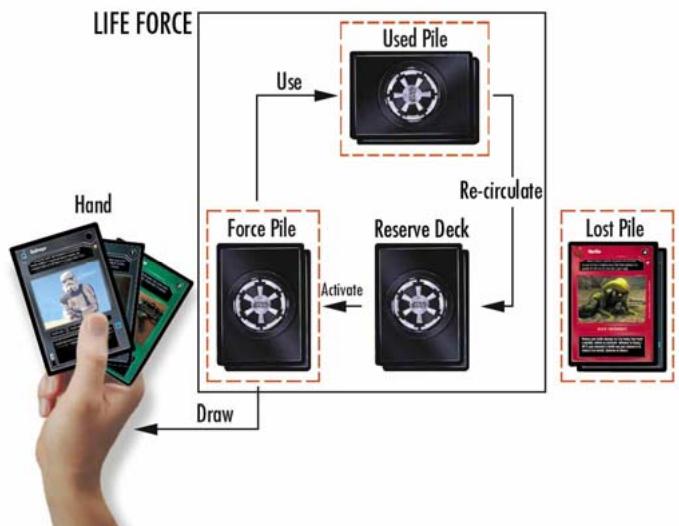
Re-circulating
Act of placing your Used Pile (as a group) beneath your Reserve Deck. You re-circulate at the end of each player's turn. Re-circulated cards will work their way back to the top of the Reserve Deck during subsequent turns to be activated again. Re-circulating both Used Piles at the end of every player’s turn is mandatory. If you forget, your opponent can insist that you recirculate. A player who forgets (and is not reminded by the opponent before the next action has its result) may not re-circulate until the end of the next turn.
Stack
One or more cards placed on another card.
Counting A Deck, Pile, Or Stack
A player may count their deck, pile or stack (face down) at any time. Also, a player may request such a count from their opponent.
Looking At A Deck, Pile, Or Stack
As a general rule, you may not look through any deck, pile, or stack unless permitted to by a rule or card (even if it's face up, such as the Lost Pile). However, if your card is stacked on (or under) another of your cards (or any location), you may examine it at any time (unless a card or rule prohibits it). Thus Dark may examine his Bluff cards, combat cards, and cards under his Starting Effect, but not cards under Insignificant Rebellion (they're not his), or I Feel The Conflict (it's not his Effect).
Shuffle & Reshuffle
When directed to shuffle (or reshuffle) a deck or pile, you must shuffle it and then allow the opponent an opportunity to ‘cut’ (take a portion of the deck or pile from the top and place it underneath the remainder). Return the deck or pile to its appropriate place on table. The phrase "Shuffle, cut, and replace" was used on older cards; treat this the same as "reshuffle."
Empty Hand
See 1.C. Implied Target Rule
Empty Deck Or Pile
When a deck (Reserve Deck) or pile (Used Pile, Force Pile or Lost Pile) is empty, you may not:
• initiate any action that deploys, takes, exchanges or steals a card (or cards) from that deck or pile;
• initiate any action that searches, peeks, glances, examines, reveals, selects or looks at a card (or cards) in that deck or pile; or
• initiate any action that draws a card (or cards) from that deck or pile (this does not apply to destiny draws). For example, you may not play How Did We Get Into This Mess if your Reserve Deck is empty.
• play a card to shuffle that deck or pile;
• use any game text that says "if you are about to draw" when your Reserve Deck is empty. See Drawing Destiny - About To Draw.
Any of these actions (even if they require multiple cards) may be initiated as long as there is at least one card in the targeted deck or pile. If there are an insufficient quantity of cards in the deck or pile to complete the action, simply complete what is possible and then end the action. An empty Reserve Deck does not stop you from drawing destiny, that destiny draw simply fails (see 1.E. Failed Destiny Draws).
An empty Lost Pile does not stop a player from initiating an action that retrieves Force (or retrieves card(s)). An empty Force Pile does not stop a player from moving that pile, such as placing it on an empty or non-empty Used Pile, with I Did It!
Losing Force
Act of discarding cards face up to Lost Pile. Like activation, you lose Force one at a time. You may choose cards to be lost from your hand or from the top of your Reserve Deck, Force Pile or Used Pile. Whenever you are required to lose Force, you must move the appropriate number of cards from your hand and/or Life Force to your Lost Pile. This is always written in the form of "lose [X] Force". When a card refers generally to “losing Force,” this applies to losing “cards as units of Force,” not to losing a specific card because of its name or some particular characteristic of that card. Thus, for example, Honor Of The Jedi or It Could Be Worse would not reduce the number of cards you must lose to a Monnok, a loss you suffer due to sabacc, or the loss of unique male Rebels in hand from M'iiyoom Onith.
Losing Force - From X
Sometimes a card will require that lost Force come from a specific place. This means that you must first lose Force from there, but if you cannot, lose the remainder from any appropriate place. For example, if you must lose 4 Force from Reserve Deck and have only 3 Force there, you would lose those 3 and the last one from somewhere else (hand, Force Pile, or Used Pile).
Peeking At Cards
A game action that allows you to peek at a card (or cards) allows you (and only you) to look at that card and then place it back where it came from (unless stated otherwise). When you peek at (examine, glance at, look at etc.) a card, you are entitled to see the entire card, and the intention is that you limit yourself to a reasonable amount of time to gather information (note: older cards stated that you had [X] seconds to peak; this text is obsolete by this rule and should be disregarded). See empty deck or pile, empty hand.
Retrieve
Act of taking the top card of your Lost Pile and placing it face down on your Used Pile. To retrieve multiple cards, simply retrieve multiple times (this is all one action). If game text allows you to retrieve 1 Force for each of a specific card on table (or some similar condition), count up all copies of that card as specified and then retrieve that total number (as one action). To randomly retrieve a card, shuffle, cut and replace the Lost Pile and then retrieve normally. To retrieve a specific card (e.g., such as "retrieve Luke" or "retrieve an Imperial"), search the Lost Pile; if a copy of the card is there (it need not be the topmost one unless the retrieving card says so) you then retrieve it (to Used Pile, as usual); do not reshuffle or change the order of the cards in any way unless instructed to do so. A retrieved card is always revealed to both players, even when the Lost Pile is face down (see Eyes In The Dark, Ap. B).
Leaves Table
If a card leaves the table by being relocated to a deck or pile, by being placed out of play, or by being returned to hand (for example, due to cards like Master Luke, ASP-707, Revealed or As Good As Gone) then all cards deployed on, carried by, or aboard that card (as well as any inactive or supporting cards on it) must be placed in their owner's Lost Pile unless specified otherwise (i.e. Captives - Releasing rules). All the cards (including the card leaving table) leave play simultaneously, and thus can be stacked in any order in the Lost Pile.
On Table
A term used to describe a card in play. See 1D. Card States for a detailed explanation of how cards are considered "on table" based upon game conditions.
Exchange
An action that requires you to Exchange one card with a card in a different location. If you are exchanging cards in a pile, the card(s) going into the pile should be placed in the same order of the pile as the card(s) coming out.
Section B. Taking Cards From A Deck/Pile
Many cards allow you to directly access your deck, pile, or stack, usually to take a card into hand, or to deploy a card from there directly. Whenever a card or rule allows you to take a card from a deck, pile or stack, and there are any criteria for what kind of card you may take, you must reveal that card after it is obtained (reveal the entire card). In this way, your opponent can check that you took a card matching the criteria specified.
However, when allowed to take “any card” you do not have to reveal the card chosen, unless you retrieve that card from your Lost Pile. If the initiating text provides more than one candidate card that may be taken from the same deck, pile or stack, you are permitted to declare the action specifying only the card you are using to search. You may then look through that deck, pile, or stack before choosing which of the cards you wish to take. Once the search has been initiated, a player must take a card if possible.
If your search fails to find any card matching the criteria given, your opponent is permitted to check to see that deck, pile, or stack in order to prove that no candidate could have been taken; this is called "verifying." In addition, when the card or card type you searched for was not found and your opponent has verified this, you may not use that searching card (or any card of the same name) to search or look through the same deck, pile, or stack again this turn.
After searching, you should replace the deck, pile, or stack without shuffling, unless otherwise instructed.
"With X in title/lore/game text"
Game text that searches for a specific word on a card (usually in title, lore, or game text) cannot be matched if that word is part of another word (though if the word is a plural or possessive, that remains a valid target). If the action depends upon more than one word in the card title then all the search keywords must also be in the same order and without any other words in between. For example, ISB Operations looks for characters with "Rebel" in lore; thus anyone with "Rebel," "Rebel's," or "Rebels" is valid, but "rebellious" isn't, since it's part of another word.
Taking Cards From A Deck Or Pile - Example 1 Dark has Bad Feeling Have I (V) ("May use 2 Force to ▲ a card (without ability) with 'duel' in game text.") on table. Dark uses the ability and searches the Reserve Deck for such a card (he doesn't state which one). He finds Epic Duel, reveals it to his opponent, and put it in his hand. He then shuffles his Reserve Deck because the ▲ includes "reshuffle" as part of the action. The next turn he decides to search again; however, this time there is no such card. His opponent is handed the Reserve Deck and allowed to verify; this should be done in a reasonable amount of time. After this the deck is shuffled and returned. Dark cannot do another search with that portion of the Effect's game text this turn.
Deploying/Playing from a Deck or Pile When permitted to deploy or play a card from a place other than your hand, you must still obey normal timing rules of the card being played or deployed (unless specifically told otherwise, such as Nal Hutta Operative). Thus you cannot deploy a site except during your deploy phase, nor could you play Elis Helrot during a battle or outside of the move phase while Insurrection is on table. You cannot deploy or play such cards as a response unless the card allowing it states you may do so "as if from hand." You do not reshuffle or reorder the cards there unless required to (note that the ▼ includes "reshuffle"). If the played card must be sent to a specific place (e.g., Watch Your Step requires an Interrupt played from Lost Pile be placed out of play) the card must go there, even if canceled. The only exception is if the card must be stacked on a grabber (see Icons - Grabber, Ch. 9).
Taking Cards From A Deck Or Pile - Example 2 Light is playing Watch Your Step and has flipped to the back side of the objective ("Once during each turn, may play one interrupt from Lost Pile as if from hand (then place that card out of play)."). Thus, at any time (even in response to another action) he can state that he plans to play an interrupt from his Lost Pile; he doesn't have to state which one yet. Once he has done so he looks for any interrupt he can play at that time and chooses to play it; if none are found that he can play (he must play one if it is possible) the opponent verifies this. In either case the Lost Pile would not be reshuffled because the objective doesn't say to.
In this case, Light has chosen to play Out Of Commission & Transmission Terminated as a top-level action. Dark responds with Unsalvageable, canceling it. Normally canceled cards are placed in the Lost Pile, but because the objective states the card is placed out of play, Out Of Commission must be placed out of play. The next turn Light uses the ability in response to Dark attempting to deploy Visage Of The Emperor (a hologram). Light searches his Lost Pile, but it turns out he only had the one copy of OOC&TT. He looks for any other responses, but there are none, and he cannot initiate a top-level action as a response, so he allows Dark to verify and play continues; he cannot use the ability again this turn, even though it failed.
Taking Cards From A Deck Or Pile - Example 3 Dark has Oppressive Enforcement and I've Lost Artoo (V) on table ("Once per game, may use 1 Force to play an Interrupt (except Sense, Alter, or Control) from under your Starting Effect as if from hand (then place that card out of play)."). His opponent plays It Could Be Worse, and Dark uses this Effect to play It's Worse! from under his Starting Effect; this is legal because the card says "as if from hand." The opponent responds with Sense, canceling the Interrupt. Oppressive Enforcement states that cards canceled by Sense are placed on Used Pile, but because the Effect says to place it out of play, it must be placed out of play.
Section C. Actions
Actions are the individual building blocks of game play. Actions occur quite naturally during the game; in fact, most of the time you don’t even need to think about actions (just as you rarely need to think about the individual steps of how you get dressed in the morning). Occasionally, however, situations will arise where it is desirable to understand the intricate details of actions - particularly in tournaments, where players want strict and definitive rules governing the specific timing of game play. Almost everything you do in the game is an action. Examples of commonly occurring actions include:
• playing or deploying one card;
• performing one Force drain;
• performing one regular move, ‘react’ or unlimited move;
• conducting one battle;
• firing one weapon;
• drawing one destiny;
• activating, using, losing, drawing or retrieving one unit of Force (or any other act of moving a card from one deck, pile or hand to another);
• using optional game text on a card already in play;
• taking one card from a deck or pile;
• re-circulating your Used Pile; and
• choosing to use an optional modifier (e.g., a lightsaber bonus to a Force drain).
Automatic modifiers (e.g., “adds 2 to power of anything he pilots”) and checking conditions (e.g., control of a location) are not actions, neither is announcing the beginning or end of a phase or turn. Everything else you do in the game is an action.
Every action has three steps that must occur in order: Initiation, Responses, Result (see Steps Of An Action).
Action Within An Action
Many times, an action causes other actions to occur within itself. For example, a Force drain is an action which typically causes the opponent to lose Force - another action. For a more complex example, consider playing Nabrun Leids; this action includes several other actions:
• targeting (selecting) the characters you wish to transport;
• targeting (selecting) the destination site;
• drawing destiny to determine Nabrun’s asking price;
• choosing whether to accept or decline the transport;
• using Force to pay the asking price (a separate action for each Force used);
• transporting the group of characters to the destination site; and
• placing the Nabrun Leids card on your Used Pile or Lost Pile.
Perhaps the ultimate example of actions within an action is battle - a single action comprising many other actions, some of which contain still other actions within themselves.
Types of Actions
Actions are initiated either as top-level actions or responses. Top-level actions are the most common action you'll perform; they're the actions that kick things off, such as deploying a character or activating a Force. Responses are actions that can only happen by responding to something else that has just happened, they can't be used as a top-level action. To understand the difference, think of actions as a tennis game: one player serves the ball, and then the other person may manage to hit it back. The person serving the ball is performing a top-level action, kicking things off, and the one hitting the ball coming to him is performing a response, reacting to what's just happened. During your turn, you perform the first top-level action in each phase; once all the responses to that action are complete, your opponent may perform the next top-level action. When all responses to that are completed, it's your turn to perform a top-level action, and so on. Some actions you can choose to have happen, and some actions have to happen. For example, you don't have to Force drain, you can choose to do it or not do it (sometimes it's in your best interest not to), but you do have to have your creatures attack if they can (even when it'd be bad, like attacking your own characters!). So there are top level actions and responses, and there are things that you can choose to happen or that must happen. Thus, there are four types of actions that take place: Optional Actions, Automatic Actions, Mandatory Actions, and Just Actions.
| You Choose To HaveIt Happen | It Must Happen | |
| Totl al-iom | Optional ActionsForce drainingInitiating a battleA group of charactersattacking a creatureFiring a weapon in a battlePlaying Beru Stew | Mandatory ActionsDrawing asteroid destinyCreatures attacking preyLosing Force to Visage ofthe EmperorPaying maintenance costsForfeiting a hit character |
| Resonse | Just ActionsPutting a just lost characteron Bacta TankReacting to a Force DrainCanceling Alter with SensePlaying Trooper Assault inresponse to a battleDeploing Tentacle on a justplayed Interrupt | Automatic ActionsCompleting (reaching) anUtinni EffectLosing a seeker and targetwhen they are togetherRetrieving 2 Force for ScumAnd VillainyCreatures attacking eachother |
Optional Actions
A top-level action you choose to initiate. Generally speaking, deploying or playing a card is optional, and anything which says "may."
Just Actions
A response to another action that you choose to initiate. To be a response, the action has to be connected to the action that just took place. For example, playing Beru Stew to activate Force is not a valid response to someone playing Sense; instead, you could play Control (which cancels Sense) or deploy There'll Be Hell To Pay on it (it deploys on a just played Interrupt). Like in the tennis match example, when you perform a top-level action, your opponent gets the first optional response to it (you can't return your own serve, your opponent gets to, even if they pass). You can perform the next just action in response to that action, then your opponent, and so on. This will be covered in more detail under The Stack.
The word "just" is not needed for something to qualify as a just action.
Automatic Actions
A response that must take place. When the conditions are met for the automatic action to take place, it occurs (this is called triggering). While they are triggered automatically (not by choice), they are still actions like any other that may in turn be responded to.
Sometimes two or more automatic actions are triggered by the same event; for example:
• specifying multiple targets (e.g. losing a seeker and its target, or affecting both players)
• using an unordered sequence (e.g. a bulleted list)
• being mentioned on multiple cards in play and/or rules, (e.g. when the Dark Side initiates battle, both First Strike and Scum And Villainy are triggered)
Automatic actions are resolved one at a time. If it is on a single card, do the events in the order listed on that card (e.g., Draw Their Fire says "Whenever a battle is initiated, player initiating battle retrieves 1 Force and defender loses 1 Force" thus the retrieval happens first, then the Force loss). In all other circumstances, they are done in an order chosen by the player whose turn it is (in the First Strike/Scum And Villainy example, the player whose turn it is can choose to have either one of those card to happen first, and then the other to happen second).
Automatic Actions and Just Actions are both responses (see The Stack for details on responses); however, for timing purposes, all Automatic Actions happen first, then Just Actions can take place.
Mandatory Actions
A top-level action that must be performed. Mandatory actions are typically indicated (either on a card like It's On Automatic Pilot or in a rule such as Attacks) by saying they occur during a time frame, and indicate that there's no choice in the matter (such as losing Force to Search And Destroy or drawing asteroid destiny). Any time during that time frame (when the player is permitted to perform a top-level action), the player directed to perform the action may choose to initiate it (his opponent cannot compel him to do so at any particular time). If both players are directed to do something by the same action, the player whose turn it is may choose when to initiate it, at which point those events are treated as competing automatic actions and resolved accordingly.
Any mandatory actions that have not been performed by the end of the required time frame become automatic actions triggered as a response to the end of the time frame and must be resolved before play can continue. For this reason, if the time frame is itself an end of something (end of battle, end of turn, etc.) the mandatory actions will always happen first before the optional actions.
Steps Of An Action - 1: Initiation
Initiation of an action (such as a character's game text or playing an Interrupt card) includes any or all of the following requirements, in this order: (1) meeting all conditions; (2) choosing all targets; (3) paying all costs If all requirements for initiating an action cannot be met, that action may not be initiated. Once it has been successfully initiated, it doesn't matter if something affects one of those, it has still been initiated (in other words, a change doesn't back up and say the action was invalid, the action simply continues). For example, if you target a player with Monnok while they have 14 cards in hand, and during the responses they lose 3 cards from hand, Monnok will still have its result as normal.
Meeting Conditions
You can't initiate an action unless all of the applicable conditions of rules and/or game text are satisfied. For example, to deploy a character, location deployment restrictions listed in that character's game text must be satisfied. In addition, presence or a Force icon is required by the rules for all non-spy characters, as is observance of special rule-based deployment restrictions such as shield rules or Dagobah rules. Similarly, a response (such as an interrupt that plays “if a battle was just initiated”) cannot occur unless it is responding to the appropriate situation (in this case, it can't be played once the weapon segment of a battle has commenced). As responses take place those responses may change conditions so that other responses would no longer be valid; for example, if a just lost character is stacked, taken into hand, or placed out of play, they're no longer just lost, and no response that had "just lost" as a condition can be initiated.
Choosing Targets
An action cannot be initiated unless all of the targets required by its game text are able to be specified. That is, they all have to be able to be targeted by the action. The only exceptions are optional items, and those items that cannot be known as a target (because it requires knowing information about a card you cannot see or the results of a random action). In such cases, targeting occurs once the potential targets are revealed (this is still considered targeting). See Implied Target Rule. An action only affects the appropriate targets (e.g., Lateral Damage resets the forfeit of a starship to zero, but not any characters aboard).
Paying Costs
An action cannot be initiated unless all of the stated costs of rules and/or game text are satisfied. Examples include using Force to deploy a character or initiate a battle, or losing 2 Force to deploy Visage Of The Emperor. Nabrun Leids requires you to draw destiny to determine the cost of that transport action. Sometimes costs do not involve Force, but can involve another card, or even foregoing another action. For example, Noble Sacrifice's cost is that you must place one of your character's out of play.
Because initiating an optional action is -by definitionoptional, you are not forced to pay for the cost, you are doing so by choice. Thus any action which applies only when you "must lose" Force cannot be used to avoid paying for the cost of an optional action. For example, Blaster Proficiency allows you to cause a just hit character to be immediately lost; the cost is losing 1 Force. You cannot play this unless you choose to lose 1 Force, which means that cards such as It Could Be Worse or We're Doomed may not affect that Force loss. However, Their Fire Has Gone Out Of The Universe allows Visage Of The Emperor to deploy without paying its cost because it simply states that you lose no Force to it, not that you "must lose" no Force to it.
(Note: older cards stated "at normal use of the Force." Since all actions are at normal use of the Force unless otherwise specified this redundant phrase is ignored.)
Steps Of An Action - 2: Responses
After the action has been initiated and before it has begun its result, responses are allowed. See The Stack for details on how this works.
Once all responses are complete (assuming the action hasn't been canceled) it has its result).
Steps Of An Action - 3: Result
The result of the action is then carried out. The results of the action are themselves automatic actions, and resolved as described under automatic actions. For example, the result of Beru Stew is that each player must activate 2 Force; since there are multiple targets (you and your opponent) the player whose turn it is decides who activates first and who activates second. Responses may take place to those actions and the steps that make them up (activating each Force is a separate action), but not to Beru Stew itself because the time for responses to that action have passed.
Actions - At Any Time
This phrase is intended to indicate that an action may be used during any phase of either player’s turn. Actions that may be initiated “at any time” are not exceptions to the normal timing rules; that is, they may not respond to other unrelated actions. (To be more precise, “at any time” actions may be initiated only as a top-level action.) For example, if Dark plays Limited Resources, Light cannot respond to that by placing A Vergence In The Force in Used Pile to draw 2 cards, because even though it says "at any time," that is not an actual response to the current action. Light
would have to wait until the stack was empty to perform that top-level action.
Actions - Duration
Some actions result in an effect that will persist for a certain period of time (e.g., is power +2 until end of turn). Once such an action resolves, that effect will continue -regardless of what happens to the card that caused it- until that duration is complete. For example, if Maul's Sith Infiltrator uses its game text to "cloak," then even if its game text is canceled, it will remain cloaked until the stated duration ends.
Actions - For Each/For Every
Any time game text permits you to use, lose or retrieve Force "for each" (or "every") of a certain card, characteristic, etc., that action is performed as one action for the full calculated amount. For example, if you occupy 3 Tatooine battleground sites, then Tatooine Celebration will permit you to initiate an action to retrieve 3 Force during your control phase (not three retrieval actions of one Force each).
Actions - Immune
A card that is immune to an action is not a valid target for that action (and thus is not a legal response). If a card is made immune to another card already targeting (or deployed on) it, the other card is canceled. The statement "Immune to Control" refers to the card Control, not other uses of that word.
Actions - Just Deployed, Just Played
For Just Deployed actions, see The Stack. A card is “Just Played” after the action is initiated but before it has had its result (so responses to a just played card occur duing the Responses step).
Actions - Before
In certain rare instances, an action will indicate it is a response to an attempt to initiate an action (often by saying it happens "before" the action takes place). When such a "before" action takes place, it occurs before the other action is even initiated. Once the "before" action is completed, the player who had been attempting to initiate the original action may choose to again initiate it, or not to (unless, of course, the action is mandatory).
If you are using a "before" action to preempt one of your opponent's actions, it may require backing up (because this happens outside the normal order of play). You may not back up when you are preempting one of your own actions; you state that you are about to do something, and then play the "before" action. For example, Dark's first action of the Damage Segment is to forfeit Vader, but Light wants to play You Do Have Your Moments (it plays "before any cards have been forfeited) to reduce all attrition to zero. Play backs up to before Vader was forfeited (he's still on table and no responses were triggered by it). Once the interrupt resolves, Dark again has the choice of forfeiting Vader or performing some other action; he is not required to forfeit Vader (and since it's no longer
mandatory to forfeit him, Dark chooses not to). Another example: if Light targets an unpiloted Speeder Bike (manuever = 0) with a Blaster Rifle, he may play Lucky Shot just as he was about to draw the weapon destiny; it would resolve before the weapon does. He still must draw the weapon destiny (even though it's not needed for him to hit the target) because all destiny draws except battle destinies are mandatory. Light may not draw the weapon destiny and then back up and play Lucky Shot, because you do not back up from your own actions.
Actions - Just Lost
Some actions are dependent upon the condition "just lost". Unless stated otherwise, "just lost" actions are applied only to act
内容过长,此处只内联前一部分;完整内容请下载或到规则页阅读。
下载 Markdown原文为社区整理/出版社公开资料,版权归原作者,仅供个人学习查阅。