
地城建筑师Stonespine Architects
一句话概览
地城建筑师 是一款已收录于村了吗规则库的桌游,支持 1–5 人,原名 Stonespine Architects。
本页内容:一句话概览 · 常见问题
这游戏怎么玩
- 本站已收录这款游戏的规则资料,可以在对话里直接提问规则细节。
常见问题(FAQ)
以下 1 条问答中 0 条来自站内玩家的真实提问,其余 1 条为本站整理的常见疑问;答复内容保持原样。
地城建筑师支持几个人玩?
1–5 人。
去哪查完整规则
想核对具体规则细节、卡牌效果或某个回合的结算方式,可以在村了吗里选中这款游戏后直接提问。
同类桌游
- 卡坦岛德式
- 工业革命:伯明翰德式
- 勃艮第城堡:特别典藏版德式
- 方舟动物园德式
- 卡卡颂抽象
- 瘟疫危机传承:第一季美式
- 阿瑞迪亚:勇踏征途美式
- 重塑宇宙德式
- 幽港迷城美式
- 埃多拉的德鲁伊德式
规则原文(Markdown)
本站收录这款游戏的规则原文 1 个文件,此处内联渲染 1 个,可直接展开阅读或下载。
Stonespine_Rulebook_Web.md26.5 KB
STONESPINE ARCHITECTS
A ROLL PLAYER TALE
Rulebook
Introduction c
Dungeon-crafting is an ancient Minotaur art, passed down from master to apprentice for eons. You've studied under Master Hortoully for a decade and now it's time to demonstrate your skill.One fnal roject stands beween you and greatness: You must carve your own perilous dungeon into the base of the Stonespine Mountains.
Kulbak will provide labor and Lord Duntum's menagerie will bin beast to populat our constructions.The bulder wose dungeon proves the ot challening to Queen Amalia's chosen heroes will achieve the title of Master Architect.
Dverview c
In Stonespine Architects, players compete to earn the most reputation by building the most dangerous dungeon over four years.
Each year, players draft cards and construct partof their dungeon, one chamber at a time.
At each year's end, players use their gold to buy additional elements for their dungeon and collect challenge cards. After four years, Hortgully will evaluate each player's creation.
Follow your blueprint, take advantage of challenges, and catch the attention of Hortgully to earn the most reputation and win the game!
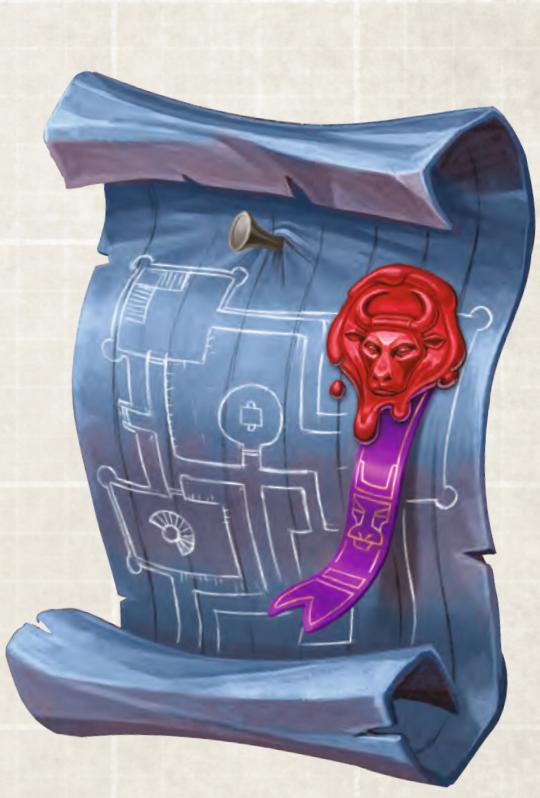
100 CHAMBER CARDS
Components c

8 BLUEPRINT CARDS
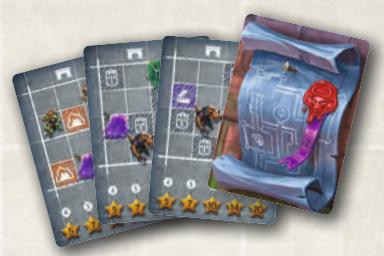
18 MARKET CARDS

1 TRACKING BOARD
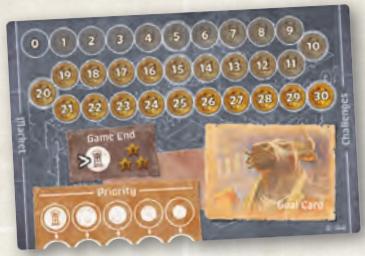
30 CHALLENGE CARDS
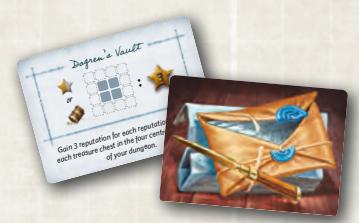
8 GOAL CARDS

10 DOORWAY MARKERS (2 per player)
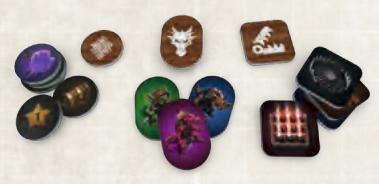
56 MARKET TOKENS (25 Circle, 16 Oval, 15 Square)
5 DUNGEON FRAMES (assembled from 2 pieces)

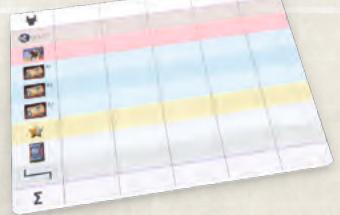
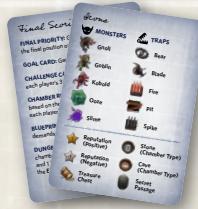
1 SCOREPAD

10 TRACKING MARKERS (2 per player)

10 REFERENCE CARDS (2 per player)
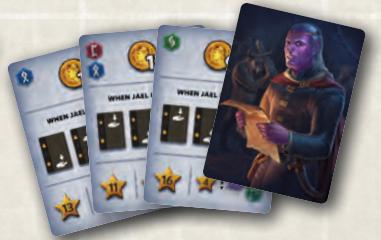
9 JAEL CARDS (solo play)

Game Setup cr
①Place the tracking board in the center of the table with the ii-iiiii (2-5) player side of the board face up.
②Have each player choose a color and collect the two matching tracking markers. Return all unused tracking markers to the game box.

③Randomly place one of each player's tracking markers on the priority track from left to right. The player in the leftmost space has the highest priority.
④Place each player's other marker on the gold track according to their priority:
| Priority Track | 1 | 2-3 | 4-5 |
| Gold | 0 | 1 | 2 |
⑤Shuffle the goal cards. Reveal one and place it on the tracking board. Return all unused goal cards to the game box.
Shuffle the challenge cards. Reveal cards based on the number of players:

| Players | 1-2 | 3 | 4 | 5 |
| Cards | 3 | 4 | 5 | 6 |
⑦Shuffle the market cards. Reveal cards based on the number of players:
| Players | 1-3 | 4 | 5 |
| Cards | 2 | 3 | 4 |
⑧Sort the market tokens face down into piles by shape ( circle,oval, andsquare) and shuffle each pile separately. Place the three piles next to the tracking board.
⑨Reveal market tokens for each space on the market cards and place them face up on the matching spaces.

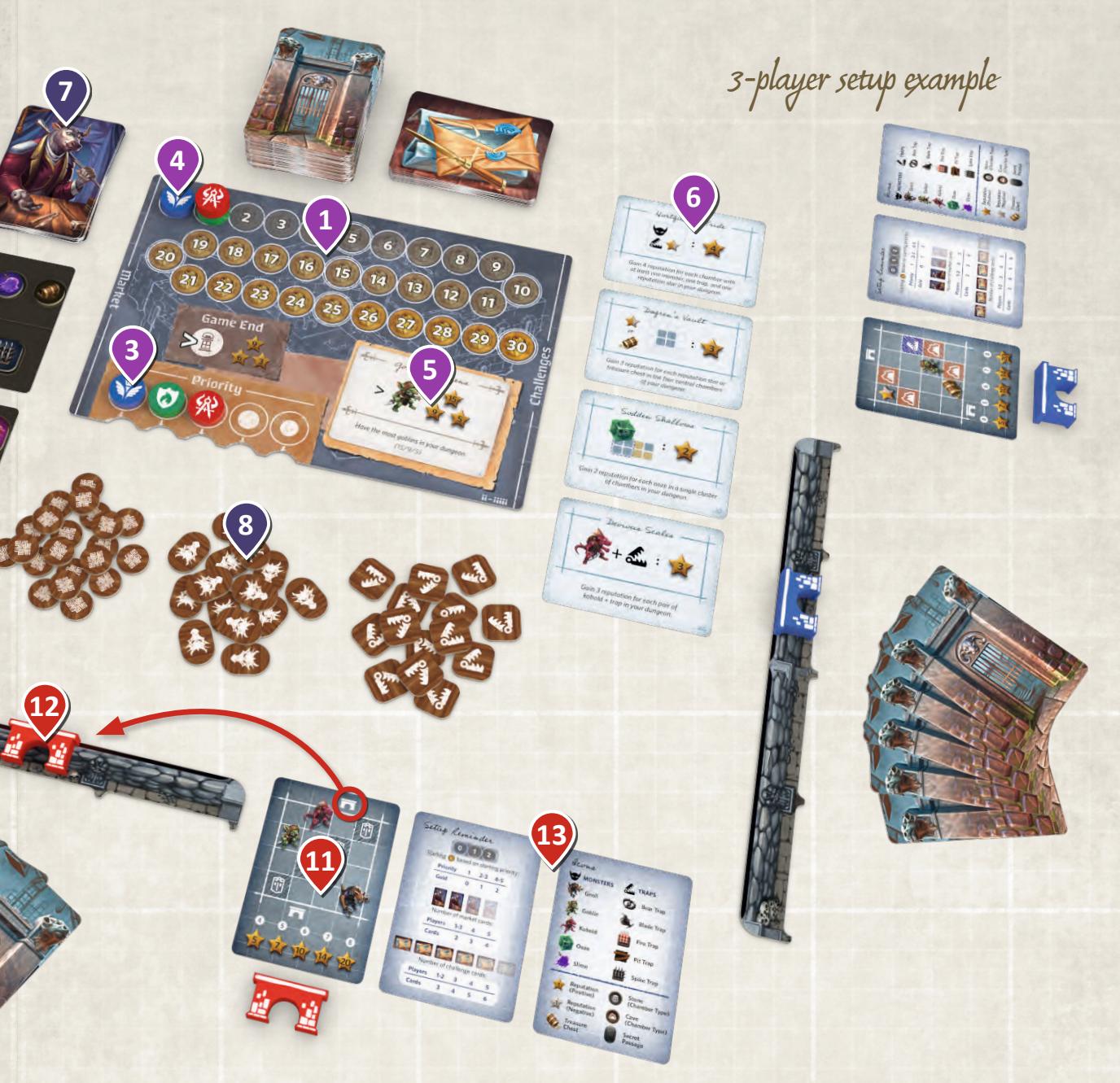
10 Assemble the dungeon frames and place one in front of each player with either side face up. Return all unused dungeon frame pieces to the game box.
Shuffle the blueprint cards and deal one face up to each player. Return all unused blueprint cards to the game box.
12 Give each player the two doorway markers matching their player color. Place one doorway marker on each player's dungeon entrance, as specified at the top of their blueprint card. The second marker will be used during final scoring.
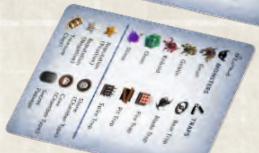
13 Give each player two reference cards (one of each).
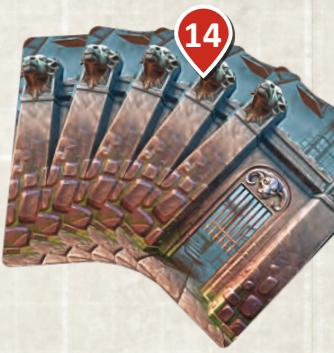
14 Shuffle the chamber cards. Deal each player a hand of five cards.
The game is ready to begin!

Game Terms cr
Chamber: The top portion of a chamber card, depicting one room of a dungeon with space for up to four elements.
Cluster: A group of orthogonally adjacent chambers of the same type (cave or stone).
• Clusters can have any number of chambers (including a single chamber).
• A group of adjacent chambers of the same type cannot be divided into multiple clusters.
• A cluster does not consider paths or secret passages, only the chamber type.
Element: An icon depicted on a chamber card or market token (except secret passage tokens).
There are four types of elements: monsters, traps, reputation stars, and treasure chests.
Path: A path exists between two or more adjacent chambers that each have doors printed on their shared edges or have a secret passage token placed across their shared edges. When placing a chamber card,a path is not required to be connected to the dungeon entrance or exit.
Single Path: A path that does not consider branches or offshoots.
| Year 1 | Year 2 | Year 3 | Year 4 |
| Clockwise | Counterclockwise | Clockwise | Counterclockwise |
How to Play r
Stonespine Architects is played over four rounds — called years. During a year, each player will place a single row of four chamber cards. At the end of the game, each player will have created a dungeon of 16 chambers in a 4x4 grid.
Each year is divided into three phases: Construction, Improvement, and Cleanup.
I. CONSTRUCTION PHASE
The Construction Phase is divided into four turns. Each turn:
- Players simultaneously select one chamber card from their hand and place it face up in their dungeon. (See Placing Chamber Cards below for more details.)
If playing with two players, each player also discards one chamber card from their hand.
- Players pass their hand of remaining chamber cards to the player on their left or right, as indicated below for the current year.
田 If playing with two players, each player also draws one chamber card from the deck and adds it to their hand.
-
Repeat steps 1-2 until players have each placed four cards in their dungeon, completing a single row.
-
Finally, each player discards the remaining card from their hand.
Variant: In step 1, players may choose to place their chamber cards face down instead of face up.
Once all players have placed their chamber cards, simultaneously reveal them.
Placing Chamber Cards
• During a single year, chamber cards must be placed in a single row, but can be placed in any order within that row.
In year 1, place chamber cards in one of the spaces directly below the player's dungeon frame.
In years 2-4, place chamber cards so that they cover the bottom portion of the card in the row directly above it.
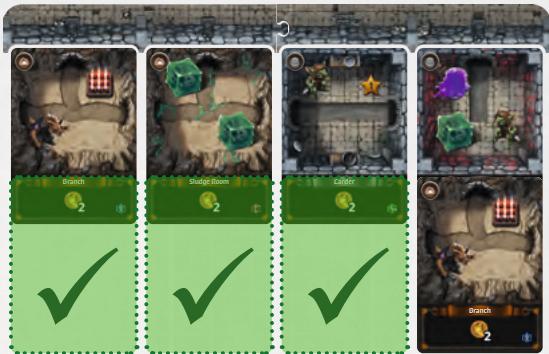
• Once a chamber card is placed, it cannot be moved.
• Doors on chamber cards are not required to match with doors of adjacent chambers or the dungeon frame.
II. IMPROVEMENT PHASE
The Improvement Phase is divided into two steps. Count Gold and Visit the Market.
STEP 1: COUNT GOLD
Players simultaneously total their gold for the current year.
• Add the gold values on all chamber cards placed in the current row of the player's dungeon.
• Add one gold for each treasure chest icon in any chamber of the player's dungeon.

In year 1, remember that some players may have already received gold during setup.

Example: The player receives 13 gold: ten (3 + 2 + 2 + 3) for their chamber cards and three for their treasure chest icons.
Move each player's tracking marker on the gold track to the space equal to their total. If a player has more than 30 gold, place their marker on the 30 space.
Then, move each player's tracking marker on the priority trackto the space directly below the track, maintaining their order.
Breaking Ties
If two or more players are tied for the most gold or are tied for a scoring condition on a goal card, resolve ties in favor of the player who has the highest priority (their tracking marker is further to the left).

STEP 2: VISIT THE MARKET
Players take turns either buying market tokens or passing to collect a challenge card, always starting with the player who has the most gold.
Buy Tokens: Choose one set of market tokens on a single market card (either the top or bottom set). Reduce the player's gold equal to the cost of the set by adjusting their tracking marker on the gold track. Immediately place the purchased token(s) on any combination of chambers in the player's dungeon. Then reevaluate who has the most gold, and that player takes the next turn visiting the market.
Example: The blue player buys the slime and ooze tokens, reduces their gold by 5 on the gold track, and adds the tokens to their dungeon. The red player then takes a turn, as they now have the most gold.
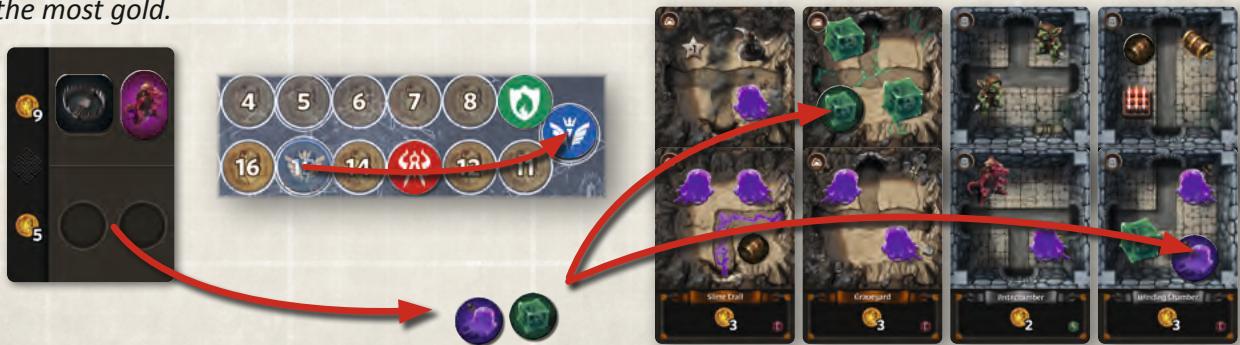
BPass: If a player chooses not to buy tokens or cannot afford tokens, they must pass. When passing, they perform the following steps:
-
Move their tracking marker on the gold track to the 0 space. Unspent gold is not carried over to the next year.
-
Select one of the revealed challenge cards and place it near their dungeon.
-
Move their tracking marker from below the priority track to the leftmost unoccupied space on the priority track. This establishes priority for the next year (or for final scoring).
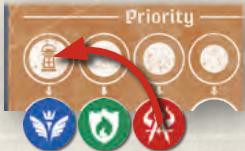
Repeat the Visit the Market step, always starting with the player who has the most gold, until all players have passed. In this way, it's possible for a player to take multiple turns before another player has the opportunity to buy tokens or pass.
①In year 4, players do not select challenge cards after passing.
Placing Market Tokens
ELEMENTS

• Each chamber can hold up to four elements. Elements include monsters, traps, reputation stars, and treasure chests and are found on market tokens and chamber cards. More than one of the same element may be present in a chamber.

• Market tokens that depict elements are placed in the four central areas of a chamber. Market tokens may not be placed in a chamber already containing four elements and may not cover other elements.
SECRET PASSAGE TOKENS
• Secret passage tokens do not depict an element and are not placed in the four central areas of a chamber. Instead, they are placed on any edge of a chamber (even without an adjacent chamber).
Secret passage tokens create a path between two chambers. A chamber with a secret passage on its bottom edge can create a path to a chamber placed directly below itin the following year.

III. CLEANUP
In year 4, skip the Cleanup Phase and proceed to finalscoring (see page 10).
The Cleanup Phase prepares for the next year. Perform the following steps:
-
Discard any remaining market tokens on market cards.
-
Discard all revealed market cards and replace them with cards from the market deck.
-
Reveal market tokens for each space on the market cards and place them face up on the matching spaces.
-
Discard the unclaimed challenge card. In years 1 and 2, reveal new challenge cards equal to the number of players plus one. In year 3, do not reveal new challenge cards as players do not select challenge cards in year 4.
-
Deal each player a hand of five chamber cards from the chamber deck.
Begin a new year, starting with the Construction Phase.

Final Scoring cr
At the end of year 4, each player places their remaining doorway marker at their dungeon exit, as specified at the bottom of their blueprint card.
Then, using the scorepad, evaluate each player's
dungeon by totaling their reputation in the six categories below.
FINAL PRIORITY

Final priority representshow much gold each player had when they passed
in the improvement phase of year 4. The player in first position on the
priority track gains 9 reputation, the player in second position gains 6 reputation, and the player in third position gains 3 reputation.
GOAL CARD
Compare the players' dungeons to determine first, second, and third place for the scoring condition on the goal card. The player in first place gains 15 reputation, the player insecond place gains9 reputation, and the player in third place gains 5 reputation.
If the goal card compares "the most" of something, a player may not gain reputation unless they have at least one of the specified element. If the goal card compares "the fewest" of something, a player may gain reputation if they have none of the specified element. If players are tied, resolve the tie in favor of the player who has the highest priority.
CHALLENGE CARDS
Each player evaluates their three challenge cards and gains reputation based on the scoring condition of each card.
CHAMBER REPUTATION

Each player totals the values on the reputation stars in their dungeon and gains (or loses) that amount of reputation.

BLUEPRINT
Each player evaluates their dungeon and gains reputation based on how many of the eight demands they meet on their blueprint card. To meet a demand, players must have the specific chamber type or element in the chamber matching the spaces on their blueprint. The reputation gained is indicated on the bottomof their blueprint card.
Example: Chloe meets five of the eight demands on her blueprint card for her dungeon on page 11. She meets three of the four cave chamber type demands, as well as the trap demand in thesecond row (any type of trap would meet this demand), and the treasure chest demand in the bottom row. For meeting five demands, she receives7 reputation.

When playing with two players, no reputation is awarded for third position when scoring
DUNGEON PATHS
Each player examines the paths in their dungeon and gains reputation for paths that connect to either their dungeon entrance or exit. To connect to an entrance or exit, there must be a door on the chamber card (or secret passage token) adjacent to the doorway marker.
• Gain 1 reputation for each chamber with a path connected to the entrance.
• Gain 1 reputation for each chamber with a path connected to the exit.
Therefore, gain 2 reputation for each chamber connected to both the entrance and exit of a player's dungeon, as they are counted twice.
①All dungeon path scoring includes offshoots and branches.
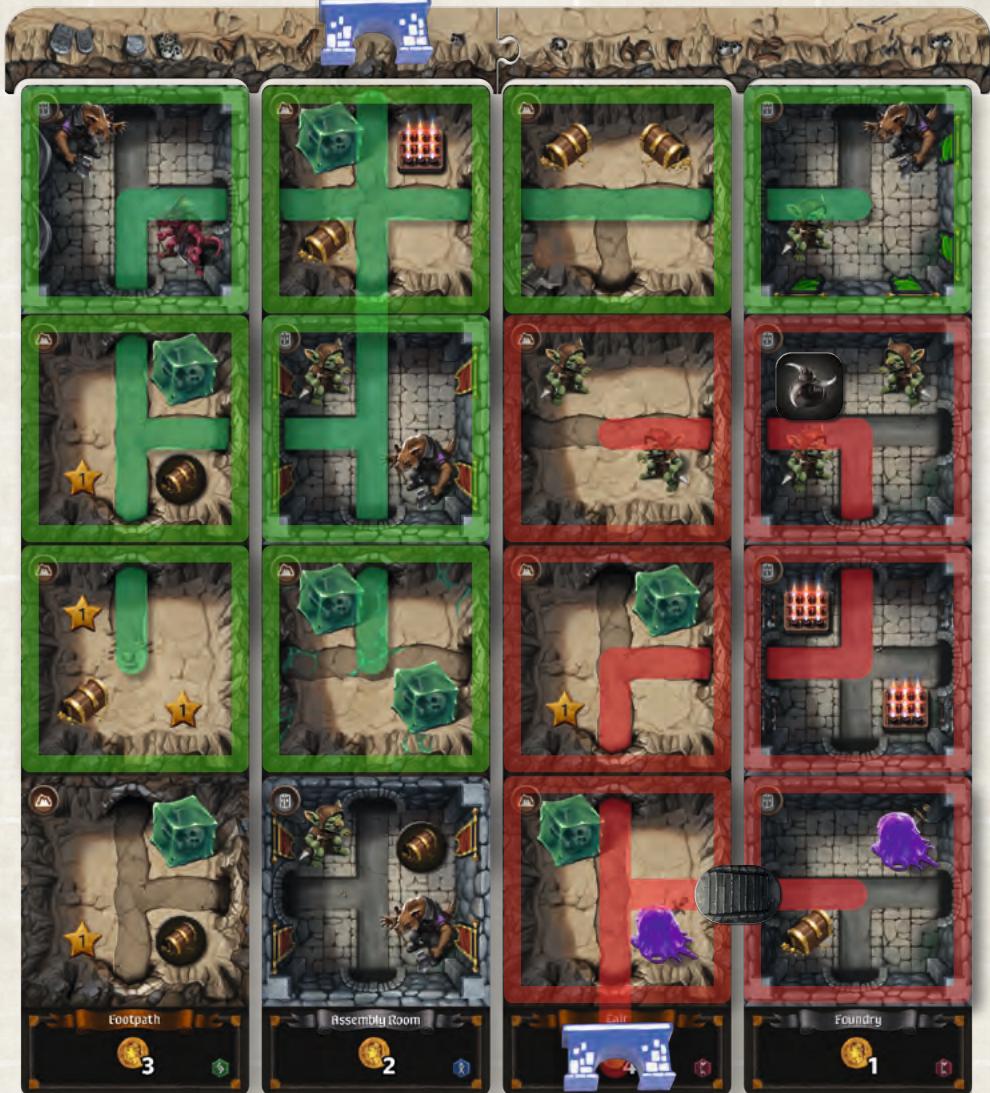
Example: Chloe scores 8 reputation for chambers connected to the entrance (highlighted in green), and 6 reputation for chambers connected to the exit (highlighted in red), for a total of 14 reputation.
The player with the most reputation has achieved the title of Master Architect! In the case of a tie, the tied player with the highest priority wins the game.
Solo Playcr
Queen Amalia has sent her most trusted advisor, Jael (JAY-el), to test Hortoully's students, as she is looking for talent to help design reinforcements for the deense of Sabek, the capital city. In solo play, you compete against Jael to prove your talent to the queen's advisor!

Jael collects chamber cards and market tokens during the game. He does not gain a blueprint card or challenge cards, nor does he build a dungeon.
The solo game plays in the same way as a 2-player game with the following changes:
SOLO - SETUP CHANGES
-
Use the 1-player side (i) of the tracking board instead of the 2-5 player side (ii-iiiii).
-
There is no priority track in solo mode. Return the second tracking marker to the game box.
-
There are nine Jael cards used for solo play. Find the three legendary Jael cards (with the y icon in the upper right corner) and return them to the game box.
-
Shuffle the remaining six basic Jael cards and place them face down on the table to form the Jael deck.
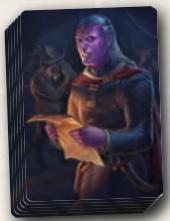
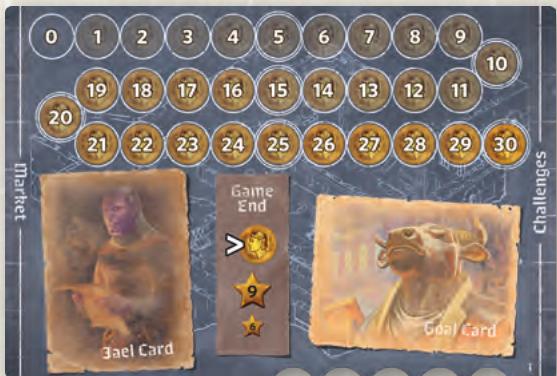
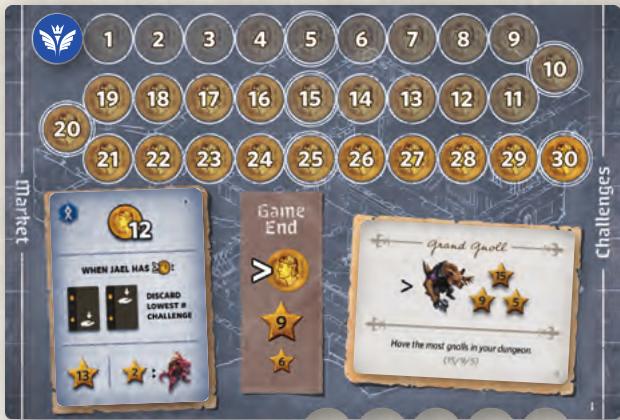
Legendary Mode: For an additional challenge, replace the three cards with the icon in the Jael deck with the three legendary Jael cards with the w icon.
SOLO - GAMEPLAY CHANGES
I. Construction
-
Reveal the top card of the Jael deck and place it on the designated space of the tracking board or on top of any previously revealed Jael cards.
-
Place a chamber card from your hand into your dungeon.
-
Choose one card in your hand to keep for the next turn.
-
Of the remaining chamber cards in your hand, if any have a,, orXJael icon (in the lower right hand corner) matching the icon on the currently revealed Jael card, place them in a score pile. Jael will score these cards at the end of the game. Discard any remaining cards.
-
Draw one chamber card for each open position in the current row of your dungeon.
-
Repeat steps 2-5 above until you have placed four cards in your dungeon.
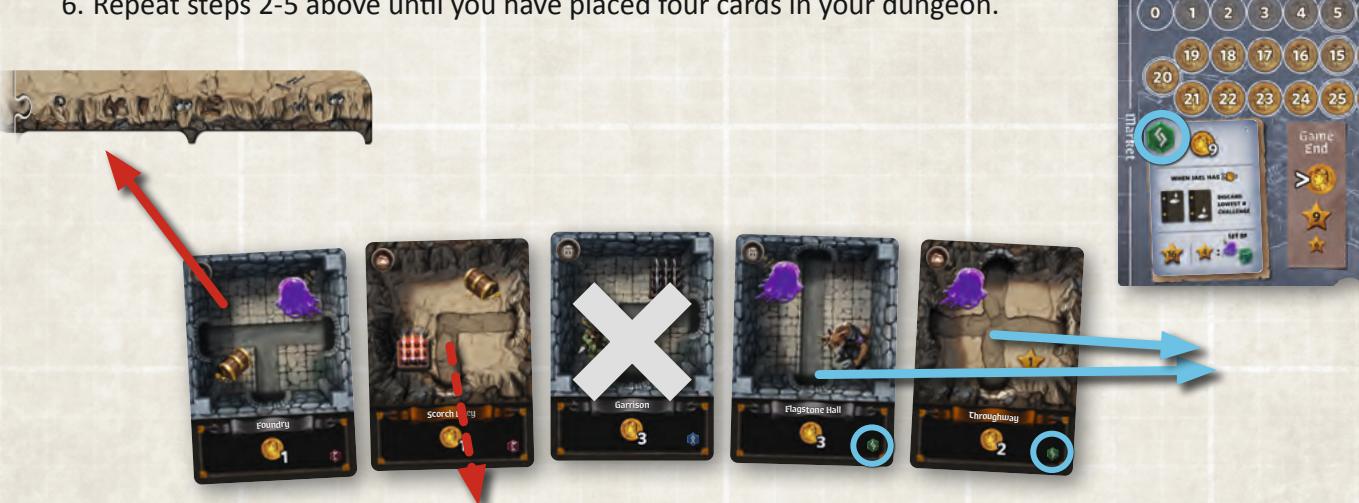
Example: On the first turn of the year, Calvin begins with a hand of five cards. He adds one card face up to his dungeon, keeps one in his hand for the next turn, and examines the other three. The current Jael card shows theicon. Two of the examined cards show this icon, so Calvin adds them to Jael's score pile. The remaining card shows aXicon and is discarded.
Calvin's hand contains the single card kept earlier in the turn. Calvin then draws three cards from the chamber deck, as there are three open positions in the current row. As a result, Calvin has four cards in his hand for the second turn.

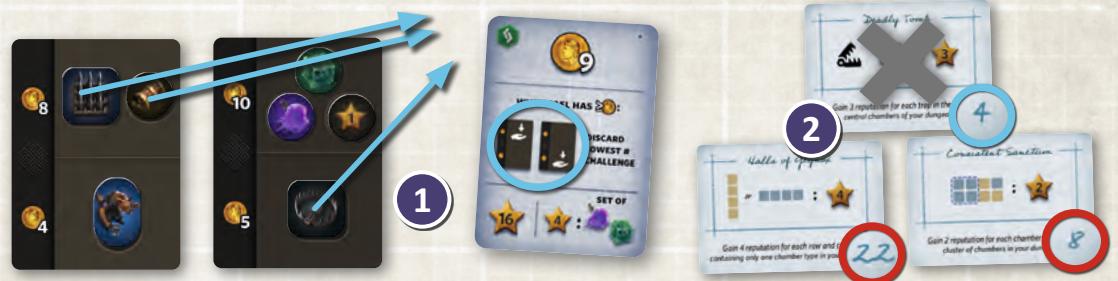

SOLO - GAMEPLAY CHANGES, CONT'D.
II. Improvement
Total your gold as in the multiplayer game, placing your tracking marker on the gold track.
COMPARE GOLD
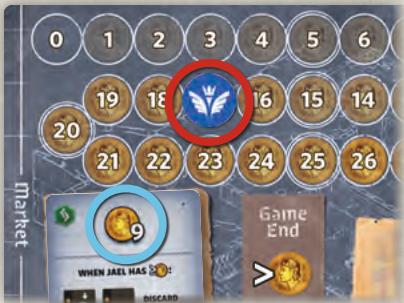
Compare your current gold value to the gold value on the revealed Jael card.
IF YOU HAVE MORE GOLD:
Visit the market to buy tokens or pass.
• If you buy tokens, adjust your marker on the gold track and place the tokens in your dungeon. Then return to the COMPARE GOLD step above.
• If you pass, see below.
IF YOU HAVE EQUAL OR LESS GOLD:
①Collect any tokens on the market cards corresponding to the $\textcircled { < }$ icons on the current Jael card and place them in Jael's scoring area.
②Discard the revealed challenge card with the lowest value.
③Visit the market to buy tokens or pass.
• If you buy tokens, adjust your marker on the gold track and place the tokens inyour dungeon. You may continue to buy tokens until you cannot or choose to pass.
• If you pass, see below.
IF YOU PASS
YEARS 1-3
• Move your tracking marker to the 0 space on the gold track.
• Select a revealed challenge card.
• Jael collects all remaining market tokens on the market cards.
• Continue to the Cleanup Phase.
YEAR 4
• Do not move your marker to the 0 space on the gold track.
• Flip your marker over to indicate that you have passed.
• Do not select a challenge card.
• Jael collects all remaining market tokens on the market cards.
• Continue to final scoring.
Jael may gain treasure chest market tokens as well as chamber cards with treasure chest icons throughout the game. These are not considered when determining his gold value.
III. Cleanup
The Cleanup Phase is completed in the same way as in the multiplayer game.
SOLO - FINAL SCORING
Scoring in solo play is the same as in a multiplayer game, with the exception of final priority, which is replaced by final gold. Use the solo side of the scorepad to tally your score and determine the winner of the game.
Calculate Jael's reputation as follows:
• Final Gold: Compare the position of your marker on the gold track to the gold value on the Jael card for year 4. If Jael has equal to or more gold than you, he gains 9 reputation and you gain 6 reputation. If you have more gold than Jael, he gains 6 reputation and you gain 9 reputation.
• Goal Card: Compare your dungeon to Jael's collected chamber cards and market tokens to determine first and second place for the scoring condition on the goal card. Between you and Jael, first place gains 15 reputation and secondplace gains 9 reputation. In the case of a tie, Jael places first.
• Jael Cards: For each card, Jael gains the base reputation and reputation according to the reputation condition.
• Chamber Reputation: Total the values of the reputation stars on Jael's chamber cards and market tokens. Jael gains (or loses) that amount of reputation.
If you have more reputation than Jael, you've impressed the queen's advisor and are declared the new Master Architect of Sabek!
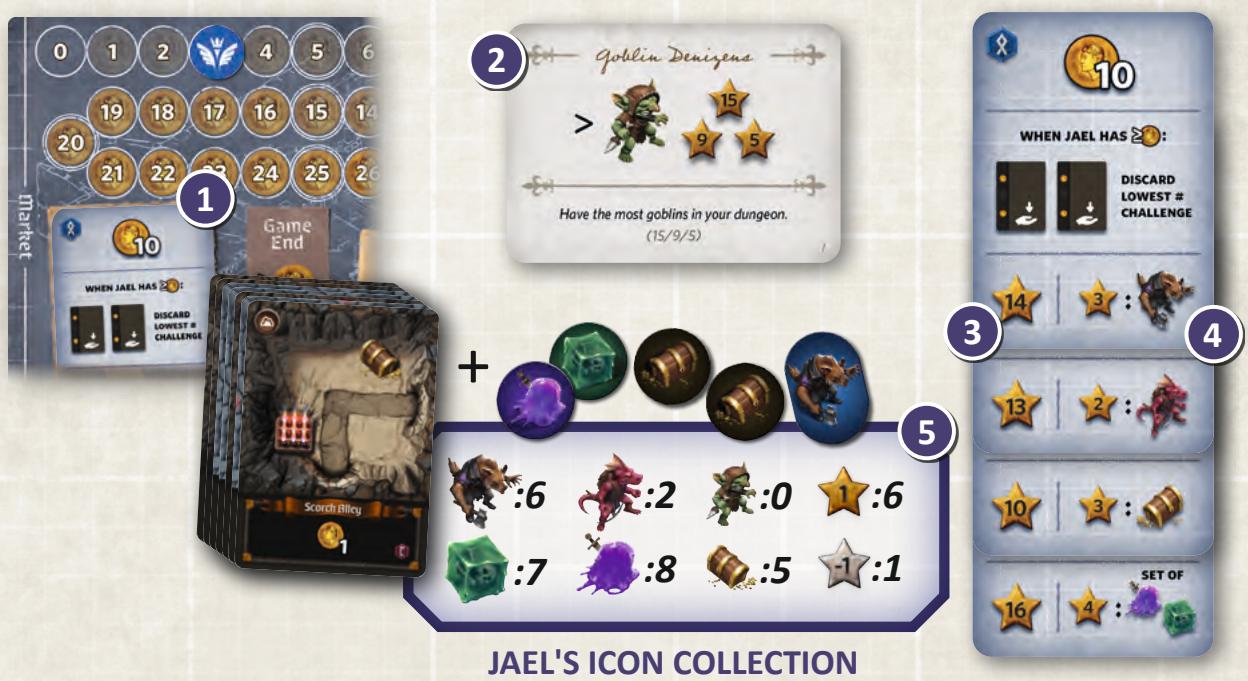
Example: Jael scores 132 reputation.
①9 reputation for having more gold than the player(10 vs 3),
②0 for the goal card (Jael has 0 goblins)
③53 for base reputation (14 + 13 + 10 + 16),
④65 for reputation conditions on the Jael cards (18 for gnolls, 4 for kobolds,
15 for treasure chests, and 28 for sets of slimes and oozes)
⑤5 reputation for reputation icons (6 - 1).

Monster (Generic) Includes Gnoll, Goblin, Kobold, Ooze, and Slime.

Iconser


Gnoll

Goblin

Kobold

Ooze

Slime


Treasure Chest
Trap (Generic)
Includes Bear, Blade, Fire, Pit, and Spike.


Fire
Bear
Pit


Blade

Reputation Star (Positive)
Secret Passage

Cave (Chamber Type)
Reputation Star (Negative)

Stone (Chamber Type)
Creditscr
Game Designer: Jordy Adan
Developers: Breeze Grigas, John Brieger, Luis Francisco & Keith Matejka
Graphic Designers: Luis Francisco, Stephen Kerr & Shy Lev-Ari
Illustrators: Lucas Ribeiro, Damien Mammoliti & Diego Sá
Narrative: James Ryan
Editors: Jon Healey & David Niecikowski
Special Thanks: To all the people who helped playtest and provide feedback throughout development: Phil Amylon, Kevin Barron, Paul Berkbigler, Scott Bogen, Ryan Boulder, Sarah Capybara, William Clos, Steven Dast, Kirk Dennison, Chris Domes, Michael Dunsmore, Steve Ehrensperger, Michael Epstein, John Galloway, Emily Hancock, Brian Hausrath, Jordan Johnson, Chris Kau, Nick Kitts, Renato Martins, Claire Matejka, Roger Meloche, Mike Mihealsick, Zach Molchany, Luke Muench, Josh Norris, Dan Radley, Joy Rodowicz, Jessica Shrestha, Carl Sommer, Jess Souder, John Velgus, and many more.
下载 Markdown原文为社区整理/出版社公开资料,版权归原作者,仅供个人学习查阅。