
帝国争霸Struggle Of Empires
一句话概览
帝国争霸 是一款已收录于村了吗规则库的桌游,支持 5–7 人,原名 Struggle Of Empires。
本页内容:一句话概览 · 游戏概述 · 1. 游戏组件 · 2. 游戏设置 · 3. 游戏流程 · 4. 游戏进行轨 · 5. 基本游戏概念 · 6. 联盟拍卖(Phase II 详解) · 7. 玩家行动(Phase III 详解) · 8. 常规行动 · 常见问题
帝国争霸 规则速览
本页收录规则速览的前 9 节(篇幅所限省略了后 5 节,其中 1 节为节选),完整规则速览与卡牌可在村了吗查询。
游戏概述
背景设定于18世纪——一个充满探索航海、殖民扩张和工业化开端的时代,欧洲及其广袤殖民地持续战火纷飞。玩家担任七大欧洲大国的领袖,指挥军事、经济与政治发展。游戏进行三场主要战争(每场5或6轮,代表约20年),战争开始前两大强国联盟对抗。每轮执行两个常规行动加任意免费行动,战争结束时根据在11个胜利点数地区(5个欧洲+6个殖民地)中控制标记的相对数量计算得分。黄金通过征税获取但会增加动乱风险,过度征税可致国家崩溃。
1. 游戏组件
纸板配件(302件)
| # | 物品 | 数量 |
|---|---|---|
| 1 | 规则书 | 1 |
| 2 | 游戏版图 | 1 |
| 3 | 中立地区记录板 | 1 |
| 4 | 钱币 | 60 |
| 5 | 黄金Token("1") | 50 |
| 6 | 黄金Token("5") | 10 |
| 7 | 动乱标记 | 100(含72×1、9×0、9×2、10×5) |
| 8 | 玩家版图(每国1个) | 7 |
| 9 | 中立地区标记 | 65 |
| 10 | 玩家顺位标记 / 战斗胜率图表 | 7 |
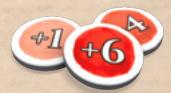
| 11 | 战力差异提示 | 3 |
| 12 | 贸易板块 | 9 |
| 13 | 免费行动板块 | 20 |
| 14 | 升级板块 | 19 |
| 15 | 军事战术板块 | 3 |
| 16 | 即时行动板块 | 16 |
木质配件(384件)
| # | 物品 | 数量 | 备注 |
|---|---|---|---|
| 1 | 战争标记 | 1 | — |
| 2 | 游戏阶段标记 | 1 | — |
| 3 | 拍卖槌 | 1 | — |
| 4 | 激活玩家标记 | 1 | — |
| 5 | 秘密行动指示物 | 2 | — |
| 6 | 军队 | 98 | 每色14 |
| 7 | 舰队 | 56 | 每色8 |
| 8 | 堡垒 | 14 | 每色2 |
| 9 | 控制标记 | 140 | 每色20 |
| 10 | 地方联盟标记 | 42 | 每色6 |
| 11 | 胜利点数标记 | 7 | 每色1 |
| 12 | 人口标记 | 7 | 每色1 |
| 13 | 大国联盟标记(有玩家时) | 7 | 每色1 |
| 14 | 大国联盟标记(无玩家时) | 7 | — |
| 15 | 拍卖标记 | 4 | 辅助或替代拍卖槌 |
其他组件
| 物品 | 数量 |
|---|---|
| 远海移动骰子 | 2 |
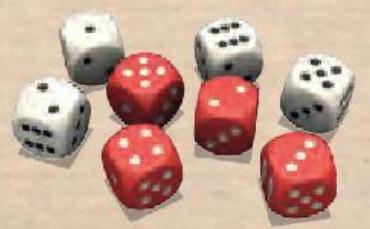
| 战斗骰子 | 8 |
| 布袋 | 2 |
2. 游戏设置
2.1 版图组件放置
- 将中立地区记录板放桌面中央。
- 从供应堆取3黄金放版图旁。
- 准备动乱盲抽袋:装入9个"0"值、72个"1"值、9个"2"值动乱标记("5"值不放袋中,留供应堆)。
- 战争标记放在战争轨空格(I)。
- 游戏阶段标记放在进行轨区域(II)。
2.2 人数相关板块调整
2人/3人/4人局需移除部分版图板块(参照版图右下角的玩家人数图标判断可用人数)。
2.3 玩家设置
- 围坐决定起始玩家(拍卖师,持有拍卖槌)。按顺时针轮询每位玩家依次选择:
- 选择大国,拿取对应颜色的所有配件:- 玩家版图
- 军事单位:14军队、8舰队、2堡垒
- 控制标记 ×20
- 地方联盟标记 ×6
- 胜利点数(VP)标记、人口标记、大国联盟(CabAL)标记各1
- 放置个人标记:
- 大国联盟标记 → 进行轨(II.)联盟提案圈旁
- 人口标记 → 人口轨空格(5)
- VP标记 → VP轨空格(0)
- 从供应堆领取10黄金。
2.4 非玩家大国设置(非7人局必做)
先于中立地区标记放置之前完成:
- 按玩家人数分配字母套组(A-E)给每个非玩家大国:
| 人数 | 使用套组 |
|---|---|
| 7人 | 跳过 |
| 6人 | A |
| 5人 | A+B |
| 4人 | A+B+C |
| 3人 | A+B+C+D |
| 2人 | A+B+C+D+E |
- (可选)随机洗混字母套组后抽取,若某大国分到重复的中立地区则返还并重抽,直到每个非玩家大国拥有5个不同的中立地区。
- 对每个非玩家大国的5个中立地区各放置一支该颜色的军队。
- (可选)有船只图标的地区投骰,1-2改为放舰队而非军队。
- 德国、中欧、奥斯曼帝国不投骰——永不放舰队。 - 2/3人特规:随机选其中一个中立地区,用控制标记代替军队。
- 所有使用的非玩家大国中立地区标记放置到中立记录板上;剩余的放回盲抽袋。
- 每个非玩家大国的大国联盟短圆柱标记放到对应格。其余配件放回盒子。
2.5 马兹·华莱士变体(Matt Wallace Variant,适用于4/5/6人局)
- 像7人局一样使用所有版图板块。
- 非玩家大国不放回盒子:为每个非玩家大国随机抽5个中立地区并放置军队(同玩家设置),有船标地区可投骰决定是否放舰队。
- 该非玩家大国的中立地区标记放置于记录板。
- Phase I:每场战争均抽并放置10个中立地区标记(如同7人局)。
- Phase II:所有7国(含非玩家)参与大国联盟拍卖(用短圆柱标)。
- Phase III:非玩家大国的军/舰为其盟友阵营提供力量加成——例如俄罗斯作为红盟非玩家,在北美有两支军队则在红盟成员任何海陆战中攻防均获+2。舰队仅用于海战。不能进攻中立地区。
- 非玩家大国单位永远不能被移除或成为目标(永久存在)。
- 计分忽略非玩家大国。
2.6 中立地区标记分配
地图放置数量
| 人数 | 放置数量 |
|---|---|
| 7人 | 10(从完整袋65个中抽) |
| 5-6人 | 9 |
| 4人 | 8 |
| 3人 | 6 |
| 2人 | 4 |
玩家抽取
- 4/5/6/7人:每人抽5个中立地区。
- 2/3人:每人抽6个中立地区。
- 抽取时可返还重复标记并重抽(原版不要求返还重复)。
- 完成后将所有使用的中立地区标记放中立记录板。
初始放置军事单位
- 从起始玩家开始,顺时针依次放置5轮(注意:是5轮不是5个!每轮放置1个单位)。
- 将你的1个军事单位(军队/舰队/堡垒)放置在任意VP产生地区,也可放在祖国内(不建议初玩者放祖国)。
- 不需要控制标记就能放置军事单位,移动规则不适用于此初始放置。
- 军队和堡垒可放十一个VP产生地区中的任意;舰队只能放有船只图标的地区。
- 保留原版规则的玩家:允许重复标记(扩散太稀严重影响游戏质量)。
经验玩家选项:轮抽起始中立地区
- 每名玩家抽取应分配数量+1个标记,面朝下选择1个留给自己,其余传左手边。
- 反复选择传递直到每人面前有分配数量的背面标记+手中1个未选的。
- 手中剩余的放回盲抽袋。
- 然后按通常规则为自己面前的每个标记放置控制标记。
2.7 版图与地图要点
- 7个大国的祖国均在欧洲。
- 11个VP地区:5个欧洲 + 6个殖民地。
- 殖民地周围有蓝色和白色边框——穿越这些远海边界需投掷远海移动骰子。欧洲内部移动不受影响。
放置限制
- 军事单位可放置在自己祖国内;不能放在其他国家祖国中。
- 舰队只能放在:①玩家的祖国;②带有彩色船只图标的VP地区(波罗的海、地中海,以及全部6个殖民地区)。
- 不可被舰队占领的地区:德国、中欧、奥斯曼帝国。
- 特例:地中海里的舰队可同时占领并支援地中海+奥斯曼帝国两地。
可执行活动的地区
- 可在地图上标明的地区执行:建立地方联盟、进行贸易(使用贸易板块)。
原版邻接关系变体(部分玩家可选)
| 修改 | 详情 |
|---|---|
| 英国↔德国 | 英国与德国相邻 |
| 德国↔波罗的海 | 德国与波罗的海不相邻 |
| 西班牙↔地中海 | 西班牙与地中海相邻 |
3. 游戏流程
帝国争霸进行3场战争(Wars),每场战争包含以下阶段:
Phase I — 抽取并放置中立地区标记(仅第2和第3场战争)
- 前一场战争遗留的中立标记保留在原处。
- 从盲抽袋中随机抽取规定数量的新中立地区标记放置到地图上。
Phase II — 决定大国联盟和回合顺序
详见下文第5章。
Phase III — 玩家行动
详见下文第6章。
Phase IV — 收入和维护 & 人口增长
详见下文第8章。
4. 游戏进行轨
进行轨有四个区域,标记当前所在阶段:
| 区域 | 名称 | 说明 |
|---|---|---|
| (I) | 抽取并放置中立地区标记 | 仅在第2、3场战争执行;盲抽袋随机抽取 |
| (II) | 决定大国联盟和回合顺序 | 使用大国联盟标记;拍卖槌指示下一位开始拍卖者 |
| (III) | 玩家行动 | 每名玩家依次行动;回合结束将风向标记传给下一位激活玩家 |
| (IV) | 收入与维持与人口增长 | 后续章节详述 |
5. 基本游戏概念
5.1 控制标记与控制
- 零和博弈:有人获得就有他人失去(大国或中立地区标记)。
- 每次战争开始时固定数量添加到VP地区。
- 通过用自己的控制标记替换中立地区标记来夺取所有权。
- 计分仅由控制标记决定,与军事力量无关。
- 绝对不能向任何人提供控制标记;只有激活玩家才能获得;不可交换或放弃。
5.2 人口(Population)
- 记录在人口轨上,范围0-9(不调整小于0或超过9的值)。
- 有限资源:用于部署军事单位或产生收入。
- 转化为军事会导致收入下降且维护成本增加,需有效平衡军事与收入。
5.3 动乱(Unrest)
动乱体现公民不满。高动乱在游戏结束时导致严厉惩罚甚至大国崩溃。
来源
| 触发事件 | 动乱增加值 |
|---|---|
| 每因任何理由失去1个军事单位(舰/军/堡) | +1 |
| 每次征税(Taxation) | +1 |
| 拿取产业升级板块(Improvement tile) | +2 |
减少方式
- 拿取政府改革板块(Government Reform)立即返还2点动乱。
- 跳过行动可返还1点动乱至供应堆。
放置规则
- 动乱标记藏在自己面前(隐藏式)。
- 返还时返还原数值(不是标记数量)至供应堆。耗尽时将供应堆全部×1标记放回盲抽袋。
- 公开动乱变体:原版规则可将动乱标记放公共供应堆(0值除外),每次拿取动乱直接+1而非抽随机标记,可根据需要与供应堆交换。隐藏动乱被认为增加了战争谜团。
征税示例
- 手上有1G,以4G赢得联盟拍卖需支付4G。缺3G→执行2次征税(+2动乱,+4G)→剩1G。若有银行Banking升级只需1次征税(+1动乱,+3G)→刚好够,剩0G且只+1动乱。
- 需支付贿赂但仅有1G→征税获取额外G并承受动乱。
- 征税能力受动乱容忍度限制。
5.4 黄金(Gold)
用途
- 购买某些板块
- 支付赢得联盟拍卖
- 发动进攻(2G)
- 谈判/贿赂/勒索等
起始与增长
- 起始10G。通过与贸易和战争结束时的收入增加。
征税规则
- 当你有费用支出但手上不足黄金时,必须用征税免费行动补足。
- 可在非激活状态下执行以支付给其他玩家。
- 每次征税:拿取1个动乱标记 + 拿取2黄金(有Banking升级→3G)。
- 必须先花光手上黄金,仅用征税补赤字。
- 不能用钱消除动乱;也不能只为积累黄金而征税。
5.5 谈判(Negotiation)
- 开放、非正式的过程,随时可以进行(特别在提出联盟提案或宣告进攻时)。
- 可包括:支付金额/贿赂改变联盟、扣押或承诺单位、进攻/防守其他玩家、勒索黄金换取不进攻等。
- 进攻时盟友可承诺任意数量的舰队和/或军队至特定地区内,但不能承诺堡垒(仅保卫拥有者)或转让地方联盟利益。
- 进攻者和防御者在进攻中仅受益于自己的板块。
- 2人游戏中仍可贿赂对手。
6. 联盟拍卖(Phase II 详解)
6.1 组建联盟
- 组建红色(Red)和蓝色(Blue)两个联盟。
- 玩家和非玩家通过一系列拍卖分为两个联盟。
- 每次拍卖是一次提案(Proposal):将2个未联盟的大国分别放入对立联盟(一个入红、一个入蓝)。
- 盟友加入顺序也决定当前战争的回合顺位。
- 每次拍卖结束后新提案开始新一轮拍卖,直到所有玩家都进入联盟。
- 所有玩家在拍卖前都必须已在联盟中——少于7人的奇数人数时,最后1个未联盟玩家与1个非玩家大国在最后一次提案中对决。
- 所有玩家均可参与每次拍卖,无论是否已加入联盟。
6.2 拍卖流程
- 第一场战争的第一轮拍卖由起始玩家开始,顺时针继续。
- 第2和第3场战争:先前战争中最后行动的玩家获拍卖槌开始下一轮。
- 拍卖槌由持有者传给左手边下一位玩家(传递后发起提案)。
- 发起提案:将一名玩家的联盟标记放红色圆圈、另一名放蓝色圆圈。
- 提案可包含自己也可以不包含。
- 仅在奇数人数最后一次拍卖时,可单独放置一个联盟标记至红或蓝。 - 首名玩家可以任意金额开价,包括0。出价不需要手中持有黄金(赢时才需支付)。
- 玩家可跳过(Skip)(表示对当前提案满意)或提高出价(Higher Bid):
- 跳过后可在同一次拍卖后续轮次重新加入竞价。
- 提高出价允许用任意两个未联盟大国标记改变提案。 - 在所有其他玩家连续跳过之前的最后一次出价者获胜。
6.3 赢得拍卖后
- 赢家立即支付竞价(必要时征税)。其他出价被忽略。
- 红色圆圈中的标记放红色联盟行第一格(从左到右),蓝色同理。
- 从持有拍卖槌的玩家开始重复拍卖,直到所有玩家都在联盟表中。
- 最后一次拍卖完成后,拍卖槌交给当前战争的最后行动玩家(下一场战争开始拍卖)。
- 按联盟表位置给予每名玩家回合顺位板块(Order Tiles: 1, 2, 3...)。
- 第一轮靠前有优势(优先拿到COL/GCC等板块);后轮靠后有优势(煽动海盗/殖民地叛乱在领先者回合结束后使用最佳效果)。
6.4 拍卖示例
- 英国先提提案:自己→红色,普鲁士→蓝色,出价1G。
- 法国跳过。
- 普鲁士不满,提新提案:奥地利→红色,法国→蓝色,提高到4G。
- 其余都跳过。普鲁士以4G胜出。
- 普鲁士手上有3G→执行1次征税(+1动乱,+2G)=总5G→支付4G剩1G。
- 奥地利放红色第1格,法国放蓝色第1格。奥地利先行动,法国后。
- 法国开始下一轮拍卖,传递给普鲁士后发起提案。
7. 玩家行动(Phase III 详解)
7.1 轮数
| 人数 | 轮数 |
|---|---|
| 2/3/4人 | 6轮 |
| 5/6/7人 | 5轮 |
| 非玩家大国 | 不行动 |
7.2 行动类型与配额
- 三种行动类型:常规(Regular)、特殊(Special)、免费(Free)。
- 每回合可做2个常规或1个常规+1个特殊(任意顺序)。
- 免费行动可随意使用(征税、免费行动板块、战术板块Tactics)。
- 所有玩家完成2个行动后→推进阶段标记→进入下一轮(从顺位1st开始)。
7.3 回合顺位
由各国在大国联盟表上的位置决定。
8. 常规行动
8.1 建造1个军事单位
- 花费1人口,在祖国放置1个军队、舰队或堡垒(降低人口轨)。
- 建完后可按"移动2军事单位"规则移动到满足条件的地区。
- 堡垒:建造时可移动,被视为移动的军队。一旦移到祖国之外就不能再移动(堡垒移动代表加农炮运输)。
- 摧毁再建:可先用建造行动摧毁单位再重建,花费仍为1人口+获得1动乱(常用于重建堡垒)。
- 例外:堡垒若远海移动鉴定失败留在祖国中,之后只能通过常规的"移动2军事单位"行动来移动它。
远海移动(Overseas Movement)
穿过远海边界的移动需投掷远海移动骰子:
| 结果 | 含义 | 后续选择 |
|---|---|---|
| 成功 Success | 移动成功 | — |
| 停留 Stall | 单位原地不动 | 可选支付1G成功移动 |
| 沉没 Sink | 失去单位 | 可选支付2G保留,或总计支付3G成功移动 |
原版远海变体:同时投掷白色和红色骰子。白骰>1→移动成功。白骰=1时看红骰:1-2损失单位,3-4单位留在原地,5-6移动成功。Navigation板块可为红骰提供+2或+4修正。
8.2 移动2军事单位
- 仅限军队或舰队(堡垒一旦放置就不能再移动)。
- 可将2次移动作为2个独立事件(如1个军队+1个舰队)。
- 如果第一次移动的单位远海鉴定失败,不能对该单位执行第二次移动。
- 所有移动都是点对点的,不穿越中间地区,无距离限制。
- 可进入祖国,绝不能进入另一个大国的祖国。
舰队移动
- 可从任何地区移至任何有船只图标的其他地区(6个殖民地、波罗的海、地中海)或你的祖国。
- 不能移动至德国、中欧或奥斯曼帝国。
军队移动
- 可以移动到至少有你1个舰队所在的殖民地。
- 总是可以移动到任意欧洲VP地区或祖国(不需舰队)。
- 北美/加勒比/南美之间移动需目的地有舰队(优势是不需要远海鉴定)。
- 远海移动定义:跨越1个或多个远海边界的任何不完全在欧洲或不全在美洲的移动。例如北美的舰队不允许军队移到加勒比或南美,只能到北美。
原版相邻与军队移动变体
- 原版更偏向某些大国(奥地利可直接进4个欧洲地区,英/尼德兰/西班牙只能进1个)。
- 以下条件满足其一即可从任意地点移入欧洲地区:在欧洲有控制标记、在相邻欧洲地区有控制标记、波罗的海有舰队可进入、地中海有舰队可进入地中海或奥斯曼帝国、该欧洲地区与你的祖国相邻。
8.3 进行1次进攻
进攻目的
- 主要目的:转化中立地区标记或对立项大国的控制标记来获得控制标记。
- 进攻敌人军事单位(但没有控制标记的地方)除了增加自己的动乱风险外不值得。
- 永远不能直接进攻属于自己大国联盟的控制标记。
宣告和支出
- 进攻者支付2黄金并指定进攻地区和被进攻的目标(中立地区或大国控制标记)。
- 进攻者必须当前拥有1支军队才能进行陆地战斗。仅有舰队也能发生海上战斗(仅消灭敌方舰队为目的)。
- 可能同时包括海战和陆战。如果有海战,优先发生。
- 海战决定谁将在随后陆战中获+1战斗力奖励——仅限带有船只图标的VP地区(6个殖民地、波罗的海、地中海、包括奥斯曼帝国的进攻)。
海上战斗条件
- 进攻者和防御者必须各有一支舰队(或盟友舰队在场)才参与。本地盟友舰队 alone 不够。
- 双方各自决定是否承诺舰队参加(进攻者先决定,然后防御者)。
- 所有舰队单位都必须参与(如果有海战的话)。
原版海上变体:进攻者必须拥有自己的舰队才能参战,本地同盟或盟友舰队不够。
陆地战斗条件
- 进攻者必须有至少1支自己的军队。
- 进攻者的所有军队单位和防御者的所有军队及堡垒必须参与(堡垒不用于进攻方)。
召集盟友
- 进攻者准备好后(已付2G、投骰前),进攻者召集盟友,然后防御者也如此。
- 盟友正式承诺舰队和/或军队单位(堡垒不能协助防御)。
- 即使黄金已易手,这些谈判没有约束力。
- 不应和中立地区联盟来协助防御。
非玩家大国自动与其联盟的进攻者/防御者结盟(含2/3人对非玩家控制标记的防御):
- 非玩家大国永远不会被进攻或移除(无论是战斗中还是投出7)。
- 进攻中立地区时非玩家大国不参与。
- 2/3人中非玩家控制标记有3点防御值,不在你联盟中可被进攻。
- 非玩家大国控制标记作为盟友时不增战斗力。
战斗结算
海上战斗 Sea Battle
- 确定基础力量:
- 每个友方舰队(含盟友承诺):+1
- 拥有更多海军训练板块的一方:+1(必须当前拥有舰队)
- 该地区的每个本地联盟:+1(仅攻/防双方)- 同一本地联盟只能用于海或陆其中之一,立刻选择。用于海战后不能用于后续陆战。
- 双方各投2骰子,计算差值,加至基础力量得总力量。
- 胜者获+1海上支援奖励,平手无人获修正。
- 重要:胜者是否有存活舰队不影响修正。
陆地战斗 Land Battle
……(完整内容可在村了吗查询)
常见问题(FAQ)
以下 1 条问答中 0 条来自站内玩家的真实提问,其余 1 条为本站整理的常见疑问;答复内容保持原样。
帝国争霸支持几个人玩?
5–7 人。
去哪查完整规则
想核对具体规则细节、卡牌效果或某个回合的结算方式,可以在村了吗里选中这款游戏后直接提问。
同类桌游
- 卡坦岛德式
- 工业革命:伯明翰德式
- 勃艮第城堡:特别典藏版德式
- 方舟动物园德式
- 卡卡颂抽象
- 瘟疫危机传承:第一季美式
- 阿瑞迪亚:勇踏征途美式
- 重塑宇宙德式
- 幽港迷城美式
- 埃多拉的德鲁伊德式
规则原文(Markdown)
本站收录这款游戏的规则原文 2 个文件,此处内联渲染 2 个,可直接展开阅读或下载。
rules_zh_帝国争霸_770.md125.0 KB
RULE BOOK
目录
介绍 3
游戏玩法概述 3
配件 4
游戏版图 5
游戏地图 5
游戏进行轨 6
游戏设置 6
玩家设置 6
游戏概念 9
控制标记和计分 9
人口 9
动乱 9
黄金 10
征税 10
谈判 10
游戏流程 11
I.抽取并放置中立地区标记 11
II.决定大国联盟和回合顺序 11
III.玩家行动 13
常规行动 13
建造1军事单位 13
移动2军事单位 14
进行1次进攻 16
跳过 23
特殊行动 23
殖民 23
黄金海岸商业 23
建立本地联盟 23
获取1个板块 23
免费行动板块 24
立即行动板块 24
升级板块 25
军事战术板块 25
使用1秘密行动指示物 26
IV.收入和维护 & 人口增长 26
V.计算胜利点数的控制 27
VI.战争结束 27
3RD战争-游戏结束 28
帝国争霸策略指南 28
制作人员 28
介绍
帝国争霸的背景是 18 世纪:一个探索和航海的时代,一个殖民的时期和工业化的开端,同时伴随着欧洲及其广泛的殖民地的持续不断的战争。
你将担任当时的七个欧洲大国之一的领袖并引导它的军事,经济和政治发展来与你的对手的大国竞争。你将会结成同盟,建设军队和船队,建立殖民地,改善经济,发动战争,并且处理你的人民之间的乱子。
你将会决定是在欧洲进行扩张还是控制美洲,非洲和远东地区的殖民地。如果一切顺利,你的选择将会引导你在即将到来的帝国争霸中取得胜利!
游戏玩法概述
该游戏包含三场主要战争,根据玩家数量,每场战争都会持续5或6轮。每场战争都开始于两个强大的大国联盟并代表大约20年的时期。在每轮游戏中,你将会进行两个行动,并且如果可以的话,还能执行任意数量的免费行动。在每场战争结束时,你将会根据你在欧洲和殖民地的共计11个地区中的每个地区里的大国控制标记的相对数量来计算胜利点数。尽管军事单位可以被用于占领或保护控制标记,但是它们本身并不代表对一个地区的控制。如何平衡你的军事和经济的需求将会是你所面临的挑战。
玩家们可以利用各种板块和指示物——包括本地联盟,贸易,特殊能力,升级,军事战术以及秘密行动——获得经济,军事和政治利益。没有这些是很难获胜的。
黄金在整个游戏中至关重要。尽管黄金总是可以通过征税获得,但是它是以增加你的国家公民的动乱为代价的。过度征税而导致的大规模动乱会导致负面后果,包括使你的国家彻底崩溃!
帝国争霸中所描绘的时代是一个跨大西洋的残暴的奴隶贸易兴盛的时代——以被熟知的非洲西部的黄金海岸为中心。就规模和持续时间而言,其是人类史上最大的悲剧之一,通常被视作为全球化的第一个实例。在本游戏中,这一系统被称作黄金海岸商业。
帝国争霸豪华版
作为一款倍受推崇的策略游戏,帝国争霸长期以来一直是制作升级版本的候选者——而老鹰社以其制作豪华高质量版本游戏的专业水准而闻名。我们制作了全新的美术,一个大型的重新设计的游戏版图,高质量的纸板配件,新的木质配件,以及带有完成收纳方案的更大的盒子。最重要的时,我们对规则书进行了升级更新!
这本经过更新和修订的规则书阐明了原版规则及示例同时提供了大量的变体规则。我们很高兴地加入了2条来自马丁华莱士的全新变体规则。其他的变体基于设计师和粉丝们的建议。一些解决了游戏中的平衡性和运气问题,另一些则提供了一些新的有关于游戏设置和更少游戏人数的想法。我们已经检查过BGG上的许多话题,评论和文件——包括由马丁华莱士和创造了这款优秀游戏原版的树蛙团队的成员们提出的话题与评论。我们随后研究,测试游戏,并且精心设计了这些变体并全都包括在游戏中,以便于玩家们使用最适合他们游戏团队的规则。
游戏配件
纸板配件
(302)

1 规则书
1 游戏版图

1 中立地区记录板



60 钱币
50x “1” 黄金,
10x “5” 黄金
100 动乱标记
72x “1”, 9x “0”, 9x “2”, 10x “5”
7 玩家版图每个大国1个

65 中立地区标记

7 玩家顺位标记 / 战斗胜率图表
3 战力差异提示

9 贸易板块

20 免费行动板块

19 升级板块

3 军事战术板块

16 即时行动板块
木质配件
(384)

1 战争标记

1 游戏阶段标记

1 拍卖槌

1 激活玩家标记

2 秘密行动指示物

98 军队
每个玩家颜色14

56 舰队
每个玩家颜色8

14 堡垒
每个玩家颜色2
140 控制标记每个玩家颜色20


42 地方联盟标记每个玩家颜色 6

7 胜利点数标记每个玩家颜色1

7 人口标记
每个玩家颜色 1

7大国联盟标记每个玩家颜色1

7大国联盟标记
(对应没有玩家的大国)
每个玩家颜色1
其他

4 拍卖标记
这些可以辅助或替换掉
拍卖槌

2 远海移动骰子
8 战斗骰子

2 布袋
游戏版图
游戏地图
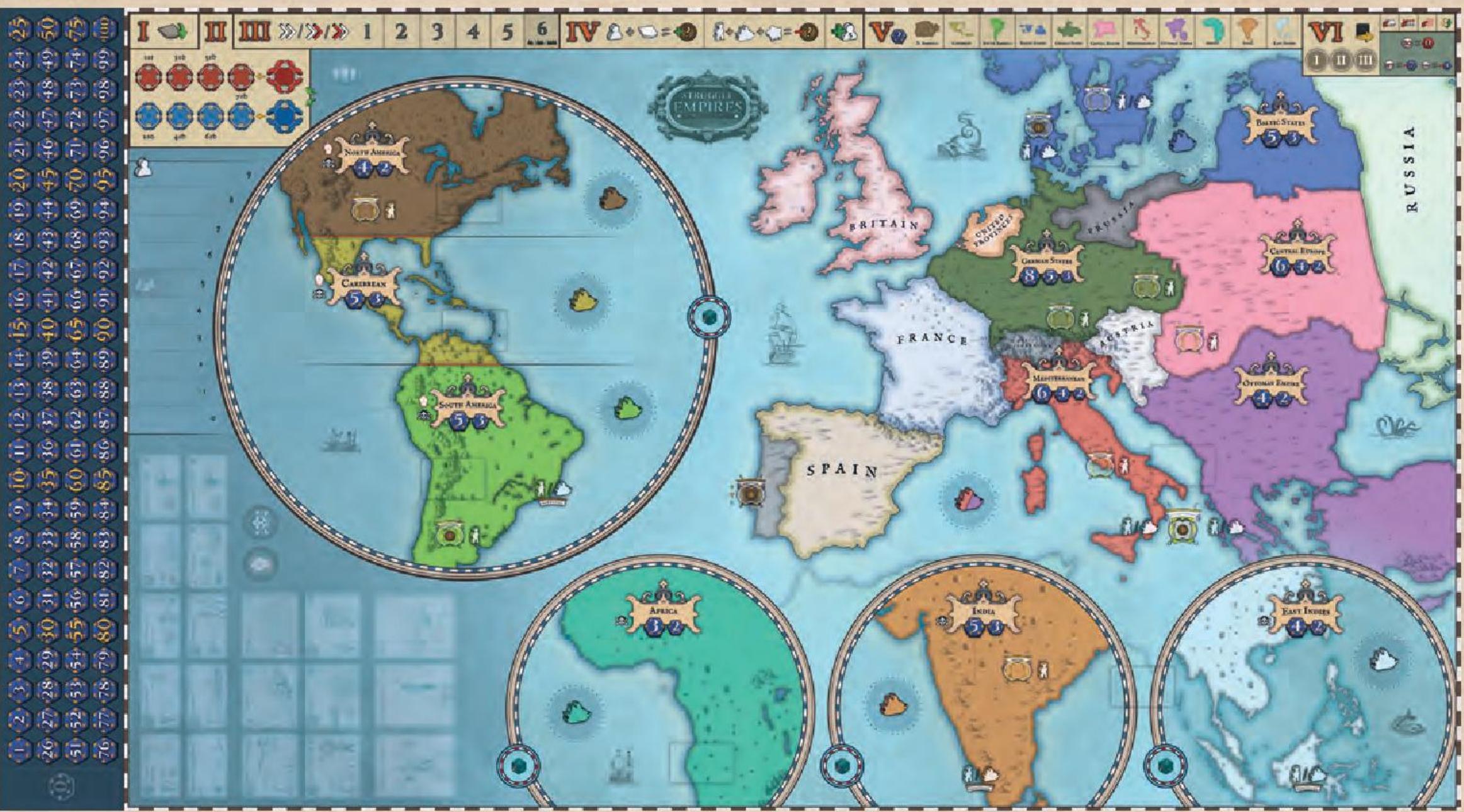
该地图由 7 个大国和 11 个胜利点数地区构成:这 7 个大国都在欧洲。一共有 5 个欧洲胜利点数地区和 6 个殖民胜利点数地区。
殖民地区周围的蓝色和白色边框表示遥远地区,当有单位移动进入或离开这些遥远的地区时需要投掷一次远海移动骰子。在欧洲内部的移动不受影响。

* 你和你的对手将每人选取 7 个大国中的 1 个来领导即将到来的帝国争霸,并将争夺 11 个胜利点数地区的控制权。
* 你可以放置军事单位至你的祖国中,但是不能放置在其他玩家的祖国中。
* 舰队只能被放置在一名玩家的祖国或带有一个彩色船只图标的胜利点数地区中(欧洲的波罗的海和地中海加上六个殖民地区)。
* 德国,中欧和奥斯曼帝国永远不会被舰队占领。


* 特殊情况:如该双色船只图标所示,一个地中海里的舰队占领并支援着地中海和奥斯曼帝国两地。
* 玩家可以在地图上绘有的地区执行:
* 建立地方联盟(通过放置地方联盟标记):
原版规则变体
* 进行贸易(通过使用贸易板块):
地方联盟
* 英国与德国相邻。
* 德国与波罗的海不相邻。
* 西班牙与地中海相邻。
在14页查看军队移动规则以及对该变化的进一步讨论。


贸易板块


(1) 请在以下内容中说明:
1. 请在以下内容中说明:
(1)请在以下内容中说明:
(2)请在以下内容中说明:
(3)请在以下内容中说明:
(4)请在以下内容中说明:
(5)请在以下内容中说明:
(6)请在以下内容中说明:
(7)请在以下内容中说明:
(8)请在以下内容中说明:
(9)请在以下内容中说明:
(10)请在以下内容中说明:
(11)请在以下内容中说明:
(12)请在以下内容中说明:
The following table provides the results of the report: (1) The report is prepared and reviewed by the Company and is conducted by the Company in the form of the Company's Operations, and (2) The Company's internal structure and reporting of the Company's operations is not necessarily suitable for the Company's operations, and (3) The Company's internal structure and reporting of the Company's operations is not necessarily suitable for the Company's operations, and (4) The Company's internal structure and reporting of the Company's operations is not necessarily suitable for the Company's operations, and (5) The Company's internal structure and reporting of the Company's operations is not necessarily suitable for the Company's operations, and (6) The Company's internal structure and reporting of the Company's operations is not necessarily suitable for the Company's operations, and (7) The Company's internal structure and reporting of the Company's operations is not necessarily suitable for the Company's operations, and (8) The Company's internal structure and reporting of the Company's operations is not necessarily suitable for the Company's operations, and (9) The Company's internal structure and reporting of the Company's operations is not necessarily suitable for the Company's operations, and (10) The Company's internal structure and reporting of the Company's operations is not necessarily suitable for the Company's operations, and (11) The Company's internal structure and reporting of the Company's operations is not necessarily suitable for the Company's operations, and (12) The Company's internal structure and reporting of the Company's operations is not necessarily suitable for the Company's operations, and (13) The Company's internal structure and reporting of the Company's operations is not necessarily suitable for the Company's operations, and (14) The Company's internal structure and reporting of the Company's operations is not necessarily suitable for the Company's operations, and (15) The Company's internal structure and reporting of the Company's operations is not necessarily suitable for the Company's operations, and (16) The Company's internal structure and reporting of the Company's operations is not necessarily suitable for the Company's operations, and (17) The Company's internal structure and reporting of the Company's operations is not necessarily suitable for the Company's operations, and (18) The Company's internal structure and reporting of the Company's operations is not necessarily suitable for the Company's operations, and (19) The Company's internal structure and reporting of the Company's operations is not necessarily suitable for the Company's operations, and (20) The Company's internal structure and reporting of the Company's operations is not necessarily suitable for the Company's operations, and (21) The Company's internal structure and reporting of the Company's operations is not necessarily suitable for the Company's operations, and (22) The Company's internal structure and reporting of the Company's operations is not necessarily suitable for the Company's operations, and (23) The Company's internal structure and reporting of the Company's operations is not necessarily suitable for the Company's operations, and (24) The Company's internal structure and reporting of the Company's operations is not necessarily suitable for the Company's operations, and (25) The Company's internal structure and reporting of the Company's operations is not necessarily suitable for the Company's operations, and (26) The Company's internal structure and reporting of the Company's operations is not necessarily suitable for the Company's operations, and (27) The Company's internal structure and reporting of the Company's operations is not necessarily suitable for the Company's operations, and (28) The Company's internal structure and reporting of the Company's operations is not necessarily suitable for the Company's operations, and (29) The Company's internal structure and reporting of the Company's operations is not necessarily suitable for the Company's operations, and (30) The Company's internal structure and reporting of the Company's operations is not necessarily suitable for the Company's operations, and (31) The Company's internal structure and reporting of the Company's operations is not necessarily suitable for the Company's operations, and (32) The Company's internal structure and reporting of the Company's operations is not necessarily suitable for the Company's operations, and (33) The Company's internal structure and reporting of the Company's operations is not necessarily suitable for the Company's operations, and (34) The Company's internal structure and reporting of the Company's operations is not necessarily suitable for the Company's operations, and (35) The Company's internal structure and reporting of the Company's operations is not necessarily suitable for the Company's operations, and (36) The Company's internal structure and reporting of the Company's operations is not necessarily suitable for the Company's operations, and (37) The Company's internal structure and reporting of the Company's operations is not necessarily suitable for the Company's operations, and (38) The Company's internal structure and reporting of the Company's operations is not necessarily suitable for the Company's operations, and (39) The Company's internal structure and reporting of the Company's operations is not necessarily suitable for the Company's operations, and (40) The Company's internal structure and reporting of the Company's operations is not necessarily suitable for the Company's operations, and (41) The Company's internal structure and reporting of the Company's operations is not necessarily suitable for the Company's operations, and (42) The Company's internal structure and reporting of the Company's operations is not necessarily suitable for the Company's operations, and (43) The Company's internal structure and reporting of the Company's operations is not necessarily suitable for the Company's operations, and (44) The Company's internal structure and reporting of the Company's operations is not necessarily suitable for the Company's operations, and (45) The Company's internal structure and reporting of the Company's operations is not necessarily suitable for the Company's operations, and (46) The Company's internal structure and reporting of the Company's operations is not necessarily suitable for the Company's operations, and (47) The Company's internal structure and reporting of the Company's operations is not necessarily suitable for the Company's operations, and (48) The Company's internal structure and reporting of the Company's operations is not necessarily suitable for the Company's operations, and (49) The Company's internal structure and reporting of the Company's operations is not necessarily suitable for the Company's operations, and (50) The Company's internal structure and reporting of the Company's operations is not necessarily suitable for the Company's operations, and (51) The Company's internal structure and reporting of the Company's operations is not necessarily suitable for the Company's operations, and (52) The Company's internal structure and reporting of the Company's operations is not necessarily suitable for the Company's operations, and (53) The Company's internal structure and reporting of the Company's operations is not necessarily suitable for the Company's operations, and (54) The Company's internal structure and reporting of the Company's operations is not necessarily suitable for the Company's operations, and (55) The Company's internal structure and reporting of the Company's operations is not necessarily suitable for the Company's operations, and (56) The Company's internal structure and reporting of the Company's operations is not necessarily suitable for the Company's operations, and (57) The Company's internal structure and reporting of the Company's operations is not necessarily suitable for the Company's operations, and (58) The Company's internal structure and reporting of the Company's operations is not necessarily suitable for the Company's operations, and (59) The Company's internal structure and reporting of the Company's operations is not necessarily suitable for the Company's operations, and (60) The Company's internal structure and reporting of the Company's operations is not necessarily suitable for the Company's operations, and (61) The Company's internal structure and reporting of the Company's operations is not necessarily suitable for the Company's operations, and (62) The Company's internal structure and reporting of the Company's operations is not necessarily suitable for the Company's operations, and (63) The Company's internal structure and reporting of the Company's operations is not necessarily suitable for the Company's operations, and (64) The Company's internal structure and reporting of the Company's operations is not necessarily suitable for the Company's operations, and (65) The Company's internal structure and reporting of the Company's operations is not necessarily suitable for the Company's operations, and (66) The Company's internal structure and reporting of the Company's operations is not necessarily suitable for the Company's operations, and (67) The Company's internal structure and reporting of the Company's operations is not necessarily suitable for the Company's operations, and (68) The Company's internal structure and reporting of the Company's operations is not necessarily suitable for the Company's operations, and (69) The Company's internal structure and reporting of the Company's operations is not necessarily suitable for the Company's operations, and (70) The Company's internal structure and reporting of the Company's operations is not necessarily suitable for the Company's operations, and (71) The Company's internal structure and reporting of the Company's operations is not necessarily suitable for the Company's operations, and (72) The Company's internal structure and reporting of the Company's operations is not necessarily suitable for the Company's operations, and (73) The Company's internal structure and reporting of the Company's operations is not necessarily suitable for the Company's operations, and (74) The Company's internal structure and reporting of the Company's operations is not necessarily suitable for the Company's operations, and (75) The Company's internal structure and reporting of the Company's operations is not necessarily suitable for the Company's operations, and (76) The Company's internal structure and reporting of the Company's operations is not necessarily suitable for the Company's operations, and (77) The Company's internal structure and reporting of the Company's operations is not necessarily suitable for the Company's operations, and (78) The Company's internal structure and reporting of the Company's operations is not necessarily suitable for the Company's operations, and (79) The Company's internal structure and reporting of the Company's operations is not necessarily suitable for the Company's operations, and (80) The Company's internal structure and reporting of the Company's operations is not necessarily suitable for the Company's operations, and (81) The Company's internal structure and reporting of the Company's operations is not necessarily suitable for the Company's operations, and (82) The Company's internal structure and reporting of the Company's operations is not necessarily suitable for the Company's operations, and (83) The Company's internal structure and reporting of the Company's operations is not necessarily suitable for the Company's operations, and (84) The Company's internal structure and reporting of the Company's operations is not necessarily suitable for the Company's operations, and (85) The Company's internal structure and reporting of the Company's operations is not necessarily suitable for the Company's operations, and (86) The Company's internal structure and reporting of the Company's operations is not necessarily suitable for the Company's operations, and (87) The Company's internal structure and reporting of the Company's operations is not necessarily suitable for the Company's operations, and (88) The Company's internal structure and reporting of the Company's operations is not necessarily suitable for the Company's operations, and (89) The Company's internal structure and reporting of the Company's operations is not necessarily suitable for the Company's operations, and (90) The Company's internal structure and reporting of the Company's operations is not necessarily suitable for the Company's operations, and (91) The Company's internal structure and reporting of the Company's operations is not necessarily suitable for the Company's operations, and (92) The Company's internal structure and reporting of the Company's operations is not necessarily suitable for the Company's operations, and (93) The Company's internal structure and reporting of the Company's operations is not necessarily suitable for the Company's operations, and (94) The Company's internal structure and reporting of the Company's operations is not necessarily suitable for the Company's operations, and (95) The Company's internal structure and reporting of the Company's operations is not necessarily suitable for the Company's operations, and (96) The Company's internal structure and reporting of the Company's operations is not necessarily suitable for the Company's operations, and (97) The Company's internal structure and reporting of the Company's operations is not necessarily suitable for the Company's operations, and (98) The Company's internal structure and reporting of the Company's operations is not necessarily suitable for the Company's operations, and (99) The Company's internal structure and reporting of the Company's operations is not necessarily suitable for the Company's operations, and (100) The Company's internal structure and reporting of the Company's operations is not necessarily suitable for the Company's operations, and (101) The Company's internal structure and reporting of the Company's operations is not necessarily suitable for the Company's operations, and (102) The Company's internal structure and reporting of the Company's operations is not necessarily suitable for the Company's operations, and (103) The Company's internal structure and reporting of the Company's operations is not necessarily suitable for the Company's operations, and (104) The Company's internal structure and reporting of the Company's operations is not necessarily suitable for the Company's operations, and (105) The Company's internal structure and reporting of the Company's operations is not necessarily suitable for the Company's operations, and (106) The Company's internal structure and reporting of the Company's operations is not necessarily suitable for the Company's operations, and (107) The Company's internal structure and reporting of the Company's operations is not necessarily suitable for the Company's operations, and (108) The Company's internal structure and reporting of the Company's operations is not necessarily suitable for the Company's operations, and (109) The Company's internal structure and reporting of the Company's operations is not necessarily suitable for the Company's operations, and (110) The Company's internal structure and reporting of the Company's operations is not necessarily suitable for the Company's operations, and (111) The Company's internal structure and reporting of the Company's operations is not necessarily suitable for the Company's operations, and (112) The Company's internal structure and reporting of the Company's operations is not necessarily suitable for the Company's operations, and (113) The Company's internal structure and reporting of the Company's operations is not necessarily suitable for the Company's operations, and (114) The Company's internal structure and reporting of the Company's operations is not necessarily suitable for the Company's operations, and (115) The Company's internal structure and reporting of the Company's operations is not necessarily suitable for the Company's operations, and (116) The Company's internal structure and reporting of the Company's operations is not necessarily suitable for the Company's operations, and (117) The Company's internal structure and reporting of the Company's operations is not necessarily suitable for the Company's operations, and (118) The Company's internal structure and reporting of the Company's operations is not necessarily suitable for the Company's operations, and (119) The Company's internal structure and reporting of the Company's operations is not necessarily suitable for the Company's operations, and (120) The Company's internal structure and reporting of the Company's operations is not necessarily suitable for the Company's operations, and (121) The Company's internal structure and reporting of the Company's operations is not necessarily suitable for the Company's operations, and (122) The Company's internal structure and reporting of the Company's operations is not necessarily suitable for the Company's operations, and (123) The Company's internal structure and reporting of the Company's operations is not necessarily suitable for the Company's operations, and (124) The Company's internal structure and reporting of the Company's operations is not necessarily suitable for the Company's operations, and (125) The Company's internal structure and reporting of the Company's operations is not necessarily suitable for the Company's operations, and (126) The Company's internal structure and reporting of the Company's operations is not necessarily suitable for the Company's operations, and (127) The Company's internal structure and reporting of the Company's operations is not necessarily suitable for the Company's operations, and (128) The Company's internal structure and reporting of the Company's operations is not necessarily suitable for the Company's operations, and (129) The Company's internal structure and reporting of the Company's operations is not necessarily suitable for the Company's operations, and (130) The Company's internal structure and reporting of the Company's operations is not necessarily suitable for the Company's operations, and (131) The Company's internal structure and reporting of the Company's operations is not necessarily suitable for the Company's operations, and (132) The Company's internal structure and reporting of the Company's operations is not necessarily suitable for the Company's operations, and (133) The Company's internal structure and reporting of the Company's operations is not necessarily suitable for the Company's operations, and (134) The Company's internal structure and reporting of the Company's operations is not necessarily suitable for the Company's operations, and (135) The Company's internal structure and reporting of the Company's operations is not necessarily suitable for the Company's operations, and (136) The Company's internal structure and reporting of the Company's operations is not necessarily suitable for the Company's operations, and (137) The Company's internal structure and reporting of the Company's operations is not necessarily suitable for the Company's operations, and (138) The Company's internal structure and reporting of the Company's operations is not necessarily suitable for the Company's operations, and (139) The Company's internal structure and reporting of the Company's operations is not necessarily suitable for the Company's operations, and (140) The Company's internal structure and reporting of the Company's operations is not necessarily suitable for the Company's operations, and (141) The Company's internal structure and reporting of the Company's operations is not necessarily suitable for the Company's operations, and (142) The Company's internal structure and reporting of the Company's operations is not necessarily suitable for the Company's operations, and (143) The Company's internal structure and reporting of the Company's operations is not necessarily suitable for the Company's operations, and (144) The Company's internal structure and reporting of the Company's operations is not necessarily suitable for the Company's operations, and (145) The Company's internal structure and reporting of the Company's operations is not necessarily suitable for the Company's operations, and (146) The Company's internal structure and reporting of the Company's operations is not necessarily suitable for the Company's operations, and (147) The Company's internal structure and reporting of the Company's operations is not necessarily suitable for the Company's operations, and (148) The Company's internal structure and reporting of the Company's operations is not necessarily suitable for the Company's operations, and (149) The Company's internal structure and reporting of the Company's operations is not necessarily suitable for the Company's operations, and (150) The Company's internal structure and reporting of the Company's operations is not necessarily suitable for the Company's operations, and (151) The Company's internal structure and reporting of the Company's operations is not necessarily suitable for the Company's operations, and (152) The Company's internal structure and reporting of the Company's operations is not necessarily suitable for the Company's operations, and (153) The Company's internal structure and reporting of the Company's operations is not necessarily suitable for the Company's operations, and (154) The Company's internal structure and reporting of the Company's operations is not necessarily suitable for the Company's operations, and (155) The Company's internal structure and reporting of the Company's operations is not necessarily suitable for the Company's operations, and (156) The Company's internal structure and reporting of the Company's operations is not necessarily suitable for the Company's operations, and (157) The Company's internal structure and reporting of the Company's operations is not necessarily suitable for the Company's operations, and (158) The Company's internal structure and reporting of the Company's operations is not necessarily suitable for the Company's operations, and (159) The Company's internal structure and reporting of the Company's operations is not necessarily suitable for the Company's operations, and (160) The Company's internal structure and reporting of the Company's operations is not necessarily suitable for the Company's operations, and (161) The Company's internal structure and reporting of the Company's operations is not necessarily suitable for the Company's operations, and (162) The Company's internal structure and reporting of the Company's operations is not necessarily suitable for the Company's operations, and (163) The Company's internal structure and reporting of the Company's operations is not necessarily suitable for the Company's operations, and (164) The Company's internal structure and reporting of the Company's operations is not necessarily suitable for the Company's operations, and (165) The Company's internal structure and reporting of the Company's operations is not necessarily suitable for the Company's operations, and (166) The Company's internal structure and reporting of the Company's operations is not necessarily suitable for the Company's operations, and (167) The Company's internal structure and reporting of the Company's operations is not necessarily suitable for the Company's operations, and (168) The Company's internal structure and reporting of the Company's operations is not necessarily suitable for the Company's operations, and (169) The Company's internal structure and reporting of the Company's operations is not necessarily suitable for the Company's operations, and (170) The Company's internal structure and reporting of the Company's operations is not necessarily suitable for the Company's operations, and (171) The Company's internal structure and reporting of the Company's operations is not necessarily suitable for the Company's operations, and (172) The Company's internal structure and reporting of the Company's operations is not necessarily suitable for the Company's operations, and (173) The Company's internal structure and reporting of the Company's operations is not necessarily suitable for the Company's operations, and (174) The Company's internal structure and reporting of the Company's operations is not necessarily suitable for the Company's operations, and (175) The Company's internal structure and reporting of the Company's operations is not necessarily suitable for the Company's operations, and (176) The Company's internal structure and reporting of the Company's operations is not necessarily suitable for the Company's operations, and (177) The Company's internal structure and reporting of the Company's operations is not necessarily suitable for the Company's operations, and (178) The Company's internal structure and reporting of the Company's operations is not necessarily suitable for the Company's operations, and (179) The Company's internal structure and reporting of the Company's operations is not necessarily suitable for the Company's operations, and (180) The Company's internal structure and reporting of the Company's operations is not necessarily suitable for the Company's operations, and (181) The Company's internal structure and reporting of the Company's operations is not necessarily suitable for the Company's operations, and (182) The Company's internal structure and reporting of the Company's operations is not necessarily suitable for the Company's operations, and (183) The Company's internal structure and reporting of the Company's operations is not necessarily suitable for the Company's operations, and (184) The Company's internal structure and reporting of the Company's operations is not necessarily suitable for the Company's operations, and (185) The Company's internal structure and reporting of the Company's operations is not necessarily suitable for the Company's operations, and (186) The Company's internal structure and reporting of the Company's operations is not necessarily suitable for the Company's operations, and (187) The Company's internal structure and reporting of the Company's operations is not necessarily suitable for the Company's operations, and (188) The Company's internal structure and reporting of the Company's operations is not necessarily suitable for the Company's operations, and (189) The Company's internal structure and reporting of the Company's operations is not necessarily suitable for the Company's operations, and (190) The Company's internal structure and reporting of the Company's operations is not necessarily suitable for the Company's operations, and (191) The Company's internal structure and reporting of the Company's operations is not necessarily suitable for the Company's operations, and (192) The Company's internal structure and reporting of the Company's operations is not necessarily suitable for the Company's operations, and (193) The Company's internal structure and reporting of the Company's operations is not necessarily suitable for the Company's operations, and (194) The Company's internal structure and reporting of the Company's operations is not necessarily suitable for the Company's operations, and (195) The Company's internal structure and reporting of the Company's operations is not necessarily suitable for the Company's operations, and (196) The Company's internal structure and reporting of the Company's operations is not necessarily suitable for the Company's operations, and (197) The Company's internal structure and reporting of the Company's operations is not necessarily suitable for the Company's operations, and (198) The Company's internal structure and reporting of the Company's operations is not necessarily suitable for the Company's operations, and (199) The Company's internal structure and reporting of the Company's operations is not necessarily suitable for the Company's operations, and (200) The Company's internal structure and reporting of the Company's operations is not necessarily suitable for the Company's operations, and (201) The Company's internal structure and reporting of the Company's operations is not necessarily suitable for the Company's operations, and (202) The Company's internal structure and reporting of the Company's operations is not necessarily suitable for the Company's operations, and (203) The Company's internal structure and reporting of the Company's operations is not necessarily suitable for the Company's operations, and (204) The Company's internal structure and reporting of the Company's operations is not necessarily suitable for the Company's operations, and (205) The Company's internal structure and reporting of the Company's operations is not necessarily suitable for the Company's operations, and (206) The Company's internal structure and reporting of the Company's operations is not necessarily suitable for the Company's operations, and (207) The Company's internal structure and reporting of the Company's operations is not necessarily suitable for the Company's operations, and (208) The Company's internal structure and reporting of the Company's operations is not necessarily suitable for the Company's operations, and (209) The Company's internal structure and reporting of the Company's operations is not necessarily suitable for the Company's operations, and (210) The Company's internal structure and reporting of the Company's operations is not necessarily suitable for the Company's operations, and (211) The Company's internal structure and reporting of the Company's operations is not necessarily suitable for the Company's operations, and (212) The Company's internal structure and reporting of the Company's operations is not necessarily suitable for the Company's operations, and (213) The Company's internal structure and reporting of the Company's operations is not necessarily suitable for the Company's operations, and (214) The Company's internal structure and reporting of the Company's operations is not necessarily suitable for the Company's operations, and (215) The Company's internal structure and reporting of the Company's operations is not necessarily suitable for the Company's operations, and (216) The Company's internal structure and reporting of the Company's operations is not necessarily suitable for the Company's operations, and (217) The Company's internal structure and reporting of the Company's operations is not necessarily suitable for the Company's operations, and (218) The Company's internal structure and reporting of the Company's operations is not necessarily suitable for the Company's operations, and (219) The Company's internal structure and reporting of the Company's operations is not necessarily suitable for the Company's operations, and (220) The Company's internal structure and reporting of the Company's operations is not necessarily suitable for the Company's operations, and (221) The Company's internal structure and reporting of the Company's operations is not necessarily suitable for the Company's operations, and (222) The Company's internal structure and reporting of the Company's operations is not necessarily suitable for the Company's operations, and (223) The Company's internal structure and reporting of the Company's operations is not necessarily suitable for the Company's operations, and (224) The Company's internal structure and reporting of the Company's operations is not necessarily suitable for the Company's operations, and (225) The Company's internal structure and reporting of the Company's operations is not necessarily suitable for the Company's operations, and (226) The Company's internal structure and reporting of the Company's operations is not necessarily suitable for the Company's operations, and (227) The Company's internal structure and reporting of the Company's operations is not necessarily suitable for the Company's operations, and (228) The Company's internal structure and reporting of the Company's operations is not necessarily suitable for the Company's operations, and (229) The Company's internal structure and reporting of the Company's operations is not necessarily suitable for the Company's operations, and (230) The Company's internal structure and reporting of the Company's operations is not necessarily suitable for the Company's operations, and (231) The Company's internal structure and reporting of the Company's operations is not necessarily suitable for the Company's operations, and (232) The Company's internal structure and reporting of the Company's operations is not necessarily suitable for the Company's operations, and (233) The Company's internal structure and reporting of the Company's operations is not necessarily suitable for the Company's operations, and (234) The Company's internal structure and reporting of the Company's operations is not necessarily suitable for the Company's operations, and (235) The Company's internal structure and reporting of the Company's operations is not necessarily suitable for the Company's operations, and (236) The Company's internal structure and reporting of the Company's operations is not necessarily suitable for the Company's operations, and (237) The Company's internal structure and reporting of the Company's operations is not necessarily suitable for the Company's operations, and (238) The Company's internal structure and reporting of the Company's operations is not necessarily suitable for the Company's operations, and (239) The Company's internal structure and reporting of the Company's operations is not necessarily suitable for the Company's operations, and (240) The Company's internal structure and reporting of the Company's operations is not necessarily suitable for the Company's operations, and (241) The Company's internal structure and reporting of the Company's operations is not necessarily suitable for the Company's operations, and (242) The Company's internal structure and reporting of the Company's operations is not necessarily suitable for the Company's operations, and (243) The Company's internal structure and reporting of the Company's operations is not necessarily suitable for the Company's operations, and (244) The Company's internal structure and reporting of the Company's operations is not necessarily suitable for the Company's operations, and (245) The Company's internal structure and reporting of the Company's operations is not necessarily suitable for the Company's operations, and (246) The Company's internal structure and reporting of the Company's operations is not necessarily suitable for the Company's operations, and (247) The Company's internal structure and reporting of the Company's operations is not necessarily suitable for the Company's operations, and (248) The Company's internal structure and reporting of the Company's operations is not necessarily suitable for the Company's operations, and (249) The Company's internal structure and reporting of the Company's operations is not necessarily suitable for the Company's operations, and (250) The Company's internal structure and reporting of the Company's operations is not necessarily suitable for the Company's operations, and (251) The Company's internal structure and reporting of the Company's operations is not necessarily suitable for the Company's operations, and (252) The Company's internal structure and reporting of the Company's operations is not necessarily suitable for the Company's operations, and (253) The Company's internal structure and reporting of the Company's operations is not necessarily suitable for the Company's operations, and (254) The Company's internal structure and reporting of the Company's operations is not necessarily suitable for the Company's operations, and (255) The Company's internal structure and reporting of the Company's operations is not necessarily suitable for the Company's operations, and (256) The Company's internal structure and reporting of the Company's operations is not necessarily suitable for the Company's operations, and (257) The Company's internal structure and reporting of the Company's operations is not necessarily suitable for the Company's operations, and (258) The Company's internal structure and reporting of the Company's operations is not necessarily suitable for the Company's operations, and (259) The Company's internal structure and reporting of the Company's operations is not necessarily suitable for the Company's operations, and (260) The Company's internal structure and reporting of the Company's operations is not necessarily suitable for the Company's operations, and (261) The Company's internal structure and reporting of the Company's operations is not necessarily suitable for the Company's operations, and (262) The Company's internal structure and reporting of the Company's operations is not necessarily suitable for the Company's operations, and (263) The Company's internal structure and reporting of the Company's operations is not necessarily suitable for the Company's operations, and (264) The Company's internal structure and reporting of the Company's operations is not necessarily suitable for the Company's operations, and (265) The Company's internal structure and reporting of the Company's operations is not necessarily suitable for the Company's operations, and (266) The Company's internal structure and reporting of the Company's operations is not necessarily suitable for the Company's operations, and (267) The Company's internal structure and reporting of the Company's operations is not necessarily suitable for the Company's operations, and (268) The Company's internal structure and reporting of the Company's operations is not necessarily suitable for the Company's operations, and (269) The Company's internal structure and reporting of the Company's operations is not necessarily suitable for the Company's operations, and (270) The Company's internal structure and reporting of the Company's operations is not necessarily suitable for the Company's operations, and (271) The Company's internal structure and reporting of the Company's operations is not necessarily suitable for the Company's operations, and (272) The Company's internal structure and reporting of the Company's operations is not necessarily suitable for the Company's operations, and (273) The Company's internal structure and reporting of the Company's operations is not necessarily suitable for the Company's operations, and (274) The Company's internal structure and reporting of the Company's operations is not necessarily suitable for the Company's operations, and (275) The Company's internal structure and reporting of the Company's operations is not necessarily suitable for the Company's operations, and (276) The Company's internal structure and reporting of the Company's operations is not necessarily suitable for the Company's operations, and (277) The Company's internal structure and reporting of the Company's operations is not necessarily suitable for the Company's operations, and (278) The Company's internal structure and reporting of the Company's operations is not necessarily suitable for the Company's operations, and (279) The Company's internal structure and reporting of the Company's operations is not necessarily suitable for the Company's operations, and (280) The Company's internal structure and reporting of the Company's operations is not necessarily suitable for the Company's operations, and (281) The Company's internal structure and reporting of the Company's operations is not necessarily suitable for the Company's operations, and (282) The Company's internal structure and reporting of the Company's operations is not necessarily suitable for the Company's operations, and (283) The Company's internal structure and reporting of the Company's operations is not necessarily suitable for the Company's operations, and (284) The Company's internal structure and reporting of the Company's operations is not necessarily suitable for the Company's operations, and (285) The Company's internal structure and reporting of the Company's operations is not necessarily suitable for the Company's operations, and (286) The Company's internal structure and reporting of the Company's operations is not necessarily suitable for the Company's operations, and (287) The Company's internal structure and reporting of the Company's operations is not necessarily suitable for the Company's operations, and (288) The Company's internal structure and reporting of the Company's operations is not necessarily suitable for the Company's operations, and (289) The Company's internal structure and reporting of the Company's operations is not necessarily suitable for the Company's operations, and (290) The Company's internal structure and reporting of the Company's operations is not necessarily suitable for the Company's operations, and (291) The Company's internal structure and reporting of the Company's operations is not necessarily suitable for the Company's operations, and (292) The Company's internal structure and reporting of the Company's operations is not necessarily suitable for the Company's operations, and (29
[1] 《关于公司2017年度利润分配预案的议案》
1. 本次分红方案:本次分红方案由公司董事会审议通过。本次分红方案由公司董事会审议通过。公司董事会对本次分红方案进行审议,同意公司董事会对本次分红方案进行审议,同意公司董事会对本次分红方案进行审议,同意公司董事会对本次分红方案进行审议,同意公司董事会对本次分红方案进行审议,同意公司董事会对本次分红方案进行审议,同意公司董事会对本次分红方案进行审议,同意公司董事会对本次分红方案进行审议,同意公司董事会对本次分红方案进行审议,同意公司董事会对本次分红方案进行审议,同意公司董事会对本次分红方案进行审议,
游戏进行轨

使用游戏阶段标记来指示游戏阶段:
阶段 I - 抽取并放置中立地区标记 (仅在 $2^{nd}$ & $3^{rd}$ 战争)。

根据玩家数量从盲抽袋中随机抽取。
阶段 II - 决定大国联盟和回合顺序。

使用玩家大国联盟标记。

使用拍卖槌来标记下一个将要开始拍卖的人。
阶段 III - 玩家行动

在一名玩家的回合结束后,将风向图标记传递给下一名激活玩家。
阶段 IV - 收入与维持与人口增长

使用玩家人口标记在人口轨道上来指示人口增长。
阶段 V - 计算胜利点数的控制

使用每名玩家的标记在胜利点数轨道上指示胜利点数。
阶段 VI - 战争结束

使用一个战争标记来指示 3 个主要游戏回合(战争)。
战争结束的提醒(返还地方联盟,刷新免费行动,返还一个封锁板块并准备好大国联盟标记)和游戏结束(动乱惩罚)。

× × × ×
× × × ×
× × × ×
× × × ×
× × × ×
游戏设置
为了 2 & 3 人游戏的特别规则用蓝色字体标注。

和中立地区记录板放置在桌子中央。


放置黄金钱币 3 和装有动乱标记的盲抽袋 4 至所有玩家都能拿到的地方。不要将价值5的动乱标记放入盲抽袋中--将它们放置在版图旁的供应堆。
版块设置: 将板块和秘密行动指示物排列在游戏版图上标


如果进行的是少于7人的游戏:
根据你们的玩家数量,有一些板块会被移除。这些板块的右下角的标记表示了其能在哪些玩家人数中被使用。
2/3/5+
仅在2,3,5,6或7人游戏中才使用这个板块。

在 2 或 3 人游戏中,每名玩家将以右下角被绿色图标标记的 1 个升级农业和 1 个储存板块开始。
将战争标记 7
放置在战争轨的空格(I)
游戏阶段标记 8
放置在游戏进行轨的区


并将域(I.)
玩家设置
* 玩家们围坐在桌子旁并决定一名起始玩家。将拍卖槌交给起始玩家。

从起始玩家开始并按桌子的顺时针方向,每名玩家:


- 2023年1月1日,公司召开2023年第一次临时股东大会,审议通过了《关于使用部分闲置募集资金进行现金管理的议案》,同意公司使用不超过人民币10,000万元的闲置募集资金进行现金管理,使用期限为自董事会审议通过之日起不超过12个月。公司使用不超过人民币10,000万元的闲置募集资金进行现金管理,使用期限为自董事会审议通过之日起不超过12个月。公司使用不超过人民币10,000万元的闲置募集资金进行现金管理,使用期限为自董事会审议通过之日起不超过12个月。公司使用不超过人民币10,000万元的闲置募集资金进行现金管理,使用期限为自董事会审议通过之日起不超过12个月。公司使用不超过人民币10,001万元的闲置募集资金进行现金管理,使用期限为自董事会审议通过之日起不超过12个月。公司使用不超过人民币10,001万元的闲置募集资金进行现金管理,使用期限为自董事会审议通过之日起不超过12个月。公司使用不超过人民币10,001万元的闲置募集资金进行现金管理,使用期限为自董事会审议通过之日起不超过12个月。公司使用不超过人民币10,001万元的闲置募集资金进行现金管理,使用金额为人民币10,001万元。
[Illegible]


- 请在以下内容中说明:
VI II III


- What is my own proper story
- I MAPLE between it
- I MAPLE and I Special showed to get more
- I pay your personal amount of the story
- Tiesing
- I Use Your Story Title
- I Use Tiesing Title
- I Use Story Title
- I Use Story Title
- I Use Story Title
- I Use Story Title
- I Use Story Title
- I Use Story Title
- I Use Story Title
- I Use Story Title
- I Use Story Title
- I Use Story Title
- I Use Story Title
- I Use Story Title
- I Use Story Title
- I Use Story Title
- I Use Story Title
- I Use Story Title
- I Use Story Title
-
Build a URL to 16.01.01
move a URL to 16.01.01
Prolome a Java
advanced algorithm: the program is using a World Big Name
or a World Big Name, and the Big Name is used to build a World Big Name
for a World Big Name, and the Big Name is used to build a World Big Name
for a World Big Name, and the Big Name is used to build a World Big Name
for a World Big Name, and the Big Name is used to build a World Big Name
for a World Big Name, and the Big Name is used to build a World Big Name
for a World Big Name, and the Big Name is used to build a World Big Name
for a World Big Name
for a World Big Name, and the Big Name is used to build a World Big Name
for a World Big Name, and the Big Name is used to build a World Big Name
for a World Big Name, and the Big Name is used to build a World Big Name
for a World Big Name, and the Big Name is used to build a World Big Name
for a World Big Name, and the Big Name is used to build a World Big Name
• Column of
• Cold Class Commons
• Snowflake Local Alliance
• Clean & Tile
• Home Door Brick (through on)
• Big or small room room and your home room
• 100% of the room. 100% of the room
• 100% of the room. 100% of the room
• 100% of the room. 100% of the room
• 100% of the room. 100% of the room
• 100% of the room. 100% of the room
• 100% of the room. 100% of the room
• 200% of the room. 200% of the room
• 200% of the room. 200% of the room
• 200% of the room. 200% of the room
• 200% of the room. 200% of the room
• 200% of the room. 200% of the room
• 200% of the room. 200% of The
Austria
- a Bigot Name
- a Bigot Name of a Bigot Name of a Bigot Name
- a Bigot Name of a Bigot Name of a Bigot Name
- a Bigot Name
- a Bigot Name of a Bigot Name of a Bigot Name
- a Bigot Name
- a Bigot Name of a Bigot Name of a Bigot Name
- a Bigot Name
- a Bigot Name of a Bigot Name of a Bigot Name
- a Bigot Name
- a Bigot Name of a Bigot Name of a Bigot Name
- a Bigot Name
- a Bigot Name of A Bigot Name of a Bigot Name
- a Bigot Name
- a Bigot Name of a Bigot Name of a Bigot Name
- a Bigot Name
- a Bigot Name of a Bigot Name of a Bigot Name
- a Bigot Name
- a Bigot Name of a Bigot Name of a Bigot Name
- a Bigot Name
- a Bigot Name of a Bigot Name of a Bigot Name
- aBigot Name
- a Bigot Name of a Bigot Name of a Bigot Name
- a Bigot Name
- a Bigot Name of a Bigot Name of a Bigot Name
- a Bigot Name
- a Bigot Name of a Bigot Name of a Bigot Name
- a Bigot Name
- a Bigot Name of a Bigot Name of a Bigot Name
- a Bigot Name
- a Bigot Name of a Bigiot Name
- a Bigot Name
- a Bigot Name of a Bigot Name of a Bigot Name
- a Bigot Name
- a Bigot Name of a Bigot Name of a Bigot Name
- a Bigot Name
- a Bigot Name of a Bigot Name of a Bigot Name
- a Bigot Name
- a Bigot Name of a Bigot Name of a Bigot Name
- a Bigot Name
- a Bigiot Name
- a Bigot Name of a Bigot Name of a Bigot Name
- a Bigot Name
- a Bigot Name of a Bigot Name of a Bigot Name
- a Bigot Name
- a Bigot Name of a Bigot Name of a Bigot Name
- a Bigot Name
- a Bigot Name of a Bigot Name of a Bigot Name
- a Bigot Name
- a Bigot Name of a Bigot Type
- a Bigot Name
- a Bigot Name of a Bigot Name of a Bigot Name
- a Bigot Name
- a Bigot Name of a Bigot Name of a Bigot Name
- a Bigot Name
- a Bigot Name of a Bigot Name of a Bigot Name
- a Bigot Name
- a Bigot Name of a Bigot Name of a Bigot Name
- a Bigot Name
- a Bigot Type
- a Bigot Name
- a Bigot Name of a Bigot Name of a Bigot Name
- a Bigot Name
- a Bigot Name of a Bigot Name of a Bigot Name
- a Bigot Name
- a Bigot Name of a Bigot Name of a Bigot Name
- a Bigot Name
- a Bigot Name of a Bigot Name of a Bigot Name
- a Bigot Name
Build a line of the line
Mines a line of the line
Place the name
A. B. A. B. B. B. B. B. B. B. B. B. B. B. B. B. B. B. B. B. B. B. B. B. B. B. B. B. B. B. B. B. B. B. B. B. B. B. B. B. B. B. B. B. B. B. B. B. B. B. B. B. B.
* 选择一个大国并拿取对应大国颜色玩家板,军事单位(14军队,8舰队和2堡垒),控制标记(20),地方联盟标记(6)以及单个的分数,人口和大国联盟标记。
10
*在下列每个位置放置你颜色的适当的状态标记:
- 将联盟标记放置在游戏进行轨的区域(II.)的联盟提案圈旁

- 将人口标记放置在人口轨的空格(5)上。
- 将胜利点数标记放置在胜利点数轨的空格(0)上。


* 从供应堆拿取 10 黄金。
Gold Court Common
Ravenum Legal Alliance
Claim + File
Case From Jams (Thought -)
I might a valid case against the Jams Court
to the Jams Court. If you have to claim
and you have to have to claim
I would give the Jams Court to the Jams Court, and you are now responsible
from Jams to the Jams Court, for the reason that the
information, the Jams Court is a responsible for the Jams Court
1 1 5
0 0 0 0 0 0 0 0 0 0 0 0 0
中立地区标记分配
首先:在地图上放置任何中立地区标记之前,先设置所有非玩家大国(如果少于7名玩家)。
* 对于每种玩家数量,下面标注出了对于5个中立地区标记的使用套组:
7人: 跳过该步骤
6人: 使用A
5人: 使用套组 $\mathrm{A} + \mathrm{B}$ 4人: 使用套组 $\mathrm{A} + \mathrm{B} + \mathrm{C}$ 3人: 使用套组 $\mathrm{A} + \mathrm{B} + \mathrm{C} + \mathrm{D}$ 2人: 使用套组 $\mathrm{A} + \mathrm{B} + \mathrm{C} + \mathrm{D} + \mathrm{E}$ * 为每个非玩家大国分配一个字母套组。

可选规则:你可以根据玩家数量随机洗混字母套组,然后为每个非玩家大国抽取5个。返还并重抽任何重复的地区,直到所有非玩家大国都拥有5个不同的中立地区。
对于每个非玩家大国,在分配给它的每一个中立地区放置一个它的颜色的军队。
可选规则:在带有船只图标的中立地区,投掷一个骰子,如果结果为1或2则分配一个舰队而不是一个军队。
注意:德国,中欧和奥斯曼帝国不要进行投掷来放置一个舰队。
2 & 3 人游戏: 对于每个非玩家大国, 随机选择它们的 1 个中立地区并用一个它们颜色的控制标记来代替其军队。
注意: 2人游戏更趋向于战棋而3人游戏在重要谈判时更加激烈。确保你使用了所有的可用板块。例如,秘密行动和军事战术板块在2和3人游戏中非常有用。
* 将所有使用的非玩家大国的中立地区标记放置在中立地区记录板上。

将所有剩余的未使用的中立地区标记返还至盲抽袋中。

为每个非玩家大国放置大国联盟标记(使用较短的圆柱)在对应的大国联盟格上。

* 将非玩家大国的其他配件放回游戏盒中。
马丁华莱士为 4, 5, 和 6 人准备的简单变体
设置
* 像 7 人游戏一样使用所有板块。
将返还非玩家大国至盒子代替为:
对于每个非玩家大国,随机抽取5中立地区标记并在每个被抽取的中立地区放置一支该大国的军队--就像玩家设置一样。
可选:如果中立地区允许舰队进入,则投掷一次六面骰,如果结果为1或2则改为放置一个舰队而不是军队。
该非玩家大国的中立地区标记随后放置在记录板上。
阶段 I - 抽取并放置中立地区标记
* 在全部3场战争中的该阶段,随机抽取并放置10中立地区标记----就像7人游戏一样。
阶段 II - 决定大国联盟和回合顺序
使用较短的大国联盟圆柱,包括大国联盟拍卖中的非玩家大国。这意味着所有七个大国(玩家或非玩家)都将包括在两个大国联盟中。
阶段 III - 玩家行动 - 进攻
每个非玩家大国的军队(或舰队)都将为他的盟友的战斗提供 +1 力量值。例如:如果俄罗斯是一个红色大国联盟中的非玩家大国并且在北美拥有两支军队,那么俄罗斯将在任何红色大国联盟成员在一次陆地战斗中成为进攻者或防御者时为其提供 +2 力量。舰队将用于海上战斗而不是陆地战斗。这些单位不能用于对中立地区标记的进攻。
* 非玩家大国的军队(或舰队)永远不能被其他大国移除或作为目标--它们是永久固定存在的。
* 计算胜利点数时,将忽略非玩家大国。
中立地区标记地图分配
按下列方式将中立地区标记随机放置在地图上:
7 人: 10 中立地区标记 (从完整的袋子里的 65 个标记)
5-6 人: 9 中立地区标记 (从袋子里去掉被使用的标记)
4 人: 8 中立地区标记 (从袋子里去掉被使用的标记)
3 人: 6 中立地区标记 (从袋子里去掉被使用的标记)
2 人: 4 中立地区标记 (从袋子里去掉被使用的标记)
玩家中立地区分配
根据玩家人数随机抽取中立地区标记并在每个抽取到的地区放置一个你的控制标记。
对于 4, 5, 6, 或 7 人, 每人随机抽取 5 个中立地区标记。
对于 2 或 3 人, 每人随机抽取 6 个中立地区标记。
* 在抽取时,你可以选择返还任意重复的并重抽。
如果进行 2 或 3 人游戏,你必须重抽重复的 所以你们最终会有 6 个不同地区。忽略标记上的任何数值或图表。完成后, 将所有使用过的中立地区标记放置在中立地区记录板上。
从起始玩家开始并按顺时针顺序放置 5 轮:
将你的 1 个军事单位(军队/舰队/堡垒)放置在任意胜利点数地区。你也可以将这些单位放置在你的祖国(不建议在你的初次游戏时这么做)。
* 你不需要一个控制标记来在一个地区放置一个军事单位。移动规则不适用于这次初始放置。
* 军队和堡垒可以被放置在十一个胜利点数地区中的任意地区。
* 舰队只能被放置在有船只图标的地区。
原版规则不允许或要求返还重复的抽取结果。要游玩原版规则,保留重复的标记。如果你扩散的太过稀少则会严重影响你的游戏。拥有1个地区的2个标记可能是有用的,但是如果你拥有2个有2个标记的地区,你很有可能会落后。
玩家轮抽起始中立地区标记
* 有经验的玩家在游戏开始时可能更喜欢轮抽中立地区标记而不是随机抽取。
每名玩家抽取应分配的数量 + 1 的中立地区指示物并选择 1 个面朝下放置在自己面前,然后将剩余的传递给左手边。
再次选择一个中立地区标记并将剩余的传递出去直到所有玩家面前都有分配数量的面朝下的中立地区标记和手中1个未被选择的标记。
将手中所有未被选择的中立地区标记返还至盲抽袋中。
* 然后每名玩家按通常规则一样,为自己面前的每个中立地区标记放置一
个自己颜色的控制标记。
* 将使用的中立地区标记放置在中立地区记录板上。
游戏概念
控制标记和计分

* 控制标记的所有权是一个零和博弈----如果有人获得了一个控制标记,那么就会有某人失去一个(大国或中立地区)。
每次战争开始时,固定数量的控制标记将会被添加到胜利点数地区。
* 你可以通过用你自己的控制标记替换中立地区标记来获取或抢夺它们的所有权。
计分仅由控制标记决定,而
内容过长,此处只内联前一部分;完整内容请下载或到规则页阅读。
下载 MarkdownRule Book 15 Digital.md85.6 KB

RULE BOOK
TABLE OF CONTENTS
INTRODUCTION
OVERVIEW OF GAME PLAY.
COMPONENTS
THE GAME BOARD
GAME MAP
GAME PLAY TRACK
GAME SETUP.. ……………
PLAYER SETUP. …
GAME CONCEPTS
CONTROL MARKERS AND SCORING.
POPULATION
UNREST..
TAXATIOI0
NEGOTIATIONI0
SEQUENCE OF PLAY.. 11
I.DRAW AND PLACE NEUTRAL REGION MARKERS.
II. DETE GRAD ALLAC .AD R ORDE.
III.PLAYER ACTIONS 13
REGULAR ACTIONS... …
BUILD 1 MILITARY UNIT.. ……… ..13
MOVE 2 MILITARY UNITS .. .14
PERFORM 1 ATTACK .16
PASS.. 23
SPECIAL ACTIONS.. 23
COLONIZE ....23
GOLD COAST COMMERCE. 23
ESTABLISH LOCAL ALLIANCE. ...23
CLAIM 1 TILE ……23
FREE ACTION TILES…24
IMMEDIATE ACTION TILES. 24
IMPROVEMENT TILES ...... …25
MILITARY TACTICS TILES .. …….25
USE 1 COVERT ACTIONS TOKEN .....26
IV. COE ND AINTEANCE & POPULATION CREAS...6
V.ASSESS CONTROL FOR VICTORY POINTS.. .27
VI.END OF WAR .27
END OF 3RD WAR· END OF GAME …
STRUGGLE OF EMPIRES Strategy Guide.. 28
CREDITS.. 28
INTRODUCTION
Struggle of Empires is set in the eighteenth century: an age of discovery and sail, a period of colonization and the beginnings of industrialization, and also a time of almost constant warfare in Europe and its far-flung colonies.
You will assume the leadership of one of the seven European Major Powers of that time and direct its military, economic, and political development to compete with your rival Major Powers. You will forge alliances, build armies and fleets, establish colonies, improve your economy, wage war, and manage unrest among your citizenry.
You will decide whether to expand in Europe or take control of colonies in the Americas, Africa, and the Far East. If well made, your choices will guide you to victory in the impending Struggle of Empires!
OVERVIEW OF GAME PLAY
The game consists of three major Wars, each lasting for 5 or 6 rounds of play depending on the number of players. Each War begins with the formation of two Grand Alliances of the Major Powers and represents a period of approximately two decades.
In each round of play, you will perform two actions, and if available, any number of free actions. At the end of each War, you will score victory points based on the relative number of each Major Power's Control markers in each of 11 regions in Europe and the colonies. Although military units can be used to capture or defend Control markers, they do not represent control of a region themselves. Your challenge will be to balance your military and economic needs
Players may take advantage of various tiles and tokens – including local alliances, trade, special abilities, improvements, military tactics, and covert operations – that grant economic, military, and political benefits. It is difficult to win without these.
Gold is essential throughout the game. Although gold is always available through taxation, it comes at the cost of increasing unrest among the citizenry of your nation. Extensive unrest due to over taxation can lead to negative consequences, including the total collapse of your nation!
The era depicted in Struggle of Empires was one in which the barbarous transatlantic slave trade was prominent – centered on what became known as the Gold Coast in western Africa. It was one of the greatest tragedies in the history of humanity in terms of scale and duration and is often regarded as the first known instance of globalization. In the game, this system is ręferred to as Gold Coast Commerce.
THE STRUGGLE OFEMPIRES DELUXE EDITION
As a highly regarded strategy game, Struggle of Empires has long been a candidate for an updated version - and Eagle-Gryphon Games is known for its expertise in creating deluxe, quality game editions. We have created new art, a large and reimagined game board, high quality cardboard components, new wooden components, and a larger box with a complete storage solution. Most importantly, we have developed an updated rule book!
This updated and revised rule book clarifies the original rules and examples and also provides a wealth of variant rules. We are pleased to include 2 new variant rules by Martin Wallace. Other variants are based on designer and fan suggestions. Some address issues of balance and luck in the game and others provide new ideas for setup and play with lower player counts. We have reviewed the many discussions, comments, and files on BoardGameGeek.com - including discussions and comments by Martin Wallace and members of the Warfrog team who originally produced this excellent game. We then developed, play tested, and curated these variants and have included them so that players may use the ones that best suit their gaming group.


COMPONENTS

(302)

1 Rulebook

1 Game Board


100 Unrest Counters 72x“1”,9x“0”, 9x“2”,10x“5”
60 coins 50x “1”Gold, 10x“5”Gold
1 Neutral Region Markers Display


65 Neutral Region Markers
7 Player Boards 1 for each Major Power

7 Player Order Markers / Battle Odds Charts
3 Attack Differential Reminders

9 Trade Tiles

20 Free Action Tiles

19 Improvement Tiles

3 Military Tactics Tiles

16 Immediate Action Tiles


1 War Marker

1 Game Phases Marker

1 Auction Gavel

1 Active Player Marker

2 Covert Operations Tokens

98 Armies 14 in each player color

56 Navies 8 in each player color

14 Forts 2 in each player color

140 Control Markers 20 in each player color

42 Local Alliance Markers 6 in each player color

7 Victory Point Markers 1 in each player color

7 Population Markers 1 in each player color

7 Grand Alliance Markers 1 in each player color

7 Grand Alliance Markers (for non-player Major Powers) 1 in each player color
OTHER
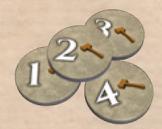
4 Auction Markers These can supplement or replace the Auction Gavel.

2 Distant Sea Movement Dice
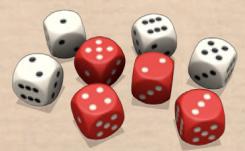
8 Battle Dice

2 Cloth Bags

THE GAME BOARD
GAME MAP
The map consists of 7 Major Powers and 11 named Victory Point regions: The 7 Major Powers are all in Europe. There are 5 European Victory Point regions and 6 Colonial Victory Point Regions.
The blue and white border around the Colonial Regions denote distant areas that require a Distant Sea Move die roll when units move in or out of the distant area. Movement within Europe is not affected.
You and your opponents will each choose 1 of the 7 Major Powers to lead in the upcoming Struggle of Empires and will compete for control of the 11 Victory Point regions.
You can place military units in your home country but never in another player's home country.
Navies may only be placed in a player's home country or in Victory Point regions with a colored ship icon (Baltic States and the Mediterranean in Europe plus the six Colonial regions).


German States, Central Europe and the Ottoman Empire can never be occupied by a Navy.

# Special Case: A Navy in the Mediterranean occupies and supports both the Mediterranean and the Ottoman Empire as shown by the two colored ship icon.
The map provides areas where players can:
Establish a Local Alliance (by placing a Local Alliance marker):
Conduct Trade (by taking a Trade tile):
ORIGINAL RULES VARIANT
Britain is adjacent to the German States.
The German States are not adjacent to the Baltic States.
Spain is adjacent to Mediterranean.
See page 14 for Army Movement Rules and further discussion of this Variant.

Local Alliance
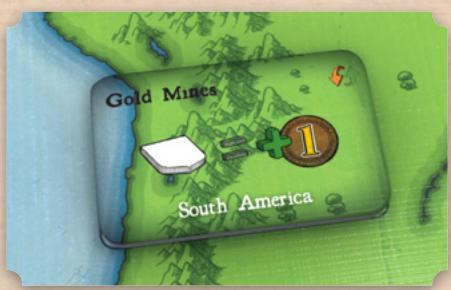
Trade tile


GAME PLAY TRACK

Uses the Game Phases marker to track Phases of Play:
Phase I - Draw and Place Neutral Region markers (2nd & 3rd Wars Only).

Drawn randomly from the Draw bag based on the number of players.

Phase II - Determine Grand Alliances and Turn Order
Using player Grand Alliance markers.

Use the Auction Gavel to mark the next person that will start an Auction.
Phase III - Player Actions

After each player's turn, give the Wind Rose marker to the next Active Player.
Phase IV - Income & Maintenance and Population Increase
Population Increase is tracked on the Population Track with player Population markers.

Phase V - Assess Control for Victory Points
Phase VI - End of War
Uses a single War marker to track the 3 major game turns (Wars).
Victory Points are tracked on the Victory Point Track using each player's marker.


Reminders for End of War (return Local Alliances, refresh Free Actions, return a Blockade tile, and ready Grand Alliance markers) and End of Game (Penalties for Unrest).

GAME SETUP
Special Rules for 2 & 3 player games are noted by blue font.
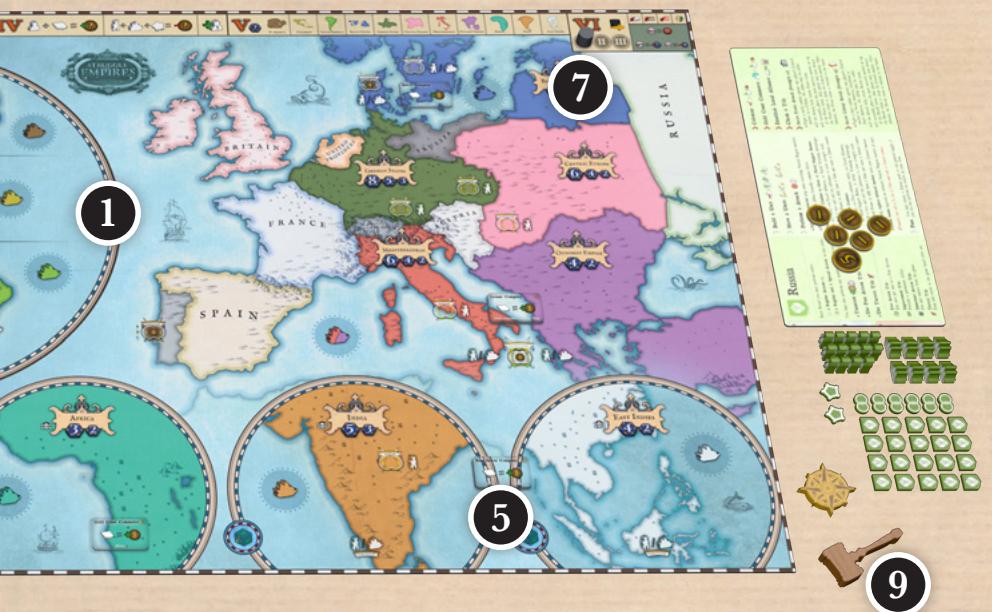
# Place the game board 1 and the Neutral Region Markers Display 2 in the center of the table.
Place the Gold coins 3 and the Draw Bag of Unrest counters 4 so they are in convenient reach for all players. Do not include the Value-5 Unrest counters in the bag – place them near the board in the General Supply.
# Tile Set Up: Arrange the tiles 5 and Covert Action tokens 6 on the game board Display as indicated.
# If playing with less than 7 players:
Some tiles are removed depending on your player count. The tiles have been marked in the lower right corner to show which are used at each player count.
2/3/5+
Use this tile only when playing with 2, 3, 5, 6 or 7 players.
In a 2 or 3 player game, each player will start with 1 Improved Agriculture and 1 Reserves tile designated by a green icon in the lower right corner of the tile.
# Place the War marker 7 on the (I) space of the War Track and the Game Phases marker 8 in area (I.) of the game play track.
PLAYER SETUP
# Seat the players around the table and determine a start player. Give the start player the Auction Gavel.

# Beginning with the start player and going clockwise around the table for each player:



Enttah Local Allaacr Clan 1 Táe
Austria
× haphr anom a Than482 Uw m Aomrn Tüe €) Uw Trmm Tit Tums Tae
Place the appropriate status marker of your color in each of the following places:
o Alliance marker in area (II.) of the Game Play track next to the Grand Alliance proposal circles. 11
# Select a Major Power and take the player mat, military units (14 Army, 8 Navy, and 2 Fort), Control markers (20), Local Alliance markers (6), and the individual Score, Population and Grand Alliance makers in that Major Power's color. 10
o Population marker on the (5) space on the Population track. 12
o Victory Point marker on the (0) space of the Victory Point track. 13
# Take 10 Gold 14 from the General Supply.
Oade Cme Comnoe Ash Lant Atnace To
C
NEUTRAL REGION MARKER DISTRIBUTION
FIRST: Set up all non-player Major Powers before placing any Neutral Region markers on the map (if there are less than 7 players).
For each player count, sort out the labeled sets of 5 Neutral Region markers as shown below:
7 Players: Skip this step
6 Players: Use set A
5 Players: Use sets A+B
4 Players: Use sets A+B+C
3 Players: Use sets A+B+C+D
2 Players: Use sets A+B+C+D+E Assign a letter set for each nonplayer Major Power.


Optional: You may randomly mix the letter sets for your player count and then draw 5 for each non-player Major Power. Return and redraw any region duplicates until all non-player Major Powers have 5 unique Neutral Regions.
For each non-player Major Power, place an Army in their player color in each of the Neutral Regions they have been assigned.
Optional: In Neutral Regions with ship icons, roll a die and assign a Navy instead of an Army on a roll of 1 or 2.
Note: German States, Central Europe, and Ottoman Empire do not roll to place a Navy.
2 & 3 Player Only: For each non-player Major Power, randomly select 1 of their Neutral Regions and replace the Army with a Control marker in their player color.
Note: 2-player games tend to be more warlike and 3 player games are more cutthroat with important negotiations. Ensure that you make use of all available tiles. For example, the Covert Operations and Military Tactics tiles can be quite useful in the 2 and 3 player games.
Place all used non-player Major Power Neutral Region markers on the Neutral Region Markers Display. 2

Return all remaining unused Neutral Region markers to the Draw Bag. 15
Place Grand Alliance markers (using the shorter cylinders) for each of the unplayed Major Powers in the Grand Alliance space for assignment. 11

Return all other materials for the non-player Major Powers back to the box.
Martin Wallace Simple Variant for 4, 5, and 6 Players
SET UP
Use all tiles as if it is a 7 player game.
Instead of returning unplayed Major Powers to the box:
For each unplayed Major Power, draw 5 random Neutral Region markers and place one Army for that Major Power in each of the Neutral Region drawn – similar to player set up.
Option: Place a Navy instead of an Army on the roll or a 1 or 2 on 1d6 if the Neutral Region allows naval access.
The Neutral Region markers for the unplayed Major Powers are then placed on the Display.
Phase I - Draw and Place Neutral Region Markers
# Randomly draw and place 10 Neutral Region Markers in this Phase for all 3 Wars – just as if it was a 7 player game.
Phase II - Determine Alliances and Play Order
Using the shorter Grand Alliance cylinders, include the unplayed Major Powers in the Grand Alliance auctions. This means all seven Major Powers (played or unplayed) will be included in the two Grand Alliances.
Phase III - Player Actions - Attack
Each unplayed Major Power Army (or Navy) will add +1 strength to the combat total of their ally. For example: If Russia is an unplayed Major Power in the red Grand Alliance and had two armies in North America, then Russia would add +2 to the Land Combat strength to any red Grand Alliance member whether attacker or defender. A Navy would be used in the Naval battle instead of the land battle. These units cannot be used in attacks versus Neutral Region markers.
Unplayed Major Power armies (or Navies) can never be removed or targeted by other Major Powers – they are permanent fixtures.
Unplayed Major Powers are ignored when assessing Victory Points.
NEUTRAL REGION MARKER MAP DISTRIBUTION
Place random Neutral Region markers on the map as follows:
7 Players: 10 Neutral Region markers (from the full bag of all 65 markers)
5-6 Players: 9 Neutral Region markers (from the bag less the markers used)
4 Players: 8 Neutral Region markers (from the bag less the markers used)
3 Players: 6 Neutral Region markers (from the bag less the markers used)
2 Players: 4 Neutral Region markers (from the bag less the markers used)
PLAYER NEUTRAL REGION DISTRIBUTION
Draw random Neutral Region markers based on player count and place one of your Control markers in each region drawn.
For 4, 5, 6, or 7 players, draw 5 random Neutral Region markers each.
For 2 or 3 players, draw 6 random Neutral Region markers each.
While drawing, you may choose to return any duplicates and redraw. If playing with 2 or 3 players, you must redraw duplicates so you end with 6 unique Neutral Regions. Ignore any values or icons on the markers. When done, place all used Neutral Region markers on the Neutral Marker Display.
Beginning with the start player and going clockwise for 5 rounds of placement:
Place 1 of your military units (Army/Navy/Fort) in any Victory Point region. You may also place these units in your home country (not recommended for your first game).
You do not need a Control marker to place a military unit in a region. No movement rules apply to this initial placement
Armies and Forts may be placed in any of the eleven Victory Point regions.
Navies may only be placed in regions with a Ship Icon.
ORIGINAL RULES did not allow or dictate returning duplicate draws. To play with original rules, keep duplicates. This can seriously affect your game if you are spread too thin. It might be useful to have 1 region with 2 markers, but if you have 2 regions with 2 markers, you will most likely fall behind.
PLAYER DRAFT FOR INITIAL NEUTRAL REGION MARKERS
Experienced players may prefer to draft Neutral Region markers instead of drawing random ones at the beginning of the game.
Each player draws the allotted number of Neutral Region markers +1 and chooses 1 to place facedown in front of them and then passes the rest to the left.
Repeat choosing a Neutral Region marker and passing the remainder until all players have their allotted number of Neutral Region markers facedown in front of them. Plus 1 unchosen marker in hand
Return all unchosen Neutral Region markers in hand to the Draw Bag.
Then each player places a Control marker in their color for each Neutral Region marker they have in front of them the same as with the normal rules
Place the used Neutral Region markers on the Neutral Region Markers Display.
CONTROL MARKERS AND SCORING

Ownership of Control markers is a zero-sum game - if someone gains a Control marker then someone else loses one (Major Power or Neutral Region).
A fixed number of Control markers are added to the Victory Point regions at the start of each War.
You claim or seize ownership of Neutral Region markers by replacing them with your own Control marker.
Scoring is determined solely by Control markers regardless of military strength.
POPULATION

Population is recorded on the Population track and cannot be adjusted below 0 or above 9.
Population is a limited resource. Your available population is used to deploy military units or to provide you with revenue. Therefore, revenue will decline and maintenance costs will increase whenever you convert population into military.
It is important to find the right balance between having an effective military and generating sufficient revenue to maintain that military while also providing for other necessary expenditures.
UNREST

Unrest is the measure of discontent among your citizenry. At the end of the game, relatively high unrest will result in severe Victory Point penalties or even the collapse of your Major Power. See End of Game page 27
Unrest counters consist of 9 Value-0, 9 Value-2 and 72 Value-1 counters that are drawn from the Draw Bag. The Value-5 Unrest counters are only used for making change. You gain Unrest counters for the following instances:
Gain 1 Unrest counter whenever you lose a military unit (Navy/Army/Fort) for any reason.
Gain 1 Unrest counter for each instance of Taxation. See Taxation next section
Gain 2 Unrest counters when taking an Industry Improvement tile.
You can only reduce unrest by taking a Government Reform Improvement tile or with a Pass. Keep your Unrest counters hidden facedown in front of you.
When returning Unrest, return that Value (not that many Counters) to the general supply. If you run out of Unrest counters in the Draw
Bag, return any Value-1 counters in the general
supply to the Draw Bag.


Population Track
ORIGINAL RULES & OPEN UNREST VARIANTS
Players may prefer to use the original rules. In this case, they may also prefer to keep Unrest open as it is trackable in the original rules. In either case, keep all of the Unrest counters in an open general supply except for the 0-Value unrest counters that can be returned to the box.
When you take unrest, take 1 point of unrest instead of drawing 1 hidden Unrest counter. Keep unrest hidden for Original Rules and open for Open Unrest. You can make change as needed from the general supply.
Note: We found the fog of war created by hidden unrest has a positive game effect at the end of the game by creating tension as well as saving time spent in analysis of players’ unrest totals.
Taxation Example 1:
You have 1 Gold on hand. You bid 4 Gold and win the Grand Alliance Auction. As a result of winning you now must pay 4 Gold.

You only have 1 Gold so you must take 2 Unrest counters to make 2 Taxation free actions to gain the necessary 3 Gold to pay off the debt. This will leave you with 1 Gold on hand.

If you have the Bank Improvement, you would only need to make 1 Taxation free action as the 1 Gold you have plus the 3 Gold you receive for taxation will be enough to pay the debt. You would only take 1 Unrest counter and will have no Gold remaining.

Note: If you bid Gold and are then overbid by another player and retire from the auction, you do not win the auction so you do not need to pay and therefore you will not need to use Taxation
Taxation Example 2: The active player threatens to attack you unless you pay a bribe of 3 Gold. You decide to pay the bribe but only have 1 Gold on hand. You must now use Taxation to gain 2 Gold and 1 Unrest counter so you can make the payment.
Your ability to take Gold for expenses is limited only by your tolerance for Unrest. Remember, too much Unrest can cause severe penalties at game end!
Although Gold may have exchanged hands earlier, nothing is binding until after a player's commitment of units in the formal Call For Allies step. Be careful of breaking deals or making idle promises; a poor reputation can have consequences within the game.
GOLD

You begin the game with 10 Gold and you may receive Gold income from trade and at the end of each War.
# Gold is used to purchase certain tiles, to pay for winning an alliance auction, and for making an Attack.
Gold can also be used to make payments to other players as part of a negotiation (to propose alliances, withhold or commit units, alttack or defend a player, extort gold in return for not attacking, etc.)
TAXATION
Whenever you have an expense and you do not have enough gold on hand to pay for it, then you must use the Taxation free action to cover the expense.
You can even do this as an inactive player to pay other players.
Immediately for each instance of Taxation:
# Take 1 Unrest counter.
Take 2 Gold (or 3 Gold if you have the Banking Improvement tile)

# Taxation can only occur when an expense must be paid and not sooner. You must first spend any Gold you have on hand and only then use the Taxation free action to gather enough Gold to pay the deficit.
IMPORTANT: You cannot pay Gold to remove unrest and you cannot use Taxation to simply accumulate Gold on hand.
NEGOTIATION
Negotiation is an open and informal process and should be conducted in good humor.
At any time in the game and especially while making an alliance proposal or declaring an attack, players may negotiate as they see fit to attempt to influence other player's actions. This includes, but is not limited to, making payments or bribes to change alliance proposals, withhold or commit units, or to attack or defend another player. An attacker could even attempt to extort gold in return for not attacking or to switch an attack to another player or a Neutral Region marker.
# IMPORTANT: You can never offer anyone a Control marker; and, only the active player can ever capture a Control marker. Control markers can neither be exchanged, nor relinquished.
For an attack, an ally can offer to commit any or all of their Navy and/or Army units in the region specified but cannot commit Forts (which can only defend their owner) or transfer any benefits from their tiles or Local Alliances. The attacker and defender can only benefit from their own tiles during an attack.
Prolonged negotiations can unnecessarily (and sometimes painfully) slow the game. We highly recommend keeping some sort of time limit agreed before play subject to your own tastes.
Negotiation is viable at all player counts. It can be ruthless at 3-player and although it is constrained in 2-player, you can still bribe your opponent!
Struggle of Empires is played in a series of 3 Wars, each comprised of the following phases:
I. DRAW AND PLACE NEUTRAL REGION MARKERS - 2nd & 3rd Wars only

Any Neutral Region markers from previous wars on the map are left in place.
Place new random Neutral Region markers from the Draw Bag on the map as follows:
7 Players: 10 Neutral Region markers (from the bag less the markers used)
5-6 Players: 9 Neutral Region markers (from the bag less the markers used)
4 Players: 8 Neutral Region markers (from the bag less the markers used)
3 Players: 6 Neutral Region markers (from the bag less the markers used)
2 Players: 4 Neutral Region markers (from the bag less the markers used)
II. DETERMINE GRAND ALLIANCES AND TURN ORDER
Create the two Grand Alliances (red and blue):
Players and non-players will be divided into two Grand Alliances for each War through a series of auctions.

Each auction is a proposal to place 2 unallied Major Powers in opposing Grand Alliances: one in the red alliance and the other in the blue alliance.
The order in which allies enter these alliances will also determine their order of play for the current War (as indicated in the Alliance Display: 1st, 2nd, 3rd, etc.)
After each auction, a new auction round begins with a new proposal until all players have been placed in either the red or blue alliances.
All players must be placed in a Grand Alliance before any non-player Major Powers can be proposed.
With an odd number of players less than 7, the final non-allied player is placed in a proposal with a non-player Major Power.
All players may participate in each auction whether or not they have already joined an alliance.
The Auction Gavel determines who begins each auction.
For the 1st War, the first auction begins with the start player (who was given the Auction Gavel in setup) and continues clockwise.

In Wars 2 and 3 the player who played last in the previous war will be given the Auction Gavel to start the first round of bidding for the Grand Alliance auctions for the next War.
Grand Alliance Example:
Remember, when bidding, players do not have to have the Gold on hand. They must pay only if they win.
Britain is the 1st person to bid as she went last in the previous war. Before making her proposal, Britain passes the Auction gavel to France who is next in clockwise order.
Britain makes her proposal by placing her own alliance marker in the red alliance and Prussia's alliance marker in the blue alliance and then makes her bid of 1 Gold. This means Britain wants Prussia in a different Grand Alliance, perhaps so she can declare war on Prussia!
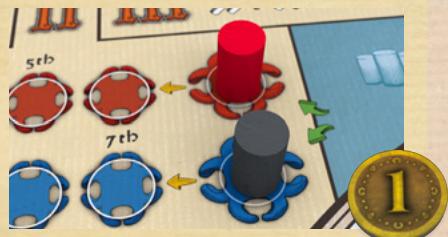
The French player, next in clockwise order, is happy with this proposal and decides to pass.
Prussia is next and isn't happy. He creates his new proposal by removing the British and Prussian alliance markers and placing Austria's alliance marker in the red alliance and France’s alliance marker in the blue alliance and then raises the bid to 4 Gold.

Now all of the remaining players decide to pass in turn. As all other players have passed, Prussia wins the auction with their bid of 4.
Prussia only has 3 Gold on hand, so he takes a Taxation free action to gain 1 Unrest counter and 2 Gold. He pays 4 Gold for the winning bid and has 1 Gold left over.
The Austrian alliance marker is placed in the first space on the alliance display in the red alliance and the French alliance marker is placed below it in the first space in the blue alliance.

Note: During Player Actions, Austria will play 1st and France will play 2nd.
The next round of bidding now starts with France who now holds the Auction Gavel. To begin, France passes the Auction Gavel to Prussia, who is next in turn order, and then France makes his auction proposal.
There is a slight advantage to going early in turn order in the frst War. You will have first choices for claiming tiles as well as Colonization (COL) and Gold Coast Commerce (GCC) markers.
For the second and third Wars, you may find going later in the turn order more useful. For example, Incite Pirate Attack and Incite Colony Revolt tokens can be played with best advantage on the victory point leaders after they have taken their final turn and can no longer respond. Going last in the final War with Logistics and a War Office can also be devastating to opponents.
Conducting the Grand Alliance Auction
Before beginning each auction, the player with the Auction Gavel should pass it to the next player to their left. That player will start the next auction in the series after the current auction is concluded.
To begin, the active player proposes two Major Powers who are not yet in an alliance by placing one unallied player's alliance status marker in the red Proposal circle and another unallied player's alliance status marker in the blue Proposal circle.
o These two Major Powers will NOT be allies but will be in opposing alliances.
o The proposal may include the player's own alliance status marker but doesn't require it.
o The only time a player may place a single alliance status marker up for proposal is for the War's last auction when there is an odd number of players. The single remaining unallied alliance status marker must be proposed alone for either the red or the blue Grand Alliance.
Bids are in Gold and the first player can begin with any amount including a 0 bid.
Players don't need to have Gold in hand to make a bid.
o Gold is only required to pay for a winning bid.
o Any deficit will be made up through Taxation.
During the bidding, a player may pass or they may raise the bid.
o A pass means the player is content with the current proposal.
o Players may always re-enter the bidding in a later round of the same auction even if they passed earlier in that auction.
o Raising the bid allows a player to change the proposal using any two unallied Grand Alliance markers, including those in the currently proposed auction.
The player who made the last bid before all other players pass in succession wins the auction.
Winning the Auction
The player who wins an auction must immediately pay for his bid (using Taxation as necessary). All other bids are ignored.
井 The alliance status marker in the red Proposal circle is placed in the first empty box (from left to right) in the red alliance row (on top) and the alliance status marker in the blue Proposal circle is placed in the first empty box in blue alliance row below that.
Repeat the auction process beginning with the player with the Auction Gavel until all players have an alliance status marker in either the top or bottom row of the Grand Alliance display
After the last auction is completed, give the Auction Gavel to the player who will play last for the current War. They will start the auction process in the next War. And give each player the Turn Order tile based on their position in the Grand Alliance display (1, 2, 3, 4, etc.)
III.PLAYER ACTIONS
With 2, 3, or 4 players: play 6 rounds. With 5, 6 or 7 players: play 5 rounds. Non-player Major Powers do not take actions.
Order of play for each Round is determined by the position of each player's Grand Alliance marker on the Grand Alliance display (1st, 2nd, 3rd, etc.)
There are 3 types of actions: Regular, Special, and Free.
On their turn each round, players may perform either 2 Regular actions or 1 Regular and 1 Special action (in any order).
On their turn, Players may also use as many Free actions as they have available. Free Actions include Taxation and those from Free action tiles.
After all players have completed their turn of 2 actions, advance the Game Phases marker 1 space and begin the next round of player actions with the first player in turn order.
This continues until the last round is completed (5 or 6) at which time play progresses to Phase IV – Income and Maintenance & Population Increase.
REGULAR ACTIONS
Regular actions can be used for both your first and second action during your turn each Round.
Exception: See Colonize and Gold Coast Commerce.

BUILD MILITARY UNIT

You may place 1 Army, 1 Navy, or 1 Fort in your home country at the cost of 1 Population. (Reduce your Population marker on the Population track).
Once built, you may now move this unit to any region as per movement rules in Move 2 Military Units. See next page
Forts generally only move when built and are treated as an Army for movement purposes. Once placed outside their home country, a Fort cannot be moved.

Army

Navy

Fort
Fort movement represents the cannons being transported to and emplaced in the actual Fort.
If the unit moves across any number of Distant Sea Area borders, the Distant Sea Move rules will apply. See Distant Sea Move next section
o Exception: When built, if a Fort fails a Distant Sea Move check, it remains in your home country and as an exception, it now can only be moved as part of a normal Move 2 Military Units action.
You must have available pieces to build military units. You can use the action Build 1 military unit to destroy a unit and then re-build it following the same rules above for building a unit. This will still cost 1 Population; and, in addition, you must take 1 Unrest counter for destroying a unit.
This is usually reserved for rebuilding a Fort.



ORIGINAL RULES VARIANT
Adjacency and Army Movement
The original adjacency rules are not intuitive and favored some Major Powers over others. For Example, Austria has direct access to 4 European Regions. In contrast, Great Britain, United Provinces, and Spain only have direct access to one.
Closely tied into the adjacency rules, the Army movement rules to European regions is awkward and has little meaningful effect on play.
The original rules are included here as a variant for players who wish to use them. They can also be used as a means to give new players a little help against more experienced players. Giving new players Austria, Prussia, and Russia will give them a little more leeway for early mistakes in placement.
An Army may only move from any Region to a European Region if at least 1 of the following conditions is met:
The player has a Control marker in the European Region.
The player has a Control marker in an adjacent European Region.
A player may move to The Baltic States if they have a Navy in the Baltic States.
A player may move to The Mediterranean or to the Ottoman Empire if they have a Navy in The Mediterranean.
The European Region is adjacent to your home country.
Adjacency Clarifications
Britain is adjacent to German States.
Spain is adjacent to The Mediterranean.
# German States is NOT adjacent to Baltic States.
MOVE ₂ MILITARY UNITS
Army or Navy only - Forts cannot be moved once emplaced in a Region.
You may independently make 2 moves for 2 different units as separate events (Army and/or Navy). You cannot move a unit that failed a Distant Sea Move check in your first move as your second move. See Distant Sea Move below
All movement is point to point. Military units do not move through Regions - they go directly to their intended destination. There are no restrictions for how far a unit can move.
You may move units to your home country but never to another Major Power's home country. Generally you only place units in your home country when they are built and are immediately moved out as it is better to have a unit in a VP producing region rather than in your home.
NAVY MOVEMENT
A Navy can be moved from any Region to any other Region that has a ship icon (the 6 colonies, The Baltic States and Mediterranean) or to your home country.
A Navy cannot be moved to the German States, Central Europe, or the Ottoman Empire.
ARMY MOVEMENT
An Army can only move to a Colonial Region if you have at least 1 Navy present in that Region.
An Army can always move to any Victory Point region in Europe or its home country (no Navy needed).

Example: A Navy in North America does not allow an Army to move to the Caribbean or South America; it only allows movement to North America.
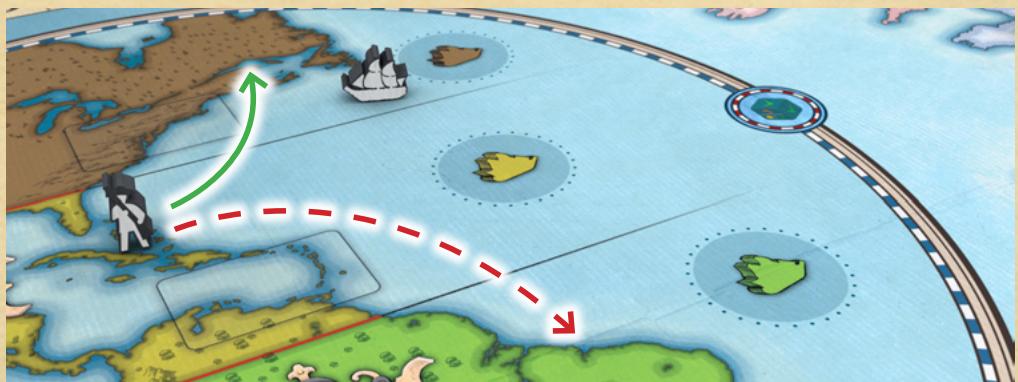
Moving armies between North America, Caribbean or South America requires a fleet at the destination. The only advantage is there is no Distant Sea Move Check in the area of the Americas.
DISTANT SEA MOVE
Any move by an Army, Navy, or Fort that crosses 1 or more Distant Sea Borders is considered a Distant Sea Move (In other words, a move that is not entirely within Europe or entirely within the Americas).
This is a dangerous move and may be subject to failure to move or possible loss of the unit.
For each Distant Sea Move, roll the Distant Sea Move custom die.

If the roll is Success, the move is completed successfully.

If the roll is Stay, the unit remains where it is. Or, you have the option to pay 1 Gold to complete the move successfully.

If the roll is Sink, lose the unit. Or, you have the option to pay 2 Gold to have it remain where it is; or, pay a total of 3 Gold to complete the move successfully.
Move Example
Britain decides to Move 2 Military Units. She wants to move her Army in German States to India but she doesn’t have a Navy in India.

She decides to move her Navy in North America to India frst. This is a Distant Sea Move so she must roll the Distant Sea Move die. The die roll is Success’ and the unit completes the move.
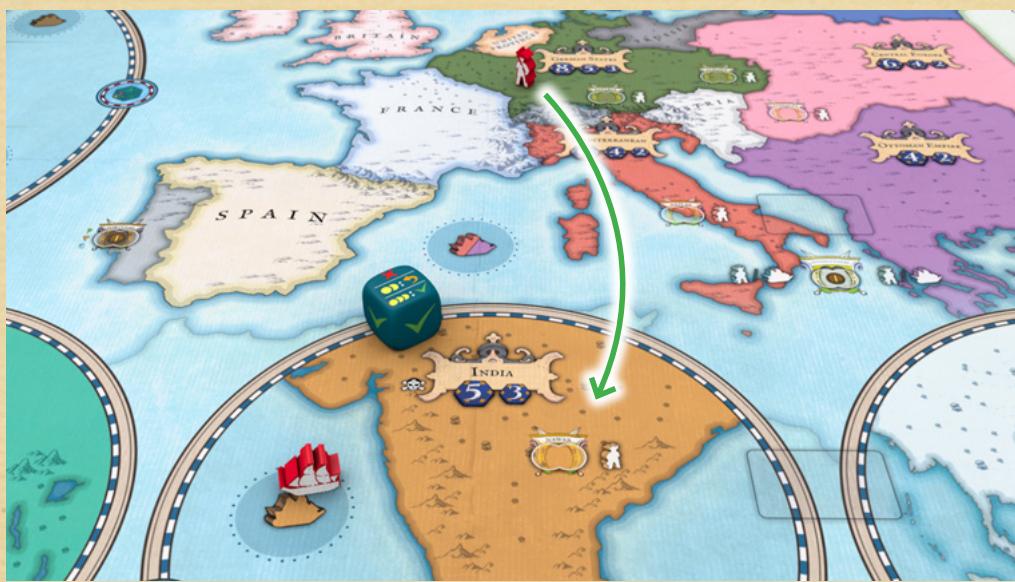
Now Britain can move her Army from German States to India as her second move. This also requires a Distant Sea Move die roll. The die roll is Sink’ meaning the Army is lost. However, she can pay 2 Gold to keep the unit in place in the German States or pay 3 Gold to allow the move to succeed.

Distant Sea Border
ORIGINAL RULES VARIANT Distant Sea Move
Distant Sea Move in the original Struggle of Empires was a "low risk of a high penalty" action with not many instances for a player to average out the high penalty (basically 2 actions). In this variant, you will be successful less often and can only mitigate failure by using a Navigation tile.
When making a Distant Sea Move, roll both a white and a red die:
If the white die roll is greater than 1, the move succeeds.
If the white die roll is 1, the red die roll determines the result as follows:
o On a roll of 1 or 2, the unit is lost and returned to your supply
o On a roll of 3 or 4, the unit remains in its point of origin.
o On a roll of 5 or 6, the Move is successful.
# 2 Navigation tiles are provided for use with this variant. Add them to the Tile Display on the Game Board.
Navigation provides a +2 bonus for the red die roll.
# 2 Navigation tiles provide a +4 bonus for the red die roll.


Player Control marker

Neutral Control marker
ORIGINAL RULES VARIANT Must have Own Fleet for Naval Combat
The attacker must have a Navy present in order to engage in Naval Combat. A Local Alliance or Allied Navy is not sufficient on its own. If the defender has a Navy present and the attacker does not, the defender gains the +1 strength advantage for the upcoming Land Combat. If neither have a Navy present, no Naval Combat occurs.
PURPOSE OF ATTACK
The purpose of an attack is primarily to gain a Control marker by converting a Neutral Region marker or a Control marker owned by another Major Power in the opposing Grand Alliance. (You may attack enemy military units in a location where they hold no Control markers, but this is seldom worthwhile other than to inflict unrest at the risk of gaining unrest yourself!)
Reminder: You can never directly attack Control markers owned by your own Grand Alliance.
See Covert Actions: Incite Pirate Attack and Incite Colony Revolt Special Actions.
Battles will see military units lost by one or both sides and each lost unit causes the owner to take 1 Unrest counter.
Although this is not explicitly stated in the original rules, many veteran players play with this rule. Use this option to simplify and shorten Naval Combat.
Unrest from combat is only caused by unit losses or the roll of 7 on your battle dice.
If a player must lose a unit, but has none (and no allied units), then no unit is lost and no unrest is taken.
# During the game, there can be informal negotiations concerning attacks. Plans and promises can be made, Gold can change hands, etc. but nothing is binding until after the Attack is officially declared and paid for.
DECLARATION AND PAYMENT FOR ATTACK
# The attacking player makes their formal commitment to attack by paying 2 Gold and designating the Region of attack and the Neutral Region or Major Power Control marker being attacked. The attacker must have an army present to have a Land Combat, although a Naval Combat can take place if the attacker only has a Navy present. However, the sole point in having only a Naval Combat is to destroy enemy fleets.
A single Attack includes the possibility of both a Naval Combat and a Land Combat. Naval Combat, if any, occurs first.
Naval Combat determines which player receives a +1 strength bonus for naval support in the subsequent Land Combat. This only occurs in Victory Point Regions with a ship icon (the 6 Colonial Regions, the Baltic States, and the Mediterranean, which includes an attack in Ottoman Empire).
o The attacker and defender must each have a Navy or a player ally committed Navy present in order to engage in Naval Combat. A Local Alliance Navy is not sufficient on its own.
o The attacker and defender each decide whether their Navies will participate in Naval Combat; attacker first, then defender.
o If there is Naval Combat, all Navy units from both the attacker and the defender must be included.
Land Combat determines whether the attacker converts the defender's Control marker to their own.
o The attacker must have at least 1 Army of their own present or there can be no Land Combat.
o All of the attacker's Army units and all of the defender's Army and Fort units must be included (Forts are not used for attack).
After the attacker has committed to the attack (having paid their 2 Gold and before the rolling of Dice) there is the formal call for allies beginning with the attacker, then followed by the defender.
At this time, allies make their formal commitments of Navy and/or Army units (Ally Forts cannot aid in defense).
If allies decide not to honor any agreements, promises etc. negotiated during an informal negotiation period, so be it. Those negotiations are non-binding, even if Gold changed hands.
Players may never ally with a Neutral Region to aid their defense.
Any military units that allies commit in the Call for Allies step are now included in the upcoming naval and/or Land Combats. This commitment is now binding for this attack.
o Non-player Major Power units automatically ally with an attacker or defender in their Grand Alliance. This includes attacks against defending non-player Major Power Control markers in a 2 or 3 player game.
o Non-player Major Power units can never be attacked or removed and so cannot be used as losses in any way (for a loss in battle or for a roll of 7).
o Non-player Major Power units are not included if a player is attacking a Neutral Region marker.
o In the 2 or 3 player game, the non-player Major Power Control markers have a defense value of 3. They may be attacked if they are not in your alliance.
o Non-player Major Power Control markers do NOT add their strength to a battle when acting as an ally.
OUTCOMES FROM ATTACKS
Naval combat winner: The winner of a Naval Combat gains a +1 strength modifier for the subsequent Land Combat.
# Attacker wins land combat
When the attacker wins a Land Combat against a Neutral Region, they replace the Neutral Region marker with one of their own Control markers Some Neutral Region markers confer additional rewards when replaced. (Replaced Neutral Region markers are placed on the Neutral Region Markers Display, not to the Draw Bag)
When the attacker wins a Land Combat against a Major Power with a Control marker, they replace one of the defender's Control markers in that location with one of their own. The defeated Control marker is returned to its owner's supply.
# Attacker loses or ties land combat
If the attacker loses or ties the Land Combat against a Neutral Region or defending Major Power, the defending Control marker remains unchanged. The attacker gains nothing.
Unit losses - Also see Ally Losses below
The losing side in a Naval or Land Combat must lose 1 involved unit and the owner of that unit gains 1 Unrest counter for the loss of a unit.

An ally's commitment of a type of unit is generally for all of their units of that type present because every unit increases the strength of their side.
However, an ally may decide exactly how many of each type of unit they are willing to commit, if any.

Defending Forts cannot be removed to satisfy losses in a tie and so a defender will avoid a loss if their only defending units are Forts, or if they had no units to lose.
IMPORTANT: Local Alliances may never be used to fulfill unit losses.
If there is a tie, both the attacking and the defending side must lose 1 involved unit and gain 1 Unrest counter for the loss of that unit.
If there is no unit to be lost, then no Unrest counter is gained (an actual unit must be lost to cause the gain of an Unrest counter).
Unit loss for rolling 7 - win, lose, or tie Also see Ally Losses below

Whenever either the attacker or defender rolls a 7 (final rolls only – See Reserves tile), their side must, where possible, lose an additional unit and the owner of the lost unit gains 1 Unrest counter for the loss of a unit.
#Ally losses
In all cases where an ally must lose a unit: if there is more than 1 ally to choose from, then the losing player (attacker or defender) decides which of their allies with a committed unit must lose a unit and gain 1 unrest.
In the case of Naval Combat, with only allied naval units attacking, the loss of a unit and gain of 1 Unrest counter must be taken by an ally.
In the case of a defender with no units present in a combat, an ally with a committed unit in the combat must lose a unit and gain 1 Unrest counter for the unit lost.
If an attacker or defender has lost or tied and then must lose another unit because they have rolled a 7, then an ally with a committed unit in the combat must take this second loss and gain 1 Unrest counter for the lost unit instead. See Special Case regarding Forts and Ties directly below
If there were only allied units defending, all losses fall on the allies.
# SPECIAL CASE: If a defender only has Fort units in a tied Land Combat, then their ally must cover the loss in the tie as Forts can't be lost to ties. However, if a 7 was also rolled, the defender would then lose a Fort and gain 1 unrest due to the roll of 7.
Reminder: A winning attacker does not need surviving units to gain a Control marker.
EXECUTION OF NAVAL AND LAND COMBAT

# If the attack is against a neutral region marker:
A. Neutral Region markers with a defense value (equal to the number shown on its marker) may be attacked.
B. A Neutral Region cannot have allies and automatically cedes the +1 strength for naval support for the upcoming Land Combat if the attacker has a Navy present.
C. When defeated, Neutral Region markers may award the following benefits:
Gain 3 Gold
Gain 1 Victory Point
# If the attack is against a Major Power
Determine if the attack is subject to a preliminary Naval Combat for naval support bonus (all areas except the German States and Central Europe).
Actual Naval Combat can only take place if both attacker and defender have at least 1 Navy of their own or of a committed ally present in the region.

o If the attacker or defender has 1 or more Navies present (including those from committed allies) and the other player has none (including those from committed allies), then that player automatically gains the +1 strength naval support bonus in the following Land Combat without Naval Combat.
If both attacker and defender have 1 or more Navies present, (including those from committed allies), proceed as follows:
-
The attacker must decide if they will commit their Navy units (including ally committed units). If the attacker declines to commit, then the defender receives the +1 strength naval support bonus without Naval Combat.
-
If the attacker does commit to Naval Combat (including ally committed units), the defender then decides whether to commit their naval units (including ally committed units). If the defender declines to commit their Navy units (including ally committed units), the attacker receives the +1 strength naval support bonus without Naval Combat.
-
If both the attacker and defender commit their Navy units (including committed allies), then Naval Combat is resolved with the winner receiving the +1 naval support bonus. Remember, both attacker and defender must use all of their Navy units present in addition to any committed ally units.
RESOLVING NAVAL COMBAT
I. The attacker and the defender first determine their base strength.
+1 strength for each friendly Navy (including ally committed units)
# +1 strength for the attacker or defender with more Naval Training tiles.

Note: Attacker or defender must have a Navy present to apply their Naval Training Bonus.
+1 for each Local Alliance applying to this region (attacker and defender only).
# IMPORTANT: Local Alliances that can support either Naval or Land Combat are used once only for either the Naval or Land Combat. Owners must choose now. If used for Naval Combat, this bonus cannot be used for the following Land Combat.
-
Attacker and defender each now roll 2 Dice and find the difference between their own Dice. This amount is added to their base strength to determine their total strength for the Naval Combat.
-
The winner gains a +1 strength naval support bonus for the upcoming Land Combat.
If there is a tie, neither player gains the strength modifier
IMPORTANT: It doesn't matter if the winner has no surviving naval units.


Russia attacks Great Britain's Control marker in the Ottoman Empire. Britain has 1 Navy in The Mediterranean and 1 Naval Training tile. Russia has no naval units present and no Naval Training tiles.
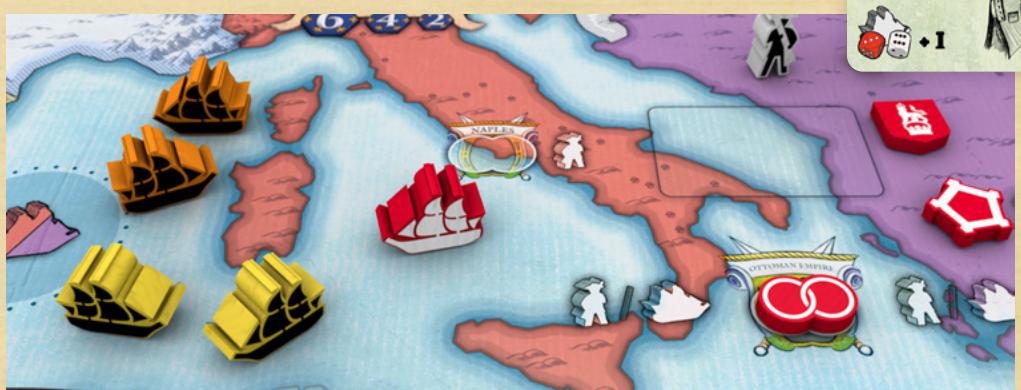
After the call for Allies, Russia has persuaded the United Provinces to ally and commit their 2 Navies in The Mediterranean. Great Britain has also convinced Spain to ally by means of a 2 Gold bribe and they have also committed 2 Navies in The Mediterranean.
Strengths are now Russia 2 (+2 from ally) and Great Britain 4 (+1 Navy, +1 Navy Training superiority, +2 from ally). Great Britain decides not to use the Local Alliance now.
Russia and then Great Britain both decide to fight for the +1 Naval Support bonus.
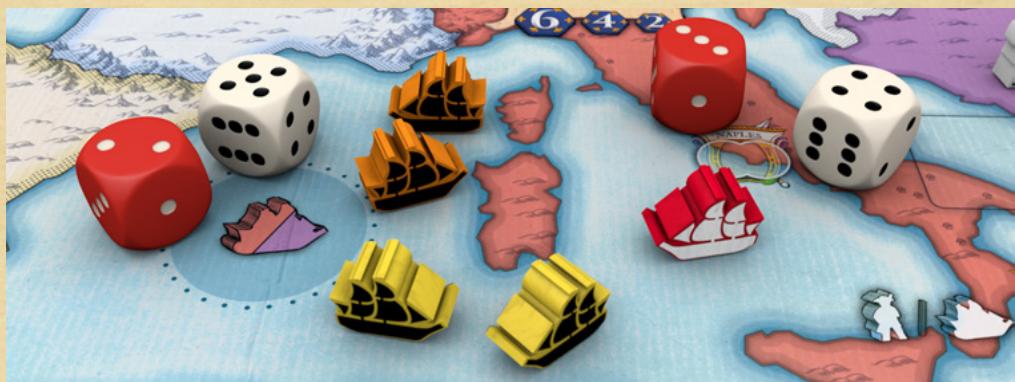
Russia rolls a 5 and a 2 and the difference of 3 brings their total strength up to 5. Great Britain rolls a 4 and a 3 and the difference of 1 brings their total strength up to 5 as well.
The result is a tie at 5 each. Neither gains the +1 Naval Support bonus.

Both sides must now lose 1 unit for the tie and 1 unit for their own roll of 7. Each lost unit will cause their owner to draw 1 Unrest counter.
Russia has no Naval units to lose so his ally United Provinces must suffer both losses and loses both Navy units and gains 2 Unrest counters!
Great Britain loses their Navy unit for the tie and gains 1 Unrest counter and their ally Spain also loses 1 Navy unit for the dice roll of 7 and gains 1 Unrest counter as well.
Note: If
内容过长,此处只内联前一部分;完整内容请下载或到规则页阅读。
下载 Markdown原文为社区整理/出版社公开资料,版权归原作者,仅供个人学习查阅。