
泰姬陵Taj Mahal
一句话概览
泰姬陵 是一款已收录于村了吗规则库的桌游,支持 2–5 人,原名 Taj Mahal。
本页内容:一句话概览 · 常见问题
这游戏怎么玩
- 本站已收录这款游戏的规则资料,可以在对话里直接提问规则细节。
常见问题(FAQ)
以下 1 条问答中 0 条来自站内玩家的真实提问,其余 1 条为本站整理的常见疑问;答复内容保持原样。
泰姬陵支持几个人玩?
2–5 人。
去哪查完整规则
想核对具体规则细节、卡牌效果或某个回合的结算方式,可以在村了吗里选中这款游戏后直接提问。
同类桌游
- 卡坦岛德式
- 工业革命:伯明翰德式
- 勃艮第城堡:特别典藏版德式
- 方舟动物园德式
- 卡卡颂抽象
- 瘟疫危机传承:第一季美式
- 阿瑞迪亚:勇踏征途美式
- 重塑宇宙德式
- 幽港迷城美式
- 埃多拉的德鲁伊德式
规则原文(Markdown)
本站收录这款游戏的规则原文 1 个文件,此处内联渲染 1 个,可直接展开阅读或下载。
TajMahal_Rulebook_English-min.md22.9 KB
Rules of Play

Introduction
For over a century, the Mogul Empire has watched over the Indian subcontinent. Gifted in organization and administration, the Moguls oversaw a truly modern India: a nation defined by its unrivaled progress and prosperity.
With a focus on social unity and open trade,
India's economic and political power took a
leading role on the global stage. Through this unexpected strength, India demonstrated its value to the world, but this same might and wealth now threaten its collapse.
Instability and unrest plague the courts, as governors and sycophants alike squabble
over petty concerns. In light of this discord, the Grand Mogul has begun to search desperately for leaders worthy of carrying India into a new age. Old loyalties vanish in the face of greed, but the opportunity to forge new partnerships has never been more ripe.
You are a member of the Mogul nobility, and are competing for the approval of the Grand Mogul, the loyalty of his advisors, and the wealth of the provinces. Master the dance of intrigue and keep your opponents guessing while you make your move. The court is yours to influence, and the future of India is within your grasp.
Game Overview
In Taj Mahal, players visit the 12 provinces of India. Each province is identified on the game board by a unique color and pattern based on real cloth patterns from the region. During each visit, players take turns playing cards to increase their influence or leveraging that influence to gain rewards. The game ends after all 12 visits have been completed, and the player with the most points wins.
Components
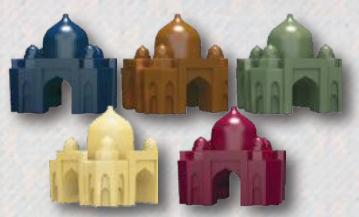
105 Palaces (5 colors, 21 of each)

96 Influence Cards (4 colors, 21 of each; 12 colorless)
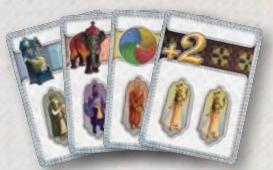
4 Prestige Cards (double-sided)

12 Province Tokens
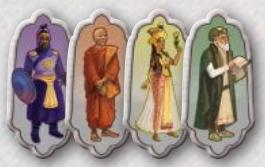
24 Advisor Tokens (double-sided; 4 types, 6 of each)

16 Bonus Tokens

1 Game Board
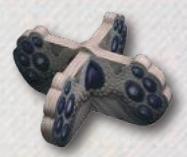
1 Crown

1 First Player Marker
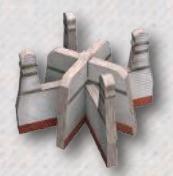
5 Scoring Markers (5 colors, 1 of each)

1 Pedestal
Before Your First Game
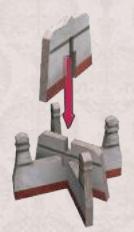
Before your first game, assemble the crown, pedestal, and first player marker as shown below:

Crown

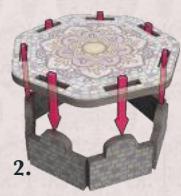
Pedestal


First Player Marker
Setup
-
Choose Colors: Each player chooses a color and takes the score marker and all palaces of that color. Then return all unused score markers and palaces to the box.
-
Prepare Game Board: Place the board in the center of the table. Then, place each player's score marker on the "0" space of the score track.
-
Create Supply: Sort the advisor tokens by type and place them near the board. Then, place each of the four prestige cards faceup near the board.
-
Place Bonus Tokens: Place the Taj Mahal bonus token on the city of Agra. Then, randomly place one bonus token faceup on each diamond-shaped city.

City of Agra

Taj Mahal Bonus Token

Diamondshaped City
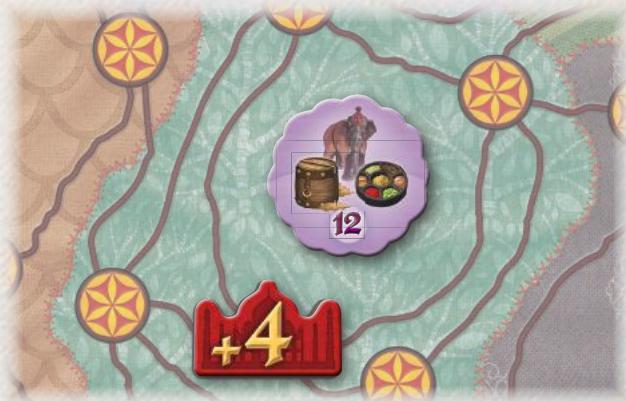
- Place Province Tokens: Place the “12" province token faceup in Agra's province. Then, randomly place one province token faceup in each other province.
-
Deal Influence Cards: Shuffle all the influence cards and deal six to each player. Then, place the deck facedown near the board.
-
Determine First Player: The youngest player is the first player and takes the first player marker.
Members of the Imperial Court
Each court member appears as art on influence cards and has a matching token type:

The Grand Mogul, who oversees all of India.

The monk, the Grand Mogul's personal spiritual advisor.


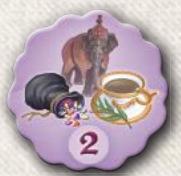
The merchants of the province, represented by a symbol of their status: the revered elephant.

The princess, who counsels the Grand Mogul on social affairs.


The general, a veteran of several military campaigns.


The vizier, a political minister wise beyond his many years.


Playing the Game
Taj Mahal is played over 12 visits, in which the court of the Grand Mogul tours the 12 provinces of India. During each visit, players take turns either attempting to influence the court or withdrawing from the visit. You gain rewards and score points through careful planning and strategic timing of your withdrawal. After all players have withdrawn, the visit ends and players prepare for the next visit. When the twelfth visit is completed, the game ends.
Preparing for a Visit
Before starting a visit, follow these steps:
- Populate the Court: To indicate the current province, place the pedestal underneath the lowest-numbered province token on the board. For the first visit of the game, this is the "“1" province token.
Next, for each empty advisor seat, take the missing advisor token from the supply and place it in its seat.
Finally, if the crown is not already in its seat, place it there.
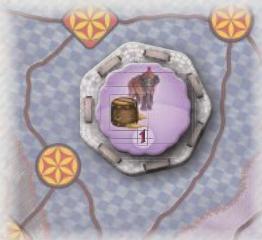
The province token seat (the pedestal) moves during play.

The crown seat and advisor seats are in a corner of the board.
- Set the Display: Based on the number of players, draw influence cards and place them faceup in a line near the deck.
2 Players: 3 cards 4 Players: 7 cards
3 Players: 5 cards 5 Players: 9 cards
If there are no cards left in the deck, shuffle the discard pile and place it facedown to make a new deck.
Open Information
The number of cards in a player's hand and claimed tokens are open information. Once claimed, tokens stay in front of you and cannot be claimed by other players. There is no limit to a player's handsize.
There is an unlimited number of palaces in each color; if you run out of palaces, you can use a substitute.
Player Turns
During each visit, players take turns in clockwise order starting with the first player. During your turn, you must either influence the court or withdraw.
Influencing the Court
To influence the court, add one card to your row by playing it from your hand faceup in front of you. Each card in your row shows one or more court members and contributes to your influence with them.
During your first turn of a visit, you can play any color card (red, yellow, green, or blue) to start your row. During future turns this visit, additional cards you add to your row must match the color of the first card in your row.
Each time you influence the court, you may also add one colorless card to your row, but a colorless card cannot be added to a row by itself.

Colorless Cards
There are two types of colorless cards: prestige cards and colorless influence cards. Each prestige card corresponds to a different advisor and is gained by earning that advisor's favor over the course of multiple visits (see "Ending a Visit" on page 7). Colorless influence cards are part of the deck and can be in your starting hand or taken from the display when you withdraw.
Withdrawing
If you do not wish to influence the court (or you have no remaining cards in hand matching the color in your row), you withdraw from the visit. As a result of withdrawing, you check for majority, and might take tokens from the court, place palaces, and score points but you can no longer participate in that visit.
Majority
Compare the cards in your row to each opponent with cards in his or her row. If among all players you have the most in any court member (not counting ties) and that member's matching token is still in its seat, claim that token by placing it in front of you and immediately resolving its effect (see "Court Effects" on page 6).
Each court member's token can be claimed only once per visit. If another player has claimed a token, you cannot have majority with that member of the court until the next visit.
When you withdraw, you claim only tokens matching court members in your row. You cannot claim tokens for any court members not in your row.
Determining Majority Example

Lena

Greg

Nicole
- On their first turns of the visit, Lena, Greg, and Nicole all influence the court by playing one card each.
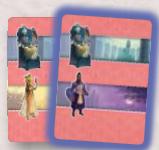
Lena

Greg

Nicole
- On their second turns, everyone again influences the court (Greg and Lena play one card each, while Nicole plays two cards).

Lena

Greg

Nicole
- On her third turn, Lena withdraws. She has majority in the Grand Mogul and takes the crown. She does not have majority in the princess or general, so she does not take those tokens.

Greg

Nicole
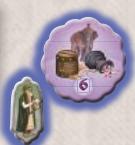
- After Lena withdraws, Greg takes his third turn by playing a card. Then Nicole withdraws. She has majority in the elephant and the vizier, so she takes the province token and the vizier token from their seats. She does not have majority in the general, so she does not take that token.

Greg
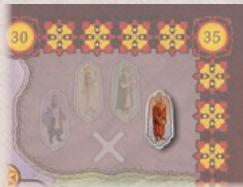
Unclaimed monk token
- On his fourth turn, Greg withdraws. Of the remaining court members, he has majority in the general and the princess, so he takes those tokens. The monk did not appear in any player's row this visit, so it stays in its seat.
Court Effects
This section explains each of the court member's token effects. When an effect causes you to score points, advance your score marker along the track accordingly. After determining majority and taking your tokens, resolve them in this order:
1. The Advisors
For each advisor token you place in front of you, place one of your palaces on an open city in the current province. A city is open if it has no palaces or only the crown palace on it. If you place a palace on an open city where a bonus token is, claim that token.
2. Bonus Tokens

For each bonus token claimed during this visit, resolve its effect as explained below. If placing palaces causes you to take more than one bonus token, resolve them one at a time in the order of your choice.
The General & Princess

Card: Draw the top card of the deck and add it to your hand.

Points: Score the number of points shown.

Commodity: Score one point plus one point for each matching commodity you already have.
When you claim a bonus token, place it faceup in front of you, where it remains until the end of the game. If it is a commodity (gems, rice, spices, or tea), score one point. Then, score one point for each commodity on your other bonus tokens or province tokens that matches the commodity on the token you just scored.
3. The Grand Mogul
When you take the crown, place it under one of your palaces to create the crown palace, then place it on a city in the current province. The crown palace is different from other palaces and follows these placement rules:

The Grand Mogul
*) It can be placed on any city in the current province, not just an open city.
+) When you place the crown palace on a city with a bonus token, do not claim that bonus token.
4. Score Palaces
If you placed at least one palace (including the crown palace) during this visit, score one point regardless of how many palaces you placed. Then, score one additional point for each other province through which you can trace an uninterrupted line of your palaces via roads from the current province (see “Connecting Provinces Example" on page 7).
5. The Elephant
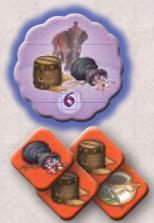
When you take the province token from the pedestal, place it faceup in front of you, where it remains until the end of the game. Score one point for each commodity on it.

The Elephant
Then, score one point for each commodity on your bonus tokens or other province tokens that matches the commodities on the province token you just scored.
Connecting Provinces Example
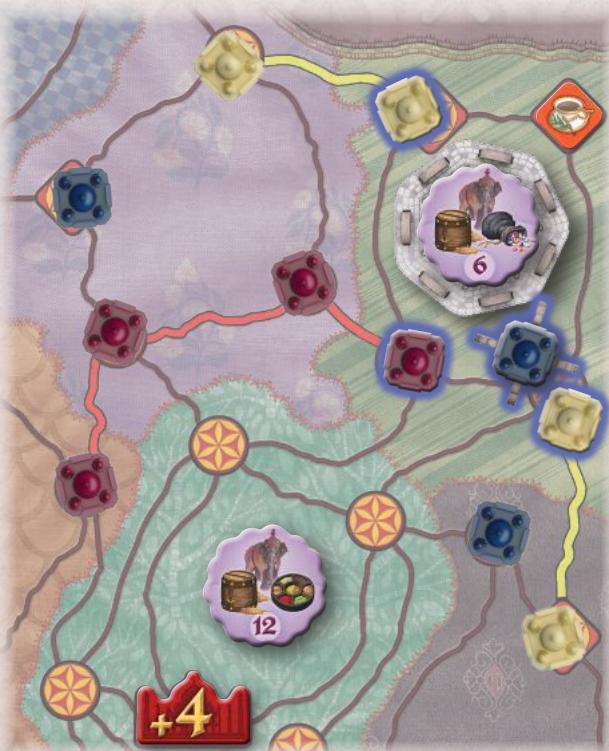
-
Lena (blue), withdraws first. She places the crown palace and scores one point for placing at least one palace in the current province this visit. Lena can't trace an uninterrupted line to any of her palaces in other provinces, so she scores no additional points.
-
Nicole (red), withdraws next. She scores one point for placing at least one palace this visit. She also scores two points for connecting to two other provinces.
-
Greg (yellow) withdraws last. He places one of his palaces on the same city as Lena's crown palace. He places his other palace on another city and takes the bonus token from it. He scores one point for placing at least one palace this visit and two additional points for connecting to two other provinces.
Scoring Commodities Example
- During the third visit, Nicole claims a rice and a tea bonus token, so she scores two points (one point for each new token).
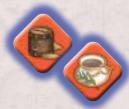
- During the fifth visit, Nicole claims another rice bonus token. She scores one point for the new rice token, and she scores one additional point for the rice token she already has.
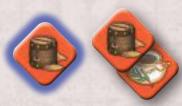
3.During the sixth visit, Nicole claims a gems bonus token, and scores one point for it. Because shedoesn't already have any gems, she has no matching commodities to her incoming token and scores no additional points.
- Also during the sixth visit, Nicole scores two points for claiming the province token (one for each commodity on it), and then scores three additional points for the bonus tokens she already has that match the commodities on the province token.

After Withdrawing
After you withdraw, return all prestige cards in your row to your hand and discard all remaining cards in your row. You cannot take any more turns this visit.
Then, choose two influence cards to take from the display and add them to your hand. If you are the last player to withdraw, you take the only remaining card. If you withdraw on your first turn (without playing any cards), take two cards from the display and draw the top card of the deck, adding them all to your hand.
After all players have withdrawn, the visit ends.
Ending a Visit
If you have two advisor tokens of the same type at the end of a visit, you must return them to the supply and take that advisor's matching prestige card (either from the supply or another player's hand) into your hand. If you already have that prestige card, you must still return the tokens to the supply, and you keep the card in hand.
If a crown palace was placed this visit, remove the crown from underneath the crown palace and return it to its seat. Leave the palace it was underneath in its city.
Then, pass the first player marker clockwise and proceed to the next visit (see "Preparing for a Visit," on page 5). If the twelfth visit just ended, proceed to final scoring.

© Dr. Reiner Knizia 2018 & © 2018 Z-Man Games. Taj Mahal, Z-Man Games, and the Z-Man logo are TMs of Z-Man Games. Fantasy Flight Supply is a TM of Fantasy Flight Games. Actual components may vary from those shown. Made in China. THIS PRODUCT IS NOT A TOY. NOT INTENDED FOR USE BY PERSONS AGE 13 OR YOUNGER.
Prestige Card Effects
The prestige cards have the following effects:

Might: Treat this card as a colorless influence card with one elephant.

Knowledge: Treat this card as a colorless influence card with one
Grand Mogul.

Nobility: Immediately score two points.

Enlightenment: Treat the card that was played with this card as matching the color of the first card in your row.
Remember to return any prestige cards in your row to your hand at the end of each visit.
End of the Game
After the twelfth visit, the game ends. For final scoring you score additional points for the cards in your hand as follows:
Score one point for each colorless card (both colorless influence cards and prestige cards).
+) Choose one color (not colorless). Score one point for each of your cards of that color.
Players then compare point totals, and the player with the most points wins!
If there is a tie, the tied players compare how many total cards they have left in their hand. The tied player with the most cards wins. If there is still a tie, the tied players share the victory.


FANTASY FLIGHT SUPPLY
2
PROTECTIVE
CARD SLEEVES
1995 County Rd B2 West Roseville, MN 55113 USA 651-639-1905 info@ZManGames.com
2-Player Rules
Taj Mahal takes place at a time in India's history when political unrest was on the rise. When playing Taj Mahal with only two players, unrest is a factor that both players must account for.
Unrest
At the end of each player's turn, resolve unrest by drawing the top card of the deck and placing it faceup near the board separate from the display. As cards accumulate in unrest, arrange them sideby-side so they are visible to both players. When you withdraw, compare the cards in your row to those in your opponent's row and to the cards in unrest.
When you resolve unrest and the drawn card is of the same color as another card already in unrest (not colorless), instead of adding the drawn card to unrest, discard it and resolve a protest.
Protests
To resolve a protest, compare the cards in unrest to the cards in each player's row. If any court members appear most in unrest, remove any matching tokens from their seats and set them aside. If the cards in unrest tie with either or both players, do not remove the token from its seat.
After resolving a protest, discard all cards in unrest. Only one protest can occur each visit, so do not draw any more cards for unrest for the rest of this visit.
If both players withdraw before a protest has been resolved, discard all cards in unrest and proceed to the end of the visit without a protest.
At the end of the visit, if the protest set aside the province token, return it to the box; return any other set-aside tokens to their seats.
Credit's
Game Design: Reiner Knizia
Game Development: Stefan Brück
2-Player Rules Concept: Volker Krumbügel
Producer: James Meier with Justin Kemppainen
Editing: Andrea dell'Agnese & Julia Faeta
Graphic Design: Dan Gerlach with Bree Lindsoe, Monica Helland & Samuel R. Shimota
Plastic Sculpting: Samuel R. Shimota
Cover and Card Art: Atha Kanaani
Board Art: Bree Lindsoe
Art Direction: Samuel R. Shimota with Bree Lindsoe
Publisher: Steven Kimball
Playtesters: Iain Adams, Chris Bowyer, Christine & Peter Dürdoth, Dave Farquhar, Walburga Freudenstein, Dieter Habelitz, Markus Huber, Ross Inglis, Kevin Jacklin, Chris Lawson, and Dominik Wagner
下载 Markdown原文为社区整理/出版社公开资料,版权归原作者,仅供个人学习查阅。