
四方之地:印加帝国Tawantinsuyu
一句话概览
四方之地:印加帝国 是一款已收录于村了吗规则库的桌游,支持 1–4 人,原名 Tawantinsuyu。
本页内容:一句话概览 · 常见问题
这游戏怎么玩
- 本站已收录这款游戏的规则资料,可以在对话里直接提问规则细节。
常见问题(FAQ)
以下 1 条问答中 0 条来自站内玩家的真实提问,其余 1 条为本站整理的常见疑问;答复内容保持原样。
四方之地:印加帝国支持几个人玩?
1–4 人。
去哪查完整规则
想核对具体规则细节、卡牌效果或某个回合的结算方式,可以在村了吗里选中这款游戏后直接提问。
同类桌游
- 卡坦岛德式
- 工业革命:伯明翰德式
- 勃艮第城堡:特别典藏版德式
- 方舟动物园德式
- 卡卡颂抽象
- 瘟疫危机传承:第一季美式
- 阿瑞迪亚:勇踏征途美式
- 重塑宇宙德式
- 幽港迷城美式
- 埃多拉的德鲁伊德式
规则原文(Markdown)
本站收录这款游戏的规则原文 1 个文件,此处内联渲染 1 个,可直接展开阅读或下载。
Tawantinsuyu_Rules_EN_1.53_2021_updated_EN_compressed.md74.1 KB
TAWANTINSUYU THEINCA EMPIRE
RULEBOOK-
2021,UPDATED VERSION
GAME OVERVIEW
The great Sapa Inca Pachacuti has just turned to his offspring and ordered them to worship Inti, the sun god, and in his name to spread the empire as far as the llamas roam. In order to be named Pachacuti's successor, players wil need to compete to see who can gain the most fame in the eyes of the the people. Fame can be gained from worshipping the gods; constructing tapestries from beautiful weavings; performing conquests into Chinchaysuyu, Antisuyu, Qullasuyu, and Kuntisuyu, the four regions of the new Empire; and more.
While there are many paths to the fame needed, one thing is certain: it is a long trip from the central great Coricancha temple to the workshops of the hillside and the village below. As was customary in Inca culture, the slopes around the Coricancha temple have been formed into terraces. These provide level land on which corn and potato can be harvested, stone and gold can be quarried, and the weavers can produce their weavings and builders can build workshops. Unfortunately, descending from the temple to these terraces is a back-breaking task; so, all who work on the hills are eager to give fame and gifts to those who build steps to make this downwards journey easier.
There are many paths forward for Tawantinsuyu but no clear path to becoming the great Pachacuti's successor. Help expand the empire through conquest, craft tapestries that will be talked about for centuries, gain fame through constructing steps for your people and statues of Inti, and secure your place as the next Sapa Inca.
COMPONENTS
1 GAME BOARD

19x Production Buildings (marked withthe Productionicon)
TILES
35x Weavings

Buildings
20x Passive Buildings (marked with the Passive Ability icon )

4 of them marked as starting Weavings (#SWO1-O4)

RESOURCES

Statues
12x small Statues

6x large Statues

4x Multiplier tiles for resources

1x Festival tile

1x Coricancha tile

25x Stone
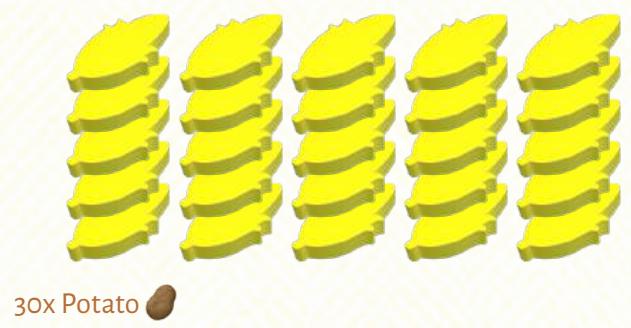

20x Gold

Note: Resources (gold, stone, potato, and corn) are not limited. Use the multiplier tiles provided or any proxy if necessary. All other components (Workers, Step markers, and Conquest markers) are limited, and no more can be added to the game.
WORKERS
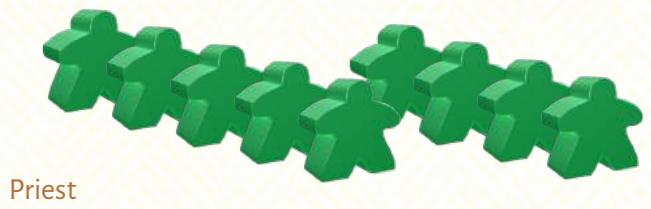
45 Workers, 9 in each color: * the box may contain a spare of each color. Remove these before play.




CARDS
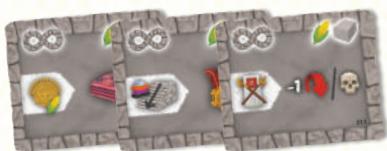
42 God cards

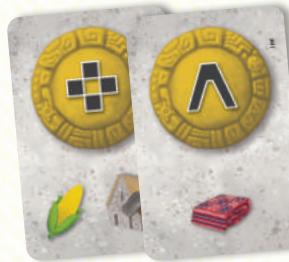
30 Army cards


1 DRAW BAG
SOLO COMPONENTS (see page 22)
PLAYER COMPONENTS
Player aid
1 per player

High Priest

1 per player color

Scoring marker
1 per player color




Steps markers
5 per player color

Temple marker
1 per player color

Conquest markers
10 per player color

SETUP
Important! We prepare each copy of the game with great care. Regrettably, mistakes can still happen. Therefore, during setup, please make sure that you are not missing any elements. This will ensure that your experience is not spoiled by a missing component. If you notice any damaged or missing components, contact us via the customer support form found at https://boardanddice.com/customersupport/.
KEY CONCEPTS
1 Conquest region: Chinchasuyu
2395 Conquest region: Antisuyu Conquest region: Qullasuyu Conquest region: Kuntisuyu Temple
6 Nomads
7 Village
8 Casualties of War
Anatomy of the central part of the board (the hill):
section
12 top terrace
10 bottom terrace
13 segment
10 middle terrace
14 Coricancha

-
Lay out the main game board in the center of the play area. Place all resources next to the board to form a general supply.
-
Give each player their High Priest, all their Conquest markers, and all their Step markers. Place their Scoring marker on the 1o space of the score track and their Temple marker on the bottommost space of the Temple track.

Bottommost space on the temple track
- Rotate the Coricancha tile randomly, and place it on the top of the hill. (Skip this step for your first game, and play with the Coricancha as printed on the board.)

The Coricancha tile
-
If playing with 2 players, remove 1 Worker of each color from the game, returning them to the game box. There should be a total of 4o Workers in play.
-
If playing with 3 players, remove 2 Workers of each color from the game, returning them to the game box. There should be a total of 35 Workers in play. (Note that this is fewer than if playing with 2 players.)
-
Place 2 Workers of each color in the draw bag. Each player draws 2 Workers. If a player draws 2 Workers of the same color, draw one more Worker (which is thus a different color); then, return one of the duplicate color Workers to the bag.
-
Add all remaining Workers to the bag. Randomly draw Workers from the bag, and place them on the Village spaces on the board, forming a queue between the potato and corn icons. The game board shows how many Workers, depending on the number of players, need to be placed into the Village.

The Village
- Place a number of Workers (depending on the number of players, as indicated on the game board) into the Nomads space. These Workers do not form a queue.

The Nomads
- If playing with 2 players, place one randomly drawn Worker from the bag on each space with a2 on the top terrace. (Marked spaces on the middle terrace will be blocked after the first Festival; see page 17.)

Initial Worker placement in a 2-player game
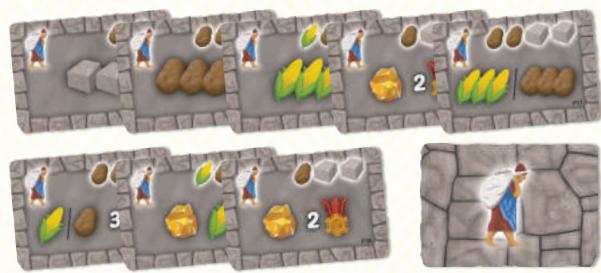
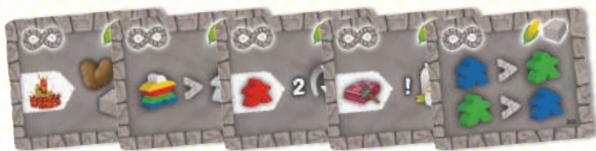
- Separate Buildings by type: Productionand Passive . Shuffle the Production and Passive Buildings separately, and create two face-down stacks. Then, reveal 2 Buildings of each type next to each of the Building stacks. This becomes the Building Market.
Example Building Market
-
Shuffle the Army cards, and place them in a facedown deck near the Building Market. Leave space for a discard pile.
-
Separate the Statues by Cod icons系日自离中A and lay them out near the Building Market.
-
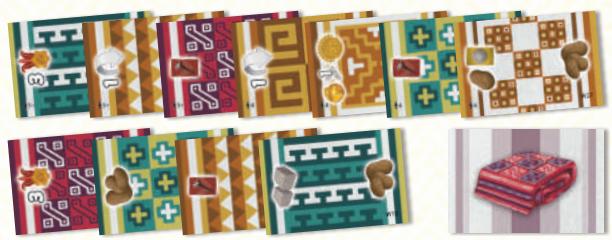
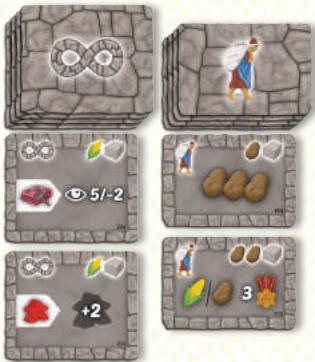
Set the Weaving tiles aside, face up. Identify and set aside the 4 starting Weavings1. In a 3-player game, remove tiles labeled 42.In a 2-player game, also remove tiles labeled 3+3. Shuffle the remaining tiles into a face-down stack 4, and reveal the top Weaving.

Example Weaving tiles
-
The last person to harvest a vegetable becomes the first player. Alternatively, randomly determine the first player using a method of your choosing.
-
Lay the 4 starting Weaving tiles face up on the table. In turn order (starting with the first player and going clockwise around the table), each player picks one. If applicable, remove any unused starting Weaving tiles from the game.
-
Give each player 2 stone from the supply.
-
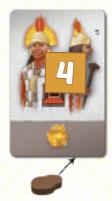
Shuffle the God cards to form a face-down deck, and deal 8 to each player. Each player picks 3 to keep in their hand and plays the remaining 5 on the table for their benefits. In reverse turn order, each player receives the benefits shown on the 5 played cards. (Players may use the benefits of one card to pay for the cost of another.)
Example 1: You select the God cards on the left side1 to gain benefits and the cards on the right side to keep 2. You gain 5 potato, 1 stone, 1 corn, 1 Army card, and 5 VP3. You may also build a Building4and you pay for it 1 stone and 1 corn, which you have previously received.
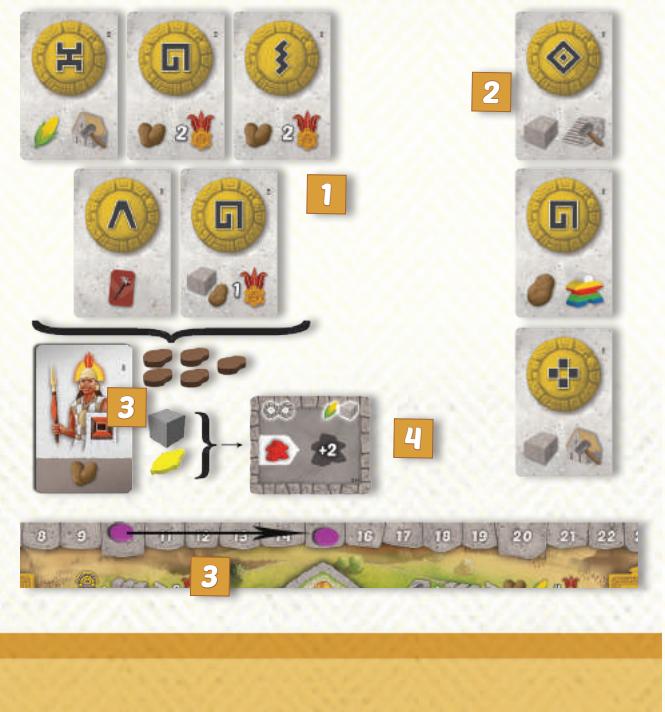
Only replenish the Building Market, refill the Nomads, and flip the top Weaving face up at the end of this procedure. After all players have finished receiving the benefits of their played cards, shuffle these God cards back into the deck. Leave space near the God cards deck for a central offer of 3/4/5 face-up cards for
games of 2/3/4 players, respectively, that will be created and used in the course of the game.
- Keep the Festival tile near the game board, as it will be needed later.
Festival tile
ONE TURN OF PLAY
COMMON TERMINOLOGY
VP= Victory Point

Resource = potato , corn , stone, or gold ; gold is a wild resource that can be spent as any other resource
Food = potato or corn (or gold )
Special First Turn Rule: Before taking your first turn of the game, start by placing your High Priest on the Coricancha tile on any of the spaces (even one already occupied by one or more High Priests belonging to other players). This placement only serves to determine the starting position of your High Priest and should not be confused with the Moving the High Priest secondary action described later in the rules.
General rule of benefits: Every Weaving/Temple step/God card ability that requires you to pay a cost is optional. Otherwise it is mandatory to perform it, even if the benefit is unwanted (for example a worker or a God card at an inappropriate time).
On your turn, you must choose one of the following two options:
-
Place a Worker: Discard 1 God card or 1 gold to place a Worker from your supply on the game board.
-
Perform 2 different secondary actions, in any order:
。Moving the High Priest,
。Praying,
。Training,or
。Recruiting.
Additionally, as a free action at any time during your turn, you may discard any number of Army cards from your hand to gain the resources depicted on them. There is no limit to the number of times you can take this free action on your turn.
At the end of your turn, you have a chance to recruit one more Worker, but you can never end your turn with more than 2 in your supply. For details, see Recruiting at the end of the turn on page 16.
If the VIllage is empty at the end of your turn, a Festival (Scoring) is triggered. Triggering a Festival is explained in its own section on pages 17 and 18.
At the end ofyour turn, replenish the Building Market if you constructed any Buildings. As in the Setup, there should be exactly four face-up Buildings (two of each type) in the Building Market before the next player takes their turn.

PLACING A WORKER
As your action, you may place a Worker from your supply onto an empty space. This costs a matching God card or 1 gold. Additionally, you must pay food costs for Roaming and Descending based on your Worker's placement compared the position of your High Priest
PLACING COST
The most common action—placing a Worker—has two costs: Roaming and Descending. To calculate the total placement cost, determine the Roaming cost and the Descending costs separately (see below). You must pay the total amount of food before performing any tasks with your Worker.
The Roaming cost is based on the distance between the section where your High Priest is standing to the space in question. A section is one-fifth of the board; each side of the hill is one section. It costs o food to place within the same section as the High Priest, it costs 1 food to place in an adjacent section, and it costs 3 food to place in a nonadjacent section.
The Descending cost is o food on the top terrace, 2 food on the middle terrace, and 5 food on the bottom terrace. This represents the effort needed to carry the tools and the benefits between the Coricancha at the top of the hill and the farms and workshops further down. The Descending cost is decreased by 2 food for each Steps marker above the space in question and in the same section. The owner of the Steps marker scores 1 VP (per Steps marker) each time an opponent places a Worker using their Steps. It is mandatory to take the benefit of Steps; you may not choose to pay extra Descending cost to deny VP from the owner of the Steps.
Example 2: In the following image, Purple is placing a Worker as depicted 1. The cost of placement is:
• 1/ for Roaming
•31for Descending
The total Descending cost of 5/ is decreased by 2 due to Black's Steps 2. Black gains 1 VP as their Steps are used by Purple.

RESOLVING TASKS
Each space is marked with a God symbol ( A) and is adjacent to 3 task icons. You can perform tasks related to those icons.
First, determine the number of tasks you may perform:
• you automatically receive 1 task, just for placing the Worker;
• special abilities of different Workers, depending on their color, may grant additional tasks; and
• each adjacent Worker of the same color grants 1 task.
Workers are considered adjacent if they are on the same terrace and they are connected to your Worker via a common path through exactly one task icon. See Examples 3 and 4.
Most commonly, you are able to perform 1 or 2 tasks, seldom 3 or 4, and very rarely 5 or more tasks.
Next, you may “spend” tasks, one at a time, to activate the 3 adjacent task icons. You must distribute tasks as evenly as possible among those 3 task icons:
• If you have 1 task, you may choose any one of the 3 task icons.
• If you have 2 tasks, you must choose 2 different task icons.
• If you have 3 tasks, you must choose all 3 task icons.
• If you have 4 or more tasks, split them into sets of 3; perform each set according to the rules above.
As soon as you are no longer able to respect the rules above, you must stop and forego any remaining tasks.
Example 3: The blue Worker (Architect) placed on the space 1 can perform 2 tasks: 1 simply for placing the Worker plus 1 because there is another blue Worker adjacent 2 to it.

Example 4: Now, the blue Worker (Architect) placed on the space1 can perform 5 tasks: 1 for placing the Worker plus 4 because of the adjacency of 4 other blue Workers — this is a potent action indeed! The first three tasks must be the adjacent: construct a Building2 gain potato 3, and gain stone4. After these tasks are performed, the placed Worker may perform two (different) ofthesame three tasks again, finally using up all 5 available tasks.

Note: If it is no longer possible to resolve a task due to the state of the board (such as no more Steps or Weavings being available), then you may spend 1 of your available tasks to “skip" this and continue resolving other tasks.
GOD CARDS
Ifyou have at least one Statue that matches the God symbol (Λ) of the God card played when placing a Worker, you may additionally receive the benefits shown on the card. You can receive these benefits before or after resolving your tasks (but after paying placement costs), and you may take one, all, or none of them—taking your benefits is optional.
At the end of your turn, add your played God card to the central offer.
If playing a God card would cause a 4th/5th/6th card (in a game of 2/3/4 players) to be added to the central offer, remove all God cards from the central offer, and shuffle them back into the draw deck. Only after you have done this, place your played card in the offer.
Example 5: In a two-player game, a God card1is used to place a Worker on a spot. At the end of the active player's turn — and before adding the new God card to the offer— there are 3 God cards in the offer. Those 3 cards are immediately shuffled into the God card deck2. Then, the played God card is added to the God cards offer3
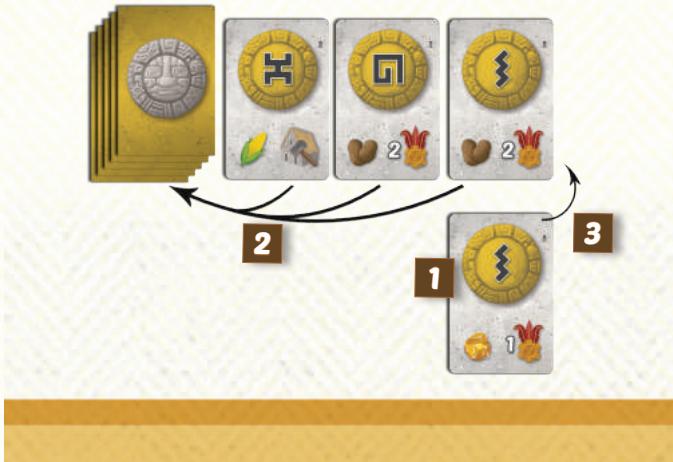
Outside of being used to place a Worker (and potentially gain resources depicted on the God cards when doing so), God cards have the following additional benefits/effects:
• You may immediately return a God card to the bottom of the deck before constructing a Building to replace 1 or 2 tiles in the Building Market.
• During a Festival, you must pay 1 potato for every God card still in your hand.
• Also during the Festival, you may play up to 3 God cards to gain the benefits depicted on them.
• At Final Scoring, every remaining God card in your hand is worth 1 VP.
Note: When paying a gold instead of a God card, you may place your Worker on any God symbol. However, even if you have a matching Statue, you do not receive any associated benefit.
WORKER SPECIAL ABILITIES
Each color Worker has a special ability that activates when placed.

Architect
Perform an additional task when placed on blue spaces.


Craftsman
Perform an additional task when placed on green spaces.

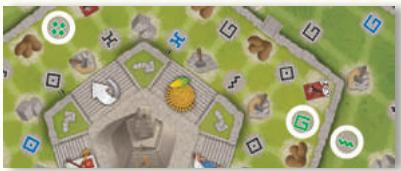
Warrior
Draw 1 Army card into your hand (before or after resolving your tasks). Then, you may retrieve 1 adjacent non-Warrior Worker from the board into your supply at no cost.

Courier
Pay a total of 1 food fewer for any Roaming/Descending costs. Steps discounts still apply.
Additionally, if this is the first Worker placed within a segment, perform an additional task. (Reminder: A segment is the intersection of a terrace and a section.) In a 2-player game, this includes the Workers placed during setup.

Priest
You may pay 1 potato to gain 1 task for this Worker (once per placement). You may also use food gained during the initial tasks' resolution for this. You must draw one God card, from either the offer or the deck, after resolving the tasks (but before adding the God card you played this turn into the central offer).
DESCRIPTION OF TASKS
Collect Resources (potato, corn, stone, gold)
Gain resources as depicted by icons: 3 potato 2 corn ,2 stone, or 1 gold .
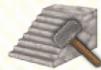

Build Steps/Place a Steps Marker
The cost of building Steps is 3 stone. Upon building Steps (by placing a Steps marker), you immediately receive 4 VP, 1 corn, and 2 potato.
Steps markers are placed in the dedicated spaces on the board, and you may build Steps on any valid empty space regardless of the section into which you place your Worker.

Example of Steps marker location on the main game board.
In each section, you may build the lower Steps (furthest from the top of the hill) only if the upper (closest to the top of the hill) spot already contains a Steps marker. When you build Steps on the lower spot, the owner of the upper Steps marker immediately scores 2 VP. This means that even if you are the owner of the upper Steps marker, you receive the 2 VP.
When an opponent uses your Steps to decrease the Descending cost of placing a Worker, you receive 1 VP. Although using your own Steps still reduces the Descending cost of placing your own Worker, you do not receive any VP when doing so.

Construct a Building
Pay the cost (top right corner of the tile1) to construct an available Building from the Building Market. Place that Building in your player area. At the end of your turn, replenish the Building Market, as described previously in these rules.

Example of Production and Passive Building.

Production Buildings provide resources or VP; however, their benefits must be triggered, as you will see later in the rules.
Passive Buildingsprovide ongoing abilities.
Detailed descriptions of all Buildings can be found in the Appendix later in the rules.
Before constructing, you may return 1 God card from your hand to the bottom of the draw deck to remove 1 or 2 Buildings from the Building Market and immediately replenish it. Place the Buildings you removed this way face down at the bottom of their stacks in the order of your choosing.

Build a Statue
Note: VP are awarded even if you gain a Statue some other way (e.g. Conquest or God cards).
Build one Statue in your player area.
• Small Statues cost 3 stone and immediately score you 3 VP.
• Large Statues cost 3 stone and 2 gold and immediately score you 9 VP.
Statues can be used to trigger God cards (as explained in the God Cards section on page 1o) and can later be discarded when performing Worship actions with the High Priest (described on page 14).
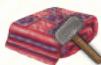
Purchase Weavings
Draw 3 Weaving tiles from the top of the pile (including the face-up Weaving from the top of the pile). Look at all 3 of them, and choose any (including none or all) to purchase. Purchasing 1/2/3 Weavings costs 1/3/6 corn. Any Weavings you do not purchase are offered to other players; in turn order, each other player may purchase 1 leftover Weaving for 2 corn. If any remain, return all leftover Weavings face down to the bottom of the Weavings stack.
Finally, reveal the top Weaving.
Note: If any ability (Building, God card, etc) grants you one or more Weavings (as opposed to a Purchase Weavings task), you may choose to take either the face-up tile or the face-down tile beneath the face-up tile at no cost. If you take the face-down one, leave the face-up one on the top of the pile; if you take the faceup one, reveal the next one at the end of the ability.
Other players do not have the opportunity to purchase Weavings when an effect like this is triggered.
Weavings form Tapestries in the form of rows of Weavings. Each player may have multiple Tapestries, but each Tapestry must be composed of Weavings with different patterns. Whenyougain a Weaving,you mustimmediately add it at either end of an existing Tapestry or start a new Tapestry. Once placed, Weavings cannot be rearranged and Tapestries cannot be split or merged. There are seven different Weaving patterns, some more common than others.
Example 6: Add new Weaving to a Tapestry.

Note: The icons on the edges of the Weavings do not have to match in order to be placed adjacent to each other in a Tapestry.
During final scoring, each Tapestry yields VP based on its size. Furthermore, each matching connection provides its reward to the owner when resolving a Merchant task (described in the next section).
Merchant
Receive rewards from your Tapestries. For each connection where two matching rewards are shown, gain that reward: 1 gold1, 2 stone2, 3 potato3, a God card plus 1 potato4, Rejuvenate (flip face-up, for free) 1 Building or Army card 5, draw one Army card 6, pay 1 gold to climb once on the Temple7, or 3 VP8.
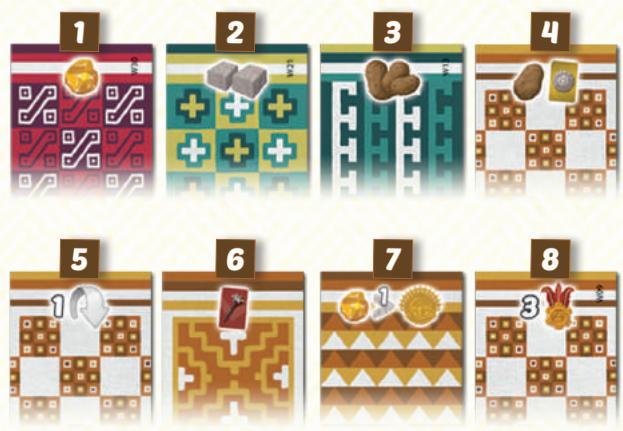
All possible Weavings rewards
Example 7: In the following image, Purple performs the Merchant task. They have two Tapestries: the first one made of 4 Weavings1and the second one 2 made of 5 Weavings.
In the first Tapestry, the leftmost Weaving connection matches and provide 3 potato 3. Also, the rightmost Weaving connection matches, and the reward is advancing one step up the Temple by paying 1 gold 4. The other Weaving connections do not match.
The second Tapestry, having two matching connections, also provides Purple with resources: 1 Army card 5and 2 stone6
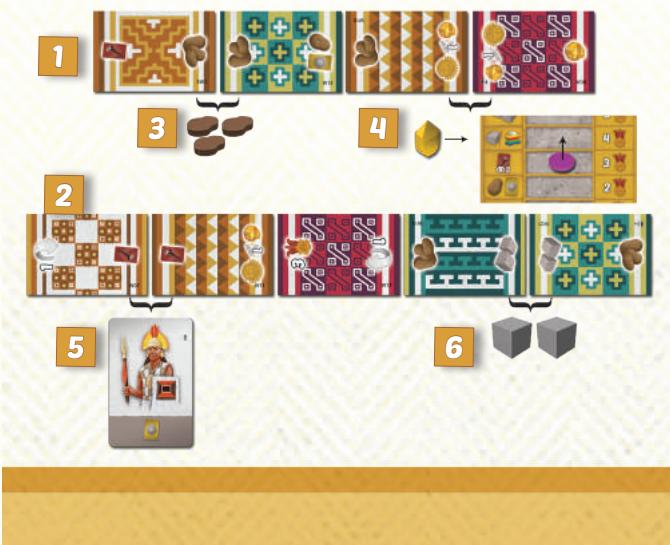

Training
Draw 2 Army cards, keeping 1 in your hand and discarding the other. Discarded Army cards are placed in the discard pile. When the Army card deck empties, shuffle the discard pile to form a new draw deck.
At the bottom of each Army card is a resource. At any point during your turn, you may perform a free action to discard Army cards to gain the resources printed on them. There is no limit to the number of times you may perform this free action on your turn. Army cards also depict 1 or 2 Soldiers on them. These Soldiers are relevant when taking the Conquest High Priest action, where having them in greater number results in more and/or better Conquests.

Produce One
Immediately receive the shown benefits of one of your face-up Production Buildings. This Building remains face up (as opposed to when producing as part of the Produce High Priest Action, which is explained later in the rules)
PERFORMING 2 SECONDARY ACTIONS
Instead of placing a Worker, you may choose two different secondary actions and perform them in any order. These actions often allow other players—in turn order—to perform some version of the action you choose.
HIGH PRIEST SECONDARY ACTION
You may move your High Priest 1 or 2 steps (sections) clockwise around the Coricancha and trigger that action for all players.
You (as the active player) may always choose to gain 1 gold instead of taking the action associated with the activation. If you do so, the other players may still perform the action, and they can never choose to to gain 1 gold instead.

Worship
All players may discard Statues from their player area to advance on the Temple track.
You may discard 1 large Statue to advance 3 steps on the Temple and/or 1 small Statue to advance 1 step. You may not discard more than 1 of each size Statue this way. Other players may choose to discard one large or small Statue to advance exactly1 step (regardless of the type of Statue that is discarded).
Remove Statues discarded this way from the game by placing them back in the game box.
Advancing on the Temple may trigger effects that are described later in the rules.

Offering
You may spend 2/4/6 corn to advance 1/2/3 step(s) on the Temple track. Other players may spend 3 corn to advance exactly 1 step on the Temple track.
Advancing on the Temple may trigger effects that are described later in the rules.

Rejuvenate
All players may pay to flip face up any number of facedown Production Buildings and/or Army cards.
You may flip one for free, and you may pay 1 food for each additional Building or Army card you wish to flip face up. Other players may pay 1 corn (not potato) per Building or Army card they wish to flip face up.

Conquest
Immediately upon initiating Conquest, you must select a Worker from either end of the Village queue and place it in the Casualties of War area. If the Village is empty, select from the Nomads instead; then, draw a Worker from the bag, and place it in the emptied Nomad space.
All players may now (in turn order, starting with you) play any number of Army cards from their hand to their player area, face up, at a cost of1 potato each. You may play your first Army card at no cost.
Each Army card depicts 1 or 2 Soldiers. Each Conquest space depicts a benefit and the number of Soldiers that are required for conquest. The number next to the indicates the minimum number of face-up Soldiers in your player area (not in your hand) that must be discarded. The number next to theindicates the minimum number of face-up Soldiers in your player area (not in your hand) that must be flipped face-down.
After all players who choose to do so have played their desired Army cards, in turn order (starting with you), each player who still has available Conquest markers may place 1 Conquest marker on an empty Conquest space in any region and immediately 1) gain the benefits of that space and 2) flip face down and/or discard the minimum number of Soldiers for that conquest. Then, you (and only you) may place 1 additional Conquest marker, gaining the benefits and discarding and/or flipping face down the appropriate number of Soldiers.
Face-down cards can later be flipped back using a Rejuvenate action, which is described in the previous section.

Example 8: The following image depicts the situation in the four Conquest regions in a 2-player game before Purple initiates a Conquest action.

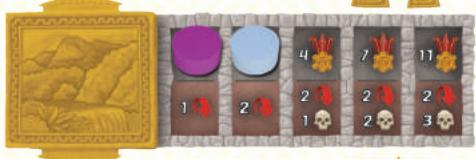
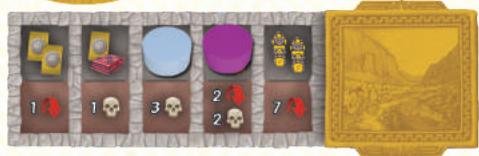

Purple has 2 Army cards face-up in their player area 1 then, they play 1 Army card for free and 2 more at the cost of 1 potato each2. Purple has a total of7 Soldiers on face-up Army cards.
Blue has 2 Army cards face-up in their player area 3; then, they play 1 Army card at the cost of 1 potato4. Blue has a total of 4 Soldiers on face-up Army cards.


Purple places a Conquest marker as depicted in the following image5to gain 4 VP. To do so, Purple must flip face down 2 Soldiers (and can do this with a single Army card)6 and must also discard 1 Soldier7
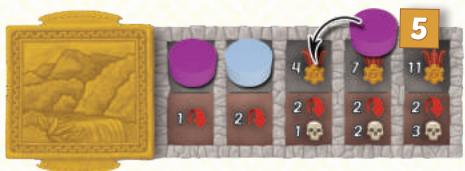

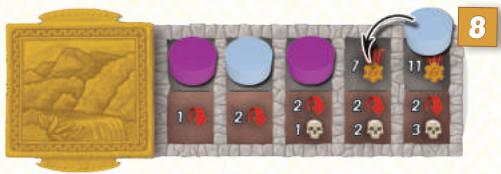
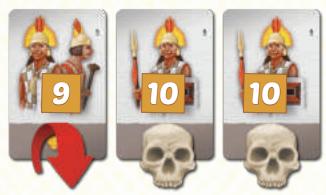
Blue follows, placing a Conquest marker as depicted in the following image 8 to gain 7 VP. To do so, Blue must flip face down 2 Soldiers (and can also do this with a single Army card)9and must also discard 2 Soldiers10
Purple, as the active player, may place a second Conquest marker and chooses to do so as depicted in the following image 11 to take 1 God card and 1 free Weaving. To do this, Purple must must discard 1 Soldier 12



Note: Ifyou choose to take gold instead of performing Conquest, you may not play Army cards or place a Conquest marker. You must still place a Worker in the Casualty of War, and the other players carry out the procedure as normal.
Produce
You receive the shown benefits of any number of your faceup Production Buildings; then, flip those Buildings face down. Before or after doing so, you (and only you), may choose one face-down Production Building to flip face up.
Afterwards, every other player may also receive the shown benefits of any number of their own face-up Production Buildings; then, flip those Buildings face down. Facedown Production Buildings can later be flipped back using a Rejuvenate action, which is described previously in the rules.
PRAYING SECONDARY ACTION
Take 2 God cards. You may take (in any combination and order) from the top of the God card deck or from the faceup offer. If you draw from the deck first, you may look at the drawn card before deciding where to take your second card from.
Note: Any time you receive God cards (with the exception of the last step of the Festival), you may take those cards, one at a time, from the offer or from the draw deck.
TRAINING SECONDARY ACTION
Draw 2 Army cards, keeping 1 in your hand and discarding the other. The effect of this secondary action is identical to the Training task described previously in the rules.
RECRUITING SECONDARY ACTION
Youmaytake one Nomad Workerfrom the NomadWorkers space. Then, immediately draw one Worker from the bag (if it is not empty), and place it on the vacated Nomad space.
RECRUITING AT THE END OF THE TURN
At the end of your turn, you may purchase a single Worker from the Village. Spend 1 potato or 1 corn to take a Worker from the respective end of the queue. If this is the last Worker remaining, you may spend 1 potato or 1 corn to purchase it. Purchasing the last Worker empties the Village and triggers a Festival (Scoring), described later in the rules. If there are no Workers in the Village, you may not recruit this way.
Each player has a limit of 2 Workers enforced at the end of their turn. This happens after a possible Worker purchase step, so the limit is enforced immediately. If you have more than 2 Workers, you must immediately give up any surplus by removing those Workers from the game permanently and returning them to the game box. You may purchase a Worker or gain one through other game effects, even when you have 2 or more Workers; the limit is only relevant at the end of your turn.
FESTIVAL - SCORING
Each time the Village empties, the active player takes the Festival token and immediately receives VP as follows: 1/2/4 VP for the first/second/third Festival (Scoring). The third Festival also marks that the game is about to come to an end.
Before the beginning of the following turn of the player holding the Festival token (i.e. after each other player had another turn), resolve the Festival in the following order:
-
Each player performs a free Merchant task.
-
Each player receives the VP to the right of their current position on the Temple track and the benefit (if any) depicted to the left of that position. The VP depicted at the center of the top four Temple track spaces are scored only during Final Scoring. Ignore those for now.
-
Check each Conquest region: the player who has the most Conquest markers scores VP equal to the current number of Workers in the Casualties of War area. (Ties are broken in favor of the player with the rightmost Conquest marker.)
-
Players must pay 1 potato for every God card in their hand. Players lose 2 VP per missing potato; if any player must lose more VP than they currently have, their scoring marker stays on the o space--you cannot have negative points.
-
If this was the third Festival, skip the next two steps and proceed to the End of the Game and Final Scoring.
-
Return the Festival token next to the game board, then draw additional Workers from the bag to refill the Village.
a. It is possible for the draw bag to run out of Workers before the Village is refilled. In this case, simply place all remaining Workers on the Village.
b. It is rare but also possible for no Workers to remain in the bag before refilling. In this case, immediately trigger the next Festival: the same person who triggered the previous one receives the Festival token and the associated VP, then each player (this time including the player holding the Festival marker) plays a single turn before evaluating the next (and last) Festival.
c. If playing with 2 players, and only during the first Festival, place one Worker randomly drawn from the bag on each space marked with this icon 2 on the middle terrace of the hill. If any of those spaces are occupied, skip those spaces.
- Finally, proceed to the Festival Card Draw phase (see below).
FESTIVAL CARD DRAW
After the first and second Festival, players draw God cards from the deck (during this phase players are not allowed to draw cards from the offer) as follows (in order from the player with the fewest VP to the player with the most VP):
• In a 4-player game, the player with the fewest VP draws 2 cards, the player with the second fewest draws 2 cards, the player with the second most draws 1 card, and the player with the most VP draws 1 card.
• In a 3-player game, the player with the fewest VP draws 2 cards, the player with the second fewest draws 2 cards, and the player with the most VP draws 1 card,
• In a 2-player game, the player with the fewest VP draws 2 cards, and the player with the most VP draws 1 card.
• If tied, the player closest to the active player in clockwise turn order (starting with the active player) is considered to have “more” VP.
Then, in turn order (starting from the active player), each player may play up to 3 God cards to receive any benefits depicted on them. Cards used this way are shuffled back into the draw deck and do not affect the card offer.
At the end of this step, if any Buildings remain in the Building Market, remove them (placing them face-down at the bottom of their respective Building stack(s)), and add four new Buildings (two of each type).
END OF GAME AND FINAL SCORING
After the third and final Festival, each player receives VP as follows:
• Tapestries: a Tapestry comprised of 1/2/3/4/5/6/7 different Weavings score 0/1/3/6/10/15/21 VP.
• If a player has reached one of the top 4 steps of the Temple track, they receive the VP printed at the center of that step.
• 2 VP per face-up Building (including Passive ones).
• 1 VP per God card in their hand.
• 1 VP per face-up Army card in their player area (not in their hand!).
• 1 VP per leftover Worker in their supply.
• 1 VP for each gold in their supply.
The player with the most VP wins. In case of a tie, the tied player with the most resources (a total of all gold, stone, corn, and potato) wins. If still tied, the tied players share a victory.
ADDITIONAL RULES
CLIMBING THETEMPLE
Whenever you advance your Temple marker on the Temple track, gain the benefit shown to the left of that step (if any). If you move multiple steps, gain all resources shown to the left of each step you advance. Any number of players may occupy the same step. You do not gain any Victory Points, as that happens only during Festivals.
 | Gain 1 gold. |
 | Take 1 God card from the top of the deck orthe offer. Draw 2 Army cards, keep 1, anddiscard the other. |
 | Gain 2 stone. |
 | Gain 1 stone OR take 1 Worker from theNomads. |
 | Draw 2 Army cards, keep 1, and discardthe other. |
 | Gain 1 potato. Take 1 God card from thetop of the deck or the offer. |
Table: Temple rewards
RECEIVING FREE WORKERS
Whenever you receive a free Worker (from a God card, a Temple reward, or other ability), take the Worker from the Nomads. Then, immediately refill the Nomads with a Worker from the bag, if the bag is not empty. If there are no Workers in the Nomads space, then you do not receive your free Worker.
APPENDIX 1 PASSIVE BUILDINGS
| Zo1 | You may treat any Worker you place as a Courier. |
| Zo2 | You may treat any Worker you place as a Priest. |
| Zo3 | Whenever you place a Warrior, you may Rejuvenate up to 2 of your Production Buildings for free. |
| Zo4 | Whenever you create a new match in a Tapestry, receive that reward immediately. |
| Zo5 | Craftsmen may be used as Architects, and Architects may be used as Craftsmen |
| Zo6 | At the start of each Festival, gain 4 potato. During endgame scoring, gain an additional 1 VP per God card left in your hand(i.e. gain 2 VP per God card in your hand). |
| Zo7 | When placing a Worker, gain VP when you use your own Steps. |
| Zo8 | When you trigger a Purchase Weavings task, draw 5 tiles and discard 2 (place them face down at the bottom of the pile inthe order of your choosing) before proceeding normally with the task. |
| Zo9 | At the start of each Festival, gain 1 VP per Weaving in your longest Tapestry. |
| Z10 | At the start of each Festival, gain 2 potato, 1 corn, and 1 stone. |
| Z11 | Whenever any player activates the Offering High Priest secondary action, gain 1 Weaving (the top one or the one directlyunderneath—your choice). |
| Z12 | Whenever any player activates the Offering High Priest secondary action or immediately before a Festival, you may payone gold to advance on the Temple. |
| Z13 | Whenever you place a Conquest marker, you may flip face down and/or discard one fewer Soldier (this works as adiscount). You are still required to flip or discard at least one Soldier. |
| Z14 | Gain +2 Tasks when you place a Warrior. |
| Z15 | You may freely spend 2 stone, 1 gold, and 2 corn as one of the other options. |
| Z16 | Whenever any player activates the Produce High Priest secondary action, you may Rejuvenate for free 1 ProductionBuilding or1 Army card before or after producing. |
| Z17 | Whenever any player activates the Conquest High Priest secondary action, you gain 1 gold and 1 VP. |
| Z18 | Whenever any player activates the Rejuvenate High Priest secondary action, draw1 Army card and gain 1 gold. |
| Z19 | Any time during your turn, you may pay 1 potato to draw 1 God card. |
| Z20 | Whenever you perform the task Collect Resources (potato, corn, stone, but not gold), receive 1 extra resource of that typeand1 VP. |

APPENDIX 2 SYMBOLS REFERENCE
Resources

potato

corn

stone

gold
Tasks

Collect Resources Gain 3 potato

Collect Resources Gain 2 corn

Collect Resources Gain 2 stone

Collect Resources Gain 1 gold

Purchase Weavings

Build a Statue

Build Steps

Build a Building

Training
Draw 2 Army cards; keep one, discard the other

Produce One
Gain benefits from 1 Building; do not flip it

Merchant
Gain rewards from Tapestries
High Priest Secondary Actions

Produce

Worship


Offering
Conquest

Rejuvenate
Temple / Conquest regions / Production Buildings / Tapestries rewards

Gain a free Weaving

Build Steps for free, gain benefits

Build a small Statue for free, gain its benefits

Build a Building for free

Gain a God card from the offer or deck

Gain X Victory Points

Take a Worker from Nomads

Advance one step on the Temple, gaining rewards

Flip X Soldiers

Discard X Soldiers


Pay 1 gold to advance on the Temple

Rejuvenate 1 Building or Army card
Other symbols

Building

Production Building

Passive Building

Army card

Large Statue

Festival


+ΛGod symbols
CREDITS
Tawantinsuyu: The Inca Empire
Game design: Dávid Turczi
Game development:
Dávid Turczi, Rainer Åhlfors, Andrei Novac, Błażej Kubacki,
Małgorzata Mitura
Illustrations: Jakub Skop, Michał Długaj, Alexander Zawada
Graphic design: Zbigniew Umgelter
Rulebook: Dávid Turczi, Andrei Novac, Błażej Kubacki, Rainer Åhlfors
Rulebook editing: Emanuela & Robert Pratt
Rulebook DTP: Agnieszka Kopera
Special thanks to Daniele Tascini for his inspiration and ideas.
Additional solo playtesting and development: Nick Shaw, Jonathan Bobal, Gary Perrin, Jimmy Durden, Noralie Lubbers.
Playtesters:
Nick Shaw, Charlotte Levy, Kieran Symington, Wai-yee Phuah, Neil HK, Ben Hodgson, Fabio Lopiano, Denholm Spurr, Jimmy Durden, Noralie Lubbers, Jonathan Bobal Gary Perrin, Anthony Howgego, Jeroen van den Hark, Robert Plesowicz, Łukasz Włodarczyk, Daniel Dubel, Mateusz Pasek, Iwona Jaworowska, Konrad Sass, Anna Czarnacka, Bartosz Folta, Anita Sokołowska, Jakub Muliński, Weronika Nogaś, Katarzyna Meszczyńska, Łukasz Juras, Krzysztof Jurzysta, Marek Mańko, the board game group at Game Grid (Lehi, UT).
Thanks for the help with the 2021 rulebook
Nick Shaw, Jeremy Avery, David Digby, Emanuela & Robert Pratt, Xavi Bordes
Board & Dice
Executive Manager: Andrei Novac
Operations Manager: Aleksandra Menio
Head of Marketing: Filip Glowacz
Head of Sales: Ireneusz Huszcza
Art Direction: Kuba Polkowski
Development Lead: Błażej Kubacki
© 202o Board & Dice. All rights reserved.
For more information about Tawantinsuyu: The Inca Empire please visit WWW.BOARDANDDICE.COM.
SOLO RULES
EXTRA COMPONENTS
Axomamma board

8 numbered tokens (of values 1, 1, 2, 2, 2, 3, 3, 4)

6-sided die (with faces showing values 1, 2, 2, 3, 3, 4)
2 double-sided Axomamma Personality tokens

Axomamma or"it” refers to the automated opponent, while "you” refers to the lone human player.
SETUP
-
Place Axomamma's player board in its play area.
-
Set up a 2-player game, with the following exceptions:
• When gaining a starting Weaving, Axomamma gets a random starting Weaving tile before you get to pick yours.
• Axomamma does not get a starting hand of God cards. Instead, it receives additional 2 stone (for a total of 4 stone), 2 corn, 1 gold, and 1 Army card face down in its hand at the bottom of its board.
• Axomamma receives 2 random Workers from the
draw bag (in the same way you do).
• You place your High Priest first; then, roll the die, and place Axomamma's High Priest the number of spaces clockwise from your High Priest equal to the value you rolled.
-
Place the 8 numbered tokens on their respective starting spaces.
-
Draw 4 God cards and slide them under the 4 spaces at the top of Axomamma's board so that only the God symbol remain uncovered.
-
Axomamma places 1 free Steps marker in the section where its High Priest starts (but does not gain any benefits from this placement).
-
Give Axomamma a Personality token to affect what type of action it will favor during the game:
• Select one of the 2 double-sided personality tokens at random, and select one side at random (return the unused Personality token to the box).
• Place the chosen token over the top of the spot in the top row of actions on Axomamma's board.
• For your first game (for an easier experience), leave all Personality tokens in the box, and leave the Gold icon visible.
GAMEPLAY
You are the starting player and play your turns normally.
Axomamma plays its turns in a slightly different way.
Unless stated explicitly otherwise, Axomamma resolves an effect the same way you would, paying costs, receiving benefits. However, Axomamma ignores all printed effects of its Passive Buildings.
General Notes
Gaining Workers
Whenever Axomamma gains a Worker from the Village or Nomads area, it also gets a reward based on the color of the Worker, as shown on its player board.
RECRUITING REWARDS:

After gaining this benefit, the color of the Worker becomes irrelevant for Axomamma.
Whenever Axomamma has more than 2 Workers, it immediately discards down to 2 Workers. Discard excess Worker at random and remove them from the game.
Drawing God cards
Whenever Axomamma may draw a God card as an effect (e.g. when climbing the Temple track or placing a Priest), it instead removes the oldest God card in the offer, places it at the bottom of the God card deck, and scores 1 VP. If there are no cards in the offer, it simply does nothing (and does not score 1 VP).
Drawing Army cards
Whenever Axomamma draws Army cards, it keeps them face down below its board, in its “hand."If Axomamma receives an effect that allows it to draw 2 cards and keep 1, it draws 1 card instead.
Resources
Axomamma uses potato differently than you. Whenever Axomamma has 5 or more potato in its supply, it exchanges 5 of them for 5 VP until it has fewer than 5 potato left. Axomamma does not use gold as a wild resource to stand in for potato for this purpose, but it does for all other purposes. Axomamma uses all other resources the same way you do, including paying for building Steps, Statues, Temple advances, etc.
Statue Benefits
When building a Statue (or gaining one for free), Axomamma receives 3 or 9 VP the same way as you would.
If Axomamma owns a Statue (of any type) and it selects a God card tucked under its board for a main action that matches that Statue, Axomamma scores 5 VP (ignoring anything else depicted on the God card).
Building Steps
If Axomamma places more Steps (after setup) it gains VP and resources the same way as you would.
Temple Benefits
Axomamma receives all benefits when moving up the Temple track, except for drawing God cards into its hand (see Drawing God cards earlier).
When it gains the Temple bonus, it takes whichever of these two it has the fewest of:
• If there is a tie, Axomamma takes a Worker if it has o or 1 Workers; otherwise it takes
• If there are no Workers available in the Village or Nomads area, Axomamma takes
• When Axomamma must take a Worker, it takes it from the potato-cost side of the Village. If the Village is empty, it takes a random Worker from the Nomads area.
High Priest Action
If Axomamma meets the conditions (see High Priest Activation Condition below) of one of the next 2 High Priest actions accessible from its High Priest's current position, it 1) moves its High Priest to the closest of these actions it can perform and 2) performs that action. You may follow the action, as per the standard rules.
Whenever Axomamma performs a High Priest action, it also
• draws 1 Army card, placing it face down below its board and
• discards up to 2 God cards from the central offer, discarding the oldest 2 if there are 3 to choose from. (It does not score VP for discarding these cards.)
High Priest Activation Conditions
• Offering: Axomamma has 4 corn or more.
• Produce: Axomamma has at least two face-up Production Buildings.
• Worship: Axomamma has one or more Statues.
• Conquest: Axomamma has more “available Soldiers” than the number of Workers in the Casualties of War area (available Soldiers are Soldiers on face-up Army cards on the table, plus one “Soldier” per Army card in its “hand”).
• Rejuvenate: Axomamma has a combined total of three or more face-down Buildings and/or Army cards.
High Priest Actions & Reactions
| High Priest Action | If Axomamma takes the Action | 内容过长,此处只内联前一部分;完整内容请下载或到规则页阅读。下载 Markdown 原文为社区整理/出版社公开资料,版权归原作者,仅供个人学习查阅。 |