
茶园Tea Garden
一句话概览
茶园 是一款已收录于村了吗规则库的桌游,支持 2–4 人,原名 Tea Garden。
本页内容:一句话概览 · 游戏概述 · 1. 游戏组件 · 2. 游戏设置 · 3. 游戏流程与回合结构 · 4. 主行动 · 5. 次要行动 · 6. 自由行动 · 7. 奖励效果与图标 · 8. 重要规则 · 9. 维护阶段 · 10. 游戏结束与计分 · 11. 关键术语 · 常见问题
茶园 规则速览
本页收录规则速览的前 12 节(篇幅所限省略了后 1 节),完整规则速览与卡牌可在村了吗查询。
游戏概述
云南山区的尖峰上,一种奇特的植物开始变绿。坊间流传着它的神奇功效,能够治愈身体、振奋精神,难怪它的种植会像野火一样蔓延到其他省份。为了响应皇帝的号召,种植大师们汇聚在一起,在长江流域建立起这一神奇植物的种群。他们中的佼佼者将获得特殊的奖励——在梦寐以求的云南省拥有肥沃的土地。
玩家扮演中国云南地区第一批茶园的主人,试图在河谷沿岸建设新茶园、扩大茶园面积。游戏分五轮进行,每轮中玩家最多可以执行 4 个主行动,这些行动由玩家手中的卡牌触发,卡牌代表行动的强度;卡牌上还会出现茶壶符号和玩家可以执行的次要行动。行动包括扩大茶园、获取新卡、收获和出售茶叶、沿河航行以及从事茶叶研究。积累最多胜利点数的玩家获胜。
核心机制: 卡牌强度驱动行动、工人放置(茶叶大学/皇帝轨道)、手牌管理、区域建造、终局条件计分
1. 游戏组件
| 组件 | 数量/说明 |
|---|---|
| 玩家版图 | 4 块 |
| 茶园塔 | 28 座(4 种颜色,每位玩家 7 座) |
| 工人米宝 | 32 个(4 种颜色,每人 8 个) |
| 船米宝 | 4 个(每人 1 个) |
| 胜利点数标记 | 4 个(每人 1 个) |
| 起始卡牌 | 44 张(每位玩家一组标有玩家颜色的 11 张牌) |
| 游戏版图 | 1 块 |
| 黑色杯子指示物 | 30 个 |
| 杯子板块 | 依玩家人数准备,每个省份一堆(数量见设置第 3 步) |
| 起始玩家指示物 | 1 个 |
| 地区奖励指示物 | 18 个 |
| 茶叶指示物 | 80 个(一面绿色、一面棕色) |
| 白色轮次标记 | 1 个 |
| 卷轴板块 | 24 块(3 种类型) |
| 皇帝指示物 | 30 个 |
| 皇帝卡 | 6 张(右上角标记着皇帝符号) |
| 行动卡 | 45 张(右上角标记着罗马数字) |
| 商队卡 | 30 张 |
| 概述卡 | 19 张 |
2. 游戏设置
- 将游戏版图放在桌子中央,方便所有玩家拿取。版图包含:① 胜利点数轨道 ② 茶大学 ③ 皇帝轨道 ④ 行动卡展示区域 ⑤ 皇帝卡展示区域 ⑥ 杯子板块区域 ⑦ 轮次轨道。在游戏版图旁创造一个卷轴板块供应堆,并按类型将它们分成 3 堆。将茶叶指示物、皇帝指示物以及杯子指示物放在游戏版图旁所有玩家方便拿取的位置。
- 正面朝下拿取地区奖励指示物并洗混,随机在游戏版图的每个六边形区域各放置 1 个,然后将它们翻开。将未使用的指示物放回盒子里。
- 洗混所有杯子板块。根据玩家人数,为每个省份准备杯子板块堆叠(在起始黄省的表格中查看每叠所需的板块数量)。将准备好的杯子板块堆叠面朝上随机堆放在游戏版图上(每个省都有一个专门的杯子板块堆叠插槽)。将未使用的板块放回盒子。
- 制作一副行动牌:先创建 5 个牌堆(每个等级一个,等级显示在右上角,I-V)。根据玩家人数,从每个等级中抽取相应数量的卡牌——2 名玩家 4 张、3 名玩家 5 张、4 名玩家 6 张,将剩余卡牌放回盒子。将牌面朝下分别洗每一等级的牌,然后将第 4 级放在第 5 级上面、第 3 级放在第 4 级上面,以此类推,创建一副牌库。从这副行动牌中翻出 6 张牌面朝上(从左边开始),牌库面朝下放在展示区域旁边。
- 创建一副商队牌:将带有蓝色装饰的商队牌洗混后牌面朝下放置作牌库;将带有橙色装饰的商队牌洗混,创建商队基本牌库,并从中根据玩家人数随机抽取相应数量的牌放在蓝色商队牌上面——2 人 7 张基础商队、3 人 10 张、4 人 13 张;将剩下的基本卡牌(橙色)放回盒子。最后翻开牌库的 3 张商队卡牌到游戏版图旁的展示区。
- 洗混皇帝卡牌并翻开 3 张正面朝上放在皇帝轨道下方。
- 每位玩家选择一张玩家版图并拿取一种颜色的以下配件:7 座茶园塔、8 个工人米宝、1 个船米宝、1 个胜利点数标记、11 张起始卡牌。
- 将各自的茶园塔放置在玩家版图标记的槽位上;将剩下的一个茶园塔放到游戏版图的起始区域内(黄色省份)。
- 每位玩家拿取 2 个茶叶指示物,将其绿色面朝上放在各自玩家版图上编号 2 的篮子内。编号代表茶叶在篮子里的品质,越高代表越好。
- 每位玩家洗混各自的 11 张起始卡牌,创造一个正面朝下的牌库,然后从这个牌库抓取 4 张卡牌到手上。 - 每位玩家放置:胜利点数标记到胜利点数轨道的起始位置;1 个工人米宝到茶叶大学的起始区域;1 个工人米宝到皇帝轨道最底部区域;1 个船米宝到河流的起始区域。
- 将轮次标记放置在轮次轨道上。最近享受过中国好茶的玩家获得起始玩家标记;如果没有人知道,随机选择一位玩家成为起始玩家。
3. 游戏流程与回合结构
3.1 整体结构
游戏分 5 轮轮流进行。在每轮游戏中,每位玩家最多可以进行 4 个回合。在游戏过程中,玩家通过出牌逐一完成回合,前 3 个回合免费,第 4 个回合则需要玩家支付茶叶指示物。玩家的一个回合包括一个主行动、一个可选的次要行动和任意数量的自由行动。
一轮游戏由以下两个阶段组成:1) 行动阶段;2) 维护阶段。
3.2 行动阶段
从持有起始玩家指示物的玩家开始,玩家按顺时针顺序轮流进行。玩家的回合中可以执行一个主行动和一个次要行动,这些行动与印在最上面已出牌上的符号相对应;此外,玩家还可以执行任意数量的自由行动。主行动、次要行动和自由行动可以任意顺序进行。玩家轮流进行回合,当他们不能或不想继续时就会 pass;所有玩家都 pass 后,行动阶段结束。
3.3 主行动的执行方式
在玩家的回合中,他总是从五个主行动中选择一个,并打出任意数量的牌(但至少一张)来决定行动的强度。打出的牌堆叠在一起,每张牌的强度都清晰可见;这些牌被放在玩家版图底部边缘的适当位置(总是放在最左边的可用区域)。如果最上面的牌上有次要行动或其他行动的标志,玩家可以在同一回合内使用。在下一回合,玩家再次将一张或多张牌放在最左边的可用区域。如果玩家想进行第四个回合,必须支付 3 个茶叶指示物,其中一个必须是棕色的。
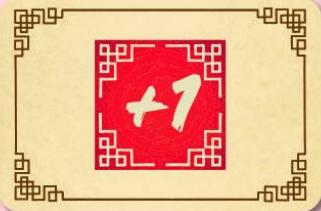
打出卡牌的强度对于执行所选主行动很重要,越高代表玩家可以达成的效果越好。作为一次性奖励,玩家可以弃掉一个卷轴板块来增加强度 1 点。
3.4 关于茶
茶叶是这款游戏的基本商品。茶叶品质分为 6 个等级,由玩家版图上的 6 个收集篮代表;每个地区生产不同品质的茶叶。茶叶的品质在购买行动卡或在皇帝轨道上前进时非常重要。
- 绿色 = 新鲜茶,其品质随着成熟而下降。
- 棕色 = 发酵茶,其品质随着成熟而提高。
- 付费时: 如果显示的是绿色茶叶,你可以用绿色茶叶或棕色茶叶付费;但是,显示的棕色茶叶只能用棕色茶叶支付。
4. 主行动
A) 建造茶园
- 在玩家版图上,每个茶园下方都有一个数字,表示建造该茶园所需的最低出牌强度总数。
- 玩家可将新茶园放置在与已拥有茶园的地区相邻的地区内任何可用空间上。地区是游戏版图上最小的领土单位;河流被视为区域的边界。
- 玩家也可以在与已拥有茶园的地区不相邻的地区建造茶园,方法是支付比建造茶园所需的常规强度多 2 点的强度;这只允许玩家多跨越一条边界。
- 玩家不可能在已有茶园的地区建造茶园。
- 通过建造茶园,玩家可以获得由地区奖励指示物决定的一次性奖励,所有在同一地区建造茶园的玩家都能获得该奖励。
- 如果玩家在某个特殊的计分区域(上面有胜利点数)上建造了茶园,就会立即获得这些点数,并将其标记在胜利点数轨道上。
- 在一次主行动中,你只能建造一个茶园。
B) 购买行动牌
- 在展示区中行动牌的上方有一个数字,表示购买每张行动牌所需的最低出牌强度;展示区的牌越靠左侧,所需的强度就越低。
- 此外,玩家还必须支付所购行动牌上标明的价格(印在卡牌底部的棕色框内)。它包括玩家必须支付给公共供应堆的指定最低品质的茶叶指示物的数量,以及玩家必须在其游戏区域内摆放的卡牌上所需的茶壶数量。本轮游戏中打出的任何带有茶壶符号的最上面的一张牌都算在内(堆叠在顶部牌下面的卡牌上的茶壶符号不计算在内)。
- 玩家将购买的牌放入手牌,并可在下一回合使用。玩家购买行动卡牌后,游戏中现在空白区域右侧的所有卡都会向左移动一格,然后从行动牌库中抽出一张新牌放在这一行的最右端。
- 在一次主行动中,你只能购买一张行动牌。
C) 向商队出售茶叶
- 每张商队卡都有两个部分——贸易部分和强度部分。玩家要获得一张商队卡,必须满足两部分中的一个条件,即贸易部分的一个条件和强度部分的一个条件。
- 贸易部分: 有两种出售茶叶的方式,玩家可从中选择一种。这些茶叶必须由玩家支付到公共供应堆中,可以是任何品质的茶叶;如果展示区的是茶叶的绿色符号,则可以是任何茶叶。满足条件后,玩家将获得相应茶叶符号旁边显示的奖励和/或胜利点数。
- 强度部分: 列出了两种不同的行动强度值。要获得"商队"牌和相应的奖励,玩家必须达到其中一个强度值,并根据所摆放的牌的强度来执行该行动。
- 商队获得的胜利点数会立即记入玩家名下;玩家要保留摆放在桌前的商队牌,因为它们可能对最终得分很重要。
- 一旦有人购买了商队卡,新卡就会立即展示出来,这样玩家就可以在 3 张商队卡中做出选择。
- 在一次主行动中,只能获得一张商队卡。
D) 发酵
- 在发酵中,新鲜绿色茶叶会转化成发酵棕色茶叶。
- 玩家可根据游戏强度发酵相应数量的茶叶(强度 = 茶叶数量)。发酵的方法是玩家将茶叶从绿色(新鲜)一面翻为棕色(发酵)一面。
- 注意,在发酵前,茶叶必须始终保持在同一个篮子里!
- 示例:某玩家出牌的总强度为 4,版图上共有 7 片茶叶——3 片品质 3 的新鲜茶叶、2 片品质 4 的新鲜茶叶、2 片品质 5 的发酵茶叶。他总共可以发酵 4 片茶叶,选择 2 片品质 4 和 2 片品质 3 的叶子,将它们翻到棕色(发酵)一面并放回同一个篮子。
E) 额外采摘茶叶
- 玩家可以通过额外采摘茶叶行动,采摘主要采摘之外的茶叶。在当前回合中,玩家每消耗一点强度,就可以从一个茶园中收获茶叶。
- 从每个采摘的茶园中,玩家可以获得一片与茶园所在区域值相对应的新鲜茶叶。因此如果玩家的强度是 3,则总共可以获得 3 片茶叶,分别与 3 个茶园所在地区的价值相对应。
- 每个茶园每回合只能额外采摘一片茶叶。
5. 次要行动
次要行动用一个装饰性圆框标出。玩家通过出牌,使最上面的一张牌包含三个次要行动之一的符号,即可获得一个次要行动;这样,玩家就可以在自己的回合中随时执行该行动。玩家还可以重复次要行动(参见"自由行动")。
A) 河流航行
- 通过执行该次要行动,玩家将其小船沿河向前移动一段,并立即获得显示的奖励。
- 最先到达河道最后一段的玩家会将自己的小船放在胜利点数最高的区域。
- 请注意,这些胜利点数只有在游戏结束时才会增加。
B) 杯子生产
- 玩家从版图上的一个牌堆(每个牌堆放置在一个省份颜色的位置)顶端取下一块杯子板块。玩家只能从至少有一个自己茶园的省份中选择。
- 玩家将板块相邻排列成一行,并尝试将相同颜色的圆形符号连接起来。板块不能倒置。每连接一个相同颜色的符号,玩家就能在游戏结束时获得胜利点数。玩家也可以将不同颜色的符号连接起来(但是这种连接不会获得胜利点数,只会获得一个杯子)。
- 玩家将两块杯子板块连接起来后,就可以将一个杯子指示物放在上面。该指示物可作为一次性自由行动:玩家可以在自己的回合中随时取下它,从相邻的一个杯子中获得奖励。在每个连接点上,玩家可以使用任意数量的指示物。
- 杯的行数不受限制,玩家可以随时开始新的一行。板块一旦放置,就不能移动。
C) 茶叶大学
- 茶叶大学分为四个区域,每个区域又分为两个部分,每个部分都有奖励。
- 每当玩家执行这个次要行动时,他们就会将自己的工人米宝按顺时针方向移动到下一个区域。玩家在指定区域内选择一个部分,将自己的工人米宝放置在那里,并获得列出的奖励(只有被选中的部分才能获得奖励)。
- 每当一个工人越过起始位置,玩家就会从他的供应堆中取出另一个工人米宝,并将其放置在圆圈中心。
- 游戏结束时,中心的每个米宝都会获得 10 点胜利点数;对于留在圆圈外围的米宝,玩家获得的胜利点数与印在相应圆圈部分的数值相对应。
6. 自由行动
自由行动可以在玩家回合的任何时刻执行,甚至是在卡牌打出之前执行,但无论如何本轮必须至少打出一张(或多张)牌。
A) 在皇帝轨道上前进
- 如果玩家有足够的皇帝指示物,他们可以在回合中的任何时候进行此自由行动。他们必须支付所需的皇帝指示物数量,以及他们想要移动到的行上所描绘的所需最低品质的茶叶(总是该工人上方的一行)。
- 然后,玩家将工人移动到目标行,并获得该行的奖励。奖励可能包括皇帝牌、移除一张牌等。
- 皇帝牌总是有三张可供选择,玩家选择其中一张,将其放入手牌中,使用方法与起始牌和行动牌类似;皇帝牌有特殊的得分终局条件。然后在新腾出的可用区域补充一张新卡。
B) 使用杯子奖励
- 玩家在其回合内的任何时候,都可以移除杯子指示物以获得相邻一个杯子的奖励。
C) 重复次要行动
- 每个回合可以重复一次次要行动,有两种方法:
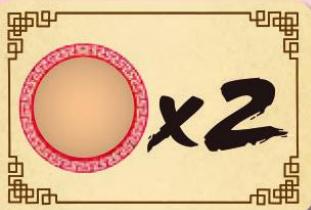
- 通过弃掉一个卷轴,玩家可以执行他刚刚使用的次要行动。如果玩家在刚才行动中获得卷轴板块,他可以立即使用它来重复当前的次要行动。
- 玩家也可以通过弃掉 3 个发酵茶叶来重复一次次要行动。
D) 使用卷轴
- 游戏中有 3 种卷轴。这些板块在应用效果后必须立即弃掉。玩家可以拥有任意数量的卷轴。
7. 奖励效果与图标
某些区域和杯子中包含特殊效果,获得这些效果后即可执行。如果牌上显示了这些效果,则在你打出这些牌作为最上面的牌时,这些效果就会生效。
- 奖励发酵: 玩家可以发酵太阳符号旁边的特定数量的茶叶。
- 抓牌和弃牌: 玩家可以从其抓牌牌库抓取 1 或 2 张牌(根据图标指示),然后弃掉相同数量的手牌到弃牌堆。当没有卡牌可以抓取时,玩家立即洗混弃牌堆来创造一个新的抓牌牌库。
- 抓一张牌: 玩家可以从其抓牌牌库抓取一张牌。
- 移除一张牌: 玩家可以选择手上、抓牌牌库或弃牌堆的一张牌来移出游戏;如果玩家从抓牌牌库移除卡牌,他必须在之后洗混牌库。
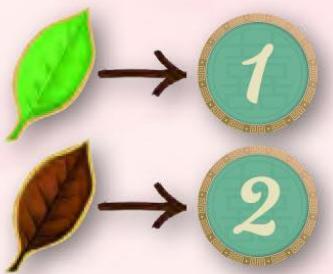
- 出售茶叶: 当带有这些符号的牌在你的回合中作为最上面的牌打出时,你可以以 1 点胜利点数出售新鲜茶叶,以 2 点胜利点数出售发酵茶叶;每回合最多出售 6 片茶叶。
- 选择一个行动: 当带有此符号的牌在你的回合中作为最上面的牌打出时,你只能从所示行动中选择一个。
- 其他图标: 代表茶园;你直接增加的胜利点数;游戏结束时获得的胜利点数;代表获得一个杯子指示物(该指示物放置在两个杯子板块相连的符号上,一个符号上可以放置多个指示物;如果你没有两块相连的杯子板块,则忽略奖励);区域价值——代表收获茶叶的品质。
7.1 卷轴的 3 种类型
| 卷轴 | 效果 |
|---|---|
| 强度 +1 | 临时增加强度,本回合所出牌的总强度 +1;一个回合内可以使用多个此类型的卷轴 |
| 中性色茶壶 | 此卷轴可被视为购买卡牌所需的任何颜色的茶壶;一回合内可使用多个此类卷轴 |
| 重复次要行动 | 丢弃此卷轴后,玩家可以重复刚刚执行的次要行动;每回合只能重复一次;如果玩家在刚刚进行的次要行动中获得了卷轴板块,则可以立即使用它来重复该次要行动 |
所有卷轴都是一次性的,使用完效果后会立即丢弃。玩家可以拥有任意数量的三种卷轴。皇帝指示物则用于在皇帝轨道上前进。
8. 重要规则
- 玩家购买的行动卡和游戏中获得的皇帝卡会直接进入玩家的手牌。这些牌可以在当前回合(皇帝牌)或随后的回合(行动牌)中使用。
- 每个回合结束时,每个玩家正好抽 4 张牌,因此他们可以在新回合开始时拥有更多的牌。
9. 维护阶段
在维护阶段,玩家要为下一轮游戏做好准备,按顺序执行以下步骤:
- A) 将轮次标记向前移动 1 个区域。
- B) 将起始玩家指示物按顺时针方向传递给下一位玩家。
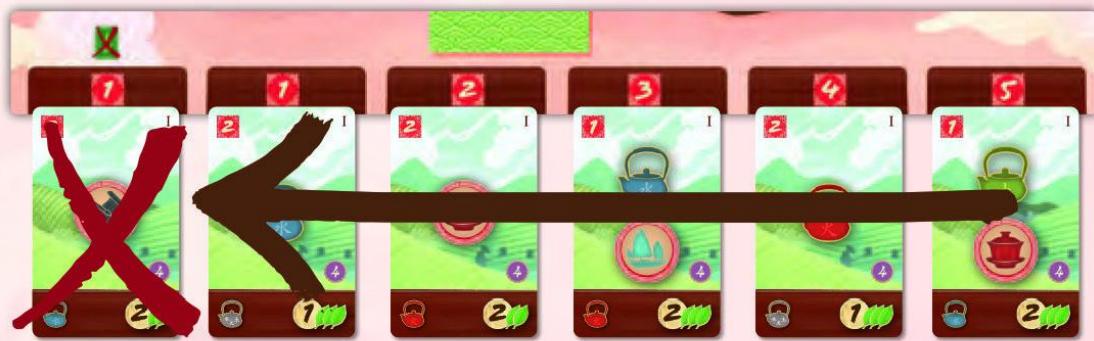
- C) 从行动牌中移除最左边的一张牌;将剩余的牌向左移动 1 个区域,并从各自的抽牌库中抽出一张新的行动牌放入该行末尾右侧的空位中。
- D) 所有玩家将打出的牌从自己版图下方的游戏区移至自己版图右侧的弃牌堆。
- E) 茶叶成熟: 所有绿色(新鲜)茶叶向左移动到品质降低 1 的篮子中(如果茶叶已经是品质 1,则留在品质 1 的篮子中);所有棕色(发酵)茶叶向右移动到品质高 1 的篮子里(如果茶叶已经是品质 6,则留在同一个篮子里)。
- F) 采茶: 玩家要从游戏版图上的每个茶园中采摘两片新鲜茶叶,茶叶的品质与相应地区的价值相对应;采摘的茶叶绿色一面朝上,放入各自版图上相应品质的篮子中。
- G) 抽牌: 玩家从抽牌库中抽出 4 张牌。如果没有足够的牌,玩家立即洗掉弃牌堆组成新的抽牌牌库,并抽取相应数量的牌。
- H) 现在,下一轮由持有起始玩家指示物的玩家开始。
示例: 某玩家的版图上有 6 片茶叶。两片品质 3 的新鲜茶叶被移到品质 2 的篮子,两片品质 4 的发酵茶叶被移到品质 5 的篮子,一片品质 6 的发酵茶叶留在篮子里。采茶时他有 6 个茶园(区域值分别为 2、3、4、5、6、6),从每个茶园获得 2 片对应品质的新鲜茶叶,共 12 片。
10. 游戏结束与计分
游戏在 5 轮后结束,第 5 轮没有维持阶段。获得胜利点最多的玩家获胜。如果双方积分相同,则在版图上拥有最多茶叶的玩家获胜;如果还是平局,拥有最多发酵茶叶的玩家获胜;如果仍然平局,则分享胜利。
除了在游戏中获得的分数(已记录在胜利点数轨道上)外,玩家还要加上以下胜利点数:
| 计分来源 | 说明 |
|---|---|
| 行动卡计分 | 玩家将其购买的所有行动牌的胜利点数相加 |
| 皇帝卡计分 | 玩家满足皇帝卡上的得分条件即可获得胜利点数 |
| 河流航行得分 | 玩家根据自己的船只当前占据的河段获得胜利点数 |
| 茶学计分 | 玩家在茶叶大学中间的每个工人可获得 10 点胜利点数;对于外圈的工人,胜利点数则根据相应的位置获得 |
| 皇帝轨道计分 | 到达皇帝轨道最顶端一行的玩家可获得 10 点胜利分 |
| 杯子生产分数 | 玩家计算自己收集的杯子中所有行的所有同色连接(连接不一定都是一种颜色,但单个连接的颜色必须一致),按下表获得胜利分 |
| 未使用的卷轴和皇帝指示物计分 | 玩家每获得一个未使用的卷轴和皇帝指示物,即可获得 1 点胜利点数 |
10.1 皇帝卡的终局计分效果
你的抽牌库、弃牌堆、手牌和版图上的所有牌都被视为你的牌库的一部分。
| 条件 | 胜利点数 |
|---|---|
| 游戏结束时你有任何发酵茶叶 | 每片 3 VP(最多 6 片茶叶) |
| 游戏结束时你有新鲜茶叶 | 每片 2 VP(只计算新鲜茶叶,最多 9 片茶叶) |
| 本卡 | 游戏结束时这张牌的胜利点数为 12 点 |
| 你拥有的任何中性颜色的茶壶卷轴 | 每个 4 VP(最多 4 个茶壶) |
| 版图上的每个茶园 | 每个 3 VP(最多 6 个茶园) |
| 你在游戏中获得的每张商队卡 | 每张 3 VP(最多 6 张商队卡) |
| 本卡 | 价值为 18 VP 减去牌库中每张起始牌的 1 VP |
| 牌库中每张带有河流符号的卡牌 | 每张 3 VP(最多 6 张) |
| 牌库中每张带有茶叶大学符号的牌 | 每张 3 VP(最多 6 张牌) |
| 牌库中每张带有杯子符号的牌 | 每张 3 VP(最多 6 张牌) |
| 牌库中每张带有茶壶符号的牌 | 每张 2 VP(最多 9 张牌) |
11. 关键术语
- 地区: 由边界或河流划定的领土。它们是地图上最小的领土单位。
- 省: 颜色相同的地区。每个省都由多个地区组成(起始的黄色省除外,该省只有一个地区,即四川)。
- 河流: 由包含各种奖励的河段组成,游戏结束时会获得河流的胜利点数。河流被视为地区的边界。
- 强度: 左上角每张卡牌上都有指示,用于执行主要动作。
- 茶壶: 用于购卡;你在那一轮中打出的最上面一张牌上的所有茶壶符号都会被计算在内。茶壶有三种颜色:绿色、红色和蓝色,也有"任何颜色的茶壶"。
- 茶叶: 每片茶叶都有两面,一面绿色、一面棕色。绿色 = 新鲜茶,其品质在茶成熟过程中会下降;棕色 = 发酵茶,其品质在茶成熟过程中会提高。
- 用茶叶付费: a) 绿茶叶——可以用绿色(新鲜)或棕色(发酵)茶叶支付;b) 棕茶叶——只能用棕色茶叶支付。若你拥有叶子,它总是新鲜(绿色)的叶子。
- 皇帝指示物: 用于在皇帝轨道上前进。
- 卷轴: 游戏中共有 3 种卷轴板块。所有卷轴都是一次性的,使用完效果后会立即丢弃;玩家可以拥有任意数量的三种卷轴。
常见问题(FAQ)
以下 1 条问答中 0 条来自站内玩家的真实提问,其余 1 条为本站整理的常见疑问;答复内容保持原样。
茶园支持几个人玩?
2–4 人。
去哪查完整规则
想核对具体规则细节、卡牌效果或某个回合的结算方式,可以在村了吗里选中这款游戏后直接提问。
同类桌游
- 卡坦岛德式
- 工业革命:伯明翰德式
- 勃艮第城堡:特别典藏版德式
- 方舟动物园德式
- 卡卡颂抽象
- 瘟疫危机传承:第一季美式
- 阿瑞迪亚:勇踏征途美式
- 重塑宇宙德式
- 幽港迷城美式
- 埃多拉的德鲁伊德式
规则原文(Markdown)
本站收录这款游戏的规则原文 2 个文件,此处内联渲染 2 个,可直接展开阅读或下载。
rules_zh_茶园_42592.md37.8 KB
TER GARDEN
茶园规则书
翻译 & 排版:陈斌华
云南山区的尖峰上,一种奇特的植物开始变绿。坊间流传着它的神奇功效,能够治愈身体,振奋精神。难怪它的种植会像野火一样蔓延到其他省份。为了响应皇帝的号召,种植大师们汇聚在一起,在长江流域建立起这一神奇植物的种群。
他们中的佼佼者将获得特殊的奖励 -- 在梦寐以求的云南省拥有肥沃的土地。接受挑战,努力将这种非凡的饮料推广到大中华地区乃至更远的地方。
50+ 100+ 150+ 200+
玩家配件

4 玩家版图

28 座代表茶园的塔,有 4 种颜色(每位玩家 7 座)

32 工人米宝,有 4 种颜色(每人 8 个)

4 船米宝,有 4 种颜色(每人 1 个)

4 胜利点数标记,有 4 种颜色(每人 1 个)

44 起始卡牌——每位玩家一组标有玩家颜色的扇子的 11 张牌
共享配件:

1 玩家版图

30 黑色杯子指示物
4 杯子板块
1 起始玩家指示物

18 地区奖励指示物

80 茶叶指示物(1 面是绿色,另一面是棕色)

1 白色轮次标记

24 卷轴板块(3 种类型)

30 皇帝指示物


6 皇帝卡——右上角标记着皇帝符号

45 行动卡——右上角标记着罗马数字

30 商队卡

19 概述卡

游戏目的
玩家扮演中国云南地区第一批茶园的主人。他们试图在河谷沿岸建设新茶园,扩大茶园面积。
游戏分五轮进行。每轮游戏中,玩家最多可以执行4个主行动,这些行动由玩家手中的卡牌触发,卡牌代表行动的强度。卡牌上还会出现茶壶符号和玩家可以执行的次要行动。行动包括扩大玩家的茶园、获取新卡、收获和出售茶叶、沿河航行以及从事茶叶研究。
游戏目标
游戏的目标是积累尽可能多的胜利点数。获得胜利点最多的玩家获胜。
游戏设置
第一次游戏前,请仔细打出纸板上的配件。
1. 将游戏版图放在桌子中央,方便所有玩家拿取。

① 胜利点数轨道
② 茶大学
③ 皇帝轨道
④ 行动卡展示区域
⑤ 皇帝卡展示区域
⑥ 杯子板块区域
⑦ 轮次轨道
在游戏版图旁创造一个卷轴板块供应堆,并按类型将它们分成 3 堆。

将茶叶指示物,皇帝指示物以及杯子指示物放在游戏版图旁所有玩家方便拿取的位置。

- 正面朝下拿取地区奖励指示物,洗混它们,然后随机在游戏版图的每个六边形区域各放置 1 个。然后将它们翻开。将未使用的指示物放回盒子里。

- 洗混所有杯子板块。根据玩家人数,为每个省份准备杯子板块堆叠。在起始黄省的表格中查看出每
叠所需的板块数量。将准备好的杯子板块堆叠面朝上随机堆放在游戏板块上(每个省都有一个专门的杯子板块堆叠插槽)。将未使用的板块放回盒子。
- 制作一副行动牌。首先,创建 5 个牌堆(每个等级一张,等级显示在右上角)。

I II III IV V
根据玩家人数,从每个等级中抽取相应数量的卡牌(将剩余卡牌放回盒子):
2 名玩家:4 张牌
3 名玩家:5 张牌
4 名玩家:6 张牌
将牌面朝下,分别洗每一等级的牌。然后将第 4 级放在第 5 级上面,第 3 级放在第 4 级上面,以此类推,创建一副牌。
从这副行动牌中翻出 6 张牌,牌面朝上(从左边开始)。将牌面朝下放在展示区域旁边。

- 创建一副商队牌。将带有蓝色装饰的商队牌洗混,然后创建一副牌,牌面朝下放置。然后将带有橙色装饰的商队牌洗混,创建出商队基本牌库。从这副牌中,根据玩家人数随机抽取一定数量的牌(见下一页的表格),放在蓝色商队牌的上面。将剩下的基本卡牌(橙色)放回盒子。

2人:7基础商队
3人:10基础商队
4人:13基础商队
最后翻开牌库的 3 张商队卡牌到游戏版图旁的展示区。
-
洗混皇帝卡牌并翻开 3 张正面朝上放在皇帝轨道下方。
-
每位玩家选择一张玩家版图并拿取一种颜色的以下配件:
7 茶园塔,8 工人米宝,1 船米宝,1 胜利点数标记,11 起始卡牌。

- 将各自茶园塔放置玩家版图标记的槽位上。将剩下一个茶园塔放到游戏版图的起始区域内(黄色省份)
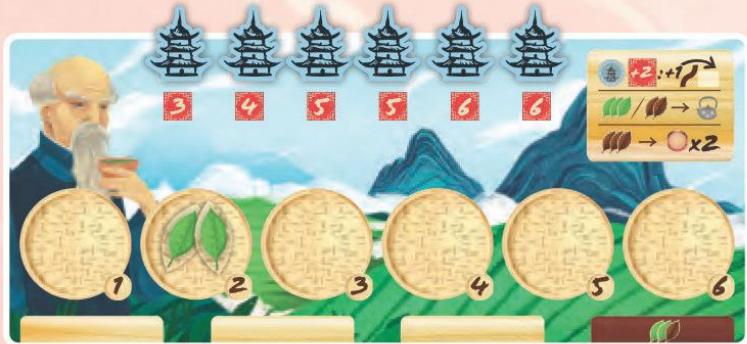

- 每位玩家拿取 2 茶叶指示物并将其绿色面朝上放在各自玩家版图上编号 2 的篮子内。编号代表茶叶在篮子里的品质。越高代表越好。
- 每位玩家洗混各自 11 张起始卡牌,创造一个正面朝下的牌库,然后从这个牌库抓取 4 张卡牌到手上。
8. 每位玩家放置:
- 胜利点数标记到胜利点数轨道的起始位置上。
- 1 工人米宝到茶叶大学的起始区域上。

- 1 工人米宝到皇帝轨道最底部区域上。
- 1 船米宝到河流的起始区域上。
- 将轮次标记放置轮次轨道上。最近享受过中国好茶的玩家获得起始玩家标记。如果没有人知道,随机选择一位玩家成为起始玩家。

游戏流程
游戏分 5 轮轮流进行。
在每轮游戏中,每位玩家最多可以进行 4 个回合。在游戏过程中,玩家通过出牌逐一完成回合,前 3 个回合免费,第 4 个回合则需要玩家支付茶叶指示物。玩家的一个回合包括一个主行动、一个可选的次要行动和任意数量的自由行动。
一轮游戏由以下阶段组成:
1) 行动阶段
2) 维护阶段
1) 行动阶段
在行动阶段,从持有起始玩家指示物的玩家开始,玩家按顺时针顺序轮流进行。玩家的回合中,玩家可以执行一个主行动和一个次要行动,这些行动与印在最上面已出牌上的符号相对应。此外,玩家还可以执行任意数量的自由行动。主行动、次要行动和自由行动可以任意顺序进行。玩家轮流进行回合,当他们不能或不想继续时,他们就会 pass。所有玩家都 pass 后,行动阶段结束。
主行动
在玩家的回合中,他总是从五个主行动(如下所述)中选择一个,并打出任意数量的牌(但至少一张)来决定行动的强度。打出的牌堆叠在一起,每张牌的强度都清晰可见。这些牌被放在玩家版图底部边缘的适当位置(总是放在最左边的可用区域)。如果最上面的牌上有次要行动或其他行动的标志,玩家可以在同一回合内使用。在下一回合,玩家再次将一张或多张牌放在最左边的可用区域。如果玩家想进行第四个回合,必须支付3个茶叶指示物,其中一个必须是棕色的。
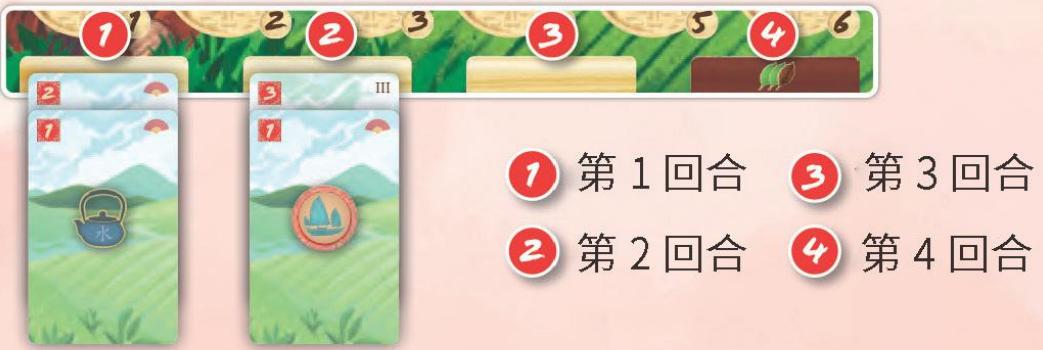
第 1 回合
第2回合第3回合
第4回合

关于茶

茶叶是这款游戏的基本商品。茶叶品质分为 6 个等级,由玩家版图上的 6 个收集篮代表。每个地区生产不同品质的茶叶。茶叶的品质在购买行动卡或在皇帝轨道上前进时非常重要。
新鲜(绿色)茶叶可以通过发酵来提高品质。发酵(棕色)茶叶在成熟过程中会提高品质,而新鲜茶叶则会降低品质(见“维护阶段-茶叶成熟”)。
付费时,如果显示的是绿色茶叶,你可以用绿色茶叶或棕色茶叶付费。但是,显示的棕色茶叶只能用棕色茶叶支付。
打出卡牌的强度是执行所选主行动中很重要的,越高代表玩家可以达成的效果越好。
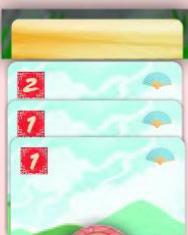

作为一次性奖励,玩家可以弃掉这个卷轴板块来增加强度1点。
主行动的类型

A) 建造茶园
在玩家版图上, 每个茶园下方都有一个数字, 表示建造该茶园所需的最低出牌强度总数。玩家可将新茶园放置在与已拥有茶园的地区相邻的地区内任何可用空间上。地区是游戏版图上最小的领土单位。河流被视为区域的边界。玩家也可以在与已拥有茶园的区域不相邻的地区建造茶园, 方法是支付比建造茶园所需的常规强度多 2 点的强度。这只允许玩家多跨越一条边界。

玩家不可能在已有茶园的地区建造茶园。
通过建造茶园,玩家可以获得由地区奖励指示物决定的一次性奖励。所有在同一地区建造茶园的玩家都能获得该奖励。如果玩家在某个特殊的计分区域(上面有胜利点数)上建造了茶园,就会立即获得这些点数,并将其标记在胜利点数轨道上。在一次主行动中,你只能建造一个茶园。
例如:卡奈尔打出的牌的总强度为 5,并决定将建造茶园作为他的主行动。到目前为止,他只有黄色省份的初始茶园。由于他已经打出了强度为 5 的牌,他可以决定是在与黄色省份相邻的地区建造一个强度为 5 的茶园,还是建造一个强度为 3 的茶园并支付 2 的强度来多跨过一个边界。他选择了第二种方案,在价值为 4 的蓝色区域建造茶园。

B) 购买行动牌
在展示区中行动牌的上方有一个数字,表示购买每张行动牌所需的最低出牌强度。展示区的牌越靠左侧,所需的强度就越低。
此外,玩家还必须支付所购行动牌上标明的价格。该价格印在卡牌底部的棕色框内。它包括玩家必须支付给公共供应堆的指定最低品质的茶叶指示物的数量,以及玩家必须在其游戏区域内摆放的卡牌上所需的茶壶数量。本轮游戏中打出的任何带有茶壶符号的最上面的牌都算在内(与堆叠在顶部牌下面的卡牌上的茶壶符号有所不同--那些不计算在内)。

购买卡牌所需强度

卡牌强度
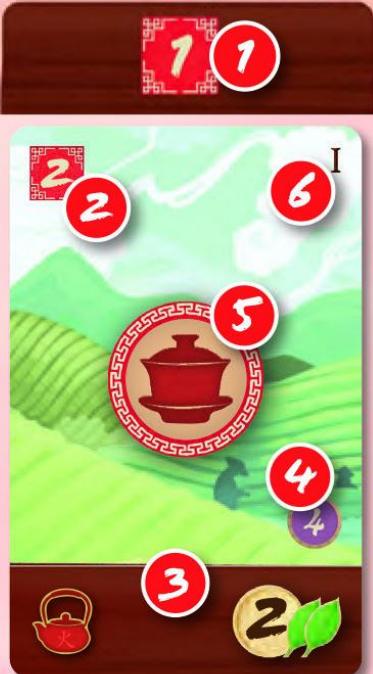

购买卡牌的费用

胜利点(你在游戏结束时获得)

次要行动效果

卡牌等级
玩家通过弃掉这个卷轴来获得 1 茶壶符号。这个卷轴视为任意茶壶颜色。另一种方式时支付任意品质的 3 任意茶叶或 2 发酵茶叶。


玩家将购买的牌放入手牌,并可在下一回合使用。玩家购买行动卡牌后,游戏中现在空白区域右侧的所有卡都会向左移动一格。然后从行动牌库中抽出一张新牌放在这一行的最右端。在一次主行动中,你只能购买一张行动牌。
例如:卡奈尔的主行动是购买一张行动牌。他已出牌的总强度是4,而他出牌区域最上面的牌上有一个绿色茶壶符号。
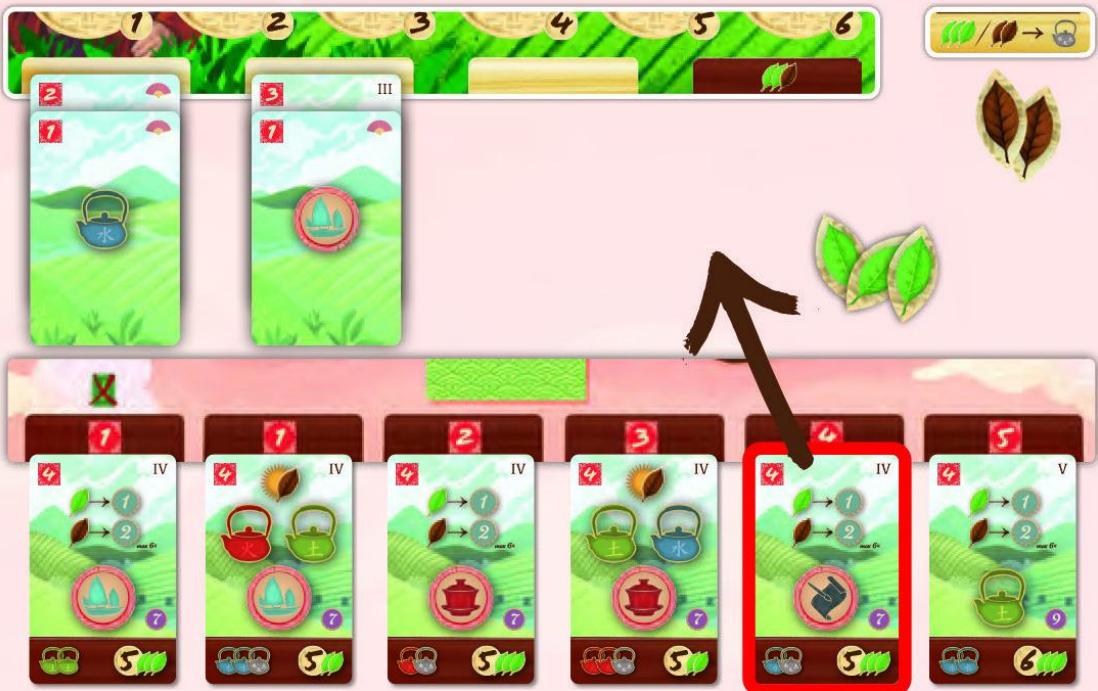
他缺少一个茶壶符号来购买所选的牌。因此,他决定丢弃1个茶壶卷轴来补齐缺失的符号并购买这张牌。他还支付了 2 个品质为 3 的茶叶。卡奈尔将购买的牌放入手中。


C) 向商队出售茶叶
玩家可以向过往的商队出售茶叶。每张商队卡都有两个部分 -- 贸易部分和强度部分。玩
家要获得一张商队卡,必须满足两部分中的一个条件,即贸易部分的一个条件和强度部分的一个条件。

贸易部分


强度部分
基础商队卡

进阶商队卡

- 在卡牌的交易部分,有两种出售茶叶的方式,玩家可从中选择一种。这些茶叶必须由玩家支付到公共供应堆中,可以是任何品质的茶叶。如果展示区的是茶叶的绿色符号,则可以是任何茶叶。满足条件后,玩家将获得相应茶叶符号旁边显示的奖励和 / 或胜利点数。
- 在卡牌的强度部分,列出了两种不同的行动强度值。要获得“商队”牌和相应的奖励,玩家必须达到其中一个强度值,并根据所摆放的牌的强度来执行该行动。
- 商队获得的胜利点数会立即记入玩家名下。玩家要保留摆放在桌前的商队牌,因为它们可能对最终得分很重要。
- 一旦有人购买了商队卡,新卡就会立即展示出来,这样玩家就可以在3张商队卡中做出选择。
- 在一次主行动中,只能获得一张商队卡。
例如:卡奈尔出的牌的总强度是6,他的主行动是商队。他向公共供应堆支付了3新鲜茶叶和1张发酵茶叶。由于他满足了商队卡的条件,他获得了以下奖励:他获得1个杯子指示物,并将其放置在相连的杯子板块上+2点胜利点数(针对该牌的贸易部分)。对于这张牌的强度部分,他可以获得6点胜利分和1个皇帝指示物。


D) 发酵
在发酵中,新鲜绿色茶叶会转化成发酵棕色茶叶。

绿色 = 新鲜,其品质随着成熟而下降。

棕色 = 发酵,其品质随着成熟而提高。
玩家可根据游戏强度发酵相应数量的茶叶(强度 = 茶叶数量)。发酵的方法是玩家将茶叶从绿色(新鲜)一面转为棕色(发酵)一面。注意,在发酵前,茶叶必须始终保持在同一个篮子里!
例如:卡奈尔出牌的总强度为 4,他决定将 “发酵” 作为主行动。他的版图上共有 7 片茶叶 -3 片品质为 3 的新鲜茶叶,2 片品质为 4 的新鲜茶叶,2 片品质为 5 的发酵茶叶。卡奈尔总共可以发酵 4 片茶叶。他选择 2 片品质为 4 的叶子和 2 片品质为 3 的叶子。他把这些叶子翻到棕色(发酵)的一面,并把它们放回同一个篮子里。

E) 额外采摘茶叶
玩家可以通过额外采摘茶叶行动,采摘主要采摘之外的茶叶。在当前回合中,玩家每消耗一点强度,就可以从一个茶园中收获茶叶。从每个采摘的茶园中,玩家可以获得一片与茶园所在区域值相对应的新鲜茶叶。因此,如果玩家的强度是3,则总共可以获得3片茶叶,与3个茶园所在地区的价值相对应。
每个茶园每回合只能额外采摘一片茶叶。
例如:Karel 打出牌的强度为 4,并决定执行额外采摘茶叶的主行动。他在游戏版图上已经有 6 个区域的茶园,数值分别为 2、3、4、5、6 和 7。
3、4、5、6 和 6。他决定从后 4 个花园里采摘茶叶。因此,他收获了 1 片品质为 4 的新鲜树叶、1 片品质为 5 的新鲜树叶和 2 片品质为 6 的新鲜树叶。
次要行动
次要行动用一个装饰性圆框标出。玩家通过出牌,使最上面的一张牌包含三个次要行动之一的符号,即可获得一个次要行动;
这样,玩家就可以在自己的回合中随时执行该行动。玩家还可以重复次要行动(更多信息请参见“自由行动”部分)。

A) 河流航行
通过执行该次要行动,玩家将其小船沿河向前移动一段,并立即获得显示的奖励。最先到达河道最后一段的玩家会将自己的小船放在胜利点数最高的区域。请注意,这些胜利点数只有在游戏结束时才会增加。
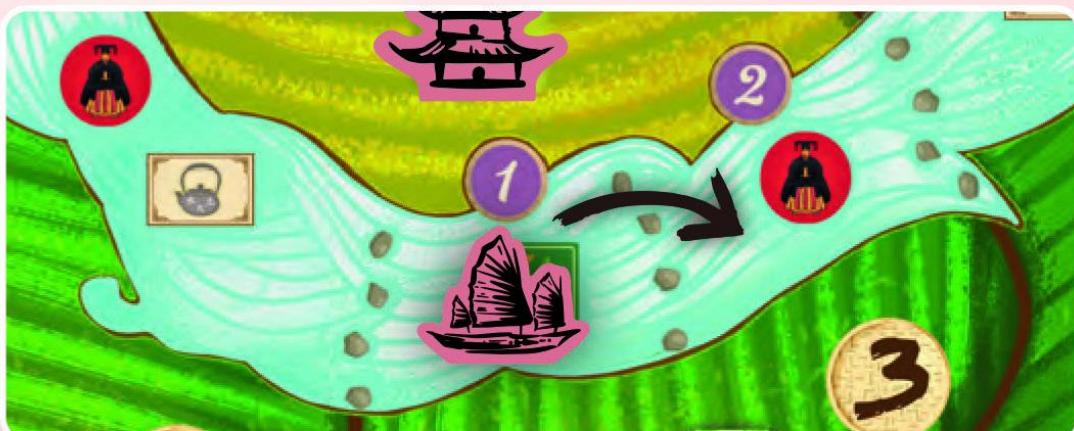
例如 作为次要行动,卡奈尔使用河道航行,将他的小船移动到河道前Ⅰ段,并获得皇帝指示物的奖励。河段中有 2 点胜利点数。此时他不会获得这些点数。但如果他仍在该河段,则会在游戏结束时获得。

B) 杯子生产
玩家从版图上的一个牌堆(每个牌堆放置在一个省份颜色的位置)顶端取下一块杯子板
块。玩家只能从至少有一个自己茶园的省份中选择。玩家将板块相邻排列成一行,并尝试将相同颜色的圆形符号连接起来。板块不能倒置。每连接一个相同颜色的符号,玩家就能在游戏结束时获得胜利点数(见“计分”部分)。玩家也可以将不同颜色的符号连接起来(但是,这种连接不会获得胜利点数,只会获得一个杯子)。
玩家将两块杯子板块连接起来后,就可以将一个杯子指示物放在上面。
该指示物可作为一次性自由行动。玩家可以在自己的回合中随时取下它,从相邻的一个杯子中获得奖励。在每个连接点上,玩家可以使用任意数量的指示物。

例如:在其回合中的任何时候,该玩家都可以移除一个杯子指示物,以获得一个皇帝指示物或3点胜利点数。
杯的行数不受限制。玩家可以随时开始新的一行。板块一旦放置,就不能移动。

C) 茶叶大学
茶叶大学分为四个区域,每个区域又分为两个部分,每个部分都有奖励。每当玩家执行这个次要行动时,他们就会将自己的工人米宝按顺时针方向移动到下一个区域。玩家在指定区域内选择一个部分,将自己的工人米宝放置在那里,并获得列出的奖励(只有被选中的部分才能获得奖励)。每当一个工人越过起始位置,玩家就会从他的供应堆中取出另一个工人米宝,并将其放置在圆圈中心。
游戏结束时, 中心的每个米宝都会获得 10 点胜利点数。对于留在圆圈外围的米宝, 玩家获得的胜利点数与印在相应圆圈部分的数值相对应。
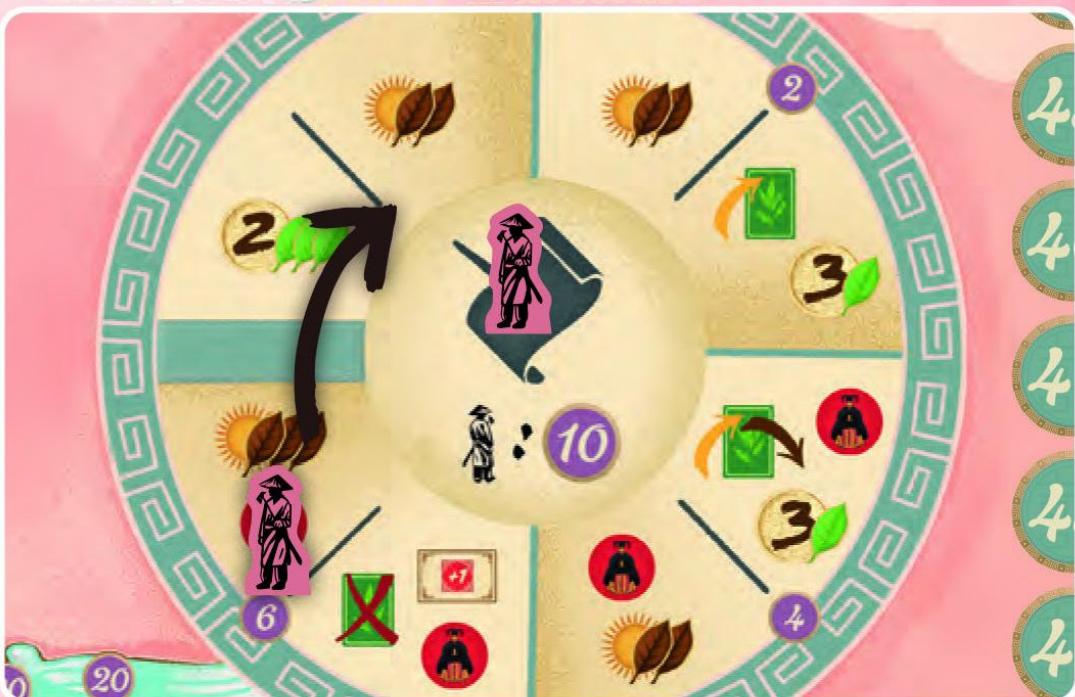
举例:卡奈尔打出的牌的总强度为 4,最上面的牌上有茶艺研究的标志。他决定先进行这个次要行动,他的工人在第 4 区,因此他顺时针移动工人到第 1 区,在那里他必须在两个有奖励的部分中做出选择。他可以获得 3 片品质为 2 的新鲜茶叶,或者从他的供应堆中发酵出 2 片茶叶。他选择了发酵。由于他在这一轮中越过了起始位置,因此他要从供应堆中拿出一个新的工人米宝放到圆圈中心。游戏结束时,他将获得 10 点胜利分。
自由行动
自由行动可以在玩家回合的任何时刻执行,甚至是在卡牌打出之前执行,但但无论如何都必须有一张或多张牌。
A) 在皇帝轨道上前进
如果玩家有足够的皇帝指示物,他们可以在回合中的任何时候进行自由行动,在皇帝轨道上前进。他们必须支付所需的皇帝指示物数量,以及他们想要移动到的行上所描绘的所需最低品质的茶叶(总是该工人上方的一行)。然后,玩家将工人移动到目标行,并获得该行的奖励。奖励可能包括皇帝牌。皇帝牌总是有三张可供选择,玩家选择其中一张,将其放入手牌中,使用方法与起始牌和行动牌类似。皇帝牌有特殊的得分终局条件(第11页)。然后在新的可用区域补充一张新卡。

例如:卡奈尔丢弃 2 个皇帝指示物和 1 个品质为 1 的茶叶,并在皇帝轨道上向上移动一行。然后,他获得 1 张皇帝牌,并将其放入手牌,还可以选择移除 1 张牌。他从抽牌库中选择一张牌,将其从游戏中移除,然后洗牌。
B) 使用杯子奖励
玩家在其回合内的任何时候,都可以移除指示物以获得相邻一个杯子的奖励(详见第6页的第二行动“杯子制作”)。
C) 重复次要行动
每个回合可以重复一次次要行动。有两种方法:

通过弃掉这个卷轴,玩家可以执行他刚刚使用的次要行动。如果玩家在刚才行动中获得卷轴板块,他可以立即使用它来重复当前的次要行动。

玩家也可以通过弃掉 3 个发酵茶叶来重复一次次要行动。
D) 使用卷轴
游戏中有 3 种卷轴。这些板块在应用效果后必须立即弃掉。玩家可以拥有任意数量的卷轴。

奖励效果
某些区域和杯子中包含特殊效果,获得这些效果后即可执行。如果牌上显示了这些效果,则在你打出这些牌的顶部时,这些效果就会生效。
你可以在下面找到它们的说明。
奖励发酵

玩家可以发酵太阳符号旁边的特定数量的茶叶。
抓牌和弃牌
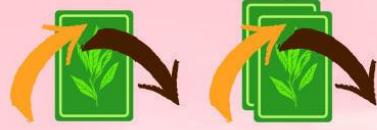
玩家可以从其抓牌牌库抓取 1 或 2 张牌(根据图标指示),然后弃掉相同数量的手牌到弃牌堆。
当没有卡牌可以抓取时,玩家立即洗混弃牌堆来创造一个新的抓牌牌库。
抓一张牌

玩家可以从其抓牌牌库抓取一张牌。
移除一张牌
玩家可以选择手上,抓牌牌库或弃牌堆的一张牌来移出游戏。如果玩家从抓牌牌库移除卡牌,他必须在之后洗混牌库。弃牌堆并创造一个新的抓牌牌库。
重要规则:
玩家购买的行动卡和游戏中获得的皇帝卡会直接进入玩家的手牌。这些牌可以在当前回合(皇帝牌)或随后的回合(行动牌)中使用。每个回合结束时,每个玩家正好抽4张牌,因此他们可以在新回合开始时拥有更多的牌。
回合示例:
卡奈尔打出两张牌,总强度为 4。最上面的一张牌上显示次要行动 “河流航行” 的符号。卡奈尔决定先执行次要行动,将他的小船向前移动一段河面,这样他就获得了一个皇帝指示物和一个卷轴,可以重复他的次要行动,他立即使用了卷轴。他丢弃了卷轴,卷轴允许他重复刚刚执行的次要行动 “河流航行”。

卡奈尔选择购买行动牌作为主行动。他所打出的牌的总强度是 4,而顶部的牌上有一个蓝色的茶壶符号。他还差一个茶壶符号才能买下所选的牌,因此他决定支付 2 片发酵的茶叶来代替缺少的 1 个符号,以便买下这张牌。接着,他又支付了 3 片品质为 5 的新鲜叶子。卡奈尔将买到的牌放入手中。
2)维持阶段
在维持阶段,玩家要为下一轮游戏做好准备。
A) 将轮次标记向前移动 1 个区域。
B) 将起始玩家指示物按顺时针方向传递给下一位玩家。
C) 从行动牌中移除最左边的一张牌。将剩余的牌向左移动 1 个区域,并从各自的抽牌库中抽出一张新的行动牌放入该行末尾右侧的空位中。
D) 所有玩家将打出的牌从自己版图下方的游戏区移至自己版图右侧的弃牌堆。
E)茶叶成熟:所有绿色(新鲜)茶叶向左移动到品质降低1的篮子中(如果茶叶已经是品质1,则留在品质1的篮子中)。所有棕色(发酵)茶叶向右移动到品质高1的篮子里(如果茶叶已经是品质6,则留在同一个篮子里)。
例如:卡奈尔的版图上有 6 片茶叶。两片品质为 3 的鲜茶叶被移到品质为 2 的篮子里,两片品质为 4 的发酵茶叶被移到品质为 5 的篮子里,一片品质为 6 的发酵茶叶留在篮子里。

F) 采茶: 在采茶阶段, 玩家要从游戏版图上的每个茶园中采摘两片新鲜茶叶。茶叶的品质与相应地区的价值相对应。采摘的茶叶绿色一面朝上, 放入各自版图上相应品质的篮子中。
例如:卡奈尔在版图上有 6 个花园,分别位于数值为 2、3、4、5、6 和 6 的区域,他从每个花园中获得 2 片特定品质的新鲜茶叶,因此他总共有 12 片新鲜茶叶可放入版图上相应的篮子中。
G) 抽牌:玩家从抽牌库中抽出 4 张牌。如果没有足够的牌,玩家立即洗掉弃牌堆,组成新的抽牌牌库,并抽取相应数量的牌。
H) 现在, 下一轮由持有起始玩家指示物的玩家开始。
5) 皇帝轨道计分
到达皇帝轨道最顶端一行的玩家可获得 10 点胜利分。
6) 杯子生产分数
玩家计算自己收集的杯子中所有行的所有同色连接(连接不一定都是一种颜色,但单个连接的颜色必须一致),根据下表获得胜利分:

7) 未使用的卷轴和皇帝指示物计分
玩家每获得一个未使用的卷轴和皇帝指示物,即可获得1点胜利点数。
获得胜利点最多的玩家获胜。如果双方积分相同,则在版图上拥有最多茶叶的玩家获胜。如果还是平局,拥有最多发酵茶叶的玩家获胜。如果仍然平局,则分享胜利。
游戏结束
游戏在 5 轮后结束。第 5 轮没有维持阶段。
计分
除了在游戏中获得的分数(已记录在胜利点数轨道上)外,玩家还要加上以下胜利点数:
1) 行动卡计分
玩家将其购买的所有行动牌(右侧显示)的胜利点数相加。
2) 皇帝卡计分
玩家满足皇帝卡上的得分条件即可获得胜利点数。有关这些条件的说明,请参阅规则末尾。

3) 河流航行得分
玩家根据自己的船只当前占据的河段获得胜利点数。
4) 茶学计分
玩家在 茶叶大学中间的每个工人可获得 10 点胜利点数。对于外圈的工人,胜利点数则根据相应的位置获得。

关键术语
地区:
由边界或河流划定的领土。它们是地图上最小的领土单位。
省:
颜色相同的地区。每个省都由多个地区组成(起始的黄色省除外,该省只有一个地区,即四川)。
河流:
由包含各种奖励的河段组成。游戏结束时会获得河流的胜利点数。河流被视为地区的边界。

强度:
左上角每张卡牌上都有指示,用于执行主要动作。

茶壶:
用于购卡;你在那一轮中打出的最上面一张牌上的所有茶壶符号都会被计算在内。茶壶有三种颜色:绿色、红色和蓝色。

任何颜色的茶壶。

茶叶:
每片茶叶都有两面,一面绿色,一面棕色。绿色 = 新鲜茶,其品质在茶成熟过程中会下降。棕色 = 发酵茶,其品质在茶成熟过程中会提高。
用茶叶付费:

a)绿茶叶——可以用绿色(新鲜)或棕色(发酵)茶叶支付
b) 棕茶叶——只能用棕色茶叶支付。

这个符号表示茶叶的品质和你获得或支付的茶叶数量。在这种情况下,3片品质2的茶叶。对于付费,你可以用发酵的绿叶付费(而不是相反)。如果你有叶子,它总是新鲜(绿色)的叶子。
a) 强度 +1——临时增加强度,本回合所出牌的总强度 +1。一个回合内可以使用多个此类型的卷轴。

游戏中共有 3 种卷轴板块。所有卷轴都是一次性的,使用完效果后会立即丢弃。玩家可以拥有任意数量的三种卷轴。
b) 中性色茶壶——此卷轴可被视为购买卡牌所需的任何颜色的茶壶。一回合内可使用多个此类卷轴。


C) 重复次要行动——丢弃此卷轴后,玩家可以重复刚刚执行的次要行动。每回合只能重复一次。如果玩家在刚刚进行的次要行动中获得了卷轴板块,则可以立即使用它来重复该次要行动。

皇帝指示物:用于在皇帝轨道上前进。
卷轴:
效果的符号和图标

允许发酵所描述数量的新鲜茶叶。如果你没有必要的新鲜茶叶,忽略这种效果。

允许你从抽牌牌库中抽牌。


允许你从抽牌牌库、弃牌堆或手牌中移除一张卡牌。如果你从抽牌牌库中取出一张牌,然后洗牌。
允许你从抽牌牌库中抽出 1 张牌。然后,你必须将 1 张卡弃到弃牌堆中。
允许你从抽牌牌库中抽出 2 张牌。然后,你必须将 2 张牌弃到弃牌堆中。

当带有这些符号的牌在你的回合中作为最上面的牌打出时,你可以以1点胜利点数出售新鲜茶叶,以2点胜利点数出售发酵茶叶。每回合最多出售6片茶叶。
当带有此符号的牌在你的回合中作为最上面的牌打出时,你只能从所示行动中选择一个。


代表茶园。

你直接增加的胜利点数。

游戏结束时获得的胜利点数。

代表获得一个杯子指示物,该指示物放置在两个杯子板块相连的符号上。一个符号上可以放置多个指示物。如果你没有两块相连的杯子板块,则忽略奖励。

区域价值——代表收获茶叶的品质。

皇帝牌的终局计分效果
你的抽牌库、弃牌堆、手牌和版图上的所有牌都被视为你的牌库的一部分。

如果游戏结束时你有任何发酵茶叶,每片茶叶的胜利点数为3点(最多6片茶叶)。

游戏结束时,如果你有新鲜茶叶,每片茶叶有2点胜利点数。只计算新鲜茶叶(最多9片茶叶)。

游戏结束时,这张牌的胜利点数为12点。

游戏结束时,你拥有的任何中性颜色的茶壶卷轴都有4点胜利点数(最多4个茶壶)。

游戏结束时,版图上的每个茶园都有3点胜利点数(最多6个茶园)。

游戏结束时,你在游戏中获得的每张商队卡都有 3 点胜利点数(最多 6 张商队卡)。

这张牌的价值是 18 点胜利点数减去牌库中每张起始牌的 1 点胜利点数。

游戏结束时,牌库中每张带有河流符号的卡牌都有3点胜利点数(最多6张)。
游戏结束时,牌库中每张带有茶叶大学符号的牌都有3点胜利点数(最多6张牌)。

游戏结束时,牌库中每张带有杯子符号的牌都有3点胜利点数(最多6张牌)。

游戏结束时,牌库中每张带有茶壶符号的牌都有2点胜利点数(最多9张牌)。
CREDITS
Author: Tomáš Holek
DTP and Graphics: Marek Jaroš, Tereza Moravcová, Jiří Trojánek, Karolína Zacklová
Illustrations: Barbora Srp Žižková
Development: Michal Šmíd
Production manager: Barbora Šulcová
Translation: Šárka Tůmová
Rule editing: Mirka Jandová, Josef Ševců, Barbora Šulcová
Proofreading: Corinna Spellerberg
Acknowledgements: The publisher would like to thank all who collaborated on this project. The author would especially like to thank Josef Ševců for his help in testing and editing the rules.
下载 Markdownalbi-tea-garden-rules-en.md42.1 KB
albi-tea-garden-rules-en
逐页 VLM 转写(qwen3-vl-plus),源 PDF:albi-tea-garden-rules-en.pdf,未翻译。
TEA GARDEN
RULES
[图: 中国风山水画,粉橙色天空下有青绿山峦、云纹、梯田与红叶树;右上角有英国国旗图标]
The sharp peaks of the Yunnan mountains have started to turn green with a peculiar plant. Whispers speak of its miraculous properties, capable of healing the body and invigorating the soul. It is no wonder that its cultivation is spreading like wildfire to other Provinces.
Answering the emperor’s call, master cultivators converge to establish a population of this marvellous plant in the valleys of the Yangtze River. And a special reward awaits the most able of them all – the promise of fertile lands in the coveted Province of Yunnan.
Take up the challenge and try to extend the expansion of this extraordinary beverage across Greater China and beyond.
GAME COMPONENTS
PLAYER COMPONENTS:
- 4 player boards
- 28 Pagodas representing Tea Gardens in 4 colours (7 per player)
- 32 Worker meeples in 4 colours (8 per player)
- 4 Boat meeples in 4 colours (1 per player)
- 4 Victory Point markers in 4 colours (1 per player)
- 44 Starting cards – a set of 11 cards per player, marked with a fan in the player’s colour
SHARED COMPONENTS:
- 1 game board
- 30 black Cup tokens
- 40 Cup tiles
- 1 Starting Player token
- 18 Region Bonus tokens
- 80 Tea Leaf tokens (one side of the token is green, the other side is brown)
- 1 white Round marker
- 24 Scroll tiles (in 3 types)
- 30 Emperor tokens
- 16 Emperor cards – marked with the Emperor symbol in the top right corner
- 45 Action cards – marked with Roman numerals in the top right corner
- 30 Caravan cards
- 10 Overview cards
[图: A full-page layout showing all game components arranged around a central illustrated game board; numbered red circles (1–19) point to corresponding component examples, including player boards, pagodas, meeples, cards, tokens, and the main board with regions, rivers, and scoring tracks.]
Don’t feel like studying the rules?
Watch the video tutorial. [QR code]
GAME OBJECTIVE
The players act as the owners of the first tea gardens in the Chinese Yunnan Region. They try to expand their tea plantations by building new tea gardens in the valley along the river.
The game is played over five rounds. Each round, players can take up to 4 main actions, which are triggered by playing cards from their hand, signifying the actions’ strength. The cards may also feature a Teapot symbol and available secondary actions the players can take. Actions include expanding the players’ tea plantations, acquiring new cards, harvesting and selling tea, sailing down the river and engaging in tea studies.
Next to the game board, create a supply of Scroll tiles and sort them into three piles by type.
[图: Three scroll tile examples: teapot icon, red square with “+1”, and circular tile with “×2”]
Place the Tea Leaf tokens, Emperor tokens, and Cup tokens next to the game board where all players can easily reach them.
[图: Tea Leaf token (green leaf), Emperor token (black figure), Cup token (red cup), and two leaf tokens (green and brown)]
-
Turn the Region Bonus tokens face-down, shuffle them, and randomly place them on all hexagonal spaces on the game board, then flip them over. Return unused tokens to the box.
[图: A Region Bonus token being placed on a hex space] -
Shuffle all the Cup tiles. Prepare a stack of Cup tiles for each Province according to the number of players. Check out the required number of tiles in each stack in the table at the starting yellow Province. Place prepared stacks of Cup tiles randomly face-up in individual stacks on the game board (there is a special slot for them in each Province). Return unused tiles to the box.
[图: Table showing Cup tile quantities: 2 players: 5×, 3 players: 6×, 4 players: 8×] -
Create a deck of Action cards. First, create 5 stacks (one for each level – the level is shown in the top right corner).
[图: Five labeled levels I–V with wave graphics]
Depending on the number of players, take the corresponding number of cards from every level (return the remaining cards to the box):
- 2 players: 4 cards
- 3 players: 5 cards
- 4 players: 6 cards
Turn the cards face-down and shuffle each level separately. Then create a single deck by placing level 4 on top of level 5, level 3 on top of level 4, and so on. Reveal 6 cards face-up from this Action card deck into the display (starting from the left). Place the deck face-down next to display.
[图: Six face-up Action cards in display row, each with level number (1–5) and icons]
- Create a Caravan deck. Take the Caravan cards with the blue ornament, shuffle them and create a deck, placing it face-down. Then create the basic Caravan deck by shuffling the Caravan cards with the orange ornament. From that deck, randomly select a number of cards based on the number of players (see the table on the next page) and place them on top of the blue Caravan deck. Return the remaining basic (orange) Caravan cards to the box.
[图: Blue and orange Caravan card stacks with geometric patterns]
GOAL OF THE GAME
The goal of the game is to accumulate as many Victory Points as possible. The player with the most Victory Points wins.
GAME SETUP
Before your first game, carefully punch out the components from the punchboards.
- Place the game board in the centre of the table so that it is easy to reach for all players.
[图: Game board layout with numbered labels: 1 Victory Point track, 2 Tea University, 3 Emperor track, 4 Space for Action cards display, 5 Space for Emperor cards display, 6 Spaces for Cup tiles, 7 Round track]
- 1 Victory Point track
- 2 Tea University
- 3 Emperor track
- 4 Space for Action cards display
- 5 Space for Emperor cards display
- 6 Spaces for Cup tiles
- 7 Round track
COURSE OF THE GAME
The game is played over 5 rounds and proceeds in turns. In each round, each player can perform up to 4 turns. Turns are performed one by one over the course of the game by playing cards, with the first 3 turns being free and the fourth turn requiring players to pay Tea Leaf tokens. A player’s turn consists of one main action, one optional secondary action and any number of free actions. A game round consists of the following phases:
1) ACTION PHASE
2) MAINTENANCE PHASE
1) ACTION PHASE
In the Action phase, starting with the player who has the Starting Player token, players take their turns one by one in clockwise order. During their turn, the player can perform one main action and one secondary action corresponding to the symbol printed on the topmost played card. Additionally, the player can perform any number of free actions. Main, secondary and free actions can be played in any order. Players take turns one by one, and when they cannot or do not want to continue, they pass. The Action phase ends when all players have passed.
MAIN ACTIONS
During their turn, players always choose one of the five main actions (described below) and play any number of their cards (but at least one) to determine the strength of the action. Played cards are stacked in such a manner that the strength of each card is visible. The cards are placed in the appropriate place at the bottom edge of the player board (always in the leftmost available space). If the topmost played card has a symbol of a secondary or other action, the player can use it during the same turn. In the next turn, the player again places a card or cards in the leftmost available space. If a player wants to play a fourth turn, they must pay 3 Tea Leaf tokens, one of which must be brown.
[图: Four player boards showing turn order: 1st turn, 2nd turn, 3rd turn, 4th turn; each with a card and numbered token]
ABOUT TEA
Tea Leaves are the basic commodity in this game. There are 6 grades of tea quality, represented by 6 collection Baskets on the player boards. Each Region produces a different quality of tea 🍵. The quality of Tea Leaves is important when purchasing Action cards or advancing on the Emperor track.
Fresh (green) Tea Leaves can be enhanced through Fermentation. While ripening, fermented (brown) Tea Leaves increase in quality, while fresh Tea Leaves lose their quality (see “Maintenance phase – Tea Ripening”).
When paying, if a green Leaf is displayed, you can pay it with either a green Leaf or a brown Leaf. However, a displayed brown Leaf can only be paid with a brown Leaf.
2 players: 7 basic Caravans
3 players: 10 basic Caravans
4 players: 13 basic Caravans
Finally, reveal 3 Caravan cards from the deck into the display next to the game board.
6. Shuffle the Emperor cards and reveal 3 cards face-up below the Emperor track.
[图: Three red Emperor cards, each with a black emperor icon]
7. Each player chooses a player board and takes the following components of one colour:
7 Tea Garden Pagodas, 8 Worker meeples, 1 Boat meeple
1 Victory Point marker, 11 Starting cards
[图: Five icons: pagoda, worker, boat, double happiness symbol, fan]
-
Players place their Tea Garden Pagodas on the marked spots on their player boards. They place the remaining Tea Garden Pagodas into the starting area on the game board (yellow Province).
[图: Player board with six pagodas placed on marked spots; game board section showing pagodas in yellow Province] -
Each player takes 2 Tea Leaf tokens and places them green side up on their player board into the Basket with the number 2. The number indicates the quality of the Tea Leaves in the Basket. The higher the number, the the better.
-
Each player shuffles their 11 starting cards, makes a face-down deck out of them, and draws 4 cards of this deck into their hand.
8. Each player places:
- the Victory Point marker of their colour on the starting space of the Victory Point track.
[图: Double happiness symbol on white cloud background]
- 1 Worker meeple on the starting space of the Tea University.
[图: Worker meeple on Tea University space]
- 1 Worker meeple on the bottommost space of the Emperor track.
[图: Worker meeple on bottommost Emperor track space]
- 1 Boat meeple on the starting space of the River.
[图: Boat meeple on River starting space]
9. Place the Round marker on the Round track. The player who last enjoyed a good cup of Chinese tea receives the Starting Player token. In case the players don’t know, they select a starting player randomly.
[图: Round track with numbers 1–20 and round marker on space 1]
The strength of the played card/s is important for performing the chosen main action; the higher it is, the better effects the player can achieve.
[图: Three stacked cards with numbers 2, 7, 7 on them]
As a one-off bonus, a player can increase their strength by 1 by discarding this Scroll tile.
[图: A scroll tile with "+1" in red]
TYPES OF MAIN ACTIONS
A) BUILDING A TEA GARDEN
[图: A circular icon with a stylized Chinese character for “tea garden”]
On the player board, below each Tea Garden there is a number indicating the minimum total strength of played cards required to build this garden. The player places a new Tea Garden on any available space in a Region adjacent to a Region in which the player already owns a Tea Garden. A Region is the smallest territorial unit on the game board. The River is considered the border of the Region. The player can also build a Tea Garden in a Region not adjacent to a Region already containing their Tea Garden by paying 2 points of strength more than the regular strength required for its construction. This allows the player to cross only one additional border.
[图: A red scroll tile with "+2", an arrow pointing to a brown tile with "+1", and a curved arrow indicating crossing a border]
It is not possible to build a Tea Garden in a Region in which the player already has one.
By building a Tea Garden, the player gains a one-off bonus determined by the Region Bonus token. This bonus is obtained by all players who build a garden in the same Region. If a player builds a Tea Garden on one of the special scoring spaces (with Victory Points on it), they immediately earn these points and mark them on the Victory Point track.
During one main action, you can only build 1 Tea Garden.
Example: Karel plays cards with a total strength of 5 and decides to play Building a Tea Garden as his main action. So far, he only has the initial garden in the yellow Province. Since he has played cards of strength 5, he can decide whether to build a garden of strength 5 in a Region adjacent to the yellow Province or a garden of strength 3 and pay 2 strengths to cross one extra border. He chooses the second option, building the garden in a blue Region with a value of 4.
B) BUYING AN ACTION CARD
[图: A circular icon with a stylized leaf symbol]
Above the Action cards in the display there is a number indicating the minimum strength of played cards required to purchase each Action card. The farther left the card is in the display, the lower its strength requirement is.
Furthermore, the player must then pay the price indicated on the purchased Action card. This price is printed in the brown frame at the bottom of the card. It consists of the number of Tea Leaf tokens of the specified minimal quality that the player must pay into the common supply and the required Teapots that the player must have on the cards laid out in their playing area. Any topmost card with a Teapot symbol played in this round counts (unlike the Teapot symbols on the cards stacked under the topmost played card – those do not count).
[图: A card with numbered parts: 1 = Strength required to purchase a card, 2 = Card strength, 3 = Purchase cost of the card, 4 = Victory Points (which you receive at the end of game), 5 = Secondary action effect, 6 = Card level]
The player can gain one Teapot symbol by discarding this Scroll. This Scroll counts as any Teapot colour.
Another way to acquire a Teapot is by paying either 3 of any Tea Leaves or 2 fermented Tea Leaves of any quality.
[图: Three green tea leaves and two brown fermented tea leaves, an arrow, and a teapot symbol]
The player takes the purchased card into their hand and can use it in the following turn(s).
After the player buys an Action card, all cards in the display to the right of the now empty space are moved one space to the left. A new card from the Action card deck is then placed at the rightmost end of the row.
During one main action, you can only purchase 1 Action card.
Example: Karel chooses for his main action to Buy an Action card. His played cards have a total strength of 4, and the top card in his playing area shows the symbol of a green Teapot. He is missing one Teapot symbol for purchasing the selected card. So, he decides to discard 1 Teapot Scroll to replace the missing symbol and buy the card. He also pays 2 Tea Leaves of quality 3. Karel takes the purchased card into his hand.
[图: Two game state illustrations: left shows three cards in display with numbers 7, 7, 1 and a playing area with a card showing a green teapot and number 4; right shows a purchased card with number 4, a teapot symbol, and victory point token 3]
C) SELLING TEA TO CARAVANS
[图: A circular icon with a camel]
Players can sell their tea to passing Caravans. Each Caravan card has two parts – a trade part and a strength part. In order for a player to acquire a Caravan card, they must fulfil one of the conditions in both parts, one of the conditions from the trade part and one of the conditions from the strength part.
[图: A caravan card with numbered parts: 1 = Trade part, 2 = Strength part, 3 = Basic Caravan cards, 4 = Advanced Caravan cards; below are two examples of caravan cards with icons and numbers]
- Trade part
- Strength part
- Basic Caravan cards
- Advanced Caravan cards
- In the trade part of the card, there are 2 ways of selling Tea Leaves, from which the player chooses one. These Leaves must be paid by the player into the common supply and can be any quality. If a green symbol of a Tea Leaf is displayed, it can be any Leaf. If a brown symbol is displayed, the player must pay a fermented Tea Leaf. After fulfilling the condition, the player receives the bonuses and/or Victory Points displayed next to the symbols of the respective Tea Leaves.
- In the strength part of the card, 2 different values of action strength are listed. To get the Caravan card and the corresponding bonus, the player must attain one of the strength values with the strength of their cards laid-out to carry out this action.
- The Victory Points obtained for Caravans are credited to the player immediately. Players keep the Caravan cards placed in front of them on the table, as they can be important for the final scoring.
- Once someone purchases a Caravan card, a new card is immediately revealed so that players can always choose between 3 Caravan cards.
- During one main action, only 1 Caravan card can be obtained.
Example: Karel plays cards with a total strength of 6 and plays Caravans as his main action. He pays 3 fresh Tea Leaves and 1 fermented Tea Leaf into the common supply. Because he has fulfilled the conditions of the Caravan card, he receives the following bonuses: He gets 1 Cup token and places it on his connected Cup tiles + 2 Victory Points for the trade part of the card. For the strength part of the card, he receives 6 Victory Points and 1 Emperor token.
[图: A card showing two rows of tea leaves (green → brown) with symbols and numbers 2 and 6; below, a row with cup tokens, VP tokens, and an Emperor token labeled 6]
D) FERMENTATION
[图: Sun icon] During Fermentation, fresh green Tea Leaves are turned into fermented brown Tea Leaves.
[图: Green leaf] Green = fresh, its quality decreases as it ripens.
[图: Brown leaf] Brown = fermented, its quality increases as it ripens.
Depending on the played strength, the player can ferment the corresponding number of Tea Leaves (strength = number of Leaves). Fermentation is carried out by the player turning the Tea Leaves from green (fresh) side to brown (fermented) side. Note that the Leaves must always remain in the same Basket as before the Fermentation!
Example: Karel plays cards with total strength of 4 and he decides to play Fermentation as his main action. He has a total of 7 Tea Leaves on his player board – 3 fresh Leaves of quality 3, 2 fresh Leaves of quality 4, 2 fermented Leaves of quality 5. Karel can ferment 4 Leaves in total. He chooses 2 Leaves of quality 4 and 2 Leaves of quality 3. He turns those Leaves to the brown (fermented) side and leaves them in the same baskets.
E) EXTRA LEAF HARVEST
[图: Leaf icon] A player can harvest Tea Leaves outside the main harvest by playing the Extra Leaf Harvest action. For each strength point played in the current turn, the player can harvest from one of their Tea Gardens. From each harvested Garden, they receive one fresh Leaf of the quality corresponding to the value of the Region in which the garden is located. So, if they play a strength of 3, they will get a total of 3 Tea Leaves, corresponding to the values of the Regions of their 3 chosen Tea Gardens. You can extra harvest only 1 Leaf from each Tea Garden per turn.
Example: Karel plays cards with a strength of 4 and decides to take the main action of Extra Leaf Harvest. He already has 6 gardens on the game board in the Regions with the values 2, 3, 4, 5, 6 and 6. He decides to harvest the Leaves from the latter 4 gardens. Therefore, he receives 1 fresh Leaf quality 4, 1 fresh Leaf quality 5 and 2 fresh Leaves quality 6.
SECONDARY ACTIONS
Secondary actions are marked with a decorative circular frame. A player gains a secondary action by playing cards in such a manner that the topmost card the player lays out contains the symbol of one of the three secondary actions; then the player can perform that action at any time during their turn. It is possible to repeat the secondary action (more about that in the section "Free actions").
A) RIVER NAVIGATION
[图: Boat icon] By playing this secondary action, the player moves their Boat meeple one segment forward along the River and immediately gains the displayed bonuses. The first player to reach the last segment of the River places their meeple on the space with the highest Victory Point value available. Note that these Victory Points are added only at the end of the game.
[图: River map with numbered segments (1, 2, 3), boats, temples, and tokens; arrow shows boat moving from segment 1 to 2]
Example: As a secondary action, Karel plays River Navigation, moves his Boat meeple on the River forward by 1 segment and gains the bonus of 1 Emperor token. In the segment there are 2 Victory points. He does not earn these points at this time, but they would be added at the end of the game if he was still in this section of the river.
B) CUP PRODUCTION
[图: Cup icon] A player takes one Cup tile from the top of one of the stacks on the game board (each stack is placed in the place of a provincial colour). They can only choose from the Provinces where they have at least one of their Tea Gardens. The player arranges the tiles next to each other in a row and tries to connect the circular symbols of the same colour. Tiles are not allowed to be laid upside down. For each same colour connection, the
FREE ACTIONS
Free actions can be played at any time during a player's turn, even before the cards are played, but there must be a card or cards played in any case.
A) ADVANCING ON THE EMPEROR TRACK
If a player has enough Emperor tokens, they can play a free action to advance on the Emperor track at any time during their turn. They must pay the required number of Emperor tokens and a Tea Leaf of the required minimal quality depicted on the row they wish to move to (this is always the row above this worker). The player then moves their worker to the target row and receives the reward depicted there. You move through the rows one at a time, you can't skip any. The reward may include Emperor cards. There are always 3 Emperor cards to choose from. The player chooses one, takes it into their hand and uses it similarly to Starting and Action cards. Emperor cards have special scoring end-game conditions (page 11). A new card is then replenished in the newly available space.
[图: Emperor track with two Emperor tokens and one Tea Leaf of quality 1 discarded; arrow shows worker moving up one row; reward includes one Emperor card and option to remove one card from hand]
Example: Karel discards 2 Emperor tokens and one Tea Leaf of quality 1 and moves up one row on the Emperor track. He then obtains 1 Emperor card, which he takes into his hand, and also gains the option to remove 1 of his cards. He chooses a card from his draw deck, removes it from the game, and then shuffles his draw deck.
B) USING THE CUP BONUS
At any time during their turn, the player can remove Cup token to gain a bonus from one adjacent Cup (see secondary action “Cup Production” on page 6 for more details)
C) REPEATING A SECONDARY ACTION
The secondary action can be repeated once per turn. There are two ways to do this:
- By discarding this Scroll, a player can play the secondary action they just played another time. If a player acquired the Scroll tile in the action just played, they can immediately use it to double the currently played secondary action.
[图: Scroll tile with “×2” symbol]
- A player can also repeat a secondary action by discarding 3 fermented Tea Leaves.
[图: Three fermented Tea Leaves → Scroll tile with “×2” symbol]
D) USING A SCROLL
There are 3 types of Scrolls in the game; these tiles must be discarded immediately after their effect is executed. Players can have any number of Scrolls.
[图: Three Scroll tiles: teapot icon, red “+1” icon, and circle with “×2”]
player earns Victory Points at the end of the game (see “scoring” section). The player can also connect symbols of different colours (however, such a connection does not earn Victory Points, only a Cup token). After the player connects two Cup tiles, they immediately place a Cup token on this connection. This token serves as a one-time free action. At any time during their turn, the player can remove it to gain a bonus from one adjacent Cup. On each connection, there can be any number of Cup tokens that the player can utilise.
[图: Two red Cup tiles connected by a white circular tile with black pattern; left Cup shows number 3, right Cup shows a Worker figure]
Example: At any time during their turn, this player can remove a Cup token to gain an Emperor token or 3 Victory Points.
The number of Cup rows is not limited. A player can start a new row at any time. Once a tile is placed, it cannot be moved.
C) TEA STUDIES AT UNIVERSITY
The Tea University is divided into four sectors, with each sector divided into two parts with bonuses. Whenever a player plays this secondary action, they move their Worker meeple to the next sector clockwise. They choose one part of the given sector, place their Worker there, and receive the listed bonuses (bonuses are received only from the selected part). Every time a Worker crosses the starting position, the player takes another Worker meeple from their supply and places it in the centre of the circle. Each Worker meeple in the centre has a value of 10 Victory Points at the end of the game. For a meeple that remains on the outer rim of the circle, the player receives Victory Points corresponding to the value printed in the respective circle section.
[图: Circular Tea University board with four sectors, numbered 2–4, showing Worker movement, bonuses (e.g., tea leaves, cards), and central meeple placement]
Example: Karel plays cards with a total strength of 4, with the symbol of the Tea Studies on the topmost card. He decides to play this secondary action first. His Worker is in sector 4, so he moves it clockwise to the first sector, where he must choose among two parts with bonuses. He could either gain 3 fresh Tea Leaves of quality 2, or ferment 2 Leaves from his supplies. He chooses Fermentation. Since he has crossed the starting position in this round, he places a new Worker meeple from his supply into the centre of the circle. At the end of the game, he earns 10 Victory Points for it.
BONUS EFFECTS
Some spaces and Cups contain special effects that are executed upon acquisition. If the effects are shown on the cards, they apply if you play them topmost.
You can find their descriptions below.
BONUS FERMENTATION
The player can ferment the specific number of Tea Leaves depicted next to the sun symbol.
DRAW AND DISCARD
The player can draw one or two cards (depending on the icon shown) from their draw deck and then discards the same amount of cards from their hand to their discard pile. When there are no more cards to be drawn, the player immediately shuffles their discard pile and create a new draw deck.
DRAW A CARD
The player can draw a card from their draw deck.
REMOVE A CARD
The player can select a card from their hand, draw deck or discard pile and remove it from the game. If a player removes a card from the draw deck, they must shuffle it afterwards. discard pile and create a new draw deck.
IMPORTANT RULES:
Action cards that a player purchases and Emperor cards acquired during the game go directly into the player's hand. These cards can then be played either in the current turn (Emperor cards) or in subsequent turns (Action cards). A player can keep any number of cards in their hand for the next round. At the end of each round, each player draws exactly 4 cards, they can thus start the round with more cards.
TURN EXAMPLE:
Karel plays two cards with a total strength of 4. The topmost card shows the symbol of the secondary action River Navigation. Karel decides to perform the secondary action first, moving his Boat forward by 1 segment of the River, which earns him an Emperor token and a Scroll enabling him to repeat the secondary action, which he immediately uses. He discards the Scroll, which allowed him to repeat the just-played secondary action River Navigation. As a result, he moves his Boat forward by another segment and gains the respective bonus of one Cup token, which he can place on any connection of his Cup tile.
[图: A board section showing a river with numbered segments, boats, pagodas, and cup tokens; arrows indicate boat movement along the river]
Karel chooses to Buy an Action Card as his main action. His played cards have a total strength of 4, and the top card show a blue Teapot symbol. He is still one Teapot symbol short to buy the chosen card, so he decides to pay 2 fermented Leaves to replace the 1 missing symbol in order to buy the card. Next, he pays 3 fresh Leaves of quality 5. Karel takes the purchased card into his hand.
[图: A row of six action cards on a player board, with icons and numbers; above them, two face-up cards with teapot symbols; to the right, two fermented leaves and three fresh leaves; an arrow points from the rightmost action card to the leaf tokens]
2) MAINTENANCE PHASE
During the Maintenance phase, the players prepare the game for the next round.
A) Move the Round marker forward by 1 space.
B) Pass the Starting Player token to the next player clockwise.
C) Remove the leftmost card from the Action card display. Shift the remaining cards 1 space to the left and place a new Action card from the respective draw deck into the empty space on the right at the end of the row.
[图: A row of six action cards on a player board; a red X marks the leftmost card; a brown arrow points from the leftmost card to the right, indicating shifting of remaining cards]
D) All players move the played cards from the playing area below their player board to their discard pile to the right of their player board.
E) Tea Ripening: Now all players simultaneously perform the Tea Ripening phase. All green (fresh) Tea Leaves are moved left to the Basket which quality is lower by 1 (if the tea is already of quality 1, it stays in the quality 1 Basket). All brown (fermented) Tea Leaves are moved right to the Basket which quality is higher by 1 (if the tea is already of quality 6, it stays in the same Basket).
Example: Karel has 6 Leaves on his player board. 1 fresh Leaf of quality 1, it stays in that basket and doesn’t move anywhere. The 2 fresh Leaves of quality 3 are moved to the basket of quality 2. The 2 fermented Leaves of quality 4 are moved to the basket of quality 5 and the 1 fermented Leaf of quality 6 remains in the basket.
F) Tea Harvest: In the Harvest phase, players harvest 2 fresh Tea Leaves from each of their Tea Gardens on the game board. The quality of the tea corresponds to the value of the respective Region. The harvested Leaves are placed with the green side up into the Basket of the corresponding quality on the respective player boards.
Example: Karel has 6 gardens on the game board, in the Regions with the values 2, 3, 4, 5, 6 and 6. He gets 2 fresh Leaves of a particular quality from each garden. So, in total, he has 12 fresh Leaves to place in the appropriate baskets on his board.
G) Drawing cards into hand: Players draw 4 cards from their draw deck. If there are not enough cards, a player immediately shuffles their discard pile to form a new draw deck and draws the appropriate number of cards.
H) Now, the next round starts with the player holding the Starting Player token.
[图: A player illustration with a conical hat, six circular tokens showing tea leaf progression (1–6), arrows indicating movement, and a top row of numbered regions (3–6) with icons.]
5) POINTS FOR EMPEROR TRACK
Players reaching the topmost row on the Emperor track gain 10 Victory Points.
6) POINTS FOR CUP PRODUCTION
Players count all same-colour connections (the connections do not need to be of one colour, but the colour must always match on the individual connections) across all rows in their Cup collection. They earn Victory Points according to the table below:
[图: A table with 7 columns labeled 1–7 above circles containing numbers 1, 2, 4, 7, 11, 16, 22 respectively; leftmost column shows two red cup icons connected by a line.]
7) POINTS FOR UNUSED SCROLLS AND EMPEROR TOKENS
Players earn 1 Victory Point for each unused Scroll and Emperor token.
The player with the most Victory Points wins. In case of a tie, the player with the most Tea Leaves on their player board is the winner. If there is still a tie, the player with the most fermented Tea Leaves is the winner. If the tie persists, the victory is shared.
END OF THE GAME
The game concludes after 5 rounds. There is no maintenance phase in the 5th round.
SCORING
Players now tally their Victory Points. In addition to the points earned during the game (which are already recorded on the Victory Point track), they add the following Victory Points:
1) POINTS FOR ACTION CARDS
Players sum up the Victory Point values of all their purchased Action cards (indicated on the right side).
[图: A green action card with a red teacup icon and the number 4 in a purple circle on the right.]
2) POINTS FOR EMPEROR CARDS
Players earn Victory Points for fulfilling the scoring conditions on Emperor cards. You can find the description of these conditions at the end of the rules.
3) POINTS FOR RIVER NAVIGATION
Players gain Victory Points based on which River segment they currently occupy with their boat.
4) POINTS FOR TEA STUDIES
Players earn 10 Victory Points for each Worker in the middle of the Tea University. For a Worker on the outer circle, Victory Points are earned according to the respective position.
IMPORTANT TERMS
REGIONS:
Territories delineated by borders or the River. They represent the smallest territorial units on the map.
PROVINCES:
Regions of the same colour. Each Province consists of several Regions (except for the starting yellow Province, which has only one Region, Sichuan).
RIVER:
Composed of segments containing various bonuses. Victory Points for the River are awarded at the end of the game. The River is considered the border of the Region.
STRENGTH:
[图: Red square with white “4” and decorative border]
Indicated on each card in the top left corner, used to execute main actions.
TEAPOT:
[图: Green teapot with “土” character]
Used for card purchasing; all Teapot symbols on your topmost cards played in that round are counted. There are three Teapot colors: green, red and blue.
[图: Grey teapot with “水火土” characters]
Teapot of any colour.
TEA LEAF:
Each Tea Leaf has two sides, a green and a brown one.
Green = fresh tea, its quality decreases during Tea Ripening.
Brown = fermented tea, its quality increases during Tea Ripening.
PAYMENT WITH TEA LEAVES:
a) Green Leaf – can be paid with either a green (fresh) or a brown (fermented) Tea Leaf
b) Brown Leaf – must be paid only with a brown Tea Leaf.
[图: Number “2” with three green leaves]
This symbol shows the quality of the tea and the number of Leaves you gain or you pay. In this case 3 Leaves of quality 2. For payment, you can pay green Leaves with fermented ones (not the other way around). If you gain Leaves, it is always fresh (green) Leaves.
SCROLLS:
There are 3 types of Scroll tiles in the game. All Scrolls are one-use only, and after using their effect, they are immediately discarded. Players can have any number of Scrolls of all three types.
[图: Scroll tile with red border, “+1” and decorative pattern]
a) Strength +1 – temporarily increases the strength. Adds +1 to the total strength of the cards played in this turn. Multiple Scrolls of this type can be used in one turn.
[图: Scroll tile with teapot icon and beige background]
b) Neutral-coloured Teapot – This Scroll can be treated as a Teapot of any colour that is needed for purchasing a card. Multiple Scrolls of this type can be used in one turn.
[图: Scroll tile with “x2” and circular design]
c) Repeat a secondary action – By discarding this Scroll, a player can repeat the secondary action they just performed. This can only be done once per turn. If a player obtains a Scroll tile in a just-played secondary action, they can immediately use it to repeat that secondary action.
EMPEROR TOKEN:
[图: Black circular token with red emperor figure]
used to advance on the Emperor track.
SYMBOLS OF EFFECTS AND ICONS
[图: Sun and two leaves]
Enables the Fermentation of the depicted amount of fresh Tea Leaves. If you don’t have the necessary fresh Leaves ignore the effect.
[图: Arrow pointing to green leaf card]
Allows you to draw a card from your draw deck.
[图: Green leaf card with red “X”]
Allows you to remove a card from your draw deck, discard pile, or hand. If you removed a card from your draw deck, shuffle it afterwards.
[图: Arrow pointing to green leaf card, then arrow to discard pile]
Allows you to draw 1 card from the draw deck. You must then discard 1 card to the discard pile.
[图: Arrow pointing to two green leaf cards, then arrows to discard pile]
Allows you to draw 2 cards from the draw deck. You must then discard 2 cards to the discard pile.
[图: Green leaf → circle “1”, brown leaf → circle “2”]
When the card with these symbols is played as the topmost card in your turn, you can sell fresh Tea Leaves for 1 Victory Point and fermented ones for 2 Victory Points each. The maximum is 6 sold Tea Leaves per turn.
[图: Two circular tokens: one with teapot, one with cup]
When the card with this symbol is played as the topmost card in your turn, you can choose only one of the actions shown.
[图: Pagoda icon]
Represents a Tea Garden.
[图: Circle with number “2”, teal background]
The number of Victory Points you add straight away.
[图: Circle with number “2”, purple background]
The number of Victory Points you receive at the end of the game.
[图: Black circular token with white geometric pattern]
Represents acquiring a Cup token, which is placed on the connected symbol of two Cup tiles. Multiple tokens can be placed on one symbol. If you don’t have two connected Cup tiles you ignore the bonus.
[图: Circle with number “2”, gold background]
Value of a Region – represents the quality of the harvested Tea Leaves.
END-GAME SCORING EFFECTS OF EMPEROR CARDS
All cards in your draw deck, discard pile, hand and below the board are considered to be part of your deck.
-
[图: 发酵茶叶图标 + 数字 3,右下角标注 “max 6x”]
If you have any fermented Leaves at the end of the game, each has a value of 3 Victory Points (max. 6 Leaves). -
[图: 新鲜茶叶图标 + 数字 2,右下角标注 “max 9x”]
If you have any fresh Leaves at the end of the game, each has a value of 2 Victory Points. Count only the fresh Leaves. (max. 9 Tea Leaves). -
[图: 数字 12 在紫色圆圈中]
This card has a value of 12 Victory Points at the end of the game. -
[图: 中性茶壶图标 + 数字 4,右下角标注 “max 4x”]
Any neutral-colored Teapot Scroll you have at the end of the game has a value of 4 Victory Points (max. 4 Teapots). -
[图: 茶园建筑图标 + 数字 3,右下角标注 “max 6x”]
Each of your Tea Gardens on the game board has a value of 3 Victory Points at the end of the game (max. 6 Tea Gardens). -
[图: 商队车图标 + 数字 3,右下角标注 “max 6x”]
Each Caravan card you acquired during the game has a value of 3 Victory Points at the end of the game (max. 6 Caravan cards). -
[图: 数字 18 减号 数字 1 加雨伞图标]
This card has a value of 18 Victory Points minus 1 Victory Point for each Starting card in your deck. -
[图: 河流符号图标 + 数字 3,右下角标注 “max 6x”]
Each card with a River symbol in your deck has a value of 3 Victory Points at the end of the game (max. 6 cards). -
[图: 茶大学符号图标 + 数字 3,右下角标注 “max 6x”]
Each card with a Tea University symbol in your deck has a value of 3 Victory Points at the end of the game (max. 6 cards). -
[图: 杯子符号图标 + 数字 3,右下角标注 “max 6x”]
Each card with a Cup symbol in your deck has a value of 3 Victory Points at the end of the game (max. 6 cards). -
[图: 茶壶符号图标 + 数字 2,右下角标注 “max 9x”]
Each card with a Teapot symbol in your deck has a value of 2 Victory Points (max. 9 cards).
CREDITS
Author: Tomáš Holek
DTP and Graphics: Marek Jaroš, Tereza Moravcová, Jiří Trojánek, Karolína Zacklová
Illustrations: Barbora Srp Žižková
Development: Michal Šmíd
Production manager: Barbora Šulcová
Translation: Šárka Tůmová
Rule editing: Mirka Jandová, Josef Ševců, Barbora Šulcová
Proofreading: Corinna Spellerberg
Acknowledgements: The publisher would like to thank all who collaborated on this project. The author would especially like to thank Josef Ševců for his help in testing and editing the rules.
3. 游戏组件
- 1 个游戏版图
- 1 套玩家面板(共 4 张)
- 1 套角色卡(共 8 张)
- 1 套事件卡(共 24 张)
- 1 套行动卡(共 36 张)
- 1 套资源标记(含:金、银、铜各 12 枚;粮、茶、丝各 10 枚)
- 1 套成就标记(共 16 枚)
- 1 个红色盖碗([图: 一只红色带盖茶碗,碗身饰有卷草与花卉纹样,置于托碟上,背景为淡粉色云纹与中式回纹边框])
- 1 个骰子(六面,标有 1–6)
- 4 个玩家指示物(颜色各异)
- 1 本规则书
原文为社区整理/出版社公开资料,版权归原作者,仅供个人学习查阅。