
坦帕斯Tempus
一句话概览
坦帕斯 是一款已收录于村了吗规则库的桌游,支持 4–5 人,原名 Tempus。
本页内容:一句话概览 · 常见问题
这游戏怎么玩
- 本站已收录这款游戏的规则资料,可以在对话里直接提问规则细节。
常见问题(FAQ)
以下 1 条问答中 0 条来自站内玩家的真实提问,其余 1 条为本站整理的常见疑问;答复内容保持原样。
坦帕斯支持几个人玩?
4–5 人。
去哪查完整规则
想核对具体规则细节、卡牌效果或某个回合的结算方式,可以在村了吗里选中这款游戏后直接提问。
同类桌游
- 卡坦岛德式
- 工业革命:伯明翰德式
- 勃艮第城堡:特别典藏版德式
- 方舟动物园德式
- 卡卡颂抽象
- 瘟疫危机传承:第一季美式
- 阿瑞迪亚:勇踏征途美式
- 重塑宇宙德式
- 幽港迷城美式
- 埃多拉的德鲁伊德式
规则原文(Markdown)
本站收录这款游戏的规则原文 1 个文件,此处内联渲染 1 个,可直接展开阅读或下载。
Tempus_US_English_RULES.md30.6 KB
A GAME BY MARTIN WALLACE FOR 3-5 PLAYERS, AGES 14 AND UP
Welcome to the world of Tempus. It is the dawn of time for mankind. Tribes lie scattered across the land, living in huts and hunting for survival. However, the spark of civilization has been lit and the peoples of Tempus will take their first steps towards what will become the modern world.
Tempus recreates the history of a world, from the invention of writing to the conquering of the skies. The game is divided into eras, and at the end of each one a significant development will be made, such as farming or printing. Which civilization will make the leap to the next level all depends upon who has shown the most progress during the turn. Each era brings an improvement, such as having better health, or being able to move further. No civilization is left behind for too long, though, as good ideas always spread quickly.
Overview of Tempus
Players create the island of Tempus by placing the map tiles on the sea hexes. Each player starts with a small civilization made up of 3 Tokens, and tries to expand their presence on the island as they move forward through time from one era to the next. Each era is broken into a number of action rounds in which a player can choose to move, have babies, have an idea, build a city, or have a fight. How effective each action is depends upon the era, with the actions in later eras being more powerful. At the end of each era, Progress Points are calculated, determining which civilization makes the leap to the new era. Progress Points are awarded to players with tokens in the terrain type corresponding to the terrain of the New Era. Those players who did not advance in this era will automatically advance at the end of the next era.
The goal of the game is to finish with the most Victory Points, which are gained for controlling hexes, having cities, and developing flight.
CONTENTS:

1 Game Board


12 Map Tiles

5 Sets of City Tiles, with 8 in each set (3 twos, 3 threes and 2 fours)
5 Sets of People Tokens,
16 per player
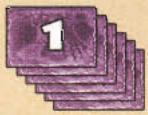
5 Sets of Action Tiles, 6 per player

5 Era Cubes, 1 per player

1 Deck of 54 Idea Cards

5 Player Aid Sheets,
1 per player

1 First Player Marker

2 Optional City Tiles. Not used in the game, simply included for you to make your own optíonal rules
ELEMENTS OF THE GAME
The Era Display
The Era display is a grid of columns and rows. This grid is used to indicate how far each player has progressed, as well as the effects of each action that a player can perform.
The icons at the top of each column represent, in some way, all of the actions a player can perform. These are all described in detail on the back cover of this rule book, but, in brief, they are: Movement, Distance, Babies, Stack Limit, Ship Movement, Ideas, Actions

placed and moved throughout the game. In addition to the Icons, the boxes in the Progress column have a background that depicts a terrain type that corresponds to 4 of the 5 terrains on the Map Tiles (mountains are not represented in the Progress Column). Full descriptions of these Eras are located on the back cover of this rule book. The significance of the terrain type is described in the Progress Section of the rule book.
City Tiles
Each player has 8 City Tiles (3 Twos, 3 Threes and 2 Fours). The number on each city represents the cost (in people tokens) to build 3 the city, as well as its Victory Point value and its defensive Combat Points value.
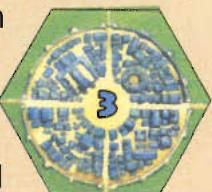
The Sea of Tempus
This is the area where players will place the Map
Tiles to build the World of Tempus. All tiles must be placedwithin the confines of the Hex grid; they cannot overlap the external boundary.

Idea Card Box
This is where the available Idea cards are placed during the game.

Player Aid Sheet
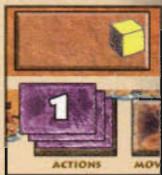
The Player Aid Sheet contains 4 distinct areas. At the top is the Actions Display. The first box is the “Actions" box, where you stack your Action Tiles at the beginning of the turn. The other 5 boxes are where you place your used Action Tiles as you perform each action during your turn.
Below that, you will find basic definitions of each Icon from the Top of the columns on the Era Display of the game board.

The bottom left contains basic descriptions of the 10 Icons in the Progress column.
The bottom right contains basic descriptions of the 9 different kinds of Idea Cards.
Map Tiles
These 12 tiles are used to build the world of Tempus. All 12 tiles are different, and are cornprised of some combination of five different types of terrain as shown below:

Idea Cards
Each ídea Card has multiple elements that serve different purposes in Tempus. The ability of the card is shown by the image on the card and brief text description. Each ability is fully described on the back of the rules. Another element is the background terrain of the card itself. This terrain is used in several different ways (attack, defense and progress) throughout the game as described in the appropriate section of the rules.

GETTING STARTED
-
All players should take a set of 8 City Tiles, 16 People Tokens, 6 Action Tiles, 1 Era Cube (in the color of their choice) and 1 Player Aid Sheet.
-
The first player at the beginning of the game is the player who most recently had a great idea (or random if you prefer). Give this player the 1st Player marker to start the game.
-
Each player should place their Era Cube in the Starting Era box (top box of the Progress Column) and stack their first 3 Action Tiles on the “Actions” box of their Player Aid Sheet.
- Shuffle the Map tiles into a pile and lay them face down by the side of the board. In play order, (starting with the 1st player and continuing clockwise) each player takes one map tile and places it face up in the Sea of Tempus. The first tile can go anywhere in the sea, and all subsequent tiles must be placed adjacent

to another tile (you cannot have separate islands). It is possible for lakes to be formed, i.e. an area of blue hexes completely surrounded by land hexes. If there are 3 players then only 8 of the map tiles should be placed. If there are 4 players then only 10 of the tiles should be placed. If there are 5 players then all 12 tiles should be used. If players run out of space to legally place tiles, then any remaining tiles are not placed.
- In player order each player now places 3 Tokens anywhere on the map to form their starting civilization. The tokens must be placed on a land hex and they must be adjacent to each other. A player may place more than one token in a hex, keeping in mind there is a maximum stacking limit of two tokens per hex at the start

of the game, as shown on the Era Display.
- Shuffle the ldea cards and lay them face down in the Idea Card box under the Era Display.
PLAYING THE GAME
Each turn in Tempus is called an Era. Each Era consists of the following four phases:
- Take Action Tiles 2. Spend Tiles & Perform Actions 3. Progress 4. End of Era
1. Take Action Tiles
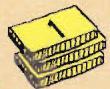
Each player takes a number of Action Tiles as indicated in the Actions Column of the Era Display on the row their Era Cube occupies. These Action Tiles are placed on the “Actions” box on the player's Player Aid Sheet.
Example: John's Era Cube is in the Cities Era and everyone else's Era Cubes are in the Farming Era. John takes 4 Action Tiles and everyone else takes 3 Action Tiles as shown in each row.
2. Spend Action Tiles & Perform Actions
This phase is broken up into several rounds. In each round, starting with the first player and continuing in clockwise order, each player spends one Action Tile. He places the Tile in the appropriate action box on his Piayer Aid Sheet. He then performs the chosen action. The same action can be selected by different players in the same round of play. The same action can be taken by a single player multiple times during the same turn. A player can choose from the following five actions:
Move People Have Babies Have A Fight Have An Idea Build A City
Move People

There are three kinds of Movement in the game; Land Movement, Lake Movement and Sea Movement. Note that the Transportation card can be used for any kind of movement as described on the back of this rulebook.
LAND MOVEMENT: The Era Display will show
the number of Tokens that can be moved (column 1) and the maximum distance (they can move less) they can be moved (column 2). Only Tokens can be moved; City counters may never be moved. Tokens can never be moved into a hex
containing a city. Nor can they be moved into a hex containing an opponent's tokens. If the player's movement rate is more than one hex, then the token may move through their own city, but never an opponent's city. The stacking limit cannot be exceeded at the end of movement (unless a sanitation card is played). The maximum number of Tokens in a hex is shown on the Era Display. Tokens must only be moved to other land hexes. Tokens may move into mountain hexes. A token may only be moved once during a single action.
LAKE MOVEMENT: Lakes may be formed by the manner in which the Map tiles have been laid. A lake is any blue area completely surrounded by land hexes. All players may use Lake movement from the start of the game. Lake movement means a Token adjacent to a lake hex may move to any other land hex adjacent to the same lake. Lake movement consumes all of the movement for that token, i.e. a token with a movement rate of 2 could not use lake movement and then move another hex, neither could it move 1 then use lake movement. All other land movement rules apply.

SEA MOVEMENT The Era display will show whether a player may use sea movement or not. If a player has sea movement capability, then, when he moves a token, he may move it from a land hex adjacent to a sea hex to ANY other land hex that is adjacent to the sea. As with lake movement, this counts as the token's entire movement. Note that the edges of the Map framing the land tiles do not impede Sea Movement; Tempus is an island. All other land movement rules apply.
EXAMPLE: In this example of movement the red Token may move two hexes. It may move to any of the hexes marked with a red check mark. Once it has moved it may not move again in this action. Note how it may use Lake Movernent to move to any land hex adjacent to the lake, but must then stop moving.

The blue token also has a movement of two hexes. It may move to any hex marked with a blue check mark. Note how it may not use Lake Movement. It may move through its own city, though. If the city belonged to another player then the token couid not move through it.
Have Babies

The Era Display indicates how many new Tokens may be placed on the map if a player chooses to Have Babies.
• Babies may only be born in Grasslands Hexes that already contain at least one of your tokens.
• Only a single baby may be born in each hex.
• The stacking limit may never be exceeded when placing a new (baby) token (unless you play a sanitation card).
• The supply of tokens is limited, so if a player runs out he may not place any more.
Thus a player who had control of only one Grasslands hex could only add one new token, even if the Era Display showed that he could place two tokens.
Have a Fight

Fighting is extremely simple in Tempus.
• A fight may only be initiated by the active player.
• The active player may only attack from a single hex containing his own token(s) to a single adjacent hex containing an opponent's token(s) or an opponent's city (never across water).
• You may never attack (or use religion on) an opponent whose tokens occupy 3 or fewer hexes on the board (their cities are not counted in this instance).
• The attacker declares which hex he is attacking and declares from which hex he is performing the attack.
• The attacker and the defender may now choose to play one or more Idea cards to possibly add to their attack or defense.
The attacker must decide first whether he wishes to play any cards. He may select any number of cards (or no cards) from his hand and place them face down. The defender then decides how many cards he wishes to play (if any), which are played face up. The attacker then reveals any cards he played.
Each combatant then calculates their final Combat Points to see who wins the fight.
• Each single token (attacking or defending) has a Combat Point value of 1.
• A defending city has a Combat Point value equal to the number printed on the city tile.
• Each Idea card whose terrain matches that of the defender's hex has a Combat Point value of 1 to the player of the card.
• In addition, each weapon card played by either player has a Combat Point value of 1.
• Each Fortification card played by the defender has a Combat Point value of 2.
If the active player is attacking a City then the defender must declare, before any cards are played, what the terrain type of the city will be (thus determining which Idea cards will have a Combat Point value in this fight).
The player with the highest total combat value wins the fight. In the case of a tie the attacker loses.
If the defender loses the fight then he removes all of his tokens, or his city counter, from the hex and they are returned to his stock. The attacker then moves as many tokens as he wishes (all, none, or anything in between) from the attacking hex into the defeated hex.
If the attacker loses the fight then the attacker removes a single (1) token from the attacking hex and returns it to his stock.
All Idea cards played in the fight are placed in the discard pile.
Note: Players are allowed to make attacks even when they are outnumbered (i.e. your stack of 2 attacks a stack of 4)
EXAMPLE: In fight ‘A' (below) Red's stack of 3 tokens is attacking Blue's stack of 2 tokens. Red must decide first whether to play any Idea cards. Red plays 2 cards face down. Blue plays 1 card face up: a Fortification Card with a Grasslands background. This adds 2 to Blue's total, making a total value of 4. Red's cards are revealed
as a Weapons Card with Farmland background, and a Transportation Card with Woods background (Red was bluffing with the extra card) whích adds 2 to Red's total (1 for the weapon, 1 for the Farmland), making Red's total value 5. Red wins and moves 2 tokens into the hex.
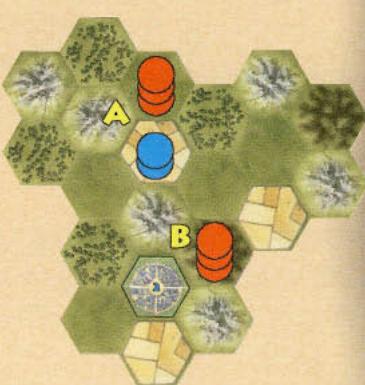
Ín fight ‘B' Red's stack of 3 tokens is attacking Blue's value 2 City. Blue must declare which terrain type his city will defend as, and chooses Woods. Red then plays 2 cards face down. Blue plays 1 card face up: A Fortification with Woods background, which is worth 3 combat points in all. Blue's total value is 5. Red's cards are revealed as an Education with Woods background card and a Military Leader with Farmland background. The first card adds 1 to Red's total, the second adds nothing (played as a bluff, hoping Blue would waste more cards). Red's totaí is 4. Blue wins, so Red removes 1 token.
Have an Idea

The Era display shows two numbers. The first number is how many Idea cards a player draws when they Have an Idea. The second number is the maximum number of cards a player may hold in their hand at once. If a player goes over the maximum then they immediately discard down to the limit. If the Idea card deck is ever exhausted then the discard
pile should be shuffled to make a new deck.
Each card has a special effect, as indicated by the central picture. Additionally the background art on the card is one of the four terrain types: Grasslands, Farmlands, Hills, or Woods.
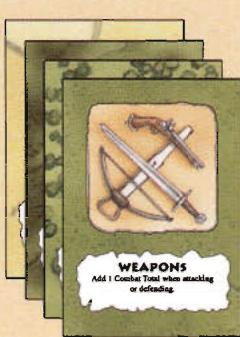
Idea Cards have three possible uses. The first is using the special effect indicated on the card. The second is to use the background terrain type on the card as a combat bonus when attacking or defending. The third is to use the background terrain type as a bonus in the Progress phase (described below).
• Playing Idea cards IS NOT an action. It is simply supplemental to performing an action.
• A player may always play as many Idea cards as they wish on their turn to use the special effect(s).
• A player may also immediately use Idea cards that were picked up when performing a “Have an Idea” action. Thus it would also be possible for a player to “Have an Idea” and then use a Military Leader that he had just picked up to make a free attack.
• Idea Cards may only be played during your turn (except when defending against an attack).
• Idea cards may be played in combination with the player's main action. They may be played before, during, or at the end of their action.
Thus it would be possible for a player who was allowed to move two tokens to move one, then play a Religion card to convert a token adjacent to the moved token, and then to move the token that had just been converted.

All the special effects of Idea cards are
described in detail on the back cover of this rule book and on the Player Aid Sheet.

Build a City
At some point in the game it will become important to build cities. There are two main reasons, firstly to free up tokens for placement elsewhere, and to score extra victory points. To build a city the player simply removes ALL of their tokens in a hex, returns them to their stock, and places a City Tile with a value equal to, or less than, the number of tokens just removed into the same hex, player choice (e.g. a player may remove 4 tokens from the Hex and replace it with either a value 4, 3 or 2 city). If you place a city with a lesser value than the tokens removed from the hex all leftover tokens are lost and returned to your stock.
• A City tile may not be built adjacent to any other City tile.
• A City tile may not be built in a grey mountain hex or a sea hex.
Note: Once a city is built, the terrain type of the hex beneath the city is no longer considered. Instead, the terrain type is declared by its owner for defense of the city as previously described in the “Have a Fight” section, and the city is worth 1 Progress Point as described in the Progress section below.
EXAMPLE: If red wanted to build another city he could only do so in the hexes marked with a red checkmark.

3. Progress
Progress occurs when all of the players have used all of their Action Tiles. Note that this may mean some players having more actions than others in later turns of the game.
Players now determine who will progress to the next unattained era on the Era Display. This Target era is called the “New Era”
First: all players who did not progress to the previous turn's New Era now automatically catch up to the leader(s) by moving their Era Cubes down to the Era of the most advanced player(s).
All players, in player order, may now play as many Idea cards as they wish, face down. Once all players have placed (or opted not to place) cards, players add up their total Progress Points to determine who advances this turn. Progress Points are calculated as follows:
• Each token in a hex that matches the terrain of the current New Era is worth 1 Progress Point.
• Each Idea card whose background terrain matches the terrain of the New Era is worth 1 Progress Point.
• Each Education Idea card played is worth 1 Progress Point.
• Each City tile a player has on the map is worth 1 Progress Point.
The player with the highest Progress Point total will advance to the New Era. If 2 or more players are tied for most Progress Points, those players advance to the New Era. The players who advanced move their Era Cubes down to the New Era on the Era Display.
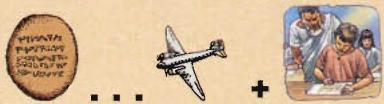
Note: In two cases there is an immediate reward for advancing. These are the Eras of Writing and Printing. When these are the New Eras, the player(s) who advance first immediately take two Idea cards for free. The remaining player(s) wili not gain this bonus when they catch up during the next Progress phase.
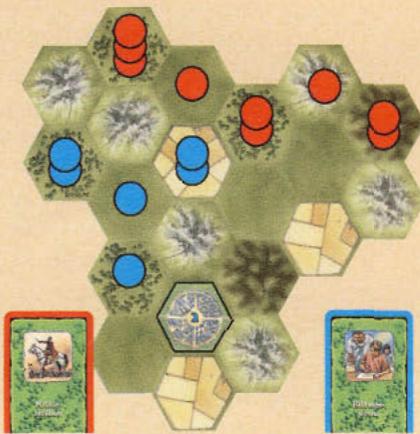
PROGRESS EXAMPLE: Red’s Cube is in the “Trade” Era. Blue's cube is in the “Roads” Era. First, Blue advances his cube to the “Trade” Era box. Now players caiculate Progress Points to see who advances to the New Era (“Ships”) box. The “Ships” Era has a Woods terrain background. Red has 5 Progress Points from his Tokens in woods hexes on the board and gains another 1 Progress Point by playing a card with a Woods background. Blue has 3 Progress Points from his tokens in woods hexes, another 1 Progress Point for his city,
and 2 Progress Points from the card he played, (1 for the Education effect, and 1 for the Woods background). Red has a total of 6 Progress Points. Blue has a totai of 6 Progress Points. As they are tied they both progress to the Ship Era box.
4. End of the Era
Players each remove all of the Action Tiles from their Player Aid Sheet and place them beside their Player Aid Sheet. The 1st player marker is passed to the next player, clockwise. A new turn now begins.
the end of the turn in which one or more players advance to the Era of Flight box.
WINNING THE GAME
At the end of the game players check to see who has won by adding up the Victory Points each player has earned. Victory Points are calculated as follows:
• Each non-mountain land hex containing one or more tokens is worth 1VP to the player who controls it. Note that the number of tokens in the hex has no bearing on the VP for the hex.
• Each City tile is worth a number of Victory Points equal to the number on the counter to its owner.
• Any player who has advanced to the Flight box adds 3 Victory Points to his total.
The player with the highest Victory Point total is the winner.
In the case of a tie the tied player with the most Idea cards left is the winner. If there is stili a tie then the tied player with the most cities on the board is the winner. If there is still a tie then the game remains tied.
CREDITS
Author: Martin Wallace
Graplhic Design & Layout: Ron Magin Rules - English Edition: Ron Magin & Cathy Doherty Published Under License by:
Café Games
P.O. Box 9.53
Phoenixville PA 19460
Ph# 610-917-0311
Fx# 610-917-0721
email: cafegames@aol.com
www.cafegames.com
© 2005 Café Games, Produced underlicense froim Warfrog Games.

© 2005, Café Games Produced under license from Warfrog Games
ERA DISPLAY ICONS & DESCRIPTIONS

MOVEMENT: This shows how many tokens may be moved if the Move action is selected. Note: a single token may not be moved more than once in a single action.


DISTANCE: This shows the maximum number of hexes that a token may be moved.


BABIES: This shows the number of new tokens that may be placed if the “Have Babies” action is selected. A maximum of 1 token may be placed per legal hex.


STACK LIMIT: This shows the standard stacking limit. It may be exceeded by the use of a Sanitation card.


SHIPS: Indicates whether Sea movement is allowed or not.

IDEAS: The first value shown is the number of Idea Cards that must be taken when the “Have an Idea” action is chosen; the second value is maximum number of Idea Cards that may be held at one time. A player may go over this limit if he immediately discards down to it.


ACTIONS PER TURN: This is the number of Action Tiles that should be taken at the start of an Era.

WRITING: Increases the number of Idea cards that may be taken. Bonus: immediately take 2 Idea cards if you are the first player(s) to progress to this Era.
FARMING: Increases the number of babies born from 1 to 2 tokens.
CITIES: Increases the stacking limit from 2 to 3.
ROADS: Increases the distance a token may move from 1 to 2 hexes.
TRADE: Increases the number of tokens that may be moved from 1 token to 2 tokens.
SHIPS: Allows players to use Sea Movement.
PRINTING: Increases the number of Idea cards that may be held. Bonus: immediately take 2 Idea cards if you are the first player(s) to progress to this Era.
INDUSTRY: Increases the stacking limit from 3 tokens to 4 tokens.
TRAINS: Increases the number of tokens that may be moved to 3 and increases movement distance to 5 hexes.
FLIGHT: Worth 3 Victory Points at the end of the game.

IDEA CARD DESCRIPTIONS
EDUCATION: Worth one Progress Point if played during the Progress phase. Note that the terrain of the card may give you an additional Progress Point.


FORTIFICATIONS: Worth 2 Combat Points if the defender. Note that the terrain type of the card may give you an additional Combat Point.

MEDICINE: You may place one extra Token if you choose the “Have Babies” action. Remember that you may not place more than one token per Grasslands hex.

MILITARY LEADER: You may make one free attack during your turn. This may be before or after you complete your normal action.
TRANSPORTATION: You may move one extra token if you choose the Move action. You may not move the same token twice using this card.

SANITATION: You may exceed the stacking limit
in one hex by one token. More than one such
card may be played to further increase the
stacking limit in either a single hex or multiple
hexes. (i.e. if you play 2 sanitation cards, you can either have +2 to the stack limit in one hex, or +1 to the stack limit in two different hexes). If you move a token from this hex later then you lose the ability to over-stack in the hex.
WEAPONS: Worth 1 Combat Point in a fight for either the attacker or defender. Note that the terrain background of the card may give you an additional Combat Point.
RELIGION: Move an oppoenet's Token (not city) into a hex you control from a hex adjacent (not across water) to it. You then convert the token to one of your own color. Please note you may not do so if you do not have a token of your own to replace it with, or if by doing so you would exceed the stacking limit (unless you play sanitation as well).
GOVERNMENT: Changes the timing of your actions. You may either choose to immediately use 2 Action Tiles and perform 2 actions this round or you may choose to pass and delay all subsequent actions by 1 round. Keep this card in front of you after it is played and discard it at the end of the turn. If you choose to perform 2 actions this round, then place the used Tiles on your Player Aid Sheet as usual. If you choose to pass, then place your Action Tile on the card, and use it (and orly it) during your next round. You do not get any extra actions, and if you pass, you still have only 1 action per round. All delayed actions must be used on the same TURN; you may not save an action from one turn to the next.
下载 Markdown原文为社区整理/出版社公开资料,版权归原作者,仅供个人学习查阅。