
Tsukuru Ten TenTen
一句话概览
Tsukuru Ten Ten 是一款已收录于村了吗规则库的桌游,支持 2–4 人,原名 Ten。
本页内容:一句话概览 · 常见问题
这游戏怎么玩
- 本站已收录这款游戏的规则资料,可以在对话里直接提问规则细节。
常见问题(FAQ)
以下 1 条问答中 0 条来自站内玩家的真实提问,其余 1 条为本站整理的常见疑问;答复内容保持原样。
Tsukuru Ten Ten支持几个人玩?
2–4 人。
去哪查完整规则
想核对具体规则细节、卡牌效果或某个回合的结算方式,可以在村了吗里选中这款游戏后直接提问。
同类桌游
- 卡坦岛德式
- 工业革命:伯明翰德式
- 勃艮第城堡:特别典藏版德式
- 方舟动物园德式
- 卡卡颂抽象
- 瘟疫危机传承:第一季美式
- 阿瑞迪亚:勇踏征途美式
- 重塑宇宙德式
- 幽港迷城美式
- 埃多拉的德鲁伊德式
规则原文(Markdown)
本站收录这款游戏的规则原文 2 个文件,此处内联渲染 2 个,可直接展开阅读或下载。
rules_en_ten_438523.md18.9 KB
来源类型:纯文本规则(非 PDF 源,早期抓取/转换产物)
说明:原文未改动,仅调整存放位置与文件名;非 PDF 扫描件,无对应原书 PDF
TEN Rulebook | RulesPalRulesPalChatRulebookTENTEN Rulebook Table of Contents Table of Contents Game Overview
Goal
Components
Setup 1. Set Up Deck
-
Set Up Supply
-
Determine Starting Player
Example 4–Player Setup
Card Types Number Cards
Wildcards
Currency Cards
Gameplay Card Draw Phase
Take a Reward Currency Limit
Busting
Buy Phase Bust Tokens
Auction Phase
End of the Game Scoring
Example Scoring
Busting Variant
Solitaire Variant Setup
Turns
Auctions
End of the Game
Quick Reference Setup
Phase Overview
Card Draw Phase
Buy Phase
Auction Phase
Busting
Credits Copyright & Contact
Game Overview
TEN is an exciting push-your-luck and auction game for the whole family! Players draw cards one-at-a-time, trying to add as many as they can without exceeding a total value of TEN, or they bust! Players may push their luck to draw more cards and use currency to buy additional cards in their attempt to build the longest number sequence in each color. When valuable wildcards emerge from the deck, players compete in auctions to obtain them in order to fill gaps in their sequences!
Goal
The goal of TEN is to complete sequential numeric runs of cards in each of the four colors. Players will score one point for each card in their longest sequence within each color at the end of the game. If a player manages to collect a run of 1 through 9, they will be awarded 10 points for that color! The player who earns the most points wins!
Components
Your game of TEN should include the following. If it does not, please visit our website at https://alderac.com/customer-service for assistance.
129 Game Cards
50 Currency Tokens
1 Rulebook
5 Reference Cards
15 Bust Tokens
Setup
1. Set Up Deck
Game cards form the deck, which will have a different number of cards depending on the number of players:
2–player game: Remove all cards with the 3 and 4+ player symbols in the bottom right corner and return them to the box.
3–player game: Remove all cards with the 4+ player symbol in the bottom right corner and return them to the box.
4–player game: No cards are removed.
5–player game: No cards are removed.
Shuffle the deck face down and place it in the middle of the play area within reach of all players.
Deck composition: 1-2 players (91 cards); 3 players (+17 cards); 4-5 players (+21 cards).
2. Set Up Supply
Give each player five currency tokens and place the remaining tokens next to the deck. Place the bust tokens next to the currency tokens to form the supply. Spent currency and bust tokens are returned to the supply.
3. Determine Starting Player
Take a number of reference cards equal to the number of players and be sure to include the card with the starting player symbol.
Shuffle the reference cards face down and deal one to each player. The player who was dealt the starting player symbol becomes the starting player and takes the first turn of the game.
Players are now ready to begin!
Example 4–Player Setup
The play area contains the deck (1), with the discard pile to its left and the tableau to its right, the supply of currency tokens and bust tokens (2) at the side of the play area, and the market (3) to the right of the tableau. Each player has a reference card and their currency tokens in front of them.
Card Types
There are three types of cards in the deck, as described below.
Number Cards
Number cards have white numbers valued 1 to 9 in each of the four colors (blue, green, orange, pink). Number cards are the main way to complete sequences.
Note: There are more copies of the lower value cards and fewer copies of the higher value cards, making the higher value cards rarer.
Wildcards
Wildcards have black numbers valued 1 through 9 or feature the any number (#) symbol.
When a wildcard is drawn, a player's Card Draw Phase is immediately paused, and an Auction Phase is resolved.
Numbered wildcards can be used as any of the four colors (blue, green, orange, pink).
Wildcards with the (#) symbol can be used as any number (from 1 to 9). The card remains the same color; only the number of the card is modified.
This special wildcard can be used as any number and any color.
Currency Cards
Currency cards have a value of one to five black currency tokens shown on the card. These cards reward currency to spend during auctions and when buying cards in the market.
Gameplay
During your turn, you always complete the Card Draw Phase, which may be interrupted by the Auction Phase when a wildcard is revealed. You may take a Buy Phase at the end of your turn if you do not bust or take currency cards.
Phase overview: Card Draw Phase → (Auction Phase) → Reward or Bust → Buy Phase → End.
Card Draw Phase
Draw cards from the top of the deck, one-at-a-time. If it is a number or currency card, place it face up to join or form a tableau. If it is a wildcard, your turn is immediately interrupted for an Auction (see "Auction Phase" on page 11). After drawing each card, you must choose to either stop and take a reward, or continue to draw another card.
Your turn ends when any of the following conditions occur:
You choose to stop drawing and take a reward (see "Take a Reward" on page 8).
You bust by drawing a card that would make the tableau contain either: a net positive total value of more than ten (11+), or currency cards with a total value of more than ten (11+) (see "Busting" on page 9).
Take a Reward
As long as you do not bust, you may choose to end the Card Draw Phase and take one of the following rewards:
All number cards in the tableau — or —
All currency in the tableau
If you choose to take all of the number cards in the tableau:
Place them face up in front of yourself.
ALL OTHER players gain currency tokens from the supply equal to the value shown on the currency cards in the tableau. After players have gained currency tokens, discard the currency cards into a face up discard pile next to the deck.
You may take a Buy Phase if you wish (see "Buy Phase" on page 10).
Once your Buy Phase is complete, or if you choose not to take a Buy Phase, your turn ends and play passes to the next player clockwise.
If you choose to take all of the currency in the tableau:
Gain currency tokens from the supply equal to the value shown on the currency cards in the tableau and discard the currency cards to the discard pile.
Move all of the number cards in the tableau to the side of the play area to join or form the market.
Your turn ends and play passes to the next player clockwise.
Note: If you choose to take all of the currency, you may not take a Buy Phase.
Currency Limit
Each player can have a maximum of ten (10) currency tokens at any time. If a player would gain currency in excess of ten (11+), the excess is lost.
Note: Bust tokens do not count towards your currency limit.
Busting
Each number card you reveal in the tableau adds to your total based on its numeric value (1-9).
Each currency card you reveal subtracts from your total based on its value of currency tokens (1-5).
Note: It is possible for a player to draw a currency card or cards that would result in a net negative total value.
Examples: 2 + 1 = 3 total. 3 - 4 = -1 total. 3 - 4 + 7 - 2 = 4 total.
In this example, the active player now has a net positive total value of 4, and a total currency value of 6. At this point, a revealed number card of 7+ or a currency card of 5 would cause the player to bust.
You bust if you reveal a card that would make the tableau contain either:
A — A net positive total value of more than ten (11+).
B — Currency cards with a total value of more than ten (11+).
Example A: 4 - 3 + 5 + 9 = 15 total value. Example B: 3 + 4 + 5 = 12 currency total, while -3 + 7 - 4 - 5 = -5 total value.
If you bust, you must resolve the following steps in order:
Move all of the number cards in the tableau to the side of the play area to join or form the market.
You gain 1 bust token, worth 3 currency, from the supply.
Only resolve this step if you bust with number cards with a net positive total value of more than ten (11+). If you bust with currency cards, skip this step and proceed to step 4. ALL OTHER players gain currency tokens from the supply equal to the value shown on the currency cards in the tableau.
Discard the currency cards to the discard pile.
Your turn ends and play passes to the next player clockwise.
Buy Phase
You may only take a Buy Phase if you did not bust this turn and chose to take number cards instead of currency as a reward. If you choose not to take a Buy Phase, play passes to the next player clockwise.
You may spend your currency to buy one card in the market. To buy a card, pay the face value of the card and place it face up in front of yourself. For example, a green "3" card costs 3 currency. You may buy only one card from the market per turn.
In addition to spending your currency and bust tokens, you may also spend any of your cards (commonly duplicate cards). Each card you discard to the discard pile counts as one (1) currency when buying a card.
You cannot buy a card that is identical (number and color) to a card you already have.
After you finish buying a card from the market, play passes to the next player clockwise.
Example: Darby spends three cards along with two currency tokens (total value of 5) in order to buy a 5 card from the market.
Bust Tokens
Each bust token is worth three (3) currency.
Bust tokens do not count towards your currency limit of ten tokens. Players will always gain a bust token when they bust, even if they already have ten currency tokens or any number of bust tokens.
Players may never make change with a bust token. You must spend all three currency when using the token or any excess is lost.
In the rare event when a player gains a bust token but none remain in the supply, use another token, like a coin.
Auction Phase
When a player draws a wildcard, their turn is immediately interrupted and the wildcard is auctioned. After the auction, play resumes with the active player.
Starting with the player to the left of the active player and continuing clockwise, each player may bid an amount of currency that they are willing to pay for the revealed wildcard. Players must either bid more currency than the previous bid, or pass.
Each player has only one opportunity to bid or pass during an auction. The auction ends after the active player bids or passes. The player who bid the most must pay that amount of currency and then places the wildcard face up in front of themselves.
In addition to spending your currency and bust tokens, you may also spend any of your cards (commonly duplicate cards). Each card you discard to the discard pile counts as one (1) currency toward the bid.
After the auction has been carried out, the active player's turn continues from where it was interrupted.
Players are not required to state which tokens and cards they will spend. However, players cannot bid more than the amount of currency and cards that they currently have. Players must pay if they win the auction.
Players do not need to assign the wildcard to a color sequence until the end of the game: wildcards remain flexible until final scoring. The number of tokens and cards players have is public information.
In the rare event that no player bids and all players pass, the wildcard is discarded.
End of the Game
The end of the game is triggered when the last card has been drawn from the deck. The active player will resolve their turn as normal, but they may no longer draw cards.
After the active player finishes their turn, starting with the player to the left of the active player and continuing clockwise, each player may take one final Buy Phase. After the active player finishes their final Buy Phase, players score points to determine the winner.
Scoring
Players arrange their number cards and wildcards to create consecutive numeric sequences in each of the four colors.
Each player scores one (1) point for each card in their longest consecutive numeric sequence in each color. Players who successfully collect all numbers 1 to 9 in any color (including any assigned wildcards) receive one bonus point (for a total of ten points instead of nine points).
The player with the highest total score is the winner!
In the event of a tie for highest score, the player with the most remaining currency is the winner (this includes only currency tokens and bust tokens, not cards). If players are still tied, the player with the fewest total cards wins. If players are still tied, then the tied players share the victory.
Example Scoring
Blue Score: 6 card run = 6 points
Green Score: 9 card run + complete set bonus = 10 points
Pink Score: 5 card run = 5 points
Orange Score: 3 card run = 3 points
TOTAL: 24 Points
Busting Variant
This variant gives players the option to buy cards when they bust. During step 2, after moving number cards from the tableau to the market, you may choose to forego gaining a bust token and instead take a Buy Phase. Resolve the remaining steps for busting as normal.
Solitaire Variant
This variant allows you to play solitaire games of TEN. JEN represents an AI opponent that you are playing against. Play begins with your turn and turns alternate with JEN being the active player, as in a 2–player game.
Setup
Follow the setup instructions for a 2–player game. You take five currency tokens and give JEN five currency tokens.
Turns
On your turn, all options are the same as in a standard game.
On JEN's turn, she will draw cards until her net positive total value equals or exceeds a predetermined number, or a bust is triggered by currency. The predetermined number is based on how difficult of a game you would like to play (4, 5, 6, 7, 8, 9, or 10). JEN always takes all of the number cards in the tableau and never chooses to take currency.
JEN cannot bust except for when the bust is triggered by currency. Resolve a currency bust as normal except JEN always takes all of the number cards that she drew on her turn in addition to gaining a bust token.
Auctions
Auctions are played a little differently. The minimum you and JEN may bid for every auction card is 5. You and JEN cannot bid using a card as currency unless it is a duplicate of a card already owned. Duplicate cards can be easily tracked by placing them in a face down stack next to collected cards.
JEN bids with the following logic:
When JEN is first to bid (on your turns), she always bids an amount as close to the total of your currency tokens, bust tokens, and duplicate cards that you have as she can pay for, OR 5, whichever is higher. If JEN cannot bid at least 5, she will not bid.
JEN only uses her currency tokens, bust tokens, and duplicate cards (in that order) to bid.
You may outbid JEN by paying more than her high bid.
When JEN is second to bid (on her turns) she always attempts to spend as much as she needs to win the auction, depending on what you bid. You may only bid as high as your total of currency and bust tokens, as well as any duplicate cards you currently have. The minimum you may bid is 5.
JEN will always compete to win auctions, regardless of whether the card is a duplicate.
Note: If neither you or JEN pays at least 5 currency to win an auction, then the card is discarded.
Note: You may buy from the market as normal, but JEN may never buy from the market.
End of the Game
Play until the last card is drawn and end the game as you would in a normal 2–player game.
If you have more points that JEN at the end of the game, you win!
Start by setting JEN's predetermined number to 4, and then move your way up higher as you are able to win each game. See how you rank:
-
You're just getting started!
-
Getting the hang of it!
-
Impressive moves!
-
A marvel of luck and strategy!
-
Among the best!
-
Truly remarkable!
-
We're not sure how you did it!
Quick Reference
Setup
Set Up Deck 2–players: Remove all cards with the 3 and 4+ player symbols in the bottom right corner and return them to the box.
3–players: Remove all cards with the 4+ player symbol in the bottom right corner and return them to the box.
4–players: No cards are removed.
5–players: No cards are removed.
Set Up Supply — Each player receives five currency tokens.
Determine Starting Player — Each player takes one reference card at random and the one with the starting player symbol becomes the starting player.
Phase Overview
Card Draw Phase → Auction Phase → Reward or Bust → Buy Phase → End.
Card Draw Phase
Draw cards from the top of the deck and place them in the tableau. After drawing each card, you must choose to either continue to draw another card or stop and take one of the following rewards:
All number cards in the tableau.
All currency in the tableau.
Buy Phase
You may only take a Buy Phase if you did not bust that turn and chose to take number cards instead of currency as a reward. You may spend your currency tokens, bust tokens. and cards to buy one card in the market. After you have finished buying a card from the market, play passes to the next player clockwise.
Auction Phase
Wildcards are auctioned immediately after they have been drawn.
Starting with the player to the left of the active player and continuing clockwise, each player may bid or pass once. The player with the highest bid must pay and take the wildcard.
Busting
Each number card in the tableau adds to your total and each currency card subtracts from your total.
You bust if you choose to reveal a card that would make the tableau contain either a net positive total value of more than ten (11+), or currency cards with a total value of more than ten (11+).
If you bust, move all number cards in the tableau to the market, then you gain one bust token, and if it was from exceeding a net positive total of more than ten (11+), ALL OTHER players gain the currency tokens shown on the currency cards, and play passes to the next player clockwise.
Credits
Designers: Molly Johnson, Robert Melvin, Shawn Stankewich
Director of Projects: Nicolas Bongiu
Production: Dave Lepore
Development Lead: John Goodenough
Creative Direction: Molly Johnson, Robert Melvin, Shawn Stankewich
Initial Graphic Concepts: Vikki Wiercinski and Flatout Games
Graphic Design: Dylan Mangini
Illustration: Shawn Stankewich
Editing: Nicolas Bongiu, Richard A. Edwards, Vladimir Orellana, Todd Rowland
Copyright & Contact
© 2021 Alderac Entertainment Group. TEN and all related marks are ™ or ® and © where indicated Alderac Entertainment Group, Inc. 2505 Anthem Village Drive Suite E-521 Henderson, NV 89052 USA. All rights reserved. Printed in China.
Warning: Choking Hazard! Not for use by children under 3 years of age.
Visit our website at: www.alderac.com/ten
Questions? https://alderac.com/customer-service
下载 MarkdownTsukuru_Ten_Ten_rulesEN_v1.md9.3 KB

• 4 Bonus Role Sheets
• 1 Instruction Manual
ツクルテン TSUKURUTEN TEN


Contents
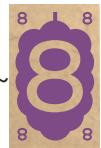
61 Number Tiles (1 Red 0 Tile, 4 Red and Blue Tiles for Numbers 1-7, and 1 Purple Tile for Numbers 5-8)
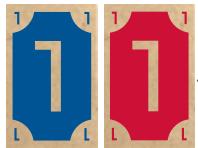


Front


Back
• 1 Dealer Marker
• 40 Scoring Chips

1 Point: 20 Chips
3 Points: 12 Chips
5 Points: 8 Chips
Game Objective
The goal is to create exactly “10” with a total of 8 number tiles. Simply adding the numbers together won't make it easy to reach “10." Use special combos of three tiles to effectively combine the number tiles.
How Special Combos Work
Number tiles (hereafter referred to as “tiles") can be converted into a single number based on the following conditions:
· A set of three consecutive red numbers → The largest number in the set
• A set of three consecutive blue numbers → The smallest number in the set
• A set of three identical numbers of the same color → Regardless of the number, it is treated as “0”
Example 1: 3-4-5 → “5″ Example 2: 1-2-3 → “1″ Example 3: 2-2-2 → “0″
It's up to you whether you use the tiles as part of a combo or as individual numbers.
Example 1: If you use the tiles 1, 2, and 3 as a combo, it becomes “3”.
But if you use them as individual numbers, “1 + 2 + 3 = 6".
Example 2: When you have 1, 1, 1, 2, and 3, you can choose how the tiles work as you want. For instance:
You could use 1, 1, and 1 as a special combo for “0," and 2 and 3 as individuals, which gives you 2 + 3 = 5, for a total of 5.
Or, you could use 1, 2, and 3 as a special combo for “1," and the other two 1s as individuals, 1 + 1 = 2, for a total of 3.
How Tenten Tiles Work
The following four tiles can be used as either red or blue, depending on your choice.


◇Game Setup
• Each person receives 2 card stands (hereafter referred to as “stands") and a bonus role sheet.
• The person who likes the number 7 the most becomes the dealer. If no one fits this, choose a dealer in the most suitable way.
• The dealer receives a dealer marker and score chips (hereafter referred to as “chips”). The dealer places the marker in front of them with the front side up. The dealer also manages the chips, keeping them nearby until the game ends.
• Place all the tiles face down in the center of the table and mix them well.
There's no need to arrange them neatly — these are now called "draw pile".
• Each player randomly picks 7 tiles from the draw pile and places them on their stand as their hand.
Once you see the numbers on the tiles, you cannot return them to the draw pile or repick.
◇Round Flow
• Turns proceed clockwise starting from the dealer.
• On your turn, you can perform one of the following actions:
A. Pick one tile from the draw pile. (Afterward, you may declare “Tenten." to complete your set or discard one tile from your hand.)
B. Declare a “Get."(Afterward, discard one tile from your hand.)
C. Declare “Tenten" using a tile from the discard pile.
• If no one declares “Tenten" and the draw pile is exhausted, the round ends, and preparations for the next round begin.
At this point, the dealer marker remains in place.
A. Pick one tile from the draw pile.
• Pick one tile from the pile and add it to your hand.
• When you can make exactly 10 with the 8 tiles in your hand, you can declare “tenten". This allows you to “finish" (the term will be explained later).
• If you don't declare “tenten," pick one tile from your hand and place it face up as a discarded tile.
From then on, place the latest discarded tile to the right of the previous one.
B. Declare a “Get."
• You can declare “get" if you can form a special combo using 2 of your hand tiles and a discarded tile from another player.
(Only the latest discarded tile is available.)
Place the 2 hand tiles and the corresponding discarded tile face up in front of you.
Pick one tile from your hand and place it face up as your discarded tile. The 3 tiles revealed during a “get" declaration must be treated as a special combo.
They cannot be considered as individual numbers.
You cannot combine them with other tiles to create a different special combo.
Example: If you revealed 1, 1, and 1 during a “get" declaration, they must be treated as “0." You can declare “get" on every turn if it's possible.
C. Declare “Tenten" using a tile from the discard pile.
• When you can make an exact total of 10 with 8 tiles which includes 7 tiles from your hand (or 7 tiles including a “get") and one of the other player's discarded tiles, you can declare “tenten" (note that only the latest discarded tile is available). This allows you to “finish" (the term will be explained later).
●Example Illustration for Four Players
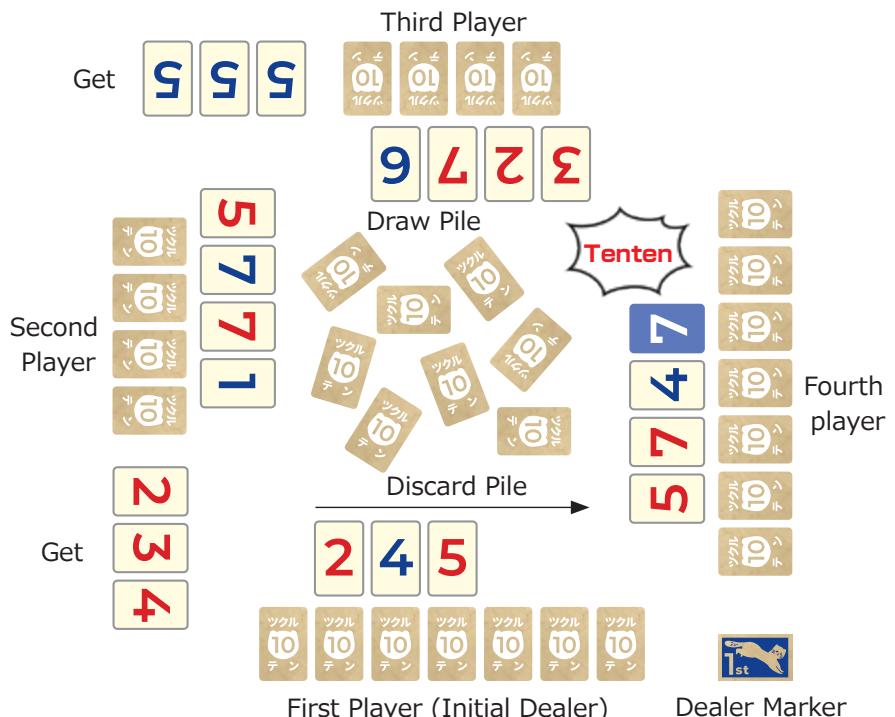
■“Finish" after Declaring “tenten"
Reveal all the tiles in your hand, including the set of three from a “get" or the corresponding discarded tile if used.
All players must verify that the total of the 8 tiles equals 10. If correct, the player receives 1 point chip.
• In case of an error, return all tiles to their positions before “finish" was declared.
The other players will each receive 1 point chip.
If you declared from your hand, discard one tile to end your turn.
However, if you declared from discarded tiles, you must redo your turn.
Then, the next player continues with their turn.
Setup for the Next Round
• Place all the tiles face down in the center of the table and mix them well.
• Each player randomly picks 7 tiles from the draw pile and places them on their stand as their hand. Once you see the numbers on the tiles, you cannot return them to the draw pile or repick. The player with the dealer marker will take their turn to start the new round.
How to End the Game
• The game ends when a player reaches 4 points, and that player is declared the winner.
Advanced Rules
Once you become familiar with the game, you can enhance your experience by playing with In the advanced rules, some of the rules are modified, and bonus roles are introduced.
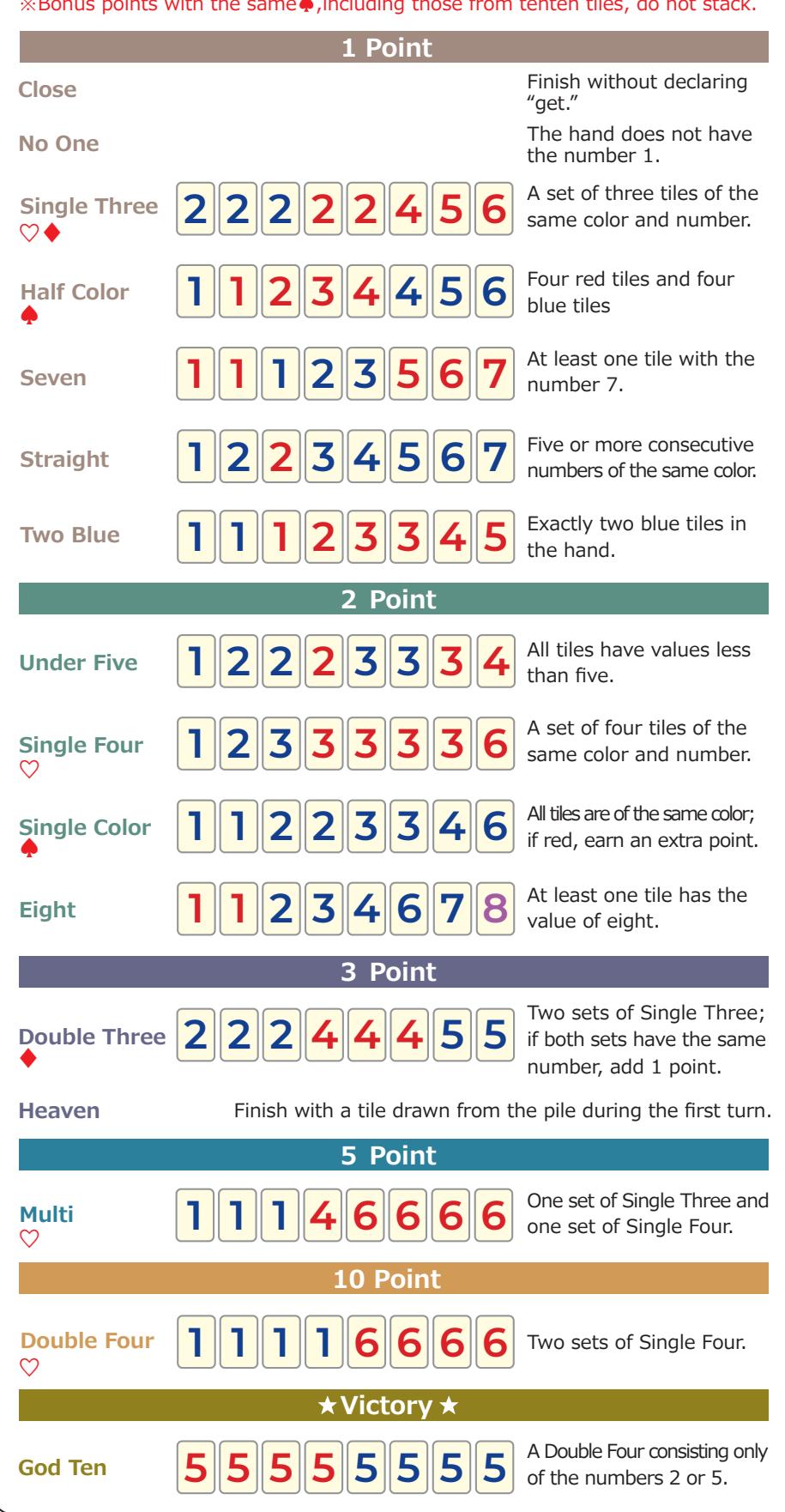
■“Finish"Bonus
When you declare “tenten," the points you can earn depend on the tiles you have. Refer to the base points and bonus points on the bonus role sheet, and calculate the total points you gain.

Points: 3 points for being the dealer + ①2 points for a single four + ②1 point for seven + ③1 point for no one = 7 points
Example 2: Non-Dealer 10122234 Hand: 11222234
Individual (1 + 1 + 1 + 3 + 4) + Special Combo (222 → 0) = 10
Points: 2 points for being a non-dealer + 1 point for close + 2 points for under five + 3 points for double three = 8 points
Rules for Handing the Dealer Marker
When the dealer dedlares “tenten" and earns the “finish" bonus, the dealer marker stays in the same position, and the game proceeds to the setup for the next round (continuation of the dealer). In all other cases, hand the dealer marker to the player on your left when preparing the setup for the next round.
How to End the Game
• When the dealer marker returns to the first dealer, turn the marker upside down, showing the 2nd part up.
• The game ends when either a player accumulates more than 25 points or the marker returns to the first dealer for the second time.
(This means each player will have the opportunity to be the dealer twice.)
• Whoever has the most points wins.
In the event of a tie, if the first dealer is included in the tie, the first dealer is declared the winner. If the first dealer is not included in the tie, the player closest to the first dealer in the turn order is declared the winner.
• In a round, if a player finishes with a “God Ten," that player wins, and the game ends immediately.
Variant Rules (For Those Who Want to Enjoy Longer with Advanced Rules)
Change the condition to end the game to only until someone earns more than 25 points.
Bonus points with the same,including those from tenten tiles, do not stack.
■Cooperation: SUNNY BIRD Inc. https://sunny-bird.com/
Video Production: Kana Ozaki (Nill Inc.)
Artwork: Hitomi Okubo (Nill Inc.)
Game Design: Kenichi Kabuki (Game NOWA)→ @KABU_KEN65
Publisher / Product Inquiries: Nill Inc. https://nill.shop/c-contact
下载 Markdown原文为社区整理/出版社公开资料,版权归原作者,仅供个人学习查阅。