
特拉马拉Terramara
一句话概览
特拉马拉 是一款已收录于村了吗规则库的桌游,支持 2–4 人,原名 Terramara。
本页内容:一句话概览 · 游戏概述 · 1. 游戏组件 · 2. 游戏设置 · 3. 游戏流程 · 4. 资源系统 · 5. 工人 · 6. 手工制品 · 7. 行动详解 · 8. 轮次结构 · 9. 轨道系统 · 10. 前哨站 · 11. 奖励片 · 12. 人物牌 · 13. 游戏结束 · 常见问题
特拉马拉 规则速览
本页收录规则速览的前 14 节(篇幅所限省略了后 1 节),完整规则速览与卡牌可在村了吗查询。
游戏概述
在公元前约 1500 年的青铜时代意大利北部,玩家扮演阿尔卑斯山至波河流域的古村落氏族首领,通过探索未知土地、发展军事实力、制作手工制品来壮大自己的氏族,最终获得最多胜利点者成为"特拉马拉"的领袖!
核心机制: 工人放置、轨道推进、区域控制、手牌管理与收集
1. 游戏组件
| 组件 | 数量/说明 |
|---|---|
| 拼图板 | 8 块(组成外框版图) |
| 家园板块 | 4 块(每次游戏使用 2 块,区分玩家人数) |
| 领地板块 | 24 块(每次游戏使用 12 块),分森林/山脉与平原/采石场两类 |
| 轮次板 | 1 块(含轮次轨道) |
| 军力轨道 | 印于版图,共 20 格,分 4 级 |
| 河流 | 印于版图,共 14 格 |
| 道路 | 印于版图 |
| 玩家配件 | 每色各 1 套:棚屋牌×1、旗帜×4、军力指示物×1、独木舟×1、马车×2、首领×1、探索者×5(或×6)、资源片各 16 种×4 = 64 个 |
| 工人片 | 17 个(一级 9 个、二级 5 个、三级 3 个) |
| 奖励片 | 18 个(一级 6 个、二级 6 个、三级 6 个) |
| 手工制品牌 | 52 张(一级 16 张、二级 16 张、三级 20 张),分工具、兵器、陶器、衣物四类,各有三个等级 |
| 人物牌 | 7 张(双面:"少年"正面 / "成年"背面) |
| 起始资源牌 | 12 张 |
| 先手玩家牌 | 1 张(正反面不同效果) |
| 中立玩家牌 | 4 张(仅 2-3 人游戏用) |
| 限制片 | 6 个(仅 2 人游戏用) |
| 火灾片 | 6 个(仅 2-3 人游戏用) |
| 勇士 | 4 个(仅当场上有 4 名玩家时放入) |
| 记分纸 | 1 张 |
2. 游戏设置
2.1 版图设置
- 将 8 块拼图板拼成外框版图(带标记面朝上),放在桌面中央。
- 将家园板块挨着放在版图最上方的栏位中:左边板块显示对应人数标记,右边板块也按人数要求选择。
- 4 人游戏: 左 4 人标记 + 右 3/4 人标记
- 3 人游戏: 左 2/3 人标记 + 右 3/4 人标记
- 2 人游戏: 左 2/3 人标记 + 右 2 人标记
2.2 领地板块设置
- 将森林/山脉板块按等级分开,从每级中随机挑选 2 块。从上到下依次放到右侧栏位:2 个一级 → 2 个二级 → 2 个三级。确保全部正面朝上(显示资源面,无积雪)。
- 同样方式将平原/采石场板块放到左侧栏位。
2.3 轮次板设置
- 将轮次指示物放在轮次轨道第一格。
- 将工人片按等级分开,在轮次轨道每格中按规则放置:
- 第 1-2 轮格:各放 2 个一级工人
- 第 3-4 轮格:各放 2 个二级工人
- 第 5 轮格:放 2 个三级工人 - 将奖励片面下按等级分开,随机放置在河流、道路和两块三级平原/采石场板块旁的指定位置,然后全部翻为面朝上。剩余奖励片备用于特定人物。
2.4 手工制品牌设置
- 将手工制品牌按等级分开,分别洗匀。
- 制作一个面朝下的牌堆:三级在最下面、二级在中间、一级在最上面。
- 从牌堆顶抓 8 张牌,从左到右面朝上地放在版图下方靠近河流的位置。
2.5 玩家个人设置
每位玩家获得:
- 1 张棚屋牌(正面个人信息区,背面为游戏结束计分项)
- 4 个旗帜
- 1 个军力指示物,放在军力轨道第 1 格
- 2 个马车,放在道路最上方的起始位置
- 1 个独木舟,放在河流起始位置
- 1 个首领
- 5 个探索者(第 6 个仅选特定人物或 2/3 人设置时才用到)
- 资源片和胜利点片放在版图旁供拿取
2.6 先手玩家
- 选出一位先手玩家,将先手玩家牌交给他(暂忽略牌上效果)。
2.7 入门游戏(推荐首次游玩)
首次游玩建议不使用人物牌和起始资源牌,改为:
- 每位玩家获得四种原生资源各 1 个
- 每位玩家获得 1 个一级工人和 1 点文化(独木舟放在河流第 1 格而非起始位)
- 根据顺位调整起始军力:第 1 位获 1 点,第 2 位获 2 点,以此类推
2.8 2 人和 3 人游戏额外设置
2 人增加 2 位中立玩家,3 人增加 1 位。
- 火灾板块: 在每行(第 1-5 轮共 6 行)领地板块的小行动格中放火灾片。面朝下洗混 4 张中立玩家牌,逐张翻开,在对应数字格放置火灾片。第 5-6 行重新洗牌。
- 中立探索者布置: 由真实玩家分配——先手玩家将一名中立探索者放在第 1 轮行的某个行动格,然后按玩家顺序依次放置到下一轮行的未被占据格,直到满足数量(3 人共 6 个、2 人共 12 个)。
- 中立军力: 将中立玩家的军力指示物放在军力轨道第 1 格。
- 剩余配件放回盒子不用。
玩法变化:
- 每轮开始时翻中立玩家牌并为每位中立玩家移动军力指示物。2 人游戏每轮结束时还需在翻开的路口格上放一个 🚗 限制片。
- 先手玩家牌易主后,第 4 顺位(2 人还包括第 3 顺位)不再获得奖励。
- 发展技能/沿路旅行时任选其一执行。
- 军力排名计分包含中立玩家。
3. 游戏流程
游戏共进行 5 轮。每轮从先手玩家开始,按顺时针顺序依次进行回合。
一位玩家在自己的回合中必须派出 1 个氏族成员(探索者或首领)到一个行动格并执行相应行动。随后可选择三项后续动作之一:制作一张手工制品、保留一张手工制品、或保留先前已储备的手工制品牌。
一轮在所有玩家都派出所有氏族成员后结束。
3.1 氏族成员的派遣限制
- 一个行动格最多容纳 2 个氏族成员,但同色只能 1 个。
- 若某行动格已有首领,其他玩家不能再派氏族成员到该格。
- 带有特殊标记的行动格限容纳 1 个氏族成员。
- 探索者可派往任意行动格,但不能派往远方的行动格(即标注了后续轮次旁领地板块的格子)。
- 首领永远不能被派往远方行动格。
3.2 抢占已有玩家的行动格
当玩家想把探索者派到已被另一名玩家探索者占据的行动格时:
- 必须自身的军力 高于 已占据者的军力(不含相等)
- 成功后损失 1 点军力
- 即使军力降到低于对方仍可如此操作
3.3 勇士
勇士相当于首领,唯一例外:可以把勇士派到自己探索者已占据的行动格。涉及首领效果不适用于勇士。每轮结束后将所有勇士收回版图旁。
4. 资源系统
游戏中有四种资源:
| 原生资源 | → | 成品资源 |
|---|---|---|
| 家畜 | → | 皮革 |
| 石头 | → | 石料 |
| 木头 | → | 木材 |
| 矿石 | → | 金属 |
- 原生资源不能代替成品资源;成品资源可以代替对应的原生资源(如用金属代替矿石)。
- 原生资源放在棚屋牌左侧,成品资源放在右侧。
- 成品资源主要用于制作手工制品。
5. 工人
工人用于精炼(将原生资源转换为对应成品资源):
- 每个工人片旋转 90° 表示已使用。
- 转换数量 = 工人等级(一级 1 个、二级 2 个、三级 3 个)。
- 每个工人每轮仅能用一次。
- 激活时未用完的转换次数当轮作废。
6. 手工制品
手工制品分四类:工具、兵器、陶器、衣物,各含一/二/三级。
6.1 制造与保留
- 玩家的独木舟到达或经过河流第 1 格时,可制作最左侧 3 张手工制品;之后每前进 2 格多解锁 1 张。
- 独木舟到达第 4 格后,才可以保留一张手工制品(每局限 1 张,且必须先制作当前保留的那张才能换新的)。
- 制作时支付费用并将卡牌置于面前;立即获得其效果。
- 保留时手牌面朝下置于面前——其他玩家不能再保留或制作此卡,游戏结束时持有保留卡的玩家失去 5 个胜利点。
6.2 效果类型
| 类型 | 触发时机 | 使用标记 |
|---|---|---|
| 持续效果 | 始终可用,满足条件即可 | 无需标记 |
| 即时效果 | 制作完成时立即使用一次 | 无需标记 |
| 每轮一次 | 每回合中可随时使用,每轮限一次 | 旋转 90° 标记已用 |
| 游戏结束效果 | 游戏结束时结算 | 无需标记 |
效果为可选,不强制使用;部分效果只需使用一部分(如提供 3 点旅行时可以选择走 0、1、2 或 3 步)。
7. 行动详解
7.1 家园行动格
数量比玩家人数多 1 个。以下行动需各派出 1 个氏族成员:
雇佣工人
- 获得 1 个工人,等级取决于当前轮次:
- 第 1-2 轮:一级工人
- 第 3-4 轮:二级工人
- 第 5 轮:三级工人
发展技能
- 获得 1 点军力 和 1 点文化。
- 2 人游戏中,在此格可按任意顺序执行抢劫或成为先手玩家两项行动。
沿路旅行
- 获得 2 点旅行。玩家可以让每辆马车各移动 1 步,或让 1 辆马车移动最多 2 步。
- 2 人游戏中,在此格可按任意顺序执行其中一项。
发动一次抢劫
- 派出氏族成员时必须立即损失 1 点军力。
- 然后根据军力等级(盾牌标志,非具体军力值)从其他玩家处收取资源:
| 与其他玩家军力等级关系 | 每有多少资源须支付 |
|---|---|
| 相同等级 | 每 5 个资源给 1 个 |
| 低 1 级 | 每 4 个资源给 1 个 |
| 低 2 级 | 每 3 个资源给 1 个 |
| 低 3 级 | 每 2 个资源给 1 个 |
| 高 1 级 | 每 6 个资源给 1 个 |
| 高 2 级 | 每 7 个资源给 1 个 |
| 高 3 级 | 每 8 个资源给 1 个 |
- 原生和成品资源在被抢时均计算在内。每位玩家自行决定给哪些资源;少于最低阈值则免付。
成为先手玩家
- 获得先手玩家牌,下轮为先手。同时沿道路移动 1 步。
- 新轮中第 2 顺位无任何奖励;第 3 顺位立即获得 1 点文化;第 4 顺位立即获得 2 点军力。
- 每轮限用一次。
第 5 轮时此行动效果改变: 选择获得 2 点旅行、2 点军力或 2 点文化之一,其他玩家什么也不得。
7.2 领地行动格
每个领地板块包含 3 个行动格。派出 1 个氏族成员到此格会立即获得格中所描绘的收益——通常为原生/成品资源、资源转换,有时还有军力、旅行或文化。
7.3 路口行动格
位于一级和二级森林/山脉板块背面。在一轮结束时,对应行靠右的领地板块翻面后解锁。
- 第 2 轮可使用第 1 轮的路口格;第 3 轮起可用第 1-2 轮的,依此类推。
- 前提:两辆马车都必须到达或经过对应的路口才能派遣氏族成员至此格。
- 2 人游戏中翻开的路口格上会放有一个限制片(🚗),需要先移除。
7.4 特殊行动格
第 5 轮的一级森林/山脉板块上提供特殊行动,在游戏开始前无法进入,需达成对应条件方可:
| 条件 | 收益 |
|---|---|
| 工人等级之和 ≥ 5 | 1 点军力 + 1 点文化 + 1 点旅行 + 任意 1 个成品资源 |
| 到达或经过河流指定符号 | 任意 1 个成品资源 + 3 个胜利点 |
| 两辆马车均到达或经过道路指定符号 | 任意 3 个成品资源 |
| 到达或经过军力轨道指定符号 | 任意 2 个成品资源 + 1 个原生→成品转换 |
7.5 自己的棚屋
可容纳任意数量的氏族成员(包括多个首领)。每派出 1 个氏族成员,可选择以下行动之一:
- 把 1 个原生资源转换为对应的成品资源
- 把 1 个原生资源交换为 1 个不同种类的原生资源
7.6 河边手工制品区
在任何行动后,可从河边可见(独木舟到达位置)的手工制品牌中选择:
- 制作一张——支付费用后立即获得其效果,然后右侧牌左移并从牌堆补一张到空缺位。
- 保留一张——需独木舟到达第 4 格,手牌面朝下置前,其他人不可碰。游戏结束时扣 5VP。保留期间河边牌仍正常制作。
- 保留先前储备的制品牌——必须先制作旧卡后才能换新的。
8. 轮次结构
8.1 一轮开始(第 2-5 轮)
- 第 2 轮: 将牌堆中的所有一级手工制品牌移除。
- 第 3 轮: 从河边移除所有一级手工制品牌,再从牌堆补牌。
- 第 4 轮: 将牌堆中的所有二级手工制品牌移除。
- 第 5 轮: 从河边移除所有二级手工制品牌,再从牌堆补牌。将先手玩家牌翻面(先手不变)。
每个人物翻面阶段(第一轮首个行动前):
- 每轮开始后、派出首个氏族成员之前,可选择将人物牌从"少年"翻为"成年"。
- 失去正面奖励,获得背面奖励。不可逆。每人每局限一次。
8.2 一轮结束(第 1-4 轮)
- 收回自己在行动格上的所有氏族成员(不包括被派到远方行动格的)。
- 将轮次指示物所在行的两个领地板块翻面——翻开 1 个路口行动格和 1 个前哨站。
- 重置所有已使用的工人片和"每轮一次"效果的手工制品,使其可再次使用。
- 轮次指示物移至下一格。
9. 轨道系统
9.1 军力
- 军力范围 0-20 格。到达最后一格(第 20 格)后不能再前进,超额军力按 1 点军力换 1 个胜利点处理。
- 仍可因被抢等负面效果退后。
- 军力等级通过盾牌划分为 4 级,影响抢劫结算而非抢劫判定本身。
游戏结束时军力排名计分:
| 排名 | 胜利点 |
|---|---|
| 最高军力 | 8VP |
| 第 2 名 | 5VP |
| 第 3 名 | 2VP |
| 第 4 名及以后 | 0VP |
平局时所有并列者获得对应名次 VP,但后续名次 VP 将被跳过(如两人并列第 1,则无人得 5VP)。
9.2 文化(河流)
- 文化使独木舟沿河前进。文化永不失去,但达第 14 格后超额按 1 点文化换 1 个胜利点处理。
- 独木舟决定玩家能制作/保留哪些手工制品。
河流里程碑:
| 格数 | 效果 |
|---|---|
| 第 4 格 | 解锁手工制品保留功能 |
| 第 6 格 | 可使用此处的一级奖励片效果 |
| 第 8 格 | 永久获得 1 个额外探索者 |
| 第 10 格 | 可使用二级奖励片效果 |
| 第 12 格 | 制作保留的手工制品时可少支付 1 个资源 |
| 第 14 格 | 可使用二/三级奖励片效果 |
9.3 旅行(道路)
两辆马车沿道路前进。每移动 1 步等于到达下一个路口、奖励片或前哨站。访问奖励片或前哨站需消耗 2 步。
马车到达各类地点的效果:
| 地点 | 效果 |
|---|---|
| 奖励片 | 立即使用其效果(其他玩家也可重复使用) |
| 前哨站 | 在此插一面旗帜 |
| 路口 | 无即时效果,但双车至此是派遣路口行动格的前提 |
| 终点 | 第一辆车获 8VP,第二辆获 5VP,以后每辆 3VP。各车独立计算 |
10. 前哨站
前哨站位于一级和二级平原/采石场板块背面。翻面后方可访问。
玩家在某个前哨站插上旗帜后,游戏结束时根据条件达成情况获得对应 VP:
| 难度 | 条件达成度 | 胜利点 |
|---|---|---|
| 简单 | — | 2VP |
| 中等 | — | 5VP |
| 困难 | — | 10VP |
玩家取所达成的最高条件值。若任一条件未达成,该前哨站计 0VP。
常见条件类别:
| 类别 | 标准(简单/中等/困难) |
|---|---|
| 工人等级之和 | 3 / 5 / 7 |
| 双马车到达道路标识位置 | 各 1 处路口 |
| 制作衣物手工制品 | 2 / 3 / 4 张 |
| 独木舟到达河流标识位置 | — |
| 军力到达军力轨道标识位置 | — |
| 制作陶器手工制品 | 2 / 3 / 4 张 |
| 制作工具手工制品 | 2 / 3 / 4 张 |
| 制作兵器手工制品 | 2 / 3 / 4 张 |
11. 奖励片
奖励片放置于道路、河边和三级平原/采石场板块旁。到达后可立即使用效果,之后留在原地,其他玩家乃至同一玩家的另一辆马车均可再次使用。
11.1 一级奖励片
| # | 效果 |
|---|---|
| 1 | 获得 1 点文化 |
| 2 | 用任意 1 个原生资源交换 4 个胜利点 |
| 3 | 获得 1 个矿石 + 1 个家畜 |
| 4 | 用任意 1 个原生资源交换 2 点军力 |
| 5 | 获得任意 1 个成品资源 |
| 6 | 获得 1 个石料 + 1 点文化 |
11.2 二级奖励片
| # | 效果 |
|---|---|
| 7 | 获得 1 个木头 + 1 个石头 |
| 8 | 获得 1 个金属 + 1 点军力 |
| 9 | 获得 1 个矿石 + 1 个家畜 + 1 个木头 + 1 个石头 |
| 10 | 用任意 1 个原生资源交换 2 点文化、或 2 点旅行、或 3 点军力 |
| 11 | 获得 2 点军力 + 1 点文化 |
| 12 | 制作 1 个手工制品,可使用原生资源代替所需的成品资源 |
11.3 三级奖励片
| # | 效果 |
|---|---|
| 13 | 用任意 2 个原生资源交换 5 个胜利点 |
| 14 | 用任意 1 个成品资源交换 5 个胜利点 |
| 15 | 获得 1 个皮革 + 1 点旅行 |
| 16 | 用任意 1 个原生资源交换任意 1 个成品资源和 1 个木材 |
| 17 | 发动一次抢劫,不损失军力 |
| 18 | 获得任意 2 个成品资源 |
12. 人物牌
7 张双面人物牌,以"少年"面开始游戏。每轮第一个行动前可选择翻面至"成年"——不可逆。
| 编号 | 少年奖励 | 成年效果 |
|---|---|---|
| ① | 立即获得 1 点旅行。此后每当获得至少 1 点旅行时,额外再获 1 点。 | — |
| ② | 立即获得 1 点文化。此后每当获得至少 1 点文化时,额外再获 1 点。 | — |
| ③ | 不会失去军力(但不能阻止交换军力的牌/行动格)。 | — |
| ④ | 制作手工制品时,最多可用 2 个对应原生资源代替所需成品资源。 | — |
| ⑤ | 每当一辆马车到达或经过路口时,获得 2 个胜利点。 | — |
| ⑥ | 每当获得至少 1 点文化时,获得 2 个胜利点。 | — |
| ⑦ | 每轮一次,在自己回合中根据军力等级获得若干胜利点。 | — |
| ⑧ | 制作一/二级手工制品时获 2VP,三级时获 3VP。 | — |
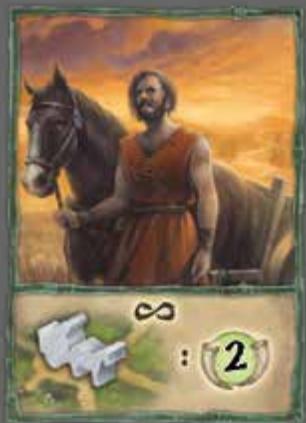
| ⑨ | 获得 1 个额外探索者。翻面后失去,且不能作为派往远方的探索者。 | — |
| ⑩ | 首领派到他人探索者格时获 3VP,派到空格时获 5VP。 | — |
| ⑪ | 拿走所有剩余奖励片作为私人供给堆。每轮使用 1 个(随轮次升权限),使用后放回盒子。翻面后失去剩余品。 | — |
| ⑫ | 在前哨站插旗时获得 4 个胜利点。 | — |
| ⑬ | 从一级森林/山脉和平原/采石场各挑选一块背面朝前置前。可将氏族成员派往此私人路口格(忽略马车位置)。游戏结束时根据前哨站条件得分。翻面后失去。 | — |
| ⑭ | 每当派出探索者或首领到任意路口格时获 2VP。游戏结束时根据前哨站达成度得分。 | — |
13. 游戏结束
第 5 轮结束后游戏立即结束,按以下顺序统计胜利点:
13.1 计分项目
| 来源 | 说明 |
|---|---|
| 手工制品 VP | 每张制作品背面的胜利点数 |
| 游戏结束效果 | 卡牌上的终结奖励 |
| 军力排名 | 见第 9.1 节 |
| 马车终点 | 见第 9.3 节 |
| 前哨站 | 插旗前哨站的最高达成条件 VP |
| 保留的手工制品 | 每张扣除 5VP |
| 资源残留 | 每种原生资源 ×0.5VP,每种成品资源 ×1VP |
| 工人等级总和 | 部分人物/制作品相关 |
13.2 平局判定
- 独木舟在河流上的位置更远的玩家获胜
- 军力更高的玩家获胜
- 若仍平局,分享胜利
常见问题(FAQ)
以下 1 条问答中 0 条来自站内玩家的真实提问,其余 1 条为本站整理的常见疑问;答复内容保持原样。
特拉马拉支持几个人玩?
2–4 人。
去哪查完整规则
想核对具体规则细节、卡牌效果或某个回合的结算方式,可以在村了吗里选中这款游戏后直接提问。
同类桌游
- 卡坦岛德式
- 工业革命:伯明翰德式
- 勃艮第城堡:特别典藏版德式
- 方舟动物园德式
- 卡卡颂抽象
- 瘟疫危机传承:第一季美式
- 阿瑞迪亚:勇踏征途美式
- 重塑宇宙德式
- 幽港迷城美式
- 埃多拉的德鲁伊德式
规则原文(Markdown)
本站收录这款游戏的规则原文 2 个文件,此处内联渲染 2 个,可直接展开阅读或下载。
rules_zh_特拉马拉_12201.md52.3 KB
特拉馬拉 TERRAITIARA
“特拉马拉”,意大利语意为“黑土”或“肥土”,是公元前约1500年处于青铜器时代中晚期,在意大利北部建立的古村落群的名称。“特拉马拉”人在阿尔卑斯山脉至波河流域的区域内定居、旅行并相互交易。
在这款游戏中,玩家扮演其中一个村落的氏族首领。要通过访问远方的村落,探索未知的土地和提高军事实力来发展自己的氏族。为了赢得胜利,玩家必须扩大氏族的领地并熟练掌握战斗技巧。在此过程中,你还将发现可以用来制作新的实用工具的科技。最终,将自己的氏族发展的最好的玩家会获取最多的胜利点,并成为整个“特拉马拉”的领袖!
游戏配件

8块拼图板组成的游戏版图
4块家园板块(每次游戏使用2块)
24块领地板块(每次游戏使用12块)


四种玩家颜色的指示物各一套:4个旗帜,1个军力指示物,1个独木舟,2个马车,1个首领,6个探索者和1张棚屋牌。
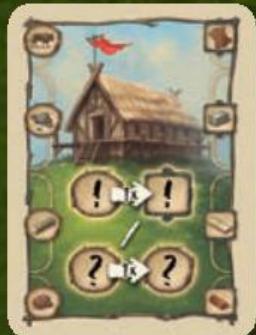

1个轮次指示物
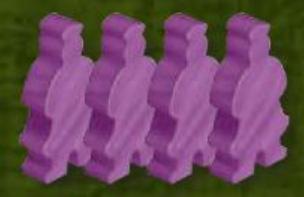
4个勇士

1叠记分纸
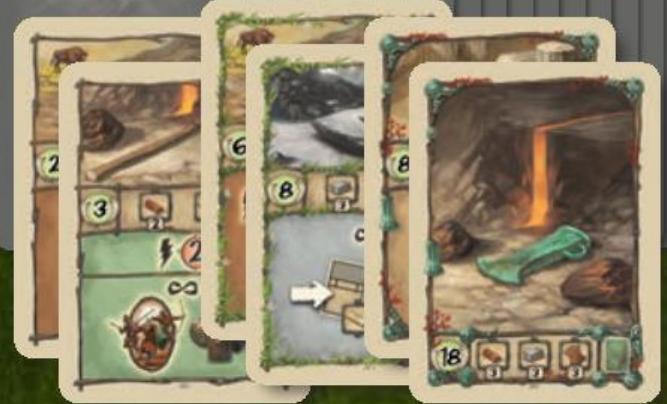

52张手工制品牌(一级16张,二级16张,三级20张)
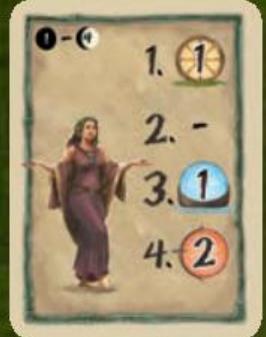
1张先手玩家牌
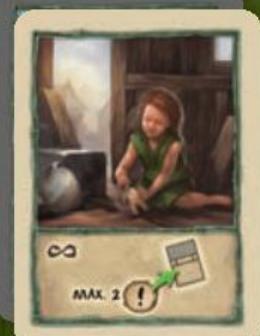
7 张人物牌
17个工人片
(一级9个,二级5个,三级3个)

18个奖励片
(一级6个, 二级6个, 三级6个)

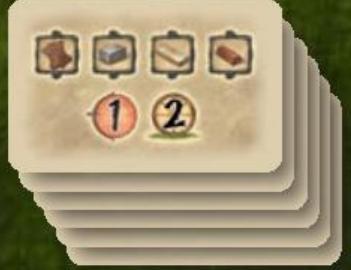
12张起始资源牌

6个火灾片

4张中立玩家牌

64个资源片(每种类型16)


4个限制片
这是一局 4 人游戏的设置。2 人和 3 人游戏时的设置变化请查看本规则书的第 15 页。
- 把 8 块拼图板拼成游戏版图的外框(带标记面朝上),放在桌子中间方便所有玩家查看的位置。
每位玩家选择并拿取一种玩家颜色的下列配件:
1张棚屋牌,正面朝上
的放在桌面上。(背面为游戏结束计分项)
4个旗帜
• 1个军力指示物,放在军力轨道的第一格里。
- 2个马车,都放在道路最上方的起始位置上。
• 1个独木舟,放在河流的起始位置上。
• 1个首领
- 5个探索者,其中1个放在河流旁边(每种颜色的第6个探索者只有在选择特定人物,以及在2人或3人游戏设置时才会用到。)

- 把资源片和胜利点片放在版图旁边,方便所有玩家拿取的位置。
如图所示,将家园板块挨着放在最上面的栏位中。左边板块应显示 4 人游戏标记,右边的板块应显示 3 人和 4 人游戏标记。

把森林/山脉板块按等级分开,从每级中随机挑选2块。从上到下放到右侧的栏位中,从2个一级的板块开始,然后是2个二级的板块,最后是2个三级的板块。确保每1个版块都是正面朝上(显示了资源并且没有积雪)。重复上述步骤,将平原/采石场板块放在左侧的栏位中。
-
把轮次指示物放在轮次轨道的第一格上。
-
把工人片按等级分开, 然后在轮次轨道的每格中按如下规则各放 2 个工人片: 第 1、2 轮: 一级工人; 第 3、4 轮: 二级工人; 第 5 轮: 三级工人。
-
选出一位先手玩家,并将先手玩家牌正面朝上放在他面前,现在先忽略牌上的效果。
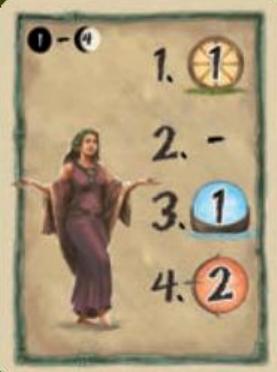
-
把奖励片面朝下按等级分开,随机放在河流、道路和2块三级平原/采石场板块旁的指定位置上。然后将所有奖励片翻为面朝上。如果玩家在游戏开始时挑选了特定的人物,可能会用到剩余的奖励片。(参见第5页)
-
将手工制品牌按等级分开,分别洗匀每级的手工制品牌。制作一个面朝下的牌堆,三级牌在最下面,二级牌在中间,一级牌在最上面。然后从牌堆顶抓8张牌,将它们从左到右面朝上地放在游戏版图下方靠近河流的指定位置上。

资源
《特拉马拉》中有四种资源。每个资源片的一面代表原生资源(圆框),另一面代表成品资源(方框)。在游戏中,玩家的原生资源放在自己棚屋牌的左边,成品资源放在自己棚屋牌的右边。以下是游戏中的资源(原生与成品):

家畜—皮革
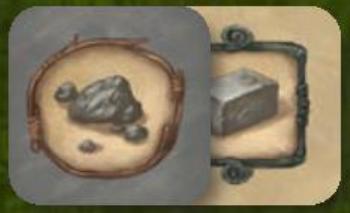
石头—石料
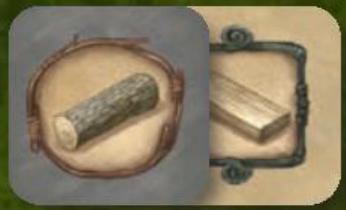
木头—木材

矿石—金属
原生资源不能代替成品资源。成品资源可以用来代替其对应的原生资源(例如,可以用金属代替矿石,但不能用矿石代替金属)。成品资源用来制作手工制品。
工人
工人可以精炼玩家的原生资源。工人分成3个等级。要使用1个工人,将该工人片旋转 $90^{\circ}$ ,以表明它已经被使用过了,然后根据工人的等级,将一定数量的原生资源转换为对应的成品资源(也就是说,一级的工人可以将1个原生资源转换为对应的成品资源,而三级工人可以将3个原生资源转换为对应的成品资源。每个工人片每轮只能使用1次,玩家可以在自己回合中的任何时候使用。工人被激活时没有用完的转换次数将在当轮中失去。

一级(正面与背面)

二级(正面与背面)

三级(正面与背面)
手工制品
手工制品是提升玩家氏族文化、旅行和军事实力的绝佳方式。手工制品会为玩家提供特殊的能力,还会在游戏结束时带来大量的胜利点。基于制作它们所需的主要资源,有四类手工制品牌。分别是工具,兵器,陶器和衣物。手工制品牌分为三个等级,可藉由卡牌正面的边框和卡牌背面的标识来区分。
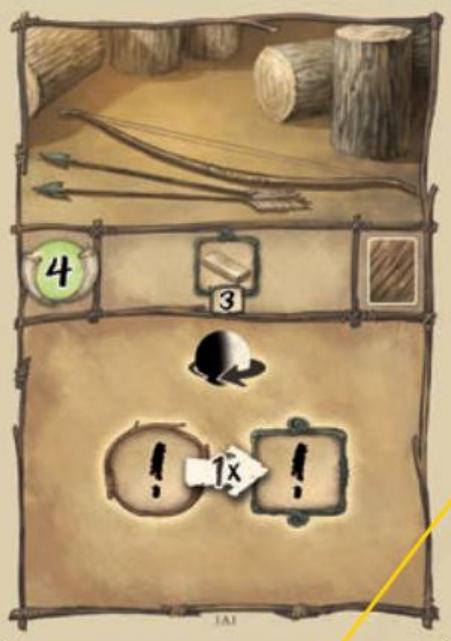
游戏结束时的胜利点

需要花费的成品资源
功能
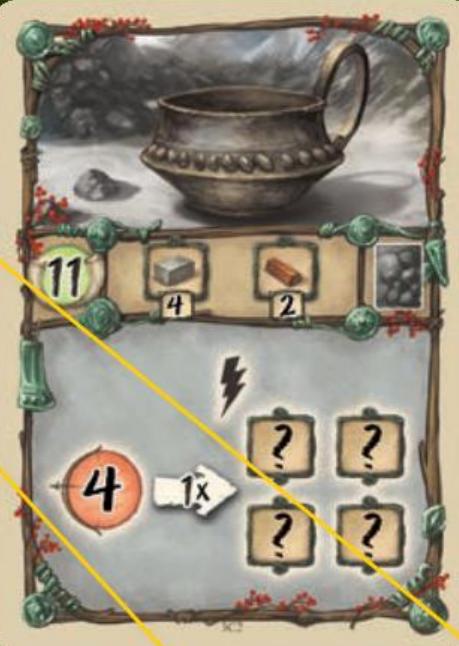
等级
手工制品的类型

插画
除了在游戏结束时带来胜利点之外,大多数手工制品也会拥有游戏中的效果。共有四种效果,每种在游戏中的触发时机都不同:
- 持续效果 ∞ 在游戏中一直处于激活状态:只要满足触发条件,就能使用其效果。
- 即时效果只能在这个手工制品被制作完成时使用一次。
- 每轮一次效果可以在玩家回合中的任何时候使用,但是每轮只能用一次。将卡牌旋转 $90^{\circ}$ 来表示其效果在本轮已经被使用过。
- 游戏结束效果 🎧 满足对应条件的情况下,在游戏结束时获得胜利点。
手工制品的效果是可选的,玩家不是必须使用它们。手工制品的效果也不是必须要完整使用(例如,如果一个手工制品奖励3点旅行,玩家可以选择在道路上走0、1、2或3步)。
开始游戏
我们建议在第一次玩这个游戏时,不使用人物和起始资源牌。而是给每位玩家四种原生资源各1个,以及1个一级工人和1点文化(把每个玩家的独木舟放在河流的第一格里,而不是起始位置上)。再根据玩家顺位调整军力:第一顺位玩家获得1点,第二顺位玩家获得2点,以此类推。
一旦所有玩家都了解游戏之后,我们推荐玩家按如下规则来选择人物和起始资源牌,随机选出并展示比游戏人数多一张的人物牌(“少年”面朝上),以及同样数量的起始资源牌,然后:
- 从末位玩家开始按逆时针的顺序,每位玩家选择一张人物牌或一张起始资源牌。
然后从先手玩家开始按顺时针的顺序,每位玩家选择一张不同类型的牌,也就是说,之前选择了人物牌的玩家现在选择起始资源牌,反之亦然。将剩余的人物牌放回游戏盒子中。
最后,从先手玩家开始按顺时针的顺序,玩家拿取自己起始资源牌上显示的资源。除了原生和成品资源外,还可能包括工人、军力、文化、旅行和胜利点。然后,将所有起始资源牌放回盒子中。
重要提示:人物牌提供的奖励不适用于起始资源牌。
进行游戏
游戏共进行 5 轮。每轮从先手玩家开始并按顺时针顺序进行自己的回合。在每位玩家的回合中,该玩家必须派出单独 1 个氏族成员(探索者或首领)。在游戏中,玩家的氏族成员人数可能会出现变化,但只有在所有玩家都派出了所有的氏族成员后,一轮游戏才算结束。1 个氏族成员可以被派出到:
- 家园行动格
- 领地行动格
• 路口行动格
- 特殊行动格
- 自己的棚屋
一个行动格最多可以容纳 2 个氏族成员,但每种颜色只能 1 个。如果首领在一个行动格中,其他氏族成员不能被派到那里。带 🖱️ 符号标记的行动格只能容纳 1 个氏族成员。

探索者可以被派到任意行动格上,但派到远方行动格上的——后续轮次旁的领地板块——将不会在派出的当轮结束时返还给玩家。他们会一直待在那里,直到那些领地板块被翻面的那一轮结束时才会返还给玩家。请注意,被派到第5轮旁的领地板块的探索者将永远不会返还给玩家,因为那些领地板块将不会被翻面。
任何已经放了 1 个探索者的行动格,其他玩家可以再派自己的首领或 1 个探索者到那里,但只有当玩家的军力高于已经占据该行动格的玩家时,才可以派出 1 个探索者到那里。派出 1 个探索者到 1 个已经被占领的行动格时,玩家会损失 1 点军力。即使失去军力后会导致自己的军力不再高于已经在该行动格放了探索者的玩家的军力时,也依然可以如此做。
首领不能被派到远方的行动格。
示例1:这是红色玩家在第二轮的一个回合,玩家可以派出氏族成员的合法行动格通过右侧的实线标识。不合法的情况通过虚线显示在示例下方。

示例2: 远方行动格,不能派出首领。

示例3: 红色玩家的军力低于蓝色玩家, 不能派出探索者。
示例4: 行动格被红色玩家的探索者或任意玩家的首领所占据。

示例5: 此行动格只能被1个氏族成员所占据。

在派出1个氏族成员并执行相关行动后,玩家可以从下列选项中选择1项:从河边可供玩家选择的手工制品牌中选择一张并制作(参见第11页);
- 制作一张玩家先前保留的手工制品牌;
从河边可供玩家选择的手工制品牌中保留一张。拿起想保留的牌并把它正面朝下放在面前,其他玩家将不能再保留或制作它。在游戏结束时,持有保留的手工制品牌的玩家将失去5个胜利点。
重要提示:只有当玩家的独木舟到达或经过了河流的第4格,才能保留一张手工制品牌,并且最多只能保留一张手工制品牌。持有保留的手工制品牌时,河边的手工制品牌仍然可以正常地制作。保留的手工制品牌无法被弃掉,必须先制作它后才能保留另一张新的手工制品牌。
为了制作手工制品,玩家必须支付其资源费用并将这些资源放回版图旁。然后拿起那张手工制品牌并把它放在自己面前。一旦手工制品被制作(不是保留),玩家立即获得其收益。当一张手工制品牌被制作或保留后,将其右边的牌依次向左平移并从手工制品牌堆顶抓牌填补最后的空缺。
家园行动格
家园行动格的数量取决于游戏中的玩家人数。其总数应该始终比玩家人数多 1 个。
4人游戏:带4人标记的板块放在左边,带3/4人标记的板块放在右边。


3人游戏:带2/3人标记的板块放在左边,带3/4人标记的板块放在右边。

2人游戏:带2/3人标记的板块放在左边,带2人标记的板块放在右边。


下面所解释的是 4 人游戏中的可选行动,也是 3 人游戏中的可选行动,但发展技能和沿路旅行是在 1 个行动格中的——派 1 个氏族成员到这个行动格允许玩家从中选择 1 个执行。在 2 人游戏中,发动一次抢劫和成为先手玩家在一个行动格中,玩家可以按照任意顺序执行这两个行动:
雇佣一个工人:通过派出 1 个氏族成员到这个行动格,玩家可以得到 1 个工人片;这个工人的等级取决于当前的轮次。在第 1—2 轮:玩家获得 1 个一级工人;在第 3—4 轮:1 个二级工人;在第 5 轮:1 个三级工人。
发展技能:通过派出 1 个氏族成员到这个行动格,玩家可以获得 1 点军力和 1 点文化。
沿路旅行:通过派出 1 个氏族成员到这个行动格,玩家可以获得 2 点旅行。玩家可以让自己的每辆马车各移动 1 步,或者让 1 辆马车最多移动 2 步。
发动一次抢劫: 为了派出 1 个氏族成员到这个行动格, 玩家必须立即失去 1 点军力。然后,所有其他玩家必须根据各自所在的军力等级给你资源。军力轨道被划分为 4 个区域(军力等级)。抢劫者所在军力等级的下方列出了其他玩家必须支付的资源数量 (必要时向下取整)。

重要提示:抢劫只看军力等级的差别,而不看具体的军力。详情请参见第9页。
与抢劫者军力等级相同的玩家,每有5个资源必须给抢劫玩家1个资源。
- 比抢劫者军力等级低一、二或三级的玩家,每有4、3或2个资源必须给抢劫者1个资源。
- 比抢劫者军力等级高一、二或三级的玩家,每有6、7或8个资源必须给抢劫者1个资源。
- 原生资源和成品资源在被抢劫时都被计算在内。每位玩家自己决定给抢劫者哪些资源;如果玩家拥有的资源少于最小阈值,就不必给抢劫者任何资源。
示例:军力等级为2的红色玩家发动一次抢劫,同一等级的蓝色玩家每有5个资源给他1个资源,在较低等级(一级)的绿色玩家每有4个资源给他1个资源。

带有此标记的行动格每轮只能使用一次。
成为先手玩家:通过派出 1 个氏族成员到这个行动格,玩家将获得先手玩家牌,并在下一轮中成为先手玩家。同时,立即沿道路移动 1 步。在新的一轮行动顺序中第 2 顺位的玩家将不会获得任何奖励。若存在更多玩家,在新的一轮行动顺序中第 3 顺位的玩家立即获得 1 点文化,第 4 顺位的玩家立即获得 2 点军力。
带有此标记的行动格每轮只能使用一次。
在游戏的第 5 轮(最后 1 轮)开始时,将先手玩家牌翻面。在最后一轮将氏族成员派到此行动格的玩家选择获得 2 点旅行、2 点军力或 2 点文化,其他玩家什么也不获得。
领地行动格
每个领地板块包含 3 个行动格,用半透明的竖线分割。大行动格和小行动格在使用上没有区别。行动格大小的差异只会对 2 人游戏和 3 人游戏的设置产生影响。

派出 1 个氏族成员到一个领地行动格会立即获得行动格里所描绘的东西。一般来说,是一些原生资源和成品资源,或是可以将原生资源转换为成品资源。一些行动格还会给玩家军力、旅行、文化或其他效果。
路口行动格
路口行动格在一级和二级森林/山脉板块的背面。在一轮结束时,对应行靠右边的领地板块翻面后,该路口行动格就可以使用了。在第2轮,可以使用第1轮的路口行动格;在第3轮,可以使用第1轮和第2轮的路口行动格,以此类推。
只有当玩家的两辆马车都到达或经过了对应的路口后,该玩家才能将1个氏族成员派到这个路口行动格,如右图图标所示:
特殊行动格
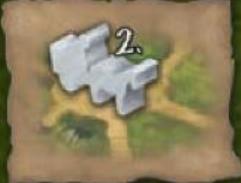
第 5 轮的三级森林 / 山脉板块提供特殊行动。在第 5 轮开始之前,任何氏族成员都不能被派到这些行动格上,且只有达到以下所示条件的玩家才能将氏族成员派到这些行动格上:
玩家所有工人等级之和至少达到5。
获得1点军力,1点文化,1点旅行和任意1个成品资源。

到达或经过河流上的这个符号。
获得任意1个成品资源和3个胜利点。
2.
玩家的两辆马车都到达或经过道路上的这个符号。
获得任意3个成品资源。
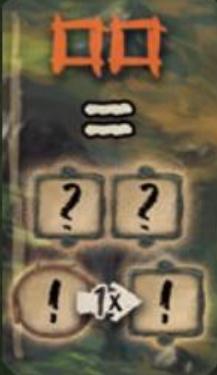
到达或经过军力轨道上的这个符号。
获得任意2个成品资源并将1个原生资源转换为对应的成品资源。
自己的棚屋
玩家也可以派出 1 个氏族成员到自己的棚屋上。自己的棚屋可以容纳任意数量的氏族成员,包括首领。每派出 1 个氏族成员到这里,玩家可以选择:
把1个原生资源转换为对应的成品资源。

把1个原生资源交换成1个不同种类的原生资源。
一轮开始
在第 2—5 轮开始时,执行以下步骤。这些步骤在轮次轨道上也有图示。
第2轮:把手工制品牌堆中的所有一级手工制品牌移除。
第 3 轮:从河边移除所有一级手工制品牌,然后从牌堆补牌。
第 4 轮:把手工制品牌堆中的所有二级手工制品牌移除。
第 5 轮:从河边移除所有二级手工制品牌,然后从牌堆补牌。将先手玩家牌翻面(先手玩家不会改变)。


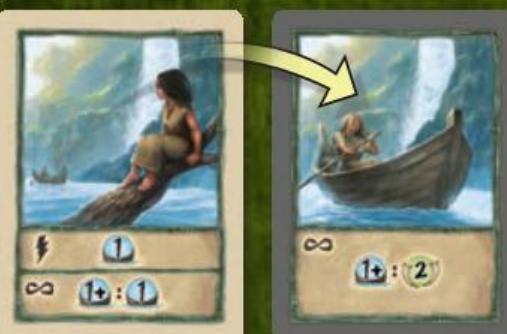
每位玩家在每轮执行第一个行动之前, 都可以选择将自己的人物牌翻面 (从 “少年” 翻到 “成年”, 参见第 12 页)。该玩家从此失去正面的奖励, 而获得背面的奖励。每局游戏每位玩家只能这样做一次, 这个行动是不可逆的。
一轮结束
在第 1—4 轮结束时,执行以下步骤:
- 玩家拿回自己在行动格上的所有氏族成员,除了放在远方行动格上的氏族成员。
- 把轮次指示物所在那一行的两个领土板块翻面。这会翻开 1 个路口行动格和 1 个从此可以访问的前哨站。
- 重置所有使用过的工人片和“每轮一次”的手工制品牌,它们可以再次使用。
- 把轮次指示物移动到轮次轨道的下一格。
军力
每位玩家在军力轨道上都有 1 个军力指示物,代表他们的军事实力。当玩家获得军力时,可以根据获得的军力数量,在这条轨道上往前移动对应的格数。某些行动可能会导致玩家失去军力,这将使玩家的指示物在这条轨道上往后移动。
如果玩家到达了轨道的最后一格(第20格),那么将不能再向前移动;此后玩家把将要获得的每点额外军力都用获得1个胜利点来代替。玩家依然会失去军力并被迫在轨道上往后移动。
军力轨道被划分为 4 个区域;每个区域的第 1 格都标有 1 面盾牌,这表示已经到达或经过该格的玩家的军力等级。

重要提示: 军力不同于军力等级。军力从0到20,并代表玩家的绝对军事实力值,而玩家的军力等级通过盾牌表示为1—4级。一位玩家的军力等级决定了他在抢劫时能从其他玩家那里得到多少资源。
在游戏结束时,拥有最高军力的玩家将获得 8 个胜利点,军力第 2 和第 3 的玩家将分别获得 5 个胜利点和 2 个胜利点。在军力相同的情况下,所有相同玩家都获得对应名次的胜利点。但根据相同玩家的数量,后续名次的胜利点将被跳过。
蓝色和黄色玩家各获得8个胜利点;军力轨道第2名的5个胜利点将被跳过。因此,红色玩家获得2个胜利点,绿色玩家不获得任何胜利点。
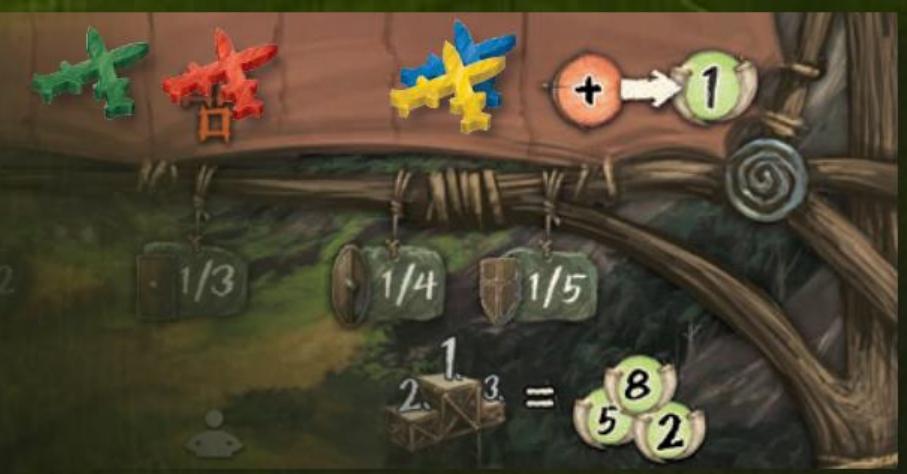
蓝色、黄色和绿色的玩家各获得8个胜利点。第2名和第3名的5个胜利点和2个胜利点将被跳过,红色玩家不获得任何胜利点。
道路
每位玩家在道路上都有两辆马车。每当玩家获得旅行时,可以将马车向前移动对应数量的步数。1 步意味着马车移动到下一个路口,一个奖励片或一个前哨站。在访问奖励片或前哨站时由于绕了远路,所以玩家总共需要2 步才能到达下一个路口。
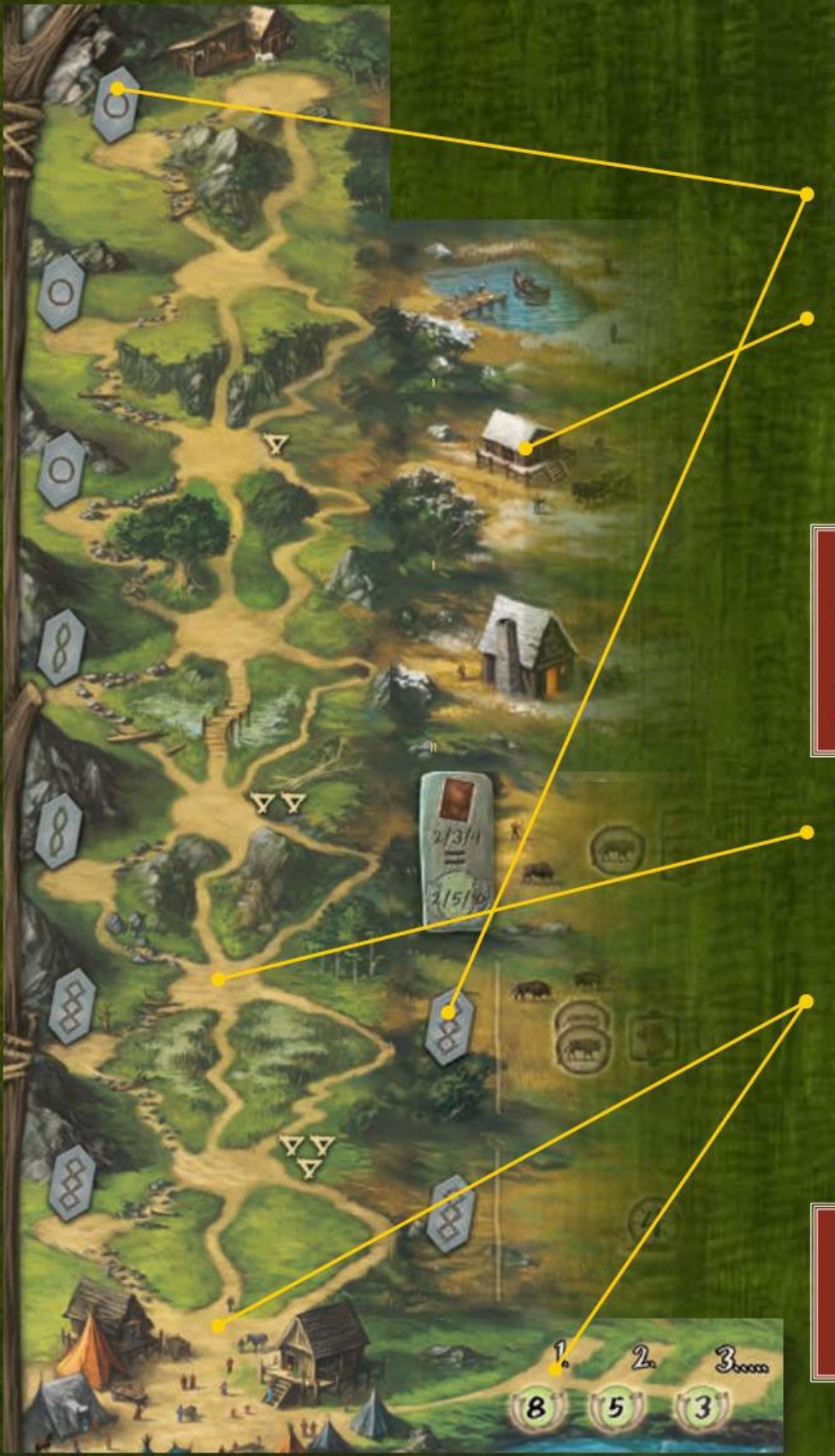
两辆马车可以分开移动。马车在道路上不能后退。当玩家的一辆马车到达或经过:
一个奖励片,玩家可以立即使用显示在其上的效果。
一个前哨站,玩家在这里放一个自己颜色的旗帜。在游戏结束时,根据玩家达成前哨站条件的程度获得对应数量的胜利点(参见下文和下一页)。一位玩家在一个前哨站只能放一个旗帜。
注意:当一级和二级领地板块在对应轮次结束时,将它们翻面后,玩家才可以访问对应的前哨站。在此之前,玩家不能走通往前哨站的道路。在左侧的配图中,第1轮到第3轮的领地板块已经翻面,玩家的马车可以访问这些前哨站。
一个路口,这里没有即时效果。然而,玩家的两辆马车必须都到达或经过了一个路口后,才能派出1个氏族成员到该路口所在行的路口行动格(参见第8页)。
道路的终点,把马车放在未被占据的最高数值的奖励格中;玩家在游戏结束时将得到对应的胜利点。第一辆到达终点的马车将获得8个胜利点,第二辆马车将获得5个胜利点,之后每辆马车将获得3个胜利点。
注意:每辆马车单独计算胜利点。因此,如果一位玩家的两辆马车都先于其他玩家到达终点,那么它将获得8个胜利点加5个胜利点。
前哨站
前哨站在一级和二级平原 / 采石场的背面。当某一行靠左边的领地板块在一轮结束时被翻面后,该前哨站就可以访问了,并在玩家的一辆马车到达后提供获得胜利点的机会。在第二轮中,第一轮的前哨站可以访问。在第三轮中,第一轮和第二轮的前哨站可以访问,以此类推。
在游戏结束时,玩家可以根据放了自己旗帜的前哨站中条件的达成程度获得对应的胜利点。每个前哨站都有简单,中等,和困难的三个条件;分别为2、5和10个胜利点。玩家获得所能达成的最高条件的胜利点。如果玩家在放了自己旗帜的前哨站没有达成任意条件,则在该前哨站不会获得任何胜利点。



玩家的工人等级之和至少为3/5/7。
玩家的两辆马车都到达了道路上对应标识的位置。
制作 2/3/4 个衣物手工制品。
独木舟到达了河流上对应标识的位置。
军力指示物到达了军力轨道上对应标识的位置。
制作 2/3/4 个陶器手工制品。
制作2/3/4个工具手工制品。
制作 2/3/4 个兵器手工制品。
河流
玩家提高文化可以令其在制作或保留手工制品牌时有更多选择。当玩家获得文化时,可以根据获得的文化数量,在河流上往前移动对应的格数。文化永远不会失去;如果到达了河流的尽头(第14格),玩家把将要获得的每点额外文化都用获得1个胜利点来代替。
玩家只能制作(或保留——前进到第 4 格后)自己独木舟沿河到达或经过位置的手工制品。因此,玩家的独木舟在河流的起始位置时,只能制作最左边的 2 个手工制品。一旦到达第一格,就可以制作最左边的 3 个手工制品,之后每前进 2 格,玩家就可以有额外一个手工制品来进行挑选。
河流上有一些特殊的行动 / 奖励可以使用。当玩家的独木舟到达或经过:
第 4 格,玩家现在可以保留手工制品(参见第 6 页的解释)。
第 6 格,玩家可以使用这里的一级奖励片的效果。
• 第8格,玩家的氏族从此永久获得1个额外的探索者。
- 第 10 格,玩家可以使用这里的二级奖励片的效果。
• 第 12 格,玩家在制作 1 个保留的手工制品时,可以少支付任意 1 个资源。
• 第 14 格,玩家可以使用这里的二级和三级奖励片的效果。
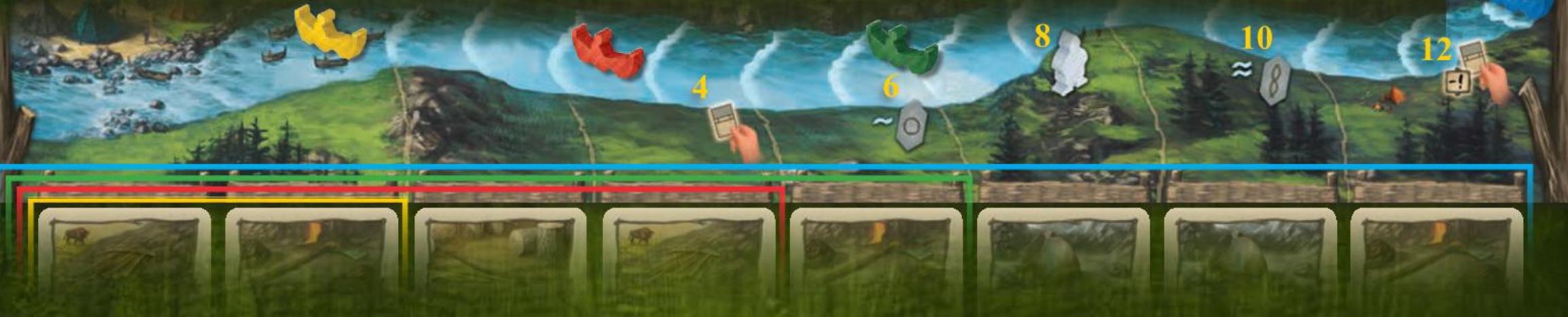
示例:黄色玩家可以制作第1个或第2个手工制品,但不能保留手工制品。红色玩家还能制作第3个或第4个手工制品,但也不能保留手工制品。绿色玩家可以制作或保留前5个手工制品中的一个,蓝色玩家可以制作或保留所有可见的手工制品中的任意一个。
奖励片
奖励片分三个等级。它们被放在道路上、河边和三级平原 / 采石场板块最左边区域的指定位置上。一旦玩家到达了一个包含奖励片的位置,就可以立即使用一次奖励片的效果,之后这个奖励片依然留在原地并且其他玩家也可以使用(以及玩家在道路上的另一辆马车)。还有一名人物提供了奖励片,但那些都是他个人的(参见第 14 页)。所有奖励片的效果将在下一页按等级详述:


获得1点文化。

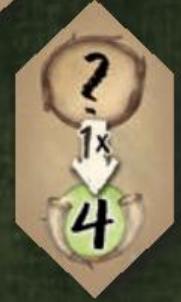
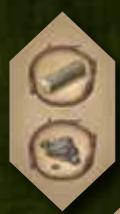
用任意 1 个原生资源交换 4 个胜利点。
获得1个矿石和1个家畜。


用任意 1 个原生资源交换 2 点军力。


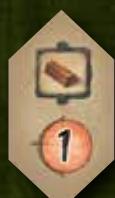
获得任意 1 个成品资源。

获得 1 个石料和 1 点文化。
获得1个木头和1个石头。
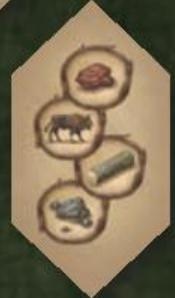

获得 1 个金属和 1 点军力。
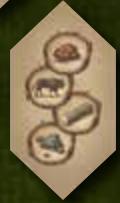
获得1个矿石,1个家畜,1个木头,1个石头。
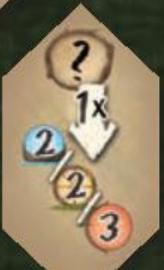
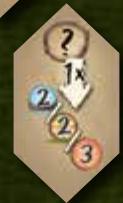
用任意1个原生资源交换2点文化、或者2点旅游,或者3点军力。

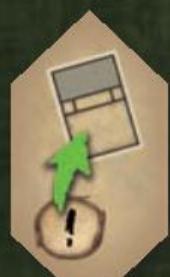

获得 2 点军力和 1 点文化。


制作 1 个手工制品,玩家可以使用对应的原生资源代替所需的成品资源。
用任意2个原生资源交换5个胜利点。


用任意 1 个成品资源交换 5 个胜利点。
获得 1 个皮革和 1 点旅行。

用任意 1 个原生资源交换任意 1 个成品资源和 1 个木材。
发动一次抢劫,不失去军力。

获得任意2个成品资源。
勇士
板块上的这个图示代表玩家可以把两个勇士指示物放在自己前面。在这一轮中,玩家可以像使用自己的氏族成员一样使用他们。勇士就像首领一样使用,只有一个例外:可以把勇士派到自己探索者占据的行动格上。但涉及玩家首领的效果不适用于勇士。在这一轮后,将所有勇士放回游戏版图旁。
示例:
红色玩家可以派出一个勇士到自己探索者占据的行动格。勇士不能被派到首领或其他勇士所占据的行动格。

人物
人物牌是双面的。每张人物牌的正面显示一个“少年”时代的男孩/女孩,以及他们在游戏中提供的奖励。每张牌的背面显示的是其“成年”后的男人/女人,提供了获得胜利点的方式。人物以他们“少年”面开始游戏。每轮开始后,在玩家派出其第1个氏族成员前,玩家可以选择把自己的人物牌翻到“成年”那面。当玩家这样做时,其失去“少年”面的所有奖励。这样做是不可逆的——木已成舟。


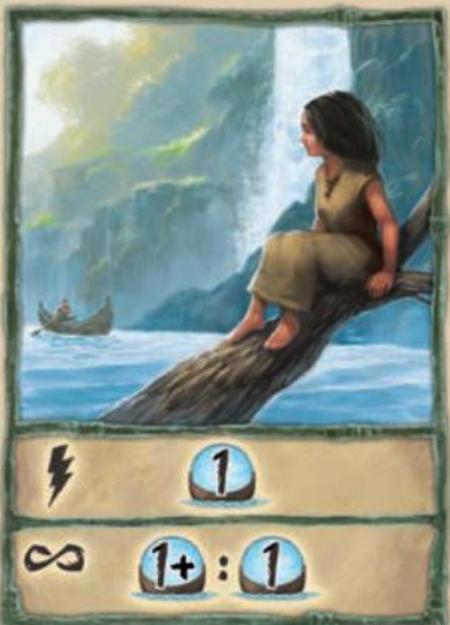


立即获得 1 点旅行。在游戏中,每当玩家获得至少 1 点旅行时,就额外获得 1 点旅行。
立即获得1点文化。在游戏中,每当玩家获得至少1点文化时,就额外获得1点文化。
玩家不会失去军力。但不适用于让玩家交换军力的牌或行动格。
每当玩家制作手工制品时,可以用最多2个对应原生资源代替所需的成品资源。

每当玩家的一辆马车到达或经过一个路口时,就获得2个胜利点。
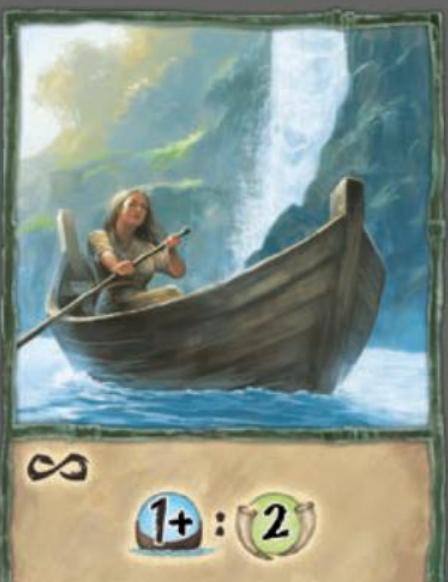
每当玩家获得至少1点文化时,就获得2个胜利点。

每轮一次,在玩家的回合中,根据军力等级获得胜利点。
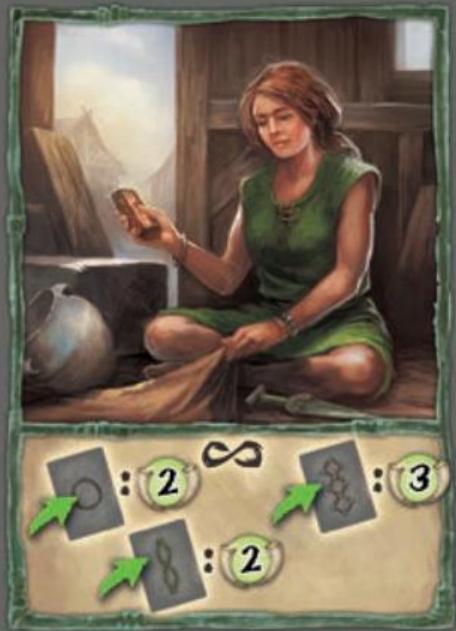
每当玩家制作一级或二级手工制品时,获得2个胜利点。每当玩家制作三级手工制品时,获得3个胜利点。

玩家的氏族获得一个额外的探索者。
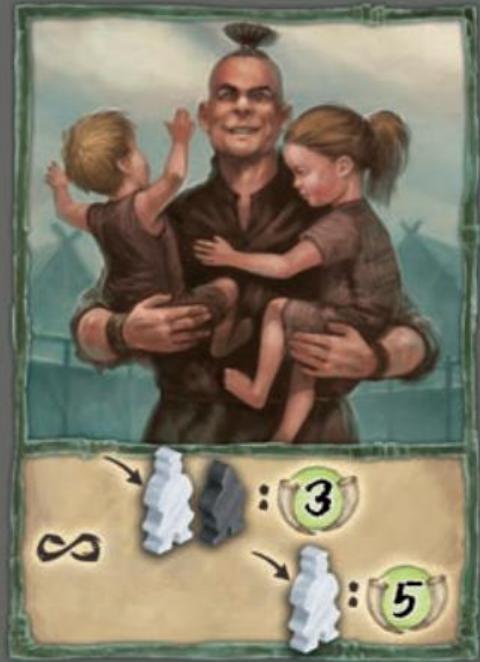
注意: 这个人物翻面后,玩家将失去额外的探索者。且不能是派到远方领地的探索者。
每当玩家把首领派到被其他玩家的探索者占据的行动格时,就获得3个胜利点。每当首领被派到一个未被占据的行动格时,就获得5个胜利点。
玩家一旦选择下面这个人物,拿取所有剩余的奖励片。把它们面朝上放在自己的面前,作为可以一次性使用的私人奖励片供给堆。

每轮一次,玩家在自己的回合中可以使用1个私人奖励片。在第1轮中,你只能使用1级的奖励片。在第2轮中,你可以使用1级或2级的奖励片。从第3轮开始,你可以使用任意1个奖励片。使用后的私人奖励片放回盒子中。

注意:这个人物翻面后,玩家失去剩余的私人奖励片。
每当玩家在前哨站放旗帜时,获得4个胜利点。
玩家一旦选择下面这个人物,从剩余的 1 级森林 / 山脉领地板块和 1 级平原 / 采石场板块中各挑选一个,背面朝上放在自己面前。
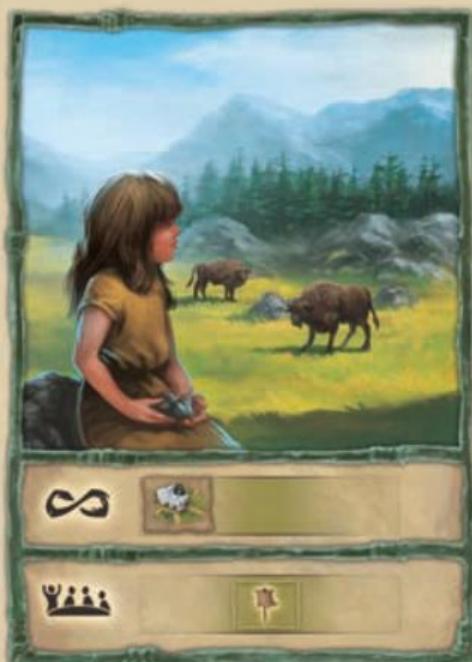
玩家可以把自己的氏族成员派到这个私人的路口行动格,忽略马车的位置。
在游戏结束时,根据前哨站的达成条件获得对应的胜利点。
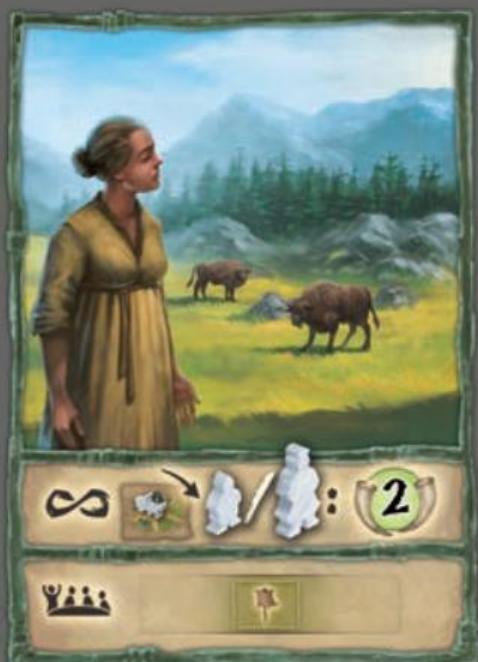
注意: 这个人物翻面后,玩家将失去私人的路口行动格。
每当玩家派出一个探索者或首领到任意路口行动格时,获得2个胜利点。
在游戏结束时,根据前哨站条件的达成程度获得对应的胜利点。
游戏结束计分
游戏在第 5 轮之后结束,胜利点最多的玩家将被任命为 “特拉马拉” 的领袖。使用一张记分纸写下玩家在每个类别中获得的胜利点。如果出现平局,独木舟在河流上走的最远的玩家是胜利者。如果仍然是平局,那么军力最高的玩家是胜利者。如果还是平局,平局的玩家分享胜利!

胜利点片
制作的手工制品
牌上的游戏结束效果
军力的排名
马车到达道路终点的排名
有玩家旗帜的前哨站
保留的手工制品牌减 5 个胜利点
每个原生资源 0.5 个胜利点,每个成品资源 1 个胜利点。
2人和3人游戏的设置变化
在 2 人游戏中,增加 2 位中立玩家。在 3 人游戏中,增加 1 位中立玩家。这些中立玩家会获得军力(如下所述),并且他们的探索者会出现在特定的行动格,除此之外他们不会参与到游戏中。按照第 2—3 页的内容设置好游戏后,再进行下列额外步骤:
在每行(第 1 轮到第 5 轮,共 6 行)领地板块的一个小行动格中放火灾板块。面朝下洗混 4 张中立玩家牌,每次翻开一张,在与翻开牌上的数字匹配的小行动格(从左到右,第 1—4 格)放火灾板块,从第一行开始每行放一个。到第 5 行和第 6 行时重新洗牌来确定放火灾板块的位置。氏族成员不能被派到火灾板块所覆盖的行动格。
示例:翻开的牌是数字2。在对应的位置放置火灾板块。
- 由真实玩家分配中立玩家的探索者。先手玩家将一个中立探索者放在第 1 轮那一行的一个行动格上,然后按照玩家顺序,之后每位玩家将一个中立探索者放置在下一轮那一行的一个未被占据的行动格上,一直持续到有两行领地板块的第 5 轮。如此一来,3 人游戏中放 6 个探索者。在 2 人游戏中重复上述步骤,玩家总共放 12 个中立探索者。
请记住:氏族成员(包括中立的探索者)不能被派到火灾所占据的行动格。
把中立玩家的军事指示物放在军力轨道的第一格里。玩家派出探索者到包含中立玩家探索者的行动格时,也要考虑中立玩家的军力。
把剩余的中立配件放回游戏盒子中,游戏中不会用到它们。
以下为针对游戏机制的改变:
在每轮开始时,洗混4张中立玩家牌,并为每位中立玩家翻开一张,在2人游戏中从军力最弱的中立玩家开始,把军事轨道上中立玩家的军力指示物向前移动对应的步数。
如果玩家们是第一次玩这个游戏,建议在执行此步骤时,不使用数值为4的牌。
- 只在 2 人游戏中:在每轮结束时,把 2 个领地板块翻面后,在翻开的路口行动格上放一个 🚗 限制片。
当有玩家获得先手玩家牌时, 第 4 顺位的奖励 (在 2 人游戏中, 还包括第 3 顺位的奖励) 将不会有人获得。
- 当玩家发展技能或沿路旅行时,任选其中一个行动执行。再派出氏族成员到这个行动格的另一位玩家仍然可以任选一个行动执行。
- 在游戏结束时,当统计军力排名的胜利点时中立玩家也计算在内。
游戏图示概述


放下 / 派出、拿回
自己的探索者、其他玩家的探索者、自己的首领。
把箭头左边的换成箭头右边的,次数最多为箭头上所示的数字。
或者、每次 / 每个
条件(如果达成左边所示的条件,就可以得到右边所示的奖励。)
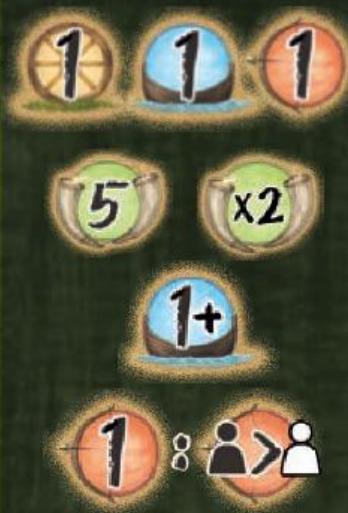

获得 1 个家畜、1 个石头
获得 1 个木头、1 个矿石
获得 1 个皮革、1 个石料
获得 1 个木材、1 个金属

对应的原生资源、成品资源


获得 1 点旅行、1 点文化、1 点军力
任意的原生资源、成品资源
获得 5 个胜利点、获得双倍胜利点
每当获得至少1点文化时
军力等级 1、2、3、4制作 1 个手工制品,玩家可以使用对应的原生资源代替所需的成品资源。
当玩家的一辆马车到达所示的路口时每有 1 位玩家的军力比你高(相等不算),就获得 1 点军力。
当玩家的第二辆马车到达所示的路口时玩家可以派出 1 个探索者到与其军力相同的玩家占据的一个行动格上;并且与一般规则不同,玩家不会失去军力。
平原、森林
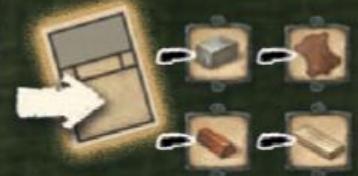
采石场、山脉
当发动一次抢劫时,抢劫者的军力等级按高一级结算。
当制作手工制品时,这种资源每有1个(显示在费用中的),就获得1个胜利点。

当制作手工制品时,每种资源都少支付1个。
当制作这类手工制品时,这种资源少支付1个。
制作人员
作者感谢所有为这款游戏付出时间、热情并提出宝贵建议的参与游戏测试的朋友们,他们是:Davide Malvestuto, Chiara Volpini, Luca Ercolini, Davide Pellacani, Jamil Zabarah, Simone Luciani, Samantha Milani, Riccardo Rabissoni, Francesca Vilmercati, Maria Chiara Calvani。还要特别感谢:Gabriele Ausiello, Marco Pranzo, Tommaso Battista, 没有他们,这款游戏就会面目全非。玩家顺位的补偿机制受到了《First Class》的启发,因此游戏设计师感谢它的作者:Helmut Ohley。最后,游戏设计师要感谢整个出版团队,包括 Max, Paul, Arno, 感谢他们为这款游戏所做的巨大贡献。《特拉马拉》,如同我们的许多游戏以及其他意大利作者的许多游戏一样,都欠 Piero Cioni 创造性的贡献一份情,他是一位非常有想象力的作者,也是一位很棒的朋友。Piero 最近离开了我们,我们要感谢他给游戏世界和我们的心灵所带来的一切。
游戏设计:Virginio Gigli, Flaminia Brasini, Stefano Luperto & Antonio Tinto
• 插图设计:Michael Menzel
- 规则书:Max van den Helder
编辑:Michael Schemaille
• 开发团队:Arno Quispel, Paul Mulders & Max van den Helder
• 中文规则翻译:帝企鹅桌游


特拉马拉手工制品牌附录
(包含Promo里的三张手工制品牌1E1,2E1,3E1)
一级
| 编号 | 类型 | 费用 | 效果 | VP |
| 1A1 | 工具 | 3木材 | 每轮一次 精炼一个资源 | 4 |
| 1A2 | 工具 | 2木材,1金属 | 持续 每当你在平原/采石场领地放一个氏族成员时,额外获得一个家畜/石头。 | 3 |
| 1A3 | 工具 | 2木材,1石块 | 持续 每当你在森林/山脉领地放一个氏族成员时,额外获得一个木头/矿石。 | 3 |
| 1A4 | 工具 | 3木材,1皮革 | 游戏结束 你制作的每套手工制品牌获得5个胜利点,即每种类型一张。1 | 2 |
| 1B1 | 兵器 | 2金属,1石块 | 即时 获得1点军力。持续 你可以把一个探索者派到与你军力相同玩家占据的行动格上;在此情况下,与一般规则不同,你不失去军力。 | 3 |
| 1B2 | 兵器 | 2金属,1木材 | 即时 获得2点军力。持续 每当你发动一次抢劫时,你的军力等级视为比当前更高一个等级来结算(最高4级)。 | 3 |
| 1B3 | 兵器 | 2金属,1皮革 | 即时 获得1点军力,每有1位玩家的军力比你高(相等不算)就再加1点。持续 每当其他玩家放一个探索者到包含你的探索者的行动格时,你获得1点军力。 | 2 |
| 1B4 | 兵器 | 3金属 | 即时 获得2点军力。游戏结束 军力等级到达3/4级时获得3/6个胜利点。 | 2 |
| 1C1 | 陶器 | 2石块,1木材 | 持续 当制作工具牌时少支付1个木材。2 | 3 |
| 1C2 | 陶器 | 2石块,1金属 | 持续 当制作兵器牌时少支付1个金属。2 | 3 |
| 1C3 | 陶器 | 3石块 | 持续 当制作陶器牌时少支付1个石块。2 | 3 |
| 1C4 | 陶器 | 2石块,1皮革 | 持续 当制作衣物牌时少支付1个皮革。2 | 3 |
① 一套牌指工具、兵器、陶器和衣物四种类型的牌各一张。百搭牌可以代替任一缺失的类型,来组成一套。
② 可以用于百搭牌(每张牌最多少支付1个)。
| 1D1 | 衣物 | 2皮革,1金属 | 即时获得1点旅行和1点文化。游戏结束你从旅行获得的胜利点数翻倍。3 | 0 |
| 1D2 | 衣物 | 2皮革,1木材 | 每轮一次支付最多3个资源(原生或成品)来获得同样数量的旅行点数。 | 1 |
| 1D3 | 衣物 | 2皮革,1石块 | 即时获得1点旅行和1点文化。持续每当你的两辆马车都到达或经过一个路口时,获得1点军力。 | 1 |
| 1D4 | 衣物 | 3皮革 | 即时获得2点旅行和2点文化。 | 2 |
| 1E+1 | 百搭 | 1皮革,1石块1木材,1金属 | 游戏结束前哨站里的你的每个旗帜给你2个胜利点。 | 5 |
二级
| 编号 | 类型 | 费用 | 效果 | VP |
| 2A1 | 工具 | 4木材 | 每轮一次 把一个原生资源转换为任意一个成品资源(自选)。 | 6 |
| 2A2 | 工具 | 3木材,2金属 | 即时 根据你当前的军力等级获得1/2/3/4个成品资源(自选)。 | 8 |
| 2A3 | 工具 | 3木材,2石块 | 每轮一次 精炼两个资源。 | 7 |
| 2A4 | 工具 | 3木材,2皮革 | 持续 每当你获得任意数量的文化时,你可以精炼一个资源。 | 8 |
| 2B1 | 兵器 | 3金属,2皮革 | 即时 获得2点旅行和2点军力。 | 6 |
| 2B2 | 兵器 | 3金属,2木材 | 即时 获得2点军力。每轮一次 支付1点军力来获得3个胜利点。 | 4 |
| 2B3 | 兵器 | 4金属 | 即时 获得2点军力,每有1位玩家的军力比你高(相等不算)就再加1点。然后,你可以执行一次抢劫(你不失去军力)。 | 2 |
| 2B4 | 兵器 | 3金属,2石块 | 即时 获得3点军力。游戏结束 你从军力获得的胜利点数翻倍。4 | 3 |
| 2C1 | 陶器 | 3石块,2木材 | 持续 每当你制作一个手工制品5时,每支付一个木材获得1个胜利点。6 | 8 |
| 2C2 | 陶器 | 3石块,2金属 | 持续 每当你制作一个手工制品5时,每支付一个金属获得1个胜利点。6 | 8 |
④ 你只在统计军力得分时获得双倍的分数。在统计游戏结束效果卡牌的胜利点数时,你不获得额外的点数。(也就是说,获得第一名时,总共获得16分。)
⑤ 自身不触发效果。(也就是说,在制作这张卡牌时不会因支付对应的的资源而获得额外的分数。)
⑥ 在出现支付减免的情况时,你依然获得印在卡牌上的费用的分数。
| 2C3 | 陶器 | 4石块 | 持续 每当你制作一个手工制品5时,每支付一个石块获得1个胜利点。6 | 6 |
| 2C4 | 陶器 | 3石块,2皮革 | 持续 每当你制作一个手工制品5时,每支付一个皮革获得1个胜利点。6 | 8 |
| 2D1 | 衣物 | 3皮革,2石块 | 即时 获得2点旅行和3点文化。 | 5 |
| 2D2 | 衣物 | 4皮革 | 即时 获得3点旅行。 | 5 |
| 2D3 | 衣物 | 3皮革,2金属 | 即时 获得1点文化。游戏结束 你在文化轨道上每前进2步获得1个胜利点(向下取整。 | 6 |
| 2D4 | 衣物 | 3皮革,2木材 | 即时 拿回你在任意行动格上的一个探索者。7 | 6 |
| 2E+1 | 百搭 | 2皮革,2石块2木材,2金属 | 游戏结束 获得你工人等级总和双倍的胜利点。8 | 10 |
三级
| 编号 | 类型 | 费用 | 效果 | VP |
| 3A1 | 工具 | 5木材 | 即时 精炼任意数量的原生资源。 | 8 |
| 3A2 | 工具 | 3木材,2金属 | 即时 获得每个类型的成品资源各一个。(皮革,石块,木材和金属) | 6 |
| 3A3 | 工具 | 4木材,2石块 | 即时 将3个原生资源转换为任意3个成品资源(自选)。 | 10 |
| 3A4 | 工具 | 4木材,2皮革 | 每轮一次 获得任意两个成品资源(自选)。 | 8 |
| 3A | 工具 | 3木材,3石块3皮革 | -- | 18 |
| 3B1 | 兵器 | 5金属 | 即时 获得3点军力,每有1位玩家的军力比你高(相等不算)就再加1点。 | 6 |
| 3B2 | 兵器 | 4金属,2石块 | 即时 获得2点军力。你可以支付3点军力来获得5个胜利点。 | 8 |
| 3B3 | 兵器 | 3金属,2木材 | 即时 获得4点军力并获得任意两个成品资源(自选)。 | 3 |
| 3B4 | 兵器 | 4金属,2皮革 | 即时 获得2点旅行和3点军事。 | 7 |
| 3B5 | 兵器 | 3金属,3石块3皮革 | -- | 18 |
| 3C1 | 陶器 | 4石块,2木材 | 持续 在制作手工制品时每种类型的资源都少支付1个。 | 5 |
| 3C2 | 陶器 | 4石块,2金属 | 即时 你可以支付4点军力来获得任意4个成品资源(自选)。 | 11 |
⑦ 包括版图上的任意一格,也包括未来行动格,或者你的棚屋。
⑧ 例如:两个一级工人和一个二级工人共获得8个胜利点。
| 3C3 | 陶器 | 5石块 | 即时 制作1个手工制品,你可以使用原生资源来代替相应的成品资源。 | 6 |
| 3C4 | 陶器 | 3石块,2皮革 | 持续 你的马车每到达一个路口时,你获得2个胜利点。 | 6 |
| 3C5 | 陶器 | 3石块,3木材3金属 | -- | 18 |
| 3D1 | 衣物 | 4皮革,2金属 | 即时 获得4点旅行和2点军力。 | 6 |
| 3D2 | 衣物 | 4皮革,2木材 | 即时 获得2点旅行,3点军力和1点文化。 | 6 |
| 3D3 | 衣物 | 3皮革,2石块 | 即时 获得3点文化。 | 7 |
| 3D4 | 衣物 | 5皮革 | 即时 获得3点旅行或3点文化。 | 7 |
| 3D5 | 衣物 | 3皮革,3金属3木材 | -- | 18 |
| 3E+1 | 百搭 | 3皮革,3石块3木材,3金属 | 即时 再次激活你已经制造的一张手工制品牌的即时效果。 | 20 |
游戏设计:Virginio Gigli,Flaminia Brasini,Stefano Luperto & Antonio Tinto
附录编辑:Paedolos (Emmanuel A.)
中文翻译:帝企鹅桌游
Copyright © 2019 Quined Games bv
Terramara_EN_WEB.md43.8 KB
TERRATTIARA
Terramara is the name given to a number of palafitte villages founded in northern Italy around 1,500 BC. The people who lived in Terramara were traders, and were known to have traveled frequently between the Alps and the river Po.
In Terramara, you'll play as the chieftain of a clan living in one of these villages. Your goal is to develop your clan by exploring far-away lands, improving your military, and visiting Outposts. To win, you'll have to expand your clan's reach and become skilled in battle. Along the way, you will be able to discover technologies that will let you create new and useful artifacts. The player who builds the best clan will score the most Victory Points (VP) and become the leader of all Terramara.
COMPONENTS


Game board in 8 puzzle pieces, 4 Homeland tiles (2 per game), and 24 Territory tiles (12 per game)
1 set in each of 4 player colors: 4 Flags, 1 Military token, 1 Canoe, 2 Caravans, 1 Chieftain, 6 Explorers & 1 Hut card


1 Round Marker

4 Warriors
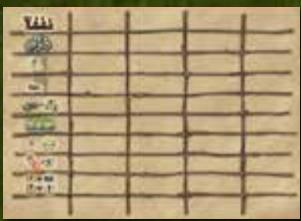
1 Scorepad


52 Artifact cards (16x level 1, 16x level 2, and 20x level 3)
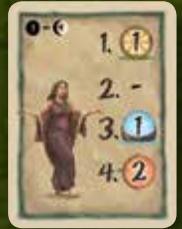
17 Worker tiles (9x level 1, 5x level 2, and 3x level 3)
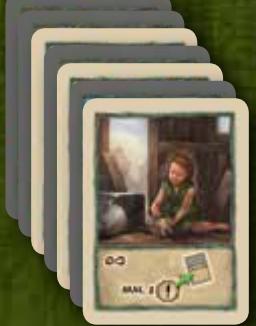
1 First Player card
7 Character cards
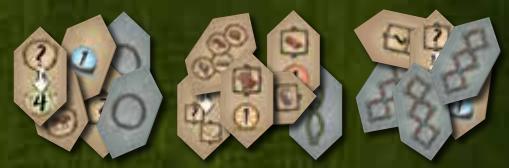
18 Bonus tiles (6x level 1, 6x level 2, and 6x level 3)

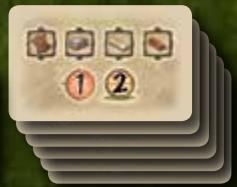
12 Starting Resources cards

6 Fire tiles

4 Neutral Player cards

64 Resource tiles (16 per type)

46 VP tiles (18x1, 12x2, 12x5, & 4x20)

4 Restriction tiles
GAME BOARD SETUP
This is the setup for a 4-player game. For changes to setup in 2- or 3-player games, see page 15 of this rulebook.
- Assemble the 8 puzzle pieces of the game board frame (icons face-up) and place it in the center of the table within easy reach of all players.
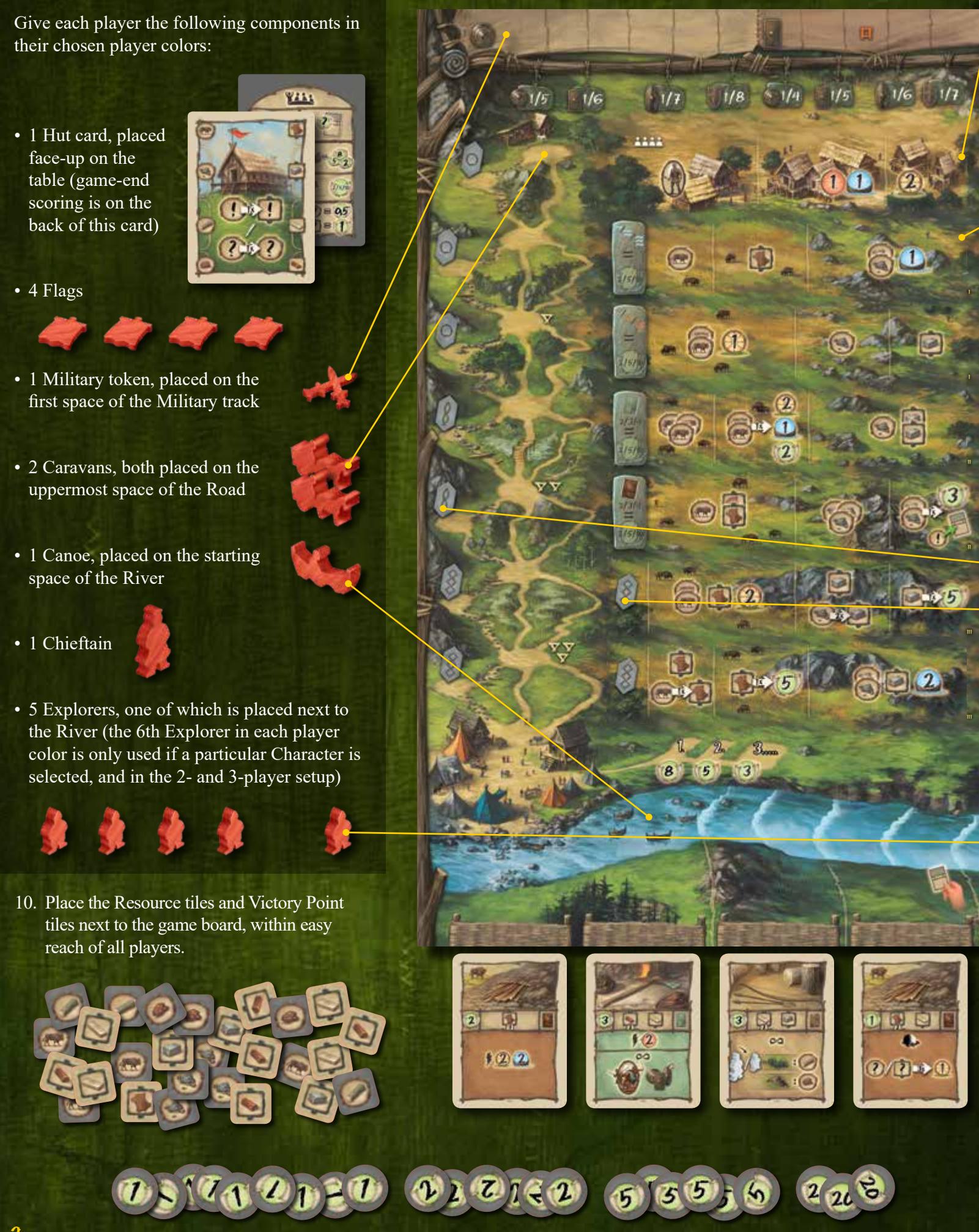

Place the depicted Homeland tiles next to each other in the topmost slot of each column. The left tile should show a 4-player game icon and the right tile a 3- and 4-player game icon.
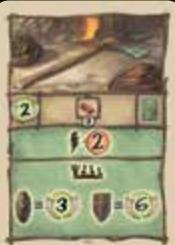
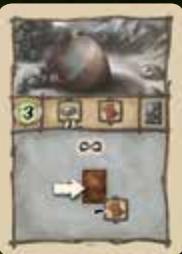
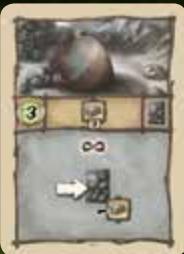
- Put the Warriors next to the game board. The number of Warriors needed in your game will depend on which Territory tiles have been placed.
Sort the Forest/Mountain tiles by level. For each level, randomly select 2 tiles. Place these in the slots in the right column, going from top to bottom, starting with 2 level-1 tiles, then 2 level-2 tiles, and finally 2 level-3 tiles. Make sure that their front sides, which show resource spaces but no snow, are face-up. Repeat this process for the Plains/Quarry tiles in the slots of the left column.
- Place the Round Marker on the first space of the Rounds track.

-
Sort the Worker tiles by level, then place 2 Worker tiles on each space of the Rounds track, as follows: level-1 Workers, rounds 1 & 2; level-2 Workers, rounds 3 & 4; level-3 Workers, round 5.
-
Select a first player and give them the First Player card. Place it face-up on the table, but ignore its effects for now.

Sort the Bonus tiles face-down by level and place them randomly on the designated spots along the River, Road and the two level-3 Plains/Quarry tiles. Then turn all Bonus tiles face-up. Leftover tiles may be used if a player chooses a specific Character at the start of the game (see page 5).
Sort and shuffle the Artifact cards by level and create a face-down Artifact deck. Start with the level-3 cards at the bottom, put level-2 cards in the middle, and level-1 cards on top. Then draw the top 8 cards of the deck and place them from left to right below the game board in the designated slots along the River.

RESOURCES
There are 4 types of resources in Terramara. Each resource tile has a raw side (round frame) and a refined one (square frame). Keep raw resources on the left of your Hut, and refined ones on the right. The following resources (raw - refined) are available:

Livestock - Leather

Stone - Ashlar

Wood - Lumber

Ore - Metal
Raw resources can never be used in place of refined ones. Refined resources may be used in place of their raw versions (i.e., you can use Metal instead of Ore, but you cannot use Ore instead of Metal). Refined resources are needed to create Artifacts.
WORKERS
Workers allow players to refine raw resources. All Workers have a level: 1, 2, or 3. To activate a Worker, rotate that Worker's tile 90° to indicate that it has been used, then transform raw resources into their corresponding refined resources in a quantity up to the level of the Worker (i.e., a level-1 Worker can transform 1 raw resource to its refined version, while a level 3-Worker can transform 3 raw resources to their refined versions). Each Worker tile can only be used once per round, at any time during your turn. Any excess capacity that is not used when the Worker is activated is lost for the round.
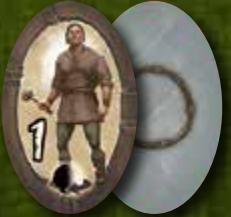
Level-1 (front & back)
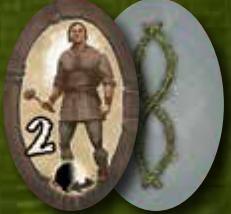
Level-2 (front & back)
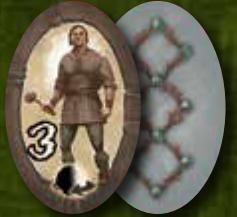
Level-3 (front & back)
ARTIFACTS
Artifacts are an excellent way to improve your clan's Culture, Travel, and Military Strength. They score significant amounts of VP at the end of the game, and may also provide you with special abilities. There are 4 categories of Artifact cards, based on the main resource required to create them. These categories are Tools, Weaponry, Pottery, and Clothing. Artifact cards are divided into three levels, mainly recognizable by their back side but also by their frame.

VP value at game end

Cost in refined resources
Function Level
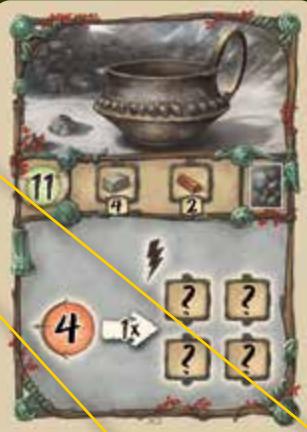
Category of the Artifact
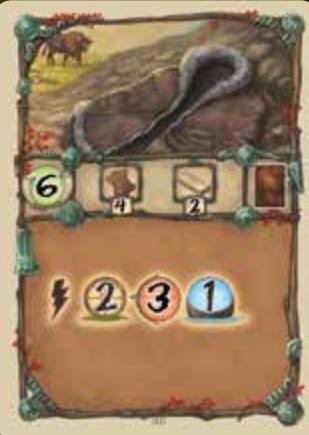
Illustration
In addition to scoring VP at the end of the game, most Artifacts have also in-game effects. There are 4 types of effects, and each triggers at a different point during the game:
• Permanent effects 8are active for the rest of the game; whenever its trigger condition is met, apply its effect.
• Instantaneous effects are applied once, as soon as the Artifact has been created.
• Once-per-round effectscan be used at any time during a player's turn, but only once per round. Rotate the card 90° to indicate that its efect has been used.
• Game-end effects score VP at the end of the game, as long as certain conditions have been met. Artifact effects are optional; players are never required to use them. Artifact effects do not have to be fully used (for example, if an Artifact awards 3 Travel, the player can choose to take 0, 1, 2, or 3 steps on the Road).
BEGINNING THE GAME
We recommend that you play your first game without Character and Starting Resources cards. Instead, give each player 1 each of the 4 different raw resources, 1 Level-1 Worker, and 1 Culture (place each player's Canoe on the first space of the River, instead of the starting space). Set Military Strength according to player order: the first player gains 1 Military, the second gains 2, and so on.
Once all players know the game, we recommend selecting Characters and Starting Resources as follows: Randomly select and reveal a number of Character cards (with “young" side face-up) and Starting Resources cards each equal to one greater than the number of players in the game.
• Beginning with the last player in player order and proceeding counter-clockwise, each player chooses either a Character or a Starting Resources card.
• Then, beginning with the first player in player order and proceeding clockwise, each player chooses a card of the other type, i.e. a player that chose a Character card at first, now chooses a Starting Resources card and vice versa. The Character card that remains unchosen, is returned to the box
• Then, beginning with the first player and going clockwise, players take the resources shown on their Starting Resources cards. In addition to raw and/or refined resources, this may include Workers, Military, Culture, Travel and VP. Then, return all Starting Resources cards to the box.
Important: Bonuses provided by Character cards do not apply to Starting Resources cards.
PLAYING THE GAME
Terramara is played over 5 rounds. Each round starts with the first player and proceeds clockwise. On each player's turn, that player must send out a single clan member (an Explorer or their Chieftain). Players' clan sizes can differ during the game, but a round only ends after each player has sent out all of their clan members. A clan member can be sent to a: • Homeland action space
• Territory action space
• Crossroads action space
• Special action space, or
• your Hut
An action space may contain up to two clan members, but no more than one per color. If a Chieftain is on an action space, no other clan member may be sent there. Action spaces marked with this symbolmay only contain a single clan member.

Explorers can be sent to any action space, but those on future Territories - on Territory tiles adjacent to rounds to come - will NOT be returned to players at the end of the round. They will remain there until the end of the round in which those Territory tiles are flipped. Be aware that Explorers sent to Territories adjacent to round 5 will never return, since those tiles won't be flipped.
Wherever a single Explorer has been sent, another player can send their Chieftain or an Explorer. An Explorer can only be sent if that player's Military Strength is greater than that of the player already occupying that action space. Sending an Explorer to an already-occupied action space makes you lose 1 Military. A player can do this even if losing Military would cause them to match the Military Strength of the player whose Explorer is already present on the action space.
Chieftains can NEVER be sent to future action spaces.
Example 1: It is the red player’s turn in the 2nd round. Some of the action spaces where a clan member can be legally sent are indicated on the right side. Illegal placements are shown in the examples below.

Example 2: Future action space; illegal to send a Chieftain.
Example 3: The red player’s Military Strength is lower than the blue player’s; illegal to send an Explorer.
Example 4: Action space occupied by the red player’s Explorer or any player’s Chieftain.
Example 5: No
more than one
clan member can
occupy this action space.
After sending out a clan member and executing the associated action, you may either:
• create 1 Artifact of your choice from those available to you along the River (see page 11); OR
• create 1 Artifact you have previously reserved; OR
• reserve 1 Artifact of your choice from those available to you along the River. Take that Artifact and place it face-down in front of you; no other player will be able to reserve or create that Artifact. At the end of the game, any player with a reserved Artifact will lose 5 VP.
Important: You may only reserve an Artifact once your Canoe has reached or passed the 4th space on the River, and you may not have more than one reserved Artifact. Artifacts along the River may still be created as normal. A reserved Artifact cannot be discarded; it must be created before you can reserve another.
To create an Artifact, its resource cost must be paid to the general supply. The player then takes that Artifact and places it in front of them. As soon as an Artifact is created (not when it is reserved), the player immediately receives its benefits. Whenever an Artifact is created or reserved, slide cards to the left if necessary and refill the River from the Artifact deck.
HOMELAND ACTION SPACES
The number of action spaces where players can send (place) clan members depends on how many players are in the game.
There should always be one more action space than there are players.
• 4 players: the depicted 4-player tile placed on the left and 3/4-player tile on the right


• 3 players: the depicted 2/3-player tile on the left and the 3/4-player tile on the right
• 2 players: the depicted 2/3-player tile on the left and the 2-player tile on the right
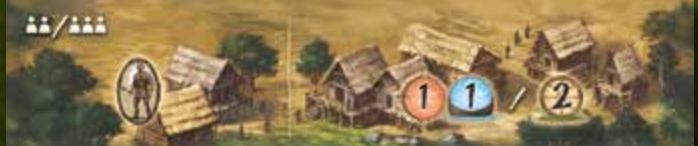
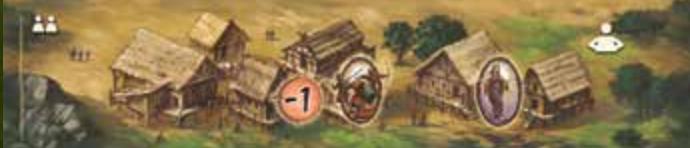
The actions available in a 4-player game are explained below. These actions are also available in a 3-player game, but Develop your Skills and Travel the Road are grouped together - sending a clan member to that action space allows you to choose one of those actions. In a 2-player game, Execute a Raid and Become First Player are also grouped together - both of these actions may be taken, in any order.
Hire a Worker: by sending a clan member to this action space, you may take 1 Worker tile; that worker's level depends on the current round. In rounds 1 & 2, the player receives a level-1 Worker. In rounds 3 & 4 a level-2 Worker, and in round 5, a level-3 Worker.
Develop your Skills: by sending a clan member to this action space, you gain 1 Military and 1 Culture.
Travel the Road: by sending a clan member to this action space, you gain 2 Travel. You may move each of your Caravans once, or a single Caravan up to two times.
Execute a Raid: to send a clan member to this action space, you must immediately lose 1 Military. Then, all other players must give you resources according to their respective Military Strengths. The Military track is split into 4 areas (Power Levels). Listed below the raider's Power Level are the number of resources each other player must pay (rounding down, as necessary).
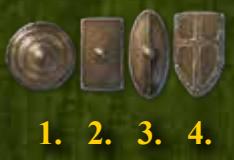
Important: Only the difference in Power Level matters, and not exact Military Strength. See page 9 for details.
• Players at the same level as the raider must give the raider 1 resource for every 5 they have.
• Players 1, 2, or 3 levels lower than the raider must respectively give the raider 1 resource for every 4, 3, or 2 resources they have.
• Players 1, 2 or 3 levels higher than the raider must respectively give the raider 1 resource for every 6, 7, or 8 resources they have.
Example: The raiding red player at Power Level 2 would receive 1 resource for every 5 resources owned by the blue player at the same Power Level, and 1 resource for every 4 resources owned by the weaker green player, at Power Level 1.

Both raw and refined resources are taken into account for these plunderings. Each player decides which of their resources to give to the raiding player; if a player has fewer resources than the threshold, they do not have to give any.
This action space may only be claimed once per round.
Become First Player: by sending a clan member to this action space you take the First Player card, which will allow you to play first in the next round. You also immediately move one step along the Road. The 2nd player in the new turn order gains no reward. If applicable, the 3rd player in new turn order immediately gains 1 Culture, and the 4th player gains 2 Military.
This action space may only be claimed once per round.
At the start of the 5th (final) round of the game, flip the First Player card over. A player who sends a clan member to this action space in the final round gains their choice of 2 Travel, 2 Military, or 2 Culture; there is no effect on other players.
TERRITORY ACTION SPACES
Each Territory tile contains 3 action spaces, divided by subtle lines. Small and large action spaces act in the same way. The difference in size for action spaces does only matter for setup in 2- and 3-player games.
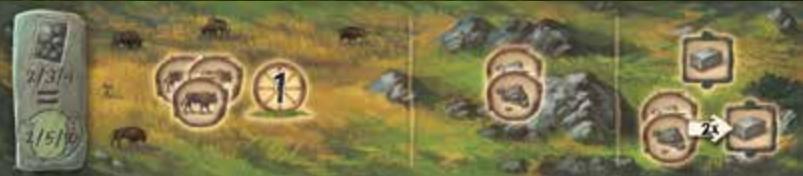
Sending a clan member to a Territory action space immediately provides what is depicted on that action space. In general this will be some combination of raw and refined resources, as well as allowing you to transform raw resources into refined ones. Some action spaces will gain you Military, Travel, Culture, or other effects
CROSSROADS ACTION SPACES
Crossroads action spaces are depicted on the reverse of the level 1 & 2 Forest/Mountain tiles. They become available when the rightmost Territory tile of a row is flipped over at the end of a round. In the 2nd round, the Crossroads action space of the 1st round becomes available; in the 3rd round, the Crossroads action space of the 1st and 2nd rounds are available, and so on.
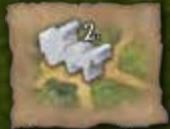
You can only send a clan member to a Crossroads action space if both of your Caravans have reached or passed the corresponding Crossroads, indicated by this symbol:
SPECIAL ACTION SPACES
The level-3 Forest/Mountain tiles provide special actions in the 5th round; no clan members can be sent to these spaces until the start of round 5. Players who meet the requirements listed below can send clan members to these spaces:
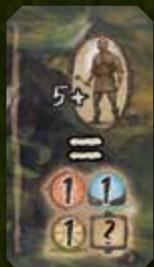
The levels of all your Workers sum up to at least 5.
Gain 1 Military, 1 Culture, and 1 Travel, and receive any 1 refined resource.
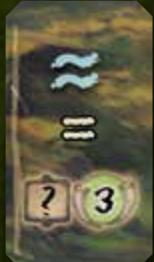
Reach or pass this symbol on the River. Receive any 1 refined resource and score 3 VP.

Reach or pass this symbol on the Road with both of your Caravans.
Receive any 3 refined resources.
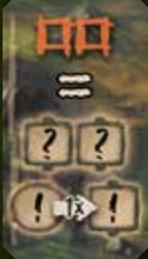
Reach or pass this symbol on the Military track.
Receive any 2 refined resources and transform 1 raw resource to its corresponding refined resource.
YOUR HUT
You can also send a clan member to your Hut. Your Hut may contain any number of clan members, including your Chieftain. For each clan member you send there, you can either:
transform one raw resource to its corresponding refined resource, or

START OF ROUND
At the start of rounds 2-5, perform the steps described below. These steps are also depicted on the Rounds track.
• Round 2: Remove all level-1 Artifact cards from the Artifact deck.
• Round 3: Remove all level-1 Artifact cards from the River, then refill.
• Round 4: Remove all level-2 Artifact cards from the Artifact deck.
• Round 5: Remove all level-2 Artifact cards from the River, then refill. Turn the First Player card over (first player doesn't change).

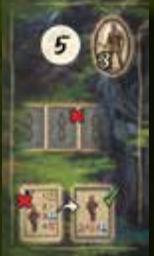

Before performing their first action in a round, a player may choose to flip their Character card over (from “young" to “experienced", see also page 12). That player loses the bonuses of the front side and gains the bonuses of the back side. Each player can only do this once per game; this action is irreversible.
END OF ROUND
At the end of rounds 1-4, perform the following steps:
• Return clan members on all action spaces to their owners, other than those placed on future action spaces.
• Turn over the two Territory tiles adjacent to the Round Marker. This will reveal a Crossroads action space and an Outpost that can be visited from this point onwards.
• Rotate all used Worker tiles and “once per round" Artifacts to their normal orientation; they are once again available to use.
• Move the Round Marker to the next space on the Rounds track.
MiLITARY
Each player has a Military token on the Military track, representing their Military Strength. When you gain Military, you may advance a number of spaces on this track up to the amount of Strength gained. Some actions may cause you to lose Military; this will move your token backwards on the track.
If you reach the end (20th space) of this track, you can advance no further; you will instead score 1 VP for each additional Military that you would have otherwise gained. You can still lose Military and be forced to move backwards on the track.
The track is split into 4 areas; the first space of each area shows a shield, indicating the Power Level of a player who has reached or passed that space.

Important: Military Strength differs from Power Level. Military Strength ranges from 0 to 20 and determines a player’s absolute strength, while a player’s Power Level is indicated by shields representing levels 1-4. A player’s Power Level determines how many resources they will receive from other players during a Raid.
At the end of the game, the player with the highest Military Strength will score 8 VP, and players with the two next-highest Military Strengths will respectively score 5 VP and 2 VP. In the case of a tie, all tied players score the appropriate amount of VP. Depending on the number of tied players, the VP for the next position(s) may not be scored.
Example 1: The blue and yellow players each score 8 VP; the 5 VP for second position on the Military track will not be scored. Therefore, the red player scores 2 VP and the green player scores no VP.

Example 2: The blue, yellow and green players each score 8 VP. Neither the 5 VP for second position nor the 2 VP for third position will be scored. The red player scores no VP.

ROAD
Each player has two Caravans on the Road. Whenever you gain Travel, you can move your Caravans a number of steps up to the number shown. A step means moving your Caravan to the next Crossroads, a bonus tile or an Outpost. Since you take a detour when visiting a bonus tile or an Outpost, you require 2 steps in total to arrive at the next Crossroads.

Movement may be split between both Caravans. Caravans cannot be moved backwards on the Road. When one of your Caravans reaches or passes:
• a bonus tile, you may apply the effect shown on that tile immediately.
an Outpost, leave one of your Flags there. At the end of the game, you score VP depending on how well you met that Outpost's requirements (see down below and on the next page). You can never leave multiple Flags on a single Outpost.
Note: Outposts become available at the end of each round, when a level 1 or level 2 Territory tile is turned over. Before that time, you cannot travel over the road leading to the Outpost. In the cut-out to the left, Territory tiles from rounds 1 to 3 are flipped over and their Outposts are available to visit with your Caravan.
• a Crossroads, there is no immediate effect. However, you must reach or pass a Crossroads with both of your Caravans in order to send a clan member to that row's Crossroads action space (see page 8).
the end of the Road, park your Caravan in the highest-valued unoccupied bonus space; you will score that many VP at the end of the game. The award is 8 VP for the first Caravan to reach the end of the Road, 5 VP for the second, and 3 VP for every Caravan thereafter.
Note: These VP are scored for each individual Caravan, so the 8 VP and 5 VP spaces can be scored by the same player if both of their Caravans reach the end of the Road ahead of all other players.
OUTPOSTS
Outposts are depicted on the reverse side of the level 1 & 2 Plains/Quarry tiles. These become active when the leftmost Territory of a row is flipped over at the end of a round, and provide scoring opportunities upon being reached by one of your Caravans. In the 2nd round, the Outpost of the 1st round becomes available. In the 3rd round the Outposts of the 1st and 2nd rounds are available, and so on.
At the end of the game, you score VP according to how well you fulfilled the requirements of Outposts where you have left your Flag. Each Outpost shows an easy, medium, and hard requirement; these respectively score 2, 5, and 10 VP. Overshooting the requirements scores you the VP of the highest requirement that you fulfilled. If you left your Flag on an Outpost but did not meet that requirement, you score 0 VP for that Outpost.

The levels of all your Workers sum up to at least 3/5/7.

Create 2/3/4 Clothing Artifacts.

Reach the matching symbol on the Road with both of your Caravans.

Create 2/3/4 Pottery Artifacts.

Reach the matching symbol on the River.

Create 2/3/4 Tools Artifacts.

Level 1
Reach the matching symbol on the Military track.

Level 2
Create 2/3/4 Weaponry Artifacts.
RiVER
Improving your Culture provides more choices of Artifacts that you may create or reserve. When you gain Culture, you may advance a number of spaces on the River up to the amount of Culture gained. Culture can never be lost; if you reach the end of the River (the 14th space), you will score 1 VP for each additional point of Culture you would have otherwise gained.
You can only create (or reserve, from space 4 onwards) Artifacts which you have passed or reached with your Canoe along the River. So if you have 0 Culture, you can only create the 2 leftmost Artifacts. Upon reaching the 1st space, you can create the 3 leftmost Artifacts, with every 2 additional spaces allowing you to choose from an extra Artifact
Some special actions/bonuses are available along the River. When you reach or pass:
• Space 4, you may now reserve Artifacts (see page 6 for an explanation).
• Space 6, you may apply the effect of the level-1 bonus tile.
• Space 8, your clan gains an extra Explorer for the rest of the game.
• Space 10, you may apply the effect of the level-2 bonus tile.
• Space 12, you get a discount of any 1 resource when creating a reserved Artifact.
• Space 14, you may apply the effects of the level-2 and level-3 bonus tiles.
Example: The yellow player can create the 1st or 2nd Artifact, but not reserve any. The red player can also create the 3rd or 4th Artifact, but not reserve any as well. The green player can create or reserve one of the rst 5 Artifacts, and the blue player can create or reserve any displayed Artifact.
BONUS TILES
There are 3 levels of bonus tiles. These are placed on designated spaces along the Road, next to the River, and on the leftmost area of a level 3 Plains/Quarry tile. Upon reaching a space that contains a bonus tile, you may apply its effect immediately and once only. The tile stays in place and is still available to other players (and for the Road, your other Caravan). There is also a Character that provides bonus tiles, but these are personal (see page 14). The effects of all bonus tiles are described on the next page, by level:

Gain 1 Culture.


Receive 1 Ore and 1 Livestock.

Level 1
Exchange any 1 raw resource for 4 VP.

Exchange any 1 raw resource for 2 Military.

Receive any 1 refined resource.

Receive 1 Wood and 1 Stone.

Receive 1 Ashlar and gain 1 Culture.
Receive 1 Metal and gain 1 Military.
Receive 1 Ore, 1 Livestock, 1 Wood, and 1 Stone.
Level 2
Exchange any 1 raw resource for either 2 Culture, OR 2 Travel, OR 3 Military.

Receive 1 Leather and gain 1 Travel.

Exchange any 1 raw resource for any 1 refined resource and 1 Lumber.

Gain 2 Military and 1 Culture.

Exchange any 2 raw resources for 5 VP.
Create 1 Artifact, you may use corresponding raw resources in place of refined.


Exchange 1 refined resource of your choice for 5 VP.
Execute a Raid. You don't lose Military.
Receive any 2 refined resources.
Level 3

WARRIORS
This symbol indicates that you may take 2 Warriors and put them in front of you. During this round you may use them as though they are members of your clan. Warriors act just like Chieftains, with one exception: you can send them to an action space occupied by your own Explorer. Effects that refer to your Chieftain do not apply to Warriors. After this round, return these Warriors to the general supply.
Example: The red player can send a Warrior to an action space occupied by their own Explorer. The Warrior can not be sent to action spaces occupied by a Chieftain or another Warrior.

CHARACTERS
Character cards are double-sided. The front of each Character card shows a boy or girl, along with the bonuses they provide during the game. The reverse of each card shows that same man or woman, grown-up; these provide ways to score VP. Characters start the game on their “young" sides. At the beginning of each round, before sending out your first clan member, you may choose to flip your character over to their “experienced" side. When you do, you lose all benefits from the “young" side. Doing so is irreversible; it cannot be undone.


Immediately gain 1 Travel.
During the game, whenever you gain at least 1 Travel, gain 1 additional Travel.
Immediately gain 1 Culture.
During the game, whenever you gain at least 1 Culture, gain 1 additional Culture.
You don't lose Military. This doesn't apply to cards or action spaces that allow you to exchange Military.
Whenever you create an Artifact, you may use up to 2 corresponding raw resources in place of refined.
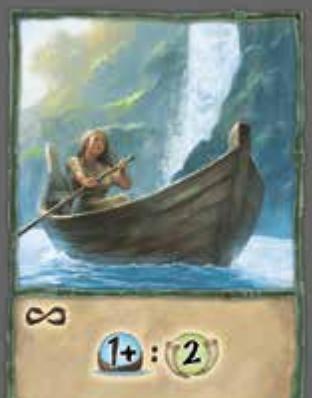

Whenever one of your Caravans reaches or passes a Crossroads, score 2 VP.
Whenever you gain at least 1 Culture, score 2 VP.
Once per round during your turn, score VP according to your Power Level.

Whenever you create a level-1 or level-2 Artifact, score 2 VP. Whenever you create a level-3 Artifact, score 3 VP.
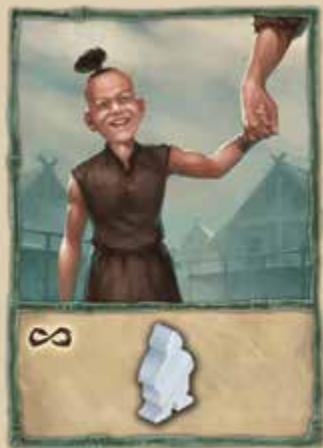
Your clan gains an extra Explorer.

Note: By flipping this Character over, you lose your extra Explorer. This cannot be one that was sent to a future Territory.
Whenever you send your Chieftain to an action space occupied by another player's Explorer, score 3 VP. Whenever you send your Chieftain to an unoccupied action space, score 5 VP.
Upon selecting this Character, take all leftover bonus tiles. Put them face-up in front of you as a personal supply of onetime-use bonus tiles.

Once per round during your turn, you may use 1 personal bonus tile. In the first round, you may only use a level-1 bonus tile. In the 2nd round, you may either use a level-1 or level-2 bonus tile. From the 3rd round, you may use any one personal bonus tile. Return a personal bonus tile to the box after use.

Note: By flipping this Character over, you lose your remaining personal bonus tiles.
Whenever you leave your Flag on an Outpost, score 4 VP.
Upon selecting this Character, take 1 leftover level-1 Forest/Mountain tile and 1 leftover level-1 Plains/Quarry tile of your choice, and place them in front of you, face-down.

You can send your clan members to this personal Crossroads action space, regardless of your Caravans' positions.
At the end of the game, score VP according to how well you fulfilled the requirements of this Outpost.
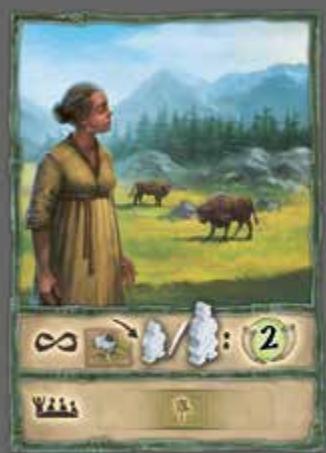
Note: By flipping this Character over, you lose your personal Crossroads action space.
Whenever you send an Explorer or your Chieftain to any Crossroads action space, score 2 VP.
At the end of the game score VP according to how well you fulfilled the requirements of this Outpost.
GAME END SCORING
The game will end at the completion of the 5th round, and the player with the most VP will be named High Chieftain of Terramara. Use the scorepad to write down the VP that players have earned in each category. In the event of a tie, the tied player who advanced furthest on the River is the winner. If there is still a tie, the tied player with the most Military Strength is the winner. If there is still a tie after that, the tied players enjoy a shared victory!
VP tiles
Artifacts created
Game-end effects on cards
Ranking in Military Strength
Caravans that reached the end of the Road
Outposts on which you left one of your Flags
-5 VP if you have a reserved Artifact
½ VP for each raw & 1 VP for each refined resource
CHANGES TO 2- AND 3-PLAYER GAMES
In a 2-player game, you add 2 neutral players. In a 3-player game, add 1 neutral player. These neutral players gain Military (as described down below) and their Explorers are present in certain action spaces, but they otherwise do not participate in the game. After setting the game up as described on pages 2-3, follow these additional steps:
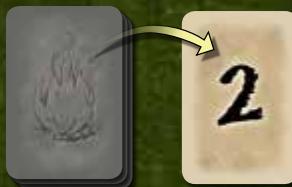
Place a Fire tile on a small action space in each of the 6 rows (adjacent to rounds 1 to 5) by shuffling the 4 Neutral Player cards and revealing them one at a time. Place one Fire tile per row, on the space matching the number on the revealed card (left-to-right, 1 - 4). Reshuffle the cards to place the 5th and 6th Fire tiles. Clan members cannot be sent to action spaces covered by Fire tiles.
Example: The revealed card shows a 2. Place the Fire tile accordingly.

• Distribute neutral player Explorers among the actual players. Starting with the first player and going in player order, each player places a neutral Explorer on an unoccupied action space adjacent to the next round, starting with the action spaces adjacent to round 1; this will continue to round 5, which spans two rows of Territory tiles. In this way, 6 Explorers will be placed for a 3-player game. Repeat this for a 2-player game, so that players have placed 12 neutral Explorers.
Remember: Clan members (including neutral Explorers) cannot be sent to action spaces covered by Fire tiles.
• Place neutral player Military tokens on the first space of the Military track. Neutral players' Military Strengths are important when sending Explorers to action spaces containing neutral Explorers.
• Return any remaining neutral components to the game box; these will not be used.
The following changes to game mechanics apply:
• At the start of each round, shuffle the 4 Neutral Player cards and reveal one card per neutral player, starting with the weakest neutral player in a 2-player game. Advance the neutral player Military token(s) that many steps along the Military track. If this is your first game, we recommend leaving the value-4 card out when performing this procedure.
• In a 2-player game only: At the end of each round when two Territory tiles are turned over, place a Restriction tileon the revealed Crossroads action space.
• When someone takes the First Player card, the bonus for 4th place (and additionally, in a 2-player game, the 3rd-place bonus) is not awarded.
• When you Develop your Skills or Travel the Road, you choose which action to take. Both options remain available to the next player to send a clan member to this action space.
• At the end of the game, take neutral players' position(s) into consideration when awarding VP for ranking in Military Strength.
ICONOGRAPHY OVERVIEW
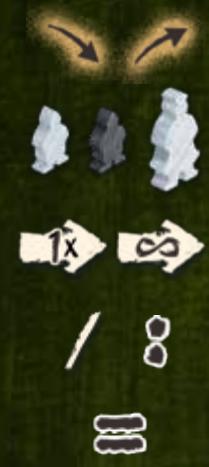
When placing, return
Your Explorer, another player's Explorer, your Chieftain
You may exchange what is on the left for what is depicted on the right, as many times as is shown on the arrow
Or, per
Condition (you may gain what is depicted on the right, if you fulfilled what is depicted left)
Receive 1 Livestock, 1 Stone
Receive 1 Wood, 1 Ore
Receive 1 Leather, 1 Ashlar
Receive 1 Lumber, 1 Metal
The corresponding raw, refined resource

Any raw, refined resource
Gain 1 Travel, 1 Culture, 1 Military
Power Level 1, 2, 3, 4 respectively
Score 5 VP, score double the VP
When executing a Raid, do so as if your Power Level were one higher
When gaining 1 or more Culture
Gain 1 Military for each player with more (not equal) Military Strength than you
When one of your Caravans reaches the depicted Crossroads
Create 1 Artifact, you may use corresponding raw resources in place of refined
You are allowed to send an Explorer to an action space occupied by a player with equal Military Strength; contrary to the normal rules, you don't lose Military
When your second Caravan reaches the depicted Crossroads
Plains, Forest
Quarry, Mountain
When creating an Artifact, score 1 VP per resource (depicted in the costs) of this type
When creating an Artifact, receive 1 discount on each type of resource
When creating an Artifact of this category, receive 1 discount on this type of resource
CREDITS
The authors would like to thank all of their friends who playtested this game for their time, enthusiasm and valuable suggestions: Davide Malvestuto, Chiara Volpini, Luca Ercolini, Davide Pellacani, Jamil Zabarah, Simone Luciani, Samantha Milani, Riccardo Rabissoni, Francesca Vilmercati, and Maria Chiara Calvani. Special thanks to Gabriele Ausiello, Marco Pranzo, and Tommaso Battista, whithout whom the game wouldn't have been the same. The compensation mechanic for player order is inspired by First Class, so the game designers thank its author, Helmut Ohley. Finally, the game designers would like to thank the whole publishing team, consisting of Max, Paul, and Arno, for their great work on this game.
Terramara, like many of our games and many of those by other Italian authors, owes a debt of gratitude to the creative contributions of Piero Cioni, a very imaginative author and a wonderful friend. Piero has recently left us, and we want to thank him for everything he has given to the world of games and to our hearts
• Game Design: Virginio Gigli, Flaminia Brasini, Stefano Luperto & Antonio Tinto
• Artwork: Michael Menzel
• Rulebook: Max van den Helder
· Editing: Michael Schemaille
• Development: Arno Quispel, Paul Mulders & Max van den Helder

QUINED GAMES
Copyright © 2019 Quined Games bv P.O. Box 1121 3260 AC Oud-Beijerland The Netherlands www.quined.com
下载 Markdown原文为社区整理/出版社公开资料,版权归原作者,仅供个人学习查阅。