
四帝共治Tetrarchia
一句话概览
四帝共治 是一款已收录于村了吗规则库的桌游,支持 1–4 人,原名 Tetrarchia。
本页内容:一句话概览 · 常见问题
这游戏怎么玩
- 本站已收录这款游戏的规则资料,可以在对话里直接提问规则细节。
常见问题(FAQ)
以下 1 条问答中 0 条来自站内玩家的真实提问,其余 1 条为本站整理的常见疑问;答复内容保持原样。
四帝共治支持几个人玩?
1–4 人。
去哪查完整规则
想核对具体规则细节、卡牌效果或某个回合的结算方式,可以在村了吗里选中这款游戏后直接提问。
同类桌游
- 卡坦岛德式
- 工业革命:伯明翰德式
- 勃艮第城堡:特别典藏版德式
- 方舟动物园德式
- 卡卡颂抽象
- 瘟疫危机传承:第一季美式
- 阿瑞迪亚:勇踏征途美式
- 重塑宇宙德式
- 幽港迷城美式
- 埃多拉的德鲁伊德式
规则原文(Markdown)
本站收录这款游戏的规则原文 1 个文件,此处内联渲染 1 个,可直接展开阅读或下载。
rulebook-Tetrarchia-ENG.md35.7 KB
RULEBOOK
TETRARCHIA
1-4 20'-40' +10
MIGUEL MARQUÉS
TETRARCHIA
By the end of the III century the Roman Empire falls apart. Enemies cross the borders, revolt spreads over the provinces, and whenever an Emperor marches to fight a threat, usurpers take his place in Rome. The Emperor Diocletian only sees one revolutionary way out: share his divine power with trusted colleagues. In a few years he creates an Imperial College, first with Maximian and later with Constantius and Galerius, forming the first “Tetrarchy”. Together they will fight all the enemies of the Empire... Will you be able to protect it?
◆ Designer: Miguel Marqués
◆Artist: Matías Cazorla
◆ Original art: Miguel Marqués
◆ Publisher: Draco Ideas

© Copyright 2021 – DRACO IDEAS. All rights reserved. No part of this product can be reproduced without explicit permission from the authors. Made in China. "TETRARCHIA" and its logo are trademarks. The components shown in this booklet can vary from the actual ones in the game.
TABLE OF CONTENTS
THE GAME
Contets…4
Setup……6
7
7
II Barbarian phase 9
1. Revolts 9
2. Barbarian activity……
10
Game end11
DUX EXPANSION 12
1. Dux… 12
.12
4.Gth13
VARIANTS 14
1. Imerim…14
2. Mare Nostrym .14
3.Via Romana……14
4. Vsrator……14
5.Roma Aeterna……1
6. Bararia……15
HISTORICAL SCENARIOS
- Carausialnl Revol.... 17
- Danubiarns Wars.. ..18
- Mauretanian War 18
- Great Persian War ... 19
SUMMARY
THE GAME
TETRARCHIA (Latin of Tetrarchy, “rule of four") is a cooperative game in which the players (1 to 4) fight together to protect the Roman Empire from revolts and Barbarian armies. With simple rules, the core engine leads to very different games, offering several difficulty challenges and many interesting choices.
The players win if they secure the borders of the Empire before the revolts or Barbarian armies lead Rome to its fall.
CONTENTS
1 board (map).

14 wooden figures:
04 Emperors (00●).
1 Dux and 1 Vicarius (O).
03 Roman fleets ().
3 Barbarian armies ().
1 Pirate fleet ().
1 Gothic army ().
62 wooden discs:
20 garrisons (0●●).
21 unrest () and 21 revolt () tokens.
◆ 2 dice: 1 Barbarian and 1 Roman .
1 rulebook (A5 format).

This new edition includes the base game plus a series of additions that will be described at the end of the rulebook: modules from the Dux expansion, variants that include a new competitive mode against an additional player, and historical scenarios.
We suggest starting with the base game and thus keep Dux, Vicarius, Pirates and Goths in the box. The Emperor figures correspond to Diocletian (Augustus of the East), Galerius (Caesar of the East), Maximian (Augustus of the West) and Constantius (Caesar of the West).
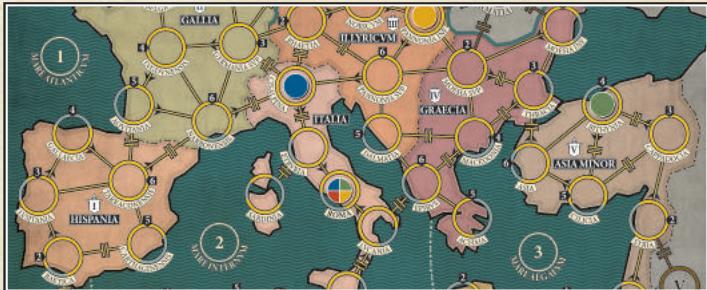
The board depicts the Roman Empire at the end of the III century (although the geography and some names have been adapted for gameplay's sake). The circles on land are the spaces over which the figures move, and they correspond to provinces: 42 Roman provinces inside the Empire, and 6 Barbarian provinces outside that represent its borders.
The 42 Roman provinces are regrouped in 7 regions of 6 provinces each. Italia is the central region, and the 6 outer regions around it have a Roman numeral and a Barbarian province assigned, its border:
I HISPANIA, with the border in Gaetvlia.
GALLIA, with the border in Britannia.
ILLYRICVM, with the border in Germania Magna.
GRAECIA, with the border in Sarmatia.
V ASIA MINOR, with the border in Persia.
V AFRICA, with the border in Libya.
The Roman provinces outside Italia are identified by their “region:province" coordinates (white and black banners). For example, the coordinates “II:5” correspond in region II, Gallia, to province 5, Aqvitania. The provinces with a colored disc printed on them contain the capitals of the Emperors:
Germania Inferior: Constantius's capital, Avgvsta Treverorvm (modern Trier).
Cisalpina: Maximians's capital, Mediolanvm (modern Milan).
) Pannonia Inferior: Galerius's capital, Sirmivm (modern Sremska Mitrovica).
Bithynia: Diocletian's capital, Nicomedia (modern Izmit).
They established their headquarters in those cities, closer to the most immediate threats. When not covered by another disc, the printed disc counts as a garrison of that Emperor.

Roma, the nominal capital of the Empire, has a multicolored disc that counts as a garrison for the 4 Emperors.
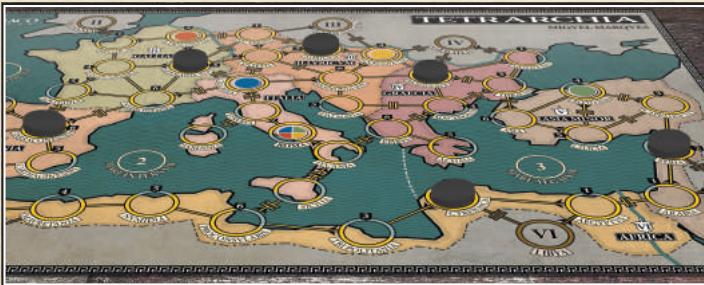
Provinces are connected by links that allow movement between them. Some of them are broken (interrupted) to represent the crossing of difficult terrain, like mountains, rivers or straits. The black arrows below some links show the Barbarian paths.
The whole sea area is divided by 2 dot-dashed lines into 3 zones, identified by a circled number: Mare Atlanticvm (1), Mare Internvm (2) and Mare Aegaevm (3). A Roman fleet placed in the circle of a given sea zone allows Emperors to move between any two coastal provinces (that contain some sea within their circle) of that zone.
SETUP
Players: they will always use the 4 Emperors, sharing them as follows:
1 player: control the 4 Emperors.
2 players: 1 Augustus and 1 Caesar each, one with the Western and one with the Eastern Emperors.
3 players: 1 Emperor each except 1 Caesar, who is shared by all the players. In case of disagreement though, the player controlling his corresponding Augustus has the last word!
4 players: 1 Emperor each.
◆Revolts: first, you must randomly distribute 6 revolts (●). In each outer region, roll the (on a , reroll) and place a revolt on that province, until you have a revolt () in each region.
◆Difficulty: then choose the difficulty level of the game:
① How many garrisons per Emperor, from 3 to 5.
② How many Roman fleets, from 1 to 3.
③ How many additional revolts, from 0 to 2.
④ How many initial Barbarian armies, from 0 to 2.
Those 4 parameters combine in 81 different ways and you may refer to each level listing the 4 values:
| DIFFICULTY LEVEL LOW HIGH | ||||
| 1 | Garrisons per Emperor | 5 | 4 | 3 |
| 2 | Roman fleets | 3 | 2 | 1 |
| 3 | Additional revolts () | 0 | 1 | 2 |
| 4 | Initial Barbarian armies (EB | 0 | 1 | 2 |
The central column, 4211, would be the medium level, but you should better start with an easier one, like 4200, or even the easiest one 300. Each of the 81 combinations leads to a different challenge. For example, the level gives more power to each Emperor while hindering their mobility through sea.
In order to add the additional revolts, roll the and place a revolt on that province. If you use initial Barbarian armies, roll the and place an army on the border province of that region. In both cases, if you obtain a province already occupied roll again.
TURN SEQUENCE
Once you choose the level and set up the rolled threats on the board, place the fleets on the sea zones of your choice and start the game. Each round consists of 4 turns following the sequence Diocletian, Galerius, Constantius, Maximian (as a reminder, follow the Roma icon in clockwise order). The Emperors start the game off the board. Every Emperor's turn has 2 phases:
① Roman phase: spend 6 "Imperivm Points" (IP) to fight the threats.
Barbarian phase: a random threat arrives () and the armies advance towards Roma.
At the start of each Emperor's turn, if he is off board the corresponding player can choose him to start the turn in Roma or in his capital (if it is not covered by any disc).
I. ROMAN PHASE
The Emperor can spend up to 6 IP (as long as he is on the board) on any of the following actions, in the order he wishes, and even perform a given action several times.
① Move: he can move to another province through:
A normal link = 1 IP.
A broken link (difficult terrain) = 2 IP.
A fleet if both provinces are on the coast of the corresponding sea zone = 1 IP.
If the destination has a revolt disc, add +1 IP. Each province space can only hold 1 figure and 1 disc. However, Emperors may pass through a province occupied by another Emperor if they move away immediately with their next action. Example: Diocletian spends 1 IP to move from Bithynia to Macedonia (using the fleet at Mare Aegaevm) and 3 IP to move on to Dalmatia (due to the broken link and the revolt). He was able to cross paths with Galerius because he did not stop in his province. He would have 2 IP left, that he could use for example to remove the revolt in Dalmatia.

② Sail: he can send a Roman fleet to an adjacent sea zone, in which there is no fleet, for 1 IP.
Secure: he can build a garrison, placing 1 of his discs in his current province if it contains no other disc, for 1 IP. In this way he protects the province and may benefit from its support when facing a Barbarian army.
Securing the borders of the Empire (the goal of the game) is a more difficult action that costs 2 IP, and moreover, the corresponding region must be free of revolt ().
Imagine the action of securing the border as a punitive expedition inland, more costly, and that in addition requires having your “back covered”.
Subdue: in his current province, he can:
Remove a revolt (●) = 2 IP.
Reduce a revolt to unrest (●) = 1 IP.
Remove an unrest () = 1 IP.
⑤ Attack: he can declare an attack on a Barbarian army through a link spending the IP he would need to move through that link (but don't move him yet). The battle is solved by rolling the and comparing the combat values:
Roman = ( + chain of own discs) x (other Emperors x2).
Barbarian = ( + chain of revolt discs) x (other Armies x2).
The Emperor adds to his result the number of his garrisons (discs of his color) linked to him in one continuous chain, and each additional Emperor linked to the targeted Barbarian army multiplies the Emperor's combat value times 2.
The Barbarian adds to his result the revolts () linked to him in one continuous chain, and each additional Barbarian army linked to the attacking Emperor multiplies the Barbarian's combat value times 2. Apply the effects of the attack:
Victory: remove the Barbarian army and any disc from the targeted province, and place the Emperor on it.
Defeat: remove the attacking Emperor and any Emperor garrison from his province. His turn ends and his figure will come back to the board at the start of his next turn.
Draw: nothing happens.
Let us see an example. The army in Narbonensis marches from Hispania towards Roma. Maximian decides to attack it from Germania Svperior spending 2 IP (1 for normal link +1 for the revolt in Narbonensis). The Barbarian value will be +7, and the Roman one (+3) x2. The +3 comes from the chain of his garrisons () linked to Maximian (Cisalpina-Etrvria-Roma) and the x2 from Constantius, linked to the target

Maximian would have the same value from Cisalpina (linked to the same chain), but would spend 3 IP (2 for broken link +1 for revolt). With Diocletian in Lvgdvnensis (linked to the target) the Roman value would have been multiplied x4, and with another army in Rhaetia (linked to the attacker) the Barbarian value would have been multiplied x2. If Constantius had been the attacker, his combat value would have been (+1) x2 from his garrison () in Lvgdvnensis. Subduing Tarraconensis, Constantius would reduce the Barbarian value to +1. And if Maximian attacked an army in Rhaetia from Pannonia Svperior, he would be linked to the same chain of his 3 garrisons () on one side, but to 1 garrison in Dalmatia on the other, although he would still add +3 because only one chain counts.
II. BARBARIAN PHASE
After the Roman phase of each Emperor, propagate the threats following this sequence:
① Revolts: check the status of the revolts.
② Barbarian activity: roll the and work out the result on that province.
③ Barbarian advance: move the Barbarian armies towards Roma.
During this phase, broken links may hinder the propagation of threats. When you have to propagate a revolt or move an army through a broken link, roll the : on 1 to 3, the provinces are not considered linked; on 4 to 6, they are linked.
In the following we will use “()" to remind that broken links must be checked. The result of the roll is temporary, the next time that broken link has to be checked, roll again.
①Revolts
Any unrest () linked () to a revolt () is changed to revolt, even with a "domino" effect (for example, ●- would become ●-●-●). Next, all the Emperors sitting on a revolt are removed and will come back to the board at the start of their next turn.
② Barbarian activity
Roll the : (region:province) and check the content of that province:
Garrison (O●O): do nothing (it is protected).
No disc: place 1 unrest disc ().
Unrest (): change it to revolt (●).
➢ Revolt (): trigger an Uprising ():
① Place 1 revolt () in all the Roman provinces linked () to it. If they are already in revolt, do nothing; if they have another disc, change it to revolt.
If there is an army left in the reserve, the uprising may generate an echo elsewhere in the Empire. Only in that case, roll the and place an army on that region's border if it is empty, and if it isn't, roll in addition the and resolve both dice as if they were a new Barbarian activity. Thus you may bring about a chain of uprisings!
③ Barbarian advance
All the Barbarian armies advance, following the black arrows below the links, towards the next linked (). If there are several armies and their order of movement may influence the game result (close or common paths, possible supported battles, few revolt tokens in reserve), move first those closest to Rome (count in number of provinces); if they are at the same distance, move first those in the region with the lowest number. And if nevertheless an army's path is blocked by another one, do not move it this turn.
When a Barbarian army enters a Roman province, remove any disc and place a revolt.
If an Emperor blocks the advance, the Barbarian army attacks him. Follow the same procedure described in the Roman phase, taking into account that now the Barbarian army is the attacker and the Emperor becomes the target.
In case of Barbarian victory, remove the Emperor and move the Barbarian army to the targeted province; in case of Barbarian defeat, remove the army and any disc from its province; in case of a draw, nothing happens.
In the example on page 9, Maximian could have ended his turn in the way of the army (Cisalpina) to let it attack him at the end of the Barbarian phase, and save in this way the IP of the attack. The numbers are the same! But beware, since the link the Barbarian army must advance through is broken, there would be a 50% probability of the army being blocked and the attack not arriving this turn.
GAME END
The game ends immediately in one of these ways:
Roman victory!
The Emperors secure the 6 borders of the Empire.
The end of the Empire! Roma falls because:
◆ a Barbarian army enters Roma; or
◆ you cannot place a disc of revolt or unrest (because the reserve is already empty).
The goal looks simple: reach the borders and build 6 garrisons. But in order to do so you need first to remove the revolts, which trigger uprisings, with the arrival of new armies, which spread new revolts...
If you focus too much on the borders you will end up facing mighty armies, and if you don't want to rely on lucky rolls you will need a plan, to cut them off from their support base and/or trap them. The turn order and the Barbarian paths must guide your strategy, so that all participants reach the battlefield on time.
The geography of the Roman Empire makes uprisings in some regions and provinces much more deadly, and the Tetrarchic capitals offer you (besides their garrison) a shortcut towards distant revolts. Learning which are the critical areas and reacting swiftly to the evolution of the board will be more important than rolling well!
REMEMBER
◆ You cannot remove your garrisons, so don't waste them. You can only recover them if they are removed by an uprising or army.
The borders are secured permanently. Uprisings remove garrisons, but they only spread to Roman provinces.
◆ Each province can only hold 1 figure and 1 disc.
◆ If an uprising reached an Emperor, he would not be removed until the next turn.
If an Emperor loses an attack, his turn ends immediately.
Emperors do not protect against the Barbarian roll, only garrisons (●0●●) do.
You can only attack through links, there are no landings.
The Black Sea is part of the third sea zone.
Britannia is not a coastal province!
DUXEXPANSION
This expansion includes 4 modules that can be added to the base game, together or separately, to enhance variety and explore new challenges. The first ones make the game easier and the last ones harder, so you can use them to compensate the difficulty level:

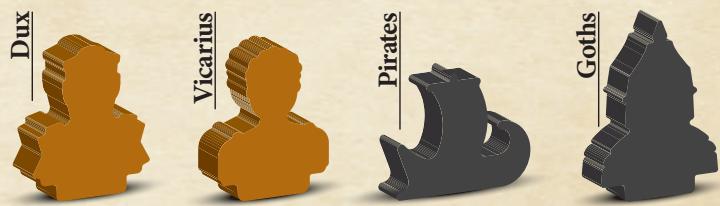
Dux, the orange Emperor' figure.
◆Vicarius, the orange figure wearing a toga.
◆Pirates, the black fleet.
Goths, the black special figure.
Decide before the game if you want to use any of them (you shouldn't in the first games).
1. DVX
Diocletian avoided concentration of power in the hands of possible usurpers. The Dux was a general that could command legions, but lacked the civil power to mobilize them or pay their salaries.
Once in the game, any player can spend 2 IP and deploy the Dux in a Roman province linked to his Emperor and with no figures. From now on, any player can spend his IP on his Emperor and/or the Dux.
He behaves as an Emperor, with two exceptions:
He cannot secure, since he has no garrisons.
If he must be removed from the board, he dies and leaves the game permanently.
2.VICARIVS
Within the strategy of power dispersion, the counterpart of the Dux was the Vicarius, in charge of the civil administration of the region. When the Vicarius mobilized the legions, they were at the Dux command. Neither of them could represent a threat.
Once in the game, any player can spend 2 IP and place the Vicarius in any Roman province free of figures and revolts. From now on, any player can spend his IP on his Emperor and/or moving the Vicarius. He moves as an Emperor, but:
He removes unrest () automatically (without IP cost) in his province, either when entering or by blocking the Barbarian roll.
He has no troops, and thus cannot join battles nor enter provinces in revolt.
If an uprising or army reaches him, he dies and leaves the game permanently.
3. PIRATES
Losing control of a coastal area often lead to the increase of pirate raids, which required the submission of the coastal provinces and the construction of new fleets.
They can only be used when playing with fewer than 3 Roman fleets. During setup, before you place your fleet(s), roll the until you get 2 or 3 (the Mediterranean) and place the Pirates in that sea zone. While they are on the board, they block the entry of fleets to that zone. An Emperor on that coast (a coastal province of that zone) can attack the Pirates for 2 IP.
Combat is similar to land combat, if you imagine that all the provinces on that coast are linked. Roll the : the Pirates add to their die the revolt discs on that coast; the Emperor adds to the Roman die his garrisons on that coast; and Barbarian armies or other Emperors on that coast multiply times 2 the corresponding combat values.
In case of victory, remove the Pirates from the board, the sea zone becomes available to Roman fleets. In case of defeat, remove the Emperor and all the garrisons on that coast. In case of a draw, nothing happens. Defeated Pirates may come back to the game: if there is an uprising on the coast of any sea zone without Roman fleet, they come back to the board in that zone.
4.GOTHS
During the III century the Goths became the most serious threat to the Roman Empire, crossing the Danube several times and ravaging entire provinces. Two centuries later they would be pushed into the Empire by the arrival of Attila's Huns.
Keep in mind that the Goths are a Barbarian army and that the maximum number of armies is still 3. Every time a Barbarian army must be placed on the two northeastern borders (III or IV), and the Goths are available in the reserve, place the Goths instead. They behave as a Barbarian army, but two exceptions make them more fearsome:
They arrive even if the border is protected or occupied (removing the garrison or figure)!
When they are involved in battle or advance through a broken link, add +1 to the .
VARIANTS
Besides these modules we also propose 6 independent variants, with Latin names, that change an aspect of the game, making it easier or harder. The last one allows the inclusion of an additional player, who will fight all the others!
1. IMPERIVM
Diocletian had more authority than the others, all four were sovereigns but his opinion usually prevailed. Maximian was meticulous and known for his organizational skills. The Caesars were younger and more 'warlike' Galerius being the boldest.
The Emperors receive a personal special power, but every time they use it they must first permanently remove 1 of their discs (from the board or reserve) from the game:
Diocletian can spend several IP moving other Emperors during that turn.
Maximian can spend 7 IP in that turn.
Constantius can block the advance of a Barbarian army before it attacks him.
Galerius can add +1 to his combat roll after rolling the dice. He may use his power several times in the same battle.
2. MARE NOSTRVM
If you have fleets in adjacent sea zones, you can consider them as one single zone. It is therefore allowed to move between any two coastal provinces of this new extended zone, spending 1 IP per zone traversed.
3. VIA ROMANA
An Emperor on one of his garrisons can order it to move towards a linked and empty province (even a border) spending the IP that he would have needed himself (1 or 2).
4.VSVRPATOR
Every time a region with its border already secured becomes full of revolts (not one that was full already), if there are Barbarian armies left in the reserve roll the and place one of them in that province of the region (if it is already occupied, reroll).
It represents a Usurper, that takes advantage of the spread of revolts to muster an army and march against Roma.
Although it did not come from outside the Empire, it behaves for all purposes like any other army.
5. ROMAAETERNA
The first Tetrarchy lasted 12 years (293-305), until the retirement of the two Augusti. But the death of Constantius in 306 and the claim of his son Constantine broke the chain of peaceful succession envisaged by Diocletian. Constantine emerged from a series of civil wars (306-312) as Emperor of the West, and after defeating his eastern counterpart (324) he ruled as “the Great”. This variant introduces rivalries within the Tetrarchy.
An Emperor leading a victory takes 1 gray (glory') disc from the reserve, but if defeated when leading he must give 1 back if possible. In case of global victory, you must also calculate the individual score of each Emperor by adding the borders he has secured and his glory discs: if an Emperor has 2 or more points above each of the others, he breaks the Tetrarchy and becomes the only one, the Great!
In this variant, achieving a global victory saves the Empire only partially, players must also preserve the Tetrarchy by avoiding an Emperor to become Great. Only in this way will Roma be eternal!
If an Emperor breaks the Tetrarchy, the global victory will be a bitter one and the fall of Roma will get closer.
6. BARBARIA
An additional player helps the Barbarians, and wins if the Emperors lose! In this way the game can hold up to 5 players.
The Barbarian player starts the game with a reserve of 4 gray and 1 black discs (), and handles the dice and pieces during the Barbarian phase.
The rules remain the same, but during his phase the Barbarian player can also spend his gray discs on these special actions (1 disc per action, which goes back to the general reserve):
Reroll all the dice that have been rolled (one or two) and keep the new result.
Cancel the advance of an army.
Change the advance direction of an army, once it enters the Empire. If the new province has an arrow, the army will follow it in the next turn; otherwise, it will follow the shortest path to Roma. If a broken link stops the advance, the change is cancelled.
At the start of each round (when the turn is back to Diocletian) he refills his reserve of 4 gray discs. He only has 1 black disc that he can spend once in the game, also in his phase, on one of these options:
Place it on any empty province (except capitals).
If there are no armies on the board, put it back in the general reserve in exchange for placing an army on an empty border.
This variant makes things very hard for the Emperors, therefore we suggest compensating it with a low difficulty level and/or other favorable modules/variants.
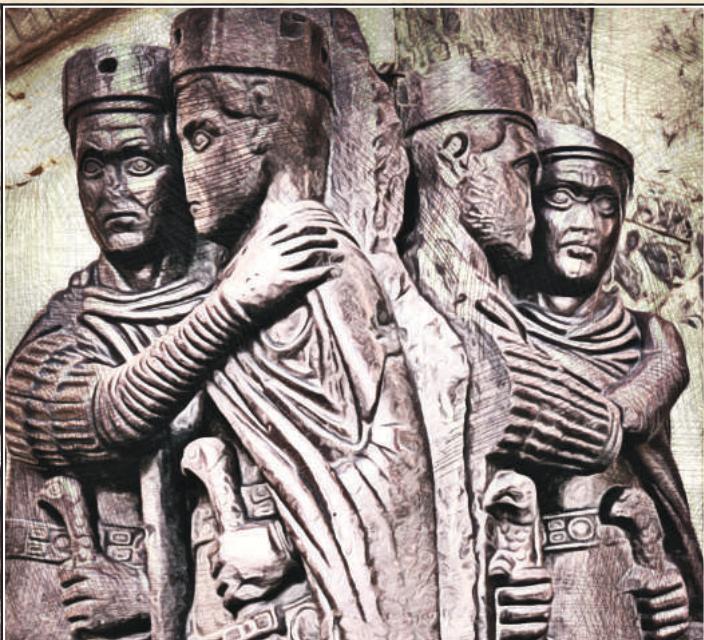
HISTORICAL SCENARIOS
TETRARCHIA has a variable setup that allows you to fight many wars. But with two small tweaks you can also experience the main real wars that the Tetrarchs had to fight in order to preserve the Empire.
These are the two additional elements:
GENERAL REVOLT: in the region(s) where the war started several revolts are placed, and in all other regions you place 1 revolt following the standard rule. If you prefer a fixed setup, we suggest placing the revolt of those regions in province 3.
REBEL ARMY: it is a Barbarian army that remains on its border province on top of a revolt disc until it is defeated (it does not advance towards Roma). Other than that, it blocks the arrival of other armies and counts for the maximum of 3 armies on the board.
All other rules and victory conditions do not change.
Some scenarios use modules from the expansion (Pirates or Goths), some use its components but only as Rebel figures (Dux or Goths).
This is the scenario list:
① Carausian Revolt (286-296): the most serious challenge to Diocletian, which leads to the Tetrarchy.
② Danubian Wars (293-296): a series of campaigns to maintain the most difficult frontier.
③ Mauretanian War (296-298): Maximian pursues the elusive Berbers into their home territory.
④ Great Persian War (296-299): the combined threat of a Persian army and an Egyptian revolt ends in total Roman victory and a 40-year peace.
If you want to experience these historical scenarios in a more intense way, you can try to play them with 3 garrisons per Emperor instead of the 4 that we propose.
1. CARAUSIAN REVOLT
Year 286. Maximian appoints Carausius, a Roman officer from Belgica, to clear the English Channel of Frankish and Saxon raiders, but rumors of his collaboration with the pirates lead Maximian to order him arrested and executed. Carausius declares himself Augustus, with the support of his fleet, the legions from Britannia and northern Gallia, and allies along the Atlantic coast. Maximian prepares an invasion of Britannia that ends in total failure and a truce follows.
Carausius searches official recognition honoring Maximian and Diocletian as co-Augusti, but they cannot let him go if they want to stop the endless chain of rebellions. In 293 they appoint the two Caesars that complete the Tetrarchy, giving Constantius one single mission: defeat Carausius. Constantius first isolates the rebel by retaking the land he held in Gallia and securing the Rhine delta against his Frankish allies, and then builds two new fleets.
Roman determination pushes a subordinate, Allectus, to assassinate Carausius and assume British command. In 296, with Maximian holding the Rhine frontier, Constantius is ready for the final assault. Landing at two different sites, one force defeats and kills Allectus, while the other, led by Constantius himself, enters London, where the Caesar is acclaimed as “restorer of the eternal light". The 10-year adventure is over.
>Difficulty level: 4221
Rebel army: use the Dux as Carausius, and place him on top of a revolt in Britannia.
General revolt: place 3 revolts in Gallia, in provinces II:1-2-4. Roll the die to place 1 revolt in each of the other 5 regions.
Expansion module: use the Pirates, but place them in Mare Atlanticvm.
Special rules:
◆ In order to attack Carausius you must have a Roman fleet in Mare Atlanticvm.
◆ Place Constantius in Germania Svperior.
◆ Constantius starts the game (skip the first turn of Diocletian and Galerius)
2. DANUBIAN WARS
Year 293. Diocletian starts a series of campaigns against the shifting pressures of the northeastern Barbarian peoples. In order to seal this long and porous frontier, he builds several forts and bridgeheads north of the Danube, creating a new defensive line called the “Ripa Sarmatica”. In 294 he defeats the Sarmatians, and accepts some in the Roman army while providing help to the rest of them against their northern neighbors. In 296 Diocletian defeats the Carpi.
But the length and geography of the frontier makes it almost impossible to seal. Galerius takes over for several years and defeats the Carpi, Bastarnae and Sarmatians again, settling many of them south of the Danube. By the end of the first Tetrarchy the frontier is safe, with 15 legions watching it. An inscription found on the lower Danube extols the “restoration of tranquilitas”.
>Difficulty level: 4222
General revolt: place 2 revolts in Illyricvm, in provinces III:3-4, and another 2 in Graecia, in provinces IV:1-2. Roll the die to place 1 revolt in each of the other 4 regions.
Expansion module: use the Goths and place them in Sarmatia. Place a second Barbarian army in Germania Magna.
Special rules:
◆ Place Diocletian in Thracia and Galerius in Pannonia Svperior.
3. MAURETANIAN WAR
Year 296. The Berber tribes from the Atlas and Sahara extend their raids to the coastal Roman provinces. The return of Constantius from Britannia allows Maximian to turn his attention to Africa. He raises an army and advances through Hispania, defending the region against the raiding Moors, and crosses the strait of Gibraltar into Tingitana, closing both coasts to the Frankish pirates.
By March 297 he begins a bloody offensive against the Berbers, devastating their home bases, killing as many as he can, and driving the remainder back into the Sahara.
On March 298 Maximian makes a triumphal entry into Carthage where, as Constantius in London, he is hailed for the restoration of the “eternal light” to Africa. He returns to Italia in early 299 to celebrate a triumph in Roma.
Difficulty level: 4221
Rebel army: use the Goths as the Berber army, and place them on top of a revolt in Gaetvlia.
General revolt: place 2 revolts in Hispania, in provinces I:1-2, and another 2 in Africa, in provinces VI:4-5. Roll the die to place 1 revolt in each of the other 4 regions.
Expansion module: use the Pirates, but place them in Mare Atlanticvm.
Special rules:
In order to attack the Berber army you must have a Roman fleet in Mare Atlanticvm.
◆ Place Maximian in Carthaginensis.
◆ Maximian starts the game (skip the first turn of the other Emperors).
4. GREAT PERSIAN WAR
Year 296. Narses of Persia culminates an escalation of anti-Roman provocations invading Armenia. Diocletian protects Syria while Galerius crosses the Euphrates, to be defeated at Callinicum. To make things worse, in 297 all Aegyptus revolts, probably with Persian support, and proclaims a new Emperor, Domitianus. Galerius recruits a new army, and Diocletian marches to Aegyptus. Alexandria falls in 298, and Diocletian advances up the Nile, where he is hailed as a Pharaoh. That same year, Galerius moves with his Gothic and Sarmatian mercenaries through Armenian mountains, and obtains a total victory over Narses. Diocletian joins him in 299 and imposes a peace treaty that would last 40 years. Galerius is hailed in Antioch as “conqueror of Persia”, and a combined triumph to all the Tetrarchy victories is celebrated in Roma.
>Difficulty level: 4222
Rebel army: use the Goths as Narses and the Dux as Domitianus, and place them on top of a revolt in Persia and Libya, respectively.
General revolt: place 2 revolts in Africa, in provinces VI:1-2, and another 2 in Asia Minor, in provinces V:1-2. Roll the die to place 1 revolt in each of the other 4 regions.
Expansion module: use the Pirates, but place them in Mare Aegaevm.
Special rules:
◆ In order to attack Domitianus or Narses you must have a Roman fleet in Mare Aegaevm.
◆ Place Diocletian in Bithynia and Galerius in Cappadocia.
The wars of the Tetrarchy were not over in 299, there were still campaigns to be fought on the Rhine and Danube. However, the almost simultaneous recovery of Britain, eradication of the Berbers, crushing of Egypt and humiliation of Great Persia were very clear signals of the new Roman supremacy for any potential rebel. Now the swords of Rome were four, and would fall without hesitation over their enemies. Although just a few months after Diocletian's retirement they would fall again over themselves...

SUMMARY: SETUP
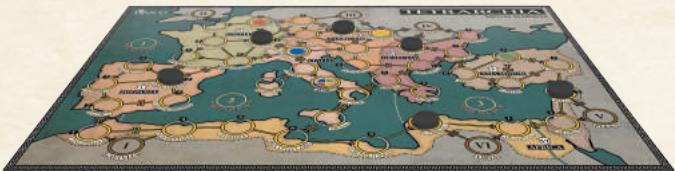
① In each region x: roll the (>1) an place :
② Choose the difficulty level:
| DIFFICULTYLEVEL LOW HIGH | ||||
| 1 | Garrisons per Emperor | 5 | 4 | 3 |
| 2 | Roman fleets | 3 | 2 | 1 |
| 3 | Additional revolts () | 0 | 1 | 2 |
| 4 | Initial Barbarian armies () | 0 | 1 | 2 |
③ Place the fleets and Diocletian starts.
SUMMARY: TURN SEQUENCE
ROMAN PHASE
6“Imperivm Points”
Move=1(=2/●=+1)
$$
{ \bf \Delta } > { \bf S a i l } = { \bf 1 } \cdot { \bf \Delta } \mathbf { b } \Rightarrow
$$
Secure:=1(=2 and no ●)
Subdue: =1/=2/●>=1
Attack (=Move):
(.++-)x2?/(0+●-●)x2?

BARBARIAN PHASE
Check: ●?(*) in
② Roll the 00:
protected
V÷>●/●☆●/●☆*:(*)
left?惊→息
occupied? o→0)
③ Barbarian advance ()

原文为社区整理/出版社公开资料,版权归原作者,仅供个人学习查阅。