
The British Way: Counterinsurgency at the End of EmpireThe British Way
一句话概览
The British Way: Counterinsurgency at the End of Empire 是一款已收录于村了吗规则库的桌游,支持 2 人,原名 The British Way。
本页内容:一句话概览 · 常见问题
这游戏怎么玩
- 本站已收录这款游戏的规则资料,可以在对话里直接提问规则细节。
常见问题(FAQ)
以下 1 条问答中 0 条来自站内玩家的真实提问,其余 1 条为本站整理的常见疑问;答复内容保持原样。
The British Way: Counterinsurgency at the End of Empire支持几个人玩?
2 人。
去哪查完整规则
想核对具体规则细节、卡牌效果或某个回合的结算方式,可以在村了吗里选中这款游戏后直接提问。
同类桌游
- 卡坦岛德式
- 工业革命:伯明翰德式
- 勃艮第城堡:特别典藏版德式
- 方舟动物园德式
- 卡卡颂抽象
- 瘟疫危机传承:第一季美式
- 阿瑞迪亚:勇踏征途美式
- 重塑宇宙德式
- 幽港迷城美式
- 埃多拉的德鲁伊德式
规则原文(Markdown)
本站收录这款游戏的规则原文 5 个文件,此处内联渲染 3 个,可直接展开阅读或下载。
TheBritishWayPalestine_British_Bot_v2.md17.3 KB
The British Way BOT rules as of July 20, 2023
General rules
The meaning of each priority symbol is as follows:
Sequential procedure
-
-
- ...
-
Perform each step in order, starting from 1 and continuing to the end.
Listed Priority
(a) (b) (c) ...
Look for a space that meets condition (a). If no space fits condition (a), look for one that fits condition (b) and then (c).
Nested Priority
[1] [2] [3]...
If multiple targets meet condition [1], look for a target that satisfies both conditions [1] and [2]. If multiple targets satisfy conditions [1] and [2], look for a target that satisfies conditions [1], [2], and [3].
Recursive procedure
(1) (2) (3)...
There are several types of processes that are executed repeatedly, and each process may consist of multiple options with different priorities. This means that if you execute (1) in the first round, you do not proceed to (2). Instead, in the 2nd round, you return to (1) to restart the entire process. At that point, if you cannot execute (1), you will examine the condition of process (2). If you execute (2), you return to (1) again in the 3rd round. The process (3) is examined and carried out only when (1) and (2) are not executable.
Space Selection Priorities
If several candidate Cities, Railways, or Districts have equal priority for NP Operation, Special Activity, or Event, select one randomly.
[Cities]
1, 2 = Haifa (City)
3, 4 = Tel-Aviv Jaffa
5, 6 = Jerusalem (City)
[Railways]
Haifa Syria Railway = 1
Haifa Tel-Aviv Railway = 2, 3
Tel-Aviv Jerusalem Railway = 4, 5
Tel-Aviv Egypt Railway = 6
[Districts] 1d6
\~City
First select City that match the conditions (if there is more than one candidate, roll 1d6). If
Cities do not meet the conditions, select the space closest to City, or as close as possible,
by the following order, any connected Railways, District adjacent to any City, other District (Galilee, Samaria, Gaza)
\~Railway
Same as above. However, Railways is the first candidates.
\~\~District
Reversed priority by the following order. District (Galilee, Samaria, Gaza)、District adjacent to any City, any Railway, City
Reactive and Proactive Event
The Event list has two sets, "Reactive" and "Proactive". Proactive involves being forwardthinking and assertive in executing operations. Reactive implies focusing on countering or responding to the situation rather than dictating the course of events. Choose between reactive or proactive before start the game.
If you choose Proactive List, you have fewer opportunities to use Event cards and have to use Operations a lot. If you choose Reactive List, more Events appear and the outcome of the game is determined more by cards and luck.
Proactive List (British)
Critical Event
P3, P8, P12, P15, P18, P26, P27, P28
Adversary EventP2, P5, P9, P10, P20, P25, P32
Reactive Type (British)
Critical Event
P1, P2, P3, P7, P8, P12, P13, P15, P16, P18, P19, P21, P23, P26, P27, P28
Adversary Event P5, P9, P10, P18, P20, P25, P31, P32
British Bot process
1. Intel Chit
- In the beginning of each card round, if the British Bot player has no Intel Chits or all Intel Chits he has are value 0, always "Pass" to draw a new Intel Chit. If he is the 1st Eligible player, put his cylinder in "Op & Special Activity" box. If he is 2nd, place the cylinder to the leftmost box.
2. Otherwise, go to "2. Event".
2. Event
If the "Event" box is empty (i.e., the opponent player has not yet conducted "Event" on the current card), do the followings,
2.1 Consult the Event List (Proactive or Reactive). When the Current Event is neither "Critical" or "Adversary", proceed to "3. Operation".
2.2 Else if the British is the 1st Eligible player and,
a. if Current Event is "Critical", then choose the Event
b. if Current Event is "Adversary", then place the British cylinder in the "Event" box to "Pass". The British draws one Intel Chit (as 1.6.1).
2.3 Else if the British is the 2nd Eligible player and,
a. if Current Event is "Critical", then choose the Event
b. if Current Event is "Adversary" and "Limited Op" is available, "Pass" to draw a new Intel Chit. Place the cylinder in the "Limited" box.
c. if Current Event is "Adversary" and "Full Op" is available, conduct "Operation".
3. Operation
Draw one of the cards A to D at random. If the conditions on the card is answered in the affirmative, execute the card instructions. Otherwise, pick another card until he picks an executable card. If no conditions are met in all four cards, go to "Pass".
Limited or full Operation
3.1 If the Bot player is playing as the 1st Eligible player, conduct "Operation with Special Activity" per the card's instructions.
3.2 If the Bot player is the 2nd Eligible player, conduct "Operation with Special Activity", unless the opponent player has already conducted "Operation with Special Activity". In such case, select "Limited Operation".
3.3 Complete the Operation in all selected spaces then conduct "Special activity" if it is "Operation with Special Activity" and it is executable (exception: Restore).
3.4 If the Bot player choose "Full Op" but can only perform an operation in one space and "Limited Operation" box is available, move the British Cylinder from “Full Op” to “Limited Operation”.
Alternatively, if the Bot player can only perform operations in two spaces and "Limited Operation" box is available, spend an Intel Chit value 0 to move the British Cylinder from “Full Op” to “Limited Operation”.
4. Pass
When the British Bot Player conducts Pass,
- place the cylinder in the "Operation with Special Activity" box.
- If the "Full Op" box is already occupied by the opponent, place the cylinder elsewhere (it doesn’t matter where the Cylinder is placed).
- Don't forget to draw an Intel Chit.
Card A: Deploy
Condition: at least two Police are Available
Instructions:
I. Deploy
- Repeat this process for three times. Add one Police where
(1) Troops with Sabotage/Terror, no Irgun, no Police
(2) more Troops than cells with (a) Active Cells, no Police [1] \~City
(b) Arms Cache, no Police [1] \~City
(c) Underground Cells, no Police [1] \~\~District
2. Conduct Restore if possible
- Find one Destination to move Troops where (it can be different from the space where you placed Police.)
[1] Tel Aviv, then Jerusalem, Haifa
(a) Space with Arms Cache, no Troops [1] City then District [2] least Underground Cells
(c) Space with Troops less than twice of Active Cells (at least one Troops) [1] \~City
(d) Space with Troops less than twice of Underground Cells (at least one Troops) [1] \~City
4. Move Troops
Move as many Troops as possible to the Destination, up to twice as many as Cells in the Destination.
Exception: .
Move Troops from the spaces that have
(1) Lone Troops [1] \~\~District
(2) more Troops than twice the number of Underground Cells there (After the move, twice as many Troops of Underground Cells must remain in Origin.
Keep three Troops intact in City.) [1] \~Railway
(3) fewer Troops than twice the number of Underground Cells there. Exclude equal. (All Troops may be moved.) [1] \~\~District
(4) Troops twice as many Troops of Underground Cells [1] \~\~District (All Troops may be moved.)
II. Restore If not already done.
III. Negotiate: if Restore can not be performed.
Card B: Patrol
Condition: At least one Active Cells and two Police on the map or Cells Intel Chit value 1 or 2 + Police with Underground
Instructions:
I. Patrol
-
Repeat this process for three times.
-
(Destination) Select a space (a) with more Active Cells than Police (including Police are 0) [1] \~City [2] most Irgun pieces (b) Underground Cells with Police [1] most Underground Cells [2] \~City
-
(Origins) Move as many Police as possible from the spaces according to the following conditions, up to the minimum number required to remove all of the Active Cells.
(a) from space with lone Police [1] \~\~District
(b) from space with Police and Troops, no Irgun [1] most Police
(c) from space with Police and Underground Cells, no Active Cells (a) District then Railway (b) City if more than one Police
(d) from any space with Police with Cells [1] \~\~District [2] most Active then most Underground Cells
2. Remove Cells
-
Select one space among the selected that can remove the most Active Cells. Remove the Active Cells. [1] most Cells [2] \~City
-
If the Bot player has Intel Chit value 1 or 2, Expend the Chit to remove Underground Cells in the selected space, if any.
II. Negotiate: per the rules' instructions.
Card C: Search
Condition: Equal to or less than one Active Cells on the map
Instructions:
I. Search
1. "Destination"
Repeat this process for three times.
(1) Select City without Curfew [1] Tel Aviv then Jerusalem, Haifa
(2) Select City with
(a) Cubes ≧ 3 with Underground Cells
[1] that can activate the most Underground Cell at the current status.
[2] Tel Aviv then Jerusalem, Haifa
(b) Cubes ≦ two with Underground Cells
[1] Least Underground Cells
[2] Tel Aviv then Jerusalem, Haifa
(3) Select Railway with
(a) Cubes ≧ Underground Cells X 2 [1] least Underground Cells [2] \~City
(b) Cubes < Underground Cells X 2 (including Cubes are 0) [1] most Underground Cells [2] \~City
(4) Select District with (a) Cubes < Underground Cells X 2 (including Cubes are 0) [1] most Irgun pieces [2] \~City
(5) If Intel Chit value 1 or 2, select City with Underground Cells + Cubes (This recursive procedure is executed only once.)
2. Troops Mobilization
Repeat the following process for the number of spaces selected in '1. Destination'.
1 Select the spaces in the order specified.
2 If the Selected space has enough Troops to activate all the Underground Cells or there is no Underground Cells, skip the "2. Troops Mobilization" process for that space (they will be activated in “5. Activation”).
3 Otherwise, examine each space adjacent to the selected space in the order specified. If there are multiple adjacent spaces in the Selected space, check the adjacent spaces in alphabetical order.
Check each space against the following conditions. If a condition is met, move as many Troops as possible to the Selected space, up to the minimum number required to activate all the Underground Cells there. When checking multiple spaces, prioritize them based on District, Railway, and City, in that order. If multiple spaces are of the same level, determine the priority based on (a) the highest number of Troops and (b) randomly if needed.
- Make Troops in City as close to three as possible considering both Destinations and Origins.
The Conditions:
(1) space with Lone Troops [1] \~\~District
(2) Railway/District with Cubes more than twice of Underground Cells [1] most surplus Troops [2] \~\~District
(3) Railway/District with fewer Troops than doubled Underground Cells, at least one Troop. [1] \~\~District [2] most mobile Troops
(4) Railway/District with equal Troops of doubled Underground Cells [1] \~\~District [2] most mobile Troops
(5) City. Haifa then Jerusalem, Tel-Aviv [1] most mobile Troops
IMPORTANT:
-
Do not make any Troop movements that would reduce the number of Cubes capable of activating the Underground Cells in the Selected spaces. The term "mobile" in The Conditions refers to this rule.
-
The restrictions on Troop movements mentioned in 1. only apply to Troops moving from the Selected space to another Selected space. These restrictions do not impede Troops moving from a non-Selected space to the Selected space.
-
The maximum number of Troops that can be moved is determined by subtracting the current number of Cubes in the Selected space from the required number of Cubes needed to activate all the Underground Cells in the Selected space.
-
After moving the Troops, if there are no Underground Cells that can be activated, the selected space becomes invalid, and the moved Troops are returned to their original spaces. A new Destination space is then searched for using the "1. Destination" process and tested according to the Condition.
3. Activation
Activate all corresponding Underground Cells in all selected spaces. (if any)
4. Activation by Intel Chit
If none of the Underground Cells in any selected City are unable to be activated, and if the bot player has an Intel Chit value of 1 or 2 and there are Troops there, spend the Chit to activate as many Underground Cells as possible.
If there is more than one City of equal value, choose Tel-Aviv, Jerusalem, then Haifa, in that order.
4. Curfew
Place Curfew to the selected Cities if no Curfew marker there.
Exception: No Curfew will be newly placed in City that activated Cells by Intel Chit.
II. Mass Detention
Condition: City with 3 Troops, Curfew
III. Negotiate: When "Mass Detention" is not executable.
I have not made Bot rules for Special Activities. Please operate the Bot British according to common sense.
Card D: Assault
Condition: at least two Troops with
- lone Arms Cache
- Active Cell
- If the bot has Intel Chit of value 1 or 2, with any Underground Cells
Instructions:
I. Assault
- Assault in three spaces that meets the following conditions.
(1) Arms Cache and at least two Troops, no Cells [1] City then District.
(2) with Active Cells and at least two Troops [1] \~City
(3) with Underground Cell and at least two Troops
+ Intel Chit of value 1 or 2
[1] \~City
- If Bot player has Intel Chit value 0, select one more valid space to conduct an additional Assault.
II. Mass Detention
Condition: City with Curfew, 3 Troops (if the condition is not met, "Negotiate")
Example: Card C: Search
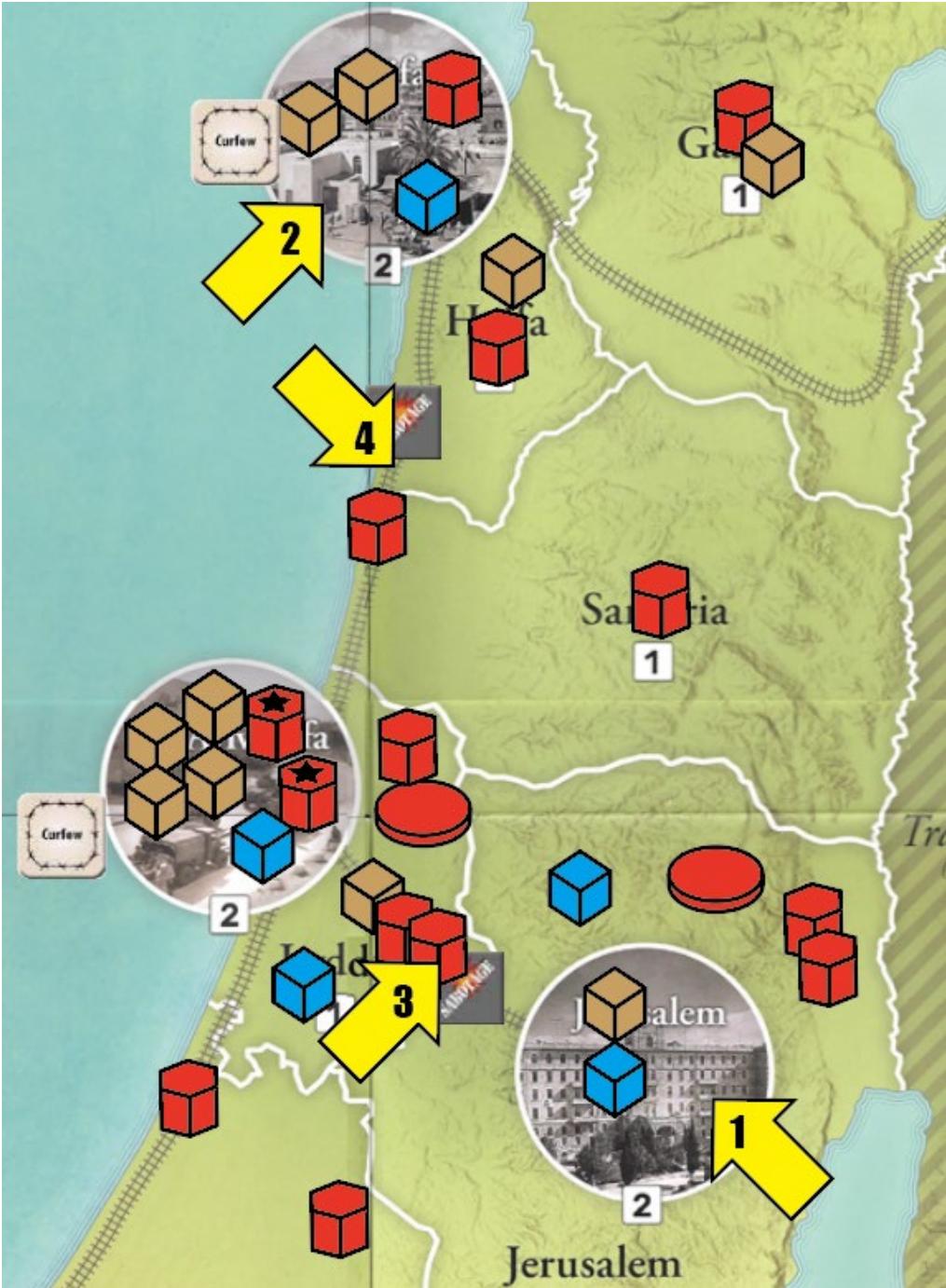
This example is after completing the first 3-card round. The first Propaganda is not yet done. Sabotage markers are placed on the "Haifa-Tel Aviv" and "Tel Aviv-Jerusalem" Railways. "Haifa (City)" and "Tel Aviv" are under Curfew. One cell is in Prison. Haganah Track is 4.

-
Execute from "1. Destination".
This process consists of a Recursive procedure from (1) to (5).
The first procedure is "(1) Select City without Curfew." "Jerusalem" meets this condition, so it becomes the first Selected space. -
As there are no other Cities that satisfy "(1)", proceed to the next Recursive procedure, which is "(2) Select City with (a) Cubes >= three with Underground Cells." "Tel Aviv" has 4 Troops but no Underground Cells, and no other City on the current map meets this condition.
-
Then, proceed to the next condition "(b) Cubes <= two with Underground Cells.".
"Haifa (City)" meets this condition, becoming the second Selected City. -
As this is a Recursive procedure, return to "(2) Select City with (a) Cubes ≧ 3 with Underground Cells." to find a new Space, but there are none.
Proceed to the next condition, "(3) Select Railway with (b) Cubes < Underground Cells X 2 (including Cubes are 0)." The "Haifa-Tel Aviv" and "Tel Aviv-Jerusalem" Railways match this condition. With a Nested Priority of "[1] most Underground Cells," the "Tel Aviv-Jerusalem" Railway becomes the third Selected Space.
- Furthermore, with a "Haganah Track" of 4, repeat the "1. Destination" process. The "Haifa-Tel Aviv" and "Tel Aviv-Egypt" Railways match the condition "(3) Select Railway with (b) Cubes < Underground Cells X 2 (including Cubes are 0)". Roll 1d6 and select the "Haifa-Tel Aviv" Railway as the fourth Selected Space.
These are the Selected spaces:
-
"Jerusalem (City)"
-
"Haifa (City)"
-
"Tel Aviv-Jerusalem (Railway)"
-
"Haifa-Tel Aviv (Railway)"
-
For each of these spaces, execute "2. Troops Mobilization." The first selected space, "Jerusalem", skips this process as per the rule: "2. If the Selected space has enough Troops to activate all the Underground Cells or there is no Underground Cell, skip the "2. Troops Mobilization" process."
-
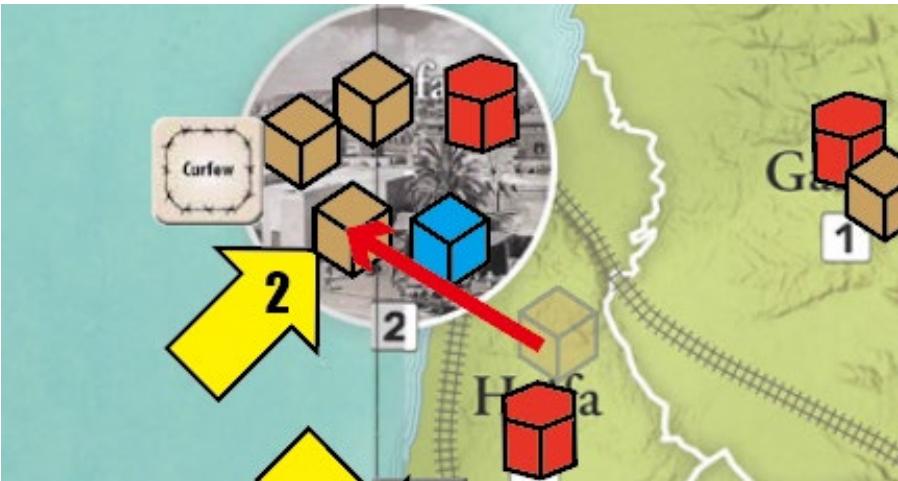
For the second selected space, "Haifa (City)", it has only "Haifa" as an adjacent space. "Haifa" meets "The Conditions:" of "(3) Railway/District with fewer Troops than doubled Underground Cells, at least one Troop." So, move one Troop from "Haifa" to "Haifa (City)".
- For the third selected space, "Tel Aviv-Jerusalem" (Railway), "Tel Aviv" is the only adjacent space with mobile Troops. Move one Troop from "Tel Aviv" to "Tel Aviv-Jerusalem" (Railway).

Note: An important rule is "4. Make Troops in City as close to three as possible considering both Destinations and Origins".
"The Tel Aviv-Jerusalem (Railway)" requires a total of 4 Troops due to its 2 Underground Cells there. However, as only 1 Troop can be moved from Tel Aviv per the instruction, this is all the Troops that can be moved to "Tel Aviv-Jerusalem (Railway)".
-
For the fourth selected space, "Haifa-Tel Aviv (Railway)", there are no movable Troops, so no changes are made to this space.
-
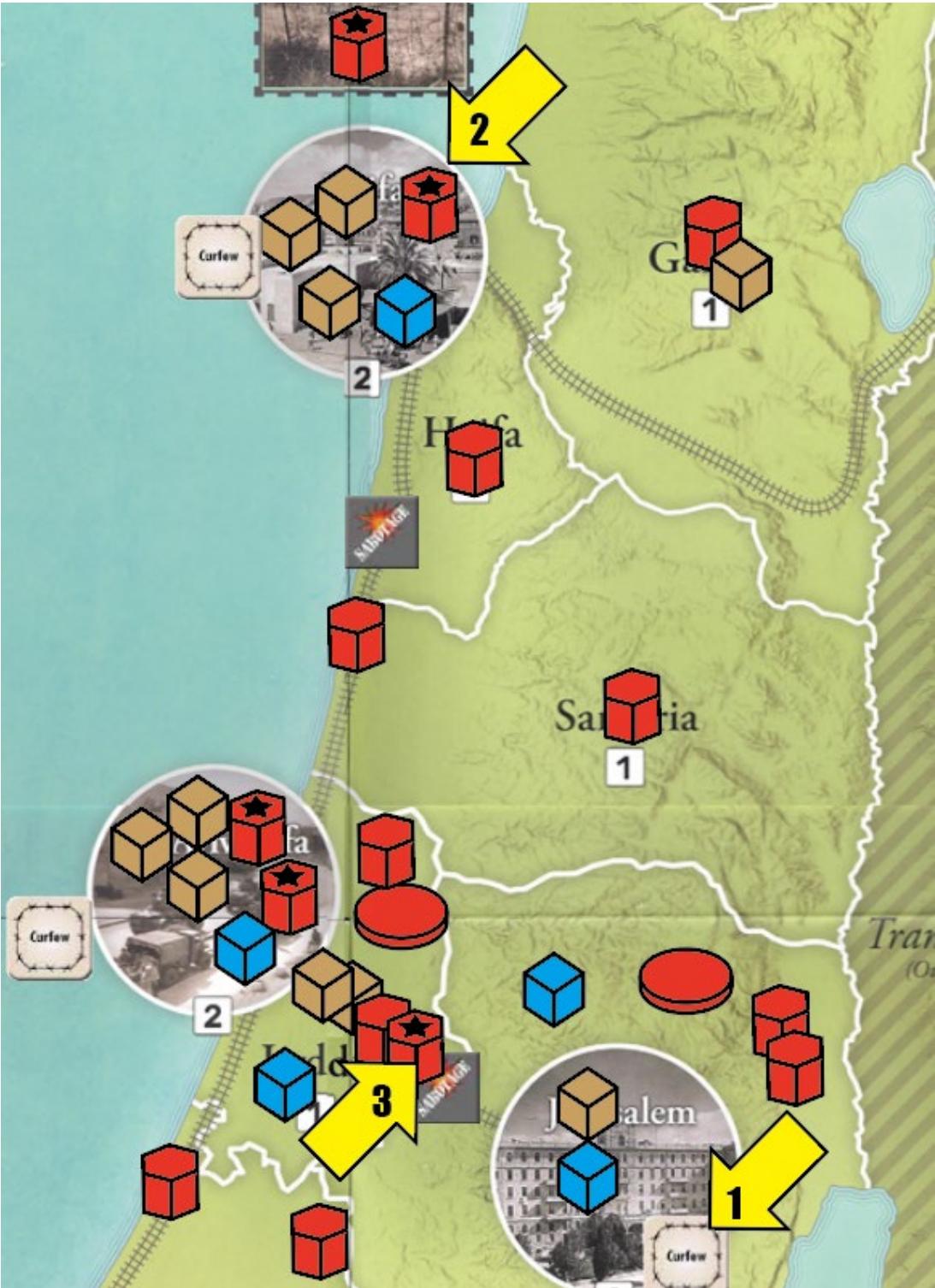
Through "3. Activation" and "4. Curfew," activate the Underground Cells in "Haifa (City)" and "Tel Aviv-Jerusalem (Railway)" and place a Curfew marker on "Jerusalem (City)".
-
In the next Special Activity, you have the option to perform "Mass Detention" in "Haifa" or "Tel Aviv" (Special Activity is not covered by the Bot rules).
01.md92.9 KB
Palestine
The British Way: Palestine 1945-1947 — Rules of Play, 2nd Edition. Designed by Stephen Rangazas.
1.0 Introduction
The British Way: Palestine is a game in The British Way COIN multipack. Alongside its accompanying games Malaya, Kenya, and Cyprus, this historical simulation strives to depict Britain's attempts to "manage" the emergencies, as the British referred to them, in their colonies during the period of decolonization that swept the world after WWII.
The British Way: Palestine focuses on the British counterinsurgency effort against the Jewish insurgency from the end of WWII in August 1945 to the British decision to leave Palestine in September 1947. The game focuses on the counterinsurgency and counter-terrorism aspects of the conflict, particularly against the Irgun and Lehi organizations, and does not directly model the wider political struggles between the British, Jewish Agency, and Arab political groups, or the civil war that began in November 1947.
The historical simulations that comprise The British Way multipack are designed to depict the full range of strategies used by the British during these conflicts, ranging from the more benevolent but still coercive provision of material benefits through pacification programs to the horrific measures used to gain control over the local population. Although many myths have arisen about an enlightened British approach to counterinsurgency that avoids large-scale violence and focuses on winning the population's 'hearts and minds', new scholarship on these conflicts have confirmed the brutality of the methods commonly used. This volume is intended to help synthesize and present this crucial scholarship, even if the simulations depicted are at times more unpleasant than fun. The main goal is that players find these thought-provoking and the gameplay encourages them to seek out the discussion of sources and historical background material in the Event notes and Campaign booklet.
1.1 General Course of Play
In The British Way: Palestine, one Event card at a time is revealed from the shared draw deck, and both players will have an opportunity to either execute that Event or perform an Operation from a unique menu, possibly adding a Special Activity. Propaganda cards mixed in with the Event cards provide periodic interruptions where the general board state is assessed and British Political Will is adjusted, possibly triggering an instant Irgun victory, after which both players receive an opportunity to collect additional assets and redeploy their forces.
1.2 Components
The following components from the multipack are required to play The British Way: Palestine:
A 17"x22" mounted Palestine game board (1.3).
A deck of 35 Palestine cards (5.0).
6 blue cubes ('Police'), 12 tan cubes ('Troops'), 15 red embossed octagonal cylinders ('Cells'), 5 flat red discs ('Arms Caches'), 2 embossed cylinders (one blue and one red)—note that this is fewer than the total number of wooden pieces included in The British Way multipack; any excess should be set aside while playing Palestine.
Three black and five white pawns (3.1.1).
Specific markers from the countersheet: 1x Political Will, 1x Haganah, 3x Curfew, 9x Intel, 15x Sabotage/Terror, 8x Capability—all other markers should be set aside while playing Palestine.
Two player aid sheets.
One Propaganda Round aid sheet.
Two six-sided dice (one red, one blue).
This rules booklet.
1.3 The Map
The map shows British Mandatory Palestine with some of the southern portion of Beersheba subdistrict removed for gameplay purposes.
1.3.1 Map Spaces. Map spaces include Districts, Cities, and Railways. All map spaces can hold forces (1.4). The foreign territories of Egypt, Transjordan, Syria, and Lebanon are marked for flavor purposes and are not playable map spaces.
1.3.2 Districts. The six large irregular spaces are the Districts of Mandatory Palestine. They are each marked with a number '1' to indicate the value of Sabotage in these spaces during the Political Will phase of the Propaganda Round (6.1). Several Districts surround a City space or have Railway spaces cutting through them. All Districts aside from Jerusalem are considered Coastal for the effects of some Events (5.0).
1.3.3 Cities. The three large circles are the major Cities of Haifa, Tel Aviv-Jaffa, and Jerusalem. They are each marked with a number '2' to indicate the value of Sabotage in these spaces during the Political Will phase of the Propaganda Round (6.1). Curfew markers may be placed in Cities by the British Search Operation (3.2.3) and by some Events (5.0).
1.3.4 Railways. Four major Railways are marked on the map by black 'track' symbols, running from Egypt (southern edge of the map) to Tel Aviv-Jaffa, Tel Aviv-Jaffa to Jerusalem, Tel Aviv-Jaffa to Haifa, and Haifa to Syria (eastern edge of the map). Sabotage markers on Railways do not affect movement but do count towards Victory (7.0) during the Political Will phase of the Propaganda Round (6.1). Railways may never hold Arms Caches (1.6.2).
1.3.5 Adjacency. Adjacency affects the movement of forces and implementation of certain Events (5.0). Any two spaces that border one another are adjacent. Railways are separate spaces adjacent to all spaces they touch.
EXAMPLE: British Troops on the Tel Aviv to Haifa Railway are adjacent to Tel Aviv-Jaffa, Haifa City, Haifa District, Samaria District, and Lydda District.
1.3.6 Prison. The Prison box is where Irgun Cells are placed when removed through Patrol (3.2.2), Assault (3.2.4), Mass Detention (4.2.3), or some Events (5.0). Half the Cells in Prison, rounded down, are returned during the Reset Phase of the Propaganda Round (6.4).
DESIGN NOTE: The Prison box and several other mechanics such as the rolls for Rob and Sabotage are inspired by Fred Serval's brilliant game, A Gest of Robin Hood.
1.4 Forces
The wooden pieces represent the two Factions' various forces: British Troops (tan cubes) and Police (blue cubes), Irgun Cells (red octagonal cylinders) and Arms Caches (red discs).
DESIGN NOTE: The British Way: Palestine and Cyprus both use Cells rather than Guerrillas because the insurgencies they depict were on the line between operating as a standard insurgency and an urban terrorist organization. Their individual operational groups were far smaller than the usual guerrilla groups depicted by Guerrilla pieces in other COIN series games (including Malaya and Kenya). Likewise, their Bases are called Arms Caches to reflect that the main limitation on both groups' operations were arms and explosives.
Important! The British in Palestine use only 6 blue Police cubes and 12 tan Troops cubes. The remaining 9 blue cubes and 3 tan cubes should be set aside and not used while playing Palestine.
1.4.1 Availability and Removal. Keep forces Available for placement in the Faction's Available Forces box. Forces removed from the map go to Available. EXCEPTION: Irgun Cells are sometimes removed to Prison (1.3.6).
Unless otherwise instructed (by Event, 5.1.1), forces may only be placed from or replaced with those in the Available boxes. A piece to be replaced by a piece that is unavailable is simply removed.
Important! Factions while executing an Operation, Special Activity, or Event to place their own forces may not take them from elsewhere on the map if the desired force type is not Available.
DESIGN NOTE: Unlike other games in the COIN series (including Malaya and Kenya), pieces that are no longer Available in a Faction's Available box may not be taken from those on the map to place elsewhere.
1.4.2 Stacking. No more than two Arms Caches (1.6.2) may occupy a single space. Arms Caches may never occupy Railways.
Arms Caches placed (such as via the Rob Operation [3.3.4], Propaganda Round Expropriations [6.2.1], or Event [5.0]) may never violate stacking.
More than one Sabotage or Terror marker may be placed in a space whether by Sabotage (3.3.3), Terror (4.3.3), or Events (5.0).
Only one Curfew marker may be placed in a City space (1.3.3), and never in any other kind of space.
1.4.3 Underground/Active. Cells are either Underground—symbol end down—or Active—symbol end up. Actions and Events flip them from one to the other state. Arms Caches, Troops, and Police are always Active. Always set up and place new Cells Underground (including if replacing a piece).
NOTE: Unless instructions specify "Underground" Cell, it is sufficient to "Activate" already Active Cells (they stay Active). Also, "moving" or "relocating" Cells does not affect Underground status unless specified.
1.5 Players & Factions
The game requires two players, each playing as one Faction: the British (blue), and the Irgun (red).
DESIGN NOTE: There were three main Jewish insurgent groups combating British rule of Palestine, the Haganah, Irgun, and Lehi. Haganah, the largest group, oscillated between cooperation and conflict with Britain and the two smaller terrorist groups. They are represented by the Haganah Track and Events. The player is playing a combination of Irgun and the far smaller Lehi. For simplicity, they are collectively referred to as Irgun.
1.6 Intel Chits and Arms Caches
Neither faction uses Resources as in standard COIN volumes. Instead each faction collects and spends a special form of resource: Intel Chits for British and Arms Caches for Irgun.
DESIGN NOTE: The general management of resources, such as finances and supplies, was less of an important constraint for the two sides than other more specific resources, such as intel and weaponry. British operations in Palestine struggled due to a lack of intelligence on Irgun despite massively outnumbering them. Likewise, the major restriction on Irgun was arms and explosives. They gained these through expropriations, robberies, and external funding that was generally devoted towards gaining arms.
1.6.1 Intel Chits. There are 9 Intel Chits with values ranging from 0 to 2 (3 of each), which should be placed in an opaque draw bag or container. British gain Intel Chits through removing an Arms Cache with Assault (3.2.4), Negotiate (4.2.2), and Events (5.0), and should always draw Intel Chits randomly when gaining them, then reveal them to both players. The number and value of Intel Chits that the British currently have is open information. British may spend the value of an Intel Chit to remove Underground Cells with Patrol (3.2.2) and Assault (3.2.4), and then the Chit is returned to the draw bag. Each Chit's full value must be spent in a single space. The British player may also discard Chits, regardless of value, back to the draw bag when conducting Search (3.2.3) or an Intelligence Lead (2.3.7).
1.6.2 Arms Caches. Irgun spend their unique resource, Arms Caches, to boost various actions. Arms Caches are gained through Rob (3.3.4), Propaganda Round (6.0), and Events (5.0), but may never be placed on Railways. They are used for selecting spaces for Recruit (3.3.1). They are spent to increase the success of Sabotage Operations (3.3.3) or as part of an Offensive (2.3.7). British may remove Arms Caches through Assault (3.2.4) and Events (5.0). Arms Caches cannot occupy Railways (1.3.4).
1.7 Sabotage and Terror
Sabotage and Terror markers are placed by the Irgun Sabotage Operation (3.3.3), Terror Special Activity (4.3.3), and some Events (5.0), and affect Political Will during the Political Will Phase of the Propaganda Round (6.1). There is no limit to the number of Sabotage or Terror markers that may be placed in one space.
1.8 British Political Will
British Political Will is tracked with a marker on the edge track. The position of this counter will determine Victory (7.0) for either side. The marker is moved during the Campaign and during the Political Will Phase of the Propaganda Round (6.1). It may never be lower than 0 or greater than 20.
1.9 Haganah
The relationship between Irgun and Haganah, the paramilitary armed wing of the Jewish Agency, is tracked with a marker on the Haganah Track (6.5), affecting the number of Irgun pieces available and some other actions.
1.10 Curfews
The three Curfew markers form a pool available to the British Faction. Curfews are placed in Cities by Search (3.2.3) and some Events (5.0). They block Irgun Recruit (3.3.1) and assist in activating Cells during Travel (3.3.2). However, Curfews are also vulnerable to the Irgun Propagandize Special Activity (4.3.2). There may only be one Curfew in each City space. Curfews are removed in one of three ways:
If a Curfew space is ever empty of British pieces.
Curfews are removed with the British Restore Special Activity (4.2.1).
All Curfews are removed during the Reset Phase of Propaganda Rounds (6.4).
2.0 Sequence of Play
2.1 Setup
Follow the instructions on the second to last page of this booklet to prepare the draw deck and set up markers and forces. A full setup diagram can be found on the back page of this booklet.
2.2 Start
Begin play by revealing the top card of the draw deck and placing it onto a played cards pile. All played cards and the number of cards in the draw deck are open to inspection.
NOTE: Unlike in most previous COIN series volumes, only one Event card is revealed at a time.
RECORD STEPS: As the steps of each Event card play are completed, place the Eligibility cylinder of the acting Faction's color (1.5) into the Initiative Track's appropriate box.
2.3 Initiative Track
One player takes the British Faction and the blue Eligibility cylinder, the other the Irgun Faction and the red Eligibility cylinder.
NOTE: This sequence of play is a new simpler take on the 2-player sequence of play developed by Brian Train in COIN volume VII - Colonial Twilight.
When playing an Event card, the British or Irgun player will execute Operations or the Event described on the card. At all times one player will be First Eligible, and the other will be Second Eligible. In each Event card round, the First Eligible player is first to choose what they will do, followed by the Second Eligible—whose choices are limited by what the First Eligible player did.
2.3.1 Eligibility. Each player puts one cylinder (blue and red respectively) on the First or Second Eligible spaces of the Initiative Track.
NOTE: Irgun always starts the game in the 1st Eligible box and returns there during the Reset phase (6.4) of each Propaganda Round.
2.3.2 Options for Eligible Factions.
First Eligible: The First Eligible player may perform a Limited Operation (2.3.4), execute the Event (5.0), perform an Operation (3.0) with Special Activity (4.0), or Pass (2.3.3).
The player selects their desired action and places their Eligibility cylinder in the appropriate box on the Initiative Track, then immediately executes the chosen action (Limited Operation, Event, Operation with Special Activity, or Pass).
Second Eligible: The Second Eligible player may then choose one of the boxes not containing the First Eligible player's cylinder and conduct the action in the box selected (or Pass).
2.3.3 Passing. After selecting a box, players may forgo the action in the box to Pass. If British pass they draw one Intel Chit (1.6.1). If Irgun pass they may Rob (3.3.4) in one space. Both players may pass and the order of cylinders in the Initiative Track will still decide eligibility (2.3.5).
2.3.4 Limited Operation. A Limited Operation is an Operation in just one space, with no Special Activity. If the Limited Operation is a Deploy (3.2.1), Patrol (3.2.2), or Search (3.2.3), it can involve pieces from multiple spaces but only one destination space.
2.3.5 Adjust Eligibility. After both players have selected and executed their actions, replace the Eligibility cylinders on the Initiative Track with the cylinder in the furthest left box becoming First Eligible, and the other cylinder becoming Second Eligible.
DESIGN NOTE: Selecting the Limited Operation box guarantees the player first eligibility on the next card. Likewise, selecting the Operation & Special Activity box guarantees second eligibility on the next card. Eligibility after selecting the Event space will depend on what the other player has chosen. The only way to block Events in The British Way is to select the Event box and then either play the Event or Pass.
2.3.6 Next Card. After eligibility has been reset, reveal the draw deck's next card and continue play.
2.3.7 Intelligence Lead and Offensive. Both players may discard or remove one of their special resources, Intel Chits or Arms Caches respectively (1.6), when conducting an Operation or Limited Operation to select an additional space. The British may discard any Intel Chit to the draw bag to add one additional space to Patrol (3.2.2), Search (3.2.3), or Assault (3.2.4). Irgun may remove an Arms Cache to Available from a space with no British to add one additional space to Recruit (3.3.1), Sabotage (3.3.3), or Rob (3.3.4). An additional space may be added in this way even if the Operation is Limited (2.3.4).
2.4 Propaganda Card
When a Propaganda card is revealed, conduct a Propaganda round (6.0).
NOTE: Each series of Event cards leading up to a Propaganda Round is called a "Campaign."
3.0 Operations
3.1 Operations in General
A Faction executing an Operation (Op) chooses one of the four Operations listed on its Faction sheet and selects the map spaces (typically several) to be involved. Select a given space only once for a given Operation.
Operations are generally allowed in up to three spaces unless the Operation is Limited (2.3.4), in which case they are allowed in only one space. EXCEPTION: Each side may add an additional space through Intelligence Lead or Offensive (2.3.7), and Irgun may add an additional space if the Haganah Track is at '4' (6.5).
The executing Faction chooses the order of the spaces in which the Operation is resolved, the enemy pieces to be affected (targeted), and the friendly pieces to be placed, replaced, or moved. Once targeted, a Faction's pieces are affected to the maximum extent possible. Actions affecting another Faction's pieces do not require that Faction's permission.
3.1.1 Pawns. If desired, mark spaces selected for Operations (3.0), Special Activities (4.0), or other actions with white and black pawns. The pawns are for convenience, not a limit on play.
3.2 British Operations
The British choose from Deploy, Patrol, Search, or Assault Operations.
3.2.1 Deploy. Deploy adds Police and then can rapidly deploy Troops to any one space. Select up to three District and/or City spaces with more Troops than Irgun pieces.
PROCEDURE: Place one Police in each selected space. Then, even if a Limited Operation (2.3.4), may move any Troops from anywhere on the map to one space (even a Railway space).
3.2.2 Patrol. Patrol moves Police and then may remove Cells to Prison in one space with Police. Select up to three destination spaces with Cells.
PROCEDURE: May move any Police from anywhere on the map to any destination spaces. Then in one destination space, remove one Active Cell to Prison for each Police in the space. Patrol may remove Underground Cells if the British player spends Intel Chits (1.6.1) equal to or greater in value than the number of Underground Cells removed. Spent Intel Chits are returned to the draw bag.
3.2.3 Search. Search moves Troops, activates Cells, and places Curfews (1.10). Select up to three destination spaces.
PROCEDURE: First, simultaneously move any adjacent British Troops desired into destination spaces. Then, in each District or Railway space selected, Activate (1.4.3) one Cell for every two cubes (moved or already there). In Cities, instead place a Curfew marker (if none there) and Activate only one Cell for every three cubes OR may discard one Intel Chit (1.6.1) of any value to the draw bag to activate one Cell for every cube and place no Curfew.
3.2.4 Assault. Assault uses Troops to remove enemy pieces. Select up to three spaces with Troops and Irgun pieces.
PROCEDURE: In each selected space, remove one Active enemy piece for every two Troops present. First remove Active Cells, then remove Arms Caches only once no Cells remain (even Underground). For each Arms Cache (1.6.2) removed, add 1 Political Will (1.8) and draw one Intel Chit (1.6.1). Cells are removed alternately to Available and Prison, Available first. British may remove Underground Cells if the British player spends Intel Chits (1.6.1) equal to or greater in value than the number of Underground Cells removed. Spent Intel Chits are returned to the draw bag.
NOTE: The value of an individual Intel Chit may not be split across spaces. Underground Cells removed by spending Intel Chits still count towards the total number of pieces that may be removed by Patrol or Assault. Underground Cells in a space prevent removal of Arms Caches with Assault until all Cells are Activated and removed, unless the British possess sufficient Intel Chits and Troops to also remove the Underground Cells.
3.3 Irgun Operations
Irgun chooses from Recruit, Travel, Sabotage, or Rob Operations.
3.3.1 Recruit. Recruit augments friendly forces. Select up to three spaces without Curfew markers.
PROCEDURE: In selected spaces with or adjacent to an Arms Cache (1.6.2), place up to two Cells. Otherwise, in selected Cities without (or not adjacent to) Arms Caches, place only one Cell. No Cells may be placed in non-City spaces without (or not adjacent to) Arms Caches, or in Cities with Curfews.
NOTE: Recruit may place Cells directly onto Railways if there is an adjacent Arms Cache.
3.3.2 Travel. Travel moves Cells and flips them back Underground. Select up to three origin spaces with Cells. A Limited Operation (2.3.4) Travel may select only a single origin space, but may move Cells to multiple destination spaces.
PROCEDURE: Move any Cells in each selected origin space to any spaces on the map, including their original space. Set Cells moving from one origin space to one destination space Active (1.4.3) if:
The destination is a Railway or Curfew space and
The number of moving Cells plus the number of cubes in that destination exceeds three.
Otherwise, flip moving Cells Underground, even if they return to their original space.
NOTE: Unlike March in Malaya or Kenya, Travel may move Cells to any spaces, not just those that are adjacent, and selects origin spaces rather than destination spaces. Therefore, a Limited Travel can only select one origin space but may select multiple destinations from that origin space.
3.3.3 Sabotage. Sabotage places Sabotage markers. Select up to three spaces with at least one Underground Cell.
PROCEDURE: In each selected space, Activate one Underground Cell. Before rolling, Irgun may expend an Arms Cache (1.6.2) that is either in or adjacent to the selected space, returning it to Available to increase the result by 2. Then, roll a die, subtracting 1 from the roll for each Police cube in the selected space. If the modified roll result is greater than 2, place a Sabotage marker in the space.
NOTE: Unlike in Malaya, Kenya, or other COIN volumes, Sabotage markers may be added to spaces that already have them, and spaces may hold more than one Sabotage marker.
DESIGN NOTE: Irgun usually place Sabotage rather than Terror markers because most of the group's attacks, especially when cooperating with Haganah, focused on sabotaging railways or destroying British facilities, rather than seeking to terrify the populace or inflict mass casualties on non-combatants.
3.3.4 Rob. Rob places Arms Caches. Select up to three Districts or Cities with more Cells than Police.
PROCEDURE: In each selected space, roll a die. If the roll result is greater than 2, add one Arms Cache (1.6.2). If there are any Police in the selected space, activate one Underground Cell there if possible.
4.0 Special Activities
4.1 Special Activities in General
When a Faction per the Initiative Track (2.3) executes an Operation (3.0), it may also execute one Special Activity (EXCEPTION: Limited Operations, 2.3.4). As with Operations, the executing Faction selects spaces and pieces affected, and the order of actions. Select a given space only once as a location for a given Special Activity. Events may grant free Special Activities (not further affecting Eligibility, 2.3.1).
Important! A Faction may execute its Special Activity at any one time immediately before, during, or after its Operation.
EXAMPLE: Irgun Sabotage in one space, then pause to Silence to remove Police in a different space, then Sabotages in that space.
4.1.1 Accompanying Operations. Some Special Activities specify that they may only accompany certain types of Operations (3.0). Certain Special Activities must occur where their Accompanying Operation occurred. If not otherwise specified, Special Activities may accompany any Operations and take place in any otherwise valid spaces.
4.2 British Special Activities
The British choose from Restore, Negotiate, or Mass Detention Special Activities.
4.2.1 Restore. Restore removes any Sabotage and Curfew markers and flips Terror markers to their Sabotage side. It may only accompany Deploy (3.2.1) and takes place in one space with Troops, Police, and no Irgun.
PROCEDURE: In the selected space, remove any Curfew and Sabotage markers, then flip any Terror markers to their Sabotage side.
4.2.2 Negotiate. Negotiate attempts to shift the Haganah Track (6.5) in Britain's favor. It may only accompany Deploy (3.2.1), Patrol (3.2.2), or Search (3.2.3).
PROCEDURE: Roll a die, adding 1 to the roll for each Terror marker on the map. If the die roll result is greater than the Haganah Track value, shift the track once to the left. If the Track is already at 0, British instead draw one Intel Chit (1.6.1).
4.2.3 Mass Detention. Mass Detention allows British to arrest a large number of Cells to Prison at the risk of losing Political Will (1.8). It may select any one City with a Curfew marker and at least three British Troops. It may accompany Search (3.2.3) or Assault (3.2.4).
PROCEDURE: Remove a die roll of Irgun Cells from the selected City and its adjacent District to Prison. If the die roll is greater than the number of removed Cells, subtract the remainder from Political Will.
EXAMPLE: British Mass Detention in a City with two Cells and with one Cell in its adjacent District. They roll a 5, removing all three Cells to Prison and then lowering Political Will by 2 (the remaining dice value once three Cells have been removed).
4.3 Irgun Special Activities
Irgun chooses from Silence, Propagandize, or Terror Special Activities.
4.3.1 Silence. Silence allows Irgun to remove Police. It may occur in one space with an equal or greater number of Underground Cells than Police. Silence may accompany any Irgun Operation (3.3).
PROCEDURE: Remove one Police to Available.
4.3.2 Propagandize. Propagandize lowers Political Will. It may occur in up to two Cities with at least one Cell and a Curfew marker. Propagandize may accompany any Irgun Operation (3.3).
PROCEDURE: If all Cells Underground, Activate one Cell. Then lower Political Will by one.
NOTE: Propagandize does not need to Activate a Cell if there is already an Active Cell in the selected space.
4.3.3 Terror. Terror places Terror markers. It may occur in any one City selected for Sabotage (3.3.3) and modifies the Sabotage Operation in that space. Terror may only accompany Sabotage (3.3.3) and must be declared before rolling.
PROCEDURE: Roll for Sabotage as usual, but instead place a Terror marker if successful. If the modified roll (adding Arms Cache if used and subtracting Police in the space) is 6 or greater, place two Terror markers and shift the Haganah Track once to the left.
DESIGN NOTE: Although many Irgun operations focused on sabotage, they also engaged in terrorist attacks, unlike Haganah. They carried out several horrific attacks, with the deadliest being the King David Hotel bombing. These attacks contributed to Haganah condemning the group's actions and ending their cooperation with Irgun.
5.0 Events
Each Event bears a title, italicized flavor text, and Event text. Flavor text provides historical interest and has no effect on play.
5.1 Executing Events
When a Faction executes an Event, it carries out the Event text literally and in order (sometimes involving actions or decisions by the other Faction). Unless otherwise specified, the executing Faction makes all selections involved in implementing the text, such as which pieces are affected. If another Faction is specified or selected to take an action, that Faction decides the details of the action. Some Events with lasting effects have markers as aids to play.
5.1.1 Where Event text contradicts rules, the Event takes precedence. However:
Events may not violate stacking (and so never place Arms Caches where there are already two, or a Curfew marker where there is already one).
Events place only Available pieces (1.4.1) and markers; they remove rather than replace if the replacement is not Available or if stacking (1.4.2) would be violated.
Events may not raise British Political Will beyond 20 or reduce it below 0 (1.8).
5.1.2 If two Events contradict, the currently played Event takes precedence.
5.1.3 An executed Event's text that can be implemented must be. If not all of its text can be carried out, implement that which can.
5.2 Dual Use
Many Events have both unshaded and shaded Event text. The executing Faction may select either the unshaded or shaded text to carry out (not both). While the unshaded text often favors the British, a player may select either text option regardless of Faction.
DESIGN NOTE: Dual-use events represent opposed effects of the same cause, forks in the historical road, or instances subject to alternative historical interpretation.
5.3 Capabilities
Dual-use Events labeled "BRITISH CAPABILITY" or "IRGUN CAPABILITY" have lasting effects mainly relating to that Faction, either positive or negative. These labels are for flavor only, and both Factions may execute Capability Events with either label. The Event's effects last for the rest of the game.
NOTE: Set out executed Capability Event cards near the board as added reminders, using a Capability marker to indicate which option was selected.
5.4 Starred Events
Several Events are marked with a star (*). These are played normally but interact with the unshaded effect of the ERNEST BEVIN (P9) Capability card.
6.0 Propaganda Round
Conduct a Propaganda Round in the sequence of phases below when each Propaganda card is revealed. The Propaganda Round aid sheet also lists this sequence.
6.1 Political Will Phase
Calculate the net effect to Political Will of the following adjustments before shifting the marker:
6.1.1 Disorder? Lower British Political Will by 1 for each Sabotage marker in Districts. Lower British Political Will by 2 for every Railway with a Sabotage marker (once total per Railway). Lower British Political Will by 2 for each Sabotage marker in Cities, and by 3 for each Terror marker in Cities.
6.1.2 Order? Increase British Political Will by 2 if no Railways are Sabotaged. Increase British Political Will by 1 for each City without any Sabotage or Terror markers.
NOTE: It's important to calculate the net shift in Political Will during these steps before moving the marker and checking victory, rather than adjusting the marker one step at a time.
6.1.3 Victory? If British Political Will is now at 0, the game immediately ends with an Irgun victory.
6.1.4 Game End? If this is the final Propaganda card and Irgun have not won, the game immediately ends with a British victory.
6.2 Resource Phase
6.2.1 Expropriations. Irgun may Rob in one District or City with more Cells than Police.
6.2.2 British Intel. If British have no Intel Chits, draw one Intel Chit from the draw pool. Otherwise, British must discard half their Intel Chits (rounded down).
6.2.3 Haganah Cooperation. If Haganah Track is at 0, British draw one Intel Chit. If it is at 4, Irgun may place one Arms Cache in any District or City with a Cell.
6.3 Redeploy Phase
6.3.1 British Redeploy. British may move Police on the map to Railways and any spaces with British pieces, then may move Troops to any Cities or Railways.
6.3.2 Irgun Redeploy. Irgun may move one Cell to each City without a Curfew marker then may move one Arms Cache to any District or City with a Cell.
6.4 Reset Phase
Then prepare for the next card as follows:
Remove all Curfew, Sabotage, and Terror markers from the map.
Return half the Cells in Prison (1.3.6) to Available (rounded down).
Flip all Cells Underground (1.4.3).
Set Irgun to 1st Eligible and British to 2nd Eligible.
Reveal the next card from the draw deck and continue play (2.3.2).
6.5 Haganah Track
The Haganah, the Jewish Agency's armed wing, was the largest of the Jewish insurgent groups. They were also the most moderate, and focused mainly on sabotage and resisting Britain's immigration policy. At the beginning of the game, they are cooperating with Irgun as part of the United Resistance Movement; however, Haganah ultimately rejected cooperation and condemned many of Irgun's actions over the course of the conflict, even providing intelligence to the British and restraining some of Irgun's attacks. The Haganah Track reflects the group's level of cooperation with the Irgun or British player.
6.5.1 Moving the Track. The Haganah Track can only be increased (shifted right) by Events (5.0). The Track is lowered (shifted left) by British Negotiate (4.2.2), Irgun Terror (4.3.3), and Events (5.0).
6.5.2 Adding and Removing Irgun Pieces. At spaces 4 and 3, the Track provides additional Cells and an additional Arms Cache to the Irgun player. When the track enters spaces 3 or 4 from a lower value, immediately add any forces under those spaces to Irgun Available. If the track ever shifts away from spaces 3 or 4 to a lower value, immediately add forces back to the Track to fill any empty spaces. First remove pieces from Available, then from the map (with Irgun choosing which pieces to remove), then finally Prison (1.3.6).
6.5.3 Additional Space for Irgun Operations. When the Haganah Track is at 4, Irgun may add an additional space to any Operation or Limited Operation.
NOTE: This is in addition to the additional space potentially gained through Offensive (2.3.7) by spending an Arms Cache, allowing up to three spaces for a Limited Operation and up to five for a full Operation.
6.5.4 Intelligence. At space 0, the British gain an Intel Chit with every Negotiate (4.2.2) and at the Propaganda Round (6.0).
7.0 Victory
Victory is determined by the level of British Political Will (1.8). British Political Will is measured on the edge track and can range from 0-20.
7.0.1 Early Victory. At the victory check during the Political Will Phase of a Propaganda round, Irgun wins if British Political Will is at 0.
7.0.2 Final Victory. If Irgun has not won at the end of the Political Will Phase of the final Propaganda Round, the game ends in a British victory.
7.1 Raising Political Will
British Political Will is raised in the following ways:
Removing an Arms Cache by Assault or Event (+1 PW)
Events (+1 to +3 PW)
At Propaganda Round, no Sabotaged Railways (+2 PW)
At Propaganda Round, for each City without any Sabotage or Terror markers (+1 PW)
7.2 Lowering Political Will
British Political Will is lowered in the following ways:
Propagandize at Curfew marker (–1 to –2 PW)
Mass Detention (–1 to –6 PW)
Events (–1 to –3 PW)
At Propaganda Round, each Sabotage marker in District spaces (–1 PW)
At Propaganda Round, each Railway with a Sabotage marker (–2 PW)
At Propaganda Round, each Sabotage marker in a City (–2 PW)
At Propaganda Round, each Terror marker in a City (–3 PW)
8.0 Example of Play
Setup the game as indicated in section 2.1 (consult the setup diagram on the back of this booklet), but construct only the first part of the deck with these cards in the following order, facedown from top to bottom: DOV GRUNER (P31), PALESTINE POLICE FORCE (P10), AMERICAN LOANS* (P27), MENACHEM BEGIN (P25), LEHI (P7), HARRY TRUMAN* (P8), and PROPAGANDA! (P35).
Reveal the first card (DOV GRUNER) from the top of the deck. Irgun is 1st Eligible and decides to perform a Sabotage Operation combined with the Terror Special Activity. Place their round Eligibility cylinder into the 'Op & Special Activity' box on the Initiative Track. They can usually select up to three spaces for Operations, but are currently able to select an additional fourth space because the Haganah Track is at '4' (they could even select a second additional space, up to five total, by removing an Arms Cache for an Offensive, but decide not to). They select Jerusalem City, Haifa City, Galilee, and Gaza for Sabotage. The Terror Special Activity modifies the Sabotage Operation in one space, and they select Jerusalem City.
The Sabotage Operation requires an Underground Cell to be Activated in each space—flip over all four Cells in these spaces so that their embossed star end is visible. Then the Irgun player must roll a die in each space, succeeding and placing a Sabotage marker on a roll of 3 or greater. In Galilee they roll a 4 and succeed—place a Sabotage marker. In Gaza they roll a 2 and fail. In Haifa their roll is reduced by 1 due to the blue Police cube there, but they roll a 4 and still succeed—place a Sabotage marker. In Jerusalem their roll is also reduced by 1 due to the Police cube, but they will place a more valuable Terror marker if they succeed (or two on a modified roll of 6). They decide to improve their chances by spending the Arms Cache from the adjacent Jerusalem District (return it to the Irgun Available Forces box), increasing their roll by 2. The roll itself is a 5, reduced to 4 by the Police but then increased to 6 by the Arms Cache! Place two Terror markers in Jerusalem, then shift the Haganah Track marker one step to the left. Two Cells and one Arms Cache must now be placed in the indicated spots underneath '4' on the Track, as Haganah withdraws support from Irgun in disgust at the Terror attack—take these pieces from the Irgun Available Forces box and place them on the Track. The Irgun player is also no longer able to select an additional space for Operations without Haganah Coordination.
Irgun launch a devastating Terror attack in Jerusalem.
The Irgun turn is now complete, and the British player may choose from either of the remaining two boxes on the Initiative Track—Limited Operation or Event. They decide to perform a Limited Patrol Operation (place their blue Eligibility cylinder in the 'Limited Op' box on the Initiative Track), selecting Jerusalem City as their destination and moving one Police cube from Haifa City there. They can then remove Activated Cells up to the number of Police there to Prison, and do so with the one Activated Cell present. The British turn is complete, and as both players have completed their turns we reset Eligibility. The Faction whose cylinder is furthest to the left, in this case British, becomes 1st Eligible, and the other Faction becomes 2nd Eligible.
Eligibility is reset at the end of each turn.
Reveal the next card: PALESTINE POLICE FORCE. British are now 1st Eligible and decide to perform the Deploy Operation with the Restore Special Activity—place their cylinder in the 'Op & Special Activity' box. British Operations may usually select up to three spaces (unless they spend an Intel Chit for an additional space), and Deploy is restricted to spaces with more Troops than Irgun pieces. They select Samaria, Tel Aviv-Jaffa, and Haifa City, and place a new Police cube from the British Available Forces box in each space. After placing Police they may also move any Troops cubes on the map to any one space, and decide to move the two Troops from Samaria to the Tel Aviv-Jerusalem Railway.
Next, they select a space with Troops, Police, and no Irgun pieces for Restore, and choose Jerusalem City. Restore would first remove all Sabotage and Curfew markers in the selected space, but there are none here. Then it flips any Terror markers to their Sabotage side—do this with both markers now. A future Restore Special Activity would then be able to remove the newly flipped Sabotage markers.
Having apprehended the culprits, the British begin to Restore order in Jerusalem.
The British turn is now complete, and Irgun have the same choice that British did previously—Limited Operation or Event. They choose to perform a Limited Rob Operation (place their cylinder in the 'Limited Op' box). Rob may select any space with more Cells than Police, and places a new Arms Cache on a roll of 3 or greater, then Activates a Cell if any Police are in the space. They select Haifa District, roll a 4, and place an Arms Cache there (from Available) without Activating the Cell. We then reset Eligibility, Irgun to 1st Eligible and British to 2nd Eligible.
Irgun Rob to place a new Arms Cache in Haifa District.
Reveal the next card: AMERICAN LOANS*. Irgun now decide to perform the Recruit Operation with the Silence Special Activity. Recruit places up to two new Cells in spaces with or adjacent to Arms Caches, or one new Cell in any City space otherwise (and may never place Cells in Cities with Curfews). Irgun choose to place one Cell in Jerusalem City, one Cell on the Haifa-Tel Aviv Railway, and one Cell on the Tel Aviv-Egypt Railway. They then remove the Arms Cache in Haifa City to perform an 'Offensive', allowing them to select a fourth space, and place one Cell in Tel Aviv-Jaffa (they could have placed two Cells if another was Available, but the Cell in Prison cannot be placed back on the map). Finally, they Silence in Tel Aviv-Jaffa, where they now have as many Underground Cells as there are Police, and remove one Police cube to Available.
Irgun launch a Recruitment Offensive and Silence a Police cube in Tel Aviv-Jaffa.
British decide to Pass, placing their Eligibility cylinder in either of the remaining boxes on the Initiative Track (in this case it doesn't matter which), and drawing a random Intel Chit. They draw one with value '1' and place it near their Available Forces box, face-up. Intel Chits can be spent to remove Underground Cells with Patrol or Assault, to enhance Search, or to select an additional space for Operations with an 'Intelligence Lead'. We then reset British to 1st Eligible and Irgun to 2nd Eligible.
Reveal the next card: MENACHEM BEGIN. British decide to perform the Search Operation with the Mass Detention Special Activity. Search moves Troops into adjacent spaces, Activates Cells there, and may place Curfew markers in Cities. The British move one Troop from the Tel Aviv-Jerusalem Railway into Tel Aviv-Jaffa, the other Troop from Tel Aviv-Jerusalem Railway into Jerusalem City, and the two Troops from Gaza into Lydda. Then, in Lydda they Activate one Cell for every two Troops now present (in this case, one), and in both Cities they Activate one Cell for every three Troops now present (again, one in each City), then place a Curfew marker in both Cities. They could alternatively spend an Intel Chit of any value to Activate one Cell per Troop in a City, without placing a Curfew marker, but decide not to do so.
Next, their Mass Detention Special Activity targets one City with a Curfew marker and at least three Troops—this could be either Tel Aviv-Jaffa or Jerusalem, but they select the former. Mass Detention rolls one die and removes that many Cells (even Underground) to Prison from the selected City and its adjacent District, with any excess result from the die being subtracted from Political Will. They roll a 4 and remove the two Cells in Tel Aviv-Jaffa and one in Lydda to Prison, then reduce the Political Will marker from '18' to '17' on the numbered edge track.
The British Search, Curfew, and Mass Detention in Tel Aviv-Jaffa removes three Cells to Prison.
Irgun now decide to execute the Event (place their cylinder in the 'Event' box). MENACHEM BEGIN is a Capability Event that will have a lasting effect, so we place it by the side of the board with a red Capability marker on it to indicate that the shaded bottom effect (favoring Irgun) was selected. We then reset Irgun to 1st Eligible and British to 2nd Eligible.
Reveal the next card: LEHI. Irgun decide to take advantage of their new Capability and perform the Travel Operation with the Propagandize Special Activity. They first Travel from Gaza, moving the one Cell there to Tel Aviv-Jaffa—it remains Active because there is a Curfew in the destination space, and the moving Cells plus cubes there exceed three. Then, they interrupt the Travel Operation to perform Propagandize, which selects up to two spaces with Cells and Curfew markers—here they can select Tel Aviv-Jaffa and Jerusalem City. Propagandize Activates a Cell in each space if there is not already one Active (but in this case there is), then usually subtracts one Political Will for each selected space—however the shaded Menachem Begin capability increases this to two per space, lowering Political Will by 4 from '17' to '13'! With Propagandize complete they can continue the Travel Operation, and just decide to move the Cell in Samaria to the Tel Aviv-Jerusalem Railway, and the Cell in Galilee to the Haifa-Syria Railway. Both moving Cells flip Underground if they are not already, and if they had selected an origin space with more than one Cell then they could have moved each Cell to different spaces.
British decide to perform a Limited Assault Operation in Lydda. Assault allows them to remove one Active Irgun piece for every two Troops present, only removing Arms Caches once no Cells (even Underground) remain in the space. Any Cells removed by Assault are sent alternatively to Available and Prison, starting with Available. In this case they remove the only piece in the space, an Arms Cache, which returns to Available and gains them one Political Will (up to '14') and another Intel Chit (this time a 0 value chit). They decide to immediately spend the 0 value chit for an Intelligence Lead, allowing them to select a second Assault space, Jerusalem City, where they remove the one Cell to Available. We then reset British to 1st Eligible and Irgun to 2nd Eligible.
Reveal the next card: HARRY TRUMAN*. British decide to first perform the Negotiate Special Activity, which allows them to roll a die and shift the Haganah Track one step to the left if they roll greater than the current Track value. They roll a 5, greater than the current value of '3', and shift the Track down to '2'. This further restricts the pieces Available to Irgun, and they must return three Cells to the Track as indicated under the '3' box. One of these can come from Available, but the other two must come from the board, and they choose to remove the two Cells in Haifa District and Jerusalem District.
With Haganah at Neutral (2) the Available Irgun forces are severely depleted.
Next, British perform the Patrol Operation again, moving one Police to each of the three Railways adjacent to Tel Aviv-Jaffa, one from Samaria and two from Jerusalem City. They can remove a Cell from one of these spaces to Prison, but only if the Cell is Active—unless they spend an Intel Chit with a value of at least 1, which they do, and remove the Cell from the Tel Aviv-Jerusalem Railway to Prison.
Irgun decide to execute the Event, selecting the shaded effect to lower Political Will by 2 to '12' (as there are two Curfews on the map). We then reset Irgun to 1st Eligible and British to 2nd Eligible.
The next card revealed is the PROPAGANDA! card, triggering a Propaganda Round. We work through each phase in turn, starting with the Political Will phase:
Political Will: Political Will is lowered by a net total of 4 (–2 for each Sabotage marker in Cities, –1 for each Sabotage marker in Districts, +1 each City without Sabotage or Terror, and +2 because no Railways have Sabotage markers), down to '8'. If Political Will was now at '0' then Irgun would win.
Resources: Irgun may perform a Rob Operation in one District or City with more Cells than Police, but there are no eligible spaces. British gain one Intel Chit, drawing a 0 value chit. If Haganah was at '0', British would draw another Intel Chit, or if it was at '4' Irgun would place an Arms Cache, but it is currently at '2'.
Redeploy: British may move Police on the map to any spaces with British pieces or any Railways, and Troops to any Cities or Railways. They choose just to move one Police from the Tel Aviv-Jerusalem Railway to the Haifa-Syria Railway, and two Troops each from Lydda and Galilee to the Tel Aviv-Egypt Railway and the Haifa-Syria Railway. Irgun may then move one Cell to each City without a Curfew, but decide not to move any Cells, and may move one Arms Cache to a City or District with a Cell, but do not currently have any Arms Caches on the map.
Reset: Remove all Sabotage, Terror, and Curfew markers from the map. Return half the Cells in Prison, rounded down, to Available (in this case two). Flip all Cells Underground. Set Irgun to 1st Eligible (they already are), then reveal the next card and continue play.
This example of play is now complete. You can continue the current game by constructing the rest of the deck (two stacks of six random Event cards, each with a Propaganda card shuffled in with the bottom two Event cards) and revealing the next Event card. Irgun are in a strong position with Political Will already very low, but they have lost a lot of Cells to Prison and the Haganah Track, so the British might be able to resist defeat by keeping the pressure on them. Good luck!
9.0 Event Tips and Background
At the bottom of each Event Background is a chapter number from Bruce Hoffman's Anonymous Soldiers: The Struggle for Israel, 1917-1947 to provide more context for the event. Hoffman's book is a recent account of the British struggle with Irgun and should be easy to find. For other accounts, though harder to find, see David Charters' The British Army and Jewish Insurgency in Palestine, 1945-1947 or J. Bowyer Bell's Terror Out of Zion.
P1. Operation Agatha
Black Saturday: British Search in 1 City then Mass Detention there. Shift Haganah Track 1 step to the left.
Arrest moderate leaders: Shift Haganah Track 1 step to the right. If it is now at 4, Irgun may perform Sabotage in 1 space.
Tips: To perform Sabotage with the shaded text, Irgun would as usual require an Underground Cell in the selected space.
Background: Operation Agatha, also known as 'Black Sabbath,' was one of the largest British search operations of the conflict. The operation targeted anyone associated with the 'Jewish resistance movement.' Curfews were placed in the three main cities with around 10,000 troops and 7,000 police participating. The majority of the arrests and searches fell on the larger Jewish Agency (Card P22) and Haganah, not the smaller, more clandestine, Irgun and Lehi organizations (Card P7). Although the operation uncovered a significant amount of arms and supplies, it did little to curb the less moderate Jewish resistance organizations and also angered many of the arrested moderates. The limited damage to Irgun was made clear when the bombing of the King David Hotel (Card P3) occurred shortly after the operation (Hoffman, Chapter 13).
P2. Exodus Affair*
Crackdown on immigration: Remove all Cells from Coastal Districts with Troops to Prison.
Britain disgraced: Lower Political Will by 3.
Tips: The star (*) indicates that any Political Will loss from this Event is lowered by 1 if the unshaded ERNEST BEVIN (P9) Capability is in play.
Background: One of the major goals of Haganah was facilitating illegal immigration of Jewish refugees into Palestine (Card P4). In July 1947, a major illegal immigration operation led to the Exodus affair. The Exodus, carrying several thousand refugee passengers, was stormed by the Royal Navy at sea. Rather than the usual method of interning the refugees in camps on Cyprus, Bevin (P9) ordered them returned to Germany. The incident became a propaganda disaster for Britain. Some scholars cite the Exodus Affair and the Sergeants Affair (Card P24) as major incidents that pushed the British to declare a withdrawal from Palestine (Hoffman, Chapter 19).
P3. King David Hotel
Widespread condemnation: Remove 1 Terror marker from the map to shift Haganah Track 1 step to the left.
Horrific terror attack: Place 2 Terror markers in 1 City with an Underground Cell.
Tips: The unshaded text requires a Terror marker to be removed to have any effect, so cannot be used if there is no Terror on the map.
Background: The King David Hotel bombing is one of the most infamous events of the conflict. The Irgun bombing killed 91 people and injured many more. The attack was widely condemned by both the British and Haganah. There are several controversies surrounding the bombing such as whether there was a warning to limit casualties and the extent that the plan was approved by the United Resistance Movement (Card P21). The British launched Operation Shark (Card P11) against Irgun in response to the attack (Hoffman, Chapter 14).
P4. Illegal Immigration*
British block entry: If no Sabotage markers in Coastal Districts, Political Will +2. Otherwise, lower Political Will by 1 for every 2 Sabotage markers or Irgun pieces in Coastal Districts (max of –3 Political Will).
Tips: The star (*) indicates that any Political Will loss from this Event is lowered by 1 if the unshaded ERNEST BEVIN (P9) Capability is in play. Count the combined total of Sabotage markers and Irgun pieces to determine Political Will loss.
Background: Following the 1939 White Paper that restricted Jewish immigration, Haganah focused on organizing illegal immigration. The issue became pressing after WWII with the large number of Jewish refugees in Europe and the Labour government's refusal to alter the immigration policy. The Jewish Agency's (Card P22) main focus during the conflict was organizing illegal immigration and negotiating with British officials on the issue. Unlike Irgun, they did not see a direct confrontation with Britain as essential. After the collapse of the United Resistance Movement (Card P21), Haganah shifted most of its activities to fostering illegal immigration rather than direct attacks against British forces. The clash over illegal immigration would lead to a worldwide scandal when Bevin ordered the Jewish refugees on the Exodus (Card P2) to return to Germany (Hoffman, Chapters 11, 14).
P5. Acre Prison Break
Prisoners sent to Eritrea: Remove up to 2 Cells in Prison from the game.
Mass escape: Move all Cells in Prison to Available.
Tips: Any Cells removed from the game by the unshaded text may no longer be used by Irgun under any circumstances.
Background: The fortress at Acre served as the main maximum security prison in Palestine. Many of the Jewish Resistance members arrested during major search operations were imprisoned at Acre. In response to the execution of Dov Gruner (Card P31), Irgun organized a daring operation to free prisoners from Acre. Forty-one members of Irgun and Lehi were freed, although several were killed or captured after escaping. The British set up an additional prison for Jewish terrorists in Eritrea, making a similar escape more difficult (Hoffman, Chapter 17).
P6. Montgomery
Pushes harsh measures: British may Search in up to 3 spaces but may not use Intel Chits.
Ignores cities: Place 1 Cell in each City without Troops.
Tips: The unshaded text would allow British to Search in 3 spaces even if the shaded ERNEST BEVIN (P9) Capability is in play.
Background: Field Marshal Bernard Montgomery, Chief of the Imperial General Staff, had prior experience from serving in Palestine during the Arab Revolt (1936-1939). Experienced in the repressive tactics used against the rural-focused Arab rebels, Montgomery advocated for similar measures against the Jewish insurgency. This strategy clashed with General Cunningham's (Card P16) strategy of targeting the terrorist organizations directly while working to win the assistance of Haganah in combating Irgun (Hoffman, Chapter 15). Image source: Archives New Zealand.
P7. Lehi
Poor coordination: Remove up to 1 Cell to Available in each space with more than 1 Cell.
Assassinations: Remove up to 1 Police from each space with an Underground Cell.
Tips: None.
Background: Lehi, also known as the Stern Gang, was the smallest of the three major Jewish resistance organizations. The group focused on assassinations and bombings against British forces. One of their most prominent attacks, the assassination of Lord Moyne, occurred prior to the start of the game. On its own, Lehi never rose to become a serious threat to British rule, but did join the United Resistance Movement (Card P21) and coordinated with Irgun during several operations (Hoffman, Chapters 6 and 11).
P8. Harry Truman*
Offers support: Increase Political Will by 2. British may Deploy in up to 3 spaces.
Pressures British: Lower Political Will by 1 for each Curfew on the map.
Tips: The star (*) indicates that any Political Will loss from this Event is lowered by 1 if the unshaded ERNEST BEVIN (P9) Capability is in play. The unshaded text would also allow British to move any Troops to one additional space as usual with a Deploy Operation.
Background: President Truman put pressure on Britain to open up Palestine to greater immigration of Jewish refugees (Card P4) by issuing an additional 100,000 immigration certificates and condemning their repressive tactics (Card P14). Truman could pressure Britain due to their reliance on American post-war loans (Card P27), particularly after he abruptly ended the lend-lease agreements. In the United States, there was significant popular sympathy for Irgun (Card P12), and this likely influenced Truman's decision to pressure Britain (Hoffman, Chapter 11).
P9. Ernest Bevin — BRITISH CAPABILITY
Foreign Secretary: Lower the Political Will loss from all starred (*) Events by 1.
Declining great power: British Operations limited to up to 2 rather than 3 spaces.
Tips: The unshaded Capability affects five Events: P2, P4, P8, P20, and P27. If the shaded Capability is in effect, British could still spend an Intel Chit to perform an Operation in an additional space.
Background: Ernest Bevin was the Foreign Secretary of the Attlee Labour government in the immediate postwar period. Instability in Palestine was one of the Labour government's immediate issues at the end of WWII, and Bevin had significant authority over British policy in Palestine. Bevin took a hard stance against widening Jewish immigration which helped push Haganah to join the United Resistance Movement (Card P21). Bevin also sought to maintain Britain's importance as a great power shaping the new world order, but the difficult economic situation of the postwar period limited his efforts (Hoffman, Chapter 11).
P10. Palestine Police Force
Guard railways: Place up to all Available Police in any Railway spaces.
Poorly funded: Remove half Police on the map to Av
内容过长,此处只内联前一部分;完整内容请下载或到规则页阅读。
下载 Markdown02.md92.0 KB
Malaya
The British Way: Malaya 1948-1960 — Rules of Play, 2nd Edition. Designed by Stephen Rangazas.
1.0 Introduction
The British Way: Malaya is a game in The British Way COIN multipack. Alongside its accompanying games Palestine, Kenya, and Cyprus, this historical simulation strives to depict Britain's attempts to "manage" the emergencies, as the British referred to them, in their colonies during the period of decolonization that swept the world after WWII.
The British Way: Malaya focuses on the British counterinsurgency effort against the Malayan Communist Party (MCP) from June 1948 through to the official end of the Malayan Emergency in July 1960—although by the middle of the 1950s it was already becoming clear that the MCP had little chance of winning, and so the game can be considered to focus primarily on the earlier stages of this conflict. The game focuses on the counterinsurgency aspects of the conflict in rural areas of the Malayan Peninsula, and does not directly model the suppression and struggle of militant trade union movements that took place at the same time in Kuala Lumpur and Singapore.
The historical simulations that comprise The British Way multipack are designed to depict the full range of strategies used by the British during these conflicts, ranging from the more benevolent but still coercive provision of material benefits through pacification programs to the horrific measures used to gain control over the local population. Although many myths have arisen about an enlightened British approach to counterinsurgency that avoids large-scale violence and focuses on winning the population's 'hearts and minds', new scholarship on these conflicts have confirmed the brutality of the methods commonly used. This volume is intended to help synthesize and present this crucial scholarship, even if the simulations depicted are at times more unpleasant than fun. The main goal is that players find these thought-provoking and the gameplay encourages them to seek out the discussion of sources and historical background material in the Event notes and Campaign booklet.
1.1 General Course of Play
In The British Way: Malaya, one Event card at a time is revealed from the shared draw deck, and both players will have an opportunity to either execute that Event or perform an Operation from a unique menu, possibly adding a Special Activity. Propaganda cards mixed in with the Event cards provide periodic interruptions where the general board state is assessed and British Political Will is adjusted, possibly triggering an instant victory for either side, after which both players receive an opportunity to collect additional assets and redeploy their forces.
1.2 Components
The following components from the multipack are required to play The British Way: Malaya:
A 17"x22" mounted Malaya game board (1.3).
A deck of 35 Malaya cards (5.0).
15 blue cubes ('Police'), 15 tan cubes ('Troops'), 15 red embossed octagonal cylinders ('Guerrillas'), 4 flat red discs ('Bases'), 4 embossed cylinders (two blue and two red)—note that this is fewer than the total number of wooden pieces included in The British Way multipack; any excess should be set aside while playing Malaya.
Three black and five white pawns (3.1.1).
Specific markers from the countersheet: 1x Political Will, 1x Commander, 4x New Villages, 10x British/MCP Control, 9x Support/Oppose, 15x Sabotage/Terror, 8x Capability—all other markers should be set aside while playing Malaya.
Two player aid sheets.
One Propaganda Round aid sheet.
Two six-sided dice (one red, one blue).
This rules booklet.
1.3 The Map
The map shows the Federation of Malaya and some adjacent territories, divided into several different kinds of spaces.
1.3.1 Map Spaces. Map spaces include Provinces (Mountain or Jungle), Thailand, Kuala Lumpur, and two Economic Centers (ECs). All map spaces can hold forces (1.4), although Thailand may only hold MCP forces. The foreign territories of Indonesia and Singapore (which was under a separate British administration) are marked for flavor purposes and are not playable map spaces.
1.3.2 Provinces. The eight large irregular spaces (excepting Thailand) are Provinces, each corresponding to a historical member state of the Federation of Malaya (the very small states of Penang, Perlis, and Malacca are incorporated into Perak, Kedah, and Negri Sembilan for gameplay purposes). Each Province is marked with a numerical Population value (either '1', '2', or '3') that affects Political Will (1.10) via changes of Control (1.7) and Support or Opposition (1.6) during the Propaganda Round (6.1), and can also modify the MCP Rally Operation (3.3.1). Each Province also has a larger space for a Control marker (1.7) and a smaller space for a Support or Opposition marker (1.6). Provinces are further distinguished as Mountain (dark green, Perak and Selangor only), or Jungle (light green, all other Provinces), affecting British Sweep (3.2.3) and Assault (3.2.4) Operations, as well as certain Events (5.0). New Village markers may be placed in Provinces by the British Resettle (4.2.1) Special Activity and some Events (5.0).
1.3.3 Thailand. The irregular Thailand space provides a refuge for MCP forces, where they may Rally (3.3.1), March (3.3.2) to or from, and Extort (4.3.1) in. British forces may never enter Thailand, and it has 0 Population value and is not considered a Province. It may be Controlled by the MCP or Uncontrolled, but can never be shifted to Support or Opposition.
1.3.4 Kuala Lumpur. The large circular space is Kuala Lumpur, the capital city of the Federation of Malaya. Like Provinces, Kuala Lumpur has a marked Population value ('2') and two spaces for Control and Support or Opposition markers. A Terror marker in Kuala Lumpur has an additional effect on Political Will during the Propaganda Round (6.1).
1.3.5 Economic Centers. The two small circular spaces are Economic Centers (commonly abbreviated 'ECs'), representing Malaya's important tin and rubber industries respectively. Each EC has an Economic value of 6, affecting British Resource earnings during the Propaganda Round (6.2.1). A Sabotage marker in an EC blocks these earnings and has an additional effect on Political Will during the Propaganda Round (6.1).
NOTE: ECs are spaces that can hold forces, but they cannot be Controlled or shifted to Support or Opposition.
1.3.6 Adjacency. Adjacency affects the movement of forces and implementation of certain Events (5.0). Any two spaces that border one another are adjacent.
EXAMPLE: MCP Guerrillas in Perak are adjacent to Thailand, Kedah, Kelantan, Pahang, Selangor, and the top Economic Center.
1.4 Forces
The wooden pieces represent the two Factions' various forces: British Troops (tan cubes) and Police (blue cubes), MCP Guerrillas (red octagonal cylinders) and Bases (red discs).
NOTE: New Villages are markers and not considered forces.
DESIGN NOTE: British Police represent both urban police (British and Malayan) and rural militias. Bases represent command, training, and supply facilities as well as political administrations.
Important! The MCP in Malaya use only 4 red Base discs. The remaining red disc should be set aside and not used while playing Malaya.
1.4.1 Availability and Removal. Keep forces Available for placement in the Faction's Available Forces box. Forces removed from the map go to Available.
Unless otherwise instructed (by Event, 5.1.1), forces may only be placed from or replaced with those in the Available boxes. A piece to be replaced by a piece that is unavailable is simply removed.
Important! Factions while executing an Operation, Special Activity, or Event to place their own forces may take them from elsewhere on the map if the desired force type is not Available.
EXAMPLE: MCP without Available Guerrillas could remove Guerrillas from the map during a Rally (3.3.1) to place them Underground, either in the same space or a different space.
1.4.2 Stacking. No more than two Bases (1.4) may occupy a single space, and no Bases may ever be placed in Economic Centers. Only MCP forces may be placed in, or move into, Thailand (1.3.3).
Bases placed (such as via the Rally Operation [3.3.1] or Event [5.0]) may never violate stacking.
More than one Terror marker may be placed in a space by Events (5.0), but never by the Terror Operation (3.3.4) or Reprisal Special Activity (4.2.2), which only place up to a maximum of one Terror marker in selected spaces.
Only one New Village marker may be placed in a Province (1.3.2), and never in any other kind of space.
1.4.3 Underground/Active. Guerrillas are either Underground—symbol end down—or Active—symbol end up. Actions and Events flip them from one to the other state. Bases, Troops, and Police are always Active. Always set up and place new Guerrillas Underground (including if replacing a piece).
NOTE: Unless instructions specify "Underground" Guerrillas, it is sufficient to "Activate" already Active Guerrillas (they stay Active). Also, "moving" or "relocating" Guerrillas does not affect Underground status unless specified.
1.5 Players & Factions
The game requires two players, each playing as one Faction: the British (blue), and the Malayan Communist Party or MCP (red).
1.6 Support and Opposition
Support and Opposition markers may be placed in Provinces and Kuala Lumpur, affecting some Operations and Special Activities and Political Will during the Propaganda Round (6.1). Kuala Lumpur (1.3.4) and all Provinces (1.3.2) always show one of three levels of Support for, or Opposition to, British rule in Malaya, that can shift during play. Each space may be either at Support or Opposition (indicated with the appropriate marker) or Neutral (indicated by the absence of any marker). A shift towards Support or Opposition either removes a marker of the opposite type, or places the specified marker if a space is already at Neutral. Some Events (5.0) may instruct you to set a space to Support or Opposition, in which case you should remove any other marker and simply place the specified marker.
NOTE: Thailand (1.3.3) and Economic Centers (1.3.5) are never at Support or Opposition and should always be treated as though they are Neutral.
1.7 Control
Provinces, Thailand, and Kuala Lumpur are always either Uncontrolled (indicated by the absence of any marker) or Controlled by either the British or the MCP (indicated by a Control marker of either Faction). The British and MCP each Control a space if their wooden forces pieces (1.4) in the space outnumber those of their opponent. Adjust Control markers immediately when Control changes due to placement, removal, or movement of pieces. Gaining or removing MCP Control immediately shifts Political Will (1.10) down or up by an amount equal to the Population value of the space (see 7.0 Victory). Control also affects certain Operations and Special Activities.
DESIGN NOTE: The MCP sought to establish liberated areas and presence across Malaya. MCP Control does not necessarily imply the MCP have completely overrun the British state in these areas, but instead represents areas of heavy presence where the British are restricted to urban centers and the countryside is dominated by the MCP.
1.8 Resources
At any moment, each Faction has between 0 and 20 Resources that it uses to pay for Operations (3.0). Mark Resources on the edge track with a cylinder of that Faction's color (1.5).
1.9 Sabotage and Terror
Sabotage and Terror markers are placed by the MCP Terror Operation (3.3.4), the British Reprisal Special Activity (4.2.2), and some Events (5.0), and can affect Political Will during the Political Will phase of the Propaganda Round (6.1) and British earnings during the Resources phase (6.2). Terror markers also inhibit MCP Agitation and British Pacify (6.3).
1.10 British Political Will
British Political Will is tracked with a marker on the edge track. The position of this counter will determine Victory (7.0) for either side. The marker is moved during the Campaign and during the Political Will Phase of the Propaganda Round (6.1). It may never be lower than 0 or greater than 20.
1.11 Commander
The current British Commander in Malaya is tracked with a marker on the Commander Track (6.6), affecting the number of spaces that may be selected by the British for Reprisal, Resettle, and Pacify with Train. The marker may be flipped to its reverse side ('Gurney Killed') to indicate that the shaded text of Event M10 is in effect.
1.12 New Villages
The four New Village markers form a pool available to the British Faction. New Villages are placed in Provinces by Resettle (4.2.1) and some Events (5.0). They block MCP Rally (3.3.1) and Extort (4.3.1) in a space, and also prevent Opposition being counted in that space during the Political Will phase of the Propaganda Round (6.1). There may only be one New Village in each Province space. New Villages are removed in one of four ways:
If a New Village is ever in a British Controlled space with Support and no MCP forces.
If a New Village is ever in a space with MCP forces and no British forces.
The MCP can remove New Villages using Intimidate (4.3.2).
Some Events (5.0) may remove or replace New Villages.
2.0 Sequence of Play
2.1 Setup
Follow the instructions on the second to last page of this booklet to prepare the draw deck (either standard or extended) and set up markers and forces. A full setup diagram can be found on the back page of this booklet.
2.2 Start
Begin play by revealing the top card of the draw deck and placing it onto a played cards pile. All played cards and the number of cards in the draw deck are open to inspection.
NOTE: Unlike in most previous COIN series volumes, only one Event card is revealed at a time.
RECORD STEPS: As the steps of each Event card play are completed, place the Eligibility cylinder of the acting Faction's color (1.5) into the Initiative Track's appropriate box.
2.3 Initiative Track
One player takes the British Faction and the blue Eligibility cylinder, the other the MCP Faction and the red Eligibility cylinder.
This sequence of play is a new simpler take on the 2-player sequence of play developed by Brian Train in COIN volume VII - Colonial Twilight.
When playing an Event card, the British or MCP player will execute Operations or the Event described on the card. At all times one player will be First Eligible, and the other will be Second Eligible. In each Event card round, the First Eligible player is first to choose what they will do, followed by the Second Eligible—whose choices are limited by what the First Eligible player did.
2.3.1 Eligibility. Each player puts one cylinder (blue and red respectively) on the First or Second Eligible spaces of the Initiative Track.
NOTE: The British always start the game in the 1st Eligible box. Eligibility order should remain untouched during each Propaganda Round (6.0).
2.3.2 Options for Eligible Factions.
First Eligible: The First Eligible player may perform a Limited Operation (2.3.4), execute the Event (5.0), perform an Operation (3.0) with Special Activity (4.0), or Pass (2.3.3).
The player selects their desired action and places their Eligibility cylinder in the appropriate box on the Initiative Track, then immediately executes the chosen action (Limited Operation, Event, Operation with Special Activity, or Pass).
Second Eligible: The Second Eligible player may then choose one of the boxes not containing the First Eligible player's cylinder and conduct the action in the box selected (or Pass).
2.3.3 Passing. After selecting a box, players may forgo the action in the box to Pass. If British pass they gain 2 Resources, and if MCP pass they gain 1 Resource (1.8). Both players may pass and the order of cylinders in the Initiative Track will still decide eligibility (2.3.5).
2.3.4 Limited Operation. A Limited Operation is an Operation in just one space, with no Special Activity. If the Limited Operation is a Garrison (3.2.2), Sweep (3.2.3), or March (3.3.2), it can involve pieces from multiple origin spaces but only one destination space.
2.3.5 Adjust Eligibility. After both players have selected and executed their actions, replace the Eligibility cylinders on the Initiative Track with the cylinder in the furthest left box becoming First Eligible, and the other cylinder becoming Second Eligible.
DESIGN NOTE: Selecting the Limited Operation box guarantees the player first eligibility on the next card. Likewise, selecting the Operation & Special Activity box guarantees second eligibility on the next card. Eligibility after selecting the Event space will depend on what the other player has chosen. The only way to block Events in The British Way is to select the Event box and then either play the Event or Pass.
2.3.6 Next Card. After eligibility has been reset, reveal the draw deck's next card and continue play.
2.4 Propaganda Card
When a Propaganda card is revealed, conduct a Propaganda round (6.0).
NOTE: Each series of Event cards leading up to a Propaganda Round is called a "Campaign."
3.0 Operations
3.1 Operations in General
A Faction executing an Operation (Op) chooses one of the four Operations listed on its Faction sheet and selects the map spaces (typically several) to be involved. Select a given space only once for a given Operation.
Operations usually cost Resources, often paid per space selected; the paying Faction must have enough Resources to pay for the Operation in each selected space. Operations are generally allowed in any number of spaces (Resources permitting) unless the Operation is Limited (2.3.4), in which case they are allowed in only one space.
The executing Faction chooses the order of the spaces in which the Operation is resolved, the enemy pieces to be affected (targeted), and the friendly pieces to be placed, replaced, or moved. Once targeted, a Faction's pieces are affected to the maximum extent possible. Actions affecting another Faction's pieces do not require that Faction's permission.
3.1.1 Pawns. If desired, mark spaces selected for Operations (3.0), Special Activities (4.0), or other actions with white and black pawns. The pawns are for convenience, not a limit on play.
3.1.2 Free Operations. Certain Events grant free Operations or Special Activities, costing no Resources (5.4). Any Pacify or Agitate performed as part of a free Train (3.2.1) or Rally (3.3.1) Operation still costs Resources. All other requirements or procedures apply as normal, unless specifically modified by Event text (5.1.1, 5.4).
3.2 British Operations
The British choose from Train, Garrison, Sweep, or Assault Operations.
British pieces may never be placed in, or move into, Thailand (1.3.3).
3.2.1 Train. Train adds British forces and can build Support via Pacify. Select Kuala Lumpur and/or any number of non-MCP Controlled Provinces, and pay 2 Resources for each space where cubes are placed.
PROCEDURE: Place up to 4 cubes in Kuala Lumpur and up 2 Police in each selected Province. Then, in one selected space (even if Limited Operation) with British Control, Troops, and Police, may Pacify to remove any Terror markers and shift up to once towards Support. Pacify costs 2 Resources per Terror marker removed and to shift towards Support, even if the Train Operation was free (3.1.2, 5.4).
NOTE: Train may Pacify in up to two spaces if Templer is the British Commander (6.6).
3.2.2 Garrison. Garrison protects Economic Centers by moving Troops and/or Police to them, and potentially revealing and removing Guerrillas there. It also allows the British to relocate their forces to Kuala Lumpur and one Province. Pay 2 Resources total (not per space selected).
PROCEDURE: Move any number of British cubes (Troops or Police) from any spaces to any Economic Centers, Kuala Lumpur, and one Province (if Limited Operation, all moving cubes must be placed in a single space). Then, in each Economic Center, Activate one Guerrilla for every cube there, and may Assault in one Economic Center at no added cost (if Limited Operation, may only reveal and Assault in an EC if it was selected as the single destination space).
3.2.3 Sweep. Sweep may move Troops and can reveal Guerrillas. Select any Provinces and/or Kuala Lumpur as destinations. Pay 2 Resources per selected destination space.
PROCEDURE: First, simultaneously move any adjacent British Troops desired into selected spaces. Then, in each selected space, Activate (1.4.3) one Guerrilla for every cube (moved or already there, even if no cubes moved). In Jungle Provinces, instead Activate only one Guerrilla for every two cubes there.
3.2.4 Assault. Assault removes enemy pieces. Select any spaces with cubes and MCP pieces. Pay 2 Resources per selected space.
PROCEDURE: In each selected space, remove one Active enemy piece for every Troop present, or one for every two Troops in Mountain Provinces, or one for every cube in Kuala Lumpur and Economic Centers. First remove Active Guerrillas, then remove Bases only once no Guerrillas remain (even Underground). For each Base removed, add 1 Political Will (1.10).
NOTE: Underground Guerrillas in a space prevent removal of Bases until all Guerillas are Activated and removed.
DESIGN NOTE: Guerrillas are less hard hitting than Troops but enjoy an information advantage in that counterinsurgents must Activate (locate) them before Assaulting them.
3.3 MCP Operations
MCP chooses from Rally, March, Attack, or Terror Operations.
3.3.1 Rally. Rally adds MCP forces and can increase Opposition via Agitate. Select any Provinces, Thailand, and/or Kuala Lumpur without Support (1.6) or New Villages (1.12). Pay 1 Resource per selected space.
PROCEDURE: In each selected space, place one Guerrilla or replace two Guerrillas with a Base (respecting stacking, 1.4.2). If the space already has at least one Base, may instead place Guerrillas up to the space's Population plus number of Bases there, or flip all Guerrillas there Underground (1.4.3). Then, in one selected space (even if Limited Operation) with MCP Control and a Base, may Agitate to remove any Terror markers and shift up to once towards Opposition. Agitate costs 1 Resource per Terror marker removed and to shift towards Opposition, even if the Rally Operation was free (3.1.2, 5.4).
3.3.2 March. March moves Guerrillas. Select any spaces as destinations. Pay 1 Resource per non-EC destination space (ECs may be selected as destination spaces for free).
PROCEDURE: Simultaneously move any Guerrillas desired into adjacent destination spaces. Set Guerrillas moving from one origin space to one destination space Active (1.4.3) if:
The destination is an Economic Center or is at Support and
The number of moving Guerrillas plus the number of cubes in that destination exceeds three.
Otherwise, moving Guerrillas retain their current orientation (Active or Underground).
3.3.3 Attack. Attack seeks to eliminate British forces. Select any spaces with MCP Guerrillas and British cubes. Pay 1 Resource per selected space.
PROCEDURE: In each selected space, Activate (1.4.3) all Guerrillas and roll one die: if the result is equal or less than the number of Guerrillas there, remove up to two British cubes (Police first, then Troops only once no Police remain). If any Troops are removed, lower Political Will (1.10) by 1.
DESIGN NOTE: The MCP generally avoided direct confrontations with British Troops, but an effective attack inflicting high casualties or the temporary seizure of a town, as the MCP did early in the war, was politically embarrassing for the British.
3.3.4 Terror. Terror shifts Kuala Lumpur and Provinces towards Opposition and places Terror markers that hinder further attempts to influence it. In Economic Centers, Terror instead places Sabotage markers that block British Resource earnings (6.2.1). Terror markers in Kuala Lumpur and Sabotage markers in ECs also affect Political Will during the Propaganda Round (6.1). Select any spaces with at least one Underground Guerrilla. Pay 1 Resource per non-EC space selected (ECs may be selected for free).
PROCEDURE: In each selected space, Activate an Underground Guerrilla and place a Terror or Sabotage marker if there is not already one there (place Terror in Kuala Lumpur and Provinces, place Sabotage in ECs). Then, shift each space once towards Opposition (no effect in ECs).
NOTE: Terror Operations will not add Terror or Sabotage markers to spaces that already have them, but may still shift Kuala Lumpur and Provinces towards Opposition.
4.0 Special Activities
4.1 Special Activities in General
When a Faction per the Initiative Track (2.3) executes an Operation (3.0), it may also execute one Special Activity (EXCEPTION: Limited Operations, 2.3.4). As with Operations, the executing Faction selects spaces and pieces affected, and the order of actions. Select a given space only once as a location for a given Special Activity. Events may grant free Special Activities (not further affecting Eligibility, 2.3.1).
Important! A Faction may execute its Special Activity at any one time immediately before, during, or after its Operation.
EXAMPLE: MCP Rally in one space, then pause to Extort to gain Resources before continuing to Rally in other spaces.
4.1.1 Accompanying Operations. Some Special Activities specify that they may only accompany certain types of Operations (3.0). Certain Special Activities must occur where their Accompanying Operation occurred. If not otherwise specified, Special Activities may accompany any Operations and take place in any otherwise valid spaces.
4.2 British Special Activities
The British choose from Resettle, Reprisal, or Air Strike Special Activities.
4.2.1 Resettle. Resettle places New Villages. It may select one British Controlled Province without a New Village marker. It may only accompany Train (3.2.1).
PROCEDURE: In the selected Province, place a New Village marker (1.12) and shift once towards Opposition.
NOTE: Resettle may select up to two Provinces if Briggs is the British Commander (6.6). A New Village marker must be available to be placed and cannot be taken from elsewhere on the map.
4.2.2 Reprisal. Reprisal removes Opposition (or Support) and relocates one Guerrilla to an adjacent space. It may select one Province with British Troops. It may only accompany Garrison (3.2.2), Sweep (3.2.3), or Assault (3.2.4).
PROCEDURE: Set the selected Province to Neutral, place a Terror marker if there was not already one there, and move one Guerrilla to an adjacent space.
NOTE: Reprisal may select up to two Provinces if Gurney is the British Commander (6.6).
4.2.3 Air Strike. Air Strike removes Active Guerrillas. It may select up to two Provinces with British forces. It may accompany any Operation.
PROCEDURE: Remove one Active Guerrilla from each selected space.
DESIGN NOTE: Air support in Malaya was most effective when paired with ground forces and intelligence. Blind bombing of the jungle produced few results but air operations that provided close air support, reconnaissance, and supply for ground forces operating in the field were effective.
4.3 MCP Special Activities
MCP chooses from Extort, Intimidate, or Ambush Special Activities.
4.3.1 Extort. Extort enables the MCP to gain Resources. It may select up to two spaces with an Underground Guerrilla and no New Villages. Extort may only accompany Rally (3.3.1), March (3.3.2), or Terror (3.3.4).
PROCEDURE: In each space, Activate an Underground Guerrilla and gain 1 Resource.
4.3.2 Intimidate. Intimidate removes Police or New Villages and Support. It may select up to two spaces with an Underground Guerrilla. Intimidate may only accompany Rally (3.3.1) or Terror (3.3.4).
PROCEDURE: In each space, remove one Police cube, or, if more Guerrillas than British forces, MCP may instead remove a New Village and any Support in the space.
4.3.3 Ambush. Ambush allows the MCP to Attack in one space with guaranteed success and avoid exposing all their Guerrillas there. It may occur in one space already selected for Attack where there is an Underground Guerrilla. Ambush may only accompany Attack (3.3.3), and the selected Attack space must be paid for as usual.
PROCEDURE: Instead of the usual Attack procedure, Activate only one Underground Guerrilla in the space and remove one enemy piece without rolling a die (Police first, Troops only once no Police remain). If any Troops are removed, lower Political Will (1.10) by 1.
NOTE: A free Ambush granted by an Event (5.4) occurs as if a free Attack were taking place in the selected space.
5.0 Events
Each Event bears a title, italicized flavor text, and Event text. Flavor text provides historical interest and has no effect on play.
5.1 Executing Events
When a Faction executes an Event, it carries out the Event text literally and in order (sometimes involving actions or decisions by the other Faction). Unless otherwise specified, the executing Faction makes all selections involved in implementing the text, such as which pieces are affected. If another Faction is specified or selected to take an action, that Faction decides the details of the action. Some Events with lasting effects have markers as aids to play.
5.1.1 Where Event text contradicts rules, the Event takes precedence. However:
Events may not violate stacking (and so never place Bases where there are already two, or a New Village marker where there is already one).
Events place only Available pieces (1.4.1) and markers; they remove rather than replace if the replacement is not Available or if stacking (1.4.2) would be violated.
Events may not raise Resources or British Political Will beyond 20 or reduce them below 0 (1.8, 1.10).
5.1.2 If two Events contradict, the currently played Event takes precedence.
5.1.3 An executed Event's text that can be implemented must be. If not all of its text can be carried out, implement that which can.
5.2 Dual Use
Many Events have both unshaded and shaded Event text. The executing Faction may select either the unshaded or shaded text to carry out (not both). While the unshaded text often favors the British, a player may select either text option regardless of Faction.
DESIGN NOTE: Dual-use events represent opposed effects of the same cause, forks in the historical road, or instances subject to alternative historical interpretation.
5.3 Capabilities
Dual-use Events labeled "BRITISH CAPABILITY" or "MCP CAPABILITY" have lasting effects mainly relating to that Faction, either positive or negative. These labels are for flavor only, and both Factions may execute Capability Events with either label. The Event's effects last for the rest of the game.
NOTE: Set out executed Capability Event cards near the board as added reminders, using a Capability marker to indicate which option was selected.
5.4 Free Operations
Some Events allow a Faction to perform an immediate Operation or Special Activity that interrupts the usual sequence of play and is typically free: it bears no Resource cost and does not affect Eligibility (2.3.1, 3.1.2), though other procedures and restrictions remain unless modified by Event text (5.1.1).
NOTE: Pacify and Agitate cost Resources even if part of free Operations (3.2.1, 3.3.1). A free Ambush Special Activity occurs as if a free Attack is occurring in the space (4.3.3).
6.0 Propaganda Round
Conduct a Propaganda Round in the sequence of phases below when each Propaganda card is revealed. The Propaganda Round aid sheet also lists this sequence.
6.1 Political Will Phase
Calculate the net effect to Political Will of the following adjustments before shifting the marker:
6.1.1 Hearts and Minds. Subtract the total Population of spaces at Opposition and without New Village markers from the total Population of spaces at Support. Adjust Political Will by the difference, increasing it if positive and decreasing it if negative.
NOTE: Remember that Opposition Provinces with New Villages do not count their Population during this step.
6.1.2 Settlers Intimidated? First, place a Sabotage marker on each Economic Center without one where Guerrillas outnumber British cubes. Then, lower Political Will by 1 for each Economic Center with a Sabotage marker and for Kuala Lumpur if it has a Terror marker.
NOTE: It's important to calculate the net shift in Political Will during these steps before moving the marker and checking victory, rather than adjusting the marker one step at a time.
6.1.3 Victory? If British Political Will is now 0, 1, or 2, the game immediately ends with an MCP victory. If British Political Will is now 18, 19, or 20, the game immediately ends with a British victory. Otherwise, continue play.
6.1.4 Game End? If this is the final Propaganda card, end the game and check scores per Victory (7.0) to determine the winner.
6.2 Resource Phase
Follow these steps to add to Factions' Resources to a maximum of 20 (1.8).
6.2.1 British Earnings. British gain Resources equal to the Population value under British Control plus the Economic value of Economic Centers without Sabotage.
6.2.2 MCP Earnings. MCP gain Resources equal to twice the number of Bases on the map.
6.3 Support Phase
British and MCP may spend Resources to affect Support and Opposition (1.6).
6.3.1 Pacify. The British may spend Resources to build Support in up to two spaces. Each space must have British Control (1.7), Police, and Troops. Every 2 British Resources spent removes a Terror marker or—once no Terror remains in a space—shifts the space once toward Support, up to one shift per space.
DESIGN NOTE: Troops and Police or local militias together provide the security needed to gain popular support.
6.3.2 Agitate. MCP may spend Resources to encourage Opposition in up to two spaces with MCP pieces and no British Control (1.7). Every 1 MCP Resource they spend removes a Terror marker or—once no Terror remains in a space—shifts the space once toward Opposition, up to one shift per space.
6.4 Redeploy Phase
6.4.1 British Redeploy. British must move Troops in Economic Centers or in Provinces with MCP Control to Kuala Lumpur or British Controlled Provinces. British may then move Police to any Economic Centers, Kuala Lumpur, and British Controlled Provinces.
6.4.2 Control. Now adjust British Control (1.7) to reflect the above moves.
6.5 Reset Phase
Then prepare for the next card as follows:
Remove all Terror and Sabotage markers from the map.
Flip all Guerrillas Underground (1.4.3).
Shift the Commander Track (6.6) one space to the right if possible.
Reveal the next card from the draw deck and continue play (2.3.2).
6.6 Commander Track
The British overall strategy in Malaya evolved over the course of the conflict. The Commander Track reflects these changes by altering the number of spaces that may be selected for some British actions.
6.6.1 Moving the Track. The Commander Track is moved at the end of each Propaganda Round (6.5) and by some Events (5.0).
6.6.2 Effects of the Track. The Commander Track allows the British to perform Reprisal in two spaces if at Gurney, Resettle in two spaces if at Briggs, and then may Pacify in two selected spaces with Train if at Templer.
NOTE: Templer allows the player to Pacify in two spaces selected for Train. The British may still only Pacify in one Train space with a Limited Operation.
6.6.3 Gurney Killed. The shaded option on GURNEY KILLED (M10) cancels the Commander Track effect until it shifts during the next Reset phase (6.5). Flip the marker over as a reminder.
DESIGN NOTE: Sir Harold Briggs was never High Commissioner but his highly influential "Briggs Plan" that occurred between the earlier "Counter-Terror" period under Gurney and the more "Hearts and Minds" approach taken by Templer helps illustrate the three major phases of British strategy.
7.0 Victory
Victory is determined by the level of British Political Will (1.10). British Political Will is measured on the edge track and can range from 0-20.
7.0.1 Early Victory. At the victory check during the Political Will phase of a Propaganda Round, the MCP win if Political Will is 0-2 and the British win if Political Will is 18-20.
7.0.2 Final Victory. If neither player has won at the end of the Political Will phase of the final Propaganda Round, the MCP win if Political Will is less than 10 and the British win if Political Will is greater than 10. If Political Will is exactly 10 the game is tied.
7.1 Raising Political Will
British Political Will is raised in the following ways:
Removing an MCP Base by Assault or Event (+1 PW)
Removing MCP Control (+ Population of space to PW)
Events (+1 PW)
At Propaganda Round, more Support Population than Opposition Population without New Village (+ difference to PW)
7.2 Lowering Political Will
British Political Will is lowered in the following ways:
Each MCP Attack or Ambush that removes Troops (–1 PW)
Adding MCP Control (– Population of space from PW)
Events (–1 to –2 PW)
At Propaganda Round, more Opposition Population without New Village than Support Population (– difference from PW)
At Propaganda Round, each Terror marker in Kuala Lumpur and each Sabotage marker in Economic Centers (–1 PW each)
8.0 Example of Play
Setup the game as indicated in section 2.1 (consult the setup diagram on the back of this booklet), but construct only the first part of the deck with these cards in the following order, facedown from top to bottom: NEW DIRECTIVES (M23), PLANTERS AND MINERS (M25), GURNEY KILLED (M10), MNLA (M8), TRADE UNIONS (M7), WEAPON BOUNTIES (M29), and PROPAGANDA! (M35).
Reveal the first card (NEW DIRECTIVES) from the top of the deck. British are 1st Eligible and decide to perform a Sweep Operation combined with the Reprisal Special Activity. Place their round Eligibility cylinder into the 'Op & Special Activity' box on the Initiative Track. Sweep allows the British to move Troops into adjacent destination spaces and reveal Guerrillas, and they must pay 2 Resources for each space selected (this is true of all British Operations aside from Garrison, which just costs 2 Resources total). The British decide to Sweep in Perak, Pahang, and Johore. They move three tan Troops cube from Kuala Lumpur to Pahang and one Troops cube from Johore to Pahang. This replaces MCP Control with British Control in Pahang (flip the Control marker over), which also increases Political Will by 1 (the Population value of the Province) due to removing MCP Control (shift the Political Will marker from '12' to '13'). The British may then Activate one Guerrilla for every cube in each destination space, or for every two cubes in light green Jungle spaces, even if no new cubes entered the space during the Sweep. So, both Guerrillas in Pahang are flipped Active (symbol end up) as there are now four Troops cubes there, and the single Guerrillas in Perak and Johore are also flipped Active. Finally, the British must pay 6 Resources for using Sweep in three spaces—shift their blue Resources cylinder on the edge track from '20' to '14'.
The British Sweep in Perak, Pahang, and Johore.
Next, they can perform the Reprisal Special Activity in up to two Provinces with at least one Troops cube—Reprisal may usually only select one Province, but the current British Commander (indicated on the Commander Track) is Gurney, who increases this to two Provinces. They select Pahang and Perak for Reprisal, set both Provinces to Neutral (remove the 'Oppose' marker in Pahang, Perak is already Neutral), place a Terror marker in both, and then move one Guerrilla in each Province to an adjacent space—move one Guerrilla from Pahang to Trengganu and one Guerrilla from Perak to Pahang (each Guerrilla remains Activated).
The British turn is now complete, and the MCP player may choose from either of the remaining two boxes on the Initiative Track—Limited Operation or Event. They decide to perform a Limited Rally Operation (place their red Eligibility cylinder in the 'Limited Op' box on the Initiative Track), which will cost them 1 Resource and may only select one space. They can select any non-Economic Center space without a New Village marker or Support for Rally, and select Trengganu, where they choose to replace the two Guerrillas there with a Base (remove the Guerrillas to Available then place a red Base disc in Trengganu). Rally also allows the MCP to Agitate in one MCP Controlled space with a Base, paying 1 additional Resource each to remove any Terror markers or shift once towards Opposition. They pay 1 additional Resource to shift Trengganu to Opposition (place an 'Oppose' marker there now). This costs the MCP 2 Resources total—shift their red Resource cylinder on the edge track from '10' to '8'. The MCP turn is now complete, and as both players have completed their turns we reset Eligibility. The Faction whose cylinder is furthest to the left, in this case MCP, becomes 1st Eligible, and the other Faction becomes 2nd Eligible.
Eligibility is reset at the end of each turn.
Reveal the next card: PLANTERS AND MINERS. MCP are now 1st Eligible and decide to perform another Rally Operation with the Extort Special Activity. This time they can select any number of spaces for Rally, paying 1 Resource for each space, and they choose a total of seven spaces: Kedah, Perak, Kelantan, Trengganu, Pahang, Selangor, and Negri Sembilan. They place one Guerrilla each in Kedah, Perak, Selangor, and Negri Sembilan (do this now), then place three Guerrillas in Kelantan and two each in Trengganu and Pahang, as the presence of an MCP Base allows them to place Guerrillas up to the number of Bases plus the Population value of each space. Finally, they pay 1 more Resource to Agitate in Kelantan (with a Base and MCP Control), shifting it to Opposition. This costs them a total of 8 Resources, shifting their Resource cylinder down from '8' to '0'. The new Guerrilla also adds MCP Control in Kedah, Selangor, and Negri Sembilan, and replaces British Control with MCP Control in Pahang, reducing Political Will by a total of 6 for the new Population with MCP Control (shift the Political Will marker from '13' to '7' now).
Next, the Extort Special Activity will allow them to gain Resources by Activating one Underground Guerrilla in up to two spaces with no New Village marker. They Activate one Guerrilla in Kelantan and one Guerrilla in Trengganu, gaining 1 Resource each for 2 total—increase their Resource Cylinder from '0' to '2'.
The MCP Rally to place Guerrillas and then Extort to gain Resources.
The MCP turn is now complete, and the British have the same choice that MCP did previously—Limited Operation or Event. They choose to perform another Sweep Operation, this time limited to one space. They Sweep again in Pahang, moving in no new Troops but Activating both Underground Guerrillas there. This costs them 2 Resources—shift their Resource cylinder from '14' to '12'. We then reset British to 1st Eligible and MCP to 2nd Eligible.
Reveal the next card: GURNEY KILLED. The British decide to perform the Assault Operation with the Air Strike Special Activity. They use Air Strike first, which allows them to remove one Active Guerrilla each from up to two Provinces with British pieces, and they choose to remove one from Johore and one from Pahang—this also removes MCP Control from Pahang, increasing Political Will by 1 from '7' to '8'. Next, they Assault in Pahang only, and can remove one Active MCP piece for every Troop there (removing Bases last, and only if no Underground Guerrillas remain). They have four Troops in Pahang so remove all three Active Guerrillas and then the Base, also increasing Political Will by 1 (from '8' to '9') for removing the Base, and then adding British Control. (In Mountain Provinces, Assault only removes one MCP piece for every two Troops, and in Cities and Economic Centers it removes one for every cube, including Police.) The British pay 2 Resources for selecting a single Assault space, reducing their Resources from '12' to '10', then their turn is complete.
The British Air Strike and Assault in Pahang to remove all MCP pieces there.
MCP decide to perform a Limited March Operation. March allows them to move Guerrillas into adjacent spaces (maximum one space if the Operation is Limited), paying 1 Resource per destination space, or 0 Resources for Economic Center destinations. Underground Guerrillas moving with March will also flip Active if the destination is an Economic Center or a space with Support, and if the total number of moving Guerrillas plus cubes in the destination space is greater than three. In this case, the MCP simply decide to move one Underground Guerrilla from Kelantan to the adjacent Economic Center, paying 0 Resources to do so. We then reset MCP to 1st Eligible and British to 2nd Eligible.
An MCP Guerrilla Marches into the undefended Economic Center.
Reveal the next card: MNLA. MCP decide to perform a Terror Operation with the Intimidate Special Activity. They Intimidate first, which can remove one Police cube from up to two spaces with Underground Guerrillas, or may instead remove a New Village and any Support if Guerrillas outnumber British pieces. There is only one space that is eligible for Intimidate, Perak, so they just remove one Police cube there.
Then, they can use Terror to Activate one Underground Guerrilla and place a Terror marker (or a Sabotage markers in Economic Centers) and shift once towards Opposition. Terror costs 1 Resource per space in Provinces and Kuala Lumpur, or 0 Resources in Economic Centers. The MCP only have 2 Resources remaining, so they Terror in Kedah, Negri Sembilan, and the top Economic Center. Activate the Guerilla in each space, place a Terror marker in Kedah and Negri Sembilan and shift each to Opposition, and place a Sabotage marker in the Economic Center. Finally, reduce MCP Resources by 2 from '2' to '0', then the MCP turn is complete.
MCP place Terror and Sabotage.
The British perform a Limited Garrison Operation. Garrison always costs 2 Resources total, and allows the British to move cubes to any Economic Centers, Kuala Lumpur, and one Province of their choice, then Activate one Guerrilla for each cube in Economic Centers and Assault in one Economic Center. However, because this Operation is Limited, they may only move cubes to one space, and may only Activate and Assault in an Economic Center if they move any cubes there. They decide to move two Troops from Pahang to Negri Sembilan (they could have come from any space, not just adjacent), replacing MCP Control with British Control and increasing Political Will by 2, from '9' to '11'. Then reduce British Resources by 2, from '10' to '8', and reset British to 1st Eligible and MCP to 2nd Eligible.
Reveal the next card: TRADE UNIONS. British decide to perform a Train Operation with the Resettle Special Activity. Train allows them to place 4 cubes in Kuala Lumpur, and up to 2 Police in any non-MCP Controlled Provinces, paying 2 Resources per space selected. They choose to place 4 Troops in Kuala Lumpur and 2 Police each in Pahang and Johore, for a total of 6 Resources (shift their Resources cylinder from '8' to '2'). Then, British may also Pacify in one space selected for Train that has British Control, Troops, and Police, allowing to pay 2 Resources for each Terror marker removed or for one shift towards Support. They spend their final 2 Resources to shift Johore to Support (place a Support marker there and shift the British Resource cylinder down to '0').
Next, they can Resettle in one British Controlled space, to shift it once towards Opposition and place a New Village marker (which prevents Rally and Extort, and also blocks any Opposition in the space from being counted during the Propaganda Round). They place a New Village in Negri Sembilan, which is already at Opposition.
The MCP have 0 Resources, so decide to execute the Event. The shaded text allows them to gain 5 Resources (shift their Resource cylinder to '5'), then set Kuala Lumpur to Neutral (remove the Support marker there). We then reset MCP to 1st Eligible and British to 2nd Eligible.
Reveal the next card: WEAPON BOUNTIES. MCP decide to perform an Attack Operation with the Ambush Special Activity. Ambush modifies one space selected for Attack where there is an Underground Guerrilla, so they do this first, selecting Perak where they Activate just one Guerrilla (but there is only one) and remove one cube, Police before Troops (remove the one Police cube there now). Then they also select Negri Sembilan for a regular Attack: if there were any Underground Guerrillas here they would need to Activate them all, then they roll one die, aiming to score equal or lower than the number of Guerrillas in the space. They roll a '4', which has no effect as there is only one Guerrilla in the space (if they had succeeded they would have removed two cubes, again Police first). If either Attack or Ambush ever removes a Troops cube, Political Will is reduced by 1. MCP must also pay 1 Resource for each space, reducing them to 3 Resources.
The British have no Resources remaining and the Event would require them to spend Resources, so they pass instead, placing their Eligibility cylinder in either the 'Limited Op' or 'Event' box to gain 2 Resources (shift their Resource cylinder to '2' now). We then reset British to 1st Eligible and MCP to 2nd Eligible.
The next card revealed is the PROPAGANDA! card, triggering a Propaganda Round. We work through each phase in turn, starting with the Political Will phase:
Political Will: Political Will is lowered by a net total of –4 (–3 because there is 5 Population with Opposition and no New Villages, compared with 2 Population with Support; and –1 because there is a Sabotage marker in one Economic Center), down to '7'. If Political Will was now at 0-2 or 18-20 then MCP or British would win respectively.
Resources: British gain 6 Resources for each Economic Center without Sabotage (6), plus Resources equal to British Controlled Population (10)—so they gain 16 total, moving their Resource cylinder from '2' to '18'. MCP gain 2 Resources for each Base on the map, in this case 4 Resources total, increasing their Resource cylinder to '7'.
Support: British may now Pacify in up to two spaces with Control, Troops, and Police, and do so in Kuala Lumpur and Pahang. In Kuala Lumpur they pay 2 Resources to add Support, and in Pahang they pay 4 Resources to remove the Terror marker and shift the space to Support—move their Resource cylinder down to '12'. MCP may Agitate in up to two MCP Controlled spaces, and do so only in Selangor, paying 1 Resource to add Opposition—shift their Resource cylinder down '6'.
Redeploy: British must move all Troops from Economic Centers or MCP Controlled spaces to Kuala Lumpur or British Controlled Provinces, but there are no Troops in this situation. Then, they may move any Police to Economic Centers, Kuala Lumpur, or British Controlled Provinces, and decide to move two from Johore to Perak.
Reset: Remove all Terror markers from the map. Flip all Guerrillas Underground. Shift the Commander Track one step to the right if possible—in this case, from Gurney to Briggs. Then reveal the next card and continue play.
This example of play is now complete. You can continue the current game by constructing the rest of the deck (two stacks of six random Event cards, each with a Propaganda card shuffled in with the bottom two Event cards) and revealing the next Event card. British Political Will is quite low, but they have managed to begin building a secure area in the south of the peninsula, and if they can consolidate this they may be able to systematically drive the MCP northwards until they are destroyed. Good luck!
9.0 Event Tips and Background
At the bottom of each Event Background is a chapter number from Karl Hack's The Malayan Emergency: Revolution and Counterinsurgency at the End of Empire to provide even more context for the event. Hack's book is the most up to date and comprehensive history of the Malayan Emergency. I highly recommend anyone interested in exploring the conflict further to seek out his work. For an older, more popular account of the Malayan Emergency see Noel Barber's War of the Running Dogs: Malaya, 1948-1960.
M1. New Villages — BRITISH CAPABILITY
Strict control: Resettle shifts Opposition spaces to Neutral.
Relocation resented: MCP may Rally in spaces with New Villages if Opposition there.
Tips: With the unshaded capability in place, Resettle would still shift Neutral spaces to Opposition.
Background: New Villages were the British name for the resettlement areas for Chinese squatters relocated as part of the Briggs Plan and other population concentration efforts. At the height of the conflict, New Villages placed strict restrictions on the movement of people and food to deny supplies to the MCP. Although these restrictions could also coerce uncooperative areas to provide information, the forcible relocation and tight restrictions were unpopular with those moved (Hack, Chapter 5).
M2. Min Yuen — MCP CAPABILITY
Identified and captured: Assault may remove Bases first in 1 selected space.
Support base: Extort in MCP Controlled spaces adds the Population value in Resources.
Tips: The unshaded capability allows British Assault to remove Bases before Guerrillas (even if Underground) in one space per Operation. The shaded capability is still subject to the usual restrictions, so Extort would still not be possible in spaces with New Villages.
Background: The Min Yuen were the civilian support base of the MCP that provided food and other supplies to nearby MNLA (Card M8) units. By the end of the conflict the British had developed a system of large-scale operations, Special Branch (Card M17) intelligence gathering, and food denial (Card M19) to eliminate all branches of the Min Yuen in an area and prevent the MCP from regenerating its forces after the British directed attention to other areas (Hack, Chapter 8).
M3. Leaflets
Induce surrender: Remove 1 Guerrilla each from 2 Jungle spaces, or 2 Guerrillas from 1 Mountain space.
Few results: In 1 space with MCP pieces, place either 2 Guerrillas or 1 MCP Base.
Tip: Kuala Lumpur and the two Economic Centers are neither Jungle nor Mountain spaces, and so could not be targeted by the unshaded text. The shaded text could place Guerrillas but not a Base in Economic Centers.
Background: British psychological warfare operations dropped millions of leaflets each year, attempting to convince MCP members to surrender. These methods helped generate many of the SEPs (Card M32) who helped British forces identify other MCP groups and arms caches. The messaging of British leaflets changed over the Emergency from those depicting killed insurgents to the more effective depiction of the benefits of surrendering compared to the hardships of remaining in the jungle (Hack, Chapter 7).
M4. Chinese Squatters
Targeted for relocation: Place a New Village in any 1 Province without one.
Targeted for recruitment: MCP may place 1 Guerrilla each in any 2 Provinces.
Tips: None.
Background: Chinese squatters, rural communities on the jungle edge with only limited government contact following WWII, were the main population contested by the two sides during the conflict. The MCP would draw many of its supplies and recruits from among these communities. Chinese squatter communities were also the main targets of British directed reprisals (Cards M9, M26), deportation (Card M16), and resettlement in New Villages (Card M1). Eighty percent would be ultimately resettled (Hack, Chapters 3 and 5).
M5. MPAJA Legacy
Population exhausted by war: Set 1 Opposition space to Neutral.
Anti-Japanese force: Shift 2 spaces with MCP each 1 level toward Opposition.
Tips: None.
Background: Following their conquest of the peninsula in late 1941, the Japanese subjected Malaya to a brutal occupation. The MCP led a united front resistance movement, the Malayan People's Anti-Japanese Army (MPAJA), with assistance and cooperation from Force 136 of the British Special Operations Executive (SOE). The MCP would use their experience and legacy as a wartime resistance movement to strengthen their campaign against the British after WWII (Hack, Chapter 2).
M6. Chin Peng
$250,000 British bounty: Activate all Guerrillas in 1 Province with a Base and move 2 Troops to the space.
Leader of the MCP: MCP may conduct 2 free Limited Operations.
Tips: Troops moved by the unshaded text may come from any map spaces, but not from Available. The two free Limited Operations granted by the shaded text may be of different types, are carried out one after the other, and may potentially use the same pieces twice.
Background: Chin Peng was the leader of the MCP, drafting many of the insurgency's resolutions and directives (Card M23) and negotiating directly with Tunku Abdul Rahman, head of the Alliance party (Card M22), at the Baling Talks. Unlike other insurgent leaders who leave no record of their perspective of a conflict, Chin Peng's memoir, My Side of History, offers insight into the MCP side of the Emergency (Hack, Chapters 3, 6, and 9).
M7. Trade Unions
Suppressed: MCP Resources –3. Set Kuala Lumpur to Support.
Support MCP: MCP Resources +5. Set Kuala Lumpur to Neutral.
Tips: None.
Background: The period between the end of WWII and the beginning of the Emergency in June 1948 was characterized by a significant amount of labor unrest and low level violence. The MCP dominated many of the trade unions. However, in the lead up to and shortly after the declaration of the Emergency, the British colonial government attempted to suppress union activity (Hack, Chapter 2).
M8. MNLA — MCP CAPABILITY
High casualties: MCP must remove 1 Attacking or Ambushing Guerrilla for each Troop removed.
Armed wing: MCP Attack and Ambush remove any 2 British cubes in each selected space.
Tips: The shaded capability allows MCP Attack and Ambush to remove Troops before Police, and allows Ambush to remove two cubes rather than one cube.
Background: The Malayan National Liberation Army (MNLA) was the armed wing of the MCP. The MNLA was capable of pulling off deadly ambushes against British forces and company-sized operations against isolated police outposts. Although attempts were made to form larger units and seize towns, large-scale British operations and the difficulty of feeding larger units prevented the MCP from replicating Mao's three stage strategy of guerrilla warfare (Hack, Chapters 4 and 6).
M9. Batang Kali
British terrorize the people: British Reprisal in 1 space with Troops and then free Assault there.
Brutal massacre: Set 1 Province to Opposition, then lower Political Will by 2.
Tips: None.
Background: In December 1948, 24 laborers were killed by British forces at Batang Kali in Selangor. This was one of the most infamous moments of the Malayan Emergency
内容过长,此处只内联前一部分;完整内容请下载或到规则页阅读。
下载 Markdown原文为社区整理/出版社公开资料,版权归原作者,仅供个人学习查阅。