
攀爬者The Climbers
一句话概览
攀爬者 是一款已收录于村了吗规则库的桌游,支持 2–5 人,原名 The Climbers。
本页内容:一句话概览 · 常见问题
这游戏怎么玩
- 本站已收录这款游戏的规则资料,可以在对话里直接提问规则细节。
常见问题(FAQ)
以下 1 条问答中 0 条来自站内玩家的真实提问,其余 1 条为本站整理的常见疑问;答复内容保持原样。
攀爬者支持几个人玩?
2–5 人。
去哪查完整规则
想核对具体规则细节、卡牌效果或某个回合的结算方式,可以在村了吗里选中这款游戏后直接提问。
同类桌游
- 卡坦岛德式
- 工业革命:伯明翰德式
- 勃艮第城堡:特别典藏版德式
- 方舟动物园德式
- 卡卡颂抽象
- 瘟疫危机传承:第一季美式
- 阿瑞迪亚:勇踏征途美式
- 重塑宇宙德式
- 幽港迷城美式
- 埃多拉的德鲁伊德式
规则原文(Markdown)
本站收录这款游戏的规则原文 1 个文件,此处内联渲染 1 个,可直接展开阅读或下载。
Climbers rulebook 2.0 EN WEB.md10.1 KB
THE CLIMBERS
RULEBOOK

Introduction/Overview
They gazed at the large structure of colorful blocks neatly stacked before them. The goal was simple: climb to the highest level possible. Getting there was more challenging than originally thought. Only one climber will make it to the top. Will it be you?
Your goal is to climb to the highest level of the structure. To help with your climb, you may move and rotate blocks. Ladders can be used to climb large distances. Your blocking disk will prevent other players from using a specific block. Use your tools wisely and at the right time to make the best possible moves in your adventure to the top!
Components
2 neutral blocks (triple cubes)
■ 12 colored blocks, size 1 (half-cubes)
12 colored blocks, size 2 (cubes)
9 colored blocks, size 4 (double cubes)
All blocks except the 2 neutral blocks have the following colors on opposing sides:
• Teal /Purple
● Yellow/Red
• Pink/Neutral
5 climbers (1 each in the 5 player colors)
5 blocking disks (1 each in the 5 player colors)
5 short ladders
5long ladders

The Colored Blocks
The Climbers can only be placed on a surface of their own color or on the neutral surface. Therefore, all surfaces except the neutral surface may only be occupied by 1 Climber. Multiple Climbers may occupy the same neutral surface if there is enough space.
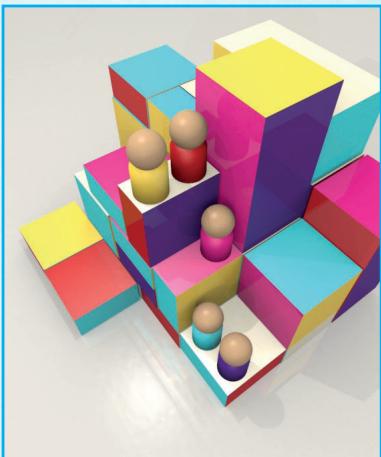
Climbers of all colors may occupy neutral surfaces. Otherwise, the color of the Climber must match the color of the surface.

The blocks are divided into smaller, imaginary squares to accommodate Climbers. The grid is used to prevent any ambiguous situations of placing blocks by ensuring at least 1 smaller square matches up with that of another block.
Size 1 blocks
These blocks can be placed horizontally (laying) or vertically (standing). In the horizontal position, up to 4 Climbers can occupy the neutral square surface. The height of the block in this position is 1, which is the eye height of the Climbers. This height of 1 is the height a Climber can climb without requiring a ladder.
In the vertical position, the height of the block is 2. A ladder is required to climb a Size 1 block in the vertical position. When oriented vertically, up to 2 Climbers may occupy the neutral rectangular surface of the Size 1 block.

Size 1 blocks can be ascended without a ladder
Size 2 blocks
These cubes each have a square neutral surface which can be occupied by a maximum of 4 Climbers. These blocks have a height of 2 in all orientations. A ladder is required to climb these blocks.

Size 2 blocks require at least a short ladder to climb
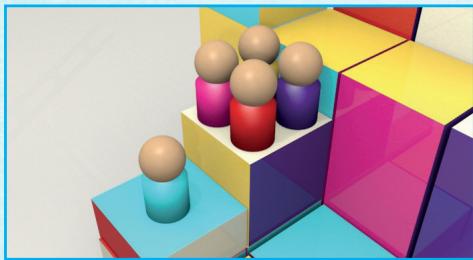
The neutral surface is fully occupied – the teal Climber cannot climb to the neutral surface!
Size 4 blocks
These blocks can be placed horizontally (laying) or vertically (standing). In the horizontal position, all Climbers can occupy the neutral rectangular surface. The height of the block in this position is 2. A ladder is required to climb this distance.
In the vertical position, the height of the block is 4. A long ladder is required to climb a height of 4. When oriented vertically, up to 4 Climbers may occupy the neutral square surface of the Size 4 block.

Size 4 blocks require a long ladder to climb.

All 5 Climbers may occupy the neutral surface on the horizontal side of a Size 4 block.
The Ladders
In general, any distance greater than the height of your climber requires the use of a ladder.
A Climber can freely climb a difference of height 1 (equal to the height of a horizontal Size 1 block). To overcome a distance greater than a height of 1, a ladder is required!
Short ladders can be used for a height of 2.
Long ladders can be used for a height of 2, 3, or 4.
Ladders may only be used to climb the sides of a block. Ladders may not be used to climb diagonally.
Both ladders may be used on the same turn. However, the Climber must reach a surface in between using both ladders. Therefore, both ladders may not be combined into a single, very long ladder.
Once used, the ladder is immediately removed from the game.
The Blocking Disks
During their turn, the player may place their blocking disk on any unoccupied, free surface. This block is now blocked for the next round. It cannot be occupied, crossed, or moved. Other blocks may not be moved on top of this block. A blocking disk may be placed on any colored surface, including neutral. After one round, when play returns to the player who originally placed the blocking disk, the blocking disk is removed from the game.

Short ladder

Long ladder

Blocks with blocking disks may not be moved or occupied by any Climber for one round.
Preparation
- Place the 2 large neutral blocks vertically next to each other in the middle of the table. All colored blocks are then randomly built around these so that both neutral blocks are completely hidden.


All players can join together in building this structure! We recommend placing the larger blocks closer to the bottom and the Size 1 blocks towards the top. Blocks may be offset, like bricks in a wall. However, the undersurface of each block must have full contact with the blocks underneath – there cannot be any holes or overhanging blocks!
- Each player randomly chooses a Climber and takes the corresponding blocking disk, plus one short ladder and one long ladder.
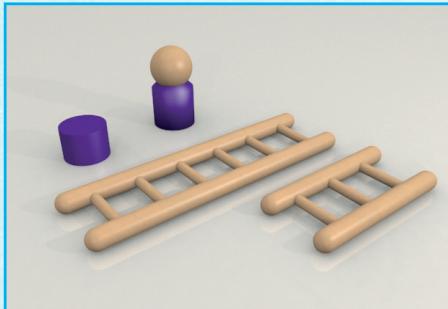
- Place all Climbers on the table near the structure of blocks.

Holes and overhanging blocks are not allowed! Blocks must have full contact of their bottom side with the block(s) underneath.

Gameplay
The player who most recently climbed a mountain goes first. Otherwise, the starting player is determined randomly. Players take turns in clockwise order from the start player.
Turn Sequence
On their turn, a player may Move their Climber as far as legally possible. This includes horizontal and upward movement. The player may also, at any time during their turn, move and/or rotate 1 unoccupied block. The player may also use their blocking disk and/or any of their ladders at any time during their turn.
Move Climber
• Climbers may only touch surfaces matching their color or the neutral color.
A player may never move their Climber diagonally onto another block or downward to another block!
• Climbers may not enter a surface that exceeds the limit of allowable Climbers
• A player may use one or both of their ladders on the same turn
If able, the other players may move their Climber upward (following turn order) after the current player completes their turn.

The Red Climber is able to climb 2 steps in one move

The Purple Climber cannot cross diagonally to the next block.

The Purple Climber may now move up to the topmost surface.
Move Blocks
All unoccupied blocks, except for the block moved by the previous player, may be moved – including the large neutral blocks.
Blocks may be placed anywhere else with at least one of its sides touching the main structure. Blocks may be rotated and placed back in the same spot.
Players may look under a block to investigate the upper surface below. This block may be placed back in its original space and is considered to not have moved, provided it has not been rotated.
It is possible to split the main structure into isolated parts.
Players may place a block on another block occupied by one or more Climbers by pushing the Climbers to make room for the block. Climbers may not be displaced from the block they occupy when placing the block.

This Size 1 block displays the minimum requirements for placing a block: One of its imaginary squares touches another on the main structure.
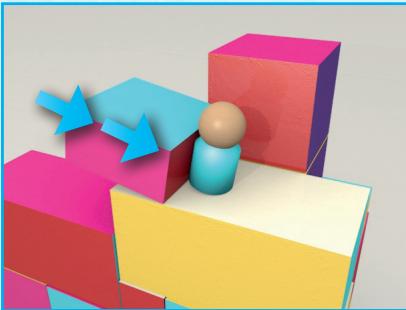
Climbers may be pushed in order to place a block.
End of the Game
Play continues until each player consecutively fails to move their Climber upward on their respective turn. The winner is the player with the Climber that has reached the highest level. If more than one Climber is at the same height, the Climber that reached that height first is the winner.
Designer: Holger Lanz
Graphics: Konstantin Vohwinkel
Rulebook: Rafaël Theunis
Development: Clay Ross

Capstone Games
339 Smith Drive
Clayton, OH 45315
Share your Climbers stories with us!
TheClimbers

@Capstone_Games

Facebook.com/CapstoneGames
下载 Markdown原文为社区整理/出版社公开资料,版权归原作者,仅供个人学习查阅。