
卡拉拉宫殿The Palaces Of Carrara
一句话概览
卡拉拉宫殿 是一款已收录于村了吗规则库的桌游,支持 2–4 人,原名 The Palaces Of Carrara。
本页内容:一句话概览 · 游戏概述 · 1. 游戏组件 · 2. 游戏设置 · 3. 游戏流程 · 4. 行动一:购买方块 · 5. 行动二:建造建筑物 · 6. 行动三:计分 · 7. 游戏结束与目标 · 8. 最终计分 · 9. 平手判定 · 关键规则与常见问题 · 常见问题
卡拉拉宫殿 规则速览
以下规则速览由本站整理,与官方规则书表述不同,仅供快速上手参考。
游戏概述
《卡拉拉宫殿》是一款供2-4人游玩、14岁以上、约60分钟的策略游戏。每位玩家是王侯家族的主导者,奉国王之命在不同城市建造富丽堂皇的建筑物,并收集最不寻常的物件;建造的位置会决定获得的分数与金钱,金钱又能用来换取更多建筑材料。游戏在最后一个建筑物被建造、或有人完成全部目标宣告结束时落幕,最终计分时分数最高的家族获胜。
核心机制: 轮盘购买、方块颜色限制、区域建造、多路径计分、目标达成
1. 游戏组件
| 组件 | 数量/说明 |
|---|---|
| 游戏图板 | 1块(使用时用有树在右下角的那一面) |
| 目标图板 | 1块(印有3个目标与游戏结束条件) |
| 玩家图板 | 每位玩家1块(含6个城市) |
| 挡板 | 每位玩家1个(对应所属颜色) |
| 建筑板块 | 30个(6种,每种5个,花费从1到5) |
| 方块 | 42个(6种颜色,每种7个) |
| 布袋 | 1个 |
| 物件 | 36个(共6种) |
| 钱币 | 40个(1元20个、5元10个、10元10个) |
| 计分标记 | 每位玩家7个(同色) |
| 分数标记 | 4个(50/100) |
| 起始玩家标记 | 1个 |
建筑物种类:
- 共有6种不同建筑物,每种出现5次,花费从1到5。
- 2种田园建筑(绿色):城堡及别墅。
- 4种城市建筑(橘色):图书馆、王宫、城门及教堂。
2. 游戏设置
2.1 第一次游戏前
- 组合轮盘(详见目标图板背后的说明)。
- 进行2或3人游戏时,把多出来的配件放回盒中。
2.2 图板与建筑板块
- 把游戏图板和目标图板放到桌子中央。
- 面朝下洗混30个建筑板块,拿取9个面朝上放到图板左下角的区域中。
- 剩余的建筑板块形成抽牌堆,放到图板旁。
2.3 物件与钱币
- 把36个物件依种类分类:每种物件各拿1个放到图板上的供应区(共6个物件);每种剩余的5个(共30个)放到游戏图板旁。
- 每个玩家拿取总值20元的钱币放到自己的挡板后;剩余钱币放到图板旁当作银行。
- 4个分数标记(50/100)放到游戏图板旁。
2.4 玩家设置
- 每个玩家拿取1个玩家图板及1个自己所属颜色的挡板。
- 每个玩家拿取自己颜色的7个计分标记放到面前,再拿其中1个放到计分轨上「0」的位置;此时每人面前应有6个标记。
2.5 起始玩家与方块
- 最近到过意大利或看过意大利照片的玩家为起始玩家。
- 起始玩家拿取起始玩家标记以及1个黑色方块。
- 依照顺时针顺序,第二位玩家拿1个蓝色方块,第三位玩家拿1个绿色方块,第四位(最后一位)玩家拿1个红色方块。
- 每位玩家各有一个不同颜色的方块,把它放到挡板后。
2.6 轮盘与布袋
- 轮盘分成6个区块(I-VI),把上面印有箭头的那个区块对准V。
- 每个颜色的方块各拿1个放到轮盘上的区块I。
- 把剩余的方块放到布袋里。
3. 游戏流程
- 由起始玩家开始,依照顺时针方向进行。
- 每个玩家在自己的回合执行一个行动,可从以下三者中择一:购买方块、建造建筑物、计分。
- 当前玩家执行行动后,由坐在他左手边的玩家进行他的回合,依此类推。
- 在每个行动之后,玩家还可以执行一次「额外购买」。
4. 行动一:购买方块
这个行动让玩家从轮盘上购买方块,这些方块在稍后建造时会用到。
步骤:
1. 顺时针转动轮盘一个区块。
2. 之后从布袋里抽出方块(不能偷看),直到轮盘上总共有11个方块;新抽出的方块放到区块I。
3. 现在可以从所选的其中一个区块购买方块。每个区块会指示每种颜色的方块花费;如果指示的颜色没有出现,你可以免费拿取该颜色的方块。你必须至少买一个方块,拿取一个免费方块也视同购买。
4. 把对应的金钱付给银行,把买来的方块放到挡板后,回合结束。
起始状态: 游戏一开始,区块I会有每种颜色的方块各1个。在区块I,一个白色方块花费6元、黄色5元、红色4元,依此类推。
范例(开局): 在顺时针转动轮盘后,玩家从布袋抽出5个方块放到区块I,轮盘上共11个方块;然后从区块II购买3个方块:1个绿色2元、1个蓝色1元、1个黑色免费,共付3元给银行。他也可以改为购买区块I的方块。
范例(游戏途中): 此时轮盘上有9个方块,玩家行动时顺时针转动轮盘一个区块,接着从布袋抽2个方块放到区块I,轮盘上共11个方块;他从区块VI购买2个方块,付给银行1元(白色方块1元,黄色方块免费)。
注意: 若玩家没有足够的金钱购买,而且那里没有免费的方块,须查阅下方特殊情况2。
4.1 购买行动的五种特殊情况
- 区块转回区块I: 当玩家转动轮盘、方块从区块VI转到区块I时,轮盘依旧放足11个方块,但这些方块会变得更加昂贵。
- 玩家付不出钱: 在选择购买行动并转动轮盘后,若玩家付不出钱购买任何方块(钱不够,或那里没有免费方块),他必须拿起挡板向大家展示他确实没有足够的钱购买一个方块;接着他从银行拿2元,回合结束,且他拿了钱之后不能再购买任何方块。
- 布袋里没有方块: 没有方块会增加到轮盘上,玩家仍旧可以选择购买方块行动——顺时针转动轮盘一个区块,并购买本来就在轮盘上的方块;他也可以向大家展示没有足够的钱购买方块,并从银行拿2元放到挡板后。
- 轮盘和布袋都空: 玩家必须选择其他的行动;若他不能选择其他行动,必须拿起挡板向大家展示无法执行任何行动,接着从银行拿2元。只要有玩家建造建筑物并把一部分方块放回布袋,轮盘就会按往常方式增加方块。
- 银行没有钱: 银行里没有钱时,玩家应使用其他配件来代替金钱。
5. 行动二:建造建筑物
玩家使用方块来建造图板上可用的建筑物。一旦建造,玩家把所选的建筑物放到自己的玩家图板上,并把该建筑物所需花费的方块放回布袋。
建筑板块信息: 每个建筑板块会显示它的建筑种类、一个相关物件,以及建造所需的方块数量(即建造花费)。
5.1 建筑种类与玩家图板
- 共有6种不同建筑物,每种出现5次,花费从1到5。
- 2种田园建筑(绿色):城堡及别墅。
- 4种城市建筑(橘色):图书馆、王宫、城门及教堂。
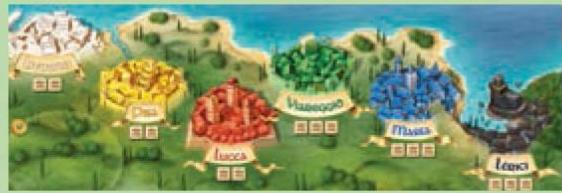
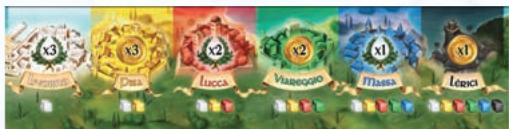
- 玩家图板展示6个城市:Livorno、Pisa、Lucca、Viareggio、Massa、Lerici。每个城市的价值显示在图板上部(例如×3);图板下部显示6种建筑种类,以及用于计分的下半部分。
- 玩家自行选择要在哪个城市建造自己的建筑物,并把建筑物放到该城市的上方。
5.2 建造步骤
- 拿取图板上现有9个可用建筑物中的1个(不是从抽牌堆取)。
- 把这个建筑物建造到你其中一个城市上。
- 支付方块花费:按建筑物上指示的方块数量,把这些方块从挡板后拿出来,并放回布袋。
- 从抽牌堆抽新的建筑物,面朝上补充到空的区域上;若抽牌堆已空,则没有新建筑物可以补充。当玩家结束建造行动,他的回合结束。
5.3 可建造的城市(由方块颜色决定)
玩家能放置建筑物的城市取决于建造所花费方块的颜色;玩家可以使用不同颜色的方块,虽然并非一定得这么做:
| 城市 | 可接受的方块颜色 |
|---|---|
| Livorno | 只能用白色方块 |
| Pisa | 只能用白色及黄色方块 |
| Lucca | 只能用白色、黄色及红色方块 |
| Viareggio | 只能用白色、黄色、红色及绿色方块 |
| Massa | 只能用白色、黄色、红色、绿色及蓝色方块 |
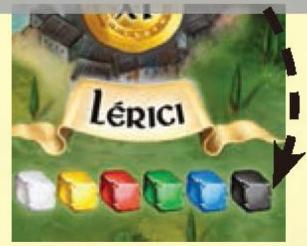
| Lerici | 可以用任何颜色的方块 |
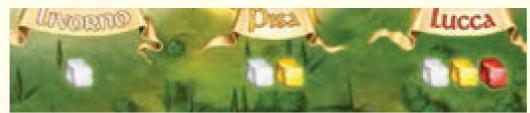
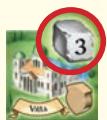
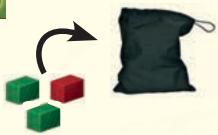
范例: 玩家拿取一个花费3个方块的别墅,用1个红色及2个绿色方块支付,建造在Viareggio。由于他用了绿色方块,他不能建造在Lucca、Pisa或Livorno,因为这些城市不接受绿色方块。
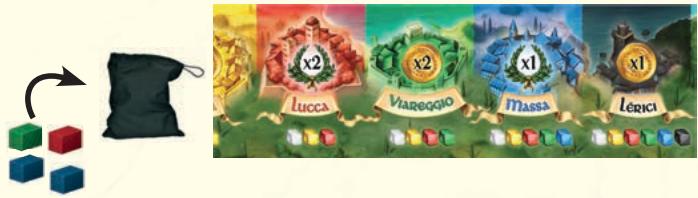
范例: 玩家拿取一个花费4个方块的建筑物,用1个红色、1个绿色及2个蓝色方块支付,建造在Lerici。他也可以建造在Massa,因为他所用的最廉价的方块是蓝色。建造在较廉价的城市有其理由,例如玩家可能想在计分阶段获得金钱而不是分数。
6. 行动三:计分
这个行动让玩家获得金钱、分数(VPs)以及物件。每位玩家有6个计分标记,因此每场游戏最多可以执行这个行动6次。
玩家可以从两种途径计分:依建筑种类计分,或依城市计分。
6.1 为一种建筑种类计分
只有在你玩家图板上的建筑物才会计分。
- 选择你想要计分的建筑种类。你必须至少有一栋该种类、而且是还没计分过的建筑物;接着,你为你在该种类的所有建筑物计分。
- 决定你会获得多少金钱或分数:把每栋建筑物的花费乘上它所在城市的价值。
- 例:花费3×3元=9元(建造在Pisa的图书馆)。
- 例:花费2×1分=2分(建造在Massa的图书馆)。
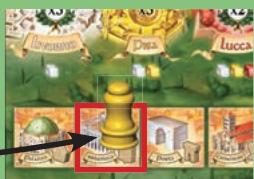
在这个计分行动中,玩家总共获得9元及2分。同时,为每栋计分的建筑物拿取1个对应种类的物件(本例中拿2本书,物件分配给图书馆板块)。 - 马上依据你获得的分数,移动计分轨上的计分标记;金钱及物件放到挡板后。接着把你一个计分标记放到玩家图板上你刚计分的该种建筑区域。
注意: 玩家从每栋计分的建筑物只会获得1个物件,不论该建筑物的花费或城市的价值。如果供应区没有足够的该种类物件,你不会获得任何东西(或只有在这些物件还能拿时才会得到);然而,玩家总是会得到分数或金钱。
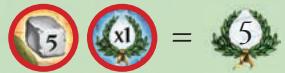
范例: 玩家为他的2个王宫计分,这2个王宫都在Massa。花费5×1分=5分,花费1×1分=1分,他总共获得6分,并各获1个皇冠(共2个);之后他把一个计分标记放到玩家图板上的王宫区域。
限制: 每位玩家每场游戏只能为每种建筑物计分一次;玩家不能用其他玩家的玩家图板来做计分行动。
6.2 为一个城市计分
城市计分使用游戏图板上的城市区块;城市区块只会用来计分,不能在那里建造建筑物。
条件(须同时满足):
1. 该城市尚未被计过分(被任何玩家)——换言之,图板上该城市还没有被放置一个计分标记。
2. 你在该城市的玩家图板上已建造至少2栋建筑物(Livorno、Pisa或Lucca),或至少3栋建筑物(Viareggio、Massa或Lerici)。
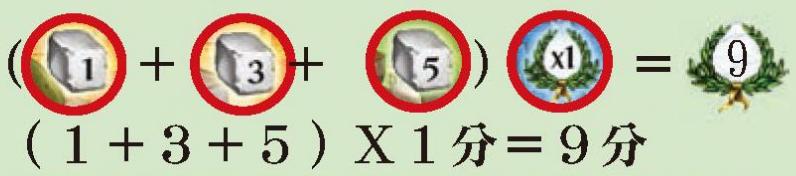
计算方式: 先把你在该城市所有建筑物的花费加总,再把这个总数乘上该城市的价值。
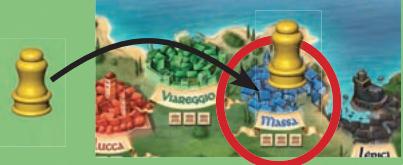
范例: 玩家在Pisa建造了花费为2与4的建筑物,满足两个条件后为Pisa计分:(2+4)×3元=18元。他从银行拿取18元放到挡板后,同时也为他在Pisa的每栋建筑物各获1个物件,并把计分标记放到游戏图板上Pisa的城市区域。此后,没有其他玩家能够再为Pisa计分。
注意: 玩家总是从每个计分的城市获得1个物件,无论建筑物的花费或城市是什么。如果供应区没有足够的该种类物件,你不会获得任何东西(或只有在这些物件还能拿时才会得到);然而,玩家总是会得到分数或金钱。
限制: 每个城市每场游戏只能被计分一次;一旦玩家已完成计分,他的回合结束。
6.3 额外购买
在每个行动(购买方块、建造建筑物、计分)之后,你可以执行一次额外的购买行动:从图板上购买1个物件——只需拿取一个可拿的物件,把它放到你的挡板后,并付10元给银行。如果图板上没有物件,就没有物件可以被购买;图板上的物件不会补充。
7. 游戏结束与目标
游戏会在以下两种方式之一出现时结束:
- 最后一个图板上的建筑物被建造时。 游戏在第30个建筑物(最后一个建筑物)被一个玩家从图板上移走并建造时结束。游戏轮次会全部跑完,让每个玩家都有相同的轮次;最后一轮后,玩家进行最终计分。
- 玩家完成目标图板上的3个目标并宣告游戏结束。
7.1 三个目标
非常重要: 每个目标的资讯总是代表一个最低要求。
- 目标1(首席卡,咖啡色): 你必须至少完成4个计分行动。这只是游戏结束的目标,玩家游戏结束时不会因为这个目标获得分数。
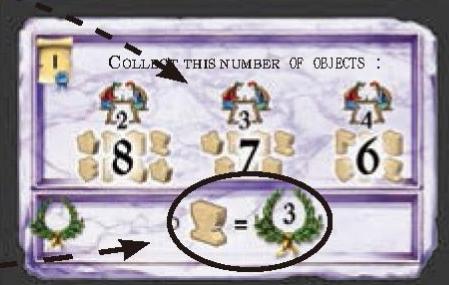
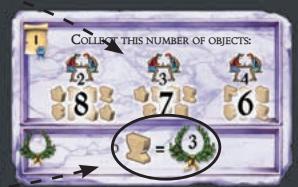
- 目标2(物件卡,紫色): 你必须收集一个特定数量的物件——4人游戏时6个物件、3人游戏时7个物件、2人游戏时8个物件。最终计分时,每位玩家为每个物件获得3分。
- 目标3(建筑卡,灰色): 你所拥有的建筑物花费总数要达成——4人游戏时20个建筑方块、3人游戏时25个建筑方块、2人游戏时30个建筑方块。游戏结束时,每位玩家获得等同于他所有建筑物花费加总总值的分数。
额外分数卡(绿色)在基本版的游戏中不会用到。
7.2 宣告游戏结束
- 如同往常,玩家执行3个行动中的一个。在他完成所有3个目标后,他可以宣告游戏结束:他拿起挡板向大家展示他已经收集到所需数量的物件,其他两个目标(计分4次及建筑物的总花费)可以清楚地看到。玩家也可能在回合一开局就已经完成3个目标,他可以选择先不宣告;也可以选择在回合一开局就宣告。
- 玩家马上因为宣告游戏结束获得5分。
- 接着,这一轮继续进行直到结束,让每个玩家都有相同的回合数。注意:这一轮尚未行动的玩家不必一定要执行最后一个行动;其他玩家不能宣告游戏结束,即使他已经完成3个目标也不行。
- 游戏现在结束,玩家进行最终计分。
特殊情况: 若一名玩家宣告游戏结束、拿起挡板后却揭露他尚未完成全部3个目标,游戏按一般流程继续进行;游戏会在任何玩家(同一个或另一个)宣告游戏结束、且3个目标都达成时结束。另一方面,游戏也会在最后一个建筑物从图板上被移走并被建造时结束。
记住:
- 为了宣告游戏结束,玩家必须完成所有3个目标;即使超过目标的需求,也算完成。
- 每位玩家在最终计分时都会获分,无论目标的数量有没有完成。
- 最终计分总是在游戏结束时发生,无论结束是由宣告引发,还是由最后一座建筑物被建造所引发。
8. 最终计分
游戏结束时,所有玩家获分。每位玩家获得:
- 每个收集的物件3分(紫色物件卡)。
- 建筑物的总花费换算成分数(灰色建筑卡)。
- 每5块钱=1分。
四人游戏范例: 玩家完成了所有3个目标并宣告游戏结束。他已计分4次,但不会因此获得任何分数;他收集了7个物件(7×3=21分);他的建筑物总花费是23(1+4+3+5+2+3+5=23分);他剩下4元(0分)。他总共获得44分。
两人游戏范例: 玩家没有宣告游戏结束,因为他只完成3个目标中的1个。他计分五次(不获分);他收集了6个物件(6×3=18分);他的建筑物总花费是25(2+4+4+3+5+1+2+4=25分);游戏结束时他剩下31元(30÷5=6分,剩余无法整除的金额不计分)。他总共获得49分。
9. 平手判定
若有两名或以上玩家在游戏结束时同分(最高分),则拥有最多方块的玩家获胜,不用管方块的颜色;如果仍然平手,则共享胜利。
关键规则与常见问题
易错规则
- 每次购买方块必先顺时针转动轮盘一个区块,再把轮盘补充到11个方块。
- 购买必须从单一区块购买,且每次购买行动至少买1个方块;拿取免费方块也视同购买。
- 可建造的城市由所用方块颜色决定:例如用过绿色方块,就不能建在Lucca、Pisa、Livorno。
- 建造必须从图板上的9个可用建筑物中拿取,不是从抽牌堆取。
- 建造后的方块放回布袋,不是丢弃。
- 计分前该种类/该城市必须尚未被计分,且须满足最低建筑数量要求。
- 每位玩家每场游戏每种建筑物只能计分一次,且不能借用他人的玩家图板计分。
- 每个城市每场只能被计分一次,一旦被任何人计分,其他人不能再为它计分。
- 物件数量不足时不获得物件,但分数或金钱照样获得。
- 宣告游戏结束须完成全部3个目标,并立即获得5分;未完成而宣告则游戏按一般流程继续。
- 计分4次只是结束目标,本身不给分。
- 额外购买每次行动只能执行一次,每个物件10元,且图板上的物件不会补充。
常见问题
-
Q:转轮盘时有方块从区块VI转到区块I会怎样?
A:轮盘依旧放足11个方块,但这些方块会变得更加昂贵。 -
Q:付不出钱买方块怎么办?
A:拿起挡板向大家展示确实不够钱买一个方块,然后从银行拿2元;回合结束,且拿了钱后不能再购买方块。 -
Q:布袋空了还能选择购买方块吗?
A:可以,顺时针转动轮盘一个区块后,购买轮盘上本来就有的方块;也可以展示没有足够金钱购买,并从银行拿2元。 -
Q:轮盘和布袋都空了怎么办?
A:必须选择其他行动;若不能选择其他行动,可展示无法执行任何行动后从银行拿2元。有人建造并把一部分方块放回布袋后,轮盘会按往常方式增加方块。 -
Q:计分是怎么算的?
A:依种类计分=每栋建筑的花费×所在城市价值;依城市计分=该城市所有建筑花费总和×城市价值。 -
Q:城市计分需要满足什么条件?
A:该城市尚未被计分,且你在该城市已建2栋(Livorno/Pisa/Lucca)或3栋(Viareggio/Massa/Lerici)建筑物。 -
Q:游戏什么时候结束?
A:第30个建筑物被建造时,或玩家完成3个目标并宣告游戏结束时。 -
Q:最终计分包含哪些项目?
A:每个物件3分、建筑物总花费换算成分数、每5元金钱1分。 -
Q:同分怎么决定胜负?
A:方块总数最多者获胜(不论颜色);若仍平手则共享胜利。 -
Q:起始有多少钱和计分标记?
A:每人起始20元;每人7个计分标记,其中1个放在计分轨「0」位置。
常见问题(FAQ)
以下 1 条问答中 0 条来自站内玩家的真实提问,其余 1 条为本站整理的常见疑问;答复内容保持原样。
卡拉拉宫殿支持几个人玩?
2–4 人。
去哪查完整规则
想核对具体规则细节、卡牌效果或某个回合的结算方式,可以在村了吗里选中这款游戏后直接提问。
同类桌游
- 卡坦岛德式
- 工业革命:伯明翰德式
- 勃艮第城堡:特别典藏版德式
- 方舟动物园德式
- 卡卡颂抽象
- 瘟疫危机传承:第一季美式
- 阿瑞迪亚:勇踏征途美式
- 重塑宇宙德式
- 幽港迷城美式
- 埃多拉的德鲁伊德式
规则原文(Markdown)
本站收录这款游戏的规则原文 3 个文件,此处内联渲染 3 个,可直接展开阅读或下载。
rules_zh_卡拉拉宫殿_8498.md29.8 KB
遊戲配件及遊戲設置
在你的第一場遊戲前:
組合輪盤:詳見目標圖板背後的說明。
進行 2 或 3 人遊戲時,
把多的配件放回盒中。
-
分數標記(4個50/100)放到遊戲圖板旁。
-
每個玩家拿取他們自己顏色的7個計分標記,並放到他們自己面前。接著,每個玩家拿1個標記並放到計分軌的0的位置。每個玩家現在應該有6個標記在他們面前。
-
每個玩家拿取一個玩家圖板及一個他們所屬顏色擋板。
-
首先,把遊戲圖板和目標圖板放到桌子中央。
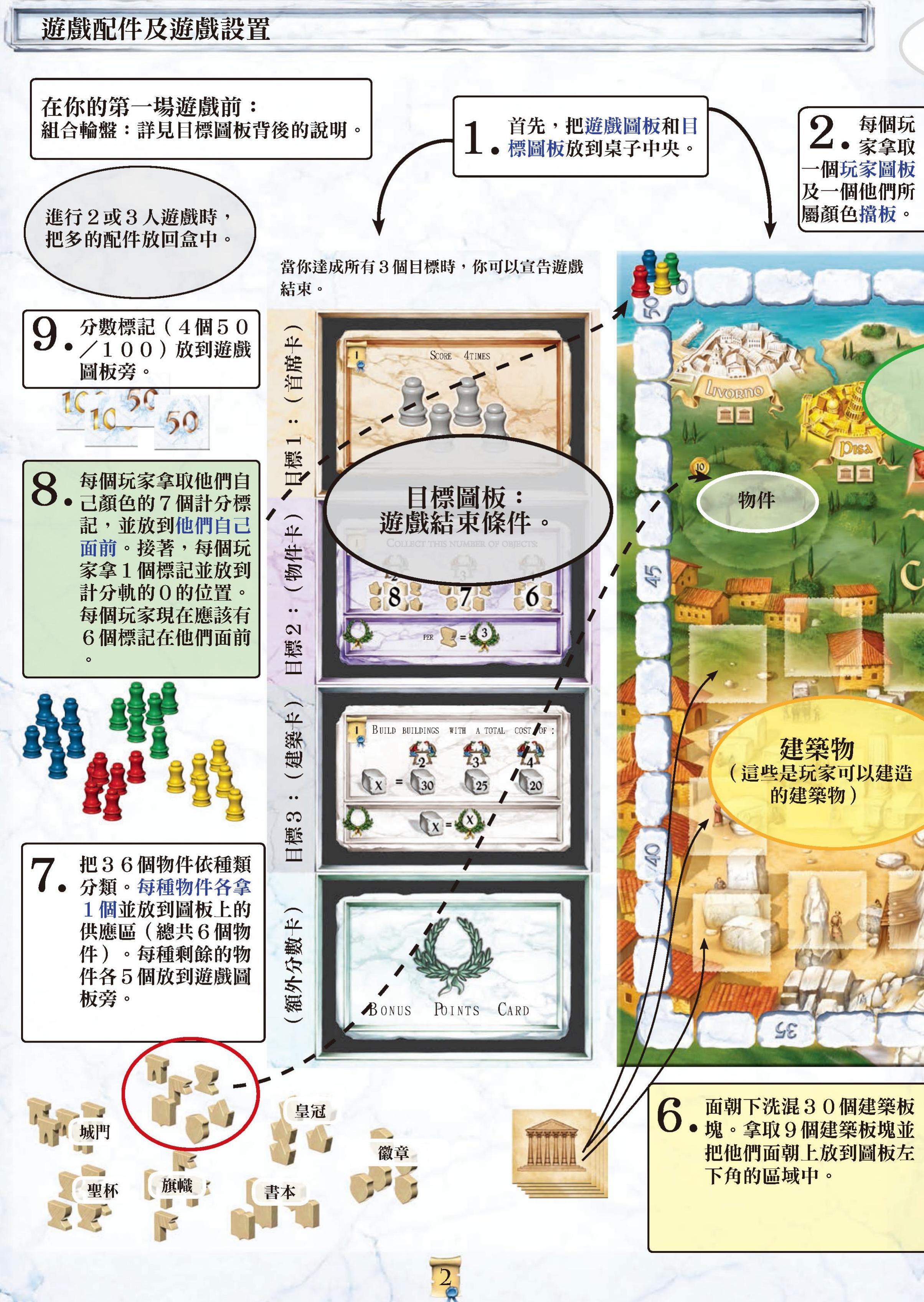
- 把36個物件依種類分類。每種物件各拿1個並放到圖板上的供應區(總共6個物件)。每種剩餘的物件各5個放到遊戲圖板旁。
(額外分數卡) 目標3:(建築卡) 目標2:(物件卡) 目標1:(首席卡)
當你達成所有 3 個目標時,你可以宣告遊戲結束。
目標圖板:
遊戲結束條件。
建築物
(這些是玩家可以建造
的建築物)
- 面朝下洗混30個建築板塊。拿取9個建築板塊並把他們面朝上放到圖板左下角的區域中。

使用有樹在右下角的那面(見插圖)。
城市區
(這裡是城市計分的地方)

輪盤
(這裡是玩家購買方塊的
市場)
Lérici
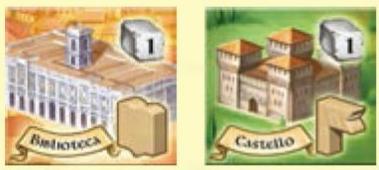
剩餘的建築物形成抽牌堆,放到圖板旁。建築物總共有6種並分成兩種類別:城市建築(20個畫有橘色背景的),以及田園建築(10個畫有綠色背景的)。
一個給2-4人進行,快速的戰略及策略遊戲。14歲以上,60分鐘。
3 40個錢幣
• (1元20個、5元10個、10元10個)每個玩家拿取總值為20元的錢幣,並放到他們的擋板後。剩餘的錢幣放到圖板旁當作銀行


- 最近一個有到過義大利或看過義大利照片的玩家為起始玩家。起始玩家拿取起始玩家標記以及一個黑色方塊。依照順時針順序,第二位玩家,拿取一個藍色方塊,第三位玩家拿取一個綠色方塊,第四個也就是最後一位玩家拿取一個紅色方塊。現在每個玩家應會有一個不同顏色的方塊,把它們放到擋板後面。

(總共有42個方塊,6種顏色,每種7個。)
- 輪盤分成6個區塊(I-VI)。把上面印有箭頭的那個區塊對準V。每個顏色的方塊各拿一個放到輪盤上的區塊I。

布袋
把剩餘的方塊放到布袋裡。
遊戲概覽
每個玩家是王侯家族的主導者。國王下令各家族要建造富麗堂皇的建築物到不同的城市中,建造最不尋常的物件會使他們富裕。在特別的時刻,各家族會邀請國王來視察他們的進度。各家族會根據他們在何處建造建築物來獲得分數、金錢,這可以使他們用來獲取更多的建築材料。遊戲結束時,最多分的家族贏得勝利!
遊戲進行
由起始玩家開始,然後按照順時針進行,每個玩家在他的回合時執行一個行動。他可以選擇以下的行動之一:
1。購買方塊
2。建造建築物
3。計分
在當前的玩家執行行動後,坐在他左手邊的玩家進行他的回合,依此類推。
行動 1:購買方塊
這個行動讓玩家從輪盤上購買方塊。這些方塊在稍後建造時會用到。
Cost ofblocks whenin Section
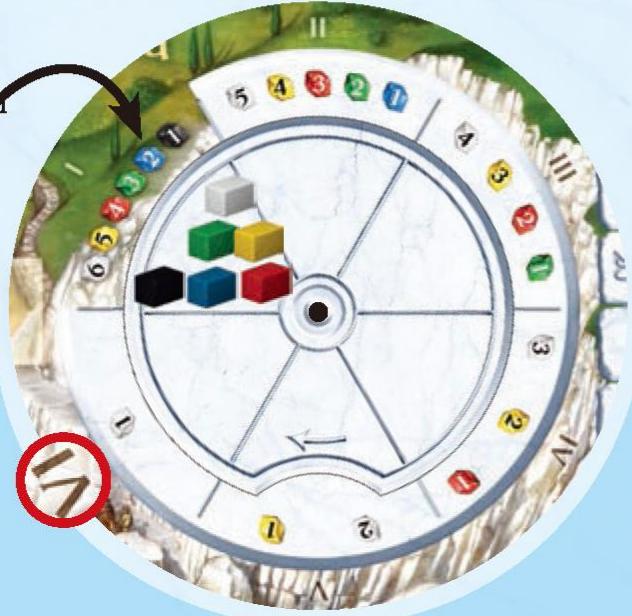
遊戲一開始:區塊Ⅰ會有每種顏色的方塊各1個。(在區塊Ⅰ、一個白色方塊花費6元、一個黃色方塊花費5元、一個紅色方塊花費4元,依此類推。)
- 當你選擇「購買方塊」行動時,你必須順時針轉動輪盤一個區塊。
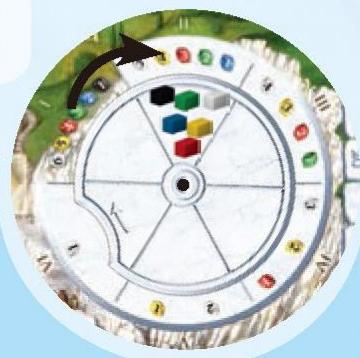
- 之後,你必須從布袋裡抽方塊出來,不能偷看,直到總共有 11 個方塊在輪盤上。這些新抽出來的方塊放到區塊 I。

一場遊戲一開始的一個「購買方塊」行動範例:
在順時針轉動輪盤後,玩家從布袋中抽5個方塊,不能偷看,並把他方到區塊Ⅰ。現在輪盤上總共有11個方塊。
- 你現在可以從你所選的一個區塊購買方塊。每個區塊會指示每種顏色的方塊花費。如果指示的顏色沒有出現,你可以免費拿取該顏色的方塊。你必須至少買一個方塊。拿取一個免費的方塊視同購買一個方塊。
(注意: 如果玩家沒有足夠的金錢來購買, 而且那裏沒有免費的方塊, 請查閱第 5 頁的特殊情況。) 如果你可以購買方塊, 把對應的金錢付給銀行。你把買來的方塊放到你的擋板後, 你的回合結束。
一場遊戲一開始的一個「購買方塊」行動範例:
玩家從區塊ⅠⅠ購買3個方塊:1個綠色花費2元、1個藍色花費1元,以及1個黑色免費。他把3元付給銀行。
注意:該玩家也可以購買區塊Ⅰ而非區塊Ⅰ中的方塊。
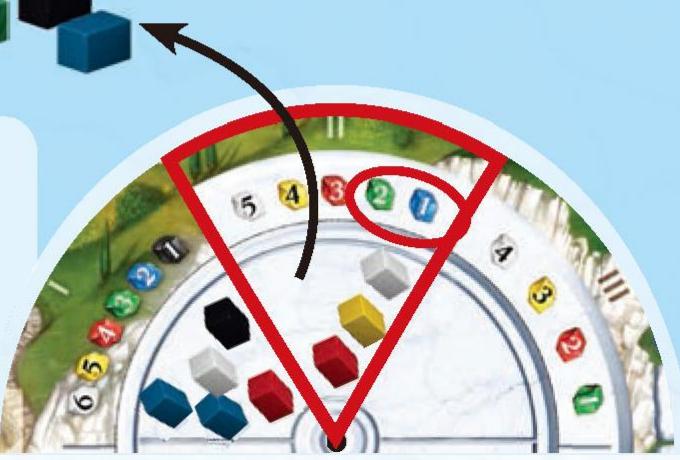
一個發生在遊戲途中的「購買方塊」行動範例:

現在,輪盤上有9個方塊。玩家開始行動,順時針轉動輪盤一個區塊。轉動輪盤後,玩家接著從袋子抽2個方塊,並把它們放到輪盤的區塊Ⅰ。現在輪盤上有11個方塊。

玩家從區塊V I 購買2個方塊。他付給銀行1元(白色方塊 1 元,黃色方塊 免費)

因此,每個「購買方塊」行動根據下列流程:1、玩家順時針賺動輪盤一個區塊。2、玩家增加方塊到輪盤上,讓輪盤上的方塊總數保持11個,最後,3、他購買方塊。
有 5 種特殊情況,你現在也許可以跳過閱讀這些情況。遊戲中發生這些情況時,請查閱以下說明:
1、如果輪盤的一個區塊轉回到區塊Ⅰ的時候該怎麼辦?
當玩家轉動輪盤而且方塊從區塊V I 轉到區塊 I 時,輪盤依舊如往常放足 1 1 個方塊。如果方塊是從區塊V I 轉到區塊 I,它們會更加昂貴。
2、如果有玩家付不出錢來呢?
如果,在選擇「購買行動」且轉動輪盤之後,玩家付不出錢購買任何的方塊(因為他沒有足夠的金幣,或者因為那裏沒有免費的方塊),以下狀況發生:該玩家必須拿起它的擋板並向大家展示他的確沒有足夠的錢購買一個方塊。接著,他從銀行拿2元。他的回合結束,他不能從銀行拿取金錢後又購買任何方塊。
3、如果布袋裡沒有方塊時怎麼辦?
當布袋是空的狀況,沒有方塊會增加到輪盤上。玩家仍舊可以選擇「購買方塊」行動。玩家將順時針轉動輪盤一個區塊,並且接著購買本來就在輪盤上的方塊。他也可以向大家展示說沒有足夠的錢購買方塊,並從銀行拿2元,把錢放到他的擋板後。
4、如果輪盤上是空的,而且布袋裡也沒有方塊時怎麼辦?
如果輪盤上是空的,而且也布袋裡也沒有方塊,玩家必須選擇其他的行動。如果玩家不能選擇其他的行動,它必須拿起他的擋板並向大家展示他無法執行任何其他的行動,接著,他從銀行拿2元。只要有玩家建造一個建築物,並把一部分的方塊返回到布袋中時,輪盤按照往常的方式增加方塊。
5、銀行沒有錢了怎麼辦?
雖然銀行裡應該會有足夠的錢,但銀行裡沒有錢是可能發生的。如果發生這種狀況,玩家應該使用其他配件來代替金錢。
行動 2:建造建築物
1 2 3 4 5
在這個行動中,玩家可以使用方塊來建造一個圖板上可用的建築物。一旦建造後,玩家把所選的建築物放到他的玩家圖板上。玩家把建築物所需花費的方塊放回布袋中。在看建築行動細節前,底下會仔細說明建築物的種類以及玩家的圖板。這些資訊對適切地了解建造規則非常重要。
每個建築板塊會顯示他的建築種類、一個物件,以及建造這個建築物所需的方塊數量(也就是建造花費)。
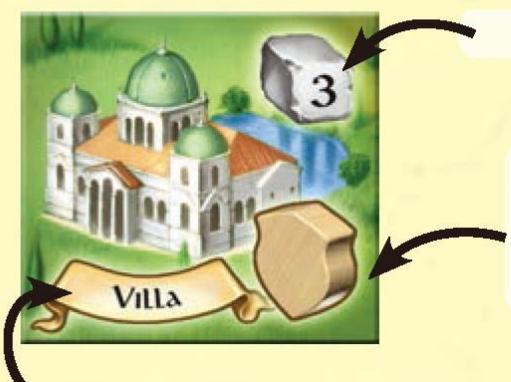
建築種類
建造花費
和這種建築相關的物件
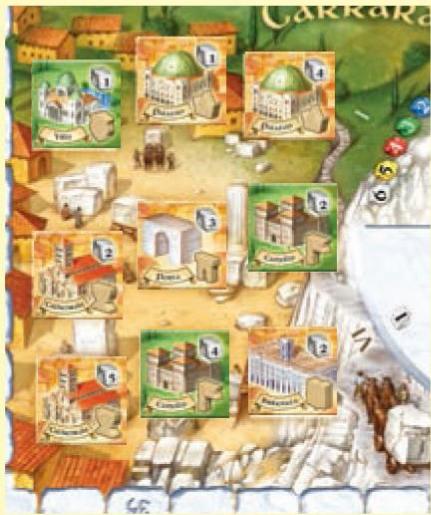
9個隨機選擇的建築物放到圖板上的這些區域。
建築種類
一共有6種不同的建築物。每種建築物會出現5次,花費從1到5。



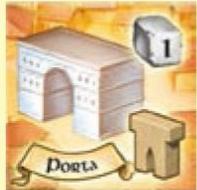
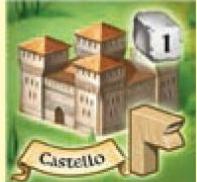
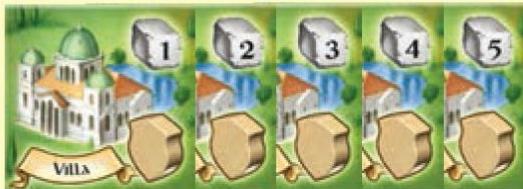
2種田園建築(綠色):城堡及別墅。
4種城市建築(橘色):圖書館、王宮、城門,以及教堂。
玩家圖板
玩家圖板展示了6個城市:Livorno、Pisa、Lucca、Viareggio、Massa、Lerici。每個城市的價值在他們的上部有顯示(×3、×3之類的)。你自己選擇要在哪個城市建造你的建築物。
下部顯示建築物的6種種類。城市,他們的價值以及用來計分的下半部分。(見第7頁「行動3:計分」)

玩家放置他們的建築物到城市的上方(這裡是舉例Pisa)
分數(用來計分)
城市,他們的顏色及價值。
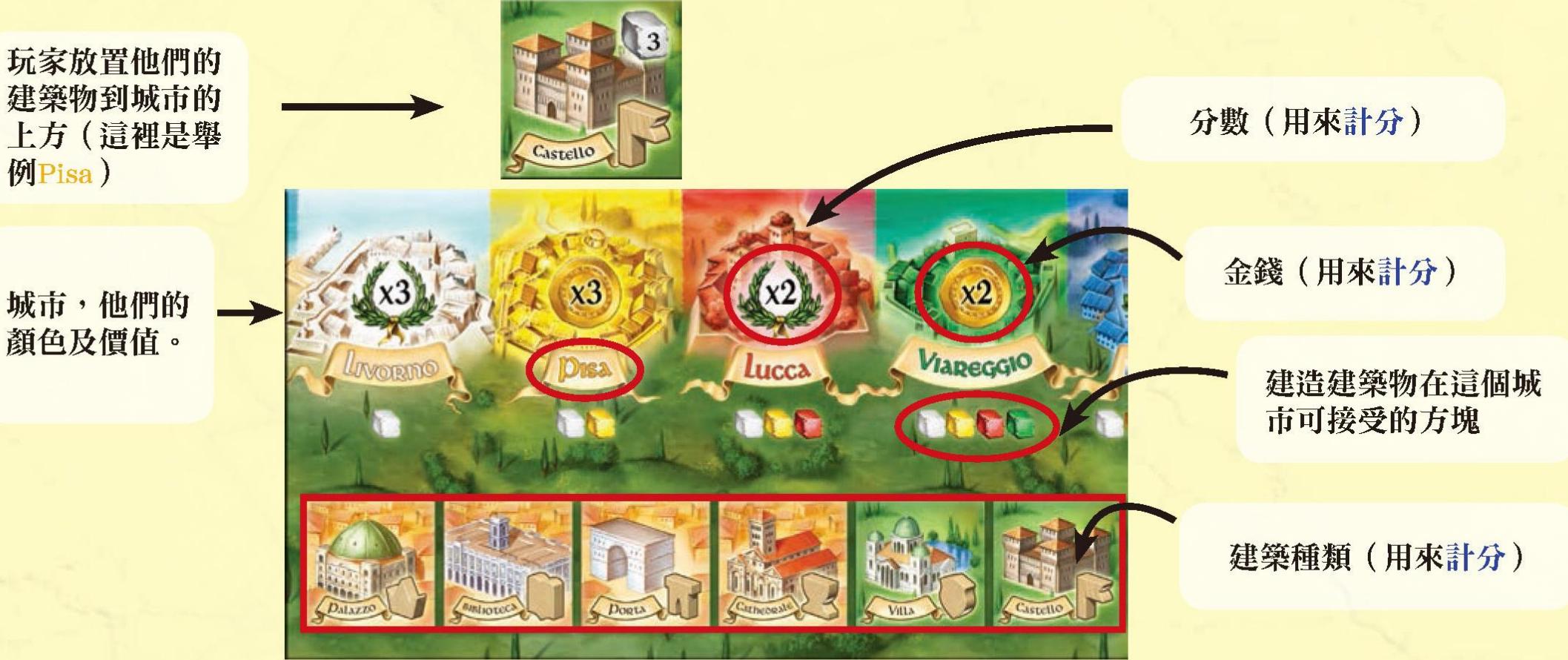
金錢(用來計分)
建造建築物在這個城市可接受的方塊
建築種類(用來計分)
「建造建築物」行動如何進行呢?
- 拿取圖板上現有9個可用建築物中的1個(不是從抽牌堆),例如拿取一個花費3的Castello。

- 建造這個建築物到你的城市中的一個;例如Pisa。

- 付方塊的花費。花費建築物上指示的方塊數量,並把這些方塊放回布袋。在這個範例中,花費3個方塊。


- 從抽牌堆抽新的建築物,面朝上補充到空的區域上。如果抽牌堆空了,沒有新的建築物可以補充。當玩家結束建造行動,他的回合結束。

玩家可以在哪個城市建造?
玩家可以放置他們建築物的城市根據建造建築物所花費的方塊顏色而定。玩家可以用不同顏色的方塊,雖然不是一定得要這麼做不可。
玩家可以建造在。。。
Livorno,只能用白色方塊。
Pisa,只能用白色及黄色方塊。


Lucca,只能用白色、黃色及紅色

Viareggio,只能用白色、黃色、紅色及綠色方塊。

Massa,只能用白色、黃色、紅色、綠色及藍色方塊。
Lerici,可以用任何顏色的方塊。

範例:玩家建造一個別墅。
玩家從圖板上拿取一個要花費3個方塊的別墅,並建造在Viareggio。

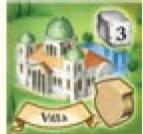
他用 1 個紅色及 2 個綠色方塊來付這個花費(3 個方塊)他把這些方塊從擋板後拿出來,並放回到布袋中。

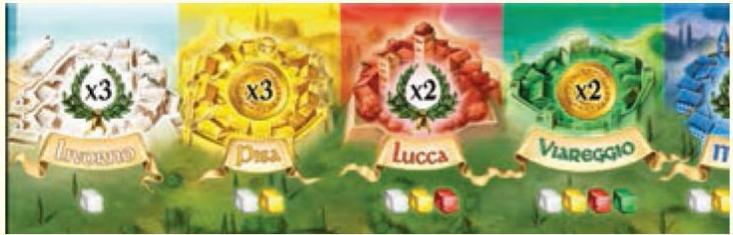
注意:因為他用了綠色方塊方塊。
,所以不能建造在Lucca、Pisa、Livorno,因為這些城市不接受綠色
範例:玩家建造了一個王宮。
玩家從圖板上拿取一個要花費 4 個方塊的別墅,並建造在Lerici。

他用 1 個紅色、1 個綠色方塊及 2 個藍色方塊來付這個花費(4 個方塊)他把這些方塊從擋板後拿出來,並放回到布袋中。
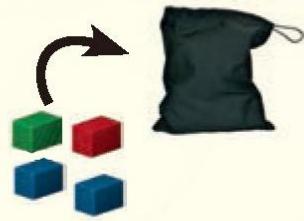


注意:玩家可以建造這個建築物在Massa,因為他用的最廉價的方塊是藍色。那裏有許多為什麼玩家想要建造在比較廉價城市的原因。例如,玩家或許想要在計分階段時獲得金錢而不是分數。(見下方「行動3:計分」)

行動 3:計分
這個行動讓玩家獲得金錢

分數 (VPs) 以及物件
每個玩家有6個計分標記。因此,玩家可以在遊戲中做這個行動6次。

玩家可以怎麼計分呢?
*玩家可以從建築物計分(依種類)。
*玩家可以從一個城市計分。



玩家為一個種類的建築物計分。
只有在你圖板上的建築物才會計分。
- 選擇你想要計分的建築物種類。你必須至少有一棟該種類的建築物,而且是還沒計分過的。接著,你為該種類的所有建築物計分。例如,2棟「圖書館」。接著,你馬上獲得金錢及/或者分數,根據該種建築物建造在哪個城市而定。

- 決定你會獲得多少金錢或分數:要這麼做,把建築物的花費乘上該建築物建造的城市價值。

花費 $3 \times 3$ 元 $= 9$ 元這個玩家從他建造在Pisa的圖書館獲得9元。
花費 2×1 分 = 2 分這個玩家從他建造在Massa的圖書館獲得2分。

在這個計分行動中,玩家總共獲得9元及2分。為每個計分的建築物拿取一個對應種類的物件。在這個範例中,拿2本書 (物件分配給圖書館板塊)。
注意:玩家只會從每個計分的建築物獲得1個物件,不論計分的建築物的花費或者城市的價值。如果供應區沒有足夠的該種類物件,你不會獲得任何東西(或者只有在這些物件還能拿時才會得到)。然而,玩家總是會得到分數或金錢!
接著,你把你的一個計分標記物區域上。
放到你的玩家圖板上,你剛計分的該種建築
繼續我們的範例,這裡玩家要把計分標記放到圖書館上。

範例:玩家為他的2個王宮計分。這2個王宮在Massa。
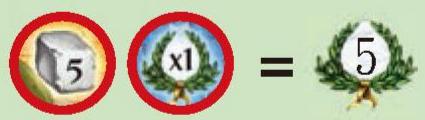
花費 $5 \times 1$ 分 $= 5$ 分他的王宮花費 5,玩家獲得 5 分。

花費 $1 \times 1$ 分 $= 1$ 分他的王宮花費1,玩家獲得1分。
因此,這個玩家總共獲得6分。玩家也會為每個王宮獲得1個皇冠,總共2個皇冠。
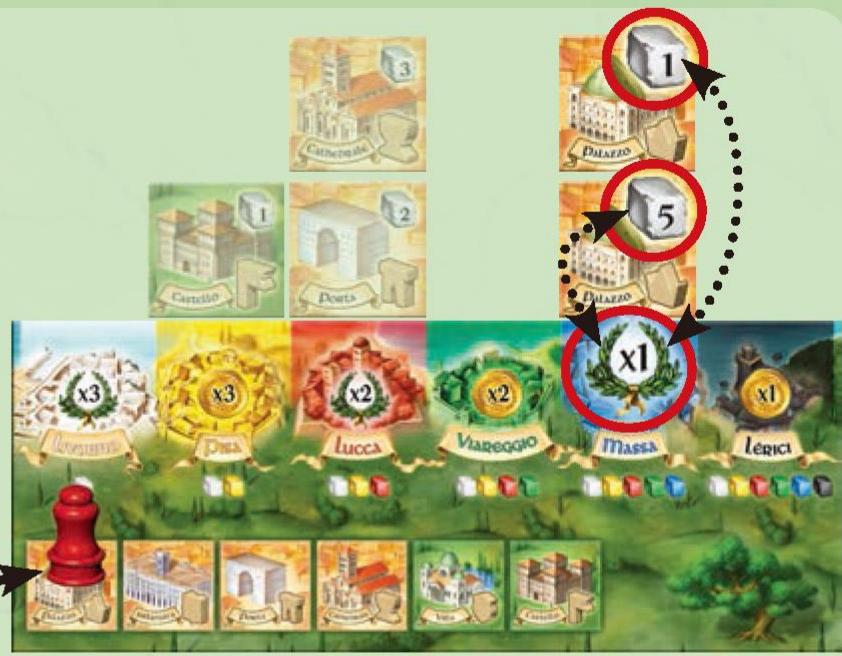
他把他的一個計分標記
放到他玩家圖板上的王宮區域。
- 馬上依據你獲得的分數,移動你計分軌上的計分標記。金錢及物件放到你的擋板後面。
每個玩家每場遊戲只能為每種建築物計分一次。
玩家不能用其他玩家的玩家圖板來做計分行動。
玩家為一個城市計分。
城市計分用遊戲圖板上的城市區塊來計分。城市區塊只會用來計分,不能建造建築物在那裏。)
- 你選擇你想要計分的城市。然而,必須先滿足以下兩種條件:
首先,這個城市必須還沒被計過分(被任何玩家)。換句話說,圖板上該城市還沒有被放置一個計分標記。第二,你必須建造至少2個建築物(在Livorno、Pisa或者Lucca)或者3個建築物(在Viareggio、Massa或者Lerici)於你的玩家圖板上欲計分的城市上。
如果這兩個條件達成,你根據計分的城市獲得分數或金錢。
- 要決定你可以獲得多少金錢或分數,你首先把你所有欲計分城市中的建築物花費加總,接著你把這個總數乘上城市的價值。
在Massa :
Viareggio在這場遊戲中不能再被計分!
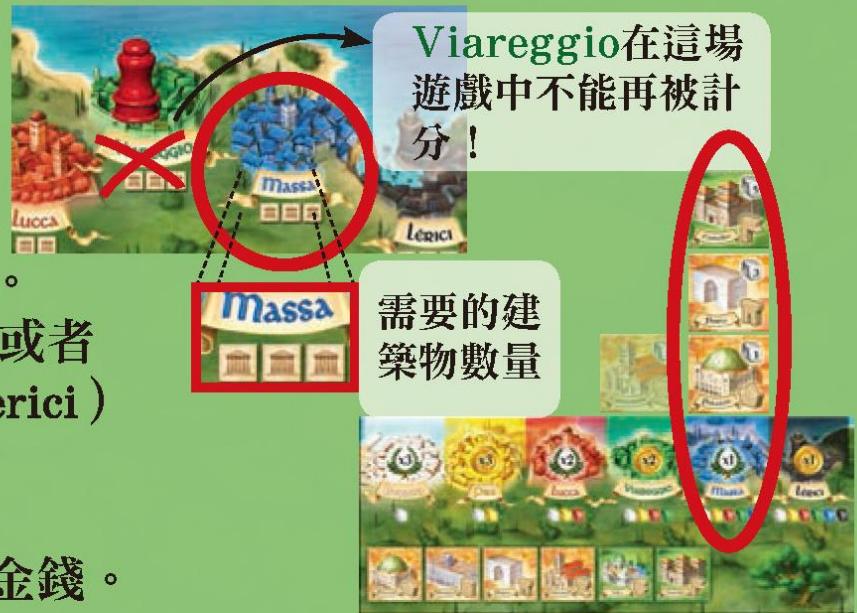
城市Massa(在遊戲圖板上)還沒被計過分。只有沒有計分標記在上面的城市可以被計分。玩家在Massa上建造了3個建築物(見上方他的玩家圖板)。該玩家為Massa計分,因為兩個條件都滿足。
你同時也為每個計分城市中的建築物拿取1個物件。在我們的範例中:1個皇冠、1個城門及1個旗幟。
注意:玩家總是從每個城市中獲得1個物件,無論它們的花費或是佔據的城市是什麼。如果供應區沒有足夠的該種類物件,你不會獲得任何東西(或者只有在這些物件還能拿時才會得到)。然而,玩家總是會得到分數或金錢!
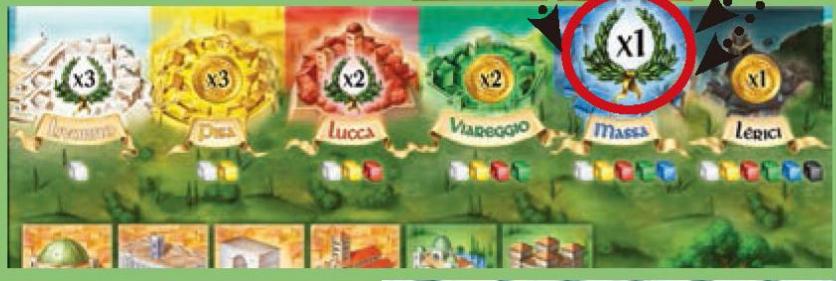
接著你把你的一個計分標記放在圖板上,你剛計分的城市區域上。

範例:玩家為Pisa計分。
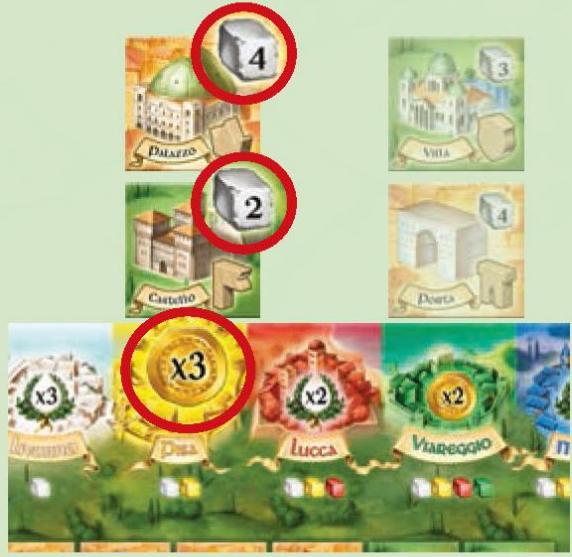
玩家滿足兩個條件:Pisa沒有上沒有計分標記,而且該玩家建造了2個建築物(最低要求)在他玩家圖板上的Pisa。他加總他的建築物花費,並乘上該城市的價值:

花費(2+4)X3元=18元

他總共從銀行拿取18元並放到擋板後。他同時也為每個他在Pisa的建築物獲得1個物件: 📄 📄 。他把他的計分標記放到遊戲圖板上Pisa的城市區域。接著,他的回合結束。遊戲中,沒有其他玩家能夠再為Pisa計分。
- 馬上依據你獲得的分數,移動你計分軌上的計分標記。金錢及物件放到你的擋板後面。每個城市每場遊戲只能被計分一次。一旦玩家已經完成計分,他的回合結束。
額外購買
在每個行動(1:購買方塊、2:建造建築物、3:計分)之後,你可以執行一個額外的購買行動。
你可以從圖板上購買 1 個物件。要這麼做,只需要拿取一個可拿的物件,把它放到你的擋板後,並付 10 元給銀行。

如果圖板上沒有物件的話,沒有物件可以被購買。圖板上的物件不會補充。

遊戲結束
遊戲會在以下兩種方式之一出現時結束:
1、最後一個圖板上的建築物被建造時。
遊戲在最後一個建築物(也就是第30個建築物)被一個玩家從圖板上移走並建造時結束。遊戲輪次會全部跑完,讓每個玩家都有相同的輪次。最後一輪後,玩家進行最終計分。
或者
2、玩家完成目標圖板上的3個目標,並宣告遊戲結束。
三個目標
總共有三個目標印在目標圖板上。這會影響遊戲結束的時刻及最終計分時玩家獲得的分數。
非常重要:每個目標的資訊總是代表一個最低要求!
目標 1(首席卡,咖啡色):
你必須至少完成 4 個計分行動。這只是遊戲結束的目標,玩家遊戲結束時不會因為這個目標獲得分數。
目標 2(物件卡,紫色):
你必須收集一個特定數量的物件:
• 4人遊戲時6個物件,
· 3人遊戲時7個物件,
- 2人遊戲時8個物件。
最終計分時,每個玩家為每個物件獲得3分。
(見第11及12頁的最終計分範例。)
目標3(建築卡,灰色):
你擁有的建築物花費總數要達成:
YOU CAN ANNOUNCE THE END OF THE GAME WHEN YOU HAVE COMPLETED ALL 3OBJECTIVES:
• 4人遊戲時20個建築方塊,
· 3人遊戲時25個建築方塊,
· 2人遊戲時30個建築方塊。
遊戲結束時,每個玩家獲得等同於他所有建築物花費加總總值的分數。(見第11及12頁的最終計分範例。)
額外分數卡(綠色)在基本版的遊戲中不會用到!

(BONUS POINTS CARD) OBJECTIVE III: OBJECTIVE II: OBJECTIVE I: (BUILDING CARD) OBJECT CARD) TOP CARD)


宣告遊戲結束:
1、如同往常,玩家執行3個行動中的一個。在他完成所有的3個目標後(見上一頁),他可以宣告遊戲結束。他拿起他的擋板向大家展示他已經收集到所許的物件數量。玩家可以清楚地看到其他兩個目標(計分4次及建築物的總花費)。(玩家可能在他的回合一開始就已經完成3個目標。他可以先決定不要宣告遊戲結束。無論如何,玩家也可以在他的回合一開始就宣告遊戲結束。)
2、玩家馬上為宣告遊戲結束獲得5分。
3、接著,當輪繼續進行直到結束,所以每個玩家都會有相同的回合數。注意:這輪尚未進行的玩家不必一定要執行最後一個行動。其他玩家不能宣告遊戲結束,即使他已經完成3個目標也不行。
4、遊戲現在結束,玩家進行最終計分。
其他可能會發生的特殊情況:
當一個玩家宣告遊戲結束但是卻還沒完成所有的3個目標時會怎麼樣?如果玩家宣告遊戲結束時,拿起他的擋板,並且揭漏他尚未完成所有的3個目標,遊戲按照一般流程繼續進行。遊戲會在任何玩家(同一個或另一個)宣告遊戲結束,且所有的3個目標都達成時時結束。另一方面來說,遊戲也會在最後一個建築物從圖板上移走並被建造時結束。
記住:
·為了要宣告遊戲結束,玩家必須完成所有3個目標。即使超過目標的需求,也算完成。
·每個玩家在最終計分時獲得分數,無論目標的數量有沒有完成。
- 最終計分總是在遊戲結束時發生,無論是否是由最後一個建築被一個玩家建造後所引發的遊戲結束。
最終計分
遊戲結束時,所有玩家獲得分數。
每個玩家獲得以下分數:
· 每個收集的物件3分(紫色物件卡)
· 建築物的總花費換算成分數(灰色建築卡)
- 5塊錢=1分。


遊戲結束-最終計分範例
四人遊戲範例:
玩家已經完成所有3個目標,而且宣告遊戲結束。
1、他已經計分4次,但是他不會因為這個獲得任何分數。
2、他收集了7個物件

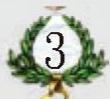
7個物件X3分=
21分 21。
3、他的建築物總花費是23:1+4+3+5+2+3+5=23分。

4、他剩4元


,4元=0分 0。
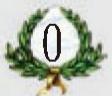
他總共獲得 4 4 分,並根據獲得的分數移動他計分軌上的計分標記。(另一個範例在下一頁。。。)

兩人遊戲的範例:
玩家沒有宣告遊戲結束,因為他只完成3個目標中的1個。
1、他計分五次
2、他收集了6個物件
,但是這不會給他任何分數(目標達成)。
(目標沒有達成)。他每個物件都可以得3分 3。

6個物件X3分=18分 18。
3、他的建築物總花費示25(目標沒有達成): $2+4+4+3+5+1+2+4=25$ 分。

4、他遊戲結束時剩下31塊錢錢不會有任何分數)

: 30元/5 = 6分

(剩餘無法整除的
他總共獲得 49 分,並根據所得到的分數移動計分軌上的計分標記。
平手判定
平手時要怎麼解決?
如果有二或多個玩家遊戲結束時最高分,那麼有最多方塊的玩家獲勝。不用管方塊的顏色。如果還是平手則共享勝利。
遊戲概覽
第一場遊戲前,把以下這幾點念給玩家們聽:
· 在這個遊戲中,你將需要從輪盤上購買方塊,並使用它們來建造建築物。你要用金錢來買這些方塊
。一但購買後,你把你買來的方塊放到擋板後。
- 當你建造一個建築物,你從圖板上拿取建築物物,並放到你的玩家圖板上其中一個城市上方。你把用掉的方塊放回布袋。
· 在建造一些建築物後,你會想要計分。你可以根據建築物的種類或者城市計分。當計分時,建築物會給你金錢、分數及物件。金錢可以用來買更多的方塊及建築物,然而分數及物件則在宣告遊戲結束時會用到,而且在最終計分時非常有用。
· 遊戲在最後一個建築物從圖板上被移走並建造時結束,或者當玩家宣告遊戲結束時結束。在這之後
,玩家進行最終計分,每個玩家會獲得分數。最終計分後最高分的玩家獲勝。
策略提示
第一場遊戲前,把以下這幾點念給玩家們聽:
- 第一場遊戲請不要使用擴充配件!
· 你很少會在每個城市都建造建築物。
·遊戲中,每個玩家會有機會計分6次。為了要宣告遊戲結束,玩家只需要宣告計分4次,如此一來
,玩家不是一定要用完他所有的6個計分標記。
· 注意你的對手!為遊戲圖板上的城市計分通常是勝利的關鍵!
· 注意你的對手!有人準備要宣告遊戲結束了嗎?
· 金錢很重要!至少在一些會在計分時給你金錢的城市中建造建築物!

© 2012 Hans im Gl, ck Verlags-GmbH
English version by:
© 2012 Z-Man Games, Inc.
3250, F.-X.-Tessier Street
Vaudreuil-Dorion, QC J7V 5V5, Canada設計師想要感謝許多玩家,他們花了很多時間測試這款遊戲。
設計師:Wolfgang Kramer 及 Michael Kiesling
For questions, comments and requests:
插圖:Franz Vohwinkel
規則編輯:Gregor Abraham,
www.zmangames.com
Magret Brunnhofer, Hanna & Alex Weiss
info@zmangames.com
中文翻譯:小柴
特別感謝:radley Eng-Kohn
下载 MarkdownPalaces of Carrara.md56.1 KB
THE PALACES OF ARRARA


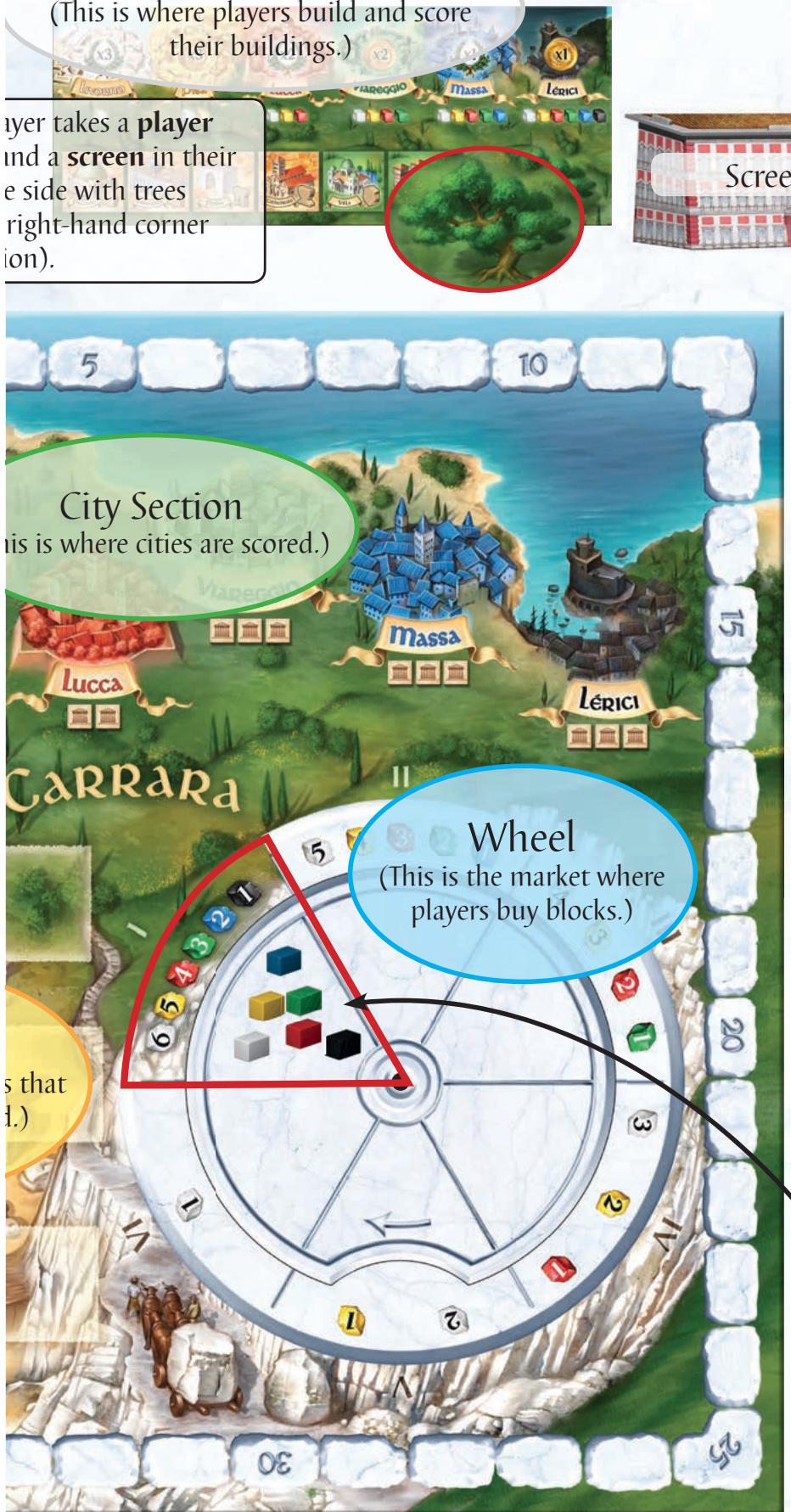
Player board (This is where players build and score their buildings.)

face-down. Take 9 buildings and place them face-up on the d corner of the board. The remaining buildings form a draw ard. There are 6 types of buildings divided into 2 categories: lings with an orange background) and the Land buildings ackground).
A fast tactical and strategic game for 2 to 4 players, aged 14+. 60 minutes
40 coins Each player takes coins worth a total value of 20 and places them behind their screen. The remaining coins are left next to the board as the bank.


The start player takes the Start Player token and a black block. The second player, in clockwise order, takes a blue block, the third player, a green block , and the fourth and last player a red block. Every player should now have a block of a different color, which they put behind their screen.
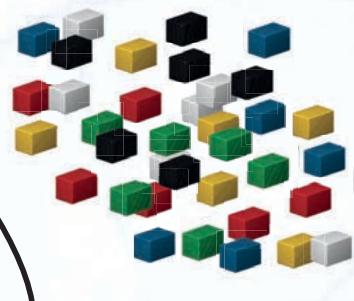
(There are 42 blocks in total, 7 in each of the 6 colors.)
The wheel is divided Align the section of the wheel with the arrow with Section V. Take 1 block of each color and put them on Section 1 of the wheel.
Bag: Put the remaining blocks in the bag.
GAME OVERVIEW
Each player is at the head of a princely family. The families were ordered by the King to build magnificent buildings in the various cities and enrich them with the most unusual objects. On special occasions, the families will invite the King so that he may inspect their progress. Depending on where they built their buildings, the families will be granted victory points, or coins, which they will use to acquire more building materials. At the end, only the family with the most victory points shall claim victory for itself!
PLAYING THE GAME
Starting with the start player and going clockwise around the table, each player takes one action during his turn. He may choose among the following actions:
11, Build buildings
111, Score
After the current player's action, the next player to his left takes her turn, and so on.
ACTION I: BUY BLOCKS
This action allows a player to buy blocks from the wheel, Those blocks will be used later when building.
Cost of blocks when in Section I

At the start of the game; There is 1 block of each color in Section 1. (1n Section 1, the cost is: 6 coins for a white block, 5 coins for a yellow block, 4 coins for a red block, etc.)
When you choose the “Buy blocks” action, •you must first rotate the wheel clockwise by one section.

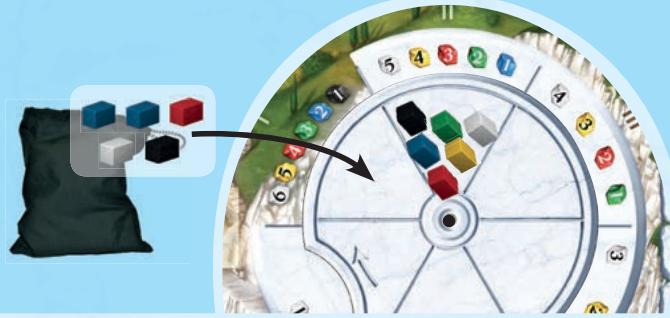
Example of the very first “Buy blocks” action in a game
After rotating the wheel clockwise, the player pulls 5 blocks out of the bag, without looking, and puts them onto Section 1. There is now a total of 11 blocks on the wheel.
2 You can now buy the block(s) of your choice from one section. Each section shows the cost for each
3,color of blocks.
lf a color is not shown, you can take the blocks of that color for free.
At this point, if there is at least one section where you can buy or take a block for free, you must do so. (Note; If a player does not have enough coins to make a purchāse or if there are no free blocks, please refer to the special situations on page 5.)
lf you can buy blocks, you pay the corresponding coins to the bank.
You then put the purchased blocks behind your screen, which ends your turn.
Example of the very rst “Buy blocks” action in a game The player buys 3 blocks from Section 11: 1 greenOfor 2 coinsCC , 1 blue for 1 coinO, and 1 black blockfor free. She puts the 3 coins back in the bank. Note; That player could have chosen to buy from Section 1 instead of Section 11.

Example of a “Buy blocks” action that occurs later in the game

Before rotating
Currently, there are 9 blocks on the wheel. The player starts the action by rotating the wheel one section clockwise.
After rotating the wheel, the player then draws 2 blocks from the bag, and he puts them onto Section 1 of the wheel. There are now 11 blocks on the wheel.

The player buys the 2 blocks from Section VI.
He pays the bank 1 coinC (the white blockcosts 1, and the yellow blockis free).
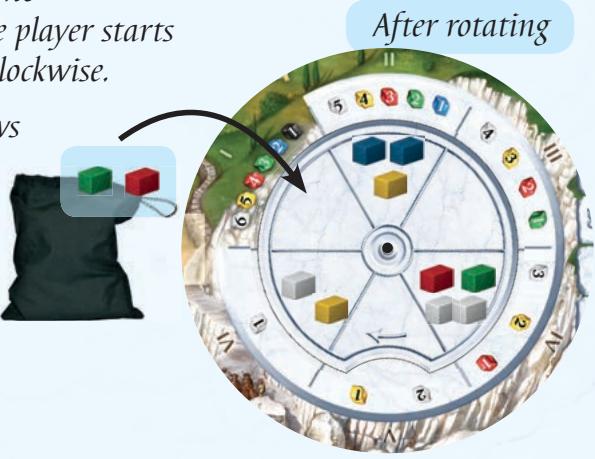
Thus, each “Buy blocks” action follows this sequence: 1, The player rotates the wheel clockwise one section, 2, The player adds blocks onto the wheel so there is a total of 11 blocks and finally, 3, He buys blocks, The are 5 special situations. You may skip reading this section for now. Refer to it if the situation occurs during your game:
1. What if a section of the wheel with blocks is rotated back to Section 1?
When a pläyer rotates th wheel and blocks are moved from Section Vl to Section 1, the wheel is filled up to 11 blocks as usual. 1f blocks that were in Section Vl are now in Section 1, they will be more expensive.
2, What if a player cannot pay?
lf, after choosing the “Buy blocks” action and rotating the wheel a player cannot buy any blocks (because he does not have enough coins or because there are no free blocks), the following occurs: that player must raise his screen to show that he does not have enough coins to buy a block. Then, he takes 2 coins from the bank. This ends his turn; he is not allowed to buy any blocks after taking the coins from the bank.
3, What happens if the bag is empty?
When the bag is empty, no blocks are added to the wheel. A player can still choose the “Buy blocks” action. The player will turn the wheel one section clockwise and will then be able to buy the blocks that are already there. He can also show that he does not have enough coins to buy blocks and take 2 coins from the bank, which he puts behind his screen
4, What happens if the wheel is empty and there are no blocks in the bag?
If the wheel is émpty and there are no blocks in the bag, the player must choose another action. If the player cannot choose another action, he must raise his screen and show that he cannot take any other action, after which he takes 2 coins from the bank. As soon as a player builds a building and returns some blocks in the bag, the wheel can be reilled as usual.
5, What happpens when the bank is out of coins?
Although there should be enough coins in the bank, it is possible for it to run out of coins. If this occurs, players should use replacement pieces of their choice to track their coin total.
ACTIONII:BUILD BUILDINGS 1B45
With this action, a player can use blocks to build one of the available buildings present on the board, Once built, the player puts the chosen building on her player board, Players pay for the buildings they build by returning blocks into the bag. Before seeing the building action in detail, the following section will describe the building types as well as the player board in detail. This information is very important to
understand the building rules properly.
Each Building tile shows the building type, an object, and the number of blocks required to build this building (i.e., the cost).
Building cost

Building type
Object associated to this type of building
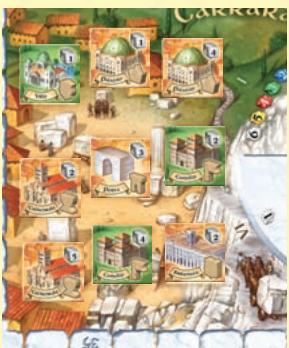
The 9 randomly chosen buildings are placed on these spaces on the boards
The Building Types
There are 6 different types of buildings. Each of them is present 5 times... with a cost ranging from 1 through 5.


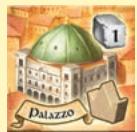


4 City buildings (orange): Biblioteca (Library), Palazzo (Palace), Porta (Gate), and Cathedrale (Cathedral).

2 Land buildings (green): Castello (Castle) and Villa.
The Player Board
The player board shows the 6 cities: Livorno, Pisa, Lucca, Viareggío, Massa, and Lérici. The value of each city is indicated in the top section (x3 3, etc.). You decide in which city you build your buildings.
The lower section shows the 6 types of buildings. The city, their values and the lower section are used during scoring. (See “Action Il: Scoring” on page 7.)

The players place their buildings above the cities (here in Pisa).
The cities, their colors, and their values
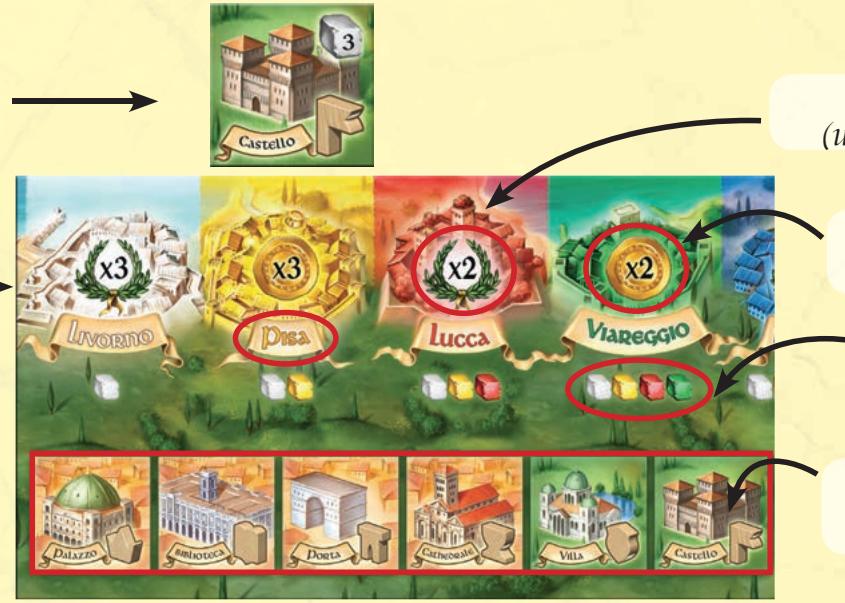
Point value (used for Scoring)
Coin value (used for Scoring)
Blocks accepted when building in this city
Building Type (used for Scoring)
How is the “Build buildings” action resolved?
Take 1 of the 9 available buildings present on the board •(not from the pile), such as the Castello with a cost of 3.


Pay the cost with blocks. Return into the bag a number of blocks equal


Refill the space with a new building from the pile, placed face-up. •If the pile is empty, no new buildings are added. Once a player has finished building, his turn is over.


ln which cities can a player build?
The city where a player may plāce their building depends on the color of the blocks used to pay for the building.
Players can use blocks of different colors, although they do not have to.
A player can build in...
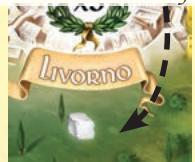


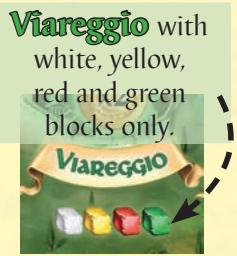


Example; The player builds a Villa,

The player takes the Villa with a cost of 3 from the board and builds it in Viareggio.
He pays the cost (3) with 1 red block and 2 green blocks. He takes these blocks from behind his screen and returns them into the bag.

Note; Since he used green blocks cities do not accept green blocks.
Example; The player builds a Palazzo,
The player takes the Palazzo with a cost of 4 from the board and builds it in Lérici.


He pays the cost (4) with 1 red block, 1 green block and 2 blue blocks. He takes them from behind his screen and returns them into the bag.
e l e i thi il Ma h hpet l e use
There are many reasons why a player would want to build in a “cheaper” city. For example, a player may want coins instead of victory points during scoring. (See “Action 111; Scoring” below.)

ACTION III:SCORING
This action allows players to receive money, victory points (VPs), and objects星司
Each player has 6 scoring markers, Consequently, a player can only do this action 6 times during game,

What can a player score?
• A player can score buildings (by type).

• A player can score a city.

THE PLAYER SCORES A TYPE OF BUILDING. Only the buildings on your board are scored,
Choose the building type that you wish to score. You must have at least •1 building of that type, and cannot already have scored it. Then, you score all buildings of that type. For example, 2 “Biblioteca”. Then, you immediately receive coins and/or victory points, depending on the cities where your buildings of this type were built.

Determine how many coins or victory points you receive: •to do so, multiply the cost of each building o this type by the value of the city in which it was built.

This player receives 9 coins for his Biblioteca in Pisa.

Cost of 2 × 1 VP = 2 VPs
This player receives 2 VPs for his Biblioteca in Massa.

For this scoring action, the player receives a total of 9 coins and 2 VPs.
For each scored building, take 1 object of the appropriate type.
Here, 2 books (the object assigned to Biblioteca tiles).
Note; A player only receives 1 object per scored building, no matter the cost or the city of the scored building. lf there are no more objects of that type in the supply, you receive nothing (or only those that were still available). However, a player always receives victory points or coins!
You then place one of your markerson your player board,

on the type of building that was just scored.
Continuing our example, here it would be placed on the Biblioteca.
Example; The player scores his 2 Palazzi, The 2 Palazzi are located in Massa.
Cost of 5 x 1 VP = 5 VPs
For his Palazzo with a cost of 5, the player receives 5 VPs.

Cost of 1 x 1 VP = 1 VP
For his Palazzo with a cost of 1, the player receives 1 VP.
Thus, the player receives a total of 6 VPs. The player also receives 1 crown per Palazzo, for a total of

2 crowns

He puts one of his markers on the Palazzo space of his player board.
The victory points are immediately added by moving your player's marker on the scoring track.
The coins and objects are placed behind your screen. Each player can score each type of building only once per game.
A player may never do a Scoring action using another player's player board.
THE PLAYER SCORES A CITY.
City scoring is done with the City Section of the game board, (The City Section is only used for scoring. lt is not possible to build there.)
1 You choose the city that you want to score. However,
12 conditions must first be fulflled:
Firstly, the city must not have been scored yet (by any player).
ln other words, a marker cannot be on that city on the board.
Secondly, you must have built at least 2 buildings (in Livorno, Pisa or Lucca) or 3 buildings (in Viareggio, Massa or Léric) above the scored city on your player board.
lf the two conditions are met, you receive points or coins, depending on the city being scored.
To determine how many coins or victory points you • receive, you first add up the cost of all your buildings in the city you are scoring, and you then multiply this sum by the value of the city.


(1+3+5) costs × 1 VP = 9 VPs
The city of Massa (on the game board) has not yet been scored. Only a city with no marker on it can be scored. The player has built 3 buildings in Massa (seen above his player board). The player can score Massa since both conditions are fulfilled.
You also take exactly 1 object for each building in the scored city. ln our example: 1 crown, 1 gate and 1 flag
Note; A player always receives only 1 object per building, regardless of their cost or the occupied city.
If there àre no more objects of the required type in the supply, you receive nothing (or only those that were still available). A player always receives victory points or coins!

You then place one of your markers on the game board, on the city you have just scored.
Example; The player scores Pisa,

The player fulfilled the two conditions: there is no scoring marker on Pisa and the player has 2 buildings (the minimum) in Pisa on her player board. She adds up her buildings' cost and multiplies the sum
by the value of the city:
(2+4) costs × 3 coins = 18 coins


She takes coins with a total value of 18 and places them behind her screen. She also
receives 1 object for each of her buildings in Pisa:
She places one of her scoring marker on Pisa on the game board. Then, her turn is over. No other player may score Pisa during this game.
The victory points are immediately added by moving your marker on the scoring track. The coins and objects are put behind your screen. Each city can only be scored once per game. Once a player has fnished scoring, his turn is over.
YOU CAN ANNOUNCE THE END OF THE GAME WHEN YOU HAVE COMPLETED ALL 3 OBJECTIVES:
ADDITIONAL PURCHASE
After every action (l: Buy blocks, ll: Build buildings, Il1: Score), you can make an additional purc You can buy exactly 1 object from those located on the board. To do so, simply take one of the available objects, puts it behind your screen, and pay 10 coinsto the bank. lf there are no objects on the board, then no objects may be purchased. The objects on the board are never reilled.

GAME END
The game can end in one of two ways:
1, The last building on the board is built,
The game ends when the last building (i.e. the 30th building) is removed from the board and built by a player. The round is completed to allow every player to have the same number of rounds. After this last round, players proceed with the final scoring.
OR
2. A player completed the 3 objectives from the Objectives board and announced the end of the game.
THE THREE OBJECTIVES
Three objectives are printed on the Objectives board. These affect the end of the game and the victory points that players receive during the final scoring.
Very important; The information on every objective always represents a minimum requirement!
Objective 1 (Top Card, brown):
You must have done at least 4 Scoring actions.
This is only a game end objective. Players receive no victory points at the end of the game for this objective.
Objective I1 (Object Card, purple):
You must have collected a certain number of objects:
• 6 objects with 4 players,
• 7 objects with 3 players,
• 8 objects with 2 players.
During the final scoring, each player receives 3 victory points per collected object. (See the Final Scoring Examples on pages 11 and 12.)
Objective I (Building Card, gray):
You must own buildings with a total cost of:
• 20 building blocks with 4 players,
• 25 building blocks with 3 players,
• 30 building blocks with 2 players.
During the final scoring, each player receives a number of victory points equal to the sum of his buildings' cost. (See the Final Scoring Examples on pages 11 and 12.)
The Bonus Points Cards (green) are not used in the basic version of the game!


Annoucing the end of the game;
-
As usual, the player takes one of the 3 actions. After he has completed all 3 objectives (see previous page), he may announce the end of the game. He raises his screen to show that he has collected the required number of objects. Players can clearly see the other two objectives (scored 4 times and the total building costs). (A player may already have completed the 3 objectives at the beginning of his turn. He may have decided not to announce the end of the game previously. Regardless, a player may also announce the end of the game at the beginning of his turn.)
-
The player immediately receives 5 VPs for announcing the end of the game.
-
Then, the current round is played until the end, so that each player has the same number of turns. Note; Players who have yet to play during this round do not have to take one last action. Another player may not announce the end of the game, even if he has completed all 3 objectives.
-
The game is now over and players proceed with the final scoring.
Another special situation may also occur here:
What happens when a player announces the end of the game but has not completed all three objectives? 1f a player announces the end of the game, lifts his screen, and reveals that he has not yet completed all 3 objectives, play continues normally The game will end when any player (the same or another one) announces the end of the game, and all three objectives have been met. Alternatively, the game can also end when the last building is removed from the board and built.
Reminders;
In order to announce the end of the game, a player must have completed all 3 objectives. An objective is considered completed even when it is surpassed.
• Each player scores points in the final scoring, regardless of the number of objectives they have completed.
The final scoring always takes place at the end of the game, whether it was triggered by the last building being built or by à player annoucing the end of the game.
FINAL SCORING
At the end of the game, all players receive points.
Each player receives points for:
• 3 VPs per collected object (as per the purple Object Card),
• the sum of his buildings' cost in VPs (as per the gray Building Card),
• each 5 coins = 1 VP.

End of the game - Final Scoring Examples
Example in a four-player game;
The player has completed all 3 objectives and announced the end of the game.
-
He scored four times, but he does not receive any victory points (VPs) for this.
-
He collected 7 objects咖FF
He receives 3 VPs per object: 7 ×3 =21
7 objects × 3 VPs = 21 VPs
- The total building costs of his buildings is 23:

1+4+3+5+2+3+5 = 23 VPs
- He has 4 coins left

4 coins = 0 VPs
He receives a total of 44 VPs and moves his marker on the scoring track accordingly.
(Another example follows on the next page...)
Example in a two-player game:
The player did not announce the end of the game since he has only completed 1 objective out of 3.
-
He scored five times but this does not give any VPs (objective completed).
-
He collected 6 objects (objective incomplete). He receives 3 VPs per object: 6 ×3
6 objects × 3 VPs = 18 VPs
- The total building costs for his buildings is 25 (objective incomplete):

2+4+4+3+5+1+2+4 = 25 VPs
- He has 31 coins left at the end of the game:


30 coins /5 = 6 VPs
(He does not receive anything for the remaining coin.)
He receives a total of 49 VPs and moves his marker on the scoring track accordingly.
TIEBREAKER
How are ties resolved?
If two or more players have the most points at the end of the game, then the player with the most blocks wins the game. The color of the blocks does not matter. If there is still a tie, then there is more than one winner.
OVERVIEW OF THE GAME
Read the following to the players before their first game:
During the game, you will buy blocks from the wheel and use them to build buildings. You will pay for those blocks with coins. Once purchased, you place your blocks behind your screen.
When you build a building, you take the building from the board and place it above one of the cities on your player board. You return the used blocks into the bag.
After building a few buildings, you will want to score them. You can either score building types or cities. When scoring, buildings will give you coins, VPs and objects. The coins will be used to buy more blocks and buildings, while the VPs and the objects are required to announce the end of the game and are also very useful during the final scoring.
The game ends either when the last building from the board is built or when a player announces the end of the game. After this, players proceed with the final scoring where everyone receives VPs. The winner is the player with the most victory points (VPs) after the final scoring.
TACTICAL HINTS
Read the following to the players before their first game:
• Do not play your first game with the expansion components!
• You will rarely build buildings in every city.
During a game, each player has the possibility to score 6 times. In order to announce the end of the game, a player need only have scored 4 times. As such, a player does not have to use all 6 of his scoring markers.
• Watch your opponents carefully! Scoring cities on the game board is often key to victory!
• Watch your opponents carefully! ls someone about to announce the end of the game?
• Coins are important, Build at least a few buildings in cities that give coins during scoring!

© 2012 Hans im Glück Verlags-GmbH English version by:
© 2012 Z-Man Games, Inc.
3250, F.-X.-Tessier Street
Vaudreuil-Dorion, QC J7V 5V5, Canada For questions, comments and requests: www.zmangames.com
info@zmangames.com
The designers wish to thank the many players who spent many hours testing the game.
Designers: Wolfgang Kramer & Michael Kiesling Illustration: Franz Vohwinkel Rules editing: Gregor Abraham, Magret Brunnhofer, Hanna & Alex Weiß Special thanks: Bradley Eng-Kohn

THE EXPANSION
The basic rules remain unchanged, with the following additions:

The players use the side of their player board with the Building Category spaces.
G-O X= x1 x 日 x1
YOU CAN ANNOUNCE THE END OF THE GAME WHEN YOU HAVE COMPLETED ALL 3 OBJECTIVES:





The 6 buildings with a cost of •8 are placed face-up next to ne game board.

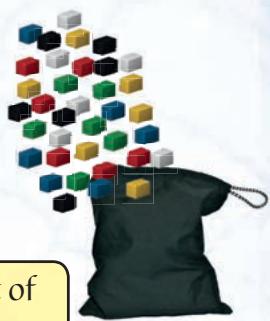
The 31 cards (6 brown Top Cards, 8 purple Object •Cards, 9 gray Building Cards, and 8 green Bonus Points Cards) are separated by color and shuffled facedown to create 4 piles. Draw the first card from each pile and place them face-up on the appropriate space of the Objectives board. The remaining cards are not used and are returned to the box. For a detailed explanation of the various cards, see pages 5 through 8.

GAMEPLAY
The game with the expansion follows the same rules as the basic game, with the following additions;
ACTION I: BUY BLOCKS
Buying blocks without turning the wheel
When a player chooses the “Buy Blocks” action, he must now choose whether he will turn the wheel or not turn the wheel.
When choosing to do the action without turning the wheel, the player does not refill the wheel either.
Otherwise, the action remains unchanged from the basic game.
Example; “Buy blocks” action without turning the wheel
There currently are 8 blocks on the wheel. The player has decided not to turn the wheel and as such does not refill it with blocks.
The player takes the yellow blockfrom Section VI. That block is free.
There are two important reasons why a player may not want to turn the wheel: He does not want to reill the wheel and the blocks he wants are already as cheap as they are going to be.

This can lead to another special situation:
What happens if the wheel is empty, but there are still blocks in the bag?
1f the wheel is empty but the bag isn't, a playêr may only choose the “Buy Blocks” action if he also turns the wheel. The “Buy Blocks without turning” option is unavailable as the player would not be able to buy any blocks from the wheel.
ACTION II:BUILD BUILDINGS 123458
The players can now build the buildings with a cost of 8, They may also improve a built building.
A sixth (6th) building of each type is added to the 30 buildings. This new building of each type has a cost of 8.
The 8-buildings are placed face-up next to the game board. You can build one of these buildings like you would one of the 9 buildings that are available on the board. To do so, you must return 8 blocks into the bag. The 8-buildings can also be used to improve an already built building (see next page). Once all the 8-buildings are gone, they may no longer be built.
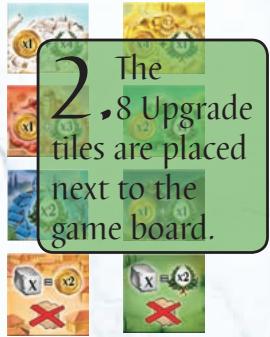
When a player builds an 8-building, he immediately taķes a Upgrade tile of his choice and places it on the appropriate Building Category space or city on his player board. There are 8 Upgrade tiles:


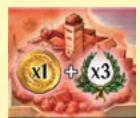

Upgrade tiles for the cities
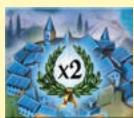


Upgrade tiles for the Building Category spaces
(See page 4 for a detailed explanation of the Upgrade tiles.)
lmproving a building
You can improve any of your already built buildings by replacing it with a building with a higher cost.
When you choose to improve a building, you only need to pay the differ-

The new building can be of the same type or of a different type, (To the • right, a Porta with a cost of 3 is replaced by the Castello with a cost of 8. The difference of 5 is paid for with the following blocks:.)

Example; In Lucca, the player replaces a Castello costing 3 with a Biblioteca with a cost of 4,
He takes the Biblioteca with a cost of 4 from the buildings on the board. Then, he pays the difference of 1 by putting a yellow block in the bag. The Castello (cost of 3) is returned to the box and the Biblioteca is placed on this newly vacated place.
Finally, the player reveals a new building and his turn is over.


ACTION III: SCORING
The player boards now show two Building Category spaces, Both of these spaces and the cities can be upgraded,
Building Category Spaces
You now have 8 different scoring options at the bottom of •your player board. If you choose one of the two Building Category spaces, you must already have built at least 1 building of the proper category (City or Land).
As with the other scoring spaces, you then receive VPs or coins, depending on which Building Category space you chose.

1f a player scores using this space, he takes the total building costs of his City buildings x 1 coin.
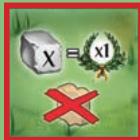
To determine the number of victory points or coins you re-•ceive, you must first add the building cost of all of your City (orange) or Land (green) buildings. You then multiply this sum by the value of the Building Category space
Example; The player chose the City buildings (orange) scoring space:
If a player scores using this space, he takes the total building costs of his Land buildings x 1 VP.

(3+2+2) costs × 1 coin = 7 coins
Then, you place one of your markers on the chosen Building Category space. In this example, on the City buildings scoring space.

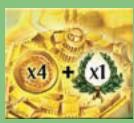
Example; The player scores the Land buildings (green background) he has built,
The player has 3 Land buildings worth 1, 3, and 4:


by the value of the Building Category space. The player receives 8 VPs for his Land buildings. Then,
(1+3+4) costs × 1 VP = 8 VPs
he places one of his markers scoring space.

on the land buildings
You then indicate your VPs by moving your marker on the scoring track and/or putting your coins behind your screen.
Each player can only score their Building Category spaces once per game.
Note; Players do not receive any objects when scoring the Building Category spaces!

Upgrade Tiles – Increase the value of a city or a Building Category space,
When a player builds an 8-building, he immediately takes an Upgrade tile of his choice. A player may only take an Üpgrade tile after building an 8-building. There are 8 Upgrade tiles:



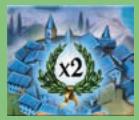


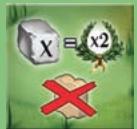
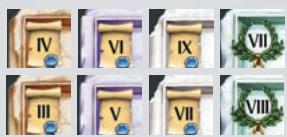
The chosen Upgrade tile must still be available. Once an Upgrade tile is taken, no other player may choose it. A player does not have to choose the tile corresponding to the color of the city where the 8-building was built. After acquiring an Upgrade tile, the player immediately sets it on top of the corresponding city or Building Category space on his player board! The Upgrade tile changes the value by covering the old one!
Example; The player has just built the Cathedrale with a cost of 8 in Viaregzio,
He takes the Lucca Upgrade tile

, and puts it over the city of Lucca on his board.
From this point on, whenever he scores buildings in that city or when he scores the city of Lucca, the player will use these values: and
Example; Later in the game, that player scores Lucca.


The player scores Lucca and receives 5 coins and 15 VPs. He also receives 1 crown and


1 gate:
FINAL SCORING
At the end of the game, all players receive points as in the basic game, with the following additions:
• any object that is not considered by the Object Card is worth 1 VP;
• any points awarded by the Bonus Points Card.
TACTICAL HINTS
Read the following before your first game with the expansion:
• Players may choose to play with the cards of their choice. ln that case, their number does not matter.
• Every player should read the 3 Objectives cards as well as the Bonus Points Card and read the appropriate examples (see pages 5 through 8) if necessary.
• You can also try these combinations:
Great Freedom

Multipliers
Double Trouble
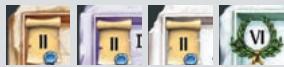
Full City
Mr. Hot Shot
Four of a kind


Reminder; Once again, all Objective cards show a MiNIMUM requirement!
The 3 Objectives from the basic game
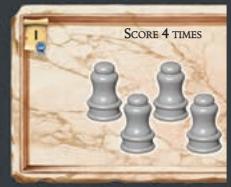


These 3 cards are used in the basic game and are already printed on the Objectives board. 1n the game with the Expansion, they are available like the other cards and should be shuffled into their respective piles. They can be drawn randomly or chosen by the players.
6 Top Cards (brown); Objectives that must be completed to announce the end of the game! No VPs!


Objective:
You must build a certain number of buildings with a cost of 5 or 8:
• 2 buildings with 4 players
• 3 buildings with 3 players
• 4 buildings with 2 players
Objective:
You must have a certain number of buildings:
• 6 buildings with 4 players
• 7 buildings with 3 players
• 8 buildings with 2 players
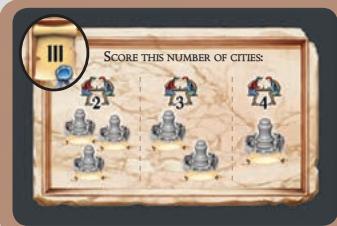

• 1 city with 4 players
Objective:
You must score a certain number of cities:
• 2 cities with 3 players
• 3 cities with 2 players
Objective:
You must collect a certain number of coins:
• 20 coins with 4 players
• 25 coins with 3 players
• 30 coins with 2 players
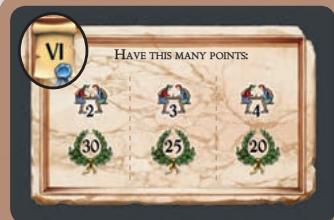
Objective:
You must reach a certain number of victory points on the scoring track:
• 20 VPs with 4 players
• 25 VPs with 3 players
• 30 VPs with 2 players
Final scoring when this card is in play;
All players receive 1 VP for every 2 coins. (lnstead of the usual

Example; End of the game
Player A:

Player B:

Player C:

8 Object Cards (purple); The top section shows an objective that must be completed to announce the end of the game, The bottom section indicates the VPs players may receive during the final scoring!

Objective:
You must collect 3 × 2 identical objects (pairs).
(4 identical objects count as 2 pairs, 6 as 3 pairs.)
Final scoring:
You receive 5 VPs per collected pair.
Example; The player has 4 identical objects at the end of the game: FF FF
He has not completed the objective. He still receives 10 VPs for his 2 pairs.
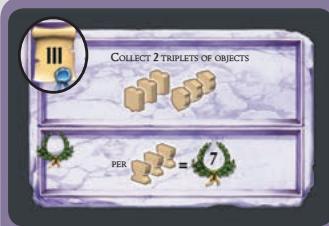
Objective;
You must collect 2 × 3 identical objects (triplets). (6 identical objects count as 2 triplets.)
Final scoring:
You receive 7 VPs per collected triplet.
Example; The player has 8 objects at the end of the game:
VPs; The player has 3 pairs and 2 different objects. He receives 15 VPs for the 3 pairs and 2 VPs for the 2 different objects. This gives him a total of 17 VPs. Reminder for all Object cards; Any object that is not considered by the Card is worth 1 VP.
Example; The player has 6 objects at the end of the game: OOU
VPs; He has not completed the objective. He receives 7 VPs for his 3 crowns, and 3 VPs for the other 3 objects (1 crown, 1 flag, and 1 coat of arms; 1 VP per object). This gives him a total of 10 VPs.


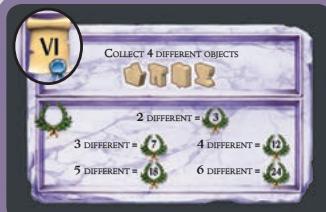

Objective:
You must collect 4 identical objects (quadruplet).
Final scoring:
• 3 VPs for 1 pair
• 6 VPs for 1 triplet
• 10 VPs for 1 quadruplet
• 15 VPs for 1 quintuplet
• 21 VPs for 1 sextuplet
Objective;
You must collect a pair (2 identical objects) and a quadruplet (4 identical objects). (6 identical objects count as a quadruplet and a pair.) Final scoring:
For each combination of 1 pair and 1 quadruplet, you get 20 VPs.
Objective;
You must collect 4 different objets.
Final scoring:
• 3 VPs for 2 different objects
• 7 VPs for 3 different objects
• 12 VPs for 4 different objects
• 18 VPs for 5 different objects
• 24 VPs for 6 different objects
Objective:
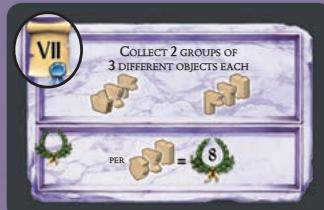
You must collect 2 x 3 different objects.
Final scoring;
You receive 8 VPs per set of 3 different objects. Identical groups still give points, as long as each group is composed of 3 different objects.
Objective:
You must collect 3 × at least 2 identical objects (pairs). (4 identical objects count as 2 pairs, 6 as 3 pairs.) Final scoring:
Up to 3 groups of identical objects are multiplied together. The result is the number of VPs you receive. A group is constituted of 2 to 6 identical objects.
Example; The player has 7 objects at the end of the game:
VPs; He has completed the objective. He receives 10 VPs for his 4 cups, and 6 VPs for his 3 gates.
This gives him a total of 16 VPs.
Example; The player has 8 objects at the end of the game:
VPs; She has completed the objective. The player receives 20 VPs for her quadruplet (4 gates) and pair (2 books). She also receives an extra 2 VPs for her 2 flags (worth 1 VP each). This gives her a total of 22 VPs.
Example; The player has 7 objects at the end of the game:
VPs; The player completed the objective since he collected at least 4 different objects.
He receives 18 VPs for his 5 different objects. For the other 2 different objects (1 cup and 1 book), he receives another 3 VPs. This gives him a total of 21 VPs.
Example: The player has 7 objects at the end of the game: ZO 2O
VPs; The player completed the objective. He receives 8 VPs for his 2 groups of different objects (for a total of 16 VPs). He receives 1 VP for the remaining object.
This gives him a total of 17 VPs. (lt does not matter which objects are in each group, as long as the 3 are different.)
Example; The player has 10 objects at the end of the game:
VPs; The player completed the objective since he collected at least 3 pairs of objects. He multiplies his 3 biggest groups together: 3 flags x 2 books x 2 gates, for a total of 12 VPs (3 x 2 x 2 = 12). His 2 coats of arms and his 1 crown are counted individually (1 VP each) for a total of 3 VPs. This gives him a total of 15 VPs.
9 Building Cards (gray); The top section shows an objective that must be completed to announce the end of the game, The bottom section indicates the VPs players may receive during the final scoring!

Objective;
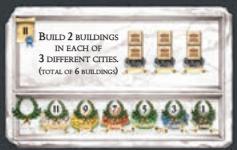
In 3 different cities, you must build 2 buildings in each of them.
Final scoring;
For 2 buildings in...
• Livorno 11 VPs • Viareggio 5 VPs
• Pisa9 VPs
• Massa 3 VPs
• Lucca 7 VPs
• Lérici 1 VPs
Example; The player built 4 buildings in Pisa, 2 buildings
in Massa, and 1 building in Lérici. He did not complete the objective.
VPs; He receives 18 VPs for the 4 buildings in Pisa (2 x 9 = 18 VPs), 3 VPs for those in Massa, and 0 VP for the one building in Lérici, for a total of 21 VPs.
Although there are 4 buildings in Pisa, it still counts as 1 city.
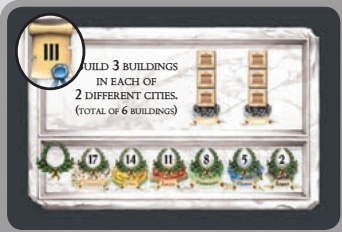 | Objective: 1n 2 different cities, you must build 3 buildings in each of them. Final scoring: For 3 buildings in... | Example; The player built 3 buildings in Lucca, 4 buildings in Massa, and 6 buildings in Lérici. VPs; He has completed the objective. He receives 11 VPs for his 3 buildings in Lucca, 5 VPs for his 4 buildings in Massa, and 4 VPs for his 6 buildings in Lérici (2 × 2 VPs). This gives him a total of 20 VPs. • Livorno 17 VPs • Lucca 11 VPs • Massa 5 VPs • Viareggio 8 VPs • Lérici 2 VPs | |
| • Pisa 14 VPs Objective: Example; The player built 5 buildings Lérici, enough to You must build 4 buildings in one city. | |||
 | complete the objective. VPs; He receives 3 VPs for his 5 buildings in Lérici. Final scoring: For 4 buildings in... • Livorno 3 VPs • Lucca 15 VPs • Massa 7 VPs • Pisa 19 VPs • Viareggio 11 VPs • Lérici 3 VPs | ||
| Objective: a cost of 8. Final scoring: | Example; The player built an 8-cost building in Lucca You must build a building with VPs; He has completed the objective and gets 19 VPs for this building. Example; The player built two 8-cost buildings in Massa. | ||
 | VPs; He has completed the objective and gets 16 Vs for his 2 buildings. For an 8-building in.. • Livorno 34 VPs • Lucca 19 VPs • Massa 8 VPs • Pisa 26 VPs • Viareggio 13 VPs • Lérici 4 VPs | ||
Objective: of Land buildings: 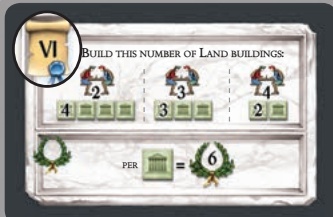 | Example; ln a 4-player game, a player built 3 Land You must build a certain number buildings, enough to complete the objective. VPs; He receives 6 VPs per Land building, for a total of 18 VPs • 2 Land buildings with 4 players (3 Land buildings x 6 VPs = 18 VPs). • 3 Land buildings with 3 players Example; ln a 4-player game, a player built 1 Land | ||
Final scoring: Objective; of City buildings:  | • 4 Land buildings with 2 players building. He does not complete the objective. VPs; He still receives 6 VPs for his Land building. You get 6 VPs per Land building. Example; In a 4-player game, a player built 7 City You must build a certain number buildings, enough to complete the objective. VPs; He receives 3 VPs per City building, for a total of 21 VPs • 4 City buildings with 4 players (7 City buildings x 3 VPs = 21 VPs). • 5 City buildings with 3 players Example; In a 3-player game, a player built 3 City • 6 City buildings with 2 players building. He does not complete the objective. VPs; He still receives 9 VPs for his City buildings (3 City | ||
| Final scoring: You get 3 VPs per City building. Objective; ln 3 different cities, you must build | |||
at least 2 buildings in each of them. 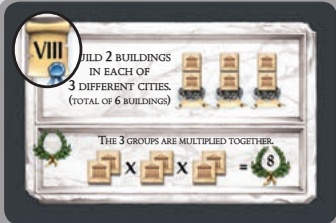 Final scoring: In up to 3 cities, the number of buildings are multiplied together. The result is the number of VPs you receive. The building costs do not matter. | |||
Objective; Example; ln a 3-player game, the player built You must build a certain number of Land and 4 City buildings with costs 5, 4, 2, 2; and 2 Land build- City buildings. ings with costs 4 and 1. The player has not completed  • 2 City and 2 Land buildings with 4 players the the objective. VPs; He has two pairs: • 3 City and 3 Land buildings with 3 players 1st pair: City building (5) + Land building (4) = 9 VPs • 4 City and 4 Land buildings with 2 players 2ⁿd pair: City building (4) + Land building (1) = 5 VPs | |||
Upgrade:


8 Bonus Points Cards (green); These cards do not show an objective that must be completed to end
the game, They simply are ways to earn bonus VPs during the final scoring!
For all Bonus Points Cards; The players score the various features, whether or not that feature was scored during the game! Note; There is no Bonus Points Card with the number 1!
This player board will be used to explain the different Bonus Points Cards. The following examples are with 4 players.


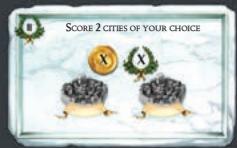
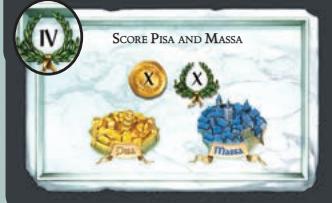
Example; Card is used in this game. The player scores Livorno and Lérici:

Livorno:

He receives a total of 27 VPs and 12 coins.
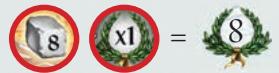
Example; The player scores his “Biblioteca” and his “Cathedrale”.

Biblioteca (2) in Massa
Biblioteca (8) in Lérici with Upgrade tile

Cathedrale (3) in Livorno
Cathedrale (4) in Lérici with Ulpgrade tile


He receives a total of 23 VPs and 12 coins.
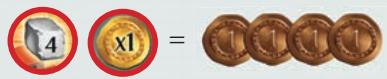
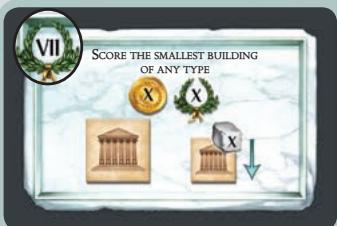
Example; The player scores the smallest building of each type:
His smallest Biblioteca in Massa:
His smallest Cathedrale in Livorno:

He does not have any Castello or Palazzo, so he does not receive any coins/VPs for them. He gets 19 VPs.

His smallest Porta in Livorno:
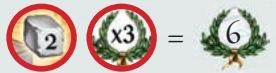
Card Erratum; This card should read: “Score the smallest building of each type."
His smallest Villa in Lucca:


Example; Left; The player's building costs total in

He does not get any VPs because someone else has a higher total. Right; His building costs total in Massa and Lérici:


He has the highest total and receives

The players add their building costs in each city. For each city, the player(s) with the highest total receive(s) VPs for that city:
Example; The player adds his building costs in:
He does not have any buildings in Pisa and Viareggio so he does not get any VPs for these cities. He receives a total of 18 VPs.
简繁检索对照.md1.6 KB
130948_129948_the-palaces-of-carrara — 简体/繁体检索对照
本游戏的规则书是繁体中文原文。用户用简体提问时,把关键词按下面这张表转成繁体再去 grep 原文,命中率最高。
回答时用简体或繁体都可以,但引用的原文保持繁体。
简体 → 繁体 对照(按该游戏原文出现频率排序,共 59 字)
| 简体 | 繁体 | 原文出现次数 |
|---|---|---|
| 个 | 個 | 222 |
| 块 | 塊 | 134 |
| 筑 | 築 | 97 |
| 计 | 計 | 94 |
| 游 | 遊 | 84 |
| 戏 | 戲 | 84 |
| 时 | 時 | 57 |
| 这 | 這 | 56 |
| 图 | 圖 | 53 |
| 标 | 標 | 52 |
| 动 | 動 | 48 |
| 结 | 結 | 46 |
| 会 | 會 | 46 |
| 费 | 費 | 43 |
| 数 | 數 | 39 |
| 后 | 後 | 38 |
| 种 | 種 | 38 |
| 买 | 買 | 38 |
| 区 | 區 | 37 |
| 获 | 獲 | 37 |
| 钱 | 錢 | 35 |
| 轮 | 輪 | 33 |
| 购 | 購 | 33 |
| 从 | 從 | 33 |
| 没 | 沒 | 31 |
| 并 | 並 | 30 |
| 总 | 總 | 29 |
| 为 | 為 | 29 |
| 盘 | 盤 | 28 |
| 来 | 來 | 28 |
| 们 | 們 | 25 |
| 类 | 類 | 22 |
| 记 | 記 | 20 |
| 该 | 該 | 18 |
| 范 | 範 | 17 |
| 挡 | 擋 | 16 |
| 进 | 進 | 14 |
| 颜 | 顏 | 14 |
| 终 | 終 | 14 |
| 银 | 銀 | 13 |
| 须 | 須 | 13 |
| 么 | 麼 | 13 |
| 现 | 現 | 12 |
| 当 | 當 | 12 |
| 选 | 選 | 12 |
| 里 | 裡 | 11 |
| 绿 | 綠 | 11 |
| 给 | 給 | 11 |
| 据 | 據 | 11 |
| 场 | 場 | 10 |
| 择 | 擇 | 10 |
| 转 | 轉 | 10 |
| 应 | 應 | 9 |
| 价 | 價 | 9 |
| 见 | 見 | 8 |
| 两 | 兩 | 8 |
| 顺 | 順 | 8 |
| 够 | 夠 | 8 |
| 况 | 況 | 8 |
原文为社区整理/出版社公开资料,版权归原作者,仅供个人学习查阅。