
三国得志Three Kingdoms Redux
一句话概览
三国得志 是一款已收录于村了吗规则库的桌游,支持 3 人,原名 Three Kingdoms Redux。
本页内容:一句话概览 · 游戏概述 · 1. 游戏组件 · 2. 游戏设置 · 3. 游戏流程 · 4. 对抗阶段详解 · 5. 结算阶段 · 6. 休整阶段 · 7. 扣分指示物 · 8. 游戏结束 · 9. 计分方式 · 常见问题
三国得志 规则速览
本页收录规则速览的前 10 节(篇幅所限省略了后 1 节),完整规则速览与卡牌可在村了吗查询。
游戏概述
公元184年黄巾起义后,东汉王朝分崩离析,魏、蜀、吴三方势力逐鹿中原。三位玩家分别扮演三国君主,管理国家发展、组建军队、开疆拓土。游戏最多进行12回合,玩家在对抗与结算中积累各类分数,最终得分最高者一统天下。
核心机制: 将领派遣争夺行动区、联盟对抗、边境战争、资源经营、多线路计分
1. 游戏组件
| 组件 | 数量/说明 |
|---|---|
| 游戏版图 | 1块 |
| 回合标记物(日晷) | 1枚 |
| 联盟指示物 | 1枚 |
| 天子指示物 | 1枚 |
| 准则标记物 | 2枚(谋略/武力双面) |
| 农田指示物 | 20枚(荒芜/丰收双面) |
| 集市指示物 | 20枚(萧条/繁荣双面) |
| 黄金指示物 | 30枚(20枚面值"1" + 10枚面值"5") |
| 粮食指示物 | 30枚(20枚储量"1" + 10枚储量"5") |
| 百姓指示物 | 15枚 |
| 扣分指示物 | 5枚(每枚代表-3VP) |
| 旌旗指示物 | 15枚(0VP/1VP双面) |
| 军队指示物 | 30枚(未训练/精锐双面) |
| 长枪指示物 | 12枚 |
| 战马指示物 | 15枚 |
| 弓弩指示物 | 15枚 |
| 战船指示物 | 15枚 |
| 国家强化卡 | 42张(21张合卡 + 21张分卡) |
| 将领卡 | 69张(魏/蜀/吴各23张含首领) |
| 将领指示物 | 69枚(魏/蜀/吴各23枚含首领) |
| 军令指示物 | 6枚(各国各2枚,+1/+2两种) |
| 国家标记物零件 | 18枚大 + 6枚小(各国各自配色) |
| 外族关系标记物 | 3枚(蒙古包样式,各国各1枚) |
| 玩家指南 | 3份(各国各1份) |
2. 游戏设置
2.1 版图与轨道放置
- 将版图置于桌面中央。
- 回合进度条: 将回合标记物放在"1"位置。
- 争夺顺序表: 在"Bid"列的"1""2""3"位分别放置魏、吴、蜀的国家标记物(大)。
- 结算顺序表: 暂空,稍后放入各国结算标记物(小)。
- 准则标记投放区:
- 用抛硬币方式决定一枚准则标记物朝上的一面,将其放在"挟持天子"行动区的投放区内。
- 另一枚准则标记物翻到相反面,放在"笼络民心"行动区的投放区内。
- 这两枚标记指示第1回合两个行动区分别以"谋略"或"武力"争夺。
- 边境地区: 在15个边境地区各放1枚旌旗指示物,0VP面朝上。
- 军事分数表和爵位表: 各国国家标记物各放于军事分数表"0"分处;爵位表"州牧"位放置各国标记物。
2.2 农业发展区和商业发展区
- 每位玩家的国境内各有1个农业发展区和1个商业发展区。
- 农业区: 放置5枚农田指示物,全部以"荒芜"面朝上。
- 商业区: 放置5枚集市指示物,全部以"萧条"面朝上。
- 剩余农田/集市指示物放在版图边备用。
- 每个农业区和商业区上方各有1个区域:粮仓和国库。开局时空。
2.3 外族部落关系表
| 国家 | 相邻外族 | 初始等级 |
|---|---|---|
| 魏国 | 匈奴 | 5 |
| 吴国 | 山越 | 6 |
| 蜀国 | 南蛮 | 7 |
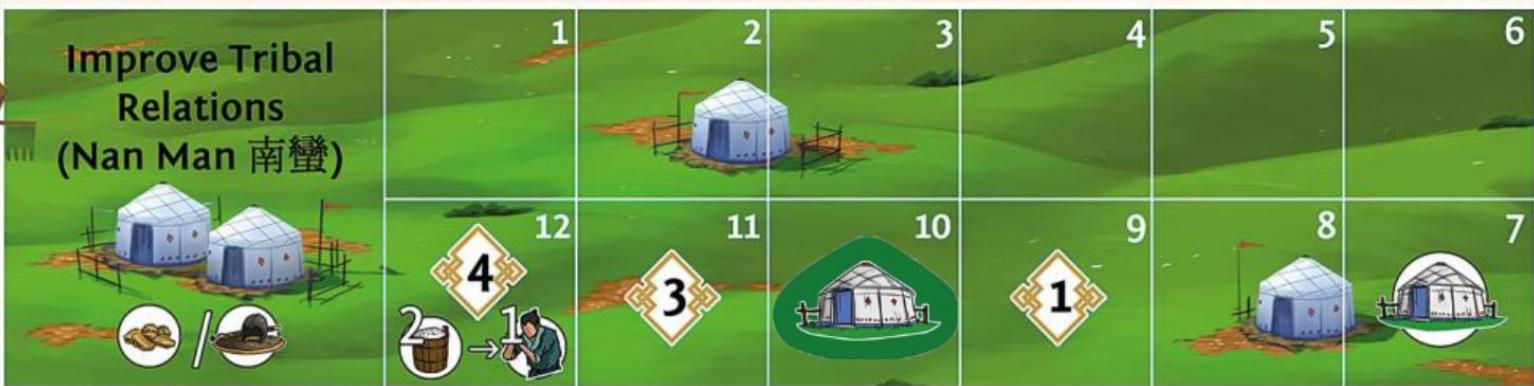
- 每位玩家将己方外族关系标记物(蒙古包)按上表放置在对应等级格位。
2.4 专属指示物准备
- 联盟指示物: 由蜀国玩家拿取保管。
- 天子指示物: 放在版图边上公共位置。
- 军令指示物: 各国各2枚,由各玩家自行保管。
- 其余所有指示物(军队、兵器、黄金、粮食、百姓、扣分、旌旗等)放在版图边上公共位置。
2.5 国家强化卡
- 将合卡和分卡分开洗混。
- 初始手牌分发:
| 国家 | 合卡数 | 分卡数 |
|---|---|---|
| 魏国 | 3 | 1 |
| 吴国 | 3 | 2 |
| 蜀国 | 3 | 3 |
- 剩余卡牌面朝下放公共位置。
2.6 初始资源
| 国家 | 黄金 | 粮食 | 百姓 |
|---|---|---|---|
| 魏国 | 3 | 3 | 0 |
| 吴国 | 4 | 4 | 1 |
| 蜀国 | 5 | 5 | 2 |
2.7 初始将领招募
每位玩家起始拥有固定数量的将领(含1名首领):魏国5名、吴国4名、蜀国3名。
招募步骤:
- 从己方将领指示物中取出首领指示物。
- 将剩余将领卡洗混,抽取6张作为备选(不展示给其他玩家)。
- 从备选中挑选要招募的将领:
| 国家 | 首领 | 备选抽牌 | 实际招募数 |
|---|---|---|---|
| 魏国 | 曹操 | 6张选4张 | 4名 |
| 吴国 | 孙坚 | 6张选3张 | 3名 |
| 蜀国 | 刘备 | 6张选2张 | 2名 |
- 没被挑选的将领卡洗回己方将领卡堆。
- 将所有将领卡和指示物放到各自玩家可方便取用的位置。
3. 游戏流程
每回合分为三个阶段,依次进行:
- 对抗阶段 — 双方轮流派遣将领到各行动区争夺主导权。
- 结算阶段 — 确定下一回合顺位,执行占领的行动。
- 休整阶段 — 翻转准则标记、后勤补给、获取军事分数、推进回合数。
若结算阶段结束时无任一玩家触发游戏结束条件,则进入额外休整阶段,然后进入下一回合。游戏最多持续12回合。
4. 对抗阶段详解
4.1 招募将领(仅第3、第5、第9回合)
在第3、5、9回合开头额外进行将领招募:
| 回合 | 魏国 | 吴国 | 蜀国 |
|---|---|---|---|
| 3 | 备选3名,招募1名 | 备选4名,招募2名 | 备选4名,招募2名 |
| 5 | 备选3名,招募1名 | 备选3名,招募1名 | 备选4名,招募2名 |
| 9 | 备选3名,招募1名 | 备选3名,招募1名 | 备选3名,招募1名 |
步骤:
1. 将剩余将领卡洗混,抽取备选数量。
2. 从备选中挑选要招募的将领。
3. 补充对应数量的将领指示物。
4. 未挑选的将领卡洗回卡组。
注意: 备选数总是比最终招募数多2。新将领从本回合起即可参与争夺。
4.2 指定联盟区
- 争夺顺序表"1""2""3"代表对抗阶段的派遣顺序。
- 顺位"2"和"3"自动结成联盟,共同对抗"1"号玩家。
- 第三顺位玩家有权选择联盟区——将联盟指示物放置在选定的公共行动区内。
- 可选联盟区共10处(排除"挟持天子"和"笼络民心",这两个带有"不可联盟"标识)。
- 不能连续两回合选同一个行动区联盟(即使不同玩家担任第三顺位也不行)。
- 若联盟双方都派人争夺联盟区且获胜,则双方都可执行该行动;若只有一方出战获胜,则由出战方执行;若联盟方全败,则由第一顺位方执行。
4.3 争夺行动区
4.3.1 行动区分布
版图共有18个行动区:12个公共行动区 + 6个国家专属行动区(含3个外交行动区)。
谋略争夺(5个): 发展农业、发展商业、交易粮食/兵器、引进教育/科技、科技兴邦
武力争夺(5个): 生产长枪/战马、生产弓弩/战船、招募军队、训练军队、索要贡品
双向争夺(2个): 笼络民心、挟持天子(当回合由准则标记决定用谋略还是武力)
边境战场(3个): 蜀-魏边境、蜀-吴边境、魏-吴边境(专属相邻两国)
外交行动区(3个): 各国专属,改善与对应外族的关系
4.3.2 将领属性
| 属性 | 范围 | 说明 |
|---|---|---|
| 谋略值 | 1~5 | 用于谋略类行动区争夺 |
| 武力值 | 1~5 | 用于武力类行动区争夺 |
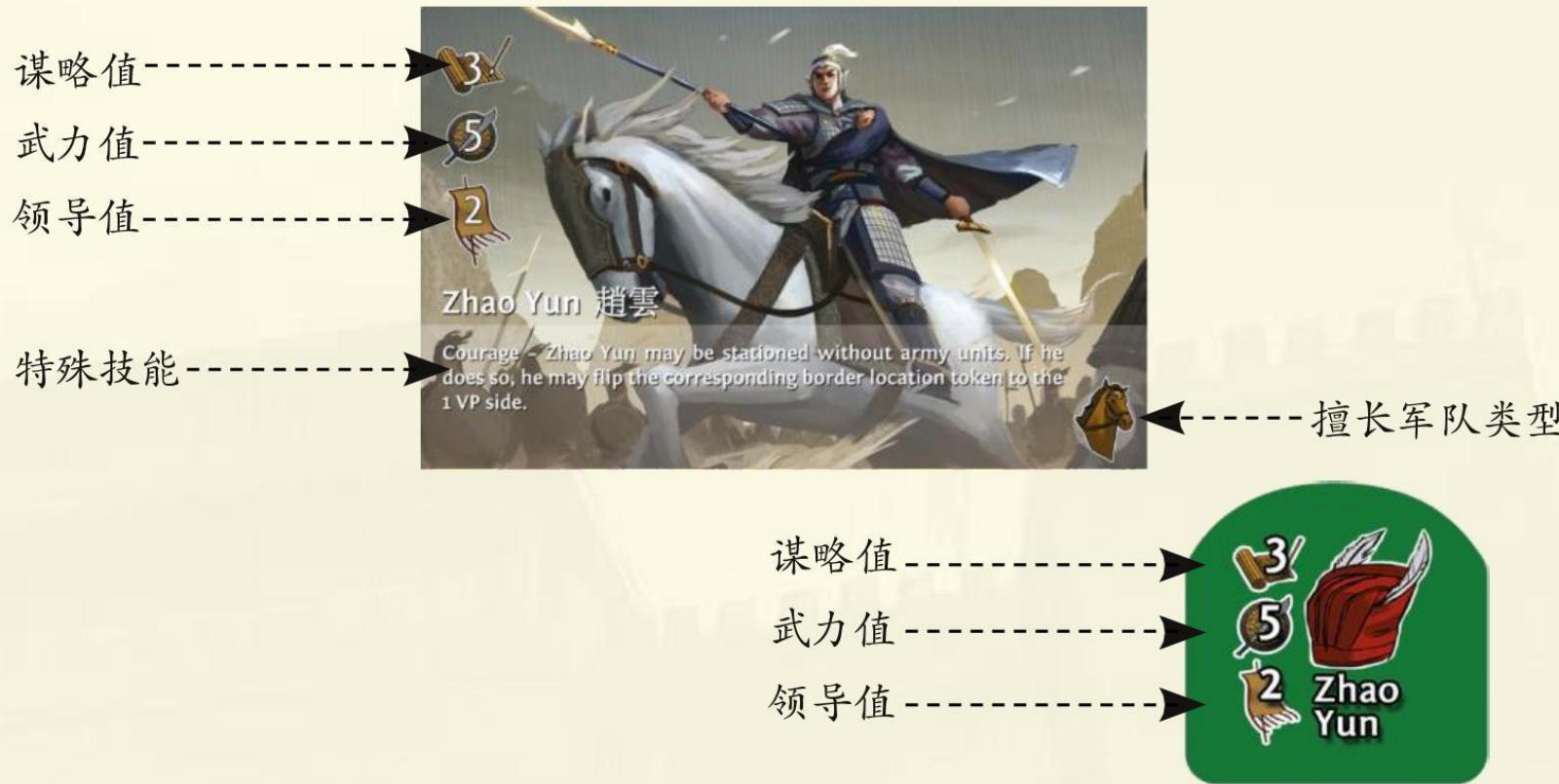
| 领导值 | 1~2 | 决定可率领的最大军队数量 |
- 将领分为军师(帽饰区分)和武将两类。
- 每张将领卡右下角标注擅长率领的兵种类型(1~2种)。
4.3.3 派遣规则
- 根据争夺顺序表,玩家按1→2→3轮流行动。
- 每次只能派遣1名将领到一个行动区。
- 每名将领每回合只能派遣一次(除非特殊技能允许再次派遣)。
- 将一个将领指示物正面向上放置到目标行动区。
- 可以增派援军,同一行动区内将领数量无上限。
- 不派遣则跳过,表示结束对抗阶段(通常无收益,除非触发特殊技能)。
4.3.4 提升实力手段
除将领本身的谋略/武力值外,可通过以下方式增强:
- 军令: 部分将领技能发动时可在将领旁放军令指示物,使该将领实力+1(或+2)。需与将领指示物一同放置。
- 挟持天子: 挟天子的玩家可将天子指示物与将领指示物一同放置,谋略/武力值+1。天子必须与将领一起放置,不可单独使用。
- 百姓拥戴: 拥有百姓指示物的玩家可将任意数量的百姓与将领一起放置,每个百姓+1实力。百姓可与天子同时使用。
4.3.5 胜负判定
比较行动区内各方实力总和:
- 实力高者获胜。
- 平局处理: 率先达到该实力的玩家获胜(先手优势)。若平局仍在对抗阶段出现且无人再增援,则最先积累到此实力的玩家获胜。
- 有特殊技能的将领(如曹操"君命无二")可能打破平局。
- 联盟区: 联盟双方的将领视为同一阵营,实力相加;第三方需超过联盟总和或在平局时先达最强。
4.3.6 边境战场
- 兵力 = 将领武力值 + 所率军队总数量。
- 一名将领只能率领同一种兵种的军队。增派新将领时可带不同兵种。
- 可只派将领不带军队(但胜利无法获得军事分数)。
- 士兵没有将领领导则没有战斗力。
- 每个国家只能在自己的边境战场派兵。
4.3.7 外交行动区
- 每回合只能向自己的外交行动区派遣最多1名将领。
- 派遣将领到外交区即确保在结算阶段能执行改善外族行动。
- 可选择:
- 只派遣将领 → 外族关系改变量0(后续看是否恶化)
- 带领军队前往震慑
- 携带黄金示好
- 但不能同时既带军队又带黄金
- 派遣军队的数量或携带的黄金数量,决定了外族关系的改善幅度(详见第5节)。
5. 结算阶段
按结算顺序表上的顺序(1→2→3),玩家轮流执行自己占领的行动区中的行动。
5.1 移除指示物
- 失利方: 取回所有派遣失利的将领指示物、军队及附带军令/天子指示物;行动区内的百姓指示物弃入公共补给堆。
- 挟持天子遗留: 上回合背面向上留在"挟持天子"区的将领取回,下回合起恢复可用。
- 获胜方: 将领、军队、军令、天子指示物暂时保留在相应行动区上。
- 联盟指示物: 无论胜负均留在联盟区内。
5.2 决定下回合争夺顺序
根据以下条件排列下一回合争夺顺序表:
- 行动区争夺成功次数(含外交行动区)为基准:成功最多的排第1,次多的排第2,最少的排第3。
- 联盟区若双方都出战并获胜,各计1次成功。 - 平局时比较军事分数(当前边境驻军获得的分数),较高者居前。
- 仍平局时按魏→吴→蜀的顺序排位。
排列完成后,将争夺顺序表上三枚国家标记物重排到新顺位。
5.3 执行行动
占领行动区的玩家可自主决定执行顺序,也可以选择不执行(目的仅为阻止对手使用)。每执行完一个行动区,取回该区上的将领/军令/天子/军队指示物,百姓丢弃至公共补给堆。
以下为各行动区具体执行内容:
5.3.1 发展农业(开垦 / 收割)
- 开垦: 将农业发展区上1枚"荒芜的农田"翻转为"丰收的农田"(从左到右依次翻转),农业发展等级+1。
- 收割: 可将任意数量的"丰收的农田"分配:
- 投入粮仓 → 储备用于边境驻军粮草补给(见后勤补给),每枚抵消1份需求。
- 不投入粮仓的 → 每枚换取5份粮食,然后从游戏中弃除。
- 执行收割不影响农业发展等级(保留已开垦的农田)。
5.3.2 发展商业(开张 / 收税)
- 开张: 将商业发展区上1枚"萧条的集市"翻转为"繁荣的集市"(从左到右依次翻转),商业发展等级+1。
- 收税: 可将任意数量的"繁荣的集市"分配:
- 投入国库 → 储备用于边境驻军物资补给(见后勤补给),每枚抵消1份需求。
- 不投入国库的 → 每枚换取4份黄金,然后从游戏中弃除。
- 执行收税不影响商业发展等级。
5.3.3 交易粮食/兵器
可选以下动作,买/卖各选其一,也可以两个都执行:
- 买粮食: 3份黄金 → 4份粮食(最多12份粮食/次)
- 卖粮食: 4份粮食 → 5份黄金
- 买兵器: 5份黄金 → 3件兵器(长枪/战马/弓弩/战船任选,每种最多6件/次)
- 卖兵器: 3件兵器 → 7份黄金(兵种可混搭)
5.3.4 引进教育/科技
两个动作可选其一或都执行:
- 雇佣教练: 支付1份粮食,将最多2个"未训练的军队"翻转成"精锐军队"。
- 引进科技: 从分卡堆或合卡堆中抽取1张国家强化卡加入手牌。
5.3.5 科技兴邦
打出手中的一张国家强化卡:
- 从手牌中选出要打出的卡,展示前置条件和花费。
- 支付对应的费用。
- 将卡正面向上放在己方补给区(已打出状态)。
- 增益效果持续至游戏结束。
- 每回合只能打出1张。
- 卡片右下角标有分数奖励,无论是否激活增益都计入。
- 花费栏含兵种图标 → 需消耗1支军队(未训练或精锐均可)。
5.3.6 生产长枪/战马
从公共补给堆中选择一项:
- 获得2件长枪
- 获得2匹战马
- 获得1件长枪 + 1匹战马
5.3.7 生产弓弩/战船
从公共补给堆中选择一项:
- 获得2件弓弩
- 获得2艘战船
- 获得1件弓弩 + 1艘战船
5.3.8 招募军队
从公共补给堆中获得2支"未训练的军队"。
5.3.9 训练军队
将己方补给堆中最多2个"未训练的军队"翻转成"精锐军队"。
5.3.10 索要贡品
从公共补给堆中选择一项:
- 获得2份黄金
- 获得2份粮食
- 获得1份黄金 + 1份粮食
- 获得1支"未训练的军队"
5.3.11 笼络民心
从公共补给堆中获得1个百姓指示物。
5.3.12 挟持天子
按以下顺序执行:
- 支付1份黄金购买官爵。
- 将爵位表上己方标记物前进一格(每次晋升=结束时多获1分)。
- 从参与争夺此区的将领中选1名,将其指示物背面向上留在此区。该将领下回合起不能参与任何行动区的争夺(包括"挟持天子")。
- 若无人执行此行动,天子指示物放回公共补给堆。
5.3.13 边境战争
按以下顺序执行:
- 驻守边境: 从获胜战场上选派1名己方将领及其军队,驻扎到一块尚未被占领的边境地区。
- 捷报回传: 拿取该边境地区的旌旗指示物,选择放入国库或粮仓。
驻守规则:
| 限制 | 说明 |
|---|---|
| 将领数量 | 每道获胜边境最多派驻1名将领 |
| 最小军队 | 必须至少带1支军队才能驻守 |
| 最大军队 | 最多带其作战时所率领的军队数 |
| 军队类型 | 该地区右上角图标限定兵种(如水军只能驻赤壁等地) |
| 擅长兵种加成 | 将领擅长驻地的兵种时,旌旗翻到1VP面后再入库;否则保持0VP面 |
| 永久驻守 | 一旦驻守就不返还,直至游戏结束 |
| 驻守顺序 | 首次驻守后想继续攻占同一条边境,必须先在其他边境也完成至少1次驻守 |
驻守顺序规则(重要): 在完成首道边境驻军后,若要继续在另一道边境驻扎,必须先在第二道边境也有至少1名将领驻守。两道边境各占1区后,便不再受此限制。
若此回合在两道边境上都发动了进攻但其中一道失败了,即便另一道取胜也无法驻军——因为驻守顺序要求两道边境都有驻军记录后才能集中进攻。
5.3.14 改善外族部落关系
将外族关系标记物向最高等级12的方向前进0~2格:
- 0支军队或0份黄金 → 改善0级
- 1支军队或1份黄金 → 改善1级
- 2支军队或2份黄金 → 改善2级
结算后的物品处理:
- 率军镇压 → 取回将领、军队和兵器(返还)。
- 以钱示好 → 只取回将领,黄金弃入公共补给堆。
外族关系满级特权: 当外族关系等级达到或保持在12级时(无论通过行动或技能),可以在结算阶段任意时刻支付2份粮食换取1个百姓指示物。每回合仅换1次。即使本回合没执行外交行动(纯靠技能维持12级)也同样可以执行此交换。
5.4 恶化外族关系(仅当本回合未执行外交行动时)
- 将外族关系标记物向后退1格(向最低级方向移动1格)。
- 若恶化至/保持在等级1,则在回合结束时拿取1枚扣分指示物(-3 VP)。
6. 休整阶段
结算阶段结束后、下一回合开始前进入休整阶段。最后一回合没有休整阶段。
6.1 翻转准则标记物
翻转"挟持天子"和"笼络民心"两个行动区的准则标记物,互换谋略/武力争夺准则。
6.2 移交天子指示物
- 若有玩家在本回合执行了"挟持天子"行动,则该玩家取回天子指示物(从公共补给堆或其他玩家手中获取)。
- 最后一回合不移交。
6.3 后勤补给
每位玩家需要从公共补给堆中支付以下费用:
| 项目 | 费用 | 抵扣来源 |
|---|---|---|
| 百姓供养 | 每2个百姓 = 1份粮食(不足2个不需支付) | 粮食 |
| 驻军黄金开销 | 每支驻军 = 1份黄金 | 国库中的集市指示物 + 旌旗指示物(每枚抵1份) |
| 驻军粮食开销 | 每支驻军 = 1份粮食 | 粮仓中的农田指示物 + 旌旗指示物(每枚抵1份) |
无法支付的后果: 每差1份就拿取1个扣分指示物(-3 VP)。
6.4 获得军事分数
统计目前所有驻守在边境的军队总数,每支军队获得1分军事分数。调整军事分数表上的对应位置。
6.5 更新回合数
将回合标记物推进一格。
6.6 激活特殊增益
某些将领和国家强化卡在回合结束时可提供特殊收益。玩家可以自主决定激活顺序(不同顺序可能产生不同结果)。
7. 扣分指示物
每个扣分指示物在游戏结束时扣除3分。以下情况需要获取扣分指示物:
- 外族关系降至等级1: 回合结束时拿取1枚。
- 后勤补给不足: 每差1份黄金或粮食拿取1枚。
8. 游戏结束
在每回合结算阶段结束时检查以下任一条件,触发即游戏立即结束(不设休整阶段):
- 此回合是第12回合。
- 某玩家的农业发展水平 和 商业发展水平均达到5级。
- 某玩家晋升至天子爵位。
- 某玩家在一道边境上占领了所有地区。
9. 计分方式
9.1 军事分数
直接从军事分数表读取:等于已驻守边境的军队总数。
9.2 边境分数
比较每道边境上双方占领的地区数量:
| 边境胜负情况 | 获得VP |
|---|---|
| 两道边境均胜利 | 5 |
| 一道胜利,另一道平手 | 3 |
| 一道胜利,另一道失败;或两道均平手 | 2 |
| 一道平手,另一道失败 | 1 |
| 两道均失败 | 0 |
9.3 旌旗分数
统计国库和粮仓中1VP面的旌旗指示物数量之和。(将领驻守时擅长对应兵种则可翻到1VP面。)
9.4 经济发展分数
每位玩家的农业发展等级 + 商业发展等级 = 经济发展等级。与三家比较排名:
| 排名 | 获得VP |
|---|---|
| 独得第一 | 5 |
| 并列第一 | 3 |
| 独得第二 | 2 |
| 并列第二 | 1 |
| 独得第三 | 0 |
三方等级完全相等 → 并列第一,各得3分。
9.5 民族和谐分数
民族和谐指数 = 外族关系等级 + 游戏结束时拥有的百姓指示物数量。与三家比较排名:
| 排名 | 获得VP |
|---|---|
| 独得第一 | 5 |
| 并列第一 | 3 |
| 独得第二 | 2 |
| 并列第二 | 1 |
| 独得第三 | 0 |
三方相等 → 并列第一,各得3分。
此外: 外族关系在9~12级时,还可额外获得1~4分奖励(直接加总)。
9.6 爵位分数
与三家比较爵位高低:
| 排名 | 排行VP |
|---|---|
| 独得第一 | 5 |
| 并列第一 | 3 |
| 独得第二 | 2 |
| 并列第二 | 1 |
| 独得第三 | 0 |
三方相同 → 并列第一,各得3分。
此外: 依据爵位表标注,额外获得1~5分爵位奖励(加总)。
9.7 天子指示物奖励
游戏结束时持有天子指示物的玩家(即倒数第二回合执行了"挟持天子"的玩家),额外获得2分。
9.8 国家强化分数
统计所有已打出国家强化卡的分数奖励之和(每张卡右下角标注)。分卡可能有额外奖励条件,视是否达成而定。
9.9 扣分惩罚
扣分指示物 × (-3)。例如3个扣分指示物 = -9分。
9.10 总分计算
上述所有项相加即为总分。最高分获胜。
平局打破规则:
- 比较黄金 + 粮食指示物数量总和,高者胜。
- 仍平局 → 按蜀→吴→魏的顺序排名(蜀优先)。
常见问题(FAQ)
以下 3 条问答来自站内玩家的真实提问,答复由本站依据规则资料作答;答复内容保持原样,仅对提问做了去口语化的轻微整理。
同一个地块可以派自己的两名将领进入和其他国家争取工位么?
结论:可以。
同一位玩家可以把自己的多名将领派往同一个行动区(同一个"工位")与别国争夺,规则原文明确写着:在同一个行动区内参与争夺的将领数目没有限制。
具体做法
- 按争夺顺序表轮流派遣将领时,轮到你行动就可以再派 1 名己方将领进入已经有己方将领在争夺的同一个行动区,用来给自己的实力"叠加"(相当于支援)。
- 这样做是有效的,会累加你方在该行动区的实力。规则中的示例就是这种情况:蜀国先派蒋琬(5 点谋略)到某行动区,随后蜀国再派姜维(4 点谋略)去支援,蜀国在该行动区就累计了 9 点谋略;魏国也同理,先派贾诩,再派荀攸去支援贾诩。
- 争夺联盟区时同样适用:联盟双方派出的将领被视为同一阵营、实力相加;示例里魏国也是先派贾诩,之后再派荀攸"支援魏军"进入联盟区。
条件与限制
- 每次行动只能派 1 名将领,但可以在不同回合的行动中(或轮到自己时)把多名将领投向同一行动区。
- 每名将领一回合只能被派遣一次,除非其特殊技能允许被再次派遣到别处;因此"同区多人"靠的是派不同的将领,而不是同一名将领反复进同一区。
- 胜者仍然按该行动区的评判准则决出:若一个行动区里出现平局,则最先在该行动区达到最强实力的玩家获胜(例如蜀国先累积到 9 点就赢;曹操在场时则触发其技能使己方在平局中获胜)。
- 你没有可派遣的将领时,对抗阶段即结束;也可以主动跳过,但跳过就代表本回合不再派遣将领。
本内容仅供参考,如有冲突以说明书和身边大佬为准
边境战场的0vp旗子标志被占领后,会拿到我方国库去,可以抵押军队驻扎的金钱或者粮食?
结论:可以。占领边境地区后拿到的旌旗指示物,放进国库或粮仓后,就能用来抵消驻军的黄金或粮食开支。
具体做法
- 玩家在边境战争中获胜并驻扎后,执行"捷报回传":拿取所驻守边境地区上的旌旗指示物,自行选择放入自己的国库还是粮仓。
- 放入国库的旌旗指示物,可抵消 1 份驻军的黄金开支;放入粮仓的旌旗指示物,可抵消 1 份驻军的粮食开支。一枚旌旗只能抵消其中一种,取决于你把它放在哪边。
- 结算发生在休整阶段的后勤补给:每支驻守边境的军队需消耗 1 份黄金 + 1 份粮食;国库里的每个集市指示物和旌旗指示物可抵消 1 份黄金,粮仓里的每个农田指示物和旌旗指示物可抵消 1 份粮食。
条件与例外
- 0VP 与 1VP 的差别只在得分:若驻扎将领擅长的军队类型与驻扎地区的军队类型吻合,摘取时可先翻到 1VP 那面(游戏结束额外 +1 分);不吻合则只能以 0VP 那面向上放入。原文对"抵消后勤开支"只说"每个放入国库/粮仓的旌旗指示物",没有区分正反面,所以 0VP 的旌旗同样能抵消 1 份开支,只是少了那 1 分。
- 抵消不了的部分要受罚:无法支付后勤补给的玩家,每差 1 份黄金/粮食就要拿 1 个扣分指示物(游戏结束每个 −3 分)。
- 规则原文里没有找到"旌旗指示物可以抵押/兑换成黄金或粮食本身"这类说法——它的作用是抵消驻军消耗,不是当作资源收入。
本内容仅供参考,如有冲突以说明书和身边大佬为准。
合卡消耗1/什么是什么意思?
结论
你看到的「1/某图标」是国家强化卡花费栏里的一种写法:它表示这张卡的建造花费是1 支军队,而这 1 支军队既可以用“未训练的军队”支付,也可以用“精锐军队”支付——两种任选其一。
具体说明
- 首先区分牌堆:国家强化卡分两叠——合卡(Unification)和分卡(Separation)。合卡主要提供各种资源的获取途径,分卡主要提供额外的得分方式。
- 打出(建造)国家强化卡时,需要按卡上标明的花费支付给公共补给堆。
- 规则专门说明:有些国家强化卡的花费栏中包含一个特定图标,这个图标的含义就是——玩家需要花费 1 支军队,可以是未训练的军队,也可以是精锐军队。
所以「1/」后面跟的那个图标不是某种固定资源,而是提示“这 1 点花费由“军队”来满足,两种军队状态都收”。
对比其他卡的花费写法
- 例如「护军府(Office of Minister of Finance)」:无前置条件,花费 1 个百姓。
- 例如「长枪军械库(Spear Armory)」:无前置条件,花费 1 件长枪 + 2 份黄金。
可以看出,花费栏写什么就必须付什么;只有出现上述“军队图标”时,才代表这 1 份花费可以用未训练军队或精锐军队的任意一种来支付。
本内容仅供参考,如有冲突以说明书和身边大佬为准
去哪查完整规则
想核对具体规则细节、卡牌效果或某个回合的结算方式,可以在村了吗里选中这款游戏后直接提问。
同类桌游
- 卡坦岛德式
- 工业革命:伯明翰德式
- 勃艮第城堡:特别典藏版德式
- 方舟动物园德式
- 卡卡颂抽象
- 瘟疫危机传承:第一季美式
- 阿瑞迪亚:勇踏征途美式
- 重塑宇宙德式
- 幽港迷城美式
- 埃多拉的德鲁伊德式
规则原文(Markdown)
本站收录这款游戏的规则原文 2 个文件,此处内联渲染 2 个,可直接展开阅读或下载。
rules_zh_三国得志_730.md102.4 KB
三國得志 THREE KINGDOMS Redux
规则说明书
在悠久的中国历史中,汉朝,建立于公元前206年,统治了中原地区及现代中国的大片领土近400年之久。然而,在二世纪末,由于朝廷的政治斗争和统治者的疏于管理,伟大的汉王朝在顷刻间陨落。贪污腐败的官僚太监权倾朝野,为所欲为,他们制定苛税,剥削农民,招致民怨四起。在汉灵帝光和七年(公元184年),贫苦的农民们已走投无路,他们在张角的号令下,揭竿而起,头扎黄巾,高喊“苍天已死,黄天当立”的口号,向官僚地主发动了猛烈攻击,史称“黄巾起义”。
黄巾起义遭遇了朝廷的强力镇压。虽然起义最终以失败而告终,但对东汉朝廷的统治已产生了巨大的冲击,且黄巾残党依旧在各地组织叛乱活动。为了有效镇压平乱,汉灵帝于中平五年(公元188年)三月接受太常刘焉的建议,将部份刺史改为州牧,由宗室或重臣担任,让其拥有地方军、政之权,以便加强地方政权的实力,有效进剿黄巾余孽。然而,正是因为汉灵帝下放权力,各地拥兵自重,军阀割据,纷纷脱离了汉王朝统治。此后,各地群雄互相攻击,逐鹿中原,上演了一出出争霸大戏。在这场雄心与胆识的较量中,有三股势力逐渐脱颖而出,分别是魏、蜀、吴。他们通过吞并周遭弱小势力,逐步扩大自己的疆土,形成三足鼎立之势,从此拉开了三国时代的序幕。
《三国得志》这款桌游由3位玩家共同重演这段魏、蜀、吴三国争霸的历史故事。你需要扮演三国君主中的其中一个,管理好你的国家,发展生产,组建军队,开疆辟土,一统中国。为了更接近历史真实,各位玩家的游戏起点不同。你可以扮演曹操统帅北魏,并在游戏初期拥有较强的实力。你也可以扮演孙坚统帅东吴,或者扮演刘备统帅西蜀,这两方在游戏初期实力稍弱。游戏中实力较弱的两股势力为了保全自己,将结成同盟,共同抗敌。
作为一国之君,你需要从方方面面进行管理,一方面需要妥善经营你的国家,另外一方面又需要派兵驻守边境以防外族来犯。只有在方方面面都采取了正确的管理策略,你才能领导你的国家走向胜利。
需要特别注意的是,随着游戏的推进,场上局势扑朔迷离,敌盟关系瞬息万变。充分了解、熟悉各个阵营在游戏不同时期的实力变化,并加以利用,将助你实现一统天下的雄心壮志!
目录
游戏概览与胜利目标....2
游戏配件....3
游戏初始设置....4
游戏图标....6
游戏术语....6
游戏流程....6
对抗阶段....6
招募将领....6
选择联盟区....7
争夺行动区....7
结算阶段....10
移除指示物....10
决定下回合争夺顺序....10
执行行动....11
恶化外族关系....17
获得/激活特殊增益....17
休整阶段....17
翻转准则标记物....17
移交天子指示物....17
后勤补给....17
获得军事分数....18
更新回合数....18
扣分指示物....18
游戏结束....18
实战战报(1个回合)....22
玩家小贴士....25
游戏指示物用法....26
初学者游戏....27
游戏制作团队....27
计分表....28
在此规则书中,你将看到许多如此方框所示的虚线框。这些虚线方框里包含了一些实战示例,或是你在游戏中需要重点关注的内容。
你可以从下方连接中查询更多信息,这些信息将在你首次游戏时给你帮助。
- 游戏介绍、规则说明及相关下载:http://startingplayer.com/games/three-kingdoms-redux/rules-and-downloads
- 演示视频:http://startingplayer.com/games/three-kingdoms-redux/videos
游戏概览与胜利目标
《三国得志》由3位玩家共同重演魏、吴、蜀三国争霸的历史故事。游戏最多持续12个回合。在每个回合中,玩家需派遣其麾下的将领去争夺游戏版图上的各个行动区,在争夺中获胜的玩家才能执行此区域对应的行动。
这些行动将从农业、商业、军事、科技、内政、外交等多个方面,帮助玩家逐步积累优势,获取分数。
玩家的行动包括:
• 发展农业或商业
• 招募或训练军队
• 生产武器
• 交易资源
• 引进科教
• 科技兴邦
• 挟持天子
• 索要贡品
• 笼络民心
• 改善外族关系
• 发动边境战争
玩家们作为一国之君,在游戏中的目的是从各个方面最大限度地发展自己的国家,并限制其他玩家的发展。在游戏结束时,玩家们将根据自己在多个方面的发展情况得分,获得最多分数 (VP) 的玩家获胜!

游戏配件
游戏通用配件:
- 28页规则说明书一本(此说明书)

1枚回合标记物
(日晷)

1枚联盟指示物
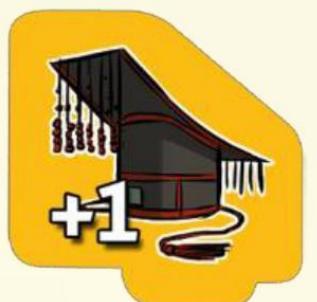
1枚天子指示物
(皇帝)
- 3份玩家指南(1份/国)

2枚准则标记物
(谋略/武力)

20枚农田指示物 (荒芜/丰收)
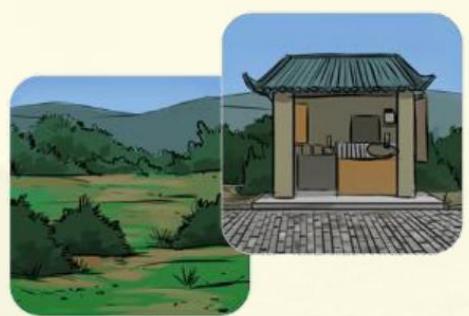
20枚集市指示物
(萧条/繁荣)

30枚黄金指示物 (20枚价值“1”和 10枚价值“5”)

5枚扣分指示物
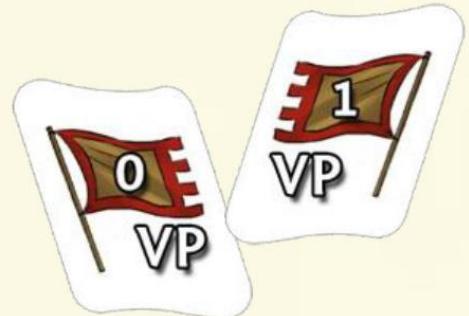
15枚旌旗指示物 (0 VP/1 VP)

- 1 份游戏版图(见上一页底部)

30枚粮食指示物 (20枚储量“1”和 10枚储量“5”)


30枚军队指示物 (未训练/精锐)
12枚长枪指示物
15枚战马指示物

15枚弓弩指示物
15枚战船指示物

15枚百姓指示物

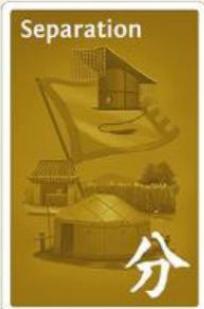
42张国家强化卡 (21张合卡,21张分卡)
玩家专属游戏配件(1种颜色/国):
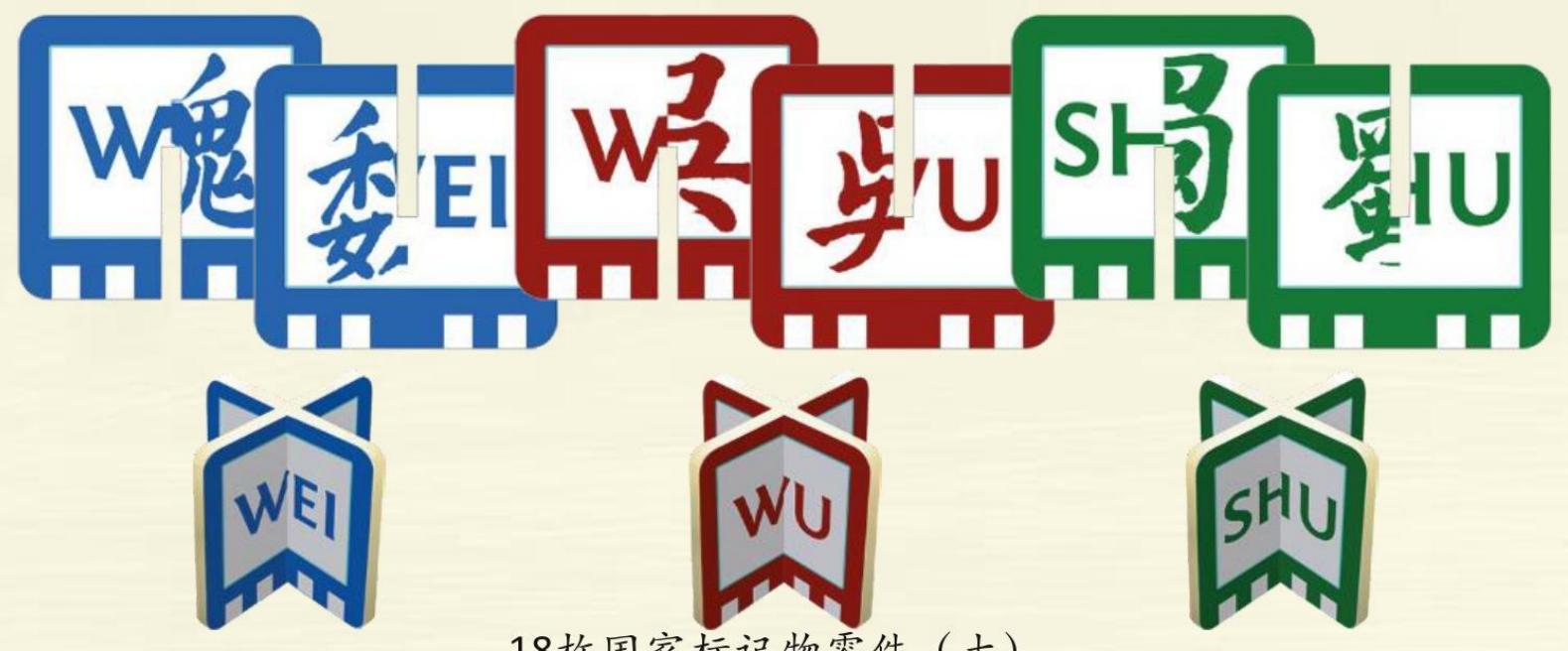
18枚国家标记物零件(大)
(图上方的零件每样3枚, 每对零件可拼成1枚完整的国家标记物)
6枚结算标记物零件(小)
(每对零件可拼成1枚完整的结算标记物)

3枚外族关系标记物
(蒙古包)
69张将领卡
(包括首领在内,23张/国)

69枚将领指示物
(包括首领在内,23枚/国)
© 2014 Starting Player

6枚军令指示物
(每个国家各2枚,+1/+2)

各位玩家分别从魏、吴、蜀三国中挑选一个国家进行游戏。
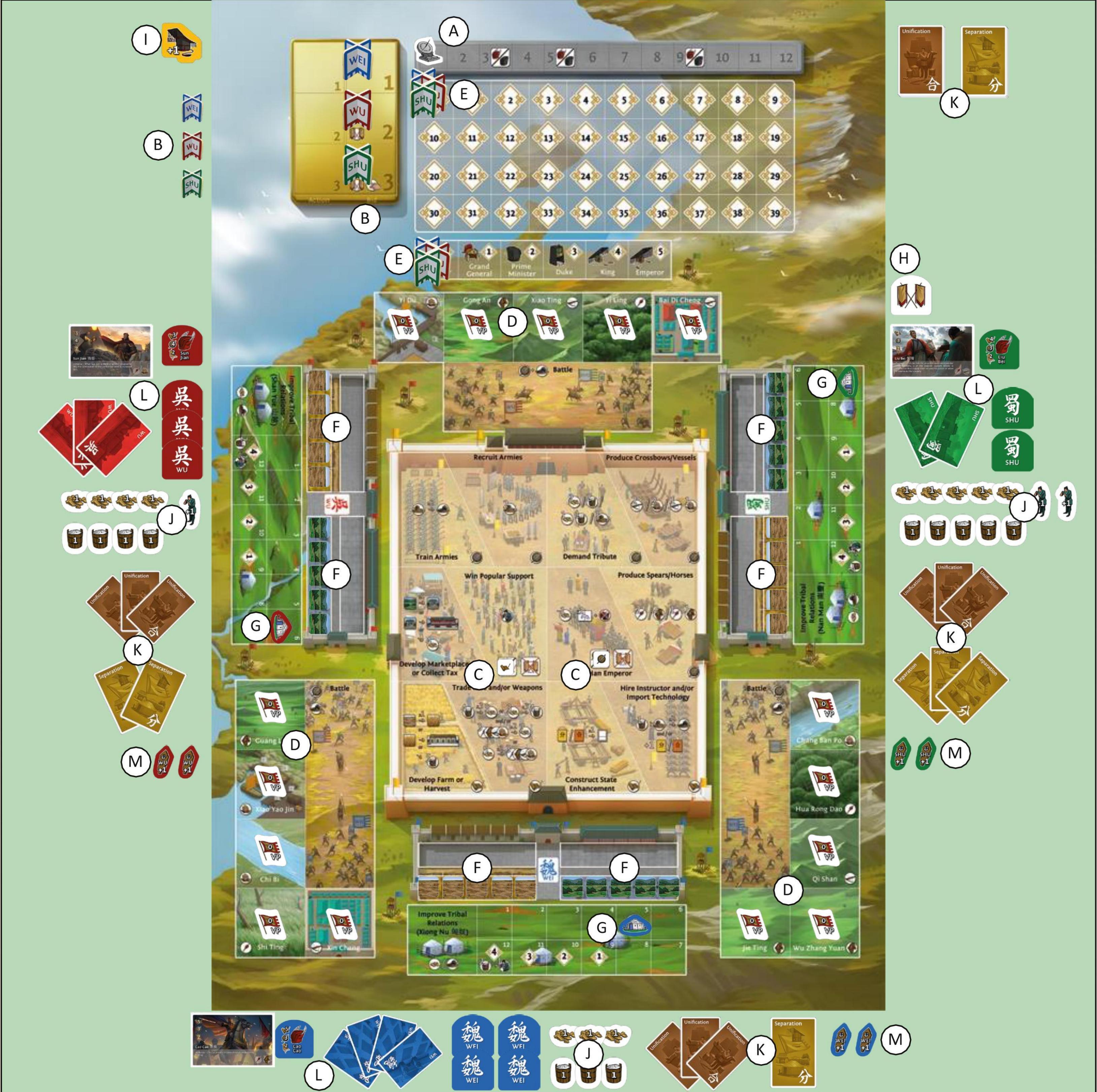
游戏版图
将版图面朝上放置在平整的桌面上。

回合进度条
将回合标记物(日晷)放置在回合进度条的“1”位置上。

争夺顺序表与结算顺序表
在争夺顺序表(右侧列,标有Bid)的“1”、“2”和“3”位置上分别放置魏、吴、蜀的国家标记物(大)。结算顺序表(左侧列,标有Action)暂空。
将魏、吴、蜀的结算标记物(小)放置在版图边上玩家们可以轻易拿取的地方。这些结算标记物将在结算阶段被放置在结算顺序表上,用于更新各位玩家在结算阶段的行动顺序。

准则标记投放区
游戏需用到2枚准则标记物,每个准则标记物的一面显示的是“谋略”,另一面显示的是“武力”。用类似“抛硬币”的方式抛起一枚准则标记物,并将其放在“挟持天子(Control Han emperor)”行动区内的准则标记投放区上将另一枚准则标记物以不同于前一枚准则标记物的一面朝上放置在“笼络民心(Win popular support)”行动区内的准则标记投放区上。这两枚准则指示物分别指代了两个行动区在第1回合时是依靠“谋略”还是依靠“武力”进行争夺。
实战示例:准则标记物投放
假如玩家抛起一枚准则标记物,落下后“武力”一面向上,将其放置在“挟持天子”行动区内,表示此行动区在第1回合使用武力来争夺。然后将另一枚准则标记物翻转到“谋略”一面向上,放置在“笼络民心”行动区内,表示此行动区在第1回合使用谋略来争夺。

边境地区
版图上共有3个边境战场,每个边境战场附近有5个边境地区。在15个边境地区上各放置1枚旌旗指示物,以0分的一面向上。

E 军事分数表和爵位表
在军事分数表上0分的位置上放置魏、吴、蜀的国家标记物各一枚;再在爵位表上“州牧(Governor)”的位置上放置魏、吴、蜀的国家标记物各一枚。

F 农业和商业发展区
在每个玩家的国境内,各有一个农业发展区和一个商业发展区,其中分别应放置5枚农田指示物和5枚集市指示物,其中,农田指示物全部以“荒芜的农田”一面向上,集市指示物全部以“萧条的集市”一面向上。剩余的农田、集市指示物放置在版图边上以备使用。
在农业发展区和商业发展区的上方各有一个区域,分别是玩家的粮仓和国库。这两个区域在游戏刚开始时都是空的。
外族部落关系表

在每个玩家的农业、商业发展区的下方,各有一个外族关系表,指示了玩家与外族部落的关系。每位玩家将己方的外族关系标记物(蒙古包)按照下述方式放置在己方外族部落关系表上对应位置:
• 魏国(匈奴):5
• 吴国(山越): 6
- 蜀国(南蛮):7
联盟指示物
蜀国玩家拿取联盟指示物以备使用。

天子(皇帝)指示物
将天子指示物放置在版图边上所有玩家可以轻易拿取的地方,以备使用。
黄金、粮食和百姓指示物

各位玩家根据下述说明,分别拿取对应数量的黄金、粮食和百姓指示物,作为游戏开局时的初始资源:
• 魏国:3个黄金指示物和3个粮食指示物
- 吴国:4个黄金指示物,4个粮食指示物和1个百姓指示物
- 蜀国:5个黄金指示物,5个粮食指示物和2个百姓指示物
国家强化卡
游戏会使用到两叠国家强化卡,分别是分卡(Separation)和合卡(Unification)。玩家需将两叠牌分开并且分别洗混,然后根据下述说明,为每位玩家分别分发对应数量的国家强化卡:

• 魏国:1张分卡和3张合卡
- 吴国: 2张分卡和3张合卡
- 蜀国: 3张分卡和3张合卡
各位玩家可以阅读一下所拿到的国家强化卡,但别被其他玩家所看到。将剩余的分卡和合卡面朝下放置在版图边上玩家们可以轻易拿取的地方。
将领卡和将领指示物
魏国、吴国、蜀国玩家在游戏开始时分别拥有5名、4名、3名将领,分别包括1名首领和一些玩家招募的将领。
每位玩家拿取其对应国家的将领卡和将领指示物,先从中挑出己方首领的将领卡和将领指示物,然后将剩余的将领卡洗混,并从中抽取6张。魏国、吴国、蜀国玩家分别从各自抽出的6张将领卡中挑选4张、3张、2张将领卡作为自己要招募的将领,然后拿取对应的将领指示物。为了更好的制定策略,玩家需防止对手看到自己挑选的将领卡和将领指示物(背面朝上放置即可)。
把没有挑选的将领卡洗回己方的将领卡堆中。将各国的将领卡和将领指示物分别放置在对应玩家能轻易拿取的地方。至此,完成了初始将领招募。
爵位晋升一级
总结一下各国初始招募的将领:
魏国:曹操 + 抽取6张将领卡,从中选择4张作为招募。
吴国:孙坚 + 抽取6张将领卡,从中选择3张作为招募。
蜀国:刘备 + 抽取6张将领卡,从中选择2张作为招募。

军令指示物
每个玩家拿取己方的军令指示物,放置在各自能轻易拿取的地方以备使用。
其余指示物
(包括军队指示物、长枪指示物、战马指示物、弓弩指示物、战船指示物、扣分指示物、黄金指示物、粮食指示物和百姓指示物)
将其余指示物放置在版图边上玩家们可以轻易拿取的地方,以备使用。
第5页的图片展示了游戏初始设置后的全貌。

联盟
游戏图标

指定联盟区
招募将领

分数

外族关系初始水平

谋略
武力

领导值

未训练的军队

精锐军队


长枪
战马
弓弩

战船

黄金

粮食


准则标记投放区
不可联盟

此处需留一名将领
百姓


萧条的集市
繁荣的市集
国库

荒芜的农田

丰收的农田

粮仓

合卡

分卡

已打出的国家强化卡
游戏术语
公共行动区-版图的中央城池内被分割成了12块区域,称为公共行动区,每位玩家都可以参与争夺这些区域,胜者可以执行此区域内展示的行动。
将领-将领们各有不同的特长,分为军师和武将两类,可通过将领指示物上的帽饰加以区分。
未训练的军队-以“未训练的军队”一面(草帽锄头)朝上军队指示物
精锐军队-以“精锐军队”一面(剑盾头盔)朝上军队指示物
兵器-长枪、弓弩、战马或战船中的一种,以各自的指示物指代。
作战军队:装备有兵器的精锐军队,具体可分为以下几种:
- 步兵 - 装备了长枪的精锐军队
- 劽兵-装备了弓弩的精锐军队
- 骑兵 - 装备了战马的精锐军队
- 水军 - 装备了战船的精锐军队
派遣将领/军队-在争夺阶段把将领/军队指示物放置在行动区中
驻守将领/军队-把将领/军队指示物留在边境未被占领的地区
开张/开垦-将集市/农田指示物翻转,变成繁荣的集市/丰收的农田
游戏流程
每一回合游戏包含以下两个阶段,按顺序进行:
1)对抗阶段
2)结算阶段
每回合结算阶段结束意味着此回合结束,若此时没有任何玩家触发游戏结束的判定条件,则进入额外的休整阶段。
对抗阶段
在每回合的对抗阶段,玩家需要合理使用所招募的将领及其技能,尽可能多地占领地盘,获得其对应行动的执行权力,从而强化自己的国家。对抗阶段具体按照以下描述的顺序开展:
1) 招募将领 (第3、第5和第9回合)
在游戏的第3、第5和第9回合时,玩家可以进行将领招募。若是在其他回合,则跳过此步骤。
所有玩家先洗乱自己的剩余将领卡,从中抽取一定数量的将领卡作为备选,然后从备选的将领中挑选要招募的将领。备选将领和招募将领数量参考下表:
| 回合数 | 魏国 | 吴国 | 蜀国 |
| 3 | 备选3名,招募1名 | 备选4名,招募2名 | 备选4名,招募2名 |
| 5 | 备选3名,招募1名 | 备选3名,招募1名 | 备选4名,招募2名 |
| 9 | 备选3名,招募1名 | 备选3名,招募1名 | 备选3名,招募1名 |
请记住,各玩家抽取的备选将领卡数量总是比最终可选择招募的将领数量多2。
当玩家完成了新将领的招募,需从自己的将领标记物堆中取回新招募将领的指示物(注意不要让其他玩家看到你的将领卡/将领标记物的正面)。将自己没有挑选的将领卡放回自己的剩余将领卡堆并洗乱。玩家从这一轮起就可以使用新招募的将领及其技能去参与版图中各个行动区的争夺。
2) 选定联盟区
争夺顺序表上标有数字“1”,“2”和“3”,代表了在当前回合的对抗阶段里,各位玩家在争夺行动区时的行动顺序。在第一回合的对抗阶段,行动顺序为:魏国首先行动,然后吴国行动,最后蜀国行动。

在争夺顺序表的“2”和“3”两栏中分别印有一个联盟图标,这表示第二顺位和第三顺位玩家自动结成联盟。两位结成联盟的玩家将可以在某一个公共行动区(联盟区)的争夺中联合对抗第一顺位玩家。
在李导顺序表的 5 这 3 栏中还印有一个指定联盟区图标,表示第三顺位玩家有权选择要在哪个公共行动区中与第二顺位玩家联盟对抗第一顺位玩家。当然,第三顺位玩家可以先与第二顺位玩家商讨再作决定。当决定完毕后,请第三顺位玩家将联盟指示物放置在选定的公共行动区中,表明在当前回合,此行动区为联盟区。
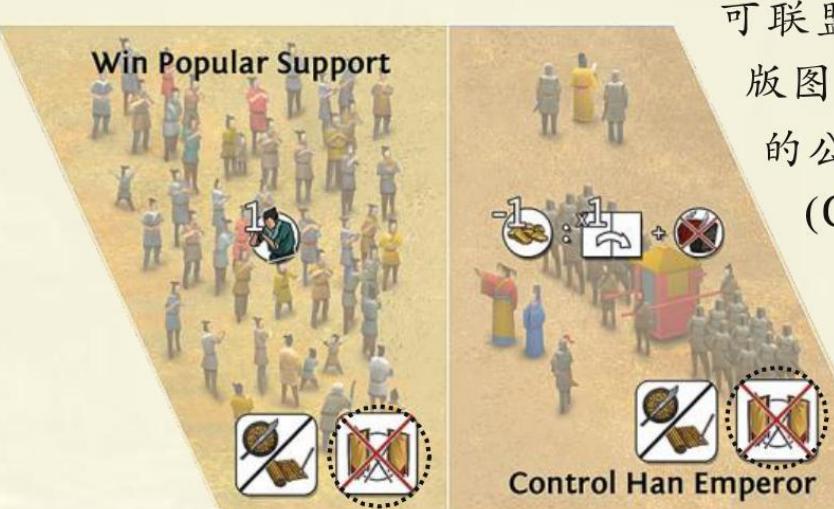
可联盟的共行动区一共有10处,是分布在版图中央城池内不带有“不可联盟图标”的公共行动区。如左图所示,“挟持天子(Control Han Emperor)”和“笼络民心(Win Popular Support)”这两个行动区将无法被指定为联盟区。此外,玩家不能连续两回合选择同一个行动区联盟,即使这两回合里是不同的两位玩家分别处在第三顺位。
若结成联盟的两位玩家都派出将领参与了联盟区的争夺并获得了胜利,则两位结成联盟的玩家都可以执行该联盟区的行动(在结算阶段)。若联盟双方中只有一方派出将领争夺联盟区并获得了胜利,则出战的那位联盟玩家可以执行该联盟区的行动(在结算阶段)。另一位没有参与争夺联盟区的联盟玩家将不能执行该联盟区的行动。若联盟双方在联盟区对抗中败下阵来,则由胜利方(第一顺位玩家)执行该联盟区的行动(在结算阶段)。
3) 争夺行动区
派遣将领
每名将领都拥有谋略值、武力值和领导值三方面属性。其中,每名将领的谋略值和武力值都在1\~5之间变动,而领导值则在1和2之间变化。领导值决定了一名将领所能率领的最大军队数量。谋略值/武力值和将领所带领的军队数量共同组成了这名将领在争夺行动区时的实力。
每名将领都拥有一项独特的技能,这些技能可用于帮助玩家在游戏中建立更多优势。玩家们可以参考自己的玩家指南,阅读并了解其他两位玩家的将领所拥有的特殊技能,知己知彼方能百战不殆。
最后,在每张将领卡的右下角印有兵种图标,指示此将领擅长率领的军队类型(1\~2种)。每当玩家的将领率领擅长的兵种前往边境作战并驻守边境,就可以额外获得1分。(详见第15页)
下图以蜀国武将赵云为例,展示了将领卡和将领指示物上描绘的内容:
行动区
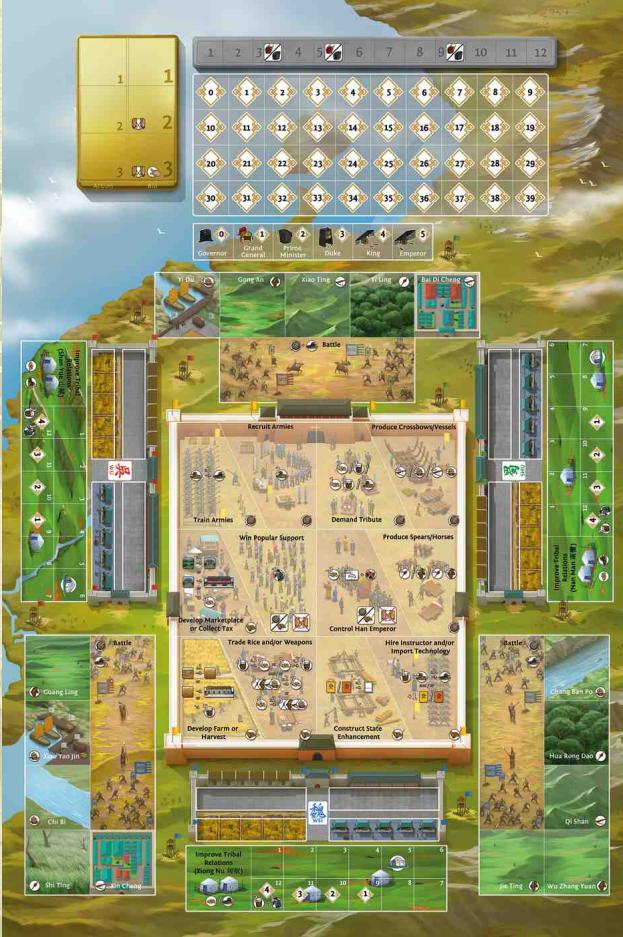
版图上一共有18个行动区。其中,12个是公共行动区,对所有玩家开放,但只有参与争夺行动区并获胜的玩家才能执行对应的行动。剩余的6个行动区属于各国专属行动区,只对其专属的玩家开放。
下面列出了每个行动区的争夺规则(可参考第8页右下角的图片和下文侧边的字母符号来定位所描述的行动区):
在争夺以下5个公共行动区时,需使用谋略。玩家可派遣谋略值高的将领(军师)前往行动区争夺。若行动区里已有别国的将领,则需要比对方更高的谋略才能夺得此行动区(详见第9页):

- 发展农业 (Develop farm or harvest)
• 发展商业 (Develop marketplace or collect tax)
- 交易粮食/兵器(Trade rice and/or weapons)
- 引进教育/科技 (Hire instructor and/or import technology)
- 科技兴邦 (Construct state enhancement)
在争夺以下5个公共行动区时,需使用武力。玩家可派遣谋略值高的将领(武将)前往行动区争夺。若行动区里已有别国的将领,则需要比对方更强的武力才能夺得此行动区(详见第9页):
- 生产长枪/战马 (Produce spears/horses)
- 生产弓弩/战船 (Produce crossbows/vessels)
- 招募军队 (Recruit armies)
- 训练军队 (Train armies)
- 索要贡品 (Demand tribute)
争夺剩余的2个公共行动区,或使用谋略,或使用武力:
• 笼络民心 (Win popular support)
- 挟持天子 (Control Han emperor)
在这两个公共行动区的底部,将各放置一枚准则标记物,指示玩家在该回合里是使用谋略还是使用武力来争夺这两个区域。这两个公共行动区的争夺准则必须是相反的,若其中一个是通过谋略来争夺,则另一个需是通过武力来争夺。在每回合的休整阶段,玩家需将这两个公共行动区内放置的准则标记物分别翻面。因此,随着回合进行,这两个公共行动区将交替以谋略和武力作为争夺准则。
在这12个公共行动区的外围,有3个边境战场,是分别专属于与其相邻两个国家的行动区。战场中的拼杀,依靠的是出征将领的武力值和他所率领的军队数量,武力值和所率领的军队数量总和高的一方胜出。一名将领的领导值决定了其所能率领的最大军队数量,而将领能率领的军队必须是装备了兵器的精锐军队。玩家可以只派遣将领而不率领军队前往战场(不推荐这么做,因为即使胜利了也无法获得军事分数,详见第15页),但不能只派遣军队前往战场,没有将领领导的军队是没有战斗力的。
如果一名出战的将领率领了两支军队,那么这两支军队必须是相同的兵种。如果增派更多的将领出战,那么不同的将领率领的军队兵种可以不相同。
这3个战场分别是:
- 蜀-魏边境战场
- 蜀-吴边境战场
- 魏 - 吴边境战场
玩家只能派兵到本国的边境战场去作战。例如,蜀国玩家不可以派兵到魏-吴边境战场去作战。
实战示例:边境征战
蜀国派遣周仓(1点领导值)率领1支步兵军队前往蜀-吴边境战场。周仓的1点领导值使他最多只能率领1支军队。接着,吴国派遣甘宁(2点领导值)率领2支骑兵军队前往蜀-吴边境战场迎战。甘宁率领的2支军队必须属于同一个兵种。
蜀国见周仓难以取胜,又派遣赵云(2点领导值)率领2支弩兵军队前往蜀—吴边境战场增援周仓。蜀国派遣了新的将领赵云,因此可以让他率领第二个兵种进入战场。当然,蜀国也可以选择只派遣赵云一个人去战场支援而不让他率领任何军队。

在每位玩家的农田与集市发展区下方,分别有一个己方专属的行动区,称为外交行动区,其对应的行动是:改善与外族部落的关系。玩家只要在对抗阶段派遣1名将领到此行动区,就能确保自己在本回合的结算阶段能执行外交行动。在每个对抗阶段,玩家只能向自己的外交行动区派遣最多1名将领,且不能向其他国家的外交行动区派遣将领。
玩家可以派将领独自前往外交行动区执行外交,也可以派将领率军队前往震慑,又或者派将领携带黄金前往示好,但不能在率军震慑的同时又以黄金示好。所派遣的将领的领导值指示了此将领所能率领的最大军队数或携带的最大黄金数。若率领2支军队前往,则2支军队必须属于同一个兵种。
这3个玩家专属的外交行动区,分别用于改善各国与其相邻外族部落的关系(详见第16页):
- 魏国外交行动区:改善与匈奴的关系
- 吴国外交行动区:改善与山越的关系
- 蜀国外交行动区:改善与南蛮的关系

行动区争夺流程
根据争夺顺序表,玩家轮流派遣本国的将领到各个行动区上参与争夺。派遣将领时玩家需要把自己的将领指示物正面向上放置在想要争夺的行动区内。玩家每次行动时只能派遣1名将领,每名将领在一回合里只能被派遣一次(除非其特殊技能允许其被再次派遣到别处)。在同一个行动区内参与争夺的将领数目没有限制。
当玩家不再有可供派遣的将领时,他的对抗阶段就结束了。在轮到玩家行动时,玩家也可以选择不派遣将领而直接跳过,但这也就意味着你打算结束自己在本回合的对抗阶段(本回合不得再派遣将领)。这通常不会给你带来任何收益,除非是能触发某些将领的特殊技能。跳过已结束的玩家,其余玩家还可以继续轮流派遣将领争夺行动区,直到所有玩家都结束了自己的对抗阶段为止。
根据各行动区的评判准则,决出各行动区上的争夺胜者,胜者将能在结算阶段执行此行动区上的行动。若一个行动区里出现平局时,则最先在该行动区达到最强实力的玩家获胜。玩家在结算阶段将轮流执行其占领的行动区上对应的各种行动。
实战示例:争夺行动区
魏国首先派遣贾诩(5点谋略值)前去占领公共行动区“发展商业 (develop marketplace or collect tax)”,紧接着,蜀国派遣姜维(4点谋略值)到此行动区参与争夺。若双方都不再增派援军,则由于贾诩的谋略值高于姜维的谋略值,魏国在此行动区的争夺中获胜。
实战示例:争夺行动区出现平局
魏国首先派遣贾诩(5点谋略值)前去占领公共行动区“发展商业 (develop marketplace or collect tax)”,紧接着,蜀国派遣蒋琬(5点谋略值)到此行动区参与争夺。若双方都不再增派援军,则由于魏国率先积累5点谋略值,魏国获胜。

再看一个较复杂的例子。如果蜀国在下一次行动中派遣姜维(4点谋略值)前去支援蒋琬,则蜀国在该行动区内就积累了9点谋略值。此时若魏国在其下一次行动中再派遣荀攸(4点谋略值)前往支援贾诩,则也积累了9点谋略值。但由于蜀国率先积累了9点谋略值,因此蜀国获胜。
最后再看一个更复杂的例子。如果魏国当初派遣的是曹操(5点谋略值)而不是贾诩(5点谋略值)前去占领此行动区,则在上一个例子中,虽然是蜀国率先积累9点谋略值,但结果却是魏国获胜,因为触发了曹操的特殊技能(君命无二:当曹操参与争夺的区域出现平局时,曹操所在的一方获胜)。
在争夺联盟区时,联盟双方派遣的将领将被视为同一阵营,将联盟双方派遣的将领实力相加作为联盟阵营的实力,第三方(第一顺位玩家)若想在联盟区取胜,则需要派遣比联盟阵营实力更强的将领组合出战,或者在平局的情况下率先积累最强的实力。
实战示例:争夺联盟行动区
假设吴国和蜀国结成联盟,并选定“发展商业 (develop marketplace or collect tax)”公共行动区为联盟区。在争夺联盟区时,魏、吴、蜀按顺序分别派遣了贾诩(5点谋略值)、吕范(4点谋略值)和蒋琬(5点谋略值)前往联盟区争夺。若三方都不再派遣增员,则由于魏国将领的谋略值总和只有5,低于联盟方(吴和蜀)的谋略值总和9,因此联盟方获胜。吴国和蜀国将可以在结算阶段执行发
展商业 (develop marketplace or collect tax) 的行动。
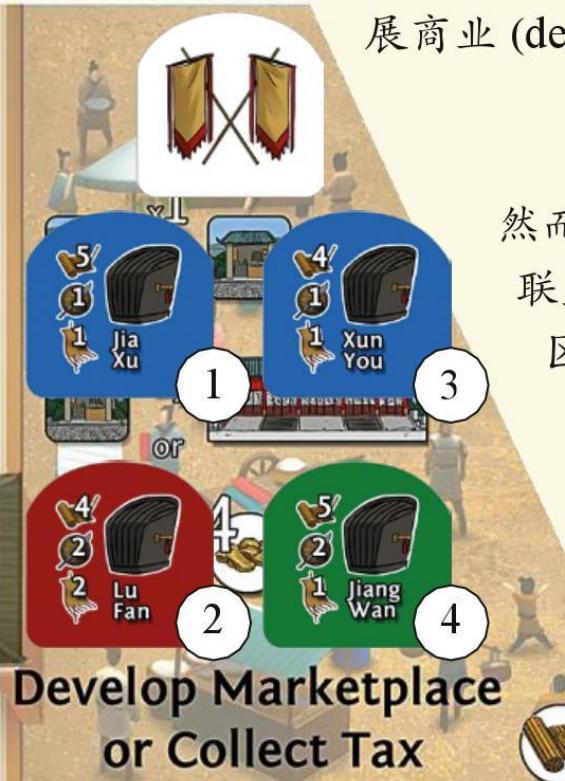
然而,如果魏国首先派遣贾诩(5点谋略值)前往占领联盟区;然后吴国派遣吕范(4点谋略值)前往联盟区迎战;紧接着魏国又立马派遣苟攸(4点谋略值)前往联盟区支援魏军;最后蜀国派遣蒋琬(5点谋略值)前往联盟区支援联盟方。这时双方战成平手,但由于魏国率先积累了最强谋略值,因此,魏国在联盟区争夺中获胜,将可以在结算阶段执行发展商业 (develop marketplace or collect tax) 的行动。
提升将领实力
在争夺行动区时,玩家可以采用以下方法来提升己方将领的争夺实力:
• 军令
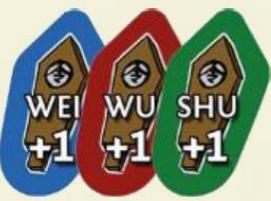
有许多将领的特殊技能在发动时,可以提升其争夺行动区时的孙坚(先发制人:若孙坚是吴国派出的第一个将领,则他的武力值+1),当玩家使用这类技能时,需要将将领指示物和对应的军令指示物一同放置在行动区中,表示此将领的实力已得到提升。
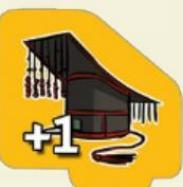
- 挟天子以令诸侯
挟持了天子(皇帝)的玩家,可以在争夺行动区时,把将领指示物和天子指示物一同放置于某个行动区内。由于挟持了天子作为人质,该玩家的这名将领在争夺此行动区时实力+1点。注意:天子指示物必须和将领指示物一同投放,不能单独投放。
- 百姓拥戴
得到百姓拥戴的将领在争夺行动区时将展现更强大的实力。玩家若拥有百姓指示物,可以在争夺行动区时,把将领指示物和若干枚百姓指示物一同放置于某个行动区内,表示该将领受到了百姓的拥戴。每个将领可得到的百姓拥戴数目不限,每个百姓拥戴指示物可以为该将领在争夺此行动区时提升1点。注意:百姓指示物必须和将领指示物一同不能单独投放。

此外,百姓指示物与天子指示物可以一同使用。
结算阶段
在结算阶段,所有玩家需确定出下一回合的玩家顺位,并轮流执行自己所占领的行动区上对应的行动。具体请参考下方的描述,按顺序执行并完成结算阶段:
1) 移除指示物
当所有玩家都完成了其对抗阶段的将领派遣工作后,进入结算阶段,首先通过比较各行动区内的将领实力,确定各行动区的争夺胜者分别是谁。
玩家若在行动区争夺中失利了,需要做以下事情:
- 从各行动区中将己方争夺失利的将领指示物连同其所率领的军队及附带的军令、天子指示物一并取回自己的补给堆中。
- 将行动区中放置的百姓指示物弃至公共补给堆中。
在上回合挟持了天子的玩家请取回自己遗留在“挟持天子”行动区里的背面向上放置的将领指示物。这名将领将可以在下一回合起再度参与行动区的争夺了(详见第13页)。
玩家若在行动区争夺中获胜了:
获胜玩家请将自己的将领指示物连同其所率领的军队及附带的军令、天子指示物都先暂时留在对应的行动区上。
无论联盟区的争夺鹿死谁手,联盟指示物都应被留在联盟区内。
2) 决定下回合争夺顺序
玩家需重新排列“结算顺序表”上的三枚行动标记物(小),使之与当前回合的玩家争夺顺序相同。这三枚行动标记物指代了三位玩家在结算阶段执行行动的先后顺序。
分别统计每位玩家在当前回合的对抗阶段里争夺行动区的成功总次数。若玩家有派遣将领前往外交行动区,则也视为一次成功,需被计入成功总次数。若联盟的两位玩家都派遣了将领前往联盟区参与争夺并获得了成功,则联盟区的成功需分别计入两位联盟玩家的成功总次数中。
按如下方式决定下一回合对抗阶段的争夺顺序:
- 此回合玩家争夺行动区的成功总次数
争夺成功总次数最高、次高、最低的三位玩家分别占据下一回合争夺顺序表的第一、第二、第三顺位。
- 出现平局: 比较军事分数
当玩家在上一项比较中出现平局时,比较平局双方当前的军事分数(military VPs),拥有较高军事分数的玩家占据争夺顺位表的靠前顺位(1→2→3)。
- 再度出现平局:按魏、吴、蜀的顺序排位
若玩家按军事分数比较仍出现平局,则平局的玩家按照魏、吴、蜀的顺序排位。例如,魏国和蜀国在本回合无论是行动区争夺成功总次数(比吴国多)还是当前军事分数都相同,则下回合玩家顺位:魏-蜀-吴。
根据上述规则确定玩家顺位后,重新排列“争夺顺序表”上的三枚国家标记物(大)。这三枚国家标记物指代了三位玩家在下一回合对抗阶段派遣将领去争夺行动区顺序。第一顺位玩家不在联盟内,第二、第三顺位玩家结成新联盟,第三顺位玩家将在下一回合对抗阶段选择新的联盟区。
实战示例:决定下一回合玩家争夺顺序
假设当前回合是第4回合,争夺顺序表上玩家顺位是:魏-吴-蜀,而第3回合的玩家争夺顺序是吴-魏-蜀。
如下图所示,重新排列结算顺序表(左侧标有Action列)上的三枚行动标记物(小),使之与当前回合的争夺顺序表(右侧标有Bid列)相同,即按1\~3排列成:魏-吴-蜀。
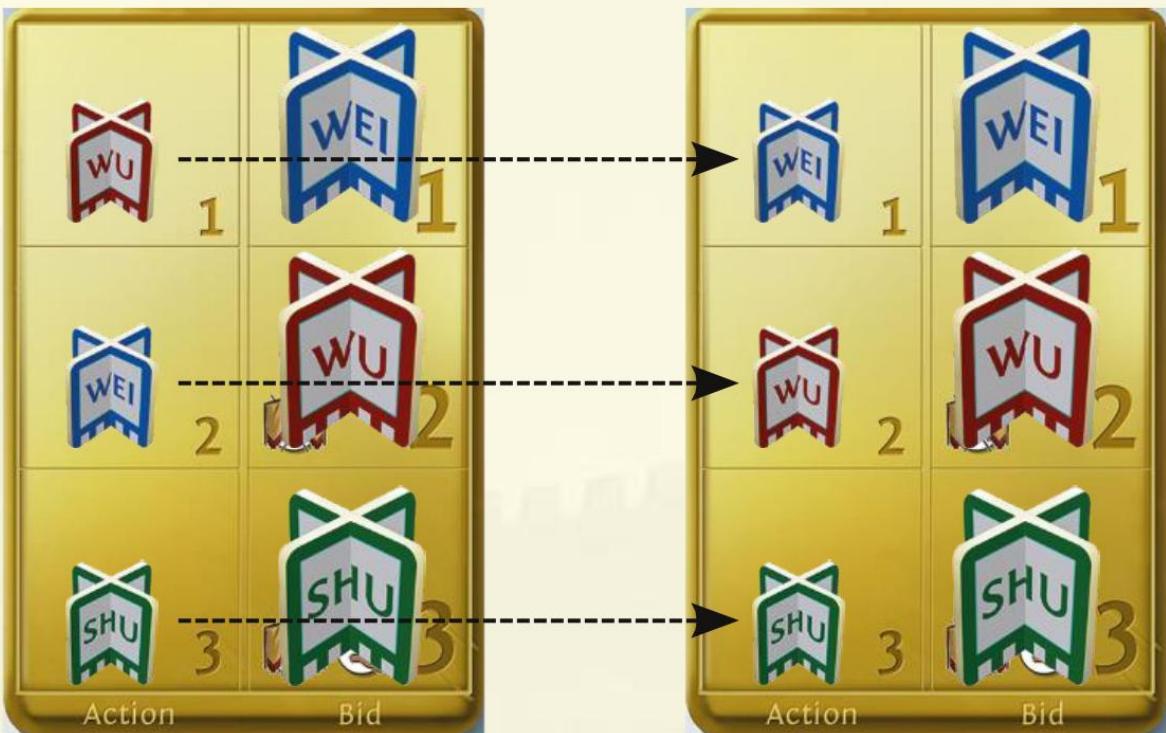
分别统计每位玩家在当前回合争夺行动区的成功总次数。假设魏国、吴国、蜀国的成功次数分别是4、3、4,则吴国玩家因此成为下一回合争夺顺序表上的第三顺位玩家,而魏国和蜀国出现平局,需进一步比较。
比较魏国和蜀国当前的军事分数(military VPs)。假设魏国和蜀国当前分别有0分和2分军事分数,则由于蜀国在军事分数的比较中领先,蜀国成为了下一回合争夺顺序表上的第一顺位玩家,魏国为第二顺位玩家。

魏国和吴国在下一回合将结成新联盟,而吴国则拥有下一回合选择新联盟区的决定权。
如第11页左上角图所示,根据新的玩家顺位,重新排列争夺顺序表(右侧列)上的三枚国家标记物(大),即按1\~3排列成:蜀-魏-吴。


假设魏国和吴国的军事分数都是0(如下图所示),则需按照魏、吴、蜀的顺序对平局玩家排位:

在这种情况下,魏国玩家就将成为下一回合的第一顺位玩家,蜀国玩家则成为第二顺位玩家,而吴国在比较行动区争夺成功次数时就已经占据了第三顺位。于是,吴国和蜀国结成下一回合的新联盟,吴国有选择联盟区的决定权。
如下图所示,根据新的玩家顺位,重新排列争夺顺序表(右侧列)上的三枚国家标记物(大),即按1\~3排列成:魏-蜀-吴。

3) 执行行动
玩家开始依照结算顺序表上的次序,轮流执行各自占领的行动区里所对应的各种行动。
若玩家占领了不止一个行动区,则玩家可以自行决定各行动区的行动执行顺序,玩家也可以选择不执行他占领的行动区上的行动(这种情况,占领的目的单纯是不让对手使用此行动区)。
每当执行了一个行动区的行动,玩家需做以下工作:
- 执行哪个行动区,就取回此行动区上的将领指示物、军令状和天子指示物,
放回玩家自己的补给堆中。
- 执行的行动区中若有军队指示物,且没有被用于驻扎在边境地区,则取回己方补给堆中。
- 执行的行动区中若有百姓指示物,请玩家将百姓指示物弃至公共补给堆中。
下文描述了每一个行动区的具体行动内容,玩家可以参考这些描述来制定行动执行策略:
发展农业 (Develop Farm or Harvest)
在游戏一开始,每个玩家的农业发展区上都覆盖了5个农田指示物,指示物朝上的一面都是“荒芜的农田”,这表明玩家此时的农业发展水平是0。
在结算此行动区时,玩家可以从以下两个行动中选择一个执行:
- 开垦 - 请玩家将农业发展区上的1个“荒芜的农田”指示物翻转变成“丰收的农田”,这表明玩家的农业发展水平上升了1。为避免混乱,请玩家参考从左到右的顺序依次翻转农田指示物。
- 收割 - 玩家可以将自己农业发展区上任意数量的“丰收的农田”指示物装入粮仓中,它们将被用于边境驻军的后续粮草补给。每个不装入粮仓的“丰收的农田”指示物能使玩家获得5份粮食,玩家可从公共补给堆中拿取对应数量的粮食指示物,然后将没有装入粮仓“丰收的农田”指示物从游戏中弃除。
执行“收割”行动时,玩家的农业发展水平并不会受到影响,因为:

= 1级农业发展水平。
每支驻扎在边境的军队在每回合休整阶段都需要消耗1份粮草(详见第17页),而每个被保留在粮仓里的“丰收的农田”指示物可以抵消1份边境驻军的粮草需求。
实战示例:发展农业
魏国在第一回合占领了“发展农业 (develop farm or harvest)”的行动区。由于他的农业发展区还没有任何“丰收的农田”,因此魏国玩家只好选择“开垦”行动。魏国玩家将其最左边的“荒芜的农田”翻转变成一片“丰收的农田”,这也意味着魏国的农业发展水平从0级变成了1级。
实战示例:收割
假设魏国已经在之前的几个回合中执行了三次“开垦”行动。在此回合中,魏国再次占领了“发展农业 (develop farm or harvest)”的行动区,并且决定执行“收割”行动。他将自己的三片“丰收的农田”按如下方式分配:向粮仓中存储2个“丰收的农田”指示物,拿剩下的1个“丰收的农田”指示物交换5个储量为1的粮食指示物,交换后这枚“丰收的农田”指示物被弃除出游戏中。

需要注意的是,魏国在执行完“收割”行动后,其农业发展水平仍旧是3级。
发展商业 (Develop Marketplace or Collect Tax)
在游戏一开始,每个玩家的商业发展区上都覆盖了5个集市指示物,指示物朝上的一面都是“萧条的集市”,这表明玩家此时的商业发展水平是0。
在结算此行动区时,玩家可以从以下两个行动中选择一个执行:
- 开张 - 请玩家将商业发展区上的1个“萧条的集市”指示物翻转变成“繁荣的集市”,这表明玩家的商业发展水平上升了1。为避免混乱,请玩家参考从左到右的顺序依次翻转集市指示物。
- 收税 - 玩家可以将自己商业发展区上任意数量的“繁荣的集市”指示物放进国库中,它们将被用于边境驻军的后续物资补给。每个不装入国库的“繁荣的集市”指示物将使玩家获得4份黄金,玩家可从公共补给堆中拿取对应数量的黄金指示物,然后将没有装入国库“繁荣的集市”指示物从游戏中弃除。
执行“收税”行动时,玩家的商业发展水平并不会受到影响,因为:

= 1级商业发展水平。
每支驻扎在边境的军队在每回合休整阶段都需要消耗1份物资(详见第17页),而每个被保留在国库里的“繁荣的集市”指示物可以抵消1份边境驻军的物资需求。
实战示例:发展农业
魏国在第一回合占领了“发展商业 (develop marketplace or collect tax)”的行动区。由于他的商业发展区还没有任何“繁荣的集市”,因此魏国玩家只好选择“开张”行动。魏国玩家将其最左边的“萧条的集市”翻转变成一片“繁荣的集市”,这也意味着魏国的商业发展水平从0级变成了1级。
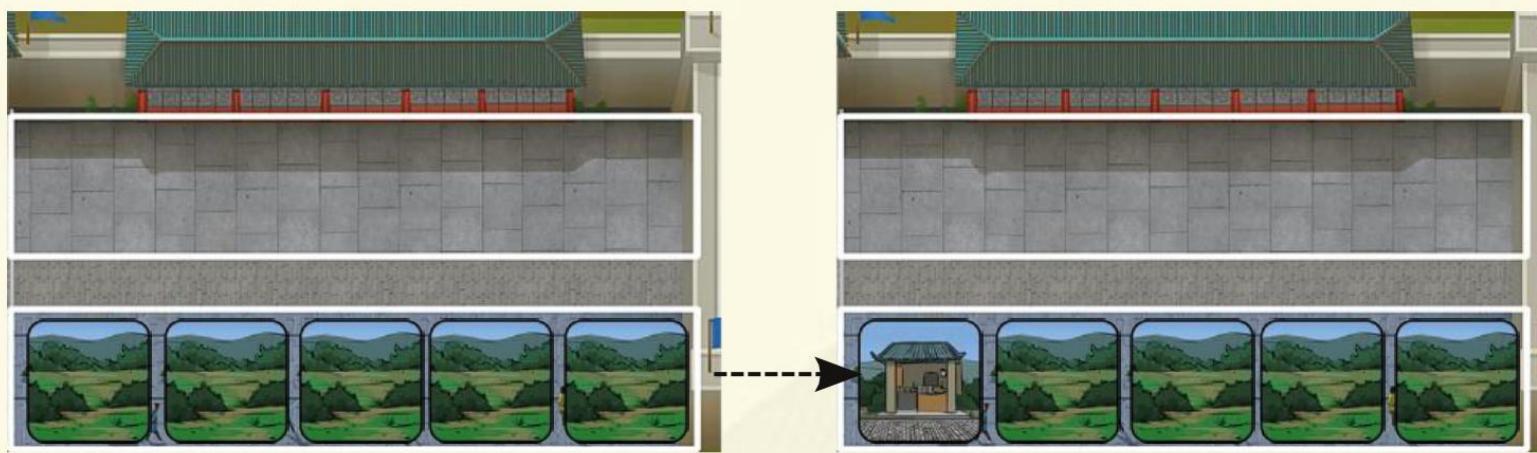
实战示例:收税
假设魏国已经在之前的几个回合中执行了四次“开张”行动。在此回合中,魏国再次占领了“发展商业 (develop marketplace or collect tax)”的行动区,并且决定执行“收税”行动。他将自己的四片“繁荣的集市”按如下方式分配:向国库中存储2个“繁荣的集市”指示物,拿剩下的2个“繁荣的集市”指示物交换8个价值为1的黄金指示物,交换后这2枚“繁荣的集市”指示物被弃除出游戏中。

需要注意的是,魏国在执行完“收税”行动后,其农业发展水平仍旧是4级。
交易粮食/兵器 (Trade Rice and/or Weapons)
在结算此行动区时,玩家可以从以下两个行动中选择一个执行,或者两个行动都执行:
- 交易粮食:按以下价格买卖粮草(注意只能做“买粮食”和“卖粮食”行动中的一种):
□ 买粮食,3份黄金 $\rightarrow$ 4份粮食;
□ 卖粮食,4份粮食 $\rightarrow$ 5份黄金。
每次交易粮食最多能交易12份粮食。
- 交易兵器:按以下价格买卖兵器(注意只能做“买兵器”和“卖兵器”行动中的一种):
☐ 买兵器,5份黄金 → 3个长枪/战马/弓弩/战船;
☐ 卖兵器,3个长枪/战马/弓弩/战船→7份黄金。
每次交易兵器最多能交易6件兵器,兵器的类型可以混搭。
引进教育/科技 (Hire Instructor and/or Import Technology)
在结算此行动区时,玩家可以从以下两个行动中选择一个执行,或者两个行动都执行:
- 雇佣教练:支付1份粮食,雇佣教练训练军队,将最多2个“未训练的军队”指示物翻转变成“精锐军队”。
- 引进科技:从分卡牌堆或合卡牌堆中抽取1张国家强化卡,加入玩家自己的补给堆中。
分卡:提供多种额外获取分数 (VPs) 的手段;
合卡:提供多种收集资源的手段。
科技兴邦 (Construct State Enhancement)
当结算此行动区时,玩家可以打出手中的一张国家强化卡。为此,玩家需要先从手中挑选要打出的国家强化卡,向其他玩家展示此国家强化卡的前置条件、增益效果和花费。确认符合打出此卡的条件后,玩家需要支付此国家强化卡的花费,然后将此国家强化卡正面向上放置在己方补给区中。
每次执行科技兴邦行动,玩家只能打出一张国家强化卡。一旦卡被打出,则根据卡上的描述,其增益效果持续到游戏结束。不论国家强化卡的效果是否被激活,每一张国家强化卡本身能为玩家提供分数奖励,标示于卡的右下角。
此处以“瞭望塔 (Watchtower)”为例展示国家强化卡上的内容:

有一些国家强化卡的花费栏中包含了下面这个图标:

这指的是玩家需要花费1支军队,可以是未训练的军队,也可以是精锐军队。
生产长枪/战马 (Produce Spears/Horses)
当结算此行动区时,玩家可以执行以下行动中的一个:
- 从公共补给堆中获得2件长枪;
- 从公共补给堆中获得2匹战马;
- 从公共补给堆中获得1件长枪+1匹战马。
生产弓弩/战船 (Produce Crossbows/Vessels)
当结算此行动区时,玩家可以执行以下行动中的一个:
- 从公共补给堆中获得2件弓弩;
- 从公共补给堆中获得2艘战船;
- 从公共补给堆中获得1件弓弩+1艘战船。
招募军队 (Recruit Armies)
当结算此行动区时,玩家从公共补给堆中获得2支未训练的军队。
训练军队 (Train Armies)
当结算此行动区时,玩家可以将己方补给堆中最多2个“未训练的军队”指示物翻转变成“精锐军队”。
索要贡品 (Demand Tribute)
当结算此行动区时,玩家可以执行以下行动中的一个:
- 从公共补给堆中获得2份黄金;
- 从公共补给堆中获得2份粮食;
- 从公共补给堆中获得1份黄金+1份粮食;
- 从公共补给堆中获得1支未训练的军队。
笼络民心 (Win Popular Support)
当结算此行动区时,玩家从公共补给堆中获得1个百姓指示物。
挟持天子 (Control Han Emperor)
当结算此行动区时,玩家需按以下顺序执行行动:
- 向公共补给堆中支付1份黄金,用于购买官爵。
- 将爵位表上己方的国家指示物向前推进一格,表示官升一级;每次晋升都将使玩家在游戏结束时多获得1分。
- 从参与争夺此行动区的将领中挑选一个,将其将领指示物背面向上遗留在此行动区中。这名将领被用于挟持天子,下一回合将不能参与包括“挟持天子”在内的任何行动区的争夺。
- 在休整阶段,需要移交天子,执行了“挟持天子”行动的玩家将获得天子指示物。若没有人执行“挟持天子”行动,则将天子指示物放回公共补给堆中。
实战示例:挟持天子及天子指示物的使用
魏国在第2回合赢得了“挟持天子 (control Han emperor)”行动区的争夺,并将曹洪的将领指示物背面朝上留在了此区域用于挟持天子。第3回合的玩家顺位是魏-吴-蜀。
在第3回合的对抗阶段:
- 魏国派遣了荀攸挟天子前往争夺“发展商业 (develop marketplace or collect tax)”行动区,天子指示物使荀攸的能力(在此行动区中是谋略值)+1。
- 吴国派遣了周瑜和甘宁前往争夺“挟持天子 (control Han emperor)”行动区,并获得了胜利。
- 蜀国派遣了赵云前往争夺“挟持天子 (control Han emperor)”行动区,但输给了吴国。

以下是第3回合结算阶段的玩家行动:
- 蜀国玩家取回赵云的将领指示物。
- 魏国玩家取回曹洪的将领指示物,在第4回合,魏国玩家可以使用曹洪参与行动区的争夺了。
- 调整结算顺序表:魏-吴-蜀。再根据玩家成功占领的行动区数量调整下回合的争夺顺序表(此处略)。
- 魏国玩家执行“开张”行动,将其商业发展区中的1枚“萧条的集市”指示物翻转变成了“繁荣的集市”。在执行完此行动后,魏国玩家取回荀攸的将领指示物,表示此行动已被执行完毕。
- 吴国玩家支付1份黄金,因此官升一级,将其爵位表上的国家指示物前进一格至“大将军”。吴国玩家将甘宁的将领指示物背面向上留在了“挟持天子”行动区内,甘宁将不能被用于第4回合的行动区争夺。最后,吴国玩家取回周瑜的将领指示物,表示此行动已被执行完毕。

在第3回合结束时,进入休整阶段。吴国玩家拿取天子指示物,因为他在第3回合执行了“挟持天子”的行动。
若没有任何玩家争夺“挟持天子 (control Han emperor)”行动区,或者有玩家占领了此行动区但没有执行“挟持天子”的行动,则在休整阶段,玩家需将天子指示物放回公共补给堆中。在下一回合,将没有玩家使用天子指示物。
实战示例:无人争夺“挟持天子”行动区
继续使用上述示例,这次假设在第3回合里无人争夺“挟持天子”行动区,则在第3回合的结算阶段,魏国玩家取回曹洪的将领指示物。
在第3回合结束后的休整阶段,魏国玩家将天子指示物放回公共补给堆中,第4回合将没有玩家使用天子指示物。
边境战争 (Battle)
当结算此行动区时,玩家需按以下顺序执行行动:
- 驻守边境:选择战场上一名己方将领和其率领的军队,驻扎进一块还未被人占领的边境地区。
- 捷报回传:玩家拿取所驻守的边境地区上的旌旗指示物,选择是放入自己的国库还是粮仓中。
当执行驻守边境行动时,玩家需遵循以下规则:
- 将领数量
玩家只能向每道获胜的边境派驻最多1名将领(及其率领的军队)。由于每位玩家有两片边境战场,这意味着玩家若在自己的两片边境战斗中都取得了胜利,就有可能能在一回合占领多于1块边境地区(还受下述规则约束)。
- 最小军队数量
玩家不能只驻守将领而不驻守军队,要驻守的将领必须从其率领的军队中携带至少1支军队跟随驻守。这意味着出战的将领若没有率领军队,则不能被驻守于边境。
- 最大军队数量
玩家能驻守的最大军队数量即其选择驻守的武将在作战时所率领的军队数量。
- 军队类型与地区限制
首先,驻扎的地区必须是与战场相邻且未被占领的区域。其次,每个区域只能驻扎特定类型的军队,参考各边境地区右上角的图标。例如,只有率领水军的将领可以驻扎在赤壁。
- 将领擅长的军队类型与旌旗指示物
每个将领都有1或2种擅长率领的军队类型,可参见每张将领卡右下角的图标。当玩家的将领率自己擅长的军队类型在边境战争中获胜并驻扎在了边境,则可以将斩获的旌旗指示物先翻转到1VP的一面(游戏结束时为玩家额外提供1分),然后再选择是放入国库还是粮仓。否则,只能将旌旗指示物以0VP的一面向上放进自己的国库或粮仓。
每支驻扎在边境的军队需要在休整阶段消耗1份黄金和1份粮食作为物资补给,而每个放入玩家国库/粮仓的旌旗指示物可以用于抵消1份驻军的黄金/粮食消耗。
- 驻守的将领和军队
驻守的将领和军队将一直驻留在边境地区直至游戏结束。因此,玩家一旦选择派一个将领驻扎在边境,就无法在之后的回合中使用其来参与行动区的争夺了。
- 已被占领的边境
玩家不能驻守将领和军队到已有军队驻守的边境地区,只能驻扎在未被占领的边境地区。
- 边境驻守顺序(重要规则)
在完成首次边境驻军后,玩家若想继续攻占这道边境上的地区,必须先在另一道边境也驻扎至少一名将领。当玩家在己方两道边境上各占领了1个区域后,就没有驻守顺序的限制了,玩家可以集中火力进攻其中一道边境。
对于只完成了首次边境驻守的玩家,考虑如下情况:假如玩家此回合在其两个边境战场上同时发动战争,其中,在尚未驻军的边境战场上战败了,则参考上述规则,即便该玩家在已驻军的边境战场上取胜了,此回合也将无法向边境驻守任何军队。
实战示例:向边境驻守将领和军队
吴国派遣甘宁和凌操分别率领2队弓弩兵和1队水军前往吴-蜀边境战场作战,并击退了蜀国派遣的赵云和2队骑兵,取得胜利。吴国因此可以选择派遣甘宁率领1或2队弓弩兵驻守边境,或者选择派遣凌操率领1队水军驻守边境。
由于甘宁率领的是弓弩兵,所以只能驻扎在有弓弩图标的区域,在吴-蜀边境地区中带有弓弩图标的是猇亭或白帝城。
由于凌操率领的是水军,所以只能驻扎在有战船图标的区域在吴-蜀边境地区中带有战船图标的只有宜都。
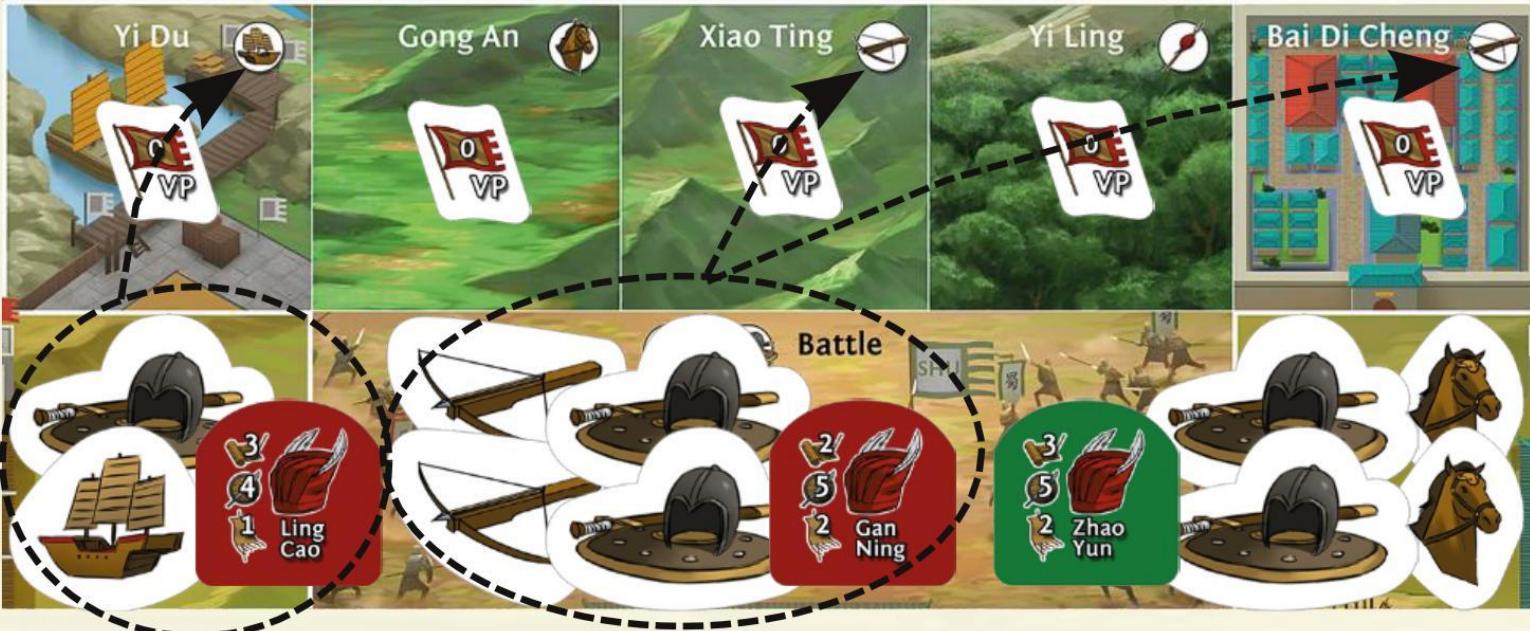
假设吴国玩家选择让甘宁率领2队弓弩兵驻扎在猇亭,则因为甘宁擅长率领的军队类型是骑兵而非弓弩兵,所以吴国在摘取旌旗指示物时不能将其翻转到1VP的那一面。吴国玩家从猇亭地区摘取完旌旗指示物后,可以选择将其放入己方的国库或粮仓中。


假设吴国玩家选择让凌操率领1队水军驻扎在宜都,则因为凌操擅长率领的军队类型正是水军,所以吴国在摘取旌旗指示物时要将其翻转到1VP的那一面,在游戏结束时此旌旗指示物为玩家额外提供1分。吴国玩家从宜都地区摘取完旌旗指示物后,可以选择将其放入己方的国库或粮仓中。

实战示例:驻扎第二和第三名将领
在上一回合,魏国玩家已在魏-吴边境上战争中取胜,并派遣曹仁率领2队水军驻扎在赤壁。曹仁是魏国的首名驻扎将领,因此,魏国要驻扎第二名将领,必须驻扎在另一边境地区上,即魏-蜀边境。
在此回合对抗阶段,魏国玩家向己方的两个边境战场都派遣了将领。其中,魏国的夏侯惇大军(7点总战力)在魏-吴边境战胜了吴国的凌操大军(5点总战力),然而,在魏-蜀边境上,魏国的徐晃大军(5点总战力)却不敌蜀国的姜维大军(6点总战力)。
魏国玩家虽然在魏-吴边境战争中获胜,但却不能将夏侯惇和其骑兵部队驻扎在边境的广陵地区。这是因为根据驻扎顺序规则,魏国玩家必须先在还未驻扎将领的魏-蜀边境地区完成驻扎,才能继续在魏-吴边境地区继续驻扎将领。本回合魏国玩家在魏-蜀边境战败,因此痛失同时向两个边境驻扎将领的机会。
在上述例子中,如果魏国向魏-蜀边境战场派出的是许褚率领2队步兵而不是徐晃率领1队步兵,则魏国玩家在两个边境战场上都将获得胜利。于是,魏国玩家就可以在这一回合让夏侯惇和许褚以及其各自率领的军队分别进驻两道边境地区上符合条件的区域。
显然,魏国玩家还可以只在魏-蜀边境地区的华容道驻扎许褚及其率领的1或2队步兵,而不将夏侯惇驻守在魏-吴边境。然而,魏国玩家不能选择只在魏-吴边境地区的广陵驻扎夏侯惇及其率领的1或2队骑兵,而不将许褚驻守在魏-蜀边境地区,这也同样是因为驻守顺序限制的原因。
改善外族部落关系 (Improve Tribal Relations)
当结算玩家专属的“外交行动区”时,玩家需将其外族关系表上的外族关系标记物向最高等级12的方向前进0\~2格,表示与外族部落的关系改善了0\~2级,改善程度与被派遣至此行动区的将领所率领的军队/携带的黄金数量相等:
- 0支军队或0份黄金-外族关系改善0级
- 1支军队或1份黄金-外族关系改善1级
- 2支军队或2份黄金-外族关系改善2级
结算完毕后,若是率军镇压,则玩家可取回将领、军队和武器指示物;若是以钱示好,则玩家只能取回将领指示物,需将黄金指示物放入公共补给堆中。
当玩家将外族关系发展到/保持在12级时,玩家可以在结算阶段的任意时刻支付2个粮食指示物来换取1个百姓支持指示物,每回合仅能换取1次。若玩家没有执行外交行动,而是使用将领的特殊技能来将外族关系发展到/保持在12级,同样可以执行一次“支付2个粮食指示物换取1个百姓指示物”的行动。
实战示例:改善与外族部落关系
在本回合初,蜀国与南蛮部落的关系等级为2级,关系十分紧张。为此,蜀国在对抗阶段派遣姜维携带2份黄金前往“外交行动区”。在结算阶段,蜀国执行外交行动时,蜀国玩家可将部落标记物前进2格,然后取回姜维的将领指示物,并将2个黄金指示物弃至公共补给堆中。
如果蜀国玩家派姜维率领2队骑兵前往“外交行动区”镇压南蛮部落,而非以钱示好,则在结算外交行动时,蜀国玩家同样可以将部落指示物前进2格,并能在结算后取回所有指示物。

实战示例:外族关系满级
贾诩的特殊技能-幕后操纵:在每个偶数回合,如果魏国玩家没有执行“改善外族关系”行动,则魏国的外族关系保持不变(不会恶化)。
魏国在第6回合招募了贾诩,并在第7回合执行了“改善外族关系”的行动,将外族关系上升至12级。在第8回合,魏国不再派遣将领到外交行动区,但由于贾诩的特殊技能,魏国与匈奴的关系并不会恶化,保持在了12级处。虽然没有执行外交行动,但魏国玩家仍可以支付2个粮食指示物来换取1个百姓指示物。
4) 恶化外族关系
(若本回合玩家没有执行外交行动)
当一位玩家执行完其所有行动后,如果此回合没有执行“改善外族关系”这一行动,则此玩家需要将己方外族关系表上的外族关系标记物向后退1格(向最低级1级方向移动1格),表示己方与外族部落的关系恶化了1级。
如果某个国家与外族部落的关系恶化至/保持在1级,则该国玩家需要在回合结束时拿取1枚扣分指示物(-3 VPs的旌旗指示物),每个扣分指示物将使玩家在游戏结束时扣除3分。
5) 获得/激活特殊收益
某些玩家招募的武将或打出的国家强化卡可以在回合结束时为玩家提供特殊收益。
招募了此类将领和/或打出了此类国家强化卡的玩家,可以在此时激活其能力并获得相应的收益。玩家可以自主决定各个特殊增益技能的激活顺序,不同的激活顺序也许会给玩家带来不同的收益结果。
实战示例:激活并收获特殊增益
蜀国玩家在上回合招募了马超并打出了国家强化卡“易货市场”。此回合,蜀国玩家没有执行“交易粮食/兵器 (trade rice and/or weapons)”的行动,其己方补给堆内剩余1匹战马。
马超的特殊技能——万马奔腾:在马超被招募的那一回合结束时,在此卡上放置4匹战马。在之后的回合中,若回合结束时蜀国补给堆中有至少2匹战马,则马超可从此卡上获得1匹战马(繁殖了)。
易货市场:在每个回合结束时,若玩家此回合没有执行“交易粮食/兵器”的行动,则可以进行1次交易:1件任意兵器 $\leftrightarrow 2$ 份粮食。
根据上述两个特殊增益的内容描述,蜀国玩家决定先激活易货市场的特殊增益,使用2份粮食换取1匹战马,此时蜀国补给堆内就拥有了2匹战马;然后再激活马超的特殊技能,则又可以从马超的将领卡上获取1匹战马。
休整阶段
每回合的结算阶段结束就意味着此回合结束了,若此时没有触发任何游戏结束的判定条件,则还需进入额外的休整阶段。在休整阶段里,玩家需执行以下行动:
1) 翻转准则标记物
翻转 “笼络民心 (win popular support)” 和 “挟持天子 (control Han emperor)” 两个行动区上的评判准则标记物,这意味着这两个地区的争夺评判准则将在下一回合对换。
2) 移交天子指示物
在刚结束的回合里,若有玩家占领并执行了“挟持天子 (control Han emperor)”行动,则该玩家在此时拿取天子指示物(从其他玩家手中移交或从公共补给堆中拿取)。游戏的最后一回合没有休整阶段,因此不移交天子指示物。
3) 后勤补给
所有玩家需从自己的公共补给堆中拿出粮食来供养拥护自己的百姓们:
- 每有2个百姓指示物,支付1份粮食(不到2个百姓指示物不需支付)
所有玩家需从自己的公共补给堆中支付边境驻军的粮食与资金消耗:
- 每支驻守边境的军队需要消耗1份黄金,国库里的每个集市指示物和旌旗指示物可以为玩家抵消1份驻军的黄金开支。
- 每支驻守边境的军队需要消耗1份粮食,粮仓里的每个农田指示物和旌旗指示物可以为玩家抵消1份驻军的粮食开支。
实战示例:后勤补给
吴国玩家的补给堆中有3名百姓指示物,并且目前已在边境地区驻守了2支军队。吴国玩家的国库中没有任何指示物,而粮仓中有1枚旌旗指示物。吴国玩家因此需支付1份粮食供养其百姓,并支付2份黄金和2-1=1份粮食作为边境驻军的物资补给。
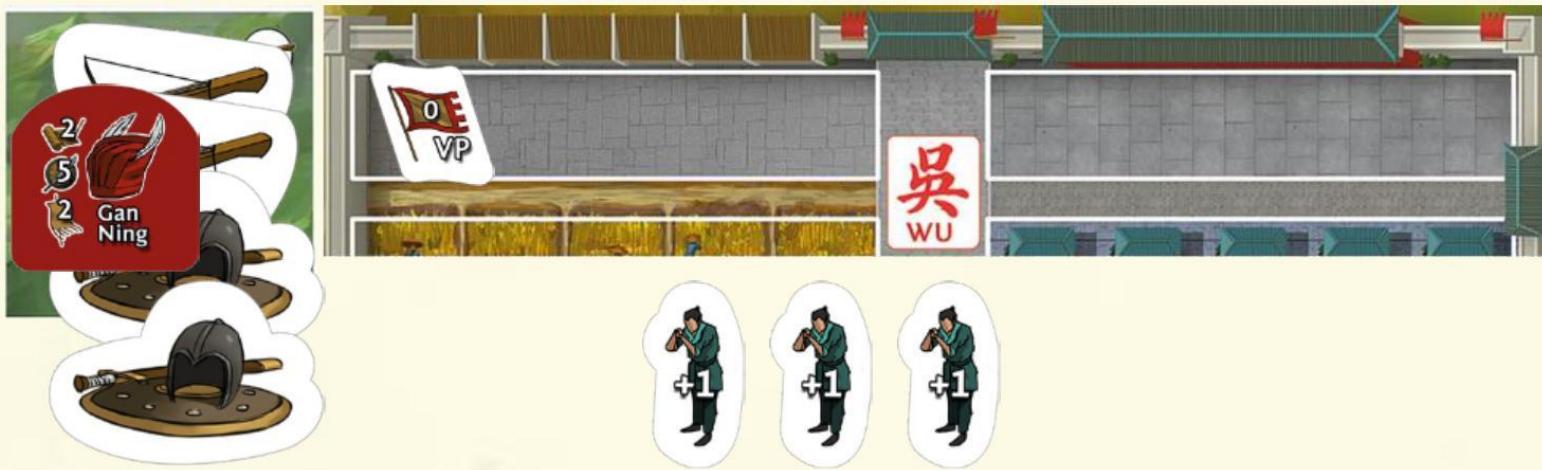
假设吴国玩家的补给堆中有4名百姓指示物,并且目前已在边境地区驻守了2支军队。吴国玩家的国库有1枚集市指示物,粮仓中有1枚农田指示物+1枚旌旗指示物。吴国玩家因此需支付2份粮食供养其百姓,并支付2-1=1份黄金和2-2=0份粮食作为边境驻军的物资补给。

无法支付后勤补给的玩家需要拿取扣分指示物作为惩罚,每差1份黄金/粮食就需要拿取1个扣分指示物,每个扣分指示物在游戏结束时扣除玩家3分。
4) 获得军事分数
玩家在边境地区每驻守了1支军队,就可以在此时获得1分军事分数。各位玩家分别统计自己目前已驻守于边境的军队总数,然后将“军事分数表”上己方国家标志物的位置调整至相应位置(前进相应分数)。
实战示例:获得军事分数
蜀国在上一回合派遣张飞率领2队骑兵驻扎在了蜀-吴边境的公安,这一回合,蜀国又在蜀-魏边境战场上取得胜利,并让姜维率领2队弩兵驻扎在了祁山。
在此回合结束时,没有触发游戏结束条件,进入休整阶段。蜀国此时可以获得4分军事分数,因为他目前一共在边境驻守了4支军队。
5) 更新回合数
将回合进度条上的回合标记物向前进一格,表示游戏进入了下一个回合。
扣分指示物
每个扣分指示物(-3VPs)在游戏结束时会扣除玩家3分。玩家在以下情况出现时需要拿取扣分指示物作为惩罚:
- 每当玩家与外族部落的关系恶化至/保持在等级1时,该玩家在回合结束时拿取1枚扣分指示物。
- 每当玩家在休整阶段进行后勤补给(包括给百姓和给驻军的补给)时无法足量供应粮食/黄金时,该玩家需统计自己所亏欠的物资数量,在后勤补给结束时拿取对应数量的扣分指示物。
游戏结束
在每回合结算阶段结束时,检查以下游戏结束条件是否被触发,若触发了任意一项条件,则游戏立刻结束。
- 此回合是第12回合
- 某玩家的商业与农业发展水平均达到5级。
- 某玩家晋升至天子(Emperor)。
- 某玩家在其一道边境上占领了所有地区。
结算阶段结束时,若上述任意一项条件被触发,则游戏立刻结束,不需要再进行休整阶段。这也意味着游戏最后一回合不需要进行后勤补给,也不能再获得军事分数。
游戏结束时,每位玩家统计自己在包括生产、军事、科技等在内的多个方面获得的分数总和,分数最高的玩家获胜。分数的统计分为以下几方面:
军事分数 (Military VPs)
从“军事分数表”上直接读取每个玩家所获得的军事分数。
实战示例:军事分数
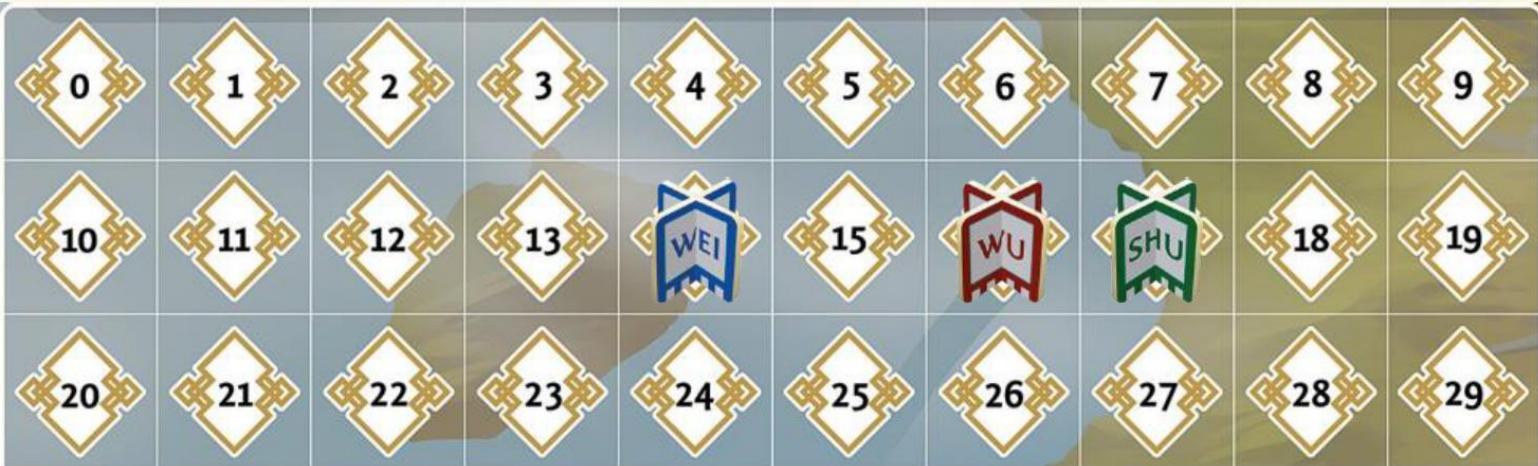
上图所示的例子中,魏、吴、蜀三位玩家分别获得14、16、17分军事分数。
边境分数 (Border VPs)
若玩家在边境上占领了比对手更多的地区,则表示玩家在这道边境上获胜,若占领的地区数量与对手相当,则表示打成平手。玩家可根据下表和自己在两道边境上的胜负情况,获得相应的边境分数。
| 边境胜负情况 | VPs |
| 两道边境均胜利 | 5 |
| 一道边境胜利,另一道边境平手 | 3 |
| 一道边境胜利,另一道边境失败;或两道边境均平手 | 2 |
| 一道边境平手,另一道边境失败 | 1 |
| 两道边境均失败 | 0 |
实战示例:边境分数

在上图展示的例子中,
- 魏国在魏-蜀边境胜利,在魏-吴边境失败,因此获得2分边境分数。
- 吴国在吴-魏边境胜利,在吴-蜀边境平手,因此获得3分边境分数。
- 蜀国在蜀-吴边境平手,在蜀-魏边境失败,因此获得1分边境分数
旌旗分数 (Border Location VPs)
玩家在向边境驻扎军队时,需摘取边境地区的旌旗指示物。若驻扎地的军队限制类型与驻扎将领的擅长军队类型相吻合,则可以将摘取的旌旗指示物翻转到1VP那面向上再放入己方的国库或粮仓中,否则旌旗指示物只能以0VP那面向上放进国库或粮仓。每位玩家统计己方国库和粮仓中1VP的旌旗指示物数量总和,以此作为自己的旌旗分数。
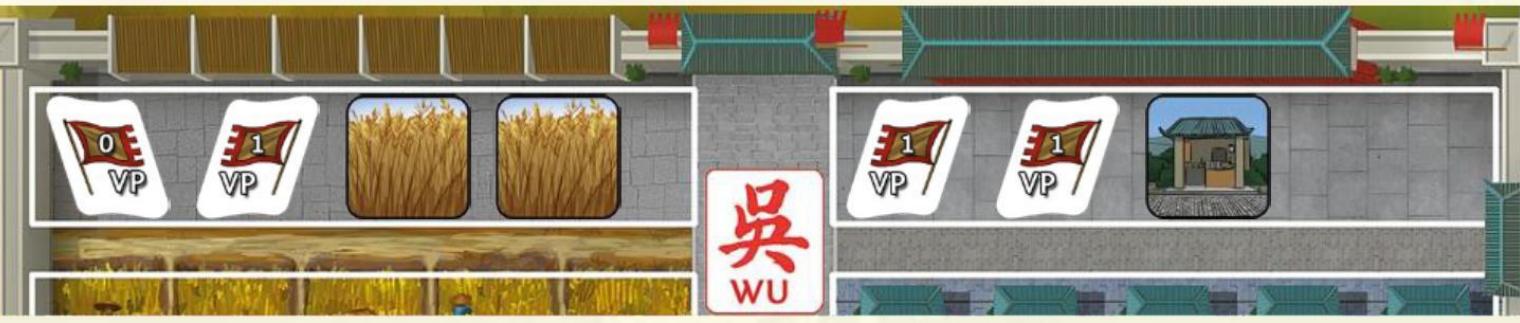
实战示例:旌旗分数
在吴国的国库和粮仓中,共有4个旌旗指示物,其中3个是1VP那面向上放置的因此吴国获得了3分旌旗分数。
经济发展分数 (Domestic Development VPs)
玩家可以从己方的农业/商业发展区中看出己方的农业/商业发展等级。每位玩家将自己的农业发展等级和商业发展等级相加得到经济发展等级,然后与其他玩家相互比较,根据下表确定自己的经济发展分数:
| 农业发展等级+商业发展等级 | VPs |
| 独得第一 | 5 |
| 并列第一 | 3 |
| 独得第二 | 2 |
| 并列第二 | 1 |
| 独得第三 | 0 |
如果三位玩家的经济发展等级都相等, 则视为三位玩家并列第一, 每位玩家都获得3分经济发展分数。
实战示例:经济发展分数

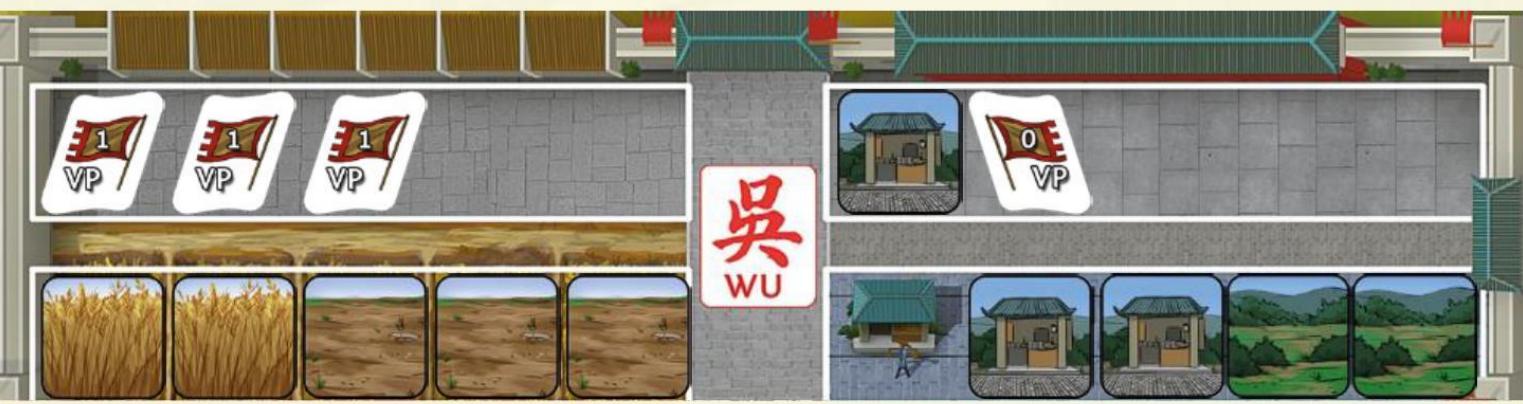

在上图所示的例子中
- 魏国的农业发展等级是5级,商业发展等级是5级,因此其经济发展等级为10级。其经济发展等级是三位玩家中最高的,独得第一名,因此获得5分经济发展分数。
- 吴国的农业发展等级是2级,商业发展等级是3级,因此其经济发展等级为5级。其经济发展等级是三位玩家中最低的,独得第三名,因此获得0分经济发展分数。
- 蜀国的农业发展等级是4级,商业发展等级是3级,因此其经济发展等级为7级。其经济发展等级在三位玩家中排第二,独得第二名,因此可以获得2分经济发展分数。
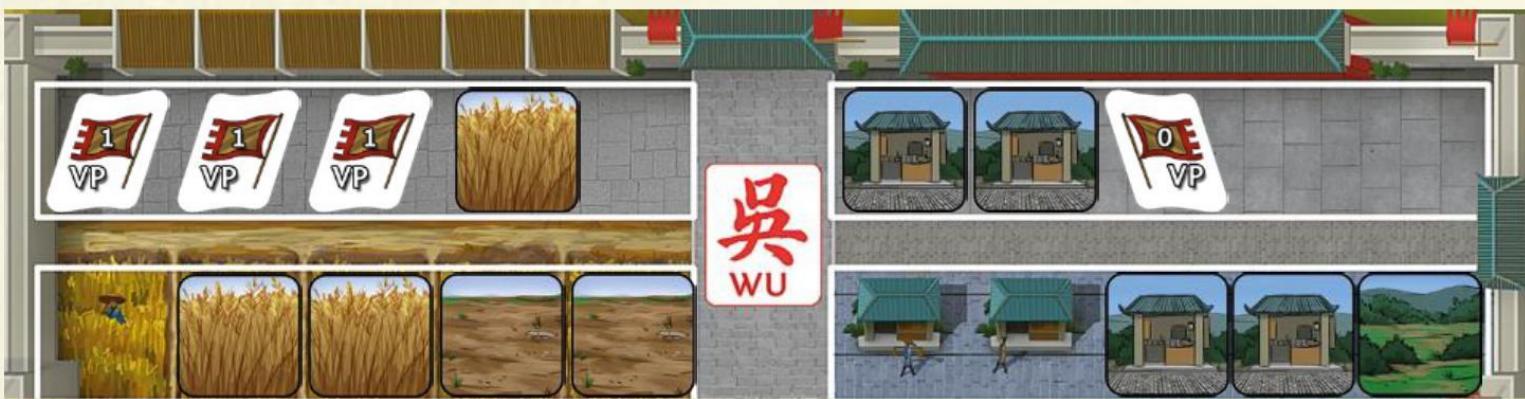
实战示例:民族和谐分数
假设另一种情况,吴国的农业发展等级是3级,商业发展等级是4级,经济发展等级为7级,与蜀国并列第二。则吴国和蜀国分别获得1分经济发展分数。
民族和谐分数 (Civil Harmony VPs)
每位玩家将己方的外族关系等级和游戏结束时拥有的百姓指示物数量相加来作为己方的民族和谐指数。各位玩家互相比较民族和谐指数,并参考下表获得对应的民族和谐分数:
| 民族和谐指数 | VPs |
| 独得第一 | 5 |
| 并列第一 | 3 |
| 独得第二 | 2 |
| 并列第二 | 1 |
| 独得第三 | 0 |
如果三位玩家的民族和谐指数都相等,则视为三位玩家并列第一,每位玩家都获得3分民族和谐分数。
此外,若玩家的外族关系发展到了9\~12级,则依据外族关系表上的标注,还可额外获得1\~4分分数奖励,与上述结果一并计入玩家的民族和谐分数中。

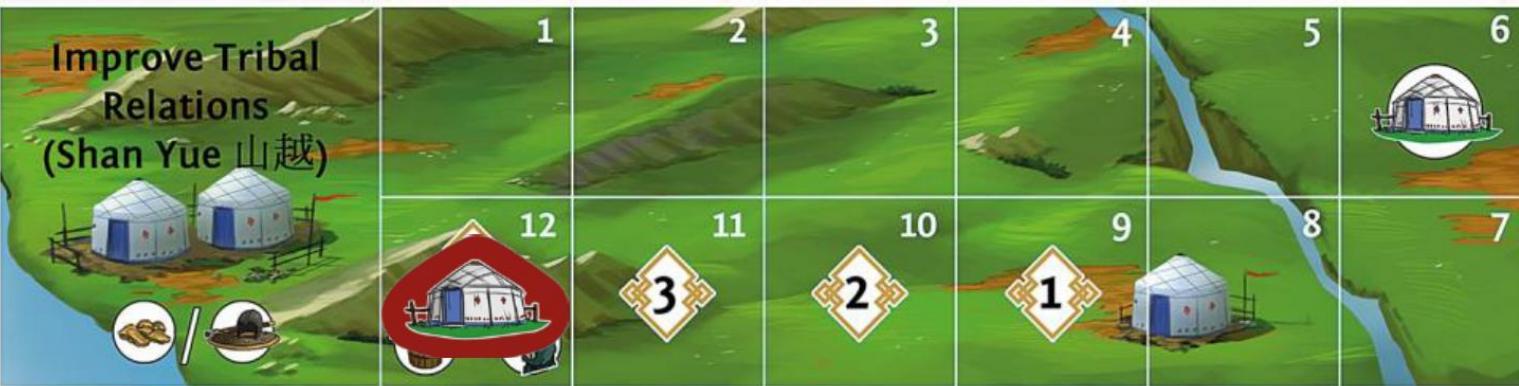
在上图所示的示例中
- 魏国的外族关系等级是11级,拥有2个百姓指示物,因此魏国的民族和谐指数是 $11 + 2 = 13$ 级,在三位玩家中排第二名,获得2分。此外,魏国的外族关系等级是11级,可以再额外获得3分。因此,魏国一共获得 $2 + 3 = 5$ 分民族和谐分数。
- 吴国的外族关系等级是12级,拥有0个百姓指示物,因此吴国的民族和谐指数是 $12 + 0 = 12$ 级,在三位玩家中排第三名,获得0分。此外,吴国的外族关系等级是12级,可以再额外获得4分。因此,吴国一共获得 $0 + 4 = 4$ 分民族和谐分数。
- 蜀国的外族关系等级是10级,拥有4个百姓指示物,因此蜀国的民族和谐指数是 $10 + 4 = 14$ 级,在三位玩家中排第一名,获得5分。此外,蜀国的外族关系等级是10级,可以再额外获得2分。因此,蜀国一共获得 $5 + 2 = 7$ 分民族和谐分数。
爵位分数 (Rank VPs)
各位玩家互相比较爵位高低,并参考下表获得对应的爵位排行分数和爵位奖励分数:
| 爵位排名 | VPs |
| 独得第一 | 5 |
| 并列第一 | 3 |
| 独得第二 | 2 |
| 并列第二 | 1 |
| 独得第三 | 0 |
如果三位玩家的爵位都相同,则视为三位玩家并列第一,每位玩家都获得3分爵位排行分数。
此外,玩家还需依据爵位表上的标注,额外获得1\~5分爵位奖励分数,与上述结果一并计入玩家的爵位分数中。
天子指示物奖励 (Han Emperor Token VPs)
在游戏结束时,挟持了天子(拥有天子指示物)的玩家,即游戏倒数第二回合执行了“挟持天子”行动的玩家,可以额外获得2分奖励。
实战示例:爵位分数和天子指示物奖励
假设在此回合,有某个游戏结束条件被触发。游戏在本回合的结算阶段后就立刻结束,并没有休整阶段。
魏国玩家在此回合占领并执行了“挟持天子”行动,其爵位从Duke晋升到了King。蜀国玩家在上一回合占领并执行了“挟持天子”行动。由于没有休整阶段,天子指示物未被移交,因此,游戏结束时天子仍被蜀国挟持。
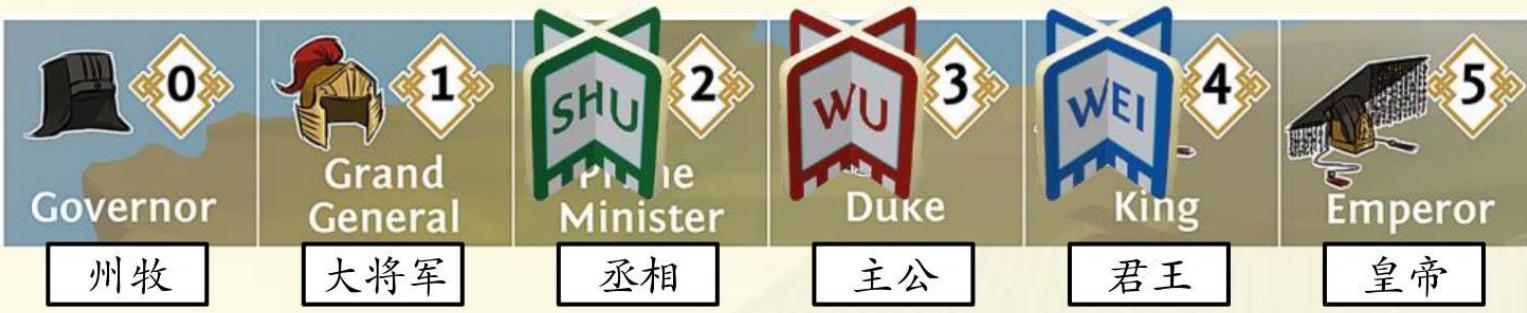
在上图所示的例子中
- 魏国的爵位是君王,是三位玩家中爵位最高的,可获得5分爵位排行分数。此外,魏国的君王爵位还可让其获得4分爵位奖励分数。因此,魏国一共获得 $5 + 4 = 9$ 分爵位分数。
- 吴国的爵位是太尉, 是三位玩家中爵位第二高的, 可获得2分爵位排行分数。此外, 吴国的君王爵位还可让其获得3分爵位奖励分数。因此, 吴国一共获得 $2 + 3 = 5$ 分爵位分数。
- 蜀国的爵位是大司马,是三位玩家中爵位最低的,可获得0分爵位排行分数。此外,蜀国的君王爵位还可让其获得2分爵位奖励分数。因此,魏国一共获得 $0 + 2 = 2$ 分爵位分数。
- 蜀国玩家挟持了天子,额外获得2分作为天子指示物奖励。
国家强化分数 (State Enhancement VPs)
每位玩家统计已打出的国家强化卡为自己带来的分数奖励。每一张国家强化卡都能为玩家提供分数,标注于每一张卡的右下角。此外,分卡能为玩家提供多种获得额外分数的手段,请玩家仔细查看是否达到分卡的额外奖励条件。各位玩家将统计结果作为自己的国家强化分数。
扣分指示物惩罚 (Deficit Token Negative VPs)
每位玩家统计自己的扣分指示物数量,每个扣分指示物记为-3分。举个例子,若玩家获得了3个扣分指示物,则扣分指示物惩罚为-9分。
每位玩家将自己上述各项分数相加,获得自己的分数总和。分数总和最高的玩家获得游戏胜利!
当分数总和出现平局时,比较平局玩家的黄金和粮食指示物数量总和,数量总和高的玩家胜出。如果仍旧出现平局,则平局的玩家按照蜀-吴-魏的顺序排名。举个例子,若蜀国和吴国玩家的分数总和并列第一,且黄金和粮食指示物的数量总和也相等,则蜀国玩家为游戏胜利者。
实战战报(1个回合)
以下是某一局试玩游戏中第1回合的实战战报。
游戏初始设置
准则标记物
- 使用武力争夺“挟持天子”行动区,使用谋略争夺“笼络民心”行动区。
各国初始的国家强化卡
魏国
□ 龙骨水车……【合卡】
□ 马厩……【合卡】
□ 兵器商栈……【合卡】
□ 税制改革(户调制)……【分卡】
• 吴国
□ 易货市场....【合卡】
□ 世兵制....【合卡】
□ 中央官学(太学)....【合卡】
□ 传国玉玺....【分卡】
□ 木偶戏....【分卡】
- 蜀国
- 船坞……【合卡】
- 财政主管(大司农)……【合卡】
- 长枪军械库……【合卡】
- 铜雀……【分卡】
- 攻城塔……【分卡】
- 造纸术……【分卡】
各国初始招募的将领
• 魏国:曹操,贾诩,司马懿,于禁,张郃,程昱,郭嘉
吴国:孙坚,凌操,太史慈,诸葛瑾,陈武,于奉,吕蒙
· 蜀国:刘备,马超,诸葛亮,蒋琬,姜维,王平,严颜
第1回合
对抗阶段
- 选择联盟区
第1回合的玩家顺位是魏-吴-蜀,因此吴国与蜀国联盟,由蜀国玩家挑选一个公共行动区作为联盟区。蜀国玩家在招募将领时,发现 $^{1}$ 诸葛亮的特殊技能和手中的国家强化卡 $^{2}$ 财政主管(大司农)的特殊增益可以形成配合,于是招募了诸葛亮作为初始将领之一,并打算选择“发展商业”行动区作为联盟区。
蜀国玩家向吴国玩家表明了自己的联盟意图。吴国玩家由于招募的初始将领在谋略值方面都较为薄弱,因此欣然同意了蜀国玩家对联盟区的选择。
1 诸葛亮——粮草先行:在诸葛亮执行完“开张”/“开垦”行动后,若蜀国的商业/农业发展区内有不超过2个繁荣的集市/丰收的农田,则他可以获得2份黄金/粮食。
$^{2}$ 财政主管(大司农)——(无前置条件,花费:1百姓,分数奖励:1VP)
强化效果:当玩家打出此卡时,需立刻执行一次“收税”行动。
- 争夺行动区
| 国家 | 派遣的将领 | 争夺的行动区 |
| 魏 | 张郃(武力值4) | 招募军队 |
| 吴 | 3孙坚(武力值4+1) | 生产弓弩/战船 |
| 蜀 | 马超(武力值5) | 生产长枪/战马 |
| 魏 | 贾诩(谋略值5) | 发展农业 |
| 吴 | 凌操(武力值4) | 索要贡品 |
| 蜀 | 刘备(谋略值4)+2百姓 | 科技兴邦 |
| 魏 | 司马懿(谋略值5) | 引进科技/教育 |
| 吴 | 诸葛瑾(谋略值4) | 发展商业 |
| 蜀 | 诸葛亮(谋略值5) | 发展商业 |
| 魏 | 于禁(武力值4) | 挟持天子 |
| 吴 | 4太史慈,不派遣 | 无 |
| 魏 | 曹操(谋略值5) | 笼络民心 |
$^{3}$ 孙坚——先发制人:若孙坚是吴国派出的第一个将领,则他的武力值+1(使用军令指示物表示)。
$^{4}$ 太史慈——按兵不动:在太史慈被招募的那一回合,如果他没有被派遣,他将在回合结束时获得一支精锐部队和一件任意兵器。

对争夺行动区进行简要分析:
魏国
作为将领数量最多的国家,魏国几乎可以主宰前两回合的行动区争夺。虽然张郃只有4点武力值,很容易被诸如孙坚或马超之类的将领所打败,但由于魏国在将领数量上拥有压倒性优势,因此仍旧很容易在行动区争夺中获胜。魏国玩家巧妙利用 $^{5}$ 曹揆的特殊技能,选择最后派遣曹操,对其他玩家保持了充分压制性。
吴国
吴国玩家的初始将领 $^{6}$ 太史慈的特殊技能可以帮助 $^{7}$ 凌操尽快驻扎于边境,从而能尽快激活凌操的特殊技能,使吴国在改善外族关系中获得更大的优势。为此,吴国玩家决定此回合只使用三名将领去争夺行动区,每争得一块行动区都被吴国玩家视为一份额外的奖励。
蜀国
对于蜀国玩家而言,前几回合的联盟区选择至关重要。若能说服吴国玩家派遣将领到行动区合力争夺,则可以或多或少地为己方争夺到最关键的行动区提供保障。在本局游戏的第1回合,吴国玩家就与蜀国玩家达成了共识,向联盟区派遣了将领。此外,蜀国玩家还认为“科技兴邦”这一行动区十分重要,因此在该行动区上投入了6点实力( $^{8}$ 刘备本身的4点谋略值+2个百姓指示物)。蜀国玩家之所以投放2个百姓指示物,是为了防范魏国玩家使用曹操轻易偷袭。在2个百姓指示物的帮助下,魏国玩家需要派遣至少2名将领,才能抢得此行动区。
5 曹操——君命无二:当曹操参与争夺的区域出现平局时,曹操所在的一方获胜。
$^{6}$ 太史慈——按兵不动:在太史慈被招募的那一回合,如果他没有被派遣,他将在回合结束时获得一支精锐部队和一件任意兵器。
7凌操——轻舟独进:在凌操率领1队水军驻扎在边境后,每当回合结束时,若吴国此回合没有执行“改善外族关系”的行动,则吴国与山越部落的关系提升1级/保持在12级。
$^{8}$ 刘备——深得民心:若刘备在争夺区域时有百姓相助,则在执行完行动或退还将军指示物时,刘备可以从中取回其中1个百姓指示物。
结算阶段
- 移除指示物
所有玩家都获得了其争夺的行动区,同时,在第1回合里,不会有背面向上被遗留在“挟持天子”行动区里的将领指示物。因此,没有任何指示物需要从游戏版图上移除。
- 确定下一回合玩家顺位
根据本回合的玩家顺位,在结算阶段行动顺序表上将三枚国家行动标记物(小)按魏-吴-蜀的顺序排布,指示了结算阶段玩家结算行动的顺序。
之后,统计各位玩家在对抗阶段争夺行动区的总成功次数。魏国玩家成功争得
5个行动区,吴国和蜀国玩家则都成功争得了3个行动区。因此,下一回合的玩家顺位是:魏-吴-蜀。
- 执行行动
| 国家 | 执行行动将领 | Action Space |
| 魏 | 贾诩 | 开垦1片农田,农业发展等级+1 |
| 魏 | 9张郃 | 获得2支未训练的军队+1匹战马 |
| 魏 | 10司马懿 | 支付1份粮食,将2个未训练的军队指示物翻转变成精锐军队,抽取2张国家强化卡 |
| 魏 | 曹操 | 获得1个百姓指示物 |
| 魏 | 于禁 | 支付1份黄金,官升一级,于禁的将军指示物被遗留在“挟持天子”行动区 |
| 吴 | 孙坚 | 获得2件弓弩 |
| 吴 | 凌操 | 获得一支未训练的军队 |
| 吴 | 11诸葛瑾 | 获得1份粮食;开张1片集市,商业发展等级+1 |
| 蜀 | 马超 | 获得2件长枪 |
| 蜀 | 刘备 | 打出12长枪军械库 |
| 蜀 | 13诸葛亮 | 获得2份黄金;开张1片集市,商业发展等级+1 |
$^{9}$ 张郃——招兵买马:在张郃被招募的那一回合结束时,他获得1支未训练的军队和2匹战马。此外,在张郃执行完“招募军队”或“训练军队”行动后,他可获得1匹战马。
$^{10}$ 司马懿——尊师重道:当司马懿执行“引进教育/科技”行动时,他能从分卡堆和合卡堆中各抽取一张牌。
11 诸葛瑾——强权外交:若吴国处在联盟中,并使用诸葛瑾执行联盟区行动,则他可在执行行动前获得1份粮食。若吴国不在联盟中,且本回合决定只执行不超过4个行动,则他可在执行行动前获得2份粮食。
12 长枪军械库——(无前置条件,花费:1件长枪+2份黄金,分数奖励:2VPs)特殊增益:当你执行“生产长枪/战马”行动来生产2件长枪时,你可以再额外获得1件长枪。
13 诸葛亮——粮草先行:在诸葛亮执行完“开张”/“开垦”行动后,若蜀国的商业/农业发展等级不超过2级,则他可以获得2份黄金/粮食。
- 恶化外族关系(若本回合玩家没有执行外交行动)
所有玩家都没有执行外交行动,因此每个国家的外族关系分别降1级。
- 获得/激活特殊增益(在所有玩家执行完行动之后,是本回合的最后环节)
□ 魏国
在 $^{14}$ 于禁的将领卡上放置2枚魏国军令指示物。
$^{15}$ 张郃获得一次性特殊收益:1支未训练的军队+2匹战马。
□ 吴国
$^{16}$ 太史慈由于没有被派遣,可获得一次性特殊收益:1支精锐军队+1艘战船。
□ 蜀国
在 $^{17}$ 马超的将领卡上放置4枚战马指示物。
$^{14}$ 于禁——宽宏大量:在于禁被招募的那一回合结束时,在此卡上放置2枚军令指示物。在之后的每个回合,当第三顺位玩家指定完联盟区后,于禁可以弃掉1枚军令指示物来加入联盟。
15 张郃——招兵买马:在张郃被招募的那一回合结束时,他获得1支未训练的军队和2匹战马。此外,在张郃执行完“招募军队”或“训练军队”行动后,他可获得1匹战马。
$^{16}$ 太史慈——按兵不动:在太史慈被招募的那一回合,如果他没有被派遣,他将在回合结束时获得一支精锐部队和一件任意兵器。
17 马超——万马奔腾:在马超被招募的那一回合结束时,在此卡上放置4匹战马。在之后的回合中,若在回合结束时蜀国补给堆中有至少2匹战马,则马超可以从此卡上获得1匹战马(繁殖了)。
休整阶段
- 翻转准则标记物
在下一回合,需使用谋略争夺“挟持天子”行动区,使用武力争夺“笼络民心”行动区。
- 移交天子指示物
由于魏国玩家此回合执行了“挟持天子”行动,此时他可从公共补给堆中拿取天子指示物。
- 后勤补给
所有玩家都不需要支付后勤补给。这是因为目前还没有玩家向边境地区驻守任何军队,同时,也没有玩家在其补给堆中拥有至少2个百姓指示物。
- 获得军事分数
由于没有玩家向边境地区驻守军队,因此没有玩家获得军事分数。
- 更新回合数
将回合进度条上的回合标记物移至2,表示游戏进入了第2回合。
以上就是某一局试玩游戏中第1回合的实战战报。若您希望获得这局游戏的完整信息,或希望更加深刻地了解本游戏的精髓,欢迎访问我们的官方网站:http://startingplayer.com/games/three-kingdoms-redux/rules-and-downloads
玩家小贴士
招募将领
玩家应充分考虑目前场上的局势、游戏的进度以及己方发展的需求,然后再决定招募哪些将领。玩家仅通过一个将领的实力或特殊技能就决定将其招募很可能不是一个好的选择,因为这意味着玩家很可能无法充分发挥将领之间、将领与国家强化卡之间的协同增益效应。
一名实力强悍(即拥有高谋略值或武力值)的将领,其特殊技能通常较弱,反之亦然。此外,在招募将领时一定要留意将领的领导值。将领的领导值决定了其在“边境战场”和“改善外族关系”时所能率领的最大军队数量。
联盟
处于联盟之中是十分有意义的一件事,因为这能大大增加玩家赢得联盟区的可能性,对于游戏初期的吴国和蜀国而言,这一点尤为明显。
因此,玩家们需要在“占领尽量多的行动区”和“处于下一回合的联盟中”作出取舍。
争夺行动区
玩家若重复与同一名对手进行激烈争夺,会导致第三位玩家顺利占领其他行动区。因此,对于两位对手的制衡需要把握好平衡。游戏如此设计初衷正是为了尽量真实地还原三国时期各个国家所需要面对的政治环境,当两方势力开战时,第三方势力定会抓住机会隐忍发展。
国家强化卡
许多分卡都有前置条件,玩家只有在满足前置条件时才能将其打出。在游戏的初期,抽取太多分卡对国家整体发展策略并不会有十分有力的帮助,因为初期玩家的资源十分有限;而合作卡在初期的作用就十分明显,可以给玩家提供更丰富的资源。
资源
在己方的补给堆中囤积太多的军队和武器有时并不能在游戏结束时被有效转化为分数进而取得胜利。为了获取尽量多的分数,玩家需要把握好向边境驻守军队的时机,因为每支驻守边境的军队能使玩家在未来的每个回合都获得1分军事分数(前提是后勤补给能跟得上)。
同样,在己方的补给堆中囤积太多的黄金和粮食也无法在游戏结束时被转化成分数。黄金和粮食最主要的功能是用于支付后勤补给,以及在最终分数总和出现平局时用于打破平局。
百姓指示物
每拥有2个百姓支持指示物就需要在休整阶段支付1份粮食,乍看之下保留百姓指示物是十分不划算的一件事。但千万别忘了玩家在使用百姓指示物来增加将领实力时是没有使用数量限制的。因此,坐拥一定数量的百姓指示物将会在行动区争夺时给对手造成巨大威胁和压力,迫使他们不得不向已占领的行动区中增派支援将领。此外,百姓指示物还可以帮助玩家在争夺关键性区域时势如破竹。综上,请好好斟酌百姓指示物的使用吧!
边境战争
- 玩家需密切关注己方两道边境上已被占领的地区,因为你无法驻守在这些已被占领的地区上。你需要考虑你将要生产的兵器类型,以及你打算派遣哪位将领前往边境驻扎。
- 有些将领即使驻守在边境地区,其特殊技能也仍然可以激活。因此,玩家应考虑先将这类将领驻扎在边境地区上,这样你就可以更充分地发挥其他将领的特殊技能了。举个例子,魏国的张辽、吴国的周瑜以及蜀国的李严,都是先派往边境驻扎的不错人选。
- 玩家不必派遣武力值很强的将领驻扎在边境地区上,否则将很难在未来的边境战斗中获得优势。
外族部落关系
“改善外族关系”行动是不会受到对手阻碍的。因此,外族关系表上9\~12级所分别对应的1\~4分其实是十分容易获得的。玩家要记得这些分数是在游戏结束后结算民族和谐分数时你能额外获得的分数。
得分类别
面面俱到是难以实现的。玩家应根据自己所招募的将领和抽到的国家强化卡,发现己方有优势的得分类别。
终止游戏
玩家需清楚游戏的终止条件是什么,并注意是否有对手即将触发游戏终止条件。如果你发现此回合里必定有玩家会触发游戏终止条件,请抓住最后的机会,尽量多地获得分数或限制对手获得分数。否则,在游戏结束的这一回合里,你可能会花费大量人力物力做一堆毫无收益的事情。
相反,如果是你即将触发某个游戏终止条件,则你可以声张自己可以随时终止游戏,并以此来帮助你积累更多的优势。你可以声称自己不会终止游戏,迫使你的对手必须储存充足的物资以支付后勤补给,否则对手可能会顶着被罚扣分指示物的风险而放手一搏。当对手们忙于补充后勤物资时,你就可以趁机多赢得一些分数,然后在适当的时机终止游戏。
游戏指示物用法
游戏中,包括军队、兵器、黄金、粮食、百姓和扣分指示物在内的全部指示物都是无限量供应的。如果游戏中某种指示物用尽了,玩家可以用其他指示物作临时替代用。
黄金指示物:
- 在休整阶段用于支付边境驻军的物资补给;
- 在执行“交易粮食/兵器”行动时用于购买兵器;
- 在执行“交易粮食/兵器”行动时用于购买粮食;
- 在执行“挟持天子”行动时用于买官;
- 在执行“改善外族关系”行动时,可用于向外族示好;
- 用于支付国家强化卡的花费。
粮食指示物:
- 在休整阶段用于支付边境驻军的粮食补给;
- 在休整阶段用于支付百姓的粮食补给;
- 在执行“交易粮食/兵器”行动时用于卖钱;
- 在执行“雇佣导师”行动时用于聘请导师训练2支军队;
- 在外族关系达到12级时用于获取更多的百姓支持;
- 用于支付国家强化卡的花费。
未训练的军队指示物:
- 可以被训练成精锐军队;
- 用于支付国家强化卡的花费。
精锐军队指示物:
- 装备完兵器后可以形成作战军队;
- 用于支付国家强化卡的花费。
兵器指示物:
- 在执行“交易粮食/兵器”行动时用于卖钱;
- 用于装备在精锐军队上形成作战军队;
- 用于支付国家强化卡的花费。
作战军队:
- 在执行“改善外族关系”行动时,用于镇压外族(执行行动后返还给玩家);
- 在发动边境战争时,可用于增强将领的作战实力(若没有驻守在边境地区,则执行行动后返还给玩家);
- 驻守在边境地区(不会返还给玩家)。
百姓指示物:
- 在争夺行动区时,用于提升1点将领实力(结算阶段被弃回公共补给堆);
- 用于支付国家强化卡的花费;
- 在游戏结束后计算“民族和谐分数”时用于提升民族和谐指数。
初学者游戏
在第一次玩《三国得志》这款桌游时,我们建议玩家参考“初学者游戏”这部分内容进行游戏。这部分内容是为了让玩家们快速上手基本游戏规则而设计的,玩家们可以在熟悉了游戏规则之后,再去窥探《三国得志》的全貌。
“初学者游戏”与正式游戏并无二致,只不过玩家不需要自己挑选要招募的将领,而是使用下表中我们为各位玩家所推荐的阵容。同时,请玩家们在初次游戏时先无视各将领的技能效果。
| 招募将领 | 魏国 | 吴国 | 蜀国 |
| 初始将领 | 曹操 | 孙坚 | 刘备 |
| 夏侯惇 | 黄盖 | 关羽 | |
| 夏侯渊 | 孙策 | 张飞 | |
| 徐晃 | 周瑜 | - | |
| 郭嘉 | - | - | |
| 第3回合 | 张郃 | 孙权 | 赵云 |
| - | 太史慈 | 诸葛亮 | |
| 第5回合 | 张辽 | 鲁肃 | 黄忠 |
| - | - | 庞统 | |
| 第9回合 | 司马懿 | 甘宁 | 马超 |
当游戏进行到第3、第5和第9回合时,玩家同样不用抽取将领卡来招募将领,而是根据上表直接招募对应的将领即可。其余游戏规则全部遵守此规则书的描述。
游戏制作团队
游戏设计者:Christina Ng Zhen Wei 和 Yeo Keng Leong
美工:Ray Toh
主要游戏测试:Loo Lip Ghee, Brandon Lye Mun Hei, Tan Wei Liang, Ng He Xiang
游戏测试:Ho Keng Chiong, Tang Yan, Ho Wei Kang, Tatu Laitinen, Lin Suting, Ng Joon Hui, Favian Choo, Jeffrey Wee, Ashleigh Peng, Marco, Guan Yu, Jane Chen, Alexis Wong, Bohan Ang, Ou Yang, Michael Tan, a player who did not wish to be named, Juan M. Medina, Ana Forero, Sara Medina, Chew Boon Longe, Eric Teo, Tan Kok Hinn, Ho Wan Yu, Charles Chua Yong Lun, Adrian Bai, Dave Perry Sam
文献查阅:Adrian Bai, Alexis Wong, Bohan Ang, Brandon Lye Mun Hei, John Bintz, Juan M. Medina, Murray Woodford, Ou Yang, Hugues Richard (Oninohugo), Erik Capps
书法:Mr. Lee Hwee Sing (李惠信)
中文翻译:苏少杰
制造商:Panda Game Manufacturing
特此纪念:Lip Ghee的父亲——Loo Say Kai先生,不幸于2012年10月29日与世长辞,正逢《三国得志》开发阶段。
计分表
| 得分类型 | 魏国 | 吴国 | 蜀国 |
| 军事 | |||
| 边境 | |||
| 旌旗 | |||
| 经济发展 | |||
| 民族和谐 | |||
| 爵位 | |||
| 挟持天子 | |||
| 国家强化 | |||
| 扣分 | |||
| 合计 |
| 得分类别 | 魏国 | 吴国 | 蜀国 |
| 军事 | |||
| 边境 | |||
| 旌旗 | |||
| 经济发展 | |||
| 民族和谐 | |||
| 爵位 | |||
| 挟持天子 | |||
| 国家强化 | |||
| 扣分 | |||
| 合计 |
| 得分类别 | 魏国 | 吴国 | 蜀国 |
| 军事 | |||
| 边境 | |||
| 旌旗 | |||
| 经济发展 | |||
| 民族和谐 | |||
| 爵位 | |||
| 挟持天子 | |||
| 国家强化 | |||
| 扣分 | |||
| 合计 |
| 得分类别 | 魏国 | 吴国 | 蜀国 |
| 军事 | |||
| 边境 | |||
| 旌旗 | |||
| 经济发展 | |||
| 民族和谐 | |||
| 爵位 | |||
| 挟持天子 | |||
| 国家强化 | |||
| 扣分 | |||
| 合计 |
TKR-Capstone-web-rules.md96.2 KB

RULEBOOK
The Han Dynasty, founded in 206 BC, ruled the central plains and much of modern day China for nearly four hundred years. However, by the late second century, court politics and poor governance had left it in rapid decline. The government was dominated by corrupt eunuchs and officials who levied heavy taxes on the peasants, resulting in public discontent. This culminated in the Yellow Turban Rebellion led by Zhang Jiao in 184 AD during the reign of Emperor Ling (168-189 AD).
Although the Yellow Turban Rebellion was eventually put down, many surviving followers went on to become bandits and continued to create problems for the government. The Han army was unable to control the bandits, and Emperor Ling granted direct administrative power over provinces and command of regional military to local lords. Many feudal lords took the opportunity to sever ties with the Han government and ruled independently. The more ambitious lords annexed neighboring territories to expand their power bases. This led to the emergence of the three power blocs of Wei, Wu, and Shu, and ushered in the Three Kingdoms period.
Three Kingdoms Redux is a board game that seeks to recreate the tripartite between the states of Wei, Wu, and Shu. You assume the role of one of the three lords – Cao Cao leading Cao Wei, Sun Jian leading Eastern Wu, or Liu Bei leading Shu Han. Players start the game from asymmetrical positions, reflecting the manpower advantages Wei enjoyed in the early part of the period. The weaker states of Wu and Shu protect themselves by forming an alliance.
As a feudal lord, you manage the different aspects of running a state whilst guarding your borders against both rebellious border tribes and external enemies.
Managing each aspect well earns victory points for your state.
But beware, for the balance of power shifts constantly during the game. Understand and take advantage of the power shifts, and you will fulfill your grand ambition of re-unifying China!
TABLE OF CONTENTS
Game Overview and Goal..2
Gamo
Game Setup4
Game lcon6
Game Terminolgy…6
Game Sequnce6
Conflict ase6
Recruit Generals… 6
Select Alliance Action Space…… 7
Bid For Action Saces……7
Reslution Phase……10
Remove Tokens. 10
Determine Turn Order For Next Round………10
Take Actions.. ………11
Reduce Tribal Relations Level……… 17
Receive/Activate Benefits.…17
Update and Maintenance...17
Flip Criterion Markers.
Pass Han Emperor Token...
Pay Popular Support Tokens' and Stationed Armies' pke....17
Award Military VPs for Stationed Armies.18
Update Round Trackmora.18
Deficit Tokens.maanmm 18
Game End..... Whahm18
Tips For Players.sAa5ah5hhAn.25
Game Tokens' Uses26
Beginners'Tutorial……27
Game Credits27
Throughout this rulebook, you will see boxes similar to this. These boxes contain examples and items you should take note of during gameplay.
GAME OVERVIEW & GOAL
Three Kingdoms Redux is played over a number of rounds, up to a maximum of 12. Players bid for various actions with their general tokens. The highest bidder of each action space obtains the right to carry out the actions.
These actions allow players to improve your state's domestic development, gain military strength, construct state enhancements, increase popularity with your people, improve relationships with your border tribes, and gain promotions to higher ranks.
The actions available to each player are:
• Develop your state's farm or marketplace
• Recruit or train army units
• Produce weapons
• Trade resources
• Import technology
• Construct state enhancements
• Control the Han emperor
Demand tributes from your vassals
Win support from your people
Improve your relationship with your border tribe
Wage battle against other states to expand your borders
The winner is the player with the most victory points (VPs) at the end of the game.
GAME COMPONENTS
General Game Components:
• 1 Rule Book

1 Round Marker

1 Alliance Token

• 3 Player Aids (1 per state)
1 Han Emperor Token

2 Criterion Markers (Administration/Combat)
• 1 Game Board (see bottom of previous page)

15 Border Location Tokens (0 VP/1 VP)
5 Deficit Tokens

20 Farm Tokens (Undeveloped/Developed)

20 Marketplace Tokens (Undeveloped/Developed)
30 Gold Tokens (20 valued “1” and 10 valued “5”)

30 Rice Tokens (20 valued “1” and 10 valued “5”)
40 Army Tokens (Untrained/Trained)

12 Spear Tokens
15 Horse Tokens

15 Crossbow Tokens

15 Vessel Tokens

15 Popular Support Tokens
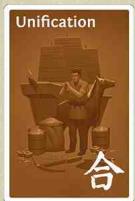

42 State Enhancement Cards (21 Unification and 21 Separation)
Player-specific Game Components (one color per state):
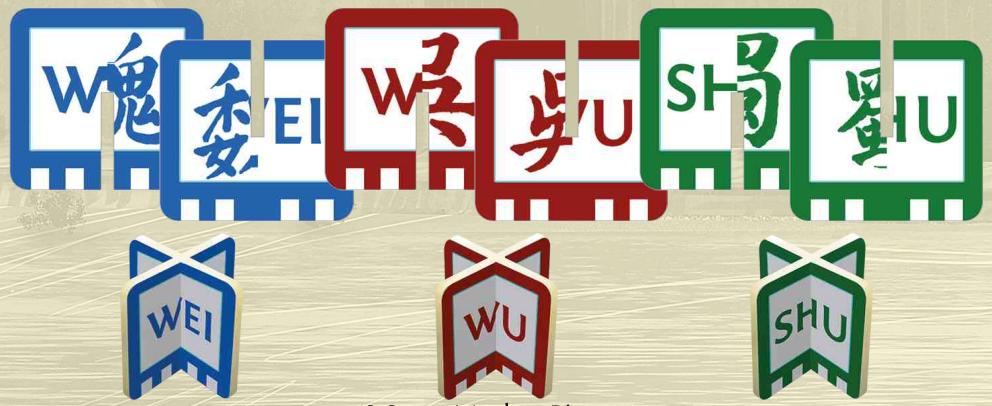
18 State Marker Pieces (3 of each piece above, each pair interlocks to form a state marker)

6 State Action Marker Pieces (each pair interlocks to form a state action marker)
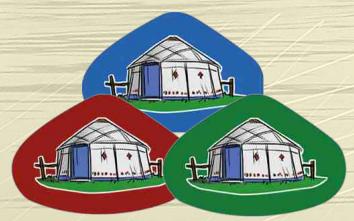
3 Tribe Markers

69 General Cards (23 per state including Lord)
69 General Tokens (23 per state including Lord)
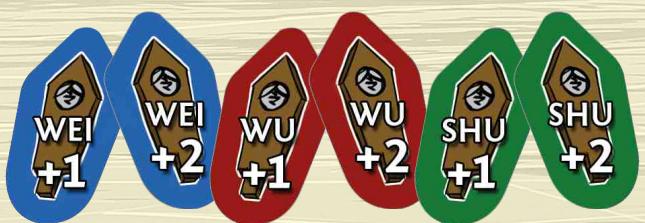
6 Bid Tokens (+1/+2, 2 per state)

Each player selects one of the states of Wei, Wu, or Shu to play.
Game Board
Place the game board face up on the table.

Round Track
Place the round marker on the “1” space of the round track.

BBid Order Track and Action Order Track
Place a Wei, Wu, and Shu state marker on the “1”, “2” and “3” space of the bid order track respectively. The action order track is left empty for now.
Set the Wei, Wu, and Shu state action markers aside, within easy reach of all players. These will be used during the Resolution Phase to update the action order track.

Criterion Marker Spaces
Both criterion markers show administration on one side and combat on the other. With one of the criterion markers, randomly select one side and place it on the criterion marker space of the “control Han emperor" action space. Place the other criterion marker with the opposite side face up on the criterion marker space of the “win popular support” action space. These represent the bidding criterion for the respective action spaces in round 1.
Example: Criterion Markers Placement
If the combat side of one criterion marker is chosen for the "control Han emperor" action space, then the administration side of the other criterion marker is placed face up on the “win popular support" action space.
DBorder Location Spaces
On each of the 15 border location spaces, place a border location token with the o VP side face up.
EMilitary VP and Rank Track
Place one of each of the Wei, Wu, and Shu state markers on the 0 VP space of the military VP track and the Governor space of the rank track.
FFarm and Marketplace Development Spaces
Each player places 5 farm tokens and 5 marketplace tokens, with the undeveloped farm and marketplace sides face up, on his state's farm and marketplace development spaces respectively. The remaining farm and marketplace tokens are set aside, within easy reach of all players.
There are two spaces above each state's farm and marketplace development spaces. These are the state's granary and treasury respectively, and are left empty at the start of the game.
Tribal Relations Track

The tribal relations track of each state is found below the state's farm and marketplace development spaces. Place each state's tribe marker on the following spaces of the corresponding state's tribal relations track:
• Wei (Xiong Nu 匈奴):5
• Wu (Shan Yue 山越):6
• Shu (Nan Man 南蛮):7
Alliance Token
The Shu player collects the alliance token and holds onto it for now.

Han Emperor Token
Set the Han emperor token aside, within easy reach of all players.
①
Gold, Rice, and Popular Support Tokens
Players collect the following number of gold, rice, and popular support tokens to start the game with:
• Wei : 3 gold tokens and 3 rice tokens
• Wu : 4 gold tokens, 4 rice tokens, and 1 popular support token
• Shu : 5 gold tokens, 5 rice tokens, and 2 popular support tokens
State Enhancement Cards
There are two decks of state enhancement cards, namely the Separation and Unification decks. Shuffle the two decks separately and deal to each player the following number of state enhancement cards:
• Wei : 1 Separation and 3 Unification
• Wu : 2 Separation and 3 Unification
• Shu : 3 Separation and 3 Unification
Players may read their dealt state enhancement cards, but keep them covered from other players'view. The two decks of the remaining state enhancement cards are placed aside and face down, within easy reach of all players.
General Cards and Tokens

Wei, Wu, and Shu players start the game with 5, 4, and 3 generals respectively, comprising of the lord and a number of recruited generals.
Each player collects his state's general cards and tokens, sets aside the lord's general card and token, shuffles the remaining general cards and draws 6 general cards. The Wei, Wu, and Shu player selects 4, 3, and 2 general cards respectively from their 6 drawn general cards, then collects the corresponding general tokens. Players keep the selected general cards and tokens covered from other players'view.
Return unselected general cards to each state's remaining general cards. Set each state's remaining general cards and tokens aside, within easy reach of the corresponding player. This completes the initial recruitment.

© 2017 Capstone Games
Summary of initial recruitment:
• Wei : Cao Cao + draw 6, select 4 to recruit
• Wu : Sun Jian + draw 6, select 3 to recruit
• Shu : Liu Bei + draw 6, select 2 to recruit

Bid Tokens
Each player collects his state's bid tokens and sets them aside, within easy reach of the corresponding player.
Remaining Tokens
(army, spear, horse, crossbow, vessel, deficit, gold, rice, and popular support tokens)
Set aside the rest of the tokens, within easy reach of all players.
A picture of the initial setup is shown on page 5.
GAME ICONS

Alliance

Select Alliance

Recruit Generals


Victory Point
Starting Tribal Relations Level
Administration

Combat
Leadership

Untrained Army

Trained Army


Spear
Horse
Crossbow

Vessel

Gold

Rice


Criterion Marker Space
Non-Alliance

Increase Rank by 1 Level

Leave 1 General Here

Popular Support

Undeveloped Marketplace


Developed Marketplace
Treasury

Undeveloped Farm

Developed Farm
Granary

Unification Card

Separation Card

Played State Enhancement Card
GAME TERMINOLOGY
Common bidding action space – Any of the 12 action spaces found at the center of the game board that all players may bid for
General - Civil official or military general, as denoted by the two types of headgear on the general tokens
Untrained army - Army token with the untrained army side face up
Trained army – Army token with the trained army side face up
Weapon – Crossbow, horse, spear, or vessel token
Army unit: Trained army equipped with weapon, as follows:
• Archery unit – Trained army with crossbow token
• Cavalry unit - Trained army with horse token
• Infantry unit - Trained army with spear token
• Naval unit - Trained army with vessel token
Assigned army/general - Army unit/general token placed on an action space during bidding
Stationed army/general – Army unit/general token sent to border location
Flipped marketplace/farm token - Marketplace/farm token with developed side face up
GAME SEQUENCE
Each round consists of two phases, occurring sequentially:
1) Conflict Phase
2) Resolution Phase
At the end of each round during which none of the game end conditions is triggered, Update and Maintenance takes place.
CONFLICT PHASE
During the Conflict Phase of each round, players strengthen their states by recruiting generals of caliber and bid for the right to take certain actions. Carry out the following in the order of presentation:
1) RECRUIT GENERALS (ROUNDS 3, 5, AND 9)
During rounds 3, 5, and 9, all players recruit new generals. Skip this step for all other rounds.
All players shuffle their remaining general cards, then draw and select a number of the drawn cards to recruit, based on the following table:
| Round | Wei 魏 | Wu 吳 | Shu 蜀 |
| 3 | Draw 3, select 1 | Draw 4, select 2 | Draw 4, select 2 |
| 5 | Draw 3, select 1 | Draw 3, select 1 | Draw 4, select 2 |
| 9 | Draw 3, select 1 | Draw 3, select 1 | Draw 3, select 1 |
The number of general cards to draw is always two more than the number of generals to be selected for recruitment.
After selecting the generals, players collect the newly recruited general tokens. Keep the recruited general cards and tokens covered from the other players'view. Return the unselected general cards to each player's remaining general cards. The newly recruited generals may be used for bidding of actions from this round onwards.
2) SELECT ALLIANCE ACTION SPACE
The “1," “2," and “3” of the bid order track indicates the turn order of players during the Conflict Phase of the current round. The turn order in round 1 is Wei at first, Wu at second, followed by Shu at third.
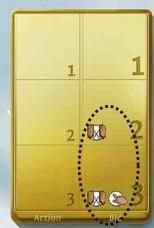
The “2” and “3” spaces contain the alliance icon, indicating that the second and third players form an alliance. Alliance players will bid for a selected action space together against the first player during the current round.
I he 3" space aiso inciuaes tne seiect alliance icon, inaicating tnat the third player selects the alliance action space. The third player may discuss the choice of alliance action space with the second player. After deciding, the third player places the alliance token on the selected action space to indicate it is the alliance action space for the current round.


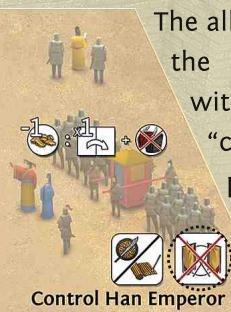
he alliance action space may only be one of
the 10 common bidding action spaces without the non-alliance icon; the “control Han emperor" and “win popular support" action spaces may not be chosen as the alliance action space. Players may not choose the
mperor same action space as thealliance
action space for consecutive rounds, even if different players become the third player in turn order.
If both alliance players bid and win the alliance action space, then both players may take the associated action (during the Resolution Phase). If only one of the alliance players bids for and wins the alliance action space, then only the bidding player may take the associated action (during the Resolution Phase). The other alliance player who did not bid for the alliance action space may not take the associated action.
3) BID FOR ACTION SPACES
Bidding with Generals
Each general possesses administration, combat, and leadership attributes. Administration and combat vary between 1 to 5. Leadership varies between 1 and 2, and determines the maximum number of army units that may be assigned with the general. Administration, combat, and army units form the basis for the bidding of action spaces.
Each general also has a unique skill that provides certain benefits to the player during the game. Players may refer to their respective player aids for other players' generals'skills.
Lastly, each general specializes in one or two army types. The player earns 1 VP whenever his general is assigned, then stationed with one of these army types.
Here is an example of a general card and general token, belonging to Zhao Yun:

Action Spaces
There are a total of 18 action spaces. 12 of these are common bidding action spaces and are open to bidding by all players. The remaining 6 action spaces are state specific and only open to bidding by specific players.
The bidding criterion for the action spaces are listed below (refer to the picture on the bottom rightof page 8 to locate the action spaces):
Bidding for the following 5 common bidding action spaces depend on(a administration:
• Develop farm or harvest
• Develop marketplace or collect tax
Trade rice and/or weapons
• Hire instructor and/or import technology
• Construct state enhancement
Bidding for the following 5 common bidding action spaces depend on b combat:
• Produce spears/horses • Produce crossbows/vessels · Recruit armies
• Train armies
Demand tribute
cBidding for the remaining 2 common bidding action spaces depend on either administration or combat:
· Win popular support
· Control Han emperor
A criterion marker is placed at the bottom of each of these 2 common bidding action spaces, to denote the criterion applicable for that round. The bidding criterion for these 2 action spaces must be different from each other, i.e. if one is based on administration, then the other must be based on combat. Both criterion markers are flipped over during the Update and Maintenance after each round. The bidding criterions will therefore alternate between administration and combat from round to round.
)Just outside of the 12 common bidding action spaces are the 3 battle action spaces. Bidding for the 3 battle action spaces depends on the sum of each assigned general's combat and the number of army units with them. A general's leadership determines the maximum number of army units that can be assigned with him. Although generals may be assigned to bid for battle action spaces without any army units, army units may not be assigned without any general leading them.I
If more than 1 army unit is assigned with the general for bidding, they must be of the same type. If additional generals are assigned for bidding at the same battle action space, they may be assigned with a different army type.
The 3 battle action spaces are:
·Battle (for Shu - Wei border)
•Battle (for Shu - Wu border)
Battle (for Wei - Wu border)
Players may only bid for battle action spaces along their own borders. For example, Shu may not bid for the battle action space of Wei - Wu border .
Example: Bidding for Battle Action Space
Shu assigns Zhou Cang (leadership 1) with 1 infantry unit to the “battle" action space for the Shu - Wu border. His leadership of 1 allows him to be assigned with at most 1 army unit. Wu then assigns Gan Ning (leadership 2) with 2 cavalry units to the same “battle" action space. The 2 army units assigned with Gan Ning must be of the same type.
Shu supports Zhou Cang's bid by assigning Zhao Yun (leadership 2) with 2 archery units. This can be done as different generals may be assigned with different army types when bidding for the same “battle"action space. Shu also has the option to assign Zhao Yun without any army units to the “battle" action space to support Zhou Cang.
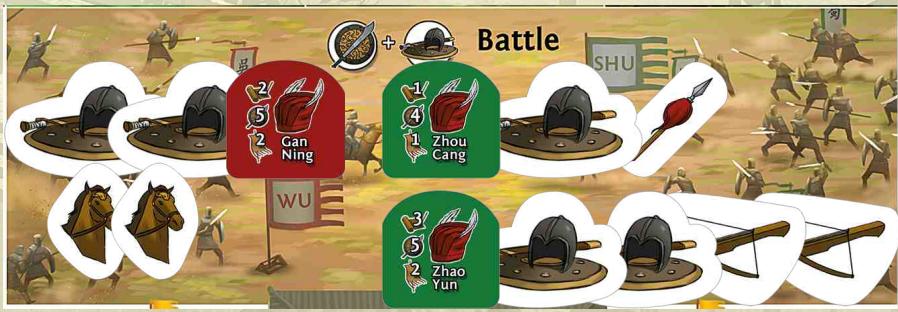
Below the farm and marketplace development spaces of each state is an action space unique to each player. These are the improve tribal relations action spaces. Players are guaranteed of this action during the Resolution Phase as long as they assign a general to the action space during the Conflict Phase of the same round. Players may only assign generals to their own improve tribal relations action space and may assign at most one general per Conflict Phase.
The general may be assigned on his own or he may be assigned with either army units or gold tokens, but not both. The maximum number of army units or gold tokens that may be assigned is equal to the leadership of the assigned general. If more than 1 army unit is assigned, they must be of the same army type.
The 3 improve tribal relations action spaces and the states they correspond to are:
· Improve tribal relations (Xiong Nu 匈奴, for Wei)
• Improve tribal relations (Shan Yue 山越, for Wu)
• Improve tribal relations (Nan Man南蠻, for Shu)

Bidding Process
Based on the bid order track, players take turns assigning their generals to bid for action spaces. This is done by placing a general token, face up, on a desired action space. Only 1 general may be assigned per turn. Unless specified, each general may only be assigned once per round. There is no limit on the maximum number of generals that may bid for the same action space.
When a player has run out of generals to assign, his turn is skipped. Bidding continues until generals of all players have been assigned. Players may pass on their own turn when they still have generals on hand, but this brings an end to their bidding for the rest of that round. There is no benefit for any unused generals at the end of bidding, unless otherwise stated on the general cards.
During the Resolution Phase, the player with the highest bid for an action space based on its bidding criterion wins the bid and gets to carry out the associated action. In the case of a tie, the player who reached the highest bid total first is the winner of that action space.
Example: Bidding
Wei assigns Jia Xu (administration 5) to the “develop marketplace or collect tax" action space (bidding criterion of administration), followed by Shu, which assigns Jiang Wei (administration 4). Wei wins the action space as its bid of 5 is larger than Shu's bid of 4.
Example: Ties in Bidding
Wei assigns Jia Xu (administration 5) to the “develop marketplace or collect tax" action space, followed by Shu, which assigns Jiang Wan (administration 5). Wei wins the action space as it was the first to reach the bid of 5.
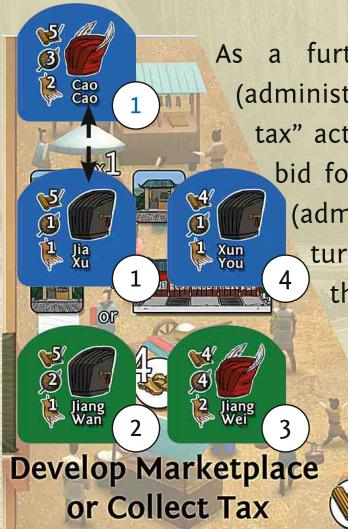
As a further example, if Shu also assigns Jiang Wei (administration 4) to the “develop marketplace or collect tax" action space in a later turn, the total administration bid for Shu is 9. If Wei responds by assigning Xun You (administration 4) to the same action space on its later turn, then its total bid is also 9. In this case, Shu wins 4 the bid as it is the first to reach the total bid of 9.

As a final example, If Wei assigns Cao Cao (administration 5) instead of Jia Xu but Shu was still the first to reach the total bid of 9, then Wei wins the action space due to Cao Cao's skill.
For the alliance action space, the alliance players' bids are combined by summing up the corresponding attribute of their assigned generals. In order for the nonalliance player to win the alliance action space, his bid has to either reach the highest bid total first or exceed the combined bid of the two alliance players.
Example: Bid for Alliance Action Space
Wu and Shu are in alliance and the “develop marketplace or collect tax” action space is the chosen alliance action space. During bidding, Wei, Wu, and Shu assign Jia Xu (administration 5), Lu Fan (administration 4), and Jiang Wan (administration 5) respectively to the alliance action space. Wei loses out on this action space as its bid of 5 is smaller than the combined bid of 9 by the
alliance. Both Wu and Shu may therefore take the “develop marketplace or collect tax" action during the Resolution Phase.
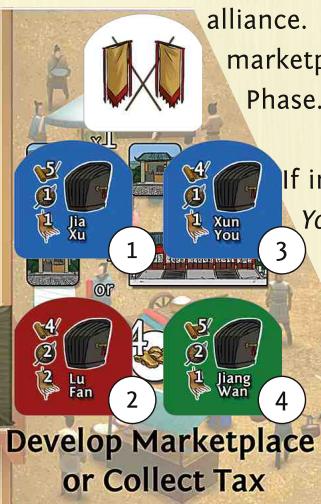
f instead, Wei assigns Jia Xu (administration 5) and Xun
You (administration 4) and was also the first to reach the bid of 9 ahead of the alliance players, then Wei wins the action space and may take the “develop marketplace or collect tax" action during the Resolution Phase.

Ways to Increase Bids
There are a number of ways to increase the bids of generals:
• Generals'skills
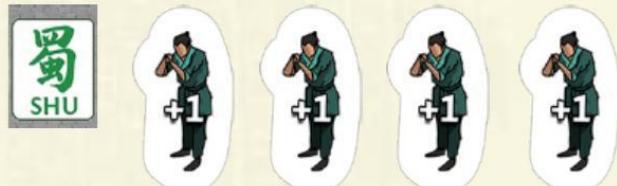
A number of generals have skills that increase their bids, e.g. Sun Jian. Wher utilising these generals' skills, the bidding player places the 6 corresponding bid token on the action space together with the WEI WU SHU general token to reflect the increased bid. +1 +1 +1

• Han emperor token
A player in possession of the Han emperor token for that round may use it to increase one of his general's bid by 1. The Han emperor token must be placed together with a general token on an action space to reflect the increased bid; it cannot be placed on its own on an action space.

• Popular support tokens
Players in possession of popular support tokens may use them to increase their generals' bids. Each popular support token increases a bid by 1. There is no limit on the number of popular support tokens that may be placed with each general. The popular support tokens must be placed together with a general token on an action space to reflect the increased bid; they cannot be placed on their own on an action space.

The popular support tokens may be used together with the Han emperor token during bidding.
RESOLUTION PHASE
During the Resolution Phase of each round, players determine the bidding order for the following round and take the actions they won. Carry out the following in the order of presentation:
1) REMOVE TOKENS
After all players have assigned their generals or passed, determine the winners of each action space by comparing the bids of each player.
Players with losing bids on any action space must:
return the corresponding losing bid general tokens with the army units, bid tokens, and the Han emperor token, if applicable, from those action spaces to the players' respective supplies (not the general supply).
return any popular support tokens placed with the corresponding general tokens from those action spaces to the general supply.
Return any general token that was flipped over and left on the “control Han emperor" action space during the previous round to the corresponding player's supply.
Players with winning bids on any action spaces leave their corresponding winning bid general tokens with the army units, bid tokens, Han emperor token and/or popular support tokens, if applicable, on the action spaces for now.
The alliance token is left on the game board regardless of the bid result for the alliance action space.
2) DETERMINE TURN ORDER FOR NEXT ROUND
Rearrange the state action markers on the action order track in the same order as the state markers on the bid order track. The state action markers serve as a reference for the turn order when taking actions.
Count the number of successful bids for each player. This total includes the improve tribal relations action, if it was taken by the player. If both alliance players bid and won the alliance action space, the successful bid counts towards the total for both alliance players.
Determine the turn order for next round's bidding in the following manner:
• Number of successful bids in the current round
The players with the highest, second highest, and lowest number of successful bids take turn order 1, 2, and 3 in next round's bidding respectively.
· First tiebreaker: Total number of military VPs
In the case of any ties between the number of successful bids, read off the military VPs for each affected player. The player with the highest number of military VPs takes the smaller turn order (1<2<3) among the affected players.
• Second tiebreaker: Order of Wei, Wu, and Shu
In the case of any ties between the number of successful bids and the total number of military VPs, the order of Wei, Wu, and Shu is followed between the affected players, in increasing turn order manner.
Rearrange the state markers on the bid order_track labelled “1,"“2," and “3” to indicate the following round's bidding order. The player going first will be out of the alliance in the next round. The players going second and third will form a new alliance, with the player going third choosing the alliance action space.
Example: Determine Turn Order
The current round is round 4, with the current turn order of Wei, Wu, and Shu. The turn order in round 3 was Wu, Wei, and Shu.
Rearrange the state action markers on the action order track in the same order as that of the state markers on the bid order track, which in this case is Wei, Wu, and Shu.

Count the number of successful bids for each player in the current round. Suppose Wei, Wu, and Shu won 4, 3, and 4 bids respectively in the current round. Wu will therefore be third in turn order for next round's bidding.
Wei and Shu enters the first tiebreaker. Suppose that Wei and Shu have 0 and 2 military VPs respectively. Since Shu's military VPs exceed that of Wei, Shu will be first in turn order and Wei will be second.

Wei and Wu will be in alliance next round, with Wu choosing the alliance action space.
Rearrange the state markers on the bid order track to reflect the new turn order, which in this case is Shu, Wei, and Wu.

Suppose that both Wei and Shu have 0 military VPs instead. In this case, they enter the second tiebreaker, which follows the order of Wei, Wu, and Shu.

This implies that Wei will be first and Shu be second in turn order, since Wu is already occupying third. Thus, Wu and Shu will be in alliance next round, with Wu choosing the alliance action space.
Rearrange the state markers on the bid order track to reflect the new turn order, which in this case is Wei, Shu, and Wu.

3) TAKE ACTIONS
Players take the actions for which they won the bids in the order reflected by the state action markers on the action order track.
If a player has won more than one action space, the player determines the sequence in which these actions are taken. A player may choose not to take the actions of any action spaces won.
As each action is taken, the player must:
• return the general tokens, bid tokens and the Han emperor token, where
applicable, from the corresponding action space to the player's supply.
return any army units not stationed at a border location from the corresponding actionspace to the player's supply.
return any popular support tokens placed with the general tokens from the corresponding action space to the general supply.
The action spaces and how a player takes the action corresponding to each action space are described below:
Develop Farm or Harvest
At the start of the game, all players' farm development spaces are covered with 5 farm tokens, with the undeveloped farm side face up. This indicates their farm development levels are at 0.
When resolving this action space, the player may carry out one of the following two actions:
Develop Farm - Flip over 1 farm token on his farm development space, starting from the leftmost farm token, so that the developed farm side is now face up. This indicates that the player has developed his farm by 1 level.
Harvest - Move any number of the flipped farm tokens, i.e. developed farm side face up, from his farm development space to his granary. Collect 5 rice tokens per remaining flippedfarm token not placed on his granary and remove these flipped farm tokens from the game.
Taking the “harvest" action does not affect the player's farm development level.

= 1 farm development level
Every farm token placed on the granary reduces the player's stationed armies' upkeep by 1 rice token during Update and Maintenance after each round.
Example: Develop Farm
Wei wins the bid for the “develop farm or harvest"action space in round 1. As there is no flipped farm token on Wei's farm development space, the player may only choose to take the“develop farm"action. The leftmost farm token is flipped from the undeveloped side to the developed side to indicate development of 1 level.

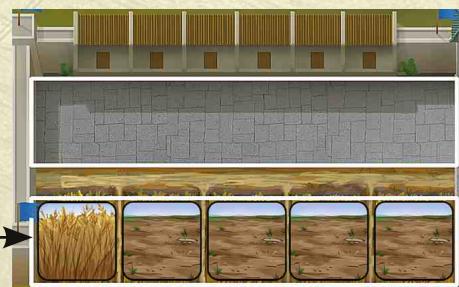
Example: Harvest
Wei has taken the “develop farm" action three times in previous rounds. In the current round, Wei wins the bid for “develop farm or harvest" action space. Wei decides to take the “harvest” action and chooses to move only 2 of the 3 flipped farm tokens from its farm development space to its granary. The third flipped farm token is therefore exchanged for 5 rice tokens and removed from the game.

Note that Wei's farm development level is unaffected by the “harvest” action and remains at 3.
Develop Marketplace or Collect Tax
At the start of the game, all players' marketplace development spaces are covered with 5 marketplace tokens, with the undeveloped marketplace side face up. This indicates their marketplace development levels are at o.
When resolving this action space, the player may carry out one of the following two actions:
Develop Marketplace - Flip over 1 marketplace token on his marketplace development space, starting from the leftmost marketplace token, so that the developed marketplace side is now face up. This indicates that the player has developed his marketplace by 1 level.
Collect Tax - Move any number of the flipped marketplace tokens, i.e. developed marketplace side face up, from his marketplace development space to his treasury. Collect 4 gold tokens per remaining flipped marketplace token not placed on his treasury and remove these flipped marketplace tokens from the game.
Taking the “collect tax" action does not affect the player's marketplace development level.

= 1 marketplace development level
Every marketplace token placed on the treasury reduces the player's stationed armies' upkeep by 1 gold token during Update and Maintenance after each round.
Example: Develop Marketplace
Wei wins the bid for “develop marketplace or collect tax" action space in round 1. As there is no flipped marketplace token on Wei's marketplace development space, the player may only choose to take the “develop marketplace” action. The leftmost marketplace token is flipped from the undeveloped side to the developed side to indicate development of 1 level.
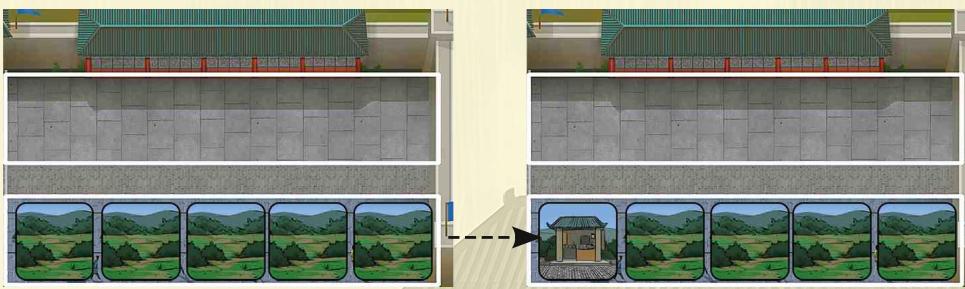
Example: Collect Tax
Wei has taken the “develop marketplace" action four times in previous rounds. In the current round, Wei wins the bid for “develop marketplace or collect tax” action space. Wei decides to take the “collect tax” action to move 2 of the 4 flipped marketplace tokens from its marketplace development space to its treasury. The third and fourth flipped marketplace tokens are exchanged for 4 gold tokens each and removed from the game.
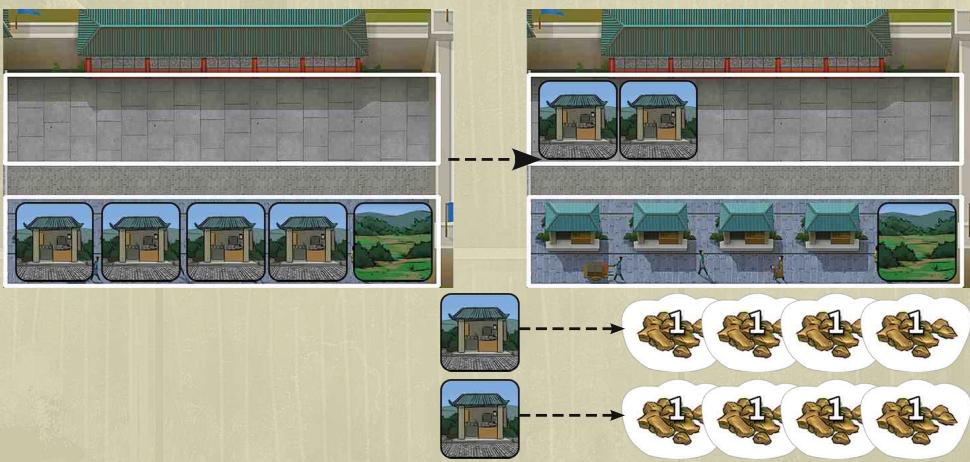
Note that Wei's marketplace development level is unaffected by the “collect tax” action and remains at 4.
Trade Rice and/or Weapons
When resolving this action space, the player may carry out one or both of the following actions:
Trade Rice: Trade gold tokens for rice tokens, or vice versa, but not both ways, at the following rates:
o Buy every 4 rice tokens for 3 gold tokens.
o Sell every 4 rice tokens for 5 gold tokens.
Each trade may not exceed 12 rice tokens.
Trade Weapons: Trade gold tokens for spear/horse/crossbow/vessel tokens, or vice versa, but not both ways, at the following rates:
o Buy every 3 spear/horse/crossbow/vessel tokens for 5 gold tokens.
o Sell every 3 spear/horse/crossbow/vessel tokens for 7 gold tokens.
Each trade may not exceed 6 weapons but may involve different weapon types.
Hire Instructor and/or Import Technology
When resolving this action space, the player may carry out one or both of the following actions:
Hire Instructor: Pay 1 rice token and flip over up to 2 of his untrained armies to the trained army side.
Import Technology: Draw 1 state enhancement card from either the Separation or the Unification deck.
The Separation deck provides alternative ways of scoring additional VPs, while the Unification deck provides alternative ways of collecting various resources.
Construct State Enhancement
When resolving this action space, the player may play 1 state enhancement card. To do so, choose 1 state enhancement card from his hand and demonstrate to the other players that its pre-requisite, if any, is satisfied. The player then pays the cost of constructing the state enhancement to the general supply and places the card face up in front of him.
Only 1 state enhancement may be constructed per successful bid of this action space. Once constructed, the benefit of the state enhancement lasts for the duration of the game. Any VPs earned are stated on the state enhancement card.
Here is an example of a state enhancement card, belonging to Watchtower:

There are state enhancements with costs that include the following icon:

This means that the cost may be met with either untrained armies or trained armies.
Produce Spears/Horses
When resolving this action space, the player may carry out one of the following actions:
• Collect 2 spear tokens from the general supply.
• Collect 2 horse tokens from the general supply.
• Collect 1 spear token and 1 horse token from the general supply.
Produce Crossbows/Vessels
When resolving this action space, the player may carry out one of the following actions:
• Collect 2 crossbow tokens from the general supply.
• Collect 2 vessel tokens from the general supply.
• Collect 1 crossbow token and 1 vessel token from the general supply.
Recruit Armies
When resolving this action space, the player collects 2 untrained armies from the general supply.
Train Armies
When resolving this action space, the player flips over up to 2 of his untrained armies to the trained army side.
Demand Tribute
When resolving this action space, the player may carry out one of the following actions:
• Collect 2 gold tokens from the general supply.
• Collect 2 rice tokens from the general supply.
• Collect 1 gold token and 1 rice token from the general supply.
• Collect 1 untrained army from the general supply.
Win Popular Support
When resolving this action space, the player collects 1 popular support token from the general supply.
Control Han Emperor
When resolving this action space, the player carries out the following:
• Pay 1 gold token to the general supply.
Move his state marker up the rank track to the next higher rank; each incremental rank earns 1 VP for the player at the end of the game.
Choose 1 of the general tokens from those he used to bid for the "control Han emperor" action space and leave it face down on the action space. This general is not available for bidding of all action spaces, including the “control Han emperor" action space, during the following round.
During Update and Maintenance following the current round, the player collects the Han emperor token from either the player who is holding the Han emperor token or from the general supply, as the case may be.
Example: Control Han Emperor and Han Emperor Token
Wei won the “control Han emperor" action space in round 2 and left Cao Hong's general token face down on the action space. The turn order for round 3 is Wei, Wu, and Shu.
During bidding of the Conflict Phase in round 3:
Wei bids for the “develop marketplace or collect tax" action space with Xun You and the Han emperor token and wins the action space.
Wu bids for the “control Han emperor" action space with Zhou Yu and Gan Ning and wins the action space.
Shu bids for the “control Han emperor" action space with Zhao Yun and loses the bid to Wu.

The following takes place during the Resolution Phase of round 3:
Return Zhao Yun's general token to Shu's supply.
•Return Cao Hong's general token to Wei's supply. Cao Hong is available for bidding in the following round, i.e. round 4.
•Update action order and bid order tracks. The action order is Wei, Wu, and Shu.
Wei develops its marketplace by flipping over 1 marketplace token on his marketplace development space. After taking the action, return Xun You's general token and the Han emperor token to Wei's supply.
Wu pays 1 gold token and promotes to the next rank, Grand General. Wu leaves Gan Ning's general token on the"control Han emperor" action space face down. Gan Ning is not available for bidding in round 4. Zhou Yu's general token is returned to Wu's supply and he is available for bidding in round 4.


During the Update and Maintenance immediately after round 3, Wei passes the Han emperor token to Wu, as Wu won the “control Han emperor" action space in round 3.
If all players do not bid for the “control Han emperor" action space in a round, return the Han emperor token to the general supply during the Update and Maintenance immediately after the round. No player may use the Han emperor token for bidding in the following round.
Example: Han Emperor Token (No Bids)
Using the above example, suppose instead that no player bids for the “control Han emperor" action space during round 3, return Cao Hong's general token to Wei's supply during the Resolution Phase of round 3.
During Update andeMaintenance immediately after round 3, Wei returns the Han emperor token to the general supply. No player may use the Han emperor token for bidding in round 4.
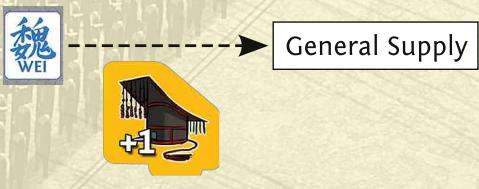
Battle
When resolving this action space, the player carries out the following:
Station a general and army units by moving 1 of his general tokens and army units assigned with that general from the “battle" action space to an unoccupied border location at that border.
Remove the border location token on the just occupied border location and place it on the player's choice of his treasury or granary.
The following rules apply during the stationing of generals and army units at unoccupied border locations:
• Number of Generals
Only 1 of the generals assigned to bid for a “battle" action space may be stationed at an unoccupied border location of the corresponding border during each round.
• Minimum Number of Army Units
The chosen general must be stationed with at least 1 of his assigned army units.
• Maximum Number of Army Units
The maximum number of army units that may be stationed is equal to the leadership of the stationed general.
• Army Type and Border Location
The type of army unit stationed at an unoccupied border location must match that denoted on the border location. For example, only naval units can be stationed at Chi Bi.
• Army Type Specialization and Border Location Token
Each general specializes in 1 or 2 army types, as denoted by the army type specialization icons on the general card. When placing the border location token on the player's choice of his treasury or granary, flip the border location token over to the 1 VP side if the general is stationed with army units of his army type specialization. Otherwise, place the border location token with the o VP side face up.
Each border location token placed on the player's treasury and granary reduces his stationed armies' upkeep by 1 gold and 1 rice token respectively.
· Stationed Generals and Army Units
Stationed generals and army units remain at the border locations until the end of the game and are therefore not available for bidding of action spaces in future rounds.
• Occupied Border Locations
Players may not station generals and army units at occupied border locations; players may only station generals and army units at the other unoccupied border locations.
• Stationing of Second and Subsequent Generals
The second general stationed by each player must be at the opposite border from that of the first general. There are no restrictions for the stationing of each player's third and subsequent generals.
A player may bid for the “battle" action spaces at both of his borders in the same round. In the case where this occurs with the second and third generals to be stationed and the bid with the second general is unsuccessful, then the player may not station his generals and army units at both borders, due to the above rule.
Example: Stationing of General and Army Units at Border Location
Wu wins the bid for the “battle" action space at the Shu - Wu border by assigning Gan Ning with 2 archery units and Ling Cao with 1 naval unit. Wu may station either Gan Ning with 1 or 2 archery units, or Ling Cao with 1 naval unit. This is due to Gan Ning and Ling Cao's leaderships of 2 and 1 respectively.
Gan Ning may only be stationed with the archery units and Ling Cao may only be stationed with a naval unit, as these are the army units assigned with the respective generals during bidding.
Furthermore, considering the army type required by each of the 5 border locations along Shu – Wu border, Wu may station either Ling Cao and the naval unit at Yi Du as that is the only border location requiring naval units, or Gan Ning and the archery units at Xiao Ting or Bai Di Cheng as these are the only border locations requiring archery units.

Suppose Wu chooses to station Gan Ning with 2 archery units at Xiao Ting, then Wu does not flip the border location token when placing it on its granary or treasury, and does not earn 1 VP from it. This is because Gan Ning's army type specialization is cavalry and not archery.

Suppose Wu chooses to station Ling Cao with 1 naval unit at Yi Du instead, then Wu flips the border location token when placing it on its granary or treasury, and earns 1 VP from it. This is because one of Ling Cao's army type specializations is naval.

Example: Stationing of Second and Subsequent Generals
Wei has stationed Cao Ren with 2 naval units at Chi Bi of the Wei – Wu border in a previous round. Cao Ren was Wei's first general to be stationed at a border location. The second general stationed by Wei must therefore be at the opposite border, i.e. the Shu – Wei border.
During the current round, Wei bids for the "battle" action spaces at both of his borders. Wei wins the bid for the “battle" action space at the Wei - Wu border with a bid of 7 against Wu's bid of 5. However, Wei loses the bid at the “battle" action space for the Shu - Wei border with a bid of 5 against Shu's bid of 6.
Even though Wei won the bid for the “battle" action space at the Wei - Wu border, Wei may not station Xiahou Dun with the cavalry units at Guang Ling along that border. This is because the second general stationed by Wei must be at the opposite border from its first. By losing the bid for the “battle" action space at the Shu - Wei border, Wei loses the opportunity to station generals and army units at both borders at the same time.
If Wei assigns Xu Chu with 2 infantry units instead of Xu Huang with 1 infantry unit to bid for the “battle" action space at the Shu - Wei border, then Wei wins both bids for the "battle" action spaces at both borders. Wei may then station Xiahou Dun and Xu Chu with their respective army units at both borders.
Wei may also choose to station only Xu Chu with 1 or 2 infantry units at Hua Rong Dao along the Shu - Wei border as this is at the opposite border to that of his first stationed general. However, Wei may not choose to station only Xiahou Dun with 1 or 2 cavalry units at Guang Ling along the Wei - Wu border, for the same reason as above.
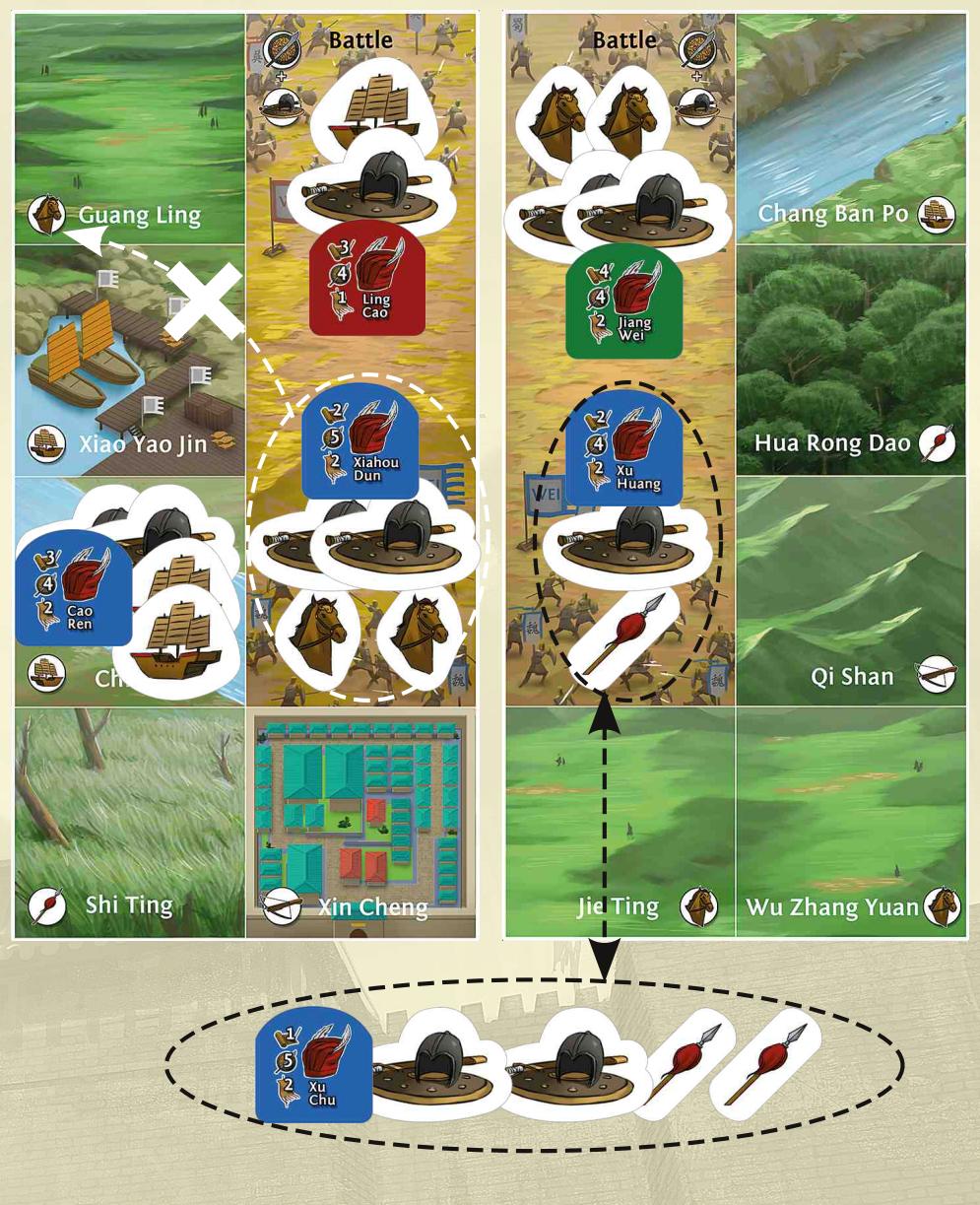
Improve Tribal Relations
When resolving this action space, the player moves his tribe marker up his tribal relations track, towards the maximum of level 12. The number of spaces to move is based on the number of gold tokens or army units assigned with the general to the “improve tribal relations" action space:
• 0 gold tokens or 0 army units - o levels
• 1 gold token or 1 army unit - 1 level
• 2 gold tokens or 2 army units - 2 levels
Pay any assigned gold tokens to the general supply. Return any assigned army units to the player's supply.
If the tribal relations level of 12 is reached or maintained, the player may pay 2 rice tokens to collect 1, and only 1, popular support token. This includes situations where the player did not take the "improve tribal relations" action but the tribal relations level is increased to or maintained at 12 due to a general's skill.
Example: Improve Tribal Relations
The tribal relations level of Shu is at level 2at the beginning of the round. Shu assigns Jiang Wei with 2 gold tokens to the “improve tribal relations" action space during the Conflict Phase. When resolving the action space during the Resolution Phase, Shu may move its tribe marker up by 2 levels and return the 2 assigned gold tokens to the general supply.
If Shu assigns Jiang Wei with 2 army units instead of 2 gold tokens, Shu may move its tribe marker up by 2 levels and return the 2 army units to Shu's supply.
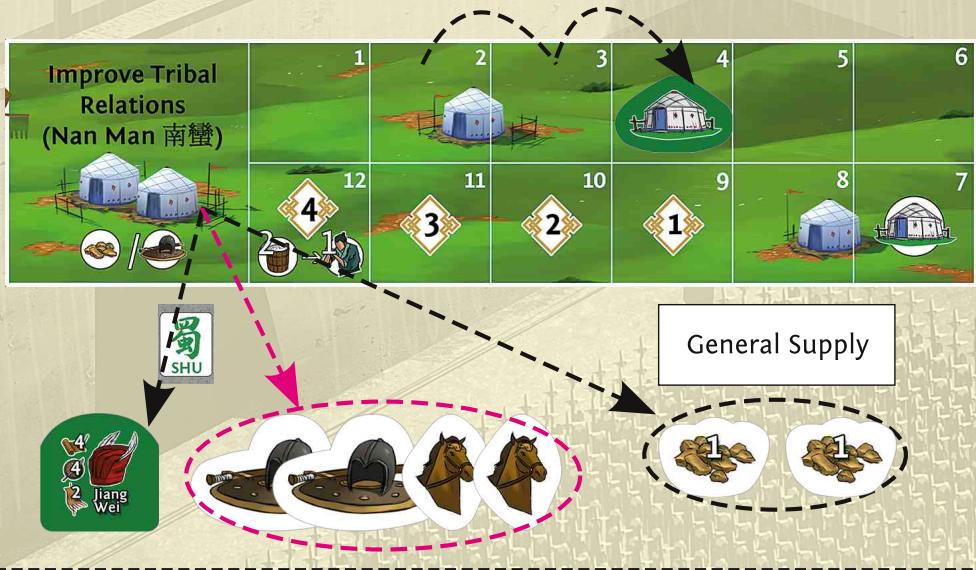
Example: Tribal Relations Level 12
Jia Xu's skill : At the end of each even round, if Wei did not take the “improve tribal relations" action, Wei's tribal relations level is maintained instead.
Wei recruited Jia Xu in a previous round. In round 7, Wei increased its tribal relations level to 12. During round 8, Wei's tribal relations level is maintained at 12 due to Jia Xu's skill. Wei may pay 2 rice tokens for 1 popular support token, even though Wei did not take the “improve tribal relations" action.
4) REDUCE TRIBAL RELATIONS LEVEL
(IF ACTION IS NOT TAKEN IN THE ROUND)
After a player has taken all his actions in a round, if he did not take the “improve tribal relations" action during the round, he must now move his tribe marker down his tribal relations track by 1 level, towards the minimum of level 1.
If the tribal relations level reaches or stays at level 1 after the updating of tribal relations track, the player suffers a rebellion and receives 1 deficit token. Each deficit token carries -3 VPs at the end of the game.
5) RECEIVE/ACTIVATE BENEFITS
A player may have recruited generals or constructed state enhancements that provide benefits at the end of a round.
The player with such generals and/or state enhancements activates and receives these benefits now. The player determines the sequence in which the benefits are activated and received.
Example: Activate and Receive Benefit
Shu recruited Ma Chao and constructed the Barter Market in a previous round. It did not take the “trade rice and/or weapons" action in the current round, and has 1 horse in its supply at the end of the round.
Ma Chao's skill: At the end of the round when Ma Chao is recruited, place 4 horses from the general supply on this card. At the end of each subsequent round, he receives 1 of these horses if Shu has at least 2 horses in its supply (they breed).
Barter Market: At the end of each round when you did not take the “trade rice and/or weapons action", you may trade 1, and only 1, weapon for 2 rice, and vice versa.
Based on the above, Shu may first activate the Barter Market to buy 1 horse for 2 rice. Shu now has 2 horses in its supply and activates Ma Chao's skill to move 1 of the horses on Ma Chao's general card to its supply.
UPDATE AND MAINTENANCE
After each round, if none of the game end conditions is triggered, all players perform Update and Maintenance. Carry out the following in the orderof presentation:
1) FLIP CRITERION MARKERS
Flip the criterion markers on the “win popular support" and “control Han emperor" action spaces to the opposite side to reflect the change in criterion for bidding of these action spaces in the Conflict Phase of the next round.
2) PASS HAN EMPEROR TOKEN
The winner of “control Han emperor" action space in the just completed round collects the Han emperor token from either the player who is holding the Han emperor token or from the general supply, as the case may be.
3) PAY POPULAR SUPPORT TOKENS' AND STATIONED ARMIES' UPKEEP
All players pay upkeep for popular support tokens in their respective supplies and for their army units stationed at border locations, as follows:
1 rice token for every 2 popular support tokens.
1 gold token for each stationed army unit, reduced by the number of marketplace and border location tokens on the corresponding state's treasury space.
1 rice token foreach stationed army unit, reduced by the number of farm and border location tokens on the corresponding state's granary space.
Example: Pay Upkeep
Wu has 3 popular support tokens in its supply and has stationed 2 army units thus far. It has no marketplace and border location tokens on its treasury space and 1 border location token with no farm tokens on its granary space. Wu therefore needs to pay 1 rice token for its popular support
内容过长,此处只内联前一部分;完整内容请下载或到规则页阅读。
下载 Markdown原文为社区整理/出版社公开资料,版权归原作者,仅供个人学习查阅。