
铁路环游:伦敦Ticket To Ride London
一句话概览
铁路环游:伦敦 是一款已收录于村了吗规则库的桌游,支持 2–4 人,原名 Ticket To Ride London。
本页内容:一句话概览 · 常见问题
这游戏怎么玩
- 本站已收录这款游戏的规则资料,可以在对话里直接提问规则细节。
常见问题(FAQ)
以下 1 条问答中 0 条来自站内玩家的真实提问,其余 1 条为本站整理的常见疑问;答复内容保持原样。
铁路环游:伦敦支持几个人玩?
2–4 人。
去哪查完整规则
想核对具体规则细节、卡牌效果或某个回合的结算方式,可以在村了吗里选中这款游戏后直接提问。
同类桌游
- 卡坦岛德式
- 工业革命:伯明翰德式
- 勃艮第城堡:特别典藏版德式
- 方舟动物园德式
- 卡卡颂抽象
- 瘟疫危机传承:第一季美式
- 阿瑞迪亚:勇踏征途美式
- 重塑宇宙德式
- 幽港迷城美式
- 埃多拉的德鲁伊德式
规则原文(Markdown)
本站收录这款游戏的规则原文 1 个文件,此处内联渲染 1 个,可直接展开阅读或下载。
Ticket to Ride London TiTo Ver 1.md12.2 KB
Solo Rules for ‘Ticket to Ride London
Version 1, 21st February 2025, Andy Phillips
General Notes
• The automated player is called ‘TiTo’.
• It is possible to run more than one copy of TiTo at once with no changes to its behaviour. Any combination of human or TiTo players can be used (between 2 and 4 total).
• TiTo follows all the standard rules in terms of the actions it can take, cards it can draw, routes it can claim and so on.
TiTo’s actions are all prescriptive and defined by the priorities described in the sections below. If a case arises that is not covered by these rules, use your judgement to follow the action that a human would take, or randomise TiTo’s action among the possibilities.
● All automated TiTo players take their turns before the human players.
• TiTo’s victory points are scored like a human player.
• Victory points can be scored as the game progresses as all the Destination Tickets are visible.
Set Up
Nothing is secret, so all cards can be placed face up (other than the draw pile).
1) Draw 2 Destination Ticket cards for the player and decide which to keep, as in the standard rules. Do this before drawing any cards for TiTo.
2) Draw 2 Destination Ticket cards for TiTo and keep both.
3) Place TiTo’s Destination Ticket cards in the order drawn. The card drawn first is TiTo's first priority, and the card drawn second is the TiTo’s second priority.
4) Draw 2 Transportation cards for TiTo, and 2 for the human player (as in the standard rules).
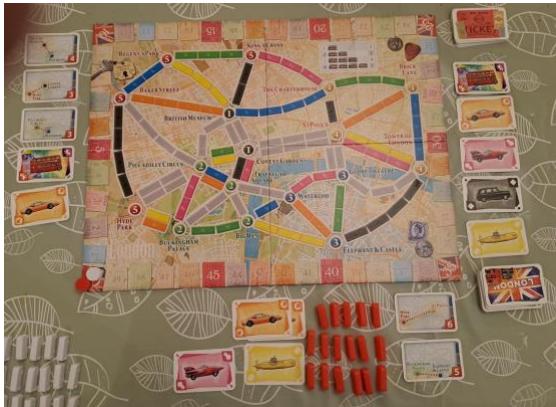
It recommended that the board and cards are set up as shown in Figure 1. In this case, TiTo is white and the human player is red.
TiTo’s cards are placed in a column in the order drawn (first drawn at the top) to the left of the board.
TiTo’s plastic buses are placed below.
As TiTo’s Transportation cards are used, move the remaining cards in its hands upwards so there are no gaps. Newly drawn cards are placed at the bottom of the column. This order of oldest cards at the top and newer cards at the bottom is used in some tie break situations when deciding TiTo’s actions.
• If playing with more than one copy of TiTo, each acts independently and has a column of cards and plastic buses.
The player’s cards and plastic buses are placed below the board. In this case, the player has chosen to keep both of their Destination Tickets.
The common cards and draw pile are to the right of the board. The discard pile will be placed below the draw pile later.

Figure 1: Recommended set up
Tito’s First Turn
If the combined victory point value on TiTo’s 2 Destination Tickets is more than 10, then play the first turn as a normal turn, as described below. Do not draw another Destination Ticket.
If the total victory point value is 10 or fewer, draw 2 Destination Tickets. Keep the lower point value card, which becomes TiTo’s third priority. If there's a tie, keep the first card drawn. Discard the other card. In the example shown in Figure 1, TiTo’s 2 initial cards have a total of 7 victory points, so 2 more cards are drawn. For example, if TiTo draws a 9-point card and a 3-point card then they keep the 3-point card, as illustrated in Figure 2. The cards are rearranged so that the Destination Tickets are at the top of the column (in the order drawn).
In this example, TiTo will prioritise completing its routes in the following order:
1) British Museum to Waterloo
2) Hyde Park to Covent Garden
3) Picadilly Circus to Waterloo

Figure 2: Selection of a third Destination Ticket for TiTo
Never draw additional Destination Tickets after TiTo's first turn. TiTo always has 2 or 3 Destination Tickets after its first turn.
TiTo’s Behaviour on a Typical Turn
TiTo’s priorities are in the following order:
1) If possible with Transportation cards already in TiTo's hand, claim a route that would help finish a Destination Ticket along the shortest possible overall path. The shortest overall continuous path can change due to player activity as the game progresses, so should be checked each turn.
a) Use coloured non-bus Transportation cards if possible, but use rainbow bus cards if necessary.
b) Prioritise the Destination Tickets in the order drawn.
c) Prioritise longer routes over shorter routes within each Destination Ticket. If there is a tie, start at the western or southern end of the route.
d) If completing grey routes and multiple Transportation cards could be used, prioritise those drawn first (which should be closest to the top of Tito’s column of cards).
2) If that isn't possible and Destination Tickets remain unfinished, pick up Transportation cards to work towards that. Prioritise as follows, noting that the priority can change after picking up the first card:
a) Take 1 face up non-bus cards of appropriate colours (of any route on any Destination Ticket, in the priority order described above). If there is more than one equal priority option, then select the one closest to the draw pile. Then draw another card (subject to the usual rule that a face up rainbow bus card cannot be chosen).
b) Take face up cards that could be used to complete a grey route next turn. This could occur if TiTo already holds cards of the same colour, or a 2-space grey route is available and prioritised by TiTo. This could be 1 or 2 cards. If 1 card allows a route to be completed next turn then draw another card (subject to the usual rule that a face up rainbow bus card cannot be chosen).
c) Take 1 face up rainbow bus card.
d) Draw 2 cards from the top of the draw pile. Use this only if no relevant coloured Transportation cards are face up.
3) If all TiTo’s Destination Tickets have been completed, try to connect numbered Districts. Prioritise actions as follows:
a) Start with the lowest available numbered District that could possibly be completed. Use the shortest overall path that is still available, taking into account any routes already claimed by TiTo. It is possible that some Districts cannot be completed, either because of routes claimed by other players, or because TiTo has too few remaining plastic buses.
b) Complete routes with this aim if possible. Otherwise, pick up cards with this aim, using the same process as described in Option 2 above for completing Destination Tickets.
c) Prioritise claiming longer routes within the shortest overall path.
d) If there is a tie, connect the locations in alphabetical order.
4) If none of the above steps are possible, attempt to complete whatever routes are available, as in the final turn described below.
If TiTo uses any Transportation cards to claim a route, move remaining cards upwards in the column such that there are no gaps.
If TiTo completes a Destination Ticket, award the associated score and turn the card face down. This makes it clear which tickets have been completed already, to simplify route checking in future turns.
TiTo’s Final Turn
The game end is triggered as normal, when one player has 2 or fewer plastic buses. The game end can be triggered by any human or TiTo player.
TiTo’s aim on its final turn is to score the most points possible. It will a claim route in this priority order:
1) Complete a Destination Ticket if possible. Prioritise routes in the same way as described in “Tito’s Behaviour” above.
2) Complete a numbered District if possible. If there are multiple options, complete the highest numbered District. If there are multiple ways to complete a District, select the longest route that can be claimed.
3) Claim routes that join to routes that have already been claimed by TiTo. Start from the first location in alphabetical order that isn't already taken. The end of the route is the location that's first alphabetically, from the possible options.
4) Claim any route, not connected to TiTo’s existing claimed routes. Claim the longest possible route. If there is a tie, use the alphabetical priority as described in the point above.
5) If no routes can be claimed, pick up Transportation cards. This efectively is a pass and scores no points.
Changing Dificulty
There are several ways to change the dificulty, if desired, including:
• Multiple copies of TiTo are typically harder to beat that one copy.
• Increasing the number of coloured Transportation cards dealt to TiTo at the start of the game increases the dificulty (but deviates from the standard rules).
Not penalising TiTo for incomplete Destination Ticket routes at the end of the game increases the dificulty (but deviates from the standard rules). This option is recommended if human players take advantage of TiTo’s face up Destination Tickets by blocking its routes.
Example of Play
Some example turns are illustrated below. TiTo is white and the human player is red.



Initial set up.
After 1st turn.
After 2nd turn.
TiTo’s original 2 Destination Tickets have a total of 7 victory points, so 2 more tickets are drawn. The lower value ticket of 2 is retained, and the higher value ticket is discarded.
The human player takes the face up orange and pink Transportation cards (with the aim of claiming part of the Hyde Park to St Paul’s route on a later turn).
TiTo prioritises completing the British Museum to Waterloo ticket (at the top of its column of cards). It can claim the 2- space grey route from Trafalgar Square to Waterloo, so does that. This scores 2 points. TiTo uses the rainbow bus Transportation card as there is no other option. It prioritises this longer route over completing a single-space grey route from British Museum to Covent Garden.
The human player takes the face up orange and yellow Transportation cards.
After $3 ^ { \mathsf { r d } }$ turn.
TiTo has no Transportation cards so cannot claim any routes. Its priorities are
1) A pink or black card for British Museum to Waterloo
2) A yellow or green card for Hyde Park to Covent Garden
3) A blue or orange card for Picadilly Circus to Waterloo TiTo takes the pick card as it’s the top priority and closer to the draw pile than the black card. This is replaced by a face up yellow card.
TiTo then takes the new yellow card as it’s the second priority.
The human player uses 3 orange Transportation cards to claim the route from Covent Garden to St Paul’s, scoring 4 points.


After 4th turn.
TiTo has 1 pink and 1 yellow Transportation card, so can only claim a 1-space route. Its priority is still the British Museum to Waterloo ticket. There are 2 possibilities, so the tie break of claiming the southern option is used. TiTo claims the Trafalgar to Covent Garden route for 1 point. It could use either Transportation card but choses the pink card as it is higher up the column.
The human player uses 1 yellow Transportation card to claim the route from Picadilly Circus to Covent Garden, for 1 point.
After 5th turn.
TiTo is still prioritising its first Destination Ticket from the British Museum to Waterloo. It uses its yellow Transportation card to claim the British Museum to Covent Garden route. This scores 1 point for claiming a 1-space route, 1 point for connecting District 1 and 4 points for completing the Destination Ticket (which is turned over to indicate that it is complete).
The human player picks up the face up green and pink Transportation cards.
A few turns later…
TiTo has completed all 3 of its Destination Tickets. It has also connected the 2 locations in District 1 in the process, so its priority is now to connect the 4 locations in District 2. This only requires the 1-space grey route from Big Ben to Trafalgar to be completed.
Once District 2 has been connected, TiTo would prioritise connecting the locations within District 3.
下载 Markdown原文为社区整理/出版社公开资料,版权归原作者,仅供个人学习查阅。