
游龙戏虎Tiger Dragon
一句话概览
游龙戏虎 是一款已收录于村了吗规则库的桌游,支持 2–5 人,原名 Tiger Dragon。
本页内容:一句话概览 · 常见问题
这游戏怎么玩
- 本站已收录这款游戏的规则资料,可以在对话里直接提问规则细节。
常见问题(FAQ)
以下 1 条问答中 0 条来自站内玩家的真实提问,其余 1 条为本站整理的常见疑问;答复内容保持原样。
游龙戏虎支持几个人玩?
2–5 人。
去哪查完整规则
想核对具体规则细节、卡牌效果或某个回合的结算方式,可以在村了吗里选中这款游戏后直接提问。
同类桌游
- 卡坦岛德式
- 工业革命:伯明翰德式
- 勃艮第城堡:特别典藏版德式
- 方舟动物园德式
- 卡卡颂抽象
- 瘟疫危机传承:第一季美式
- 阿瑞迪亚:勇踏征途美式
- 重塑宇宙德式
- 幽港迷城美式
- 埃多拉的德鲁伊德式
规则原文(Markdown)
本站收录这款游戏的规则原文 1 个文件,此处内联渲染 1 个,可直接展开阅读或下载。
Tiger & Dragon Rules.md5.9 KB
How to Play Tiger & Dragon
Basic Info
The goal of the game is to play the last tile from your hand. You then score based on the number on the last tile you played, plus (with three or more players) any bonus points from face-down tiles in your Defend row. (Specifics of scoring vary by scoring rule card.) The winner is the first player to reach ten points.
The tile set consists of 38 tiles:
• 36 tiles labeled 1–8
• The number on the tile indicates how many there are in total (one “1,” five “5,” etc.).
• 2 wild tiles: Red Dragon and Blue Tiger

• These match any tile of their own color. In other words, the Red Dragon can be used to defend against any odd attack tile, and the Blue Tiger can be used to defend against any even attack tile. If played on offense, opponents can defend with any tile of the matching color.
Setting Up
Get out the player boards and give one to each player. Put the point chits somewhere within reach.
Shuffle the tiles, then deal to each player. The number to deal depends on the number of players:
2 players: 13 tiles each
3 players: 11 tiles each
4 players: 9 tiles each
5 players: 7 tiles each
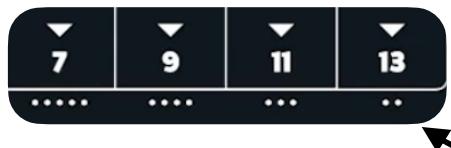
The dots on the boards show a reminder of how many tiles to deal for each number of players!
Choose a player to go first (whoever is reading these rules), and deal one extra tile to that player, and give them the chit, which says “+1” on it, to indicate that they started the round and had one extra tile. After that, rotate start player to the left (or start each round with the player who won the previous round).
Playing the Game
The player board has two rows for playing tiles: the Attack row on the top, and the Defend row on the bottom. Note how the spaces are connected and numbered.

The player who starts the round plays a numbered tile in the space of their board, as the first attack. For the sake of argument, let’s say it’s a 7. The next player must then play a 7 (or Red Dragon) in their Defend row, or pass. Remember, wild tiles match any other tile of their own color, both for attack and defense.
If they pass: play continues to the next player, who has to make the same decision. You may always pass. If they play: that player plays a 7 or Red Dragon in their leftmost Defend row space, then plays a hand tile in their Attack row space attached to the Defend row space. (i.e. Leftmost Attack row space, ignoring the top-left space with the in it if you weren’t the one who started the round.)
If everyone passes and play returns to the attacker, then the attacker gets to play any hand tile they wish, face-down, in their Defend row, then plays a new attack.
Scoring
When you play your last hand tile, score based on the scoring rule card. Each face-down tile in your Defend row (except the final tile; it’s always face-up) counts as one bonus point. No bonus points if your last tile is a Red Dragon or Blue Tiger, nor in two-player games. First player to ten points wins.
FOUR-PLAYER PARTNER VARIANT: Play to fifteen points total, as North/South and East/West partners.
Hint: Generally, you want to pass when your partner attacks, to score more face-down bonus tiles.
Scoring Rule Translations
For the most part, you should honestly be fine just looking at the individual cards, even if they’re all in Japanese. Still, just in case, you might want translations for a couple of the red ones in particular.
BATTLE AT THE DOJO

7, 8 → 4 pt.
4, 5, 6 → 3 pt.
2, 3 → 2 pt.
1 → 10 pt.
Wild → 1 pt. (no bonuses)
BATTLE in a Storm

3, 6 → 5 pt. 2, 4, 5, 7, 8 → 2 pt.
1 → 10 pt.
Wild → 1 pt. (no bonuses)
BATTLE at a Volcano

2, 3 → 4 pt.
4, 5, 6 → 3 pt.
7, 8 → 2 pt.
1 → 10 pt.
Wild → 1 pt. (no bonuses)
BATTLE in a Swamp

4, 8 → 5 pt. 2, 3, 5, 6, 7 → 2 pt.
1 → 10 pt.
Wild → 1 pt. (no bonuses)
BATTLE in a Forest

4, 5, 6 → 4 pt.
3, 7 → 3 pt.
2, 8 → 2 pt.
1 → 10 pt.
Wild → 1 pt. (no bonuses)
BATTLE on a Cliff
Reveal a hand tile* at start of round.

Win with revealed tile → 6 pt. Win with other tile (even if same number) → 3 pt.
1 → 10 pt.
*Can’t be 1 or wild.
Wild → 1 pt. (no bonuses)
BATTLE on the Coast

3, 5, 7 → 4 pt.
2, 4, 6, 8 → 3 pt.
1 → 10 pt.
Wild → 1 pt. (no bonuses)
BATTLE in the Fog

Score number shown on last tile played 3 → 3 pt. • 8 → 8 pt.
1 → 10 pt.
Wild → 1 pt. (no bonuses)
BATTLE in a Field

2, 4, 6, 8 → 4 pt.
3, 5, 7 → 3 pt.
1 → 10 pt.
Wild → 1 pt. (no bonuses)
BATTLE in a Cave

2–8 → 2 pt. Plus ALL players’ total bonuses
1 → 10 pt.
Wild → 1 pt. (no bonuses)
PROMOTIONAL CARD (Not included)
Battle at Game Market: Score the difference between your last two tiles played. If both are the same number, or your final tile is wild, score exactly 1 point (no bonuses). Score 10 points for finishing with a 1.
下载 Markdown原文为社区整理/出版社公开资料,版权归原作者,仅供个人学习查阅。