
小小史诗任务Tiny Epic Quest
一句话概览
小小史诗任务 是一款已收录于村了吗规则库的桌游,支持 1–4 人,原名 Tiny Epic Quest。
本页内容:一句话概览 · 常见问题
这游戏怎么玩
- 本站已收录这款游戏的规则资料,可以在对话里直接提问规则细节。
常见问题(FAQ)
以下 1 条问答中 0 条来自站内玩家的真实提问,其余 1 条为本站整理的常见疑问;答复内容保持原样。
小小史诗任务支持几个人玩?
1–4 人。
去哪查完整规则
想核对具体规则细节、卡牌效果或某个回合的结算方式,可以在村了吗里选中这款游戏后直接提问。
同类桌游
- 卡坦岛德式
- 工业革命:伯明翰德式
- 勃艮第城堡:特别典藏版德式
- 方舟动物园德式
- 卡卡颂抽象
- 瘟疫危机传承:第一季美式
- 阿瑞迪亚:勇踏征途美式
- 重塑宇宙德式
- 幽港迷城美式
- 埃多拉的德鲁伊德式
规则原文(Markdown)
本站收录这款游戏的规则原文 1 个文件,此处内联渲染 1 个,可直接展开阅读或下载。
Tiny_Epic_Quest_FREE_PNP_Rulebook-©2016_Gamelyn_Games.md33.1 KB
Tiny Epic Quest
By Scott Almes
2-4 Players / 30-45 Minutes
Story
A world of peace has been torn asunder by the opening of a vile portal from the goblin kingdom. Nasty goblins now pore into the Mushroom Villages, setting the realm ablaze. Now you must quest in order to right this wrong. There are many ways to help save the realm. You can learn spells, raid dangerous temples, collect powerful items, and complete treacherous quests. Along the way you’ll neat to rely on planning and wit, and be careful not to push your luck too far. Of course, you can always ask the mushroom people for assistance along the way. Do you have what it takes to quest against the goblin kingdom?
Components
17 Map Cards:6 Temple / Spell 4 Capital City / Spell 7 Mushroom Villages/ Goblin 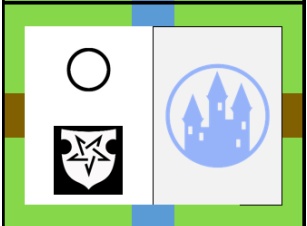 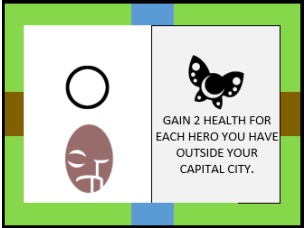 1 Magic Card | |||||||||||||||||||||||||
| 6 | 7 8 9 10 | Adventure Log | The Ten es eaer Reals | ||||||||||||||||||||||
| 54 | Me x Health h | 糕 | 2 Spell | s ellls | |||||||||||||||||||||
| 32 | |||||||||||||||||||||||||
5 Quest Dice | 12 Core Items (4 each of 3types)Sword, Shield, Staff | Additional Items | |||||||||||||||||||||||
| S | A | ||||||||||||||||||||||||
1 Round Tracker 4 Health 4 SpellTokens TrackersScoring Chart(in 4 playerTotalSpellsGoblins Quests0 -5 -2 -1  colors)1-32 1 33 4 8 64 7 12 8  5 10 15 106 12 18 137 14 22 168 17 26 199 20 30 2310 24 35 27 | 1 Magic 4 PowerTracker Trackers  | ||||||||||||||||||||||||
| Re 2 | |||||||||||||||||||||||||
| Round 2 | |||||||||||||||||||||||||
| Round 3 | |||||||||||||||||||||||||
| Round 5 | |||||||||||||||||||||||||
Setup
- Give each player:
a. A Player Board
b. 3 pawns in their color
c. 1 Health Token
i. Place on the 6 space on your player board.
d. 1 Power Token
i. Place on the 3 space on your player board.
e. 1 Quest/Rest Card. Quest should be face-up.
f. 3 Core Items (one of each)
i. These items should be placed on the first space on their Adventure track on the player board.
g. Place any extras back in the box.
- Place the Magic Card on the table
a. Place the player’s Spells Trackers just off to the left of the board.
b. Place the Magic Marker on the space.
- Create the map by:
a. Shuffle the 6 Dungeon Cards and 7 Random Fairy villages into a deck. Then deal 5 of them into the following formation:

a. Place the four home cards (noted with a ) symbol in the following formation. Even if a player color isn’t in the game, his card is still used.

b. Then, arrange the remaining 8 from the mixed deck to form the following shape.
| H | H | |||
| 山 | 山 | |||
c. Your final map will look like this. All map cards should be face-up.

- Place the 3 pawns of each player on their colored capital city space


-
Place a face up goblins on each of the seven goblin spaces . Place the others in a stack where the players can reach them.
-
Place the 5 Transportation Cards face up within reach.
-
Give the 1st Player Token to the tallest player. The “!” should be face-up to start the game.
-
Shuffle the Quest cards and put them in a facedown stack. Deal 3 face-up so all players can see them.
-
Place the Round Tracker in the center of the table. Place the Round Marker on the ‘1’ space.
Gameplay Overview
The game is played over exactly 5 rounds or until there are no more goblins tokens on any map card (they have ALL been killed) or one player has learned the very last spell. Each round consists of two phases:
1) Day – Movement
2) Night – Questing
Health and Power
In the game players will be managing two resources: Health and Power. Health will be depleted as you take on attacks by goblins, and Power will be used to activate special abilities and items. Starting off, players have a maximum Health level of 6 and a maximum Power level of 3. Players cannot gain resources past their maximum limit. However, as the game goes on, this maximum limit can increase. For each Goblin you kill, your health limit increases by one. For each Spell you learn, your power limit increases by one. The highest you can ever take your maximum limit is 10.
Day Phase – Movement
During this phase there will be 4 turns, starting with the player that holds the 1st player token. This will mean 4 of the 5 transportation cards are used.
During Movement, turns go clockwise. On a player they:
1) Select a Transportation Card
a. Active player may use the transportation card, or do nothing
b. Going clockwise, the other players may either use the transportation card or pass
2) Flip the selected Transportation Card to show it is no longer available for this round.
Transportation Card
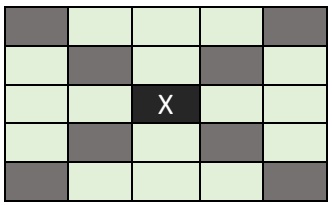
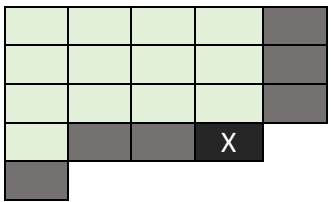
This action is the same whether you selected the card yourself, or you are following the active player. There are five types of transportation cards in the game. The five types and their respective movements are:
By Gryphon | Move diagonally. | |||||
 | ||||||
By Raft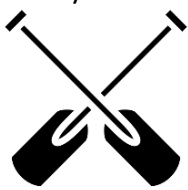 | Move along the river. | |||||
 | ||||||
By Ship | Move along the coast.Cards that do not touchthe shore by at least oneside are not counted. | |||||
 | ||||||
| X | ||||||
By Horse | Move along the dirt path. | |||||
 | ||||||
By Foot | Move one space in anydirection, no matter whatyour health. | |||||
 | ||||||
Movement Speed
Players may move as many spaces as they wish via the transportation type. (Except for by foot, which is always one space) You may move a hero out of an Adventure if you wish. But, when they return they must start the adventure over again. You may also move a hero off of a Goblin space or a Spell.
Actions
After a player has moved their pawn, then they may take an action at that new space. If a player has not moved, then they may not take an action. A pawn cannot be moved to a space on the same card. They must first move off of it, and then back on it.
The actions available are:
| Place on a spell. |  | Place your hero directly on the spellsymbol. You will attempt to learn that spellduring Questing. You cannot do this forSpells you have already learned. Multipleheroes may try to learn a Spell each round. | ||
| Place it on a Temple | Place your Hero on the title of a Temple.When Questing, you will attempt tocomplete this Temple.Completed temples allow players to gainitems. Multiple players may try tocomplete an adventure each round. If morethan one hero is on the entrance of thequest, be sure to keep them in the order oftheir arrival.Only two Heroes may be in a Temple at thesame time. A player cannot have twoHeroes be in the same temple at the sametime. | |||
| Ice Temple | ||||
 |  | |||
| Place it on a goblin. |  | Place your pawn on the circle above thegoblin. You will attempt to kill it duringQuesting. Only one player may fight eachmonster. | ||
| Place it on aMushroom Village. |  | Place a pawn on this symbol. You may takethe action that is described on the space.Multiple heroes may visit a Mushroomvillage. | ||
| Enter a Capital City |  | If you land on your own Capital City, orenter another players, you can collect 1Health and 1 Power. Multiple Heroes maybe in a Capital City at the same time. | ||
Passing
If a player decides to pass instead of moving, they collect one Power and one Health if they have at least one hero in their capital city.
Aggressive Goblins
After the first round, goblins left on the board become ‘aggressive’ (red side up), and will make it harder for players to move through the space that they are in. Aggressive goblins are red-side up. When a player wishes to pass through a space with an aggressive goblin, or visit the mushroom village on the
other half, they must pay one force to do so. Even if they are traveling by ship and passing aggressive goblins on the shore. Stopping to fight the goblin however is free. If you do attack an aggressive goblin, flip it back over to its green side to show that is in engaged in combat. After an aggressive goblin is being fought by a hero it no longer hinders other heroes’ movements.
The Quest Cards
Quest cards allow players to fulfill special quests for a reward. The top of the card is the title of the quest. The middle of the card tells you how to start or complete the quest. The bottom of the card tells you what the reward is. All players are competing against each other for the face-up quests. There are two types of quest cards: Movement Quests and Item Quests.
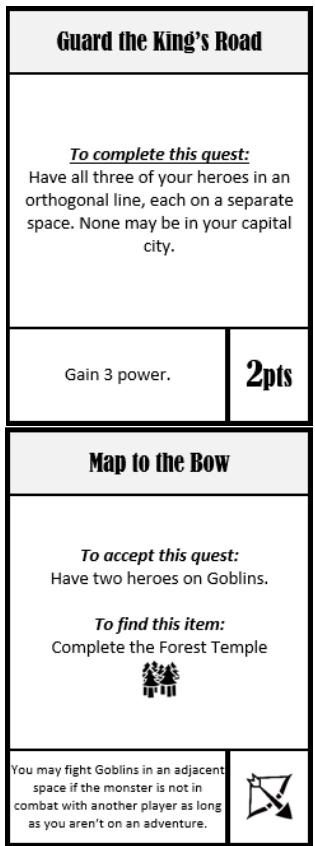
Movement Quests
Movement Quests are completed in one step. To complete the Quest you must fulfill the objective in the ‘To Complete this Quest’ section. You must complete this objective by taking an action to do so. You cannot collect a card passively. If you meet the requirements listed on the card then you take the card. You gain points at the end of the game as well as the special benefit listed at the bottom, if any.
Item Quests
Item Quests are completed in two steps. First, the card must be taken by a player if they complete the objective in the ‘To accept this quest section. You must take this card by taking an action to do so. You cannot collect a card passively. If you meet the requirements in ‘To accept this quest’ you should take the card and place it in front of you. This will be done in the Day phase.
Second, after you have collected the card, you must complete the temple listed on the bottom of the card. This will be done in the Night Phase. Once you reach the treasure room of that temple, then you take the item from the supply listed on this card and give it to one of your heroes. A Hero may hold up to two items. Collecting this item will also show that you have completed the quest, which will be important when calculating your points
A Quest that is accepted or completed should be instantly replaced by a new one off the top of the deck. If a Quest is completed, the active player should also flip over their player marker from the ‘!’ to the blank side to show that a new quest will not have to be replaced at the end of the round.
If an action would result in a player fulfilling two quest cards, the player must choose which one is completed. You cannot complete or accept two quest cards at once.
Phase Completion
After 4 transportation cards have been used, then you move to the questing round.
Night Phase
During this phase, players will try to complete three different types of obstacles:
Exploring Temples
Defeating Goblin Bands
Learning Spells
Each player should have their Quest/Rest card with the Quest face-up. Then the player with the $1 ^ { \mathfrak { s t } }$ player token takes the 5 Quest dice and starts the phase.
The flow of this phase is as follows:
- The active player (player with the dice) must choose to Quest or Rest
a. If a player Rests, they flip their card over and pass the dice clockwise. See ‘Resting below to see additional steps when resting.
b. If a player chooses to continue Questing, then they follow the next steps
-
The active player rolls the dice and then resolves any , $\pmb { \triangle } _ { \ast }$ , and symbols in that order. $\Re _ { \ast } ^ { \ast }$
-
All players that are Questing then use the $R _ { 2 } ^ { 3 } , \mathbb { S } ^ { 3 } ,$ and $y = \frac { 1 } { 4 }$ symbols to resolve questions.
-
The dice get passed to the next player who is still Questing, who starts at #1 again. This may be the same player if everyone else is Resting.
Questing
Note: While questing each die face can only be used once. If you have multiple heroes that could use the dice then you get to choose which ones the dice are allotted to.
Dice should be resolved in the following order:
-
Magic
-
Power
-
Damage
-
Temples and Fighting
Magic $\underset { \times } { \overleftrightarrow { \mathbf { \Lambda } } }$
For each rolled advance the Magic Track by one. Depending on how far the magic marker is moved up, the $\pmb { \triangle }$ and $\Re _ { * } ^ { * }$ may be effected:
When the spell tracker is in the 0 or 1 spell range, everything is normal. The $\pmb { \triangle }$ will gain a player one power and the $\Re _ { * } ^ { * }$ will reduce a player by one health.
When the spell tracker is in the 2 spell range, then players no longer gain $\pmb { \triangle }$ and the $\Re _ { * } ^ { * }$ will reduce the health by 2 instead of one.
When the spell tracker reaches the $3 ^ { \mathsf { r d } }$ spell, then the $\blacktriangle$ will damage players by one health instead of gaining them a power. And, the $\Re _ { * } ^ { * }$ will now reduce a players health by 3.
Power
Count up each rolled. This is how much total power is distributed. Power is gained going clockwise starting with the active player, with each player gaining one at a time until all the power is distributed. For example, if two are rolled, then the active player and the player clockwise to him or her will take one power. Each player who gets power should move up their power appropriately. Note that the progression of the spell track will change how power is distributed. When the magic marker enters the spell space that rewards 2 spells, Power is no longer given and the dice are ignored. When the magic marker enters the space that rewards 3 spells, Power becomes harmful, and instead of distributing Power each $\pmb { \triangle }$ symbol will lose a player one health.

Damage
Count up each $\Re _ { * } ^ { * }$ rolled. This represents the total number of goblins attacking, and the number is distributed clockwise starting with the active player. Each player gets the effect of one $\Re _ { * } ^ { * }$ until all the $\Re _ { * } ^ { * }$ allotted. The $\Re _ { * } ^ { * }$ symbol will lose a player health, and the amount lost escalates at the night phase continues. At the beginning of the phase, a $\Re _ { * } ^ { * }$ will make that player lose one health. As the spell track continues, the $\Re _ { * } ^ { * }$ will lose the player two health, and then three health.
A damage can be blocked by spending two Power to block one $\mathbf { \chi } _ { \mathcal { N } _ { k , \pm } ^ { \ast } } ^ { \ast }$ If anybody reaches the $☉$ on their health track then they must their Quest card to Rest return ALL of their heroes to their home. They can no longer quest and take part in rolling. A wounded goblin is left in its space, and they get no benefit from a dungeon or the spell track. In addition, if a player hits the $☉$ they must move their spell level down by one!

Temples
Going into Temples will help players gain items that will help them on their journey. Some of these items are found on a player’s adventure log on their player board, and others are gained by quests. One such temple is shown below:

Players start temples on the title of the temples, or where they left off the previous round. To advance to the next space, they must have the symbols depicted on the next space. You may spend two power to count as either a Torch or a Map.
Two heroes may be in a Temple at the same time. They do not block one another, and may share spaces as they progress.
When you reach the final space, leave them there until you Rest. You do not collect the benefit of the temple until you rest for the round.
To kill a goblin you must first wound it several times, and then finish it off. To wound it you must have a number of equal to or greater than its health (a full strength goblin has 2 health). Once you wound a goblin, then you rotate it once. Continue this until you reach the ‘X’, which shows that it is killed. Once a goblin is killed, you should collect the token. The token should be flipped over to show that it was killed. The player will earn points based on the total number of goblins they killed.
If you leave a wounded goblin by resting, it will stay on the board and become aggressive at the end of the round.
Note: Legendary items, like the sword, shield, and staff are only usable in the Night Phase.
Using Power
During the Night Phase, players are able to use power to get special bonuses. By default, all players can gain an extra Map or Backpack by spending two power. Or, you may block a damage by spending two power. This is noted on your player card for reference. As players collect more items, then they are able to use power in different ways to benefit them, as described on their cards. You can use power whether you are the one who rolled or not.
Resting
When you elect to rest, you flip your card over and pass the dice clockwise. You no longer quest and take part in rolling. You should then resolve any heroes left on the board depending on where they are located:
Mushroom Villages or Capital Cities
Heroes in Mushroom Villages or Capital Cities stay in their current locations.
Fighting Goblins
Heroes fighting goblins return to their Capital City. If there is a Goblin at full health or wounded, it will stay there until the next round.
In a Temple
Heroes at the end of the Temple track return back to the Capital City. This may progress or award them an Item on their player board. Note where their items are located on their player board. If the next step depicted a temple they just completed, they should move the item one space forward. If there is still another Temple on the track, the item stays on the board. If the item has completed its track, then the player should give it to one of their heroes of their choice. A hero can hold up to two items. Earning an item on your player board will earn you three points.
Completing a Temple may also allow you to complete an Item Quest. If this is the case, take the item from the general supply. The player with the first player marker should flip the first player token so the ‘!’ is face-down, to indicate a quest has been completed this round.


If a Hero has not completed a Quest, they may choose to remain in the Temple until the next round, or they may return to their Capital City.
Learn Spells
If you have any Heroes on Spell locations, first look at the location of the marker on the magic track. The marker will indicate how many Spells could be learned at that moment, which will be from 0 to 3. If it allows you to learn enough spells to get to a spell where you have a hero then move your marker up to that spell. (You may have more than one hero across several spells to help your odds. In this case, move it to the furthest spell you can reach with the magic track.)


In the example above, the magic track has progressed enough to earn 2 spells this turn. Let’s pretend
the orange player has chosen to rest. They are currently on the space. If they have a hero on the
space then they would be able to advance their token to that space. However, if they only had a
hero on the then they would not progress because there wasn’t enough magic to learn that many
spells and their token wouldn’t move. If they happened to have a hero on both the X and 8 spaces,
then they can move to the space, as they progress to the furthest spell that they can that has a hero
on it. Players will earn points based on the total number of spells they earned at the end of the game.

After the player has figured out whether they’ve earned any spells, all of their Heroes on Spells then return to their Capital City.
Ending a Round
The game ends after the $5 ^ { \mathrm { t h } }$ round of play or until there are no more goblins tokens on any map card (they have ALL been killed) or one player has learned the very last spell. After the $5 ^ { \mathrm { t h } }$ round is completed, then players should proceed to Game End/Scoring. If this was not the final round, the players should do the following to setup for the next round:
Move the magic track token back to the $\underset { \star } { \varpi }$ symbol.
Reset the goblins:
o First, any goblins that remain on the board should be flipped from the green side to the red (aggressive) side. Goblins that are already red side up will remain that way.
o Then, fill any open goblin spots with goblin tokens. In the unlikely event that there are not enough tokens to fill all the spaces, the player with the ${ 1 ^ { \mathfrak { s t } } }$ player token chooses which ones get filled.
If the 1st player token was not flipped over due to a Quest being completed, then the leftmost Quest should be discarded, the two remaining cards shifted to the left, and new Quest card dealt face-up to the right.
Pass the 1st player token to the player who rested LAST. They will begin the next round. The token should be oriented so the ‘!’ is face-up.
Game End/Scoring
When the game ends players then add up their points. Players will get points from four different methods:
-
Total Goblins Killed
-
Total Spells Earned
-
Total Quests Completed
-
Total Core Items Gained
Goblins, Spells, and Quests earn points based on the below chart.
| Total Spells Goblins Quests | ||||
| 01 | -5 | -2 | -1 | |
| -3 | 1 | 1 | ||
| 2 | 1 | 4 | 3 | |
| 34 | 4 | 8 | 6 | |
| 7 | 12 | 8 | ||
| 56 | 10 | 15 | 10 | |
| 12 | 18 | 13 | ||
| 7 | 14 | 22 | 16 | |
| 8910 | 17 | 26 | 19 | |
| 20 | 30 | 23 | ||
| 24 | 35 | 27 | ||
Players will then gain 3 points for each Core Item they earned. Players then total their points and the most points then wins the game! In the event of a tie, the player who collected the most items, both through quests and their player board, is the winner.
下载 Markdown原文为社区整理/出版社公开资料,版权归原作者,仅供个人学习查阅。