
决战卡美洛Tournament At Camelot
一句话概览
决战卡美洛 是一款已收录于村了吗规则库的桌游,支持 3–6 人,原名 Tournament At Camelot。
本页内容:一句话概览 · 常见问题
这游戏怎么玩
- 本站已收录这款游戏的规则资料,可以在对话里直接提问规则细节。
常见问题(FAQ)
以下 1 条问答中 0 条来自站内玩家的真实提问,其余 1 条为本站整理的常见疑问;答复内容保持原样。
决战卡美洛支持几个人玩?
3–6 人。
去哪查完整规则
想核对具体规则细节、卡牌效果或某个回合的结算方式,可以在村了吗里选中这款游戏后直接提问。
同类桌游
- 卡坦岛德式
- 工业革命:伯明翰德式
- 勃艮第城堡:特别典藏版德式
- 方舟动物园德式
- 卡卡颂抽象
- 瘟疫危机传承:第一季美式
- 阿瑞迪亚:勇踏征途美式
- 重塑宇宙德式
- 幽港迷城美式
- 埃多拉的德鲁伊德式
规则原文(Markdown)
本站收录这款游戏的规则原文 1 个文件,此处内联渲染 1 个,可直接展开阅读或下载。
ToC-Rulebook-v7-2-FOR WEB.md17.9 KB
ABOUT KING ARTHUR
No one knows whether there was an historical King Arthur, but the stories of his court at Camelot have captivated people for nearly a millenium. However, not many realize that this narrative was not derived from a single cohesive work, but is comprised of many sources, including myth, folklore and literary invention, often in contradiction and conflict with one another.
Many elements of Arthurian legend we recognize today first appeared in Geoffrey Monmouth's History of the Kings of Britain (1181), although it's likely much of the material was adapted from earlier sources now lost to us. Monmouth tells us of Arthur's father, Uther Pendragon; the watchful wizard Merlin; Arthur's marriage to Guinevere; and Mordred's (identified as a nephew, not a son!) attempt to seize the throne that ultimtely led to both of their deaths at the Battle of Camlann. Monmouth portrays Arthur as a warrior king who leads his men into battle.
The story of Lancelot du Lac, his adulterous affair with Queen Guinevere and the exploits and adventures of other Knights of the Round Table—including Perceval and the Fisher King—is explored in the 12th century French romances that comprise the “Lancelot/Grail Cycle”. These works are much concerned with the Quest for the Holy Grail and tend to portray Arthur as wise and thoughtful monarch as opposed to a fierce warrior.
It wasn't until the 13th Century that somewhat coherent narratives began to coalesce in the form of a series of French prose works, know as the “Vulgate Cycle” and continued the continental tendency to shrink Arthur's role in his own legend. In the Vulgate Cycle, a more Christian emphasis emerges, well-known characters such as Galahad are introduced, and the roles of established characters are expanded or altered (as when the traitorous Mordred becomes Arthur's bastard son).
By the time Thomas Mallory publishes Le Morte d’Arthur in the late 15th century, the mighty Arthur of the earlier material had been superceeded by those of the French romances. Mallory attempted to create a single narrative that comprised elements of both traditions. Although not completely successful, it is from Mallory that subsequent additions to the Arthurian corpus derive.
The modern era saw a very strong revival in interest. Many outstanding works have been created, including Richard Wagner's masterpiece, Parsifal—an opera based on the 13th Century German poem by Wolframm von Eschenback; Alfred Tennyson's Idylls of the King and Marion Zimmer Bradley's The Mists of Avalon.
Although it's roots are in medieval Britain, the legend of King Arthur and the Knights of the Round Table continue to enthrall people. New works are created and old source material is studied. Even games are made!
We hope you enjoy playing and hope that you may be inspired to seek out and explore some of the many sources mentioned here.
TOURNAMENT at CAMELOT
OBJECT OF THE GAME: To be the player with the most HEALTH at the the end of the game. This is achieved by injuring your opponents (with weapon cards) more than they injure you.
- COMPONENTS –
- CHARACTER CARDS (16) (8 PROTAGONIST and 8 COMPANION Cards) Every player receives a PROTAGONIST card and paired COMPANION card that they will play with for the duration of the game.

*See Companion Cards: Threshold for Use on pg 10 for the specifics.
- HEALTH CARDS & TOKENS (6 sets)
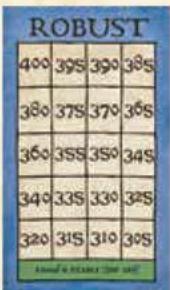
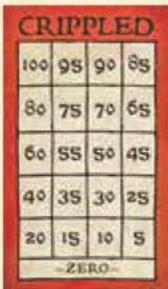
Keeps track of each player's Health (shows the level of injury sustained). There are 2 cards and one token per set, as shown below.
CARD #1
Side A

Side B

Side A
CARD #2

Health Marker
Side B
3. WEAPONS DECK (80 cards)
Each player's hand consists of cards from this deck that are dealt out every round. There are 3 types of Weapon cards: Basic Weapons, Alchemy and Sorcerers (MERLIN and SORCERER'S APPRENTICE).
A. BASIC WEAPON cards (60)


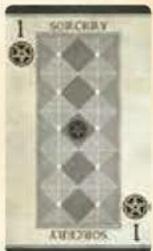

4 SUITS: SWORDS, ARROWS, sORCERY AND DECEPTION – 15 cards each
Each Basic Weapon suit has 11 STANDARD cards and 4 POISONED cards.
STANDARD CARDS
They are worth 5 injury points

POISONED CARDS have a skull as well as a "Poison” symbol on the side.
Worth 10 injury points

POISONED cards injure opponents more than STANDARD cards.
B. ALCHEMY cards (15)
ALCHEMY cards stand in for any Basic Weapon suit. However, special rules apply when playing them. (See pg. 6.)

There are no "poisoned” ALCHEMY cards.
C. SORCERER CARDS (5)
ALCHEMY cards are worth 5 injury points.
• MERLIN (3) and SORCERER'S APPRENTICE (2) cards
• These cards are wild. When played, each is assigned a specific suit and number value.
• MERLIN cards inflict 25 injury points
• SORCERER'S APPRENTICE cards inflict 5 injury points


6. GODSEND CARDS (24)
• GODSEND cards give special help to players with the least Health.
• They are used for one round only, and then discarded.

7. OTHER TOKENS (4)
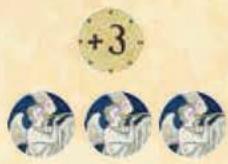
• When playing as KING ARTHUR the “+3” token is used as a card value reminder
• The (3) WILL OF GOD tokens keep track of the special WILL OF GOD card powers.
- GAME SET UP -
1. Distribute to each player:
a) PROTAGONIST card and paired COMPANION card. (Randomly selected or specifically chosen by players.)
b) Set of HEALTH cards and a HEALTH MARKER
- Each player places their PROTAGONIST card over their COMPANION card, covering everything except the threshold for use area at the bottom of the COMPANION card.
Note: SIR GAWAIN's COMPANION, the GREEN SASH, is the only card with no 'Threshold for Use. These two cards are placed side by side at the start of the game.

GUINEVERE card is placed on top of LANCELOT, showing only the threshold for use on the LANCELOT card.
-
Each player puts their HEALTH cards on the table, with the blue “Robust” card on top. They then place their HEALTH marker on the space marked 400. (400 indicates the player is at full health.)
-
Shuffle the GODSEND deck and put it face down on the table, leaving space for two cards to be revealed at the start of the “Godsend Phase” (see pg 9).
5. DEALING the CARDS
a) Randomly determine the dealer.
b) Each player receives 12 cards.
c) The remaining WEAPON cards are placed on table to form the WEAPONS Draw Deck. Some PROTAGONIST and GODSEND cards may require the drawing of additional weapons.
- GAME SETUP FOR A 4-PLAYER GAME –

- HOW TO PLAY –
Tournament at Camelot is a trick-taking game played in a series of hands (“Tourney Rounds”) during which Weapon cards are played from each player's hand into the center of the table (“Melee”). Cards are played in a clock-wise direction.
TOURNEY ROUND
- The player to the left of the Dealer always plays the first Weapon card of the Tourney Round.
a) All opponents must follow suit if they are able—or play a MERLIN or
SORCERER'S APPRENTICE card.
b) If a player is unable to follow suit, they must play an ALCHEMY card. ALCHEMY cards take on the character of the LEAD SUIT
c) If a player is unable to follow suit, and does not have an ALCHEMY card, they choose any card from their hand and place it face
As noted previously, both MERLIN and SORCERER'S APPRENTICE cards are assigned a specific suit and number value by the person playing the card. The suit the player assigns must be the same as the lead suit.
up directly into the DISCARD PILE. That player immediately sustains 5 injury points for the SHAME of not being able to participate in the Melee.
d) Players may only lead with an ALCHEMY card if it is the only suit left in their hand. If ALCHEMY is lead, you may play any card.
-
FEINT: Before determining who wins the Melee, flip all cards of equal value face down (this includes MERLIN and SORCERER'S APPRENTICE cards that share a value with other cards in the Melee). These cards cannot win the Melee but count towards injury.
-
From the remaining face up cards, the player who played the LOWEST VALUED Weapon card LOSES the Melee.
a) The losing player gathers the played Weapon cards, and places them in a pile (“Weapon Hits pile") on the table in their immediate play area. (Weapons added to the Discard Pile are NOT taken by the losing player as Weapon Hits.)
b) If ALL the cards in the Melee are face down they are not taken: set them aside as injury for the next Melee. If this was the last Melee of the game, discard them.
c) The losing player must play the FIRST Weapon card of the NEXT melee.
- Steps 1 and 2 continue until all dealt cards have been played, at which time the current Tourney Round ends.

– SAMPLE MELEE –
1apa sORCERY card if they have one.


Area designated for DISCARD PILE
Player 2 has no SORCERY or ALCHEMY cards, so they can play any card from their hand. However, since it doesn't follow suit, it's immediately placed into the Discard Pile and the Player suffers 5 injury for the SHAME.

Player 5 plays the MERLIN card and immediately declares that it is a “11 of Sorcery."

Player 3 plays the 11-ALCHEMY card. This card, in effect, becomes an 11-sORCERY card.

Player 4 plays the 7-soRCERY card.
Before we determine who has won the Melee, the 11 of Alchemy and the MERLIN card acting as an 11 of Sorcery are flipped face down due to a FEINT.
Of the remaining face up cards, Player 4 loses the Melee for playing the lowest valued card. That player takes all the cards in the Melee and places them into their Weapon Hits pile.
– EXAMPLE –
These are the cards in Player 4's Weapon Hits pile at the end of the first Tourney Round.

5 points

5 points

5 points
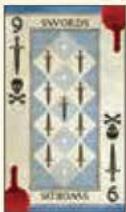
10 points
Player 4's TOTAL INJURY for this round is 65.

10 points

5 points

25 points
MAXIMUM INJURY EFFECTS Some cards may double a suit's injury points. Doubling injury points is the maximum any card may inflict or any player may receive.
- Once the Tourney Round is over, each player counts up the Weapon Hits taken during the Tourney Round to determine their total INJURY.
EXAMPLE:
Total Weapon Hits = 65
400 minus 65 = 335
The higher the Weapon Hits, the greater the Injury and the lower the Health score!

• STANDARD Weapon cards are worth 5 INJURY points
• POISONED cards are worth 10 INJURY points
• MERLIN cards are each worth 25 INJURY points
• SORCERER'S APPRENTICE cards are each worth 5 INJURY points.
-
Once TOTAL INJURY is determined, each player moves their Health Token to the appropriate space on their HEALTH card.
-
Any player who has passed the Threshold for Use on their Companion card may use the Companion card's special powers in the upcoming Tourney Round. See “Companion Cards: 'Threshold for Use” on page 10.
-
The most injured player gathers and shuffles all the Weapon cards. They will become dealer for the next Tourney Round. If there is a tie for most injured, the tied player closest to the previous dealer will be the dealer in the next Tourney Round.
-
GODSEND cards are distributed, as outlined below (“WHO GETS A GODSEND CARD”), before the cards for the next Tourney Round are dealt.
GODSEND PHASE
In Tournament at Camelot, Divine Help is always available to the most injured players. GODSEND cards provide players with additional special powers that may be used during a Tourney Round.
WHO GETS A GODSEND CARD?
• As the game progresses, the number of players who automatically receive a GODSEND card grows:
GODSEND CARD ELIGIBILITY CHART (3-4 PLAYERS)
Tourney Round 1 - only most injured player receives a card
Tourney Round 2 - two most injured players receive a card
Tourney Round 3 - three most injured players receive a card
Tourney Round 4 - four most injured players receive a card
Tourney Round 5+ - five most injured players receive a card
GODSEND CARD ELIGIBILITY CHART (5-6 PLAYERS)
Tourney Round 1 - two most injured player receives a card
Tourney Round 2 - three most injured players receive a card
Tourney Round 3 - four most injured players receive a card
Tourney Round 4+ - five most injured players receive a card
THE HEALTHIEST PLAYER NEVER GETS A GODSEND CARD
WHAT IF THERE IS A TIE FOR
MOST INJURED?
If there is a tie for eligibility to draw a GODSEND card, the tied player closest to the previous dealer will draw a GODSEND card first.
HOW DO PLAYERS CHOOSE THEIR GODSEND CARDS?
After INJURY points have been tallied and scored on HEALTH cards:
-
The first two cards of the GODSEND deck are turned over (see GAME SET-UP diagram, page 6).
-
The most injured player (with the lowest score) selects a GODSEND card:
a) They may take one of the face-up cards OR draw one from the top of the GODSEND deck.
b) They place the selected GODSEND card face up on the table next to their Companion card.
c) If one of the face-up cards was selected, it is immediately replaced with another from the the top of the GODSEND deck. (Note: This step may be ignored during the first round in a 3-4 player game.)
-
Step 2 is repeated for all eligible players according to the number of rounds that have been played. The Player(s) with the most Health NEVER receives a GODSEND card!
-
Any player who is 100 or more points behind the healthiest player receives an additional GODSEND card, beginning with the most injured player.
-
Any player who is 200 or more points behind the healthiest player receives an additional GODSEND card, beginning with the most injured player.
-
Any remaining face-up GODSEND cards are placed in the GODSEND discard pile.
COMPANION CARDS: THRESHOLD FOR USE
The power on a COMPANION card is available for use once a player has reached its Threshold for Use, which is shown at the bottom of each COMPANION card. Meeting the Threshold is determined by the player's Health score.

All players, including the player with the most Health (highest numerical points on Health card) may use their COMPANION card abilities, as long as the Threshold for Use has been met.
Once a COMPANION has joined the Protagonist in play, it is always available for use—even if a player's Health increases to a point higher than the COMPANION card’s printed Threshold for Use.
END OF GAME AND VICTORY
• The game ends when a player reaches ZERO on their health card. • The player with the most remaining health wins!
- 2-PLAYER GAME VARIATION -
For a 2-player game, remove the ARROWS suit from the deck, and play as described above.
CREDITS
Game Design by Ken Shannon, Karen Boginski, Jody Barbessi
Graphic Design by Jody Barbessi
Production Layout by Vasilakos Design, LLC

PLAYTESTERS
| Sarasota School of Arts and Science Board & Card Gaming Club Liz Smith Shannon Davin Therriault Michael Mayfield Peter Kageyama Joe Boginski Megan Moyer Steve Backhus Jan Baer Bri Buckler Toda Bjornson Rod Bristow Mark Choyce | Gabriel Dias Grace Dias Sarah Dias Daniel Delgado Jeremiah Ericson Brain Fiore Kyle Forsythe Jill Finlayson Charlene Francis Danny Fuestman Hal Greenberg Barry Guertin David Hearne Kristen Jijelava Gianni LoVario Craig McElroy David Moorehead | Kyle Platte Tom Reed Clete Roberts Jonathan Roy Justin Schwartz Jennifer Shannon Kenny Shannon IV Caroline Sine Julie Smith Pierce Timba Paul Watson Todd Williams Arthur Yambor Special Thanks to Danica Enyart, Kyle Forsythe and Heather |
原文为社区整理/出版社公开资料,版权归原作者,仅供个人学习查阅。