
Tower of BabelTower Of Babel
一句话概览
Tower of Babel 是一款已收录于村了吗规则库的桌游,支持 3–5 人,原名 Tower Of Babel。
本页内容:一句话概览 · 常见问题
这游戏怎么玩
- 本站已收录这款游戏的规则资料,可以在对话里直接提问规则细节。
常见问题(FAQ)
以下 1 条问答中 0 条来自站内玩家的真实提问,其余 1 条为本站整理的常见疑问;答复内容保持原样。
Tower of Babel支持几个人玩?
3–5 人。
去哪查完整规则
想核对具体规则细节、卡牌效果或某个回合的结算方式,可以在村了吗里选中这款游戏后直接提问。
同类桌游
- 卡坦岛德式
- 工业革命:伯明翰德式
- 勃艮第城堡:特别典藏版德式
- 方舟动物园德式
- 卡卡颂抽象
- 瘟疫危机传承:第一季美式
- 阿瑞迪亚:勇踏征途美式
- 重塑宇宙德式
- 幽港迷城美式
- 埃多拉的德鲁伊德式
规则原文(Markdown)
本站收录这款游戏的规则原文 1 个文件,此处内联渲染 1 个,可直接展开阅读或下载。
Tower of Babel Rules.md14.1 KB
Tower of BABEL
Author: Reiner Knizia — Graphics: Franz Vohwinkel — 3-5 players — age 10 +
Contents
1 game board, 100 building parts (15 @ value 1, 5 @ value 3 each in 5 colors), 28 building discs, 5 columns, 1 scoring marker,
15 action cards, 5 trading cards, 100 building cards (25 each of camel, crane, ship, stone mason), these rules
Game setup for 4 players
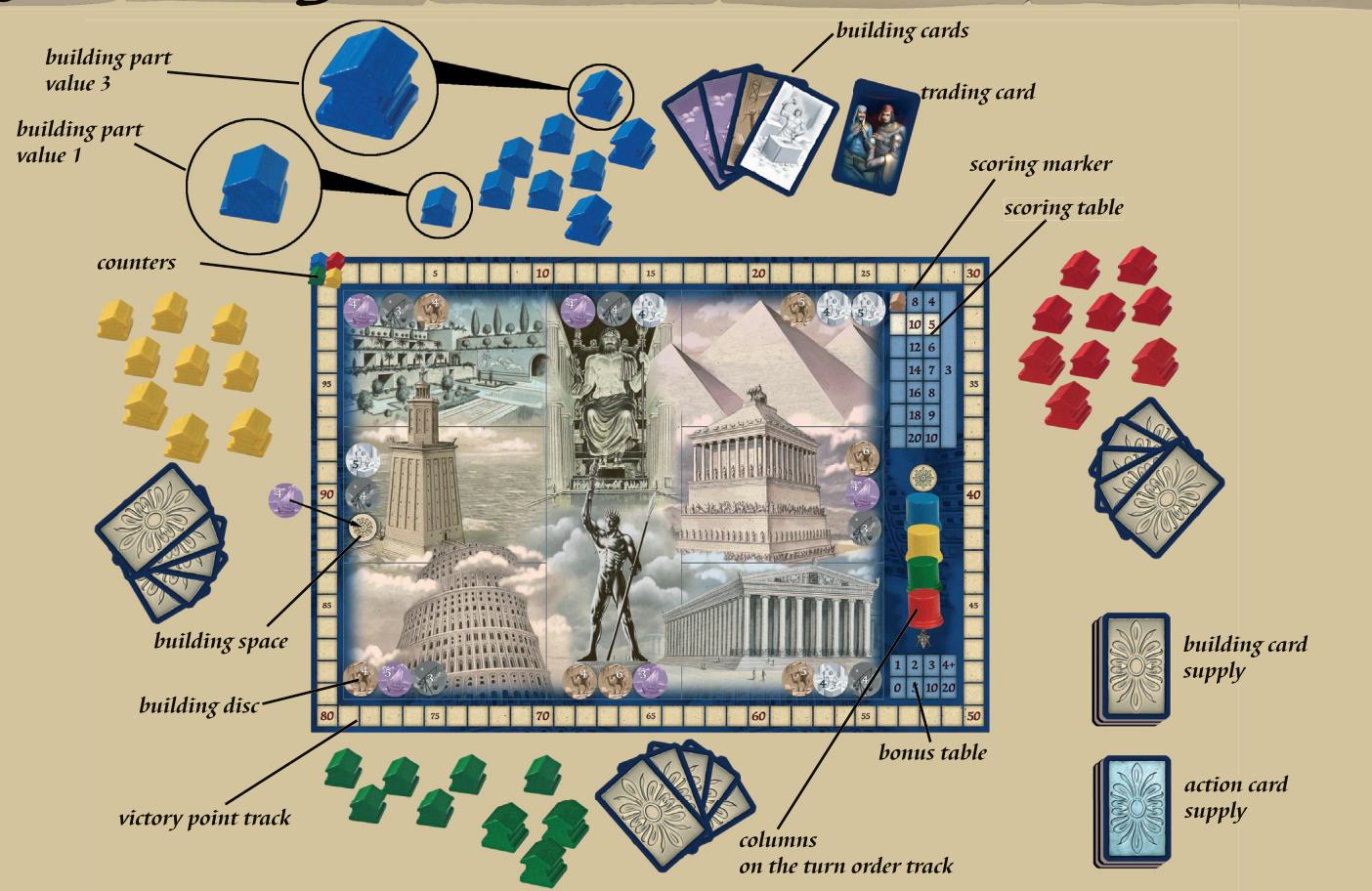
Preparation
- Before the first game, carefully remove all building discs from their frames.
- Place the 4 two-colored building discs in the box. See page 4 to read about their use. Shuffle the remaining 24 discs face down and then randomly place 1 face up on each of the 24 building spaces for the 8 wonders of the world.
- Place the scoring marker on the top-most space of the scoring table.
- Shuffle the action cards and place them as à face down supply near the board.
- Shuffle the building cards and place them as a face down supply near the board.
- Each player chooses a color and takes:
- 20 building parts and 1 column in his color and
- 1 trading card and 4 building cards from the building card supply.
- The players take their cards privately into their hands and place the building parts before them on the table (their play areas). The players each place 1 of their value 1 building parts as a counter on the start space of victory point track. The players choose a start player. He places his column on the bottom space of the turn order track on the game board. ln clockwise order, the other players place their columns on the turn order track in ascending order.
Overview
The players build together the 8 wonders of the ancient world. Each player tries to have the most building parts in a completed project and as many building discs as possible as both earn the player victory points. The player with the most victory points at the end is the winner!
Playing the game
The active player (the player whose column is at the bottom of the turn order track) begins his turn. He chooses between the following two actions:
- pass or
- build.
When the active player completes his turn, the player on his left takes his turn.
Pass
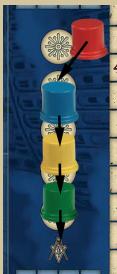
The active player takes 1 building card from the supply and removes his column from the board. Next, he moves all the other columns on the board down one space. Then, he puts his column in the bottom-most empty space in the turn order track. Each player, including the active player, takes a building card from the supply. The active player has completed his turn.
Build
Here the players use their building parts in the wonders and acquire the building discs.
1, Select wonder
The active player places his column on the wonder of his choice. Then he takes one of the building discs for that wonder and places it on top of his column. The number on the building disc indicates the number of building cards needed of the kind shown on the building disc.
The two-colored building discs need the numbers indicated of both kinds shown on the building disc. See also page 4.
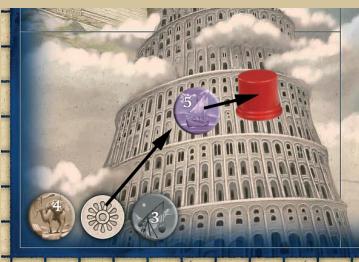
The red player places his column on the Tower of Babel and takes the building disc showing 5 ships.
2, Make offer
Each opponent makes the active player an offer of how many of the needed building cards he is willing to give for the building of the wonder. For that, each opponent places this number of building cards from his hand face down on the table. All players do this at the same time. An opponent may not offer more cards than the number shown on the building disc. The active player does not make an offer. For an offer, each opponent has 2 possibilities:
- he places only building cards or
- he places building caràs and his trading card.
Next, the players reveal their offers at the same time. If any player has building cards in his offer that do not match the needed kind, he rèturns these immediately to his hand.
3, Select opponent(s)
The active player can select from none to all opponents to take part in the building. When the active player selects an opponents offer, he must take the entire offer. However, from the opponents who included a trading card in their offers, the active player may only select one to take part in the building. The number of building cards in all accepted offers may not be
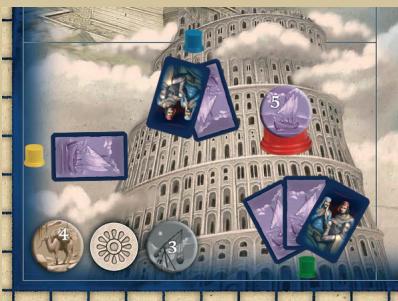
The opponents place their offers face down and reveal them at the same time.
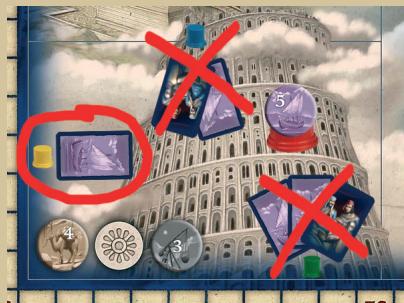
The red player selects the offer of the yellow player.
more than the number needed as shown on the disc. Also, for the two-colored discs, the number of building cards accepted of each kind cannot exceed the number for that kind. See also page 4.

This needs exactly 2 camels and 3 stone masons,
4, Build
lf the number of offered building cards the active player accepted is less than the number needed as shown on the building disc, the active player must now add building cards of the kind(s) needed from his hand so the total equals the number needed. Of course, it is possible that no more are needed. The selected opponents and the active player (if he added cards) place building parts of their colors on the wonder equal in number to the number of building cards they contributed. The active player takes the building disc used in this build and places it face down in his play area. However, if the active player selected an opponent who included a trading card in his offer, he gives that opponent the building disc and replaces the building parts his opponent just placed on the wonder with his own.
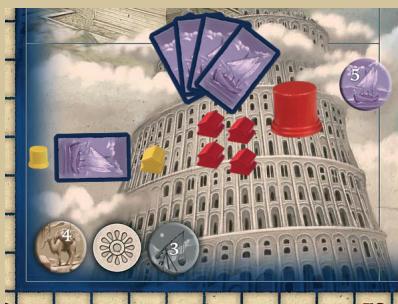
In this example, the red player selects only the offer of the yellow opponent. To fulfill the need on the building disc, he adds 4 ship cards from his hand to the 1 ship card offered by yellow. The yellow opponent places 1 building part and the red player places 4 and takes the building disc.

Here, the red player selects the offers from the yellow and green opponents, He adds 2 ship cards from his hand to the 3 offered by yellow and green, The yellow opponent places 1 building part, the red player places 4 (2 for his cards and 2 to replace the 2 from green, as green played a trading card), and the green opponent takes the building disc.
5. End of the build turn
The active player and the selected opponents place the building cards they played face up on the discard pile. Opponents, whose offers were not selected, take as many victory points as building cards of the needed kind they offered. They get no points for offering a trading card or un-needed building cards. These opponents then take their offered cards back into their hands. All players return any offered trading cards back into their hands.
Finally, the active player moves all the other columns on the board down one space.

The blue opponent offered 1 building card of the kind needed, but was not selected. He takes the building card back into his hand and scores 1 victory point.
Then, he puts his column in the bottom-most empty space in the turn order track. Each player, including the active player, takes a building card from the supply. The active player has completed his turn.
Special case; building disc not fulfilled
If the number of required building cards are not offered (including those from the active player), nothing is built. No building parts are placed and the building disc is returned to its place on the board. All opponents who made offers earn 1 victory point for each building card offered that matched the kind(s) needed by the building disc. Each player, including the active player, takes a building card from the supply. The active player has completed his turn.
Scoring
When the last building disc for a wonder is fulfilled, this wonder is scored. Players score victory points based on how many building parts they contributed. The numbers for the top two contributors are shown on the current row of the scoring table: the row where the scoring marker now stands.
The player with the most building parts on the wonder earns the highest value in victory points shown on that row of the table. The player with the second most building parts on the wonder earns the second highest value in victory points shown. All other players with at least 1 building part on the wonder earn 3 victory points.
ln the case of ties: when two or more tie with the most building parts, each of those tied scores the points shown for second most and all other players with at least 1 building part score 3 points. lf only one player has the most, but two or more tie for second most, the player with the most scores the highest value and all other players with at least 1 building part score 3 points. To record their victory points, the players move their counters on the victory point track. The players then move the scoring
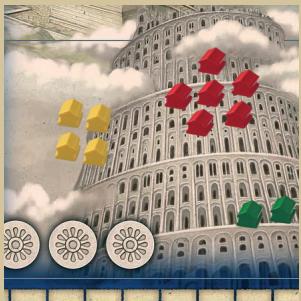

With 6 building parts, red has the most and scores 8 victory points, Yellow has second most with 4 building parts and scores 4 points, Green scores 3 points, Blue scores 0, as he has no building parts on the wonder.
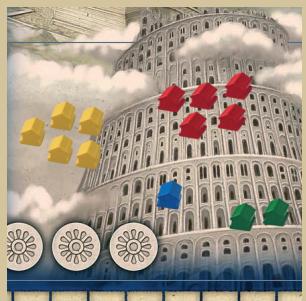

Red and yellow tie for most building parts with 5 and each scores 4 points, Green and blue each score 3 points for their participation.
marker on the scoring table down one space.
Next, the active player (on whose turn the wonder was completed) takes 1 action card from the supply. Finally, the players take back their building parts from the completed wonder.
Game end and final scoring
The game ends, as soon as the last building disc of one kind is taken. Two-colored discs count as both colors for determining the game end. lf a wonder is completed by the taking of the game-ending disc, it is scored before the final scoring.
Then the players execute the final scoring. First, move the scoring marker to the light space on the scoring table. All incomplete wonders are now scored as though they were complete, but using this row on the table. No action cards are given in final scoring. Players also earn extra victory points for having multiple building discs of the same kind, using the bonus table on the game board. lf a player has a two-colored disc, he must choose which color to score it as; it does not score for both colors. Players record their victory points by moving their counters on the victory point track.
The player with the most victory points is the winner!
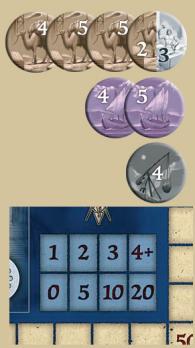
The player places the two-colored disc with the camels. He earns 20 victory points for the 4 camels, 5 victory points for the 2 ships, and no points for the single crane. He earns a total of 25 victory points.
Action cards
A player who, by his action initiates the scoring of a wonder, earns an action card. When a player uses an action card, he discards it. These are the 15 action cards:
Card trade (2)

The player can discard up to 5 building cards from his hand and draw the same number from the supply.
This card may be played at any time in the game.
Joker (2)
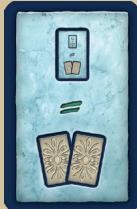
The active player can use this card when he chooses to build. The joker counts as exactly 2 of the needed building cards.
Card draw (3)

The player draws 3 building cards from the supply.
This card may be played at any time in the game.
Triple bonus (2)
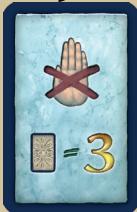
If the players offer for a building is not selected, he earns 3 victory points instead of 1 victory per offered needed building card.
Building disc bonus (2)
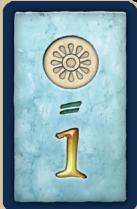
During final scoring, the player earns an additional victory point for each building disc he has.
* The active player and his opponents draw their final building cards only after the second turn. The active player only moves the columns after the second turn. lf the active player chooses to pass on either turn, he draws a building card as part of the pass choice.
Double turn (2)

The active player can take a second turn after he inishes his turn (whether he passes or builds).*
5 victory points (2)
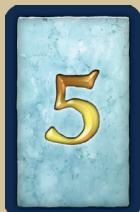
The player earns an extra 5 victory points during final scoring.
The twocolored building discs
When you choose to use the two-colored building discs, remove 1 camel, 1 crane, 1 ship, and 1 stone mason, each valued at 5, placing them in the box. Then, shuffle the two-colored discs with the remaining single-colored discs.

For many test rounds, suggestions, and comments, the author and publisher thank lain Adams, Sebastian Bleasdale, Chris Boote, Chris Bowyer, Martin Higham, Ross Inglis, Kevin Jacklin, Karl-Heinz Schmiel, and Hannes Wildner. We offer special thanks to Dieter Hornung.
© 2005 Hans im Glück Verlags-GmbH
If you have comments, questions, or suggestions, please write us at:
RioGames@aol.com or
Rio Grande Games, PO Box 45715, Rio Rancho, NM 87174, USA

原文为社区整理/出版社公开资料,版权归原作者,仅供个人学习查阅。