
洪水警报Turn The Tide
一句话概览
洪水警报 是一款已收录于村了吗规则库的桌游,支持 3–5 人,原名 Turn The Tide。
本页内容:一句话概览 · 常见问题
这游戏怎么玩
- 本站已收录这款游戏的规则资料,可以在对话里直接提问规则细节。
常见问题(FAQ)
以下 1 条问答中 0 条来自站内玩家的真实提问,其余 1 条为本站整理的常见疑问;答复内容保持原样。
洪水警报支持几个人玩?
3–5 人。
去哪查完整规则
想核对具体规则细节、卡牌效果或某个回合的结算方式,可以在村了吗里选中这款游戏后直接提问。
同类桌游
- 卡坦岛德式
- 工业革命:伯明翰德式
- 勃艮第城堡:特别典藏版德式
- 方舟动物园德式
- 卡卡颂抽象
- 瘟疫危机传承:第一季美式
- 阿瑞迪亚:勇踏征途美式
- 重塑宇宙德式
- 幽港迷城美式
- 埃多拉的德鲁伊德式
规则原文(Markdown)
本站收录这款游戏的规则原文 1 个文件,此处内联渲染 1 个,可直接展开阅读或下载。
Turn the Tide Rules.md9.3 KB
TUPN tHe TiDe TM

Tye SiNK or SWiM Strategy carD GaMe FOr AGeS 10 t0 aDULt · 3-5 PLayerS Rules of Play
Contents
60 Weather cards (numbered 1–60)
24 Tide Level cards
24 Life Preserver tokens
1 Score pad & pencil

Object
Score the most points by playing cards that will keep your tide level low and your life preservers afloat.
Game Play Overview
Turn the Tide is played out over a series of rounds equal to the number of players in the game. Each round consists of 12 hands. In each hand, players bid for two Tide Level cards with the aim of not winning the higher tide. Whoever has the highest Tide Level card showing at the end of each hand loses a life preserver. Every life preserver counts for one point. The player with the most points at the end of the last round wins.
Setup
Separate the cards into two decks according to card back. Shuffle the 24 Tide Level cards (blue back) and stack them face down in the middle of the playing area. Then shuffle the 60 Weather cards (yellow back) and deal 12 cards face down to each player. Place any leftover cards back in the box. Players may look at and organize their cards but keep them secret from opponents.
About the Weather Cards
Each of the 60 Weather Cards features a unique number between 1 and 60. (Every number is represented once.) In addition, cards numbered 13–48 contain an illustration of either one or half life preserver in the top center. The life preservers are used to determine the distribution of the life preserver tokens at the beginning of the game.
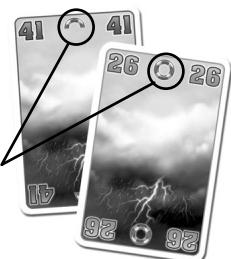
Add up the total number of life preservers shown in the upper middle of your 12 Weather cards and take that number of life preserver tokens. Two halves make a whole.
If there is a remaining half, round down (see examples below). Place your life preservers face up in front of you, in a row. Any remaining life preservers are placed back in the box.
Examples:
Julia has 5 total life preservers shown on her 12 Weather cards and receives 5 life preserver tokens.
Aidan has 3.5 total life preservers shown on his 12 Weather cards and receives 3 life preserver tokens.
Sarah has 6.5 total life preservers shown on her 12 Weather cards and receives 6 life preserver tokens.

Note: At first glance, the distribution of life preservers may seem unfair. However, the players with more life preservers have a higher concentration of Weather cards that are more difficult to play.
How to Play
Twelve hands make up one complete round. Each individual hand consists of five steps, carried out one after the other, as follows:
1) One player turns over the top two Tide Level cards from the face down pile and places them face up on opposite sides of the deck.
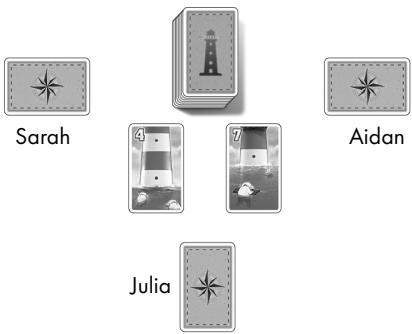

2) Each player chooses one Weather card from her and places it face front of her. When all players have finished selecting cards, everyone simultaneously turns their chosen card face up and compares numbers.
3) The player who played the highest number Weather card (Julia) must take the lower Tide Level card from the two face up next to the deck. She then lays it face up in her playing area so that all of the other players can see it. Next, the player who played the second highest Weather card (Aidan) must take the remaining Tide Level card and do the same (this player’s Tide Level card is always the higher number of the two cards turned over in Step 1).

4) The player who now has the highest Tide Level card showing among all players loses a life preserver and turns it face down. Note: If two players tie for the highest Tide Level, then both must turn over a life preserver.
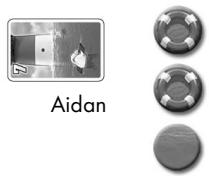
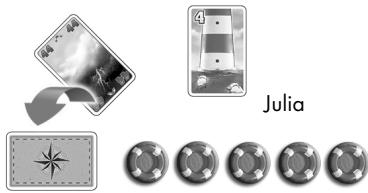
5) Next, each player takes the Weather card played in Step 2 and places it face down in a separate pile off to the side. (The Tide Level cards remain face up in front of each player.)
When the last step is completed, the next hand begins. Once again, the top two cards from the face down Tide Level pile are turned up. Each player then secretly chooses a remaining Weather card, which is played openly when everyone has finished making a selection. The player with the highest Weather takes the lower number Tide Level card. The player with the second highest Weather card takes the remaining Tide Level card.
Important Playing Notes:
• In each hand, the player who loses a life preserver is not necessarily the same player who received the higher of the two Tide Level cards from the middle. It is possible that a different player will have a higher Tide Level card showing from a previous hand.
• When you receive a new Tide Level card from the middle, place it on top of the old one.

Round Elimination
If you turn over your last life preserver, you get one last chance to stay in the round. You are only eliminated from the round when you lose once more (that is, when you must turn over another life preserver, but have none left to turn). If you are eliminated from the round, take your Weather Cards as well as your accumulated Tide Level cards and turn them face down.
End of a Round and Scoring
A round ends after each player has played all 12 cards from his hand. Alternatively, the round ends instantly when there are only two players left in the game.
At the end of the round, you are awarded one point for each remaining face up life preserver. If you have no life preservers, you get no points (0). If you were eliminated from the round because of a lack of life preservers, you receive one negative point (–1). In addition, the player who, at the end of the round, had the lowest Tide Level card showing, receives one additional bonus point. Write down everyone’s points on the score pad. Note: If two players are tied for the lowest Tide Level, then they each receive an additional point. A player with no Tide Level cards in his playing area has the lowest Tide Level.

GAMEWRIGHT® Games for the Infinitely Imaginative® 124 Watertown Street Watertown, MA 02472 Tel: 617-924-6006 Fax: 617-924-6101 email: jester@gamewright.com www.gamewright.com Licensed with permission from AMIGO Spiel + Freizeit GmbH ©2004 Gamewright, a trademark of Ceaco, Inc. All rights reserved.


Example of Scoring in a 4 Player Game:
•Sarah has 3 life preservers left and receives 3 points.
•Brian has 0 life preservers left and receives no points.
•Aidan has 2 life preservers left and receives 2 points.
•Julia has 1 life preserver left and receives 1 point. She also has the lowest Tide Level card showing and receives an additional bonus point.
Starting a New Round
Take the 12 Weather cards that made up your hand, along with the corresponding life preserver tokens, and pass them all to the player on your left. (Turn all of the life preservers face up.) Re-shuffle the 24 Tide Level cards and place them face down in the middle. Turn over the top two Tide Level cards and play out a new round just like the previous one.
A game consists of as many rounds as there are players, so that each person gets a chance to play each opponent’s set of cards. (For example, if there are three players, there are three rounds.)
Strategy tip: Try to remember your cards from the previous round, since the player to your left will have those same cards in the next round.
Winning the Game
Tally up the scores at the end of the last round. The player with the most points wins.
A Word from Gamewright
At first glance, the combination of cuddly sheep and ocean tides migh seem like an odd pairing for a highly strategic card game. But, once you get your feet wet (sorry, couldn’t resist), we think you will agree that the theme is a perfect complement to the game’s other unique characteristics. In particular, the simultaneous “blind bidding” element makes for some very interesting player dynamics. (Hint: don’t play all of your low cards too early in a round.) And the fact that everyone gets a chance to “one up” their opponents by playing each other’s hands, is one of the most exciting twists we’ve yet to see in a card game. Sheep Ahoy!
Note: In all our rules, we use either “he” or “she” to include everyone.
下载 Markdown原文为社区整理/出版社公开资料,版权归原作者,仅供个人学习查阅。